‘US ending sanctions on Sudan as reward for shifting to West’
Press TV – January 14, 2017
The American government is ending some economic sanctions against Sudan as a reward for Khartoum’s closer ties with the West and Saudi Arabia, an African American journalist in Detroit says.
“The Sudanese government has shifted its foreign policy more towards Saudi Arabia,” said Abayomi Azikiwe, editor at the Pan-African News Wire.
“This is reflected in their participation in the war against Yemen… also they’ve broken diplomatic relations with the Islamic Republic of Iran,” Azikiwe said in a phone interview with Press TV on Friday.
“So I think this is a reward for Sudan in regard to moving closer to the West,” he added.
Obama signed an executive order on Friday to ease but not eliminate some trade and investment sanctions against Khartoum, arguing that the East African country has shown “a marked reduction in offensive military activity, culminating in a pledge to maintain a cessation of hostilities in conflict areas.”
The outgoing president expressed determination that the situation which led the US to impose and continue the 20-year-old sanctions had changed in light of Sudan’s “positive actions” over the last six months.
Sudan has been under US sanctions since 1997. Washington accuses Khartoum of supporting terrorist groups, and it has blacklisted the country as a state sponsor of terrorism since 1993.
The US has accused Sudanese President Omar al-Bashir of war crimes related to the conflict-torn Darfur region.
Violence broke out in Darfur in 2003 when ethnic minority rebels rose against the long-time ruler, accusing Bashir’s Arab-dominated government of marginalizing the region.
Sudanese president applies for a visa to US despite ICC indictment
MEMO | May 20, 2016
The Sudanese foreign ministry has sent a formal request to the US Embassy in Khartoum to grant the Sudanese President Omar Al-Bashir an entry visa to the US to attend the next United Nations General Assembly.
Information Minister Ahmed Bilal said President Al-Bashir had been invited by UN Secretary-General Ban Ki-moon. He said the US is obligated, as host of the UN, to grant a visa to the leader.
It would be Bashir’s first visit to the US since 2009 when he was indicted by the Hague-based ICC for alleged war crimes in Darfur.
In addition, the Sudanese minister announced the government’s desire to make a formal request, as it previously did, for the mandate of the international peacekeeping mission in Darfur, known as UNAMID, not to be renewed.
Ismail said that the reasons for the existence of UNAMID in Darfur are no longer present and that the government is now able to protect civilians and to ensure the stability of the situation.
UNAMID has been stationed in Darfur since 2007 with a mandate to stem violence against civilians. The UN Security Council will discuss a one-year renewal of its mission in June.
Lebanon PM urges national unity amid Saudi pressure
Press TV – February 26, 2016
Lebanese Prime Minister Tammam Salam has called for national unity in the face of Saudi pressure after Riyadh suspended a $4 billion in aid to Beirut amid a diplomatic row.
During a Thursday cabinet meeting, Salam highlighted the importance of national unity and urged ministers to “take into consideration the Arab consensus during the difficult and delicate crisis [the country] is passing through,” Information Minister Ramzi Joreige quoted him as saying.
Beirut-Riyadh ties have recently soured after Saudi Arabia suspended a $3-billion package to the Lebanese army and a remainder of $1 billion in aid to its internal security forces earlier this month.
The suspension came after Lebanon refused to endorse joint anti-Iran statements issued last month at separate meetings held in Cairo and Jeddah.
Riyadh also called on Tuesday on all its nationals in Lebanon to leave the country due to deteriorating political relations with Beirut.
Lebanese ministers rejected Saudi calls for apology to the kingdom. Minister of State for Parliamentary Affairs Mohammad Fneish said Beirut had “committed no wrong for which to apologize.”
Industry Minister Hussein Hajj Hassan also voiced surprise over Riyadh’s measures against Beirut. “I don’t understand this great equation: we either apologize or we must bear a collective punishment.”
Economy Minister Alain Hakim, however, urged calm and said the country should not “panic before any measures by [Persian] Gulf states because such fears harm our economy.”
Saudi severed diplomatic relations with Iran on January 3 in the wake of the attacks on two of its diplomatic missions in Iran amid the angry protests over the execution of prominent Shia cleric Sheikh Nimr al-Nimr. This is while Tehran condemned the violence and made dozens of arrests after the incidents.
A number of Riyadh’s allies, including Bahrain, Sudan, Somalia and Djibouti, also followed the kingdom’s lead under pressure and broke off diplomatic ties with Tehran. The Saudis pledged the Somali government USD 50 million in aid on the same day Mogadishu declared it had cut ties with Iran, according to a leaked document.
Lebanon’s resistance movement Hezbollah has slammed Saudi Arabia for suspending aid to the country’s army and said the move exposes the real face of Saudi Arabia and refutes its claims about fighting terrorism.
The Saudis are apparently irked by the victories of the Syrian army, backed by Hezbollah resistance fighters, against the Takfiri militants fighting to topple the Damascus government with the backing of Riyadh.
Meanwhile, some analysts believe the Saudi regime is pressuring Lebanon to regain the influence it lost there in 2011, when the cabinet of former pro-Saudi prime minister, Saad Hariri, collapsed.
They say the kingdom might take further steps against Lebanon such as stopping flights to the country or evicting thousands of Lebanese nationals working in Saudi Arabia.
A number of Lebanese media outlets also speculate that Riyadh is exerting pressure on Beirut to secure the release of a Saudi prince jailed in Beirut for drug smuggling.
Saudi Prince Abdel Mohsen Bin Walid Bin Abdulaziz Al Saud was arrested in Lebanon in late October with two tons of amphetamines at the Rafik Hariri International Airport in Beirut last October.
Killing by Sanctions
By Philip Giraldi • Unz Review • February 23, 2016
While Secretary of State, Madeleine Albright, who is currently advising presidential candidate Hillary Clinton, famously said that the estimated 500,000 children who died as a result of U.S. sanctions on Iraq was “worth it.” It was, perhaps, a rare moment of candor from a politician, an admission that Washington is willing to support ostensibly non-lethal measures in such an all-encompassing fashion as to produce mass deaths of people who have no ability to influence the actions undertaken by their government. Sanctions are collective punishment, a blunt edged weapon used all too frequently by Washington to compel foreign governments to submit without having to go to war. There is nothing benign about them and Americans should regard them as potentially just as deadly as direct military intervention.
There are currently a number of countries that are subject to U.S. enforced sanctions but only three fall under the category of “state sponsors of terrorism.” They are Iran, Syria and Sudan. That status entails a number of U.S. Government sanctions including a ban on arms-related exports and sales; controls over exports of dual-use items; prohibitions on economic assistance; and imposition of miscellaneous financial and other restrictions. The financial measures require the United States to oppose loans by the World Bank or other international financial institutions and prohibit any U.S. person from engaging in a financial transaction with a terrorism-list government without a Treasury Department license issued by the Office of Foreign Assets Control (OFAC). The license and other approvals are reported to be complicated and the process is extremely difficult to navigate, discouraging anyone from having business dealings with the targeted countries.
Other sanctions are not always directly related to terrorism. They sometimes target select individuals and organizations that are considered by the U.S. government to be focal points of some aberrant behavior. A number of Russian officials have been sanctioned over Ukraine and even over the functioning of the country’s judiciary while the Iranian Revolutionary Guard has been sanctioned both for its involvement with radical groups and its support of Tehran’s missile program. But the most devastating sanctions are those which are directed against a country and nearly everything that it does economically, which was the case with Iraq under Saddam Hussein. Currently, Sudan falls under that category.
I recently spent a week in Sudan as the guest of a NGO. The objective was to show a group of hopefully influential foreign visitors the devastating effect of sanctions on the local economy. We visitors were of course aware that we were being fed a line that was most favorable to the government position so we also spoke to other Sudanese who were not necessarily part of the program as well as to United States government officials working at the Embassy.
The status of state sponsor of terrorism was bestowed on Sudan back in 1993 after the Sudanese government invited Osama bin Laden to stay in the country. Subsequently it was also claimed that Khartoum was supporting radical groups in Africa and elsewhere, to include Boko Harum, Uganda’s Lord’s Resistance Army and Egyptian Islamic Jihad. Since that time the conditions that led to the designation have changed dramatically. Bin Laden was asked to leave and relations with a number of militant groups were severed. Sudan has even severed diplomatic relations with Iran.
The latest edition of the State Department’s annual Country Reports on Terrorism states that “Sudan remained a generally cooperative partner of the United States on counterterrorism. During the past year, the Government of Sudan continued to support counterterrorism operations to counter threats to U.S. interests and personnel in Sudan.” Beyond that, the Sudanese intelligence service has been active in sharing information on terrorists in neighboring countries, to include Yemen, Uganda, Eritrea, Somalia, Chad and Libya. The information has been of such value that in 2010 the United States intelligence community advocated decoupling intelligence sharing from restrictions imposed on bilateral contact due to concerns over developments in Darfur.
In 2010 John Kerry, then Chairman of the Senate Foreign Relations committee, pledged to the Sudanese government that the terrorism designation would be lifted but failed to follow through. Later, in 2013, as Secretary of State, he was reminded of his promise by his Sudanese counterpart but apparently was thwarted in taking any action by advisers around President Barack Obama, most notably Susan Rice and Samantha Power. Both had in part made their reputations by writing and speaking to condemn Sudan. They were among the first to describe the conflict in Darfur as a genocide and are correctly perceived as hostile to any change in Sudan’s status.
The other sanctions on Sudan, referred to as a “comprehensive trade embargo,” blend claims of terrorism support with alleged human rights violations. They were imposed by Bill Clinton in 1997 and supplemented under George W. Bush in 2006. The last of these were linked to what has been described as a civil war starting in 2003 pitting the mostly Arabic speaking north of the country against the mostly indigenous black African south and west. The western media depicted the conflict in a racial context as well as in terms of religion, with Muslim pitted against Christian and animist, but the reality was much more complex than that with groups also dividing along linguistic, tribal and even occupational lines, sometimes featuring nomadic herdsmen against farmers.
Most sources agree that the various wars in and around Sudan have cost the lives of hundreds of thousands of Sudanese as well as between 14,000 and 200,000 who were reportedly “enslaved” in abductions carried out by both sides. The conflict in Darfur has been described as a genocide with a government supported militia known as Janjaweed and the rebels together having been accused of carrying out numerous atrocities. As a consequence, Sudan’s then-and-now president Omar Hassan al-Bashir has been on the receiving end of an arrest warrant from the International Criminal Court.
Al-Bashir, it should be noted became president by virtue of a military coup, though he has now been elected to office three times, once in an uncontested election in 1996 and in 2010 in a multiparty election that was described as “highly chaotic, non-transparent and vulnerable to electoral manipulation.” The most recent election took place on April 2015 and was strongly criticized by the U.S., Britain and Norway, all of whom had sent observers. Al-Bashir heads the ruling National Congress Party, but in fact he rules largely by fiat. He is either very popular or very unpopular with the Sudanese people depending on whom one talks to.
Genuine moves towards Sudanese democracy through the mechanism of a currently ongoing National Discussion are promising but are likely to slowly evolve in reality. The country’s legal system is based on Sharia but there is general tolerance of other religions in practice if not in law. The National Museum has a section relating to Christianity in Sudan and there is a Christian hour on television every Sunday. The Roman Catholic cathedral is located near the government center and there is also an active Coptic community. Christian community leaders openly support the existing government, just as they do in Syria, perhaps recognizing that available alternatives might be much worse.
A cease fire with the southern states in Sudan in 2005 led to the involvement of a United Nations Mission and a referendum in 2011 resulted in secession from the north. South Sudan is now an independent country that is enduring its own birth pangs. There are some reports of continued violence possibly instigated by Khartoum as well as little noticed government repression in the southern Blue Nile and South Kordofan states, which have been largely closed to the media and foreign NGOs pending yet another referendum to determine their future status.
Darfur followed with its own peace agreement in 2006. It is relatively quiet though military operations against a final hold out group of rebels in the region continue. Humanitarian and UN affiliated groups are in Darfur to monitor the process of reconciliation and it is expected that there will be another referendum to determine the region’s final status. At least some of the continuing unrest has been attributed to the activity of radicals from Chad, who are able to freely cross the open 600 mile long border to enter Darfur.
Business leaders in Khartoum note that there has been considerable economic growth in Sudan in spite of sanctions, concentrated in the sectors of oil, agriculture and mining. Since 1997, Sudan has been working with the International Monetary Fund (IMF) to initiate reforms and create sustainable growth. There is, however, considerable official corruption and across the board poverty, largely among those engaged in agriculture.
In spite of some positive developments, Washington’s sanctions have blocked almost all business with Sudan. Selling or buying anything to or from Sudan requires clearance by OFAC and is largely limited to agricultural, communications or medical products. The paperwork requires months to complete and the actual purchases have to be made through third parties, meaning that everything costs more and comes without warranties, service or support. This is because the United States has effectively shut down any banking transactions or extensions of credit with Sudan and when no one can get paid except by suitcases full of cash it becomes impossible to conduct business. Few foreign banks exist in Sudan and they are very careful about how they operate. Even the IMF is reportedly having difficulty in funding its own projects in country. It all means that Sudan cannot pay its bills through conventional correspondent banking arrangements as foreign banks are fearful of being fined by the United States. No one is willing to take that risk.
To be sure, part of Sudan’s economic woes come from its sustaining a war economy in response to the unrest in several regions. But beyond that no investment money coming in due to sanctions means no improvement in agricultural technology, which would benefit the poorest part of the population, or in health care or in education. Poverty has been increasing due to sanctions and attempts to evade the restrictions have resulted in smuggling, money laundering and an increase in unconventional banking to include hawala transfers that are not subject to normal bank controls. Because Sudan is currently not integrated into the international banking system its transactions cannot be monitored to prevent terrorist money transfers.
And there is also a human price to pay for inability to move money. Sudanese health care providers believe that many preventable deaths are attributable to persistent lack of medicinal supplies or diagnostic equipment due to sanctions. Even if the numbers are overstated, that is almost certainly true. In a recent case three patients in Darfur died for lack of renal dialysis solutions.
I oppose sanctions in principle because I believe they are a blunt instrument that punishes innocent civilians when broadly construed while having no effect at all when directly targeting the country’s relatively wealthy and unreachable government officials. If sanctions are to make any sense they should be designed to achieve a quantifiable result but that is rarely the case and they frequently serve no purpose whatsoever beyond dishing out punishment. It has been claimed that sanctions actually worked in Sudan because its government has moved to meet some of Washington’s demands over Darfur and South Sudan, but that is a simplistic explanation for rather more complex phenomena that were likely driven by multiple constituencies and interests.
More often than not, sanctions harden a government’s resolve to resist, as they did in Cuba, and even become useful to the regime as an excuse for government failures. The explanation provided by George W. Bush’s special envoy to Sudan, Andrew Natsios, that sanctions “send a message… to start behaving differently when they deal with their own people. That’s what this is all about,” is hubristic imperialism at its finest. It is reported in Sudan that many young Sudanese hate the United States and it is not difficult to understand why.
And there are good selfish reasons for the United States to lift sanctions and normalize relations with Khartoum. Sudan is an autocracy but no worse than American allies like Saudi Arabia, the Emirates and Egypt. It is active in fighting alleged rebels but is far more restrained than the current Saudi military intervention in Yemen. And though Khartoum has had sometimes ambivalent relationships with Islamic radicals it has been far less engaged in that fashion than Pakistan, Qatar and Saudi Arabia. So Sudan passes the smell test for being a disagreeable regime that is compatible with the United States’ broader interests.
And those broader interests are clear, including allowing American companies to participate in the future development of the country. U.S. sanctions have forced the Sudanese to turn to Moscow and Beijing for assistance. Russia is involved in gold mining and China is increasingly engaged in transportation, communications and energy projects. The Sudanese rail network and its international air carrier Sudan Air have collapsed due to lack of spare parts for their U.S. made hardware, an opportunity for American suppliers to quickly reenter the market. It is not in the U.S. national interest to create conditions favorable to competitors seeking to dominate the potentially large and developing Sudanese economy, ceding to them a significant foothold in East Africa by default.
Furthermore, Sudan is a bridge between Africa and the Arab world. It harbors no international terrorists and is a relative oasis of calm in a region in turmoil, well placed to monitor developments in neighboring Egypt, Chad, Libya, Somalia, Eritrea, Zaire, Central African Republic, Uganda and Yemen. It has made a significant contribution in counterterrorism and could do even better if properly motivated and provided with the tools needed, potentially playing a major role in the U.S. sponsored Partnership for Regional East Africa Counterterrorism. Normalizing relations with Sudan’s banks could, inter alia, stop money laundering and shut down possible terrorist money transfers.
There is, in short, no good reason to continue the status quo apart from the objections of two Obama advisers who have a personal stake in depicting Sudan in the most negative fashion. Unfortunately U.S. foreign policy has drifted away from supporting actual national interests and is mired in responding to various constituencies, in Obama’s case the “responsibility to protect” advocates. One can quite imagine that with something like a Marco Rubio it would revert to the mindless belligerency mode, but as both models seek to remake foreign governments they should equally be eschewed. Countries like Sudan and Iran should not be made to feel that they are permanently under the heel of the American jackboot. Nor should Washington feel compelled to play that role. Except in those rare situations where trade embargoes can inhibit flows of weapons to belligerents in a hot war, sanctions are useless, diminishing both those who apply the punishment and those who are on the receiving end. They should never be considered a serious instrument for foreign policy.
Saudi invasion of Syria: The bluff that could ignite World War III
By Finian Cunningham | RT | February 7, 2016
The Saudi plan to send ground troops into Syria appears to be just a ruse. But this is precisely the kind of reckless saber-rattling that could ignite an all-out war, one that could embroil the United States and Russia.
Saudi rulers have reportedly amassed a 150,000-strong army to invade Syria on the alleged pretext “to fight against terrorism” and to defeat the so-called Islamic State (also known as ISIS/ISIL). Saudi officials told CNN that in addition to Saudi troops there are ground forces from Egypt, Turkey, Sudan, Morocco, Jordan, Qatar, Bahrain and the United Arab Emirates.
Syria’s Foreign Minister Walid al-Muallem gave a categorical response, saying the move would be seen as an act of aggression and that any invasion force regardless of its stated reasons for entering Syria will be sent back in “wooden coffins”.
Nevertheless, US President Barack Obama has welcomed the Saudi plan to intervene in Syria.
Obama’s Defense Secretary Ashton Carter is this week due to meet in Brussels with counterparts from the US-led so-called “anti-terror” coalition to make a decision on the whether to activate the Saudi plan. A Saudi military spokesman has already said that if the US-led coalition gives its consent then his country will proceed with the intervention.
In recent weeks, Carter and other senior US officials, including Vice President Joe Biden, have been calling for increased regional Arab military action against ISIS in Syria and Iraq. Carter and Biden have also said the US is prepared to send in its own ground troops en masse if the Geneva peace talks collapse.
Now, those talks appear to be floundering. So, does that mean that a large-scale invasion of US-led foreign armies in Syria is on the way?
Let’s step back a moment and assess what is really going on. The Saudi warning – or more accurately “threat” – of military intervention in Syria is not the first time that this has been adverted to. Back in mid-December, when Riyadh announced the formation of a 34-Islamic nation alliance to “fight terrorism”, the Saudis said that the military alliance reserved the right to invade any country where there was deemed to be a terror threat – including Syria.
Another factor is that the House of Saud is not pleased with US-led diplomatic efforts on Syria. US Secretary of State John Kerry’s bustling to organize the Geneva negotiations – supposedly to find a peace settlement to the five-year conflict – is seen by the Saudis as giving too many concessions to the Syrian government of President Bashar al-Assad and his foreign allies, Russia, Iran and Lebanon’s Hezbollah.
The Geneva talks – which came unstuck last week – can be arguably assessed as not a genuine internal Syria process to resolve the war – but rather they are a cynical political attempt by Washington and its allies to undermine the Syrian government for their long-held objective of regime change. The inclusion among the political opposition at Geneva of Al Qaeda-linked militants, Jaish al-Islam and Ahrar al-Sham, with Western backing, illustrates the ulterior purpose.
The Washington Post gave the game away when it reported at the weekend: “The Obama administration has found itself increasingly backed into a corner by Russian bombing in Syria that its diplomacy has so far appeared powerless to stop.”
In other words, the Geneva diplomacy, mounted in large part by Kerry, was really aimed at halting the blistering Russian aerial campaign. The four-month intervention ordered by Russian President Vladimir Putin has turned the tide of the entire Syrian war, allowing the Syrian Arab Army to win back strategically important terrain.
That the Russian military operations have not stopped, indeed have stepped up, has caused much consternation in Washington and its allies.
Russia and Syria can reasonably argue that the UN resolutions passed in November and December give them the prerogative to continue their campaign to defeat ISIS and all other Al Qaeda-linked terror groups. But it seems clear now that Kerry was counting on the Geneva talks as a way of stalling the Russian-Syrian assaults on the regime-change mercenaries.
Kerry told reporters over the weekend that he is making a last-gasp attempt to persuade Russia to call a ceasefire in Syria. Indicating the fraught nature of his discussions with Russian counterpart Sergei Lavrov, Kerry said: “The modalities of a ceasefire itself are also being discussed… But if it’s just talks for the sake of talks in order to continue the bombing, nobody is going to accept that, and we will know that in the course of the next days.”
Moscow last week was adamant that it would not stop its bombing operations until “all terrorists” in Syria have been defeated. Syria’s Foreign Minister al-Muallem reiterated this weekend that there would be no ceasefire while illegally armed groups remain in Syria.
What we can surmise is that because the US-led covert military means for regime change in Syria is being thwarted and at the same time the alternative political means for regime change are also not gaining any traction – due to Russia and Syria’s astuteness on the ulterior agenda – the Washington axis is now reacting out of frustration.
Part of this frustrated reaction are the threats from Saudi Arabia, Turkey and other regional regimes – with US tacit approval – to go-ahead with a direct military intervention.
In short, it’s a bluff aimed at pressuring Syria and Russia to accommodate the ceasefire demands, which in reality are to serve as a breathing space for the foreign-backed terrorist proxies.
From a military point of view, the Saudi troop invasion cannot be taken remotely serious as an effective deployment. We only have to look at how the Saudi regime has been battered in Yemen over the past 10 months – in the Arab region’s poorest country – to appreciate that the Saudis have not the capability of carrying out a campaign in Syria.
As American professor Colin Cavell noted to this author: “Saudi intervention in Syria will have as much success as its intervention in Yemen. History has clearly shown that mercenary forces will never fight external wars with any success or elan, and no Saudi soldier in his right mind truly supports the Saudi monarchy. Everyone in Saudi Arabia knows that the House of Saud has no legitimacy, is based solely on force and manipulation, propped up by the US and the UK, and – if it did not have so much money – is a joke, run by fools.”
Thus, while a military gambit is decidedly unrealistic, the real danger is that the Saudi rulers and their American patrons have become so unhinged from reality that they could miscalculate and go into Syria. That would be like a spark in a powder keg. It will be seen as an act of war on Syria and its allies, Russia, Iran and Hezbollah. The US would inevitably be drawn fully into the spiral of a world war.
History has illustrated that wars are often the result not of a single, willful decision – but instead as the result of an ever-quickening process of folly.
Syria is just one potential cataclysm.
Finian Cunningham (born 1963) has written extensively on international affairs, with articles published in several languages. Originally from Belfast, Northern Ireland, he is a Master’s graduate in Agricultural Chemistry and worked as a scientific editor for the Royal Society of Chemistry, Cambridge, England, before pursuing a career in newspaper journalism. For over 20 years he worked as an editor and writer in major news media organizations, including The Mirror, Irish Times and Independent. Now a freelance journalist based in East Africa, his columns appear on RT, Sputnik, Strategic Culture Foundation and Press TV.
Saudis splurging to rally support against Iran
Press TV – January 17, 2016
Saudi Arabia pledged the Somali government USD 50 million in aid on the same day Mogadishu declared it had severed ties with Iran, a report says.
According to a document from the Saudi embassy in Nairobi, Kenya, to the embassy of Somalia there, the regime in Riyadh pledged USD 20 million in budget support to Mogadishu and USD 30 million for investment in the African country, Reuters reported Sunday.
The news agency quoted diplomats as saying that the financial support is “the latest sign of patronage used by the kingdom to shore up regional support against Iran.”
“The Saudis currently manage to rally countries behind them both on financial grounds and the argument of non-interference,” a diplomat said. Iran has repeatedly denied the Saudi allegations of interference in the affairs of other countries.
On January 2, Saudi Arabia announced the execution of prominent cleric Sheikh Nimr al-Nimr and 46 other people. Nimr was a critic of Riyadh. After that, protesters gathered outside the Saudi embassy in the Iranian capital, Tehran, and the consulate building in the city of Mashhad. Some people attacked the Saudi diplomatic missions during the protests. Iranian authorities strongly condemned the attacks and some 60 people were detained.
Riyadh severed its ties with Tehran on January 3.
Somalia was among those countries that declared they were cutting diplomatic relations with Iran. Bahrain, Sudan, Djibouti and Comoros also have severed ties with Iran. Kuwait and the United Arab Emirates recalled ambassadors.
The Somali government has not confirmed or denied the pledge, but Mogadishu claims the Saudi support for Somalia, which has been long-running, is not related to the decision to break diplomatic ties with Iran. The Saudi Foreign Ministry did not respond to requests for comment.
Deutsche Bank to pay $258mn in settlement
Press TV – November 4, 2015
Deutsche Bank will pay $258 million and fire six employees to resolve investigations by state and federal banking regulators into its dealings with countries like Iran and Syria in violation of United States sanctions laws.
Deutsche Bank, a German banking giant that has a big presence on Wall Street, will pay $200 million to the New York State Department of Financial Services and another $58 million to the Federal Reserve. It also agreed to appoint an independent monitor, the New York Times has reported.
It is the latest in a string of settlements over sanctions violations as regulators take aim at banks for doing business with blacklisted countries. Still, a criminal investigation by the Manhattan district attorney and the United States attorney’s office in Manhattan are continuing, people briefed on the matter said.
In a statement, Deutsche Bank said: “We are pleased to have reached a resolution with the New York Department of Financial Services and the Federal Reserve. The conduct ceased several years ago, and since then we have terminated all business with parties from the countries involved.”
The activity under investigation occurred from 1999 to 2006, according to regulators. Deutsche Bank handled 27,200 dollar-clearing transactions valued at over $10.86 billion, for customers in Iran, Libya, Syria, Myanmar and Sudan.
Regulators said bank employees developed ways to hide the nature of the transactions from internal controls intended to flag problematic payments.
Several of the employees involved in the conduct have already left Deutsche Bank, regulators said Wednesday, but an additional six will be fired and three others will be banned from duties involving Deutsche Bank’s American operations.
Investigations and settlements of cases involving violations of United States sanctions are nearing their end just as Washington is easing its stance toward some foreign countries like Iran and Cuba.
Reports emerge about Russian mediation between Khartoum and Juba
MEMO – September 7, 2015
Russia will lead a new round of mediation between Khartoum and Juba to ensure the implementation of the recent agreement struck on bilateral relations between the two sides, an official Sudanese source revealed yesterday.
Sudan News Agency (SUNA) reported that the foreign ministers of Sudan, Moscow and the state of South Sudan will meet in Russia on Thursday to discuss triparty relations between Moscow, Khartoum and Juba as well as the South Sudan-Sudan relations.
SUNA quoted the Sudanese Foreign Minister Ibrahim Ghandour as saying: “The Sudan’s relations with South Sudan is supposed to be better, theoretically, but there are some pending issues between the two states, most importantly, the implementation of the nine cooperation agreements signed by the two presidents, Field Marshal Omar Al-Bashir, the President of the Republic [of the Sudan] and Major General Salva Kiir, president of South Sudan, on the 9th of September in 2012.”
He added that his visit to Russia on Wednesday marks the third anniversary of the Addis Ababa agreement, although only one of the nine agreements was implemented – the agreement on the transfer of South Sudan’s oil through Port Sudan.
Ghandour also noted that his visit, which will take place between 9-11 September, came in response to an invitation from the Russian foreign minister. According to Ghandour, the two ministers will discuss bilateral relation between Russia and the Sudan in all fields; in addition to the coordination of regional and international issues.
The Sudanese foreign minister added that relations between the two countries are developing at both the economic and political levels.
Both Major U.S. Parties are Plagues on Humanity
By Glen Ford | Black Agenda Report | July 1, 2015
There has never been a dime’s worth of difference between the Clintons (Bill and Hillary) and Barack Obama, and less than ten cents separates the worldviews of these Democratic political twins from the Bush wing of the Republican Party.
 Each has their individual quirks. Barack destroys international order and the rule of law while dabbling at song; Bill dismantled the U.S. manufacturing base and threw record numbers of Blacks in prison as he toyed with his trumpet; George W. played the fool who would Shock and Awe the world into obedience; and Hillary is the evil crone that curses the dead while screaming “We are Woman” like a banshee. But they are all the same in their corporate soullessness.
They all lie for a living, and they live to lie. Hillary Clinton commingled official and personal criminality through the medium of email. Knowing that, in a life dedicated to crime, she could never successfully sequester her private and public conspiracies, Hillary privatized all of her email correspondence during her tenure as Obama’s Secretary of State (in the perfect spirit of neoliberalism). The fate of millions of Haitians whose country’s earthquake and development “aid” are under the Clinton family thumb were doubtless bundled into the tens of thousands of messages she erased on leaving Foggy Bottom.
Republicans have harassed her ever since, seeking an electronic smoking gun to show Clinton’s cowardice or lack of resolve to “stand up for America” and “our troops” or some other nonsense. What the Benghazi affair actually proves is that the Obama administration was just as intent as the Republicans to maintain the fiction that the “rebels” put in power by seven months of NATO bombing of Libya were not various flavors of Islamic jihadists – some of whom were already turning on their erstwhile masters. The U.S.-Saudi project to create and nurture the international jihadist network is a bipartisan venture that dates back to Jimmy Carter’s presidency – and, therefore, nothing for Democrats and Republicans to fight about. However, the GOP’s churning of Clinton’s emails does provide a glimpse into her quest to run for president in 2016 as the woman who vanquished Muammar Gaddafi (“Qaddafi” or simply “Q” in Clinton’s usage).
A number of Clinton’s correspondences were with Sidney Blumenthal, a former Clinton family spin-master who wrote nasty things about Barack Obama while working for Hillary’s 2008 presidential campaign – which made it impossible for her to hire him at the State Department. Nevertheless, Clinton needed his talents for hype for the campaign ahead. Their emails in the summer of 2011 discussed how Hillary’s status as stateswoman could soar when the Libyan leader was finally eliminated. “This is a historic moment and you will be credited for realizing it,” wrote Blumenthal, feeding the crone’s huge gizzard of ego, according to an article in Monday’s New York Times. “You must go on camera,” wrote Blumenthal. “You must establish yourself in the historical record at this moment.” Hillary was anxious to seize the time to establish what Blumenthal described as “the Clinton Doctrine.”
The Times piece somehow concludes that Obama stole Clinton’s thunder with an 1,100-word speech, in late August, declaring: “The Gaddafi regime is coming to an end, and the future of Libya is in the hands of its people.” But Hillary best expressed the ghoulishness of America’s ruling duopoly two months later, in October, when Gaddafi was savagely butchered by screaming jihadists. “We came, we saw, he died,” cackled the banshee.
In the annals of global diplomacy, no more vulgar words have been spoken by a major power foreign minister or head of state. Yet, Clinton’s calculated quip perfectly encapsulates the bloodlust that is the common characteristic of both the governing duopoly of the United States and their suckling children in ISIS and the other proliferating al Qaida factions.
Thanks to Seymour Hersh, we now have a much more plausible scenario for the May 2, 2011, demise of Osama bin Laden, the “OG” of the U.S.-Saudi spawned global jihad, whose body will never be located. Virtually the entire U.S. account of his death is a lie, repeatedly contradicted on its own terms – another layer of fictional Americana in the age of empire in decline.
Clinton was hard-pressed to imagine how she might trump the president’s bin Laden death-watch extravaganza. Her opportunity came five months later, when she delivered her gruesome paraphrase of Julius Caesar on the occasion of Col. Gaddafi’s murder. In the context of Washington’s deeply racist foreign policy, Gaddafi and bin Laden were equally deserving of death, although Gaddafi was among the most fervent and effective fighters against Islamic jihadists: his government was the first in the world to request a global arrest warrant against bin Laden.
The Libyan Islamists were quickly transferred to the new U.S.-NATO-Saudi-Qatari front lines in Syria. The CIA station in Benghazi was at the center of the action – and got burned in the wild and unwieldy process of herding jihadists, who find it difficult to take orders from “infidels,” even when the “Crusaders” are paying the bills and supplying the weapons.
The U.S. consulate and CIA station in Benghazi were attacked on September 11, 2012. The next day, the Pentagon’s intelligence agency issued a report predicting that a “Salafist principality” – another term for an Islamic State – would likely arise in Syria as a result of the war, and that “Western countries, the Gulf States and Turkey are supporting these efforts.” Moreover, the establishment of such an Islamic “principality” would create “the ideal atmosphere for AQI [al Qaida in Iraq, which became ISIS, ISIL and the Islamic State] to return to its old pockets in Mosul and Ramadi” in Iraq – events that have since transpired.
The Defense Intelligence Agency report didn’t say so, but the “Western Powers” included the United States, through its CIA.
The document was declassified this year as the result of a suit by a libertarian right-wing legal outfit. The people of the world continue to be fed the fiction that the U.S. is engaged in a long, twilight struggle against al Qaida Salafists whose international network was created by, and continues to benefit from, “Western countries, the Gulf States and Turkey.”
However, the 2012 Pentagon warning about the rise of an Islamic State may have had some effect on U.S. policy in Syria. One year later, in September of 2013, President Obama backed off from his threat to bomb Syria in “retaliation” for a chemical missile attack against civilians – a crime much more likely committed by western-backed Salafists. The conventional wisdom is that the Russians tricked a hapless Secretary of State John Kerry into agreeing to the peaceful, internationally supervised destruction of Syria’s chemical arsenal; or that the refusal of Britain’s Parliament to go along with an air assault on Syria made the U.S. position untenable; or that Obama feared losing a vote on the issue in the U.S. Congress. None of this rings true to me. The United States is not easily deterred by the opinions of Europeans, who in the end accept Washington’s acts as a fait accompli. And, it was not clear that Obama would have lost the vote in Congress – a vote that he requested, while at the same time declaring that he did not need the legislature’s permission to “punish” Syria for crossing his “red line.”
I think that high Pentagon officials and elements of the Obama administration – probably including the president, himself – took the Benghazi disaster and the Defense Intelligence Agency report to heart, and decided that it was better to keep bleeding the Syrians and their Russian, Lebanese and Iranian allies through a prolonged war, than to bomb al Qaida into power. For the U.S., regional chaos is preferable to the triumph of the, ultimately, unmanageable Salafists – unchained.
The thirty-plus year war against Iran would, however, be ratcheted up. The Bush administration was snatched back from the brink of a military assault against Teheran in 2007 when – to the great consternation of Vice President Dick Cheney – all 16 U.S. intelligence agencies declared, publicly and unanimously, that Iran had abandoned its nuclear weapons program, years before.
The spooks reaffirmed their consensus in the 2010 National Intelligence Estimate – again, that there was no evidence Iran has any intention of making a bomb. The Obama administration has since avoided asking the intelligence agencies for their analysis on the issue, knowing they would get the same answer. Instead, they rely on Israeli propaganda, pick and choose various “experts” from inside and outside the arms control “community,” or simply put forward unsupported statements on Iran’s capabilities and intentions: the Big Lie. While Bush was humiliated by facts supplied by his own intelligence experts, Obama has escalated the confrontation with Iran, applying crippling sanctions and the whole range of low-level warfare, in close collaboration with Israel – proving, once again, that Obama is the “more effective evil.”
Obama has nearly completed knocking off victims on the “hit list” of countries that George Bush was working on when General Wesley Clark ran across it in 2002. Iraq, Syria, Libya, and Somalia have been invaded since then, and Sudan was stripped of a third of its territory. Only Iran and Lebanon remain intact and outside the U.S. imperial umbrella.
The Republican-Democratic duopoly plays tag-team in promoting the Project for a New American Century – a doctrine promulgated by neo-conservatives in 1997 that has served as the guiding light of both the Bush and Obama administrations. The differences between the two teams are merely rhetorical. The Bush regime is described as “unilateralist,” although it employed the same “Coalition of the Willing” approach to aggressive war as does the Obama administration. President Obama claims the right to disregard and methodically undermine international law through “humanitarian” military intervention, whereas Bush claimed to be “spreading democracy.” Same weapons systems, same mass murder, same objective: U.S. domination of the planet.
There’s nothing democratic or humanitarian about the U.S. imperial project. Therefore, its maintenance requires the deployment of 24-7 psychological operations worldwide, but directed primarily against the U.S. public.
Republican strategist Karl Rove was far more honest than his Democratic counterparts when he explained to a reporter, back in 2004:
We’re an empire now, and when we act, we create our own reality. And while you’re studying that reality—judiciously, as you will—we’ll act again, creating other new realities, which you can study too, and that’s how things will sort out. We’re history’s actors … and you, all of you, will be left to just study what we do.
Election seasons are reality-creation festivals, during which the two corporate parties pretend to put forward different visions of the national and global destiny – when, in fact, they answer to the same master and must pursue the same general strategy.
The continuity of GOP-Democratic rule – the near-identical depravity – is horrifically evident in the Democratic Republic of Congo, where six million people have been slaughtered by U.S. surrogates since 1996: the largest genocide since World War II. Successive U.S. administrations – Bill Clinton, George W. Bush, and Barack Obama, assisted by Secretary of State Hillary Clinton and Susan Rice, the high U.S. official most deeply implicated in the entirety of the genocide – have armed, financed, and covered up the Congolese holocaust. Each administration has collaborated with its predecessor to hide the crime and obscure the question of guilt – and then to continue the killing.
Decent people do not vote for political parties that produce such fiends, who deserve Nuremburg justice of the capital kind. Any talk of “lesser evils” is both stupid and obscene.
BAR executive editor Glen Ford can be contacted at Glen.Ford@BlackAgendaReport.com.
Featured Video
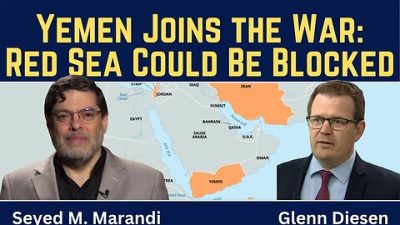
Yemen joins the war – Red Sea could be blocked next – Saudi regime at risk
or go to
Aletho News Archives – Video-Images
From the Archives
A superpower and “the world’s sickest warrior state”
By Paul J. Balles | March 8, 2010
Living through five or six major wars has hardened me to what I thought were the extremes of inhuman cruelty and brutality.
Two things made those extremes almost bearable: the brutality always revealed – at least according to the media coverage – the viciousness of the enemy. It was therefore quite understandable when our “brave men and women” pulverized the enemy.
Films of Japanese torturing captive Americans somehow justified holding Japanese Americans in internment camps during World War II; and only a small percentage of Americans found the bombing of Hiroshima and Nagasaki unreasonably vengeful at best, at worst, depraved.
The media giants in America portrayed the North Koreans as barbaric beasts with their captives, quite unlike their southern counterpoints – our allies during the Korean War. No one ever felt the need to explain how the South Koreans were a civilized breed while the North Koreans were absolute savages, at least according to the official line.
In Vietnam, our warriors justifiably (or so the media made us believe) dropped napalm on the North Vietnamese who had the gall to hide in villages and tunnels to ravage our invaders. At least it was accepted practice until some rogue photojournalist filmed a young girl screaming down a Vietnamese road in flames. … continue
Blog Roll
 Aletho News
- Russian tanker approaches Cuba despite US oil blockade
- Marandi: Yemen joins the war – Red Sea could be blocked next – Saudi regime at risk
- Pro-Palestinian French member of European Parliament denied entry to Canada
- Pakistan to Host US-Iran Talks
- How Indonesia’s tilt toward the US left it stranded in the Strait of Hormuz
- US has no choice but to retreat from Iranian borders: Top commander
- Iran Retaliation Strikes Chemical Plant Near Dimona
- AWACS’ Destruction is a Major Loss for US Military – Ex-DoW Analyst
- Israel’s Iran Strategy Uses US Military & Gulf States as Its Pawns
- Iran: Trump wanted regime change, now just begging for Hormuz to open
- If Americans Knew
- Israeli police block Catholic cardinal from entering Church of the Holy Sepulchre on Palm Sunday
- Israel is assassinating journalists again, more than any other nation, anywhere, ever – Not a ceasefire Day 170
- Over 300 US service members wounded, majority have brain injuries – Not a ceasefire Day 169
- Researchers at Human Rights Watch Resign Over Blocked Report on Palestinian Refugee Return
- Jewish Groups Are Backing a War Americans Don’t Want
- Eric Fingerhut Thinks He’s the President of the Jews
- Top Jewish Philanthropists, Rabbis Urge Israeli President to Take Action Against ‘Jewish Extremists’
- Don’t Be Fooled. Zionist Leaders Have Always Wanted to Control Southern Lebanon
- Israel’s widespread use of torture is a core element of its genocide against the Palestinian people
- In Israel’s War on Iran, Many Middle East US Bases Rendered “All But Uninhabitable”
- No Tricks Zone
- German Science Blog Accuses PIK Climate Institute Of Hallucinating Climate Tipping Points
- Devastating Assessment Of Comirnaty Vaccine By Former Senior Pfizer Europe Toxicologist
- New Study: CO2 Is ‘Effectively Negligible’ As An Explanatory Climate Change Factor Since 2000
- Former Pfizer Toxicologist Dr. Helmut Sterz Tells Bundestag Hearing Pfizer Vaccine Should Have Never Been Approved
- Energy Expert: Germany’s Nuclear Phaseout Was A “500 Billion Euro Mistake”
- New Research: South Australia’s Mid-Holocene Sea Surface Temperatures Were 4°C Warmer Than Today
- Storing Green Energy To Last Germany 10 Days Would Require A 60-Million Tonne Battery
- New Studies: UK Sea Levels Were 4 Meters Higher Than Today During The Mid-Holocene
- Destructive Green New Deal: German Energy And Metal Group Warns Of Drastic Crisis
- New Study Documents A 20-Year Pause In Arctic Sea Ice Decline – Driven By Internal Variability
 Aletho News