Arctic Council Decisions Made Without Russia to Be Illegitimate – Ambassador to US Antonov
Samizdat – 09.06.2022
WASHINGTON – Russia is concerned about plans to resume the work of the Arctic Council without its participation and warns that decisions made in this format will be illegitimate, Russian Ambassador to the United States Anatoly Antonov said.
Canada, Denmark, Finland, Iceland, Norway, Sweden and the United States earlier announced their intention to resume work in the Council on a limited basis – within the framework of projects that do not involve Russia.
“Such a step cannot but cause concern not only for Russia as the current chairman of the Council, but also for the entire international community interested in the further sustainable development of this region. We state that this unique format of interstate interaction continues to be politicized,” Antonov said.
“Decisions on behalf of the Arctic Council, made without our country, will be illegitimate and violate the principle of consensus stipulated by its governing documents,” he warned.
The work of the Council was suspended on March 3 in light of the events in Ukraine.
Family worried as Iranian held incommunicado in Swedish detention

Hamid Nouri, a former Iranian official, has been jailed in Sweden since 2019
Press TV – June 1, 2022
A former Iranian official, wrongfully accused and jailed in Sweden, has been held incommunicado for almost a month, his relatives say.
The Iranian Judiciary’s Media Center cited Hamid Nouri’s family members as saying that he has not been able to contact them for 28 days now.
The Swedish judiciary has reportedly cut off communication with his family after relocating him to another detention center, leading to serious concerns among his family in Iran.
Nouri was arrested upon arrival in Sweden at Stockholm Airport in November 2019 and immediately imprisoned. He has been held in solitary confinement for over two years.
Swedish prosecutors have requested the maximum penalty of life imprisonment for Nouri, accusing the former Iranian judiciary official of prisoner abuse.
The charges against Nouri stem from accusations leveled against him by members of the anti-Iran terrorist Mujahedin Khalq Organization (MKO), who claim Nouri was involved in the execution and torture of MKO members in 1988. Nouri vehemently rejects the allegations.
Iran’s Foreign Minister Hossein Amir-Abdollahian has denounced his detention as “illegal.”
Reports say Swedish judicial authorities have been preventing Nouri from contacting his family since moving him to a different detention center.
Upon arrest, he was forbidden for around eight months from making phone calls to his family members, and barred from meeting them in person for two years.
Data shenanigans as Sweden misleads its public over vaccination-related mortality data
Health Advisory & Recovery Team | May 29, 2022
In December 2021 Norman Fenton, Martin Neil, Clare Craig, Josh Geutzkow, Joel Smalley, Scott McLachlan and Jonathan Engler published an article casting doubt on the vaccine efficacy implied by the UK’s official mortality statistics as they related to vaccination status, raising miscategorisation of vaccinated deaths soon after injection as unvaccinated as a possible significant factor.
The authors — as expected — were unable to publish this article in any mainstream journal, as anything which counters the government’s official position on anything related to the pandemic, especially vaccinations, has effectively been suppressed or censored throughout the last 2 years.
Despite repeated FOI requests by several parties, no UK government agency has ever released sufficiently granular data broken down into the necessary categories to permit any meaningful analysis of the extent (if any) of this miscategorisation issue.
Now, however, it appears that an FOI request to the Swedish Public Health Agency by 29 doctors and scientists has been successful in obtaining such data (for Sweden). They have written an article about it (in English) here.
The data is revelatory. It essentially shows that individuals dying within 2 weeks of vaccination have been classed and counted as unvaccinated. Incredibly, this applies to the 14 day period after the second as well as the first dose. The numbers involved are certainly non-trivial. In a substack blog, Jessica Rose has re-run the implied vaccine efficacy statistics in light of the new data categorizations.
In conclusion, the correct categorization turns the vaccine efficacy calculation totally on its head, suggesting a significantly increased risk of death in the vaccinated compared to the unvaccinated, rather than the vice-versa conclusion the authorities had originally touted. Whilst there is no age-breakdown, the magnitude of the reversal in the conclusions is nonetheless stark enough to conclude that there has been very serious and likely deliberate misrepresentation of what the mortality statistics truly imply about the efficacy of the vaccines against mortality.
One wonders how many other countries have played similar tricks with their data?
Post-script:
A further – anonymous – author has published an article claiming to build on Jessica Rose’s piece by calculating the mortality rates in the vaccinated and unvaccinated and comparing them to flu.
The author acknowledges the possible effect of age-confounding in the text, but in referring to it as having only a “slight” effect this understates its potential to interfere with his analysis; to draw the conclusions he /she does would in fact require a proper age breakdown of deaths month-by-month. However, if the analysis might lead to a misinterpretation of vaccine effectiveness because of the age bias then it is up to those with access to the data by age to refute the analysis.
The main take-away from the episode around this FOI is not that the vaccines are or are not efficacious (vs death), but rather that there has been a systematic miscategorization error which (1) seems likely to have been deliberate and (2) resulted in an extremely misleading picture of what the data suggests.
Such incidents – which now appear all too common in many countries – are likely to shatter the public’s trust in the institutions upon which we are supposed to rely.
Sweden’s “Psychological Defence Agency” issues warning about memes that “spread misleading information”

Hurtful meme requiring censorship for public safety
By Tom Parker | Reclaim The Net | May 26, 2022
Sweden’s “Psychological Defence Agency,” which is dedicated to preventing and countering “malign information” and “disinformation,” has taken aim at “misleading” memes in its new “Do Not Be Fooled” campaign.
On a page titled “Laughter that can hurt,” the agency warns that:
“Humor, parody and satire are usually harmless forms of entertainment that can sometimes be used to spread misleading information and ridicule or criticize people or opinions – for example in the form of memes.”
Not only is the Psychological Defence Agency warning Swedish citizens to be on the lookout for misleading memes but it also urges them to be wary of the persuasive power of memes.
“Memes can be used to shift focus from a particular issue, take over and change the direction of a debate, or to support a hidden agenda,” the agency states.
Another point of contention raised by the Swedish Psychological Agency in this campaign is the way memes spread. Apparently, popular memes don’t usually go viral because they’re funny and get lots of shares. Instead, the Laughter that can hurt page claims that they have “often gone viral through bots.”
Nemo Stjernström, the project manager for the campaign, told the Swedish magazine Resume that memes were included in this Do Not Be Fooled campaign because “misinformation and foreign influence can be clothed in the most innocent packaging.”
The communications manager at the Psychological Defence Agency, Mikael Östlund, tied the campaign to this year’s Swedish general election by noting that “it is becoming increasingly important to increase one’s own resilience [to information influence], not least in an election year like this.”
Sweden’s Psychological Defence Agency was launched in January. Its efforts include training thousands of public officials on how to respond to false information and working with social media companies to reduce its spread. When it launched, the head of the agency, Henrik Landerholm, insisted that it’s “not the Ministry of Truth or a State Information Board like we had during the Cold War.”
Outside of Sweden, mainstream media outlets, politicians, and activists have all taken aim at memes by suggesting that they need to be debunked, censored, or even banned. Big Tech platforms are also “fact-checking” and censoring memes.
15,000 NATO troops from 14 nations, including the US, Sweden, Finland and Ukraine, start drills near Russia
Samizdat | May 16, 2022
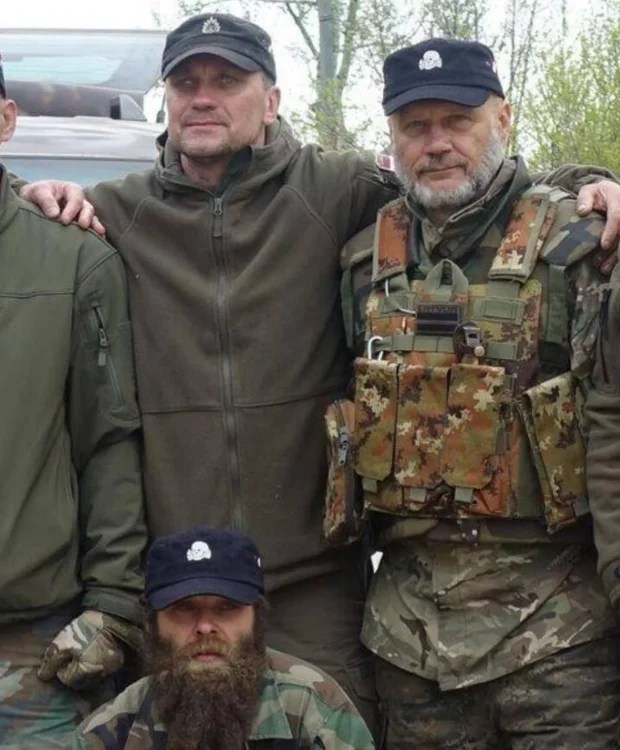
Large-scale NATO military drills started in Estonia on Monday. The exercise dubbed ‘Hedgehog 2022’ is one of the largest in the Baltic nation’s history, according to the military bloc. The drills will involve some 15,000 troops from 14 nations, including both military bloc members and their partners.
Soldiers from Finland, Sweden, Georgia and Ukraine are among those that will take part in the exercise, Finnish public broadcaster Yle reported. The drills will include all branches of the armed forces and will involve air, sea and land exercises, as well as cyber warfare training, according to the broadcaster.
According to a NATO statement, the drills will also see the US Navy Wasp-class landing ship ‘Kearsarge’ take part in the exercises. Both the military bloc and Estonian Defense Forces deputy commander, Major General Veiko-Vello Palm, have denied that the drills just over 60km from the Russian border have anything to do with Moscow’s ongoing military action in Ukraine.
The drills started just a day after Finland and Sweden officially announced their plans to join NATO, and were planned long before the conflict in Ukraine broke out, Western officials have said.
The exercises in Estonia are, however, just one part of NATO’s large-scale military activities near the Russian border. Another Baltic state, Lithuania, is hosting the ‘Iron Wolf’ exercise, which involves 3,000 NATO troops and 1,000 pieces of military equipment, including Germany’s Leopard 2 tanks.
Two of NATO’s biggest exercises – ‘Defender Europe’ and ‘Swift Response’ – are taking place in Poland and eight other countries, involving 18,000 troops from 20 nations, according to NATO’s statement on Friday.
“Exercises like these show that NATO stands strong and ready to protect our nations and defend against any threat,” the military bloc’s spokesperson, Oana Lungescu, said, adding that the drills “help to remove any room for miscalculation or misunderstanding about our resolve to protect and defend every inch of allied territory.”
The NATO Response Force is currently taking part in the 7,500-strong ‘Wettiner Heide’ drills in Germany. The Mediterranean Sea is about to witness ‘Neptune series’ naval drills involving the USS ‘Harry S. Truman’ carrier strike group that will be placed under NATO command. This will only be the second time since the end of the Cold War that a US carrier group has been transferred under the military bloc’s command, NATO has said.
In June, the Baltic States and Poland will host what NATO describes as “Europe’s largest integrated air and missile defense exercise,” which would involve 23 nations.
In late April, Finland hosted NATO naval drills. Now, it is also hosting a joint land exercise, in which troops from the US, the UK, Estonia and Latvia are participating.
The massive military wargames are taking place amid heightened tensions between Russia, NATO and some of the military bloc’s partners. Finland, which shares a long border with Russia, and Sweden decided to reconsider their long-standing policy of non-alignment following a major change in public opinion after the launch of Russia’s attack on Ukraine.
The development sparked a wave of criticism from Moscow, which warned that it would have to respond if Finland and Sweden join NATO. Moscow also maintains that it considers NATO’s expansion as a direct threat to its own security.
‘Finns & Swedes won’t benefit from NATO’
Samizdat | May 16, 2022
NATO membership won’t make Finland and Sweden more secure, but would likely see them fighting somebody else’s wars and hosting American bases, Dr. Jan Oberg, director of the Transnational Foundation for Peace and Future Research, has told RT.
“It’s a disastrous decision,” Oberg said on Sunday, following an official declaration by the Finnish government that it is planning to join the US-led military bloc. Hours later, a similar announcement was made by the ruling party in Sweden. The two Nordic nations stayed out of NATO during the Cold War, but their governments said Russia’s military operation in Ukraine has become a game-changer.
Finland and Sweden have failed to carry out “long-term consequence analysis,” he added. “Nobody seems to ask whether NATO is the right thing to join. After all these years since 1945, NATO has proven that it’s not able to deliver what taxpayers are paying for, namely stability, peace and security… and then Finland and Sweden say: ‘We’ll join this failed organization,’” he remarked.
“We have to ask ourselves: ‘Who caused the conflict [between Moscow and Kiev]?’ Everybody talks about the Russian invasion, which I deplore too, but underlying that is the conflict, which has to do with the NATO expansion,” the peace researcher said.
Making sure Ukraine becomes a neutral country that will never join NATO has been cited by Moscow as one of the main reasons for its ongoing military operation.
Oberg said he understood Russia’s concerns about the expansion of the bloc towards its borders. “If I was sitting in Moscow, I would feel that this was threatening,” he observed, referring to Finland and Sweden’s possible membership. “When you move troops up to the very border on both sides you increase tension; you decrease reaction time; you do all the things you shouldn’t do strategically if peace was your goal. Peace is not the goal of these people.”
The military-industrial complex – “those who sell weapons and profit from wars” – will gain from NATO adding two new members, he said. “The Swedish people and the Finnish people will not benefit from this. It’ll be completely new for them that they are now supposed to participate… in somebody else’s wars.”
With the US pushing for bases in Denmark and Norway, “are we to believe that there will not be American bases or American troops or something, you know, more permanent in Sweden and Finland?” he wondered.
NATO membership would also be “opening these countries for potential nuclearism that should never have been done in this particular area,” the peace researcher added.
Oberg said it was “appalling” that the governments in Helsinki and Stockholm didn’t put the issue to a referendum. “This is unheard of with such an important decision as joining NATO.”
While opinion polls have shown an overwhelming support for NATO membership in Finland, in Sweden the idea was backed by less than 50% of the public, he noted. “I’m amazed that there’s so little public discussion, so little uproar in terms of huge demonstrations in large cities in Sweden,” the scholar said.
He blamed the media, of which “80% to 90% is pro-NATO,” for this situation. “It’s very difficult to get into the media today with an alternative view… There’s no democracy and free media practice in this,” Oberg insisted.
Jan Oberg is a Danish-Swedish peace researcher, who received his doctorate from Lund University in Sweden. He taught courses in several countries, including Japan, Austria and Switzerland.
In 1986, the scholar co-founded the Transnational Foundation for Peace and Futures Research (TFF), an independent think tank aimed at promoting conflict-mitigation and achieving peace through peaceful means around the globe. He assisted on-the-ground work in ex-Yugoslavia, Georgia, Burundi, Iraq, Iran and Syria. In 2013, Oberg and TTF were nominated for the Nobel Peace Prize for their activities.
Will Sweden and Finland feel safer after joining NATO?
By Drago Bosnic | April 20, 2022
NATO expansion has been the main culprit behind all instability in Europe for the last 30+ years. Of course, NATO’s aggression against many countries, either as an organization, or separately, by each of its member states resulted in the deaths of millions, with orders of magnitude more of those whose lives may not have been physically lost, but they certainly have been ruined by the Alliance’s actions. The absolute havoc and the trail of death and destruction left in the wake of NATO invasions across the Middle East, always euphemistically dubbed “humanitarian interventions“, stand as a grisly testament to that.
The expansion of this supposedly “defensive alliance” which has not conducted a single truly defensive operation in well over 70 years of its existence, has first destroyed the relatively prosperous Yugoslavia, which was subjected to nearly a decade-long siege throughout the 1990s. During the 2000s, Russia’s attempts to create an atmosphere of trust and cooperation with the North Atlantic Alliance have been futile. No matter what Russia did, the alliance kept creeping closer to its borders. By the early 2010s, it was clear that NATO had no intention of stopping. The conflict in Ukraine is NATO’s latest brainchild, although there has hardly been any actual thinking behind it. It has been more like bulldozing its way towards Russia.
The last 8 years have shown where all this leads to, with the last nearly 2 months reaching a boiling point between the Russian Federation and the ever increasingly belligerent alliance. A recent announcement by both Sweden and Finland that they feel supposedly “threatened” and that they are very likely to enter NATO seems rather strange, especially given that they did not officially join NATO during the Cold War, when the USSR had undisputed control over the Baltic region.
An obvious question arises, why would Sweden and Finland feel threatened now, when the strategic situation has all but reversed, with Russia’s presence in the Baltics limited to relatively tiny areas around Saint Petersburg and Kaliningrad? It’s quite obvious that this can only be seen as another encroachment on Russia’s borders, another part of NATO’s larger geopolitical offensive. Still, although it may seem that NATO’s further expansion into Scandinavia is going to jeopardize Russia’s northwestern areas, Russia doesn’t seem particularly fazed by this prospect. While certainly not happy with this turn of events, Russia’s decision makers and strategic planners aren’t exactly pulling their hair out and running in circles over this.
First, it should be understood that both Sweden and Finland are neutral countries in name only. During the Cold War, both Scandinavian countries served as a hotbed of NATO intelligence activities, with the CIA and MI6 operating extensively in both countries. Soviet and later Russian intelligence were well aware of this.
During the 1990s, this became even more prominent, when both countries entered the EU, but also increased their official cooperation and interoperability with NATO. Naturally, over the years, this cooperation grew to unprecedented levels and the Russian military acted accordingly. The strategic military command structures in the Kremlin have treated both countries as de facto NATO member states for decades.
This is especially true for Finland, particularly after it announced it will be acquiring at least 65 F-35A fighter jets from the US military industrial giant Lockheed Martin. This jet, despite hundreds if not thousands of critical flaws and other shortcomings, is a serious ISR (intelligence, surveillance and reconnaissance) asset. The jet is bristling with sensors, all of which are connected to a massive network-centric warfare system, the center of which is located in the Pentagon. By operating this jet, Finland is effectively giving up on the sovereignty over its own air force and ceding it to the United States.
The Russian military is perfectly aware of this and has already made plans to react accordingly. Earlier, Finland’s official neutrality from a military standpoint complicated this. But now, rather ironically, the Scandinavian country might even make things easier for Russia’s strategic military planning by joining the ever expanding “defensive” alliance.
However, does this change anything for Finland and Sweden? Will NATO really make both countries safer? The short answer is simply no. By joining the North Atlantic Alliance, countries effectively cede much of their sovereignty to the US. Given the US’ strategic obsession with encircling Russia, the Kremlin feels strongly about this matter and it simply doesn’t take any chances.
Thus, the only “benefit” Sweden and Finland get is becoming meat shields for the US in the case of a nuclear exchange, because Russia is simply going to dedicate a portion of its thermonuclear arsenal to these countries. And if Russia doesn’t have a shortage of something, it’s nuclear weapons. Given the US’ and NATO’s track record, who is to blame then?
Le Pen promises to pull France out of NATO
By Uriel Araujo | April 15, 2022
NATO now has become one of the most important issue in Europe, with the new developments in Sweden and Finland, and electoral impacts in France. French Presidential candidate Marine Le Pen (who heads for the second round to be held on April 24) has vowed to pull France out of NATO’s military command. It would not be unprecedented, as the country did it in 1966. Le Pen claims the alliance structure “perpetuates the anachronistic and aggressive logic of the Cold War bloc”.
France was one of the Alliance’s founding members in 1949 and even hosted it for 15 years. This was a major event in French history. To help French ordinary citizens to accept the presence of foreign troops on their territory in times of peace, films like À votre service were shown in movie theaters, as part of a NATO PR campaign, so to speak. France’s relationship with the Anglo-Saxon structure (which is hegemonic within NATO), and with the alliance itself has always been complex, and Le Pen’s promise should be understood in this context and not necessarily as mere “extremism”.
In doing so, if elected, Le Pen would be in fact following the steps of general Charles de Gaulle (who ruled the country 1940-46 and 1958-1969). The conservative French leader wanted a truly independent nuclear France who would engage with Washington on more equal terms, becoming perhaps a kind of third force in the then Cold War’s bipolar world and even possibly reaching a détent with the USSR. The British-American “special relationship” was seen by him as detrimental to Europe.
Moreover, the US veto power regarding nuclear weapons also prevented Paris from pursuing its own atomic goals. Unable to place France in the tripartite directorate he proposed in his 1958 memorandum to US President Dwight Eisenhower and UK Prime Minister Harold Macmillan, de Gaulle refused to sign the 1963 agreement against nuclear testing – and, by 1969, France was already a fully fledged nuclear power. He also vetoed British entry into the European Union in the same year and, in 1964, told West Germany it should cease to follow a policy subordinated to Washington and adopt one for European independence (albeit not hostility). Of course, no NATO country followed his lead.
Isolated, France went on to withdraw from the Alliance’s so-called integrated military structure in 1966 (although not completely leaving the Treaty) and expelled all of its headquarters and units on French territory. It was President Nicolas Sarkozy who finally ended Paris “estrangement” from the organization in 2009 – so it took 43 years for Paris to change its course.
Even though Paris still hosted some NATO meetings and civilian structures, the spirit of Gaullism still shaped to some degree French strategic thinking during the Cold War, and the NATO-France relationship alternated between phases of rapprochement and tension. It was President Miterrand who started to bring France back into the Alliance’s integrated military command. And even so, it has been a kind of “flexible membership” (as it is often described).
Charles de Gaulle was one of the most important political leaders of the 20th century and even so, France remained relatively isolated in the European continent pertaining to its stance on NATO during the time of his leadership. He also faced several challenges, as the European countries acted in concert to try to neutralize many of his efforts. One cannot really tell whether Le Pen would be up to such a task, and estranging from NATO in any case is obviously not so simple, but the current situation on the other hand is also full of contradictions from a French and European perspective.
Meanwhile, on April 13 both Finland and Sweden took a major step towards joining NATO. In their joint press conference, the Prime Ministers Sanna Marin (Finland) and Magdalena Andersson (Sweden) both claimed that the security landscape in the continent has changed. Marin stated that Finland which shares a border with Russia will decide within weeks whether to join the Alliance. While a tight majority in Sweden now are in favor of joining the Atlantic Alliance, according to a recent poll, about 70% of Finnish people back it and this figure has more than doubled since the current Russian-Ukrainian war started.
Currently, both Nordic countries are NATO partners, since they abandoned their previous neutral stance by joining the European Union in 1995 and thus take part in military exercises and intelligence exchange, but they are not full-fledged members. Both countries were publicly assured by NATO secretary general Jens Stoltenberg that their applications would indeed be welcome, and they also received public support from Germany, France, and the UK. Joining or leaving the Alliance is not so simple – an application to join it must be accepted by all 30 member states, and this should take a minimum of four months and probably at least a whole year to be processed. In any case, it will be seen by Moscow as yet another provocation, amid a situation of escalating tensions.
Experts such as University of Chicago political scientist John Mearsheimer have been warning since 2014 that the ongoing Ukrainian war was mainly the West’s fault and Mearsheimer maintains it remains the West’s fault to this day. NATO’s constant expansion breaking the 1990 promises that were made during the fall of the Soviet Union as well as Washington’s policy of “encircling” and “containing” Moscow have cornered it to its limits. As Russian President Vladimir Putin said in December 2021: “What would Americans do if we went to the border between Canada and the U.S. or to the border with Mexico and deploy our missiles there?” Mearsheimer also warns that should tensions escalate, there is a real risk of a nuclear war.
Today the world faces the risks of a global food crisis and hunger, as well as on-going international energy crises, and a migration crisis in Europe. It is up for responsible Western leaders to open communication and dialogue channels with the Kremlin. Further provoking Moscow at this point is simply irresponsible and not in Europe’s best interests. France could thus play a key role in the continent. The EU in fact now faces the hard choice between being a self-dependent Europe or an Atlantic Europe.
Uriel Araujo is a researcher with a focus on international and ethnic conflicts.
Should We Commit to Fight Russia — for Finland?
BY PAT BUCHANAN • UNZ REVIEW • APRIL 15, 2022
The prime ministers of Sweden and Finland, Magdalena Andersson and Sanna Marin, both signaled Wednesday that they will likely be applying for membership in NATO.
The “prospect” is most “welcome,” says The Washington Post: “Finland and Sweden Should Join NATO.”
The editorial was titled “A Way to Punish Putin.”
Before joining the rejoicing in NATO capitals, we might inspect what NATO membership for these two Nordic nations would mean for the United States.
Finland is a nation the size of Germany, but with a population only 4% of that of Russia and a border with Russia that is 830 miles long.
Should Finland join NATO, the United States, under Article 5 of the NATO treaty, would be obligated to go to war with the world’s largest nuclear power to retrieve Finnish lands that an enraged Russia might grab.
Moscow has already indicated that, should Sweden and Finland join NATO, Russia will introduce new nuclear weapons into the Baltic region.
Why is it wise for us to formally agree, in perpetuity, as NATO is a permanent alliance, to go to war with Russia, for Finland?
Given the war in Ukraine and concomitant crisis in Eastern Europe, it is understandable why Stockholm and Helsinki would seek greater security beneath the U.S. nuclear umbrella.
But why would we voluntarily agree to give Sweden and Finland these war guarantees? Why would we commit to go to war with Putin’s Russia, a war that could, and likely would, escalate to the use of tactical nuclear weapons, especially if Russia were losing?
Finland was neutral during the Cold War. Sweden has been neutral since the Napoleonic wars of the early 19th century.
How did we suffer from their neutrality?
In Helsinki and Stockholm, the benefit of a U.S.-NATO commitment to go to war for Finland or Sweden is understandable.
But how does it benefit our country, the USA, to be obligated to go to war with a nation that commands the world’s largest stockpile of nuclear weapons — over some quarrel in the Baltic Sea or Gulf of Finland that does not affect us?
Asked for his view on Sweden and Finland’s campaign to join NATO, Putin spokesman Dmitry Peskov had a note of warning:
“We have repeatedly said that the (NATO) alliance remains a tool geared towards confrontation and its further expansion will not bring stability to the European continent.”
Should Putin’s Russia clash with Finland or Sweden today, the U.S. is free to respond, or not to respond, as it sees fit, depending on our own assessment of risks and rewards.
Why not keep it that way? Why surrender our freedom of action in some future collision involving our main adversary?
History holds lessons for us here.
In March 1939, six months after Munich, when Czechoslovakia disintegrated into its ethnic components, Britain issued an unsolicited war guarantee to Poland, then negotiating with Germany over the port city of Danzig taken from Germany by the victorious Allies after World War I.
When Germany, on Sept. 1, 1939, invaded Poland, Britain was obligated to declare war on Germany over a matter that was not a vital interest of Great Britain or its worldwide empire.
Lest we forget, it was the Bucharest Declaration of 2008, opening the door to membership in NATO for Ukraine and Georgia, that led to the recent crises in Eastern Europe and the current war.
The Russia-Georgia War of August 2008, the U.S.-backed coup in Ukraine in 2014, and Putin’s annexation of Crimea, Luhansk and Donetsk in eastern Ukraine all proceeded from NATO’s decision in 2008 to open the door to membership for Georgia and Ukraine.
Russia’s invasion of Ukraine today is partly due to the U.S. and Ukraine’s refusal to rule out NATO membership for Kyiv.
No NATO nation today has a border with Russia nearly as long as that of Finland. If Finland joins NATO, will we put U.S. boots on the ground along that 830-mile border with Russia? Will U.S. warplanes fly in and out of Finnish airfields and air bases up to the border of Russia?
Collective security is said to be a good idea.
But the core of NATO security is provided by U.S. war guarantees, while most of the collecting is done by our 29 NATO allies, which could become 31 by summer’s end.
Otto von Bismarck predicted that the Great War, when it came, would be ignited by “some damn fool thing in the Balkans.”
And World War I was indeed triggered by the assassination of the Austrian archduke in Sarajevo in June 1914. The Germans came in in part because the kaiser had given Austria a “blank check” for war.
What enabled America to stay out of both world wars for years after they began was our freedom of “entangling alliances” when they began.
But today we not only lead an alliance of 30 nations, but we are adding two more members, one of which has a border of 830 miles with Russia.
How long does our luck last?
Sweden Saw Second Smallest Increase in National Debt Out of All EU Countries
By Noah Carl | The Daily Sceptic | April 13, 2022
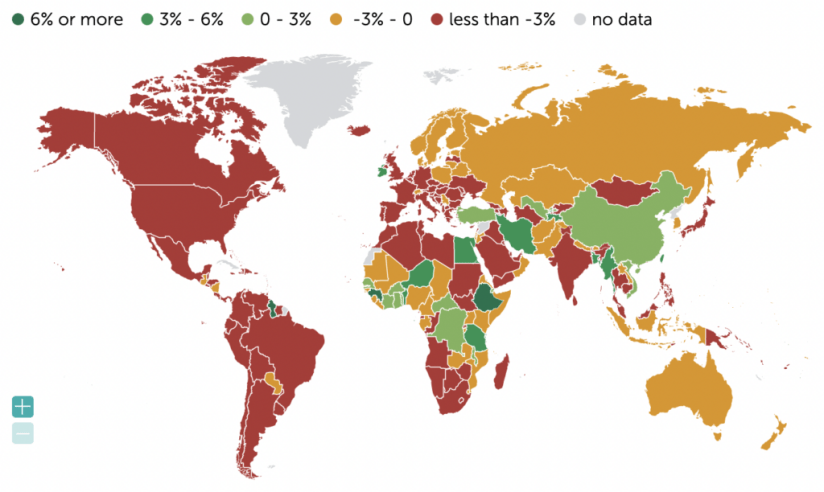
In 2020, the first year of the pandemic, almost every country in the world had a major recession. As this map from the IMF shows, most countries in Europe saw GDP decline by more than 3%, the only exception being Ireland (which in any case has an unusual way of counting GDP).
Despite this, unemployment in the EU only increased by a modest 1.2 percentage points, rising from 6.6% to 7.8% by the third quarter of 2020. One reason why unemployment didn’t rise more during months of lockdown is that governments spent unprecedented sums of money on furlough and other wage-support schemes.
In other words, they paid people to sit at home all day. For example, The U.K.’s Coronavirus Job Retention Scheme paid furloughed workers 80% of their previous salary, up to a cap of £2,500 a week.
While such wage-support schemes had the benefit of preventing large rises in unemployment, they had the cost of being extremely expensive. Data published by the ONS in January of this year show just how expensive.
The chart below shows change in general government gross debt (as a percentage of GDP) in percentage points from the fourth quarter of 2019 to the third quarter of 2021:
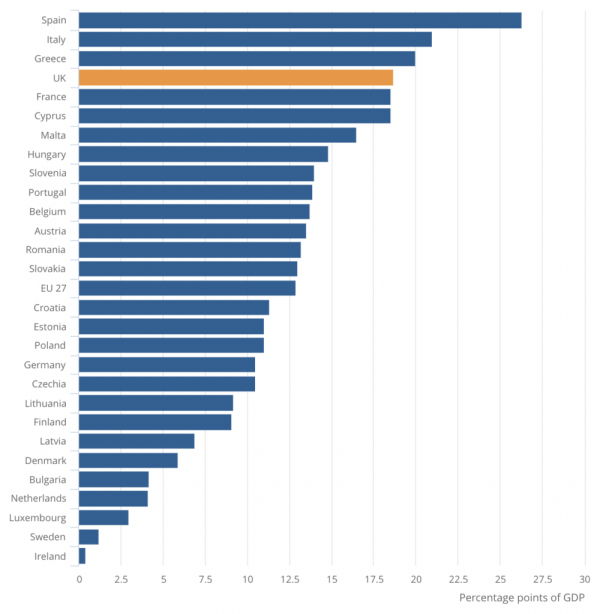
Many countries saw absolutely huge increases in debt. Over just seven quarters, Spain’s debt grew by 26 percentage points, Italy’s by 21 percentage points, and Greece’s by 20 percentage points. The UK wasn’t far behind, logging an increase of 18.7 percentage points.
At the other end of the spectrum, Ireland’s debt grew by less than one percentage point, while Sweden’s grew by only 1.2 percentage points. Of course, Sweden’s strong performance comes as no surprise, given it was the only major European country that didn’t lock down in the spring.
As I noted previously, The Economist ranked Sweden third in a league table of 23 rich countries for overall economic performance during the pandemic. And we know this didn’t come at the cost of Swedish lives – the country actually saw negative excess mortality between January of 2020 and June of 2021.
To compare European countries in a comprehensive way, I plotted change in general government gross debt against age-adjusted excess mortality. (Data were not available for Germany, Ireland, Norway and Switzerland.)
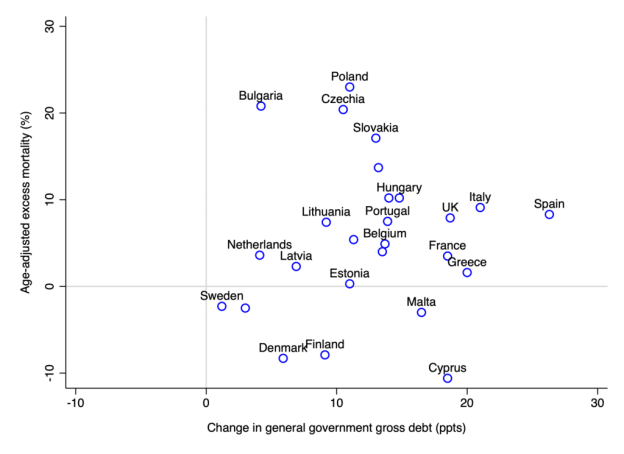
Taking into account both metrics, Sweden was one of the best overall performers in Europe, along with Luxembourg, Denmark and Finland. And it was by far the best performer among countries with a population over 10 million.
By contrast, Eastern European countries and large Western European countries – almost all of which had strict lockdowns – did poorly on both metrics. So lockdown was harmful to the public finances, with little corresponding benefit in terms of reduced mortality.
Denmark is First EU Country to Scrap All COVID Restrictions
21st Century Wire | January 29, 2022
Later this week, England is scheduled to drop its problematic mask mandate for shops and public transport, along with its highly unpopular vaccine passport regime. Up north, Scotland says it will “relax” so-called ‘work from home guidance,’ and reopen nightclubs, as well as ending venue capacity limits.
While the UK and Ireland gingerly roll-back their highly disruptive COVID restriction policies, other European countries are now leading the way by scrapping the entire ‘pandemic’ regime altogether.
Financial Times reports…
Denmark said it would lift almost all Covid-19 restrictions and stop designating it a “societally critical” disease on Wednesday in the latest sign that western European countries are easing or even eradicating strict measures brought in to combat the Omicron coronavirus variant.
Magnus Heunicke, Denmark’s health minister, wrote to parliament on Wednesday saying that he would remove all Covid-19 restrictions on February 1, except for testing on arrival from abroad. Just as the Danish government did in September, when it lifted all restrictions, it will also stop calling Covid-19 a “societally critical disease”, meaning that it will no longer have the legal basis to introduce wide-ranging curbs.
“Tonight we can begin to lower our shoulders and find our smiles again,” said Mette Frederiksen, Danish prime minister, on Wednesday evening. “The pandemic is still here, but with what we know now, we can dare to believe we are through the critical phase.”
Denmark is the latest European country in recent days to announce it is dropping most or nearly all measures as it follows in the footsteps of the UK, Ireland and the Netherlands…
Meanwhile, mainstream media outlets like Politico report this latest development with the accompanied fear-mongering over the latest “subvariant” – allegedly on the loose:
The announcement comes as a new subvariant of Omicron, BA.2, is gaining a foothold in Denmark and driving infections up, with 46,000 new COVID-19 cases recorded on Wednesday.
“Recent weeks have seen very high infection rates, in fact the highest in the entire pandemic,” Frederiksen said. “Therefore, it may seem strange and paradoxical that we are now ready to let go of the restrictions.”
Some 82 percent of Denmark’s population is fully vaccinated with two doses, of whom 50 percent are boosted with a third dose, according to the Danish Health and Medicines Authority.
However, as the FT points out, with this alleged rise in “cases” (aka PCR positive tests) promoted in the media – there is no corresponding rise in serious illness as a result COVID-19:
Denmark still has one of the highest number of Covid-19 cases per capita in the world, currently more than 10 times its previous peak as Omicron causes tens of thousands of daily infections. But the number of patients in intensive care continues to fall and, even with Omicron, never hit the peaks reached from April 2020 and January 2021.
Elsewhere in Scandinavia, Sweden, Norway and Finland have all announced they will also be easing their restrictions in the coming weeks.
Featured Video
Prof. Ted Postol: Iran Already Achieved Nuclear Deterrence Against Israel
or go to
Aletho News Archives – Video-Images
From the Archives
How the occupied mentality syndrome works
Saudi Arabia on the American chessboard – Part 3
By B. J. Sabri | American Herald Tribune | June 27, 2016
Read part 2: “The occupied mentality Syndrome“
Previously I argued whether Saudi Arabia’s repeated involvements in U.S. interventions and wars stem from free national will or in response to a specific condition. For starters, in Saudi Arabia there is no national will. In Saudi Arabia, the national will is the will of the Al Saud clan. Still, when a major Arab state allies itself with a superpower that committed unspeakable crimes against humanity in almost every Arab country, then something is wrong. This fact alone should compel us to examine the U.S.-Saudi relation for one exceptional reason. As a result of the U.S.-Saudi wars, hundreds of thousands of people in Afghanistan, Iraq, Iran, Libya, Syria, Yemen, and Somalia have lost their lives. Millions became displaced in their own homelands. And millions more rendered refugees.
Attributing the Saudi policies to the bonds of “partnership” with the U.S. is frivolous. There are no bonds between these two thugs except those of business, military deals, secret plots, and wars. Proving this point, bonds such as these have no space for the American and Saudi peoples to share significant cultural or societal exchanges. If partnership is not the reason for the Saudi contribution to the U.S. strategy of empire and imperialism, then another reason must exist.
This leads to three possibilities. … continue
Blog Roll
 Aletho News
- Hezbollah hits Israeli warship off Lebanon’s coast, sets it aflame
- Iran slams US strikes on B1 bridge, Mahshahr petrochemical plants as ‘blatant acts of state terrorism’
- In letter to UN chief, Araghchi warns of dire consequences of US-Israeli attacks on Iran’s nuclear facilities
- Why the CIA conspiracy to invade Iran with Kurdish militias failed
- Why Are Upbeat US Claims About Mission to Rescue Pilot ‘Highly Questionable’?
- Aircraft destroyed during US ‘rescue’ of downed F-15 pilot cost more than $100 million each
- Washington University removes professor who condemned US-Israeli war on Iran
- Russia Warns of Retaliation as UK Authorizes Seizure of Vessels
- Serbia thwarts plot to bomb Russia-Hungary gas pipeline – Vucic
- Al Mayadeen voices solidarity with Dr. Marandi amid death threats
- If Americans Knew
- In Iran, Israel-US take aim at “reason, research, and freedom of thought” – Daily Update
- US loses planes over Iran, Israel downgrades Lebanon war goals – Daily Update
- Israel Is Blocking Palestinians from Easter at Church Where Jesus Resurrected
- Plot to assassinate Palestinian activist follows harassment campaign promoted by Zionist groups and elected officials
- Prominent New York synagogue hosts presentation on why U.S. Jews should support the ethnic cleansing of Gaza
- Tapper vs. Piker: Is the CNN Anchor Auditioning for David Ellison?
- Shouldn’t Democrats Be Able to Condemn Genocide?
- Israel-US kill negotiators, destroy civilian structures, but Iran’s military capabilities still largely intact – Daily Update
- ‘War crime’: Global condemnation as Israeli ministers celebrate death penalty law targeting Palestinian prisoners
- 7 Ways Israel Is Turning Lebanon Into Gaza
- No Tricks Zone
- An Inconvenient Tree: Uncovered In Alps… Europe Much Warmer Than Today 6000 Years Ago
- New Study Reports A 60% Slowdown In Greenland’s Ice Loss Rate In The Last Decade
- Low Intensity Tornado Wrecks Major Solar Farm, Creating A Potential Toxic Dump
- New Study Finds Warming Saves Lives…Cold Temperatures 12 Times More Deadly Than Excess Heat
- German Science Blog Accuses PIK Climate Institute Of Hallucinating Climate Tipping Points
- Devastating Assessment Of Comirnaty Vaccine By Former Senior Pfizer Europe Toxicologist
- New Study: CO2 Is ‘Effectively Negligible’ As An Explanatory Climate Change Factor Since 2000
- Former Pfizer Toxicologist Dr. Helmut Sterz Tells Bundestag Hearing Pfizer Vaccine Should Have Never Been Approved
- Energy Expert: Germany’s Nuclear Phaseout Was A “500 Billion Euro Mistake”
- New Research: South Australia’s Mid-Holocene Sea Surface Temperatures Were 4°C Warmer Than Today
 Aletho News