Putin and the Press: The Demonology School of Journalism
By James Petras | October 11, 2015
The major influential western print media are engaged in a prolonged, large-scale effort to demonize Russian President Putin, his politics and persona. There is an article (or several articles) every day in which he is personally stigmatized as a dictator, authoritarian, czar, ‘former KGB operative’ and Soviet-style ruler; anything but the repeatedly elected President of Russia.
He is accused of hijacking Russia from the ‘road to democracy’, as pursued by his grotesquely corrupt predecessor Boris Yeltsin; of directing the bloody repression of the ‘freedom loving Chechens’; of jailing innocent, independent, and critical oligarchs and robber barons; of fomenting an uprising in the ‘democratic, newly pro-Western’ Ukraine and seizing control of Crimea; of backing a ‘bloody tyrant’ in Syria (elected President Bashar Assad) in a civil war against ISIS terrorists; of running the Russian economy into the ground; and of militarily threatening the Baltic and Eastern European NATO member countries.
In a word, the media have propagated an image of an ‘out-of-control autocrat’, who makes a mockery of ‘democratic’ norms and ‘Western values’, and who seeks to revive the ‘Soviet (aka Evil) Empire’.
The corollary is that ‘Western powers’, despite their peace-loving propensities and fraternal attempts to bring Russia into the democratic ‘fold’, have been ‘forced’ to now surround Russia with NATO military bases and missiles; to finance a violent coup in the Ukraine (on Russia’s frontier) and arm the Ukrainian putsch government and neo-fascist militias to ‘restore democracy’ and violently suppress ethnic Russian ‘separatists’ in Eastern Ukraine. We are told that US and EU sanctions against Russia were carefully crafted ‘diplomatic’ measures designed to punish the Moscow ‘aggressor’.
In reality, the Western media has relentlessly demonized Vladimir Putin in a campaign to further NATO military expansion and undermine the Russian economy and its national security. The goal is ultimately to force a ‘regime change’, restoring the neo-liberal elites who had pillaged Russia’s economy during the 1990s and whose brutal economic policies led to the premature death of over 6 million Russians due to deprivation and the collapse of the healthcare system.
Putin: Demon or Realist, Autocrat or Democrat, Vassal or Independent Leader?
The Western media has backed every oligarch, gangster, and fraudster who has gone on trial and been convicted during Putin’s term in office. The propagandists tell us the reason for this affinity between the Western media and the gangster-oligarchs is that these convicted felons, who claim to be ‘political dissidents’ and critics of Putin’s rule, have been dispossessed, and jailed for upholding ‘Western values’.
The Western media conveniently ignore the well-documented studies on the source of the gangster-oligarchs’ wealth: The violent and illegal seizure of multi-billion dollars-worth of natural resources (aluminum, oil and gas), banks, factories, pension funds and real estate. During the Yeltsin period the oligarchs controlled thousands of armed gangsters and engaged in internal warfare during which thousands were killed, including top government regulators, police officials and journalists who dared to oppose or expose their pillage and property grabs.
Putin’s prosecution of a mere fraction of the most notorious oligarch-gangsters has won the support of the vast majority of Russian citizens because it represents a return to law and order and the return of stolen public wealth.
Only the Western media has dared to refer to these convicted felons as ‘political victims and reformers’. They did so because the oligarchs had become the most loyal and submissive assets in the US and EU governments’ efforts to convert Russia into an irreversibly weak vassal state.
The Western media constantly refer to President Putin as the ‘authoritarian ruler’, despite the fact that he has been repeatedly elected by large majorities in competitive elections against Western backed and funded candidates. His popularity is attested to by opinion polls conducted by Western agencies.
In 2015, President Putin’s support soared to over 85%. The pro-Western Russian neo-liberal politicians scored in the low single digits according to the same independent polls.
Clearly the Russian public does not want to return to the poverty and chaos of the Western-backed gangster politics of the 1990s.
Whatever reservations working and middle class Russians have over President Putin’s style of decision-making, they clearly value his crackdown on gangster-controlled elections, Chechen terrorism, and his restoration of Russian military defense of its frontiers, including the annexation of Crimea, following the US-engineered coup in Ukraine.
Every day, the Western media recycle reports of the ‘decline and demise’ of the Russian economy, blaming ‘statist’ mismanagement of the economy by Putin. They claim ‘declining living standards’, the ‘negative growth’ of the economy and the ‘growing isolation’ of an ‘expansionist’ Russia in the face of Western sanctions.
These media claims are laughable. Readily available data demonstrate that living standards of the vast majority of Russian citizens have significantly increased under President Putin’s administration, especially after the utter collapse under the free marketers of the 1990s. Russian workers receive their pay, pensioners their pensions, enterprises their loans – on time. During the ‘free market’ days of Boris Yeltsin, workers went up to a year without pay, pensioners were selling their heirlooms in the street to survive and enterprises paid extortionate interest rates to oligarch-gangster controlled banks! Comparative data, easily obtained, are deliberately ignored by the mass media because it doesn’t fit the demonological narrative.
The mass media present the neo-liberal ‘opposition’ and ‘liberal critics’ as Russian democrats defending ‘Western values’. They forget to mention that these ‘liberal critics’ have been directly funded by Western foundations (National Endowment for Democracy, Soros Foundation, etc.) and Russian non-governmental organizations (NGO’s) with longstanding ties to US and EU governments, intelligence agencies and exiled Russian billionaires. The so-called ‘Russian’ democratic opposition revealed their abject servility to Western interests when they openly supported the Ukrainian coup and Kiev’s bloody assault on ethnic Russian-Ukrainians in the eastern ‘Donbas’ regions of Donetsk, Luhansk and Odessa. Whatever shreds of respectability and credibility the ‘democratic opposition’ retained with the Russian public, up to that point, was lost. They were seen for what they are: propaganda arms of Western imperialism and mouth-pieces for neo-fascists.
The Western mass media charge Putin’s government with the same crimes that their own governments commit. After the US State Department’s Victoria Nuland admitted to channeling $5 billion to fund the 2014 coup in Ukraine and after the Polish regime boasted of training far right street fighters, whose mob violence served as a pretext for the coup, and after neo-fascist coalition partners in Odessa of burned alive four dozen ethnic Russian-Ukrainian citizens opposed to the coup, the Western mass media accused Putin of ‘intervening’ in Ukraine. This was because Russia had convoked a referendum in Crimea, in which over 80% of the electorate voted to secede from the illegitimate Ukrainian coup regime and rejoin Russia.
In truth, the Putin government is a victim of the Western power grab in the Ukraine, with Russia having to absorb hundreds of thousands of ethnic Russian refugees driven out of the Donbas, yet the Western media portray Putin as the executioner. Meanwhile the Western coup-makers and their far-right allies are depicted as victims… forced to bomb and decimate the Donbas region.
The charade continued. The Western media portray the subsequent punitive, economic sanctions imposed by the expansionist US and EU on Russia as a result of Putin’s ‘aggression’, referring to Russia’s defense of Crimea’s self-determination and the rights of the millions of bilingual ethnic Russian citizens of Ukraine.
The absurdity and convoluted nature of Western demonological propaganda has reached new even more bizarre heights with their hysteria against Russia’s military support of the secular Syrian government against ISIS and other jihadi terrorists.
The Western mass media have launched a global campaign charging that the Russian air force bombs ‘non-ISIS military bases’, presumably the bases of Western-backed ‘friendly’ jihadi terrorists. This ridiculous ‘reportage’ and its accompanying ‘photos’ were published before the Russian air strikes even took place!!
Apparently timing doesn’t matter in Washington’s ‘alternative universe of lies’!
NATO passed its political line to the media that Russian support for the legitimate regime of President Assad must be discredited; that the Russian presence is ‘provocative’ and responsible for ‘creating tensions’ in the region – after years of Western-sponsored jihadi terrorism against Syria!
Obedient to its masters, the Western media breathlessly ‘reported’ that the Russians were ‘really’ engaged in Syria in order destroy the pro-Western ‘fighters’, leaving ISIS alone.
No credible evidence for this propaganda was ever presented. They trotted out aerial photos of wreckage, which had likely been lifted from previous US bombings.
The media’s clumsy execution of the Pentagon’s line managed to embarrass even the US Secretary of Defense, Ashton Carter, who backed off of such claims and called for an explanation from Russia. Even Secretary Kerry, who now seeks to secure Putin’s military support for the US against ISIS while withdrawing Russia’s political backing of President Assad, has cautioned the media to modify its line, now that the US favors ‘greater coordination’ with Russia — but under US leadership. The media has recently conformed to this line, although it has not managed to explain how Washington could now work with the demonic President Putin.
Conclusion
Western media is engaged in an intense long-term propaganda campaign to demonize President Putin. Its role is to convince world public opinion and world leaders to blindly follow the US and EU, as well as their ‘allies’ and vassal states, in a campaign to degrade and undermine Russia, and consolidate a unipolar empire under US tutelage.
The Western mass media is important; but it must be remembered that the media is an instrument of imperial state power. Its lies and fabrications, its demonization of leaders, like President Putin, are one part of a global military offensive to establish dominance and to destroy adversaries.
The more intense the imperial campaign, the riskier the power grab, the greater the need to demonize the victims.
This explains how the escalation of the rabid anti-Putin propaganda campaign coincides with the single biggest Western power grab — the Ukraine coup (‘regime change’) — since West Germany annexed East Germany, and NATO and the EU incorporated the Baltic States, Eastern Europe and the Balkans into the West’s strategic alliance. The West’s bloody break-up of the Yugoslav federation was part of this strategic program.
The problem with the Western demonization of adversaries, whether it is Russia, Iran and China today, or earlier Cuba, Libya and Yemen in the past, is that Washington and the EU face severe economic crises at home and military defeats abroad by armed Islamic and nationalist resistance movements.
The US had invested hundreds of billions of dollars to prop up a shaky puppet regime in US-occupied Iraq, yet the US-trained and supplied Iraqi Army fled as the Baathist-Islamist ‘ISIS’ quickly over-ran half the country.
US troops have occupied Afghanistan for fourteen years, losing tens of thousands of lives and limbs and yet the nationalist-Islamist Taliban can easily take over Afghanistan’s third largest city, Kunduz (population 300,000), and occupies three quarters of the rest of the countryside.
Libya and Somalia are a disaster. And still Washington allocates a half billion dollars to train pro-Western mercenaries to overthrow Syria’s President Assad – mercenaries who give up their arms or join ISIS the moment they cross the border from Jordan or Turkey. The US trained mercenaries have handed over untold millions of dollars worth of heavy and light weapons and armored carriers to ISIS and Al Qaeda. The EU and the US face the dismal reality that Libya, Somalia and Syria are over-run by anti-Western Islamic fighters.
In Asia, China is demonized in the Western media, portrayed as being on the verge of collapse, facing a hard landing, even as China grows at 7%. The Western media wring their collective hands over the crisis in China while Beijing finances two new international development banks for $100 billion, raises its contribution to the IMF and brings 50 countries, including most of the EU but minus the US and Japan, into a new infrastructure lending institution.
Two big questions face the US and EU:
Why do the Western media launch a campaign of demonization that doesn’t correspond to reality? What is the goal of such demonization, which objectively undermines the possibility of forming tactical alliances to end the US’ military losses, political defeats and diplomatic isolation? The US needs Russia to defeat ISIS.
For Moscow, the fight against ISIS is crucial to Russian national security: thousands of Chechen terrorists (some trained by the US) are fighting with ISIS and threaten to return to the Caucuses and terrorize Russia. Unlike the US public’s opposition to Washington’s role in forcing ‘regime change’ in Syria, the Russian public supports Moscow’s military support for the Syrian government because the Chechens’ campaign of terror within Russia, especially the 2004 massacre of hundreds of school children, teachers, and parents in Beslan, is seared into their memory – a fact conveniently ignored by Western media when it ‘sympathizes’ with Chechen ‘freedom fighters’.
In reality, Washington should have a common interest to ally with Russia in the fight against ISIS in Syria and Iraq. However Obama is committed to ousting Assad (Russia’s ally) to expand US dominance in the Middle East in partnership with Israel and Saudi Arabia. Clearly there are insurmountable contradictions between short-term military objectives (fighting ISIS) and strategic imperial political imperatives (consolidating US-Israeli hegemony over the Middle East and Iran).
Washington has moved to end its isolation in Latin America by re-establishing diplomatic relations with Cuba. Meanwhile, Washington retains the economic blockade of Cuba and its huge US military base in Guantanamo. Cuba is seen as a tactical political ally in ‘moderating’ the leftist government of Venezuela and pressuring the Colombian FARC to disarm, even as Washington deepens its military presence in the continent.
Obama signed off on a nuclear agreement with Iran (but the crippling sanctions and blockade remain in place) in order to secure Tehran’s support for the war against ISIS in Iraq and the Taliban in Afghanistan. Temporarily, the Western mass media has ‘toned-down’ its demonological reporting on Iran and Cuba, for tactical purposes.
The Obama regime has adopted a ‘good cop/bad cop’ (or schizophrenic) posture with Russia on Syria – Secretary of State John Kerry speaks of joint co-operation with Moscow while Secretary of Defense Ashton Carter proposes to militarily confront ‘Russian aggression’. The media hasn’t made the switch because they don’t know which orders to obey or which line to ‘parrot’.
In the meantime, the domestic economic crisis deepens, ISIS advances, the Taliban approaches Kabul, the Russians are arming and defending President Assad and millions of refugees, fleeing the war zones, have over- run Europe. European border wars are raging. And Obama wrings his hands in impotence. Demonology offers no allies, no solutions and no positive path to peace and co-existence.
Syria ‘opposition’ says will boycott UN-backed peace negotiations
Press TV – October 11, 2015
Syria’s main foreign-backed opposition group says it plans to boycott peace negotiations proposed by the United Nations in protest against Russian airstrikes in the Arab country.
The so-called Syrian National Coalition (SNC) made the announcement in a statement on Sunday, saying it did not favor the talks proposed by UN peace envoy Staffan de Mistura.
The opposition group said it had “decided not to participate in the consultative working groups and considers adherence to the Geneva communique and UN Security Council resolutions and an end to Russian” airstrikes targeting Daesh militants in Syria as a basis for the resumption of peace talks.
The opposition was pointing to a document agreed by some states in 2012, which outlined a roadmap to resolve the crisis in Syria, including the formation of a transitional governing body and the removal of Syrian President Bashar al-Assad from power.
Back in July, the UN envoy proposed the formation of working groups for both opposition and government representatives to address their concerns.
Since September 30, Russia has been carrying out its airstrikes in coordination with the Syrian government and has repeatedly voiced its support for a solution which includes Assad.
A report released by the Wall Street Journal last week said Russian airstrikes were also targeting militants backed by the US Central Intelligence Agency (CIA) in Syria.
Russian air force jet fighters have reportedly demolished numerous vehicles, command posts, communication centers, fuel and ammunition depots, plants used for making bombs and improvised explosive devices (IEDs), as well as several training camps, all used by Daesh.
Hundreds of Daesh militants, including a number of commanders, have reportedly been killed in the Russian airstrikes.
Syria has been fighting a foreign-sponsored militancy since March 2011. So far, more than 250,000 people have lost their lives in the conflict.
Deconstructing the NATO Narrative on Syria
By Eva Bartlett | Dissident Voice | October 10, 2015
Over the past five years, the increasingly ridiculous propaganda against President al-Assad and the Syrian Arab Army (SAA) has ranged from the scripted (OTPOR fomented -“revolution“) “peaceful protesters under fire” rhetoric, to other deceitful lexicon like “civil war,” and “moderate rebels.”
As the intervention campaigns continue with new terrorist and “humanitarian” actors (literally) constantly emerging in the NATO-alliance’s theatre of death squads, it is worth reviewing some of the important points regarding the war on Syria.
Million Person Marches
On March 29, 2011 (less than two weeks into the fantasy “revolution”) over 6 million people across Syria took to the streets in support of President al-Assad. In June, a reported hundreds of thousands marched in Damascus in support of the president, with a 2.3 km long Syrian flag. In November, 2011 (9 months into the chaos), masses again held demonstrations supporting President al-Assad, notably in Homs (the so-called “capital of the ‘revolution’”), Dara’a (the so-called “birthplace of the ‘revolution’”), Deir ez-Zour, Raqqa, Latakia, and Damascus.
Mass demonstrations like this have occurred repeatedly since, including in March 2012, in May 2014 in the lead-up to Presidential elections, and in June 2015, to note just some of the larger rallies.
In May 2013, it was reported that even NATO recognized the Syrian president’s increased popularity. “The data, relayed to NATO over the last month, asserted that 70 percent of Syrians support” the Assad government. At present, the number is now at least 80 percent.
The most telling barometer of Assad’s support base was the Presidential elections in June 2014, which saw 74 percent (11.6 million) of 15.8 million registered Syrian voters vote, with President al-Assad winning 88 percent of the votes. The lengths Syrians outside of Syria went to in order to vote included flooding the Syrian embassy in Beirut for two full days (and walking several kilometres to get there) and flying from countries with closed Syrian embassies to Damascus airport simply to cast their votes. Within Syria, Syrians braved terrorist mortars and rockets designed to keep them from voting; 151 shells were fired on Damascus alone, killing 5 and maiming 33 Syrians.
For a more detailed look at his broad base of popular support, see Professor Tim Anderson’s “Why Syrians Support Bashar al Assad.”
The Reforms
Prior to the events of March 2011 Syrians did have legitimate desires for specific reforms, many of which were implemented from the beginning of the unrest. In fact, President al-Assad made reforms prior to and following March 17, 2011.
Stephen Gowans noted some of those early reforms, including:
- Canceling the Emergency Law;
- Amending the the constitution and putting it to a referendum [8.4 million Syrians voted; 7.5 million voted in favour of the constitution];
- Scheduling, then holding, multi-party parliamentary and presidential elections
The constitution, according to Gowans, “mandated that the government maintain a role in guiding the economy on behalf of Syrian interests, and that the Syrian government would not make Syrians work for the interests of Western banks, oil companies, and other corporations.”
It also included:
- “security against sickness, disability and old age; access to health care; free education at all levels”
- a provision “requiring that at minimum half the members of the People’s Assembly are to be drawn from the ranks of peasants and workers.”
Political commentator Jay Tharappel further articulated:
The new constitution introduced a multi-party political system in the sense that the eligibility of political parties to participate isn’t based on the discretionary permission of the Baath party or on reservations, rather on a constitutional criteria… the new constitution forbids political parties that are based on religion, sect or ethnicity, or which are inherently discriminatory towards one’s gender or race. (2012: Art.8)
No surprise that NATO’s exile-Syrian pawns refused the reforms and a constitution which ensures a sovereign Syria secure from the claws of multi-national corporations and Western banks.
In his article, “Decriminalising Bashar – towards a more effective anti-war movement,” writer Carlos Martinez outlined Syria’s positives, including its anti-imperialist, socialist policies; its secularism and multiculturalism; and—poignantly—its continued support for Palestinians and anti-Zionist stance.
These are all points that contradict the lies spewed over the past nearly five years, and shatter the feeble justification for continuing to wage war on Syria.
Twisting the Numbers to Serve the War Agenda
The number and nature of Syrians killed varies depending on which list one consults. Many talking heads draw from one sole source, UK-based Syrian Rami Abdulrahman of the so-called Syrian Observatory for Human Rights (SOHR) (run out of his home and based on information provided largely by unnamed “activists”). Abdulrahman hasn’t been to Syria for 15 years, and, as Tony Cartalucci noted, is “a member of the so-called ‘Syrian opposition’ and seeks the ouster of Syrian President Bashar Al Assad.” Further, Cartalucci explained, “Abdul Rahman’s operation is indeed funded by the European Union and a “European country” he refuses to identify.” So not an impartial source.
In her February 2012 “Questioning the Syrian Casualty List,” political analyst Sharmine Narwani laid out the logistical difficulties of collating the number of deaths, including:
- Different casualty lists and difficulty confirming accuracy of any of them.
- Lack of information on: how deaths were verified and by whom and from what motivation.
- Lack of information on the dead: civilian, pro or anti government civilians; armed groups; Syrian security forces?”
She found that one early casualty list included 29 Palestinian refugees “killed by Israeli fire on the Golan Heights on 15 May 2011 and 5 June 2011 when protesters congregated on Syria’s armistice line with Israel.”
Jay Tharappel looked at two of the other prime groups cited regarding casualties in Syria: the Syrian Network for Human Rights (SNHR) and the Violations Documentation Center (VDC).
He noted that neither of the groups “are ‘independent’ in the sense that they function merely to provide facts, they’re all open about their agenda to overthrow the Syrian government…and for the imposition of a no-fly zone on behalf of the ‘moderate rebels’, whoever they are.”
Further, according to Tharappel, “the SNHR doesn’t provide any evidence to substantiate its assertions about the numbers killed by government forces. They claim to have ‘documented [victims] by full name, place, and date of death,’ however none of these can be found on their website.”
Regarding the VDC, he wrote, “there are good reasons to believe the VDC is listing dead insurgents as civilians, as well as mislabeling dead government soldiers as FSA fighters.”
One example he cited was the listing of a Jaysh al-Islam militant, ‘Hisham Al-Sheikh Bakri’, killed by the SAA in Douma (infested with Jaysh al-Islam terrorists), in February 2015, which al-Masdar News reported. The VDC also listed ‘Hisham Abd al-Aziz al-Shaikh Bakri’, “however this one is listed as an adult male civilian and not a Jaish Al-Islam fighter,” Tharappel wrote.
Even embedded war reporter Nir Rosen, Tharappel recalled, in 2012 wrote:
Every day the opposition gives a death toll, usually without any explanation of the cause of the deaths. Many of those reported killed are in fact dead opposition fighters, but the cause of their death is hidden and they are described in reports as innocent civilians killed by security forces, as if they were all merely protesting or sitting in their homes.
It would be an understatement to say there are considerable, and intentional, inaccuracies in the lists of these groups. In fact, most of the aforementioned groups fail to note what commentators like Paul Larudee did:
The UN estimates 220,000 deaths thus far in the Syrian war. But almost half are Syrian army soldiers or allied local militia fighters, and two thirds are combatants if we count opposition fighters. Either way, the ratio of civilian to military casualties is roughly 1:2, given that the opposition is also inflicting civilian casualties. Compare that to the roughly 3:1 ratio in the US war in Iraq and 4:1 in the Israeli attack on Gaza in 2008-9. (The rate of Palestinian to Israeli casualties was an astronomical 100:1.)
“Leftists” Keeping the Myths Alive
Public figures like Owen Jones, and pro-Palestinian sites like the Middle East Eye and the Electronic Intifada, have a following for their more palatable (and safe) solidarity stance on Palestine, but routinely spew rhetoric against Syria, which is then echoed by their well-intentioned, if very misinformed, followers.
Much of grassroots “Leftists”’ anti-Syria propaganda is as poisonous as corporate media. Routinely, at ostensibly anti-war/anti-Imperialist gatherings, the anti-Syria narrative is predominant.
For example, at the March 2015 World Social Forum in Tunis, some Syria-specific panels spun the fairy tale of “revolutionaries” in Syria, one panel alleging: “The protests in Syria were peaceful for almost six or seven months; 6-7000 unarmed people were killed; only then did ‘rebels’ eventually take up arms.”
Yet, it is known that from the beginning, in Dara’a and throughout Syria, armed protesters were firing upon, and butchering, security forces and civilians. Tim Anderson’s “Syria: how the violence began, in Daraa” pointed out that police were killed by snipers in the March 17/18 protests; the Syrian army was only brought to Dara’a following the murder of the policemen. Additionally, a storage of protesters’ weapons was found in Dara’a’s al-Omari mosque.
Prem Shankar Jha’s, “Who Fired The First Shot?” described the slaughter of 20 Syrian soldiers outside Dara’a a month later, “by cutting their throats, and cutting off the head of one of the soldiers.” A very “moderate”-rebel practice.
In “Syria: The Hidden Massacre” Sharmine Narwani investigated the early massacres of Syrian soldiers, noting that many of the murders occurred even after the Syrian government had abolished the state security courts, lifted the state of emergency, granted general amnesties, and recognized the right to peaceful protest.
The April 10, 2011 murder of Banyas farmer Nidal Janoud was one of the first horrific murders of Syrian civilians by so-called “unarmed protesters.” Face gashed open, mutilated and bleeding, Janoud was paraded by an armed mob, who then hacked him to death.
Father Frans Van der Ludt—the Dutch priest living in Syria for nearly 5 decades prior to his April 7, 2014 assassination by militants occupying the old city of Homs—wrote (repeatedly) of the “armed demonstrators” he saw in early protests, “who began to shoot at the police first.”
May 2011 video footage of later-resigned Al Jazeera journalist Ali Hashem shows fighters entering Syria from Lebanon, carrying guns and RPGs (Hashem stated he’d likewise seen fighters entering in April). Al Jazeera refused to air the May footage, telling Hashem to ‘forget there are armed men.’ [See: Sharmine Narwani’s “Surprise Video Changes Syria “Timeline””] Unarmed protesters?
The Sectarian Card: Slogans and Massacres
What sectarianism we see in Syria today was delivered primarily by the Wahabi and Muslim Brotherhood (MB) regimes of Saudi Arabia and Qatar and by Turkey, with NATO’s blessing and backing. The cross-sect make-up of both the Syrian State and the Syrian army alone speaks of Syria’s intentional secularism, as well as the prevalent refusal of average Syrians to self-identify along sectarian lines.
On the other hand, from the beginning, the West’s “nonviolent protesters” were chanting sectarian slogans, notably, “Christians to Beirut, Alawis to the grave.” Other popular chants included: calling for the extermination of all Alawis; pledging allegiance to Saudi-based extremist Syrian Sheikh Adnan Arour and to extremist MB supporting Egyptian Sheikh, Yusuf al-Qardawi.
Qatar-based Qaradawi advocates killing Syrian civilians: “It is OK to kill one third of the Syrian population if it leads to the toppling of the heretical regime.” The inflammatory Arour said about Syria’s Alawis: “By Allah we shall mince them in meat grinders and feed their flesh to the dogs.”
The NATO alliance’s terrorists have committed numerous massacres of Syrian civilians and soldiers, many of which were intended to sow sectarianism, including:
- The June 2011 Jisr al Shugour, Idlib, massacre of up to 120 people (soldiers and civilians) by between 500-600 so-called FSA terrorists; blamed on the SAA as having killed “military deserters”. [see Prem Shankar Jha’s article “Syria – Who fired the first shot?”]
- The Houla massacre of over 100 civilians on May 25, 2012, which only 2 days later the UN claimed—without an investigation— had been committed by the Syrian Army. [See Tim Anderson’s detailed rebuttal, “The Houla Massacre Revisited: “Official Truth” in the Dirty War on Syria” In the same article, Anderson also looked at the August 2012 Daraya massacre of 245 people and the December 2012 Aqrab massacre of up to 150 villagers.
- The August 2013 massacre of at least 220 civilians (including a fetus, many children, women, elderly) and kidnapping of at least 100 (mostly women and children) in villages in the Latakia countryside.
- The December 2013 massacre of at least 80 residents (many “slaughtered like sheep”, decapitated, burned in bakery ovens) in Adra industrial village.
- The continued terrorist-mortaring of civilian areas and schools; the repeated terrorist-car-bombing of civilian areas and schools. [see: “The Terrorism We Support in Syria: A First-hand Account of the Use of Mortars against Civilians”]
Yet, in spite of outside forces attempts to sow sectarianism in Syria, the vast majority of Syrian people refuse it. Re-visiting Syria in July 2015, Professor Tim Anderson recounted that Latakia alone “has grown from 1.3 million to around 3 million people – they come from all parts, not just Aleppo, also Hama, Deir eZorr, and other areas.” He also visited Sweida, a mainly Druze region, which has accommodated “135,000 families, mainly from Daraa – others from other parts”. Mainly Sunni families.
The Syrian “Civil War”?!
Given that:
- At least 80,000 terrorists from over 80 countries are fighting as mercenaries in Syria;
- Israel has repeatedly bombed Syria [examples here, here and here];
- Israel is treating al-Qaeda terrorists in their hospitals and enabling their transit back and forth into Syria, as well as arming them—even Israeli media have reported that Israel is providing aid to al-Qaeda terrorists; even the UN has reported on Israeli soldiers interacting with Jebhat al-Nusra in the occupied Syrian Golan;
- Turkey is not only arming and funneling terrorists into Syria but also repeatedly co-attacks Syria;
- the whole crisis was manufactured in imperialist think tanks years before the 2011 events;
…“Civil war” is the absolute last term that could be used to describe the war on Syria.
In 2002, then-Under Secretary of State John Bolton added Syria (and Libya, Cuba) to the “rogue states” of George W Bush’s “Axis of Evil,”…meaning Syria was on the list of countries to “bring democracy to” (aka destroy) even back then.
Anthony Cartalucci’s “US Planned Syrian Civilian Catastrophe Since 2007” laid out a number of pivotal statements and events regarding not only the war on Syria but also the events which would be falsely-dubbed the “Arab Spring.” Points include:
- General Wesley Clark’s revelation of US plans to destroy the governments of Iraq, Syria, Lebanon, Libya, Somalia, Sudan, and Iran.
- Seymour Hersh’s 2007 “The Redirection” on NATO and allies’ arming and training of sectarian extremists to create sectarian divide in Lebanon, Syria and beyond.
The 2009 Brookings Institution report, “Which Path to Persia?”, on plans to weaken Syria and Lebanon, to later attack Iran.
Further, Stephen Gowans reported:
- U.S. funding to the Syrian opposition began flowing under the Bush administration in 2005.
- Since its founding in October 2011, the Syrian National Council has received $20.4 million from Libya, $15 million from Qatar, $5 million from the UAE.
Former French Minister for Foreign Affairs, Roland Dumas, in a June 2013 TV interview spoke of his meeting (two years prior) with British officials who confessed that:
Britain was organizing an invasion of rebels into Syria. This operation goes way back. It was prepared, preconceived and planned.
More recent evidence of the NATO-alliance plot against Syria includes a June 2012 NY Times article noting the CIA support for “rebels” in Syria, including providing and funneling “automatic rifles, rocket-propelled grenades, ammunition and some antitank weapons” from Turkey to Syria. The article said:
A small number of C.I.A. officers are operating secretly in southern Turkey, helping allies decide which Syrian opposition fighters across the border will receive arms to fight the Syrian government, according to American officials and Arab intelligence officers.
In October 2014, Serena Shim, a US journalist working for Press TV, was killed in a highly suspicious car crash near Turkey’s border with Syria shortly after reporting she had been threatened by Turkish intelligence. Shim had previously reported she had photos of “militants going in through the Turkish border… I’ve got images of them in World Food Organization trucks.”
Similar statements have been made. For example, testimony of a Turkish driver explaining “how vehicles would be accompanied by MİT agents during the trip, which would start from the Atme camp in Syria and end at the border town of Akçakale in Şanlıurfa Province, where the militants and cargo would reenter Syria.”
In July, 2015, Press TV reported that terrorists caught in Aleppo confessed to receiving training by US and Gulf personnel in Turkey.
As I wrote, “in a November 2014 report, the Secretary-General mentioned the presence of al-Nusra and other terrorists in the ceasefire area ‘unloading weapons from a truck,’ as well as a ‘vehicle with a mounted anti-aircraft gun’ and Israeli ‘interactions’ with ‘armed gangs.’”
Given all of this, and America’s plan to train up to 15,000 more “rebels” over the next three years, it is beyond ridiculous that the inappropriate term “civil war” continues to be propagated.
DA’ESH and Other Moderates
In June, 2015, Anthony Cartalucci wrote about a recently-released 2012 Department of Defense document which admitted that the US foresaw ISIS’ establishing a “Salafist principality in eastern Syria (Hasaka and Der Zor), and this is exactly what the supporting powers to the opposition want….”
He outlined the flow of weapons and terrorists from Libya to Syria, via Turkey, “coordinated by US State Department officials and intelligence agencies in Benghazi – a terrorist hotbed for decades,” as well as weapons from Eastern Europe.
Earlier “moderates” include the Farouq Brigades‘ (of the so-called “FSA”) organ-eating terrorist “Abu Sakkar,” and those numerous “FSA” and al-Nusra militants who committed the massacres listed above, to name but a portion.
“Human Rights” Front Groups Promoting War Rhetoric
Human Rights Watch, Amnesty International, Avaaz, Moveon, and lesser-known, newly-created groups like The Syria Campaign, The White Helmets, and Action Group for Palestinians in Syria, are complicit in war-propagandizing and even calling for a (Libya 2.0) no-fly-zone bombing campaign of Syria.
On HRW, geopolitical analyst Eric Draitser noted:
Human Rights Watch is undeniably an appendage of US foreign policy. It is in many ways part of the ‘soft power’ arm of US power projection, a means of delegitimizing, demonizing, and otherwise destabilizing countries that do not play ball with the US…
Vigilant Twitter users have called out HRW’s lying Ken Roth for tweeting a photo he claimed to be Aleppo’s destruction from “barrel bombs” but which was, in fact, Ayn al-Arab (Kobani) post-Da’esh attacks and US-coalition bombs. In another outrageous case, Roth tweeted a video of the flattened al-Shuja’iyya neighborhood of Gaza, devastated by Israeli bombing in 2014, purporting it to be Aleppo.
Again, he was called out, forcing a weak retraction. Post-retraction, he tweeted yet another image of destruction, again claiming it to be from “Assad’s barrel bombs” but which was according to the photo byline Hamidiyeh, Aleppo, where “local popular committee fighters, who support the Syrian government forces, try to defend the traditionally Christian district” against ISIS.
On Amnesty International, Anthony Cartalucci wrote:
Amnesty does take money from both governments and corporate-financier interests, one of the most notorious of which, Open Society, is headed by convicted financial criminal George Soros (whose Open Society also funds Human Rights Watch and a myriad of other “human rights” advocates). Suzanne Nossel, Executive Director of Amnesty International USA, for instance, was drawn directly from the US State Department…
Highlighting just one instance of AI’s slick maneuvering, Rick Sterling, in his May 2015 “Eight Problems with Amnesty’s Report on Aleppo Syria” outed Amnesty for not only normalizing sending weapons to terrorists in Syria but suggesting how to do so in an underhand means. He emphasized:
This is an amazing statement, effectively sanctioning the supplying of arms to insurgents who agree to follow ‘humanitarian’ rules of war.
Sterling further noted that Amnesty:
- relied on groups “either based in, or receiving funds from, Turkey, USA or one of the other countries heavily involved in seeking overthrow of the Damascus government.
- did not seek testimonies from the “two-thirds of the displaced persons in Syria INSIDE Syria…people who fled Aleppo and are now living in Homs, Latakia, Damascus or in Aleppo under government control.”
In “Humanitarians for War on Syria” Sterling elaborated on the intervention campaign:
The goal is to prepare the public for a “No Fly Zone” enforced by US and other military powers. This is how the invasion of Iraq began. This is how the public was prepared for the US/NATO air attack on Libya.
The results of western ‘regime change’ in Iraq and Libya have been disastrous. … Avaaz is ramping up its campaign trying to reach 1 million people signing a petition for a “Safe Zone” in Syria.
Sterling wrote on the “White Helmets”, “created by the UK and USA in 2013. Civilians from rebel controlled territory were paid to go to Turkey to receive some training in rescue operations. The program was managed by James Le Mesurier, a former British soldier and private contractor…” He noted the ties between WH and anti-Syria actors, including Jabat al-Nusra. One example of their propaganda: “Video of the recent alleged chlorine gas attacks starts with the White Helmet logo and continues with the logo of Nusra. In reality, White Helmets is a small rescue team for Nusra/Al Queda (sic).”
Vanessa Beeley’s “‘White Helmets’: New Breed of Mercenaries and Propagandists, Disguised as ‘Humanitarians’ in Syria” further flushed out the propaganda elements of the WH operation and their parroting of the MSM/HR industry anti-Syrian rhetoric.
The list of “humanitarian” actors is long, and the list of their war-propagating lies even longer. [see: “Human Rights” front groups (“Humanitarian Interventionalists”) warring on Syria]
The Yarmouk Card
A district of Damascus formerly housing over one million residents, of whom 160,000 were Palestinian refugees, according to the UN, the rest Syrians, the plight of Yarmouk neighbourhood has been used by “humanitarian” campaigners to pull at heartstrings and to further confuse supporters of Palestine on the subject of Syria and the State’s treatment of Palestinians. In fact, Syria has been one of Palestine’s greatest advocates and friends, providing Palestinian refugees in Syria with a quality of life equal to that of Syrians, including free education, health care and other social services. The same cannot even remotely be said of any of Palestine’s neighbouring countries, where Palestinian refugees languish in abysmal refugee camps and are denied the right to professional employment, and affordable and quality health care and education, much less dignity.
The United Nations, the HR industry, and the media obfuscate on Yarmouk, ignoring or whitewashing both the presence of various terrorist groups and the role of some Palestinian factions in enabling these groups entry, as well as fighting alongside them against the Syrian government. Talking heads also pointedly ignore the Syrian government-facilitated evacuations of Yarmouk residents to government, community, and UN provided shelters. They likewise ignore the documented repeated and continuous terrorists attacks on government and other aid distribution within the neighbourhood, as well as on anti-terrorist demonstrations held by Yarmouk residents.
One such demonstration occurred in May 2013, with UK-media Sky News’ Tim Marshall present as demonstrators came under so-called “rebel” fire. He reported:
… Some screamed at us: “Please tell the world the truth! We don’t want the fighters here, we want the army to kill them!”… About 1,000 people were in the demonstration. …The shooting began almost immediately. A man went down, followed by others. …As they passed us a man stopped and shouted that he was sure the fighters were not Syrians but men paid to come to Damascus and kill people…
In his April 2015 “Who Are the Starving and Besieged Residents of Yarmouk and Why Are They There?” Paul Larudee asked:
Who are the remaining civilians and why are they refusing to evacuate to outside shelter like so many others? Local humanitarian relief supervisors report (personal communication) that some of them are not from Yarmouk and some are not Palestinian. They include the families of Syrian and foreign fighters that are trying to overthrow the Syrian government by force of arms, and some of them came from districts adjacent to Yarmouk, such as the Daesh stronghold of Hajar al-Aswad.
Larudee’s article further addressed the issues of:
- the Syrian government allowing food aid into the district: “…it has allowed the stockpiling of supplies on the edge of the camp and it has permitted civilians from inside to collect and distribute the aid….”
- the Syrian military’s siege tactic (combined with evacuation of civilians): “The objective is to remove the civilians from the area as much as possible and then attack the enemy or provoke surrender…”
Analyst Sharmine Narwani observed:
The Syrian government has every right to blockade the border areas between Yarmouk and Damascus to prevent extremist gunmen from entering the capital. I have been in Yarmouk several times, including last year, and have talked to aid workers inside the camp, including UNRWA. The Syrian government, in their view, assists in getting aid and food to refugee populations inside the camp – contrary to western narratives and those activists like the EI activists… most of whom appear not to have set foot inside Yarmouk since the early days of the conflict.
Although the figure of 18,000 remaining Palestinians in Yarmouk may have been accurate in October 2013, today, after the evacuation of thousands, anti-Syria publications continue to cite 18,000. Journalist Lizzie Phelan, who visited Yarmouk in September 2015, says the number remaining is around 4,000.
Most media and HR groups are not reporting that there are Palestinian fighters fighting alongside the SAA, in Yarmouk and other parts of Syria, against the NATO-alliance’s fighters. Al Masdar News reported in June 2015:
…ISIS originally launched a successful offensive at the Yarmouk Camp District in the month of March; however, after a joint counter-assault by the PFLP-GC, Fatah Al-Intifada, the Palestine Liberation Army (PLA), and members of Aknef Al-Maqdis; ISIS was forced to withdrawal to the southern sector of the district, leaving only the southern axis under their control.
Sharmine Narwani’s “Stealing Palestine: Who dragged Palestinians into Syria’s conflict?” is essential reading, to understand the current situation in Syria vis-a-vis its Palestinian refugees. As for Palestinians themselves, the Syria Solidarity Movement published a statement which emphasized that “more than 1101 Palestinian groups and individuals declare their solidarity with the Syrian people and the Syrian state.” Signatories include Jerusalem’s Archbishop Atallah Hanna, the Palestinian Popular Forum, Yarmouk, and other Palestinian Yarmouk residents.
Serial Chemical Offenders Remain at Large
Israel has on more than one occasion used prohibited chemical and other weapons on the locked-down nearly 2 million Palestinians of Gaza. During the 2008/2009 Israeli massacre of Gaza, the Israeli army rained white phosphorous on schools sheltering displaced Palestinian families, on homes, and on hospitals (of which I gathered video, photo and witness evidence at the time). Israel also used DIME on the Palestinians of Gaza. Yet, Israel remains unpunished, and receives ever increasing billions of dollars and new weaponry every year. Nor has the US ever been held accountable for its widespread criminal use of CW, such as on the people of Vietnam, of Iraq.
The US and HR actors have repeatedly—and without evidence—accused Syria of using Sarin gas, then Chlorine, accusations which have been amply refuted. Seymour Hersh’s probe on the sarin attacks was so damning US mainstream media wouldn’t print it.
In rebuttal to the May 2015 accusation of chlorine attacks — as always followed with human rights groups’ calls for a No-Fly Zone —Stephen Gowans wrote:
As a weapon, chlorine gas is exceedingly ineffective. It is lethal only in highly concentrated doses and where medical treatment is not immediately available. It is far less effective than conventional weapons. Why, then, would the Syrian army use a highly ineffective weapon, which is deplored by world public opinion, and whose use would provide the United States a pretext to directly intervene militarily in Syria, when it has far more effective conventional weapons, which are not deplored by world public opinion, and whose use does not deliver a pretext to Washington to intervene? (See also Gowans’ “New York Times Complicit in Spreading False Syria Allegations”)
Tim Anderson investigated the August 2013 Ghouta attacks, pointing out:
- UN investigator Carla del Ponte had testimony from victims that ‘rebels’ had used sarin gas in a prior attack
- Turkish security forces sarin in the homes of Jabhat al Nusra fighters.
- Evidence of video manipulation in the Ghouta attacks.
- “Parents identified children in photos as those kidnapped in Latakia, two weeks earlier.”
- “CW had been supplied by Saudis to ‘rebel’ groups, some locals had died due to mishandling.”
- “Three of five CW attacks were ‘against soldiers’ or ‘against soldiers and civilians’.”
The Interventionalists have tried repeatedly to accuse the Syrian government of CWs usage; yet the real criminals remain at large.
Against Incitement, For Peace
Syria’s Permanent Representative to the UN, Dr. Bashar al-Ja’afari, in May, 2015, said that spreading incitement and lies on Syria is a blatant violation of UN Security Council (UNSC) Resolution No. 1624 for 2005 and of journalism ethics if any, SANA reported.
Syrian media, which attempts to report the reality of Syria under attack, has been repeatedly targeted, something the MSM refuses to acknowledge (See: Media Black-Out on Arab Journalists and Civilians Beheaded in Syria by Western-Backed Mercenaries).
As the NATO-alliance pushes for a “safe zone”…meaning a “no-fly zone” for the purpose of bombing Syria, anti-war activists and journalists must denounce the lies of anti-Syria governments and “human rights” groups, and must share the truth of Syria’s war against terrorism.
Since drafting this lengthy Syria-101 overview, there have been major shifts in Syria’s war against foreign-backed terrorism, namely Russia’s recent airstrikes against Da’esh and co. This increase in Russian support for Syria—with Russian planes destroying more Da’esh and other western-backed terrorists and their training camps in just a few days than the US coalition has over the past year—is a turning point in the war on Syria. Predictably, corporate media are pulling all the stops to demonize Russia‘s involvement, although Russia was invited by the Syrian government to do precisely what it is doing.
Those following Syria closely have echoed what Syrian leadership has said for years and continues to say: the way to stop ISIS and all its brethren terrorist factions, and to bring security to the region, is to cease arming, financing, training and funneling terrorists and weapons into Syria, silence the sectarian indoctrination coming from Gulf extremist sheikhs, and support the Syrian army and allies in their fight for security and stability in Syria.
Eva Bartlett is a Canadian freelance journalist and activist who has lived in and written from the Gaza Strip, Syria, and Lebanon. Visit Eva’s website.
Guardian accused of passing off terrorist “hell cannon” as “barrel bombs”

The caption of this image on the Guardian currently reads: “An unverified photo of an unexploded barrel bomb alleged to contain napalm gel.”
OffGuardian | October 10, 2015
Robert Stuart, the indefatigable challenger of the media narrative through his analysis of the BBC’s “Saving Syria’s Children” program, is now taking on the Guardian. Below we publish his recent letter to the Graun’s complaints department regarding its use of a photo it claimed was a Syrian “barrel bomb”, but which is apparently no such thing.
Please share this as widely as possible and feel free to write your own emails or letters to the Guardian if you feel it is appropriate.
From: Robert Stuart
Sent: 07 October 2015 16:07:44
To: guardian.readers@theguardian.com
Syrian civil defence group accuses Assad of napalm attack near Damascus – The Guardian, 12 August 2015
Dear Mr Elliott,
I wish to complain that the above print and web article breaches the Guardian News & Media’s Editorial Code, which states (p8):
The Press must take care not to publish inaccurate, misleading or distorted information, including pictures.
I. An image in the article is captioned “An unverified photo of an unexploded barrel bomb alleged to contain napalm gel.”
As several comments below the online version of the article note [1] the image in fact quite clearly shows an opposition “Hell Cannon” mortar device. Numerous images [2] and videos [3] of these munitions, which are fashioned from domestic cooking gas canisters, in the hands of opposition fighters in Syria can readily be found online.
II. A correction to the web article states:
This article was amended to [sic] 13 August 2015 to remove a description of the Syrian Civil Defence as “aligned to the opposition”. The SCD argue that they are a neutral organisation and not aligned to any political group.
Rick Sterling, co-founder of Syria Solidarity Movement, observes [4]:
White Helmets is the newly minted name for “Syrian Civil Defence”. Despite the name, Syria Civil Defence was not created by Syrians nor does it serve Syria. Rather it was created by the UK and USA in 2013. Civilians from rebel controlled territory were paid to go to Turkey to receive some training in rescue operations. The program was managed by James Le Mesurier, a former British soldier and private contractor whose company is based in Dubai.
Sterling adds:
The trainees are said to be ‘nonpartisan’ but only work in rebel-controlled areas of Idlib (now controlled by Nusra/Al Queda) and Aleppo.
The White Helmets work primarily with the rebel group Jabat al Nusra (Al Queda in Syria). Video of the recent alleged chlorine gas attacks starts with the White Helmet logo and continues with the logo of Nusra. In reality, White Helmets is a small rescue team for Nusra/Al Queda.
But White Helmets primary function is propaganda. White Helmets demonizes the Assad government and encourages direct foreign intervention.
Numerous images and videos posted online make shockingly and abundantly plain the partisan and non-peaceful character of the Syrian Civil Defence/White Helmets. [5]
I suggest therefore that the amendment of the original, accurate, description of the Syrian Civil Defence as “aligned to the opposition” also breaches the Guardian Editors’ Code in respect of accuracy.
Yours sincerely
Robert Stuart
NOTES
[1]
http://discussion.theguardian.com/comment-permalink/57434207
http://discussion.theguardian.com/comment-permalink/57435927
http://discussion.theguardian.com/comment-permalink/57440161
http://discussion.theguardian.com/comment-permalink/57437178
[2]
[3]
https://thewallwillfall.wordpress.com/2015/08/09/syria-welcome-to-hell/
http://www.liveleak.com/view?i=ac6_1439473586
[4]
http://dissidentvoice.org/2015/04/seven-steps-of-highly-effective-manipulators/
[5]
http://m.liveleak.com/view?i=fd8_1430900709 – “Syria – So-called “White Helmets” facilitate an al Nusra execution”
https://youtu.be/d-gfgqi45pI?t=15m54s – “White Helmets” carrying weapons (15:55 and 17:05, still images here http://on.fb.me/1hrYO59 and here http://on.fb.me/1X6gHrd)
https://youtu.be/DE6yIIzxaBE?t=10m22s – Haj Abu Ahmad of the Civil Defence Force is translated as follows:
(From 10:23) “Glad tidings have reached us in Jisr al-Shghor on the hands of our mujahedeen brothers, may Allah strengthen them and make them steadfast on the correct way, and soon Insha’Allah the strongholds of the Assad regime in Latakya and Damascus will be liberated”. (Still images here http://on.fb.me/1EtnlBF and here http://on.fb.me/1X6iQTL).
(From 11:11) “Now we secure the families and transfer them to a safe place, outside of Jisr al-Shughor and we also search for injured civilians, as for the dead bodies, we put them in bodybags after identifying them so we can send [news of them] to their families. Finally we collect the bodies of the Shabiha (Assad regime militia) and throw them in the trash.” (Still image here: http://on.fb.me/1FcDMNw).
https://youtu.be/cs75QuGSaGg?t=6m3s – “White Helmet” gives victory sign over corpses of presumed Syrian government forces members (6:07, still image here http://on.fb.me/1O3SRWI).
https://www.youtube.com/watch?v=GkGszvFrf-8 – “White Helmet” jubilantly waving black flag of Jabat al Nusra (al-Qaeda in Syria) (35 seconds, still image here http://bit.ly/1OY8BOE).
US can’t rescue CIA-trained terrorists in Syria: American officials
Press TV – October 10, 2015
Militants trained by the US Central Intelligence Agency (CIA) to fight against the Syrian government are now under Russian missile strikes with little prospect of rescue by their American supporters, according to US officials.
Russia has directed parts of its military campaign against US-backed terrorists and other extremist groups in an effort to weaken them, The Associated Press reported on Saturday, citing unnamed US officials.
The Obama administration has few options to defend those it had secretly trained and armed, the officials say.
US Representative Mike Pompeo, a Republican from Kansas who serves on the House of Representatives Intelligence Committee, told The Associated Press the Russians “know their targets, and they have a sophisticated capacity to understand the battlefield situation.”
The CIA began its covert operation in 2013 to arm, fund and train terrorists to overthrow the government of Syrian President Bashar al-Assad.
The covert CIA program has floundered for years, so much so that some lawmakers in Congress proposed cutting its budget.
Some CIA-trained terrorists have been captured; others have defected to other extremist groups, such al-Nusra Front.
“Probably 60 to 80 percent of the arms that America shoveled in have gone to al-Qaeda and its affiliates,” said Joshua Landis, a Syria expert at the University of Oklahoma.
Since 2013, the CIA has trained approximately 10,000 terrorists. The effort was separate from a failed US military program to train “moderate” militants to supposedly fight the Daesh (ISIL) terrorist group.
That $500 million Pentagon program is widely considered a failure, and on Friday, the US Defense Department announced it was abandoning those efforts and instead opting to arm existing groups to fight Daesh.
The US Defense Department had spent $42 million (out of $500 million set aside for the training program) to vet, arm and pay dozens of militants. The original goal of the program was to train 5,400 in the first year.
Putin VS Erdogan: Syrian Kurds Seek Alliance With Russia
Sputnik – 10.10.2015
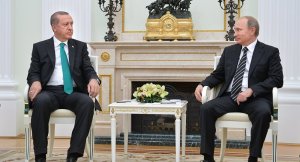 Syrian Kurds have expressed their willingness to cooperate with Russia. This would be a setback for the Turkish President Erdogan, who is seeking to destroy the Kurdistan Workers’ Party (PKK), DWN wrote.
In an interview with al-Monitor, the leader of the Syrian Kurds Salih Muslim announced his willingness to cooperate with Russia and Syrian President Bashar-al-Assad, the newspaper reported.
He said the Syrian Kurds are interested in cooperating with anyone who fights against ISIL. Moreover, Russia had promised the government in Damascus that it would respond to any Turkish intervention in Syria, which many Kurds are afraid of.
The US, in turn, has also been increasingly supportive of cooperation with the Russians. Many US officials believe that Russia could be helpful in their fight against ISIL, which turned out to be more difficult than expected.
However, Turkey fears that Russia’s potential support for the Kurds may lead to a situation in which a new Kurdish region would form along its southern borders and destabilize Turkey. This could result in a further downturn in the relations between Turkey and Russia, which have already deteriorated after an aviation incident at the Turkish border.
On October 3, a Russian Su-30 fighter jet had briefly crossed Turkish airspace due to poor weather conditions. Russian authorities officially apologized for the incident, saying it was a “misunderstanding,” and promised to avoid such incidents in the future.
Photo © Sputnik/ Alexei Druzhinin
On British role in Syria and plans for FT reported ‘safe zones’
By Dr Alexander Yakovenko, Russian Ambassador to the United Kingdom | RT | October 8, 2015
Will Damascus request the British to assist in the same way, I don’t know. But there is another way for the British, and, in fact, everybody else, to carry out airstrikes against ISIS and other terrorists legitimately. It means a UN Security Council mandate, provided in response to the request of the Syrian Government. That is what we are now working on in New York. That is how the British could have their finger in the bombing pie in Syria. Russia is far from pulling this blanket upon herself. We want to work together.
There are other advantages of this course, besides establishing clear-cut objectives and terms of such collective intervention by the international community in Syria. We could agree, in the text of this resolution, on realistic and flexible enough modalities of a political settlement in Syria, which would allow those who left their country to come back and take part in its post-war reconstruction. The latter, by the way, could be a major source of economic growth in the region. What is equally important, this settlement will make it unnecessary for the EU to provide asylum to refugees from Syria.
I’ve read the said FT material. Some would say that it is very much in line with the backstabbing tradition of Western politics. I hope those plans were not serious on the part of our Anglo-American partners, who were able to see our preparations for airstrikes in Syria. The British have a signals intelligence post in Cyprus, just opposite our naval supply station in Syria, an equivalent of a 19th century coaling station. Perhaps, they just couldn’t say ‘no’ to their regional allies. But had it been true, it would have raised a host of serious issues. Because it would have been done behind our backs and in circumvention of the UN Security Council. Some seem eager to get NATO involved. The Alliance, until now, has been out of the picture in Syria, and for good reasons. Those plans, if implemented, would have brought about a de facto partition of Syria. More than that, our partners would have well found themselves in the position of protecting the terrorists.
It is a very dangerous idea. Some players might have harbored it. At least this would explain, why all of a sudden and from nowhere the tide of refugees in Europe this year. Quite likely it was meant to bring the EU on board as regards ‘safe zone’ plans. Now the migration crisis factor works for more realistic assumptions in Europe in respect of the political process in Syria, which cannot proceed while ISIS is there.
But let’s discuss things positively. Among those I can see close cooperation between the Russian and British military. Making common cause in Syria creates mutual trust, establishes mutual control, and provides incentives for both sides to be effective in doing its part of the job. We have just requested our Western partners provide us with their intelligence on the terrorist infrastructure in Syria, if they really think that we strike the wrong targets. We have also requested contact numbers of the Free Syrian Army to help bring it into a united effort to defeat terrorists.
And initial results of our strikes prove that they can be very effective if delivered in earnest, with no other objectives at the back of one’s mind. It also shows that the terrorists took their impunity for granted. In fact, it could be said that the anti-ISIS coalition of 60 (!) states presided over this outfit’s expansion for a whole year, rather than tried hard to stop and destroy it.
I am sure that thus there will be all the conditions in place for us to have a common view of the situation and make joint efforts on that basis. Among other things, it would have provided a welcome opportunity for our and the British military to be allies like we were in WWII. It would drastically change the terrorists’ calculus while doing the same to our relationship, which is in a very bad shape indeed.
Dr Alexander Yakovenko, Russian Ambassador to the United Kingdom of Great Britain and Northern Ireland, Deputy foreign minister (2005-2011). Follow him on Twitter @Amb_Yakovenko
NYT: Putin is “enemy No. 1 in the Sunni Muslim world”
Sputnik – 08.10.2015
In the US information war aimed against the Russian air campaign in Syria, perhaps no outlet has been more misleading than the New York Times.
Writing for America’s newspaper of record, columnist Thomas Friedman wrote fairly candidly of his opinion on Russia’s Syria campaign.
“Putin stupidly went into Syria looking for a cheap sugar high to show his people that Russia is still a world power,” Friedman wrote in the NYT last week. “Watch him become public enemy No. 1 in the Sunni Muslim world. ‘Yo, Vladimir, how’s that working for you?'”
As Patrick L. Smith points out, writing for Salon, “most of ‘the Sunni Muslim world’ is as appalled by the Islamic State as the non-Sunni Muslim world.”
But Friedman’s unfounded statements shouldn’t be altogether surprising, given his employer’s history of toeing the line of the US government.
Since the Russian airstrikes began, the New York Times – as well as the vast majority of Western media – has spread the Pentagon’s falsehoods about the conflicts.
“We are always encouraged to find anything Putin does devious and the outcome of hidden motives and some obscure agenda having to do with his pouting ambition to be seen as a first-rank world leader,” Smith writes.
“From the government-supervised New York Times on down, this is what you read in the newspapers and hear on the radio and television broadcasts.”
So Friedman’s self-described “defense of President Barack Obama’s policy on Syria,” falls in line with that doctrine.
While Friedman may claim to disapprove of the airstrikes because “Putin and Russia would be seen as going all-in to protect Assad, a pro-Iranian, Alawite/Shiite genocidal war criminal,” it’s hard to ignore the true source of such hyperbolic statements.
Friedman’s views – and those of the New York Times – owe allegiance not to truth, but to American empire.
US slams Russia for striking terrorists
Press TV | October 7, 2015
The United States has condemned Russia for striking the Western-backed militants in Syria and denied that it is cooperating with Moscow in this regard.
Speaking at a press conference in Rome, Italy, on Wednesday, US Defense Secretary Ashton Carter called the airstrikes against terrorists “a fundamental mistake”.
“I have said before that we believed that Russia has the wrong strategy — they continue to hit targets that are not ISIL. We believe this is a fundamental mistake,” Carter claimed, using an acronym for the Daesh terrorist group.
“Despite what the Russians say we have not agreed to cooperate with Russia so long as they continue to pursue a mistaken strategy and hit these targets,” he added.
Earlier in the day, the Russian Defense Ministry said it was considering proposals from the US to coordinate operations against ISIL terrorists.
“On the whole, these proposals could be put in place,” defense Ministry spokesman Igor Konashenkov said.
He added that US and Russian military officials were discussing technical details on Wednesday.
“What we will do is continue basic, technical discussions on the professional safety procedures for our pilots flying above Syria,” Carter said.
“That’s it. We will keep the channel open because it’s a matter of safety for our pilots,” he added.
A new US intelligence assessment has found Russia has targeted militant groups backed by the Central Intelligence Agency (CIA) in Syria.
The assessment, shared by commanders on the ground, has led American officials to conclude that Russian warplanes have intentionally struck CIA-backed militants in a string of attacks running for days, the Wall Street Journal reported.
Meanwhile, US foreign policy expert Zbigniew Brzezinski, a strong supporter of the Obama administration, says the United States should retaliate if Russia does not stop bombing its assets in Syria.

Former US national security adviser Zbigniew Brzezinski
Moscow’s apparent decision to strike CIA-trained militants “at best” reflects “Russian military incompetence,” and worst, “evidence of a dangerous desire to highlight American political impotence,” Brzezinski, the national security adviser for former President Jimmy Carter, wrote in an article published by the Financial Times on Sunday.
He added that if Moscow continues to target these people, then Washington should retaliate against Russians.
Obama administration officials are debating how the United States can come to the aid of its proxy forces on the ground without risking a broader conflict, according to the Wall Street Journal.
US officials said Russia’s moves in Syria posed a direct challenge to the Obama administration’s foreign policy on the Middle East.
Obama Boots Syrian Peace Chance
By Robert Parry | Consortium News | October 6, 2015
President Barack Obama is turning his back on possibly the last best chance to resolve the bloody Syrian war because he fears a backlash from Official Washington’s powerful coalition of neoconservatives and “liberal interventionists” along with their foreign fellow-travelers: Israel, Turkey, Saudi Arabia, Qatar and other Gulf sheikdoms.
The route toward peace would be to collaborate with Russia and Iran to get Syrian President Bashar al-Assad to accept a power-sharing unity government that would fairly represent Syria’s major religious and ethnic groups – Christians, Alawites, Shiites and moderate Sunnis – along with a commitment for free, internationally monitored elections once adequate security is restored.
But for such an arrangement to work, Obama also would have to crack down aggressively on U.S. regional “allies” to ensure that they stopped funding, supplying and otherwise assisting the Sunni extremist forces including Al Qaeda’s Nusra Front and the Islamic State (or ISIS). Obama would have to confront the Sunni “allies” – including Saudi Arabia, Qatar and Turkey – as well as Israel.
His pressure would have to include stern action aimed at the global finances of the Gulf states – i.e., seizing their assets as punishment for their continuing support for terrorism – as well as similar sanctions against Turkey, possibly ousting it from NATO if it balked, and a withdrawal of political and financial support for Israel if it continued helping Nusra fighters and viewing Al Qaeda as the “lesser evil” in Syria. [See Consortiumnews.com’s “Al-Qaeda, Saudi Arabia and Israel.”]
Obama also would have to make it clear to Syria’s “moderate” Sunni politicians whom the U.S. government has been subsidizing for the past several years that they must sit down with Assad’s representatives and work out a unity government or the American largess would end.
This combination of strong international pressure on the Sunni terror infrastructure and strong-arming internal players in Syria into a unity government could isolate the Sunni extremists from Al Qaeda and the Islamic State and thus minimize the need for military strikes whether carried out by Russia (against both Al Qaeda and ISIS) or the U.S. coalition (focusing on ISIS).
And, the arrival of Russian military support for the Assad government – as well as the increased backing from Iran and Lebanon’s Hezbollah – represented the moment when the prospect for peace was brightest, whatever one thinks of those various players. However, instead of working with Russian President Vladimir Putin and Iranian President Hassan Rouhani, President Obama chose to bend to the pressures of Official Washington.
Appeasing the Warmongers
Thinking he had stretched the tolerance of neocons and liberal hawks as far as he could by pushing through the nuclear deal with Iran, Obama fell in line behind their propagandistic denunciations of Assad and Putin. Obama’s administration joined in promoting the new favorite “group think” of Washington – that Putin had promised to only bomb the Islamic State and then reneged by attacking “moderate” rebels and their more powerful ally, Al Qaeda’s Nusra Front.
Conveniently, this storyline doesn’t cite the wording of Putin’s supposed “promise” although some articles do mention him vowing to attack “terrorist” groups, which the mainstream U.S. news media has interpreted as the Islamic State only. But this odd framing accepts the breathtaking premise that Al Qaeda is no longer a terrorist organization – apparently rehabilitated by the fact that Israel has been helping Al Qaeda’s affiliate, the Nusra Front, along the Golan Heights and prefers it to Assad’s continued rule. [See Consortiumnews.com’s “Should US Ally with Al Qaeda in Syria?”]
Among the many purveyors of this “Putin lied” narrative is Washington Post columnist Richard Cohen, who on Tuesday repeated the canard that Putin had “promised” to strike only the Islamic State and then broke that promise. For good measure, Cohen added that the Russians had “invaded” Syria although they were formally invited by the recognized government of Syria.
“Yes, the Russians did invade,” Cohen wrote. “They sent war planes, mechanized units and even troops into Syria. They have begun bombing missions, apparently hitting insurgents seeking to topple Syrian leader Bashar al-Assad and not only, as Russian President Vladimir Putin promised, Islamic State units. Putin – surprise! – lied.”
Normally in journalism, before we accuse someone of lying, we show what they actually said and contrast it with the facts. But Official Washington has long since moved Putin into the free-fire zone of demonization. Anything can be said about him, whether based in reality or not, and anyone who objects to this “group think” is called a “Putin bootlicker” or a “Putin apologist.”
Thus, any reality-based skepticism is ruled out of the frame of debate. Such was the way that the United States plunged blindly into the Iraq War in 2003 when Saddam Hussein was the demonized figure and the Europeans who warned President George W. Bush not to invade were laughed at as “Euro-weenies.” American skeptics were “Saddam apologists.”
Inside-Out ‘Logic’
Cohen is back at it again in his Tuesday column, which – on the Internet – has the curious title “The High Cost of Avoiding War in Syria.” Cohen throws around the word “invasion” where Russia is involved – even when there was no “invasion” – but he advocates an actual U.S. invasion with cavalier hypocrisy.
Cohen slams Obama for not having established “a no-fly zone” in Syria earlier, which would have involved the United States bombing and destroying Syria’s air force, a clear act of aggression and an obvious boon to Al Qaeda and ISIS.
Cohen also says he was for “arming the rebels,” another violation of international law which – when tried by Obama to appease the drumbeat from Cohen and his ilk – led to many U.S.-trained and U.S.-armed rebels taking their equipment and skills to Al Qaeda and ISIS.
Yet, Cohen — on the prized opinion real estate of The Washington Post’s op-ed page and in his nationally syndicated column — unapologetically encourages an illegal invasion of another country while condemning Russia for doing the same except that Russia was following international law by working with the sovereign government of Syria and therefore has not “invaded” Syria.
We also are supposed to forget that Cohen’s ideas would benefit Sunni jihadists, such as the Al Qaeda-dominated “Army of Conquest” which could use the “no-fly zones” to mount a victorious offensive to capture Damascus and create a humanitarian crisis even worse than now.
Possibly with ISIS chopping off the heads of “infidels” – Christians, Alawites, Shiites, etc. – and with Al Qaeda having a new home in the center of the Middle East to plot terror strikes on the West, Cohen’s plan might necessitate a major U.S. military intervention that would get even more people killed and deal the final death blow to the American Republic.
In evaluating Cohen’s lame-brained double-think, it is worth remembering that he was one of the many U.S. opinion leaders who cheered on Secretary of State Colin Powell’s deceptive Iraq War speech to the United Nations on Feb. 5, 2003. Waving “we-love-Colin” pompoms alongside all his esteemed colleagues, Cohen laughed at anyone who still doubted that Saddam Hussein possessed hidden WMD stockpiles.
“The evidence he [Powell] presented to the United Nations – some of it circumstantial, some of it absolutely bone-chilling in its detail – had to prove to anyone that Iraq not only hasn’t accounted for its weapons of mass destruction but without a doubt still retains them,” Cohen wrote. “Only a fool – or possibly a Frenchman – could conclude otherwise.”
Ha-ha, did you get that clever line – “Only a fool – or possibly a Frenchman” – pretty funny except that by heaping ridicule on those of us who doubted Powell’s evidence, Cohen contributed to the deaths of some 4,500 U.S. soldiers, the slaughter of hundreds of thousands of Iraqis, the cost to U.S. taxpayers of more than $1 trillion, and chaos now spreading across not just the Middle East but into Europe.
In a normal place where there was some modicum of accountability, you would have expected Cohen to be banished to Storage Room B with his red stapler or worse. But no, Cohen is back running with the same juvenile in-crowd, behaving just as stupidly and just as recklessly as he has many times in the past.
Obama Intimidated
But the larger problem is that President Obama appears intimidated by this collection of know-it-alls who preen across the editorial pages of The Washington Post and The New York Times or who hold down prestigious “fellowships” at the Brookings Institution or other big-name think tanks or who self-identify as “human rights activists” advocating “humanitarian” wars.
Arguably, Obama has always had an outsized regard for people with establishment credentials. It is, after all, how he rose through the ranks as first an extremely bright academic and later a talented orator and politician. Without family connections or personal wealth, he needed the approval of various influential individuals. If he offended them in some way, he risked being pigeonholed as “an angry black man.”
Indeed, the comedy duo Key & Peele developed a series of funny skits with Jordan Peele playing the always proper and controlled Obama and Keegan-Michael Key as “anger translator Luther.” Obama even invited “Luther” to translate Obama’s speech to the 2015 White House Correspondents Dinner, except that by the end of that talk Obama was expressing his own anger and Luther peeled away.
The problem in the real world is that Obama remains cowed by the Important People of Washington – represented in that oh-so-important crowd at the dinner – and bows to their misguided thinking.
Obama also is facing a beefed-up lobbying operation for Saudi Arabia to go along with the always formidable Israel Lobby. The Intercept reported that in September the Saudi kingdom added to its large stable of thoroughbred influence-peddlers by signing “Edelman, the largest privately owned public relations agency in the world [and] the Podesta Group … a lobbying firm founded by Tony Podesta, a major fundraiser for the Hillary Clinton presidential campaign.”
Indeed, the repressive Saudi kingdom may need some special P.R. help as it prepares to behead Ali Mohammed al-Nimr whose body would then be attached to a cross or otherwise displayed in a crucifixion that would leave his corpse to rot for several days as a warning to others. Al-Nimr is a Shiite who at the age of 17 in 2012 participated in a pro-democracy demonstration that was viewed as an affront to the monarchy.
The Saudis also have been waging a ruthless air war against impoverished Yemen, attacking Houthis who stem from a branch of Shia Islam which Saudi Sunni Wahhabism considers apostasy. The Saudi bombing campaign, which recently killed some 131 celebrants at a wedding inside Yemen, gets intelligence and logistical support from the Obama administration even though the slaughter of Houthis has benefited their Yemeni rivals, “Al Qaeda in the Arabian Peninsula” who have gained ground behind the Saudi air offensive.
Diverting Attention
Yet, the Saudis’ P.R. battalions – along with the Israel Lobby – have kept Official Washington’s focus in other directions. Indeed, there are now so many false or dubious narratives dis-informing the capital’s “group think” that U.S. decisions are driven more by mythology than facts.
Obama could begin the process of restoring sanity to Washington by declassifying U.S. intelligence analyses on several key issues. For instance, Obama could release what’s now known about the Aug. 21, 2013 sarin gas attack outside Damascus.
After that attack, there was a rush to judgment at the State Department and within the mainstream U.S. news media to blame that atrocity on Assad’s forces, although I’m told that CIA analysts have since moved away from that view and now agree that the attack was likely a provocation designed to draw the U.S. military into the war on the side of the Sunni jihadists. [See Consortiumnews.com’s “The Collapsing Syria-Sarin Case.”]
Though Obama and other officials have dropped the sarin accusations from their public speeches – harping instead on “barrel bombs” as if those homemade weapons are some uniquely evil device – Obama has refused to retract the sarin allegations which helped shape the hyper-hostile “conventional wisdom” against Assad.
Similarly, Obama has withheld U.S. intelligence information about the July 17, 2014 shoot-down of Malaysia Airlines Flight 17 over eastern Ukraine, letting stand hasty accusations blaming Putin. Obama appears infatuated by the trendy concept of “strategic communications” or “Stratcom,” which blends psy-ops, propaganda and P.R. into one noxious brew to poison public opinion about one’s “enemy.”
With the recent Russian military intervention in Syria, Obama had the chance to correct the record on the sarin-gas attack and the MH-17 shoot-down but instead continued the “Stratcom” both in his United Nations speech and his news conference last Friday with more hyperbolic attacks against Assad and Putin. In doing so, Obama apparently bowed to the desired rhetoric of hardliners like U.S. Ambassador to the UN Samantha Power and the editorial-page masters of The Washington Post and The New York Times.
Obama may have hoped his harsh language would appease the neocons and their liberal-hawk pals, but the tough-guy rhetoric has only opened him up to new attacks over the disparity between his words and deeds. As the clueless columnist Richard Cohen wrote, “A no-fly zone needs to be established. It is not too late to do something. By doing so little, the United States has allowed others to do so much.” [Emphasis in original.]
In other words, Cohen appears to want the U.S. military to shoot down Russian planes over Syria, even though the Russians have been invited by the recognized government to be there and the U.S. has not. The minor complication of possible human extinction from a nuclear war apparently is of little consequence when compared to the street cred that one gets from such manly talk.
For Official Washington – and apparently Obama – the peace option is regarded as unacceptable, i.e., working with Russia and Iran to achieve a power-sharing unity government in Damascus (with the promise of elections as soon as possible) along with the United States demanding from its regional “allies” a complete shutdown of assistance to the Islamic State, Al Qaeda’s Nusra Front and all other Sunni jihadists.
That option would require Obama and the neocon/liberal-hawk cowboys to get down off their high horses, admit they have been tossing their lasso in the wrong direction – and compromise.
Investigative reporter Robert Parry broke many of the Iran-Contra stories for The Associated Press and Newsweek in the 1980s. You can buy his latest book, America’s Stolen Narrative, either in print here or as an e-book (from Amazon and barnesandnoble.com).
Syrian Army Invites Terrorists to Surrender Before Major Operation
Sputnik – 05.10.2015
Syrian air force helicopters dropped leaflets in the south of Hama province, inviting terrorists to surrender and warning civilians about the beginning of a major military operation.
Agitational leaflets were dropped on the territories of Rastan and Talbiseh settlements, currently controlled by Islamic State and Jabhat al-Nusra militants, RIA Novosti reported.
There were two types of dispersed leaflets. One contained a detailed instruction on how to behave when approaching Syrian troops’ checkpoints and urged civilians to leave their homes on the threshold of a forthcoming military operation.
“With this leaflet you are allowed to safely pass Syrian Arab Army checkpoints,” the leaflet for civilians said. “The army will provide food supplies and medical assistance. Cooperate with the Syrian army and leave the war zone for the sake of your own lives.”
In the other leaflet, Syrian citizens who took sides with terrorists were offered to surrender their arms and give up confrontation with the army.
“The future is in front of you, and this is your chance to return to your motherland’s embrace,” it said. “Use this chance before it is too late. Lay down arms just like hundreds did before you. The government will take care of you and welcome your return.”
The Syrian Army is preparing for a major anti-terrorist operation in the south of Hama province, including the settlements of Rastan and Talbiseh, currently controlled by extremists.
The primary goal of the Syrian leadership is to secure a route between the towns of Homs and Hama. The towns are fully controlled by government forces, but settlements between them are considered the main stronghold of terrorists, including ISIL, in this part of Syria.
I Wish Nobody Was Bombing Syria
By Ron Paul | October 5, 2015
The US regime change policy for Syria has been a catastrophe. More than 200,000 killed and an entire country reduced to rubble at least partly because President Obama decided that “Assad has lost his legitimacy.” How is it that the president of a country 6,000 miles away has the authority to decide whether another leader belongs in office or not? What if Rouhani in Iran decided that Obama had lost his legitimacy for killing a number of American citizens by drone without charge or trial? Would we accept that?
At least three years of US efforts to train rebels to overthrow the Syrian government has produced, as General Lloyd Austin, Commander of US Central Command, testified last month, “four or five” trained and vetted “moderates” in Syria. The $500 million appropriated for this purpose has disappeared.
The neocon solution to this failure to overthrow Assad and “degrade and destroy” ISIS is to increase the bombing and lead a ground invasion of Syria. The confusing policy of fighting Assad and also fighting his enemies does not seem to bother the neocons. They want us to forget all about their recent failures in Libya and Iraq and to try the same failed strategy one more time.
But something dramatic happened last week. Russian president Vladimir Putin delivered a speech at the United Nations criticizing the US policy of partnering with one set of extremists – al-Qaeda and its allies – to attack both ISIS and Assad. “Do you realize now what you have done?” asked Putin.
Shortly after Putin’s UN speech, he requested and was granted authority from the Russian parliament to use force in Syria in response to the Syrian government’s request for assistance against the rebels. Russian fighters and bombers began flying sorties over Syria almost immediately. In less than a week of Russian bombing, considerable damage appears to have been done to both ISIS and to al-Qaeda affiliates – some of which are considered allies by the US and were actually trained by the CIA.
It may be tempting to cheer Russian military action in Syria, as it seems ISIS is finally suffering some considerable losses. Press reports suggest large numbers of desertions in their ranks after the Russian attacks. All of a sudden what looked to be an inevitable ISIS takeover of Syria once Assad was overthrown, seems far less likely with the Russians on the scene.
But I cannot cheer the bombs, whether they are Russian bombs or US bombs or French or British bombs. I do not believe a terrorist group created by foreign intervention in the region will be solved by more foreign intervention in the region. Bombs represent a total failure of policy. They destroy a country’s economy and infrastructure.
I wish the American people would finally demand that their government end its destructive policy of trying to change any regime that does not bow to Washington’s demands. I wish Congress respected our Constitution enough to demand that the president seek a declaration of war before attacking a foreign country. I wish President Bush and his neocon advisors had never decided to overthrow the Syrian government. I wish President Obama had fired the neocons who led him from one foolish intervention to another. I wish the CIA had not trained rebels to fight alongside al-Qaeda in Syria. I wish we would reject the shrill cries of the warmongers. I wish the US media was more than just a propaganda arm of the US government.
I am not thrilled that Russia is bombing Syria. I wish nobody was bombing Syria.
Featured Video
New positive ivermectin evidence
or go to
Aletho News Archives – Video-Images
From the Archives
Fanatical Followers of the Covid Regime: A Jim Jones-Style Cult?
By Professor Roger Watson and Dr. Niall McCrae | The Daily Sceptic | November 15, 2021
As scholars at leading British universities over recent decades, we witnessed the replacement of critical thinking and debate by narrative: facts are discrimination and scientific method is imperialism; truth, instead, is derived from ‘progressive’ values. This educational trend may be a major contributory factor to the ease in which society has been inculcated to the Covid ‘new normal’ of masking, testing, and repeated doses of vaccines for a disease of similar risk to severe influenza.
One doesn’t need much critical reasoning to observe the flawed logic of some vaccination enthusiasts, such as people who respond to experiencing any side effects, however debilitating, by saying “at least I know it’s working”, or, after contracting the disease despite their promised inoculation (over 90% effective, according to initial drug company claims), “I’d have been worse off without the jab.” … continue
Blog Roll
 Aletho News
- EU Council Advances Chat Control 2.0 Scanning Proposal
- Ex-Greek MEP files complaint against Israeli spyware firm over alleged Pegasus surveillance
- Troubling ideas throughout the Torah, Talmud, Mishneh Torah and Tanya
- ‘Grave, alarming’: Iran mission on Trump’s UNGA ‘annihilation’ threats
- Najaf airport to reopen to Iranian flights within 24 hours: Ambassador
- From ‘How Will This End For Iran’ to ‘When America Walks Away’: A tale of two Economist covers
- Tehran blasts ‘baseless’ speculation linking Iran to alleged bomb plot at UK air base
- The Rise And… Rise Of ‘Color Revolutions’
- The Coming GOP Bloodbath?
- Arctic Scare Stories Melt Away
- If Americans Knew
- Netanyahu Asked UAE Leader to Deny Report on Oct. 7 Warning in Secret Visit, Sources Say
- CNN Chief Int’l Correspondent Clarissa Ward on Journalists in Gaza
- Democratic Party Consultants Surround Troy Jackson with Pro-Israel Donors
- Christian Leader Responds To Netanyahu’s Claims Regarding Palestinian Christians
- In Gaza, ‘Whoever Survives the Bombing Won’t Survive the Rubble’
- Israel kills more Palestinians, amid push to resettle Gaza – Daily Update
- Israel forces Gazans to live in constant peril – Daily Update
- Deconstructing Netanyahu’s pants-on-fire UN rant – Daily Update
- Trump betrayed voters with his campaign lies and prioritized a foreign country once he took office
- Netanyahu calls Israel’s war in Gaza ‘opposite of genocide’ in UN speech to near-empty hall
- No Tricks Zone
- New Study: Earth And Venus Surface Warmth Largely Explained By Convection And Lapse Rate, Not CO2 Or Radiation
- 2025 Nature Paper Claiming Worsening Global Drought Gets RETRACTED …Heavily Flawed
- New Study: ‘Global Drought Shows No Detectable Recent Acceleration Under Climate Warming’
- Economic Masterminds: German Socialists Suggest Taxing Productivity Gains Stemming From Using AI
- The South China Sea Has Not Been Cooperating With The Climate Change Narrative
- Energy Crisis: Germany Enters Heating Season With Historically Low Gas Reserve Fill Levels
- New Study: The Antarctic Ice Sheet Gained Mass From 2020-2024 Due To Staggering Snow And Ice Accumulation
- Study: Ocean Heating Rates From Thousands Of Years Ago ‘Dwarf’ Modern Ocean Heating Rates
- Climate Extremists Target, Attack Large-Scale Power Grid Infrastructure In Germany!
- New Study: Antarctic Ice Melt Has Contributed Less Than 1 Centimeter To Sea Level Rise In The Last 30 Years

