Putin interview to Charlie Rose in the run-up to his address at the UN General Assembly’s 70th session
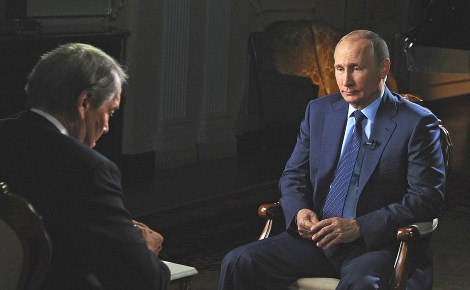
Full text of the interview will be published on September 29.
* * *
CHARLIE ROSE: You will speak to the United Nations in a much-anticipated address on Monday. It will be the first time you have been there in a number of years. What will you say to the UN, to America, to the world?
VLADIMIR PUTIN: Since this interview will be aired prior to my speech, I do not think it reasonable to go into much detail about everything I am going to speak about, but, broadly, I will certainly mention some facts from the history of the United Nations. Now I can already tell you that the decision to establish the United Nations was taken in our country at the Yalta Conference. It was in the Soviet Union that this decision was made. The Soviet Union, and Russia as the successor state to the Soviet Union, is a founding member state of the United Nations and a permanent member of its Security Council.
Of course, I will have to say a few words about the present day, about the evolving international situation, about the fact that the United Nations remains the sole universal international organisation designed to maintain global peace. And in this sense it has no alternative today. It is also apparent that it should adapt to the ever-changing world, which we discuss all the time: how it should evolve and at what rate, which components should undergo qualitative changes. Of course, I will have to or rather should use this international platform to explain Russia’s vision of today’s international relations, as well as the future of this organisation and the global community.
CHARLIE ROSE: We are expecting you to speak about the threat of the Islamic State and your presence in Syria that is related to that. What is the purpose of your presence in Syria and how does that relate to the challenge of ISIS?
VLADIMIR PUTIN: I believe, I am pretty certain that virtually everyone speaking from the United Nations platform is going to talk about the fight, about the need to fight terrorism, and I cannot avoid this issue, either. This is quite understandable because it is a serious common threat to all of us; it is a common challenge to all of us. Today, terrorism threatens a great number of states, a great number of people – hundreds of thousands, millions of people suffer from its criminal activity. And we all face the task of joining our efforts in the fight against this common evil.
Concerning our, as you put it, presence in Syria, as of today it has taken the form of weapons supplies to the Syrian government, personnel training and humanitarian aid to the Syrian people. We act based on the United Nations Charter, i.e. the fundamental principles of modern international law, according to which this or that type of aid, including military assistance, can and must be provided exclusively to legitimate government of one country or another, upon its consent or request, or upon the decision of the United Nations Security Council. In this particular case, we act based on the request from the Syrian government to provide military and technical assistance, which we deliver under entirely legal international contracts.
CHARLIE ROSE: The Secretary of State John Kerry said that the United States welcomed your assistance in the fight against the Islamic State. Others have taken note of the fact that these are combat planes and manpad systems that are being used against the conventional army, not extremists.
VLADIMIR PUTIN: There is only one regular army there. That is the army of Syrian President al-Assad. And he is confronted with what some of our international partners interpret as an opposition. In reality, al-Assad’s army is fighting against terrorist organisations. You should know better than me about the hearings that have just taken place in the United States Senate, where the military and Pentagon representatives, if I am not mistaken, reported to the senators about what the United States had done to train the combat part of the opposition forces. The initial aim was to train between 5,000 and 6,000 fighters, and then 12,000 more. It turns out that only 60 of these fighters have been properly trained, and as few as 4 or 5 people actually carry weapons, while the rest of them have deserted with the American weapons to join ISIS. That is the first point.
Secondly, in my opinion, provision of military support to illegal structures runs counter to the principles of modern international law and the United Nations Charter. We have been providing assistance to legitimate government entities only.
In this connection, we have proposed cooperation to the countries in the region, we are trying to establish some kind of coordination framework. I personally informed the President of Turkey, the King of Jordan, as well as the Saudi Arabia of that, we informed the United States too, and Mr Kerry, whom you have mentioned, had an in-depth conversation with our Foreign Minister Sergei Lavrov on this matter; besides, our military stay in touch and discuss this issue. We would welcome a common platform for collective action against the terrorists.
<…>
CHARLIE ROSE: Are you ready to join forces with the United States against ISIS and is it why you are in Syria? Others believe that it might be part of your goal, that you are trying to save President al-Assad’s administration because they have been losing ground and the war has not been going well for them, and you are there to rescue them.
VLADIMIR PUTIN: That’s right, that’s how it is. We provide assistance to legitimate Syrian authorities. Moreover, I strongly believe that by acting otherwise, acting to destroy the legitimate bodies of power we would create a situation that we are witnessing today in other countries of the region or in other regions of the world, for instance, in Libya, where all state institutions have completely disintegrated.
Unfortunately, we are witnessing a similar situation in Iraq. There is no other way to settle the Syrian conflict other than by strengthening the existing legitimate government agencies, support them in their fight against terrorism and, of course, at the same time encourage them to start a positive dialogue with the “healthy” part of the opposition and launch political transformations.
CHARLIE ROSE: As you know, some coalition partners want al-Assad to go before they can support the government.
VLADIMIR PUTIN: I would like to advise or recommend them to forward this suggestion to the Syrian people. It is only up to the Syrian people living in Syria to determine who, how and based on what principles should rule their country.
CHARLIE ROSE: Do you support what President al-Assad is doing in Syria and what is happening to those Syrians, to those millions of refugees, to hundreds of thousands of people who have been killed and many – by his own force?
VLADIMIR PUTIN: And do you think that those who support the armed opposition and, mainly, terrorist organisations just in order to overthrow al-Assad without thinking of what awaits the country after the complete destruction of state institutions are doing the right thing?
Time and again, with perseverance worthy of a better cause, you are talking about the Syrian army fighting against its people. But take a look at those who control 60 percent of Syrian territory. Where is that civilised opposition? 60 percent of Syria is controlled either by ISIS, Jabhat al-Nusra or other terrorist organisations, organisations that have been recognised as terrorist by the United States, as well as other countries and the UN.
CHARLIE ROSE: Would Russia deploy its combat troops in Syria if it is necessary to defeat ISIS?
VLADIMIR PUTIN: Russia will not take part in any field operations on the territory of Syria or in other states; at least, we do not plan it for now. But we are thinking of how to intensify our work both with President al-Assad and our partners in other countries.
CHARLIE ROSE: As we come back to the problem of many people considering that al-Assad is helping ISIS, that his terrible attitude towards the Syrian people and the use of barrel bombs and other actions are helping ISIS, and if he is removed, the transition period would be better at some point for the purposes of fighting ISIS.
VLADIMIR PUTIN: In secret services’ parlance, I can say that such an assessment is a blatant act by al-Assad’s enemies. It is anti-Syrian propaganda.
CHARLIE ROSE: This wording is very broad, among other things, it can mean new efforts by Russia to take up the leadership role in the Middle East and it can mean that it represents your new strategy. Is it really a new strategy?
VLADIMIR PUTIN: No. There are more than 2,000 militants in Syria from the former Soviet Union. So instead of waiting for them to return back home we should help President al-Assad fight them there, in Syria. This is the main incentive that impels us to help President al-Assad.
In general, we want the situation in the region to stabilize.
CHARLIE ROSE: You are proud of Russia and it means that you want Russia to play a more significant role in the world. This is just one of the examples.
VLADIMIR PUTIN: This is not an end in itself. I am proud of Russia. We have much to be proud of. But we have no obsession that Russia must be a super power in the international arena.
CHARLIE ROSE: But you are a major power because of the nuclear weapons you possess. You are a force to be reckoned with.
VLADIMIR PUTIN: I hope so (laughing), otherwise what are these weapons for?
The Ukrainian issue is a separate huge issue for us, I will tell you why. Ukraine is the closest country to us. We have always said that Ukraine is our sister country and it is true. It is not just a Slavic people, it is the closest people to Russia: we have similar languages, culture, common history, religion etc.
Here is what I believe is completely unacceptable for us. Addressing issues, including controversial ones, as well as domestic issues of the former Soviet Republics through the so-called coloured revolutions, through coups and unconstitutional means of toppling the current government. That is absolutely unacceptable. Our partners in the United States are not trying to hide the fact that they supported those opposed to President Yanukovych.
CHARLIE ROSE: You believe the United States had something to do with the ousting of Yanukovych, when he had to flee to Russia?
VLADIMIR PUTIN.: I know this for sure.
CHARLIE ROSE: How can you know for sure?
VLADIMIR PUTIN: It is very simple. We have thousands of contacts and thousands of connections with people who live in Ukraine. And we know who had meetings and worked with people who overthrew Viktor Yanukovych, as well as when and where they did it; we know the ways the assistance was provided, we know how much they paid them, we know which territories and countries hosted trainings and how it was done, we know who the instructors were. We know everything. Well, actually, our US partners are not keeping it a secret.
CHARLIE ROSE: Do you respect the sovereignty of Ukraine?
VLADIMIR PUTIN: Certainly. However, we would like other countries to respect the sovereignty of other states, including Ukraine, too. Respecting the sovereignty means preventing coups, unconstitutional actions and illegitimate overthrowing of the legitimate government.
CHARLIE ROSE: How does the renewal of the legitimate power take place in your judgment? How will that come about? And what role will Russia play?
VLADIMIR PUTIN: At no time in the past, now or in the future has or will Russia take any part in actions aimed at overthrowing the legitimate government.
CHARLIE ROSE: Did you have to use the military force to accomplish that objective?
VLADIMIR PUTIN: Of course, no.
CHARLIE ROSE: Russia has military presence on the borders with Ukraine, and some argue that there have been Russian troops in Ukraine itself.
VLADIMIR PUTIN: Do you have a military presence in Europe?
CHARLIE ROSE: Yes.
VLADIMIR PUTIN: The U.S. tactical nuclear weapons are in Europe, let us not forget this. Does it mean that the U.S. has occupied Germany or that the U.S. never stopped the occupation after World War II and only transformed the occupation troops into the NATO forces? And if we keep our troops on our territory on the border with some state, you see it is a crime?
CHARLIE ROSE: As you know, you are very much talked about in America.
VLADIMIR PUTIN: Do they not have anything else to do? ( Laughs.)
CHARLIE ROSE: Or maybe they are curious people? Or maybe you are an interesting character, maybe that is what it is? They know that you were the KGB agent, who retired and got into politics. In St. Petersburg you became deputy mayor, then moved to Moscow. And the interesting thing is that they see these images of you, bare-chested man on horseback, and they say there is a man who carefully cultivates his image of strength.
You enjoy the work, you enjoy representing Russia, and I know you have been an intelligence officer. Intelligence officer knows how to read other people; that’s part of the job, right?
VLADIMIR PUTIN: It used to be my job. Now I have a different job and for quite a while already.
CHARLIE ROSE: Someone in Russia told me, “There is no such thing as a former KGB man. Once a KGB man, always a KGB man.”
VLADIMIR PUTIN: You know every stage of your life has an impact on you. Whatever we do, all the knowledge, the experience, they stay with us, we carry them on, use them in one way or another. In this sense, yes, you are right.
CHARLIE ROSE: Once, somebody from the CIA told me that the training you have is important, that you learn to be liked as well. Because you have to charm people, you have to seduce them.
VLADIMIR PUTIN: Well, if the CIA told you so, then it must be true. They are experts on that. (Laughing)
CHARLIE ROSE: The popularity rating you have in Russia, I believe, makes every politician in the world envious. Why are you so popular?
VLADIMIR PUTIN: There is something that unites me and other citizens of Russia. It is love for our Motherland.
CHARLIE ROSE: It was an emotional moment at the time of the [World War II Memory], because of the sacrifices Russia had made. And you were staying with a picture of your father with tears in your eyes.
VLADIMIR PUTIN: Yes, my family and my relatives as a whole suffered heavy losses during the Second World War. That is true. In my father’s family there were five brothers and four of them were killed, I believe. On my mother’s side the situation is much the same. In general, Russia suffered heavily. No doubt, we cannot forget that and we must not forget, not to accuse anyone but to ensure that nothing of the kind ever happens again.
CHARLIE ROSE: You also said that the worst thing that happened in the last century was the disintegration of the Soviet Union, the Soviet empire. There are those who look at Ukraine and Georgia and think that you do not want to recreate the Soviet empire, but you do want to recreate a sphere of influence, which, you think, Russia deserves because of the relationship that has existed. Why are you smiling?
VLADIMIR PUTIN: (Laughing) Your questions make me happy. Somebody is always suspecting Russia of having some ambitions, there are always those who are trying to misinterpret us or keep something back. I did say that I see the collapse of the Soviet Union as a great tragedy of the XX century. Do you know why? First of all, because 25 million of Russian people suddenly turned out to be outside the borders of the Russian Federation. They used to live in one state; the Soviet Union has traditionally been called Russia, the Soviet Russia, and it was the great Russia. They used to live in one country and suddenly found themselves abroad. Can you imagine how many problems came out?
First, there were everyday issues, the separation of families, the economic and social problems. The list is endless. Do you think it is normal that 25 million people, Russian people, suddenly found themselves abroad? The Russians have turned out to be the largest divided nation in the world nowadays. Is that not a problem? It is not a problem for you as it is for me.
CHARLIE ROSE: As far as we know, you are very popular, but, forgive me, there are many people who are very critical towards you in Russia. As you know, they say it is more autocratic than democratic. They say that political opponents and journalists had been killed and imprisoned in Russia. They say your power is unchallenged. And they say that power, an absolute power corrupts absolutely. What would you say to those people who worry about the climate, the atmosphere in Russia?
VLADIMIR PUTIN: There can be no democracy without observing the law and everyone must observe it – that is the most basic and important thing that we all should remember.
As for those tragic incidents as losses of lives, including those of the journalists, unfortunately, it happens in all countries around the world. But if it occurs in Russia, we take every step possible to ensure that the perpetrators are found, identified and punished. We will work on all issues in the same way.
But the most important thing is that we will continue improving our political system so that people and every citizen will feel that they can influence the life of state and society, they can influence the authorities, and so that the authorities will be aware of their responsibility before those people who gave their confidence to the representatives of the authorities in the elections.
CHARLIE ROSE: If you as the leader of this country insist that the rule of law be observed, if you insist that justice be done, if you because of your power do that, then it could go a long way eliminating that perception.
VLADIMIR PUTIN: A lot can be done, but not everyone immediately succeeds in everything. How long has it taken the democratic process to develop in the United States? Since it was founded. So, do you think that as regards democracy everything is settled now in America? If this were so, there would be no Ferguson issue, right? There would be no other issues of similar kind, there would be no police abuse.
Our goal is to see all these issues and respond to them timely and properly. The same applies to Russia. We also have a lot of problems.
CHARLIE ROSE: Are you curious about America more than simply another nation that you have to deal with?
VLADIMIR PUTIN: It is interesting for us to know what is happening in the US. America has a strong influence on the situation in the world in general.
CHARLIE ROSE: What do you like most about America?
VLADIMIR PUTIN: America’s creative approach to solving the problems the country is faced with, its openness and open-mindedness which make it possible to unleash the potential of the people. I believe that largely due to these qualities America has made such tremendous strides in its development.
CHARLIE ROSE: What do you think of President Obama? What is your evaluation of him?
VLADIMIR PUTIN: I do not think I am entitled to assess the President of the United States. This is up to the American people.
CHARLIE ROSE: Do you think his activities in foreign affairs reflect a weakness?
VLADIMIR PUTIN: Why? I do not think so at all. The point is that in any country, including the United States, may be in the United States even more often than in any other country, foreign policy is used for internal political struggle. An election campaign will soon start in the United States. They always play either Russian card or any other.
CHARLIE ROSE: Let me ask you this question: Do you think he listens to you?
VLADIMIR PUTIN: I think that we all listen to each other when it does not contradict our own ideas of what we should and should not do.
CHARLIE ROSE: You said Russia is not a super power. Do you think he considers Russia an equal? Considers you an equal? Which is the way you want to be treated?
VLADIMIR PUTIN: (Laughing) Ask him, he is your President! How can I know what he thinks?
CHARLIE ROSE: Are you watching the Republican political debates?
VLADIMIR PUTIN: If you ask me whether I watch them on a daily basis – I would say no.
CHARLIE ROSE: Marco Rubio is running for a Republican nomination and he said you were a gangster.
VLADIMIR PUTIN: How can I be a gangster, if I worked for the KGB? It is absolutely ridiculous.
CHARLIE ROSE: Are people in Russia fearful of you?
VLADIMIR PUTIN: I do not think so. I assume most people trust me, if they vote for me in elections. And it is the most important thing. It places great responsibility on me, immense responsibility. I am grateful to the people for that trust, but I surely feel great responsibility for what I do and for the result of my work.
<…>
Putin slams ‘illegal’ US support for militants in Syria
Press TV | September 27, 2015
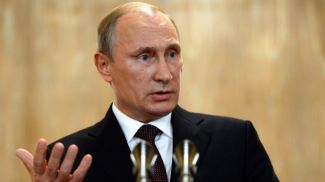 Russian President Vladimir Putin has denounced US support for militants in Syria as illegal and ineffective.
“In my opinion, provision of military support to illegal structures runs counter to the principles of modern international law and the United Nations Charter,” he told US media on Sunday ahead of a meeting with President Barack Obama.
The Russian leader said that Syrian President Bashar al-Assad deserves international support because he is fighting terrorist organizations, Reuters reported.
Putin said that Russia’s support for the Assad government was in accordance with the UN Charter, since “we have been providing assistance to legitimate government entities only.”
Russian support has come in the form of “weapons supplies to the Syrian government, personnel training and humanitarian aid to the Syrian people,” he stated.
The Russian president then pointed to the Pentagon’s $500 million program to train and equip militants in Syria, which US military and intelligence officials have branded as a failure.
“It turns out that only 60 of these fighters have been properly trained, and as few as four or five people actually carry weapons,” Putin said. “The rest of them have deserted with the American weapons to join ISIS,” he said, using another acronym for the Daesh (ISIL) terrorist group.
Obama and Putin are set to meet on Monday after Putin’s much-anticipated speech at the 70th UN General Assembly in New York, 10 years after his last speech at the annual event.
According to the Kremlin’s press secretary, Syria will be topping the agenda of the meeting. “If there is enough time,” the Ukrainian conflict will also be discussed, Dmitry Peskov said.
Russia has been beefing up its military presence in Syria, equipping Damascus with advanced military aircraft such as the Mikoyan MiG-31 fighter jets and and other sophisticated equipment.
A secret US intelligence assessment predicts that Russia will launch military strikes in Syria to boost the Syrian government and stop advances by Daesh terrorists.
The intelligence, provided to the White House, says the airstrikes would be carried out by Russian fighter jets that were flown to Syria over the last week, The Los Angeles Times reported.
US officials said Russia moved warplanes to a base near the coastal city of Latakia last week. Russia has also stationed T-90 tanks there, and has increased the number of its military flights to the same airfield.
Moscow’s military support for Assad, however, goes against the current US policy, which calls for the Syrian president’s ouster.
Correcting America’s mistakes in Syria, a wish list
By Camille Alexandre Otrakji
Dear American friends who are reporting on, analyzing, or advising decision makers on Syria,
No one is expecting you to “Support Assad”, just like you really shouldn’t have wasted the past four years committed to supporting Assad’s adversaries and opponents.
- You started (summer 2011) by working with your allies (especially the French) to pass a security council resolution that would authorize you to use force in Syria against the Syrian army. You only stopped after repeated vetoes by Russia and China.
- You recognized the Syrian National Council as “legitimate representative of the Syrian people”, then you recognized the Syrian National Coalition. Both groups included opposition characters that were selected and managed by you, the French and your Gulf Arab state allies. “The Syrian people” had zero input in the selection process. Both groups included secular faces but the real power behind them was the Muslim Brotherhood, an organization with a criminal past and present … An organization that refused to support war on ISIS. An organization that bullied then alienated many of the liberals, women and minorities in Syrian opposition.
- You boycotted (or rarely interacted with) millions of Syrians who supported their government against your favorite side in the Syrian conflict (“the opposition”). Syrian visa applicants who did not support “the revolution” in US consulates had to answer and almost apologize to your immigration officers who asked them why are they not on America’s side in the Syrian conflict.
- Your media and analysts simply followed your state department’s directives. CNN and the Washington post mobilized in favor of anyone who would carry arms against the Syrian army. CFR and other think tanks discussed openly the need to work with Al-Qaeda (Annusra) in order to defeat the regime. Large numbers of American activists (a mix of those naturally inspired, and many others who are paid to write against Assad) worked relentlessly on social media platforms to attack, humiliate and discredit any Syrian or non Syrian who advocated dialogue as a way to end the conflict. Your passionate warmongers included the leftists (“we are here to help the Syrian people”) and the neocons (“We should teach Assad a lesson”).
- You know that there is no proof and there is no logic behind accusations that “Assad” used chemical weapons, yet you continued to use it as a pressure tool against Assad, despite the resulting escalation in hate and violence among the Syrian people that your regime-demonization propaganda was contributing to.
The United States does not need to do a 180 degree turn (and it will not). Here is how a 90 degree adjustment can lead to a more constructive role in the exceptionally complex and dangerous Syrian crisis.
- Do not recognize ANYONE of being the legitimate representative of the Syrian people. There are millions of Syrians who support Assad/government/the army. There are millions of Syrians who support the opposition. There are millions of Syrians who do not care about politics. They just want to go back to normal life.
- Everyone contributed to violence. No, Assad is not the main culprit. Before 2011, he ruled Syria for 11 years without killing anyone. He reduced the number of political prisoners from an estimated 1,300 in 2001, to an estimated 200 in 2010. Everyone, starting with the United States, is responsible for what happened after 2011. If you are not planning to demonize yourself, please try to realize that it is only fair to not demonize anyone. If you want a quantification of the size of your responsibility, try to imagine the recently revealed (by the Washington Post ) details about your covert CIA Syria annual budget of $1 billion… Did you buy anything good with that yearly investment?
- If you insist on calling Assad “The ruthless Syrian dictator”, please make sure you call Syrian opposition figures “ruthless corrupt, weak, naive, sectarian, vengeful, and utterly useless Syrian opposition figure”. Or better, avoid the negativity on both sides.
- Forget the past. If your allegations (unproven) of a Syrian role in the attack on US marines in Beirut in 1983 (32 years ago) is still bothering you, why not take it out on the Saudis for their more certain role in 9/11, or why not first punish yourself for the millions of Iraqis who died because of “mistakes” by previous US administrations… you lost hundreds. others lost millions … they are not seeking revenge.
- The end does NOT justify the means. If you are dying to spread democracy, remember that there are millions of other ideologues who are equally eager to spread communism, or their fanatic interpretations of Islam … Everyone believes in salvation through his ideology.
- Democracy is not working too well in most countries. Lebanon and Iraq (your democratic allies in the Arab world) are even more corrupt than authoritarian Syria. Instead of promoting democracy, try to promote the foundations on which democracy can be later successfully established. Promote the separation of religion and state in Syria. Promote tolerance and respect of opinions that differ. Promote women’s rights. Promote freedom of speech (which Lebanon and Iraq have, and so should Syria).
- Reopen your embassy in Damascus. This time direct your diplomats (and security officers) to work for peace and reconciliation. U.S. interests will be better served that way. Regime supporters, rational opposition, and the larger segment of Syrians who are neutral, will all thank you.
- Close the Facebook page of the US embassy in Damascus, or replace its current immature editor(s).
- Call on all sides to join you in admitting their mistakes. Everyday that you all wait before you radically change, hundreds of innocent Syrians will die.
- When you work with regional and international actors, please try to respect the desires of the majority of Syrians who do not wish to become an American, Russian, Iranian, Saudi, Turkish or Qatari satellite. There will be a long term, costly, resistance to any proposal that gives outside powers an exceptional influence in Syria. Please do not waste time and innocent lives. Syrians do not wish to be a Jordan or a Lebanon. You do not want Syria to be a bigger Lebanon that borders (and constantly exports its problems to) your allies to the north, east, south and east or Syria.
- You want what’s good for the Syrian people? While it is hard to find a clear majority of Syrians agreeing on the question of regime change, there is little doubt that the vast majority of Syrians want the Golan Heights back (illegally occupied by Israel since 1967). They want economic prosperity… ending torture … freedom of press with responsibilities (no sectarianization, no promotion of hate or violence… ), they want to fight corruption … they want a more accountable government. You surely can help by pressuring Israel to return the Golan, by economic assistance to Syria, and by pressuring the Syrian government AND Syrian opposition to respect those truly popular demands (and not only the issues the US and its Syrian opposition allies always used to demonize the regime and only the regime).
- Oh … can you start by ending economic sanctions that you placed in 1979 (to punish Syria for its resistance to the Camp David accord)? … you are not hurting “the regime” with those sanctions … you are killing innocent Syrians instead. Remember that your sanctions killed hundreds of thousands of Iraqi children during the nineties.
Here is the the preamble to the 1789 American constitution: “We the People of the United States, in Order to form a more perfect Union, establish Justice, insure domestic Tranquility, provide for the common defense, promote the general Welfare, and secure the Blessings of Liberty to ourselves and our Posterity, do ordain and establish this Constitution for the United States of America.”
Eighty one years later (on February 3, 1870) the 15th amendment that granted African Americans the right to vote was ratified.
One hundred and thirty one years later (on August 18, 1920), the 19th amendment that guarantees all American women the right to vote was ratified.
Please be careful with Syria. Change takes time and planning. It takes a favorable regional environment… and it takes realism. 120-min Hollywood or Disney fairy tale movies (“the Arab Spring”) are not going to lead to a happy ending in a country as complex as Syria.
Russia, Iran, Iraq & Syria setting up ‘joint information center’ to coordinate anti-ISIS operations
RT | September 26, 2015
Russia, Iran, Iraq and Syria have agreed to establish a joint information center in Baghdad to coordinate their operations against Islamic State (IS, formerly ISIL/ISIS) militants, according to sources.
“The main goal of the center will be gathering, processing and analyzing current information about the situation in the Middle East – primarily for fighting IS,” a military-diplomatic source told Russian news agencies on Saturday.
The information center in the Iraqi capital will be headed by an officer of one of the founding countries on a rotating basis. Rotation will take place every three months. According to the source, Iraq will run the center for the next three months.
Russia, Iran, Iraq and Syria may also use the information center to coordinate anti-IS combat plans, the source said, adding that the agreement is a milestone for uniting the region’s countries in the war on terrorism – primarily on Islamic State militants.
On Friday, the US TV-Channel Fox News reported the four countries were establishing a “coordination cell” in Baghdad, but Dmitry Peskov, spokesman for Vladimir Putin, denied this. “We have already said there are many reports which are not true,” he told news agencies.
Recent media reports indicate Russia is boosting its cooperation with Syria and other Middle East countries in the fight against terrorism.
Western media say Russia is sending warplanes and tanks to Syria and building a military base in Latakia, but Russian officials deny this, saying Moscow is continuing to supply Syria with weapons in accordance with bilateral contracts.
“Russia has never made a secret of military-technical cooperation with Syria. Our country has long been supplying weapons and military equipment to Syria under the existing bilateral contracts,” Foreign Ministry spokeswoman Maria Zakharova said in a statement on September 9.
Syria hopes that Russia’s counter-terror policy will be more effective than the US-led anti-IS coalition.
“Moscow is acting within the framework of international law, respecting the sovereignty of our country and in coordination with Syria,” Syrian Foreign Minister Walid Muallem told RT. “We do not hide anything under the table. We regard Russia as our friend and strategic ally which is honest in its actions.”
Russia has long insisted on the creation of an international anti-terrorist coalition, to coordinate the efforts with the Syrian Army in combating the jihadists on the ground.
How To Solve The European Migrant/Refugee Crisis – 5 Simple Steps
Storm Clouds Gathering | September 25, 2015
The refugee crisis in Europe could be easily solved. The problem is that the real solution would not suit the the political establishment of the United States or Western Europe. We’ve distilled what needs to be done down to 5 simple steps.
- Stop funding and arming rebel groups attempting to overthrow the Syrian government. It’s well established that these weapons have been ending up in the hands of ISIS and its affiliates. This has caused nothing but chaos and destruction. Money being funneled into these shady operations should be immediately redirected to an intensive reconstruction effort.
- Pressure Turkey and Jordan to cut off ISIS supply routes, and impose sanctions on any country facilitating the sale of oil from IS territory or allowing funds or materials to reach them. No army can function if their supply chain is broken. It’s not an accident these routes start at the Turkish and Jordanian borders.
- Support the Syrian government. An entire year of U.S. airstrikes in Syria have utterly failed to destroy or even significantly weaken ISIS. Of course this is because the real strategy isn’t to bring ISIS down, but rather to contain them and allow them to weaken Assad gradually. If Washington really wanted to stop this group, they would take a hint from Russia and provide the Syrian government with weapons, training and logistical support to enable them to push ISIS back. This means Washington and its allies would have to officially abandon all plans for a forced regime change. They might not like Assad, but the majority of the citizens of Syria support him. In fact he has more support within his country than Obama or the U.S. congress have in America. And at various intervals he’s had more support than Congress and Obama combined. Any government installed after a U.S. backed regime change will be viewed as a puppet government, and will therefore lack the legitimacy needed to stabilize the region. If you need evidence of this, just look at Afghanistan or Iraq.
- Provide direct assistance to rebuild housing, infrastructure and businesses destroyed by the conflict. In the short term temporary refugee camps should be set up in areas outside of the conflict zone, and food and medical supplies shipped in on a regular basis. Yes this will cost money, but so has the five year regime change push that created the problem in the first place.
- Return the refugees to these stabilized regions. It is in no one’s interest to flood Europe with masses of unemployed refugees. Doing so will only lead to heightened tensions and will strengthen xenophobic movements. These people don’t need to be transplanted into the ghettos of Europe, they need their homes back.
Russia Checks Western Lies on Syria
By Finian Cunningham | Sputnik | September 25, 2015
You have to hand it to Russia. In recent weeks, one move after another by Moscow over the Syrian crisis could be accompanied by the audible word “check”, leaving Washington and its minions grappling with disorientation about how to respond to the Russian moves.
At the heart of the West’s disorientation what is being exposed is its glaring criminal deceptions over Syria.
This week, Russian foreign ministry spokeswoman Maria Zahkarova probed the Western rationale towards Syria with this incisive proposition.
She said that if Washington insists that Syrian President Bashar al-Assad should stand down, then the United States government should henceforth remove its signature from the 2012 Geneva Communiqué. The same logical ultimatum applies to Britain and France.
That communiqué, signed three years ago by international governments, as well as the United Nations, European Union and Arab League, clearly states that “the political future of Syria must be determined by the Syrian people themselves”.
The binding document had followed lengthy negotiations between Russia, China and the Western powers, and it was signed in Geneva in the summer of 2012 under the auspices of then UN Secretary General Kofi Annan. Hillary Clinton was the US Secretary of State at the time.
Nowhere in the Geneva accord is it mentioned that Syria’s Assad should relinquish power.
It merely endorses a political process of dialogue among Syrian parties, the outcome of which is to be mandated by the Syrian people. In fact, two years after the communiqué was signed the Syrian people voted by a huge majority to re-elect Assad as the country’s leader.
Yet Western powers continue to assert that Assad “has to go”.
Germany’s Chancellor Angela Merkel this week appeared to break the Western ranks when she said that Bashar al-Assad must be part of the political negotiations to solve the Syrian conflict.
Nevertheless, Washington, Britain and France remain implacable in their insistence that the Syrian president has to stand down. In other words, these Western powers are unilaterally demanding regime change in spite of the fact that they signed up to the Geneva Communiqué, which makes no such stipulation. With typical unreasonable arrogance, Washington and its allies appoint themselves to over-ride the sovereign right of the Syrian nation.
Last week, while in London, Clinton’s successor John Kerry repeated the American demand that “Assad must go”. Speaking alongside his British counterpart Philip Hammond, Kerry said he was open to talks with Russia on the Syrian crisis, but that the bottom-line for Washington and London was that the Syrian leader had to vacate office.
“We’re prepared to negotiate. Is Assad prepared to negotiate, really negotiate? Is Russia prepared to bring him to the table?” said Kerry.
The New York Times elucidated further Washington’s intentions. It reported: “[American] officials indicated that the larger goal was to draw the Russians into a political process that would ultimately replace Syria’s government of President Bashar al-Assad, a longtime ally of the Kremlin.”
Maria Zakharova, the Russian foreign ministry spokesman, has subsequently nailed that Western lie on Syria. If Washington insists on Assad’s removal, then the US government should repudiate the Geneva Communiqué. “Otherwise,” said Zakharova, “the US is deceiving everybody.” Check!
This follows the move earlier this month when Russia placed its support full square behind the Assad government. Moscow has delivered military aid to Damascus in line with legal bilateral agreements.
Russian President Vladimir Putin explained that the Syrian government is the primary offensive force against the terrorist networks tearing Syria apart.
Therefore, if Washington and its Western allies claim to be fighting against terrorism in Syria, then they should have no objection to Russia’s support for the government in Damascus. Check!
Again, the Russian move deftly exposes another Western deception.
Since Moscow beefed up its military support for Syria, Washington, London and Paris have been reeling from their own contradictions. The West says it is alarmed that Moscow is “shoring up the Assad regime”.
But if these powers were genuinely in the business of “degrading and defeating” the so-called Islamic State and other jihadist terror groups, then why should they be alarmed by Russia supporting the principal force – the Syrian government – in the battle against the terrorists?
Russian Foreign Minister Sergei Lavrov pointed out that the West’s logic is “upside-down”. He has also commented that the West’s “anti-terror” coalition bombing Syria and Iraq does not appear to be genuine in its ostensible aims. After a year of US-led air strikes on Syria and Iraq, the terror groups seem to be stronger than ever.
Clearly, the West’s “anti-terror” strategy is ineffective, suggesting that the real aim of the West is to further weaken the Syrian state.
Scrabbling around to find some cover for its naked upside-down logic, Washington, London and Paris are now saying that they fear that Russia’s military intervention in Syria “may lead to an escalation of the conflict” or to a clash with the US-led coalition.
John Kerry and his Western counterparts have even resorted to this oxymoron. Kerry said the “root cause” of the refugee crisis assailing Europe is the “conflict in Syria” and that is, in his view, further “rationale” for the removal of President Assad. How convoluted can you get?
The four-year-old conflict in Syria is so obviously the driver for millions of Syrian refugees. But the “root cause” that Kerry so deceptively misplaces is the criminal covert war of regime change that Washington has launched on that country, along with the collusion of Britain, France, Turkey and the Gulf Arab dictatorships of Saudi Arabia and Qatar.
That US-led regime-change war has involved unleashing thousands of terrorist mercenaries on Syria. It’s a well-worn American strategy played time and again in different parts of world down through the decades. Ukraine and Yemen are two other current case studies of Washington’s covert state-sponsored terrorism. Fiendishly, Western propaganda in the form of “Western news journalism” helps to mask what should be transparent criminality committed by Washington and its so-called allies and clients.
Deciphering the West’s lies and deceptions is not always an easy task.
But thanks to Russia’s logical policy, the West’s lies in Syria are at last being nailed. We might even say “Checkmated!”
How the anti-war movement can stop the UK government bombing Syria
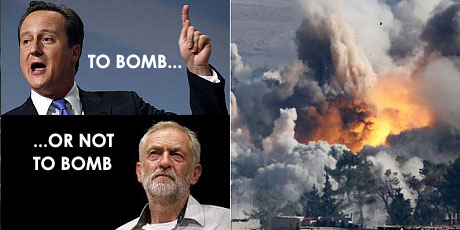
The stakes are high, but with enough pressure from below, David Cameron’s plan to bomb Syria can be defeated.
By Chris Nineham | Stop the War Coalition | September 24, 2015
WE HAVE the biggest opportunity since the start of the Iraq war to make a real change in foreign policy. The aggressive, interventionist policy that has done so much damage is now at the heart of a great contest in British society.
Jeremy Corbyn is facing a massive onslaught from all sections of the establishment. No one can envy him this experience, and the prime question is how we defend him from these attacks and build support for the policies that got him elected as Labour party leader with such a huge majority.
When the right wing is this hysterical, the establishment this panicked, and the media this vitriolic, you know there is just a chance something good might be in reach.
In the next few weeks and months there are going to be a series of stand-offs around foreign policy issues, including almost certainly a vote in parliament on bombing Syria, the outcome of the Iraq war inquiry report, and of course the madness of renewing Trident.
Few mainstream commentators have the wherewithal to understand Corbyn’s victory. They first speculated about left-wing entryism, then they focussed on his ‘style’, now they’ve decided to ignore the scale of his mandate.
Of course Jeremy is different, he wears jumpers and shockingly he tends to say what he thinks. But whatever the media would like to think, his success is not about the way he does what he does, it is about the issues he has brought to the forefront of British politics.
The real nightmare for the establishment is that millions of people agree with him about austerity, about war, and about the shocking state of official politics.
What alarms the mainstream is the energy and enthusiasm generated by his campaign to become leader of the Labour party, much of it due to the protest movements that he has supported so tirelessly over decades, including crucially the anti-war movement.
A return to protest
But if the Corbyn surge was powered partly at least by the movements, we have to make sure that what he has achieved in turn reinvigorates protest.
We know that Corbyn can’t do it alone. And we know too that there are a lot of people around him who — to put it politely — don’t agree with him. Within days of his leadership victory, there were very public briefings against him by a serving UK army general, two of his cabinet ‘colleagues’, including the shadow foreign secretary Hilary Benn, and Sadiq Khan, Labour’s newly selected candidate for London mayor.
Quite simply, Jeremy Corbyn is going to need all the help he can get.
It is clear also, that despite the disasters of the last fourteen years, the British political establishment is desperate to maintain its role as chief cheerleader for US military interventionism. And having scented rebellion against Corbyn among Labour MPs, they have a new confidence about winning a vote to bomb Syria, and at the same time damaging the party’s anti-war leader.
A plan of action: stopping the bombing of Syria
The main task must be to extend the enthusiasm and energy generated by his campaigning over the past months into every local community, workplace and college.
The more people are actively engaged in the campaign to stop the drive to war in Syria, and in the anti-austerity movement, the more we will be defending Jeremy Corbyn under such relentless attack.
How can we do this?
For the anti-war movement, we need to get onto the streets in every area and onto campuses with leaflets, petitions, posters, badges, etc, drawing people into an ever-widening network of activists for peace.
We need to re-invigorate local anti-war groups and start new groups where none exist. While organising locally, the untimate focus will be on parliament and the need to break the consensus that always takes Britain into disastrous wars on the coat tails of the United States.
In 2013, mass pressure on MPs, coupled with the memory of Tony Blair’s catastrophic war on Iraq, delivered an unprecedented defeat for the government, as David Cameron tried to bounce parliament into supporting the bombing of Syria’s Assad regime.
Now Cameron hope that by switching the target to ISIS, he can reverse that defeat and take the UK into yet another pointless war that will serve no purpose, other than to create more death and chaos, and drive more refugees to flee the war zone.
We need to implement immediately a comprehensive lobbying of MPs:
- Use the online lobby tool to contact MPs
- Send letters to MPs’ constituency offices
- Get letters in local newspapers
- Organise group visits to MPs’ regular surgeries to deliver petitions collected locally
There needs to be a particular focus on MPs who have vowed publicly to defy Jeremy Corbyn, so they understand the scale of the opposition to waging war in Syria.
War and the refugee crisis
The links between the refugee crisis and the wars our government so enthusiastically backs need to be underlined continually in our campaigning.
It is scandalous that David Cameron thinks promising to take twenty thousand refugees over five years is an adequate response to the migration or 60 million people fleeing war, conflict and poverty.
It is also outrageous that he wants to respond to people fleeing war-torn countries by intensifying the bombing of Syria — one of the main causes of the crisis.
The most effective thing that the West could do to end this misery is to de-escalate, stop arming regional dictators and aggressors and encourage a negotiated settlement in Syria. We need to develop and promote these arguments everywhere.
Isis is clearly a horrible organisation whose presence makes our arguments harder. We have to tackle the debate head on by having the most high profile possible public meetings and forums we can in each area.
A plan of action: the anti-austerity movement
Stop the War has always contrasted the vast government expenditure on the military and weapons of mass destruction, and the draconian austerity cuts to public and welfare services. Billions are spent on the UK war machine at the same time that brutal cuts in benefits are driving some desperate victims to suicide.
The protests at the Conservative Party conference from 3 October will help shape the political landscape over the next months. Tens of thousands will be protesting there, not just on the opening day – 4 October – but for the whole week. The anti-war message needs to be heard loud and clear by the movement, by the media and by the politicians.
Time is tight — the flashpoints are imminent, and we need to act now.
Within a few days of Jeremy Corbyn becoming Labour leader over 120 new members joined Stop the War Coalition, an indication that the movements that underpinned his victory are recognised as central to defending him.
The stakes are high. With enough pressure from below, David Cameron’s government’s plan to bomb Syria can be defeated for a second time, which would be a long term humiliation for the warmongers.
We also need a big campaign and protest over the scandalous delay in publishing the Iraq war inquiry report, blocked it appears by those — like Tony Blair and Jack Straw — likely to be criticised by Chilcot. With Jeremy Corbyn declaring that Tony Blair should be held to account for alleged war crimes, there is a real prospect that Blair could be driven out of public life once and for all.
Next year parliament will vote on the renewal of Trident nuclear weapons system, at a projected cost of over £100billion. The Campaign for Nuclear disarmament is already mounting a concerted campaign to get MPs to vote against. A huge protest movement before parliament votes will intensify that pressure.
The moment a vote on bombing Syria is announced, Stop the War will call a protest, but the success, the scale, and the impact of that protest depends on what we all do in the next few weeks. Its up to us.
‘West crying for refugees with one eye, aiming gun with the other’ – Assad (FULL INTERVIEW)
RT | September 16, 2015
In a rare interview with Russian media outlets, RT among them, Syrian leader Bashar Assad spoke about global and domestic terrorism threats, the need for a united front against jihadism, Western propaganda about the refugee crisis and ways to bring peace to his war-torn nation.
Question 1:Mr. President, thank you from the Russian media, from RT, from Rossiyskaya Gazeta, Channel 1, Russia 24, RIA Novosti, and NTV channel, for giving us all the opportunity to talk to you during this very critical phase of the crisis in Syria, where there are many questions that need to be addressed on where exactly the political process to achieve peace in Syria is heading, what’s the latest developments on the fight against ISIL, and the status of the Russian and Syrian partnership, and of course the enormous exodus of Syrian refugees that has been dominating headlines in Europe.
Now, the crisis in Syria is entering its fifth year. You have defied all predictions by Western leaders that you would be ousted imminently, and continue to serve today as the President of the Syrian Arab Republic. Now, there has been a lot of speculation recently caused by reports that officials from your government met with officials from your adversary Saudi Arabia that caused speculation that the political process in Syria has entered a new phase, but then statements from Saudi Arabia that continue to insist on your departure suggest that in fact very little has changed despite the grave threat that groups like ISIL pose far beyond Syria’s borders.
So, what is your position on the political process? How do you feel about power sharing and working with those groups in the opposition that continue to say publically that there can be no political solution in Syria unless that includes your immediate departure? Have they sent you any signal that they are willing to team up with you and your government? In addition to that, since the beginning of the crisis in Syria, many of those groups were calling to you to carry out reforms and political change. But is such change even possible now under the current circumstances with the war and the ongoing spread of terror in Syria?
President Assad: Let me first divide this question. It’s a multi question in one question. The first part regarding the political process, since the beginning of the crisis we adopted the dialogue approach, and there were many rounds of dialogue between Syrians in Syria, in Moscow, and in Geneva. Actually, the only step that has been made or achieved was in Moscow 2, not in Geneva, not in Moscow 1, and actually it’s a partial step, it’s not a full step, and that’s natural because it’s a big crisis. You cannot achieve solutions in a few hours or a few days. It’s a step forward, and we are waiting for Moscow 3. I think we need to continue the dialogue between the Syrian entities, political entities or political currents, in parallel with fighting terrorism in order to achieve or reach a consensus about the future of Syria. So, that’s what we have to continue.
If I jump to the last part, because it’s related to this one, is it possible to achieve anything taking into consideration the prevalence of terrorism in Syria and in Iraq and in the region in general? We have to continue dialogue in order to reach the consensus as I said, but if you want to implement anything real, it’s impossible to do anything while you have people being killed, bloodletting hasn’t stopped, people feel insecure. Let’s say we sit together as Syrian political parties or powers and achieve a consensus regarding something in politics, in economy, in education, in health, in everything. How can we implement it if the priority of every single Syrian citizen is to be secure? So, we can achieve consensus, but we cannot implement unless we defeat the terrorism in Syria. We have to defeat terrorism, not only ISIS.
I’m talking about terrorism, because you have many organizations, mainly ISIS and al-Nusra that were announced as terrorist groups by the Security Council. So, this is regarding the political process. Sharing power, of course we already shared it with some part of the opposition that accepted to share it with us. A few years ago they joined the government. Although sharing power is related to the constitution, to the elections, mainly parliamentary elections, and of course representation of the Syrian people by those powers. But in spite of that, because of the crisis, we said let’s share it now, let’s do something, a step forward, no matter how effective.
Regarding the refugee crisis, I will say now that Western dealing in the Western propaganda recently, mainly during the last week, regardless of the accusation that those refugees are fleeing the Syrian government, but they call it regime, of course. Actually, it’s like the West now is crying for the refugees with one eye and aiming at them with a machinegun with the second one, because actually those refugees left Syria because of the terrorism, mainly because of the terrorists and because of the killing, and second because of the results of terrorism. When you have terrorism, and you have the destruction of the infrastructure, you won’t have the basic needs of living, so many people leave because of the terrorism and because they want to earn their living somewhere in this world.
So, the West is crying for them, and the West is supporting terrorists since the beginning of the crisis when it said that this was a peaceful uprising, when they said later it’s moderate opposition, and now they say there is terrorism like al-Nusra and ISIS, but because of the Syrian state or the Syrian regime or the Syrian president. So, as long as they follow this propaganda, they will have more refugees. So, it’s not about that Europe didn’t accept them or embrace them as refugees, it’s about not dealing with the cause. If you are worried about them, stop supporting terrorists. That’s what we think regarding the crisis. This is the core of the whole issue of refugees.
President Assad: As you know, we are at war with terrorism, and this terrorism is supported by foreign powers. It means that we are in a state of complete war. I believe that any society and any patriotic individuals, and any parties which truly belong to the people should unite when there is a war against an enemy; whether that enemy is in the form of domestic terrorism or foreign terrorism. If we ask any Syrian today about what they want, the first thing they would say is: we want security and safety for every person and every family.
So we, as political forces, whether inside or outside the government, should unite around what the Syrian people want. That means we should first unite against terrorism. That is logical and self-evident. That’s why I say that we have to unite now as political forces, or government, or as armed groups which fought against the government, in order to fight terrorism. This has actually happened.
There are forces fighting terrorism now alongside the Syrian state, which had previously fought against the Syrian state. We have made progress in this regard, but I would like to take this opportunity to call on all forces to unite against terrorism, because it is the way to achieve the political objectives which we, as Syrians, want through dialogue and political action.
Intervention: Concerning the Moscow-3 and Geneva-3 conferences; in your opinion, are there good prospects for them?
President Assad: The importance of Moscow-3 lies in the fact that it paves the way to Geneva-3, because the international sponsorship in Geneva was not neutral, while the Russian sponsorship is. It is not biased, and is based on international law and Security Council resolutions. Second, there are substantial differences around the ‘transitional body’ item in Geneva. Moscow-3 is required to solve these problems between the different Syrian parties; and when we reach Geneva-3, it is ensured that there is a Syrian consensus which would enable it to succeed. We believe that it is difficult for Geneva-3 to succeed unless Moscow-3 does. That’s why we support holding this round of negotiations in Moscow after preparations for the success of this round have been completed, particularly by the Russian officials.
Question 3: I would like to continue with the issue of international cooperation in order to solve the Syrian crisis. It’s clear that Iran, since solving the nuclear issue, will play a more active role in regional affairs. How would you evaluate recent Iranian initiatives on reaching a settlement for the situation in Syria? And, in general, what is the importance of Tehran’s support for you? Is there military support? And, if so, what form does it take?
President Assad: At present, there is no Iranian initiative. There are ideas or principles for an Iranian initiative based primarily on Syria’s sovereignty, the decisions of the Syrian people and on fighting terrorism. The relationship between Syria and Iran is an old one. It is over three-and-a-half decades old. There is an alliance based on a great degree of trust. That’s why we believe that the Iranian role is important. Iran supports Syria and the Syrian people. It stands with the Syrian state politically, economically and militarily. When we say militarily, it doesn’t mean – as claimed by some in the Western media – that Iran has sent an army or armed forces to Syria. That is not true. It sends us military equipment, and of course there is an exchange of military experts between Syria and Iran. This has always been the case, and it is natural for this cooperation to grow between the two countries in a state of war. Yes, Iranian support has been essential to support Syria in its steadfastness in this difficult and ferocious war.
Question 4: Concerning regional factors and proponents, you recently talked about security coordination with Cairo in fighting terrorism, and that you are in the same battle line in this regard. How is your relationship with Cairo today given that it hosts some opposition groups? Do you have a direct relationship, or perhaps through the Russian mediator, particularly in light of the strategic relations between Russia and Egypt. President Sisi has become a welcome guest in Moscow today.
President Assad: Relations between Syria and Egypt have not ceased to exist even over the past few years, and even when the president was Mohammed Morsi, who is a member of the terrorist Muslim Brotherhood organisation. Egyptian institutions insisted on maintaining a certain element of this relationship. First, because the Egyptian people are fully aware of what is happening in Syria, and second because the battle we are fighting is practically against the same enemy. This has now become clearer to everyone. Terrorism has spread in Libya, Egypt, Yemen, Syria, Iraq, in other Arab countries, and in some Muslim countries like Afghanistan, Pakistan and others. That’s why I can say that there is joint vision between us and the Egyptians; but our relationship exists now on a security level. There are no political relations. I mean, there are no contacts between the Syrian Foreign Ministry and the Egyptian Foreign Ministry, for instance. Contacts are done on a security level only. We understand the pressures that might be applied on Egypt or on both Syria and Egypt so that they don’t have a strong relationship. This relationship does not go, of course, through Moscow. As I said, this relationship has never ceased to exist, but we feel comfortable about improving relations between Russia and Egypt. At the same time, there is a good, strong and historical relation between Moscow and Damascus, so it is natural for Russia to feel comfortable for any positive development in relations between Syria and Egypt.
Question 5: Mr. President, allow me to go back to the question of fighting terrorism. How do you look at the idea of creating a region free of ISIS terrorists in the north of the country on the border with Turkey? In that context, what do you say about the indirect cooperation between the West and terrorist organizations like the al-Nusra Front and other extremist groups? And with whom are you willing to cooperate and fight against ISIS terrorists?
President Assad: To say that the border with Turkey should be free of terrorism means that terrorism is allowed in other regions. That is unacceptable. Terrorism should be eradicated everywhere; and we have been calling for three decades for an international coalition to fight terrorism. But as for Western cooperation with the al-Nusra Front, this is reality, because we know that Turkey supports al-Nusra and ISIS by providing them with arms, money and terrorist volunteers. And it is well-known that Turkey has close relations with the West. Erdogan and Davutoglu cannot make a single move without coordinating first with the United States and other Western countries. Al-Nusra and ISIS operate with such a force in the region under Western cover, because Western states have always believed that terrorism is a card they can pull from their pocket and use from time to time. Now, they want to use al-Nusra just against ISIS, maybe because ISIS is out of control one way or another. But that doesn’t mean they want to eradicate ISIS. Had they wanted to do so, they would have been able to do that. For us, ISIS, al-Nusra, and all similar organizations which carry weapons and kill civilians are extremist organizations.
But who we conduct dialogue with is a very important question. From the start we said that we engage in dialogue with any party, if that dialogue leads to degrading terrorism and consequently achieve stability. This naturally includes the political powers, but there are also armed groups with whom we conducted dialogue and reached agreement in troubled areas which have become quiet now. In other areas, these armed groups joined the Syrian Army and are fighting by its side, and some of their members became martyrs. So we talk to everyone except organizations I mentioned like ISIS, al-Nusra, and other similar ones for the simple reason that these organizations base their doctrine on terrorism. They are ideological organizations and are not simply opposed to the state, as is the case with a number of armed groups. Their doctrine is based on terrorism, and consequently dialogue with such organizations cannot lead to any real result. We should fight and eradicate them completely and talking to them is absolutely futile.
Intervention: When talking about regional partners, with whom are you prepared to cooperate in fighting terrorism?
President Assad: Certainly with friendly countries, particularly Russia and Iran. Also we are cooperating with Iraq because it faces the same type of terrorism. As for other countries, we have no veto on any country provided that it has the will to fight terrorism and not as they are doing in what is called “the international coalition” led by the United States. In fact, since this coalition started to operate, ISIS has been expanding. In other words, the coalition has failed and has no real impact on the ground. At the same time, countries like Turkey, Qatar, Saudi Arabia, and Western countries which provide cover for terrorism like France, the United States, or others, cannot fight terrorism. You cannot be with and against terrorism at the same time. But if these countries decide to change their policies and realize that terrorism is like a scorpion, if you put it in your pocket, it will sting you. If that happens, we have no objection to cooperating with all these countries, provided it is a real and not a fake coalition to fight terrorism.
Question 6: What is the Syrian army’s current condition? They’ve been fighting for over four years. Are they exhausted by the war, or become stronger as a result of engagement in military operations? And are there reserve forces to support them? I also have another important question: you said a large number of former adversaries have moved to your side and are fighting within the ranks of government forces. How many? And what is the extent of their help in the fight against extremist groups?
President Assad: Of course, war is bad. And any war is destructive, any war weakens any society and any army, no matter how strong or rich a country is. But things cannot be assessed this way. War is supposed to unite society against the enemy. The army becomes the most-important symbol for any society when there is aggression against the country. Society embraces the army, and provides it with all the necessary support, including human resources, volunteers, conscripts, in order to defend the homeland. At the same time, war provides a great deal of expertise to any armed forces practically and militarily. So, there are always positive and negative aspects. We cannot say that the army becomes weaker or stronger. But in return, this social embrace and support for the army provides it with volunteers. So, in answer to your question ‘are there reserves?’… yes, certainly, for without such reserves, the army wouldn’t have been able to stand for four-and-a-half years in a very tough war, particularly since the enemy we fight today has an unlimited supply of people. We have terrorist fighters from over 80 or 90 countries today, so our enemy is enjoying enormous support in various countries, from where people come here to fight alongside the terrorists. As for the army, it’s almost exclusively made of Syrians. So, we have reserve forces, and this is what enables us to carry on. There is also determination. We have reserves not only in terms of human power, but in will as well. We are more determined than ever before to fight and defend our country against terrorists. This is what led some fighters who used to fight against the state at the beginning for varying reasons, discovered they were wrong and decided to join the state. Now they are fighting battles along with the army, and some have actually joined as regular soldiers. Some have kept their weapons, but they are fighting in groups alongside the armed forces in different parts of Syria.
Question 7: Mr. President, Russia has been fighting terrorism for 20 years, and we have seen its different manifestations. It now seems you are fighting it head on. In general, the world is witnessing a new form of terrorism. In the regions occupied by ISIS, they are setting up courts and administrations, and there are reports that it intends to mint its own currency. They are constructing what looks like a state. This in itself might attract new supporters from different countries. Can you explain to us whom are you fighting? Is it a large group of terrorists or is it a new state which intends to radically redraw regional and global borders? What is ISIS today?
President Assad: Of course, the terrorist ISIS groups tried to give the semblance of a state, as you said, in order to attract more volunteers who live on the dreams of the past: that there was an Islamic state acting for the sake of religion. That ideal is unreal. It is deceptive. But no state can suddenly bring a new form to any society. The state should be the product of its society. It should be the natural evolution of that society, to express it. In the end, a state should be a projection of its society. You cannot bring about a state which has a different form and implant it in a society. Here we ask the question: does ISIS, or what they call ‘Islamic State’, have any semblance to Syrian society? Certainly not.
Of course we have terrorist groups, but they are not an expression of society. In Russia, you have terrorist groups today, but they do not project Russian society, nor do they have any semblance to the open and diverse Russian society. That’s why if they tried to mint a currency or have stamps or passports, or have all these forms which indicate the existence of a state, it doesn’t mean they actually exist as a state; first because they are different from the people and, second, because people in those regions flee towards the real state, the Syrian state, the national state. Sometimes they fight them too. A very small minority believes these lies. They are certainly not a state, they are a terrorist group. But if we want to ask about who they are, let’s speak frankly: They are the third phase of the political or ideological poisons produced by the West, aimed at achieving political objectives. The first phase was the Muslim Brotherhood at the turn of the last century. The second phase was al-Qaeda in Afghanistan in order to fight the Soviet Union. And the third phase is ISIS, the al-Nusra Front and these groups. Who are ISIS? And who are these groups? They are simply extremist products of the West.
Question 8: Mr. President, at the beginning of the Syrian crisis, the Kurdish issue started to be discussed more often. Previously, Damascus was severely criticized because of its position towards the Kurdish minority. But now, practically, in some areas, Kurdish formations are your allies in the fight against ISIS. Do you have a specific position towards who the Kurds are to you and who you are to them?
President Assad: First, you cannot say there was a certain state policy concerning the Kurds. A state cannot discriminate between members of its population; otherwise, it creates division in the country. If we had been discriminating between different components of society, the majority of these components wouldn’t have supported the state now, and the country would have disintegrated from the very beginning. For us, the Kurds are part of the Syrian fabric. They are not foreigners – they live in this region like the Arabs, Circassians, Armenians and many other ethnicities and sects who’ve been living in Syria for many centuries. It’s not known when some of them came to this region. Without these groups, there wouldn’t have been a homogenous Syria. So, are they our allies today? No, they are patriotic people. But on the other hand, you cannot put all the Kurds in one category. Like any other Syrian component, there are different currents among them. They belong to different parties. There are those on the left and those on the right. There are tribes, and there are different groups. So, it is not objective to talk about the Kurds as one mass.
There are certain Kurdish demands expressed by some parties, but there are no Kurdish demands for the Kurds. There are Kurds who are integrated fully into society; and I would like to stress that they are not allies at this stage, as some people would like to show. I would like to stress that they are not just allies at this stage, as some suggest. There are many fallen Kurdish soldiers who fought with the army, which means they are an integral part of society. But there are parties which had certain demands, and we addressed some at the beginning of the crisis. There are other demands which have nothing to do with the state, and which the state cannot address. There are things which would relate to the entire population, to the constitution, and the people should endorse these demands before a decision can be taken by the state. In any case, anything proposed should be in the national framework. That’s why I say that we are with the Kurds, and with other components, all of us in alliance to fight terrorism.
This is what I talked about a while ago: that we should unite in order to fight ISIS. After we defeat ISIS, al-Nusra and the terrorists, the Kurdish demands expressed by certain parties can be discussed nationally. There’s no problem with that, we do not have a veto on any demand as long as it is within the framework of Syria’s unity and the unity of the Syrian people and territory, fighting terrorism, Syrian diversity, and the freedom of this diversity in its ethnic, national, sectarian, and religious sense.
Question 9: Mr. President, you partially answered this question, but I would like a more-precise answer, because some Kurdish forces in Syria call for amending the constitution. For instance, setting up a local administration and moving towards autonomy in the north. These statements are becoming more frequent now that the Kurds are fighting ISIS with a certain degree of success. Do you agree with such statements that the Kurds can bet on some kind of gratitude? Is it up for discussion?
President Assad: When we defend our country, we do not ask people to thank us. It is our natural duty to defend our country. If they deserve thanks, then every Syrian citizen defending their country deserves as much. But I believe that defending one’s country is a duty, and when you carry out your duty, you don’t need thanks. But what you have said is related to the Syrian constitution. Today, if you want to change the existing structure in your country, in Russia for instance, let’s say to redraw the borders of the republics, or give one republic powers different to those given to other republics – this has nothing to do with the president or the government. This has to do with the constitution.
The president does not own the constitution and the government does not own the constitution. Only the people own the constitution, and consequently changing the constitution means national dialogue. For us, we don’t have a problem with any demand. As a state, we do not have any objection to these issues as long as they do not infringe upon Syria’s unity and diversity and the freedom of its citizens.
But if there are certain groups or sections in Syria which have certain demands, these demands should be in the national framework, and in dialogue with the Syrian political forces. When the Syrian people agree on taking steps of this kind, which have to do with federalism, autonomy, decentralization or changing the whole political system, this needs to be agreed upon by the Syrian people, and consequently amending the constitution. This is why these groups need to convince the Syrian people of their proposals. In that respect, they are not in dialogue with the state, but rather with the people. When the Syrian people decide to move in a certain direction, and to approve a certain step, we will naturally approve it.
Question 10: Now, the U.S.-led coalition has been carrying out airstrikes on Syrian territory for about one year on the same areas that the Syrian Air Force is also striking ISIL targets, yet there hasn’t been a single incident of the U.S.-led coalition and the Syrian Air Force activity clashing with one another. Is there any direct or indirect coordination between your government and the U.S. coalition in the fight against ISIL?
President Assad: You’d be surprised if I say no. I can tell you that my answer will be not realistic, to say now, while we are fighting the same, let’s say enemy, while we’re attacking the same target in the same area without any coordination and at the same time without any conflict. And actually this is strange, but this is reality. There’s not a single coordination or contact between the Syrian government and the United States government or between the Syrian army and the U.S. army. This is because they cannot confess, they cannot accept the reality that we are the only power fighting ISIS on the ground. For them, maybe, if they deal or cooperate with the Syrian Army, this is like a recognition of our effectiveness in fighting ISIS. This is part of the willful blindness of the U.S. administration, unfortunately.
Question 11: So not event indirectly though, for example the Kurds? Because we know the U.S. is working with the Kurds, and the Kurds have some contacts with the Syrian government. So, not even any indirect coordination?
President Assad: Not even any third party, including the Iraqis, because before they started the attacks, they let us know through the Iraqis. Since then, not a single message or contact through any other party.
Question 12: OK, so just a little bit further than that. You’ve lived in the West, and you, at one time, moved in some of those circles with some Western leaders that since the beginning of the crisis have been backing armed groups who are fighting to see you overthrown. How do you feel about one day working again with those very same Western leaders, perhaps shaking hands with them? Would you ever be able to trust them again?
President Assad: First, it’s not a personal relation; it’s a relation between states, and when you talk about relation between states, you don’t talk about trust; you talk about mechanism. So, trust is a very personal thing you cannot depend on in political relations between, let’s say, people. I mean, you are responsible for, for example in Syria, for 23 million, and let’s say in another country for tens of millions. You cannot put the fate of those tens of millions or maybe hundreds of millions on the trust of a single person, or two persons in two countries. So, there must be a mechanism. When you have a mechanism, you can talk about trust in a different way, not a personal way. This is first.
Second, the main mission of any politician, or any government, president, prime minister, it doesn’t matter, is to work for the interest of his people and the interest of his country. If any meeting or any handshaking with anyone in the world will bring benefit to the Syrian people, I have to do it, whether I like it or not. So, it’s not about me, I accept it or I like it or whatever; it’s about what the added value of this step that you’re going to take. So yes, we are ready whenever there’s the interest of the Syrians. I will do it, whatever it is.
Question 13: Regarding alliances in the fight against terrorism and ISIS, President Putin called for a regional alliance to fight the so-called ‘Islamic State’; and the recent visits of Arab officials to Moscow fall into that context, but Syrian Foreign Minister Walid al-Moallem said that would need a miracle. We are talking here about security coordination, as described by Damascus, with the governments of Jordan, Turkey and Saudi Arabia. How do you envisage that alliance? Will it achieve any results, in your opinion? You said that any relationship is based on interests, so are you willing to coordinate with these countries, and what is the truth behind the meetings held between Syrian, and maybe Saudi, officials as reported by the media?
President Assad: As for fighting terrorism, this is a big and comprehensive issue which includes cultural and economic aspects. It obviously has security and military aspects as well. In terms of prevention, all the other aspects are more important than the security and military ones, but today, in the reality we now live in terms of fighting terrorism, we are not facing terrorist groups, we are facing terrorist armies equipped with light, medium and heavy weaponry. They have billions of dollars to recruit volunteers. The military and security aspects should be given priority at this stage. So, we think this alliance should act in different areas, but to fight on the ground first. Naturally, this alliance should consist of states which believe in fighting terrorism and believe that their natural position should be against terrorism.
In the current state of affairs, the person supporting terrorism cannot be the same person fighting terrorism. This is what these states are doing now. Saudi Arabia, Turkey and Jordan, who pretend to be part of a coalition against terrorism in northern Syria, actually support terrorism in the south, the north and the north-west, virtually in the same regions in which they are supposed to be fighting terrorism. Once again I say that, within the framework of public interest, if these states decide to go back to the right position, to return to their senses and fight terrorism, naturally we will accept and cooperate with them and with others. We do not have a veto and we do not stick to the past. Politics change all the time. It might change from bad to good, and the ally might become an adversary, and the adversary an ally. This is normal. When they fight against terrorism, we will cooperate with them.
Question 14: Mr. President, there is a huge wave of refugees, largely from Syria, going to Europe. Some say these people are practically lost to Syria. They are deeply unhappy with the Syrian authorities because they haven’t been able to protect them and they’ve had to leave their homes. How do you view those people? Do you see them as part of the Syrian electorate in the future? Do you expect them to return? And the second question has to do with the European sense of guilt about the displacement happening now. Do you think that Europe should feel guilty?
President Assad: Any person who leaves Syria constitutes a loss to the homeland, to be sure, regardless of the position or capabilities of that person. This, of course, does not include terrorists. It includes all citizens in general with the exception of terrorists. So, yes, there is a great loss as a result of emigration. You raised a question on elections. Last year, we had a presidential election in Syria, and there were many refugees in different countries, particularly in Lebanon. According to Western propaganda, they had fled the state, the oppression of the state and the killing of the state, and they are supposed to be enemies of the state. But the surprise for Westerners was that most of them voted for the president who is supposed to be killing them. That was a great blow to Western propaganda. Of course, voting has certain conditions. There should be an embassy, and to have the custodianship of the Syrian state in the voting process. That depends on relations between the states. Many countries have severed relations with Syria and closed Syrian embassies, and consequently Syrian citizens cannot vote in those countries. They have to go to other countries where ballot boxes are installed, and that did happen last year.
As for Europe, of course it’s guilty. Today, Europe is trying to say that Europe feels guilty because it hasn’t given money or hasn’t allowed these people to immigrate legally, and that’s why they came across the sea and drowned. We are sad for every innocent victim, but is the victim who drowns in the sea dearer to us than the victim killed in Syria? Are they dearer than innocent people whose heads are cut off by terrorists? Can you feel sad for a child’s death in the sea and not for thousands of children who have been killed by the terrorists in Syria? And also for men, women, and the elderly? These European double standards are no longer acceptable. They have been flagrantly exposed. It doesn’t make sense to feel sad for the death of certain people and not for deaths of others. The principles are the same. So Europe is responsible because it supported terrorism, as I said a short while ago, and is still supporting terrorism and providing cover for them. It still calls them ‘moderate’ and categorizes them into groups, even though all these groups in Syria are extremists.
Question 15: If you don’t mind, I would like to go back to the question about Syria’s political future. Mr. President, your opponents, whether fighting against the authorities with weapons or your political opponents, still insist that one of the most-important conditions for peace is your departure from political life and as president. What do you think about that – as president and as a Syrian citizen? Are you theoretically prepared for that if you feel it’s necessary?
President Assad: In addition to what you say, Western propaganda has, from the very beginning, been about the cause of the problem being the president. Why? Because they want to portray the whole problem in Syria lies in one individual; and consequently the natural reaction for many people is that, if the problem lies in one individual, that individual should not be more important than the entire homeland. So let that individual go and things will be alright. That’s how they oversimplify things in the West. What’s happening in Syria, in this regard, is similar to what happened in your case. Notice what happened in the Western media since the coup in Ukraine. What happened? President Putin was transformed from a friend of the West to a foe and, yet again, he was characterized as a tsar. He is portrayed as a dictator suppressing opposition in Russia, and that he came to power through undemocratic means, despite the fact that he was elected in democratic elections, and the West itself acknowledged that the elections were democratic. Now, it is no longer democratic. This is Western propaganda. They say that if the president went things will get better. What does that mean, practically? For the West, it means that as long as you are there, we will continue to support terrorism, because the Western principle followed now in Syria and Russia and other countries is changing presidents, changing states, or what they call bringing regimes down. Why? Because they do not accept partners and do not accept independent states. What is their problem with Russia? What is their problem with Syria? What is their problem with Iran? They are all independent countries. They want a certain individual to go and be replaced by someone who acts in their interests and not in the interest of his country. For us, the president comes through the people and through elections and, if he goes, he goes through the people. He doesn’t go as a result of an American decision, a Security Council decision, the Geneva conference or the Geneva communiqué. If the people want him to stay, he should stay; and if the people reject him, he should leave immediately. This is the principle according to which I look at this issue.
Question 16: Military operations have been ongoing for more than four years. It’s likely that you analyze things and review matters often. In your opinion, was there a crucial juncture when you realized war was unavoidable? And who initiated that war machinery? The influence of Washington or your Middle East neighbours? Or were there mistakes on your part? Are there things you regret? And if you had the opportunity to go back, would you change them?
President Assad: In every state, there are mistakes, and mistakes might be made every day, but these mistakes do not constitute a crucial juncture because they are always there. So what is it that makes these mistakes suddenly lead to the situation we are living in Syria today? It doesn’t make sense. You might be surprised if I tell that the crucial juncture in what happened in Syria is something that many people wouldn’t even think of. It was the Iraq war in 2003, when the United States invaded Iraq. We were strongly opposed to that invasion, because we knew that things were moving in the direction of dividing societies and creating unrest. And we are Iraq’s neighbours. At that time, we saw that the war would turn Iraq into a sectarian country; into a society divided against itself. To the west of Syria there is another sectarian country – Lebanon. We are in the middle. We knew well that we would be affected. Consequently, the beginning of the Syrian crisis, or what happened in the beginning, was the natural result of that war and the sectarian situation in Iraq, part of which moved to Syria, and it was easy for them to incite some Syrian groups on sectarian grounds.
The second point, which might be less crucial, is that when the West adopted terrorism officially in Afghanistan in the early 1980s and called terrorists at that time ‘freedom fighters’, and then in 2006 when Islamic State appeared in Iraq under American sponsorship and they didn’t fight it. All these things together created the conditions for the unrest with Western support and Gulf money, particularly form Qatar and Saudi Arabia, and with Turkish logistic support, particularly since President Erdogan belongs intellectually to the Muslim Brotherhood. Consequently, he believes that, if the situation changed in Syria, Egypt, and Iraq, it means the creation of a new sultanate; not an Ottoman sultanate this time, but a sultanate for the Brotherhood extending from the Atlantic to the Mediterranean and ruled by Erdogan. All these factors together brought things to what we have today. Once again, I say that there were mistakes, and mistakes always create gaps and weak points, but they are not sufficient to cause that alone, and they do not justify what happened. And if these gaps and weak points are the cause, why didn’t they lead to revolutions in the Gulf states – particularly in Saudi Arabia which doesn’t know anything about democracy? The answer is self-evident, I believe.
Mr. President, thank you for giving us the time and for your detailed answers to our questions.
Will US Grasp Putin’s Syria Lifeline?
By Robert Parry | Consortium News | September 22, 2015
Russian President Vladimir Putin has thrown U.S. policymakers what amounts to a lifeline to pull them out of the quicksand that is the Syrian war, but Official Washington’s neocons and the mainstream U.S. news media are growling about Putin’s audacity and challenging his motives.
For instance, The New York Times’ lead editorial on Monday accused Putin of “dangerously building up Russia’s military presence” in Syria, even though Putin’s stated goal is to help crush the Sunni jihadists in the Islamic State and other extremist movements.
Instead, the Times harrumphs about Putin using his upcoming speech to the United Nations General Assembly “to make the case for an international coalition against the Islamic State, apparently ignoring the one already being led by the United States.”
The Times then reprises the bizarre neocon argument that the best way to solve the threat from the Islamic State, Al Qaeda and other jihadist forces is to eliminate Syrian President Bashar al-Assad and his military who have been the principal obstacles to an outright victory by the Sunni terrorist groups.
The dreamy Times/neocon prescription continues to be that “regime change” in Damascus would finally lead to the emergence of the mythical “moderate” rebels who would somehow prevail over the far more numerous and far better armed extremists. This perspective ignores the fact that after a $500 million training project for these “moderates,” the U.S. military says four or five fighters are now on the battlefield inside Syria. In other words, the members of this U.S.-trained brigade can be counted on the fingers of one hand.
But rather than rethink Official Washington’s goofy “group think” on Syria – or provide readers a fuller history of the Syrian conflict – the Times moves on to blame Putin for the mess.
“No one should be fooled about Russia’s culpability in Syria’s agony,” the Times writes. “Mr. Putin could have helped prevent the fighting that has killed more than 250,000 Syrians and displaced millions more, had he worked with other major powers in 2011 to keep Mr. Assad from waging war on his people following peaceful anti-government protests. … Mr. Assad would probably be gone without the weapons aid and other assistance from Russia and Iran.”
This “group think” ignores the early role of Sunni extremists in killing police and soldiers and thus provoking the harsh retaliation that followed. But the Syrian narrative, according to The New York Times, is that the “white-hat” protesters were simply set upon by the “black-hat” government.
The Times’ simplistic story-line fits neatly with what the influential neoconservatives want the West to believe, since the neocons have had Syria on their “regime change” list, alongside Iraq and Iran, since the list was compiled as part of Israeli leader Benjamin Netanyahu’s 1996 political campaign. The Times’ narrative also leaves out the crucial role of Turkey, Saudi Arabia, Qatar and other U.S. “allies” in supporting Al Qaeda and its Islamic State spinoff.
Bush’s Unaccounted-for Cash
Further complicating Official Washington’s let’s-blame-Putin Syrian narrative is the unintended role of President George W. Bush and the U.S. military in laying the groundwork for these brutal Sunni extremist movements through the invasion of Iraq last decade. After all, it was only in reaction to the U.S. military presence that “Al Qaeda in Iraq” took root in Iraqi and then Syrian territory.
Not only did the ouster and execution of Sunni leader Saddam Hussein alienate the region’s Sunnis, but Bush’s desperation to avert an outright military defeat in Iraq during his second term led him to authorize the payment of billions of dollars to Sunni fighters to get them to stop shooting at American soldiers and to give Bush time to negotiate a U.S. troop withdrawal.
Beginning in 2006, those U.S. payments to Sunni fighters to get them to suspend their resistance were central to what was then called the “Sunni Awakening.” Though the program preceded Bush’s “surge” of troops in 2007, the bought-and-paid-for truce became central to what Official Washington then hailed as the “successful surge” or “victory at last.”
Besides the billions of dollars paid out in pallets of U.S. cash to Sunni insurgents, Bush’s “surge” cost the lives of another 1,000 U.S. soldiers and killed a countless number of Iraqis, many just going about their daily lives until they were blown apart by powerful American munitions. [See, for example, the “Collateral Murder” video leaked by Pvt. Bradley/Chelsea Manning]
But what the U.S. intelligence community is only now assessing is the collateral damage caused by the bribes that the Bush administration paid to Sunni insurgents. Some of the cash appears to have become seed money for the transformation of “Al Qaeda in Iraq” into the Islamic State as Sunnis, who continued to be disenfranchised by Iraq’s Shiite-dominated government, expanded their sectarian war into Syria.
Besides the Iraqi Sunnis, Syria’s secular government, with Assad and other key leaders from the Alawite branch of Shiite Islam, also was set upon by home-grown Sunni extremists and foreign jihadists, some of whom joined the Islamic State but mostly coalesced around Al Qaeda’s Nusra Front and other radical forces. Though the Islamic State had originated as “Al Qaeda in Iraq” (or AQI), it evolved into an even more bloodthirsty force and, in Syria, split off from Al Qaeda central.
Intelligence Reporting
U.S. intelligence followed many of these developments in real time. According to a Defense Intelligence Agency report from August 2012, “AQI supported the Syrian opposition from the beginning, both ideologically and through the media. … AQI declared its opposition of Assad’s government because it considered it a sectarian regime targeting Sunnis.”
In other words, Assad’s early complaint about “terrorists” having infiltrated the opposition had a basis in fact. Early in the disorders in 2011, there were cases of armed elements killing police and soldiers. Later, there were terrorist bombings targeting senior Syrian government officials, including a July 18, 2012 explosion – deemed a suicide bombing by government officials – that killed Syrian Defense Minister General Dawoud Rajiha and Assef Shawkat, the deputy defense minister and Assad’s brother-in-law.
By then, it had become clear that Saudi Arabia, Qatar, Turkey and other Sunni-ruled countries were funneling money and other help to jihadist rebels seeking to oust Assad’s regime, which was considered a protector of Christians, Shiites, Alawites and other minorities fearing persecution if Sunni extremists prevailed.
As the 2012 DIA report noted about Syria, “internally, events are taking a clear sectarian direction. … The salafist, the Muslim Brotherhood, and AQI are the major forces driving the insurgency in Syria. … The West, Gulf countries, and Turkey support the opposition; while Russia, China, and Iran support the regime.”
The DIA analysts already understood the risks that AQI represented both to Syria and Iraq. The report included a stark warning about the expansion of AQI, which was changing into the Islamic State or what the DIA referred to as ISI. The brutal armed movement was seeing its ranks swelled by the arrival of global jihadists rallying to the black banner of Sunni militancy, intolerant of both Westerners and “heretics” from Shiite and other non-Sunni branches of Islam.
As this movement strengthened it risked spilling back into Iraq. The DIA wrote: “This creates the ideal atmosphere for AQI to return to its old pockets in Mosul and Ramadi [in Iraq], and will provide a renewed momentum under the presumption of unifying the jihad among Sunni Iraq and Syria, and the rest of the Sunnis in the Arab world against what it considers one enemy, the dissenters [apparently a reference to Shiite and other non-Sunni forms of Islam]. ISI could also declare an Islamic State through its union with other terrorist organizations in Iraq and Syria, which will create grave danger in regards to unifying Iraq and the protection of its territory.”
Facing this growing Sunni terrorist threat — which indeed did spill back into Iraq — the idea that the CIA or the U.S. military could effectively arm and train a “moderate” rebel force to somehow compete with the Islamists was already delusional, yet that was the “group think” among the Important People of Official Washington, simply organize a “moderate” army to oust Assad and everything would turn out just great.
On Oct. 2, 2014, Vice President Joe Biden let more of the cat out of the bag when he told an audience at Harvard’s Kennedy School: “our allies in the region were our largest problem in Syria … the Saudis, the emirates, etc., what were they doing? They were so determined to take down Assad and essentially have a proxy Sunni-Shia war, what did they do? They poured hundreds of millions of dollars and tens of thousands of tons of military weapons into anyone who would fight against Assad, except the people who were being supplied were Al Nusra and Al Qaeda and the extremist elements of jihadis coming from other parts of the world.” [Quote at 53:20 of clip.]
In other words, much of the U.S.-led anti-Islamic State coalition actually has been involved in financing and arming many of the same jihadists that the coalition is now supposedly fighting. If you take into account the lost billions of dollars that the Bush administration dumped on Sunni fighters starting in 2006, you could argue that the U.S.-led coalition bears primary responsibility for creating the problem that it is now confronting.
Biden made a similar point at least in reference to the Persian Gulf states: “Now all of a sudden, I don’t want to be too facetious, but they have seen the lord. … Saudi Arabia has stopped funding. Saudi Arabia is allowing training [of anti-Islamic State fighters] on its soil … the Qataris have cut off their support for the most extreme elements of terrorist organizations, and the Turks … [are] trying to seal their border.”
But there remain many doubts about the commitment of these Sunni governments to the cause of fighting the Islamic State and even more doubts about whether that commitment extends to Al Qaeda’s Nusra Front and other jihadist forces. Some neocons have even advocated backing Al Qaeda as the lesser evil both vis a vis the Islamic State and the Assad regime.
Blaming Putin
Yet, the Times editorial on Monday blamed Putin for a big chunk of the Syrian mess because Russia has dared support the internationally recognized Syrian government in the face of vicious foreign-supported terrorism. The Times casts no blame on the United States or its allies for the Syrian horror.
The Times also hurled personal insults at Putin as part of its equally one-sided narrative of the Ukraine crisis, which the editorial writers have summarized as simply a case of “Russian aggression” or a “Russian invasion” – ignoring the behind-the-scenes role of neocon Assistant Secretary of State Victoria Nuland in orchestrating the violent overthrow of Ukraine’s elected President Viktor Yanukovych in February 2014.
In Monday’s editorial, the Times reported that President Barack Obama “considers Mr. Putin a thug,” though it was President Obama who boasted just last month, “I’ve ordered military action in seven countries,” another inconvenient fact that the Times discreetly leaves out. In other words, who’s the “thug”?
Yet, despite all its huffing and puffing and calling Putin names, the Times ultimately concludes that Obama should test out the lifeline that Putin has tossed to Obama’s Syrian policy which – with all its thrashing and arm waving – is rapidly disappearing into the quicksand. The editorial concluded:
“Secretary of State John Kerry, speaking in London on Friday, made it clear that America would be looking for ‘common ground’ in Syria, which could mean keeping Mr. Assad in power temporarily during a transition. The Russians should accept that Mr. Assad must go within a specific time frame, say six months. The objective is a transition government that includes elements of the Assad regime and the opposition. Iran should be part of any deal.
“America should be aware that Mr. Putin’s motivations are decidedly mixed and that he may not care nearly as much about joining the fight against the Islamic State as propping up his old ally. But with that in mind there is no reason not to test him.”
Kerry’s apparent willingness to work with the Russians – a position that I’m told Obama shares – is at least a sign that some sanity exists inside the State Department, which initially mounted an absurd and futile attempt to organize an aerial blockade to prevent Russia from flying in any assistance to Syria.
If successful, that scheme, emanating from Nuland’s European division, could have collapsed the Syrian regime and opened the gates of Damascus to the Islamic State and/or Al Qaeda. So obsessed are the neocons to achieve their long-held goal of “regime change” in Syria that they would run the risk of turning Syria over to the Islamic State head-choppers and Al Qaeda’s terrorism plotters.
However, after the requisite snorting and pawing of hooves, it appears that the cooler heads in the Obama administration may have finally asserted themselves – and perhaps at The New York Times as well.
Investigative reporter Robert Parry broke many of the Iran-Contra stories for The Associated Press and Newsweek in the 1980s. You can buy his latest book, America’s Stolen Narrative, either in print here or as an e-book (from Amazon and barnesandnoble.com).
US-trained militants give up arms to Nusra right after entering Syria
Press TV – September 22, 2015
“Moderate” militants trained by the US military have handed over their weapons to terrorists upon entry into Syria.
Militants with Division 30, who had just graduated from a US-led military training program in Turkey, surrendered to the al-Qaeda-affiliated Jabhat al-Nusra in Syria, The Telegraph reported on Monday, quoting a number of sources.
The militants are said to have given up all their guns and equipment immediately after entry into Syria.
“A strong slap for America… the new group from Division 30 that entered yesterday hands over all of its weapons to Jabhat al-Nusra after being granted safe passage,” read a statement on Twitter by a man calling himself Abu Fahd al-Tunisi, a member of Nusra. “They handed over a very large amount of ammunition and medium weaponry and a number of pick-ups.”
The division’s commander, Anas Ibrahim Obaid, explained to the terrorists that he had tricked the US military to get guns, according to Abu Khattab al-Maqdisi, another Nusra member.
“He promised to issue a statement… repudiating Division 30, the coalition, and those who trained him,” he tweeted. “And he also gave a large amount of weapons to Jabhat al-Nusra.”
The division entered Syria with “12 four-wheel vehicles equipped with machine guns and ammunition” a day earlier, said the Syrian Observatory for Human Rights.
The entry of the 70 men was also confirmed by the US Central Command after they graduated from the Pentagon’s “train and equip” program.
Petraeus recipe for battling ISIS: US-protected rebel enclaves in Syria, surge in Iraq
RT | September 22, 2015
To achieve victory in the Middle East, the US needs to establish and protect rebel enclaves in Syria, and launch another “surge” in Iraq, former CIA director and retired US Army general David Petraeus told a Senate panel.
This was the first public appearance for the retired general and former spymaster, following his April sentencing for revealing classified information to his mistress.
Describing Syria as a “geopolitical Chernobyl… spewing instability” all over the Middle East, Petraeus urged the Senate Armed Services Committee (SASC) to endorse a policy that would “stop the Syrian air force from flying” and establish safe areas where civilians and anti-government rebels could be protected by US airpower and advisers. Meanwhile, all the elements of the surge were once again required in Iraq, but this time around the Iraqis would have to provide the ground troops, he said.
Petraeus echoed the official position of the State Department that Syrian president Bashar al-Assad was to blame for the rise of Islamic State (IS, also known as ISIS or ISIL), blaming the government’s “barrel bombs” rather than IS for most of the civilian deaths in Syria. The general pushed for the creation of US-backed protected areas where civilians and militia opposed to the government could shelter under the coalition air umbrella. Eventually, he said, US advisers could be deployed there as boots on the ground.
“This is a very complicated military activity, but it is doable,” Petraeus told lawmakers.
Petraeus resigned as director of the CIA in November 2012, following the revelations that he had shared classified information with his biographer – and lover – Paula Broadwell. As part of a plea bargain with the government, he was sentenced to two years’ probation and a $100,000 fine.
The ex-general began his testimony with an apology, calling what he did a “serious mistake” and a “violation of the trust placed in me.” The panel, chaired by Arizona Republican John McCain, repeatedly thanked Petraeus for his military service and commended him on the apology.
Without bringing up the Broadwell scandal at all, McCain praised Petraeus as a “distinguished” leader and argued his 2007 testimony was critical to securing Senate support for the ‘surge’ strategy that “defeated al-Qaeda in Iraq, brought security to the Iraqi people, and created the possibility for meaningful political reconciliation.”
Both Republicans and Democrats on the panel were eager to hear Petraeus’s prescriptions for salvaging the US war effort against Islamic State. A yearlong air campaign by the 60-nation coalition, at the cost of $4 billion, has not dislodged the self-proclaimed Caliphate, while the handful of US-trained Syrian fighters were ambushed and scattered by Al-Nusra Front, an Al-Qaeda affiliate.
Petraeus argued that the “train and equip” program was impossible to abandon, since the US strategy in the region absolutely depended on having a Sunni Arab fighting force. Asked whether there was anyone inside Syria actually available to train, he said that many moderate rebels “drifted” to Islamist groups like Al-Nusra, because they had resources and were fighting against the Assad government. Peeling off these low-ranking members could work, he said, just as it did in Iraq.
Arguing that working with the government in Damascus would damage US credibility among the Sunnis, Petraeus called for lawmakers to resist the Russian effort to “force” the US into an alliance with president Bashar al-Assad. If Russia really wanted to fight ISIS, it could have joined the US-led coalition and asked to be integrated into the air war, Petraeus said.
Russian president Vladimir Putin recently proposed a coordinated international effort against IS, but rebuffed speculation that Russian forces would engage in combat operations in Syria.
“We are providing Syria with quite strong support in terms of equipment, training of military servicemen and weapons,” Putin said. “We are considering various options, but so far what you are talking about is not on the agenda.”
Petraeus did caution against the rush to overthrow Assad, noting that Syria “could actually get worse” if there was no plan for the aftermath.
During Petraeus’s testimony before the SASC, it was reported that retired Marine General John Allen, head of the anti-IS coalition, would be stepping down in November. Sources within the Obama administration told Bloomberg that Allen made the decision out of concern for his wife’s poor health.
UN Condemns Ukrainian Government Cover-Ups
By Eric Zuesse | Aletho News | September 21, 2015
On September 18th, the UN’s Office of the High Commissioner for Human Rights headlined “Statement of the Special Rapporteur on extrajudicial, summary or arbitrary executions, Christof Heyns Ukraine: Lives lost in an accountability vacuum,” and condemned there the current Ukrainian Government in strong language, regarding not only the coup which had brought them to power in February 2014, but regarding also the massacre of the people who on 2 May 2014 had been peacefully demonstrating in Odessa against the coup. Specifically, the ongoing cover-ups by the Ukrainian Government concerning both of these matters were condemned by him.
The High Commissioner, Christof Heyns, said:
By allowing almost immediate access of the scene to ‘pro-unity’ protesters, members of the public or to municipal authorities, investigators lost a large proportion of potentially valuable forensic evidence. Meanwhile I am worried by indications that the Government has significantly reduced the size of the team investigating these events in the past year, before it has had an opportunity to report. The slow progress of the investigation and the lack of transparency with which it is being conducted have contributed to a great deal of public dissatisfaction and provided a fertile environment for rumour and misinformation. It is disconcerting that the Special Unit of the Ministry of Internal Affairs that investigates the 2 May events cancelled our appointment in Odessa at short notice, without any explanation.
I am further concerned that administrative and personal impediments seem to have been imposed to prevent or at least discourage the families of those who died from obtaining the status of suffering or affected persons before the Courts. Meanwhile I am greatly alarmed by reports of the extent to which authorities are tolerating both verbal and physical intimidation both of families attending court proceedings and of the judges of those cases, not only outside the court building, but also inside it and in the court room itself.
Here is an excellent video of the coup.
Here is a brief video on the massacre, on 2 May 2014, in Odessa’s Trade Unions Building.
Also of interest might be the following articles:
“Ukraine’s President Poroshenko Admits Overthrow of Yanukovych Was a Coup”
The Obama Administration has a strong record of installing anti-Russian governments — not only in Ukraine. Obama enabled the 28 June 2009 coup that overthrew Honduras’s progressive democratically elected President Manuel Zelaya to succeed, and enabled the coup’s junta to stay in power though no other head-of-state supported it; and the great investigative journalist Wayne Madsen reports on 21 September 2015 that there is strong reason to believe that the Obama Administration was actually behind the recent coup in Burkino Faso. Furthermore, the Obama Administration has been involved in unsuccessful coup-plots in Venezuela and Ecuador, according to a 12 March 2015 study by the Council On Hemispheric Affairs. In addition, the Obama Administration bombed Libya and removed Muammar Gaddafi from power there, and is bombing Syria in order to remove Bashar al-Assad from power there. The Obama Administration also has continued the Bush Administration’s policy of “unsigning” to the legal authority of the International Criminal Court, but doesn’t use the same rabid rhetoric against the Court that Obama’s predecessor did. The Obama Administration has also taken a strong anti-Russian position on virtually everything at the United Nations, such as by voting against a Russian-supported resolution condemning fascism in all its forms (including Holocaust-denial), which resolution passed overwhelmingly and was opposed by only three governments: U.S., Ukraine, and Canada.
Obama is highly critical of Russia, and of its leader, Vladimir Putin. The U.S. White House in February issued its National Security Strategy 2015, and it used the pejorative term “aggression” 18 times, 17 of which referred to Russia.
So, the U.N. High Commissioner’s statement condemning the Ukrainian Government’s cover-ups might be viewed in Washington as simply the UN’s taking the pro-Russian side. Psychopaths could view it that way. But other people will (like the UN) oppose cover-ups — and oppose Obama’s international policies (such as those described). Indeed, the only U.S. President who has been as hostile toward the UN as Obama is, was his immediate predecessor, whose policies Obama publicly opposed when running for the U.S. Presidency in 2008. And, then, in his 2012 re-election campaign, Obama vocally criticized his opponent Mitt Romney’s statement that Russia “is without question our number one geopolitical foe.” But, now, Obama cites Russia 17 out of 18 times for “aggression.”
Geir Lundestad, who was the Director of the Nobel Institute, and Secretary of the Peace Prize Committee, at the time when Barack Obama won the Nobel Peace Prize in 2009, recently said that “giving Obama a helping hand” was the reason why the Committee awarded Obama the Prize, but that doing this “did not achieve what the committee had hoped for.” However, he denied “that it was a mistake to give Obama the Peace Prize.” Even all of those coups and massacres don’t mean it was a mistake. Maybe it wasn’t much different from “what the committee had hoped for.” After all: Norway, and its Nobel Institute, is a U.S. ally. Unlike the United Nations, it only pretends to represent the interests of all people everywhere.
Investigative historian Eric Zuesse is the author, most recently, of They’re Not Even Close: The Democratic vs. Republican Economic Records, 1910-2010, and of CHRIST’S VENTRILOQUISTS: The Event that Created Christianity.
Featured Video
New positive ivermectin evidence
or go to
Aletho News Archives – Video-Images
From the Archives
Fanatical Followers of the Covid Regime: A Jim Jones-Style Cult?
By Professor Roger Watson and Dr. Niall McCrae | The Daily Sceptic | November 15, 2021
As scholars at leading British universities over recent decades, we witnessed the replacement of critical thinking and debate by narrative: facts are discrimination and scientific method is imperialism; truth, instead, is derived from ‘progressive’ values. This educational trend may be a major contributory factor to the ease in which society has been inculcated to the Covid ‘new normal’ of masking, testing, and repeated doses of vaccines for a disease of similar risk to severe influenza.
One doesn’t need much critical reasoning to observe the flawed logic of some vaccination enthusiasts, such as people who respond to experiencing any side effects, however debilitating, by saying “at least I know it’s working”, or, after contracting the disease despite their promised inoculation (over 90% effective, according to initial drug company claims), “I’d have been worse off without the jab.” … continue
Blog Roll
 Aletho News
- EU Council Advances Chat Control 2.0 Scanning Proposal
- Ex-Greek MEP files complaint against Israeli spyware firm over alleged Pegasus surveillance
- Troubling ideas throughout the Torah, Talmud, Mishneh Torah and Tanya
- ‘Grave, alarming’: Iran mission on Trump’s UNGA ‘annihilation’ threats
- Najaf airport to reopen to Iranian flights within 24 hours: Ambassador
- From ‘How Will This End For Iran’ to ‘When America Walks Away’: A tale of two Economist covers
- Tehran blasts ‘baseless’ speculation linking Iran to alleged bomb plot at UK air base
- The Rise And… Rise Of ‘Color Revolutions’
- The Coming GOP Bloodbath?
- Arctic Scare Stories Melt Away
- If Americans Knew
- Netanyahu Asked UAE Leader to Deny Report on Oct. 7 Warning in Secret Visit, Sources Say
- CNN Chief Int’l Correspondent Clarissa Ward on Journalists in Gaza
- Democratic Party Consultants Surround Troy Jackson with Pro-Israel Donors
- Christian Leader Responds To Netanyahu’s Claims Regarding Palestinian Christians
- In Gaza, ‘Whoever Survives the Bombing Won’t Survive the Rubble’
- Israel kills more Palestinians, amid push to resettle Gaza – Daily Update
- Israel forces Gazans to live in constant peril – Daily Update
- Deconstructing Netanyahu’s pants-on-fire UN rant – Daily Update
- Trump betrayed voters with his campaign lies and prioritized a foreign country once he took office
- Netanyahu calls Israel’s war in Gaza ‘opposite of genocide’ in UN speech to near-empty hall
- No Tricks Zone
- New Study: Earth And Venus Surface Warmth Largely Explained By Convection And Lapse Rate, Not CO2 Or Radiation
- 2025 Nature Paper Claiming Worsening Global Drought Gets RETRACTED …Heavily Flawed
- New Study: ‘Global Drought Shows No Detectable Recent Acceleration Under Climate Warming’
- Economic Masterminds: German Socialists Suggest Taxing Productivity Gains Stemming From Using AI
- The South China Sea Has Not Been Cooperating With The Climate Change Narrative
- Energy Crisis: Germany Enters Heating Season With Historically Low Gas Reserve Fill Levels
- New Study: The Antarctic Ice Sheet Gained Mass From 2020-2024 Due To Staggering Snow And Ice Accumulation
- Study: Ocean Heating Rates From Thousands Of Years Ago ‘Dwarf’ Modern Ocean Heating Rates
- Climate Extremists Target, Attack Large-Scale Power Grid Infrastructure In Germany!
- New Study: Antarctic Ice Melt Has Contributed Less Than 1 Centimeter To Sea Level Rise In The Last 30 Years

