Syria’s return to Arab League is a big deal
BY M. K. BHADRAKUMAR | INDIAN PUNCHLINE | MAY 8, 2023
When a mere subplot overnight assumes habitation and a name, it becomes more fascinating than the main plot itself. Syria’s return to the Arab League after its decade-long exclusion can be regarded as a sub-plot of the China-brokered rapprochement between Saudi Arabia and Iran. But then, China and Iran are not per se party to the process.
Syria’s return to the Arab League is seen as an Arab initiative, but it is quintessentially a project Riyadh steered through in close consultation and coordination with Damascus, ignoring some murmur by a clutch of Arab States and patently in defiance of Washington’s trenchant opposition.
Against the backdrop of the epochal struggle for a new world order characterised by multipolarity and resistance to Western hegemony, Russia and China quietly encouraged Riyadh to move in such a direction.
A riveting thing about the decision taken by the foreign ministers of the seven Arab League nations at the meeting in Cairo on Sunday is its sweet timing. For, this is the 80th anniversary of the establishment of the Ba’ath Party in Damascus in 1943, which espoused an ideology of Arab nationalist and anti-imperialist interests that have lately re-appeared in the geopolitics of West Asia.
Syria has a tradition of strategic autonomy. Through the past decade, it was preoccupied with fighting off the US-sponsored regime change project, with help from Russia and Iran. As it turns the corner and is stabilising, Syria’s strategic autonomy will be increasingly in evidence. This is one thing.
However, the strategic relations with Russia and Iran will continue to remain special and there should be no misconceptions on that score. But Syria is capable of ingenuity and diplomatic acumen to create space for itself to manoeuvre, as geopolitics takes a back seat and Assad prioritises stabilisation and reconstruction of the economy, which requires regional cooperation.
The recent visit by Iran’s president Ebrahim Raisi to Syria testifies to Tehran’s “soft diplomacy,” exuding pragmatism that on the one hand made it clear that despite the recent rapprochement between Damascus and Arab countries, Syrian-Iranian ties are still strong and even highlighted Syria’s role in the resistance to Israel — with Raisi holding a meeting in Damascus with senior Palestinian officials, including leaders of Hamas and Islamic Jihad — while on the other hand, the negotiations with the Syrian leadership was largely about economic cooperation.
Raisi said Iran is ready to take an active part in the post-war reconstruction of Syria. Iran faces competition from Gulf countries that have deep pockets. Meanwhile, the warming of relations between Syria and Turkey is also on the agenda, which is sure to lead to increased trade and spur investment flow.
To put matters in perspective, Iran’s exports to Syria currently amount to a paltry sum of $243 million. However, since the beginning of the conflict in Syria, Iran has been a key sponsor of the Syrian authorities. In January 2013, Tehran opened the first credit line of $1 billion for Damascus, which was under international sanctions, thanks to which the government was able to pay for imported food. This was followed by a loan of $3.6 billion for the purchase of petroleum products. The third loan of $1 billion was extended in 2015. Tehran also allocated funds to Damascus to pay salaries to civil servants, which helped preserve state institutions. In 2012, a free trade agreement began to operate between the countries. Iran is also spending billions to finance Shiite militias in Syria and supply them with weapons. Naturally, Tehran would like to recoup some of these investments.
Syria is assessing, rightly so, that normalisation with the Arab neighbours and Turkey will be a game changer. But, while everyone is talking about Syria’s “readmission to the Arab family” as a concession, Damascus reacted to the Arab League decision in a measured way.
The Syrian Foreign Ministry statement said on Sunday, “Syria has been following the positive trends and interactions that are currently taking place in the Arab region, and believes that these benefit all Arab countries and favour the stability, security and well-being of their peoples.
“Syria has received with interest the decision issued by the meeting of the Council of the League of Arab States.” The statement went on to stress the importance of dialogue and joint action to confront the challenges facing the Arab countries. It recalled that Syria is a founding member of the Arab League and always had a strong position in favour of strengthening joint Arab action.
Most important, the statement concluded by reaffirming that the next stage requires “an effective and constructive Arab approach on the bilateral and collective levels on the basis of dialogue, mutual respect, and the common interests of the Arab nation.”
From all appearance, the Arab League statement itself was a “consensus statement” drafted with great sensitivity by Saudi Arabia.
In an interview with Al-Mayadeen, Raisi said prior to his departure for Damascus that “Syria has always been on the axis of resistance… We unequivocally support all fronts of the axis of resistance, and my visit to Syria is within the framework of this support, and we are working to strengthen the resistance front, and we will not hesitate in this.” In fact, Raisi’s arrival in Syria coincided with increased Israeli attacks by Israel on Iranian military facilities, including on Aleppo airport.
Without doubt, Iran remains Syria’s main ally and Iranian influence in Damascus is still strong. Iran views Syria as its strategic territory through which Tehran can establish ties with Lebanon and confront Israel.
What works to Syria’s advantage here is that the Saudi-Iranian detente is based on a common view in Riyadh and Tehran that they have to coexist in one form or another, since their enmity and regional rivalry turned out to be a “lose-lose” proposition that didn’t improve their regional standing. Suffice to say, their national interest resulting from their rapprochement overrides past rivalries. Syria will be a testing ground where each other’s true intentions as well as conduct will come under close scrutiny.
The good part is that the Saudis have concluded that President Assad is firmly in the saddle, having weathered the most devastating war since World War 2, and mending relations with Damascus can be a “win-win” for Riyadh.
That said, Syria is a strategic hinge where Riyadh will need to balance its strategic ties with the US and its tacit ties with Israel. But then, Saudi Arabia’s new strategic calculus also includes China and Russia. When it comes to Syria, Russia is an anchor sheet for Assad, while China has been all along on the right side of history.
This geopolitical setting has driven Biden Administration into frenzy, NSA Jake Sullivan rushed to Saudi Arabia holding the hands of his Indian and Emirati counterparts for company! Wisdom lies in Washington using Saudis (and Emiratis and Indians) to open a line to Damascus. However, Assad will set the very same non-negotiable condition to Washington for normalisation that he insisted with Turkey — vacation of US occupation. Beyond that lies, of course, Israel’s annexation of Golan Heights.
One killed by Israeli missile strike – Syria
The Cradle | May 2, 2023
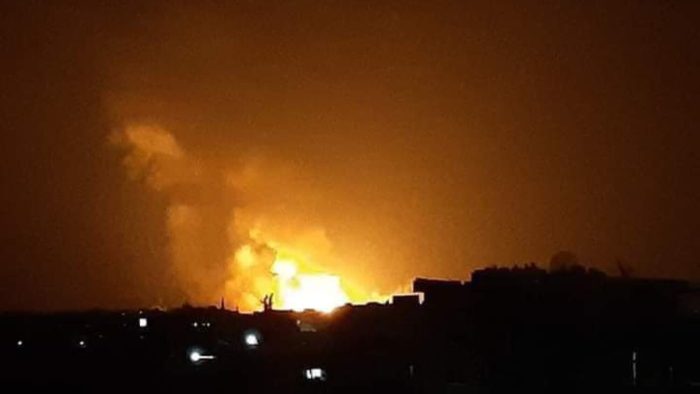
Israel launched fresh airstrikes on Syria’s Aleppo in the late hours of 1 May, killing one soldier and once again putting Aleppo International Airport out of service.
“At about 11:35 PM, Israel carried out an aerial aggression using waves of missiles from the direction of southeast Aleppo, targeting its airport and several sites in its vicinity,” a military source told SANA.
“The Israeli aggression claimed the life of a military personnel and caused the injury of seven others [including two civilians],” the source added.
This is the second time in less than two months that Aleppo International Airport has been crippled as a result of Israeli airstrikes.
On 7 March, Israeli jets bombarded Aleppo airport, damaging its runway and forcing aid deliveries for quake-struck Syria to be redirected to Latakia and Damascus airports.
A few days later, the UN issued a statement condemning the strikes and saying that such attacks “impede humanitarian access and could have drastic humanitarian consequences for millions of people who have been affected by the earthquake.”
“Attacks must never be directed against civilians or civilian objects. The humanitarian community has been responding to one of the worst crises that hit Syria since 6 February against the background of 12 years of conflict, economic decline, and a desperate humanitarian situation,” the UN statement said at the time, adding that Aleppo is “one of the worst earthquake-impacted governorates in Syria.”
Both Damascus and Aleppo airports have been regular targets for the Israeli air force. At the start of this year, Israeli strikes left Damascus International Airport crippled and out of commission.
This is the eleventh Israeli attack against Syria since the devastating earthquake ravaged much of the country in February. Just two days ago, Israeli strikes in Homs left several injured.
Israel’s airstrikes on Syria are illegal under international law but frequently happen under the pretext of targeting Iranian and Hezbollah targets. More often than not, however, the strikes target the Syrian army.
As a result, Tehran has expressed its willingness to bolster Syria’s air defenses to counter the continuous Israeli attacks better.
Arab states call for withdrawal of foreign forces from Syria
RT | May 1, 2023
The government in Damascus should re-establish the rule of law on all of Syria’s territory, ending the presence of foreign armed groups and terrorists, the foreign ministers of Syria, Saudi Arabia, Jordan, Egypt, and Iraq said on Monday after meeting in Amman.
Jordan hosted the meeting, the first of its kind since Syria’s membership in the Arab League was suspended in 2011. Prior to the multilateral meeting, Syrian Foreign Minister Faisal Mekdad met with his Jordanian counterpart Ayman Safadi to discuss refugees, border security and “water issues,” according to Amman.
In a joint statement distributed by state news agencies, the five ministers called for “ending the presence of terrorist organizations” as well as “armed groups” on the territory of Syria, and “neutralizing their ability to threaten regional and international security.” They also pledged to “support Syria and its institutions to establish control over all of its territory and impose the rule of law.”
Saudi Arabia, Egypt, Jordan and Iraq pledged to establish ties with the Syrian military and security institutions in order to “address security challenges.” The five ministers also called for stopping “foreign interference in Syrian domestic affairs.” Their joint declaration also called for setting up technical teams of experts that would follow up on the summit and implement practical measures to resolve the conflict in Syria.
The Amman meeting comes just weeks after Mekdad visited Saudi Arabia and received the kingdom’s endorsement for Syria’s territorial integrity. Currently, Turkish-backed militants control parts of northern Syria, while the northeast is under the control of US-backed Kurdish militias. Several hundred US soldiers are also in Syria, controlling most of the country’s oil wells.
MIlitants backed by Saudi Arabia and the US launched an uprising against Syrian President Bashar Assad in 2011. With the help of Russia and Iran, the government in Damascus eventually prevailed over the collection of rebels, including terrorists affiliated with Al-Qaeda and Islamic State (IS, formerly ISIS). While Syria’s neighbors and regional powers have moved to improve relations with Damascus in recent months, the US has not changed its “regime change” policy.
The Leaked Plan to Attack Russians in Syria Revealed
By Steven Sahiounie | Strategic Culture Foundation | May 1, 2023
The war in Ukraine was planned to extend to Syria. Leaked secret documents revealed the Ukrainian military were planning to attack Russian troops stationed in Syria in an effort to distract Russia and cause losses and casualties far from the battlefield in eastern Europe.
Jack Teixeira, a young member of the Massachusetts Air National Guard, was arrested by the FBI in the investigation of leaked classified military intelligence which were viewed on the Discord chat platform.
Among the documents were details of the planning and assessment of attacks on Russian military capabilities in Syria, to be carried out by the U.S. military partner there, the SDF.
The SDF control the northeast quarter of Syria and the troops are made up of about one-third Kurds and two-thirds Arab tribal members. The Kurdish semi-autonomous region in Syria was created by the U.S. alliance with the Communist administration of the Kurds under Ilham Ahmed and General Mazloum Abdi.
The area the U.S.-Kurdish alliance controls is not populated by a majority of Kurds, but the Kurds do represent a sizable ethnic population. Once they became financially and militarily supported by the U.S., the Kurds were able to carry out a program of ethnic cleansing which displaced the original inhabitants from their homes, lands and businesses.
The SDF working alongside the U.S. occupation forces in Syria were planned to be supplied with drones and other equipment to attack the Russian troops in Syria. The Russian airbase on the coast in Latakia was cited to be attacked as well as other areas.
The Ukrainian military intelligence had planned the attacks in Syria, using the U.S. allied paramilitary force the SDF, for the purpose of opening a second front in the war with Russia. The planning strategized that Russia would be distracted by attacks on its forces in Syria, and become weaker in their military capabilities.
Ukrainian President Zelenskyy, a former TV comedienne, cancelled the operations while still in the planning stages.
The Russian military was invited into Syria in October 2015, when the terrorist group Jibhat al-Nusra was at its height and threatened to over-run the coastal region. After the Russian military arrived in Syria, the Russian forces alongside the Syrian Arab Army were successful in pushing the terrorists back. Today, the central government in Damascus controls almost all of Syria with the exception of the Kurdish region previously described, and the small province of Idlib in the north west which is under the occupation of Hayat Tahrir al-Sham, the current name of Jibhat al-Nusra. Mohammed al-Julani is in control of Idlib. He started off in Iraq with Al Qaeda, then was sent to Syria by the leader of ISIS, and finally is holding about 3 million civilian hostage in Idlib, while being supplied with humanitarian aid by the U.S., UN, EU and other charities.
The Russian presence in Syria today can be termed a peace-keeping mission. They still attack ISIS and terrorist positions, but most of their presence is in holding the peace between the Kurds and their sworn enemy, Turkey. If it was not for the Russian military presence in Syria, Turkey would have invaded even further into the Kurdish region, and there could have been massacres.
Russia has a working relationship with Syria, Iran and Turkey and has been negotiating for a peaceful settlement to the Syrian crisis.
Turkey had been a U.S. ally, but has felt betrayed by the U.S. support of the Kurdish paramilitary SDF, which consists of the core military group YPG, which is aligned with the PKK, a terrorist group responsible for about 30,000 deaths over decades.
Had the Ukrainian plan to attack Russians in Syria been carried out, the response could have been a joint Turkish-Russian military operation against the Kurds, which could have resulted in U.S. military deaths or injuries, and would likely have ended with the U.S. occupation forces withdrawal to Iraq.
If Zelensky hadn’t stopped the plans, Syria could have regained the north east quarter from the Kurds, and Turkey could have vanquished the SDF and YPG. That would then leave Idlib and the terrorists sitting on the border without their U.S. supporters. It could have resulted in Idlib’s terrorist occupiers fleeing under cover of darkness, and the 3 million hostages being set free after more than a decade of captivity.
Under the plan, the SDF asked for protection that they would not be revealed as the source of the planned attacks on the Russian military in Syria, and instead make it appear that the U.S. protected terrorists holding Idlib would be blamed.
Turkey has military troops occupying Idlib, and should the plan have been carried out, Russia could have attacked Idlib as the source of the planned attacks, and this would have been a direct confrontation between Turkey and Russia on Syria soil.
The U.S. may have ordered Zelenskyy to halt the planned attacks on Russians in Syria. Washington, DC. is insisting to remain occupying bases in Syria to prevent Syria from access to its energy resources, and thus preventing Syria from recovery from the U.S.-NATO attack on Syria beginning in 2011. The U.S. has failed in their plan to install an American puppet in Syria, but they were successful in making sure they have a compliant and easily manipulated leader in Ukraine.
UN cross-border aid program for Syria abused by extremists: Moscow
The Cradle | April 28, 2023
Moscow’s permanent representative to the UN, Vasily Nebenzia, said on 27 April that the UN-sponsored cross-border aid mechanism for Syria has “exhausted its capabilities” and is being “used for other purposes.”
The cross-border humanitarian aid mechanism has “has long since exhausted its capabilities and is being used for other purposes, far from addressing the humanitarian situation,” Nebenzia stressed.
The cross-border aid mechanism was established by the UN in 2014 in order to provide aid to northern Syria through the Turkish-Syrian border without authorization from the government in Damascus – a contravention of international regulations.
However, extremist militants in control of large swathes of Syria’s north began taking advantage of the mechanism in order to seize humanitarian aid for themselves, at times to sell for higher prices. Northern border-crossings associated with the UN aid program have even been subject to drug smuggling by armed groups.
Groups such as the Nusra Front, the former Al-Qaeda branch now known as Hayat Tahrir al-Sham (HTS), have also been involved in kidnapping aid workers to demand large ransoms – worsening an already volatile humanitarian situation. The aid program also excludes the majority of the population who reside in government-held territory, where an economy ravaged by sanctions has created significant humanitarian concerns.
“We would like to stress that if our western colleagues in the UN Security Council continue to act as if nothing has happened, and ignore the thwarting of the implementation of the Security Council resolution by international terrorists, we will draw the required conclusions from the current situation while formulating our position on extending the aid transfer mechanism for next July,” Nebenzia added.
The last time the cross-border aid mechanism was extended was in January this year. Russia has called for an end to the program numerous times, and has vetoed its extension in the past.
“It looks like permissions to use two additional checkpoints for three months, issued by Damascus, have de-facto reduced to zero UN enthusiasm to unblock deliveries via the contact line,” the Russian official said.
This refers to the two additional border crossings opened by the Syrian government following February’s devastating earthquake. The crossings, which link government-held territory to the militant-held north, would allow aid to be dispersed conventionally through the Syrian Arab Red Crescent (SARC). However, the UN has yet to lift restrictions on the use of these crossings.
Some have said that this is to perpetuate the idea that Damascus is behind the obstruction of aid delivery across the country, when in fact, HTS and other groups are to blame.
US officials accuse Russia of antagonizing Washington’s illegally occupying troops in Syria
By Robert Inlakesh | RT | April 29, 2023
The US military, with the help of its Kurdish allies, occupies a third of Syrian territory with no legal basis and is now complaining about Russia antagonizing its troops. Although Moscow has been invited into Syria by Damascus and the US has repeatedly been asked to leave, the Americans are treating Syrian territory as if it is their own.
US officials have recently lashed out with yet more accusations against Moscow. This time the complaints have surfaced through Western corporate media outlets such as the Wall Street Journal (WSJ). The head of US Air Forces Central Command, Lt. Gen. Alexus Grynkewich, told the WSJ that “we continue to see unsafe and unprofessional area activity from the Russians,” reportedly in proximity of US forces. No evidence has been provided for the claims and Moscow has yet to make any comment.
In July of last year, Dana Stroul, the Biden administration’s deputy assistant secretary of defense (DASD) for the Middle East, said: “Russia is flying in and moving about, at times, in the same space or terrain, near our forces, and it is the responsible, professional thing to do to make sure we have a channel to talk to each other.” She claimed this system has been in place for “a very long time” and is key in preventing misunderstandings that could “tip into an escalatory cycle.” With the presence of both forces in close proximity so frequently, there has yet to be any indication that what is being complained about now is anything new.
However, the story that is being completely written out of existence here is that the US has no legitimacy whatsoever to even operate inside Syria. The US government attempts to legally justify its presence by asserting that under international law it is a victim state in the face of non-state actors such as ‘Islamic State (IS, formerly ISIS) ISIS or Al-Qaeda. Therefore, the Authorization for Use of Military Force (UAMF) against Iraq, which was passed by US Congress in 2002, is utilized here.
The problem is that the US invasion of Iraq had no validity under international law either, a point explicitly made by former UN Secretary-General Kofi Annan in 2004. Knowing this, US government officials will always cite their invitation from the Iraqi government to operate inside the country today, sometimes attempting to attach their operations in Syria as coming in defense of their Iraqi ally. Article 2(4) of the UN Charter, an international law which prohibits the use of force against the territorial integrity or political independence of another state, completely invalidates US operations inside Syria, since the sovereign government of the nation never granted America permission to enter its territory. In fact, it has even ordered US forces to leave.
Even if you buy the domestic argument about the US fight against ISIS, an organization that has been reduced to terror cells that linger in caves for the most part, this justification also begins to fall apart when examined closely. In 2017, US Senator for Virginia, Tim Kaine, wrote to the US State Department and Secretary of Defense, expressing his concern that if the anti-ISIS mission was extended to include pursuing objectives outside combating the terrorist group, it would have no legitimacy.
In 2018, former US Secretary of State Rex Tillerson stated that he planned on maintaining an indefinite troop presence in Syria, both to fight ISIS and to combat Iran and Syrian President Bashar Assad. Even today, the US Department of Defense openly mentions that its mission in Syria and Iraq is a strategy to undermine Iran and ISIS. At one point, after former US President Donald Trump had been misled to believe that all US forces had been withdrawn from Syria, he corrected himself by saying that the US military presence there is “only for the oil.”
Interestingly, at a conference in 2019, Stroul stated that despite the lack of investment that the US was able to muster to counter Iranian and Russian influence in Syria, it still maintained compelling leverage “to shape an outcome that is more protective and conducive to US interests.”
Stroul outlined four ways that the US maintains its leverage. The first key point she made was about the territory in the north-east, which she said is “owned via the US military with its local partner,” adding that the “one third of Syria is the resource rich, economic powerhouse of Syria.” She elaborated that this is “where the hydrocarbons are” and that it is also the “agricultural powerhouse” of the country. Additionally, she stated that the strategy of isolating the government in Damascus diplomatically is in part about preventing Moscow’s efforts to re-integrate the country onto the international stage, and that US sanctions are partly attached to a wider anti-Iran strategy.
Perhaps the most shocking of all Stroul’s points was the admission that the US has only allowed reconstruction in the areas controlled by its SDF allies in occupied Syria while commenting that “the rest of Syria is rubble.” Stroul continued, “What Russia wants and what Assad want, is economic reconstruction and that is something that the United States can basically hold a card on via the international financial institutions and our cooperation with the Europeans.” In the wake of the devastating earthquake in Northern Syria earlier this year, the prevention of reconstruction has contributed significantly to civilian suffering resulting from the natural disaster.
The US Caesar Act sanctions have been blasted for years by UN experts, who have called upon the Biden administration to drop them over the “suffocating” humanitarian crisis they are inflicting on Syrian civilians. Under international law, the third of Syrian territory “owned” by the US can be argued as tantamount to an illegal occupation by a foreign military force. Given that the US military is an occupying power, Damascus has the right to use force to expel it, furthermore, since Russia has been invited into Syria by the official government, the US claims of harassment carry no weight. The United States of America has no right to claim self defense in Syria, it has only one right there – to leave and not return.
Robert Inlakesh is a political analyst, journalist and documentary filmmaker currently based in London, UK. He has reported from and lived in the Palestinian territories and currently works with Quds News. Director of ‘Steal of the Century: Trump’s Palestine-Israel Catastrophe’.
Israel strikes Syria in response to rare missile attack
The Cradle | April 9, 2023
Israel launched several airstrikes against Syria during the early hours of 9 April, targeting Syrian military sites in the vicinity of the capital Damascus and other areas south of the country, state-media reported.
“At about 05:00 AM, the Israeli enemy launched an aerial aggression with a number of missiles from the direction of occupied Syrian Golan targeting some sites in the southern region,” a military source told state-news outlet SANA.
“Our air defenses intercepted the enemy’s missiles and downed some of them,” the Syrian source added.
The Israeli army claimed to have used airstrikes and artillery to target rocket-launchers and a Syrian military compound. So far, no casualties have been reported and only some material damages ensued.
The Israeli strikes came in response to the firing of several rockets from Syrian territory into the Israeli occupied Golan Heights the night before. Late on 8 April and after midnight on 9 April, a total of six rockets were fired from Syria towards the Golan Heights, three of which landed in Israeli controlled-territory. The missiles were launched in separate barrages.
Two others fell in an open space while the last was intercepted, the Israeli military claimed. Reports suggested that one of the missiles fell in Jordanian territory.
Israel “sees the State of Syria responsible for all activities occurring within its territory and will not allow any attempts to violate Israeli sovereignty,” the Israeli military said in a statement.
The Liwa al-Quds (Jerusalem Brigade) faction, a pro-Syrian government militant group formed in 2013 and made up predominantly of Palestinians, claimed responsibility for the rocket-attack into Israel. The group said that the attack was a response to Israel’s brutal assaults on worshipers in the Al-Aqsa Mosque over the past few days.
In older statements, the Liwa al-Quds group has pledged to “liberate Jerusalem and all of Palestine after purifying Syria from terrorism.”
The rocket-attack was a rare occurrence. The last time rockets were launched from Syria into Israel was in 2019.
This new attack came just two days after dozens of rockets were fired into northern Israel from Lebanese territory in response to Israel’s brutality in Al-Aqsa Mosque.
No group claimed responsibility for firing the rockets from Lebanon. However, Israeli media suggested that it was a coordinated attack carried out by the Palestinians in Lebanon and green-lighted by Hezbollah.
The Hebrew media claims represented the growing fear in Israel of increased coordination between Hezbollah, Iran, the Palestinians, and the axis of resistance in general – while also reinforcing the fear that several fronts are now open against Israel.
These recent rocket attacks against Israel have coincided with an unprecedented surge in Palestinian resistance operations against settlers and soldiers inside of Palestine.
Recent hostilities between Syrian and US forces could be a turning point
By Robert Inlakesh | RT | April 9, 2023
US President Joe Biden ordered airstrikes on a number of positions in northeastern Syria last month, after Washington announced the death of a contractor in a drone strike.
What followed was an unprecedented response from the Syrian Arab Army (SAA) and allied militias, shelling US positions throughout the duration of the following day. This exchange of fire marks a turning point in the conflict between the two sides.
On March 23, the US Department of Defense claimed that a drone, of Iranian origin, had struck US forces stationed near al-Hasakah, in northeastern Syria, killing an American contractor and injuring a number of service members. To which F-15 fighter jets were launched from Doha in order to target Iranian-allied militia groups in the Deir ez-Zor province of Syria. Throughout recent years there have been several exchanges between US and Iranian-allied militia groups in Syria’s east. However, these rarely resulted in American casualties and the brief escalations were controlled.
What changed following the US strikes on March 24 is that there was intense return fire from not only Iranian-aligned militias in Deir ez-Zor, but also from the SAA itself. A number of US bases were struck in the response, which primarily targeted American forces around the al-Omar oil fields, inflicting traumatic brain injuries on six US troops, according to the Pentagon. During a trip to Canada the following day, Joe Biden remarked that the US was “not going to stop” when asked about retaliating against Iran for the exchange in Syria. “Be prepared for us to act forcefully to protect our people” he said.
It later emerged that the Biden administration had moved one of its aircraft carriers, the USS George H.W. Bush, closer to Syria, which, deputy Pentagon press secretary Sabrina Singh explained, was due to “increased attacks from [Iran’s Islamic Revolutionary Guard Corps (IRGC)]-affiliated groups targeting our service members across Syria.” What this represents, regardless of whatever action the US may take in the future, is a strategic change in the equation set forth by Syria and its allies in Syria’s east. What an Iraqi source with intimate knowledge of the situation claimed had been an “order to now kill American troops and not just fire warning shots.”
According to a Syrian political source, who chose to remain anonymous for security reasons, the escalation in the northeast is directly tied to the ongoing Israeli aggression against the country:
“The recent move by Syria and allies is a direct response to a wave of Israeli escalation against the country that began last year. If you remember in August of 2022, there was a similar stand-off between the Americans and IRGC allies in northeastern Syria. The Israeli escalation is directly enabled by the United States, whose officials talked in the past about the importance of the American military presence in Syria for Israel’s war-between-wars campaign against Iran-aligned forces there.”
The “war between wars” is one of Tel Aviv’s inter-war campaigns, where covert operations are carried out against enemy states during a period of relative calm between both sides. Israel’s recent campaign has primarily consisted of operations against Iranian-linked targets, both inside and outside of Iran; it also has included a large number of unannounced airstrikes inside Syria, where members of the IRGC have been targeted, along with allied militia groups. The Israel Defense Forces have a policy of not commenting on these attacks but Prime Minister Benjamin Netanyahu has in the past admitted that “hundreds” of them had taken place over the years.
If Damascus’ new approach of responding forcefully against the US military in northeastern Syria is adopted going forward, it will give Washington only two options: negotiate with Damascus or leave the country completely. If American soldiers are coming home in body bags over maintaining an occupation inside a country that the US public, along with Congress, were never consulted on, the pressure of remaining could become a burden on the Biden administration. This is especially the case at a time when the Arab World is beginning to normalize formal ties with Damascus, in addition to Washington’s NATO ally Türkiye.
A Syria-Türkiye rapprochement could be essential to forcing the US out of Syria also, as both countries could end up coordinating during any future Turkish offensive against the Kurdish-led Syrian Democratic Forces (SDF) in the northeast. The SDF operate as a kind of US proxy force, allowing for the Americans to use a small number of their own troops to occupy roughly a third of Syria’s territory; included in which are the most fertile agricultural lands and the majority of Syria’s natural resources. Both previous attacks, launched by Ankara in 2018 and 2019, led to a withdrawal of US forces so as to not accidentally cause friction with their NATO ally. In the event that another military operation from Türkiye is launched, Syria could be poised to retake its oil fields, in theory.
The adoption of a head-on confrontation strategy by Iran-aligned groups and the Syrian government could lead to new horizons and to the possibility of a US withdrawal, that is assuming the Biden administration is not wedded completely to the idea of staying.
Robert Inlakesh is a political analyst, journalist and documentary filmmaker currently based in London, UK. He has reported from and lived in the Palestinian territories and currently works with Quds News.
US deploys guided-missile submarine to Middle East
Press TV – April 8, 2023
The United States says a nuclear-powered American guided-missile submarine is operating in the Middle East in support of the US Fifth Fleet, which is based in Bahrain.
The USS Florida entered the region on Thursday and began transiting the Suez Canal on Friday, Commander Timothy Hawkins said in a statement on Saturday, according to Reuters.
“It is capable of carrying up to 154 Tomahawk land-attack cruise missiles and is deployed to US 5th Fleet to help ensure regional maritime security and stability,” Hawkins added.
This came after the US Navy relocated a warship in the Mediterranean to the coast near Syria after tensions rose between Tehran and Washington over deadly attacks on Iranian military advisors in Syria.
Iran’s envoy to the UN Amir Saeid Iravani earlier on Monday warned that the Islamic Republic will take “decisive measures” to protect its forces and interests in Syria against any threats posed by the United States or others.
Last week, two Iranian military advisers stationed in Syria were killed in an Israeli airstrike near the country’s capital Damascus. Following the attack, the IRGC issued a stern warning to the Israeli regime on Sunday, vowing retaliation for the killing of its military advisers in Syria.
The relocation of the US warship came as US President Joe Biden claimed in March that the United States was not seeking a conflict with Iran.
Saudi, Iran, Syria envoys meet in Oman
MEMO | April 4, 2023
The ambassadors of Saudi Arabia, Iran, Syria and Iraq held a meeting in the Gulf country of Oman on Tuesday, according to Iraqi Ambassador, Qais Saad Al-Amiri, Anadolu News Agency reports.
The diplomats exchanged views about regional affairs during the meeting hosted by Al-Amiri “in an atmosphere of optimism and familiarity among the attendees,” the Iraqi Embassy in Muscat tweeted.
Last month, Saudi Arabia and Iran announced the restoration of their diplomatic relations during talks hosted by Beijing, a deal called a diplomatic coup by China.
The two sides are expected to open embassies in each other’s capitals within two months since the deal was signed on 10 March.
Talks are also under way between Saudi Arabia and Syria to resume consular services in the two countries, according to the Saudi Foreign Ministry.
Simultaneous US aggression in Black Sea and Mediterranean as multipolarity accelerates
By Drago Bosnic | April 3, 2023
Following the recent engagements between illegal American occupation forces in northeastern Syria and what the Pentagon called “pro-Iranian forces”, leaving dead and wounded on both sides, the United States has decided to further escalate tensions in Syria and the Middle East as a whole. As the multipolar, or should we say the actual world, is engaging in real and masterful diplomacy (in stark contrast to the US), reconciling archrivals such as Iran and Saudi Arabia and slowly but surely normalizing relations between Syria and Turkey, the stabilization of the globe seems like an unstoppable process. This is deeply alarming to the political West, the only entity on the planet in constant need of widespread death, destruction and chaos so it can maintain the illusion of the “garden-jungle” geopolitical framework.
Using the recent clashes as an excuse, Washington DC announced an extension of the CSG (carrier strike group) deployment led by USS “George H.W. Bush” Nimitz-class supercarrier, over 9.000 km away from its home port of Norfolk in Virginia. On Friday, US CENTCOM (Central Command) spokesman Colonel Joe Buccino stated that the extension of the “George H.W. Bush” CSG, inclusive of the “USS Leyte Gulf”, the “USS Delbert D. Black” and the “USNS Arctic” allows options to “potentially bolster the capabilities of CENTCOM to respond to a range of contingencies in the Middle East”. At the time of the announcement, the CSG was near Sicily. Apparently, the deployment will also include “a scheduled, expedited deployment of a squadron of A-10 attack aircraft to the region.”
According to Reuters, at least one US official, “speaking on the condition of anonymity”, confirmed that the George H.W. Bush CSG was “expected to remain in the European Command area of responsibility”, most likely until further notice, meaning that the US wants to keep tensions as high as possible for as long as possible. For the mainstream propaganda machine, the conflict in Syria is still called the “Syrian Civil War”, although it is anything but. Washington DC and its numerous satellite states in the region have been attacking the unfortunate country for over a decade now, resulting in hundreds of thousands of dead and millions of refugees. In addition, the US maintains an illegal occupation of northeastern Syria, where it’s supposedly “guarding” (i.e. stealing) the country’s oil reserves.
However, US militancy in Syria (and the wider Middle East) is only a fraction of the belligerent thalassocracy’s aggression against the world. Concurrently, Washington DC and its numerous NATO satellite states also conducted naval drills off the coast of Romania’s Tulcea County on the country’s Black Sea coast. The region borders the Odessa Oblast (an area currently occupied by the Kiev regime). Apparently, the war games included a scenario where thousands of NATO soldiers simulated coastal defense against a large-scale attack by an “unnamed aggressor” (obviously referring to Russia). Dubbed “Sea Shield 23”, the naval drills started on March 20 and were concluded on Sunday, April 2.
In total, close to 3,500 servicemen from the US and eleven other NATO vassals took part, including at least 30 naval ships, 14 aircraft and 15 other “fast intervention” boats. The live-fire drills were conducted both in the Black Sea and the Danube Delta, approximately 30 km from the border with Odessa Oblast. Since Russia started the special military operation (SMO), the US has conducted a number of large-scale military exercises in Eastern Europe to simulate a potential conflict with Moscow. This includes a recent simulated nuclear attack on Saint Petersburg, Russia’s second-largest city with close to six million inhabitants. A USAF B-52H “Stratofortress” flying in Estonian airspace circled in an area barely 100 km from the Russian border.
To put that into perspective, we should imagine a Russian Tu-95MS “Bear” strategic bomber/missile carrier flying just 60 miles off Manhattan, simulating a thermonuclear strike on New York City, one of the most important urban areas in the US. Still, that doesn’t prevent the US from doing everything in its power to provoke Russia. Considering that the “deep diving pro-Ukrainian group” that conducted the Nord Stream terrorist attacks has now also been dangerously close to the Turk (formerly South) Stream pipelines, the Russian Black Sea Fleet will need to be as vigilant as ever. The pipeline is the only major energy hub supplying natural gas to Turkey and Southeast Europe.
In the meantime, the world is working towards creating conditions for peaceful coexistence and cooperation of the globe’s numerous civilizations. Organizations such as BRICS and SCO (Shanghai Cooperation Organization) are rapidly expanding by admitting new members, with Iran being the most recent constituent of SCO. Saudi Arabia also became a dialogue partner on March 29, marking an important milestone in the organization’s history, which now includes all major oil producers in Eurasia and the Middle East. This also marks a crucial step toward eliminating Western currency dominance, the key provision to limiting the belligerent power pole’s ability to conduct military and economic aggression against the world.
Drago Bosnic, independent geopolitical and military analyst.
Large quantities of US weapons lost, stolen in Iraq, Syria: Report

The Cradle – March 31 2023
Hundreds of thousands of dollars in US artillery equipment, unspecified “weapons systems,” and specialized ammunition meant for US forces in Syria and Iraq have been stolen in recent years, The Intercept reported on 30 March.
According to criminal investigations files obtained under the Freedom of Information Act by The Intercept, at least four large-scale thefts and one loss of US equipment valued at some $200,000 have occurred in Iraq and Syria between 2020 and 2022. The lost items include 40mm high-explosive grenades stolen from US Special Forces.
The losses continue a previous pattern. The Intercept notes further that a 2020 audit by the Pentagon’s inspector general found that Special Operations Joint Task Force–Operation Inherent Resolve, the main unit that partners with the Kurdish-led Syrian Democratic Forces (SDF) to illegally occupy northeast Iraq, did not properly account for $715.8 million of equipment purchased for the SDF.
The recent failure to prevent the theft of, and account for, US-supplied weapons is concerning because this previously played a key role in the rise of Al-Qaeda affiliated groups, including the Nusra Front and ISIS, in Iraq and Syria.
In the spring of 2015, an extremist coalition led by the Nusra Front successfully conquered Syria’s Idlib governorate, in large part thanks to US-manufactured and supplied TOW anti-tank missiles. The missiles were originally supplied to Free Syrian Army (FSA) groups working with closely with Nusra.
When Russia intervened in the Syria conflict to prevent the fall of the government to Al-Qaeda groups – including Nusra, ISIS, and Ahrar al-Sham – a few months later, in September 2015, US officials drastically escalated TOW missile shipments to FSA units working with these groups.
When journalist Sharmine Narwani asked why US-supplied weapons allegedly meant for FSA groups were showing up in the hands of the Nusra Front, CENTCOM spokesman Lieutenant Commander Kyle Raines responded: “We don’t ‘command and control’ these forces – we only ‘train and enable’ them. Who they say they’re allying with, that’s their business.”
ISIS was also a major beneficiary of US-supplied weapons. Conflict Armament Research (CAR), a UK-based organization that tracks the supply of weapons into conflict-affected areas, reported that “Unauthorised retransfer – the violation of agreements by which a supplier government prohibits the re-export of materiel by a recipient government without its prior consent – is a significant source of [ISIS] weapons and ammunition. The US and Saudi Arabia supplied most of this material without authorization, apparently to Syrian opposition forces.”
By way of example, CAR noted that it had recovered US-supplied anti-tank missiles used by ISIS in Ramadi in February 2016. CAR confirmed that the missiles had been exported from the United States in December 2015. This indicates that the weapons were diverted to ISIS “in a matter of days or weeks after their supply.”
Featured Video
Laith Marouf: Hezbollah’s position on US-Iran ceasefire
or go to
Aletho News Archives – Video-Images
From the Archives
The Dirty Little Secret behind the “Global Terrorism Index”
The Omission of Israeli Terrorism in the Occupied Palestinian Territories
By Karin Brothers | Global Research | December 6, 2014
… The Israeli settlements — all of which are illegal – have been identified as a major impediment to peace. The refusal of a major “global” terrorism report to name the Israeli settlers as one of the groups most responsible for terrorism not only misrepresents a major source of regional violence but exposes the Global Terrorism Index as a propaganda tool that supports a U.S. agenda.
In recent years, governments have been attempting to thwart terrorism by blocking supportive fund-raising. When it comes to Israeli settlements, however, the US and Canada actually encourage fund-raising by giving organizations (such as Christian Friends of Israeli Communities (CFOIC) and the Jewish National Fund) financial support in the form of donor tax-deductions.
Charities which provide funds for the Israeli settlements should be regarded as terror-financing organizations. They should not only lose their tax-deductible status, but they should be banned because they support the violation of international humanitarian law. The terror-financing laws that are being strictly enforced for Muslim charities should be applied to Christian and Jewish charities as well. … Read full article
Blog Roll
 Aletho News
- How UK Regulator Ofcom Quietly Bypassed International Law to Police American Speech
- The Black Cube Files: How Former Mossad Operatives Flipped a Nation
- Laith Marouf: Hezbollah’s position on US-Iran ceasefire: What you’re not being told
- Israel’s priority lies in destroying chances of peace between Iran, US: Ex-UN nuclear chief
- Ceasefire for all or for none: Iran shuts Hormuz over Lebanon attacks
- Strait of Hormuz is Iran’s ‘nuclear weapon’ that forced US retreat: Medvedev
- Energy crisis will last for months – Kremlin envoy
- Europe’s quiet role in the war on Iran
- Forty days that shook the Empire: How Iran turned the tables on US and prevailed
- Netanyahu unilaterally declares Lebanon outside of ceasefire deal
- If Americans Knew
- Tucker Carlson on Israel: This Is the Behavior of an Ally? Really?
- Gazans face a triple crisis: severe shortages of water and bread, healthcare in tatters
- NY Times reports how Netanyahu took the US into Iran War
- A sigh of relief over Iran, but Gaza and Lebanon in dire straits – Daily Update
- Thousands dead and neighborhoods razed to the ground: Aid agencies fear southern Lebanon is becoming the new Gaza
- The war the US is fighting for Israel could cost trillions
- ‘Cigarette Burns, Nail Wounds’: Toddler Tortured in Gaza to Coerce Father
- Trump Says US Sent ‘a Lot of Guns’ to Protesters in Iran
- Israeli forces destroy 17 UN peacekeeper cameras in south Lebanon
- US-Israeli strikes ‘completely destroy’ synagogue in Tehran
- No Tricks Zone
- An Inconvenient Tree: Uncovered In Alps… Europe Much Warmer Than Today 6000 Years Ago
- New Study Reports A 60% Slowdown In Greenland’s Ice Loss Rate In The Last Decade
- Low Intensity Tornado Wrecks Major Solar Farm, Creating A Potential Toxic Dump
- New Study Finds Warming Saves Lives…Cold Temperatures 12 Times More Deadly Than Excess Heat
- German Science Blog Accuses PIK Climate Institute Of Hallucinating Climate Tipping Points
- Devastating Assessment Of Comirnaty Vaccine By Former Senior Pfizer Europe Toxicologist
- New Study: CO2 Is ‘Effectively Negligible’ As An Explanatory Climate Change Factor Since 2000
- Former Pfizer Toxicologist Dr. Helmut Sterz Tells Bundestag Hearing Pfizer Vaccine Should Have Never Been Approved
- Energy Expert: Germany’s Nuclear Phaseout Was A “500 Billion Euro Mistake”
- New Research: South Australia’s Mid-Holocene Sea Surface Temperatures Were 4°C Warmer Than Today
 Aletho News