Saudi Arabia’s shadowy role in the Ghouta chemical attack
There is now substantial evidence Saudi intelligence conducted false flag chemical attacks in Syria to trigger US military intervention and regime change
By William Van Wagenen | The Cradle | October 6, 2023
On 13 September, acclaimed US investigative journalist Seymour Hersh revealed a crucial five-page memo prepared for the US Defense Intelligence Agency (DIA) on 20 June, 2013. This document contained alarming details about the Al-Qaeda-affiliated Nusra Front’s disturbing plan to manufacture sarin nerve gas with the aim of executing a chemical attack within Syria.
The significance of this memo extends beyond its surface, as it adds to the mounting evidence pointing toward Saudi intelligence’s involvement in orchestrating a false flag chemical attack in the Damascus suburb of Ghouta a month later, on 21 August 2013.
The attack resulted in the tragic deaths of numerous civilians and nearly triggered a western military intervention in support of Islamist militant factions aiming to overthrow the Syrian government.
Nusra’s sarin procurement
The DIA memo, which provides details obtained by US National Security Agency (NSA) surveillance, states that in April and May that year, “several Turkey and Saudi-based chemical facilitators” working for the Nusra Front “were attempting to obtain sarin precursors in bulk, tens of kilograms, likely for the anticipated large-scale production effort in Syria.”
Notably, the memo identifies three Nusra operatives — Abd al-Ghani, Kifah Ibrahim, and Adil Mahmud — who planned to perfect “a process for making sarin, then go to Syria to train others to begin large scale production at an unidentified lab in Syria.” Ibrahim and Mahmud were both captured in Iraq in May 2013, according to the memo.
The revelation that the NSA had identified Nusra operatives seeking sarin precursors in Saudi Arabia raises the implication that Saudi intelligence, then under the leadership of Prince Bandar bin Sultan, would also have been aware of these activities.
This implies that Riyadh might have either actively facilitated Nusra in obtaining sarin precursors or chosen not to interfere, allowing these sinister plans to progress unimpeded.
The memo further states that:
“The Syria-based part of this effort [to produce sarin] may have begun as early as late 2012. Abu Muhammad al-Hamawi, the [Nusra Front] emir for Hamah, was attempting to obtain phosphorous trichloride, a key sarin precursor, in December 2012. We cannot definitively connect this to the sarin cell, but it could very well be linked.”
Saudi’s ‘southern strategy’
According to US-based, regime-change advocate Charles Lister and Swedish journalist Aron Lund, Abu Muhammad al-Hamawi is also known as Sheikh Saleh al-Hamawi, a Syrian from the town of Halfaya in Hama. He was one of six founders of the Nusra Front and a recipient of Saudi support.
The timeframe in December 2012, when Hamawi was purportedly seeking sarin precursors, coincides with the period when Prince Bandar bin Sultan — the well-connected former Saudi ambassador to Washington — oversaw the implementation of Saudi intelligence’s “southern strategy” to shift the focus of the conflict towards Damascus.
Bandar had assumed the position of director of Saudi intelligence in mid-2012 and established an operations center in Jordan to covertly direct efforts against the Syrian government. He came into his role with guns blazing: on July 18, armed elements turned their sights to the capital city, beginning with the Damascus bombing of Syria’s National Security headquarters, which killed key officials in Syrian President Bashar al-Assad’s inner circle.
The New York Times reported that in November 2012, a “cataract of weapons” procured by Saudi intelligence began flowing from Jordan into Syria. While the weapons were publicly presented as going to so-called “moderates” in the Free Syrian Army (FSA), US officials acknowledged that many of them ended up in the hands of “hard-line Islamic Jihadists.”
In February 2013, the Washington Post interviewed Hamawi, identifying him as an FSA rather than a Nusra commander (the FSA and Nusra collaborated closely and, in many cases, were indistinguishable).
Hamawi suggested his units had received weapons shipments in previous weeks from Saudi Arabia as part of Bandar’s southern strategy while stating that “Deraa and Damascus are the key fronts on the revolution, and Damascus is where it is going to end.”
According to a leaked NSA document, Prince Bandar’s subordinate, National Security Council deputy chief Prince Salman bin Sultan, provided 120 tons of explosives and other weaponry to opposition forces, giving them direct instructions to “light up Damascus” and “flatten” the airport in March 2013.
Regiment 111
In December 2012, several jihadist groups spearheaded by the Nusra Front captured a Syrian army base in the Aleppo countryside known as Regiment 111. The base contained stocks of mustard gas, chlorine, and sarin, which Nusra seized. Katibat al-Muhajireen, an Islamist armed group of foreign fighters supported by British intelligence, also participated in the capture of Regiment 111.
It is highly probable that US intelligence was aware of Nusra’s acquisition of these chemical weapons. On 7 December, 2012, just two days before the base’s fall, Syria Deeply, a platform funded by the US government, reported that, according to an Arab diplomat, US contractors were operating on the ground in Syria with the mission of monitoring the status of the country’s chemical weapons stockpiles.
The diplomat said there “are 24-hour Skype links connecting the US with rebel brigades to enhance monitoring of chemical weapons sites on the ground.”
Just as jihadists backed by Saudi and western intelligence were about to acquire sarin (or the components to create sarin) from Regiment 111, US officials began floating accusations that the Syrian government was preparing to use chemical weapons. US officials also cited these claims as a justification for possible western military intervention.
Predictably, the Syrian opposition soon asserted that the Syrian government had employed chemical weapons. On 25 December 2012, a Syrian army defector claimed to Al-Jazeera that the Syrian government had used a nerve gas resembling sarin in an attack on Homs. However, the evidence supporting these allegations was so flimsy that even US officials promptly dismissed them.
Nonetheless, Prince Bandar saw an opportunity in this incident. In February 2013, he tried to persuade the White House that Syria’s Assad had crossed US President Barack Obama’s “red line” by employing chemical weapons.
US response and arming opposition
Several months later, evidence began to emerge suggesting that the Nusra Front had managed to obtain or produce some low-grade sarin. On 19 March, 2013, a rocket containing chemical agents was launched at the town of Khan al-Assal in Aleppo province, resulting in the death of 25 individuals.
Notably, among the casualties, 16 were Syrian soldiers, a detail that raised doubts about Assad’s culpability in the attack.
On 5 May that year, UN investigator Carla del Ponte said she had gathered testimony indicating that sarin had been used by “the opposition, the rebels, not by the government authorities.”
Bolstering del Ponte’s claim, Reuters reported on 30 May that Turkish authorities detained 12 Nusra Front militants in possession of 4.5lb of sarin gas, while a Nusra fighter who helped capture the Regiment 111 base later speculated that Nusra had carried out the Khan al-Assal attack with the sarin captured at the base.
When the Syrian army and allied-Hezbollah forces captured the strategic town of Qusair on the Lebanon border in June, officials in Washington began to panic, believing that drastic measures were needed “to stem the tide of Assad victories.”
Amid calls for a no fly zone in Syria from prominent US lawmakers and the media, the Pentagon announced it was sending F-16s and Patriot missile batteries to Jordan. Although Obama refused direct military intervention, his administration issued a special assessment claiming the Syrian government had used chemical weapons and announcing that the US would now arm extremist opposition groups directly.
But for Prince Bandar, this was not enough. Reuters reported that Saudi officials, including the late King Abdullah and Prince Bandar, “want more US involvement … They are really worried about the attitude in Washington.”
Foreign support for Syrian ‘rebels’
On 20 June, the DIA memo revealed by Seymour Hersh was written and distributed, confirming that the Nusra Front was seeking to produce sarin. But this information was ignored, and western officials continued to make new fabricated claims that Damascus had carried out chemical attacks, including in Saraqeb, Sheikh Maqsoud, and Jobar.
It is in this context that Prince Bandar, with the help of his counterparts in US and Israeli intelligence, prepared to launch a massive “rebel” assault on Damascus.
The French newspaper La Figaro reported that according to its sources, the “first Syrian contingents trained in guerrilla warfare by the Americans in Jordan have been in action since mid-August in southern Syria, in the Deraa region. A first group of 300 men, probably supported by Israeli and Jordanian commandos, as well as by men from the CIA, would have crossed the border on August 17. A second would have joined them on the 19th.”
The stage was now set for a US air campaign to aid Bandar’s jihadist groups amassing near Damascus. However, a trigger was still needed to force Obama to authorize it.
The Ghouta attack
On the morning of 21 August 2013, a flurry of videos appeared on social media allegedly showing the aftermath of a mass chemical attack carried out by the Syrian army in Ghouta, killing 1,429 civilians, including 456 children.
The New York Times reported that “Within hours, [Obama] administration officials began signaling that they were preparing for an immediate military strike to punish the Syrian government,” reversing Obama’s previous reluctance.
The following day, 22 August, La Figaro published its report about the jihadist offensive on Damascus, stating “the anti-Assad operation has begun.”
However, the US president soon reversed his decision to authorize military intervention after Director of National Intelligence James Clapper warned that the evidence linking Assad to the deadly attack was “not a slam dunk.”
In the absence of a wide-scale US bombing campaign, the armed offensive on Damascus failed after 15 days of brutal fighting.
In their interim report released in September 2013, UN investigators later confirmed sarin had been used in Ghouta.
The UN team did not have a mandate to attribute responsibility for the Ghouta attack, however, a detailed analysis published in 2021 by Rootclaim showed that the Saudi-backed Liwa al-Islam fired the sarin-filled rockets in Ghouta – not the Syrian army.
Furthermore, the conclusive UN report released in December 2013 corroborated that jihadist groups had indeed used small quantities of sarin in attacks against Syrian soldiers in the Damascus suburb of Jobar on 24 August and in Ashrafiah Sahnaya in the capital’s countryside on 25 August.
Continued false flag attacks
Jordanian journalist Yahya Ababneh visited Ghouta days after the attack and interviewed several opposition fighters, their families, local doctors, and civilians. According to his sources, local armed groups received chemical weapons via Saudi Prince Bandar and were responsible for carrying out the Ghouta attack.
Ababneh reported that fighters he spoke with “reported that their salaries came from the Saudi government” and that “Prince Bandar is referred to as ‘al-Habib’ or ‘the lover’ by al-Qaeda militants fighting in Syria.”
One month later, a senior UN official who dealt directly with Syrian affairs claimed that according to fighters in Ghouta, “Saudi intelligence was behind the attacks, and unfortunately nobody will dare say that.”
Syria Deeply reported in December 2012 that as part of a special task force sent to Jordan, the “US and its allies have hired contractors to train some Syrian rebel brigades in chemical weapons security.”
After Ghouta, jihadist groups supported by the CIA, Saudi intelligence, and Mossad continued to stage false flag chemical attacks blamed on Assad, most notably in Khan Sheikhoun in April 2017, and Douma in April 2018.
Saudi-funded sedition
The Saudi role in such false flags was further illustrated in March 2018 when the Syrian army liberated some Eastern Ghouta farmlands and discovered a well-equipped chemical laboratory run by Saudi-backed Liwa al-Islam (by then known as Jaish al-Islam).
The Cradle columnist Sharmine Narwani visited the lab that year and reported that it was packed with equipment, chemical substances, and munitions. The equipment included a US-manufactured gas compressor for which Saudi Arabia put out tenders in 2015.
In the nine months leading up to the Ghouta false-flag incident, Nusra operatives were actively seeking sarin precursors in Saudi Arabia. Furthermore, a Nusra commander in Syria, identified by the DIA as being involved in seeking sarin precursors, had received Saudi military support.
Saudi intelligence was not only arming and financing jihadist groups but was also issuing direct orders for attacks in Damascus. Liwa al-Islam fired the sarin-filled rockets at Ghouta at a critical juncture when a major offensive on Damascus, planned by Saudi intelligence in cooperation with the CIA and Mossad, was about to commence.
The broader pattern of false flag chemical attacks blamed on the Syrian government, such as those in Khan Sheikhoun and Douma, further underscores the potential Saudi role in such operations.
Considering the documented evidence, it becomes increasingly implausible to suggest that Liwa al-Islam acted alone in the Ghouta false-flag attack. The incident resulted in the deaths of numerous Syrian civilians, including women and children, and nearly led to western military intervention, aligning with the objectives of US, Saudi, and allied intelligence agencies seeking to overthrow the Syrian government.
US has close partnership with Takfiri terrorists in Syria, says President Assad
Press TV – September 30, 2023
President Bashar al-Assad says foreign-sponsored Takfiri terrorists are operating in areas of northeast Syria controlled by US occupation forces, stating that Washington has built up a close and strong partnership with militants wreaking havoc across the country.
Assad made the remarks in an exclusive interview with China’s state-run CGTN television news channel broadcast late on Friday.
“The northeastern sector of Syria is exactly the region, where terrorists are operating and Americans assert control over. The issue is not simply restricted to the looting of natural resources; but rather a partnership with terrorists to reap mutual benefits. This brings another problem, as a major power is in cahoots with terrorist. These are the facts on the ground in Syria,” he said.
Assad said the Syrian conflict is not over yet, and the Arab country is in the midst of a war.
“Syria, due to its geographical location, has historically endured numerous invasions. Anytime occupiers overran the country, they destroyed its cities and towns. Syria has, however, managed to recover. Syrian people will be able to rebuild their own country when the war ends and the siege is lifted.”
Assad said, “The current situation is certainly not good. It is, frankly speaking, difficult because livelihood woes and struggles are the main problems of the Syrian nation. I mean the financial miseries that they have to endure. Their pains and sufferings are increasing.”
“If reconstruction gets underway, Syria will have a very bright future. I am not speaking of assumptions, desires and expectations, but rather about the pre-war situation. Prior to the war, Syria’s growth was at its best rate of 7%, which was considered a very high ratio for a country with limited capacities.
“We had no foreign debts. We used to borrow and pay back our debts directly. We had enough wheat and used to export grains to other countries. We used to export vegetables and fruits, and were developing our industries in the early years of the crisis. Therefore, I can assuredly say that Syria will be much better than what it was before the war in case the war stops and reconstruction starts,” Assad added.
China and Syria forge ‘strategic partnership’ – leaders
RT | September 22, 2023
Beijing and Damascus announced a new “strategic partnership” during Syrian President Bashar Assad’s ongoing visit to China. President Xi Jinping met him in the city of Hangzhou before this week’s launch of the Asian Games, a high-profile international sports event.
Assad is visiting China for the first time since 2004, when he met then-President Hu Jintao. Xi announced the new agreement as he welcomed his guest in the capital of Zhejiang Province on Friday.
The Chinese leader stated that the relationship between the two nations has “withstood the test of international changes” and pledged to maintain them in the face of international “instability and uncertainty.”
The US and its allies have been seeking to oust Assad for over a decade, accusing him of various transgressions during an armed conflict in the country. The bloodshed started in 2011 as mass protests surged against the Syrian government but were soon hijacked by international jihadist organizations. These elements sidelined other anti-government forces, which Western nations touted as “moderate rebels,” as the main threat to Damascus.
Russian intervention in 2015 turned the tide and helped the Syrian Army oust Islamist militants from most of the country. Some portions, where Turkish and American troops or their local allies are present, remain outside Damascus’ control.
The US has imposed crippling unilateral sanctions on Syria, which hamper its ability to reconstruct after this brutal conflict. Xi expressed support for Assad’s efforts to rebuild the nation, keep terrorists in check, and seek a political settlement for the Syrian people.
The Arab League readmitted Syria in May as Damascus seeks to normalize relations with its neighbors. Beijing had facilitated the restoration of diplomatic relations between regional rivals, Iran and Saudi Arabia, in June. Both nations played significant roles in the Syrian crisis, the former supporting Assad’s government and the latter initially vying for his ouster.
The Syrian president and First Lady Asma Assad arrived in Hangzhou on Thursday. On Saturday, the visiting dignitaries are set to attend the opening ceremony of the 19th Asian Games alongside a dozen other foreign guests.
Unrest grows in US-occupied Syria after Kurdish proxy hikes fuel prices by 300 percent
The Cradle | September 19, 2023
Syrians living under the de-facto rule of the Autonomous Administration of North and East Syria (AANES) in Hasakah governorate have launched mass demonstrations and a general strike to oppose a fuel price hike of over 300 percent for public transport and industrial vehicles.
The unprecedented protests have grown in scope after Kurdish authorities announced that reversing the decision is “almost impossible,” citing the country’s deteriorating economic situation. While fuel prices for vehicles were hiked from 525 to 2,050 Syrian pounds, the fuel price for heating, agriculture, and electric generators remains the same.
Protesters have been blocking roads and shutting down businesses for several days in the towns of Qamishli, Rumailan, and Mabada, accusing the US-backed authorities of plundering Syria’s wealth for their own benefit. Demonstrations have also been called in the regions of Raqqa, Manbij, and Ain al-Arab, which could lead to significant economic repercussions in all areas under the control of the AANES and its official military force – the Syrian Democratic Forces (SDF).
“The people went out to express their rejection of the policies of AANES, which aim to impoverish the people and push them to migrate,” a demonstrator in Qamishli told Lebanese daily Al-Akhbar.
“There was a consensus to provide and improve the quality of diesel in exchange for increasing its prices,” the head of the AANES fuel management authority, Abeer Khaled, recently told reporters, adding that “it is difficult to retract or modify the decision to increase [considering that] raising prices will contribute to reducing fuel smuggling operations outside areas under the control of AANES.
In 2021, AANES reversed a similar decision to hike fuel prices after intense clashes between locals and the SDF left several dead.
The territory occupied by the SDF and the US army in Syria’s northeast houses the country’s largest oil and gas fields, as well as vast wheat fields.
Washington’s forces regularly smuggle these resources via convoys to their bases in the Iraqi Kurdistan Region (IKR), where the oil and gas are sold to fund the operations of US proxy militias and de facto authorities.
The protests in Hasakah come as armed operations continue in neighboring Deir Ezzor governorate by Syrian Arab tribes who have been staging a rebellion against Kurdish forces. While heavy clashes have subsided for the most part, the region is still seeing sporadic attacks targeting the SDF.
The West appears to be preparing another regime change ‘uprising’ in Syria
By Eva Bartlett | RT | September 12, 2023
Twelve years on, the West’s war on Syria continues, with seemingly new plans to destabilize the country and overthrow its leadership. This after years of brutal sanctions against (and crocodile tears for) the Syrian people.
Earlier this year, a discussion between journalist Edward Xu and Farhan Haq, deputy spokesman for the UN secretary-general, went viral when Xu’s questions led to a bold-faced display of feigned ignorance on the UN spokesman’s part. Asked whether he thought the presence of the US military in Syria was illegal or not, Haq stammered out, “There’s no US armed forces inside of Syria…I believe there’s military activity, but in terms of a ground presence in Syria, I’m not aware of that.”
Xu had referred to a US airstrike the day prior that had killed 11 people in Syria and asked for Haq’s comment on whether or not Syria’s territorial integrity should be respected. Haq called for “foreign forces” to exercise restraint, but presumably he didn’t mean US forces – since, of course, according to him, none were there.
Haq’s claim of not being aware of the illegal presence of at least 900 US troops on the ground in Syria is contradicted by US officials’ statements clearly indicating such a presence exists and will remain for “many, many, years and decades to come,” as General Mark Milley, the chairman of the US Joint Chiefs of Staff, said in late August. Of course the US has no plans of leaving Syria – why would it, when there are so many natural resources left to plunder (oil, gas, wheat…), as the US and its proxies have been doing for years. Former President Donald Trump even bragged about this in November 2019, saying, “We’re keeping the oil… We left troops behind only for the oil.”
While the Xu-Haq exchange took place last March, it remains very relevant today as the US and its allies gear up to cause more instability in Syria, with the same old goal of overthrowing the Syrian government.
Syria 2011 destabilization ‘protests’ anew?
British journalist Vanessa Beeley recently reported on potential new Western efforts to destabilize Syria, fomenting unrest much like in 2011. But this time, the unrest is being fomented in Sweida province, with Israel playing an instrumental role, she said.
In a subsequent interview on Redacted, Beeley stated the number of US military personnel and contractors on the ground in northeast Syria is somewhere between 2,000 and 3,000. The US, she said, continues to use al-Tanf, its illegal military base in the southeast of the country on the borders with Iraq and Jordan, to train still more militants to eventually have them take control over part of the Syrian-Jordanian border and thus close off an important land border for Syria.
Worse still is the prospect of Syria 2011 all over, with the US and allies, “training 16,000 Druze fighters in Sweida,” with the intent of sowing chaos as in 2011. “There is a very small minority here that is – with the backing of Israel and the US – looking for autonomy, very similar to the Kurdish project in the northeast, and a federalist project to separate them from the Syrian State and to create an independent statelet,” Beeley said. “This is part of the US-Israeli plan to Balkanize Syria and divide it into warring statelets. This movement is basically now being power multiplied by the US at al-Tanf.”
She also highlighted a recent visit by three US congressmen to a district in northern Syria controlled by terrorist factions, pointing out that they had entered Syria illegally (as Western politicians and corporate media prefer to do) to fraternize with terrorist groups (as Western politicians and media prefer to do).
Syrian analyst Kevork Almassian recently commented on the Sweida protests, noting that “the leaders of the protesters are calling for political decentralization, which is the fancy word for partition and autonomy of the province from Damascus.”
Syria’s economy is in shambles now, largely a result of the US-led war on Syria and years of steadily more brutal Western sanctions. “Can someone please explain to me how political decentralization will solve the [economic] misery, and why no one from these leaders of the protesters are asking the EU the US to lift the draconian sanctions against them that is causing all this misery?” Almassian asked.
“Why is no one from these so-called leaders of the protesters saying let’s go and liberate the eastern shore of the Euphrates from the American occupation forces who are occupying their oil and wheat fields?”
Good questions, as was his question on who benefits from the sectarian partitioning of Syria. The Syrian people? No. The US, Israel and allies? Bingo.
‘Anti-terrorist’ resolution forgotten in favor of regime change
In her Redacted interview, Beeley stated, “What we’re basically seeing is a resurgence of the kind of 2011 narrative of peaceful protests in the south, the desire to overthrow Bashar al-Assad. UN officials are calling for resolution 2254 which is effectively regime change and political interference in the political process in Syria.” The resolution she is referring to, adopted in 2015, called for “free and fair elections” under UN supervision to be held in Syria within 18 months, among other things.
Back in 2016, I interviewed Dr. Bouthaina Shaaban, a political and media advisor to Assad. When emphasizing how the West was fanning, not fighting, terrorism in Syria, she addressed UNSC Resolutions 2254 and the lesser-mentioned 2253, which entails stopping terrorism in Syria and prosecuting those who support, facilitate, or participate in the direct or indirect financing of activities carried out by ISIS, al-Qaida and associated groups.
Shaaban said, “You want to implement 2254? Implement 2253 first, and then it would be very easy to implement 2254. This is the double-standards of the West: they address their audience with having a stand against terrorism and wanting to fight terrorism, when in reality they are facilitating terrorism and not even mentioning even a Security Council Resolution under the 7th Chapter that was taken 24 hours before 2254.”
Washington can claim its troops are in Syria to “fight ISIS,” but as I wrote some years ago, these claims are transparently fake, with multiple instances of the US-led coalition offering no resistance to terrorist advances or even facilitating their victories against Syrian forces.
In just one of the more recent reports of US theft of Syrian oil, Syrian media on August 24 reported that a convoy of 60 tankers loaded with crude oil exited Syria to US occupation bases in Iraq. In August 2022, Syria’s Oil Ministry stated that “US occupation forces and their mercenaries steal up to 66,000 barrels every single day from the fields occupied in the eastern region,” amounting to around 83% of Syria’s daily oil production, the Cradle reported.
As Milley boasted, the US intends to (illegally) remain in Syria for a long time. Not to “fight terrorism” but to destabilize the country still more, impoverish and kill the people still more, and loot its resources still more.
Eva Bartlett is a Canadian independent journalist. She has spent years on the ground covering conflict zones in the Middle East, especially in Syria and Palestine (where she lived for nearly four years).
What Is Happening In Syria?
Washington’s interventionism and its disregard for its own highly promoted “rules based international order” is outrageous
BY PHILIP GIRALDI • UNZ REVIEW • AUGUST 15, 2023
Which are the governments generally regarded as “rogue” by an overwhelming majority of the world’s nations? If you answered either Russia or China you would be wrong, even though many countries have condemned Russia’s attack on Ukraine on grounds that no government has an intrinsic right to invade another unless there is an imminent serious threat that would excuse such an intervention. I would however expect that most readers of this review would have made the right choice, which is that the United States is probably number one based on its ability to destabilize whole regions with a military reach that spans the globe. And indeed, it is important to note that the Russian “special military operation” directed against Ukraine would not have happened at all if the Joe Biden Administration had simply indicated clearly and non-ambiguously to the Russian government that there was no intention of allowing Ukraine to join the North Atlantic Treaty Organization (NATO) alliance. Ironically, the White House knew very well that inviting Kiev to enter into the alliance was a legitimate red-line, existential issue for the Kremlin, but opted to push hard on the issue instead. Instead of opting for a negotiated peaceful settlement, Biden and his clown show foreign and national security policy team opted to kill possibly hundreds of thousands of Ukrainians and Russians to somehow “weaken” Russia, an intention that has borne no fruit even after more than a year and a half of fighting.
So yes, by the world’s reckoning the United States of American is both “exceptional” and “number one,” which a series of White House inhabitants have aspired to, though perhaps not in the same way as buffoons like Senators Tom Cotton and Ted Cruz refer to it. Most non-Americans see the US as the greatest threat to world peace. And then there is America’s “closest ally and best friend in the whole world” Israel in second place, a government which commits crimes against humanity and even war crimes on a nearly daily basis with absolute impunity as it is protected and defended by the very same United States, where the Jewish state runs the foremost and most powerful foreign policy lobby. It is a lobby that has inserted itself in all levels of government and which has corrupted huge majorities of politicians and both major political parties while also controlling the “message” on the Middle East promoted by the media.
Even as I write this, 41 Democratic Party politicians are spending their recess on a Lobby sponsored trip to Israel. Their leaders include the inimitable traitor 80 year old Congressman Steny Hoyer of Maryland, who is on his twenty-third trip to the country that he loves and admires beyond all others, and House Democratic Leader Hakeem Jeffries. Jeffries is on his second trip to Israel this year. He should be ashamed but, of course, isn’t. It is the largest-ever delegation of Democratic lawmakers on a tour of Israel, sponsored in this case by the American Israel Education Foundation, an affiliate of the American Israel Public Affairs Committee (AIPAC). Not to be outdone House Speaker Kevin McCarthy is leading 31 Republican Congressmen on the same mission though the groups will not mingle and the speaker will be careful to render his own obeisance separately to the Israeli leadership.
The Democrats and Republicans, will as always be unable to enunciate any good reasons for American bondage to Israel beyond bromides like “Israel has a right to defend itself,” which will be repeated over and over before the Solons head back to Washington to send billions more of US taxpayer dollars to the Jewish state. While in Israel they will be fed a special diet of “all Arabs are terrorists” and good old Steny will be nodding his head in time with the song. That is before he and his colleagues engage in crawling on their bellies before Israeli Prime Minister Benjamin Netanyahu as a sign of their total submission to his will.
If one is seeking a single example of the failure of the United States and its ally Israel to abide by the clearly mythical “rules based international order” one might well examine what is going on in Syria, where both the US and the Jewish state have been punishing the country through lethal sanctions and direct military intervention for many years with no sign that the interaction will be ending any time soon. The activity is rarely reported in the US and European media, which somehow has decided that Syrian President Bashar al-Assad is some kind of tyrant who deserves whatever he gets, even if it is dished out by “apartheid” Israel and the clueless US, which has been illegally militarily occupying roughly one third of Syria since 2015, including the areas that have producing oil facilities and good agricultural land, both of which are being exploited or stolen. Israel meanwhile has annexed the Syrian Golan Heights, which it occupied in 1967. Donald Trump gave his blessing to the illegal annexation and also gave his consent to whatever the Jewish state decides to do both with the Syrians and the Palestinians while also conniving at the nearly daily air attacks carried out by Israel against targets in both Palestine-Gaza and Syria, killing scores of local soldiers and civilians.
The US military occupation has been supplemented by an increasingly harsh series of sanctions that have effectively cut off food, medicines and other basic commodities to the Syrian people while also denying access to international banking services. Russia, which is assisting Syria at the invitation of the country’s government, has made up for some of the shortages but there is considerable suffering among the ordinary people, not the country’s leaders. The claim by Washington is that Syria has to be protected from its own “totalitarian” government and the US is there to fight terrorists, most particularly ISIS. Ironically perhaps, but Tel Aviv and Washington actually support some of the groups that many would consider to be themselves terrorists, including providing direct US aid to al-Qaeda clone Hayat Tahrir al Sham and Israeli support for ISIS to include treating wounded terrorists in Israel’s hospitals. The US air base at Al-Tanf, near the border with Iraq and Jordan, has, in fact, become a support hub for terrorist groups opposing the al-Assad government.
Sanctions on energy imports were temporarily lifted by the US and EU after the disastrous earthquakes the shook the region in February, but in June, US lawmakers introduced the Assad Regime Anti-Normalization Act of 2023 which would use secondary sanctions to penalize those countries that might be tempted to help restore services to the areas of Syria affected by both war and the impact of the quakes. Israel reportedly has exploited the opportunity provided by the natural disaster to increase its air attacks on Syrian infrastructure.
Indeed, recent history tells us that both Israel and the United States are particularly fond of occupying someone else’s land and are capable of coming up with excuses for doing so at the drop of a hat. The reasons generally sound like saying “Hey! We are the good guys who support democracy!” Repeat as necessary until the audience either goes to sleep or wanders off. The western media reporting on what is taking place in Syria can be regarded as being in the “wanders off” category.
I certainly am not the only one who has noted that the United States tends to do everything ass-backwards in its conduct of foreign policy since the time of the Clintons. That has certainly been the case in dealing with nations like Syria and Russia, where ambassadors Robert Ford and Michael McFaul were openly hostile to the respective local governments and openly sought to empower declared opponents of the countries’ leaders. Syria presumably was demonized to please Israel, beginning with the seeking to destabilize Syria through the passage of the Syria Accountability Act in 2003, even though Damascus posed no threat whatsoever to American interests. The current sanctions come at a time when Syria is continuing to struggle to rebuild after a still active twelve year civil war that destroyed much of the country’s infrastructure. US sanctions are making more difficult ongoing reconstruction efforts and are de facto largely punishing the Syrian people, with only minor impact on its government.
And sanctioning to punish Syria is bipartisan, perhaps reflecting a desire to satisfy Israeli demands. Donald Trump, who ran for president pledging to end America’s pointless wars overseas, on June 17th 2020 nevertheless initiated new sanctions against Syria and its government. US Ambassador to the United Nations Kelly Craft informed the Security Council that the Trump Administration would implement the measures to “prevent the Assad regime from securing a military victory. Our aim is to deprive the Assad regime of the revenue and the support it has used to commit the large-scale atrocities and human rights violations that prevent a political resolution and severely diminish the prospects for peace.”
Subsequently, the most recent block of sanctions was imposed through the Caesar Syria Civilian Protection Act, signed by President Trump in December 2020 after he was due to leave office, with the objective of stopping “bad actors who continue to aid and finance the Assad regime’s atrocities against the Syrian people while simply enriching themselves.” At that time, the existing US sanctions on Syria had already frozen all government assets and had also targeted companies and even individuals. The new sanctions gave the White House and Treasury the power to apply so-called “secondary sanctions” to freeze the assets of any entity or even individual, regardless of nationality, for doing any business in Syria. The threat of secondary sanctions have in fact had a major negative impact on Damascus’s remaining trading partners, to include Lebanon and Iran. Russia might also be impacted as it is involved in Syrian reconstruction.
The United States and Israel clearly hope that punitive sanctions will eventually force the starving Syrian people to rise up against the government, as some sought to do during the so-called Arab Spring in 2011. That means that a sanctions routine, much favored by both the Trump and Biden Administrations, never succeeds in compelling rogue governments to behave better because the way it works it is always really about regime change no matter how it is packaged. In the case of Syria, and contrary to the claims made by Ambassador Craft at the United Nations, the Bashar al-Assad government has already won the war in spite of US and Turkish intervention on behalf of the largely terrorist group supported insurgency. And the evidence for Syria’s having carried out “large scale atrocities and human rights violations” has mostly been manufactured by enemies of the government, to include the Hollywood and Washington think tank favorite, the White Helmets, a terrorist front group funded at least in part by western intelligence agencies, which was featured in a self-generated documentary that won a Hollywood Motion Pictures Academy Award in 2017. The film was effusively praised by the usual celebrity brain-deads including Hillary Clinton and George Clooney. It is indeed overall a very impressive piece of propaganda. The National Holocaust Museum even gave the coveted 2019 Elie Wiesel Award to the group. The White Helmets are still active in Syria in areas that are still held by the so-called rebels and they featured in a film clip just last week. They are still being funded by western governments and Israel to destabilize the government of Bashar al-Assad.
One might well ask what the US objective in continuing to promote the carnage and suffering in a Syria that poses no threat to Americans or to any vital security interests. It is similar to a question that might well be raised regarding Ukraine, which is confronting an unneeded escalation of 3,000 US military reservists to reinforce the 20,000 American soldiers that have arrived in theater since February 2022. And then there is Iran, which responded to its oil tankers being hijacked in international waters under the unilaterally imposed authority granted by US sanctions. Iran has sought to respond in kind and now the US will dispatch Marines to the Persian Gulf to ride shotgun on foreign tankers and other commercial vessels traversing the Straits of Hormuz. If Iranian vessels come too close, they will shoot to kill. It is another escalation that is asking for trouble. Why can’t the United States leave the rest of the world alone? That is perhaps the fundamental question for our times.
Philip M. Giraldi, Ph.D., is Executive Director of the Council for the National Interest, a 501(c)3 tax deductible educational foundation (Federal ID Number #52-1739023) that seeks a more interests-based U.S. foreign policy in the Middle East. Website is councilforthenationalinterest.org, address is P.O. Box 2157, Purcellville VA 20134 and its email is inform@cnionline.org.
Syrian army mobilizes in response to ISIS, US threat
The Cradle | August 14, 2023
The Syrian Army has reinforced its positions with soldiers and military equipment in the eastern countryside of Deir Ezzor in response to increased attacks by ISIS and a possible assault on Al-Bukamal by US occupation forces and their allies, Syria’s Al-Watan newspaper reported on 14 August.
Local sources reported that a huge military convoy of the Syrian army arrived yesterday evening in the desert of Al-Mayadeen on the Homs-Deir Ezzor Road. The convoy consisted of buses and troop vehicles, in addition to field artillery, mortars, and modern tanks.
According to Al-Watan, the Syrian army is preparing to repel a possible military assault that US forces and its proxy armed groups, including the Kurdish-led Syrian Democratic Forces (SDF), may launch from the eastern bank of the Euphrates River toward the city of Al-Bukamal. The Syrian army expects US forces and their allies to try to capture Al-Bukamal, and thereby block the only remaining border crossing between Syria and Iraq under Syrian government control.
The military reinforcements arrived two days after an attack by ISIS militants on a military bus Thursday evening, which led to the killing of 33 Syrian soldiers in the Al-Mayadeen desert as they traveled to a base at the T2 pumping station southeast of Deir Ezzor.
The T2 pumping station was an ISIS stronghold until its capture by the Syrian army in 2017.
ISIS also launched an attack on a checkpoint of the Syrian army last Wednesday near the village of Maadan Ateeq, east of Raqqa, killing ten Syrian soldiers.
The Syrian military build-up in Deir Ezzor also comes as the Russian military targeted ISIS positions in the region from warships anchored off the Syrian coast. Russian forces fired highly destructive precision missiles in the early hours of yesterday, targeting the extremist organization in the deserts of Hama and Homs.
According to the UK-based Syrian Observatory of Human Rights (SOHR), Syria is witnessing the “most violent” escalation in ISIS activities since it was “eliminated geographically” in 2019.
According to the Syrian military, ISIS enjoys logistical support and training from US forces occupying the illegal Al-Tanf military base at the intersection of the borders between Syria, Jordan, and Iraq.
The US acknowledges training armed groups it calls the Free Syrian Army (FSA) inside the Al-Tanf base, while protecting a 55 km area around it.
Previous US support for ISIS was illustrated by a 2012 US Defense Intelligence Agency (DIA) document that indicated a Salafist principality like the one established by ISIS in 2014 would emerge in western Iraq and eastern Syria. The document indicated that this would be a positive outcome in the view of the US and its regional partners as part of their covert war against the Syrian government, which began in 2011.
For years, ISIS was able to quickly acquire US and Saudi-supplied weapons allegedly sent to other extremist groups in Syria fighting under the Free Syrian Army (FSA) brand. In some cases, US and Saudi-supplied weapons purchased in eastern Europe reached ISIS within two months, according to a study by the UK-based Conflict Armament Research.
SDF ‘frustrated’ with US silence over repeated Turkish attacks
The Cradle | August 8, 2023
The US-backed Kurdish militia, the Syrian Democratic Forces (SDF), has become increasingly frustrated with Washington over its failure to condemn continued Turkish attacks against the group, Al-Akhbar daily reported on 8 August.
The Kurdish group has released several statements this month “denouncing the silence” of the US coalition in Syria, and “holding them responsible” for the surge in attacks against their leaders.
According to the newspaper, Kurdish officials held a recent interview in which they, for the first time, explicitly condemned US silence on Ankara’s strikes.
The widening of the gap between Washington and its Kurdish proxy can be attributed to three factors, Kurdish sources told Al-Akhbar.
The first is that some in the SDF continue to see Washington as a permanent partner, while the US wishes to “limit” its relationship with the Kurdish group. The report explains it as Washington’s “keenness not to disturb its relationship with Turkiye.”
The second is the US failure to help the SDF implement its goal of full self-determination and autonomy in northern Syria.
The third factor is viewed by the SDF as the “most dangerous,” and is the US plan to forge new alliances with the Arab tribes of the region – which, according to earlier reports, may include merging SDF forces with Arab tribal troops organized by Washington.
The SDF has long viewed such a plan as a threat to its Kurdish identity.
According to the Al-Akhbar report, a leader in the Deir Ezzor Military Council – a council of Arab tribesmen organized by the US – recently launched a rebellion against the SDF with support from Washington.
The Arab tribal leader, Abu Khawla, “would not have dared to rebel against the SDF had it not been for the implicit support of the US,” the report adds.
On 3 August, a Turkish drone strike resulted in the killing of four SDF members.
The following day, the SDF released a statement urging Washington to take a clear and final stance on Ankara’s continued strikes against its Kurdish ally.
With this distance from the US, some have suggested that the SDF has been torn on who to depend on for its future in the country.
As a result, it has recently held several rounds of talks with Damascus. While failing to reach any agreements regarding its wish to maintain autonomy, the SDF remains on the same page as Bashar al-Assad’s government when it comes to the Turkish occupation of Syria.
In the past, the two sides have coordinated against the Turkish presence in Syria.
SDF chief Mazloum Abdi in April expressed openness to potentially merging his forces with the Syrian army at some point in the future.
US forced Saudi Arabia, UAE to freeze investments in Syria
The Cradle | August 2, 2023
All promises of humanitarian aid and investment in Syria by Gulf countries such as the UAE and Saudi Arabia have been frozen as a result of US warnings and threats, Lebanese daily Al-Akhbar reported on 2 August.
“All the Emirati and Saudi promises to help Syria and activate investment in it on several levels remained words on tongues and ink on paper, and none of them were translated into reality,” Arab diplomatic sources told Al-Akhbar.
According to the sources, the UAE “underestimated the ability of US sanctions to prevent” these investments and aid transfers from materializing.
“It became clear that US sanctions and warnings … by the Americans to Emirati and Saudi officials … have already managed to thwart any new investment attempts in Syria … There are Emirati investment projects that already exist in Syria, but work in them has been frozen, under the pretext of the unstable security conditions,” the newspaper cites the sources as saying.
Following the 6 February earthquake that devastated Turkiye and Syria, an Arab embrace of Damascus was initiated – with a number of Arab states, including most notably Saudi Arabia, restoring diplomatic ties with the government of Bashar al-Assad.
While this initially carried the hope of facilitating a swift end to the Syrian crisis and a reconstruction of the country, US sanctions and political pressure campaigns against normalizing with Assad have stalled such hopes.
US lawmakers have even introduced legislation aimed at targeting countries that normalize ties with the Syrian government.
On 31 July, Syrian Foreign Minister Faisal Mekdad accused western leaders of threatening to sanction Arab states to stop the normalization of ties with Syria. However, he added that “our Arab brothers will not submit to western blackmail,” stressing that there are talks with Arab nations “far from US influence.”
As some Arab states remain adamant about opposing Syria, such as Qatar, others, including Iraq, have continued to push for its full reintegration into the regional fold.
Despite US attempts to drive a wedge between Baghdad and Damascus, as Al-Akhbar describes, the two states have continued close cooperation in several fields.
As part of Iraqi Prime Minister Mohammed Shia al-Sudani’s recent visit to Syria and meeting with Assad, many things were discussed, including increased energy cooperation to combat severe shortages caused by US occupation.
While the US is systematically obstructing the Arab rapprochement with Damascus, its occupation forces in the country are reportedly preparing for new military action – coinciding with preparations being made by Iran-backed resistance groups.
According to Al-Akhbar, the US is attempting to strengthen its Kurdish proxy, the Syrian Democratic Forces (SDF) – as well as other factions and extremist armed groups who are being trained inside the US base in Syria’s southeastern Al-Tanf region.
“The declared goal [is] occupying the city of Al-Bukamal to cut off the road between Damascus and Baghdad,” the report reads, thereby obstructing access “to the Iranian depth.”
However, this US “move will be an opportunity for the … the axis to pounce on the American forces in the Syrian desert and expel them from this sensitive area.”
The newspaper adds that there are “military preparations” – most likely jointly coordinated by Syria, Iran, and Russia – in the Badia desert region and in Suwayda, “can be considered preparation for a ground attack on the US Al-Tanf base, perhaps preceded by an attack with drones and ballistic missiles.”
As the threat of such an attack looms over the US occupation, Washington has been significantly reinforcing its occupation in Syria recently.
An anonymous US military official recently said that there is a jointly coordinated Russian-Iranian campaign being waged with the aim of pressuring Washington’s troops to withdraw from Syria.
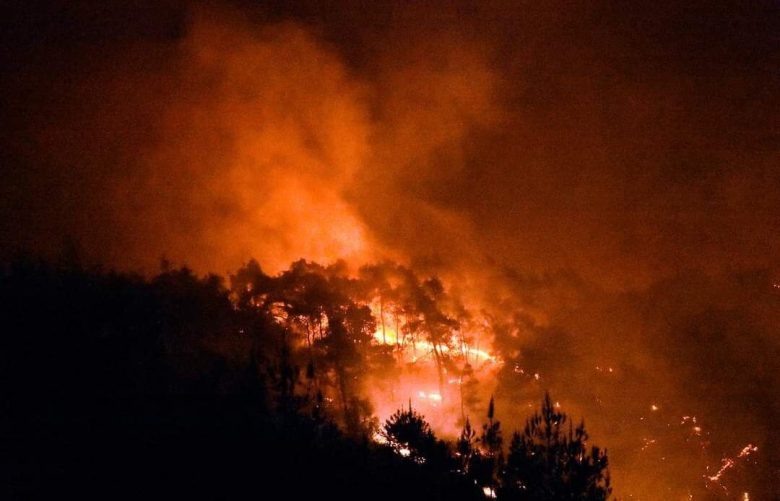
Wildfires in Syria used as a weapon of war
By Steven Sahiounie | Mideast Discourse | July 30, 2023
Wildfires broke out on July 25 in Latakia province in northwest Syria and are still burning amid new fires being started. The fires spread quickly by a sudden unusual wind which whipped up. The whole country, and the adjacent Mediterranean region, is in a heat-wave which sets the stage for such a devastating fire burning crops, forests and homes. However, this was not a chance wildfire, but was an act of terrorism.
General Jalal Dawoud, Head of the Fire Department in Latakia, says the fire was man-made. This was determined because the origin of the fire was not in one place, but was started in scattered areas all at the same time in daylight hours.
After the security forces began their investigation, it was found that the fires were started by drones originating from Idlib, under the occupation of Hayat Tahrir al-Sham, formerly Jibhat al-Nusra, the Al Qaeda affiliate in Syria.
Turkey is illegally occupying Idlib as they protect the terrorists under the command of Mohammed Jolani, formerly allied with Abu Baker Al Baghdadi, the head of ISIS who was killed in Idlib by President Trump.
The terrorists have been attacking the fire fighters and vehicles. Bassem Bakar, a water tanker driver, was killed when the terrorists targeted his vehicle near Deir Hanna and Rabiah. Two other men with him were injured.
Turkey is well known for the manufacture of drones, and has been selling drones to Ukraine recently.
On July 25, a fire department vehicle drove over a previously planted mine on Zgharo Mountain, near the town of Maskita, but without injuries. This area was occupied by the terrorists now in Idlib during the 2015 period before they were driven east to Idlib.
The Mayor of Latakia, Amer Hallal, said fire depratments from many areas came to fight the fires, and a Russian water tanker airplane came to battle the fires. Civilians were evacuated from homes and farms and taken to a safe area where they were given humanitarian aid.
The fire raged in Rabiah which sits on a road that connects directly to Idlib. Other areas burning are Ghamam, Sarsekiah, Ein Zarkha, Deir Hanna, Jib Alahmar, Sed Bradoon, and Jebal al Zahra.
A young soldier who volunteered to fight the fires, Mounif Sebry Hassoun, died while fighting the fire due to suffocation in Meshkita. He is from village of Wadi Khelah, in the suburb of Jeblah
The Syrian government, Syrian Red Crescent are coordinating efforts to put out the fires and assisting the humanitarian needs of the affected civilians. Local restaurants have been donating meals to the fire fighters. The Syrian Arab Army (SAA) and the Syrian Red Crescent are putting out fires in Rabiah, which is the front line against the terrorists in Idlib.
The foreign policy of the US and EU have kept the status quo in Idlib. 3 million civilians there are kept as human shields by Hayat Tahrir al-Sham. Turkey prevents the SAA and the Russian military from freeing the civilians kept as hostages to an international game of chess played by America.
International aid organizations, such as the UN, Doctors Without Borders, Save the Children and others deliver all the humanitarian aid to the civilians, while Jolani and his terrorists receive all the aid and distribute it to their cronies first, and sell whatever they horde in a huge shopping mall Jolani and partners built.
Idlib is an agricultural province with farmers and terrorists selling olives and olive oil to Turkish businesses.
The US, EU and UN are enablers of Jolani and the terrorists under his command. Recently, Jolani hung people in Idlib that he perceived were enemies. He and his men oppress women by not allowing social programs directed at women’s issues. The terrorists rule under Islamic Law and in the case of a rape, a woman must present the court with three men who are witnesses to the rape in order to get a conviction. In this situation, rapes go unreported as there is no chance for justice.
Drones can be used for humanitarian purposes, for example: delivering medicines to a remote village. However, drones can also deliver a deadly payload in a war, or attack, and now in Syria they are being used to start wildfires in the heat of summer amid dry winds which spread the deadly fires.
The world responded to the massive 7.8 earthquake on February 6 in Syria and Turkey. Humanitarian aid poured in from Arab countries mainly, with the US boycotting all aid to Syria, with the sole exception of Idlib and the occupying terrorists there.
The earthquake aid has long ago stopped, and although many friends of Syria have asked the US and EU to lift the sanctions which prevent all rebuilding and recovery in Syria from years of war and the earthquake, still there has been no move to lift any sanctions.
Recently, a list of the world’s poorest nations was unveiled with Syria tying for the worse place along with Yemen and Afghanistan. 12 years of armed conflict, the COVID-19 pandemic, the 7.8 earthquake of the century, and now wildfires being delivered by terrorists supported by the US and NATO.
Jolani and his US supported terrorists have no red lines they cannot cross. They are heartless criminals holding the northwest of Syria in fear of their next move.
US mulling multi-front offensive in Syria in collaboration with Takfiri terrorists
By Robert Inlakesh | Press TV | July 29, 2023
The US military is readying approximately 2,500 service members for deployment in the West Asian region, as its proxy forces in Syria’s northeast and al-Tanf areas seek potential alliances with Takfiri terrorists in the northwestern Idlib province.
With tensions boiling between the Syrian government-aligned forces and the US occupation troops in the war-ravaged Arab country, it might be a sign of more violence on the way, observers believe.
According to a report published in New York local media in mid-July, some 2,500 10th Mountain Division soldiers were being sent “off to combat” in Iraq and Syria.
It is not exactly clear how many soldiers from the light-infantry division will be dispatched for operations in the two West Asian countries.
However, the number of forces being sent rings true with a report from the Turkish newspaper, Yeni Safak, that claimed Washington was preparing to send 2,500 troops to northeast Syria.
The US currently maintains, at least publicly, that it has around 900 active-duty service members deployed to Syria, a number which is speculated to be much higher.
If the US is indeed sending additional forces to the region, it could indicate that its objectives have slightly changed in the northeast of the country.
At this time, the Americans occupy roughly a third of Syrian territory and do so without any congressional approval, through its occupation – which it uses the Kurdish Syrian Democratic Forces (SDF) to maintain – it holds hostage the most fertile agricultural lands and roughly 90 percent of Syria’s natural gas from the Damascus government.
Over the past years, the Syrian Arab Army (SAA) and its allies based in the Deir Ezzor province, have grown tired of continued US troop presence inside their territory.
On March 23, the US Department of Defense (DoD) announced “retaliatory strikes” against targets in Deir Ezzor, following a UAV strike against its forces in al-Hasakah.
“Earlier today, a US contractor was killed and five US service members and one additional US contractor were wounded after a one-way unmanned aerial vehicle struck a maintenance facility on a coalition base near Hasakah in northeast Syria at approximately 1:38 p.m. local time,” stated the announcement.
The US coalition airstrikes triggered an unusually extensive response from the SAA and its allies, which fired back and inflicted six traumatic brain injuries, according to the US reports.
At the time, back in March, a Syrian political source told me that the recent move by Syria and its allies was a “direct response” to a wave of Israeli escalation against the country that began last year.
“If you remember in August of 2022, there was a similar stand-off between the Americans and resistance forces in northeastern Syria,” he said, pleading anonymity.
I was also informed by a second source that an order had been given at the time to directly target Americans and not just fire warning shots. However, no further details were divulged.
In mid-July, the US began fortifying its occupation bases surrounding the Conoco and al-Omar oil and gas fields, with forces belonging to their SDF proxies.
According to an Al-Mayadeen source at the time, Washington informed the SDF and its affiliated militias “to prepare for any attack on the region from the Western banks of the Euphrates River” and the US “tasked the Free Syrian Army to mobilize, to face any attack on the 55-kilometer area in Al-Tanf”.
Reports that surfaced on pro-opposition ‘Syria TV’ indicated that the Idlib province-based terrorist group, Hayat Tahrir al-Sham, had hosted several SDF delegations from northeast Syria over the span of months.
The two parties had allegedly concluded agreements on the transport of fuel from Syria’s north-east to Idlib, which appears to have come after Hayat Tahrir al-Sham began facing mounting pressure from Turkiye in northern Aleppo.
The talks between the dominant Idlib Takfiri terrorist group and the SDF apparently explored the possibility of a joint Hayat Tahrir al-Sham-SDF civilian administration with the SDF reportedly claiming that the US supports the idea of unifying the two militant strongholds.
A source who has intimate knowledge of the current security situation in Syria, and who chose to remain anonymous, told the Press TV website that “these moves are complicating, even if this does not amount to an offensive, the only thing that will change the current scenario is a Turkiye-Syria normalization and a possible anti-SDF operation”.
What is also of interest to these developments is that US-Russia relations inside Syria are also deteriorating, with Washington accusing a Russian fighter jet of damaging a US drone on July 23; allegedly using flares to cause the damage.
The terrorist stronghold of Idlib and the US proxies in both northeastern Syria and al-Tanf are seemingly coming together, at a time when American troops are being deployed to the area amid tensions between their occupying forces and the Syrian government’s military.
A possible way forward, in the event that the US carries out a new offensive strategy against the SAA and its allies in Syria, is through the possible normalization of ties between Ankara and Damascus, according to observers.
Despite there being no breakthrough between Turkiye and Syria, the two states are engaged in a dialogue that is aimed at a restoration of ties between them.
Experts say the reason why this is so crucial to combating any potential American plots against the Syrian government and its allies is that Ankara’s cooperation with Damascus could bring an end to many of the various territorial issues in the country.
Turkiye currently occupies two small pockets in the north of Syria, while it actively threatens an offensive against the Kurdish SDF, which it accuses of being run by the YPG and hence a terrorist threat on its border.
If Turkiye forces an incursion into northeastern Syria, dealing another significant blow to the Kurdish armed groups there, it will also force the US to again abandon its SDF proxies, as happened in 2018 and 2019.
If the US withdraws temporarily, this would provide the perfect opportunity for the SAA and its allies to cross the Euphrates River and liberate their oil fields, which the SDF would not likely be capable of holding by themselves.
This is why, in the event that Washington is implementing a new strategy to further punish Syria and its people, a Turkish military offensive may be the simplest way to quickly put an end to it.
Featured Video

Iran FM Araghchi: “Hormuz Will No Longer Be the Same”
or go to
Aletho News Archives – Video-Images
From the Archives
Sam Husseini: The entire US establishment helped lie their way into the Iraq war
By Slava Zilber | American Herald Tribune | October 14, 2019
Sam Husseini is a senior analyst with the Institute for Public Accuracy, independent journalist and contributor to The Nation and FAIR.
Slava Zilber: Sam, three years ago, you appeared on Talk Nation Radio with David Swanson and spoke about the case of the GCHQ whistleblower Katharine Gun. You pointed out that the people involved in the spying on the UN and the people authorizing the Iraq War were not held accountable:
“Virtually everybody who went along with the war, whether it is Kerry or Clinton, of course, the Bush administration themselves has falsified their own records in terms of why, what they did, when they did, why they did it, to the extent that they’ve been scrutinised at all.”
You also address it in a recent article. And recently, Joe Biden has been lying about his position on the Iraq War. How can such an important issue escape meaningful scrutiny? … continue
Blog Roll
 Aletho News
- Iran FM Araghchi: “Hormuz Will No Longer Be the Same”
- EU facing trillion-euro debt hole while seeking more cash for Kiev
- How US, Europe, Persian Gulf states exhausted missile stockpiles, splurged billions to defend Israel
- Up in arms… Koreans reject U.S. empire’s plan to make South Korea the next Ukraine
- Iran, Turkey, Pakistan, Saudi Arabia could advance region-led security framework in Tehran: FM spox
- Netizens condemn Japanese drama for projecting Japan’s wartime atrocities onto Chinese characters
- Racist Seinfeld Dances for Joy as Bibi Unveils His New Map
- A West Bank War for Netanyahu’s Election Campaign, Could It Backfire?
- Yemen denounces European Parliament’s ‘hypocritical’ push to blacklist Ansarullah
- Qalibaf: UAE’s UN bid aims to ‘clear the runway’ for ‘Greater Israel’, whitewash genocide
- If Americans Knew
- An error has occurred; the feed is probably down. Try again later.
- No Tricks Zone
- Sudden Stratospheric Warming, Powerful El Niño Combination May Lead To Extreme Europe Cold, Energy Crisis!
- Two New Studies Find Thwaites Glacier Melt Cannot Be Driven By Human Activity Or A Warming Ocean
- E-Cars Reduce CO2 Emissions By Only 41% Compared To Internal Combustion Engine Vehicles
- Predictions Made By Renowned Climate Professor Over Past Decades Have Been Proven To Be Poor
- New Study Suggests Large Regions Of The Pacific Ocean Have Been Cooling For The Last 80 Years
- Germany’s Green Energy Debacle: High Energy Costs Force Kahla Porzellan to Close After 182 Years!
- New Study: 50 Years Of The Most Aggressive ‘Net Zero’ Policies Can Only Affect The Global Climate By 0.03°C
- US September “Heat” Was No Record…Many Records Set Decades Ago
- Latest European Green Energy Debacle; Portugal’s Largest Flagship Solar Park Insolvent!
- Green Energy Debacle: German Expert Professor Fritz Vahrenholt Warns Of Severe Economic And Social Consequences

