More F-35s arrive in West Asia in latest anti-Iran deployment
The Cradle | July 27, 2023
A squadron of US F-35 fighter jets have arrived in the region, Washington’s air force announced on 26 July, coming as part of increased efforts to “beef up deterrence against Iran,” US media outlet Fox News wrote on 26 July.
“The Iranian navy did make attempts to seize commercial tankers lawfully transiting international waters. The U.S. Navy responded immediately and prevented those seizures,” US Fifth Fleet spokesman Tim Hawkins said.
Washington repeatedly accuses Iran of attempting to ‘hijack’ foreign vessels. However, Tehran maintains that it pursues foreign tankers who are either involved in fuel smuggling, or who have violated international regulations by colliding with Iranian vessels and fleeing – as has happened on a number of occasions.
The F-35s were deployed to the US CENTCOM ‘Area of Responsibility’ and serve as an augmentation to those already patrolling the Strait of Hormuz.
According to the military, they aim to provide cover for ships in the region in order to prevent Iranian seizures. They also aim to “deliver ‘increased capacity’ to the region and ‘allow the U.S. to fly in contested airspace across the theater if required,’” an air force press release cited by Fox News reads.
The F-35 jets will also “be available to help in Syria,” Fox News said. US troops currently occupy Syria, controlling its oilfields in coordination with proxy militias, while claiming to be carrying out anti-ISIS operations.
“This deployment demonstrates the U.S.’s commitment to ensure peace and security in the region, through maritime support and support to the coalition’s enduring mission to defeat ISIS in Syria,” the US air force said.
This latest jet deployment comes as Washington has been cementing its military presence across West Asia, seemingly in preparation for a confrontation with Iran. This has seen the US recently deploy a nuclear submarine and a navy destroyer to the Persian Gulf.
In Syria specifically, Washington and Moscow have recently gotten closer to coming to blows.
On 26 July, a US MQ-9 Reaper surveillance and attack drone locked its weapons on two Russian warplanes, reportedly forcing the jets to drop flares that “damaged” the drone’s wings.
This marked the second incident in three days where Russian jets dropped flares on a US drone attempting to lock weapons on them.
According to an anonymous US military official cited in a report earlier this month, Russian and Iranian forces in Syria have been coordinating with the specific aim of forcing Washington’s troops to eventually withdraw from the country.
As a result, Washington has been continuously reinforcing its military bases in Syria, and is reportedly planning to deploy an additional 2,500 troops to the country.
US-led coalition’s jets violated Syrian airspace several times in past day: Russia
Press TV – July 17, 2023
Russia says the US-led military coalition’s fighter jets violated Syria’s airspace in the strategic al-Tanf region several times during the past day, amid repeated calls by Damascus for the expulsion of Washington’s occupation forces from the country.
Rear Admiral Oleg Gurinov, deputy chief of the Russian Center for Reconciliation of the Opposing Parties in Syria, said at a press briefing on Sunday that the al-Tanf airspace is where international air routes pass.
“A pair of the coalition’s F-16 fighter jets, and one MC-12W spy plane violated Syria’s airspace in the al-Tanf area, across which international air routes run, five times during the day,” he said.
Gurinov added that during the past 24 hours, twelve cases of violations of the de-confliction protocols of December 9, 2019 by the US-led coalition drones were recorded, warning that such actions create risks of air accidents with civilian planes.
He further said a shelling attack on the positions of government troops in Syria’s Idlib and Latakia de-escalation zone has injured a Syrian soldier.
The latest development comes as an unnamed Pentagon official declared earlier in the day that the US announced considering military options to address “Russian aggression in the skies over Syria.”
The unknown official further voiced the US’s rising concerns about “growing ties between Iran, Russia, and Syria across the Middle East.”
The official also claimed that “Russia is beholden to Iran for its support in the war in Ukraine, and Tehran wants the US out of Syria” to extend aid to Lebanon’s Hezbollah resistance movement “and threaten Israel.”
Such claims by Washington officials come as the US military is illegally occupying Syria with nearly 1,000 troops and has seized the country’s oil fields in cooperation with local anti-Damascus militants and terrorist groups while stealing its crude supplies and transferring them across the border to its bases in Iraq.
In 2014, the US and its allies invaded Syria under the pretext of fighting Daesh. The Takfiri terrorist group had emerged as Washington was running out of excuses to extend its regional meddling or enlarge it in scale.
Russia, alongside Iran, has been helping Syrian forces in battles across the conflict-plagued country, mainly providing aerial support to ground operations against foreign-backed terrorists.
Damascus maintains that the unauthorized US deployment aims to plunder the country’s natural resources.
Russia – which together with Turkey is carrying out joint patrols in northern Syria – has established special “de-confliction” zones where the US-led coalition can operate.
Syrians lash out at Israeli plan to raze entire village in occupied Golan Heights
Press TV – July 11, 2023
Residents of the occupied Golan Heights have staged a demonstration to express their fierce opposition to the Tel Aviv regime’s plan to completely raze a village in the strategic plateau to build a military base, in a blatant violation of international law.
According to a report by Syria’s official news agency, SANA, protesters rejected the demolition of the remaining homes in the village of Ain Fiet, whose residents were forcibly displaced by the Israeli regime over the past years.
“The Zionist entity aims to obliterate the national identity, establish a military outpost on our lands and Judaize them,” the protesters said.
They said the regime’s scheme to raze the village is contrary to the United Nations Security Council resolution 497.
The UN resolution, adopted unanimously on December 17, 1981, declares that the Israeli annexation of the occupied Golan Heights is “null and void and without international legal effect” and further calls on the Tel Aviv regime to rescind its action.
The protesters further reiterated their devotion to their homeland and Syrian identity in the face of the Israeli regime’s practices, including arbitrary arrests and systematic oppression.
In 1967, Israel waged a full-scale war against Arab territories, during which it occupied a large area of the Golan and annexed it four years later – a move never recognized by the international community.
Israeli forces destroyed Ain Fiet, one of the most fertile and beautiful villages in the Syrian Golan Heights, following the 1967 Six-Day War.
Nearly 131,000 people living there were forcibly displaced, while 7,000 people opted to remain in six other nearby villages, namely Majdal Shams, Masa’da, Baqatha, Ain Qunya, Ghajar and Sahita.
Later on, the Israeli military razed Sahita village and turned it into a military post. It forced its local residents to abandon the village and move to Masa’da.
In 1973, another war broke out and a year later, the United Nations brokered a ceasefire and established a buffer zone between the Israeli and Syrian forces. The UN also adopted several resolutions calling for Israel’s withdrawal from the Golan, but the regime has ignored them.
Earlier this month, Israel further occupied Ghajar village by erecting fences to the north of the area, cutting it off completely from Lebanon.
Last month, dozens of residents and landowners in the towns of Majdal Shams and Masa’deh were prevented from reaching their lands by Israeli forces, leading to confrontations.
The Israeli forces have raided the farmlands to install wind turbines, which according to the farmers, could pose environmental hazards to their lands and interfere with their farming practices.
Israel has over the past several decades come up with dozens of illegal settlements in the occupied Golan in defiance of international calls for the regime to stop its illegal construction activities there.
In 2019, former US president Donald Trump signed a decree recognizing Israeli “sovereignty” over the Golan Heights, in a move that was widely condemned by the international community.
Syria denounced the US decision as a violation of its sovereignty and territorial integrity.
In December 2021, Israel announced its plan to double the number of its illegal settlements in the Golan Heights despite a resolution by the UN General Assembly demanding that the regime stop its settlement activities and withdraw from the occupied territory.
Damascus has repeatedly reaffirmed its sovereignty over the area, saying it must be completely restored to its control.
Russian military responds to US ‘drone harassment’ complaints
RT | July 9, 2023
The Russian Air Force is conducting joint exercises with its Syrian counterparts, so part of the country’s airspace remains off-limits to the US-led forces, the Defense Ministry reiterated after the Pentagon accused Russia of “harassing” American drones for the third time this week.
“The Russian side once again expresses concern about the systematic violations of deconfliction protocols related to the flights of unmanned aerial vehicles (UAVs) of the so-called international anti-terrorist coalition,” the deputy head of the Russian Reconciliation Center for Syria, Rear Adm. Oleg Gurinov, said in a statement on Saturday.
On Friday, the commander of US Air Forces Central, Lt. Gen. Alex Grynkewich, claimed that “three MQ-9 drones were once again harassed by Russian fighter aircraft while flying over Syria,” for the third day in a row. He shared no footage of the encounters this time, but accused Russian pilots of making “18 unprofessional close passes that caused the MQ-9s to react to avoid unsafe situations.”
On Wednesday, Moscow and Damascus kicked off a joint air defense drill, which is scheduled to last until the middle of this month. Electronic warfare units are also involved in the exercise, preparing for joint action to counter enemy airstrikes.
Asked whether the US drones could have indeed flown into a restricted area, Pentagon spokesman Patrick Ryder insisted at a press briefing on Thursday that it would be preposterous to suggest Washington was to blame.
“You – did you see the video?.. So to suggest that somehow, you know, this is our fault, it’s ridiculous. So okay?,” he told journalists .
Ryder went on to say that US forces “have very successfully deconflicted with the Russians over many years” – but refused to say whether the US was following deconfliction protocols this time.
US-backed militia abducts young men in ‘recruitment’ campaign in eastern Syria
The Cradle | July 8, 2023
Militants of the US-backed Syrian Democratic Forces (SDF) launched massive arrest campaigns targeting young men in the areas under the group’s control in northeast Syria, immediately taking them to compulsory recruitment camps, Sputnik reported on 8 July.
Civic and local sources told the Russian news agency that SDF militants loyal to the US army, “are launching, for the third day in a row, campaigns of mass arrests and kidnappings of young men born between 1998 to 2005 in all the cities and towns of Hasakah and Raqqa governorates, where more than 500 young men were forcibly conscripted.”
The sources added that SDF forces set up permanent and temporary military checkpoints in the cities of Hasakah, Qamishli, and Shaddadi, and arrested large numbers of young men, including university and institute students.
The sources indicated that Hasakah residents demonstrated on 5 July in front of the local SDF recruitment headquarters demanding the immediate release of their conscripted sons. In response, the SDF called in military reinforcements, including US-made armored vehicles, to disperse the sit-in.
In Raqqa, local sources told Sputnik that SDF militants set up a checkpoint near the old bridge in the city to stop passing cars in search of young men to conscript and take to the group’s military camps.
Last month, Arab News reported that 13-year-old Kurdish girl, Peyal Aqil, went missing on her way home from a school exam, after being approached by a recruiter for the Revolutionary Youth, a group connected to the SDF and its parent group, the Kurdistan Workers Party (PKK). She followed him to one of the group’s centers in the city of Qamishli.
Her friends waited for her outside, but she never emerged.
Peyal’s mother, Hamrin Alouji, said she and her husband complained to local authorities, who refused to help.
The Revolutionary Youth group later said Peyal joined willingly, a claim her mother rejects. “We consider that at this age, she cannot give consent, even if she was convinced” by the group’s program, Alouji said.
A month after her disappearance in May, Peyal managed to run away from one of the training camps and return home.
Arab News notes that according to a UN report issued this week, 1,696 minors were recruited by armed groups in Syria in 2022, including 637 by the Kurdish-led SDF.
The report also said the UN had confirmed 611 recruitment cases by the Turkish-backed Syrian National Army (SNF), and 383 by the Al-Qaeda-linked Hayat Tahrir al-Sham. The report noted 25 cases of child recruitment by Syrian government forces and pro-government militias.
According to Bassam Alahmad, executive director of Syrians for Truth and Justice, an independent civil society organization, some children are forcibly conscripted, while others sign up out of poverty, for ideological reasons, or out of tribal loyalties.
Alahmad called on the SDF-affiliated administration in northeast Syria to “assume its responsibilities in order to stop these operations.”
An official with the PKK-linked Revolutionary Youth acknowledged to Arab News that the group recruits minors, but claimed they join willingly. “We do not kidnap anyone, and we do not force anyone to join us,” he said.
“They themselves come to us and tell us their intention to join the service of the nation,” he said. “We do not take minors if they are indecisive or unsure.”
Heavy Lies the Crown: POTUS Biden Totally Loses the Plot As NATO’s Narrative Implodes

By Declan Hayes | Strategic Culture Foundation | July 3, 2023
First off, hats off to young Hafez Bashar Assad, who recently aced a Master’s degree in Pure Mathematics from Russia’s prestigious Moscow State University which has, in the course of its long and glorious history, produced several Fields Medals winners. May young Hafez go on to similarly great things.
Hafez was, some years back, the subject of oceans of ire when he represented Syria in the Math Olympics, a competition I have some familiarity with, as friends of mine represented Ireland in years gone by. And though those young Irishmen went on to be awarded PhDs from the world’s most prestigious universities and land jobs with mouth-watering salaries from the world’s most prestigious companies, like young Hafez, they got nowhere at the Math Olympics because they lacked the in-depth 24/7 tutoring the United States’ Ivy League Professors give the young (generally Chinese) charges, who compete under the Yankee flag.
So well done, young Hafez and congratulations, too, to your beautiful, urbane, cosmopolitan, multi-lingual, great and gracious mother, Asma Assad, proudly hugging you after you were awarded your degree. I know of no current or former First Lady, who is in her league in terms of elegance, grace, brains or sheer good manners and your father, Syrian President Bashar Assad, certainly hit the jackpot when he landed that Damask Rose. He is a lucky and blessed man.
Moving from Moscow to Kiev, we see that former Irish President and serial grifter Mary Robinson and Swedish propagandist Greta Thunberg are on a jolly there to advise Clown Prince Zelensky on matters concerning the environment. As 20 year old Greta has only recently graduated High School, at an age when most others would be whistling through their undergraduate degrees, one wonders if this slow learner will stay as silent on NATO’s use of depleted uranium as she has been on the Nordstream terrorist attack, the greatest ecological crime of our era.
Not that I care as Greta, and Mary Robinson are, like Clown Prince Zelensky himself, media creations, all tinsel and no substance. NATO’s Zelensky regime must be really scraping the barrel if that is the best they can do.
But the bottom of the barrel is all NATO seems to have left. French dictator Macron spends his time attending Elton John 1970s’ retro concerts as France burns down around him. The best that Britain can do is to ban Nigel Farage from having a bank account and keep POW Julian Assange on ice for their American masters.
Stella Moris, Julian’s wife, was recently in Rome where, appropriately dressed, she met Pope Francis, who has also recently honoured British film-maker Ken Loach, who was recently expelled from the British Labour Party. Say what you like about Julian Assange and, irrespective as to whether the British will murder him or hand him over to the Yanks for further torture sessions, he is blessed to have such a woman standing foursquare beside him.
Although all of these singularities would have been noted in Washington, it is doubtful if they registered with Creepy Joe Biden, the Don Vittorio of the NATO organised crime gang. Don Vittorio, you may recall, is the senile Italian Mafia godfather, who appeared in The Sopranos a few seasons before fellow mafia mobster Junior also succumbed to dementia.
Although, as Biden claims Putin, in some parallel world, may be losing the war in Iraq, in this world Creepy Joe is most definitely losing the 2024 Presidential war to Donald Trump and Bobby Kennedy. Although Oddslotter still has him favourite to be re-elected, Biden’s place is in the dock as a war criminal and then off to an old folks’ home to be heard from no more.
The threats that Trump and Kennedy pose are not so much personal threats to Creepy Joe as they are to the gangster system he presides over. Trump is a threat because he says what others will not say: that the United States is a predatory state that robs and loots at will. And Kennedy is a threat because he points out the threats Big Pharma’s greed pose to all Americans and Big Pharma’s spokespersons like notorious narcissist Dr. Peter Hotez, won’t even debate him on Joe Rogan’s show for over $1 million in cash.
Although neither of these challengers criticise Israel, such criticisms are inconceivable because of the nature of NATO’s gangsterism. Palestinians are little more than plastic ducks at a shooting arcade and heaven help any “anti-Semite” who might argue otherwise.
But even argument itself is now haram in NATOstan. Donald Trump, remember, was banned from social media when he was POTUS, supposedly the world’s most powerful position. Germany’s Greens, perhaps trying to reconnect to their Nazis past, have persecuted their own citizens for not being sufficiently Russophobic and Australia, Canada and Vichy Ireland are, as part of NATO’s plans of world conquest, introducing the most draconian hate speech laws that have drawn the ire of Joe Rogan, Tucker Carlson and Elon Musk.
And there is the rub. Rogan, Carlson and Musk are forming the backbone of an opposition that believe in such things as free speech and free, open and honest debate and such things present an existential threat to Biden and his fellow-fraudsters.
In my earlier paeon to Asma Assad, I used an abundance of adjectives to try to give Syria’s First Lady her well-earned due. However, at days’ end, she is a wife, a mother and a woman, a wonderful adult female in other words and not a cisgender or a transgender, phrases that Biden’s handlers have shanghaied from the British and Roman Empires where Transjordan and Cisjordan were, still are and will always be divided by the Jordan River and Gaul and Cisgaul were, still are and will always be divided by the mighty Alps. You do not need Hafez Assad’s Master’s Degree in Pure Mathematics to know no such demarcations apply to sovereign womanhood and nor do you even need Greta Thunberg’s hard-earned High School diploma. What you need is a degree of honesty and common sense and, because they are attributes Creepy Joe and his whore-bonking son Hunter cashed in years ago, all of Creepy Joe’s dodgy deals are now coming home to roost.

And, just as the Alps and the Jordan divide for all time the Cis from the rest, so also in our own time do the mountains and rivers of honesty and truth divide the Creepy Joe Bidens and Mary Robinsons from the great and the good, from Stella Moris, Gonzalo Lira, Hafez and Asma Assad, all of whom affirm the words of Irish martyr Terence MacSwiney that “it is not those who can inflict the most, but those who can endure the most, who will prevail”.
And, it is because of good, great and immortal people like Asma Assad that Damascus itself has prevailed against Biden’s Beast of the Apocalypse. Let us, as we conclude, recall Mark Twain’s recollections of that eternal city: “We shall remember… Damascus, the Pearl of the East, the pride of Syria, the fabled garden of Eden, the home of princes and genii of the Arabian Nights, the oldest metropolis on Earth, the one city in all the world that has kept its name and held its place and looked serenely on while the Kingdoms and Empires of four thousand years have risen to life, enjoyed their little season of pride and pomp, and then vanished and been forgotten.”
And, as Eternal Damascus and her eternally gallant allies prepare to consign Biden, NATOstan’s faux Little Caesar, to the trash bin of history, let us salute not only Hafez and Asma Assad on their recent fortune but all of the great and good people of Syria, Palestine, Serbia, China and Russia who, at great cost, defied NATO and carried the banners of humanity not only for the Assange and Lira families but for all of us in the face of the butchers Biden, Macron and Zelensky sent against them. May God bless them and their protectors, the heroic men and women of the Syrian Arab Army, now and forever.
US, Turkish-backed militias in Syria boost number of child soldiers in their ranks: UN
The Cradle | June 30, 2023
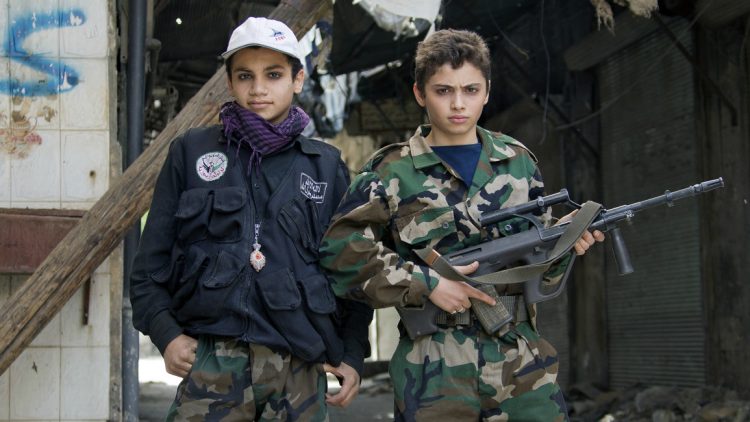
According to a UN report released on 28 June, the US and Turkish-backed armed groups in Syria have been increasingly recruiting minors into their ranks.
The report claims that the number of children recruited by militant groups in the country has risen from around 800 to over 1,200 since 2020.
It adds that among those recruiting children are the US-backed Kurdish militia, the Syrian Democratic Forces (SDF), which oversee control of Syrian oilfields in collaboration with Washington’s occupation forces.
The UN claims that more than 600 of child recruitment cases in Syria are attributed to the SDF and associated Kurdish groups in the country. This is despite the fact that the SDF signed an agreement with the UN in 2019 to end minors’ enlistment.
Over 600 child recruitment cases have also been attributed to the Turkish-backed Syrian National Army (SNA) coalition of militant groups, which has incorporated fighters from several extremist groups, including ISIS, over the years.
Additionally, the UN says that Hayat Tahrir al-Sham (HTS), formerly known as the Al-Qaeda-linked Nusra Front, has recruited over 380 minors into their ranks.
Twenty-five cases among Syrian government forces and allied militias have allegedly been recorded as well.
Bassam al-Ahmad, executive director of Syrians for Truth and Justice, said that in some cases, children are forcibly conscripted into the ranks of armed groups. He added that some join for religious or ideological beliefs, while others join for the salaries much needed by them or their families.
Ahmad claimed that some children are even sent out of the country to participate as mercenaries in foreign wars.
The enlistment of child soldiers has been an issue for much of the Syrian conflict.
During the recruitment efforts of the Nusra Front between 2013 and 2016, led mainly by Saudi cleric Abdullah al-Muhaysni, scores of teenagers were among the thousands enlisted to fight against the Syrian army. Many of these teenagers were sent on suicide missions.
In 2016, members of a US-backed armed group, the Nour al-Din al-Zinki Movement, were filmed beheading a 12-year-old boy named Abdullah Issa, who they claimed was a fighter in the pro-government Liwa al-Quds militia.
Liwa al-Quds released a statement at the time categorically denying that the boy was a fighter, claiming that he had been residing in an area of Aleppo under the control of armed groups.
In 2019, the Nour al-Din al-Zinki Movement was absorbed by the SNA after being defeated by HTS.
US sends more fighter jets to its Middle East
RT | June 15, 2023
The US military has sent additional fighter jets to the Middle East after accusing Russia of “increasingly unsafe” aircraft activity in the region, including during several incidents in Syria.
F-22 Raptors with the 94th Fighter Squadron have been deployed from Langley Air Force Base in Virginia, according to Central Command (CENTCOM), which oversees US military operations in the Middle East, Central Asia and parts of Africa.
The decision was part of a “multifaceted show of US support and capability in the wake of increasingly unsafe and unprofessional behavior by Russian aircraft,” CENTCOM said in a press release on Wednesday.
Pentagon officials have accused Moscow of reckless flights over US bases in Syria in recent weeks, with CENTCOM chief General Erik Kurilla claiming there has been a “significant spike” in “provocative” actions since March.
In an interview with the Wall Street Journal in April, Air Force Lieutenant General Alexus Grynkewich warned that the rise in tensions could lead to a “miscalculation” among Russian and American pilots operating in Syria, stating there were 60 separate incidents between March and April alone.
Moscow has similarly accused Washington of unprofessional behavior in Syria. Last month, Rear Admiral Oleg Gurinov, deputy head of the Russian Center for the Reconciliation of Warring Parties in Syria, said American warplanes continued to commit “gross violations” of deconfliction protocols.
“US Air Force pilots continue to activate weapons systems when approaching in the air with Russian Aerospace Forces aircraft performing planned flights in eastern Syria,” the official added.
The US currently maintains about 900 ground troops in Syria and operates a network of air bases around the region. The new aircraft deployment also comes after CENTCOM said it would strengthen the US “defense posture” in the Middle East with additional naval assets, vowing to carry out “heightened patrols” in the Persian Gulf in response to “destabilizing” actions by Tehran.
The Middle East and US Terrorist Activities
By Viktor Mikhin – New Eastern Outlook – 08.06.2023
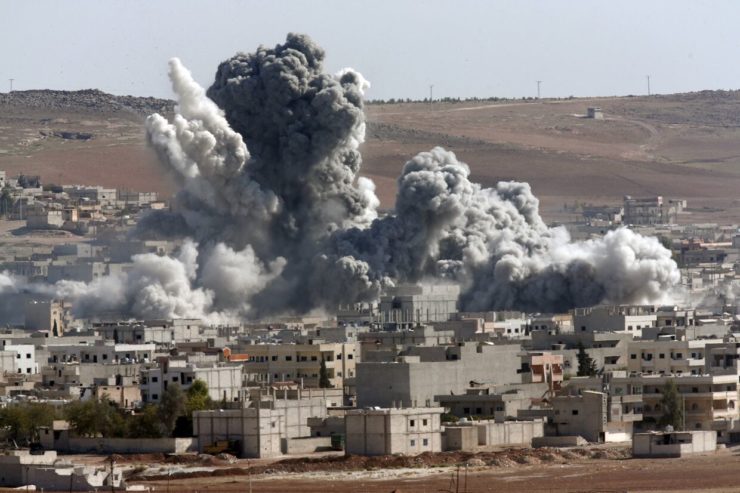
Incredibly high civilian casualty rates from American-led military adventurism in Afghanistan, Iraq, Pakistan, Syria, Yemen, Libya, and Somalia have been revealed in a new research by Brown University’s The Cost of War Project in the State of Rhode Island. The report provides direct data on the victims of the war in which nearly a million people were killed by the US efforts.
According to the study, another important aspect that has indirectly killed several million more people is the military destruction of the economy, public services, infrastructure and the environment, which increases the death toll long after the bombs have been dropped and increases over time. The report estimates that these factors contributed to more than 3.5 million deaths. This aspect requires more research, and the project specifically emphasizes that “the many long-term and underestimated consequences of war” need to be explored in more detail.
Another study shows that the number of direct casualties from wars that killed nearly a million people is an understatement, which the report again refers to by saying that “the exact death toll remains unknown.” In another section of the project’s report on the Iraqi death toll, it says that “estimates of the Iraqi war death toll have been particularly inconsistent. The Lancet 2006 estimated that approximately 600,000 Iraqis died as a result of military violence between 2003 and 2006.” The report goes on to say that the controversy over conflicting reports about the death toll in Iraq stems from news reports estimates, with some exaggerating the death toll while those who supported the illegal invasion downplayed the death toll.
The project cites a report in The Lancet that says the death toll in Iraq since 2003 and in the next three years alone reached 600,000 Iraqis. Various unbiased studies have been conducted, concluding that more than one million Iraqis were killed as a result of the US invasion and occupation of Iraq from 2003 to 2011.
Even the one million mark in Iraqi deaths could be considered an understatement when there were daily reports of almost daily terrorist bombings that killed hundreds of Iraqis. And then, add to that the US and DAESH era from 2014 to 2017, when hundreds of thousands more people were killed, and it’s not hard to imagine that over a million Iraqis have died and continue to die today as a result of the US so-called “war on terror.”
There is no doubt that the US military presence has brought nothing but insecurity and instability to West Asia. In January 2018, Leader of the Islamic Revolution in Iran, Ayatollah Sayyid Ali Khamenei said: “What is important is that the corruptive presence of the US in this region must end… They (Americans) have brought war, discord, sedition and destruction to this region; they brought about destruction of infrastructures. Of course, they do this everywhere in the world… It must be stopped.”
The Cost of War Project’s latest study also warns that “these wars continue to affect millions of people around the world, who live with their consequences and die from them.” The report focuses on the impact of the wars unleashed by the United States on women and children, who “bear the brunt of these ongoing consequences.”
The report notes that while some people have died in combat, many more, especially children, have died as a result of the negative effects of wars, such as the spread of disease and damage to public services. “More research is needed on the impact of the destruction of public services by war, especially outside the health care system, on public health,” the report says. “Damage to water and sanitation systems, roads and commercial infrastructure such as ports, for example, has significant and important negative consequences.”
The study says that the wars and conflicts the United States has fought or been involved in under the pretext of supposedly fighting terrorism since September 11, 2001, clearly show that the consequences of the ongoing violence of war are so vast and complex that they cannot be measured. It should be noted that after the 9/11 attacks, the US waged wars and fomented conflicts, especially in West Asia, under the pretext of fighting terrorism. However, as a result of US military adventurism, there has been an extremely dramatic increase in terrorist groups that had no presence in West Asia or countries such as Somalia prior to Washington’s military intervention in the region.
In other words, the so-called “war on terror” has had the opposite effect from the stated goal of Pentagon’s campaign of instability in West Asia, which has allowed terrorism to flourish. In other words, and many experts agree, the presence of US troops and US policies in the Middle East and other parts of the world have only led to the direct growth of terrorism and terrorist organizations that have destabilized peace and tranquility in those parts of the world.
The report states that the damage and continued deaths caused by the wars mean that those who have unleashed them must take responsibility, including financial responsibility for repairing the damage caused. Suffice it to recall how the American clown of a Secretary of State Colin Powell shook some test tube of incomprehensible white powder on the UN podium and hysterically frightened the whole world with unthinkable troubles from Saddam Hussein. And that was the reason for the barbaric and unjustifiable attack on sovereign Iraq in 2003, from which the Iraqis are still unable to recover and rebuild their state.
Iraqis, and indeed millions of other people, still suffer from distress, pain and trauma in both current and former war zones, according to the study, which calls on the United States as well as its allies to ease the continuing loss and suffering of millions and provide the required “reparations, though not easy, and cheap.” It is something “imperative,” the report notes.
The project correctly and very justifiably blames the US for its role in the military adventurism it embarked on after 9/11, particularly the casualties inflicted during the American two-year war and the 20 year of occupation of Afghanistan. The report focuses on Afghanistan as an example of how people, particularly women and children, the most vulnerable in society, are dying because, despite the indiscriminate withdrawal (or rather shameful flight) of US troops, the damage Washington has done to Afghanistan’s vital services, such as its health sector, sanitation and other infrastructure over 20 years of war and occupation, means that Afghans are still dying today. “Although the United States withdrew military forces from Afghanistan in 2021, officially ending the war that began with its invasion 20 years ago, Afghans are suffering and dying from war-related causes today more often than ever,” the report notes alarmingly.
The Cost of War Project says that much more research is needed to gather more adequate data “to guide life-saving actions.” “More research is needed on the impact of the destruction of public services by war, especially outside the health care system, on public health,” the report notes. “Damage to water and sanitation systems, roads and commercial infrastructure such as ports, for example, has significant consequences.”
In the case of Somalia, for example, the US intervention and the ensuing war prevented the delivery of humanitarian aid, which, according to the study, exacerbated the famine. This is a natural disaster that could have been mitigated if the US had instead chosen to spend a huge amount of money on humanitarian aid programs instead of radicalizing the local population (and increasing terrorism and bloodshed) by bombing civilians with drones. The section of the report reads: “While all belligerents must be held accountable, in the causation sections this report addresses the relevant consequences of the actions of the United States, as the primary power responsible for all these crimes.”
Critics argue that if the United States had not fought wars against West Asian countries or provoked conflicts in the region, other parties would not have participated in any combat missions. In this case, the US should be solely responsible for the disturbing direct and indirect death toll resulting from its provocative and illegal military measures. Washington’s policy of intimidation, military adventurism and terrorism against peace-loving nations of the world must end. And this is the will and aspiration of peoples who want to live in peace and prosperity, without wars and aggressions, and to follow the path of building a new multipolar world, actively promoted by Russian President Vladimir Putin.
Foreign interference in Arab world must come to an end: Arab leaders
The Cradle | May 20, 2023
At the conclusion of the 32nd annual Arab League summit hosted by Saudi Arabia on 19 May, the regional bloc issued a joint declaration calling for an end to foreign interference in the region and reaffirming their support for Palestinian liberation.
“We call for stopping foreign interference in the domestic affairs of Arab countries and categorically reject all support for the formation of armed groups and militias outside the scope of state institutions,” the joint statement reads.
It also stressed that the Israeli occupation of Palestine remains “one of the key factors of stability in the region” and condemns “in the strongest terms the practices and violations targeting Palestinians in their lives, property and existence” while calling for the formation of a sovereign Palestinian state “on the 1967 borders with East Jerusalem as its capital.”
The statement goes on to hail the decision made by regional leaders to welcome Syria back into the Arab League.
“We stress the importance of continuing to intensify pan-Arab efforts aimed at helping Syria overcome its crisis in line with the joint Arab efforts and brotherly relations that connect all Arab peoples,” the statement reads.
During his closing remarks at the end of Friday’s summit, Saudi Crown Prince Mohammed bin Salman (MbS) stressed that the region must not turn into a conflict zone and reassured attendants that “world peace” was near.
He also hoped Syria’s “return to the Arab League leads to the end of its crisis.”
Earlier in the day, MbS warmly welcomed Syrian President Bashar al-Assad to the summit’s venue, officially marking the end of Syria’s isolation within West Asia after 12 years of a US-backed war.
“I would like to loudly welcome Syria back to its seat among its brothers,” Algerian Prime Minister Ayman Benabderrahmane said in the opening speech of the summit.
“Today we are facing an opportunity to change the international situation that appears in the form of a unipolar world, a result of the dominance of the west, who lack all ethics and principles,” the Syrian president said during his speech.
“We stand together against the movement of darkness,” Assad added, referring to extremist armed groups that dominate the Syrian opposition, many of which have had the support of Arab League member states, including Saudi Arabia and Qatar.
An unexpected guest at Friday’s summit was Ukrainian President Volodymyr Zelensky, who arrived at the last minute in a French government jet to address those present in what regional observers called “an entertainment break.”
During his speech, the Ukrainian leader invoked the Arab world’s history of invasion and occupation by claiming his country “will never submit to any foreigners or colonizers.”
“Unfortunately, there are some in the world and here among you who turn a blind eye to those [prisoner of war] cages and illegal annexations,” Zelensky, an ally of the Israeli government, told the gathering of Arab leaders.
“I’m here so that everyone can take an honest look, no matter how hard the Russians try to influence, there must still be independence,” he added before departing for Japan to plead with G7 leaders for further military and financial assistance.
After meeting with Zelensky earlier on Friday, MbS spoke about “the kingdom’s readiness to continue mediating efforts between Russia and Ukraine,” adding he would “support all international efforts aimed at resolving the crisis politically in a way that contributes to achieving security.”
According to reports in Russian media, Zelensky was set to meet with a delegation from Moscow during his brief stay in Jeddah.
Bashar al-Assad’s full speech at the Arab League
The 2023 Arab League summit, officially the 32nd Ordinary Session of the Council of the League of Arab States at the Summit Level, is a meeting of heads of state and government of member states of the League of Arab States that took place in Jeddah, Saudi Arabia, on 19 May 2023. All countries were represented at this meeting, including Syria, which returned triumphantly after its membership was suspended in 2011.
Speech of Bashar al-Assad, President of the Syrian Arab Republic
Transcript:
Your Highness Prince Mohammed bin Salman, Crown Prince of the Kingdom of Saudi Arabia, Your Majesties, Highnesses, and Excellencies, Ladies and Gentlemen…
Where does one begin his speech when the dangers are no longer imminent, but realized? He begins with the hope that motivates achievement and work. And when ailments accumulate, a doctor can treat them individually, provided he addresses the underlying disease causing them.
Therefore, we must look for the main issues that threaten our future and produce our crises, so that we do not drown and drown future generations in dealing with the consequences rather than the causes. Threats contain risks and opportunities. Today, we are presented with an opportunity as the international situation changes, and a multipolar world appears as a result of the dominance of the West, which is devoid of principles, ethics, friends, and partners. It is a historic opportunity to reorganize our affairs with the least possible foreign intervention, which requires repositioning ourselves in this world that is shaping today to be an active participant in it, and investing in the positive atmosphere resulting from the reconciliations that preceded the summit and made the situation as it is today.
It is an opportunity to solidify our culture in the face of the impending collapse with modern liberalism that targets the innate human nature and strips people of their ethics and identity, and to define our Arab identity with its civilizational dimension, as it is falsely accused of racism and chauvinism in order to make it in conflict with its natural national, ethnic, and religious components, so that our societies die in their struggle within themselves, and not with others.
There are many too many topics that cannot be discussed for lack of time, and summits would not be enough to evoke them all… They do not begin with the crimes of the Zionist entity, rejected by Arabs, against the Palestinian resistance people, nor do they end with the danger of the Ottoman expansionist thought grafted with a deviant Muslim Brotherhood flavour ; and they are inseparable from the challenge of development as a top priority for our developing societies. Here comes the role of the Arab League as a natural platform for discussing and addressing various issues, with the condition of its working system being reviewed in its charter, internal system, and the development of its mechanisms in line with the times. Joint Arab action needs common visions, strategies and goals that we later turn into executive plans. It needs a unified poliicy, firm principles and clear mechanisms and controls. That is how we’ll be able to move from mere reaction to the anticipation of events. Then the Arab League will be a way out in case of siege, not a partner to it, and a refuge from aggression and not an enabler for it.
As for the issues that concern us daily, from Libya to Syria, passing through Yemen and Sudan, and many other issues in different regions, we cannot treat diseases by treating symptoms. All of these issues are the results of larger problems that have not been dealt with previously. To talk about some of them, we need to address the cracks that have arisen on the Arab scene during the past decade and restore the role of the Arab League as a healer of wounds, not a deepener of wounds. The most important thing is to leave internal affairs to their peoples, as they are capable of managing their own affairs, and our role is only to prevent external interference in their countries and assist them exclusively upon request.
As for Syria, its past, present, and future is Arabism, but it is the Arabism of belonging, not the Arabism of embrace [alliances], because the embraces are transient, while belonging is permanent. A person may move from one embrace to another for some reason, but it does not change his belonging. Those who change it are without belonging in the first place, and those who fall in the heart do not fade in the embrace. Syria is the heart of Arabism and in its heart.
Ladies and Gentlemen,
As we hold this summit in a turbulent world, hope is rising in light of the Arab-Arab rapprochment, and regional and international rapprochment, that culminated with this summit, which I hope will mark the beginning of a new phase of Arab action, for solidarity among us, for peace in our region, for development and prosperity instead of war and destruction.
In accordance with the allocated five minutes for speeches, I extend my sincere thanks to the heads of delegations who have expressed their deep sympathy with Syria, and I reciprocate their sentiments. I also thank the Custodian of the Two Holy Mosques for the significant role he has played and the intensive efforts he has made to enhance reconciliation in our region and for the success of this summit. I wish him, His Highness the Crown Prince, and the brotherly Saudi people, continued progress and prosperity.
Peace be upon you, and may the mercy of God and His blessings.
Translation: resistancenews.org
Railway of Resistance: A grand project to connect Iran, Iraq, Syria
By Mohamad Hasan Sweidan | The Cradle | May 19 2023
Sir Halford John Mackinder, one of Britain’s most prominent theorists in the field of geopolitics, discusses the significance of land connectivity between nations in his 1904 essay called The Geographical Pivot of History.
Besides introducing his notable Heartland Theory, Mackinder argued that advancements in transportation technology, such as the development of railways, have altered the balance of power in international politics by enabling a powerful state or group of states to expand its influence along transport routes.
The establishment of blocs, like the EU or BRICS, for instance, aims to enhance communication between member states. This objective has positive implications for the economy and helps reduce the risk of tensions among them.
The cost of such tensions has increased considerably, given the growing benefits and common interests achieved through strengthened ties between nations. Consequently, reinforcing connections within a specific region has a positive impact on the entire area.
Therefore, any infrastructure project between countries cannot be viewed solely from an economic standpoint; its geopolitical effects must also be highlighted.
West Asia connected by railway
In July 2018, Saeed Rasouli, head of the Islamic Republic of Iran Railways (RAI), announced the country’s intention to construct a railway line connecting the Persian Gulf to the Mediterranean Sea, the Iran-Iraq-Syria railway link. This ambitious project would run from Basra in southern Iraq to Albu Kamal on the Iraqi-Syrian border and then extend to Deir Ezzor in northeastern Syria.
Undoubtedly, this project strengthens communication between the countries of West Asia and increases the need for other powers to collaborate with this important region, which is strategically located in parts of Mackinder’s “Heartland” and Nicholas Spykman’s “Rimland” of Eurasia.
Moreover, in accordance with Mackinder’s proposition, it can be argued that this railway project holds geopolitical significance for the three involved countries – Iran, Iraq, and Syria – and for West Asia as a whole.
The concept of a railway link between Iran and Iraq emerged over a decade ago. In 2011, Iran completed the 17-kilometer Khorramshahr-Shalamjah railway, which aimed to connect Iran’s railways to the city of Basra. Subsequently, in 2014, a memorandum of understanding (MoU) was signed between Tehran and Baghdad to construct the Shalamjah-Basra line.
As per the agreement, Iran was responsible for designing and building a bridge over the Arvand River, while the Iraqi side pledged to construct a 32-kilometer railway line from the Shalamjah border to the Basra railway station within Iraqi territory.
Final destination: Syria
On 14 August, 2018, Iran announced its intention to further extend the railway from its territory to Syria, with Iraq’s participation. This move aimed to counter western sanctions and enhance economic cooperation.
The railway project would begin at the Imam Khomeini port on the Persian Gulf, located in Iran’s southwestern Khuzestan province, to the Shalamjah crossing on the Iraqi border. From there, the railway traverses through the Iraqi province of Basra, crossing Albu Kamal on the Syrian border and ending at the Mediterranean port of Latakia.
Iranian official sources stated that this railway would contribute to Syria’s reconstruction efforts, bolster the transport sector, and facilitate religious tourism between Iran, Iraq, and Syria. Iran would bear the costs of the project within its own territory, while Iraq would contribute its share up to the Syrian border.
During the visit of former Iranian President Hassan Rouhani to Iraq in March 2019, a memorandum of understanding on the project was signed between Tehran and Baghdad. However, despite the agreements, the Iraqi side has faced economic challenges and a lack of funds, resulting in a delay in the construction of the railway.

Proposed railway links between Iran, Iraq, and Syria
Three Sections
The railway project can be divided into three sections: The first section links the Imam Khomeini Port to the Shalamjah crossing on the Iraqi border. According to the Iranian Minister of Roads and Urban Development Mehrdad Bazrpash, the railway line in Iran has been completed and has reached the zero border point.
The second section will link the Shalamjah Crossing to Basra in southern Iraq, then extend to Baghdad, Anbar province, and finally, the Syrian border. The financing of this section, according to the agreement, falls under the responsibility of the Iraqi government. The commencement of this phase is expected soon.
The third section, within Syria, encompasses two routes: The northern route extends between Iraq’s al-Qaim and Syria’s Albu Kamal, then heads west towards the Syrian port of Latakia. The southern route runs from the al-Qaim crossing on the Iraqi-Syrian border to Damascus via Homs.
It should be noted that although the shortest route to Damascus is through al-Tanf, due to the presence of the illegal US occupation forces there, the longer Homs-Damascus corridor was adopted. This also ensures the passage of railways through a greater number of Syrian cities.
Economic significance
Although the rail line between Iran and Iraq will only span 32 km and cost approximately $120 million, divided equally, its significance extends far beyond its length. It will serve as the sole railway connection between the two countries and play a crucial role in improving communication throughout the wider region by linking China’s Belt and Road Initative (BRI) lines to Iraq via Iran.
Once completed, the project will enable Iraq to easily connect to Iran’s extensive railway network, which extends to Iran’s eastern border. This linkage will open pathways for Baghdad to connect with Afghanistan, Pakistan, China, the Caucasus, Central Asia, and the Far East.
Moreover, in the future, the project positions Iraq as a transit route for trade between the Arab countries of the Persian Gulf region and Central Asia, as well as Russia. Incidentally, Iran and Russia have just inked an agreement to establish a railway connecting the Iranian cities of Astara with Rasht, as part of the International North–South Transport Corridor (INSTC).
The railway line also contributes to the promotion of religious tourism among the three countries, which are home to several important Shia shrines. In September 2022, more than 21 million people from around the world, including 3 million Iranians, visited Iraq for the annual Arbaeen pilgrimage in the holy city of Karbala. This figure is likely to increase significantly with a rail link, leading to increased revenues for the Iraqi treasury.
Furthermore, the project serves as a means to bypass western sanctions and external pressures on the three countries, particularly Iran and Syria. It strengthens the independence of these nations and reduces the likelihood of foreign powers interfering in the economic relations of the project countries.
Obstacles to project implementation
Despite the signed agreements, the Tehran-Baghdad-Damascus railway project has faced mixed reactions in Iraq, leading to a lack of enthusiasm for moving forward with the rail link. Only last month, the Ministry of Transport issued a clarification regarding its rail link with Iran, stressing that the project is related to “passenger transportation only.”
Iraqi politicians have expressed concerns that the rail link with Iran could hinder their country’s Dry Canal project, which aims to connect the port of Faw in Basra province to the Turkish and Syrian borders.
They believe that the Grand Faw Port is strategically positioned as the closest point for sea cargo to Europe, potentially bringing economic benefits and employment opportunities. These concerns arise from the fear that the Imam Khomeini port in Iran could gain increased importance, diminishing the significance of the Faw Port.
But Iraqi concerns actually present an opportunity to link Iran to the Dry Canal, enhancing the strategic importance of both projects and bolstering Iraq’s position as a regional trading hub. In the near future, communication and cooperation between these neighbors will be crucial in thwarting external efforts to impede the economic interdependence of the three countries.
A promising journey
The tripartite railway link project holds immense significance as it connects these countries within a larger network, resembling the historical Silk Road that facilitated trade between the east and the west for centuries.
The railway project has the ability to initiate a major transformation in West Asia if it materializes and expands further afield to countries like Saudi Arabia, Jordan, and Lebanon.
Their participation would not only reduce tensions among regional states but also yield positive economic outcomes and bolster tourism, particularly religious tourism, and foster stronger inter-regional ties.
By connecting key players in a geopolitically strategic region, the Tehran-Baghdad-Damascus rail link has the potential to lay the foundation for a new West Asian paradigm that promotes connectivity, stability, and prosperity.
As seen by the recent Iran-Saudi and Syria-Saudi rapprochement agreements, the region is in a collaborative mood, actively seeking economic development instead of conflict. With China and Russia – two powers at the forefront of Eurasia’s biggest interconnectivity projects (BRI and INSTC) – brokering and impacting many of these diplomatic initiatives, expect railways, roads, and waterways to begin linking countries that have been at odds for decades.
Featured Video

Iran FM Araghchi: “Hormuz Will No Longer Be the Same”
or go to
Aletho News Archives – Video-Images
From the Archives
Sam Husseini: The entire US establishment helped lie their way into the Iraq war
By Slava Zilber | American Herald Tribune | October 14, 2019
Sam Husseini is a senior analyst with the Institute for Public Accuracy, independent journalist and contributor to The Nation and FAIR.
Slava Zilber: Sam, three years ago, you appeared on Talk Nation Radio with David Swanson and spoke about the case of the GCHQ whistleblower Katharine Gun. You pointed out that the people involved in the spying on the UN and the people authorizing the Iraq War were not held accountable:
“Virtually everybody who went along with the war, whether it is Kerry or Clinton, of course, the Bush administration themselves has falsified their own records in terms of why, what they did, when they did, why they did it, to the extent that they’ve been scrutinised at all.”
You also address it in a recent article. And recently, Joe Biden has been lying about his position on the Iraq War. How can such an important issue escape meaningful scrutiny? … continue
Blog Roll
 Aletho News
- Iran FM Araghchi: “Hormuz Will No Longer Be the Same”
- EU facing trillion-euro debt hole while seeking more cash for Kiev
- How US, Europe, Persian Gulf states exhausted missile stockpiles, splurged billions to defend Israel
- Up in arms… Koreans reject U.S. empire’s plan to make South Korea the next Ukraine
- Iran, Turkey, Pakistan, Saudi Arabia could advance region-led security framework in Tehran: FM spox
- Netizens condemn Japanese drama for projecting Japan’s wartime atrocities onto Chinese characters
- Racist Seinfeld Dances for Joy as Bibi Unveils His New Map
- A West Bank War for Netanyahu’s Election Campaign, Could It Backfire?
- Yemen denounces European Parliament’s ‘hypocritical’ push to blacklist Ansarullah
- Qalibaf: UAE’s UN bid aims to ‘clear the runway’ for ‘Greater Israel’, whitewash genocide
- If Americans Knew
- An error has occurred; the feed is probably down. Try again later.
- No Tricks Zone
- Sudden Stratospheric Warming, Powerful El Niño Combination May Lead To Extreme Europe Cold, Energy Crisis!
- Two New Studies Find Thwaites Glacier Melt Cannot Be Driven By Human Activity Or A Warming Ocean
- E-Cars Reduce CO2 Emissions By Only 41% Compared To Internal Combustion Engine Vehicles
- Predictions Made By Renowned Climate Professor Over Past Decades Have Been Proven To Be Poor
- New Study Suggests Large Regions Of The Pacific Ocean Have Been Cooling For The Last 80 Years
- Germany’s Green Energy Debacle: High Energy Costs Force Kahla Porzellan to Close After 182 Years!
- New Study: 50 Years Of The Most Aggressive ‘Net Zero’ Policies Can Only Affect The Global Climate By 0.03°C
- US September “Heat” Was No Record…Many Records Set Decades Ago
- Latest European Green Energy Debacle; Portugal’s Largest Flagship Solar Park Insolvent!
- Green Energy Debacle: German Expert Professor Fritz Vahrenholt Warns Of Severe Economic And Social Consequences

