Ukrainian Army War Crimes Include Shelling of Ambulances, Firetrucks, and Rescue Workers in the Donbass Republics — Similar to Israelis and U.S. Backed Terrorists in Syria
By Eva Bartlett | CovertAction Magazine | September 23, 2022
In the more than eight years of bombing the civilians of the Donetsk and Luhansk People’s Republics, Ukraine has committed untold numbers of war crimes. These include bombing residential areas, markets, hospitals, schools, parks—including with prohibited heavy weapons and banned cluster munitions—and, since late July, raining banned “Petal” mines down on populated civilian areas, including the very center of Donetsk, including as recently as September 7.
A lesser-known war crime is Ukraine’s routine targeting of ambulances, fire trucks, medics and rescuers, and their headquarters and stations. Many of the times Ukraine bombs such heroic rescuers, it is when they are on the way, or already on site, to help civilians often themselves just bombed by Ukraine.
On August 21, Ukrainian shelling of the DPR’s Gorlovka wounded twelve, including five firefighters.
The day prior, Ukrainian shelling targeted an ambulance station in the LPR’s Lysychansk, wounding several and damaging some of the ambulances.
On June 23, the Kievskiy District of Donetsk came under repeated shelling over the course of the two hours I was visiting the Emergency Services headquarters there. On the grounds, I saw the remnants of a “Hurricane” missile from a previous Ukrainian attack.
The previous day, Ukrainian forces targeted an Emergency Services fire truck on call, leaving the driver hospitalized in critical condition. According to his colleagues, they saw a drone above them just prior to Ukraine’s strike. The targeting was unquestionably deliberate.
On June 18, Ukraine targeted a central Donetsk district after Emergency Services had arrived, killing a firefighter and the driver, and injuring three more rescuers.
In early June, heavy Ukrainian shelling of Kuibyshevsky District, Donetsk, destroyed an ambulance and seriously injured the driver.
Ukraine’s attacks on emergency workers is not new; Ukraine has been doing so for years.
In June 2021, during a humanitarian cease-fire, Ukrainian forces targeted an ambulance which had arrived to evacuate three injured DPR soldiers.
In October 2019, Ukrainian forces fired an anti-tank guided missile at a DPR military ambulance en route to help a child, wounding the driver and a paramedic.
In August 2018, Ukrainian forces fired a missile at a DPR ambulance, killing the driver and two female paramedics.
When I first visited the DPR in September 2019, going to hard-hit areas around Gorlovka, I was told by Zaitsevo administration that ambulances could not reach the villagers.
“The paramedics don’t go farther than this building; it’s too dangerous. If somebody needs medical care near the front lines, someone has to go in their own car and take them to a point where medics can then take them to Gorlovka. The soldiers also help civilians who are injured.”
This is something I was very familiar with in Gaza, occupied Palestine, where Israeli soldiers routinely fire at Palestinian farmers and other laborers on agricultural land, a policy of harassment to drive Palestinians off their land. In most cases, ambulances likewise could not reach the injured due to Israel’s policy of targeting ambulances. Consequently, seriously injured Palestinians bleed to death.
In Zaitsevo, I was told this had happened there, too. “A woman died due to huge blood loss because no one could reach her house to take her away in time. She was injured in the shelling and bled to death.”
Targeting medics and other rescuers ensures those in need of help are deprived of it, and increases the likelihood that people who might have lived instead die of their injuries.
The intentional targeting of ambulances and medics, as well as fire trucks and other emergency services vehicles and workers, is against international law.
Speaking to DPR Rescuers
During my last two visits to the DPR, in June and August 2022, I interviewed a number of Emergency Services workers and medics.
According to Konstantin Zhukov, the Chief Medical Officer of Donetsk Ambulance Services, the ambulance services workers face shelling daily, constantly, and many employees have been wounded while working. One of the ambulance stations was completely destroyed by Ukrainian shelling.
Outside, I spoke with Tatyana Golota, an emergency physician, and Alena Kondrasheva, a paramedic.
Both reiterated that it is normal coming under repeated Ukrainian fire. They spoke of Ukraine shelling after medics and emergency services workers had arrived to help civilians.
They showed me an ambulance completely destroyed by Ukrainian shelling. It was new and had only been operational a few months before being destroyed.
“That day we were at work and heard about the brigade coming under fire. The doctor had gone to help people, and the driver, by chance, walked away to try to get a mobile signal. At that moment, there was a direct hit on the vehicle.”
Also in Donetsk, I spoke with Sergei Neka, Director of the Department of Fire and Rescue Forces of the Ministry of Emergency Situations.
He likewise said rescuers increasingly come under fire when they go out on a call, sometimes making it impossible to reach the people in need.
According to him, from February 24, 2022, to when I spoke with him in August, four people were killed and 40 injured, as well as significant damage to equipment and buildings.
“Our units arrive at the scene of the accident and Ukraine begins to shell it. A lot of equipment has been damaged and destroyed.”
I asked about the impact of the “Petal” mines Ukraine has been dropping on the city, and was told a 21-year-old employee was injured by a PFM-1S mine after a region was cleared, the mine falling from the building and the unsuspecting rescuer stepping on it, losing his foot.
In Makeevka, just east of Donetsk, I went to an orphanage that had been shelled with the mines. Most of the clean-up was completed by the time I arrived on the second day of de-mining, but one remained. I watched a sapper find and detonate it, and although I had previously seen a group of eight mines detonated, creating a massive blast, the force of the single mine was still quite powerful.
According to Dmitry Chamota, Head of Donetsk Emergency Services Deminers, they found 26 PFM-1 mines scattered around the grounds of the orphanage, including on the playground.
In June, I met Andrey Levchenko, Chief of Kievskiy District Emergency Ministry. Over the course of the two hours at his station, Ukraine was intensively shelling the district, leading us to take cover inside the building lest the property be targeted again.
We did venture outside between bouts of shelling, where Levchenko pointed out damage to the buildings and the shell of the Ukrainian-fired Hurricane MLRS which struck the premises.
The building has blown out windows, sandbagged windows to attempt to protect the workers; some days prior, the chief’s office had been damaged by shrapnel from the shelling. Thankfully, he had just stepped out a minute before the blast.
He showed me the fire truck damaged on June 22, pointing out the many shrapnel holes and noting one of the rear tires had been blown out.
Two of the employees who had been out on that call spoke to me about that day, saying that, after Ukrainian shelling of the district, they received a call that people were trapped inside a building with the door blocked after the shelling. A fire was spreading to the second and third floors, and that people were unable to escape. As the rescuers assessed the situation, a shell hit a wall near the truck and wounded the driver.
They said that, prior to the shelling, they saw a drone overhead. This, combined with the facts that they were uniformed and the fire truck was clearly marked and in a civilian area where people were calling for help, makes it credible to believe Ukraine deliberately targeted the rescuers.
Of Ukraine’s heightened shelling over the past many months, Levchenko said it was constant and daily. “Before, if we speak about 2014-2015, twenty minutes, one hour maximum. Now six-seven hours non-stop, every day.”
He said that the Ukrainian forces shell, wait until rescuers arrive and then shell again. “They wait for 30 minutes for us to arrive. We arrive there, start assisting people, and the shelling resumes.”
This is something I witnessed for myself when, on August 4, Ukraine bombed the hotel in which I was staying, the fourth and fifth shells landing 50 meters away and then directly beside the hotel, respectively. When the fifth struck, shattering inwards the lobby glass doors, I had fortunately just stepped out of the lobby where 30 seconds earlier I had been speaking to journalists who had run in from the street.
When it seemed the shelling had stopped, journalists went outside to document the damage. Sadly, a young woman outside the hotel had been killed by the shelling. Five others just two streets away were also torn apart by the bombs, including a promising 12-year-old ballerina, her grandmother, and her world famous former ballerina ballet teacher.

Galina Vasilyevna Volodina (left), and twelve-year-old Katya Kutubaeva, the ballerina killed by Ukraine. [Source: slippedisc.com]
Emergency Services arrived and, not long after, Ukraine resumed its shelling. Fortunately, they were able to get inside, but this is just one example of Ukraine’s double strikes.
According to Levchenko, Ukraine does not only shell two times, but that they sometimes shell three times: “They wait again, our guys hide in the shelters, as soon as we go out, put out the fire, help people, there could be people under the debris, doors stuck, people can’t get out and get to the basement…then shelling resumes.”
He described the people engaging in this sort of warfare against civilians and rescuers as “Shameless. Scumbags. Terrorists.”
He is not wrong.
Targeting Rescuers: A Terrorist Tactic Adopted by U.S. Allies in Ukraine, Israel and Syria
As the DPR Emergency Services chief pointed out damage to the fire truck, I was reminded of Israel’s attacks on Palestinian medics and fire brigades in Gaza, including during the December 27, 2008-January 18, 2009, Israeli war on Gaza, where I was living at the time.
During those three weeks, I rode in the medics’ ambulances, documenting the destruction and the victims of Israel’s war crimes, but also in a sense as a human shield, in the hope that Israel would not strike ambulances in which a handful of internationals and I were riding.
As it turned out, by the end of the Israeli massacre of Gaza, Israeli forces killed 16 medical rescuers, four in one day alone. Another 57 were injured. At least 16 ambulances were damaged, with at least nine completely destroyed.
One of the murdered was a 35-year-old paramedic, Arafa Abd al-Dayem, who I had accompanied the night prior to his murder. As I wrote of that evening, “The dead, a 24-year-old night watchman, had no warning of the at least 2 missiles which leveled the school and tore him apart. The medics work to load the corpse, first having to replace the flat tire. Working frantically, still fearful of potential strikes, they crowd the ambulance, hoist the van, replace the flat. A missile hits 50 meters away. Surely, undoubtedly, those warplanes above us know—from the markings of the ambulance, the clothes of the medics, the crystal clear photos their drones can take—that we are civilians and medics below. Yet they fire.”
Arafa was killed later that day, when Israeli forces fired a flechette shell directly at his ambulance, shredding him with the dart-like flechettes, causing massive internal bleeding in his abdomen, blood in his lung, shock, and death.
A surgeon I interviewed later when writing about Israel’s widespread use of flechettes in Gaza told me that flechettes cause more injuries than other small munitions precisely because they spread in a larger area. And while the darts appear innocuously small, their velocity and design enable them to bore through cement and bones and “cut everything internal.” Accordingly, the prime cause of death is severe internal bleeding from slashed organs, particularly the heart, liver and brain.
One of the injured, Hassan al-Attal, 35, was a medic whose ambulance I was in when he and another medic came under Israeli sniper fire while attempting to retrieve a corpse from the street just beyond the ambulance. The sniper fire reached the ambulance itself. Hassan was wounded in the leg. This was during a few hours of supposed cease-fire. But in any case, the medics never should have been targeted.
As I wrote, “Although the Geneva Conventions explicitly state that ‘medical personnel searching, collecting, transporting or treating the wounded should be protected and respected in all circumstances,’ throughout Israel’s invasion this was not the case. Indeed, as the injured and emergency workers testify, Israeli forces targeted and prevented medical workers from reaching the wounded.
Without coordination, many ambulances did not dare risk Israeli gunfire and shelling, meaning hundreds of calls went unanswered, according to the Palestinian Center for Human Rights. Denied medical care, many victims succumbed to their wounds.”
Israeli forces killed 13 Civil Defense workers and injured 31, also destroyed six civil defense stations and damaging four.
From that same article, “Civil Defense workers, like medics, are protected under international law. The Fourth Geneva Convention states not only that emergency workers must be respected and allowed to do their work, but that their buildings, equipment and vehicles must not be targeted.
Yousef al-Zahar, director-general of Civil Defense in Gaza, told me at the time, ‘Targeting the Civil Defense centers and teams is an obvious indicator that the Israeli forces intended to paralyze Civil Defense activities in the Gaza Strip to raise civilian victims’ numbers in the casualties.’”
According to statistics from the Palestinian Authority Ministry of Health and the PRCS, from the outbreak of the second Intifada in September 2000 to when I wrote the 2010 article, Israeli Forces have killed at least 56 medical rescuers, including paramedics, drivers, doctors and volunteers—an average of one rescuer every two months—and have injured at least another 500 medical rescuers.
Likewise, British journalist Vanessa Beeley has written at length about Syrian rescuers targeted by terrorist factions in Syria, their equipment stolen. In one of her articles, she cited a Commanding Officer of the Real Syria Civil Defense in an Aleppo district describing a scenario which Donbas and Palestinian rescuers would recognize:
“They (terrorists) targeted us deliberately in order to destroy our equipment & structures. They wanted to prevent us being able to work for our people. They would target our crew with sniper fire and explosive bullets. Their main mission was to kill the crew and destroy our base so we couldn’t care for the people of Aleppo.”
In that same article, she noted that “terrorist groups systematically carried out double-tap attacks” on the rescuers, just as Israel does to Palestinian rescuers and Ukraine to Donbas rescuers.
Ukraine Continues Killing Donbas Rescuers
On September 1, 13 DPR Emergency workers were killed and 9 injured from Ukrainian shelling. According to a representative of the Emergency Situations, the shelling was intentional.
“The missiles exactly hit residential buildings. The vehicle was outside and it was hit with shrapnel and pieces of the destroyed building. But again, you can see it’s an emergency vehicle—a fire vehicle. This is a war crime.”
The following day, two more Emergency Services workers were killed and two injured by Ukrainian shelling of their fire truck, in Makeevka. They were en route to put out a fire. Images accompanying the news show a mangled bright red fire truck, unmistakably a rescue services vehicle.
When in August I spoke with the Director of the Donetsk Department of Fire and Rescue of the Ministry of Emergency Situations, he told me that, at that time, four Emergency Services workers had been killed and 40 injured by Ukrainian shelling.
With Ukraine’s targeting of Emergency Services in September, the number of rescuers Ukraine has killed is now at least 19, with another 51 injured.
I had the chance to speak with the mother of a young firefighter, Pavel (“Pasha”) Legonkiy, killed by Ukrainian shelling on June 18, 2022. He and other Emergency Services personnel had gone to the site of a Ukrainian shelling, in central Donetsk. A Ukrainian double-tap strike killed Pasha and the driver, injuring three others.
Svetlana spoke proudly of her courageous, compassionate son.
“He loved his work very much. He lived for this work. It was his duty to help people. My son dreamed of starting a family, dreamed of having children, dreamed of working! And one shell that you sent here ended his life.”
These men and women know very well the threats they face when going out on a call, but go anyway, to help their citizens under Ukrainian attacks.
The two women I spoke to at Donetsk Ambulance Services replied to my question about whether they considered stopping their work.
“I’m really scared, everyone is scared. But what can we do? How about the patients? They are people like me, they hurt and are even more scared. They are waiting for our help. While you are driving you feel fear, but as soon as you get to the place of the tragedy, the fear goes away and you just start doing your job and forget about this fear.”
The Kievskiy Emergency Ministry Chief, Andrey Levchenko, said of the rescuers, “They are all heroes. If it were possible, I would give a medal to every one of them, to honor their work, to support them. But they don’t do that for the medals, no way. Nobody ever said, ‘we’re not going, we don’t want to,’” he said, referring to when rescuers go out on calls.
He is right. These rescuers are heroes, putting their lives on the line every time they go out to help a person in need, knowing full well Ukraine frequently strikes an area a second and a third time, specifically to target rescuers. While they might not receive or want medals, they should be afforded their right under international law to rescue people without fear of being shelled by Ukraine.
China demands end of US theft of Syrian resources
The Cradle | September 23, 2022
The People’s Republic of China called on the US government to stop the plundering of Syria’s oil resources, in a press statement on 22 September.
“We call on the United States to respect Syria’s sovereignty and territorial integrity, unilaterally lift sanctions, and end the theft of Syria’s national resources,” said China’s Foreign Ministry spokesman Wang Wenbin in a news briefing.
The call made by the Asian giant comes in light of repeated news that US armed forces have transported oil out of Hasakah governorate to military bases in Iraq.
The Syrian foreign ministry revealed the oil sector has incurred losses of at least $107.1 billion since the start of the US-sponsored war in 2011.
Meanwhile, Syria suffers from a severe energy crisis with repeated blackouts in various parts of the country.
China’s Foreign Ministry spokesman Wang Wenbin claimed that “this is not the first time that the United States military has stolen oil from Syria and they seem to be becoming more and more uncontrollable.”
Wenbin also called on the US government to investigate the claims made by Syria’s foreign ministry and compensate the country for any damages.
China’s foreign ministry spokesman highlighted that the US military has used at least 800 tankers in August alone.
“By June 2022, US military’s extraction, smuggling, and illegal transaction of Syrian oil, gas, and mineral resources have brought an estimated $18.2 bln of direct losses on Syria, making Syria’s humanitarian disaster much worse,” he added in his statement.
Wenbin described the situation in Syria relative to other countries such as Libya and Afghanistan, adding that “the rights and lives of the Syrian people are being taken away, instead of being protected.”
Special Military Operation, Season 2
Big Serge | September 12, 2022
September 9 – 11 will go down in history as a period of great significance in the Russo-Ukrainian war. Both belligerent parties crossed very important thresholds, which taken together suggest that the war is entering a new phase. On the 9th and 10th, Ukraine achieved its first concrete success of the war by retaking all the Russian-held territory in Kharkov Oblast west of the Oskil river, including the western bank of Kupyansk and the transit node of Izyum.
Meanwhile, Vladimir Putin convened an emergency meeting of his national security council, which precipitated Russia’s own escalation on the 11th, when Ukrainian infrastructure was at long last subject to attack, plunging much of the country into darkness.
It seems clear that the war is entering a new phase, and it seems highly likely that both parties will attempt to take decisive action in the near feature. For now, let’s try to parse through the developments of the past week and get a handle on where the war is heading.
At the risk of sounding very pedantic, Ukraine’s counteroffensive in eastern Kharkov Oblast is an excellent demonstration of the difficulties in evaluating military operations. Everyone agrees on the basic geography of what has happened: Ukraine cleared everything west of the Oskil river of Russian forces. Nobody agrees on what this means, however. I have seen all of the following interpretations posited – note, people reached all of these conclusions from the same set of data:
- Russia has drawn Ukraine into a trap and will soon counterattack
- Russia voluntarily withdrew from Kharkov to prioritize other fronts
- Russia drew the Ukrainians out to hit them with artillery
- Russia suffered a massive intelligence failure and did not see or respond to Ukraine’s offensive
- Russia suffered a defeat in battle and was forced to retreat
Let’s do a methodical autopsy and see what we come away with.
The first thing we want to note is that the disparity of forces on this front was absolutely laughable. Ukraine assembled a strike group of at least five full brigades, and aimed at a line of contact which had no Russian regular troops at all. The Russian frontline defenses in the region were manned by allied donbas militia and national guardsmen. It seems there was a lone Battalion Tactical Group (BTG) in Izyum, but little else.
It is undeniable, even for Ukrainians celebrating the advance, that Kharkov oblast had been almost completely hollowed out of Russian troops, leaving little more than a screening force. Two important things flow from this. First, that the Ukrainian shock group was in most places advancing against virtually nonexistent resistance. Secondly, more ominously for Ukraine, the low quality units left behind for screening purposes were able to put up good resistance against the Ukrainians – the Rosgvardiya men in Balakliya held out tenaciously for several days before evacuating through a corridor.
In my previous analysis, conducted while the Ukrainian counteroffensive was just beginning to develop, I noted two important things about the shape of the battlefield.
- I argued that Ukraine would be unable to push across the Oskil and properly exploit their offensive.
- I noted that Ukraine was making rapid advances against thinly manned, hollowed out portions of the front, and that Russia had committed very little to the battle.
Both of these statements were correct. I freely admit, however, that I drew the incorrect conclusion from them. I believed the Ukrainian advance would culminate at the Oskil river, leaving them vulnerable to a Russian counterattack by the arriving reserves. It seems fairly clear now that this is incorrect, and the Russian reserves that were en-route were tasked with stabilizing the defense at the Oskil, not launching a counterattack.
This was not an operational trap by Russia, but neither was it a victory in battle for Ukraine – for the simple reason that there was not much of a battle at all. Russia had already hollowed out these positions, and withdrew the remaining screening forces very quickly. Ukraine covered a lot of ground, but were unable to destroy any Russian units, because there really weren’t any there.
It would be silly to try to talk the Ukrainian side out of their excitement right now. Credit where credit is due, they did manage to put together a good sized shock group, aim it at a weak portion of the front, and regain a good bit of ground. Considering the abject lack of successes for Ukraine in this war, they are rightfully trying to eke every last bit of morale and propaganda out of this.
I do not, however, believe that the territorial losses in Kharkov in any way change the ultimate calculus of the war. Russia hollowed out this front and surrendered ground, but they were able to maul the Ukrainian forces as they advanced with relentless artillery and airstrikes. Ukrainian channels widely report overflowing hospitals. The Russian Ministry of Defense claimed 4,000 killed and 8,000 wounded for Ukraine during their advance – I believe this is high, but even if we reduce the numbers by 50% (leaving us with 6,000 total casualties, reasonable given how much ordnance Russia discharged) it is very clear that the loss ratios in this operation were stacked badly against Ukraine, as they always are.
As I predicted in my last piece, Ukraine has so far been unable to exploit their offensive by reaching the operational depth. They have been totally unable to project forces across the Oskil River. With the advance eastward firmly culminated, they are seeking to maintain their momentum, or at least the appearance of it.
Ukraine’s successful advance in Kharkov Oblast has been augmented with a blitz of fakery and propaganda designed to simulate a total shift in strategic momentum. These include fakes related to Russian domestic politics, such as fabricated calls for Putin’s impeachment, and battlefield misinformation, like claims that the Ukrainian Army has breached the borders of the LNR or stormed Donetsk City. They have also circulated out of context videos (the most popular one shows a Russian vehicle depot in Crimea) purporting to show that the Russians abandoned hundreds of vehicles in Izyum.
The fakery is not important. Ukraine will, however, also attempt to maintain battlefield momentum by piggybacking on the Kharkov operation with additional counteroffensives. They continue to attempt to cross the Donets River in force to storm Lyman, unsuccessfully. They also continue their attacks in the Kherson direction, making little progress and taking high casualties.
The most important development, however, is the claim that a second Ukrainian shock group has been assembled in Zaparozhia. This is an area where the geography actually would allow Ukraine to achieve operational exploitation. A successful drive towards Melitopol or Mariupol would compromise the land bridge to Crimea and threaten to crumble Russia’s entire position in the south.
Unlike Kharkov, however, this is not a hollowed out portion of the front. The newly formed Russian 3rd Corps is concentrated in the south, and Russian convoys have been spotted recently moving through the Mariupol region. Ukraine may very well attempt yet another offensive operation in this direction, but given the strength of the Russian grouping here the results will be more like Kherson than Kharkov.
During the opening months of the war, I argued on Twitter that massed offensives are difficult, and that Ukraine had not yet shown the organizational ability to organize an operational higher than the brigade level. All the attacking action that we saw from Ukraine early on took the form of single brigade – or more often, single battalion – commanders taking initiative.
Well, lo and behold, Ukraine managed to field at least two (Kherson, Kharkov) and perhaps three (Zaporizhia) multi-brigade shock groups, and launch coordinated operations. This was made possible because Ukraine is a pseudo-state, which is supplied, financed, and increasingly managed by NATO. Western agencies cannot resist bragging – Britain identified itself as the party responsible for planning and organizing the Kherson operation, while the USA claims credit for the more successful Kharkov attack.
It is difficult to overstate the extent to which Ukraine is sustained solely by the west. Ukrainian soldiers are trained by NATO officers, armed with NATO weapons, accompanied in the field by NATO soldiers foreign volunteers, and the Ukrainian pseudo-state is kept running by cash injections from the west. Videos from the Kharkov front abound with English speaking soldiers and foreign weapons.
The point isn’t just to point out, yet again, that Ukraine is a failed state – a corpse that is given the illusion of life by outside actors moving its limbs. The point is that Russia understands this and correctly understands itself to be in a civilizational collision with the west. To that end, we must understand that Russian escalation is underway, and think about what that means.
By this point, the idea that Russia needs to mobilize has become a tired old meme, courtesy of the deranged Igor Strelkov. It is certainly true that Russia must escalate, but leaping directly to mobilization (putting the economy on war footing and calling up conscripts) would be a grave mistake. Russia has other, better ways to escalate. The recent Ukrainian advance in Kharkov is an obvious signal to raise the force deployment, and Ukrainian potshots at targets across the Russian border only add to the pressure to take the gloves off.
First, I would like to comment on why I am against mobilization. One of the most important dimensions of this war is the economic front. Europe is being driven to the brink by the energy crisis. The Wall Street Journal keyed in on what I believe to be the most apt descriptor of the crisis, warning of a “new era of deindustrialization in Europe.”
A full mobilization would be very costly for Russia’s economy, risking the edge that it currently holds in the economic confrontation with Europe. This, I believe, is the main reason that the Russian government was quick to quash rumors of mobilization today. There are other steps on the escalation ladder before going to total war footing.
There are already rumors that Russia is planning to change the formal designation of the war, from “Special Military Operation”. While that could mean a formal declaration of war, I think that is unlikely. Rather, Russia will likely give the Ukraine operation the same designation as its operations in Syria, loosening the rules of engagement and beginning to target Ukrainian assets in earnest.
We saw a foretaste of this last night, when Russia wiped out over half of Ukraine’s power generation with a few missiles. There are many more targets that they can go after – more nodes in the electrical grid, water pumping and filtration facilities, and higher level command posts. There is at least some probability that Russia begins targeting the command facilities with NATO personnel in them. Plausible deniability works both ways; because NATO is not officially in Ukraine – only “volunteers” – targeting their personnel is not an overtly aggressive act.
Russia also has many ways to boost its force deployment in Ukraine that fall short of full mobilization. They have a pool of demobilized contract soldiers that they can call up, as well as a pool of reservists that they can raise with a partial mobilization.
The Russian line is hardening. Just in the past 24 hours, Kremlin spokesman Dmitry Peskov said there were “no prospect for negotiations” with Ukraine, and Putin said “Unfriendly forces are targeting us, and we must take initiative in order to succeed in confronting them.” Medvedev went even further just now: “A certain Zelenskyy said that he will not hold a dialogue with those who issue ultimatums. The current ‘ultimatums’ are a warm-up for kids, a preview of demands to be made in the future. He knows them: the total surrender of the Kiev regime on Russia’s terms”
If you believe the Russian government is utterly incompetent and duplicitous, feel free to view statements like this as bluster. But given the warning shot at Ukrainian power generation yesterday, my sense is that Russia is preparing to escalate to a higher level of intensity, which Ukraine cannot match with its indigenous resources. The only other player on the escalation ladder is the United States.
Dark times are ahead for Ukraine – and perhaps for Americans on the other front of this war.
Syria and Ukraine are two fronts in the same war. This is very important to understand. In Syria, the United States has attempted to wreck Russia’s most important Middle Eastern ally and create a Trashcanistan of chaos to suck in Russian resources; in Ukraine, NATO has armed a kamikaze state to hurl at Russia’s western border. In the Russian mind, these wars are inextricably linked.
After the Kharkov counteroffensive, I strongly suspect that Russia will look for a way to strike back at the United States, without crossing red lines that could lead to a more direct confrontation. Syria is the place where this would happen. The United States maintains several illegal bases on Syrian soil, which Russia could strike using its Syrian allies much the same way that the United States is using Ukraine. Russia is in the finishing stage training a new Syrian airborne division. With Russian air cover, an attack on one of the American bases in Syria would be possible – the USA would be forced to choose between shooting down Russian planes and flirting with nuclear war, or humbly accepting the loss of an illegal base that it has worked hard to hide from its own citizens. Given the utter lack of enthusiasm among the American public for yet another war in the Middle East, it seems that the USA would simply have to swallow the loss.
- Russian escalation of attacks on Ukrainian infrastructure and command centers.
- Russian force deployment raised without full mobilization.
- Intensification of Russian efforts to recover DNR territory.
- Possible escalation in Syria, likely in the form of Syrian army attacks on US bases.
Israel bombed both Syrian airports
Samizdat | September 2, 2022
Wednesday evening’s missile attack temporarily disabled the Aleppo international airport but also caused damage to the one in Damascus, the Syrian government said on Thursday. The attack, which Syria blamed on Israel, is the first known instance of targeting both civilian airports on the same day.
Israeli F-16s launched a total of 16 projectiles from outside Syrian airspace, said Major General Oleg Egorov, deputy chief of the Russian peacemaking mission in Damascus. Syrian air defenses shot down three of the incoming missiles, but the others struck the facilities in Aleppo and Damascus, he added.
According to the Syrian transportation ministry, the Aleppo runway was damaged but repairs are ongoing and the airport is expected to reopen for traffic by noon local time on Friday. As for the Damascus airport, the damage inflicted “did not affect” operations, the ministry said.
“Syria retains its full rights to hold the Israeli occupation authorities accountable and bear all legal, moral, political and financial responsibilities for deliberately targeting the international airports of Damascus and Aleppo and for endangering civilian facilities and lives,” the Syrian Foreign Ministry said in a letter to the UN secretary-general and the Security Council, according to the state news agency SANA.
Back in June, a series of Israeli strikes took the Damascus airport out of service for several weeks, with traffic being rerouted to Aleppo – which had only reopened in February 2020, after being damaged in the decade-long civil war. Wednesday’s strike is the first known instance of Israel attacking both of Syria’s active international airports.
The international airport in Latakia is adjacent to the Khmeimim airbase used by the Russian expeditionary force, and has so far not been a target of Israeli attacks.
Israel has repeatedly targeted Syria with missiles, usually fired from Lebanese airspace or the occupied Golan Heights, wary of air defense systems provided by Russia to Damascus. On the rare occasions Jerusalem has acknowledged the attacks, the Israeli government said it was exercising preemptive self-defense against Iran. Tehran has offered military aid to Damascus in recent years against both Islamic State (IS, formerly ISIS) terrorists and other radical militants.
The London-based Iran International claimed that Wednesday’s strike was aimed at preventing an Iranian cargo plane from landing, first in Aleppo and then in Damascus. The plane reportedly belongs to an airline the US has designated as affiliated with Iran’s Islamic Revolutionary Guard Corps, and placed under sanctions.
US Carries Out Airstrikes Targeting “Iranian-Backed” Groups in Syria
By Kyle Anzalone | The Libertarian Institute | August 23, 2022
US Central Command (CENTCOM) announced it carried out airstrikes in Syria on Tuesday. The Department of Defense claims the bombs hit facilities used by groups affiliated with Iran’s Islamic Revolutionary Guard Corps (IRGC) and were in retaliation for an attack on US personnel in Syria.
The CENTCOM press release asserts that Iranian-supported groups attacked US forces in Syria on August 15, and Tuesday’s bombing was necessary to protect American troops. “Today’s strikes were necessary to protect and defend US personnel. The United States took proportionate, deliberate action intended to limit the risk of escalation and minimize the risk of casualties,” the Pentagon said.
A Pentagon statement on August 15 said a US base in al-Tanf, Syria, was attacked by a series of drones causing no damage or injuries. There was no claim of responsibility for the attack. The White House has not provided evidence that an Iranian-backed group carried out the attack.
The US occupies about a third of Syrian territory with 900 troops. Washington claims its forces remain in Syria to ensure the enduring defeat of the Islamic State. However, Iranian-backed groups support the government of Bashar al-Assad, an avowed enemy of ISIS. In recent months, ISIS has carried out several attacks against Assad’s forces, killing scores of soldiers.
President Joe Biden asserted he had Constitutional authority to carry out the strikes. “The President gave the direction for these strikes pursuant to his Article II authority to protect and defend US personnel by disrupting or deterring attacks by Iran-backed groups,” the press release said.
While Article II may give Biden the power to defend US troops, Congress has never passed a declaration of war or authorization of military force for Syria. Without Congressional authorization, three successive American presidents bombed Syria.
The strikes also come as Washington and Tehran have made significant progress towards reviving the Iran nuclear agreement. The US and Iran have been engaged in indirect talks for over a year. Reuters reported Monday that Tehran had dropped two key demands, paving the way for a deal that would see the US and Iran return to compliance with the nuclear deal.
Syria denies holding American citizens captive, including journalist Austin Lee
Press TV – August 17, 2022
Syria has dismissed allegations of holding American nationals, including freelance journalist and veteran US Marine Corps Austin Tice, who disappeared a decade ago while reporting on the foreign-sponsored conflict in the Arab country.
The Syrian Ministry of Foreign Affairs and Expatriates said in a statement on Wednesday that Damascus “denies that it has kidnapped or is hiding any American citizens who entered its territory or resided in areas under the sovereignty and authority of the Syrian government.”
“The US administration, represented by President [Joe Biden] and Secretary of State [Antony Blinken], issued last week misleading and illogical statements that included baseless accusations against Syria that it had kidnapped or detained American citizens including former US Marine Austin Tice,” it said.
“The Syrian Arab Republic categorically denies the accusations of his kidnapping, or holding any American citizen,” the ministry stated, reiterating the Damascus government’s full commitment to the principles of the international law and the provisions of the Vienna Convention on Consular Relations.
The Syrian foreign ministry also denied any secret contacts with US officials on missing Americans, emphasizing that “any official dialogue with the American government will only be public based on the respect of Syria’s sovereignty.”
“The US must immediately and unconditionally withdraw all its military forces that are unlawfully present on the Syrian soil, stop plundering and smuggling Syrian crude oil and wheat crops, end support for separatist groups and terrorist outfits stationed at the illegal US-run military base in al-Tanf region, and remove sanctions imposed by successive US administrations against the Syrian nation,” the ministry statement added.
Biden last week claimed that his administration knew with “certainty” that Tice, who was abducted in the Syrian capital Damascus in August 2012, was being held by Syria’s government.
“On the tenth anniversary of his abduction, I am calling on Syria to end this and help us bring him home,” the US president said in a statement.
The Syrian government has denied on multiple occasions that it is holding Tice, who reported for The Washington Post and McClatchy newspapers, among other news outlets.
Tice’s family said Austin was traveling in the Damascus suburb of Darayya to work on one of his final pieces for the summer on August 13, 2012, when he was abducted. He was supposed to leave for Lebanon the following day.
Since then, the only information Tice’s family has received from his captors was a 43-second video that surfaced five weeks after his disappearance.
It was titled “Austin Tice is Alive” and showed Tice and a group of militants, but contained no other information.
Tice is one of two Americans who went missing in Syria. The other is Majd Kamalmaz, a psychologist from Virginia, who vanished in Syria in 2017.
Russia-Turkey reset eases regional tensions
BY M. K. BHADRAKUMAR | INDIAN PUNCHLINE | AUGUST 9, 2022
The 4-hour meeting on Friday at Sochi between President Vladimir Putin and President Recep Erdogan promises to be a defining moment in regional politics. The single biggest takeaway from the Sochi meet is, of course, the “win-win” economic partnership between Russia and Turkey that helps Russia, on the one hand, to continue to interact with the world market circumventing Western sanctions, while, on the other hand, is a boon for the Turkish economy.
Turkey is a member of the European Uinion’s Customs Union and it is no secret that there is a lot of Russian money floating around in the wake of the western sanctions. If that money can be turned into investments in Turkey to set up production units with western technology and market access, creating jobs and revving up the country’s economy, it is a “win-win”. This is one thing.
At Sochi, Putin and Erdogan agreed on phasing out the use of dollar in their transactions. Part of Turkey’s purchase of Russian gas will be settled in rubles, which will of course strengthen the Russian currency. Equally, the Sochi meeting tasked 5 Turkish banks to accept Russia’s Mir payment system, which Moscow developed following Russia’s exclusion from the SWIFT.
At its most obvious level, the Mir system enables Russian nationals, especially tourists, to freely visit Turkey. Indeed, the West’s prying eyes can also be kept out. A Bloomberg News report last week suggests that sensitive money transactions that are beyond western scrutiny may already be taking place. Basically, Turkey helps Russia to mitigate the effect of western sanctions while taking care that it won’t face any collateral sanctions either!
Quite obviously, all this is only possible within a matrix of political understanding. The 4-hour conversation in Sochi was almost entirely conducted in one-on-one mode. Erdogan cryptically remarked later that his talks with Putin would benefit the region. He did not elaborate.
Conceivably, there are three major areas where the matrix will be felt in immediate terms— Syria, Black Sea and Transcaucasia. Turkish and Russian interests crisscross here.
In the Black Sea, Turkey, as the custodian of the Montreux Convention Regarding the Regime of the Straits (1936), has a key role to play with regard to the passage of warships in times of war through the the Dardanelles strait, the Sea of Marmara, and the Bosporus strait. The current implications are self-evident.
Again, in Transcaucasia, Turkey can play a stabilising role, which Moscow expects, given Ankara’s influence in Baku. However, when it comes to Syria, a complex tapestry appears. The Turkish press has reported that Erdogan is planning to have a call with Syrian President Bashar al-Assad.
Putin has been encouraging Erdogan to think on these lines as the best way to address Turkey’s border security issues in northern Syria — by directly communicating with Assad instead of launching military incursions.
Putin’s vision is that the moribund Adana Agreement (1998) still has a lot of unused potential, where Damascus had guaranteed the containment of militant Syria-based Kurdish separatist groups. The “Adana spirit” evaporated once the Obama administration lured Erdogan into its regime change project in 2011 to overthrow Assad. Until that time, Erdogan and Assad, including their families, had enjoyed a warm friendship.
However, circumstances today are propitious for a rapprochement between Erdogan and Assad. First, Assad has successfully beaten back — thanks to Russian and Iranian backing — the US-led jihadi project in Syria. Damascus has liberated most of the regions from jihadi groups and the residual issue concerns the US occupation of a third of Syrian territory in the north and east.
Assad has consolidated the government’s staying power for years to come. Second, Assad is steadily gaining regional acceptance too among Syria’s Arab neighbours. Syria is seeking membership of the SCO alongside Egypt, Saudi Arabia, Bahrain and the UAE. Third, Turkish-American relations have soured in recent years since the CIA-backed military coup in 2016 to overthrow Erdogan.
One main factor today is the US’ politico-military alliance with the militant Syrian Kurds who are its foot soldiers and aspire to establish a Kurdish homeland in northern Syria bordering Turkey under American protection. Erdogan is deeply suspicious of US intentions.
Fourth, stemming from the above, Turkey sees eye to eye with Moscow and Tehran (and Damascus) in their demand for the vacation of US occupation of Syria (which is neither mandated by the UN nor is at Syrian invitation.) Fifth, Russia and Iran have contacts with Syrian Kurdish groups but a reconciliation between the Kurds and Damascus cannot gain traction so long as the US military presence continues.
Quite obviously, any endeavour to cut this Gordian knot will have to begin with the reconciliation between Erdogan and Assad. It is in Turkish interests to strengthen Damascus and promote a Syrian settlement, which will ultimately make the US occupation of Syria untenable and open the pathway for pacifying the Kurdish regions in northern Syria.
Meanwhile, in a development that has bearing on Syria’s security, Russia today launched an Iranian military satellite from its Baikanur Cosmodrome. It is a Russian-built Kanopus-V Earth-observation satellite that will boost Iran’s capability to conduct continuous surveillance on locations of its choosing, including military facilities in Israel.
Moscow negotiated the satellite deal in secret with Iran’s elite Islamic Revolutionary Guard Corps (which is involved in Syria) and experts from Moscow have trained IRGC’s ground crews in the satellite’s operation.
Russia’s ties with Israel have sharply deteriorated lately due to Israel’s involvement in Ukraine as a participant in Pentagon’s “coalition of the willing”. Moscow is probably expelling the hugely influential Jewish Agency, which has kept an office in Moscow since the Gorbachev era.
Moscow’s criticism of Israeli missile strikes against Syria has noticeably sharpened lately. Russian-Israeli relations will languish for the foreseeable future. Israel seems acutely conscious of its growing isolation. President Isaac Herzog reached out to Putin today but it turned out to be an inconclusive conversation. Moscow will be extra-vigilant, given the Biden Administration’s strong nexus with Israeli PM Lapid.
Suffice to say, together with Israel’s fraught ties with Moscow and Ankara and the deep antagonism toward Tehran, a Turkish-Russian-Iranian condominium in Syria is the last thing that Israel wants to see happening at the present juncture. Israel is the odd man out, what with the Abraham Accords losing its gravitas.
Putin’s initiatives to create axis with Turkey and Iran respectively mesh with the broader trend of the region reshaping itself through processes dominated by the countries within the region against the backdrop of the US retrenchment.
Russia offers monthly donation of 40,000 tons of wheat for Lebanon
Lebanon has been dealing with bread shortages over recent months, in the latest dilemma to hit the crisis-hit nation
The Cradle | August 6, 2022
The Russian Ambassador to Lebanon, Alexander Rudakov, has reportedly obtained initial approval from Moscow to provide Lebanon with a donation of 40,000 tons of wheat per month until the end of the year.
This deal could be extended past December to help the Levantine nation overcome a worsening food crisis, according to information obtained by Al-Akhbar.
Russia’s offer comes just days after Beirut cleared the Syrian-owned Laodicea vessel to depart the port of Tripoli, despite protests from the Ukrainian embassy, which claimed the ship was carrying “stolen grain.”
However, customs officials revealed to The Cradle that the ship’s grain cargo originated in Russia.
Lebanon’s top prosecutor allowed the ship to leave after revealing Kiev failed to present evidence to back their claim of theft against Russia and Syria.
Before the ship’s release, the Ukrainian embassy offered to retract their claim if Beirut paid them for the Russian grain.
Since 2019, Lebanon has been faced with the dire consequences of a severe economic meltdown.
The situation has pushed over 80 percent of the population below the poverty line and all but wiped out the value of the local currency.
Lebanon used to import as much as 80 percent of its wheat from Ukraine, but since the start of the Russian war, it now faces a major food crisis.
Another factor that limits Lebanon’s wheat supply is the destruction of the country’s grain silos during the Beirut Port blast of 2020 — considered to be the largest non-nuclear explosion in history.
As all of this unfolds inside the country, Lebanon is facing a serious threat of war from Israel; the two nations are mired in a dispute for control of an offshore gas field that could provide billions in revenue.
As Lebanon suffers food crisis, Ukraine uses Western support to block flour and wheat from its markets
By Robert Inlakesh | Samizdat | August 3, 2022
A Syrian-flagged ship named the Laodicea that docked in the Lebanese port of Tripoli was detained last Saturday, preventing desperately needed flour and barley from reaching people in the Middle East. The move came after Western threats against Beirut and unsubstantiated claims from Kiev that the cargo was stolen from Ukraine. The ship, which has been on a US blacklist since 2015 for allegedly carrying shipments from sanctioned Crimea, is now under investigation.
On Friday, allegations emerged in Western media, citing the Ukrainian embassy in Beirut, that “stolen” flour and barley had been transferred to the Lebanese port of Tripoli and that Kiev had warned the Lebanese government against buying the grain. The news was said to have sparked protests from Western governments “warning” Lebanon’s Foreign Minister, Abdallah Bou Habib, over the allegedly stolen cargo. It later turned out that Kiev possessed no evidence that the flour and barley aboard the ship was from Ukraine. Despite this, Lebanon has now seized the ship and will act according to legal proceedings on the issue, after reported Western pressure.
The Ukrainian embassy in Beirut told Reuters that “the ship has traveled from a Crimean port that is closed to international shipping, carrying 5,000 tonnes of barley and 5,000 tonnes of flour that we suspect was taken from Ukrainian stores,” without presenting evidence to support the claim. An official from a private firm responsible for the import of the grain, Loyal Agro Co LTD, based in Turkey, not only denied that the goods were Ukrainian, but also clarified that the ship was carrying 8,000 tonnes of flour and 1,700 tonnes of barley in total. The vessel was also said to have been seeking private buyers in Lebanon, not a sale to the Lebanese government, and was destined to travel on to Syria after its stop in Tripoli.
Additionally, the Russian embassy in Beirut said that it had “no information regarding the Syrian vessel or a cargo brought to Lebanon by a private company.” An official at the Lebanese port authority also stated that there was “nothing wrong” with the cargo aboard the ship. None of this however, was enough to prevent the issue being pursued and for Lebanon to be threatened.
What makes this issue troubling, is that – without evidence – Western nations and Kiev can openly pressure Lebanon to keep much needed supplies away from its people, in this case potentially forever and for at least 72 hours under detention. The country is currently suffering its worst ever economic collapse, enduring shortages in food, medicine, electricity and essential goods. According to some UN estimates, some 78% of the Lebanese population now live in poverty. The food shortage has led to long queues at bakeries, sometimes resulting in gunfire and brawls between people fighting over the limited supply of bread. The Ukraine crisis has made Lebanon’s predicament even tougher, with a lack of flow of supplies from Ukraine and difficulties bringing in Russian goods due to sanctions. The Western “Caesar Act” sanctions against Syria have also made the situation even worse, as Lebanon has historically benefited greatly from its bigger neighbor.
What Kiev is doing, by threatening the future of bilateral relations between Lebanon and Ukraine over this issue, could be interpreted as blackmail. Ukraine has 20 million tonnes of wheat that it still hasn’t exported and a severing of relations with Beirut would mean that Lebanon could potentially miss out on acquiring it during a food shortage. The Lebanese government is clearly in a weak position and Kiev, backed by the power of NATO, is now attempting to bully Beirut over unsubstantiated claims that are denied by all sides, notwithstanding that officials won’t even state the allegation with certainty.
Another issue here is the double-standard at play, whilst Western nations suffer economically themselves, there is no hesitation at sending billions of dollars in aid to Ukraine every other week. Yet when it comes to simply amending sanctions, after pledging to do so, in order to allow Egypt to send gas to ease the energy crisis in Lebanon, Washington still refuses to allow it, a year later.
Instead, based upon unsubstantiated claims, Lebanon is forced to suffer even more by having basic food supplies dangled over its head. Whilst the West acts holier-than-thou on the issue of unsubstantiated claims of Ukraine’s grain being sold by private firms in Lebanon, it seemingly forgets that the US illegally occupies neighboring Syria’s most fertile agricultural lands, in addition to the majority of its oil and gas fields.
America has repeatedly been accused of smuggling Syrian grain and oil into Iraq, resources which should belong to the Syrian government and could be part of the answer to Lebanon’s current shortage.
Robert Inlakesh is a political analyst, journalist and documentary filmmaker currently based in London, UK. He has reported from and lived in the occupied Palestinian territories and currently works with Quds News. Director of ‘Steal of the Century: Trump’s Palestine-Israel Catastrophe’.
NATO-backed network of Syria dirty war propagandists identified
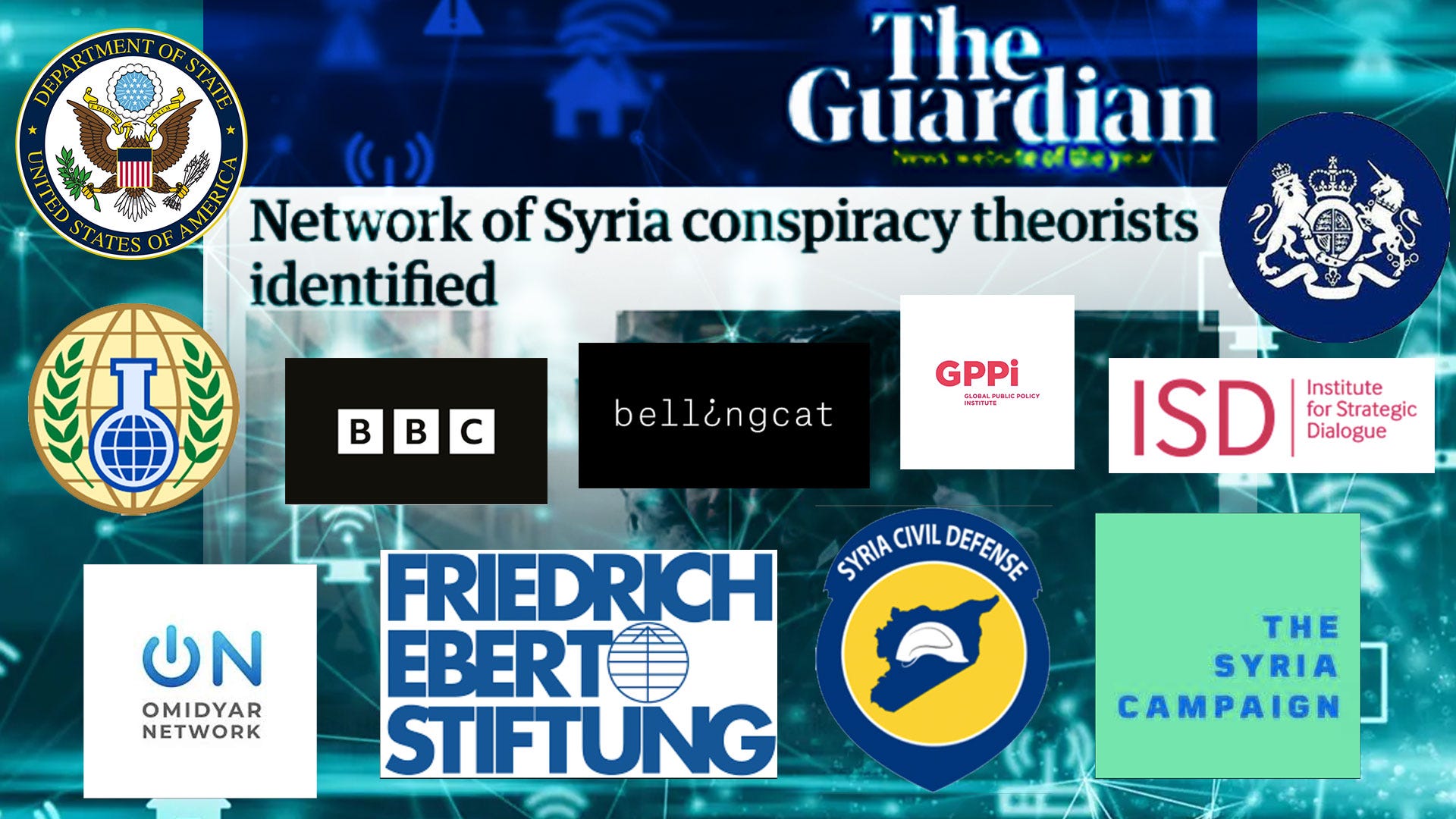
Defaming journalism on the OPCW’s Syria cover-up scandal, The Guardian and its NATO-funded sources out themselves as the real “network of conspiracy theorists.”
By Aaron Maté | August 1, 2022
On June 10th, The Guardian’s Mark Townsend published an article headlined “Russia-backed network of Syria conspiracy theorists identified.” (“Russia-backed” has since been removed).
The article is based on what Townsend calls a “new analysis” that “reveals” a “network more than two dozen conspiracy theorists, frequently backed by a coordinated Russian campaign.” This network, Townsend claims, is “focused on the denial or distortion of facts about the Syrian regime’s use of chemical weapons and on attacking the findings of the world’s foremost chemical weapons watchdog,” the Organization for the Prohibition of Chemical Weapons (OPCW). According to Townsend, I am named “as the most prolific spreader of disinformation” among the nefarious bunch.
In hawking this purported exposé of “disinformation”, Townsend violated every basic standard of journalism. He did not contact me before publishing his allegations; fails to offer a shred of evidence for them; and does not cite a single example of my alleged “prolific” disinformation. Instead, Townsend bases his claims entirely on a think-tank report that also provides no evidence, nor even assert that I have said anything false. In the process, Townsend failed to disclose that the report’s authors — the Institute for Strategic Dialogue (ISD) and the Syria Campaign — are groups funded by the US government and other belligerents in the Syria proxy war. To top it off, Townsend fabricates additional allegations that his state-funded sources do not even make.
As a result, Townsend and the Guardian have engaged in the exact sort of conduct that they falsely impute to me and others: spreading Syria-related disinformation with coordinated support from state-funded actors. The aim of this propaganda network is transparent: defaming journalism that exposes the OPCW’s ongoing Syria cover-up scandal and the dirty war waged by Western powers on Syria.
The OPCW cover-up is arguably the most copiously documented pro-war deception since the US-led drive to invade Iraq. In Western media, as The Guardian’s behavior newly demonstrates, it is also without question the most suppressed.
At the center of the story are two veteran OPCW scientists, Dr. Brendan Whelan and Ian Henderson. The pair were among a team that deployed to Syria in April 2018 to investigate an alleged chemical attack in the town of Douma. They have since accused senior OPCW officials of manipulating the Douma probe to reach a conclusion that baselessly implicated the Syrian government in a chlorine gas attack. Their claims are backed up by a trove of leaked documents and emails that show extensive doctoring and censoring of the Douma team’s findings.
The Douma cover-up extends far beyond the OPCW’s executive suite. It also implicates NATO governments led by the US, which bombed Syria over the Douma chemical weapons allegation, and then, weeks later, privately pressured the OPCW to validate it. Since the OPCW scandal became public, the US and its allies have thwarted efforts to address it.
At the most criminal level, the scandal implicates sectarian death squads armed and funded by the US and allies during their decade-long campaign for regime change in Syria.
At the time of the incident, Douma was occupied by the Saudi-backed jihadi militia Jaysh-al-Islam and under bombardment from Syrian army forces attempting to retake control. Shortly before their surrender, local allies of Jaysh-al-Islam accused Syrian forces of using chemical weapons. They released gruesome footage of an apartment building filled with slain civilians. A gas cylinder was filmed positioned above a crater on the roof. Concurrently, the White Helmets, a NATO and Gulf state-funded, insurgent-adjacent organization, released footage of what it claimed were gas attack victims in a Douma field hospital. Several journalists, including Riam Dalati of the BBC, Robert Fisk of the Independent, and James Harkin of the Intercept, found evidence that the hospital scene was staged. (In February 2019, Dalati claimed that he can “prove without a doubt that the Douma Hospital scene was staged.” Oddly, more than three years later, he has not released his findings).
The White Helmets’ alleged fakery of a chemical attack aftermath, coupled with the censored OPCW findings showing no evidence that a chemical attack occurred, suggest the inescapable conclusion that insurgents in Douma carried out a deception to frame the Syrian government. And given the unexplained deaths of the more than 40 victims filmed in the Douma apartment building, that deception may have entailed a murderous war crime.
Unlike the Iraq WMD hoax, the very existence of the OPCW’s Douma scandal is unknown to much of the Western world. With few exceptions, establishment media outlets have refused to acknowledge the OPCW whistleblowers and the leaks that brought their story to light.
After largely ignoring the OPCW cover-up since it first surfaced in May 2019, the Guardian has now published defamatory claims about journalists, myself included, who have dared to report on the censored facts.
When I wrote The Guardian about the Townsend article’s journalistic lapses, I did not get a response. One week later, I phoned Townsend, who was now back in the office but had yet to reply. In our conservation, which I recorded and recently published, I repeatedly asked Townsend to substantiate his claims about me and identify even a single example of my alleged disinformation.
Townsend did not attempt to defend his article’s assertions, beyond claiming that they were based on what was “in a report.” When I pressed further, he claimed that he had to “dash for a meeting” and promised that I would soon hear from the paper’s reader’s editor. (Before I published our phone call, and this article, I emailed Townsend a detailed list of questions and invited him to offer any additional comment. He did not respond).
“Deadly Disinformation”
Townsend could not provide any evidence for his assertions because the report that he parroted offers none as well.
The report, titled “Deadly Disinformation” and authored by The Institute for Strategic Dialogue (ISD) and the Syria Campaign, contains bare references to my reporting and makes no effort to refute it. Nowhere does the report even claim that I have said anything false. It simply claims to have “identified 28 individuals, outlets and organisations who have spread disinformation about the Syrian conflict,” and that I am “the most prolific spreader of disinformation” among them.
When the report bothers to mention of anything that I have actually said, it engages in distortion. In its first mention, the report states that I wrote an article that “attacks Bellingcat for its contributions to the Organization for the Prohibition of Chemical Weapons (OPCW).” Here, they not only fail to assert that I said anything false, but offer a false portrayal of what happened.
As for “attacking” Bellingcat — a website that, like the report’s authors, is funded by NATO states that were belligerents in the Syria dirty war – what I really did was expose its disinformation.
In this case, Bellingcat fraudulently attacked Whelan (the key OPCW whistleblower), along with several journalists (myself included) by falsely accusing us of concealing an OPCW letter that, I quickly revealed, did not in fact exist. Bellingcat was forced to add a correction, delete embarrassing tweets, and apologize to one of the article’s targets, the journalist Peter Hitchens (who resides in the UK, home to strict libel laws). I later exposed that Bellingcat copied a hidden, external author for some of their false material.
In short, the ISD/Syria Campaign’s first purported example of my alleged “disinformation” is an easily verifiable case where I’ve exposed state-backed lies.
The report’s only other substantive example comes when it notes that I have argued that the OPCW probe’s Douma probe “was flawed.” This far understates my case: the OPCW’s Douma investigation wasn’t “flawed”; it’s a scandalous cover-up worthy of global attention. Regardless, yet again, the report does not even assert that my argument is false, let alone try to explain why.
In a July 13th email, I asked the ISD to substantiate their claim that I have spread disinformation, and provide even one example of it. On its website, the ISD claims to “take complaints seriously,” and promises a response “within ten working days.” As of this writing, after 13 working days, I have not heard back.
At The Guardian, OPCW leaks are “problematic”
When I emailed a complaint about Townsend’s reporting, The Guardian admitted fault only on failing to contact me before publishing his evidence-free allegations. This was the result, they claimed, of a “breakdown of communication internally.” I was then offered the chance to respond to the article in 200 words.
A key point in my reply (which can be read here) was that The Guardian and its state-funded source is unable to identify any falsehoods in anything I’ve written “because my reporting on the OPCW’s Douma cover-up scandal is based on damning OPCW leaks.” These leaks, I added, “reveal that veteran inspectors found no evidence of a chemical attack in Douma, and that expert toxicologists ruled out chlorine gas as the victims’ cause of death. But these findings were doctored and censored by senior OPCW officials.”
At The Guardian, this passage set off an apparent alarm. After disparaging my reporting on the OPCW leaks, The Guardian informed me that they would now prevent me from even mentioning them. In a July 8 email, a Guardian editor wrote that the “the part about the OPCW” in my reply “continues to be problematic.” My reference to the OPCW leaks, the editor claimed, “makes an assertion that has been rebutted by an independent inquiry.”
I responded by asking the editor to specify exactly which “assertion” of mine has been rebutted. I also proposed that, if they believe that I have said anything “problematic,” they publish their own rebuttal.
In multiple follow-up emails, the editor failed to identify any “rebutted” assertion of mine. Despite that, the Guardian proceeded to publish my reply without its reference to the OPCW leaks. But this raised a new problem: in censoring my statement, they misquoted me. When I pointed out that error, they updated my reply to finally allow a (minimal) mention of the OPCW leaks.
The Guardian also took me up on my proposal that they publish their own rebuttal:
Editor’s note: Both the ISD and the Syria Campaign list a diverse range of funders and describe themselves as “fiercely independent”. In 2020 the OPCW rebutted claims about its investigation into the Douma incident (Inquiry strikes blow to Russian denials of Syria chemical attack).
As for the “inquiry” that The Guardian claims “rebutted claims about its investigation into the Douma incident,” the inquiry was not independent, and did not rebut anything.
The “inquiry” was appointed by the OPCW’s Director General’s office, the very body that presided over the cover-up. It was also staffed by two “investigators” from the US and UK. These happen to be the two states that bombed Syria based on the Douma allegations that the OPCW fraudulently validated, and that have since tried to bury the scandal at every stage.
Accordingly, the OPCW “inquiry” avoided the allegations of censorship in the Douma probe and instead disingenuously minimized the whistleblowers’ role. The whistleblowers themselves have rebutted the inquiry’s claims about them, as have I in subsequent reporting.
A network of NATO disinformation
As for what the Guardian calls the ISD and Syria Campaign’s “diverse range of funders,” both groups indeed enjoy a diverse range of funders: everyone from NATO governments to NATO government-funded organizations. They also receive support from billionaire-funded foundations that often work in concert with these same NATO governments’ foreign policy objectives.
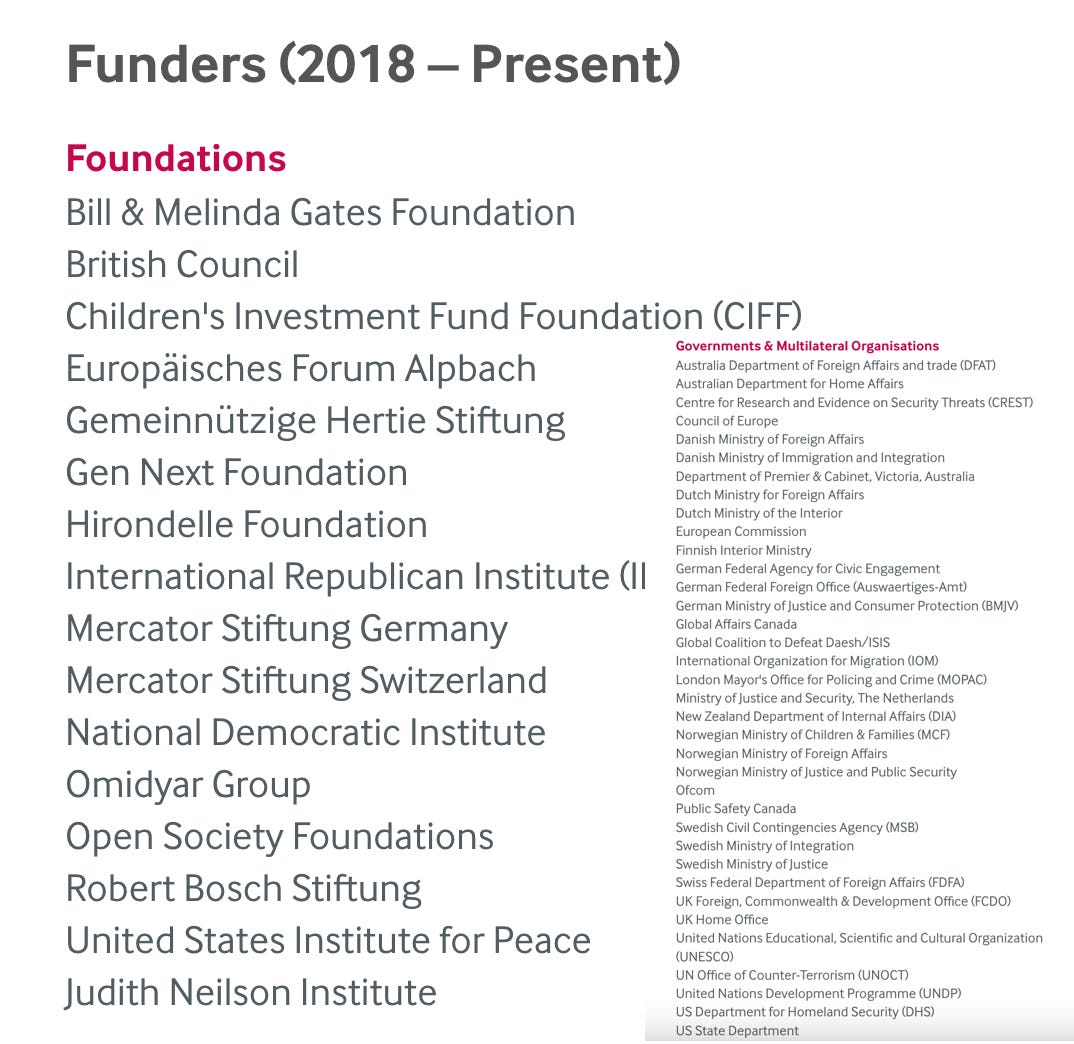
The Institute for Strategic Dialogue’s “diverse range of funders,” according to The Guardian.
The ISD’s “diverse” funders include the US State Department, the US Department of Homeland Security, three other US state-funded organizations, and more than two dozen other NATO government agencies. On the private side, the ISD’s funders include the foundations of three of the world’s richest oligarchs: Pierre Omidyar’s Omidyar Group, George Soros’ Open Society Foundations, and the Bill and Melinda Gates Foundation.
In using the ISD as a source, The Guardian has a conflict of interest that its article did not disclose. The latter two ISD donors have also given sizeable grants to The Guardian: at least $625,000 from Open Society Foundations since 2019, and at least $12.9 million from the Bill and Melinda Gates Foundation since 2011.
Omidyar’s foundation has a direct role in the ISD/Syria Campaign report. The Omidyar Group’s Luminate Strategic Initiatives is listed alongside the German government-funded Friedrich-Ebert-Stiftung foundation as the report’s fiscal sponsor.
Omidyar’s sponsorship of an attack on journalism about the OPCW scandal is highly fitting. The Intercept, the self-described “fearless and adversarial” outlet that Omidyar also funds with his vast fortune, has never once acknowledged the OPCW leaks or whistleblowers’ existence. While ignoring the OPCW scandal for more than three years, The Intercept has published multiple articles promoting the allegation that Syria committed a chemical attack in Douma.
Like the ISD, the Syria Campaign is also funded by governments and other belligerents in the Syria dirty war. As The Grayzone’s Max Blumenthal reported in 2017, the Syria Campaign was founded by Ayman Asfari, a Syrian-British billionaire oil tycoon and leading financial supporter of the Syrian National Coalition, the largest government-in-exile group established after the Syria conflict erupted in 2011. The Syria Campaign has also done extensive P.R. and fundraising for the White Helmets, the insurgent-adjacent, NATO state-funded organization implicated in the Douma incident.
That these two state-funded groups “describe themselves as ‘fiercely independent'” is apparently enough for The Guardian. I trust that the Guardian would feel differently if they were dealing with self-described “fiercely independent” groups funded by the Russian and Syrian governments.
Unsurprisingly, the vast majority of sources quoted in the ISD/Syria Campaign report are funded or employed by the same NATO state and private sponsors. This includes the White Helmets; the Global Public Policy Institute; Syrian American Medical Society (SAMS); self-described journalist Chloe Hadjimatheou of the BBC, who produced a podcast series that disparaged the OPCW whistleblowers and whitewashed the Douma cover-up; and James Jeffrey, the former US Special Envoy for Syria.
For a report that claims to be concerned with protecting Syrians from “real-world harm,” Jeffrey is a particularly interesting interview subject. Few US officials have been as candid about their willingness to immiserate Syrian civilians in pursuit of hegemonic US goals in their country.
Jeffrey has declared that al-Qaeda is a US “asset” in Syria, and has admitted to misleading the Trump White House to undermine an effort to withdraw the US military, whose illegal occupation deliberately deprives Syria of its own wheat and fuel. Jeffrey has openly bragged about his “effective strategy” to ensure “no reconstruction assistance” in Syria — even though the war-ravaged country is “desperate for it.” And he has also taken credit for helping to impose crippling US sanctions on Syria that have “crushed the country’s economy.”
Jeffrey’s proudly self-acknowledged real-world harms on millions of Syrians don’t seem to bother the study’s authors, presumably because their Western state sponsors implement them.
The report is so invested in its state funders’ aims in Syria that it approvingly airs frustration that other governments are failing to toe the NATO line. A “former Western diplomat” complains that “disinformation” on Syria is helping states “avoid making the decisions that we want them to make, say in the Security Council or elsewhere.” (emphasis added). From the point of view of Western officials, the anonymous diplomat is employing an accurate operative definition of what constitutes “disinformation”: any information that causes those deemed subordinate to “avoid making the decisions that we want them to make.”
Fittingly, another anonymous “senior diplomat” laments that supposed Syria disinformation is intended “ultimately to cast doubt upon the legitimacy and integrity of the people doing this kind of [policy] work.” Daring to question the “legitimacy and integrity” of Western policymakers who oversaw a multi-billion dollar CIA-led dirty war on Syria that knowingly empowered al-Qaeda and other sectarian death squads while leaving hundreds of thousands dead — another intolerable act that can only result from “disinformation.”
A member of the US-funded, insurgent-adjacent White Helmets is also given space to lament that alleged “disinformation” is hurting its donations. “We hear about billions of dollars for aid at conferences on Syria but most of that funding goes to the UN,” a White Helmets manager complains. Unmentioned is that European governments have cut funding to the group after their late founder, the lavishly paid UK military veteran James le Mesurier, admitted to pocketing donor funds and financial fraud right before he took his own life.
Having promoted the hegemonic agenda of its state sponsors, the report closes with a thinly veiled call to censor the dissenting voices it targets.
The ISD and Syria Campaign urge policymakers to “adopt a whole-of-government approach in tackling disinformation” and “ensure that loopholes or special privileges are not created for ‘media’ which would only exacerbate the spread of disinformation.” These “privileges” presumably refer to free speech. The report also notes favorably that platforms have addressed “thematic harms such as public health disinformation or foreign interference in elections.” As a result, the report calls on these platforms to “commit to applying similar levels of resourcing… in the context of the ongoing Syrian conflict.” Perhaps they have in mind the censorship of journalism about Hunter Biden’s laptop before the 2020 election, on the fake grounds that the story was “Russian disinformation.”
The fact that this network of state-funded actors is devoting energy to disparaging journalism about the OPCW’s Syria cover-up — and even advocating that it be censored – reflects their powerful sponsors’ desperation to bury a damning scandal.
In public, OPCW Director General Fernando Arias has provided misleading and outright false answers about the Douma probe, including why he refuses to meet with the dissenting inspectors and the rest of the original investigative team.
On top of the two known whistleblowers, Arias has ignored calls for accountability from his original predecessor, founding OPCW chief Jose Bustani, as well as four other former senior OPCW officials. Along with Bustani, former senior UN official Hans von Sponeck has spearheaded the Berlin Group 21, a global initiative to address the OPCW scandal. The US has responded to Bustani by blocking his testimony at the United Nations. Arias meanwhile refused to open a letter that he received from Sponeck’s group, returning it back to sender.
The response of Western media outlets like the Guardian to the stonewalling of these veteran diplomats and senior OPCW officials has simply been to ignore it.
In whitewashing the OPCW cover-up, the preponderance of state sources parroted by The Guardian reveals the ultimate irony in its allegations. While claiming to “identify” a fictional network of Russia-backed disinformation actors about Syria, The Guardian’s Townsend is himself spreading the disinformation of a NATO-funded network that defames voices who expose the dirty war on Syria.
In fact, one of Townsend’s central allegations goes well beyond his state-funded sources. Although Townsend’s article is premised on identifying a “network of conspiracy theorists,” Townsend’s sole source – the ISD/Syria Campaign report – never alleges that such a “network” exists. Nowhere in the report does the word “network” even appear.
Thus, Townsend has not only parroted state-funded sources, but concocted an additional allegation in the service of their narrative. This is not just an ordinary fabrication: in creating the fantasy of a “coordinated”, “Russia-backed”, “network of conspiracy theorists,” Townsend also reveals himself to be the very thing that he accuses his targets of being: a conspiracy theorist.
And given that Townsend not only parrots his state-backed sources but works for an outlet funded by some of the same sponsors, it is fair to say that The Guardian and these state-funded think tanks are a part of the same network.
Consequently, reading the article’s headline — “Network of Syria conspiracy theorists identified”—as a description of The Guardian and the NATO-funded sources that it relied on, the claim is no longer inaccurate.
The Bab al Hawa Deception
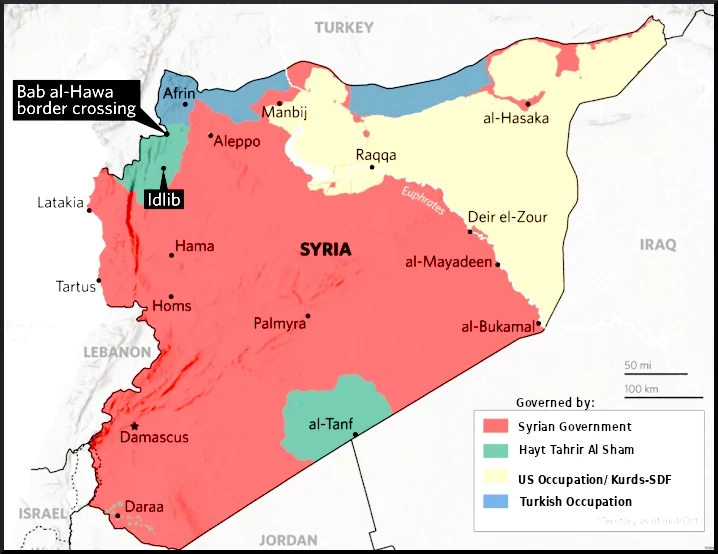
Syria Support Movement | July 17, 2022
On July 12, the UN Security Council extended the authorization for humanitarian aid to cross through Bab al Hawa on the Turkey-Syria border for another six months. The US and allies had wanted a one-year extension, but Russia vetoed it. The US, UK and France abstained on the six-month approval, while all others supported it.
There is much misinformation and deceit about the Bab al Hawa crossing in Idlib province, Syria. First, Western media rarely mention that after the aid crosses the border, it is effectively controlled by Syria’s version of Al Qaeda, Hayat Tahrir al Sham (HTS). Second, they fail to explain that HTS hoards much of the aid for its fighters. When Aleppo was liberated by the Syrian Army, reporters found large stashes of medicines and food in their headquarters that were set aside for the use of the militia. Third, HTS makes millions of dollars by taxing the aid that it distributes to the rest of the population under its control.
In May 2018, HTS was added to the US State Department’s list as a Foreign Terrorist Organization (FTO). HTS’s 15000 fighters are able to manipulate the numbers by including their names and the names of their accompanying families as civilians, thus receiving huge amounts of aid from UN agencies such as the World Food Program. It is rarely mentioned that thousands of these civilians are not Syrian. They are Uyghurs and Turkmen supporters of Al Qaeda, from Turkey, China and elsewhere.
The Bab al Hawa crossing is also an entry point for weapons and sectarian fighters smuggled in with the copious aid. This is not new. In 2014, legendary journalist Serena Shim reported how she witnessed fighters and weapons entering Syria using World Food Organization trucks at Bab al Hawa. She was killed in Turkey two days after her report.
It is claimed over 4 million persons are in Idlib. That is a huge exaggeration. Before the conflict began in 2011 there were 1.5 million. When sectarian militants seized control, many civilians fled for Aleppo or Latakia. Even including fighters coming from other areas, the population is much LESS than before the conflict. The number of civilians in Idlib is grossly inflated for political and economic reasons.
The media also fail to mention that the aid across Bab al Hawa serves only the Al Qaeda-controlled area (the northern green section of the map) and not the rest of Syria. While western states send massive amounts of aid to this minority, the vast majority of Syrians suffer with little aid. Moreover, they are under the extreme US “Caesar” sanctions designed by the US to crush the economy by outlawing the Syrian Central Bank, make it impossible for Syrians to rebuild infrastructure, and punish Syrians and anyone who would trade or assist them.
Russian, Chinese and other representatives on the UN Security Council have pointed out that aid to Syria should be going through the UN recognized government in Damascus. Aid to civilians in Idlib should be distributed via the Syrian Red Crescent or a comparable neutral organization.
Providing aid through Bab al Hawa via hostile Turkey to an officially designated terrorist organization should be prohibited. It is a clear violation of Syrian sovereignty. In December 2022, when the authorization again comes to a UN Security Council vote, the crossing may finally be shut down. At that point, the legitimate aid to civilians in Idlib province can be delivered from within Syria as it should be.
US “Iran Nuclear Deal” Ploy Coming Full Circle
By Brian Berletic – New Eastern Outlook – 22.07.2022
Hopes for the Joint Comprehensive Plan of Action (JCPOA) simply known as the Iran Nuclear Deal seemed to fade further during US President Joe Biden’s recent trip to Israel where the US and Israeli governments signed a pledge to use force against Iran should it pursue nuclear weapons (weapons both the US and Israel possess).
US-based ABC News in its article, “Biden left with few options on Iran as nuclear talks stall,” would claim:
President Joe Biden made a clear promise on Iran, declaring that the country would never become a nuclear power under his watch. But during his time in the White House, the path towards upholding that promise has only become murkier.
During his trip to the Middle East, the president said he would consider using force against Iran only as a “last resort,” although Israel, the US.’s most ardent ally in the region, has pushed for the administration to issue a “credible military threat” against Tehran.
The article would mention the Iran Nuclear Deal specifically, claiming:
… while the administration initially hope to cut a “longer and stronger” deal with Iran, over a year and half of indirect negotiations has produced little movement towards restoring even the original terms of the agreement.
After a monthslong stalemate, a 9th round of talks took place in Doha, Qatar, at the end of June. A State Department spokesperson did not sugarcoat the outcome, saying “no progress was made.”
The 2018 unilateral withdrawal of America from the deal by the administration of US President Donald Trump is blamed for the deal’s failure. Yet the Trump administration’s withdrawal was predicted long before President Trump took office, and in fact, long before US President Barack Obama even signed the deal in the first place. President Biden’s recent activities are only wrapping up what was always a diplomatic ploy meant to trap Iran.
The Nuclear Deal Was Always a Trap
When President Obama signed the Iran Nuclear Deal, it was celebrated as a breakthrough in US diplomacy and a departure from the previous Bush administration’s expanding wars of aggression spanning Iraq and Afghanistan while threatening Iran next.
Signed by the United States and Iran along with other participating nations (the UK, EU, Germany, Russia, China, and France) in 2015, NBC News in their article, “What is the Iran nuclear deal?” would explain:
The Iran nuclear deal, formally known as the Joint Comprehensive Plan of Action, offered Tehran billions of dollars in sanctions relief in exchange for agreeing to curb its nuclear program.
The agreement was aimed at ensuring that “Iran’s nuclear program will be exclusively peaceful.” In return, it lifted UN Security Council and other sanctions, including in areas covering trade, technology, finance and energy.
At face value, the United States imposing sanctions on Iran to impede its development of nuclear weapons was problematic. The United States is the only nation in human history to use nuclear weapons against another nation, twice. Following the 2001 US invasion and occupation of Afghanistan and the 2003 US invasion and occupation of Iraq, the United States had military forces to Iran’s west and east. US hostilities toward Iran stretch back decades and the US State Department, regardless of administration, has made little secret that Washington seeks regime change in Tehran just as it did in Afghanistan and Iraq.
Worse still, US policymakers as early as 2009 had articulated a ploy by which the US would offer Iran a “deal” before deliberately sabotaging it and using its failure as a pretext for the long sought-after regime change war the US has wanted against Iran.
The Washington DC-based Brookings Institution, funded by the largest corporate-financier interests in the Western world as well as Western governments themselves including the US through the US State Department published the 2009 paper (PDF), “Which Path to Persia? Options for a New American Strategy Toward Iran.” In it, the Brookings Institution’s policymakers explicitly articulated options the US could pursue to achieve regime change in Iran.
These options were broken down into sections and chapters within the 170-page report and ranged from “An Offer Iran Shouldn’t Refuse: Persuasion,” to “Toppling Tehran: Regime Change,” to “Going All the Way: Invasion,” and “The Velvet Revolution: Supporting a Popular Uprising.” Everything from setting diplomatic traps to arming designated terrorist organzations were not only discussed, but in the years that followed the paper’s publication, they were implemented one after the other without success. The remaining options on the long list are military in nature involving either the US or Israel (or both) waging war directly and openly against Iran.
All that is required before doing so is a pretext, including the “offer” the US made, but Iran “refused.”
“An Offer Iran Shouldn’t Refuse”
Under “Chapter 1” titled, “An Offer Iran Shouldn’t Refuse: Persuasion,” Brookings policymakers would explain (emphasis added):
… any military operation against Iran will likely be very unpopular around the world and require the proper international context—both to ensure the logistical support the operation would require and to minimize the blowback from it.
The paper then laid out how the US could appear to the world as a peacemaker and depict Iran’s betrayal of a “very good deal” as the pretext for an otherwise reluctant US military response (emphasis added):
The best way to minimize international opprobrium and maximize support (however, grudging or covert) is to strike only when there is a widespread conviction that the Iranians were given but then rejected a superb offer—one so good that only a regime determined to acquire nuclear weapons and acquire them for the wrong reasons would turn it down. Under those circumstances, the United States (or Israel) could portray its operations as taken in sorrow, not anger, and at least some in the international community would conclude that the Iranians “brought it on themselves” by refusing a very good deal.
The Iran Nuclear Deal was doomed before it was ever signed. It was conceived wholly as a pretext for war, not as a diplomatic solution to avoid it.
False Hope Spanning Multiple US Presidencies
In many ways, Iran would be foolish not to create a sufficient military deterrence against US aggression, including the development of nuclear weapons if necessary. However, Iran nonetheless agreed to the nuclear deal’s terms and until the US unilaterally abandoned the deal in 2018, abided by it.
In fact, following the US withdrawal from the deal, Iran continued abiding by many of its conditions alongside its other signatories in the vain hope that under a new US administration it could be salvaged.
When US President Joe Biden took office, the obvious first step by Washington should have been to unconditionally rejoin the deal by removing sanctions, followed by Iran’s renewed and full compliance to the deal’s conditions. Yet the US demanded Iranian compliance first before even agreeing to negotiate Washington’s return to the deal.
It was clear long before President Obama’s signature was inked on the deal’s documents that the US would sabotage it, blame Iran, then pursue renewed and expanded aggression against Iran directly, by proxy, or both. President Trump in 2018 took advantage of America’s domestic politics and the perceived notion that US “Republicans” seek a harder line versus Iran in order to abandon the deal. Because of President Trump’s perceived trait as an “outsider” both to his own party and wider US politics, the US could shift the blame squarely on his administration. Yet the continuity of this ploy across presidential administrations is evident by the fact that upon coming into office, President Biden did not immediately and unconditionally return the US to the deal’s framework.
Instead, President Biden’s administration prevented America’s return to the deal by creating unreasonable preconditions placed entirely upon Iran. With President Biden’s statement in Israel coupled with a recent claim made by US National Security Adviser Jake Sullivan that Iran is preparing to supply Russia with drones, the US is closing the door on the deal indefinitely.
Further evidence of continuity between US administrations can be seen throughout the US-led destabilization, invasion, and occupation of Syria. The campaign was meant as one of several prerequisites laid out by the Brookings Institution’s experts in 2009 before attempting regime change against Iran directly. Ironically, as the Obama administration appeared reconciliatory toward Iran by signing the Iran Nuclear Deal, the same administration presided over the devastating proxy war targeting Iran’s key ally in the region, Syria.
Support of US aggression in Syria transcended presidencies, from the Bush administration who set the stage for it, to the Obama administration who presided over the opening phases of hostilities and occupation, to the Trump and now Biden administrations who have perpetuated a US military presence in Syria along with a policy of denying Syria its key fuel and food production regions in the east to block reconstruction. US foreign policy toward Syria and Iran should not be interpreted separately. The fate of both nations is entwined and illustrates the wider agenda the US is pursuing in the region and has been for decades regardless of US administration.
Barring a fundamental reordering of both American foreign policy objectives and a reordering of the special interests driving them, the Iran Nuclear Deal’s prospects of success will only fade further in the distance. While Tehran’s patience is admirable, Iran and its allies must prepare for the inevitable hostilities that will follow US blame against Tehran for “undermining” a deal the US never had any intention of honoring in the first place.
Brian Berletic is a Bangkok-based geopolitical researcher and writer.
Featured Video
Laith Marouf: Hezbollah’s position on US-Iran ceasefire
or go to
Aletho News Archives – Video-Images
From the Archives
The Dirty Little Secret behind the “Global Terrorism Index”
The Omission of Israeli Terrorism in the Occupied Palestinian Territories
By Karin Brothers | Global Research | December 6, 2014
… The Israeli settlements — all of which are illegal – have been identified as a major impediment to peace. The refusal of a major “global” terrorism report to name the Israeli settlers as one of the groups most responsible for terrorism not only misrepresents a major source of regional violence but exposes the Global Terrorism Index as a propaganda tool that supports a U.S. agenda.
In recent years, governments have been attempting to thwart terrorism by blocking supportive fund-raising. When it comes to Israeli settlements, however, the US and Canada actually encourage fund-raising by giving organizations (such as Christian Friends of Israeli Communities (CFOIC) and the Jewish National Fund) financial support in the form of donor tax-deductions.
Charities which provide funds for the Israeli settlements should be regarded as terror-financing organizations. They should not only lose their tax-deductible status, but they should be banned because they support the violation of international humanitarian law. The terror-financing laws that are being strictly enforced for Muslim charities should be applied to Christian and Jewish charities as well. … Read full article
Blog Roll
 Aletho News
- Trump Administration Moves To Automate U.S. Military Draft Registration
- Spain orders reopening of Tehran embassy, condemns Israel’s carpet bombing of Lebanon
- Israel faces ‘unsustainable’ strategic crisis following 40-day war against Iran: Analyst
- Iran restricts Hormuz access to 15 vessels per day under ceasefire terms: Report
- The ‘Opposition Party’ Has Done Nothing to Stop the Iran War and Much to Goad Trump Into Continuing It
- Moscow backs Tehran on status of Lebanon in US-Iran deal
- How UK Regulator Ofcom Quietly Bypassed International Law to Police American Speech
- The Black Cube Files: How Former Mossad Operatives Flipped a Nation
- Laith Marouf: Hezbollah’s position on US-Iran ceasefire: What you’re not being told
- Israel’s priority lies in destroying chances of peace between Iran, US: Ex-UN nuclear chief
- If Americans Knew
- The gallows law: Israel moves toward executing Palestinian children
- Tucker Carlson: The Path to Peace requires ending ‘special alliance’ with Israel
- This is ceasefire? Israel’s biggest massacre yet in Lebanon, another journalist killed in Gaza – Daily Update
- Tucker Carlson on Israel: This Is the Behavior of an Ally? Really?
- Gazans face a triple crisis: severe shortages of water and bread, healthcare in tatters
- NY Times reports how Netanyahu took the US into Iran War
- A sigh of relief over Iran, but Gaza and Lebanon in dire straits – Daily Update
- Thousands dead and neighborhoods razed to the ground: Aid agencies fear southern Lebanon is becoming the new Gaza
- The war the US is fighting for Israel could cost trillions
- ‘Cigarette Burns, Nail Wounds’: Toddler Tortured in Gaza to Coerce Father
- No Tricks Zone
- An Inconvenient Tree: Uncovered In Alps… Europe Much Warmer Than Today 6000 Years Ago
- New Study Reports A 60% Slowdown In Greenland’s Ice Loss Rate In The Last Decade
- Low Intensity Tornado Wrecks Major Solar Farm, Creating A Potential Toxic Dump
- New Study Finds Warming Saves Lives…Cold Temperatures 12 Times More Deadly Than Excess Heat
- German Science Blog Accuses PIK Climate Institute Of Hallucinating Climate Tipping Points
- Devastating Assessment Of Comirnaty Vaccine By Former Senior Pfizer Europe Toxicologist
- New Study: CO2 Is ‘Effectively Negligible’ As An Explanatory Climate Change Factor Since 2000
- Former Pfizer Toxicologist Dr. Helmut Sterz Tells Bundestag Hearing Pfizer Vaccine Should Have Never Been Approved
- Energy Expert: Germany’s Nuclear Phaseout Was A “500 Billion Euro Mistake”
- New Research: South Australia’s Mid-Holocene Sea Surface Temperatures Were 4°C Warmer Than Today
 Aletho News