Trump Extricates Himself from the Trap in Syria, Abandoning the Kurds
By Dmitry MININ | Strategic Culture Foundation | 28.12.2018
It is not only many members of the US establishment who have labeled President Trump’s order to withdraw America’s forces (2,200 troops) from Syria as a betrayal, but also the allies of the United States. They claim that Trump is throwing the Syrian Kurds under the bus and leaving Israel in a state of “strategic isolation.” Also coming in for criticism is the statement by the US administration (the first of its kind) announcing that it has no plans to remove Bashar al-Assad from power.
It may turn out to be Syria’s Kurds (who number about two million) who will face the most dramatic consequences of the president’s decision, for it was they who created the de facto autonomous state of Rojava in northeastern Syria with the Americans’ support. Now Rojava’s very existence is under threat.
Ankara has already stated that it has not given up on its plan for “an offensive against the terrorists” in eastern Syria, but has merely put it on hold for a while (i.e., until the Americans have left). Officially, this has been prompted by the fact that Turkey intends to take over for the US and finish off the remnants of the “Islamic State” (IS) — something over which Trump and Erdoğan have supposedly already reached an explicit agreement. The leader in the White House has already tweeted that this is so. Turkey’s foreign affairs minister, Mevlüt Çavuşoğlu, issued the same confirmation on Dec. 21. If left to its own devices, the Syrian government army could handle a few stray IS units even without the Turks, but Ankara isn’t particularly interested in IS. Turkey needs to wipe Rojava off the map.
According to Çavuşoğlu, the vacuum that will be left after the US troops pull out “can be filled by terrorist organizations,” so Turkey is ready to exert control over those territories (which, as a reminder, are Syrian).
Faced with the dilemma over whether to favor as an ally the mythical state of Rojava or Turkey, the leader in the White House did not hesitate to choose the latter. Although the American troops are slated to leave Syria within 60 to 100 days, the State Department advisors who are helping to rebuild the nation’s infrastructure in northeastern Syria are being pulled out within a matter of days. Brett McGurk, the chief advisor and special presidential envoy in Syria — a man whom the Kurds practically viewed as the architect of their statehood — is openly irate. McGurk, who saw himself as a new version of Lawrence of Arabia, accused the White House of “abandoning the US allies in the region.” However, he himself bears much of the responsibility for the chaos there. It was none other than McGurk who was the primary author of the new Iraqi constitution that plunged that country into the abyss of civil war. And he also wooed the Syrian Kurds on behalf of the US, by dangling promises of their own statehood, which never materialized.
The command of the Kurdish Syrian Democratic Forces has already issued a statement condemning the US decision and proclaiming its determination to continue the fight. Kurdish leaders are less concerned with the Americans’ departure than with the deal the Americans reached with the Turks behind the Kurds’ backs. Their statement calls out Turkey’s intentions to take aggressive action against Rojava, in addition to Ankara’s “dirty plans and games.” The Kurds feel that by simultaneously announcing both the withdrawal of their troops as well as the sale of the Patriot missile-defense system to Turkey, the US has green-lighted the plans for a “Turkish occupation” of their territory. However, for some reason they are requesting protection from the UN, although Rojava is legally within the borders of the Syrian state and thus that kind of conversation needs to be held with Damascus.
What awaits Rojava? The only thing that can save it would be the recognition of the sovereignty of Damascus within its borders. If Syrian government troops enter Rojava, the Turks will not risk seriously damaging their relationship with Russia in order to launch an offensive. Nor do they even need northeastern Syria, as they only need assurances that there will be no further moves to create a Kurdish quasi-state and thus no threats to Turkey’s stability. Damascus and Moscow are ready to provide this. Russian representatives have always expressed their readiness to work with Damascus in order to safeguard the national rights of the Syrian Kurds in a mutually acceptable way. If the Kurds had been willing to move in this direction earlier, their negotiations with the Syrian government could have been conducted in a more favorable atmosphere. But better late than never. If the leaders in Rojava don’t find a way to reach a compromise with Damascus, the Syrian Kurds could be looking at a real calamity.
Why Mattis’ exit is a defining moment in US foreign policy
By M. K. BHADRAKUMAR | NewsClick | December 24, 2018
Within the week, President Trump’s sudden announcement of “total” troop withdrawal from Syria has ripped apart the American political system and exposed its fault lines. Trump’s decision is intrinsically a sound one. He didn’t start the Syrian conflict and he has been on record repeatedly that the US had no business to intervene in it militarily. But his writ as president and commander-in-chief didn’t run large. Astoundingly enough, we know now that the Pentagon defied the president who is also the commander-in-chief.
We also know that Trump’s defence secretary James Mattis set the scale and scope of the US intervention in Syria. From what was meant to be a limited intervention, Mattis turned it into an open-ended military occupation of Syria. This was despite the fact that the US carries no UN mandate to send forces to Syria. The repeated protests by Damascus, including at the UN, were ignored.
Indeed, the military mission that was originally geared to fight the ISIS morphed into a geopolitical one to counter Iran (and Russia’s) presence in Syria. Above all, the US military virtually occupied one-third of Syrian territory and declared it an exclusive region that even Syrian government forces were barred from entering and imposed a “no-fly zone” there. All this constituted a gross violation of international law and UN Charter.
While resigning in protest, Mattis took care to turn it into a first-rate political scandal. This has put Trump’s back up. If Mattis was hoping to keep his job till end-February with an intention to continue to undermine the president’s foreign policies, an unforgiving Trump has other plans. Trump has announced the appointment of an acting defence secretary w.e.f. Jan 1, which defangs Mattis overnight. Trump thereby ensures that his decision on troop withdrawal in Syria will be implemented on the ground.
The really stunning part is that the bulk of America’s political class, think tanks and the media have rallied to support Mattis in an astounding display of defiance and spite toward their elected president. Suffice to say, there has been an insurrection against Trump’s foreign policy agenda and Mattis was a key figure in that enterprise. Quintessentially, the established American political system – what Trump calls the “Swamp” – refuses to make way for the elected president, his mandate from the people for his political platform notwithstanding. Isn’t it a sham that the US claims to have a government “of the people, by the people, for the people”?
Quite obviously, Syria is only the tip of the iceberg. Looking back, Mattis had a virtual free run through the past two-year period, to undermine Trump’s foreign policy agenda across the board. Mattis had the great advantage of serving at NATO Headquarters as Supreme Allied Commander Transformation. His president, on the other hand, was a novice in alliance politics. Mattis knew precisely how consensus opinion is forged in Brussels around decisions taken in Washington, how those decisions get formally adopted by alliance partners and how Washington’s projects invariably get implemented. Thus, Trump’s role got incrementally reduced to ranting and raving about the NATO budget. Trump talks no longer about NATO being “obsolete”.
Simply put, Mattis has brilliantly revived the NATO. He did this knowing fully well that a transatlantic alliance raring to go cannot do without an “enemy”. And Mattis also knew that that “enemy” has to be Russia. Thus, the reboot of NATO and the ratcheting up of tensions with Russia became mutually reinforcing endeavors. The result is plain to see: NATO has come closer to Russia’s borders than at anytime before and is creating threatening military infrastructure there. Moscow is in a quandary because it is well aware that the NATO project is a de facto Pentagon project and Trump himself probably had little to do with it.
Moscow keeps hoping that a Russian-American summit would help matters, but then, Trump’s plans for meeting with Vladimir Putin runs into strong headwinds whenever the idea surfaces. The “Russia collusion” inquiry keeps Trump off balance (although Robert Mueller has so far failed to produce a shred of evidence that Moscow promoted Trump’s candidacy in the 2016 election.) Put differently, for the “Swamp” the Robert Mueller inquiry becomes critically important precisely for the reason that Trump is prevented from making any concerted attempt to improve US-Russia relations.
Syria and Afghanistan are only illustrative examples of how the Pentagon has a corporate interest in fighting open-ended wars. In both cases, a military victory is no longer regarded as feasible, and it is the hidden geopolitical agenda that matters to the Pentagon. Equally, cascading tensions with Russia or the open-ended wars translate as bigger budgetary allocation for the Pentagon, which of course largely goes to fund the military-industrial complex. One can take a safe bet that it is a matter of time before Mattis himself gets re-employed in the corporate board of some big arms manufacturing enterprise. The passion with which he has been advocating Saudi Arabia’s cause in the downstream of the Jamal Khashoggi affair speaks volumes about the unholy nexus at work involving the sheikhs, the Pentagon and the arms vendors – and the US lawmakers.
This sort of nexus has spawned a powerful coalition of interest groups who are viscerally opposed to a “demilitarization” of the US foreign policies, which is at the core of Trump’s agenda. Their favorite candidate in the 2016 election was Hillary Clinton. Their focus today is on debilitating the Trump presidency in any whichever way they can and to work toward ensuring that Trump doesn’t win a second term.
In this holding operation, Mattis played a stellar role by systematically undermining the Trump agenda. Mattis is a skilled operator in the military bureaucracy and his departure leaves a void for the Swamp. But his exit is not going to be the end of the vicious struggle going on in American politics. The good part is that Trump seems to understand that it will be a downhill slope ahead of him unless he took a last-ditch stance and dug in now to assert his constitutional prerogative as the president to push his foreign policy agenda. The point is, that agenda also happens to be linked to Trump’s campaign platform for the 2020 election.
Israeli Provocative Strikes on Syria Endangered Two Passenger Jets: Russian MoD
Al-Manar | December 26, 2018
‘Israel’ conducted its airstrikes on Syria while passenger planes were landing in Damascus, according to the Russian Defense Ministry.
The ministry also reported that at least three Syrian servicemen were injured after two Israeli bombs hit the territory of a Syrian Army logistics center.
Syria’s air defenses managed to destroy 14 out of 16 Israeli bombs during the airstrike, according to the ministry. It added that none of the passenger planes that were under threat due to the airstrike were related to Russian air carriers.
Syria Withdrawal Enrages the Chickenhawks
A Christmas present for the American and Syrian people
By Philip Giraldi • Unz Review • December 25, 2018
President Donald Trump’s order to withdraw from Syria has been greeted, predictably, with an avalanche of condemnation culminating in last Thursday’s resignation by Defense Secretary James Mattis. The Mattis resignation letter focused on the betrayal of allies, though it was inevitably light on details, suggesting that the Marine Corps General was having some difficulty in discerning that American interests might be somewhat different than those of feckless and faux allies like Israel and Saudi Arabia that are adept at manipulating the levers of power in Washington and in the media. Mattis clearly appreciates that having allies is a force multiplier in wartime but fails to understand that it is a liability otherwise as the allies create an obligation to go to war on their behalf rather than in response to any actual national interest.
The media was quick to line up behind Mattis. On Friday, The New York Times featured a lead editorial entitled “Jim Mattis was right” while neocon twitter accounts blazed with indignation. Prominent chickenhawk mouthpieces David Frum and Bill Kristol, among many others, tweeted that the end is nigh.
During the day preceding Mattis’s dramatic announcement, the press went to war against the Administration over Syria and also regarding other reports that there would be troop reductions in Afghanistan. The following headline actually appeared on a Reuters online article the day after the announcement by the president: “In Syria retreat, Trump rebuffs top advisers and blindsides U.S. commanders.” It would be difficult to imagine stuffing more bullshit into one relatively short sentence. “Retreat,” “rebuffs” and “blindsides” are not words that are intended to convey any sort of even-handed assessment of what is occurring in U.S. policy towards the Middle East. They are instead meant to imply that “Hey, that moron in the White House has screwed up again!”
Consider for a moment the agenda that Reuters is apparently pushing. It is supporting an illegal and unconstitutional invasion of Syria by the United States that has a stated primary objective of removing a terrorist organization which is already mostly gone and a less frequently acknowledged goal of regime change for the legitimate government in Damascus and the expulsion of that government’s principal allies. Reuters is asserting that staying in Syria would be a good thing for the United States and also for its “allies” in the region even though there is no way to “win” and no exit strategy.
Reuters is presumably basing its assessment on the collective judgments of a group of “top advisers” who are warmongers that the rest of the world as well as many Americans consider to be psychopaths or possibly even insane. And then there are the preferences of the “blindsided” generals, like Mattis, who have a personal interest in career terms for maintaining a constant state of warfare. If you want to really know how what the military thinks about an ongoing war ask a sergeant or a private, never a general. They will tell you that they are sick of endless deployments that accomplish nothing.
The New York Times lead story headline on Thursday also let you know that its Editors were not pleased by Trump’s move. It read “U.S. Exit Seen as a Betrayal of the Kurds, and a Boon for ISIS.” They also editorialized “Trump’s Decision to Withdraw From Syria Is Alarming. Just Ask His Advisers.”
The Washington Post was not far behind. It immediately ran an op-ed by the redoubtable neocon chickenhawk Max Boot, whom Caitlin Johnstone has dubbed “The Man Who Has Been Wrong About Everything.” The piece was entitled Trump’s surprise Syria pullout is a giant Christmas gift to our enemies making a twofer with an incredible “Fuck the EU” Victoria Nuland’s piece entitled “In a single tweet Trump destroys U.S. policy in the Middle East,” which appeared simultaneously. That anyone would regard Boot and Nuland as objective authorities on the Middle East given their ultimate and prevailing loyalty to Israel has to be wondered at, but then again Fred Hiatt is the editorial/opinion page editor and he is of the same persuasion, both ethnically and philosophically. They are all, of course, devoted Zionists and the big lie about what is going on in the region is apparently always worth repeating. As Joseph Goebbels put it in 1941 “… when one lies, one should lie big, and stick to it… even at the risk of looking ridiculous.”
Comments relating to the articles, op-eds and editorials in the Post and Times bordered on the hysterical, sometimes suggesting that readers actually believe that Trump was following orders from Russian President Vladimir Putin. And what was stirring at Reuters, The Times, and the Post was only the tip of the iceberg. The mainstream television news providers united in condemning the audacity of a president who might actually try to end a war while the only favorable commentary on Trump’s having taken a step that is long overdue came from the alternative media.
One might profitably recall how Trump has only been praised as “presidential” by the Establishment twice – when he staged cruise missile attacks on Syria based on faulty intelligence. The Deep State wants blood, make no mistake about it and it is not interested in “retreat.” And Trump will also get almost no support from Congress, with only longtime critics of Syrian policy Senators Rand Paul and Mike Lee as well as Congresswoman Tulsi Gabbard praising the move initially.
The arguments being made to criticize the Trump initiative were essentially cookie cutter neocon soundbites. The Reuters piece in its first few lines of text asserts that the reversal of policy “stunned lawmakers and allies with his order for U.S. troops to leave Syria, a decision that upends American policy in the Middle East. The result, said current and former officials and people briefed on the decision, will empower Russia and Iran and leave unfinished the goal of erasing the risk that Islamic State, or ISIS, which has lost all but a sliver of territory, could rebuild.” The article goes on to quote an anonymous Pentagon source who opined that “… Trump’s decision was widely seen in the Pentagon as benefiting Russia as well as Iran, both of which have used their support for the Syrian government to bolster their regional influence. Iran also has improved its ability to ship arms to Lebanese Hezbollah for use against Israel. Asked who gained from the withdrawal, the defense official, who spoke on condition of anonymity, replied: ‘Geopolitically Russia, regionally Iran.’”
Another so-called expert Charles Lister of the Middle East Institute was also cited in the article, saying “It completely takes apart America’s broader strategy in Syria, but perhaps more importantly, the centerpiece of the Trump administration policy, which is containing Iran.”
Israel is also turning up the heat on Trump, claiming that the move will make it more insecure. Prime Minister Benjamin Netanyahu pledged to increase air attacks on Iranian targets in Syria as an added security measure to make up for the American betrayal. Normally liberal American Jews have joined the hue and cry against Trump on behalf of Israel. Filmmaker Rob Reiner tweeted on Thursday that the president is a “childish moronic mentally unstable malignant narcissist” who is “committing Treason” against the United States.
The real story, lost in the wailing and gnashing to teeth, is that even after conceding that Donald Trump’s hyperbolic claim that the United States had defeated ISIS as the motive for the withdrawal is nonsense, there is still no good reason for Washington to continue to keep troops in Syria. The U.S. in reality did far less in the war against the terrorist groups infesting the region than did the Russians, Iranians or the Syrians themselves and, as a result, it will have less say in what kind of Syria emerges from the carnage. That is almost certainly a good thing for the Syrian people.
But let’s assume for sake of argument that the U.S. invasion really was about ISIS. Well, ISIS continues to hold on to a small bit of territory near the Euphrates River and is reported to have between one and two thousand remaining fighters. There are other estimates suggesting that between 10,000 and 20,000 followers have dispersed and gone underground awaiting a possible resurgence by the group. The argument that ISIS will reorganize and re-emerge as a result of the American withdrawal assumes that it is the 2,000 strong U.S. armed forces that are keeping it down, which is ridiculous. The best remedy against an ISIS recovery is to support a restored and re-unified Syria, which will have more than enough resources available to eliminate the last bits of the terrorist groups remaining in its territory.
So we go to fallback argument B, which is “containing Iran.” “Containment” was a U.S. policy devised by George Kennan in 1947 to inhibit the expansion of a powerful and sometimes aggressive soon-to-be nuclear armed Soviet Union, which was rightly seen as a serious threat. Iran is a second world country with a small military and economy with no nuclear arsenal and it neither threatens the United States nor any of its neighbors. But Israel supported by Saudi Arabia does not like Iran and has induced Washington to follow its lead. Withdrawing from Syria recognizes that Iran is no threat in reality. Positioning American military forces to “counter” Iran does not reduce the threat against the United States because there was no threat there to begin with.
And then there is the argument that the U.S. departure empowers Iran and Russia. Staying in Syria is, on the contrary, a drain on both those countries’ limited resources. The more money and manpower they have to commit to Syria the less they have to become engaged elsewhere and it is hard to imagine how either country would exploit the “victory” in Syria to leverage their involvement in other parts of the world. Both would be delighted if a final settlement of the Syrian problem could be arrived at so they can get out.
And as for the United States, the military should only be deployed anywhere to defend the U.S. itself or vital interests. There is nothing like that at stake in Syria. So, is American national security better or worse if the U.S. leaves? As Russian and American soldiers only confront each other directly in Syria, U.S. national security would in fact be greatly improved because the danger of igniting an accidental war with Russia would be dramatically reduced. There have reportedly already been a dozen incidents between U.S. and Russian troops, including some involving shooting. That has been a dozen too many. Even the possibility of starting an unintended war with Iran would potentially be disastrous for the United States as well as for everyone else in the region, so it is far better to put some distance between the two sides.
And finally, it is necessary to go to the argument for disengagement from Syria that is too little heard in the western media or from the usual bonehead politicians named Graham and Rubio who pronounce on foreign policy. How has American intervention in the Middle East and south and central Asia benefited the people in the countries that have been invaded or bombed? Not at all. By some estimates four million Muslims have been killed as a consequence of the wars since 2001 and millions more displaced. More than eight thousand U.S. military have died in the process in wars that had no purpose and no exit strategy. And the wars have been expensive – $6 trillion and counting, much of it borrowed. War without end means killing without end and it has to stop.
Withdrawing from Syria is the right thing to do, though one has to be concerned that there might be some secret side deals with Israel or Turkey that could actually result in more attacks on Syria and on the Kurds. Donald Trump is already under extreme pressure coming from all directions to reverse his decision to leave Syria and it is quite possible that he will either fold completely or bend at least a bit. It is to be hoped that he will not do so as a Christmas present to the American people. And he might want to think of a Christmas present for 2019. One might suggest a complete withdrawal from Afghanistan.
Philip M. Giraldi, Ph.D., is Executive Director of the Council for the National Interest, a 501(c)3 tax deductible educational foundation that seeks a more interests-based U.S. foreign policy in the Middle East. Website is www.councilforthenationalinterest.org, address is P.O. Box 2157, Purcellville VA 20134 and its email is inform@cnionline.org.
Troops Out of Syria and Afghanistan? That’s a Good Start!
By Ron Paul | December 24, 2018
We all had a big shock this week when, seemingly out of the blue, President Trump announced that he was removing US troops from Syria and would draw down half of the remaining US troops in Afghanistan. The president told us the troops were in Syria to fight ISIS and with ISIS nearly gone the Syrians and their allies could finish the job.
All of a sudden the Trump haters who for two years had been telling us that the president was dangerous because he might get us in a war, were telling us that the president is dangerous because he was getting us out of a war! These are the same people who have been complaining about the president’s historic efforts to help move toward peace with North Korea.
There was more than a little hypocrisy among the “never Trump” resistance over the president’s announcement. Many of the talking heads and politicians who attacked George W. Bush’s wars, then were silent for President Obama’s wars, are now attacking President Trump for actually taking steps to end some wars. It just goes to show that for many who make their living from politics and the military-industrial complex, there are seldom any real principles involved.
Among the neoconservatives, Sen. Lindsey Graham’s reaction was pretty typical. Though it seems Sen. Graham is never bothered when presidents violate the Constitution to take the US into another war without authorization, he cannot tolerate it when a president follows the Constitution and removes US troops from wars they have no business being involved in. Sen. Graham is now threatening to hold Congressional hearings in attempt to reverse the President’s decision to remove troops from Syria.
Neoconservatives are among the strongest proponents of the idea that as a “unitary executive,” the president should not be encumbered by things like the Constitution when it comes to war-making. Now all of a sudden when a president uses his actual Constitutional authority to remove troops from a war zone the neocons demand Congressional meddling to weaken the president. They get it wrong on both fronts! The president does have Constitutional authority to move US troops and to remove US troops; Congress has the power and the obligation to declare war and the power of the purse to end wars.
Most of the Washington establishment – especially the “resistance” liberals and the neocons – are complaining that by removing US troops from these two war zones President Trump has gone too far. I would disagree with them. I call President Trump’s announcement a good start. Americans are tired of being the world’s policemen. The United States does not “lose influence” by declining to get involved in disputes oceans away. We lose influence by spending more on the military than most of the rest of the world combined and meddling where we are not wanted. We will lose a whole lot more influence when their crazy spending makes us bankrupt. Is that what they want?
We should pay attention to Washington’s wild reaction to Trump’s announcement. The vested interests do not want us to have any kind of “peace dividend” because they have become so rich on the “war dividend.” Meanwhile the middle class is getting poorer and we’re all less safe. Let’s hope President Trump continues these moves to restore sanity in our foreign policy. That would really make America great again!
Trump made the right decision to quit Syrian conflict
Despite the criticism, there is a strong argument that the US president has done the right thing by withdrawing his forces from Syria
By M.K. Bhadrakumar | Asia Times | December 21, 2018
If 700 days out of US President Donald Trump’s 1,461 days of presidency seem a wasteland of unfulfilled promises and expectations in foreign policy – except, perhaps, on the Korean Peninsula – things dramatically changed on December 19 when he announced the troop withdrawal from Syria.
Taken together with Washington’s hurry to negotiate with the Afghan Taliban, it appears that Trump is, finally, on the move as a man of peace, fulfilling the pledge of Candidate Trump to prioritize nation-building over extravagant military adventures in faraway lands.
However, the big question remains: Is the Washington establishment ready for Trump’s action plan? The signs so far are very discouraging. The resignation of US Defense Secretary James Mattis raises the stakes incalculably.
Russian President Vladimir Putin echoed on Thursday the widespread skepticism whether Trump’s decision will be enforced by Pentagon commanders. Yet the odds are that they just might. This needs explaining.
Admittedly, Trump is still a quintessential “outsider” in the Washington Beltway, but then, he also enjoys the backing of a good majority of the American people who are tired of the United States’ endless wars abroad. And that becomes a decisive factor in Trump’s political calculus. This is one thing.
A proxy war
Indeed, a coalition of disgruntled elements and assorted interest groups is forming to debunk Trump. Simply put, they are unhappy that the US military is pulling out of Syria. For many, a gravy train is running while for some others, the issue is Trump – not even Syria.
For the Cold Warriors in the strategic community, Syria is a proxy war against Russia.
Evidently, there is a sophistry in their campaign against Trump’s decision. Principally, three phony arguments are being advanced – that Trump’s decision “baffles” the United States’ allies; that he has thrown the Kurds under the bus; and that a US pullout from Syria harms the anti-ISIS fight.
To take the last argument first – what will be the impact on the Syrian situation? To be sure, ISIS is down, but not quite out. But then, ISIS is today only residual terrorism, after the huge defeat in Iraq.
At any rate, the brunt of the fight against the ISIS was borne by the Syrian government forces and their allies – remember Aleppo? Their grit to finish the job has never been in doubt and there is no reason to fear any let-up.
In fact, their interest lies in stabilizing the security situation in the quickest possible way so the political process leading to a post-conflict Syrian order can be sped up.
Ironically, the departure of the US forces could help matters, since in many ways the US military presence only impeded the anti-ISIS fight in Syria. It is well known that terrorist groups took shelter in the US-led security zones in eastern Syria.
The Al-Tanf base and its 50-square-kilometer security perimeter was only the most glaring example. Again, the “no-fly zones” prevented Syrian and Russian jets from hunting down the ISIS cadres and de facto amounted to US air cover for terrorists.
National security
Succinctly put, the Americans are laboring under an illusion that they alone “won” the war against the ISIS in Syria, or Iraq. This illusion must be purged.
No, without the 2,000 American troops, Syria isn’t about to collapse like a sack of potatoes or become the revolving door for international terrorists. Trust the Russians and Iranians to eliminate the scourge of terrorism from Syrian soil, because it directly affects their own national security.
Therefore, isn’t it the smart thing to do to let “others” do the job, as Trump put it? However unpalatable the thought might be, a tragedy like the attack on the US Marine Corps barracks in Beirut in 1983 is waiting to happen in Syria once the Turkish military crushes and scatters the Kurdish militia, leaving the 2,000 US troops stranded like sitting ducks in 12 bases in the middle of nowhere spread over a vast territory about one-third the size of all Syria.
Wouldn’t Trump know he’s skating on thin ice? For if body bags were to come home, the political cost would be his – not Mattis’.
Equally, Trump can no longer take for granted the Saudi willingness generously to bankroll the United States’ war in Syria, especially if the self-styled humanists on the Hill proceed with their foreign-policy agenda to wreak vengeance on Crown Prince Mohammad bin Salman for the killing of Jamal Khashoggi. You can’t have the cake and eat it too, can you?
The ground reality is that Saudi Arabia, the United Arab Emirates, Qatar and Jordan have exited the Syrian conflict. Egypt has no stomach to get involved and Turkey, of course, has turned hostile. So who are these “allies” that the agitated folks in the US are talking about? The frank answer is: a clutch of British and French operatives and a horde of Western mercenaries. Isn’t this a macabre joke?
The Americans have been acting as “spoilers” in Syria, locked in a geopolitical struggle that has very little to do with fighting terrorism and has only impeded the stabilization of the Syrian situation. Thus it is no coincidence that Trump unveiled his considered decision just as the announcement was made in Geneva that the pan-Syrian committee for the drafting of a new constitution has been set up, which will work under United Nations supervision to galvanize a political process leading to elections and the formation of a new government enjoying the mandate of the people.
Turkey and the Kurds
Finally, the Kurdish factor. The alliance with the Kurdish militia in Syria has severely damaged US-Turkish relations. Turkey will never allow the creation of a Kurdish homeland on its borders, and it has a congruence of interests with Iraq and Iran – and even Syria – in this regard.
On the other hand, without a strong partnership with Turkey, a “swing” state overlooking several regions, American strategies not only in the Greater Middle East but also in the Eastern Mediterranean, the Balkans, the Black Sea and the Caucasus will be at a serious disadvantage. Now, is that something the US can afford?
The US has done a great injustice to the Kurds by giving them false hopes. Leave them alone. They will reconcile with Damascus, availing of the good offices of Russians who have dealt with them from time immemorial.
Plainly put, the Pentagon’s trainers and Special Forces “embedded” with Kurdish men and women fighters helped develop romantic notions of creating an independent country for their partners. This should never have happened.
Good News, for a Change: Trump Quits Syria
By Michael Howard | American Herald Tribune | December 22, 2018
Nothing brings the media and political establishments together like an imperial question. It’s this subject, more so than any other, on which, like some terrible bloodthirsty cult, they all share the same defective brain. When the president, whoever and however unpopular he may be, uses violence to expand the empire’s global reach, laurels spurt in from every direction. See every major US military action in recent history. On the other hand, should the president neglect to add to our imperial adventures or, horror of horrors, roll them back a tad, he’s sure to reap a whirlwind of frenzied opposition. The public observes this and becomes conditioned: aggression is good; inaction is bad. By and large, this is how the empire maintains itself.
Having announced plans to take the boots off the ground in Syria, where their presence is a crime, Trump finds himself on the wrong end of the equation. According to Bob Woodward, Trump never forgave himself for letting the generals talk him into deploying more troops in Afghanistan, a pointless war if ever there was one. He wanted out, but they badgered him into staying. Now he’s paying them back. In one of his unwonted lucid moments, Trump outlined the rationale behind the pullout heard round the world: “Does the USA want to be the policeman of the Middle East, getting nothing but spending precious lives and trillions of dollars protecting others who, in almost all cases, do not appreciate what we are doing? Do we want to be there forever? Time for others to finally fight.”
For that, he’s in the doghouse, the empire’s errand boys descending on him like an army of (war) hawks. Reading quickly through the numerous reports, op-eds and editorials churned out by the mass media over the past twenty-four hours, it’s plain to see that everyone is working from the same script, as if a talking-points memo had been issued from on high. They all hate Trump’s decision, and they all hate it for the same exact reasons.
Reason number one: ISIS isn’t dead yet. Every article I read emphasized the fact that, according to military analysts, there are still thousands of ISIS fighters in Syria and elsewhere. Of course there are. While the caliphate was crumbling, experts on the region like Patrick Cockburn were warning that, rather than vanish into thin air, ISIS would adjust its tactics and mutate into a guerrilla force, which is what it has done. America’s track record against guerrilla units isn’t very impressive—they’re notoriously resilient and difficult to root out. Besides, ISIS isn’t merely a militia; it’s an ideology (exported by our good friends and allies in the Gulf), and you can’t kill an ideology with bombs. We tried that, remember? Before Dick and George launched their War on (sic) Terror, global terrorists of the ISIS variety were dwelling in a few obscure pockets of the Middle East. Seventeen years and two invasions later, they’re everywhere. It’s called cause and effect. We have yet to learn about it. If we ever do, we might want to give the late William Blum’s anti-terror formula a try:
If I were the president, I could stop terrorist attacks against the United States in a few days. Permanently. I would first apologize—very publicly and very sincerely—to all the widows and the orphans, the impoverished and the tortured, and all the many millions of other victims of American imperialism. I would then announce that America’s global interventions—including the awful bombings—have come to an end. And I would inform Israel that it is no longer the 51st state of the union but—oddly enough—a foreign country. I would then reduce the military budget by at least 90% and use the savings to pay reparations to the victims and repair the damage from the many American bombings and invasions.
Speaking of Israel, that’s another reason to oppose Trump’s Syria withdrawal. If we pull out of Syria now, we’ll be hanging Israel out to dry. So goes the talking point. Behold: Trump “promised to protect Israel, but that nation will now be left to face alone the buildup by Iran and its proxies along its northern border.” That’s from the Washington Post editorial board. Here’s how the New York Times editorial board formulated it: “The American withdrawal worries Israel, anxious about Iran’s robust military presence in Syria …” And the editorial board at the Wall Street Journal: “Israel will have a harder time stopping Iran’s military and militia buildup in southern Syria …” Uncanny! One paper ought to sue the others for plagiarism.
Want more? Let’s go to the op-eds. The Post published a whole heap of them, all pushing the same point of view. Born-again liberal Max Boot says that a “US withdrawal from Syria will entrench the Islamic Republic of Iran on Israel’s doorstep,” while the winsome Jennifer Rubin submits that Trump’s directive “confirms we have no coherent policy for containing Iran. Israel may finally discover that slavish praise of Trump … won’t help keep Iran at bay.” Over at CNN, Emmy-winning correspondent Nick Paton Walsh tells us that an American withdrawal “threatens Israel.” Maybe it does, maybe it doesn’t. What I’d like to know is why American citizens should care at all about whether or not Israel feels threatened by Iran’s presence in Syria. What has Israel done for us lately? What has Israel ever done for us? (Answer key: nothing; nothing.) We’re constantly fed scare stories about how the big, bad mullahs are coming for the poor Israelis, with their stock of undeclared nuclear weapons, but no one ever bothers to explain why that matters. Worse, almost no one bothers to ask. The sooner we start demanding answers to these questions the better off everyone will be.
As if selling Israel down the river wasn’t bad enough, Trump is reportedly giving a “gift” (it being December) to everyone we’re supposed to hate: anti-Semitic Iran, genocidal Assad and, last but certainly not least, the evil, hegemonic Russians. “Tehran and Moscow will celebrate … As will Bashar al-Assad, who proved that genocide pays in the end.” That’s Rubin, who goes on to lament that “our” enemies are not the same as Trump’s. By “our” she means “my.” After all, Bashar al-Assad is no more an enemy of the American people than Israel is a friend. Our enemies are the corporations, the bought-and-paid-for politicians, the police state, and people like Jennifer Rubin, who try to convince us otherwise.
Not to be outdone, Victoria “Yats is the guy” Nuland (another enemy) roved way off the reservation and declared that, once US troops vacate Syria, “The Kremlin will proceed as it has long planned, consolidating control over the rest of Syria for Assad until 2021 and then rigging an election for a new figurehead.” Who will the Kremlin select as its 2020 figurehead in Washington? Submit your requests at the Russian consulate nearest you. Ultimately, Vicky moans, “Putin will have achieved his long-held dream of restoring post-Soviet hegemony in the heart of the Middle East.” Considering the outcomes of American hegemony in the Middle East, maybe it’s not such a bad idea to step aside let someone else have a turn. Putin couldn’t do any worse if he tried.
Slightly less alarmist, but no less goofy, was David Ignatius’ take for, again, the Post. “What’s truly distressing,” Ignatius writes plaintively, “is that until Trump’s sudden turnabout, the United States had something of a virtuous cycle going in the region.” A virtuous, not to be confused with vicious, cycle. Interesting. Let’s take a look at some of the American military’s virtuous activity over the past few years. In a report titled “War of Annihilation,” about the US-led coalition’s campaign to liberate Raqqa from ISIS, Amnesty International writes [my emphases]:
The wholesale destruction wrought upon every almost street in Raqqa as a result of artillery and air strikes stands in stark contrast to Coalition claims about precision strikes. UN experts, Amnesty International’s researchers who conducted the investigation, and seasoned war correspondents found the level of destruction in Raqqa worse than anything previously witnessed in other wars. In April the UNHCR, the UN Refugee Agency stated that “the UN team entering Raqqa city were shocked by the level of destruction, which exceeded anything they had ever seen before.”
US Army Sergeant Major John Wayne Troxell stated that “In five months [the coalition] fired 30,000 artillery rounds on ISIS targets … They fired more rounds in five months in Raqqa, Syria, than any other Marine artillery battalion, or any Marine or Army battalion, since the Vietnam War.” Airwars estimates that no less than 1,300 civilians were killed in Raqqa by the US-led coalition in four months—about eleven people per day. According to UN officials, eighty percent of the city was destroyed by a combination of airstrikes and artillery fire, and is now uninhabitable. Virtuous or vicious?
In Mosul, Iraq, government forces backed by US air power fought ISIS for nine months between October 2016 and July 2017. Like Raqqa, much of the city was flattened by coalition airstrikes. Civilian infrastructure, including residential areas, was demolished. Last December, the Associated Press reported that 9,000 to 11,000 civilians were killed in the fighting. “Of the nearly 10,000 deaths the AP found, around a third of the casualties died in bombardments by the U.S.-led coalition or Iraqi forces.” Another third were killed by ISIS, “and it could not be determined which side was responsible for the deaths of the remainder.” More than 3,000 killed by the virtuous guys.
Then there’s Yemen, where shrapnel from US-made bombs has repeatedly been found at the sites of war crimes committed by Saudi Arabia and the United Arab Emirates. Not to mention the mass famine and widespread disease (85,000 children have died of starvation since the war began in 2015; millions more are at risk). According to David Ignatius, “Saudi Arabia and the United Arab Emirates wanted to help contain Turkish power and create a more stable Syrian state.” Now, thanks to the big pullout, they’re no longer in a position to do so. A crying shame.
Obtuse as these analyses are, a few started to wander in the right direction before stopping and turning back. Ignatius, for example, notes that Trump has “ceded power in northern Syria to Turkey and its proxies, which have made a ruinous mess everywhere in Syria they’ve tried to control.” The Wall Street Journal mentioned the Turkish connection too: “Mr. Trump made his withdrawal decision soon after a phone call with Turkey’s Recep Tayyip Erdogan.” So did the NYT : “In recent days he has vowed to launch a new offensive against them in the Syrian border region. Mr. Trump discussed his withdrawal decision in a telephone call with Mr. Erdogan on Friday.” The Post went furthest, writing: “The autocratic Turkish ruler appears to have extracted favors from Mr. Trump in recent days, including the sale of U.S. Patriot missiles and a promise to re-examine the possible extradition of his rival, Fethullah Gulen, from Pennsylvania. If Mr. Trump received anything in return, he hasn’t disclosed it.”
Is the Post being coy, or are its editors really unable to connect the dots? Trump and Erdogan agreed to a quid pro quo. In exchange for the US stepping aside and looking the other way while Turkey invades Syria and attacks the Kurds (again), Erdogan will stop pretending to care that a Washington Post columnist was murdered on the orders of Mohammed bin Salman. You won’t be hearing the name Khashoggi very much in the future. That scandal, such a nuisance for Trump, is as good as dead.
In any case, pulling out of Syria may be a loss for the American empire, but it’s a win for the American republic. Next up, Afghanistan, Iraq, Yemen, Nigeria, Niger, Somalia, et al.
Endless War Has Been Normalized and Everyone Is Crazy
By Caitlin JOHNSTONE | Medium | December 22, 2018
Since I last wrote about the bipartisan shrieking, hysterical reaction to Trump’s planned military withdrawal from Syria the other day, it hasn’t gotten better, it’s gotten worse. I’m having a hard time even picking out individual bits of the collective freakout from the political/media class to point at, because doing so would diminish the frenetic white noise of the paranoid, conspiratorial, fearmongering establishment reaction to the possibility of a few thousands troops being pulled back from a territory they were illegally occupying.
Endless war and military expansionism has become so normalized in establishment thought that even a slight scale-down is treated as something abnormal and shocking. The talking heads of the corporate state media had been almost entirely ignoring the buildup of US troops in Syria and the operations they’ve been carrying out there, but as soon as the possibility of those troops leaving emerged, all the alarm bells started ringing. Endless war was considered so normal that nobody ever talked about it, then Trump tweeted he’s bringing the troops home, and now every armchair liberal in America who had no idea what a Kurd was until five minutes ago is suddenly an expert on Erdoğan and the YPG. Lindsey Graham, who has never met an unaccountable US military occupation he didn’t like, is now suddenly cheerleading for congressional oversight: not for sending troops into wars, but for pulling them out.
“I would urge my colleagues in the Senate and the House, call people from the administration and explain this policy,” Graham recently told reporters on Capitol Hill. “This is the role of the Congress, to make administrations explain their policy, not in a tweet, but before Congress answering questions.”
“It is imperative Congress hold hearings on withdrawal decision in Syria — and potentially Afghanistan — to understand implications to our national security,” Graham tweeted today.
In an even marginally sane world, the fact that a nation’s armed forces are engaged in daily military violence would be cause for shock and alarm, and pulling those forces out of that situation would be viewed as a return to normalcy. Instead we are seeing the exact opposite. In an even marginally sane world, congressional oversight would be required to send the US military to invade countries and commit acts of war, because that act, not withdrawing them, is what’s abnormal. Instead we are seeing the exact opposite.
A hypothetical space alien observing our civilization for the first time would conclude that we are insane, and that hypothetical space alien would be absolutely correct. Have some Reese’s Pieces, hypothetical space alien.
It is absolutely bat shit crazy that we feel normal about the most powerful military force in the history of civilization running around the world invading and occupying and bombing and killing, yet are made to feel weird about the possibility of any part of that ending. It is absolutely bat shit crazy that endless war is normalized while the possibility of peace and respecting national sovereignty to any extent is aggressively abnormalized. In a sane world the exact opposite would be true, but in our world this self-evident fact has been obscured. In a sane world anyone who tried to convince you that war is normal would be rejected and shunned, but in our world those people make six million dollars a year reading from a teleprompter on MSNBC.
How did this happen to us? How did we get so crazy and confused?
I sometimes hear the analogy of sleepwalking used; people are sleepwalking through life, so they believe the things the TV tells them to believe, and this turns them into a bunch of mindless zombies marching to the beat of CIA/CNN narratives and consenting to unlimited military bloodbaths around the world. I don’t think this is necessarily a useful way of thinking about our situation and our fellow citizens. I think a much more useful way of looking at our plight is to retrace our steps and think about how everyone got to where they’re at as individuals.
We come into this world screaming and clueless, and it doesn’t generally get much better from there. We look around and we see a bunch of grownups moving confidently around us, and they sure look like they know what’s going on. So we listen real attentively to what they’re telling us about our world and how it works, not realizing that they’re just repeating the same things grownups told them when they were little, and not realizing that if any of those grownups were really honest with themselves they’re just moving learned concepts around inside a headspace that’s just as clueless about life’s big questions as the day it was born.
And that’s just early childhood. Once you move out of that and start learning about politics, philosophy, religion etc as you get bigger, you run into a whole bunch of clever faces who’ve figured out how to use your cluelessness about life to their advantage. You stumble toward adulthood without knowing what’s going on, and then confident-sounding people show up and say “Oh hey I know what’s going on. Follow me.” And before you know it you’re donating ten percent of your income to some church, addicted to drugs, in an abusive relationship, building your life around ideas from old books which were promoted by dead kings to the advantage of the powerful, or getting your information about the world from Fox News.
For most people life is like stumbling around in a dark room you have no idea how you got into, without even knowing what you’re looking for. Then as you’re reaching around in the darkness your hand is grasped by someone else’s hand, and it says in a confident-sounding voice, “I know where to go. Come with me.” The owner of the other hand doesn’t know any more about the room than you do really, they just know how to feign confidence. And it just so happens that most of those hands in the darkness are actually leading you in the service of the powerful.
That’s all mainstream narratives are: hands reaching out in the darkness of a confusing world, speaking in confident-sounding voices and guiding you in a direction which benefits the powerful. The largest voices belong to the rich and the powerful, which means those are the hands you’re most likely to encounter when stumbling around in the darkness. You go to school which is designed to indoctrinate you into mainstream narratives, you consume media which is designed to do the same, and most people find themselves led from hand to hand in this way all the way to the grave.
That’s really all everyone’s doing here, reaching out in the darkness of a confusing world and trying to find our way to the truth. It’s messy as hell and there are so many confident-sounding voices calling out to us giving us false directions about where to go, and lots of people get lost to the grabbing hands of power-serving narratives. But the more of us who learn to see through the dominant narratives and discover the underlying truths, the more hands there are to guide others away from the interests of the powerful and toward a sane society. A society in which people abhor war and embrace peace, in which people collaborate with each other and their environment, in which people overcome the challenges facing our species and create a beautiful world together.
People aren’t sleepwalking, they are being duped. Duped into insanity in a confusing, abrasive world where it’s hard enough just to get your legs underneath you and figure out which way’s up, let alone come to a conscious truth-based understanding of what’s really going on in the world. But the people doing the duping are having a hard time holding onto everyone’s hand, and their grip is slipping. We’ll find our way out of this dark room yet.
Psychoanalysing NATO: The Diagnosis
By Patrick ARMSTRONG | Strategic Culture Foundation | 21.12.2018
In previous essays I argued that NATO tries to distract our attention from its crimes by accusing Russia of those crimes: this is “projection“. NATO manipulates its audience into thinking the unreal is real: this is “gaslighting“. NATO sees what it expects to see – Moscow’s statements that they will respond to medium range missiles emplaced next door are re-jigged as the “threats” which justify NATO’s earlier act: this is “confirmation bias“. And, finally, NATO thinks Russia is so weak it’s doomed and so strong that it is destroying the tranquillity of NATOLand: this is a sort of geopolitical “schizophrenia.” (I must acknowledge Bryan MacDonald’s marvellous neologism of Russophrenia – a condition where the sufferer believes Russia is both about to collapse, and take over the world.)
I wrote the series partly to amuse the reader but with a serious purpose as well. And that serious purpose is to illustrate the absurdities that NATO expects us to believe. NATO here being understood as sometimes the headquarters “international staff”, sometimes all members in solemn conclave, sometimes some NATO members and associates. “NATO” has become a remarkably flexible concept: Libya was a NATO operation, even though Germany kept out of it. Somalia was not a NATO operation even though Germany was in it. Canada, a founding NATO member, was in Afghanistan but not in Iraq. Some interventions are NATO, others aren’t. The NATO alliance today is a box of spare parts from which Washington assembles its “coalitions of the willing“. It’s Washington’s beard.
NATO and its members are inexhaustible sources of wooden language and dishonesty. Take Washington’s demand that Iran get out of Syria while US forces stay there. Syria has a recognised government, that government invited Iran in; no one invited the USA and its minions in. A child could see the upside down nature of this: it’s a housebreaker demanding the host evict the guests and hand over their bedrooms. This, apparently, is what NATO calls the “rules-based order“. Here’s the American official insisting it’s all legal: “our forces are there under a set of legal and diplomatic documents… “; but he only mentions one and it’s an American one. Putin is condemned for saying “Whatever action a State takes bypassing this procedure are illegitimate, run counter to the UN Charter and defy international law“. We are expected to solemnly nod our heads rather than contemptuously laugh when unilateralism is meretriciously named “rules-based”. These inversions of reality are routinely fed to us by NATO and its mouthpieces.
A very recent revelation of NATO’s gaslighting is the Integrity Initiative (such a gaslighting name!) busy trolling away with a couple of million from the British taxpayer. Its remit, apparently, includes infiltrating political movements of an ally and it “defends democracy against disinformation” by smearing its own political actors with disinformation. Does Russia do this? Well there’s RT and Sputnik and “Russians” did spend nearly $5000 on Google and $7000 on Facebook fixing the US election. And almost one dollar on Brexit ads. And one should never forget the insidious effect of Masha and the Bear. But don’t dare laugh at these preposterous assertions: the BBC earnestly assures us that humour is Putin’s newest weapon. Against this mighty effort, there can be no vigilance too strong! The only way to protect our values is to trash them: defend freedom of thought by secretly planting fake stories, defend democracy by smearing the opposition as Russian stooges. Pure gaslighting, defended by projection and confirmation bias: “This kind of work attracts the extremely hostile and aggressive attention of disinformation actors, like the Kremlin and its various proxies“.
NATO hyperventilates about “Russia’s military activities, particularly along NATO’s borders“. Only in NATO’s counterfeit universe could this be imagined; in the real world Russia’s military is inside its own borders. Once again, the proper response is a contemptuous sneer rather than solemn head nodding.
NATO collectively and severally manifests a detachment from reality. Its website is full of pious assertions about being a defensive alliance that brings stability wherever it goes, replete with valuable values. And it always tells the truth. The reality? No rational person would regard Moscow’s concern about a military alliance creeping ever closer as “aggressive”. There is less stability in Libya, Iraq and Afghanistan than before NATO entered them. Fooling around in Yugoslavia, Georgia and Ukraine have sparked actual shooting wars. NATO’s activities in Syria (illegal by any standards of international law, be it remembered) have not brought stability. More civilians killed, Raqqa obliterated, hospitals methodically destroyed. All “tragic accidents” of course; but don’t look here! look at Russia! Only in its imagination is NATO a bringer of stability. As to its values, they’re mutable – it’s good to break up Yugoslavia, invade Iraq and Afghanistan and destroy Libya but Crimeans taking the opportunity to return to Russia is a heinous crime. NATO’s so-called values are whatever NATO does. And as to NATO’s promises: well it did expand, didn’t it? (Here’s NATO’s official weasel-wording: “Personal assurances from individual leaders cannot replace Alliance consensus and do not constitute formal NATO agreement”. And suddenly its narrative jumps to President Clinton. Wrong POTUS, actually; NATO’s caught gaslighting again.) Its intervention in Libya was very far from what the UN resolution approved: it was an armed intervention against the government on false pretences.
Here’s what NATO’s so-called “stability projection” has actually produced: riots in France, partly connected with the influx of “migrants” coming from the Libya that NATO destroyed. But, we are supposed to believe it has nothing to do with NATO, it’s Putin! Only an idiot could believe that.
NATO had a purpose when it was formed, or at least it thought it did. It is true that, at war’s end where the Soviet Army stood “elections” were held and socialist or communist parties came to power and stayed in power. (Austria being an exception). There were at least two ways that one could understand this extension of Soviet power. One was that they were the actions of an expansionist hostile power that fully intended to go all the way to Cape Finisterre if it could and, if not prevented, would. In such a case the Western Allies would be fully justified in forming a defensive alliance to deter Soviet expansion. Another possible interpretation was that, after such a hard victory in so fearfully destructive a war, Moscow was determined that never again would its neighbours be used as an assembly area and start line for the forces of another Hitler. Such an interpretation would call for quite another approach from the Western Allies. We all know which of the two interpretations was followed. I have speculated elsewhere that Reinhard Gehlen may have had a strong influence on that decision. But, for whatever reason, the NATO alliance was founded on that first assumption and it shaped the world in one direction rather than another.
Since the USSR broke up, taking with it NATO’s original raison d’être, NATO members, sometimes under the NATO flag and sometimes not, have helped break up Yugoslavia and Serbia, invaded Afghanistan, Iraq (twice), Syria, destroyed Libya, incited a war in Georgia, carried out a coup d’etat in Ukraine and participated in the civil war there. That’s not stability. And, where NATO has set foot, it stays. KFOR is still bringing “peace and stability” in Year 19 and Kosovo is home to a huge US base. Afghanistan is in Year 17. Iraq is in Year 15. Syria is Year 7 and set to run forever. Ironically Latvians, Estonians and Lithuanians are back in Afghanistan; different flag, same place. That’s not stability either.
And still the wooden language rolls out. But turn off your brain when you read it.
POLITICAL – NATO promotes democratic values and enables members to consult and cooperate on defence and security-related issues to solve problems, build trust and, in the long run, prevent conflict.
MILITARY – NATO is committed to the peaceful resolution of disputes. If diplomatic efforts fail, it has the military power to undertake crisis-management operations. These are carried out under the collective defence clause of NATO’s founding treaty – Article 5 of the Washington Treaty or under a United Nations mandate, alone or in cooperation with other countries and international organisations.
Has post-USSR NATO ever peacefully resolved a dispute? Anywhere? Any time? It’s always military power. What did Article 5 (an attack on one is an attack on all) have to do with NATO’s war on Libya? Did it attack one of them? How about Serbia? One can (fraudulently) argue that someone in Afghanistan attacked the USA but who did in Iraq? As to “democratic values”, well, it will be amusing to watch NATO’s reactions to Ukraine President Poroshenko trying to avoid the election. And nobody likes to mention the pack of organ harvesters and drug runners NATO gave a whole country to.
If NATO were a human individual on the couch, a case could be made that it is living in a fantasy world in which everything is reversed.
Woe unto them that call evil good, and good evil;
that put darkness for light, and light for darkness;
that put bitter for sweet, and sweet for bitter!
Delenda NATO est!
US leaves trail of bitterness in Syria
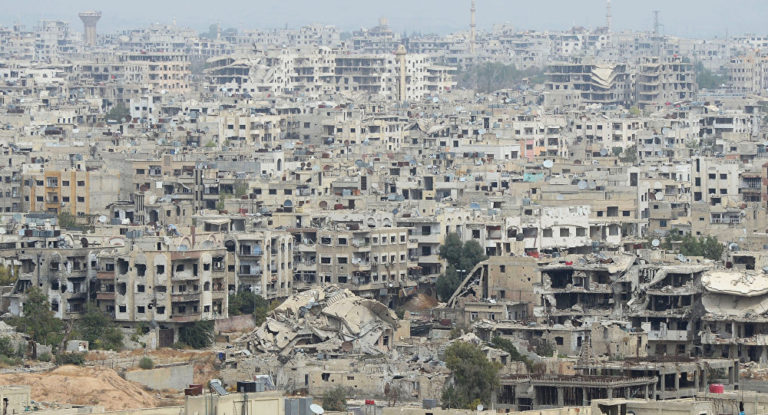
Stalingrad of Syrian war: ancient Syrian city of Raqqa after US bombing
By M. K. BHADRAKUMAR | Indian Punchline | December 21, 2018
On December 17, Ankara was notified of President Trump’s decision on troop withdrawal from Syria. During an earlier phone conversation between him and President Recep Erdogan on Dec 14, Trump had pointedly asked and elicited a positive response from the Turkish leader as to whether Turkey would have the capability to eliminate the remnants of the ISIS in the Syrian tract east of the Euphrates in the event of a US withdrawal from Syria. Erdogan reportedly “reaffirmed” Turkey’s commitment to fight the ISIS.
Ankara likely shared this information with Moscow and Tehran. The three foreign ministers met in Geneva on Dec 19 for a trilateral meeting as guarantors of the Astana format on Syria. The joint statement issued after the meeting, therefore, can be seen as indicative of Turkey’s resolve to give primacy to the trilateral format with Russia and Iran on issues concerning Syria.
To be sure, Turkey will have issues to take up with the Trump administration in the coming days and weeks. As one commentator put it, “For example, will the U.S. collect the weapons provided to the YPG? What measures will the U.S. take for preventing a chaos in the region after the withdrawal? All these require more military and political talks between Turkey and the U.S. Turkey will continue to cautiously follow the situation in Syria.”
However, senior Turkish officials have made it clear that the planned military operations against Syrian Kurds will continue to unfold. Defence Minister Hulusi Akar has been quoted by the state news agency Anadolu as saying, “Now we have Manbij and the east of the Euphrates in front of us. We are working intensively on this subject. Right now it is being said that some ditches, tunnels were dug in Manbij and to the east of the Euphrates. They (Kurds) can dig tunnels or ditches if they want, they can go underground if they want, when the time and place comes they will buried in the ditches they dug. No one should doubt this.”
Yesterday, Erdogan told the visiting Iranian president Hassan Rouhani that Ankara hopes to work closer with Tehran to end the fighting in Syria. Erdogan said at a joint press conference with Rouhani, “There are many steps that Turkey and Iran can take together to stop the fighting in the region and to establish peace. Syria’s territorial integrity must be respected by all sides. Both countries are of the same opinion regarding this.” Significantly, Erdogan also voiced Turkey’s support for Iran (“brotherly nation”) against the US sanctions.
However, Ankara is yet to make an official statement regarding Trump’s Syrian pullout plan. All three countries – Turkey, Russia and Iran – seem skeptical about Trump’s clout to enforce his decision overcoming resistance from the Pentagon. From such a perspective, the resignation of Defence Secretary James Mattis on December 20 will come as confirmation that Trump is indeed forcing his political will, exercising his presidential prerogative to take foreign policy decisions as well as insisting on his supreme authority as commander-in-chief to decide on issues of war involving the US armed forces.
Unlike Turkey and Iran, Russia has voiced opinions on Trump’s withdrawal plans. President Vladimir Putin stated at a press conference in Moscow on Dec 20:
“As concerns the defeat of ISIS, overall I agree with the President of the United States. I already said that we achieved significant progress in the fight against terrorism… There is a risk of these and similar groups migrating to neighbouring regions… We know that, we understand the risk fully. Donald is right about that, and I agree with him.”
“As concerns the withdrawal of American troops, I do not know what that is. The United States have been present in, say, Afghanistan, for how long? Seventeen years, and every year they talk about withdrawing the troops. But they are still there. This is my second point.”
“Third… The current issue on the agenda is building a constitutional committee… We submitted the list to the UN… Maybe not by the end of this year but in the beginning of the next the list will be agreed and this will open the next stage of the settlement, which will be political settlement.”
“Is the presence of American troops required there? I do not think it is. However, let us not forget that their presence… is illegitimate… The military contingent can only be there under a resolution of the UN Security Council or at the invitation of the legitimate Syrian Government…. So, if they decide to withdraw their troops, it is the right decision.”
Overall, Putin commended Trump’s decision, while keeping fingers crossed that as the focus is shifting to the political process will gain traction. Putin didn’t mince words in calling the US intervention in Syria as a violation of international law and UN Charter. The Kremlin spokesman Dmitry Peskov who spoke later in a TV interview was also quite upfront: “The American presence on the Syrian soil is not conductive to attaining the goals of a political and diplomatic solution.” (TASS )
Neither Russia nor Turkey and Iran would expect a cooperative attitude from the American side in a near term over Syria. The US has a stony heart when it comes to Syria’s reconstruction – although it caused immense destruction in that country during its occupation. The US military will be leaving behind a trail of bitterness in Syria. The three other protagonists understood perfectly well that Pentagon commanders were fighting a secretive geopolitical war against each of them. “Good riddance” – that must be the refrain in Ankara, Moscow and Tehran.
Featured Video

Max Blumenthal: ‘Israel First’ in Iran War Sparks MAGA Civil War
or go to
Aletho News Archives – Video-Images
From the Archives
Wartime internment camps in Australia
National Archives of Australia
World War I
During World War I, for security reasons the Australian Government pursued a comprehensive internment policy against enemy aliens living in Australia.
Initially only those born in countries at war with Australia were classed as enemy aliens, but later this was expanded to include people of enemy nations who were naturalised British subjects, Australian-born descendants of migrants born in enemy nations and others who were thought to pose a threat to Australia’s security.
Australia interned almost 7,000 people during World War I, of whom about 4,500 were enemy aliens and British nationals of German ancestry already resident in Australia.
Records of World War I internment camps
World War II
During World War II, Australian authorities established internment camps for three reasons – to prevent residents from assisting Australia’s enemies, to appease public opinion and to house overseas internees sent to Australia for the duration of the war.
Unlike World War I, the initial aim of internment during the later conflict was to identify and intern those who posed a particular threat to the safety or defence of the country. As the war progressed, however, this policy changed and Japanese residents were interned en masse. In the later years of the war, Germans and Italians were also interned on the basis of nationality, particularly those living in the north of Australia. In all, just over 20 per cent of all Italians resident in Australia were interned. … continue
Blog Roll
 Aletho News
- Tomorrow’s naval blockade showdown
- ‘Israel’ attacks civilians to hide its embarrassing military failures & out of pure sadism
- Any Foreign Military Vessel Approaching Hormuz Under Any Pretext ‘Will Be Dealt With Severely’: IRGC
- Diplomats slam US negotiators’ performance in Iran talks
- Trump Refuses Exit Ramp, War with Iran will Continue
- Trump Says US Naval Blockade in Strait of Hormuz Will Begin Shortly
- US, Iran end 21-hour talks without agreement
- US IRAN TALKS: Who Are the Crazy Ones Here? /Lt Col Daniel Davis
- Talks with the US end without a deal over excessive US demands: Iran
- Feeling Better, Getting Worse: How Psychiatric Drugs Create the Illusion They Cure
- If Americans Knew
- US-Iran ceasefire negotiations make zero progress – Daily Update
- Pro-Israel ‘Thinktanks’ and Individuals who Influence U.S. Foreign Policy
- Mearsheimer reveals how Israel dictates US policies on Iran, Gaza – video
- After killing 350+, Israel still has a “score to settle” with Lebanon before ceasefire – Daily Update
- Military aid to Israel emerges as the latest political litmus test for Democrats
- The only Palestinian children’s rights organization closes following years-long Israeli campaign against it
- ‘I Can’t Forget the Smell’: Lebanese Reel After Israel Kills Over 300 in Single Day
- DNC Shoots Down Resolutions Calling Out AIPAC and Limiting Arms to Israel
- TCN: Is Israel Blackmailing President Trump?
- Israel killed at least 303 Lebanese yesterday – who were they? Daily Update
- No Tricks Zone
- German Expert: Heat Dome Led To Record Temps In Western USA…Warmer In 1934, 1936
- New Study: No Linear Warming Or Glacier Retreat Along Northern Antarctic Peninsula Since 1980s
- An Inconvenient Tree: Uncovered In Alps… Europe Much Warmer Than Today 6000 Years Ago
- New Study Reports A 60% Slowdown In Greenland’s Ice Loss Rate In The Last Decade
- Low Intensity Tornado Wrecks Major Solar Farm, Creating A Potential Toxic Dump
- New Study Finds Warming Saves Lives…Cold Temperatures 12 Times More Deadly Than Excess Heat
- German Science Blog Accuses PIK Climate Institute Of Hallucinating Climate Tipping Points
- Devastating Assessment Of Comirnaty Vaccine By Former Senior Pfizer Europe Toxicologist
- New Study: CO2 Is ‘Effectively Negligible’ As An Explanatory Climate Change Factor Since 2000
- Former Pfizer Toxicologist Dr. Helmut Sterz Tells Bundestag Hearing Pfizer Vaccine Should Have Never Been Approved
 Aletho News