Kurdish delegation in Damascus for peace talks
Press TV – July 27, 2018
An alliance of Kurdish and Arab militants in Syria has sent a delegation to the Syrian capital for talks with Syrian government officials.
The so-called Syrian Democratic Council (SDC), which is linked to the Syrian Democratic Forces (SDF) — a US-backed coalition of mainly Kurdish militants holding a grip on northeastern Syria — sent the delegation to Damascus on Wednesday, according to SDC co-chair Riad Darar.
The delegation, led by executive head of SDC Ilham Ahmed, was expected to discuss matters of service provision in the areas controlled by the Kurdish group, but “the talks might widen to political and security matters,” Darar told Reuters on Friday.
“This is certainly the first visit that happened,” he added.
The militants are allied with the United States and French troops deployed to Syria under the pretext of fighting Daesh.
Chief among their demands is having an autonomous region within the Syrian borders. Darar, however, said that the outcome of the meetings is not yet clear, and that he did not know which Syrian officials will be meeting with the Kurdish delegation.
He also did not clarify how long the delegation will stay in Damascus.
Their Kurdish militant group, once called by President Bashar al-Assad as “traitors” to the nation, announced last month that it was ready for “unconditional” peace talks with the government amid the Syrian army’s major gains against the foreign-backed terrorist groups.
Assad said back in May that he was “opening doors” for negotiations with the SDF, who have apparently become wary of their unpredictable “ally”, the United States.
In an interview with Russia’s RT television network, Assad said, “we started now opening doors for negotiations, because the majority of them are Syrians, supposedly they like their country, they don’t like to be puppets to any foreigners. If not, we’re going to resort… to liberating those areas by force.”
According to Syrian media, the Kurds had expressed readiness to hand over control of the Eastern Euphrates to the government after Washington withheld its support for the Kurdish militants in the northern Syrian cities of Manbij and Afrin.
The presence of the Kurdish militants in the area have been a source of tension between the US and Turkey. Last month, the two sides reached a deal about the withdrawal of the Kurds from Manbij.
The Kurds have stressed that that they do not seek independence, but say they want a political deal to safeguard an autonomous administration which is now under their control in the north.
Syrian City Rocked By Deadliest Terror Attack In The Last Two Years
By Tyler Durden – Zero Hedge – 07/25/2018
The deadliest terror attack in Syria in the last two years just rocked a city in southern Syria, yet few in the West will likely ever hear of it even as the reported death toll soared late in the day to over 215 civilians killed, with over 180 more wounded.
The Eiffel Tower won’t be lit up with colors of the Syrian flag in memory of victims, nor will viral #neverforget hashtags make the rounds on social media — and we don’t expect too many official condolences issued from European or Western political leaders, as has happened with terror attacks that hit the Western world over recent years (though to its credit the US State Department tonight belatedly condemned the “barbaric ISIS-claimed attacks that took place”).
This in spite of the fact that as ISIS is on its last legs in the tiny southwest pocket of southwest Syria adjacent to the Israeli-occupied Golan and the Jordanian border, and as Syrian and Russian jets continue to pound Islamic State positions, “whole families were butchered, scores of on the spot executions, children, women & elderly killed in their homes, another dark day for Syria,” in the description of Syrian-British reporter Danny Makki.

Aftermath of one of the suicide blasts in Sweida. Via SANA
Early Wednesday morning four suicide bombers stuck a popular open-air market and other locations in Sweida city, a provincial capital in the country’s south. Syrian state media said a motorcycle bomber detonated himself in the marketplace just after dawn, after which a series of other ISIS attacks followed.
Islamic State media channels quickly claimed responsibility for the massacre, even as the Syrian Army continues to advance against ISIS and other al-Qaeda terrorists in Daraa and Quneitra provinces, where the particular ISIS group near the Israeli border goes by the name of Jaish Khaled Bin al-Waleed.
#SAA recaptured some villages from #ISIS/#Daesh militants since they occupied them from #FSA on 19 July #Quneitra #Syria pic.twitter.com/Shcarjm4Sc
— Islamic World Update (@islamicworldupd) July 24, 2018
Syrian State media reports that authorities thwarted other potential attacks and “hunted down two terrorist suicide bombers who had been wearing explosive belts and killed them before they were able to blow themselves up in the residential areas in the city.”
The chaotic aftermath, reportedly with bodies strewn about the crowded marketplace, made casualty counts hard to come by, as initially Reuters counted 50 among the dead, but late in the day reported 215 killed and 180 injured, including 75 ISIS fighters.

Some of the terrorists involved in the coordinated attacks and who apparently survived the initial attacks were reportedly rounded up by mobs of angry Sweida residents and hung in front of a public building.
If 166 people were killed anywhere other than #Syria in the world it would be breaking news, not to mention #ISIS being the main cause of those deaths. #Sweida
— Danny Makki (@Dannymakkisyria) July 25, 2018
Journalist Danny Makki, reporting from on the ground in southern Syria, observed “ISIS isn’t finished, its nowhere near finished, it managed to kill over 150 people in one of Syria’s safest provinces in one day.”
As ISIS continues to go underground while facing defeat under Syrian and Russian bombardment, many more such suicide attacks are likely to continue.
‘Evacuation of White Helmets Shows That It is Western Product’ – Military Expert
Sputnik – July 26, 2018
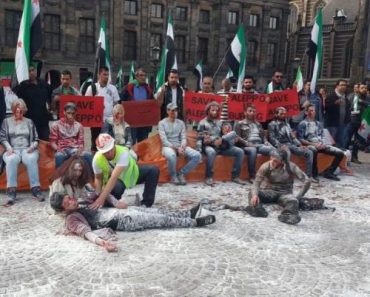
Hundreds of members of the so-called Syrian Civil Defense, the White Helmets, have been evacuated from southwestern Syria to Jordan, via the occupied Golan Heights by the Israelis. Sputnik discussed this operation with military experts Amin Hteit and Vladimir Fitin.
During the Syrian conflict, the activists of the White Helmets have been involved in “the most odious provocations” and their evacuation reveals their true nature and hypocrisy, the Russian Foreign Ministry said Monday.
A military expert, former Lebanese Army general Amin Hteit in an interview with Sputnik confirmed the Russian foreign ministry’s statements, saying that, “the evacuation of this group clearly shows that this is a Western product in the full sense of the word.”
According to Hteit, the White Helmets carried out the task of creating a given information background to justify any “aggression” by the United States, France and Britain against Syria.“What we are seeing now is how the creator has rescued its creation,” Hteit said.
“I say so, because there is some evidence for this. First of all, the group was created by the United Kingdom with US support; secondly, their training took place in the military camps of Israel, and then they were sent into Syria; thirdly, their alleged documentary reports were filmed at the behest of British and American intelligence. They were supporting the ongoing operations against Syria via their information campaign,” the retired general told Sputnik.
In an interview with Sputnik, an expert from the Russian Institute for Strategic Studies, Vladimir Fitin, said that the videos made by the White Helmets were created on the orders and with the money of the British and US intelligence services.
“Now they are being urgently taken out of Syria so that they do not fall into the hands of the rapidly advancing Syrian army,” Fitin said.He went on by saying that while only a part of the members of the White Helmets were removed, the rest continue to work in the terrorist-controlled territories.
“It is quite possible that they will release some provocative new video,” the expert said.
Earlier it was reported that the Israeli forces have evacuated several hundred White Helmets and their family members from southern Syria to Jordan at the request of several Western countries. The transfer has been labeled a “criminal operation” by Damascus, which believes the NGO’s members have cooperated with terrorists and plotted several false flag attacks.
Tel Aviv commented on the information regarding the militants’ extraction from Syria and their alleged work with Israeli intelligence agencies, saying that it is a humanitarian operation.
The White Helmets claim to be acting as a volunteer rescue group, but has been repeatedly accused of working with jihadists, such as al-Nusra Front and staging fake videos that they later use to accuse Damascus of being responsible for attacks against civilians.
The group was founded in Turkey by former MI5 officer James Le Mesurier and funded by several western countries. Despite their claims of helping citizens, the Russian Defense Ministry has uncovered evidence and found witnesses suggesting that one of their latest reports of an alleged chemical attack in Douma was a fake.
Western States Salvage Terror Assets in Syria
By Finian CUNNINGHAM | Strategic Culture Foundation | 24.07.2018
Western states made a dramatic intervention in the Syrian war earlier this week to extricate hundreds of terrorist militants. The militants are to be fast-tracked for resettlement in Europe and Canada.
But in saving their terror assets, Western governments are risking future public safety as well as sowing seeds for increasing multicultural strife.
In a stunning revelation of the foreign links to the extremists in Syria, Israeli Prime Minister Benjamin Netanyahu ordered his military forces to evacuate up to 800 militants belonging to the so-called White Helmets. They are the propaganda merchants for Nusra Front and other al-Qaeda-linked terror organizations.
Netanyahu announced that the blatant intervention to rescue the jihadists in southwest Syria was made at the personal request of US President Donald Trump and the Canadian premier Justin Trudeau, “among others”.
Separately, there were reports of four senior jihadist commanders being given safe passage by Israeli forces out of Syria as the Syrian army closed in on the last-remaining militant strongholds around the southwest city of Daraa and Quneitra province.
Nor was it coincidental that the evacuation operations were accompanied by Israeli air strikes on Syrian government facilities in Hama province.
Damascus condemned the extraction of hundreds of jihadists by Israel and its Western allies as a “criminal operation” and further proof of the foreign sponsoring that has fomented the nearly eight-year war.
Of course, Netanyahu, Western governments and news media sought to portray the evacuation of the “White Helmets” as a “humanitarian gesture”. This was at the same time that Israeli warplanes and snipers were stepping up the killing of medics and civilians in Gaza.
Britain’s newly appointed foreign secretary Jeremy Hunt described the Israeli “rescue” of “White Helmets” as “fantastic news”, saying that the militants were the “bravest of the brave”.
We won’t delay too much here on this fraud. The so-called first responders of the “White Helmets” are a CIA, MI6-backed propaganda outfit working hand-in-hand with the terrorist militia. Their fake videos of chemical weapons attacks and air strikes have been a key propaganda device aided and abetted by the Western news media to demonize the Syrian armed forces and its Russian ally.
The fictitious propaganda stunt alleging a chemical weapon attack in Douma on April 7 this year resulted in a barrage of air strikes by the US, Britain and France.
Created in 2013 by a British MI6 agent and former British army officer James Le Mesurier, the so-called White Helmets have been funded with hundreds of millions of dollars by the governments of the US, Britain and other NATO states.
There is abundant video evidence showing members of this fake rescue group participating in gruesome executions by the al Qaeda-aligned militants with whom they associate. One such video shows an execution of a Syrian army soldier in Daraa, the city from where the latest evacuation of jihadists by Israel took place. Daraa is also, by the way, mendaciously referred to in the Western media as the “cradle of the revolution” or the “birthplace of the uprising” against President Assad’s government back in March 2011. The only thing that Daraa was a birthplace of was the US-led foreign covert war for regime change in Syria.
Now here’s a curious thing about the latest salvaging of terror assets in Syria. The United States and Israel are not taking any of the 800 militants for resettlement. Independent investigative journalist Vanessa Beeley, who has done much to expose the real macabre nature of the White Helmets and their terror links, says that both the US and Israeli no doubt realize that by taking in such “war refugees” they are inviting terrorists into their own societies.
Which makes you wonder why Britain, Germany and Canada are stepping up to the plate to offer the 800 White Helmets a home?
The case of Germany is particularly odd. Interior minister Horst Seehofer has personally authorized the resettlement of White Helmets spirited out of Syria by Israel. This is the same Seehofer who has mounted such a strong challenge to Chancellor Angela Merkel’s “open door” policy towards immigrants.
What we are witnessing is a suicidal ignorance by Western governments to take in these cadres of White Helmets. Perhaps Seehofer and other government ministers like Britain’s Jeremy Hunt are simply woefully misinformed. But surely the state security agencies of their respective countries know all too well the criminal, psychotic nature of the people whom they are allowing into their societies.
Such a callous disregard for public safety is not unprecedented. In his well-researched book, My Fight For Syrian Freedom, Irish peace activist Dr Declan Hayes details numerous cases of how jihadist assets were knowingly cultivated by British and French state security services for the purpose of waging the covert war for regime change in Syria and Libya. These assets have been allowed to return to Britain and France under the cover of being “refugees”, with the security services turning a blind eye to their true identity.
The nefarious relationship has resulted in these terror assets committing atrocities in Europe. For example, as Hayes points out, the Manchester concert bomb attack that killed 22 people in May last year was carried out by operatives belonging to a Libyan jihad cell that MI5 and MI6 had previously overseen for their objective of prosecuting the regime-change war in Libya against Muammar Gaddafi.
Similar murky connections between jihadists “blooded in Syria” and state secret services have been uncovered in terror attacks in France and Belgium. It is not clear if these terror assets go rogue or whether they are being used by British, French and other military intelligence as a deliberate provocation in order to promote tighter national security laws and greater surveillance powers over their citizens.
Declan Hayes reckons that the problem of Western-sponsored terrorists returning to Britain and other European countries under the cover of claiming to be “war refugees” is much greater than Western governments or their media are admitting.
Hayes says that in his experience of visiting Syria many times during the war, most families loyal to the government were adamantly defiant about staying in the country and defending their communities. He reckons that there is a legitimate concern that many of the refugees fleeing from formerly militant-held cities like Aleppo and Daraa are jihadists and their families.
This view supports the right of some European governments to be wary about taking in large numbers of refugees from Syria and other war-torn countries. There is a case for rigorous vetting, but such a case is often emotionally blackmailed by naive media commentary as being “heartless” or “racist”.
There is no doubt that Western government agencies have fomented terrorist groups in Syria and elsewhere to do their dirty work for destabilizing target governments.
Now that the war in Syria is all but over with the Syrian army, backed by Russia, Iran and Hezbollah, rooting out the last jihadist remnants, we are seeing Western states taking in their terror assets. Maybe as a desperate intervention to stop them from revealing the dirty secrets of Western government collusion.
The repatriation of the White Helmets terrorist propagandists to the UK, Germany and Canada is a classic illustration.
Western authorities are playing with fire. Not only are they running the risk of public safety from future terrorist incidents. They are also stoking the flames of xenophobia, racism and culture wars against many innocent refugees who have been given shelter in Western countries.
TRUDEAU TO ADMIT TERRORIST AUXILIARIES INTO CANADA
The Hamilton Coalition To Stop The War | July 23, 2018
The fact that Canada is admitting as refugees at least 250 White Helmets and their family members exposes the involvement of the Trudeau government, like the Harper government before it, in the illegal, US-led, regime-change operation in Syria.
These two federal governments are collectively responsible for setting up and continuing the international coalition that produced the proxy war against Syria, using terrorist mercenaries as its foot soldiers; leading the international regime of brutal economic sanctions against Syria which turned about four million Syrians into refugees – (the international sanctions regime was drawn up in a meeting in Ottawa in June 2013); demonizing the legitimate government of Syria, breaking off diplomatic relations with it, and trying to delegitimize it in international forums; supporting armed rebels against Syria, a member state of the United Nations, by bringing their leaders to Ottawa and giving them funds; overflying Syria on military missions without the express consent of its government; and supporting the propaganda arm of the regime change operation through the White Helmets.
Now that the Syrian government has liberated Deraa, where the western-sponsored regime-change operation began in 2011, the “rebels” and their auxiliaries have had to scramble to find places of refuge. Thus, the Trudeau government has felt obliged to admit as refugees to Canada some of their foreign policy assets, namely the White Helmets.
Who are the White Helmets? The White Helmets claim to be a “fiercely independent” organization of volunteer first responders in Syria helping Syrian civilians injured in the war.
In fact, the White Helmets are a fiercely partisan organization of relatively well-paid employees, set up by British and US intelligence services inside of Turkey (a belligerent in the war against Syria) in 2013. A Madison Avenue public relations firm was contracted to develop the concept of the White Helmets as a humanitarian agency for public consumption in the West – to provide a ‘sugar-coating’ to an ugly and illegal imperial war. John Lemesurier, a former British military intelligence officer and later “military contractor”, was hired to front the organization, which has been funded to the tune of about 150 million dollars by the governments of the USA, UK, France, Holland, Denmark, Japan, New Zealand, and Canada, among others. In 2016, Canada donated $4.5 million dollars to the White Helmets. Currently, a Freedom of Information request is seeking to determine if the Canadian government has made repeated donations of $4.5 million in 2017 and 2018. On top of the donations, the Canadian government has organized two cross-Canada publicity tours of White Helmet personnel in recent years in various cities. This past March, a delegation of White Helmets was welcomed to speak to the Canadian parliament’s Human Rights Committee. In addition, the New Democratic Party endorsed the White Helmets for the Nobel Peace Prize, which it failed to win.
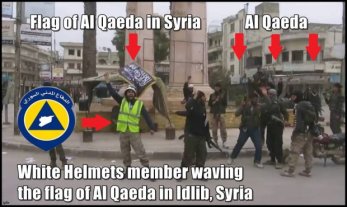 The White Helmets are embedded in the Al-Qaeda terrorist network and operate exclusively in terrorist-held areas of Syria. Though it also calls itself the Syrian Civil Defence, the government of Syria created the real Syrian Civil Defence in 1953 and was a founding member of the International Civil Defence Organization.
Once in place inside the terrorist-occupied enclaves inside of Syria, the true role of the White Helmets emerged. The group specialized in making videos of dramatically-staged rescues of children from among the rubble of part of cities which Al-Qaeda (and sometimes other terrorist groups) had managed to seize and occupy. Two notorious staged videos stand out: the staged rescues of Omran Daqneesh in Aleppo and Hassan Diab in Douma. Occasionally, however, the White Helmets joined in recreational video competitions, such as the Mannequin Challenge. The twofold principal purposes of the child-rescue videos was, first, to demonize the Syrian government as a brutal tyranny, even though it was lawfully defending its sovereign territory against foreign invasion, and, secondly, to promote the western regime change operation in Syria as a humanitarian intervention.
Specifically, the White Helmet videos were timed to promote calls by western governments for direct military intervention in Syria by such means as a no-fly zone (similar to the one imposed on Libya in 2011) or a “civilian corridor”. And, on at least two occasions, the tactic worked. In April 2017, the White Helmets staged a false flag chemical attack on Khan Sheikhoun which prompted a US missile attack on the Sharyat Air Base in Syria. A recent outstanding example of the propaganda use of such videos was the staging of a fake nerve agent attack in Douma, Syria, on April 7 of this year. The incident, though later revealed as a hoax by the Organization for the Prohibition of Chemical Weapons (OPCW), nonetheless resulted in over one hundred missile strikes by the USA, UK, and France on Syria on April 13, 2018.
In addition, the White Helmets’ true role as an auxiliary to terrorism was captured on film on several occasions when they participated in Al-Qaeda summary executions and by Facebook postings by numerous White Helmets on their personal accounts showing themselves moonlighting as armed Al-Qaeda fighters and heaping praise on Al-Qaeda leaders. Contrarily, civilians inside the enclaves in Syrian cities liberated from Al-Qaeda and ISIS told many western reporters that the White Helmets provided no medical help or assistance to them, but rather only to the armed terrorists. Moreover, real Syrian Civil Defence workers testified that many of their comrades were killed by Al-Qaeda fighters and their equipment and vehicles given to the White Helmets.
The rescue of the White Helmet “rescuers” by Israel through the Golan Heights should not come as a surprise because Israel has been a major player in the illegal, failed, regime change operation in Syria. Israel has bombed Syria more than one hundred times during the war. Israel openly supported FSA fighters with arms, intelligence, and funding in southern Syria and routinely transferred wounded terrorists to hospitals inside Israel for medical treatment before returning them to the front. Israeli PM Netanyahu posed for photos in one of those hospitals at the bedside of wounded terrorists last year. Today (July 22, 2018), in a tweet, Netanyahu stated that both President Trump and Prime Minister Trudeau personally asked for his help in rescuing the White Helmets from Syria.
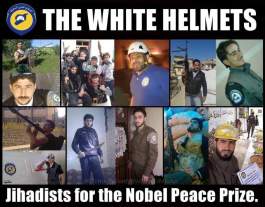 Syria is well rid of these White Helmets. But, if Canadians understood who these people really were, they would strongly object to the settling of terrorists in our midst. Last November in the House of Commons, Trudeau asserted that Canadians returning from terrorist activities in Syria and Iraq would not be charged with criminal offences. Rather, he asserted, “We also have methods of de-emphasizing or de-programming people who want to harm our society, and those are some things we have to move forward on.” At the end of the day, then, the Trudeau government in effect embraces terrorist fighters and their auxiliaries.
That the Canadian government is planning to admit White Helmets personnel to Canada as refugees should gravely concern Canadians. These civil defence poseurs are ideologically committed to terrorism, personally connected to Al Qaeda, and have the blood on their hands of many Syrians whose country they helped to invade and occupy. The potential for them to cause harm in Canada is high.
We urge Canadians immediately to contact their MP’s about this matter, to spread the alarm via social media, and to write letters to newspapers. We also urge the Canadian government to do the following:
- withdraw from the US-led military coalition in Syria and Iraq;
- end Canada’s punishing economic sanctions against Syria;
- re-establish diplomatic ties with the Syrian government;
- participate in the reconstruction of Syria through payments of reparation.
Published by the Hamilton Coalition To Stop The War
hcsw.ca
hcsw@cogeco.ca
For further info, please contact Ken Stone at 289-382-9008 or at kenstone@cogeco.ca
The Myth of US ‘Inaction’ in Syria
By William Van Wagenen – The Libertarian Institute – July 8, 2018
Introduction
When the Russian military intervened in the Syrian war in October 2015, many in the Western press complained bitterly, demanding that US planners intervene directly in Syria on behalf of the anti-government rebels in response. Reuters alleged that “The Middle East is angry and bewildered by US inaction in Syria,” arguing that “The question on everyone’s mind is: will the United States and its European and regional Sunni allies intervene to stop President Vladimir Putin from reversing the gains made by mainstream Syrian rebels after more than four years of war? Few are holding their breath.” The Washington Post similarly argued that Russian president Vladimir Putin was “exploiting America’s inaction,” while the Guardian lamented the “western inability to care enough about the plight of Syrians.” As Russian and Syrian forces battled rebels one year later in Aleppo, more dramatic accusations of US inaction emerged, with Foreign Policy describing US policy in Syria under Obama as “inaction in the face of genocide.”
 The idea that the United States has not intervened in Syria and is guilty of “inaction,” is a myth however. The United States and its Western and Gulf Allies have intervened in the Syrian conflict from early on. US planners have been fighting what the New York Times described as a “$1 Billion Secret C.I.A. War in Syria” while providing weapons to rebels through a program considered “one of the costliest covert action programs in the history of the C.I.A.” Starting in the fall of 2012, the US and its Gulf partners, under the direction of then CIA director David Petraeus, were openly sending “a cataract of weaponry” into Syria. It is likely that such shipments began much earlier without public acknowledgment, via the “rat line” from Libya, as reported by journalist Seymour Hersh. US Special Envoy to Syria Michael Ratner, in a meeting with members of the Syrian opposition, explained that “The armed groups in Syria get a lot of support, not just from the United States but from other partners,” while Secretary of State John Kerry added in the same meeting, “I think we’ve been putting an extraordinary amount of arms in,” and “Qatar, Turkey, Saudi Arabia, a huge amount of weapons [are] coming in. A huge amount of money.”
Also a myth is the idea that any US intervention in Syria would seek to protect civilians. While allegations that Syrian and Russian forces were committing genocide in Aleppo proved baseless, US planners have themselves supported rebels intent on committing genocide and sectarian mass murder. This was clearly evident in the Syrian city of Latakia, which by the time of the Russian intervention in October 2015 was on the verge of falling to a coalition of Syrian rebel groups including al-Qaeda (known in Syria as the Nusra Front) and the US-armed and funded Free Syrian Army (FSA).
Robert Worth of the New York Times writes that “In Latakia, some people told me that their city might have been destroyed if not for the Russians. The city has long been one of Syria’s safe zones, well defended by the army and its militias; there are tent cities full of people who have fled other parts of the country, including thousands from Aleppo. But in the summer of 2015, the rebels were closing in on the Latakia city limits, and mortars were falling downtown. If the rebels had captured the area — where Alawites are the majority — a result would almost certainly have been sectarian mass murder. Many people in the region would have blamed the United States, which armed some of the rebels operating in the area. . . Andrew Exum, who worked in the Pentagon at the time, told me that the military drew up contingency plans for a rapid collapse of the regime. The planning sessions were talked about as ‘catastrophic success [emphasis mine].’”
Alawite civilians in Latakia faced the prospect of being massacred if rebels had been able to capture the city, due to the virulently anti-Alawite views of Nusra Front members. Nusra religious clerics draw on the writings of the fringe 14th century Islamic scholar Ibn Taymiyya to argue that Alawites are “infidels” deserving of death. Syria analyst Sam Heller described Nusra clerics as promoting “toxic — even genocidal — sectarianism.” Rebels from the FSA, which have fought alongside and “in the ranks” of the Nusra Front throughout the conflict, also posed a threat to Alawite civilians in Latakia. While typically considered moderate in the Western press, many FSA battalions have been armed and funded by the Syrian Muslim Brotherhood (MB). Thanks to the influence of Brotherhood ideologue Said Hawwa, the Syrian Brotherhood strongly promoted the anti-Alawite sectarian views of Ibn Taymiyya from the 1960’s until the 1980’s. This anti-Alawite sectarianism re-emerged in segments of the Syrian opposition, including in elements of the FSA, when peaceful protests and armed insurrection against the Syrian government simultaneously erupted in Syria in the spring of 2011.
While the Syrian and Russian militaries managed to protect Latakia and prevent a massacre of the city’s Alawite civilians, the broader effort to prevent the fall of the country to al-Qaeda and its FSA allies exacted a huge toll on Syria’s Alawites. The Telegraph noted that already by April 2015, “The scale of the sect’s losses is staggering” and that of some 250,000 Alawite men of fighting age “as many as one third are dead” and that “Alawite villages nestled in the hills of their ancestral Latakia province are all but devoid of young men. The women dress only in mourning black.”
While arming rebels threatening the massacre of Alawite civilians in Latakia, US planners were at the same time welcoming the potential massacre of Syrian civilians in Damascus. The Syrian capital was on the verge of falling to the Islamic State (ISIS) in the summer of 2015 after ISIS, with the help of Nusra, captured all of the Yarmouk Palestinian refugee camp in the southern Damascus suburbs. The New York Times acknowledged the ISIS threat to Damascus at this time, observing that “By seizing much of the camp” ISIS had “made its greatest inroads yet into Damascus,” while the Washington Post noted that “Their new push puts [ISIS] within five miles of the heart of the capital . . . even as they are on the retreat in Iraq.”
In a private meeting with members of the Syrian opposition, Secretary of State John Kerry acknowledged that US planners had actually welcomed the ISIS advance on Damascus, in an effort to use it as leverage to force Assad to give up power. Kerry explained that, “the reason Russia came in is because ISIL [ISIS] was getting stronger. Daesh [ISIS] was threatening the possibility of going to Damascus. And that is why Russia came in. They didn’t want a Daesh [ISIS] government and they supported Assad. And we know this was growing. We were watching. We saw that Daesh [ISIS]was growing in strength. And we thought Assad was threatened. We thought we could manage that Assad might then negotiate. Instead of negotiating, he got Putin to support him [emphasis mine].”
Because the US was bombing ISIS in defense of its Kurdish allies in Northeastern Syria and its Iraqi government allies in Northwestern Iraq, the fact that US planners at the same time welcomed the ISIS push on Damascus against the Syrian government was largely obscured.
Had Damascus fallen to ISIS, it is clear that many civilians in the city, including Christians, Alawites, Shiites, members of the LGBTQ community, and pro-government Sunnis, would have been killed. While commenting on the Russian intervention, Michael Kofman of the Wilson Center acknowledged that “Assad may be irredeemable in the eyes of the United States, but it is equally clear that a high human price would be paid when the Islamic State [ISIS] or al-Nusra seizes the major population centers in Syria that he still controls.”
It is also clear that US planners were deliberately supporting al-Qaeda (Nusra), despite its genocidal intentions towards Syria’s Alawites, by flooding Syria with weapons. Because FSA brigades that received funding and weapons from the US and its Gulf Allies were fighting side by side with militants from Nusra throughout the country, in practice much of the money and weapons sent to the FSA ultimately benefited al-Qaeda.
For example, US-made TOW anti-tank missiles sent by US planners to FSA groups in Idlib played a crucial role in helping Nusra conquer the entire province in the spring of 2015. Syria analyst Hassan Hassan observed in Foreign Policy during this period that “The Syrian rebels are on a roll” and that “The recent offensives in Idlib have been strikingly swift — thanks in large part to suicide bombers and American anti-tank TOW missiles,” which the FSA and Nusra deployed in tandem. Syria analyst Charles Lister, also writing in Foreign Policy, described how US planners explicitly encouraged the FSA groups they were arming to fight alongside Nusra in Idlib. Rebel victories in Idlib, in particular the town of Jisr al-Shughour, allowed Nusra and the FSA to then threaten the massacre of Alawites in Latakia.
When Russia intervened militarily in Syria in October 2015, US planners responded by immediately increasing shipments of TOW anti-tank missiles to FSA groups, some of which then helped Nusra capture the strategic town of Murek in central Syria one month later in November 2015.
This prompted Daveed Gartenstein-Ross of the Foundation for Defense of Democracies (FDD) to observe that “it is impossible to argue that U.S. officials involved in the CIA’s program cannot discern that Nusra and other extremists have benefited” from CIA weapons shipments to Syrian rebels, “And despite this, the CIA decided to drastically increase lethal support to vetted rebel factions following the Russian intervention into Syria in late September.”
Nusra did not only benefit from fighting alongside FSA rebels armed with US-supplied weapons, but acquired many of these weapons themselves. That Nusra regularly purchased weapons from the Western-backed military councils supplying the FSA was confirmed in October 2014, when the New York Times reported that Shafi al-Ajmi, a Nusra fundraiser, told a Saudi news channel that “When the military councils sell the weapons they receive, guess who buys them? It’s me.”
That al-Qaeda was purchasing US supplied weapons seemed of little concern to US planners. When journalist Sharmine Narwani asked why US-supplied weapons allegedly meant for FSA groups were showing up in Nusra hands, CENTCOM spokesman Lieutenant Commander Kyle Raines responded: “We don’t ‘command and control’ these forces—we only ‘train and enable’ them. Who they say they’re allying with, that’s their business.”
Obama administration officials themselves acknowledged tacit US support for al-Qaeda, admitting in November 2016 to the Washington Post that they had struck “a deal with the devil,” years before, “whereby the United States largely held its fire against al-Nusra because the group was popular with Syrians in rebel-controlled areas and furthered the U.S. goal of putting military pressure on Assad,” thereby confirming long standing Russian accusations that the US had been “sheltering al-Nusra.”
More recently, Ben Rhodes, deputy national security advisor under the Obama administration, acknowledged providing military support to Syrian rebels, even though it was clear that Nusra comprised a good portion of the Syrian opposition as a whole. Rhodes explained that “there was a slight absurdity in the fact that we were debating options to provide military support to the opposition at the same time that we were deciding to designate al-Nusra, a big chunk of that opposition, as a terrorist organization.”
Despite designating Nusra as a terror group already in 2012, US planners nevertheless provided weapons to the Syrian rebels, of which Nusra comprised a “big chunk,” for the next 7 years. As Sharmine Narwani observes, “U.S. arms have been seen in Nusra’s possession for many years now, including highly valued TOW missiles, which were game-changing weapons in the Syrian military theater. When American weapons end up in al-Qaeda hands during the first or second year of a conflict, one assumes simple errors in judgment. When the problem persists after seven years, however, it starts to look like there’s a policy in place to look the other way.”
US planners welcomed rebel gains in Syria, including by rebel groups advocating genocide against Syria’s Alawite population, such as ISIS and Nusra, because these gains bolstered the broader US goal of toppling the Syrian government, in an effort to weaken its close allies, Iran and Hezbollah. US planners wished to see rebel gains in Syria, in spite of the obviously catastrophic consequences for Syrian civilians, including for Syria’s Sunnis, which rebel success would bring. US support for the rebels belies the myth of US “inaction” in Syria, and the myth that any US intervention would be for the sake of preventing massacres and even genocide, rather than in support of it.
In the remainder of this essay, I will review the US support for rebel advances in the spring and summer of 2015 in Idlib, Latakia, Palmyra, Yarmouk, and Homs. I will describe how these rebel advances nearly led to the massacre of Syrian civilians in two of the country’s main population centers, Latakia and Damascus, if not for the Russian intervention which halted the rebel advance.
Idlib
In March of 2015, rebels from the Jaish al-Fatah coalition, which included Nusra and the jihadist rebel group Ahrar al-Sham, launched a coordinated assault along with brigades from the FSA on Idlib province, leading to the capture of the province as a whole from Syrian government forces two months later.
Rebels captured Idlib city itself on March 29. Al-Jazeera quoted the pro-opposition Syrian Observatory for Human Rights (SOHR) as declaring “Al-Nusra Front and its allies have captured all of Idlib,” in a battle that led to some 130 deaths. Al-Jazeera also quoted representatives of the Western-backed Syrian National Council (SNC) as declaring the capture of Idlib city as “an important victory on the road to the full liberation of Syrian soil from the Assad regime and its allies,” showing the close relationship between the US-supported Syrian political opposition in exile and al-Qaeda affiliated militants on the ground in Syria. Rebels captured the last major Syrian army base in the province on March 19 near the town of Mastouma. Rebel control of Idlib was completed with the ouster of the Syrian army from the town of Ariha at the end of May, causing government forces to retreat to bases on the coast in Latakia.
The rebel offensive in Idlib succeeded largely due to the lethal combination of Nusra suicide bombers and US-provided TOW anti-tank missiles. FSA commander Fares Bayoush from the Fursan al-Haq brigade explained to the LA Times “that his group’s TOW missiles played an important role in repelling government tanks during a March offensive in Idlib province spearheaded by an Islamist coalition called the Army of Conquest, which includes Al Nusra Front.” It was during this period that Syria analyst Hassan Hassan observed in Foreign Policy that, “The Syrian rebels are on a roll,” and that “the recent offensives in Idlib have been strikingly swift — thanks in large part to suicide bombers and American anti-tank TOW missiles,” as well as that,“For the first time since the conflict began, Assad’s heartlands in the Western region [Latakia] seemed exposed.”
The close cooperation between FSA brigades and rebels from the al-Qaeda affiliated Nusra Front in Idlib was encouraged by US planners. Syria analyst Charles Lister, also writing in Foreign Policy, observed that “The involvement of FSA groups, in fact, reveals how the factions’ backers have changed their tune regarding coordination with Islamists. Several commanders involved in leading recent Idlib operations confirmed to this author that the U.S.-led operations room in southern Turkey, which coordinates the provision of lethal and non-lethal support to vetted opposition groups, was instrumental in facilitating their involvement in the operation from early April onwards. That operations room — along with another in Jordan, which covers Syria’s south — also appears to have dramatically increased its level of assistance and provision of intelligence to vetted groups in recent weeks [emphasis mine].”
Lister, who has testified several times before the US House Foreign Affairs Committee to make policy proscriptions for US planners in Syria, argued at that time that US cooperation with al-Qaeda (Nusra) is the best option: “[T]here still remains no better alternative to cooperating with al Qaeda, and thus facilitating its prominence. If the West wants a better solution, it must broaden and intensify its engagement with Syria’s insurgent groups and considerably expand its provision of assistance to a wider set of acceptable groups” echoing a popular view among Western and Gulf think tank analysts that al-Qaeda was worthy of US support.
Predictably, US efforts to help al-Qaeda conquer Idlib had grim consequences for many of its residents, large numbers of whom fled after rebels took control of the city and province. The Guardian reported that while under Syrian government control, Idlib city, with a population of some 165,000 before the war, “had been swollen by hundreds of thousands of displaced people, who had fled there to escape fighting elsewhere.” In contrast, when the rebels came, many civilians fled. The New York Times reported that although “some Idlib residents celebrated Saturday, cheering as fighters ripped down posters of Mr. Assad or embracing insurgent relatives who returned to the city for the first time in years, others streamed out of the city, with convoys of loaded cars and trucks blocking roads.” Citing the United Nations, the NYT reported that already by April 1, just two days after the rebel arrival, at least 30,000 residents had fled the city. One Idlib resident who fled when the rebels arrived explained that “The rebels that attacked Idlib at the end of March 2015 came from all sorts of countries. I even saw children carrying weapons. The rebels had a list of names of people who were to be killed, in the majority of cases because they held pro government views. One of my friends, a teacher, was on the list and was shot. . . . I left Idlib with my cousin who had a car. Afterwards, my house was occupied and looted by the rebels. I had planned to sell my house to enable my daughter to study medicine. Now it’s too late. I also worry about our old Christian neighbors. I am a Muslim but the religion of these rebels is not my Islam. I detest Salafism, and do not want to live under it.”
On April 25, rebels from the Jaish al-Fatah coalition, which included the jihadist rebel groups Nusra, Ahrar al-Sham, and Jund al-Aqsa, captured the strategic town of Jisr al-Shughour, which lies on the highway connecting Latakia to Aleppo. The rebel capture of the town came one month after the capture of Idlib city. The Guardian quoted one senior opposition member who had supplied weapons to the rebels taking Jisr al-Shughour as noting, “I would put the advances down to one word . . .Tow,” referring to missiles made in the US and purchased by Saudi Arabia for supply to the rebels. The opposition member noted as well that “Saudi is not as concerned as it was by who among the rebel groups is winning, as long as it’s not [Isis]. They’ve convinced everyone involved in Syria that the real enemy is Iran,” suggesting Saudi comfort in militarily supplying jihadist rebels from al-Qaeda. Rebel media posted video of civilians fleeing Jisr al-Shughour after its capture, claiming they wished to escape in anticipation of a pending regime bombardment now that the city had fallen. The Guardian also quoted one resident as noting that FSA groups participated alongside the Nusra-led Jaish al-Fatah coalition in taking the city, in accordance with the familiar pattern: “There were people from the normal opposition there. They were strong too, but the jihadists were stronger.”
Though the city fell on April 25, hundreds of Syrian army soldiers and some women and children fled to the National Hospital complex, which remained under siege by rebels for the next month. The soldiers managed to repel multiple suicide car bombs, targeting them with rocket propelled grenades. Rebels then began preparing to detonate a large tunnel bomb below the hospital to destroy it and kill the soldiers inside. The soldiers then attempted to flee the hospital under air cover from the Syrian air force. Of this incident, the Telegraph reports, “Syrian rebel leaders have described massacres of hundreds of Assad troops and fighters in grim detail as the regime’s defenses begin to crumble in the face of revived attacks on several fronts. President Bashar al-Assad had promised to rescue hundreds of his men who were surrounded in a last stand at a hospital in the key north-western town of Jisr al-Shughour. Eventually, the men tried to run for it under the cover of a regime aerial attack, pre-empting a final assault by rebels including Jabhat al-Nusra, the Syrian branch of al-Qaeda, and other Islamist groups. Instead, many of the soldiers were shot down as they were cornered in orchards on the edge of town, a rebel spokesman said.” Rebels claimed to have killed 208 Syrian soldiers, including several high ranking officers, while pro-government sources claimed up to 80 soldiers managed to escape. One soldier who managed to escape alive described the ordeal to Chinese state media, adding that a number of civilians escaped with the soldiers.
Jisr al-Shughour fell four years after rebels initially attempted to take the city in June 2011, just three months after the beginning of anti-government protests. Several hundred rebels attacked the local police station with dynamite, killing a number of soldiers inside, and then ambushed and killed as many as 120 Syrian army soldiers sent as reinforcements. This event was known as the “massacre” of Jisr al-Shughour. The killings were widely attributed to the Syrian army itself at the time, as activists implausibly blamed the Syrian army for the killing of its own soldiers. The story of government responsibility for the killings was widely believed, and reported as such in the Western press, as the rebel attacks took place at a time before armed rebel activity in Syria was widely acknowledged. This was despite correct reporting on the killings at the time by Syria expert and University of Oklahoma professor Joshua Landis. Rebel responsibility for the killings was later confirmed by journalist Rania Abouzeid, who was able to return to Jisr al-Shughour years later and interview witnesses who confirmed rebels had killed the soldiers, as recounted in her book, “No Turning Back: Life, Loss, and Hope in Wartime Syria (pages 55-60).”
Latakia
The defeat of government forces in Idlib, in particular in Jisr al-Shughour, allowed rebels to then push on toward Latakia province on the Western coast of Syria, and to threaten the massacre of the large Alawite population there, as discussed above. A representative from the rebel group Ahrar al-Sham explained to Reuters that “Jisr al-Shughour is more important than Idlib itself, it is very close to the coastal area which is a regime area [Latakia], the coast now is within our fire reach.”
Alawites, which comprised some 50% of the population in Latakia, faced the prospect of being massacred if rebels from Nusra had been able to capture the city, due to the virulently anti-Alawite views of Nusra members, who draw on the writings of the fringe 14th century Islamic scholar Ibn Taymiyya in order to deem Alawites “infidels” deserving of death.
Syrian analyst Sam Heller cites the views of the supreme Nusra religious official Sami al-Oreidi to show that Nusra promotes “toxic — even genocidal – sectarianism” against Syria’s Alawite population. Heller writes that “[T]he verdict on Syria’s Alawites, Oreidi makes clear, is death. Oreidi cites medieval Islamic jurist Imam al-Ghazali, who wrote, ‘Proceed with [the Alawites] as you would with apostates…. The land must be purged of them.’ He also quotes Islamic scholar Ibn Taymiyyah, himself Syrian and among the formative influences on modern Salafism: This people called the ‘Nuseiriyyah [Alawites] . . . are more infidels than the Jews and the Nasara [Christians]; more infidels, in fact, than many polytheists. Their harm to the nation of Muhammad, peace be upon him, is greater than the infidels waging war on it.’”
But it was not only jihadist fighters from the Nusra Front that held strongly sectarian, anti-Alawite views, but also many fighters from the FSA as well, due to the Syrian Muslim Brotherhood (MB) roots of many FSA battalions. Thanks to the influence of Brotherhood ideologue Said Hawwa, the Syrian MB promoted the anti-Alawite sectarian views of Ibn Taymiyya from the 1960’s until the 1980’s.
Islam scholar Itzchak Weismann of the University of Haifa writes that “In defining his attitude toward the ‘Alawis, Hawwa alludes to a fatwa of Ibn Taymiya, which although it concerns a particular Ismal’ili sect can be applied, in his opinion, to any analogous sect in the Muslim world. According to this fatwa jihad against this sect precedes jihad against polytheists (musbrikun) or against ahl al-kitab, as it belongs to the category of jihad against murtaddun [apostates]. Thus, in Hawwa’s view, Syria is a unique case of a Muslim state that is ruled by a heretical batini government, and in such a case he sees no escape from a violent confrontation. The Sunni majority, led by the Islamic movement, must wage an uncompromising war against Assad’s regime and against ‘Alawi dominance in Syria.”
This view helped inspire some Brotherhood members, such as Marwan Hadid, to split from the broader Syrian MB organization and initiate an armed insurrection against the Syrian government in Hama in 1964. Upon Hadid’s death in government custody in 1976, his followers, known as the Fighting Vanguard, initiated an assassination campaign targeting Alawite members of the Syrian government bureaucracy and security forces. As part of this campaign, Fighting Vanguard militants massacred 83 Alawite army cadets in Aleppo in June 1979, while attempting to assassinate President Hafez al-Assad himself in June 1980. In response, Assad ordered the massacre of some 500 MB members then being held in Tadmur prison. The Syrian MB joined the Fighting Vanguard in launching an armed insurrection (which they called a jihad) against the Syrian government in Hama in 1982. Islamist militants attacked police stations, Ba’ath party offices and Syrian army units, forcing the army to withdraw from the city. The army regrouped however, and (in)famously suppressed the insurrection, with the use of considerable violence, leaving thousands dead and much of the city in ruins (for a review of this period, see “Ashes of Hama” by Rafael Lefevre and “The Struggle for Power in Syria” by Nikolaos van Dam).
While the Syrian MB has espoused more moderate positions after the group was defeated in Hama, anti-Alawite sectarianism which colored its conflict with the Syrian government in the 1980’s re-emerged in some segments of the Syrian opposition at the outset of anti-government protests in 2011, and was taken up by some FSA rebel groups.
In some anti-government protests in the spring of 2011, protestors chanted the slogan “Christians to Beirut, Alawites to the grave,” while in June 2011, Syrian opposition cleric and FSA supporter Adnan Arour threatened to put Alawites supporting the government in “meat grinders” and “feed their flesh to the dogs.”
In the summer of 2011, Lebanese Sunnis from the city of Tripoli were entering Syria to fight for the FSA-affiliated Farouq Brigade in Homs, with encouragement from Lebanese cleric Masen al-Mohammed, who insisted that “Assad is an infidel,” because he is a member of the Alawite faith and that “It is the duty of every Muslim, every Arab to fight the infidels.”
FSA groups inquired of Islamic scholars in March 2012 whether it was allowed to raid Alawite villages and kill their women and children in response to alleged crimes committed by the Syrian army.
On April 10, 2011, just weeks after the first anti-government protests in Syria, anti-government activists loyal to local Salafi cleric and protest leader Anas Ayrout murdered an Alawite farmer in Banias named Nidal Janoud. Video emerged of the activists stabbing Nidal to death in the street. In July 2013, Ayrout, by then a rebel commander and member of the Western-backed Syrian National Council (SNC) told Reuters that “We have to drive them [Alawites] out of their homes like they drove us out. They have to feel pain like we feel pain,” and that “(Alawites) are relaxed while areas that have slipped out of regime control are always under shelling (by government forces), always in pain. . . If you do not create a balance of terror, the battle will not be decided.”
Similarly, in September 2013, Zahran Alloush, a Salafi preacher and founder of the Saudi-supported opposition rebel group Jaish al-Islam, called for “cleansing Damascus” of all Alawites, while calling Shiite Muslims, of which Alawites are considered an offshoot, “unclean” and threating to “destroy your skulls” and “make you taste the worst torture in life before Allah makes you taste the worst torture on judgment day.” Proof that Jaish al-Islam was welcomed by the mainstream and Western-backed political opposition became clear when Zahran’s cousin and co-founder of Jaish al-Islam, Mohammad Alloush, was appointed as the lead negotiator for the Syrian opposition at the Geneva peace negotiations in January 2016.
The anti-Alawite incitement promoted by opposition clerics such as Alloush, al-Mohammed, Arour, and Ayrout was at times translated into action. In December 2012, FSA battalions carried out a mass kidnapping of Alawite civilians in the town of Aqrab. Alex Thomsen of Channel 4 News reported that according to residents of the town who had escaped, “rebels wanted to take the women and children to al-Houla to use them as human shields against bombardment from government forces, and they believed they would kill the remaining men.”
In August 2013, one month after Ayrout’s threats against Alawites, fighters under the command of FSA head Salim Idriss participated alongside Nusra and ISIS in the massacre and kidnapping of Alawite civilians in 10 villages in Latakia, according to the BBC. Human Rights Watch (HRC) investigated the massacre further, and reported that on August 4, rebels overran a Syrian army position, killing some 30 Syrian soldiers. Rebels then massacred 190 civilians, including 57 women and 18 children and 14 elderly men. Rebels also kidnapped and held hostage some 200 additional civilians, the majority women and children. Many of the hostages were released 9 months later as part of a ceasefire deal to end fighting between the Syrian army and rebels in Homs, and victims were able to recount horrific details of their captivity to the pro-Syrian government Lebanese newspaper, al-Akhbar.
The massacre came as part of a rebel offensive, led by ISIS, to capture Tartous, a port town crucial for the Syrian army receiving weapons shipments by sea from its Iranian allies. The Telegraph reported that Western-backed Syrian National Council (SNC) denied that rebels were targeting civilians based on their religious identity, but that the SNC nevertheless “praised” the ISIS led-offensive “stating that the villages had been used as launching posts from which pro-government militias had shelled rebel held villages in the north of the province.” At the same time, the Telegraph reported that “Video footage posted showed rebel groups indiscriminately launching rockets in the direction of Qardaha, the Assad village, and many of the comments made in the footage were clearly sectarian.”
In November 2015, Jaish al-Islam placed Alawite prisoners, both kidnapped civilians and captured Syrian soldiers, in metal cages in public squares. The Telegraph cited SOHR reporting that “Jaish al-Islam is using these captives and kidnapped people – including whole families – as human shields,” allegedly in an effort to prevent Syrian government bombing.
Christians in Latakia also feared the rebels. In March 2014, the Armenian Christian village of Kassab in northern Latakia province was overrun by rebels crossing the Syrian border from Turkey. Saudi owned al-Arabia reports that “Kassab’s residents fled after rebels seized their village on March 23, as part of a rebel offensive in the coastal Syrian province of Latakia, Assad’s ancestral heartland.” One resident who fled when the rebels came told al-Jazeera that “There was no obvious reason to invade, no heavy Syrian military presence. . . But that morning, shelling was pouring down like hail.” Once the residents fled, rebels looted their homes and farm equipment. “They have taken the televisions, radios and microwaves to Kassab Square, and they’ve gathered all the tractors at the Kassab Tourist Resort,” a media representative for the Armenians in the town told al-Jazeera. The Washington Post reported that a “mother of three said that after she arrived in Latakia with her children, she called home, and a man who identified himself as a member of Jabhat al-Nusra answered” and told her “Come back, why did you leave your home? We have come here to protect you,” before also telling her “she should convert to Islam before returning.” The mother described how “I pleaded with him, ‘Eat and drink whatever you like, but please don’t destroy the house.’” American celebrity personality Kim Kardashian, herself Armenian, attempted to bring attention to the plight of Kassab’s residents and the danger they faced from al-Qaeda rebels. In response, the Daily Beast published an article making light of her concerns, suggesting Kardashian was simply an apologist for dictators.
Despite rebel attacks on various villages in Latakia province as described above, Latakia city and its some 400,000 residents had largely been spared the violence engulfing much of the country, with some 200,000 displaced persons finding refuge in Latakia, many of whom were housed in tents and pre-fabricated homes in the city’s sports stadium complex.
By the spring of 2015, however, rebels were encroaching closer and closer on Latakia city. In March 2015, Saudi-owned al-Arabiya reported that rebels had detonated a car bomb in Qardaha, President Assad’s hometown, located just 30 kilometers Latakia city, and that the Syrian army was conducting operations in an effort to “put to an end the frequent shelling of loyalist villages and towns on the coasts. Morale is reportedly cracking in the regime strongholds due to repeated artillery shelling.”
When Jisr al-Shughour in Idlib province fell to the rebels in April 2015, pro-opposition Orient News reported that the coming rebel advance on Latakia would be considerably more difficult and complicated, not just for military reasons, but due to demographic ones as well, as Latakia is primarily populated by supporters of the government. Orient News also acknowledged that many towns and cities in Latakia taken by the rebels would be depopulated, explaining that the “entry of the opposition to these regions will cause a large wave of displaced persons, as occurred when the opposition took control of the villages of Ishtabrak and al-Rasmania and Ghania, which are villages surrounding Jisr al-Shughour and whose residents support the government,” noting as well that the capture of these towns by the opposition “led to residents of these towns fleeing to areas under government control in the Sahel [Latakia].”
In June 2015, one Latakia resident told Syria Deeply that, the “opposition’s proximity to Latakia is what everyone talks about these days. People expect that Latakia is next, after Idlib and Jisr al-Shughour. When the opposition took over Idlib, people in Latakia were disappointed, but when they took over Jisr al-Shughour, people were scared.” The resident noted that many young men from Latakia had already died fighting with the Syrian army against rebels elsewhere in Syria: “Many Latakians were killed fighting with the army and serving their country. More than 150 people from my neighborhood were killed in service. Their pictures are hung along the main street. All streets in Latakia are like this.” Despite the fear of a rebel takeover of Latakia, the resident suggested many were encouraged by the fact that prominent Syrian general Suhail al-Hassan, who had had considerable success in defeating rebels elsewhere, had been appointed to re-take Jisr al-Shughour. The resident concluded his comments by stating that “The army is our only hope that Syria would become peaceful again.”
While the threat of the massacre of Alawite civilians in Latakia city loomed in the summer of 2015, Syria’s Alawite community had already suffered terrible losses at the hands of the rebels elsewhere. In April 2015 the Telegraph had noted that “The scale of the sect’s losses is staggering: with a population of around two million, a tenth of Syria’s population, the Alawites boast perhaps 250,000 men of fighting age. Today as many as one third are dead, local residents and Western diplomats say. Many Alawite villages nestled in the hills of their ancestral Latakia province are all but devoid of young men. The women dress only in mourning black [emphasis mine].” The Telegraph quotes a Latakia resident as explaining that “Every day there at least 30 men returned from the front lines in coffins. In the beginning of the war their deaths were celebrated with big funerals. Now they are quietly dumped in the back of pick-up trucks,” which caused some Alawite mothers to “set up ‘road blocks’ at the entrances to some of the mountain villages to prevent the army from forcibly taking their sons to the military draft” and to tell military commanders to “Go and bring the sons of the big shots to war and after that we will give you our children.” Resentment due to the high casualties among Alawite army conscripts had begun years before. The Telegraph reported in October 2012 that “as families see their young soldiers coming home in body bags ‘everyday’ that support [for Bashar al-Assad] is cracking” in his hometown of Qardaha, where “The walls are covered in posters showing the faces of the young men that have been killed.”
On September 2, 2015 rebels detonated a car bomb outside a school in Latakia city, killing 12. In providing context for the bombing, the BBC noted that “Latakia has largely escaped the conflict that has devastated most of Syria and left 250,000 people dead. But a rebel alliance that includes al-Qaeda’s local affiliate, al-Nusra Front, has been advancing on the city and within its surrounding province after driving government forces out of much of neighboring Idlib province earlier this year.” The BBC chose not acknowledge the threat to civilians of the rebel advance, characterizing it instead as simply “the latest in a series of setbacks for the president.” Al-Jazeera cited SOHR as reporting this was “the biggest car bomb attack in Latakia since the war began” and that “This is rare for Latakia city, which is usually hit by rockets.” Al-Jazeera added that “Rebel fighters entrenched in the hilly terrain around Latakia regularly fire rockets and other missiles into the city.”
Robert Worth of the New York Times writes of this period that “the rebels were closing in on the Latakia city limits, and mortars were falling downtown. If the rebels had captured the area — where Alawites are the majority — a result would almost certainly have been sectarian mass murder. Many people in the region would have blamed the United States, which armed some of the rebels operating in the area. . . Andrew Exum, who worked in the Pentagon at the time, told me that the military drew up contingency plans for a rapid collapse of the regime. The planning sessions were talked about as ‘catastrophic success [emphasis mine].’”
The phrase “catastrophic success” is an odd one. Presumably, the rebel takeover of Latakia and possible collapse of the Syrian government would be catastrophic, given the large numbers of people that would have been massacred. Such an outcome would have nevertheless constituted a success, from the perspective of US planners, as the fall of the Syrian government was long a strategic US goal, due to the desire to weaken Syria’s close allies, Iran and Hezbollah.
For example, Flynt Leverett, the former Middle East specialist for the State Department, CIA and National Security Council during the Bush Administration described how, “The unrest in Syria started in March 2011. . . . and by April of 2011, just one month into this the Obama administration was backgrounding David Sanger from the New York Times and other sympathetic reporters that they were looking at the situation in Syria as a way of pushing back and undermining Iran. That if you could bring about regime change in [Syria] the argument was that this would really weaken Iran’s regional position and reignite the Green Movement and produce regime change in Iran. . . This has been very much the real strategic driver for American policy toward the situation.”
Central Syria (Homs and Hama)
In late March 2015, ISIS fighters moved south and west from their stronghold in Raqqa to initiate an offensive to take control of territory in central Syria, in Homs and Hama provinces. Both provinces are strategically important as the M5 highway, which connects Damascus to the major population centers in the north, in particular Aleppo, runs directly through both Homs and Hama and constitutes Syria’s economic and military lifeline. ISIS gains in Homs and Hama, in particular in the ancient city of Palmyra, also helped open the road toward Damascus.
On March 23, 2015 ISIS fighters assaulted the town of Sheikh Hilal, in an effort to control the larger Salamiya area in Hama. Reuters cited the SOHR as reporting that ISIS had killed 74 Syrian government soldiers during the assault, which according to Syrian government officials were either off-duty soldiers or members of the locally formed defense groups. ISIS released photos of five Syrian soldiers its militants had beheaded. On June 27, ISIS raided Sheikh Hilal once again. Al-Arabiya quotes SOHR as reporting that ISIS fighters killed “40 government loyalists, including soldiers and members of the National Defense Forces,’ a local pro-regime militia.” Sheikh Hilal was an important target for ISIS because according to SOHR, “If they seize control of this road, they’ll cut off the regime forces in Aleppo, since the government won’t be able to send reinforcements or supplies there.”
On March 30, 2015 ISIS fighters assaulted the town of Mabouja, 30 km west of Sheikh Hilal. Al-Jazeera cites the SOHR as reporting that “ISIL [ISIS] had killed entire families and that the dead included people who were burned alive. The population of Mabouja includes Alawites and Ismailis — sects deemed heretical by the radical brand of Sunni Islam espoused by ISIL [ISIS], said Rami Abdulrahman, who runs the Observatory. But he said that Sunni residents were among the dead, too [emphasis mine].” Al-Jazeera also observed that, “ISIL [ISIS] fighters have mounted numerous attacks in government-held areas in the provinces of Hama and Homs in recent weeks, even as it has lost ground in the north and northeast under pressure from a Kurdish militia backed by U.S.-led airstrikes.” The New York Times reports that according to a journalist from the area near Mabouja, “48 bodies had been buried on Wednesday, and that residents were angry that the government had not sent ‘real army, tanks and heavy weapons’ to back up lightly armed pro-government militias” from the National Defense Forces (NDF) which had been tasked with protecting the town. According to pro-Syrian government al-Masdar News, fighters from the NDF were able to finally repel the ISIS assault with help from the “Syrian Arab Air Force’s (SAAF) Hind Helicopters,” while the “NDF was successful in retaking all lost territory in Al-Maba’ouji, while also killing over 40 enemy combatants from ISIS, including a number of foreigners from Tunisia, Chechnya, Saudi Arabia, Kuwait, and Bosnia,” while the NDF suffered 31 dead and 23 injured.
On May 20, 2015 ISIS conquered the city of Tadmur at the site of ancient Palmyra, famous for its Roman ruins, and which lies in Homs province on the road between Deir Ezzour and Damascus. CNN reported of the ISIS assault to take Palmyra that “After at least 100 Syrian soldiers died in fighting overnight, Syrian warplanes carried out airstrikes Thursday in and around Palmyra.”
Shortly after capturing the city, ISIS released video of its fighters throwing two allegedly gay men from the top of a building, and then stoning them. CBS News cites an eyewitness as claiming that “ISIS militants blared on loudspeakers for men to gather. Then a black van pulled up outside the Wael Hotel, and Mallah and Salamah were brought out. The first to be thrown off was Mallah. He was tied to a chair so he couldn’t resist, then pushed over the side. He landed on his back, broken but still moving. A fighter shot him in the head. Next was Salameh. He landed on his head and died immediately. Still, fighters stoned his body, Omar said. The bodies were then hung up in Palmyra’s Freedom Square for two days, each with a placard on his chest: ‘He received the punishment for practicing the crime of Lot’s people.’” ISIS also released video of teenage boys carrying out the mass execution of 25 captured Syrian soldiers in the city’s ancient amphitheater. Agence France Presse (AFP) reported that ISIS executed as many as 200 people after taking the city. ISIS militants also murdered Khalid al-Asaad, the 83 year old retired director of antiquities for Palmyra. The New York Times reports that “After detaining him for weeks, the jihadists dragged him on Tuesday to a public square where a masked swordsman cut off his head in front of a crowd, Mr. Asaad’s relatives said. His blood-soaked body was then suspended with red twine by its wrists from a traffic light, his head resting on the ground between his feet, his glasses still on, according to a photo distributed on social media by Islamic State supporters.”
CNN commented that despite these atrocities, “there’s no indication that Syrian ground forces will try to take back the city, 150 miles northeast of Damascus, the capital. Nor that any other countries such as the United States will come to the rescue. ‘The world does not care about us,’ the Palmyra resident said. ‘All they are interested in is the stones of ancient Palmyra.’”
US planners could have indeed bombed convoys of ISIS fighters moving across the open desert from Raqqa to assault Palmyra, but chose not to. The LA Times reported of this period that “as Islamic State [ISIS] closed in on Palmyra, the U.S.-led aerial coalition that has been pummeling Islamic State in Syria for the past 18 months took no action to prevent the extremists’ advance toward the historic town — which, until then, had remained in the hands of the sorely overstretched Syrian security forces. The U.S. approach in Palmyra contrasted dramatically with the very proactive U.S. bombardment of Kobani during 2014-15 on behalf of U.S.-allied Kurdish militias fending off a furious Islamic State offensive [Emphasis mine].” US planners were willing to come to the aid of their Kurdish allies in northeastern Syria against ISIS, but refused to do the same for residents in Palmyra, as the city had been under Syrian government control.
One year later, in March 2016, Russian and Syrian forces were able to retake Palmyra and liberate it from ISIS, to the displeasure of US planners. The LA Times noted that White House officials have “difficulty publicly lauding advances against Islamic State by Assad and his allies, including the Russians and Iranians, after years of calling for Assad’s fall” and that the Russian success in combating ISIS created a “dilemma” for US planners, because “Washington has endeavored to portray the battle against Islamic State as a project of the United States and its allies, while accusing Moscow of attacking ‘moderate’ rebels instead of the extremists. Palmyra seems to embody an alternative narrative.” US dissatisfaction at the defeat of ISIS in Palmyra was also expressed by State Department spokesperson Mark Toner at a press briefing in March 2016, when Toner refused “to laud” the Syrian and Russian effort to liberate the city.
The fall of Palmyra in May 2015 resulted in ISIS control of some 50% of Syrian territory, and constituted “another strategic defeat that could expose Homs and Damascus to the terror group’s advances,” according to the Guardian. Al-Jazeera acknowledged the same, explaining that the “fall of the city potentially opens the way for ISIL [ISIS] to advance towards key government-held areas, including the capital and Homs.”
After capturing Palmyra, ISIS militants attempted multiple times to assault the nearby T4 airbase, located 40 km west to the west of the ancient city in Homs province. Crowd-sourced journalism site Bellingcat reported that “The Islamic State’s [ISIS] offensive in Central Syria has not only allowed the fighters of the Islamic State [ISIS] to expand their operations into areas previously out of reach, but it now also threatens the regime’s gas supplies, its presence on numerous fronts, its control over the only road leading to the vitally important T4 airbase and the airbase itself, the largest of its kind in Syria.”
On August 6, 2015 ISIS advanced further toward the Damascus by capturing the town of al-Qaryatain, which lays roughly half way between Palmyra and the Syrian capital. United Press International (UPI) reports that “37 pro-government forces were killed, as were 23 IS militants. The battle began with suicide bombings at checkpoints of the town of about 40,000; the population of the community, a mix of Sunni Muslims and Christians, has been reduced by the flight of refugees. The capture of al-Qaryatain indicates IS [ISIS] can move troops and supplies across central Syria without interference, from Palmyra in the east and southwestward to al-Qaryatain.” CNN cited SOHR as reporting that “The Islamic extremists [ISIS] have abducted more than 200 people, said Rami Abdurrahman, the observatory’s executive director. Up to 500 people are unaccounted for, but Abdurrahman said the observatory has confirmed that at least 230 people have been taken hostage. He said that ISIS militants targeted Christians, some of whom were abducted from the town’s Dar Alyan monastery, as well as people believed to have alliances with the Syrian regime.” To be considered a collaborator or as having “alliances with the regime” by ISIS, it was often enough to simply have a picture of Bashar al-Assad on one’s phone, despite the fact that “lots of people have a picture of Bashar on the phone because it helps them get through checkpoints,” according to one former ISIS captive. ISIS militants then bulldozed the 1,500 year old monastery and its church, while the senior priest, Father Jacques Mouraud, was among the kidnapped.
The capture of Qaraytain also allowed ISIS forces to threaten to take control of the strategic M5 highway on month later. Patrick Cockburn of the Independent reported in September 2015 that “Islamic State (Isis) forces in Syria are threatening to capture a crucial road, the loss of which could touch off a panic and the exodus of several million refugees from government areas, in addition to the four million who have already fled. Isis fighters have advanced recently to within 22 miles of the M5 highway, the only major route connecting government-held territory in Damascus to the north and west of the country. . . The four million Syrians who are already refugees mostly came from opposition or contested areas that have been systematically bombarded by government aircraft and artillery, making them uninhabitable. But the majority of the 17 million Syrians still in the country live in government-controlled areas now threatened by Isis. These people are terrified of Isis occupying their cities, towns and villages because of its reputation for mass executions, ritual mutilation and rape against those not obedient to its extreme variant of Sunni Islam. Half the Syrian population has already been displaced inside or outside the country, so accurate figures are hard to estimate, but among those particularly at risk are the Alawites (2.6 million), the Shia heterodox sect that has provided the ruling elite of Syria since the 1960s, the Christians (two million), the Syrian Kurds (2.2 million), and Druze (650,000) in addition to millions of Sunni Arabs associated with the Syrian government and its army [emphasis mine].”
Yarmouk
By April 2015, ISIS and Nusra had also captured the Yarmouk Palestinian refugee camp, known as the capital of the Palestinian diaspora, in the southern suburbs of Damascus, and just kilometers from the presidential palace. This allowed ISIS and Nusra to control territory that could be used as a base to assault the heart of the Syrian capital itself.
Flush with newly delivered weapons supplied by the CIA and its Saudi partners, rebels from the FSA and Nusra had invaded and occupied Yarmouk camp two and a half years previously, on December 15, 2012. Rebels entered the camp against the will of Yarmouk’s resident’s, despite explicit requests from the PLO that the rebels not invade, as Palestinians wished to remain neutral in the conflict.
Some 800,000 Yarmouk residents, both Palestinian and Syrian, fled the camp to escape the dangers of the subsequent fighting. Residents, fearing both the rebel mortars and Syrian government MiG airstrikes, sought refuge in other Damascus neighborhoods, in the Palestinian camps in Lebanon, in Turkey, and even in Europe, with the scale of the displacement numerically rivaling that of the 1948 Nakba.
Rebels soon began looting homes, taking over hospitals and stealing medicine. The Syrian government imposed a siege on Yarmouk, which prevented the rebels from advancing further toward Damascus, but which made food, water, and basic necessities scarce, forcing residents to depend heavily on intermittent UNRWA humanitarian aid deliveries. Government and rebel use of heavy artillery and mortars while fighting one another led to significant destruction in the camp, and scores of civilian deaths.
The few remaining civilians, roughly 20,000, became trapped in the camp because, as one Yarmouk resident told the Guardian, “rebel groups were eager to keep people in the camp, she said, particularly men and boys. Their departure was seen as defection from the opposition cause as well as potentially making it easier for government troops to enter the camp by force and regain control.” While the Syrian government encouraged civilians to leave, many nonetheless feared being detained by the Syrian security forces which were screening exiting civilians for fighters. The rebel occupation and government siege continued for years, causing hundreds of deaths due to starvation and lack of medical care.
In April 2015, Nusra fighters facilitated the entry of ISIS fighters into Yarmouk. The BBC reported that “Monitors say IS [ISIS] and the al-Qaeda-affiliated al-Nusra Front, who have fought each other in other parts of Syria, are working together in Yarmouk.”
Several thousand residents who managed to escape the camp and take shelter in a school in an area under Syrian army control told of ISIS atrocities, including one boy who saw ISIS fighters using a severed head as a soccer ball, and a woman who described how “’Daesh’s [ISIS] arrival meant destruction and massacre. Their behavior’s not human and their religion is not ours.”
Clashes between ISIS and local Palestinian rebels (who were loyal to Hamas and had previously supported Nusra’s initial invasion of the camp) exacerbated the humanitarian situation, forcing UNRWA to cease the already limited aid deliveries to Yarmouk. The Guardian quoted one Yarmouk resident as stating, “There is no food or electricity or water, Daesh [ISIS] is killing and looting the camp, there are clashes, there is shelling. Everyone is shelling the camp. . . As soon as Daesh entered the camp they burned the Palestinian flag and beheaded civilians.”
The Syrian government tightened the siege, reaffirming their concern that ISIS fighters controlled territory so near the heart of the Syrian capital. Al-Jazeera reporter Stefanie Dekker explained that “It is a complex situation. The government forces control the northern part [of the camp] towards Damascus. It is their priority to keep the capital safe. . . The fact that ISIL [ISIS] fighters are less than 10km away is of a huge concern. If they allow a humanitarian corridor, who will be coming out?” Despite these concerns, al-Jazeera reported that the Syrian government did indeed allow residents to leave, as some 2,000 were able to be evacuated at this time, with many finding shelter in government schools in neighboring areas.
Fighters from the pro-government Popular Front for the Liberation of Palestine-General Command (PFLP-GC) confronted ISIS fighters at the northern edge of the camp to stop their advance, while the Syrian military bombed ISIS positions. Foreign Policy quoted one PFLP-GC fighter originally from Yarmouk as saying “I will not stop until they [ISIS] leave the camp. . . I have no problem staying here in this position, not sleeping, digging out tunnels, and fighting. We need to do this,” while quoting another PFLP-GC fighter who felt that “If we weren’t here fighting, [the militants] would be able to access Damascus. . . We’re here to protect the camp and Damascus.”
The New York Times acknowledged the ISIS threat to Syrian capital at this time, observing that “By seizing much of the camp” ISIS had “made its greatest inroads yet into Damascus,” while the Washington Post noted that “Their new push puts [ISIS] within five miles of the heart of the capital . . . even as they are on the retreat in Iraq.”
As a result of this threat, 14 Palestinian factions agreed to form a joint operations room with the Syrian army to try defeat ISIS militarily and purge its militants from the camp. PLO Executive Committee member Ahmed Majdalani told a press conference that “The decision will be jointly made by the two sides to retake the camp from the obscurantist terrorists who seize it now.” However, the PLO soon reversed course, claiming the Palestinians should not be dragged into any conflict, allegedly as a result of pressure on Palestinian President Mahmoud Abbas from Saudi Arabia and Qatar.
The US preference for the advance of ISIS toward Damascus, even as US warplanes were bombing the terror group in Eastern Syria and Iraq, was explained by Secretary of State John Kerry. Kerry shockingly admitted that US planners actually welcomed the ISIS push toward Damascus, which they felt they could leverage to put pressure on Assad to give up power to the US-backed opposition. As discussed above, Kerry explained that, “We were watching. We saw that Daesh [ISIS]was growing in strength. And we thought Assad was threatened. We thought we could manage that Assad might then negotiate. Instead of negotiating, he got Putin to support him.” The New York Times reported in detail on the meeting, an audio recording of which was leaked, as did the Guardian and CNN. Despite Kerry’s shocking comments, none of these three news outlets mentioned his admission that US planners welcomed the ISIS advance on Damascus, presumably due to requests by US intelligence officials. CNN initially posted the full audio of the leaked tape, but later took it down, claiming in an editor’s note to have done so for the safety of participants in the meeting.
Russia Intervenes
The Nusra/FSA advance on Latakia and ISIS advance on Damascus and the M5 highway provides the context in which Russian forces intervened in Syria in September 2015. Writing in the New York Review of Books, Charles Glass confirmed Secretary of State Kerry’s view that Russia intervened in the conflict to prevent the fall of the Syrian government to jihadists from Nusra and ISIS. Glass quoted “one analyst familiar with Russian decision making” as noting that by autumn 2015, “it was clear Damascus could fall,” which was a “red line” that “Russia could not abide.” As a result, Russia “increased air support and sent ground forces to guarantee the survival of Syria’s government, army, and institutions. Its action saved Damascus from an insurgent onslaught and gave the Syrian army the upper hand in the long seesaw war.”
US planners responded to Russian efforts to save Damascus and Latakia from Nusra and ISIS respectively by immediately increasing shipments of TOW anti-tank missiles to the FSA, despite their knowledge these weapons had helped Nusra conquer Idlib and threaten Latakia.
The New York Times reported on October 12, 2015, just two weeks after the start of the Russian intervention, that rebels were now receiving as many TOW missiles as they asked for. One FSA commander explained, “We get what we ask for in a very short time,” while another rebel official in Hama called the supply “carte blanche,” suggesting, “We can get as much as we need and whenever we need them.” The NYT also acknowledged that FSA cooperation with Nusra constituted a “tactical alliance that Free Syrian Army commanders describe as an uncomfortable marriage of necessity, because they cannot operate without the consent of the larger and stronger Nusra Front.”
Daveed Gartenstein-Ross of the Foundation for Defense of Democracies (FDD) observed that “at this point it is impossible to argue that U.S. officials involved in the CIA’s program cannot discern that Nusra and other extremists have benefited” from CIA weapons shipments to Syrian rebels, “And despite this, the CIA decided to drastically increase lethal support to vetted rebel factions following the Russian intervention into Syria in late September.”
TOW Missiles Just “Rhetoric”
Understanding that TOW shipments were benefitting al-Qaeda, US planners stopped short of also providing anti-aircraft missiles to FSA groups. US planners have strongly supported Syrian rebel groups, but not at any cost. The New York Times noted that the Russians “appear to be using techniques honed in Afghanistan, where the occupying Soviet Army fought insurgents who were eventually supplied with antiaircraft missiles by the United States. Some of those insurgents later began Al Qaeda. That specter hangs over American policy, and has kept Syrian insurgents from receiving what they most want: antiaircraft missiles . . .”
Opposition supporters, including many oddly identifying as socialists, complained bitterly that US planners were not willing to take the step of providing anti-aircraft missiles to the FSA, for the ultimate benefit of al-Qaeda. Author and opposition supporter Leila al-Shami bizarrely suggested the US refusal to provide anti-aircraft missiles to the rebels proves that “The United States support for Free Syrian Army militias on the ground has never really been any more than rhetoric. It’s never really given any serious support to them.” Al-Shami ignores the over $1 billion of weaponry and assistance provided by the CIA to the rebels directly, not to mention the much larger amounts of aid provided by America’s Gulf partners to both the FSA and Salafi rebel groups Ahrar al-Sham and Jaish al-Islam since the start of the Syrian conflict, with US approval. Some opposition supporters expressed to Secretary of State Kerry that they would not be satisfied unless the US military intervened directly on behalf of the rebels to depose Assad, despite the illegality of doing so under international law, and potential that such an intervention could trigger a direct conflict between the US and Russia. Rebel-affiliated media activists tweeting under the guise of the young girl, Bana al-Abed, suggested the US should come to the aid of the al-Qaeda-dominated rebels in Aleppo even at the risk of starting World War III with Russia.
Conclusion
US planners welcomed rebel gains in Syria, including by jihadist groups advocating genocide against Syria’s Alawite population such as ISIS and Nusra, because these gains bolstered the broader US goal of toppling the Syrian government, in an effort to weaken its close allies, Iran and Hezbollah. US planners wished to see rebel gains in Syria, in spite of the obviously catastrophic consequences for Syrian civilians that rebel success would bring. US support for the rebels belies the myth of US “inaction” in Syria, and the myth that any US intervention would be for the sake of preventing massacres and even genocide, rather than in support of it.
The Syrian government is an authoritarian police state that has long been in need of drastic reform. Like all governments fighting a war, the Syrian government has killed civilians and committed crimes against innocent people during the course of the Syrian conflict (though the extent of these crimes has been massively inflated and often even fabricated in the Western press). Similarly, the Russian military deserves harsh criticism, as it has undoubtedly killed civilians unnecessarily during air strikes against the rebels. The deaths of these civilians are tragic, as are the deaths of civilians in Raqqa and Mosul killed by US bombs in the effort to defeat ISIS in those cities.
It is unclear however, how Syrian civilians generally would have benefited if US planners had succeeded in accomplishing their goal of helping the predominantly jihadist Syrian rebels, including al-Qaeda and ISIS, topple the Syrian government. One Syrian fighting for a pro-government militia articulated why he and many Syrians in general oppose the rebels and the Syrian political opposition which supports them: “At first, my family sympathized with the protesters. But then it became obvious that the hardliners among the secular opposition work in the interests of Turkey and the Arab monarchies. Plus the course for Islamization was visible early on, and that was a concern. Like pretty much all normal people, my family, my friends and everyone I know in Syria are strongly against Wahhabis and religious extremism in general [emphasis mine],” with Wahhabism referring to the state ideology of Saudi Arabia, from which al-Qaeda and ISIS draw much of their inspiration.
In Syria’s major population centers, civilians are terrified that the rebels will come, and look to the Syrian army to protect them. Large numbers of civilians leave any city where rebels gain a foothold and seek refuge primarily in government controlled areas of the country or outside of Syria itself. The threat of Syrian and Russian bombing certainly plays a role in this, but it is clear that rebel looting, the murder of minorities and those sympathetic to the government, and the imposition of extremist religious rule do not endear the rebels to Syria’s civilian population.
Contrary to most reporting on Syria, which suggests the civil war has pitted Syria’s entire Sunni population against its Alawite, Christian, Druze, Shia and other minorities, in fact many Syrian Sunnis support the government and oppose Salafi-Jihadism, the extremist religious ideology undergirding most rebel groups in Syria. The Syrian government would have fallen long ago, if not for Sunni support. For example, the rebels were hated even in the majority Sunni city of Aleppo and many Sunnis continue to fight in the Syrian army against the rebels, while many Syrian Sunnis have been killed by the rebels for this support of the government. For this reason, describing the rebels as “Sunni” is misleading. A more accurate description of Syria’s rebels would be “Salafi-Jihadi” or “Wahhabi,” or “Takfiri,” or “religious fundamentalist” rather than “Sunni.”
Had Damascus and Latakia fallen to the rebels, not only Alawites and Christians, but also pro-government Sunnis and Sunnis opposed to Salafi-Jihadi ideology would have been massacred, not to mention members of Syria’s LGBTQ community. The Russian intervention in Syria then, by all indications, prevented this horrific outcome for Syrians of all ethnic and religious identities, despite the best efforts of US planners to achieve the “catastrophic success” in Syria they had hoped for.
Henningsen: ‘US Can Help Refugee Crisis By Lifting Sanctions and Getting Out of Syria’
21st Century Wire | July 18, 2018
One potentially positive outcome from Monday’s Trump-Putin Summit in Helsinki, Finland was a clear signal that both leaders have talked about cooperating in Syria, rather than treating each other as geopolitical adversaries at the expense of Syria’s own welfare.
While this has been received with fury by the US mainstream corporate media, pro-war Democrats and Neocon Republicans – it has been seen by the rest of the world as a much-needed diplomatic overture which could help to stabilize the situation, rather than exacerbate existing problems across the country and the Middle East in general. Russia’s Defense Ministry announced it is already prepared to ‘boost cooperation’ with the U.S. military in Syria, saying in a statement Tuesday that it’s ready for “practical implementation” of any memorandums of understanding reached between Trump and Putin, including the extension of the START arms control treaty.
21WIRE editor Patrick Henningsen spoke to RT International yesterday about what the US and its EU counterparts need to do to mitigate Europe’s Migrant Crisis as well as Syria and the Middle East’s refugee crisis – namely, lifting punitive joint US-EU economic sanctions on Syria, and also seeing the US end its illegal occupation with its Kurdish SDF proxy militias in northeastern Syria: Watch:
While His Opponents Cry Treason Trump Sues for Peace
By Tom LUONGO | Strategic Culture Foundation | 18.07.2018
For the second time in as many months President Trump went against the grain of US foreign policy.
I will not mince words. I was hoping for more from the Trump-Putin Summit in Helsinki; something concrete. Even a small agreement about a quid pro quo in Syria would have been welcome.
But, given the level of histrionics on display in the US media and on the left I guess I should have tempered my expectations. Cries of Trump being guilty of ‘treason’ and ‘high crimes and misdemeanors’ are rampant.
And they aren’t going to stop.
Crying treason for opening up diplomatic contact with a foreign leader whom we are not at war with is beyond hyperbole. It is the height of insanity. And I don’t use that term lightly.
Trump’s opponents both from members of the Deep State and media as well as those citizens supporting ‘The Resistance’ are so unhinged they have become indistinguishable from Colonel Jack T. Ripper from Dr. Strangelove.
I swear I saw a tweet from Obama Administration CIA Director John Brennan discussing bodily fluids, but I may have misread it.
They have nurtured their own angst and denial at having lost an election they have erected a bogeyman in Vladimir Putin as the only way in which the disgusting Trump could possibly have won.
And the Deep State of permanent government has cultivated this psychological poison perfectly. Now there are truly millions of otherwise normal people frothing at the mouth about everything Trump does is proof that he is the puppet of Putin, his evil master.
This has placed them firmly in the camp of wanting perpetual, undeclared war with everyone Trump wants peace with.
All because they don’t have the emotional maturity to accept reality.
And Trump, never one to miss an opportunity to twist the knife, in a moment of near sublime statesmanship during the post-summit press conference declared, “I would rather take a political risk in pursuit of peace than to risk peace in pursuit of politics. I will not make decisions on foreign policy in a futile effort to appease partisan critics, the media, or Democrats who want to resist and obstruct.”
That statement won his candidates the mid-term elections and likely won him re-election in 2020. It’s a statement that he can campaign on and give not only his base a boost but convince even more of the political center to reject the insanity of the left and side with him.
After all, he just put something above politics and that something is the very thing that got him elected in the first place, peace.
And that is eternally to his credit.
It is also in stark contrast to his ill-conceived bombing of the Al-Shairat airbase while hosting Chinese Premier Xi Jinping in April of 2017. This was an act of pure political optics, designed to appease his virulent critics.
But, as he learned from that act and many others since then, nothing will appease these people than his removal from the office. The Resistance needs it to vindicate their descent into madness. The Deep State needs it to ensure the gravy train keeps flowing.
There are too many cozy relationships at risk, too many think tank jobs on the block, and too many weapons contracts at stake and too many more taxpayer-funded junkets to attend for Trump and Putin to remake the post-WWII political order.
Putin, for his part, was obviously firm in his dealings with Trump. There were many rumors of offers being made which were rejected. As myself and many others have pointed out, Trump didn’t have much to offer Putin in concrete terms on many of the outstanding issues of the day.
I believe the only thing they can agree on is that Syria is nearly settled in Assad’s favor and all that needs to be done now is convince the Israelis and Iran to behave themselves. In all of the furor over Trump’s meeting with Putin this tweet from uber-hawk and MIC-mouthpiece, Senator Lindsay Graham is the most telling.
“It is beyond absurd to believe that Russia will ‘police Iran’ or drive them out of Syria. Iran is Assad’s biggest ally – even more so than Russia. Russia policing Iran makes about as much sense as trusting Russia to police the removal/destruction of chemical weapons in Syria.” — Lindsay Graham, July 16th
No one that I know of other than myself and a very small handful of equally obscure political commentators have broached the subject of Russia policing Syria after the US picks up and leaves as any Grand Bargain for Middle East Peace.
Remember, Graham was just in Syria trying to drum up further support for Kurdish independence in a clear attempt to undermine what he just told everyone Trump’s plan was.
So, to me, this signals strongly that peace in Syria is what Trump and Putin discussed at length in their meeting and why the Deep State has so thoroughly gone off the deep end. Graham just told everyone what the plan is, folks.
And the plan is peace in the Middle East.
Trump and Putin both referenced working with Israeli Prime Minister Benjamin Netanyahu to craft a post-Civil War plan of action in Syria. Putin mentioned restoring Syria to the 1974 border of the Golan Heights while Trump made it clear he no longer wants our people there.
Moreover, Trump sent an envoy from the US to sit down and talk peace with the Taliban in Afghanistan, putting paid Secretary of State Mike Pompeo’s assertion that the US is ready to talk. Lindsay must be shaking in his thigh-highs over the prospect of this as well.
Remember, the US only negotiates when it knows it is losing. Empires dictate terms, they don’t sue for peace.
And that is exactly what Trump is beginning to do with Russia on a number of fronts across Central Asia. And for this he is being vilified by his opponents for being a traitor. A traitor to what?
Chaos.
Russian military ‘ready to work with US’ after Trump & Putin talk Syria, nuclear arms in Helsinki
RT | July 17, 2018
The Russian military is ready to work with the US colleagues on all the areas discussed by the two presidents during the Helsinki summit, namely cooperation in Syria and mutual reduction of the strategic nuclear arsenals.
“Russian Defense Ministry is ready to implement the agreements on the international security, reached by Russia’s President Vladimir Putin and US President Donald Trump during the Helsinki summit yesterday,” Ministry’s spokesman Major General Igor Konashenkov told reporters on Tuesday.
On Monday, Russian and the US leaders agreed to revitalize the military cooperation in several fields. During the press conference in the aftermath of the summit, Trump stated that Russian and US militaries proved to actually get along better than the politicians of the two countries over the past few years, naming deconfliction communication in Syria as an example.
Putin and Trump agreed to work together on returning the people displaced by the Syrian conflict, since several million of refugees are still living in Turkey and Lebanon. These people might take off and head for Europe, the US and other destinations, Putin warned.
“One should not wait until they start moving towards these destinations, the conditions for their return must be created,” Putin stated.
The two agreed also to step up negotiations on the prolonging of the Strategic Arms Reduction Treaty (START), aimed at mutual reduction and limitation of the strategic nuclear arsenals. The existing third iteration of the START agreement expires in 2021. Putin said Moscow was ready to prolong the deal, while some “details” must be ironed out first.
Konashenkov said the military was ready “to intensify contacts with its American colleagues through the General Staff and other available channels of communication” on all of the aforementioned issues, as well as other outstanding problems of the international security.
‘Step to new multipolar world’?
The Putin-Trump meeting marked an important step toward the emerging multipolar world, where the main actors get together and negotiate, standing by their “national interests,” geopolitical expert Pierre-Emmanuel Thomann told RT.
Such a new approach would likely be more fruitful than the “ancient” US unilateral drive for the forced Westernization and multiculturalism, while the summit itself exemplified “the acceptance from the US of the new multipolar world.”
“I think this is a new process. Vladimir Putin and Donald Trump have shown to the world they want to be in charge,” Thomann said. “They want to start negotiations on the real political basis, and I think this is a good start, because the utopian ideas on the international relations always fail. And they admit they are rivals, they want to identify common grounds for cooperation and try to overcome their differences.”
The Russian-US desire to cooperate on fixing the Syrian conflict will prove to be beneficial not only to the war-torn country itself, but to the whole Middle East region and, ultimately, Europe, Thomann believes.
Featured Video
Seyed M. Marandi: Negotiations Collapsed – Return to War
or go to
Aletho News Archives – Video-Images
From the Archives
The US-Iran Scenario That Most Scares Israel
By Ali Haydar | Al-Akhbar | October 9, 2013
Israeli Prime Minister Benjamin Netanyahu issued a series of threats toward Iran and its interlocutors in the West, including the US, as serious negotiations on Iran’s nuclear program seem more plausible.
As a possible rapprochement looms between the US and Iran, Netanyahu has attempted to impose impossible Israeli conditions on the negotiators, such as the full dismantling of Iran’s nuclear program, not to mention threatening military force.
Whatever the deal that could materialize between Iran and the West, Israel is going to find itself before an open-ended path. One can foresee three possible scenarios… continue
Blog Roll
 Aletho News
- Most Israelis oppose Iran ceasefire, reject talks: Poll
- Iran to charge ships from ‘hostile’ nations to cross Hormuz – security chief
- UK, Spain reject Trump’s new scheme to blockade Hormuz Strait
- Russian frigate ‘resurfaces’, chases off NATO pirates days after Kiev ‘sank’ it
- Ukraine Targets Russian Merchant Fleet With NATO Intel Support – Presidential Aide
- Russia’s ‘shadow fleet’ makes mockery of UK naval power
- Ukraine plans to attack Russian ships with Norwegian support
- US’s ‘Very Foolish’ Double Blockade of Hormuz Strait Makes Absolutely No Sense: Here’s Why
- China issues rules on countermeasures against foreign states’ unlawful extraterritorial jurisdiction
- Seyed M. Marandi: Negotiations Collapsed – Return to War
- If Americans Knew
- Israeli prison authorities are blocking hundreds of solidarity postcards being sent to female Palestinian prisoners
- ‘I wished for death’: Sexual violence in Israel’s prisons is an ‘organized state policy’
- Israeli army shoots, kills 9-year-old girl in her Gaza classroom
- Israel is attacking Lebanon to sabotage the Iran ceasefire, but the media is hiding its true motivation
- Israel’s restriction of aid into Gaza leads to critical shortages in bread, baby formula, and water
- Critical shortages in Gaza, Lebanon in ruins, “piracy” in Iran – Daily Update
- US-Iran ceasefire negotiations make zero progress – Daily Update
- Pro-Israel ‘Thinktanks’ and Individuals who Influence U.S. Foreign Policy
- Mearsheimer reveals how Israel dictates US policies on Iran, Gaza – video
- After killing 350+, Israel still has a “score to settle” with Lebanon before ceasefire – Daily Update
- No Tricks Zone
- Cave Discovery Reveals Today’s Desert Climates Were Recently Far Warmer, Wetter, Teeming With Life
- German Expert: Heat Dome Led To Record Temps In Western USA…Warmer In 1934, 1936
- New Study: No Linear Warming Or Glacier Retreat Along Northern Antarctic Peninsula Since 1980s
- An Inconvenient Tree: Uncovered In Alps… Europe Much Warmer Than Today 6000 Years Ago
- New Study Reports A 60% Slowdown In Greenland’s Ice Loss Rate In The Last Decade
- Low Intensity Tornado Wrecks Major Solar Farm, Creating A Potential Toxic Dump
- New Study Finds Warming Saves Lives…Cold Temperatures 12 Times More Deadly Than Excess Heat
- German Science Blog Accuses PIK Climate Institute Of Hallucinating Climate Tipping Points
- Devastating Assessment Of Comirnaty Vaccine By Former Senior Pfizer Europe Toxicologist
- New Study: CO2 Is ‘Effectively Negligible’ As An Explanatory Climate Change Factor Since 2000
 Aletho News