Israeli Offer to Palestinian Families: Take $500,000 and Leave West Bank
Al-Manar | January 2, 2013
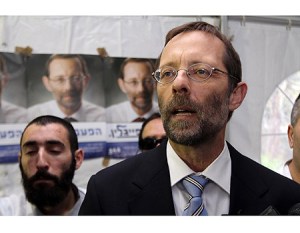 A Zionist Likud hardliner suggested paying Palestinian families $500,000 each to emigrate from the West Bank to the West.
Moshe Feiglin, who earlier on Tuesday was detained by Israeli police after trying to pray at the so-called Temple Mount, proposed paying Palestinians to leave West Bank.
“The State of Israel is paying 10% of its GNP every year for the two-state solution and the Oslo Accords. It’s paying for separation fences, Iron Domes and a guard at every café. Soon we’ll have to place Iron Domes in every school in Tel Aviv.
“With this budget we can give every Arab family in Judea and Samaria $500,000 to encourage it to immigrate to a place with a better future.
“You may say, ‘But no one will have them.’ That’s not true because the Western nations are shrinking due to low birth rates. The question is whether the world will have Sudanese migrants who can’t build or migrants from Judea and Samaria who do know how to build.”
Related articles
- Israel forces Jordan Valley Palestinians from homes ahead of war drill (alethonews.wordpress.com)
Israeli police smash boy’s head to the ground in Aqsa incursion
Al Akhbar | October 6, 2012
A video has surfaced showing Israeli police smashing a teenage boy’s head to the ground during an incursion into the revered Aqsa compound in Jerusalem Friday. Police had fired tear gas and stun grenades at a group of worshipers Friday protesting the entry of illegal Jewish settlers into Islam’s third holiest site earlier this week.
The video exposes further the brutality of Friday’s attack where witnesses reported several arrests and some injuries. It shows a boy being dragged across the ground, and pinned down as he screams “Khalas”, or enough. Police then punch his head against the stone floor in a swift and forceful swing of the arm.
Many youth and injured sought refuge in the Haram el-Sharif mosque, or Dome of the Rock, as police clad in black stood stationed around it during the incursion.
Reuters reported that protesters hurled stones at police during their protest, and Israeli police spokesman Micky Rosenfeld claims that one of the demonstrators tried to stab a police officer and that only one Palestinian was arrested.
Israelis have made repeated threats to demolish the Aqsa mosque, considered the third holiest site in Islam, in order to build a Jewish temple in its stead. The move would accelerate redemption, according to some Jewish religious authorities.
Some thirty illegal Jewish settlers toured the compound this week under heavy police protection, a move that has been interpreted by Palestinians as an attempt to assert Israeli claims to the site, named Temple Mount in Jewish tradition.
Al-Aqsa Mosque and its surrounding area attacked 100 times during 2011
MEMO | February 22, 2012
A study conducted by Al-Aqsa Foundation for Endowment and Heritage in Israel has revealed that Al-Aqsa Mosque and its surrounding area has been subjected to around 100 attacks and violations in 2011 alone. The study noted that the attacks varied between physical attacks and plots which pose threats to the sanctity and security of the mosque. The study also documented provocative statements constituting incitement by Israelis to damage the third holiest site in the Muslim world.
The report claims that around 5,000 Israelis, including Jewish settlers and members of other extremist groups, stormed into Al-Aqsa in 2011. The intruders performed Talmudic rituals, sometimes in public, other times in secret, including carrying parts of the Torah inside the mosque.
There has also been an escalation in the frequency of incursions by Israeli intelligence officers and political and official figures into Al-Aqsa Mosque.
More than 200,000 tourists were granted admittance to the mosque, sometimes violating its sanctity by wearing scanty clothing.
Al-Aqsa has witnessed a campaign of unprecedented military presence; strict measures preventing Muslims from going to the mosque; and acts aimed at decreasing the continuous Muslim presence in the Noble Sanctuary, through banning orders and limiting entry to certain age groups. The Israeli Occupation Authorities also prevented 3.7 million Palestinians from the West Bank and Gaza Strip from reaching Occupied Jerusalem and Al-Aqsa Mosque to conduct acts of worship therein.
While the Israelis have blocked essential maintenance and reconstruction within the mosque compound, Jewish organisations’ calls for the mosque to be destroyed and a temple to be built in its place have increased in number. The year 2011 saw a campaign of excavations and the construction of long, interlinked tunnels underneath Al Aqsa and the surrounding area in all directions. The tunnels are to have “Jewish synagogues and Judaisation centres”. What has been notable about the excavations last year is that they have been more overt, unlike previous years.
Israeli efforts to Judaise the area have included work at the Muslim-owned Buraq (“Wailing”) Wall and the proposed demolition of the historic Magharba Gate Bridge. The report notes that the latter was saved, temporarily at least, by the effects of the Arab Spring and concerns raised by Israeli Prime Minister Benjamin Netanyahu.
Israel has plans to transform the area around Al-Aqsa into so-called “Talmudic gardens”, which will incorporate tourist centres and commercial shopping malls. All of this is in addition to the increasing number of illegal Jewish settlers and settlements in districts such as Ras Al-Amoud.
The Al-Aqsa Foundation for Endowment and Heritage has issued a warning that the Israeli Occupation Authorities could seek to capitalise on the developments of the Arab Spring so as to damage Al-Aqsa Mosque and Sanctuary in 2012. Intelligence reports, it says, predict serious attacks against Al-Aqsa by extremist Jews. Such predictions follow statements by former Knesset (Israeli Parliament) Member Avraham Burg that Al-Aqsa will be demolished or torched while Netanyahu is in office; and this, he claimed, will be followed by the establishment of the so-called Third Temple. In the light of these serious threats to the Holy Mosque, the Foundation called on Muslims and Arabs to put Jerusalem and Al-Aqsa at the top of their priorities for action.
Related articles
- Israeli forces invade al-Aqsa Mosque (altahrir.wordpress.com)
- Palestinian factions warn against Likudists entry of Al-Aqsa mosque (altahrir.wordpress.com)
- Israeli Likud Party Calls to Storm al-Aqsa Mosque (altahrir.wordpress.com)
- Settlers Enter The Al Aqsa Mosque (altahrir.wordpress.com)
Featured Video

American Military Failure in Afghanistan
or go to
Aletho News Archives – Video-Images
Frlom the Archives
The Fiction of the Jewish History in Palestine
By Hasan Afif El-Hasan | The Palestine Chronicle | April 8, 2011
Prime Minister Benjamin Netanyahu told NNC Pierce Morgan on March 18, 2011 that he might agree to a Palestinian state through negotiations. And he added, “We will make territorial concessions although it is very painful to do that in our ancestral land.” Netanyahu was not talking about Poland where his ancestors lived. He was talking about Palestine where generations of its indigenous population ancestors lived, cultivated the land and are buried.
By the end of the nineteenth century, Zionism created a new Jewish identity of blood and soil. To mobilize their followers and supporters and appeal to their emotions, the Zionists created myths. Zionism started as a tribal religion without god, but in order to fulfill its function as a unifying force, Zionism required external religious and race symbols, not inner content. Its leaders regarded metaphysical religious belief and purity of race as having value in itself. They created a divine paradisiacal state of merger with the gods. Despite his non-religious ideology, Herzl’s writings were replete with religious references. The Jews should settle in Palestine because, in his words, “the Temple will be visible from long distance, for it is only our ancient faith that has kept us together”.
The Zionists and their supporters have invested tremendous financial and scholarly resources to work within the Hebrew Bible historical narratives to affirm the links between the intrusive Zionist population and the ancient Israelite past, and by doing so assert the right of that population to the land. The political end-game shaped the investigation and the outcome. Tracing the roots of Israel’s ethnic state in biblical antiquity is effectively to silence the indigenous Palestinian claim to the past and therefore to the land. The Biblical scholarship employs a bewildering array of terms for the region: “the Holy Land”, “the Land of the Bible”, “Eretz Israel”, “the Land of Israel”, or “Judah and Samaria.” To the casual reader these names appear interchangeable, but they all imply connection to ancient Israel.
Biblical narratives or poems that cannot be supported by archeology and common sense are treated by the Zionists and their supporters as historical language. … continue
Blog Roll
 Aletho News
- CIA Assessment: The Resistance Cannot Be Crushed
- Hezbollah Returns: It Didn’t Start a War, It Is Ending One
- EU states seek ‘talks’ with Iran for access to Strait of Hormuz: Report
- Trump on Hormuz: “Others must take care of it” after US falters
- Who Is closer to collapse?
- A War that Backfired: Why the US-Israeli Campaign Is Strengthening Iran
- How Zionist Control Is Hurting US Interests
- Iran warns it may target US missile launch sites in UAE cities
- American Military Failure in Afghanistan
- Friendly Skies of Georgia: Are Israeli-Linked Drones Launching False Flags from Georgian Territory?
- If Americans Knew
- As US-Israel war on Iran rages, Gaza faces massive dust storm – Not a ceasefire Day 156
- No let-up in attacks on Gaza as Israel takes on Iran, Lebanon – Not a ceasefire Day 155
- ‘Of Course’: IDF Drops Case Against Soldiers Accused of Raping Palestinian Prisoner
- Don’t Fall for the Regime Change Talk. Israel Is ‘Mowing the Lawn’ in Iran
- Will Israel and the US wreck the Gulf States along with Iran?
- US so far burned through ‘years’ of munitions in Iran war: Report
- How the Israeli Tail Wags the American Dog
- Outdated intel likely led to deadly U.S. strike on Iranian elementary school, sources say
- Pentagon insider says high U.S official Douglas Feith reported to Netanyahu
- In fond memory of Walid Khalidi, the historian of Palestine
- No Tricks Zone
- Storing Green Energy To Last Germany 10 Days Would Require A 60-Million Tonne Battery
- New Studies: UK Sea Levels Were 4 Meters Higher Than Today During The Mid-Holocene
- Destructive Green New Deal: German Energy And Metal Group Warns Of Drastic Crisis
- New Study Documents A 20-Year Pause In Arctic Sea Ice Decline – Driven By Internal Variability
- Wake-up Call: Survey Shows Majority Of Germans Now Favor Postponing Climate Targets!
- Televised! Leading German Political Candidate Tells Schoolchildren CO2 Makes Sun Hotter!
- New Study: A Century Warming Of 1.1°C Is ‘Commonplace’ And ‘Not Unusual’ During This Interglacial
- New Study: ‘Internal Noise’ And Volcanic Forcing Can Trigger 10-15°C Warming Within Decades
- Glaciers Worldwide Are Suddendly Surging, Experts Blame Warming!
- Surprising Discovery: Sahara Is Greening…Billions Of Trees Where Once Thought To Be Barren
 Aletho News