Texas judge: Enforcing the IHRA definition of anti-Semitism limits speech
Interim decision allows policies to remain in place for now

‘Freedom for Palestine’ protest march that drew thousands of participants on November 4, 2023 in Berlin, Germany. [Sean Gallup/Getty Images]
MEMO | October 31, 2024
Texas Sues Pfizer for ‘Endangering Children’ by Selling Ineffective ADHD Drug
By Suzanne Burdick, Ph.D. | The Defender | November 22, 2023
Acting on behalf of the state of Texas, Attorney General Ken Paxton on Monday unsealed a lawsuit against Pfizer and its drug manufacturer, Tris Pharma, alleging the companies sold medication to children even though they knew the drug was ineffective and potentially unsafe.
The suit, filed in the Harrison County District Court, alleges Pfizer knowingly distributed a drug used for treating attention-deficit/hyperactivity disorder (ADHD) to children on Medicaid — despite the drug’s pattern of failing quality control tests.
The drug, Quillivant XR, is a stimulant that affects brain and nerve chemicals involved in hyperactivity and impulse control.
From 2012-2018, “Pfizer and Tris continually manipulated Quillivant testing to hide poor manufacturing practices and defraud the Texas Medicaid program,” according to a press release.
During those years, many families complained that the medication failed to work. According to the complaint:
“At no point did Defendants warn Texas Medicaid providers or decision-makers that Quillivant had known manufacturing issues affecting its efficacy, thereby depriving the Medicaid program of the crucial information it relies on. … As a result, thousands of Texas children received an adulterated Schedule II Controlled Dangerous Substance.”
In a tweet, Paxton said:
Commenting on the lawsuit, Kim Mack Rosenberg, acting general counsel for Children’s Health Defense, said, “Pfizer once again is in the spotlight for alleged unethical and fraudulent activity.”
Rosenberg told The Defender :
“I applaud the Texas AG for taking action here to protect some of Texas’s most vulnerable children, those who rely on Medicaid for healthcare. To knowingly supply adulterated medication to vulnerable children is inexplicable and unconscionable.”
“Unfortunately,” Rosenberg added, “this is not the first time questions have been raised about Pfizer’s conduct, including wrongdoing allegedly resulting in children dying in clinical trials in Nigeria in the 1990s and serious questions about Pfizer’s COVID-19 injections and its treatment medication Paxlovid.”
Defendants in the suit include Pfizer, Tris and Tris CEO Ketan Mehta.
The lawsuit stemmed from a whistleblower complaint made by Tarik Ahmed, who served as Tris’ technology chief from 2013-2017.
The lawyers are suing for more than $1 million, including civil penalty fees, and are asking the court to force Pfizer and Tris to pay back to the state of Texas all profits received from selling Quillivant in the Texas Medicaid program “as a result of Defendants’ unlawful acts” and, additionally, to pay back double that amount.
Lawyers with Paxton’s office requested a trial by jury.
In 2017, Quillivant grossed roughly $193.3 million in U.S. sales. The drug was developed by NextWave Pharmaceuticals, which Pfizer bought in 2012 for $680 million.
The lawyers charged the defendants with defrauding the Texas Medicaid program “by providing adulterated pharmaceutical drugs to Texas children in violation of the Texas Medicaid Fraud Prevention Act, now known as the Texas Health Care Program Fraud Prevention Act (‘THFPA’).”
The press release said, “For years, Tris altered the drug’s testing method in violation of federal and state laws to ensure Quillivant passed regulatory hurdles and could continue to be sold.”
According to Reuters, Pfizer said in a statement that it had examined the suit’s allegations on “multiple occasions” and “did not find any impact on the safety of the product.”
Pfizer said the case has no merit and will move to dismiss it.
A Tris spokesperson told Reuters in an email, “We categorically deny and intend to rigorously defend these allegations in the court of law.”
Drug failed quality control tests for years
Almost immediately after getting U.S. Food and Drug Administration (FDA) approval, Quillivant began failing routine quality tests. According to the complaint:
“Beginning at least as early as October 2012, Tris quality control personnel observed that sample of Quillivant tested under FDA-required dissolution specifications were not generating passing results.
“Dissolution testing is an important quality control tool used to measure whether a drug was properly manufactured, by comparing a simulated release of the drug to a standard set upon the drug’s initial approval.
“This in turn helps to predict whether the drug (as manufactured) will be released as expected in a patient’s body — which is critical for ensuring proper and consistent patient dosing.”
The Quillivant samples formed lumps during the reconstitution phase of the test.
Instead of investigating why there were lumps, Tris “retrained” its analysts to shake the water/drug mixture longer and to conduct the test only when “foaming is absent from the suspension,” the filing said.
Even with these changes, Quillivant continued to fail dissolution tests. Tris then stopped using that testing method and switched to a new method.
“Alarmingly,” the filing said, “the new test method was not representative of real-world usage by patients, and worse, went against the pharmacy reconstitution instructions contained in the FDA-approved label for Quillivant.”
When quality control issues continued to arise, the companies told the FDA a “misleading” and “convenient narrative to explain away the problem.”
Pfizer wanted to ‘fully exploit the economic potential of Texas Medicaid’
Meanwhile, Pfizer was petitioning Texas Medicaid to get Quillivant added to the program’s preferred drug list — but said nothing about the drug’s ongoing and unresolved quality control issues.
The FDA on March 26, 2018, sent a warning letter to Pfizer, informing the company that Quillivant was “adulterated starting in 2012 and continuing into 2018.”
Yet “even after receiving this clear and unequivocal assessment, neither Tris nor Pfizer alerted Texas Medicaid decision-makers to the FDA’s serious findings,” the filing said.
The suit alleges that the companies avoided telling Texas Medicaid about the issues because “Quillivant’s status with Texas Medicaid became a selling point.” The filing said:
“Tris and Pfizer both recognized that Texas Medicaid business would be crucial for Quillivant’s success.
“To fully exploit the economic potential of Texas Medicaid, Defendants needed Medicaid decision-makers to add Quillivant to the VDP [Vendor Drug Program] Formulary and the Preferred Drug List.
“These steps would effectively allow Medicaid providers to prescribe Quillivant to their Medicaid patients and would streamline the prescribing process by eliminating the need for the treating doctor to go through the burdensome process of obtaining prior authorization.”
Pfizer projected that Quillivant sales in Texas would significantly increase if the drug were added to the Texas Medicaid Preferred Drug List, as Texas was a “populous state with a disproportionately high percentage of children covered by Medicaid,” according to the complaint.
The Civil Medicaid Fraud Division of Paxton’s office undertook the investigation.
Suzanne Burdick, Ph.D., is a reporter and researcher for The Defender based in Fairfield, Iowa.
This article was originally published by The Defender — Children’s Health Defense’s News & Views Website under Creative Commons license CC BY-NC-ND 4.0. Please consider subscribing to The Defender or donating to Children’s Health Defense.
U.S. Supreme Court to Weigh in on State Laws to Prevent Tech Giants From Censoring Social Media Content
By Michael Nevradakis, Ph.D. | The Defender | September 29, 2023
The U.S. Supreme Court today said it will hear cases challenging Texas and Florida laws that prohibit social media companies from censoring content posted on their platforms, in what The New York Times said will lead to “a major ruling on how the First Amendment applies to powerful tech platforms.”
The two laws, both passed in 2021, and the Supreme Court’s decision to consider them, “could have nationwide repercussions for how social media — and all websites — display user-generated content,” CNN reported.
If upheld, the laws could open the door to more state legislation with similar obligations for social media sites.
Texas House Bill 20 (HB 20) and Florida Senate Bill 7072 (SB 7072) allow users to “sue social media platforms over allegations of political censorship” and “restrict companies from taking down or demoting certain kinds of content even when the platforms may decide it violates their terms of service,” according to CNN.
The laws also could make it harder for platforms to remove what they determine is “misinformation, hate speech or other offensive material,” CNN added.
According to USA Today, the laws “limit” platforms’ ability to regulate content, “even if those posts spread a foreign government’s misinformation or provide false medical advice.”
Two tech industry trade groups, NetChoice and the Computer & Communications Industry Association, challenged the laws in 2021, saying that tech companies enjoy First Amendment protection which prevents the government from telling them “whether and how to disseminate speech,” the Times reported.
Both states’ laws were temporarily blocked by federal courts pending the completion of the appeals process.
According to The Associated Press (AP), the court’s announcement came three days before the start of its new term. A decision is expected in 2024, according to USA Today.
W. Scott McCollough, an Austin, Texas-based technology attorney, welcomed the news.
“I’m glad the Supreme Court picked up the case, because what both Texas and Florida were doing is, they required individualized protection — a consumer protection measure,” he said. “It required them to inform the parties that ‘we’ve done something to you.’”
McCollough added:
“The two states here recognize that these platforms have immense power. They purport to have the right to act unilaterally and subjectively to restrict posts as part of content moderation. So, the states are requiring them to give notice to the people they are censoring and tell them why they did it. This is reasonable at its face.
“If nothing else, I’ve always believed that these aspects of these two state statutes, in theory, should not have a First Amendment problem. States have forever engaged in consumer protection matters. Every state has consumer protection statutes.”
Laws intended to ‘combat Silicon Valley censorship’
Texas HB 20 regarding “censorship of or certain other interference with digital expression, including expression on social media platforms or through electronic mail messages,” passed on Sept. 9, 2021, and was set to take effect on Dec. 2, 2021.
According to Politico, HB 20 “would allow both the state of Texas and individual Texans to sue companies if they ‘censor’ an individual based on their viewpoints or their geographic location by banning them or blocking, removing or otherwise discriminating against their posts.” It would apply to platforms with at least 50 million active users.
Florida SB 7072, Social Media Platforms, also known as the Stop Social Media Censorship Act, was to take effect July 1, 2021. It sought to regulate the content moderation policies of social media platforms, barring them from banning users based on their political ideology.
According to the Times, “The sites in question are largely barred from removing posts based on the viewpoints they express, with exceptions for the sexual exploitation of children, incitement of criminal activity and some threats of violence.”
Supporters of the Florida and Texas laws “argue that the measures are needed to combat what they called Silicon Valley censorship,” including on issues like COVID-19 and claiming election fraud, the Times also reported.
Challenges to both laws resulted in conflicting rulings in federal courts.
In May 2022, the U.S. Court of Appeals for the 11th Circuit largely upheld a preliminary injunction freezing enforcement of the Florida law.
Also in May 2022, the U.S. Supreme Court temporarily blocked enforcement of the Texas law pending completion of the appeals process. However, in September 2022, the U.S. Court of Appeals for the 5th Circuit reversed earlier court rulings that had blocked the law.
Judge Andrew S. Oldham of the 5th Circuit wrote, “Today we reject the idea that corporations have a freewheeling First Amendment right to censor what people say. The platforms are not newspapers. Their censorship is not speech.”
McCollough agreed, saying that prior legal precedent holding that “newspapers don’t have to post everybody’s letter to the editor” was based on the rationale that “there is not enough space in a newspaper to post everybody’s letter.”
The 5th Circuit is considering two other cases with First Amendment and free speech implications: Missouri et al. v. Biden et al. and Kennedy et al. v. Biden et al., in which Children’s Health Defense (CHD) is a plaintiff. The 5th Circuit heard oral arguments in Missouri et al. v. Biden et al. last month.
In July, the two cases were consolidated.
Legal experts said the consolidated case is likely headed to the Supreme Court after Associate Justice Samuel Alito earlier this month lifted an injunction that temporarily blocked certain Biden administration offices and officials from contact with social media giants.
The injunction, requested in the Missouri v. Biden case, on July 4 was granted by Judge Terry Doughty of the U.S. District Court for the Western District of Louisiana Monroe Division and was later upheld under a Sept. 8 ruling by the 5th Circuit.
Justice Alito paused it after the U.S. Department of Justice (DOJ) submitted an emergency filing asking the Supreme Court to stay the injunction while the high court considers whether to hear the case.
The Supreme Court’s alignment in its 5-4 vote temporarily blocking the Texas law, was “unusual,” according to the AP, with liberal justice Elena Kagan joining three conservative justices — Samuel Alito, Neil Gorsuch and Clarence Thomas — in the dissenting opinion that would have allowed the law to remain in effect.
In the dissent, Justice Alito wrote, “Social media platforms have transformed the way people communicate with each other and obtain news. At issue is a groundbreaking Texas law that addresses the power of dominant social media corporations to shape public discussion of the important issues of the day.”
Kim Mack Rosenberg, CHD’s acting general counsel, highlighted the significance of the constitutional issues the Supreme Court will consider:
“We will be watching the two First Amendment cases out of Texas and Florida carefully. In these two cases, the social media companies are claiming their First Amendment rights are violated by these laws.
“In several cases in which CHD is involved, we argue that the social media platforms and the U.S. government violated the First Amendment rights of those posting to social media and the consumers of the posts.”
U.S. government claims First Amendment protects its ‘bully pulpit’
One of several legal matters at hand in the two cases pertains to Section 230 of the Communications Decency Act. Passed in 1996, Section 230 gives internet providers legal protections for hosting, moderating and removing most user content.
According to the New York Post, Section 230 was designed to prevent internet companies from being treated as publishers by shielding them from lawsuits by anyone claiming to be wronged by content posted by another user — even though the platforms typically engage in moderation of user-posted content.
In his dissent, Justice Alito wrote, “It is not at all obvious how our existing precedents, which predate the age of the internet, should apply to large social media companies.”
Social media platforms have long argued that they are not publishers, in order to avoid legal liability for content posted by their users. However, in other instances, these same companies have claimed, in court, that they are publishers and have the right to exercise editorial control over content on their platforms.
For instance, Facebook’s parent company, Meta, recently argued that a subpoena from the District of Columbia’s attorney general interfered with its ability to exercise editorial control over content on its platform.
“Facebook has long had the same public response when questioned about its disruption of the news industry: it is a tech platform, not a publisher or a media company,” as the Guardian reported in 2018.
But in legal arguments, Facebook has repeatedly argued, it’s “a publisher, and a company that makes editorial decisions, which are protected by the First Amendment.”
Social media platforms “claim that they are not publishers and that they should not be liable for the information that shows up on their platforms,” McCollough said.
“You’re either a publisher or you’re not a publisher, and they’ve always said they’re not publishers. So why are they saying they’re publishers now? Are they publishers for the First Amendment and not publishers for Section 230? Explain that one,” he added.
Social media platforms’ First Amendment rights are also at issue. In a brief submitted to the Supreme Court, the State of Texas argued that HB 20 does not affect social media platforms’ free speech rights because “no reasonable viewer could possibly attribute what a user says to the Platforms themselves.”
“Given the Platforms’ virtually unlimited capacity to carry content, requiring them to provide users equal access regardless of viewpoint will do nothing to crowd out the Platforms’ own speech,” the brief also stated.
According to McCollough, “the big sexy issue” in this case involves content moderation. “Can a state basically prohibit discrimination based on viewpoint? And it ultimately comes down to whether, when these platforms are engaging in so-called content moderation, whether that is them ‘speaking’ — if that is a form of speech,” he said.
“We have always contended that that is not speech. It’s conduct. It’s the consumer, the one who is doing the posting, that is engaging in speech. By taking down speech that the platform may not approve of, that is not speech by the platform,” he added.
A policy principle known as common carriage is also implicated. The Communications Act of 1934, for instance, classifies telephone companies as “common carriers,” requiring those companies to make their services available to the public at affordable rates and regardless of viewpoint or other factors.
In a previous legal brief, Texas argued that social media platforms are “the twenty-first century descendants of telegraph and telephone companies: that is, traditional common carriers” — that must generally accept all customers without viewpoint discrimination.
In 2021, Justice Thomas compared social media platforms to communication utilities that are regulated under common carrier laws, on the basis that concentration in the industry gives these companies “enormous control over speech.”
McCollough said, “When you hold out to indiscriminately serve the public on uniform terms and conditions — in other words, if you say I’ll cover it if you just accept my pre-published terms and conditions, then that basically makes you a common carrier.”
The federal government has also asserted its own purported First Amendment rights.
Solicitor General Elizabeth B. Prelogar argues that lawsuits challenging government attempts to regulate social media content violate the First Amendment on the basis that the office of the president has a “bully pulpit to seek to persuade Americans … to act in ways that the President believes would advance the public interest.”
The Wall Street Journal reported that the Supreme Court asked the DOJ for its views regarding the Florida and Texas laws “as is typical in cases involving federal interests.” In a brief, Prelogar urged the court to hear the cases.
“When a social-media platform selects, edits and arranges third-party speech for presentation to the public, it engages in activity protected by the First Amendment,” she wrote, adding that “the act of culling and curating the content that users see is inherently expressive, even if the speech that is collected is almost wholly provided by users.”
Chris Marchese, litigation director for NetChoice, said “Online services have a well-established First Amendment right to host, curate and share content as they see fit.”
And Matt Schruers, president of the Computer & Communications Industry Association, said, “It is high time that the Supreme Court resolves whether governments can force websites to publish dangerous content. … Telling private websites they must give equal treatment to extremist hate isn’t just unwise, it is unconstitutional, and we look forward to demonstrating that to the court.”
Tech companies, government using variation of ‘too big to fail’ argument
McCollough told The Defender that what the parties will be briefing and arguing is whether the two state statutes’ content moderation restrictions comply with the First Amendment — in other words, each state’s prohibition against viewpoint discrimination and whether that violates the First Amendment.
The Supreme Court will also hear arguments related to the “individualized explanation requirements” and the extent to which they “comply with the First Amendment.”
“What the solicitor general argued is that these platforms are just way too big,” McCollough said. “They have so many posts that it would be so burdensome on them to be reasonable with their consumers, and that this violates the First Amendment.”
McCollough called this “a variation of the ‘too big to fail’ argument … They’re too big, they do so much, that they just can’t be bothered with an individualized explanation.”
According to McCollough, the Supreme Court’s decision will have major implications for contemporary understandings of free speech and First Amendment rights.
“If you look at the position of the solicitor general and, therefore, the U.S. government, they are saying that the government has a right to free speech, the platforms have a right to free speech, but the people do not have a right to free speech.”
“From a policy perspective, what is the message being sent to Americans? Sit down, shut up, there’s nothing you can do about it, there’s nothing the state legislature can do about it,” he said. “And if they are right about the First Amendment, there’s nothing Congress can do about it.”
“Don’t sit down, don’t shut up, and yes, there is something you can do about it,” he said.
Michael Nevradakis, Ph.D., based in Athens, Greece, is a senior reporter for The Defender and part of the rotation of hosts for CHD.TV’s “Good Morning CHD.”
This article was originally published by The Defender — Children’s Health Defense’s News & Views Website under Creative Commons license CC BY-NC-ND 4.0. Please consider subscribing to The Defender or donating to Children’s Health Defense.
Texas Launches Investigation into Gain-of-Function Research and Misrepresentations by Covid-19 Vaccine Manufacturers
By Ken Paxton, Attorney General of Texas | May 1, 2023
Attorney General Paxton launched an investigation into the pharmaceutical companies Pfizer, Moderna, and Johnson & Johnson concerning whether they engaged in gain-of-function research and misled the public about doing so.
Paxton is also investigating whether the companies misrepresented the efficacy of their Covid-19 vaccines and the likelihood of transmitting Covid-19 after taking the vaccines in violation of the Texas Deceptive Trade Practices Act. The investigation will also look into the potential manipulation of vaccine trial data. This investigation concerns potentially fraudulent activity that falls outside the scope of legal immunity granted to manufacturers of the Covid-19 vaccine. It will also review the companies’ controversial practice of reporting the metric of “relative risk reduction” instead of “absolute risk reduction” when publicly discussing the efficacy of their vaccines.
In recent years, certain pharmaceutical companies have had record-breaking financial success, driven in part by sales made from products related to the Covid-19 pandemic. This vested interest in the success of these Covid-19 products, combined with reports about the alarming side effects of vaccines, demands aggressive investigation.
Texas’s investigation will force these companies to turn over documents the public otherwise could not access. Attorney General Paxton is committed to discovering the full scope of decision-making behind pandemic interventions forced on the public, especially when a profit motive or political pressure may have compromised Americans’ health and safety. Efforts by the federal government to coerce compliance with unjust and illegal pandemic interventions, even at the cost of citizens’ employment, means this investigation into the scientific and ethical basis on which public health decisions were made is of major significance.
Given the unprecedented political power and influence over public health policies that pharmaceutical companies now wield, it is more important than ever that they are held accountable if they take dangerous, illegal actions to boost their revenues.
“The development of the Covid-19 vaccine, and the representations made by and knowledge of Pfizer, Moderna, and Johnson & Johnson, are of profound interest to the public’s health and welfare. This investigation aims to discover the truth,” said Attorney General Paxton. “This pandemic was a deeply challenging time for Americans. If any company illegally took advantage of consumers during this period or compromised people’s safety to increase their profits, they will be held responsible. If public health policy was developed on the basis of flawed or misleading research, the public must know. The catastrophic effects of the pandemic and subsequent interventions forced on our country and citizens deserve intense scrutiny, and we are pursuing any hint of wrongdoing to the fullest.”
To read the CID for Pfizer, click here.
To read the CID for Moderna, click here.
To read the CID for Johnson & Johnson, click here.
Biden declares US energy emergency
Samizdat | June 6, 2022
President Joe Biden has blamed Russia for another crisis, saying the US might not be able to generate enough electricity to meet consumer demand partly because of Moscow’s military offensive against Ukraine.
The president declared an energy emergency on Monday, saying national security and quality of life are jeopardized by potential shortfalls in power supplies. He invoked the Defense Production Act – originally part of an industrial mobilization effort in response to the Korean War – to spur domestic production of solar panels and other forms of “clean” energy to boost power supplies.
“Multiple factors are threatening the ability of the United States to provide sufficient electricity generation to serve expected customer demand,” Biden said in his emergency declaration. “These factors include disruptions of energy markets caused by Russia’s invasion of Ukraine and extreme weather events exacerbated by climate change.”
Increased reliance on renewable energy sources has been blamed for disruptions to power service in such states as California and Texas. Solar and wind power are intermittent, so periods of high demand aren’t always matched by supplies. For instance, wind turbines froze up during an historic winter freeze last year in Texas, contributing to blackouts that caused 246 deaths and at least $195 billion in damage.
Biden’s emergency declaration included a two-year exemption from tariffs on solar panels from four Southeast Asian countries. The proposed tariffs had been blamed for delaying major solar projects in the US. About three-fourths of the solar modules installed in the US are imported from Southeast Asia.
The president has blamed Russia for record US fuel prices and a surge in inflation to a 40-year high. He’s also attributed a looming global food crisis to the Russia-Ukraine conflict.
Texas Medical Doctors Testify Before State Senate to Oppose Mandatory COVID Shots
By Brian Shilhavy | Health Impact News | May 8, 2021
This past week the Texas Senate Committee on State Affairs took testimony from Texas physicians regarding SB 1669: Stop Forced Vaccination and Vaccine Passports in Texas.
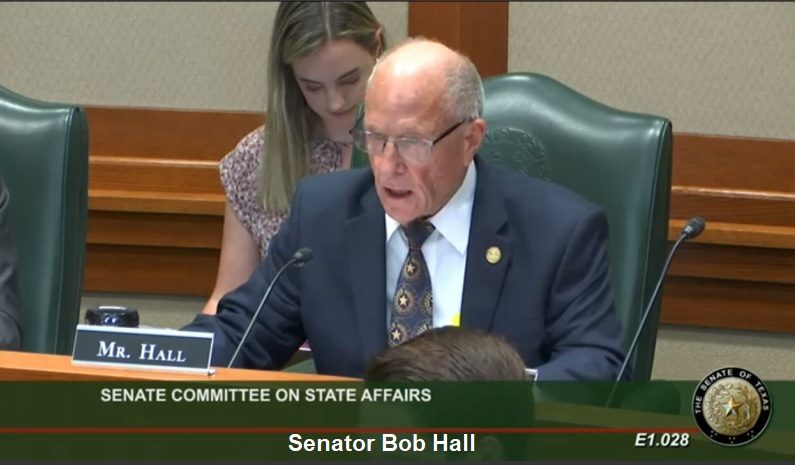
SB 1669 was sponsored by Senator Bob Hall.
You can learn more about this bill at the National Vaccine Information Center’s Advocacy Portal (registration required.)
Here is some of the text provided to the public regarding Senate Bill 1669:
Contact your Texas State Legislators and Demand No Forced Vaccination, No Vaccine Passports, No Exceptions – Support SB 1669
Mandated vaccination in Texas with COVID-19 vaccines will be the reality unless the legislature takes decisive action now. In fact, it has already started happening.
Houston Methodist Hospital has told its 26,000 employees to get vaccinated by June 7th or get fired. Atria Senior Living, which has 16 facilities in Texas, is requiring all employees to receive 2 COVID-19 vaccines by May 1, 2021 as a condition of employment or face termination.
The city of Farmer’s Branch, Texas is requiring COVID-19 vaccination to access the city run facility called The Branch Connection. Forget taking a cruise with Royal Caribbean from Texas unless you’ve been COVID-19 vaccinated. St. Edwards University in Austin became one of the first colleges to mandate COVID-19 vaccines.
This is just the beginning.
Governor Abbott’s Executive Order Prohibiting COVID-19 Vaccine Passports Falls Short at Protection
Texas Governor Greg Abbott has been quoted saying that in Texas, COVID-19 vaccines “are always voluntary and never forced.”
The truth is Executive Order GA 35 falls short at preserving the right of law-abiding Texas citizens to be able to function normally in society without having to show proof of a COVID-19 vaccination.
EO GA 35 only prohibits the government, or public or private entities funded by the government, from requiring documentation of an individual’s COVID-19 vaccination status. This does nothing to prohibit businesses not receiving government funding from banning customers who don’t have a COVID-19 vaccine. Also, this executive order fails to give any protection to employees whose employers are requiring COVID-19 vaccination as a condition of employment.
In addition, the limited protections offered in EO GA 35 will be short lived because the order only applies to “Emergency Use Authorization” (EUA) COVID-19 vaccines. Once a vaccine has received full FDA approval, the EUA designation no longer applies and therefore neither will any protection in this executive order including the ban on forced vaccination by the government. Full FDA approval will be soon. Moderna, the manufacture of one of the 3 available COVID-19 vaccines, is already seeking full FDA approval, and Pfizer, one of the other manufacturers, announced it would seek full approval in the first half of 2021.
Governor Abbott’s executive order also falls short when compared to Florida Governor Ron DeSantis’s executive order banning vaccines passports which additionally prohibits all business from requiring COVID-19 vaccination status or post infection recovery status to gain access to or service from the business, and it applies to all COVID-19 vaccines instead of expiring after full FDA approval is achieved. It also protects personal privacy rights by prohibiting the government from publishing or sharing a person’s COVID-19 vaccination status to third parties.
Texans Need a Law Passed to Protect them From Forced Vaccination and Vaccine Passports (If you want to immediately see what you can do to help pass SB 1669 into law in Texas scroll down to “Action Needed)”
We are grateful to announce that Texas history has been made with the filing of
SB 1669 in the Texas Legislature by Senator Bob Hall.SB 1669 prohibits discrimination or segregation based on vaccination or immune status and prohibits forced vaccination in all areas of your life.
We need your help getting SB 1669 moving as the bill is currently stalled awaiting a hearing in the Senate State Affairs Committee. Legislators need to be educated about the shortcomings in Governor Abbott’s executive order and the vulnerabilities for mandated vaccination in Texas based on current law so they can pass this bill or amend parts of it onto other bills.
This is by far the most comprehensive bill prohibiting mandated vaccination in all areas that could affect your life including government orders, employment, healthcare, education, access to businesses, access to events and venues like sports and concerts, long-term care, nursing homes, insurance, and childcare.
Read more at the National Vaccine Information Center’s Advocacy Portal.
Senator Bob Hall, in his opening statements at the Senate hearing this week stated:
The chief responsibility and Constitutional role of our government is to protect the rights of the individual. Employees can take off their helmets, masks, and uniforms at the end of the work day, but they cannot remove a vaccine.
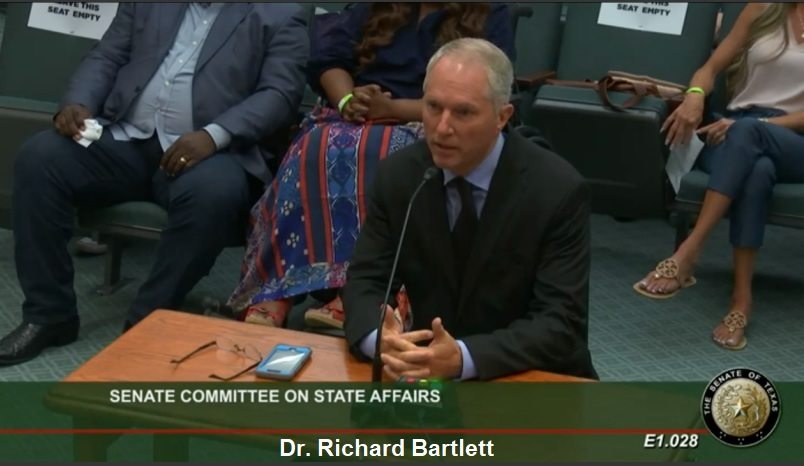
Dr. Richard Bartlett was the first physician to testify in favor of SB 1669 to Stop Forced Vaccination and Vaccine Passports in Texas.
Dr. Bartlett has over 28 years of medical practice experience and is a veteran primary care and emergency room doctor in West Texas.
Dr. Bartlett is best known since the COVID crisis started as a doctor who has cured many patients using an older, already FDA approved drug, called budesonide, which is an inhaled corticosteroid. (Learn more here.)
During his testimony, Dr. Bartlett explained that there are existing treatments already available to treat COVID patients, making it unnecessary to mandate experimental new “vaccines.”
He pointed to a recent Oxford University study just published that showed 90% success rate in using inhaled budesonide with COVID patients in preventing long-term care or hospitalization.
From the Oxford study:
The STOIC study found that inhaled budesonide given to patients with COVID-19 within seven days of the onset of symptoms also reduced recovery time. Budesonide is a corticosteroid used in the long-term management of asthma and chronic obstructive pulmonary disease (COPD).
Findings from the phase 2 randomised study, which was supported by the NIHR Oxford Biomedical Research Centre (BRC), were published on the medRxiv pre-print server.
The findings from 146 people – of whom half took 800 micrograms of the medication twice a day and half were on usual care – suggests that inhaled budesonide reduced the relative risk of requiring urgent care or hospitalisation by 90% in the 28-day study period. Participants allocated the budesonide inhaler also had a quicker resolution of fever, symptoms and fewer persistent symptoms after 28 days. (Source.)
Dr. Bartlett works in the Emergency Room, and he stated that there are very few patients coming in now with COVID, but “I am now seeing more people come in (to the ER) who are having complications from the COVID shot.”
And Dr. Bartlett points out that these are mostly younger people who were in excellent health before the shot, since Dr. Bartlett works in Lubbock, Texas, which is a college town.
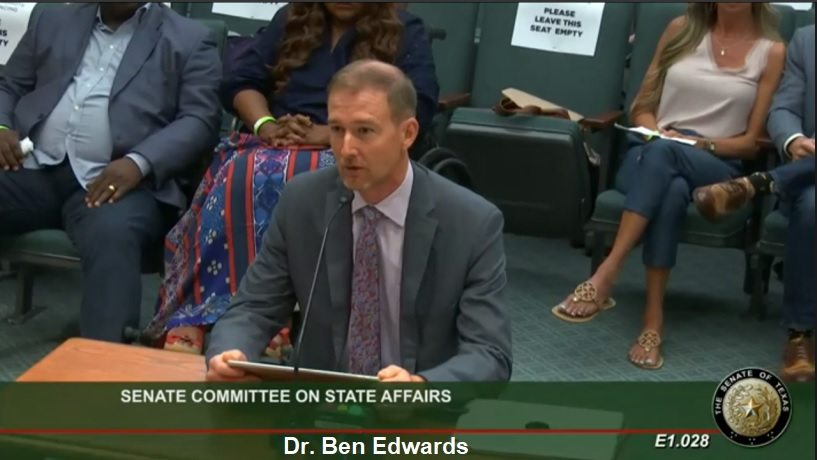
Dr. Ben Edwards of Veritas Medical in Lubbock, Texas, was the next physician to give testimony in favor of SB 1669 to Stop Forced Vaccination and Vaccine Passports in Texas.
Dr. Edwards received his degree from Baylor University, and later graduated from UT-Houston Medical School. He moved to Waco to complete his training at the Waco Family Practice Residency Program where he was Chief Resident. He now operates three clinics in West Texas.
Dr. Edwards stated his concern that “the forced and coerced COVID-19 vaccinations would, in my opinion, be a violation of the Nuremberg Code,” as well as several other international codes on bioethics and human rights.
He cited the fact that the CDC is now reporting 4,178 deaths reported to VAERS, while for the previous 20 years combined there were 4,182 deaths recorded from all vaccines.
He also pointed out that a Harvard Study has previously estimated that only about 1% of all adverse reactions to vaccines are ever reported to VAERS. Two other subsequent studies showed the same thing.
In his own practice, Dr. Edwards stated that he has received “numerous reports within hours of receiving the COVID vaccines that people have suffered strokes, heart attacks, pulmonary embolisms (blood clots), and sudden death.”
Dr. Edwards went on to cite research which shows that those with natural immunity to COVID (they already had it) will see a 2 to 3 fold increase risk of adverse reactions from the COVID shots.
Over half of Texans now have this natural immunity. He stated:
On a personal note, I believe that God gave us an amazingly robust immune system, and I don’t think you can improve on God.
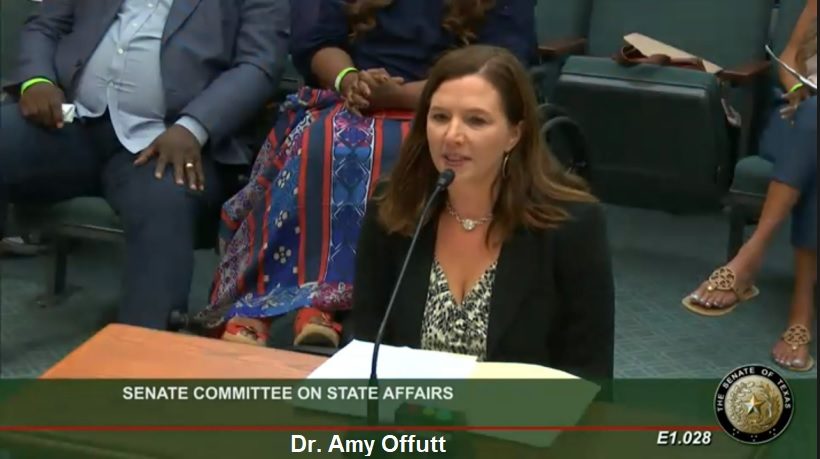
The next physician to testify in favor of SB 1669 to Stop Forced Vaccination and Vaccine Passports in Texas was Dr. Amy Offutt from St. Marble Falls, TX.
Dr. Offutt is trained in Integrative Medicine. She was recently appointed by Governor Greg Abbott to the Pediatric Acute-Onset Neuropsychiatric Syndrome Advisory Council. In addition, she serves on the Board of Directors for ILADS (International Lyme and Associated Diseases Society).
Dr. Offutt is another physician who has been successfully treating COVID patients with existing early treatment protocols.
She testified:
As of last Friday, my practice has treated 579 acutely ill patients as old as 98 years of age, with only ten hospitalizations and one dead.
The man who died presented on the 12th day of illness was a transplant patient and had already been to the ER multiple times before seeking care from us. This was such an unnecessary tragedy.
Dr. Offutt believes that “informed consent is the core to shared decision making in medicine.”
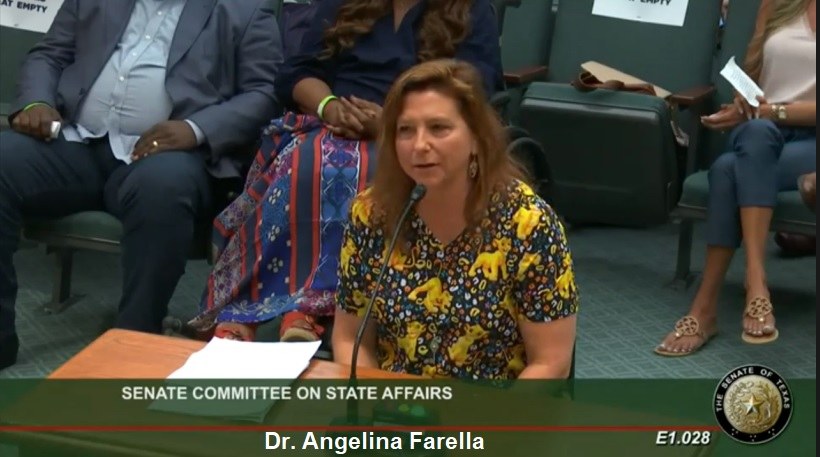
The next physician to testify in favor of SB 1669 to Stop Forced Vaccination and Vaccine Passports in Texas was Dr. Angelina Farella from Webster, TX.
Dr. Farella is a pediatrician with over 25 years experience. She started out her testimony to the Senate Committee by stating:
I am here today to protect our children in Texas. This is a very scary situation that we are in right now.
Dr. Farella stated that as a pediatrician she has given out tens of thousands of vaccines, and that she is not “anti-vaccine,” but:
I am against this COVID vaccine, if we can even call it that (a vaccine.)
What we are doing to our children with this vaccine is actually criminal.
All of these physicians are “frontline physicians” who actually treat patients, but their clinical experiences in treating COVID patients is being censored by the corporate media, and ignored by the government and Big Pharma, in favor mass vaccination instead.
Here is their testimony. This is from our Rumble Channel, and it is also on our Bitchute Channel.
We Need to Hear Much More About Florida and Texas and Less About the Latest Covid Hotspots
By Will Jones • Lockdown Sceptics • April 30, 2021
Would that journalists and broadcasters paid as much attention to places with no restrictions doing fine as they do to the latest places experiencing a Covid surge.
All eyes are currently on India and especially Delhi where, after a year of little impact, the virus is making its nasty presence felt. But as Ivor Cummins points out, India for whatever reason has a long way to go to catch up with countries in Europe and the Americas when it comes to Covid deaths. The country is not a good comparison for the UK where the virus is endemic and substantial population immunity is now present.
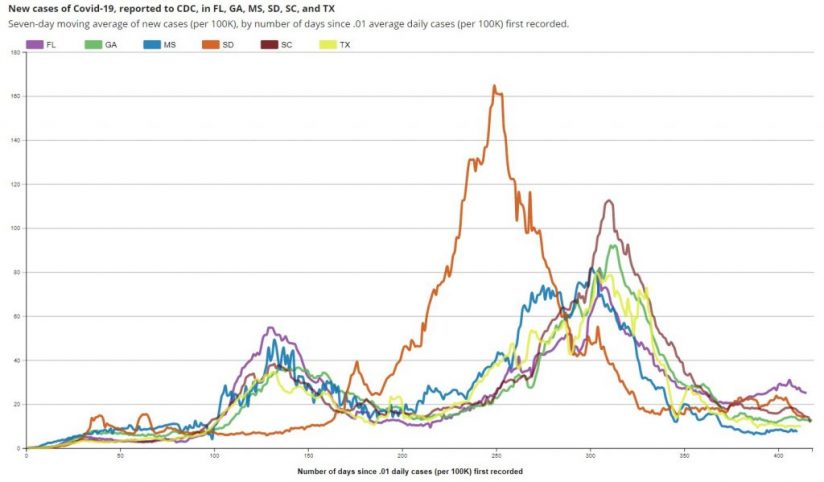
If only our media would spend as much time telling the population about how Florida lifted its restrictions back in September, how South Dakota never had any, and how Texas and Mississippi reopened in full at the start of March, as they do telling us about how many people are in hospital in Delhi. The latest positive-test data for these open states is in the graph above, along with two other light-restriction states, South Carolina and Georgia. Note the conspicuous lack of surge despite being basically back to normal. What more evidence do our politicians and scientists need that the threat from the virus is overblown and does not warrant social restrictions or emergency measures? Is the Government interested in data which contradict their preferred narrative?
The Telegraph today is reporting that as of June 21st – another seven weeks away – Brits will be permitted once again to attend large events without anti-social and uneconomic distancing requirements and hug one another. Our ultra-cautious scientists are advising that these things might just be okay by then. Though in case you might have thought they would then end the seemingly endless state of emergency, they have said measures such as staggering entries to venues accommodating large groups and good ventilation will still be required. What part of normal don’t they understand?
Nor is there any indication of a move to return international travel to normal, as the country faces more limitations on travel this summer – when most of the country is vaccinated – than last summer – when nobody was. What this has to do with following the science is, as ever, unclear.
What’s strange is that even in America where parts of their own country are living free and showing that the measures aren’t needed, state governments, with popular support and backed by federal agencies, just carry on with their restrictions, lifting them only very slowly and with no obvious commitment to bringing them finally to an end. It’s as though people don’t want to know. Too much has been invested in the lockdown narrative, it seems, for people to be able to cope psychologically with the trauma of facing the truth that it is fundamentally false. Too many reputations are at risk. Too many interests coincide.
Are we doomed to live forever in this Covid state of emergency? I confess it is hard to see what will prompt governments to bring it to an end, now that we live in permanent fear of the appearance of variants and believe we must continually top up the whole world’s antibodies through rolling annual programmes of vaccinations. One of the most depressing thoughts is I find it almost impossible to imagine Boris Johnson facing the camera and announcing: “My friends, our ordeal is over. The data is clear. The virus is now one among many hazards with which we daily must live. Vaccines are available to the vulnerable, as are effective treatments, and we will continually strive to find the safest ways to protect those at risk from this and other illnesses. It is time to resume our old lives. I declare the state of emergency to be over.”
Will we ever reach a point where we no longer even think about whether some activity is “Covid secure”? Where we no longer see our fellow human beings as sources of infection? It would be good to hear much more often from the Government that this is where it believes we are headed, sooner rather than later.
Assigning Blame for the Blackouts in Texas
By Planning Engineer | Climate Etc. | February 18, 2021
The story from some media sources is that frozen wind turbines are responsible for the power shortfalls in Texas. Other media sources emphasize that fossil fuel resources should shoulder the blame because they have large cold induced outages as well and also some natural gas plants could not obtain fuel.
Extreme cold should be expected to cause significant outages of both renewable and fossil fuel based resources. Why would anyone expect that sufficient amounts of natural gas would be available and deliverable to supply much needed generation? Considering the extreme cold, nothing particularly surprising is happening within any resource class in Texas. The technologies and their performance were well within the expected bounds of what could have been foreseen for such weather conditions. While some degradation should be expected, what is happening in Texas is a departure from what they should be experiencing. Who or what then is responsible for the shocking consequences produced by Texas’s run in with this recent bout of extreme cold?
TRADITIONAL PLANNING
Traditionally, responsibility for ensuring adequate capacity during extreme conditions has fallen upon individual utility providers. A couple decades ago I was responsible for the load forecasting, transmission planning and generation planning efforts of an electric cooperative in the southeastern US. My group’s projections, studies and analysis supported our plans to meet customer demand under forecasted peak load conditions. We had seen considerable growth in residential and commercial heat pumps. At colder temperature these units stop producing heat efficiently and switch to resistance heating which causes a spike in demand. Our forecasts showed that we would need to plan for extra capacity to meet this potential demand under extreme conditions in upcoming winters.
I was raked over the coals and this forecast was strongly challenged. Providing extra generation capacity, ensuring committed (firm) deliveries of gas during the winter, upgrading transmission facilities are all expensive endeavors. Premiums are paid to ensure gas delivery and backup power and there is no refund if it’s not used. Such actions increased the annual budget and impact rates significantly for something that is not likely to occur most years, even if the extreme weather projections are appropriate. You certainly don’t want to over-estimate peak demand due to the increasing costs associated with meeting that demand. But back then we were obligated to provide for such “expected” loads. Our CEO, accountants and rate makers would ideally have liked a lower extreme demand projection as that would in most cases have kept our cost down. It was challenging to hold firm and stand by the studies and force the extra costs on our Members.
Fortuitously for us, we were hit with extreme winter conditions just when the plan went in place. Demand soared and the planned capacity we had provided was needed. A neighboring entity was hit with the same conditions. Like us they had significant growth in heat pumps – but they had not forecasted their extreme weather peak to climb as we had. They had to go to the overburdened markets to find energy and make some curtailments. The cost of replacement power turned out to be significantly greater proportionately than we incurred by planning for the high demand. They suffered real consequences due to the shortcomings of their planning efforts.
However, if extreme winter had not occurred, our neighbor’s costs would have been lower than ours that year and that may have continued many years into the future as long as we didn’t see extreme winter conditions. Instead of the praise we eventually received, there would have at least been some annoyance directed at my groups for contributing to “un-needed expenditures”. That’s the way of the world. You can often do things a little cheaper, save some money and most of the time you can get away with it. But sometimes/eventually you cut it too close and the consequences can be extreme.
The Approach in Texas
Who is responsible for providing adequate capacity in Texas during extreme conditions? The short answer is no one. The Electric Reliability Council of Texas (ERCOT) looks at potential forecasted peak conditions and expected available generation and if there is sufficient margin they assume everything will be all right. But unlike utilities under traditional models, they don’t ensure that the resources can deliver power under adverse conditions, they don’t require that generators have secured firm fuel supplies, and they don’t make sure the resources will be ready and available to operate. They count on enough resources being there because they assume that is in their owner’s best interests. Unlike all other US energy markets, Texas does not even have a capacity market. By design they rely solely upon the energy market. This means that entities profit only from the actual energy they sell into the system. They do not see any profit from having stand by capacity ready to help out in emergencies. The energy only market works well under normal conditions to keep prices down. While generally markets are often great things, providing needed energy during extreme conditions evidently is not their forte. Unlike the traditional approach where specific entities have responsibilities to meet peak levels, in Texas the responsibility is diffuse and unassigned. There is no significant long term motivation for entities to ensure extra capacity just in case it may be needed during extreme conditions. Entities that might make that gamble theoretically can profit when markets skyrocket, but such approaches require tremendous patience and the ability to weather many years of potential negative returns.
This article from GreenTech media praises energy only markets as do many green interests. Capacity markets are characterized as wasteful. Andrew Barlow, Head of the PUC in Texas is quoted as follows, “Legislators have shown strong support for the energy-only market that has fueled the diversification of the state’s electricity generation fleet and yielded significant benefits for customers while making Texas the national leader in installed wind generation. ”
Why has Capacity been devalued?
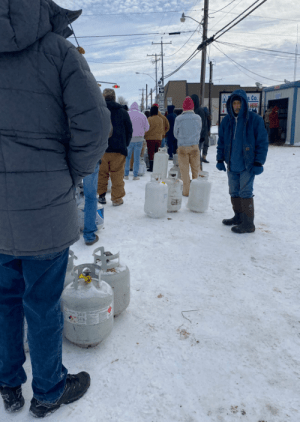 Traditional fossil fuel generation has (as does most hydro and nuclear) inherent capacity value. That means such resources generally can be operated with a high degree of reliability and dependability. With incentives they can be operated so that they will likely be there when needed. Wind and solar are intermittent resources, working only under good conditions for wind and sun, and as such do not have capacity value unless they are paired with costly battery systems.
If you want to achieve a higher level of penetration from renewables, dollars will have to be funneled away from traditional resources towards renewables. For high levels of renewable penetration, you need a system where the consumers’ dollars applied to renewable generators are maximized. Rewarding resources for offering capacity advantages effectively penalizes renewables. As noted by the head of the PUC in Texas, an energy only market can fuel diversification towards intermittent resources. It does this because it rewards only energy that is fed into the grid, not backup power. (Side note-it’s typical to provide “renewable” resources preference for feeding into the grid as well. Sometimes wind is compensated for feeding into the grid even during periods of excess generation when fossil fuel resources are penalized. But that’s another article.)
Traditional planning studies might recognize that wind needs to be backed up by fossil fuel (more so under extreme conditions) such that if you have these backup generators its much cheaper to use and fuel them, than to add wind farms with the accompanying significant investment for concrete, rare earth metals, vast swaths of land … . Traditional planning approaches often have to go to get around this “bias” of favoring capacity providing resources over intermittent resources.
When capacity value is rewarded, this makes the economics of renewables much less competitive. Texas has stacked the deck to make wind and solar more competitive than they could be in a system that better recognizes the value of dependable resources which can supply capacity benefits. An energy only market helps accomplish the goal of making wind and solar more competitive. Except capacity value is a real value. Ignoring that, as Texas did, comes with real perils.
In Texas now we are seeing the extreme shortages and market price spikes that can result from devaluing capacity. The impacts are increased by both having more intermittent resources which do not provide capacity and also because owners and potential owners of resources which could provide capacity are not incentivized to have those units ready for backup with firm energy supplies.
Personal Observations
Wind and solar have value and can be added to power systems effectively in many instances. But seeking to attain excessive levels of wind and solar quickly becomes counterproductive. It is difficult to impossible to justify the significant amounts of wind and solar penetration desired by many policy makers today using principals of good cost allocation. Various rate schemes and market proposals have been developed to help wind and solar become more competitive. But they come with costs, often hidden. As I’ve written before, it may be because transmission providers have to assume the costs and build a more expensive system to accommodate them. It may be that rates and markets unfairly punish other alternatives to give wind and solar an advantage. It may be that they expose the system to greater risks than before. It may be that they eat away at established reliability levels and weaken system performance during adverse conditions. In a fair system with good price signals today’s wind and solar cannot achieve high penetration levels in a fair competition.
Having a strong technical knowledge of the power system along with some expertise in finance, rates and costs can help one see the folly of a variety of policies adopted to support many of today’s wind and solar projects. Very few policy makers possess anything close to the skill sets needed for such an evaluation. Furthermore, while policy makers could listen to experts, their voices are drowned out by those with vested interests in wind and solar technology who garner considerable support from those ideologically inclined to support renewables regardless of impacts.
A simpler approach to understanding the ineffectiveness of unbridled advocacy for wind and solar is to look at those areas which have heavily invested in these intermittent resources and achieved higher penetration levels of such resources. Typically electric users see significant overall increases in the cost of energy delivered to consumers. Emissions of CO2 do not uniformly decrease along with employment of renewables, but may instead increase due to how back up resources are operated. Additionally reliability problems tend to emerge in these systems. Texas, a leader in wind, once again is added to the experience gained in California, Germany and the UK showing that reliability concerns and outages increase along with greater employment of intermittent resources.
Anyone can look at Texas and observe that fossil fuel resources could have performed better in the cold. If those who owned the plants had secured guaranteed fuel, Texas would have been better off. More emergency peaking units would be a great thing to have on hand. Why would generators be inclined to do such a thing? Consider, what would be happening if the owners of gas generation had built sufficient generation to get through this emergency with some excess power? Instead of collecting $9,000 per MWH from existing functioning units, they would be receiving less than $100 per MWH for the output of those plants and their new plants. Why would anyone make tremendous infrastructure that would sit idle in normal years and serve to slash your revenue by orders of magnitudes in extreme conditions?
The incentive for gas generation to do the right thing was taken away by Texas’s deliberate energy only market strategy. The purpose of which was to aid the profitability of intermittent wind and solar resources and increase their penetration levels. I don’t believe anyone has ever advanced the notion that fossil fuel plants might operate based on altruism. Incentives and responsibility need to be paired. Doing a post-mortem on the Texas situation ignoring incentives and responsibility is inappropriate and incomplete.
Texas: ‘Arab rejection of Israel led to Israeli-Palestinian conflict’
Ma’an – September 17, 2018
BETHLEHEM – The State Board of Education of Texas, in the United States, voted to require teachers to teach students that the “Arab rejection of the State of Israel has led to ongoing conflict,” The Dallas Morning News reported.
The Jerusalem Post news outlet said that “this change will be made in ‘the rise of independence movements in Africa, the Middle East, and South Asia and reasons for ongoing conflicts’ section in high school social studies curriculum.”
The board also voted, over the weekend, to remove certain historical figures from the teaching syllabus, such as former first lady and secretary of state Hillary Clinton and author and political [anti-war] activist Helen Keller, as part of an effort to “streamline” the curriculum in public schools.
Reportedly, “the board also included Moses as an influence on the writing of the nation’s founding documents, while it removed political philosopher Thomas Hobbes from that section.”
The Dallas Morning News also reported that the voting was not final yet and could be amended by the board before the final vote in November.
This is not the first time all eyes focused on Texas’s education system. “In 2002 and 2014, the board adopted a new generation of social studies products. Moses was mentioned explicitly in learning standards in Texas, and publishers responded by including him in textbooks,” according to National Public Radio.
Boycott Israel & you won’t get aid donations, Hurricane Harvey victims told
RT | October 20, 2017
Residents in a Houston suburb will not receive funds donated for Hurricane Harvey relief efforts if they support boycotting Israel, according to a funding application form issued in the wake of the devastating storm.
The city of Dickinson, Texas, told individuals and businesses on Monday that they are now accepting applications for “grants from the fund generously donated to the Dickinson Harvey Relief Fund” for storm damage repair.
In order to apply for the grant, however, applicants must agree to a number of clauses, one of which is asserting that they do not boycott Israel.
“By executing this Agreement below, the Applicant verifies that the Applicant: (1) does not boycott Israel; and (2) will not boycott Israel during the term of this Agreement,” read the application form.
The American Civil Liberties Union (ACLU) criticized the city’s condition as a violation of free speech rights.
“Dickinson’s requirement is an egregious violation of the First Amendment, reminiscent of McCarthy-era loyalty oaths requiring Americans to disavow membership in the Communist party and other forms of ‘subversive’ activity,” said ACLU of Texas Legal Director Andre Segura.
The clause likely stems from a Texas law passed in May that requires all state contractors to certify that they are not participating in boycotts of Israel.
“As Israel’s No. 1 trading partner in the United States, Texas is proud to reaffirm its support for the people of Israel and we will continue to build on our historic partnership… Anti-Israel policies are anti-Texas policies, and we will not tolerate such actions against an important ally,” said Governor Greg Abbott at the signing ceremony.
Dickinson is one of the hardest hit towns in the Houston area, according to a September report from KTRK. Some 7,000 homes and 88 businesses were seriously damaged, said the local police department. The small town is home to just 20,000 people.
RT.com has reached out to representatives of the City of Dickinson for comment.
READ MORE: US Air Force sprays Harvey-stricken Texas with controversial chemicals
Texas’ Annual Roundup of the Working Poor
By Trisha Trigilio | ACLU of Texas | March 4, 2016
March 5th marks the beginning of the annual Great Texas Warrant Roundup. It sounds like quite a lot of fun, another cowboy extravaganza from a state famous for its stock shows and rodeos.
But what it is, in practice, is a shakedown of Texas’s working poor.
The Great Texas Warrant Roundup is an annual statewide collaboration of courts and law enforcement agencies. Their goal is to collect payment of overdue fines and fees from Texans who have outstanding warrants for unpaid traffic tickets and to arrest and jail those who can’t pay. What little press is dedicated to the Roundup focuses on praising cities for the so-called “amnesty” period that precedes it.
The state’s unreasonable traffic ticket scheme and the devastation it can wreak on low-income Texans receive considerably less attention.
Depending on the jurisdiction, a ticket for failing to signal a lane change — the trooper’s justification for Sandra Bland’s tragic traffic stop — will cost you around $66. But the state tacks on $103 in court costs and a host of fees, some bordering on Kafkaesque. Texas will charge you a public defender fee, even though courts refuse to appoint a public defender for traffic ticket cases. If your fine is already too expensive to afford, Texas charges a fee to put you on a payment plan. You’ll even pay an “administrative fee” for the privilege of handing money over to the court. For people who are too poor to pay their traffic fines, a $66 fine can balloon to over $500 because of these court costs and fees, as well as late fines and warrant fees when towns try to arrest the poor (at times illegally) to collect money they simply do not have.
If you can’t afford to keep up with these fees, the state will suspend renewal of your driver’s license (add another $30 for the License Renewal Suspension Fee), and you’ll be unable to register your car, making it illegal for you to drive to the job you need to take care of your kids and pay off your spiraling debt. An expired registration means you’re certain to be pulled over and put back at square one, with new tickets, new fines, new fees, and no hope.
Case in point: Valerie Gonzales, one of the original plaintiffs represented by the Texas Fair Defense Project in a class action lawsuit against the City of Austin. Valerie is a 31-year-old mother of five children with disabilities. She and her family live in poverty. After receiving two traffic tickets nine years ago, not only had Valerie’s tickets multiplied and her fines ballooned into the thousands of dollars, she lost a job after she was unconstitutionally jailed without the benefit of a court-appointed attorney.
When people like Valerie are arrested in the coming warrant roundup, judges across Texas will follow their usual plan of demanding a payment in exchange for liberty. Without asking questions about financial circumstances, judges literally order people to turn over all the money they happen to be holding when they are arrested. “Give me what’s in your pockets” is not a phrase that should be uttered in a courtroom. What’s worse, when the working poor don’t have enough money to hand over, judges send them to jail without a fair hearing or a second thought.
Jailing people for debt is both unjust and profoundly counterproductive. Not only does it deprive people of their liberty and separate them from their children and families, it also renders them incapable of paying off their fines and costs the taxpayer (by conservative estimates) $51 per person per day of incarceration. It’s in everyone’s best interests to keep Texans with their families and out of jail.
There are sensible alternatives. Courts can consider ability to pay before assessing unmanageable fines or waive debts for people who have made a genuine effort to pay what they can. So why don’t they?
This is what makes the roundup so nefarious. Courts are hoping that the threat of jail will frighten people into turning over whatever they can scrape together in exchange for protection from arrest. Rather than praising amnesty, we should address the systemic injustices that keep low-income Texans in perpetual debt to the state.
Featured Video
America Racing to Strategic Defeat in Iran
or go to
Aletho News Archives – Video-Images
From the Archives
An Expert Military Analysis of War with China
Actually, None is Necessary
By Fred Reed • Unz Review • December 13, 2020
The Correlation of Armed Forces: U.S. goods and services trade with China totaled an estimated $634.8 billion in 2019. Exports were $163.0 billion; imports were $471.8 billion. The U.S. goods and services trade deficit with China was $308.8 billion in 2019. Trade in services with China (exports and imports) totaled an estimated $76.7 billion in 2019. Services exports were $56.5 billion; services imports were $20.1 billion. The U.S. services trade surplus with China was $36.4 billion in 2019.
There is talk within the Washingtoniat of a possible war with China. Steve Bannon, who apparently was dropped on his head as a child, actually favors such a war. We hear the usual shoo-the-boobs alarm about how the Chinese are doing something terrible and we must gird our loins and American values and show them what for, bow wow, woof. The danger is that the current game of who-blinks-first in Asian waters might actually provoke a shooting war. You know the kind of thing: One warship refuses to get out of the way of another, a collision ensues, some retard lieutenant who signed up on waivers opens fire, and we’re off and running. It is not a good idea to let children play with matches.
The said war is discussed either in emotional terms by idiots or in purely naval terms by those familiar with such things, so we hear of the First Island Chain and the Second Island Chain and whose missiles against the other’s missiles and so on. This would be appropriate if we were fighting World War Two again. Which we aren’t. Let’s take a quick-and-dirty look at how such a war might go.
To begin the war, America would overestimate itself and underestimate China. This is doctrine in the Pentagon. … continue
Blog Roll
 Aletho News
- Poland rules out sending Patriot missiles to US/Israel amid war on Iran
- Tehran approves new Hormuz plan with major restrictions
- No Threat Can Force Iran’s Surrender /Trita Parsi & Lt Cl Daniel Davis
- UK’s New Pandemic Plan Would Turn Big Tech Into a Mass Location Tracking Network
- Growing insecurity, soaring prices fuel protests in north as regime bans evacuation: Sources
- Iran denies responsibility for ‘depraved’ attack on Kuwait desalination plant
- Bring The Troops Back. End This War Now!
- Can we please stop calling Israel the ‘only democracy in the Middle East’ now?
- US should start removing its troops from Germany, proposes AfD co-leader Chrupalla
- Iran Red Crescent: 600 educational centers attacked in US-Israeli ‘war crimes’
- If Americans Knew
- The Line Between Affinity and Conspiracy
- As Iran targets US military bases, will they be relocated to Israel? Not a ceasefire Day 171
- Will Trump Go Kamikaze?
- Is the University of Florida Shutting Down College Republicans over Israel Criticism?
- Jewish extremist arrested over alleged plot to firebomb Palestinian activist Nerdeen Kiswani’s home
- More than half of Palestinian child detainees have no charges
- The More Murderous Israel Gets, The More We Hear About “Antisemitism”
- Land Day and the Palestinian struggle after 30 months of genocide
- The Iran War Is About Palestine
- Israeli soldiers echo settler ideology, talk of revenge after targeting Palestinians and detaining CNN crew in the West Bank
- No Tricks Zone
- New Study Finds Warming Saves Lives…Cold Temperatures 12 Times More Deadly Than Excess Heat
- German Science Blog Accuses PIK Climate Institute Of Hallucinating Climate Tipping Points
- Devastating Assessment Of Comirnaty Vaccine By Former Senior Pfizer Europe Toxicologist
- New Study: CO2 Is ‘Effectively Negligible’ As An Explanatory Climate Change Factor Since 2000
- Former Pfizer Toxicologist Dr. Helmut Sterz Tells Bundestag Hearing Pfizer Vaccine Should Have Never Been Approved
- Energy Expert: Germany’s Nuclear Phaseout Was A “500 Billion Euro Mistake”
- New Research: South Australia’s Mid-Holocene Sea Surface Temperatures Were 4°C Warmer Than Today
- Storing Green Energy To Last Germany 10 Days Would Require A 60-Million Tonne Battery
- New Studies: UK Sea Levels Were 4 Meters Higher Than Today During The Mid-Holocene
- Destructive Green New Deal: German Energy And Metal Group Warns Of Drastic Crisis
 Aletho News