#StopCETA: Thousands protest EU-Canada trade deal in demos across Europe
RT | January 22, 2017
Protesters in more than a dozen European states have taken to the streets in scheduled demonstrations against the yet-to-be-approved CETA trade agreement, charging it will result in the loss of jobs, lower safety standards, and grant freer rein to corporations.
“The people and the planet are not merchandise,” read a banner carried at the front of a column of demonstrators in Madrid.
In Dublin, protesters dressed as politicians from the ruling Fine Gael party handed over a “blank check” to a man dressed as a “corporation,” wearing a skull mask.
A procession of 130 tractors and as many as 18,000 people marched through the heart of Berlin before symbolically handing over a petition at the German agricultural ministry. The demonstration, organized by Germany’s Green Party and environmentally-conscious farmers wasn’t exclusively aimed at CETA, but the treaty received prominent mentions in the list of complaints.
Other notable rallies, documented on social media, were staged in Paris, Madrid and several other Spanish cities, Ourense in Portugal and Brussels.
TTIP, and TiSA, two other unratified pro-free trade treaties were also condemned.
The broad coalition of anti-globalists, environmentalists and labor movements that was behind what they called the Decentralized Day of Action against CETA, which had been negotiated for seven years, prior to being signed last October, outlined three main objections to CETA, the Comprehensive Economic and Trade Agreement.
The first was regulatory harmonization between Canada and the EU which would mean goods are produced to the same standard, and can be easily imported without additional certification.
“With the excuse of improving trade between the countries, regulations designed to protect the environment, workers’ rights, public services and consumer standards, will be reduced to the minimum common denominator,” said StopCETA.net.
The second is the additional legal protection given to foreign investors.
“Multinational corporations will have the right to sue governments if laws or regulations are introduced that cause them loss of profits,” continued the organizers.
And the third argument focused on the secrecy of the treaty, which was negotiated behind closed doors, and which will need to be ratified by the European Parliament this spring, before being approved by the national legislatures of the 28 EU member states.
Proponents of CETA argue that it will boost trade between Canada and Europe by 20 percent, and annually add €12 billion to the EU economy and €8.4 billion to Canada’s economy.
After several decades in which trade barriers were removed by governments with scant consultation with the public, there’s been growing resistance to new agreements from both above and below.
The Transatlantic Trade and Investment Partnership (TTIP), a deal similar to CETA, but involving the much larger US economy, has also been met with fierce public resistance in Europe, and Donald Trump has signaled that dismantling TTIP is one of his priorities as President of the US.
The Trade in Services Agreement (TiSA) that plans to open up the service industries of 23 mostly developed countries to foreign companies and individuals, has gone through 21 rounds of negotiations since 2013, with no final document published yet, and no deadline for the end of talks.
Reported Death Of TTIP – An Abhorrent Political Deception

By Graham Vanbergen | TruePublica | September 9, 2016
The global mainstream media have loudly hailed the stunning success of the peoples uprising against the Transatlantic Trade and Investment Partnership or TTIP in the light of its demise. In the last few years protests broke out all over Europe as the unelected bureaucrats steamed ahead with this unpopular trade deal, even after the results of the largest ever consultation study in the EU Commission’s history resulted in a 97% negative response of 150,000 people.
The emerging movement spawned enormous online activism never seen before, culminating in the largest petition in Europe’s history with a staggering collective of over 3.2 million signatures delivered by passionate foot-soldiers right to the epicentre of where the political elite inhabit in the EU. The beating heart of TTIP activism was Berlin, Paris and London. This is not to forget the huge protest effort made by citizens across almost all of the EU’s major cities.

Infographic: Corporate Europe Observatory
When preparing for TTIP negotiations, 560 meetings took place between 2012 and 2013. Just 4% were represented by public interest and civil society. Unashamedly, the Commission allowed 92% of all TTIP meetings to be dominated by lobbyists and corporate trade associations Today, these shadowy agitators amount to over 30,000 grey suits stalking the halls of the Commission HQ in the de facto capital of the European Union in Brussels.
In May of this year Wikileaks confirmed that TTIP amounted to “a huge transfer of power from people to big business.” Greenpeace Netherlands then leaked 248 secret pages of the controversial trade deal between the U.S. and EU, exposing how environmental regulations, climate protections and consumer rights were effectively being “bartered away behind closed doors.” Tensions amongst civil society rose to fever pitch with the devastating news.
Der Spiegel Germany wrote “Protests Threaten Trans-Atlantic Trade Deal” as the leaks became public. With concerted effort activists seemingly brought the trade agreement to the brink of collapse within days. At the same time, Merkel’s grandly staged meeting with US President Barack Obama in Hanover was nothing more than showmanship. It aimed to show the strain of negotiations, as if somehow Germany (and therefore the EU) was going to get a better deal from TTIP and pacify the building rage of her citizens.
As if to rub salt into the wounds a report by TruePublica, published in The European Financial Review confirmed that corruption in the EU trading bloc had now reached 14 per cent of GDP – a staggering €1 trillion. By now 70 per cent of all European citizens believe corruption to be at the heart of their respective governments and the EU Commission itself, and that a corporate coup d’tat is taking the place of democratic principles that Europe fought so hard for over generations.
Then, out of the blue, an unexpected announcement is made last week. The media on all sides of the spectrum is broadly going along with the story that French Prime Minister Manuel Valls and German Vice Chancellor and Economy Minister Sigmar Gabriel have agreed that negotiations between the EU and the US on TTIP, have essentially failed. That’s it – the deal is dead. Hoorah!
The Telegraph – “EU’s TTIP trade deal with the US has collapsed, says Germany”
The Independent – “TTIP negotiations should stop, French government says”
ZeroHedge – “The Americans Give Us Nothing”: France Effectively Kills TTIP’
RT – ‘TTIP negotiations between EU and US have de facto failed’ – German economy minister”
Not so fast. You don’t think that the American’s are going to let the biggest trade deal in human history fail just because 97% of citizens reject it do you? No, France and Germany just need a plan. After Brexit, Britain can stay out of the firing line of the protest movement for a while.
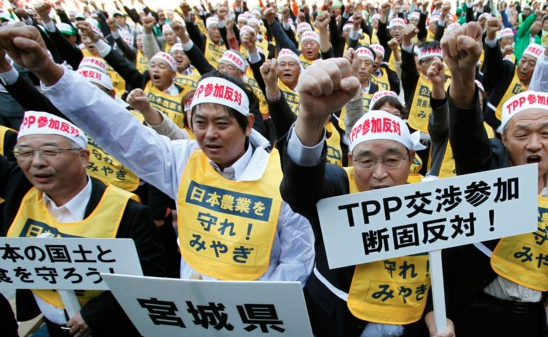
Mass protests in Japan
So, they looked to Japan. It had the same problem with its version of the trade deal similarly called TPP. Mass protests broke out as the same secret meetings gripped the political foreground. Its Prime Minister “Shinzo Abe, instructed the coalition early in the year not to “forcibly” proceed with the TPP negotiations until after elections, Kyodo News reported. Abe genuinely “feared a voter backlash in the Upper House elections” amid the growing scandal of a 242 page leaked document laying bare the bones of the deal. Having been elected June 11th, Abe now intends to force the deal through “this fall”.
I made enquiries with sources close to the ground on the EU/US TTIP deal along the same lines; was this simply a delaying tactic until after elections in 2017 for France’s Hollande and Germany’s Merkel? The response was not wholly unexpected.
“The seemingly early celebration of the end of TTIP has also surprised us a bit. Despite last week’s statements by the German and French trade ministers and the way these have been portrayed, we are continuing to campaign against the deal.”
In another exchange:
“The declarations of French and German leaders aim to: divert attention away from CETA, reduce the numbers in the streets of Germany on 17th September, put TTIP on hold while elections take place in France, Germany and the USA. The fifteenth round of TTIP negotiations will happen in the first week of October… This has been confirmed by our US friends.”
I then contacted Corporate Europe Observatory (CEO). It is a research and campaign group working to expose and challenge the privileged access and influence enjoyed by corporations and their lobby groups in EU policy making. They have been exposing the misinformation and propaganda of the EU Commission for years.
The CEO response to my same question was emphatic and quite clear:
“Public opposition to CETA and TTIP has led French and German leaders to please voters with words against TTIP. Unfortunately, the next round of TTIP negotiations is scheduled for early October and no EU leader has publicly said he or she will vote against CETA in the EU Council in October. This is clearly not the end of TTIP and CETA, just the beginning of electoral campaigns in France and Germany.”
Germany and France have taken the same stance as Japan on these trade agreements, they are not dead at all – they are lying.
I then spoke to Peter Koenig, an economist and geopolitical analyst. He is also former World Bank staff and worked extensively around the world in the fields of environment and water resources and posed the same question. He said:
“Following a debate on PressTV Edition Française, where I was one of the interviewees, the focus was on the German and French Ministers’ expressed conclusion that TTIP negotiations failed. I wrote an article “The TTIP is Dead”, hoping that spreading of this ‘promise’ by the highest authorities of the two key countries in the EU would make sure among the European populace that any deviation from this ‘promise’ would be perceived as a lie and receive strongest public expressions of protest.”
“In the meantime, it has become clear that the TTIP and TISA ‘deals’ are not at all dead. In fact, shortly after the German and French announcements, Jean-Claude Juncker, the unelected President of the European Commission, declared majestically that for him the negotiations are not dead.”
Koenig continues,
“There are other means to infiltrate the TTIP into the EU, i.e. through CETA and according to Juncker, doesn’t need ratification of each EU members’ parliament. Then there is TISA, the even more secret ‘trade agreement’ between 50 countries around the globe. TISA could easily be used to clandestinely impose TTIP rules on Europe.”
Nick Dearden, Director of Global Justice Now confirmed what Peter Koenig is saying in a Guardian piece “Think TTIP is a threat to democracy? There’s another trade deal that’s already signed”
“TTIP is not alone. Its smaller sister deal between the EU and Canada is called CETA (the Comprehensive Economic and Trade Agreement). CETA is just as dangerous as TTIP; indeed it’s in the vanguard of TTIP-style deals, because it’s already been signed by the European commission and the Canadian government. It now awaits ratification over the next 12 months.
The one positive thing about CETA is that it has already been signed and that means that we’re allowed to see it. Its 1,500 pages show us that it’s a threat to not only our food standards, but also the battle against climate change, our ability to regulate big banks to prevent another crash and our power to renationalise industries.
CETA contains a new legal system, open only to foreign corporations and investors. Should the British government make a decision, say, to outlaw dangerous chemicals, improve food safety or put cigarettes in plain packaging, a Canadian company can sue the British government for “unfairness”. And by unfairness this simply means they can’t make as much profit as they expected. The “trial” would be held as a special tribunal, overseen by corporate lawyers.”
What is missing from this statement is that any American corporation headquartered in Canada can sue any nation in the EU via CETA for the same reasons – namely, loss of ‘expected’ profits. They don’t actually have to be Canadian corporations.
As Global Justice also confirms, Canada has itself fought and lost a plentiful and diverse range of legal cases brought by US corporations under the North American Free Trade Agreement (Nafta) for “outlawing carcinogenic chemicals in petrol, reinvesting in local communities and halting the devastation of quarries.” If TTIP doesn’t bring this horrific erosion of democratic power to the shores of Europe, CETA will. ‘Brexit’ will mean for nothing. It will be sold to the British people as a global trade agreement which will be heralded as a great success and supported by much of the media who themselves have a vested interest in such deals.
In the end, does it matter if it’s called TTIP, CETA, TISA and the like, they are all shadowy unaccountable acronyms designed to enrich the few via extreme neoliberal capitalism under the guise of free trade.
Uruguay’s Withdrawal From TiSA Trade Deal in Country’s Interests
Sputnik – 15.10.2015
Uruguay’s most important services are transport and tourism, “and these are already liberalized,” therefore the country has “much to lose and little to gain” in the Trade in Services Agreement (TiSA) free trade deal, according to an Uruguayan senator.
Uruguay’s withdrawal from the Trade in Services Agreement (TiSA) free trade agreement talks was in the country’s interests, as the proposed deal is designed to serve mainly the United States and the large corporations, an Uruguayan senator told Sputnik.
TiSA is a proposed international trade deal between 24 parties, initiated by the United States and EU member states, to open up trade in services to a greater degree than allowed by the current General Agreement on Trade in Services (GATS). Last month, Uruguay announced that it had pulled out of the multilateral negotiations. Paraguay followed suit shortly afterwards.
“It is not convenient to participate in these kinds of treaties as they mainly follow the line of interests of the United States and transnational [corporations],” Frente Amplio’s Marcos Otegui said, adding that the decision to abandon the talks was supported by a “large majority.”
According to the senator, Uruguay’s most important services are transport and tourism, “and these are already liberalized,” therefore the country has “much to lose and little to gain” in this deal.
Uruguay is betting on regional integration, but is open to the world, the senator stressed
“Today Uruguay deals with more than 160 countries… during much of the 20th century it only traded with 40 countries, therefore regional integration does not put a limit on trading with the world,” he said.
TiSA opponents argue that the controversial deal only seeks to tear down trade barriers to services Washington wants to sell abroad and paves the way for supranational labor laws, as well as finance and industrial policies that will undermine a national government’s ability to protect its citizens.
Not Over Yet: Some Tough Votes Ahead on Fast Track
By Kevin Zeese and Margaret Flowers | Flush the TPP | June 13, 2015
While we all cheered the failure (TAA) to pass Trade Adjustment Assistance in the hope that its defeat would stop Fast Track, the House quickly voted to pass Fast Track Trade Promotion Authority (TPA) with 219 votes (218 is a majority but there were some abstentions). This situation means that the House and Senate have not passed identical versions of Fast Track (because the Senate version includes TAA) so Fast Track cannot go to the President’s desk yet to be signed into law. There are several possible scenarios ahead that leave the outcome of the fight against Fast Track uncertain.
While much of the media described today’s votes as a complete victory for those who oppose Fast Track and the Obama trade agenda, the fact is that we have some difficult challenges ahead. We won an important battle, and it was a tremendous victory especially when it is considered that President Obama did all he could including a special trip to the Congress for a private meeting with the Democratic leadership and the entire Democratic Caucus.
But, it is not over. Speaker Boehner called for reconsideration of TAA and a re-vote is supposed to happen within two legislative days so there may be another vote as early as Monday afternoon. We need to hold the line on TAA to prevent any form of TAA from passing the House and prepare for a vote in the Senate if a new form of TAA passes or if the TPA bill passed in the House goes back to the Senate without TAA.
Possibilities in the House
Since we won by a large majority on TAA in the House with a vote tally of 302 to 126 (76 vote difference), it is unlikely (but not impossible) that the current form of TAA would pass in a re-vote. No doubt this weekend President Obama is working overtime to convince Democrats to change their vote and Majority Leader Boehner is looking for Republicans to go against their views and vote for TAA. One Member told us after today’s vote that it is now a game of numbers. Politico does the numbers:
House Republican leaders say they have 100 votes for TAA, and Democrats would need to provide 118 if another vote happens. On Friday, Democrats provided 40 votes for TAA, while 86 Republicans supported it. In other words, Democrats would need to essentially triple their vote total to pass the measure.
If increased Democratic support cannot be achieved, passage would very likely require a mixture of Republicans voting for TAA in order to pass Fast Track and Democrats changing their position because they do not want to embarrass the president. Today, many of the “no” votes came after TAA failed to get a majority and everybody knew it would fail so they voted “no” or switched their vote to “no”. How firm are the votes of those who joined in after it had already failed? If the current TAA is not amended and it passes in the re-vote, there would be no need for any further action in the Senate and Fast Track would become law.
If the re-vote fails, a second possibility is for TAA to be re-written and voted on as a new bill in order to gain majority support. There were three problems with the current form of TAA: (1) Funding TAA by Medicare cuts; (2) Too small a budget; and (3) Failure to cover all workers, especially public workers.
The Medicare cuts were most significant in that almost no Democrat wants to be on record voting against Medicare. Prior to the vote, leadership of both parties came up with an alternative source of revenue (tax enforcement revenue). If this were written into a new TAA, the Medicare problem could be solved. It is not clear how real these tax enforcement dollars are so House leadership could also expand the budget for TAA and solve the budget problem as well. These two changes alone might be enough to gain a lot of Democratic votes. These changes would probably not lose a lot of Republican votes; in fact, Republican leadership still might be able to convince a group of Republicans to vote for TAA in order to get Fast Track passed.
The third problem is a significant one especially since under the Trade In Services Agreement (TISA) public workers will be threatened. For example, TISA could result in privatizing the US Postal Service which is the nation’s second-largest civilian employer after Wal-Mart with about 536,000 career workers. Adding public workers to TAA would require additional funding since more workers would be covered and this might be unpopular with Republicans.
If TAA is amended and passed in the House, the Senate would have to vote again – the House bill could either go to the Senate and be voted on as an original bill; or it could go to a conference committee where differences would be ironed out and then both chambers (House and Senate) would have to hold a re-vote.
We want our allies in the House to vote “no” on TAA no matter what kind of amendments are made to the bill. Now that TPA has passed, stopping TAA is critical for stopping Fast Track. The House TPA (Fast Track) without TAA would be much more difficult to pass in the Senate. Our goal in the House is for TAA bill to be defeated.
The Senate
When TPA came before the Senate, it was bundled together as one bill with TAA. It took a 62-38 vote to end debate on the bill and allow it to move forward. Other than Senators Collins (R-ME), Lee (R-UT), Paul (R-KY), Sessions (R-AL), Shelby (R-AL) and Enzi (R-WY) (who did not vote), all Republicans voted for the bill. In order to stop TPA in the Senate on a re-vote, three additional votes would be needed to prevent the new bill from reaching 60 votes and passing.
One possible scenario is that the House fails to pass TAA and sends a TPA bill to the Senate without TAA. This would be the most likely scenario that would lead to failure in the Senate. There were many Senators who insisted on TAA being included, indeed, some wanted a larger TAA. In addition, Senator Maria Cantwell (D-WA) was promised that the Export – Import Bank would be renewed in order to get her vote, that promise was not fulfilled so she is a possible “no” vote if this returns to the Senate.
The other possibility is that the House passes TAA in its present form or a new version. This would make it very difficult to stop TPA in the Senate. Other than Cantwell, it is hard to see who would change their vote. Senator Lindsay Graham (R-SC) had insisted that currency manipulation be included in the TPA. It wasn’t but he voted for the TPA anyway. Perhaps now that he is running for president, he might vote against TPA.
Our Task
The immediate task is to pressure Members of the House of Representatives to oppose any form of TAA.
Once again the Congress needs to be flooded with phone calls from across the political spectrum. The populist rebellion that has been taking place, especially during the last week, needs to continue so that Members of Congress know that they are risking their future election if TPA becomes law and rigged corporate trade agreements are given an easy path to becoming law.
It is also important to remind Members while they are home this weekend that you want them to vote “no” on TAA. Here is a link to a list of those Members who voted “no.” Thank your Member if she or he voted “no” and tell her or him to stay strong and not to compromise. Perhaps there will be an opportunity to reach her or him at a public event this weekend.
The Rigged Trade Rebellion was outside the Capitol all week. Once the vote was announced on Wednesday it became a 24 hour a day encampment until the vote on Friday.
The Popular Resistance Rapid Response Team will return to Capitol Hill on Monday to continue the Rigged Trade Rebellion. If you are able to make it to DC, we encourage you to come. This is a critical time to make the opposition to Fast Track highly visible. We have been staying at the corner of Independence Ave and New Jersey Ave SE so that we can speak to Members as they walk back and forth between their offices and the Capitol for votes.
One staffer mentioned to us that Members sometimes decide how they will vote just minutes beforehand. It could be that seeing your sign or speaking with you just prior to a vote could make a difference in what they do.
We still have the possibility of stopping Fast Track. Let’s put it over the edge in the next few weeks. You can follow the work to stop Fast Track at www.FlushtheTPP.org. And contact gro.ecnatsiseRralupoP@eiznekcaM if you have questions or are planning to come to DC.
Meet TISA: Another Major Treaty Negotiated In Secret Alongside TPP And TTIP

By Glyn Moody | Techdirt | April 29, 2014
This Wednesday evening there is to be a “Public Information Session and Discussion” (pdf) about TISA: the Trade in Services Agreement. If, like me, you’ve never heard of this, you might think it’s a new initiative. But it turns out that it’s been under way for more than a year: the previous USTR, Ron Kirk, informed Congress about it back in January 2013 (pdf). Aside from the occasional laconic press release from the USTR, a page put together by the Australian government, and a rather poorly-publicized consultation by the European Commission last year, there has been almost no public information about this agreement. A cynic might even think they were trying to keep it quiet.
Perhaps the best introduction to TISA comes from the Public Services International (PSI) organization, a global trade union federation representing 20 million people working in public services in 150 countries. Last year, it released a naturally skeptical brief on the proposed agreement (pdf):
At the beginning of 2012, about 20 WTO members (the EU counted as one) calling themselves “The Really Good Friends of Services” (RGF) launched secret unofficial talks towards drafting a treaty that would further liberalize trade and investment in services, and expand “regulatory disciplines” on all services sectors, including many public services. The “disciplines,” or treaty rules, would provide all foreign providers access to domestic markets at “no less favorable” conditions as domestic suppliers and would restrict governments’ ability to regulate, purchase and provide services. This would essentially change the regulation of many public and privatized or commercial services from serving the public interest to serving the profit interests of private, foreign corporations.
The Australian government’s TISA page fills in some details:
The TiSA negotiations will cover all services sectors. In addition to improved market access commitments, the negotiations also provide an opportunity to develop new disciplines (or trade rules) in areas where there has been significant developments since the WTO Uruguay Round negotiations. There negotiations will cover financial services; ICT services (including telecommunications and e-commerce); professional services; maritime transport services; air transport services, competitive delivery services; energy services; temporary entry of business persons; government procurement; and new rules on domestic regulation to ensure regulatory settings do not operate as a barrier to trade in services.
If that sounds familiar, it’s because very similar language is used to describe TAFTA/TTIP, which aims to liberalize trade and investment, to provide foreign investors with access to domestic markets on the same terms as local suppliers, to limit a government’s ability to regulate there by removing “non-tariff barriers” — described above as “regulatory settings” — and to use corporate sovereignty provisions to enforce investors’ rights.
Those similarities suggest TISA is part of a larger plan that includes not just TAFTA/TTIP, but TPP too, and which aims to cement the dominance of the US and EU in world trade against a background of Asia’s growing power. Indeed, it’s striking how membership of TISA coincides almost exactly with that of TTIP added to TPP:
The 23 TiSA parties currently comprise: Australia, Canada, Chile, Chinese Taipei, Colombia, Costa Rica, European Union (representing its 28 Member States), Hong Kong, Iceland, Israel, Japan, Liechtenstein, Mexico, New Zealand, Norway, Pakistan, Panama, Paraguay, Peru, Republic of Korea, Switzerland,, Turkey and the United States.
Once more, the rising economies of the BRICS nations — Brazil, Russia, India, China, South Africa — are all absent, and the clear intent, as with TTIP and TPP, is to impose the West’s terms on them. That’s explicitly recognized by one of the chief proponents of TISA, the European Services Forum:
the possible future agreement would for the time being fall short of the participation of some of the leading emerging economies, notably Brazil, China, India and the ASEAN countries. It is not desirable that all those countries would reap the benefits of the possible future agreement without in turn having to contribute to it and to be bound by its rules.
The Australian government’s page reveals that there have already been five rounds of negotiations — all held behind closed doors, of course, just as with TTIP and TPP. The Public Information Session taking place in Geneva this week seems to mark the start of a new phase in those negotiations, at least allowing some token transparency. Perhaps this has been provoked by the growing public anger over the secrecy surrounding TPP and TAFTA/TTIP, and fears that the longer TISA was kept out of the limelight, the worse the reaction would be when people found out about it.It seems appropriate, then, that the unexpected unveiling of this new global agreement should be greeted not only by an updated and more in-depth critique from the PSI — “TISA versus Public Services” — but also the first anti-TISA day of protest. Somehow, I don’t think it will be the last.
Follow me @glynmoody on Twitter or identi.ca, and +glynmoody on Google+
Featured Video
America Racing to Strategic Defeat in Iran
or go to
Aletho News Archives – Video-Images
From the Archives
Should Europeans ‘Thank’ the Americans for Destroying Nord Stream?
By Robert Bridge | Strategic Culture Foundation | September 29, 2022
With an investigation continuing into the destruction of the Nord Stream gas pipeline that provided energy supplies to Europe from Russia, there appears to be just one prime suspect, and that should surprise nobody.
Following the sabotage of the Nord Stream 1 and 2 gas pipelines, former Polish Foreign Minister Radoslaw Sikorski already seemed to know the identity of the perpetrator when he tweeted out: “Thank you, USA.”
At first glance, it seemed that Sikorski was speaking sarcastically, berating Washington for carrying out an attack that will have severe repercussions for the people of Europe. After all, how could anyone see any good coming from the termination of Europe’s primary source of gas reserves with winter just around the corner? It was Sikorski’s homeland of Poland, after all, that urged its citizens to collect firewood in the face of dwindling gas reserves.
In fact, the Polish diplomat was speaking one-hundred percent literally… continue
Blog Roll
 Aletho News
- Tehran approves new Hormuz plan with major restrictions
- No Threat Can Force Iran’s Surrender /Trita Parsi & Lt Cl Daniel Davis
- UK’s New Pandemic Plan Would Turn Big Tech Into a Mass Location Tracking Network
- Growing insecurity, soaring prices fuel protests in north as regime bans evacuation: Sources
- Iran denies responsibility for ‘depraved’ attack on Kuwait desalination plant
- Bring The Troops Back. End This War Now!
- Can we please stop calling Israel the ‘only democracy in the Middle East’ now?
- US should start removing its troops from Germany, proposes AfD co-leader Chrupalla
- Iran Red Crescent: 600 educational centers attacked in US-Israeli ‘war crimes’
- Russian Oil Tanker Arrives in Cuba Amid U.S. Blockade
- If Americans Knew
- As Iran targets US military bases, will they be relocated to Israel? Not a ceasefire Day 171
- Will Trump Go Kamikaze?
- Is the University of Florida Shutting Down College Republicans over Israel Criticism?
- Jewish extremist arrested over alleged plot to firebomb Palestinian activist Nerdeen Kiswani’s home
- More than half of Palestinian child detainees have no charges
- The More Murderous Israel Gets, The More We Hear About “Antisemitism”
- Land Day and the Palestinian struggle after 30 months of genocide
- The Iran War Is About Palestine
- Israeli soldiers echo settler ideology, talk of revenge after targeting Palestinians and detaining CNN crew in the West Bank
- Israeli Policies Threaten Future of Christian Schools in Jerusalem
- No Tricks Zone
- New Study Finds Warming Saves Lives…Cold Temperatures 12 Times More Deadly Than Excess Heat
- German Science Blog Accuses PIK Climate Institute Of Hallucinating Climate Tipping Points
- Devastating Assessment Of Comirnaty Vaccine By Former Senior Pfizer Europe Toxicologist
- New Study: CO2 Is ‘Effectively Negligible’ As An Explanatory Climate Change Factor Since 2000
- Former Pfizer Toxicologist Dr. Helmut Sterz Tells Bundestag Hearing Pfizer Vaccine Should Have Never Been Approved
- Energy Expert: Germany’s Nuclear Phaseout Was A “500 Billion Euro Mistake”
- New Research: South Australia’s Mid-Holocene Sea Surface Temperatures Were 4°C Warmer Than Today
- Storing Green Energy To Last Germany 10 Days Would Require A 60-Million Tonne Battery
- New Studies: UK Sea Levels Were 4 Meters Higher Than Today During The Mid-Holocene
- Destructive Green New Deal: German Energy And Metal Group Warns Of Drastic Crisis
 Aletho News