Are You On a Secret TSA Watchlist?
By Jim Bovard | The Libertarian Institute | October 7, 2025
In 1999, the Supreme Court recognized that the “‘constitutional right to travel from one State to another’ is firmly embedded in our jurisprudence.” Unless, of course, federal agents secretly disapprove of you, your beliefs, or your suspected connections.
The Transportation Security Administration has vexed Americans for more than twenty years. Last week, three separate idiotic TSA surveillance programs were exposed by Congress and the Trump administration.
In 2021, the Transportation Security Administration (TSA) created a secret watchlist of individuals who publicly opposed President Joe Biden’s COVID mask mandate. Operation Freedom to Breathe resulted in dozens of individuals being either banned from flying or hit with additional groping or patdowns. As journalist Matt Taibbi reported, “12 were placed on a watch list for removing their masks in-flight,” which a TSA memo characterized as “an act of extreme recklessness in carrying out an act that represents a threat to the life of passengers and crew.” That covert crackdown only ended when a federal judge struck down Biden’s mask mandate in April 2022. Only in Washington would an edict to banish all dissidents be labeled Operation Freedom to Breathe.
The Biden’s TSA secretly condemned hundreds of people allegedly linked to the January 6, 2021 Capitol protests. TSA approved “enhanced screening” and watchlists for anyone “suspected of traveling to the National Capital Region” for that protest, Senator Rand Paul (R-KY) revealed. TSA bloated the list of January 6 suspects by tapping a George Washington University database of alleged extremists—which was as credible as randomly selecting names of Trump donors. A TSA privacy officer protested, “TSA is punishing people for the expression of their ideas when they haven’t been charged, let alone convicted of incitement or sedition.”
New dirt also came to the surface about the Quiet Skies program, which sent TSA air marshals to covertly surveil travelers on the flimsiest pretexts. If you fell asleep or used the bathroom or glared at noisy kids during a flight, those incriminating facts might have been added to your federal dossier. Air marshals noted whether suspects gained weight or were balding or were paranoid about the undercover federal agents who followed them into the parking lot to their cars. If you fidgeted, sweat, or had “strong body odor”—BOOM! the feds were onto you. Air marshals also zeroed in on “facial flushing,” “gripping/white knuckling bags,” “face touching,” or “wide open, staring eyes,” and “rapid eye blinking.”
Quiet Skies, which cost $200 million a year, was scandalized last year after it targeted former congresswoman Tulsi Gabbard (currently the Director of National Intelligence) after she criticized Democratic presidential nominee Kamala Harris. Turns out Quiet Skies was also tracking three Republican congressmen prior to the program being abolished in June. TSA has not yet revealed the names of those congressmen.
Legions of women bitterly complain on social media about TSA screeners molesting them. But if a woman pushes a TSA screeners hands away from her breasts, then she can placed on the TSA secret “95 list” of potentially troublesome travelers. TSA’s official watchlist defines troublemaker to include someone who merely “loiters” near a TSA checkpoint or demonstrates any “concerning behavior.” Any behavior which is “offensive [to the TSA] and without legal justification” can get a person secretly listed, according to a confidential TSA memo. TSA assistant administrator Darby LaJoye told Congress that any traveler who demonstrated “concerning” behavior can be secretly placed on the list. “Concerning behavior” is vague enough to add 10,000 chumps a day to the watchlist. The TSA would have been more honest if it announced that anyone who fails to instantly and unquestioningly submit to all TSA demands is guilty of insubordination.
TSA can also place someone on the watchlist simply because they are “publicly notorious.” Did getting denounced by TSA chief John Pistole in 2014 for “maligning” and “disparaging” TSA agents in an op-ed qualify me for the list and endless TSA supplemental patdowns when I travel? The Brennan Center for Justice warned that TSA could add “pretty much anyone with even a modest public profile, such as journalists or activists,” to the “95 list.” ACLU attorney Hugh Handeyside warns that the new watchlist “permits TSA officials to blacklist people for conduct that could be wholly innocuous. This is conduct that’s so completely subjective, and in many cases likely completely innocent, it just gives officers too much latitude to blacklist people arbitrarily and to essentially punish them for asserting their rights and in doing anything other than complying with officers’ demands.”
There are other TSA surveillance programs and watchlists that desperately need sunshine if not legal de-lousing. A 2023 report by the U.S. Senate Homeland Security and Governmental Affairs Committee noted that “U.S. travelers may be screened for at least 22 different reasons.” An Iron Curtain of secrecy covers the operation:
“The executive branch has revealed hardly any information about what watchlists it maintains, who is included, and why or how those lists are used.”
DHS receives requests from almost 20,000 people a year complaining about being banned from flying or subjected to enhanced screening, and 98% of those people are not on terrorist watchlists, according to TSA.
The Senate report revealed the existence of TSA’s Security Notification List which “includes individuals who may pose a threat to aviation security, but who do not warrant additional screening.” So if they pose a threat to airline safety, why are they permitted to fly? The report noted:
“These individuals may seek to intentionally evade or defeat security measures or may attempt to disrupt the safe and effective completion of screening…Individuals on this list may not be referred for additional screening solely by virtue of their placement on this list, but TSA personnel may be given forewarning of their travel.”
Is this simply the “Bad Attitude List” or the “Give Hell to Anyone Who Complained Since 9/11 List”?
The Senate report warned, “A watchlist that is not properly maintained… breaks the trust with innocent Americans who get caught up in this net with no way out.” TSA watchlists are perilous to freedom because TSA proudly hires many employees who failed every intelligence test they ever took. “Senator Ted Kennedy and former U.S. Representative John Lewis, and even babies, have been stopped at airports because they shared biographical information with individuals on the [No Fly] terrorist watchlist,” the Senate report noted.
How many other secret watchlists has TSA or DHS not yet revealed? We have no idea how many Americans’ rights and liberties continue to vanish into TSA black holes.
Endless false alarms at TSA checkpoints are a clue that the agency is still on par with a drunk blindfolded person swinging at a pinata. Airport security seems like a perpetual psycho-pathological experiment to determine how much degradation Americans will tolerate. Despite squeezing millions of butts and boobs, TSA has never caught a real terrorist. After pointlessly groping millions of Americans, TSA has no excuse for groping millions more.
US spying on Tulsi Gabbard – whistleblowers

RT | August 7, 2024
The US government has put former Hawaii Representative Tulsi Gabbard on a special air traffic surveillance list, according to a group of Air Marshal whistleblowers.
Gabbard served in Congress for eight years (2013-2021) and ran for the Democratic presidential nomination in 2020, but left the party in 2022 over ideological differences. She is also a lieutenant-colonel in the US Army reserve.
For the Transportation Security Administration (TSA), however, Gabbard appears to be a security risk. Last month, she was placed into the ‘Quiet Skies’ program and monitored wherever she flies, according to the Air Marshal National Council (AMNC).
The outlet UncoverDC reported this week that Gabbard has “two Explosive Detection Canine Teams, one Transportation Security Specialist (explosives), one plainclothes TSA Supervisor, and three Federal Air Marshals [FAMs] on every flight she boards,” citing AMNC director Sonya LaBosco.
AMNC posted on X that the claim came from their whistleblowers, who are ready to go on the record with the appropriate documentation.
The group has also claimed that the TSA and FAMS have “initiated armed government surveillance on high level conservative politicians,” and that the information they intend to reveal will “horrify and sicken you as Americans.”
LaBosco has accused the TSA and its parent department, Homeland Security, of engaging in a “big domestic surveillance grab” that seems to be targeting conservatives. According to the group, Quiet Skies has been used against several people who attended the January 6, 2021 protest at the US Capitol – and their family members, including infants.
According to LaBosco, Gabbard was placed on the list on July 23, a day after she criticized President Joe Biden and Vice President Kamala Harris in a Fox News interview. FAMs were mobilized the very next day and followed her on a July 25 flight, LaBosco said.
Gabbard famously rattled Harris during the 2020 Democratic primary debates, bringing up her prosecutorial record. She also denounced Hillary Clinton as “the queen of warmongers,” after the former presidential candidate accused her of being a “Russian asset.”
Most recently, Gabbard told podcaster Lex Fridman that “all the statements and comments that the [Biden-Harris White House] has made from the beginning of this war essentially point to their objective being to basically destroy Russia.”
Gabbard has not yet commented on the whistleblower revelations. She has just returned from Oklahoma, where she took command of a drill sergeant battalion that runs the US Army basic training program.
According to the TSA, ‘Quiet Skies’ is a tool that allows the FAMS to “focus on travelers who may present an elevated risk to aviation security.” The agency claims to have developed “a set of risk-based, intelligence-driven scenario rules,” under strict DHS oversight and respect for privacy and civil rights.
TSA Still Molesting at Warp Speed
By Jim Bovard | The Libertarian Institute | February 23, 2023
I traveled to Hartford, Connecticut last week for a conference. It was the first time since the start of the pandemic that I had the pleasure of being pawed by TSA agents. Alas, since 2020, neither I nor the Transportation Security Administration have become corrigible.
Flying out of Washington National Airport on Thursday, I saw a special entry for the CLEAR program that enables people who pay $189 a year to skip TSA lines. I lambasted this program here back in December. Travelers stand in photo kiosks that compare their face with a federal database of photos from passport applications, drivers’ licenses ,and other sources. TSA promises that its new airport regime will respect Americans’ privacy. Fat chance: TSA previously promised no traveler would be delayed more than 10 minutes at TSA checkpoints.
I stood and watched semi-frazzled travelers enter a roped-off expanse to get TSA approval for their visage.
A skinny young woman with a CLEAR t-shirt and a clipboard was standing guard at the entrance of the biometric site. She looked like a cherub with long straight red hair and a welcoming smile. Who could suspect that, as The Washington Post warned, the new system could be “America’s biggest step yet to normalize treating our faces as data that can be stored, tracked and, inevitably, stolen”?
“How soon will they be making the biometric checks mandatory?” I asked her.
“I don’t know anything about that,” she replied, as if I’d asked about the surface temperature of the planet Venus.
“Do people ever complain about having to do the biometric checks?
“No, this is voluntary,” she replied with a smile wider than a Kamala Harris grimace.
She was a good Washingtonian: she could never imagine any federal agency flogging hell out of the Constitution. I considered peppering her with another half dozen questions but wanted to keep my sarcasm fresh for dealing with TSA agents. My hunch was that the redheaded cherub was not a regular reader of the Libertarian Institute.
I finished guzzling my morning coffee I fetched from home and tossed the used Gatorade bottle into the giant trash barrel at the entrance to the TSA queue. The previous time I went through a TSA checkpoint at National Airport, TSA agents got riled up because I forgot to take off my belt. That spurred an enhanced patdown, a verbal brawl, and an article I wrote that the Minneapolis Star Tribune headlined, “The World’s Most Incompetent Agency.”
Seeking to avoid another kerfuffle, I sought to comply with the TSA checkpoint regimen.
I took off my boots and belt and took all the metal clutter out of my pockets.
I passed through and—beep—another alarm. WTF?
A TSA agent pointed to the giant video screen on the controlled side of the checkpoint, revealing a bright yellow splotch that proved that my derriere failed federal inspection.
“That’s my wallet,” I said.
“You aren’t allowed to have that in the scanner. We have to do a patdown.”
So I’m supposed to abandon my wallet to rascals notorious for robbing travelers? More than 500 TSA agents have been fired for stealing laptops, cell phones, and other property at checkpoints and in luggage screening.
Another TSA agent shuffled up to find my terrorist contraband. This dude was in his 20s but he looked weary before his time. He explained that he would perform a supplemental enhanced patdown on my backside.
“Are you going to jam my groin?” I growled.
“No, we’re not going to do that.”
“Yeah, OK, whatever.”
He proceeded to run his hands and his TSA Terrorist Catcher Magic Wand over my thighs and butt. I refrained from muttering that he got further than I usually did on first dates long ago. He then checked the inside of my thighs and signaled I could leave. I kept my profanity in reserve for the return flight.
Coming back through Hartford on Sunday afternoon, I was chagrined to see a long line of docile folks waiting to receive TSA blessings. I entered the queue and a scrawny, 70ish guy with his right arm in a sling came in behind me. He was struggling with his carry-on bag so I guessed his arm injury was recent.
He groused that he had paid for TSA Pre-Check but they hadn’t allowed him to use it that day. TSA Pre-Check customers usually avoid Whole Body Scanners—another reminder that the entire system is a charade.
“Where are you going?” he asked.
“I’m going to Washington but I don’t work for the feds.”
“Good,” he replied. He said he was going to Fort Lauderdale and I said that was a helluva friendlier place than D.C.
Over the years, I enjoy drawing out folks to see if they recognize TSA’s “security theater.” This guy got it.
I mentioned that I might have problems today at the checkpoint because TSA hates me.
“Why do they hate you?” he asked.
“Because I have flogged them in print for 20 years. Their scanners fail to catch mock bombs and weapons in 95% of the tests by undercover agents. Their explosive detection tests are so harebrained that they are triggered by hand sanitizer. The TSA chief denounced me for maligning and disparaging TSA employees.”
He smiled.
“But I don’t know why they would ever suspect me because I was a Boy Scout.”
He laughed and said he’d been a Scout as well. “But your hat makes you suspicious,” he added.
It was a bulky brown hat I’d recently picked up in Tennessee. I didn’t realize till afterwards that it was the “Bootlegger” design. I said that if I was flying out of North Carolina, my hat would fit right in. But here in Connecticut, I was screwed.
As we got near the checkpoint, I tugged off my belt and began unlacing my heavy boots. “You can go ahead of me—this will take awhile,” I told the elderly gentleman.
“No, no—you go first,” he insisted. He absolutely, positively did not want to go just before me.
As I stood waiting my cameo in the Whole Body Scanner, I heard him explain to a TSA agent that he had metal knee and hip replacements. They signaled for him to step through a side gate next to the scanner.
I ambled into the screener radiating as much disdain as I could muster on a Sunday afternoon. A TSA agent barked that my feet were in the wrong place; I had to make sure I put my socks in the cut-out drawing. Yeah, yeah…
“Hold your arms up higher,” she ordered.
That woman sounded as dumb as my high school gym teacher.
She signaled me to exit and then another agent came up with a TSA magic wand and signaled that I must halt.
“We have to check you,” a tall, spindly young guy announced.
“What was the problem?” I growled.
“The scanner alerted for something around your shoulders and upper arms.”
I have been working on my bench press lately but I didn’t think the results were that impressive.
He waved the wand and found nothing and signaled I could move along.
“What might have triggered the alert?” I asked.
“I dunno. It could have been the heavy shirt.”
Maybe they thought the wool in my shirt came from sheep that were raised by Al Qaeda in Yemen?
As I tracked down my carry-on bag and boots on the carousel, I saw a TSA agent barking orders to the old guy with the arm in a sling.
“Do you want the supplemental screening to take place here or in a private room?” the TSA agent with a vapid visage badgered him.
I was tempted to shout: don’t go in the private room! But the guy had good instincts and said on his own that he wanted the patdown in public. At least it would be videotaped if the process went to hell in a handbasket.
The agent kept going up and down the old guy with the wand, poking and prodding and repeatedly ordering him to change his posture. The man looked humiliated at being treated like a terrorist suspect in front of so many bystanders. I don’t have that reaction to extra patdowns because I don’t give a damn for the opinions of TSA agents or anyone who happily submits to their boneheaded antics. But I could tell from the expression on the guy’s face that he was shocked.
He was finally released from TSA custody and shuffled with his shoes and belts to a nearby bench. As he was putting himself back together, I came up to offer condolences.
“I think it was the sling—that’s why they targeted me,” he said.
“They could have easily checked if you had a bomb or a gun in the sling without groping you all over but they didn’t do that,” I scoffed.
He put his head down and wished me a good trip.
“As a fellow American, I’m sorry how they treated you.”
My comment seemed to stun him. But more than twenty years after 9/11, TSA has no right to continue treating Americans like convicts waiting to enter a prison shower. TSA has taken menstruating women to private rooms to force them to lower their pants to prove they are bleeding—an abuse that has spurred multiple federal lawsuits. TSA effectively claims that Americans have no constitutional rights because they “voluntarily” submit to searches for permission to fly. That legal hogwash entitles them to endlessly harass hapless citizens.
Despite squeezing millions of butts and boobs, TSA has never caught a real terrorist. TSA should be abolished and replaced by the type of private security companies that protect European and Canadian fliers without endless BS from officialdom.
Jim Bovard is the author of Public Policy Hooligan (2012), Attention Deficit Democracy (2006), Lost Rights: The Destruction of American Liberty (1994), and 7 other books.
TSA to take mug shots of domestic air travelers
By Edward Hasbrouck | Papers, please! | June 8, 2020
The Transportation Security Administration (TSA) has officially although quietly announced that, as it has planned for years, its deployment of mug-shot machines at airport checkpoints will move from pilot projects to the new normal for domestic air travelers.
According to a Privacy Impact Assessment (PIA) released last week, the TSA plans to integrate facial recognition into the Secure Flight profiling, scoring, and control system used by the TSA and other linked agencies to decide who is, and who is not, “allowed” to pass through TSA checkpoints to exercise their right to travel by airline common carrier.
Cameras to photograph would-be travelers’ faces will be added to each of the stations at airport checkpoints where TSA employees and contractors currently scan would-be passengers’ travel documents (boarding passes and, if they present ID, ID documents).
U.S. Customs and Border Protection (CBP), in collaboration with airlines and airport operators, already collects photos of many international travelers. CBP has been moving in fits and starts toward making mug shots mandatory even for U.S. citizens traveling internationally. As of now, mug shots are still officially “voluntary” for U.S. citizen international travelers, although many U.S. citizens have reported not being allowed to opt out. But last month, as we noted in an earlier blog post, the CBP official in charge of deployment of facial recognition said CBP plans to issue a Notice of Proposed Rulemaking (NPRM) for mandatory facial recognition of international travelers before the end of this year.
We expect that, consistent with the TSA’s “biometrics vision for all commercial aviation travelers”, deployment of facial recognition at TSA checkpoints for domestic air travelers will follow the same steps as have been followed by CBP in rolling out facial recognition for international air travelers: first pilot projects, then universal deployment of “optional” mug-shot cameras at airports (on an allegedly “opt-out” basis), then increasingly adverse treatment (delay, more intrusuive and in time of pandemic dangerous groping, etc.) of those who opt out, and eventually — if most travelers “voluntarily” submit to mug shots — denial of travel to those who don’t. The PIA doesn’t say how soon any of this will happen.
The time to say “no” is now, while you still can. Don’t consent to being photographed at TSA checkpoints or airline check-in counters or kiosks. For your own safety as well the protection of your civil liberties, don’t remove your mask! TSA checkpoints, check-in counters, and all kinds of kiosks are among the places at airports where transmission of contagious diseases is most likely. We are very interested in hearing from any traveler who is ordered to remove a face mask.
The TSA claims that domestic air travelers will be allowed to “opt out” of facial imaging, but it will be up to you to spot the cameras and stay out of their field of view. Notably, the TSA’s Privacy Impact Assessment (PIA) doesn’t say what, if any, notices will be posted for travelers to see before they come into range of the mug-shot cameras.
The required notices are dictated by the Paperwork Reduction Act (PRA) and the Privacy Act, but the TSA has ignored both of these Federal laws in its facial recognition plans.
Even if a “collection of information” (including biometric information) by a Federal agency such as the TSA is voluntary, the PRA requires that it be approved in advance by the Office of Management and Budget (OMB) and assigned an OMB control number. That OMB control number and other notices specified by the PRA must be provided to all individuals from whom information is to be collected.
Pursuant to the PRA, no penalties may be imposed for failure or refusal to provide information unless these approval and notice requirements are complied with.
The PIA for facial imaging at TSA checkpoints doesn’t cite an OMB control number, and so far as we can tell, there is none. If TSA checkpoint staff ask you to take off your face mask so that they can take your mug shot, ask for the OMB control number for this information collection and a copy of the applicable Paperwork Reduction Act Notice.
The TSA says that facial images collected by the TSA “will be retained for no longer than 24 hours after the flight departure time.“ But regardless of how long this data is retained, any retention of personal identified information such as mug shots is prohibited by the Privacy Act unless the agency has previously published an applicable System Of Records Notice (SORN) in the Federal Register. Operation of a system of records without proper notice is a crime on the part of the responsible agency officials.
The new PIA for the TSA’s facial recognition scheme for air travelers claims that the data collected would be covered by the Secure Flight SORN promulgated in 2015. But facial images collected at checkpoints are not among the categories of information listed in the SORN as included in that system of records.
The bottom line is that the TSA facial recognition scheme described in the latest PIA would violate both the PRA and the Privacy Act. To the extent that it would require or induce travelers to remove their face masks, it would exacerbate the pandemic hazards of travel to the health of travelers and airline, airport, and TSA staff and contractors.
Woman Sues TSA for Inserting Fingers Inside of Her During “Search”
By Jonathan Corbett | Professional Troublemaker | March 9, 2020
Michele Leuthauser was traveling from Las Vegas-McCarran International Airport last June wearing yoga pants that should have made it quite easy to determine that she was concealing nothing on the lower half of her body. But, because the TSA uses body scanners with a false positive rate somewhere in the range of 20-40% (some studies higher), Michele was flagged for additional screening: a pat-down of her “groin area.”
Unfortunately, a yet-to-be-identified TSA screener used this as an opportunity to violate Michele. While typically body scanner alarms are resolved with a quick and limited (yet still often invasive) pat-down right next to the machine, the screener directed Michele to a “private room.” Screening in a private room is supposed to be an option offered to passengers who feel more comfortable (an option I advise all travelers against taking at all costs), but for Michele it was mandatory.
 When doing pat-downs, the TSA has little mats with footprints painted on to indicate to the passenger how to stand. But, the screener told Michele to spread her legs far wider than the mat — an order that seems common for TSA screeners about to inflict abuse.
She then proceeded to rub her hand on Michele’s vulva, pressing firmly enough to penetrate her labia with her finger through her leggings, and then continuing to rub her vulva until Michele, in shock, finally recoiled and told the screener to stop.
On Friday, I filed suit on behalf of Michele after TSA supervisors, local police, and TSA’s Office of the Chief Counsel refused to do anything about this incident.
While TSA policies (and the Constitution) obviously prohibit checkpoint body cavity searches, no one seems to care when normal screening turns to blatant sexual assault. I look forward to giving TSA incentive to care in the U.S. District Court for the District of Nevada.
Leuthauser v. TSA – Complaint (.pdf)

Jon Corbett is a civil rights attorney known for filing the first lawsuit against the deployment of TSA nude body scanners, as well as defeating the body scanners live in “How to Get ANYTHING Through TSA Nude Body Scanners.” Twitter: @_JonCorbett, Web: https://professional-troublemaker.com/
I Was Harassed, Wrongfully Detained, Then Had “Evidence” Planted On Me At the Airport
By Eric Striker • National Justice • January 9, 2020
It all started yesterday evening when I arrived at Pittsburgh International Airport in the rustbelt township of Moon, Pennsylvania for a flight to Boston.
I approached the Kiosk to print my ticket and immediately got an error, asking I go get my boarding pass from the airline’s main booth. I followed the instructions.
There, the woman typed my information in and made a phone call. After a lengthy 20 minutes, she gave me the phone and asked me to “listen” while she briefly walked away. This most likely was a way to get whatever Department of Homeland Security surveillance team to identify me and watch me through the camera.
Shortly after, my ticket printed with the dreaded SSSS – Secondary Security Screening Selection. This is the first time it has ever happened to me (I last flew less than a year ago). The SSSS list is reserved for suspected terrorists and criminals, of which I am neither. There are millions of people on the list, with random samplings finding that up to 40% of people on it have inaccurately registered records. Furthermore, a federal judge last September found that the practice is unconstitutional. I’ve been traveling largely by bus and car to work on news stories or visit friends so I was caught off guard.
Little did I know I was in for an annoying and long night, but I didn’t expect how bad it would be. I have heard from other peaceful dissidents and journalists that they have been harassed like this at the airport for the past year.
I used the restroom then approached the TSA line. They took me to a separate, cordoned off section and began the invasive and downright ridiculous process.
As one man meticulously poked and prodded my frank-n-beans from every angle, a senior citizen checked every nook and cranny of my wallet along with the bristles of my toothbrush for…I’m not sure exactly. I made sure that none of my electronics (phones and laptops) were being illegally searched, which they didn’t, they only ask you to turn them on.
In the commotion (at least 7 TSA agents surrounded me) a woman was asking me for personal information, like my latest home address. My response to her was to ask whether it was mandatory to give it to her. She did not say whether it was mandatory, but kept asking over and over again for my information and I refused to give it. I don’t have anything to hide, but the principle stands.
When the search concluded (about 20-30 minutes), they found a secondary phone I use that happened to be out of batteries. They asked me to turn it on, which I agreed to but needed to charge it. The TSA supervisor told me it was against protocol, and escorted me with all of my stuff back outside to charge my phone, telling me that I would have to do the search all over again from scratch.
At this point I was going to miss my flight. I summoned the supervisor again, who was very polite and friendly to my face, to demand a place where I can complain for my atrocious treatment and that I be compensated for my airline ticket. I informed him that I was a journalist and that being treated like a member of Al Qaeda on my way to a domestic flight was confusing and humiliating.
He gave me a TSA card and in my frustration over the bullshit I had just endured, decided to leave the airport to find different transportation to my destination that would be free of these silly theatrics.
As I walked away, a female police officer named Deb Spotts approached me to ask me why I had gone into the TSA security and back out. I told her they had asked me to go out and charge my phone. She then demanded to know why I had used the bathroom, to which I responded “to take a piss.”
She asked me for identification, and my response was to ask her if I was being detained and was free to leave over and over again. She radio’d her Sergeant, Michael Kuma, who gave the order to arrest me. Multiple police officers, including one carrying an assault weapon, grabbed me and put me in handcuffs.
The entire time I was loudly asking in front of others in the airport lobby why I was being detained, what their probable cause was, and that I wanted to call a lawyer. The police officers transporting me told me that they did not know why I was being detained, which is absurd.
I specifically told the officers that I did not consent to any search of any of my belongings, which they mostly respected. My things were put in a bucket in front of my cell and I was in there for about an hour.
Finally, Sergeant Kuma emerges with his team. I asked him for an explanation.
According to Kuma, the TSA inspectors had “felt” two bullets in one of the tight sleeves of my flight jacket. I have never owned a firearm nor have been shooting.
I asked Kuma why I was not dogpiled and detained during the TSA special suspected terrorist screening process if they thought I was trying to bring bullets on board. Kuma’s response is that bringing bullets on a flight was not illegal, which is a flagrant lie!
I then gave Kuma permission to search my jacket and show me the supposed bullets in my possession. He took his time, briefly got the jacket out of my sight, then acted like he was struggling to get the “bullets” out.
Then, all the cops smiled at me while Kuma said “oh wow, they’re only pen caps!”
He then pulled out black bullet-shaped pen caps from my jacket as I looked on in disbelief. I don’t carry or use pens at all.
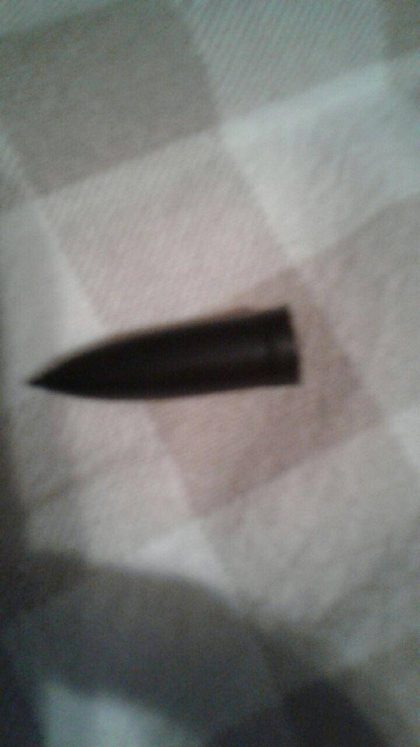
I showed the pen cap to a friend who actually runs an office supply store. He said the weird bullet shaped plastic caps might belong to a mechanical pencil, which I also do not carry around and have never while owning the jacket I was wearing. Kuma I believe threw one of them away, but when I realized what was going on I said “no, that’s my property, I’ll keep it” for the second one.
These were beyond all reasonable doubt planted on me after they put me in handcuffs. Judging from the big sarcastic smiles on the police officers’ faces as I was finally let out of my cell, they were planted on me at the precinct, probably by Sergeant Kuma himself when he needed an excuse for why I was being locked up.
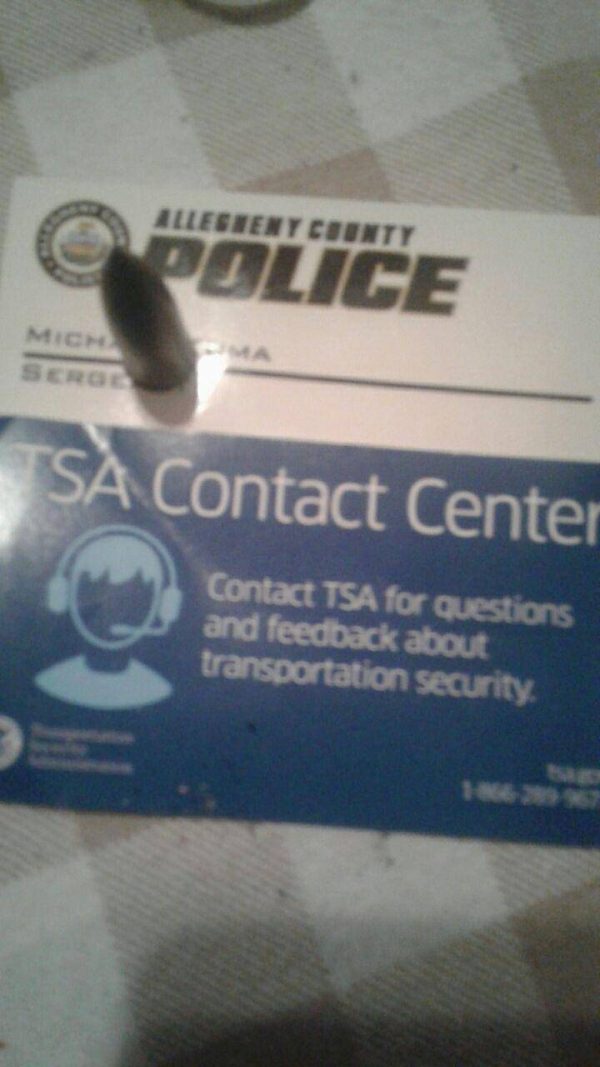
I then obtained the Sergeant’s business card, with a phone number on the back to be able to get the police report of my illegal arrest. He told me to wait a while because it takes time to get it in the system. I have a funny feeling this police report will never materialize but will be trying anyway.
These kinds of shenanigans are so stupid I’m almost tempted to laugh about this myself. I’m relieved they didn’t plant actual bullets on me, though that would’ve added a whole new layer of bullshit for them too. This type of petty corruption would be a joke if it wasn’t part of a wider system the federal government has in place that has no law enforcement value and is intended solely to intimidate and inconvenience journalists and people with First Amendment protected opinions they don’t like.
The big question I have, and will be investigating, is how did I get on the SSSS list, along with many others I know who engage in peaceful advocacy or dissent? Why in the last year, and all of my life, have I flown without any problems prior to this?
The Department of Homeland Security keeps the criteria for being a “selectee” very private, likely due to the civil liberties ramifications of the system as they drastically expand how many people are targeted and why. As someone who hasn’t even been harassed by the FBI or accused of anything, occam’s razor tells me that in my case and others, they are using a purely political criteria. The only scenario for what just happened is that they are deferring to the Southern Poverty Law Center for names and adding them to the list uncritically. If it came out, it would be a scandal, as the SPLC is a highly discredited, agenda-ridden and universally despised organization.
There is a small chance that it is a case of mistaken identity, but I doubt it. I will be looking into applying for the DHS Traveler Redress Inquiry Program (TRIP) and will see what they tell me.
National Justice is over the target indeed!
Homeland Security’s Multibillion-Dollar Comedy Show
Image by James Bovard
By James Bovard | FFF | December 26, 2017
After the 9/11 attacks, Congress and the Bush administration pretended that unlimited federal spending was one of the best ways to thwart terrorist threats. In 2002, Congress created the Homeland Security Department (DHS), sweeping some of the most inept federal agencies, such as the Secret Service and the Federal Emergency Management Agency (FEMA), into the new mega-department. Congress also created numerous programs — some run directly by FEMA — to shovel out more than $30 billion in anti-terrorism funding to local and state governments.
As Sen. Tom Coburn (R–Okla.) observed a few years ago, “FEMA’s lax guidelines and oversight made the agency a virtual rubberstamp for most anything that grant recipients creatively justified as related to homeland security — regardless of how loosely related.” Louisiana Homeland Security grant recipients spent $2,400 for a lapel microphone and $2,700 for a teleprompter. Fort Worth, Texas, spent $24,000 of a federal anti-terrorism grant on a latrine-on-wheels. Other Texas local governments spent Homeland Security grants on “a hog catcher for Liberty County, body bags, garbage bags, Ziploc bags and two 2011 Camaros at $31,000 apiece,” as a Senate report revealed.
DHS approved a Michigan police department’s spending $6,200 of its grant on 13 sno-cone machines. The Senate report noted that local officials “defended the sno-cone purchases saying the machines were needed to treat heat-related emergencies.” DHS also asserted that the machines were “dual purpose” because they “could be used to fill ice packs in an emergency.”
The Jacksonville Urban Area Security Initiative used a DHS grant to produce an 8-minute film entitled “Domestic Terrorism: The First Line of Defense.” The film urged viewers to report any suspicious activity and to be especially wary of people that are “alone or nervous” or people “of average or above average intelligence” (unlike the people who made the film). People were also told to be on the lookout for residents who displayed “increased frequency of prayer or religious behavior.” As a Techdirt analysis pointed out, “Broadly defined ‘suspicious behavior’ is a great way to make every citizen a suspect … and justify every violation of personal privacy. If you need warrantless wiretaps or a reason to indefinitely detain U.S. citizens, all you have to do is start listing everyday activity as ‘suspicious.’”
Anti-terrorism funding has proven to be a boon for the travel industry. Many DHS grant recipients paid to send their employees to the HALO Counter-Terrorism Summit in 2012, which took place at the Paradise Point Resort & Spa on an island near San Diego. Invitees were told that “this luxury resort features over 460 guestrooms, five pools, three fantastic restaurants overlooking the bay, a world-class spa and state-of-the-art fitness center. Paradise awaits.” The highlight of the conference was a “zombie apocalypse” show featuring “40 actors dressed as zombies getting gunned down by a military tactical unit…. Conference attendees were invited to watch the shows as part of their education in emergency response training,” as a Senate investigation reported. This type of federally subsidized mass-shooting rehearsal did not spur any protests from anti-gun groups.
DHS handouts make state and local law-enforcement agencies more intrusive and punitive. DHS has given a number of grants to purchase license-plate readers for police patrol cars. One California urban area spent $6 million on the readers, which were used to detect vehicles with “excessive traffic violations.” Two years ago, DHS solicited proposals for private companies to create a national database on license-plate data that could disclose exactly when and where citizens drive. The subsequent firestorm caused DHS to temporarily back off from its proposal but it was rolled out again in 2015.
Maryland used federal Homeland Security grants to equip hundreds of police cars with license-plate scanners that create almost 100 million records per year detailing exactly where and when each vehicle travels. The grants also paid for stationary cameras that recorded license plates passing on nearby roads. The massive databank, which mortifies the ACLU, has been almost a total failure at nailing violent criminals or car thieves or terrorists. Instead, almost all the license-plate alerts involve scofflaws who failed to take their cars in for mandatory vehicle-emissions tests.
Increased surveillance
Local governments and agencies in the Chicago area spent $45 million in Homeland Security grants to set up a network of surveillance cameras known as “Project Shield.” The system was justified as an anti-terrorist measure but was shut down after it was recognized as a boondoggle. A Chicago Tribune editorial derided the program as “Project Sieve.” Some of its equipment failed to function in hot or cold weather. Almost 20 percent of the equipment was misplaced or stolen. Idiotic decisions were made in where to place the surveillance cameras — in police-station lobbies for example. Congressman Michael Quigley (D–Ill.) denounced Project Shield as “corruption which makes us less safe.”
After the heavy-handed police response to protests in Ferguson, Missouri, in August 2014, Barack Obama publicly fretted about the militarization of police. But many of the worst abuses have long been funded by DHS. A Senate report noted, “‘Militarized’ vehicles and bomb detection robots top the list of ‘must have’ equipment being purchased by law enforcement teams around the country.”
Many police departments use DHS grants to purchase the same type of armored personnel carriers used by the U.S. military. The most popular model is the BearCat — an acronym for Ballistic Engineered Armored Response Counter Attack Truck. The Keene, New Hampshire, police department justified using federal funds to purchase a BearCat because of rowdiness at a local pumpkin festival. An Arizona police department used a BearCat to carry out a raid on a cockfight organizer. A police department in Washington state used its BearCat to “pull over drunk drivers.” The Clovis, California, Police Department displayed its BearCat at a local Easter egg hunt. A Senate report noted, “Police departments rave about the vehicles’ ‘shock and awe’ effect saying the vehicles’ menacing presence can be enough of a deterrent for would-be criminals.” Unfortunately, there is no way to deter police departments from spending federal dollars to intimidate local taxpayers.
Police departments are also using DHS grants to buy drones to conduct surveillance over their entire domains. As the Senate report explained, “Given the proliferation of military drones used in war operations, local police now want similar equipment in their arsenal of crime-fighting tools.” Senator Coburn warned, “The deployment of these types of surveillance machines raises important questions about American citizens’ constitutional rights and the appropriate balance between improving security and freedom. Federal, state, and local policymakers must carefully consider whether new law-enforcement tools and strategies protect freedom or threaten civil liberties.” But few members of Congress have shown any interest in reining in federally funded abuses.
Federal grant money is enabling local police to buy other military-style devices. As a Senate report noted, “Long-Range Acoustic Device (LRAD) machines were originally developed for use by the military as a nonlethal way to repel adversaries, including Iraqi insurgents or pirates, by making a loud and intense sound that is capable of damaging hearing.” Pittsburgh used $88,000 of DHS grant money to buy a “long-range acoustic device” and used it on protesters at a 2009 international summit in Pittsburgh, leading to at least one lawsuit from a victim claiming permanent loss of hearing.
Federal anti-terrorism grants are also spurring pointless intrusions around the nation. The Washington, D.C., subway system has been plagued by high-profile violent attacks by riders (as well as horrendous service which occasionally kills passengers). The feds’ solution? Special grants of $10 million or more per year to bankroll police to accost travelers before they enter the subway system and search their purse, briefcase, backpack, or whatever. Metro officials insisted that the searches were no big deal because they would be very brief — unless, of course, police found a reason to arrest someone or detain him for questioning. Police rely on hand-held explosive-detection devices which are well known to be ludicrously inaccurate (and can be triggered by hand sanitizer or soap). A Washington Post reporter noted that “many of those transit commuters still have the option of traveling by car, where their property is likely to be safe from police search as long as they don’t commit a crime, a distinction no longer available to Metro riders.” The police search teams are not deployed in response to any credible threat; instead, they are simply sent out to establish police presence. This is akin to the “security theater” that TSA has made famous. But news that police conduct warrantless searches of passengers entering subway stops quickly spreads on social media. If someone wants to avoid the hassle (or the discovery of the nuclear bomb in his suitcase), he merely needs to go to a different metro station a mile or two away.
Federal anti-terrorism grants have been a great political success regardless of pervasive waste, fraud, and abuse. As author James Risen (who was targeted for years by both the Bush and Obama Justice Departments for national-security leaks he received) observed, the “homeland security–industrial complex” has been a windfall for Washington. Politicians have “learned that keeping the terrorist threat alive provides enormous political benefits…. A decade of fear-mongering has brought power and wealth to those who have been the most skillful at hyping the terrorism threat,” enhancing the “financial well-being of countless federal bureaucrats, contractors, subcontractors, consultant, analysis and pundits.”
The Trump administration has proposed curtailing some anti-terrorism grants to state and local governments but it remains to be seen whether Congress gets on board. What does the United States have to show for tens of billions of dollars of Homeland Security antiterrorism spending by local and state governments? Michael Sheehan, former New York City deputy commissioner for counterterrorism, observed, “I firmly believe that those huge budget increases have not significantly contributed to our post–9/11 security.” But the war on terrorism has been an unmitigated victory for Leviathan and politicians at every level of government.
TSA facial biometric body scanners and government watchlists being used in train stations
MassPrivatel | August 22, 2017
The TSA is winning the war on Americans minds as commuters are being tricked into giving away their rights without a fight.
The above video warns that facial recognition body scanners are coming to a train station near you…
“Soon you might have to pass through one of these to get to your train or subway.”
Last week, the TSA Los Angeles Metropolitan Transportation Authority ‘voluntarily’ asked commuters to walk through facial recognition body scanners before being allowed to board a train.
If you watched the video you might have noticed that the mass media (CBS) did not interview a single person who was concerned about their privacy. Instead, they quoted passengers who think body scanners are a good thing.
Nothing suspicious about that, right?
CBS warned that if the LA Metro installs the body scanners next year, commuters won’t be able to opt-out.
According to an article in the LA Times, the LA Metro has begun piloting biometric body scanners that send short-wave radio frequencies through commuters bodies to search for bombs and weapons.
A ‘pilot program’ is really a government euphemism for gauging the public’s response to another intrusive police search.
Bill Gates bankrolled high speed body scanners
According to an article in ‘The Guardian’, the start-up company Evolv Technology is pilot testing high speed body scanners at the Los Angeles’s Union Station, Union Station in D.C., and the Denver international airport.
Evolv has taken a page right out of the TSA playbook citing safety concerns and fear of terror to justify their usage.
Corporations are using Americans fears of terror to make huge profits.
Evolv stands to make hundreds of millions of dollars if commuter train stations install their body scanners. A single scanner will cost taxpayers $60,000, while Bill Gates who helped fund Evolv Technoloy makes a nice profit.
Police use our fears of terror to justify losing of our rights
An LA Times article served as a mouthpiece to justify more government spying.
Mr. Wiggins isn’t done scaring the public just yet…
Curiously, the LA Times devoted only one sentence to privacy concerns.
Three months ago, I warned everyone that California Transit Authorities have a history of using corporate spy gear to spy on commuters.
A class action lawsuit in California revealed that Transit Police are using a ‘Bart Watch’ app and Stingray surveillance to allegedly spy on commuters texts and emails.
Let’s make one thing perfectly clear, the war on terror is a for-profit business being led by private corporations and DHS. (The TSA is part of DHS.)
To learn more I recommend checking out Gary Jacobucci’s article that asked if, ‘DHS is a private offshore corporation.‘ Here are two companies that appear to be fronts for DHS: Homeland Security Solutions and Homeland Security Corporation. (Click here & here to find out more.)
Body scanners use government watchlists
Evolve uses ‘Known Wolves’, watchlist software that can identify people of interest or anyone on a government watchlist.
Getting the public to accept facial recognition body scanners at airports and Disney World is only part of a much greater privacy nightmare.
Evolv’s facial recognition body scanners are being used at public area screenings, sporting events, and employee screenings.
Retail stores and conference centers are also using facial biometric cameras and scanners.
Imagine a future where the police use government watchlists, facial biometric scanners, Stingray cellphone surveillance, Bluetooth, and license plate readers to spy on our every movement.
This is our future unless we fight for our privacy rights.

image credit: CryHavok
Is the TSA Pressuring Americans Into Submitting to Background Checks?
By Jay Stanley | ACLU | May 5, 2016
The New York Times had a piece Tuesday on how security lines at airports are getting longer—in many cases, dramatically so, with waits of several hours at some times and airports. For example, the Times reported,
Ben Cheever, a support engineer for a cybersecurity firm, recently missed a flight in Seattle despite getting to the airport two hours ahead of his 6 p.m. departure to San Diego. Two lines spilled into the airport lobby, he said. A third was reserved for passengers who had signed up to a trusted traveler program called T.S.A. PreCheck that allowed them speedier access.
A lot of people love PreCheck. People not only like speedier lines, but it also plays to the natural human tendency to appreciate special treatment. But as I have noted before, there are serious questions about where this background-check program is headed. What is now a whitelist for a select few may turn into the normal manner of travel, subjecting virtually every passenger to increasingly intrusive database checks, excluding only an unfortunate few who become effectively blacklisted. As I observed last year,
by manipulating the system and the lines, the TSA can push more and more people to seek refuge from poor treatment within a government background check program that demands an ever-increasing amount of information about our lives.
What does the TSA say is the solution to longer security lines? According to the Times,
Both the airlines and the T.S.A. said that one way to alleviate the longer wait is to sign up for PreCheck, which allows eligible passengers to go through the speedier lanes without having to take off their shoes and belts or remove laptops and other electronic devices from their bags.
Is the TSA intentionally making everybody stand in long lines in order to pressure passengers into “voluntarily” submitting to (and paying for) background checks? I don’t believe that 3-hour waits are part of an intentional PreCheck-boosting plot, and the agency has incentives to avoid political backlash as angry travelers call their members of Congress. The Times cites a shortage of TSA screeners, budget cuts, and a growing number of passengers as the explanation for the longer waits. Nevertheless, when conditions are bad it’s a natural question to ask. The agency has a stated goal of moving as many Americans as possible into PreCheck, and will no doubt make use of the current situation to increase pressure on people to do so, as we saw officials doing in their comments to the Times. The structural logic of the situation gives the TSA an incentive to make life difficult for those who resist joining their background check program. It’s a parallel to the airlines’ incentive to make seats as uncomfortable as possible for those lowly passengers who hold out paying fees for “upgrades.” As Tim Wu put it, “in order for fees to work, there needs be something worth paying to avoid.”
$1 Billion TSA Behavioral Screening Program Slammed as Ineffective “Junk Science”
AllGov | March 23, 2015
The Transportation Security Administration (TSA) has been accused of spending a billion dollars on a passenger-screening program that’s based on junk science.
The claim arose in a lawsuit (pdf) filed by the American Civil Liberties Union (ACLU), which has tried unsuccessfully to get the TSA to release documents on its SPOT (Screening Passengers by Observation Techniques) [pdf]) program through the Freedom of Information Act.
SPOT, whose techniques were first used in 2003 and formalized in 2007, uses “highly questionable” screening techniques, according to the ACLU complaint, while being “discriminatory, ineffective, pseudo-scientific, and wasteful of taxpayer money.” TSA has spent at least $1 billion on SPOT.
The Government Accountability Office (GAO) reported in 2010 that “TSA deployed SPOT nationwide before first determining whether there was a scientifically valid basis for using behavior detection and appearance indicators as a means for reliably identifying passengers as potential threats in airports,” according to the ACLU. And in 2013, GAO recommended that the agency spend less money on the program, which uses 3,000 “behavior detection officers” whose jobs is to identify terrorists before they board jetliners.
The ACLU contends SPOT uses racial profiling, even though TSA has a zero-tolerance policy for such singling out of people based on their ethnicity. The lawsuit says “passengers, as well as behavior detection officers themselves, have complained that this process results in subjecting people of Middle Eastern descent or appearance, African Americans, Hispanics, and other minorities to additional questioning and screening solely on the basis of their race.” Furthermore, “there is no known instance in which these techniques were responsible for apprehending someone who posed a security threat” after years of using SPOT.
To Learn More:
TSA Asked to Divulge Screening Techniques (by Adam Klasfeld, Courthouse News Service )
ACLU Sues TSA over Behavior Screening Program (by Bart Jansen, USA Today )
American Civil Liberties Union v. Transportation Security Administration (U.S. District Court, Southern New York) (pdf)
Request Under Freedom of Information Act/Expedited Processing Requested (American Civil Liberties Union) (pdf)
TSA Behavior Detection Technique Deemed Not Much Better than “Chance” (by Noel Brinkerhoff, AllGov )
Philadelphia Man Sues After Video Evidence Proves False Arrest on Terrorism Charges
By Andrew Meyer | PINAC | February 4, 2015
Roger Vanderklok only wanted to file a complaint. Instead, he was taken to jail.
After being questioned by Transportation Security Administration workers at Philadelphia International Airport about some PowerBars and a watch in his bag, Vanderklok was accosted by TSA supervisor Charles Kieser.
When Vanderklok asked to file a complaint, Kieser instead called the Philadelphia police, who promptly arrested Vanderklok and took him to jail.
Vanderklok is now suing the Philadelphia police along with the TSA and the Department of Homeland Security.
“The police at the airport never even questioned Mr. Vanderklok. They just detained him,” said Vanderklok’s attorney, Thomas Malone. “The detectives at the 18th [District] also never spoke with him. He was charged based on a single allegation by one TSA employee.”
Vanderklok was arrested on January 26, 2013, after security grew suspicious of the watch and PowerBars in his bag. Vanderklok, 57, an architect from Philadelphia, was asked if he had any “organic matter” in his bag. Thinking the TSA was asking if he had any fruit or vegetables, Vanderklok said no.
Here’s what happened next, according to Philly.com :
PowerBars, which contain milk, grain and sugar, are considered “organic matter” and can resemble a common explosive. Terrorists often use a small electronic device, like a watch, to detonate the explosive. Hence the agent’s concern.
Once the items were deemed harmless, Vanderklok says, he told Kieser that if someone had only told him what “organic matter” meant, he could have saved everyone a lot of trouble. Kieser then became confrontational. Vanderklok says he calmly asked to file a complaint. He then waited while someone was supposedly retrieving the proper form.
Instead, Kieser summoned the Philadelphia Police. Vanderklok was taken to an airport holding cell, and his personal belongings – including his phone – were confiscated while police “investigated” him.
Vanderklok was detained for three hours in a holding cell – missing his plane – then handcuffed and taken to a police station jail cell for a total of 20 hours.
None of the police officers told him why he was there. Only at his 2 a.m. arraignment did Vanderklok find out he was being charged with “threatening the placement of a bomb” and making “terroristic threats.” His wife had to pay $4,000 bail to get him released from jail at 4 a.m.
At Vanderklok’s trial on April 8, 2013, TSA supervisor Kieser told the court, “I saw a passenger becoming agitated. Hands were in the air. And it’s something we deal with regularly. But I don’t let it go on on my checkpoint.” Kieser added that Vanderklok, “had both hands with fingers extended up toward the ceiling up in the air at the time and shaking them,” and “put his finger in my face. And he said, ‘Let me tell you something. I’ll bring a bomb through here any day I want.’ And he said you’ll never find it.”
Fortunately for Vanderklok, Kieser went overboard with his lying, as the airport surveillance videos showed Vanderklok looked calm with his laptop under his arms and his hands clasped in front of him throughout the incident.
Judge Felice Stack acquitted Vanderklok of all charges within minutes of hearing Kieser’s testimony. The only questions left are how much will the TSA and Philadelphia police offer as a settlement, and will Kieser and any of the officers who arrested Vanderklok face any repercussions? – Video
Featured Video

America Racing to Strategic Defeat in Iran
or go to
Aletho News Archives – Video-Images
From the Archives
Should Europeans ‘Thank’ the Americans for Destroying Nord Stream?
By Robert Bridge | Strategic Culture Foundation | September 29, 2022
With an investigation continuing into the destruction of the Nord Stream gas pipeline that provided energy supplies to Europe from Russia, there appears to be just one prime suspect, and that should surprise nobody.
Following the sabotage of the Nord Stream 1 and 2 gas pipelines, former Polish Foreign Minister Radoslaw Sikorski already seemed to know the identity of the perpetrator when he tweeted out: “Thank you, USA.”
At first glance, it seemed that Sikorski was speaking sarcastically, berating Washington for carrying out an attack that will have severe repercussions for the people of Europe. After all, how could anyone see any good coming from the termination of Europe’s primary source of gas reserves with winter just around the corner? It was Sikorski’s homeland of Poland, after all, that urged its citizens to collect firewood in the face of dwindling gas reserves.
In fact, the Polish diplomat was speaking one-hundred percent literally… continue
Blog Roll
 Aletho News
- UK’s New Pandemic Plan Would Turn Big Tech Into a Mass Location Tracking Network
- Growing insecurity, soaring prices fuel protests in north as regime bans evacuation: Sources
- Iran denies responsibility for ‘depraved’ attack on Kuwait desalination plant
- Bring The Troops Back. End This War Now!
- Can we please stop calling Israel the ‘only democracy in the Middle East’ now?
- US should start removing its troops from Germany, proposes AfD co-leader Chrupalla
- Iran Red Crescent: 600 educational centers attacked in US-Israeli ‘war crimes’
- Russian Oil Tanker Arrives in Cuba Amid U.S. Blockade
- America Racing to Strategic Defeat in Iran: Lt Col Daniel Davis
- FTC Warns Visa, Mastercard, PayPal, Stripe Over Political Debanking
- If Americans Knew
- As Iran targets US military bases, will they be relocated to Israel? Not a ceasefire Day 171
- Will Trump Go Kamikaze?
- Is the University of Florida Shutting Down College Republicans over Israel Criticism?
- Jewish extremist arrested over alleged plot to firebomb Palestinian activist Nerdeen Kiswani’s home
- More than half of Palestinian child detainees have no charges
- The More Murderous Israel Gets, The More We Hear About “Antisemitism”
- Land Day and the Palestinian struggle after 30 months of genocide
- The Iran War Is About Palestine
- Israeli soldiers echo settler ideology, talk of revenge after targeting Palestinians and detaining CNN crew in the West Bank
- Israeli Policies Threaten Future of Christian Schools in Jerusalem
- No Tricks Zone
- New Study Finds Warming Saves Lives…Cold Temperatures 12 Times More Deadly Than Excess Heat
- German Science Blog Accuses PIK Climate Institute Of Hallucinating Climate Tipping Points
- Devastating Assessment Of Comirnaty Vaccine By Former Senior Pfizer Europe Toxicologist
- New Study: CO2 Is ‘Effectively Negligible’ As An Explanatory Climate Change Factor Since 2000
- Former Pfizer Toxicologist Dr. Helmut Sterz Tells Bundestag Hearing Pfizer Vaccine Should Have Never Been Approved
- Energy Expert: Germany’s Nuclear Phaseout Was A “500 Billion Euro Mistake”
- New Research: South Australia’s Mid-Holocene Sea Surface Temperatures Were 4°C Warmer Than Today
- Storing Green Energy To Last Germany 10 Days Would Require A 60-Million Tonne Battery
- New Studies: UK Sea Levels Were 4 Meters Higher Than Today During The Mid-Holocene
- Destructive Green New Deal: German Energy And Metal Group Warns Of Drastic Crisis
 Aletho News