Report on Turkey smuggling weapons to Al-Qaeda in Syria shows why Russia’s desire to halt ‘aid’ was right
By Eva Bartlett | RT | June 4, 2021
New allegations that aid trucks to Syria from Turkey carried weapons for terrorists have surfaced. But it’s unlikely to convince those in the West to change their tune that Russia was wrong to want border crossings closed.
In July 2020, there were those who self-righteously railed at Russia for allegedly denying humanitarian aid to Syrians. They screamed that in calling for crossings to be closed, Russia was attempting to starve and choke civilians in need of assistance.
The Russian mission to the UN, however, maintains that ample aid is delivered from within Syria, via various agencies, including the UN. It argues that delivering aid from outside of Syria is no longer necessary, since most of the country has returned to peace and security. I haven’t come across a Russian representative who has stated so, but wonder if another reason Russia wanted cross-border ‘aid’ from Turkey halted was because it knew weapons were being smuggled to terrorists in Syria?
On May 30, Sedat Peker, a Turkish mobster and former ally to Turkish President Recep Erdogan, published a new video in a series he has been releasing on criminal activities among Erdogan’s inner circle. In this latest video, Peker spoke of the weapons and vehicles sent to Al-Qaeda in Syria, and that the contractor behind these shipments was a company called SADAT, run by Erdogan’s former chief military advisor.
“Our trucks went under the name of Sedat Peker Aid Convoy. We knew other trucks that went on my behalf carried weapons. This was organized by a team within SADAT. No registration, no paperwork applied to these shipments that crossed directly [to Syria],” said Peker.
The revelations should not come as a surprise. In January 2013, the late journalist Serena Shim, as I wrote, exposed how terrorists and arms were smuggled into Syria from Turkey, noting World Food Organization trucks were being used. In October 2014, Shim was killed in a car accident, shortly after telling Press TV she feared for her life and that Turkish intelligence had accused her of being a spy. Her family, and inquiring journalists, believed it was down to Turkish foul play, noting the official story of Shim’s death changing. The US government didn’t investigate the suspicious death of one of its citizens in Turkey.
As Shim reported, if WFO trucks were at one point used to smuggle arms into Syria, can you blame Russia or Syria if they are indeed sceptical of supposed ‘aid’ entering from Turkey?
But whenever the issue of aid crossing into Syria is brought up at the UN Security Council, the narrative is usually to ‘blame Russia’. Hysterical headlines aside, is it really likely that Russia, with the world’s eyes on its every move, is actually trying to starve civilians in Syria? It is Russia, remember, that has demined vast areas of Syria formerly occupied by terrorist factions in order for local people to be able to return to their areas. It is also Russia that delivered aid to Raqqa, the city completely flattened by the US and allies in the pretext of fighting terrorism.
Syria’s cross-border mechanism (CBM) began in 2014, when – due to the presence of terrorist groups – aid couldn’t be delivered from within the country. The Security Council established the CBM, with four crossings into Syria: two from Turkey, one from Iraq, the last from Jordan. In December 2019, all except the Bab al-Hawa crossing from Turkey were closed down, with aid being coordinated via Damascus.
But as Russian representatives at the UN pointed out in a statement in July 2020, by then the situation had changed, with most of Syria back under the control of the government. Sending aid to those who need it can be done from within the country. Western media suggested that Syria would use the closure of crossings to starve its civilians, but the reality is that Damascus has consistently cooperated in sending aid, while the US has in the past stymied aid delivery.
Russia’s statement also noted, “The UN still has no presence in Idlib de-escalation zone which is controlled by international terrorists and fighters. It’s not a secret that the terrorist groups control certain areas of the de-escalation zone and use the UN humanitarian aid as a tool to exert pressure on [the] civil population and openly make profit from such deliveries.”
But amid a round of finger pointing, the West and allies continued to criticise Russia for wanting to end the CBM. In response, the Russian Federation’s representative to the UN Security Council wondered whether the UN’s OCHA (Office for the Coordination of Humanitarian Affairs) could go to Idlib to see if terrorists occupying that region were respecting the Declaration of Commitment some had signed regarding aid deliveries.
This was a valid point, given that in areas previously occupied by terrorists, most civilians never saw the ample aid sent in by Syria and agencies. Terrorist groups controlled and hoarded the aid, from east Aleppo to Madaya to al-Waer, to eastern Ghouta. So it was by no means a stretch of the imagination to assume the same might play out in Idlib, particularly since the terrorists included factions from the aforementioned regions, who were bussed to Idlib as the cities and towns finally returned to peace.
The Russian statement also addressed frenzied Western claims that the other closed crossings were the only means to send aid to civilians in the north-east of Syria. It read, “In total, since the beginning of 2020 when ‘Al Yarubiyah’ was closed, more humanitarian aid has been delivered to the north-east of Syria than in previous years.”
Still the narrative continued, though, and in March 2021, the dictator of Human Rights Watch, Ken Roth, tweeted about “Putin starving Syria”, resurrecting the cries over the unnecessary, and closed, crossings. But his claim prompted an angry response from some.
So who is actually starving civilians in Syria? Aside from terrorists hoarding food and denying it to the local people, there are more significant reasons for their preventable suffering. And these are the West’s sanctions against them, particularly the June 2020 Caesar Act.
Last year, James Jeffrey, the then US Special Representative for Syria Engagement, was quoted as saying the latest sanctions would contribute to the fall of the Syrian pound. What a wonderful way to “protect” Syrians. In US parlance, “protect” means “starve.”
As I walk around Damascus, I ask about the cost of food, and whether people can afford to feed their families. Most say their salaries aren’t sufficient: food prices have skyrocketed, salaries have not. Most describe adopting a more vegetarian diet – chicken and meats are too expensive to have more than once a month, or at all.
Furthermore, there is the US occupation forces’ thieving or destroying of Syrian resources. On that, Dr. Bashar Ja’afari, in his former post as Syria’s permanent representative to the UN, in June 2020, said, “When the United States daily steals 200,000 barrels of oil from the Syrian oil fields, 400,000 tons of cotton, 5,000,000 sheep and sets fire to thousands of hectares of wheat fields, and deliberately weakens the value of the Syrian pound, and when it imposes coercive economic measures aiming to choke the Syrian people and occupying parts of the Syrian lands, and when the US representative expresses her concern over the deteriorating situation of the Syrian citizen’s living conditions the logical question will be are not these acts the symptoms of political schizophrenia?”
But as usual the US and its allies blame Russia and Syria for the suffering in Syria, whitewashing their own very long litany of crimes there.
Although the smuggling of weapons and terrorists via Turkey has been openly known for years, it’s rather amusing that it takes a petty mobster, and not Western media or leadership, to draw new attention to it. No, as terrorists use those weapons to fight the Syrian government (and rival terrorist factions, and civilians), the West is only concerned about blaming Russia and Syria. Ten years of lies and war against the people of Syria just aren’t enough for America and its allies.
Eva Bartlett is a Canadian independent journalist and activist. She has spent years on the ground covering conflict zones in the Middle East, especially in Syria and Palestine (where she lived for nearly four years).
Turkey: security cooperation with US government ‘has ended’
MEMO | May 24, 2021
Joint training and intelligence-sharing between Turkey and the US have reportedly been ended gradually since 2016, Middle East Eye has reported. The move was apparently part of a process initiated by Turkish Interior Minister Suleyman Soylu.
According to the London-based news outlet, which cited Turkish sources close to the prominent minister, he suspended a number of joint programmes and cooperation gradually due to the fallout between Ankara and Washington since he took office five years ago. The activities suspended include joint training by Turkish and US police forces, early access to intelligence on suspects, and other intelligence information usually shared between the two.
Despite those restrictions, the suspensions were largely limited to the early access to shared data and intelligence that the US had previously enjoyed. “It didn’t completely impede the cooperation with the American authorities, because they were able to receive the relevant information once the investigations have been completed and submitted to the courts,” one anonymous official is quoted as saying.
The increasingly strained relations between the US and Turkey over the past few years have long been known, but Soylu’s suspensions also apparently had a personal touch. He and other ministers were twice sanctioned temporarily by Washington, first in 2018 because of the detention of American Pastor Andrew Brunson, and then again the year after over the Turkish operation against Kurdish militants in northern Syria.
Furthermore, officials such as Soylu have long suspected the US of having a hand in the failed coup attempt by segments of the Turkish military in 2016, especially due to Washington’s refusal to extradite the suspected mastermind of the coup, Fethullah Gülen. On Wednesday last week, Soylu openly voiced those suspicions, stating that the coup attempt “happened with an order from them [the US].”
During a televised speech he also accused the United Arab Emirates of involvement. “The UAE and the US are the perpetrators of 15 July [the coup]. The UAE is the most important operational partner of the US.” In that same TV appearance, Soylu also revealed that he refused to grant a meeting with US Ambassador David Satterfield. “I won’t award him any appointment. I would only do it if they begin to show respect to this country,” he insisted.
Leaked documents prove UK funded anti-Damascus groups: Assad’s top aide
Press TV – May 9, 2021
A senior aide to Syrian President Bashar al-Assad has accused the United Kingdom of funding anti-Damascus groups to stoke further unrest in the Arab country and said Western states were exerting pressure on Syrian officials to dissent from the government.
Bouthaina Shaaban, Assad’s political and media adviser, made the remarks in a video conference organized by the German Schiller Institute on Saturday, entitled “The Moral Collapse of the Trans-Atlantic World Cries Out for a New Paradigm,” Syria’s official news agency SANA reported.
Shaaban said Syria has been waging a “double-edged” war over the past decade, one on the ground against terrorists wreaking havoc in the country and the other against a Western-backed drive for inciting dissent within government ranks.
“All that happened in Syria of destruction, death, and displacement, were because of Western intelligence institutions which, in cooperation with Turkey, trained thousands of terrorists to achieve a single goal which is destroying Syria,” the presidential aide said, adding that the West was dealing with Syria as if it were still under their colonization, ignoring its deep-rooted history and values.
Shaaban also said leaked British documents revealed that the United Kingdom “officially funded” groups of Syrian dissidents who called themselves “witnesses” to launch street movements and provide news for Western media outlets.
Assad’s political and media adviser told the video conference that, “Western governments were pressing Syrian officials to dissent and bribing some of them with money to join those against the Syrian government, assuring them the political system is going to fall and collapse.”
Syrian government troops and their allies have managed to retake some 80 percent of the war-ravaged Arab country’s territory from the Takfiri terrorists.
The Syrian army is fighting to drive out the remaining militants, but the presence of US and European forces in addition to Turkish troops has slowed down its advances.
The United States has also imposed crippling sanctions on Damascus. The Syrian government has repeatedly denounced Washington’s unilateral sanctions as “crimes against humanity,” saying the Western sponsors of terrorism must pay the price for their atrocities against the Syrian nation.
Hamas welcomes Turkish-Egyptian detente
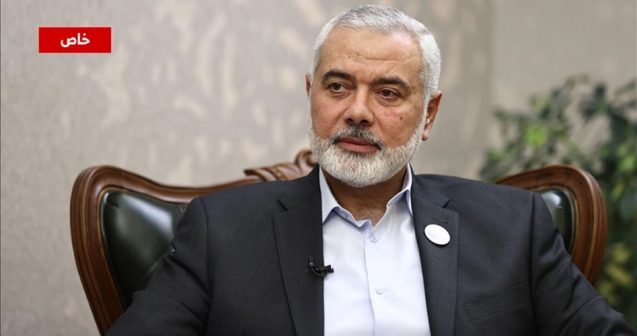
Ismail Haneyya
Palestine Information Center – April 1, 2021
ISTANBUL – Head of Hamas’s political bureau Ismail Haneyya has welcomed the Turkish-Egyptian rapprochement, expressing confidence that any cooperation between Ankara and Cairo will be in the interest of the Palestinian people and their national cause.
Haneyya made the remarks in an interview conducted by Anadolu Agency after he visited its headquarters in Istanbul.
“We welcome the Turkish-Egyptian rapprochement, and we believe that more understandings between them and between Arab and Islamic countries will have a positive impact on us in Palestine as well as on the Arab countries,” the Hamas political chief said.
“There are historically known central states in the region that play strategic roles, such as Egypt, Turkey, Iran and Saudi Arabia, so any understanding and rapprochement between them will be in the interests of the peoples in the region and the Palestinian cause,” he added.
As for the upcoming Palestinian elections, Haneyya affirmed that his Movement is committed to forming a national consensus government even if it scored a victory in the legislative elections slated for next May.
“Hamas is participating in the elections on the basis of partnership and not with the aim of defeating others. It does not want to dominate the Palestinian political system,” he underlined.
He described the upcoming elections as an important opportunity to improve the current Palestinian conditions and end 15 years of national division.
US-Led Western/Israeli Aggression Against Syria
By Stephen Lendman | March 25, 2021
A decade of war on Syria and its long-suffering people isn’t enough for US hardliners.
Perhaps they intend forever war they’re losing but won’t end.
Former French diplomat Michele Rimbaud slammed a decade of US-led war on Syria, using terrorists as proxy fighters, along with waging economic war on its people — aiming to suffocate them into submission.
Like Afghan and Yemeni civilians, Syrians suffered more greatly than what their counterparts endured in two world wars — with no end of their ordeal in prospect.
“Should we wait 30 years in order to discover the outcome of the war in Syria, whether it is a military or economic war,” Rimbaud asked?
“When time comes for settling accounts and justice, it will be appropriate to remind the governments that have participated until today in this aggression of the seriousness of their criminal project, and we in the first place will condemn the three Western member states at the Security Council (the US, UK and France) who demand the implementation of the international law and claim to be its guardians, while they are the first to violate it.”
“The political or military officials, the intellectuals and media outlets who decided, organized, supported, or justified the crime of the international aggression against Syria and other countries must know that they will remain responsible for this crime regardless of what they did or didn’t do, and they must be held accountable.”
Where has the UN been for the last decade on Syria, for the last two decades on endless US war in Afghanistan and Yemen, for aggression against Libya in 2011 — for wars by other means against nations free from its control?
The world body consistently fails to denounce US wars of aggression, time and again blaming victimized nations for high crimes committed against them.
With rare exceptions, UN secretaries general serve US-led Western interests, supporting aggression by failing to denounce it, disgracing the office they hold, breaching UN Charter principles.
Since installed as UN secretary general by Washington in January 2017, Antonio Guterres was silent about US-led aggression in Syria and elsewhere — supporting the imperial state instead of denouncing its criminality and demanding accountability.
In mid-March, the UN noted the “grim 10-year anniversary of” war in Syria.
Its special envoy Geir Pedersen said the following without laying blame where it belongs, as follows:
“I want to commemorate Syrian victims and remember Syrian suffering and resilience in the face of unimaginable violence and indignities that (they) have faced over ten long years, including unspeakable horrors of chemical weapons.”
“Syrians had been injured, maimed and killed in every way imaginable – their corpses even desecrated.”
They’ve been “denied humanitarian assistance, sometimes under sieges in which perpetrators deliberately starved the population.”
They’ve “faced human rights violations on an enormous and systematic scale.”
“Those responsible for actions that may amount to crimes against humanity or war crimes enjoy near-total impunity, which not only undermines a peace agreement but perpetuates the living nightmare that has been life in Syria.”
The US, NATO, Israel, and their imperial partners bear full responsibility for the highest of high crimes against Syria and its people.
Yet in his above remarks and more of the same, Pedersen was silent about US-led aggression.
What Obama/Biden launched in March 2011, Trump continued, Biden/Harris going the same way — with no resolution in prospect because US dark forces reject it.
On Wednesday, Russia reported that US-supported jihadists launched 25 terrorist attacks in the past 24 hours, much the same going on daily against Syrian forces seeking to liberate the country and civilians caught in harm’s way.
When CW incidents occur, Damascus is always blamed for what it had nothing to do with — high crimes committed by US-supported jihadists.
While most Syrian territory was liberated by its armed forces — greatly aided by Russian airpower — US-supported terrorists control most of Idlib province.
They’re active elsewhere in the country — heavily armed with US, Western, and Israeli weapons.
Pentagon forces illegally occupy northern and southern parts of Syria with no intention of leaving.
Turkish forces illegally occupy northern Syrian territory. Allied with jihadist fighters, they’re at war with Damascus like the US, NATO and Israel.
The Pentagon and CIA continue to deploy ISIS jihadists to parts of Syria where they attack government forces and civilians.
Russian airpower is key — the difference between US dark forces gaining control over Syria or handing them an embarrassing defeat.
On Wednesday, Southfront reported the following:
In response to Russian airstrikes on Turkish-supported jihadists and sites they control in northern Syria, Ankara “summoned Russian ambassador Alexei Yerkhov to express its concerns…”
Ignoring its repeated breaches of the deescalation agreement reached with Moscow, Turkey falsely accused Russia of violations.
“At the same time, Ankara has no concerns regarding funding and supporting Al-Qaeda-styled groups in the region to promote its own interests,” Southfront reported.
The Erdogan regime is also concerned about Russian airstrikes disrupting its smuggling of stolen Syrian oil and gas.
Separately on Tuesday, rockets struck an illegal US base near a Conico oil field in Deir Ezzor, Syria.
Reportedly, US forces guarding and facilitating the theft of Syrian oil suffered casualties.
Southfront reported on what it called impunity in Syria being punished, saying:
“Turkish-backed militants in Greater Idlib, and in northeastern Syria in general are being given no quarter” by Russian airstrikes.”
The headquarters of Turkish-backed al-Sham Corps terrorists was struck.
So was Saramada in northern Syria near Turkey’s border. A factory operated by Hayat Tahir al-Sham terrorists was targeted.
So were other terrorist targets, elements backed by Turkey’s Erdogan in defiance of the deescalation zone agreement with Moscow.
Southfront called the latest Russian operation “one of the most severe since the ceasefire agreement was implemented.”
“It is likely an attempt to deter the Turkish-backed factions, as well as HTS from carrying out any more expansive operations.”
Despite Syrian army advances and the latest Russian aerial operations, Erdogan is highly unlikely to cease his cross-border aggression.
The same goes for Biden regime hardliners. US aggression continues with no signs of cessation.
Gazprom significantly boosts natural gas supplies abroad in 2021
RT | March 15, 2021
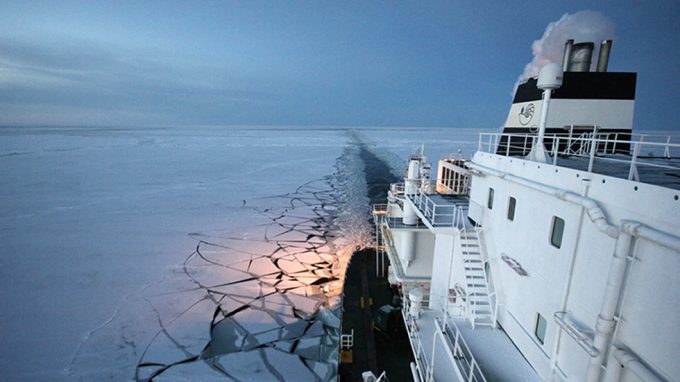
Russian energy major Gazprom’s gas exports to non-CIS (Commonwealth of Independent States) countries increased by 28.3% since the beginning of the year to 42.9 billion cubic meters, the company said.
That is “9.5 billion cubic meters more than in the first 2.5 months of last year,” according to Gazprom.
The company pointed out that the high demand for gas was due to the cold start of the calendar spring this year. “We continue to provide gas to domestic and foreign consumers on a full-scale basis,” it said.
Gazprom’s supplies particularly rose in Turkey (by 80.5%), Romania (77.7%), Finland (74.2%), Serbia (61.5%) and Bulgaria (52.1%). Gas deliveries to Germany and Greece also saw a boost of 28.7% and 24.5%, respectively.
The company said that in the first two weeks of this month, gas supplies to Turkey increased 11.5 times compared with the same period last year. Exports to China via the Power of Siberia mega gas pipeline regularly exceed Gazprom’s daily contractual obligations. The actual volume of supplies from March 1 to March 15 was 3.2 times more than in the same period of 2020, it said.
Belgrade may postpone or end transfer of Serbian embassy to Jerusalem
By Paul Antonopoulos | February 5, 2021
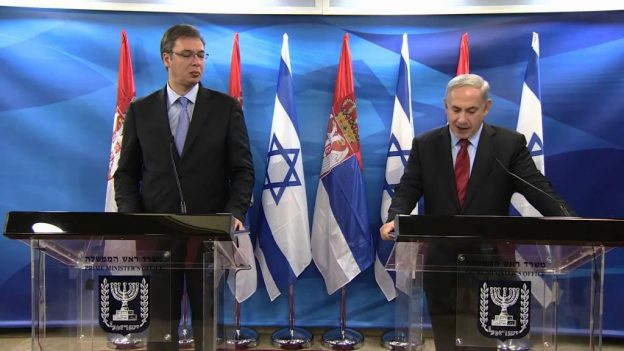
After the Israeli recognition of the so-called independent state of Kosovo on Monday, Belgrade finds itself in a difficult position and will reconsider its decision to move the Serbian embassy from Tel Aviv to Jerusalem. Serbia committed itself to this step by signing the September 2020 Washington Agreement suspecting that Kosovo and Israel would recognize each other eventually. Serbian President Aleksandar Vučić now says that his country will “build relations with the Jewish state in accordance to the new circumstances,” suggesting the embassy move might not occur at all.
The Washington Agreement was always tailored to the interests of Israel and Kosovo and not Serbia, yet Vučić still signed it to the dismay of Serbs. The agreement signed by Kosovo’s so-called Prime Minister Avdullah Hoti and then U.S. President Donald Trump states that Kosovo and Israel agree to mutual recognition. The agreement signed between Vučić and Trump specifies that Belgrade has an obligation to move its embassy from Tel Aviv to Jerusalem by July 1, 2021.
As much as the move between Israel and Kosovo was expected, it was probably not anticipated that the last item from the Washington Agreement would actually become the first. This is especially painful for Serbia as Vučić agreed with Kosovo’s authorities that the two would not engage in efforts for countries to recognize or stop recognizing Kosovo. This will likely bring new consequences to Serbia’s engagement with Israel.
As Serbian Foreign Minister Nikola Selaković noted, it will be interesting to observe whether there will now be Muslim and Arab countries that will recognize Kosovo or stop recognizing the illegal entity after its normalization with Israel.
So what will Muslim countries do?
Last year, thanks in large to Trump’s efforts, the United Arab Emirates, Bahrain, Sudan and Morocco normalized their relations with Israel, while Saudi Arabia and the Jewish state have been cooperating for many years behind closed doors.
Turkey, despite being the first Muslim majority country to recognize Israel, has hypocritically reacted to the signing of the agreement between Pristina and Tel Aviv. Turkish President Recep Tayyip Erdoğan claims that it does “not serve the Palestinian issue” and undermines the vision of a two-state solution. Erdoğan’s outrage is despite his country having multi-billion-dollar trade exchanges with Israel that was increasing year-on-year before the COVID-19 pandemic.
The Turkish Ministry of Foreign Affairs also stated that by signing the agreement, Kosovo, which it also recognizes, “undertook to open its embassy in Jerusalem, which is contrary to international law.” Again, Turkey made another contradiction considering it violated United Nations Resolution 550 and 789 by partially reopening the town of Varosha in occupied northern Cyprus last year, and by violating the United Nations Charter Law of the Sea by illegally entering Greece’s maritime space for much of 2020.
The question of relocating the Serbian embassy also entails the question of the status of Jerusalem – while the Israelis consider it their capital, the Palestinians say it is an occupied city. Palestinian Ambassador to Serbia, Mohammed Nabhan, said immediately after the signing of the Washington Agreement that 57 countries from the Arab League and the Islamic Organization for Cooperation could withdraw their recognition of Kosovo due to their agreement with Israel. There have been no such announcements from these Islamic organizations or their members.
This is an empty threat by Nabhan as the position of Muslim and Arab states regarding Israel are no longer united, something the Palestinian Authority appears to be oblivious to. Islamic countries are extremely divided over the issue of Israel and Kosovo. Several Muslim states like Iran, Syria, Iraq and Morocco do not recognize the independence of the breakaway Serbian province. Self-proclaimed Kosovo has been recognized by leading Arab countries, including the United Arab Emirates, Bahrain, Saudi Arabia, Qatar, and Egypt. It is difficult to expect that there will be any changes, especially since the voice of the Palestinian Authority is no longer as important as it used to be. The Palestinian question, which was once a major global issue, is now reduced, especially in the Arab World as they are now mostly focused on containing Turkish expansionism and Iranian influence.
Immediately after the signing of the Washington Agreement, it was speculated that Serbia might not fulfill what it signed if Israel recognizes the self-proclaimed independence of Kosovo. The very act of recognition is only a consequence of what was already signed in Washington last year. The new American administration are most likely not against Trump’s September 2020 Agreement, meaning they will try and implement it, or at the minimum not stop it. Belgrade’s only trump card is that they can postpone or end the transfer of the Serbian embassy from Tel Aviv to Jerusalem.
Paul Antonopoulos is an independent geopolitical analyst.
Azerbaijan won the war in Nagorno-Karabakh but reduced its sovereignty
By Paul Antonopoulos | February 1, 2021
Although Azerbaijan won the war against Armenia, both countries have in fact lost part of their sovereignty.
Azerbaijan won the war and expanded territorially after it captured or received the districts surrounding Nagorno-Karabakh proper that Armenian forces captured in the first war (1988-1994). The status of Nagorno-Karabakh proper remains undetermined but is protected by Russian peacekeepers and is still governed by Armenians.
Despite this territorial expansion, Azerbaijan has in fact partly lost its sovereignty. During the war, reports began emerging that Azerbaijani military leaders were becoming increasingly frustrated with the level of control that Turkey had over their fighting forces. These reports were quickly dismissed and denied by Azerbaijan as Armenian attempts to create division through misinformation. But if this was just misinformation, then there would be no risk of division to begin with, meaning it would not be worth giving attention to, suggesting there was certainly an element of truth to it.
Azerbaijan’s military success lays with two key factors: the Armenian political and military incompetency and lack of will, and Turkey’s contribution with drones, special forces, intelligence and transfer of Syrian jihadists.
Armenian Prime Minister Nikol Pashinyan never truly committed to the war effort as Armenian forces were never fully mobilized, powerful Iskander missiles infrequently used, the Armenian Air Force mostly grounded, Armenian diaspora and foreign volunteers rejected from fighting, and local Armenian militias not equipped with enough ammunition, maps and communication devices, nor were the militias assigned commanders – yet this was supposedly a “war for survival,” as Pashinyan termed it.
None-the-less, despite the incompetency of the Armenian leadership, Azerbaijan’s rapid success in Nagorno-Karabakh would not have been possible without significant Turkish support. Even Azerbaijan’s success is limited as it did not achieve its main war aim – the capture of Nagorno-Karabakh.
More importantly, Ankara’s footprint in the country massively expanded through the deployment of more Turkish troops to Azerbaijan, control of more military bases, and the establishment of a joint observation center with Russia in the Agdam region.
As said, reports circulated during the war that divisions in the Azerbaijani military and political circles were emerging between a pro-Turkish faction and another faction in opposition to Turkey’s dominant role in the war effort. These reports have only intensified in recent days as Turkish troops are now deployed in Azerbaijan. Azerbaijani politicians and military leaders are beginning to worry about Ankara’s strong influence in the country, with critics commenting that Azerbaijan has become the 82nd province of Turkey. Although Azerbaijan now controls most of the formerly Armenian-held territory, it cannot exercise control over it without Turkish and Russian oversight.
In fact, even Iran has greater opportunities to influence Azerbaijan that it was not able to do before the war. Azerbaijan’s capture of the districts to the south of Nagorno-Karabakh proper means that it shares external borders with only Armenia and Iran. Effectively Iran has great opportunities to be one of the leading foreign investors in the region as Armenia and Azerbaijan have not normalized their relations. Iranian Foreign Minister Mohammad Javad Zarif visited the Nakhichevan exclave of Azerbaijan, the region wedged between Armenia, Turkey and Iran, to boost regional cooperation through new railroad and transportation routes.
In turn, it will be inevitable that Iran will attempt to gain influence through pan-Shi’ism, but this may prove difficult to gain a foothold as pan-Turkism has become the dominant ideology of Azerbaijan because of Turkey’s own soft power manoeuvers. Russia will utilize its influence through its peacekeepers in the region, and also soft power through economic exchanges.
Although Azerbaijani President Ilham Aliyev will relish his country’s long-awaited victory after his father Heydar Aliyev signed a humiliating ceasefire in May 1994 to conclude the First Nagorno-Karabakh War, the long-term repercussion means that Turkey dominates the Azerbaijani military and wields great political influence over Baku. Also, there is limited Azerbaijani governance in the territories it controls because of Russia’s watchful eye through the deployment of peacekeepers. And finally, we can see much stronger Iranian influence as it aims to penetrate the region through economic and religious means.
Azerbaijani flags may be flying over the captured territories, but it certainly has come at the price of reduced sovereignty – militarily, economically, politically, and perhaps even religiously and culturally.
Paul Antonopoulos is an independent geopolitical analyst.
Iran-Turkey railway aims for 1M tons of cargo in 2021
MEMO | January 27, 2021
Roughly 1 million tons of cargo are to be transported via rail between Turkey and Iran this year, Turkish authorities said Tuesday, reports Anadolu Agency.
The Transport and Infrastructure Ministry said in a statement that a recent memorandum of understanding signed in a gathering of railway representatives in Turkey’s capital Ankara on January 12-13 would open a new era for the transit railway.
Despite the novel coronavirus pandemic, three train services were run daily between Turkey and Iran in 2020, transporting 564,000 tons of cargo, according to the statement.
The statement also announced that freight trains would also run between Turkey and Pakistan via Iran on a common tariff between the three countries. It added that talks are still ongoing to set this tariff.
With a recently completed railway between Iran and Afghanistan, it will now also be possible to transport freight between Turkey and Afghanistan.
“After the railway connection between Iran and Afghanistan was completed on December 10, 2020, it became possible for a wagon loaded in Turkey to transit Iran to Afghanistan.”
The railway administrations of Turkey, Iran, and Afghanistan will come together in the coming months to set a course for rail transport between Turkey and Afghanistan.
The statement added that efforts were underway for a cargo transportation corridor through Iran between Europe and China.
The Kurds have Once Again been Abandoned by their “American Brothers”
By Valery Kulikov – New Eastern Outlook – 28.12.2020
Yet again thrown by their “older American brothers” to the winds of fate, the Kurds in the Levant nowadays are not living through the best of times. On the border running between Syria and Iraq, a new armed conflict entailing human casualties is unfolding, one which demonstrates, among other things, a clear lack of unity among the Kurds, and that so-called Kurdistan is divided into parts ruled by various leaders, many of whom are competitors, and often almost irreconcilable enemies. Against this backdrop in the past few years, fierce battles between Kurdish formations have begun to occur more and more frequently, with the warring parties, while losing their fighters, the warring parties, concentrating their forces along the border in anticipation of new clashes.
The Syrian Kurds blame their Iraqi compatriots from the Peshmerga group for causing this conflict, including preparing for war in the Syrian Arab Republic. So, according to the position announced in ANF News by the Syrian Kurds, since October the Kurdistan Democratic Party (KDP) has been organizing provocations in South Kurdistan. The KDP, controlled by the family of Iraqi Kurdish leader Barzani, has been accused of both working closely with Turkey in various areas, including intelligence gathering, spreading propaganda, and logistics, and fueling domestic conflicts that could lead to civil war.
In October, Peshmerga proclaimed that an attack had been committed by Syrian Kurds on an oil pipeline, which resulted in oil exports from Kurdistan to Turkey being suspended.
On November 4, local media outlets reported that armed clashes broke out between Peshmerga forces and Kurdistan Workers’ Party militants in the area of Duhok, which resulted in the death of one Iraqi Kurdish fighter and injuries for three others.
On December 15, General Mazloum Abdi, who is the commander-in-chief of the Kurdish-Arab “Syrian Democratic Forces”, which was created by the United States, accused Iraqi Kurds of attacking and wounding three SDF members.
On December 16, the Iraqi Kurdistan regional authorities announced that Syrian armed groups from the YPG (which forms the backbone of the SDF) attacked bases and positions held by the Iraqi Peshmerga near the border. Syrian Kurdish leaders denied these accusations, calling them false, and leveled similar accusations toward Iraqi tribesmen themselves.
Local observers note that Iraqi Kurds are being transferred to the Syrian front with support provided by Turkish combat drones. It is worth noting that Ankara considers the YPG to be the Syrian wing of the Kurdistan Workers’ Party, which is labeled as a terrorist group in Turkey; this was used as the rationale for it to invade Rojava last October, displacing hundreds of thousands of civilians. Selahattin Demirtas, the co-chairman of Turkey’s largest Kurdish People’s Democratic Party, has been behind bars for the fourth year on charges of “supporting terrorism”. To mitigate the influence of this Kurdish movement, which is represented in the Turkish parliament, and to sow more discord in the Kurdish community, Turkey is preparing to organize a new Kurdish party with support from the country’s ruling Justice and Development Party.
 Regarding the military potential possessed by Kurdish groups in Syria and Iraq, it should be specified that both sides have virtually full-fledged armed forces that have been equipped with help from “foreign players”. Washington and Ankara are the ones helping the Iraqi Kurds. The Syrian Kurdish groups were financed, armed, and trained by the United States and its allies in the anti-terrorist coalition. At the same time, it is evident that both sides have been lent support by Washington, as well as used by it in the struggle for influence, power, and oil – both in Syria and Iraq. On top of that, the United States essentially put its seal of approval on the defeat of the Kurdistan Workers’ Party – a party recognized by them as terrorists in the European Union – in the Syrian Arab Republic and Iraq, where the main bases that the PKK has are located since their forces were defeated in Turkey.
In recent years, Trump has effectively lost interest in supporting the Kurds in the region, and even announced in October 2019 that American troops would be withdrawn from the area, and this time would not defend the Kurds. After that, Turkish aircraft started to attack the region and the positions that were held by the Kurds.
Donald Trump stated his position on the Kurds and the reason why the United States is abandoning them yet again on his Twitter page a year ago, noting in particular that the Kurds, an Iranian ethnic group, did not help the United States during WWII – including during the invasion of Normandy. It seems that the US president clearly drew on this kind of “extensive expertise” in WWII history from an article by Kurt Schlichter in the publication Townhall – which praises Trump’s policies – that stated: “The Kurds helped destroy DAESH (a terrorist group banned in the Russian Federation) … But let’s be honest: the Kurds did not come to help us in Normandy, Incheon, Khe Sanh, and Kandahar”. Well, what else can be expected for the Kurds from their “elder American brothers”?
The processes among the Kurds, which began in 2019 after another episode involving betrayal by the United States, were described in sufficient detail by The New York Times. Today, these processes have intensified, as have Turkey’s operations against the Kurds in Syria. One of the very hot spots in this regard was the city of Ain Issa in the northern part of the Raqqa Governorate, where Turkey has stepped up its shelling of Kurdish positions. For example, on the evening of December 17, the Turkish army and militants allied with it struck a powerful blow to the positions held by the predominantly Kurdish “Syrian Democratic Forces” in the area of the city of Ain Issa, attacking two nearby villages, and this forced SDF groups to abandon these positions and regroup their forces to keep the enemy from advancing any further. On the night of December 22, pro-Turkish forces ratcheted up the intensity of their strikes on the city of Ain Issa and its environs, and the Turkish military itself switched to using heavy artillery to strike the northern part of the Raqqa Governorate.
Under these conditions, representatives of the Russian and Syria military held talks on December 22 with representatives of Kurdish autonomous organizations – with participation on the part of Turkish officers – to try to ease tensions, but the parties did not reach any agreement. Representatives from the Turkish military demanded the withdrawal of all militants from the SDF, promising to stop the attacks by pro-Turkish criminal groups on Ain Issa if this occurs, although Ankara had previously denied that the militants were acting on its instruction.
The situation remains filled with tension, despite the measures taken by Russia to help foster stabilization.
Informal British-Turkish-Ukrainian alliance is emerging in the Black Sea
By Paul Antonopoulos | November 30, 2020
Trade agreements between the UK and Turkey are “very close,” Turkish Foreign Minister Mevlüt Çavuşoğlu said during a visit to Britain in July. London’s endeavour to secure post-Brexit trade agreements reflects on the status of its economic relations with Turkey. A UK-Turkey trade agreement is important for both countries, not only commercially, but also geopolitically as it can extend into the Ukraine against Russia, particularly in the Black Sea.
The trade agreement is crucial because the EU’s relationship with Turkey and the UK have deteriorated. Brussels and Ankara clash over the erosion of democratic controls and balances in Turkey, and also because of its increasingly dynamic foreign policy in Libya and the Eastern Mediterranean against Greece and Cyprus. Turkey’s relationship with the U.S. has also intensified, especially since Ankara bought the Russian S-400 missile defense system despite opposition from Washington and NATO. With it appearing imminent that Joe Biden will become the next U.S. President, relations between Washington and Ankara are set to deteriorate further.
This makes the UK one of Turkey’s few remaining friends in the West, and for Ankara a trade deal would signal a close economic and political relationship with a major European power that still wields international influence. For its part, the UK was willing to cultivate a good relationship with Ankara in the context of a “Global Britain” that it wants to build after Brexit.
When it was still a member of the EU, the UK was one of the leading supporters of Turkey’s membership into the bloc. London has also taken a much more discreet stance than other European capitals in condemning President Recep Tayyip Erdoğan for the deteriorating domestic situation. When Turkey launched a military operation in Syria in 2019, the UK was initially reluctant to condemn Ankara unlike other NATO members, just like what happened when Turkey intervened in Libya.
It was always inevitable that a post-Brexit UK would have strengthened relations with Turkey, especially as British Prime Minister Boris Johnson often boasts that his paternal great-grandfather, Ali Kemal, was a former Ottoman Minister of the Interior.
Johnson describes the Gülen movement, once allied to Erdoğan but now considered a terrorist organization by Ankara, as a “cult.” He also supports Turkey’s post-coup purges that resulted in the detainment of over half a million Turkish citizens, not only from the military, but also from education, media, politics and many other sectors.
It appears that Johnson’s post-Brexit “Global Britain” has Turkey as a lynchpin for its renewed international engagement with the world, and this poses immense security risks for Russia, especially in the Black Sea.
Erdoğan was outraged when Canadian Prime Minister Justin Trudeau suspended arms shipments to Turkey because of its involvement in Azerbaijan’s war against Armenia. This was a major blow to the TB2 Bayraktar drones that are highly valued by Erdoğan as he uses them in his military adventures in not only Libya, Syria and Nagorno-Karabakh, but also in the Aegean in espionage acts against so-called NATO ally Greece. He has even set up a drone base in occupied northern Cyprus to oversee the Eastern Mediterranean.
The so-called “domestically produced” Bayraktar drones have been exposed for using parts from nine foreign companies, including a Canadian one. Although Erdoğan was outraged by Trudeau’s decision, he found a British company to replace Canadian parts. Britain’s decision to be involved in the Bayraktar drone program is all the more controversial considering five of the nine foreign companies involved have withdrawn their support because of Turkey’s role in the Second Nagorno-Karabakh War.
Although the growing unofficial alliance for now appears to be in the fields of economics and military technology, alarming reports are emerging that British troops will be stationed in Ukraine’s Mykolaiv Port on the Black Sea.
Ukrainian Foreign Minister Dmytro Kuleba told the BBC that if British troops “land there and stay, we will not mind either. From the first day of the Russian aggression, Britain has been close and provided practical support, and not only militarily.”
Post-Brexit Britain will not weaken its maximum pressure against Russia, and rather it appears to be increasing its campaign. Britain, as a non-Arctic country, is attempting to bully its way into Arctic geopolitics by undermining Russian dominance in the region. However, Britain’s campaign of maximum pressure creates instability on Russia’s vast frontiers, including in Ukraine and the Black Sea.
With this we can see an informal tripartite alliance emerge between the UK, Turkey and Ukraine.
Kiev has formed a venture with Ankara to produce 48 Turkish Bayraktar drones in Ukraine. This also comes as Ukraine’s Ukrspetsexport and Turkey’s Baykar Makina established the Black Sea Shield in 2019 to develop drones, engine technologies, and guided munitions. In fact, Turkey will allow Ukraine to sell Bayraktar drones it produces, which will now contain British parts after several foreign companies withdrew from the drone program. It is not known whether Bayraktar drones can currently be produced because of the mass withdrawal of foreign companies, but we can expect Ukrainian and British companies to eventually fill the voids left behind.
Both Turkey and Ukraine cannot challenge Russian dominance in the Black Sea alone, and it is in their hope that by closely aligning and cooperating that they can tip the balance in their favor, especially if Britain will have a military presence in Mykolaiv Port. Ukraine still does not recognize Russian sovereignty over Crimea, Britain maintains sanctions against Moscow because of the reunification, and Turkey continually alleges that Russia mistreats the Crimean Tatars.
Erdoğan uses Turkish minorities, whether they be in Syria, Greece or Cyprus, to justify interventions and/or involvement in other countries internal affairs. Erdoğan is now using the Tatar minority to force himself into the Crimean issue while simultaneously helping Ukraine arm itself militarily. With Turkish diplomatic and technological support, alongside British diplomatic, technological and perhaps limited military support, Ukraine might be emboldened to engage in a campaign against Crimea or disrupt Russian trade in the Black Sea.
It certainly appears that an informal tripartite alliance is emerging between the UK, Turkey and Ukraine, and it is aimed against Russia in the Black Sea to end the status quo and insert their own security structure in the region on their own terms.
Paul Antonopoulos is an independent geopolitical analyst.
Featured Video

Your Enslavement Begins in Gaza: The ‘Board of Peace’
or go to
Aletho News Archives – Video-Images
From the Archives
The US: The Century of Lost Wars
By James Petras | Global Research | September 12, 2018
Introduction
Despite having the biggest military budget in the world, five times larger than the next six countries, the largest number of military bases – over 180 – in the world and the most expensive military industrial complex, the US has failed to win a single war in the 21st century.
In this paper we will enumerate the wars and proceed to analyze why, despite the powerful material basis for wars, it has led to failures. … continue
Blog Roll
 Aletho News
- Israel designates five Palestinian media outlets as ‘terrorist organizations’
- Israel, not America, first: Carlson’s Huckabee interview lays bare US foreign policy priorities
- Israeli troops executed Palestinian aid workers at ‘point blank range’: Report
- Iran war What if today’s Iran is resigned to a long, hellish war with the US?
- Why Israel Is Escalating Its War Crimes Against Lebanon
- Iran in the face of the armed diplomacy of imperialism
- The US build-up around Iran constitutes strategic war option, not ‘deterrence’
- Iran to US: Sanctions and war failed; try diplomacy and respect
- China supplies Iran with radar, surveillance tech to track US stealth aircraft: Report
- Zelensky rejects territorial concessions to Russia
- If Americans Knew
- Footage Shows Israeli Troops Waiting in Ambush, Then Opening Fire on a Palestinian Teen
- The US is on the brink of a major new war that Trump has not even bothered explaining
- Latest Epstein document dump is one more cover-up
- No Protection, No Justice: US Citizens Killed with Impunity by Israel
- Maria Farmer: Epstein Victim Reveals Explosive Information Covered Up by Media
- Average of five Palestinians killed by Israel every day in Gaza since ceasefire – Not a ceasefire Day 136
- Palestinian church leaders admonish Christian Zionist Mike Huckabee – Not a ceasefire Day 135
- Ominous messaging from Trump’s “Board of Peace” – Not a ceasefire Day 134
- ‘Christians Out’: Jerusalem Church Tagged With Hate Graffiti, Police Investigating
- Israeli Settlers Kill American Teen
- No Tricks Zone
- New Research Reaffirms Clouds, Aerosols, And Surface Solar Radiation Are ‘Driving The Climate System’
- Germany: Electric Car Catches Fire At Charging Station, Sets Off Local “Inferno”, Widespread Damage
- New Study: Canada’s New Brunswick Was 1°C Warmer Than Today During The Medieval Warm Period
- Coal Power Back In Trend As Globe Tries To Keep Pace With Growing Demand For Power
- New Study: A 4°C Warmer Beaufort Sea Had ‘No Sea Ice’ 11,700 – 8200 Years Ago
- Unfudging The Data: Dutch Meteorological Institute Reinstates Early 20th Centruy Heat Waves It Had Erased Earlier
- German Gas Crisis…Chancellor Merz Allegedly Bans Gas Debate Ahead of Elections!
- Pollen Reconstructions Show The Last Glacial’s Warming Events Were Global, 10x Greater Than Modern
- Germany’s Natural Gas Storage Level Dwindles To Just 28%… Increasingly Critical
- New Study Rebuts The Assumption That Anthropogenic CO2 Molecules Have ‘Special’ Properties
 Aletho News