Iran to buy, swap 15 mcm per day of Russia’s gas via Azerbaijan
Press TV – September 19, 2022
Iran will import Russian gas through pipelines from Azerbaijan under arrangements agreed in a major deal between Tehran and Moscow two months ago, according to a report published in the local media.
The semi-official Fars news agency said in a Monday report that Iran will buy some 9 million cubic meters (mcm) per day of gas from Russia and will take delivery of another 6 mcm per day under a swap deal for the purpose of delivery to Russian gas customers to the south of Iran.
The report cited data from an internal report of the Iranian Oil Ministry and said the purchase and swap arrangements are related to a $40 billion deal signed in July between Iran’s state oil company the NIOC and Russia’s Gazprom.
Earlier reports had indicated that Iran could take delivery of Russian gas from Turkmenistan for the purpose of swap delivery to Turkey and Iraq.
However, the new data suggest Iran will use the 15 mcm per day of gas supply from Russia to strengthen its domestic supply network in the densely populated regions in the northwest while being able to export increased amounts of natural gas to Turkey and Iraq through pipelines in the west of the country.
Iran is already in a gas swap arrangement with Turkmenistan and Azerbaijan under which it consumes gas received from Turkmenistan in its northeastern regions and delivers the same amount of gas to Azerbaijan.
The Fars report said Iran will deliver the equivalent of 6 mcm per day of gas to Russian customers in the south in the form of liquefied natural gas (LNG). It added that Gazprom will be a partner in the liquefaction process.
CIA Threatens Turkish Businessmen Over Trade With Russia
Samizdat – 26.08.2022
ANKARA – The Central Intelligence Agency (CIA) used intimidation against Turkish businessmen involved in trade with Russia, prying into their real estate contracts with Russians, Turkish daily Yeni Safak reported on Friday.
According to the newspaper, the CIA Turkey chief called and “openly threatened” the officials of construction companies with links to housing purchases made by Russian entities and individuals. The CIA official reportedly interviewed Turkish businessmen, asking them about the number of houses sold to Russians, the currency used in transactions and other confidential details.
Another instance of “meddling” in Turkish internal affairs includes a letter which, according to Yeni Safak, US Deputy Treasury Secretary Wally Adeyemo sent to Turkish Industry and Business Association (TUSIAD). The letter, reportedly dated this Monday, threatened to impose sanctions on TUSIAD members that were doing business with Russia.
Adeyemo also held a phone call with Turkish Deputy Finance Minister Yunus Elitas last Friday, in which he raised concerns that Russian entities and individuals are attempting to use Turkey to circumvent sanctions imposed by the West.
The US and a number of aligned countries began imposing sanctions on Russian individuals and entities in response to the launch of Russia’s special military operation in Ukraine in late February. So far, Turkey has not joined the sanctions regime against Moscow.
Turkey says it will enforce anti-Russia sanctions
Samizdat | August 21, 2022
Turkish Deputy Finance Minister Yunus Elitas has told US Deputy Treasury Secretary Wally Adeyemo that Ankara won’t allow the “breaching” of American sanctions on Moscow but that its “balanced” position on the Ukraine conflict remains unchanged.
Elitas and Adeyemo spoke by phone on Friday, several weeks after the Financial Times reported that Western officials are “increasingly alarmed” at Turkey’s growing trade ties to Russia, and are considering ways to retaliate if these ties help Russia bypass EU and US sanctions.
According to a readout of Friday’s call from the US Treasury Department, “Adeyemo raised concerns that Russian entities and individuals are attempting to use Turkey to evade sanctions put in place by the United States and 30 countries.”
Adeyemo also “reiterated the United States’ interest in the success of the Turkish economy” and “the integrity of its banking sector.” This statement could be perceived as a threat, considering that the officials quoted by the FT suggested that Western nations could potentially instruct their corporations and banks to pull out of Turkey over the supposed sanctions evasion.
The Turks appear to be cooperating. According to its own readout of the call, Turkey’s Finance Ministry said that “Elitas confirmed that Turkey’s position has not changed regarding the current processes and sanctions, but that it would not allow the breaching of sanctions by any institution or person.”
Turkish President Recep Tayyip Erdogan has previously described his position on the conflict in Ukraine as “balanced.” While Turkey has condemned Russia over the conflict and has sold some weapons to Ukraine, it is the only NATO member that has not sanctioned Moscow or closed its airspace to Russian flights.
Turkey continues to import Russian oil and gas, and following a meeting between Erdogan and Russian President Vladimir Putin earlier this month, the countries agreed to increase their bilateral trade to $100 billion by 2030 and cooperate on energy projects and counterterrorism initiatives. Erdogan and Putin also agreed that Turkey would pay for some of its gas imports from Russia in rubles.
Erdogan has also positioned himself as a middleman between Ukraine and Russia. Turkey hosted ultimately unsuccessful peace talks in March but later helped broker an agreement to resume shipments of grain to world markets via the Black Sea.
‘Dirty bomb’ in Ukraine would affect nine countries
Samizdat – August 16, 2022
A total of nine countries could be contaminated if the Russian-controlled Zaporozhye nuclear power plant in southern Ukraine is hit by multiple launch rocket systems, a former chief inspector of the USSR’s nuclear authority told RT.
Russian troops established control of the Zaporozhye NPP, Europe’s largest facility of the kind, early on in the course of military operations in Ukraine. Since then, Russia has repeatedly accused Kiev of launching artillery and drone strikes on the facility. Ukrainian officials claimed that the Russians were shelling themselves to discredit Kiev.
In an interview published on Tuesday, Vladimir Kuznetsov warned that if the plant is hit by volley fire, with numerous missiles striking the storage facility that holds spent nuclear fuel, chances are that more than one container would be damaged. This scenario would entail radiation escaping “into the environment – hence the contamination of not only the industrial site but also the Dnepr river which is nearby,” the expert noted.
Kuznetsov also pointed out that such a strike would most likely be accompanied by a fire, and “God knows where the wind would send the combustion products.”
The former chief inspector surmised that should 20 to 30 containers be breached in such an attack, the “radiation would affect approximately nine countries: Turkey, Bulgaria, Romania, Slovakia, the Czech Republic, Poland, the Baltic states and obviously Western Ukraine.”
Russian forces took over the Zaporozhye nuclear power plant in early March, within the first two weeks of Moscow’s military campaign against its neighbor.
In recent weeks, the Russian military has accused Ukraine of deliberately targeting the facility multiple times and warned that a major nuclear disaster, akin to that at Chernobyl in 1986, or even worse, could happen if such attacks continue unchecked.
Kiev, meanwhile, denies these allegations and claims that it is Russian forces that are shelling the power plant to frame the Ukrainian military – a point of view shared by the US and EU. The UN has called the attacks “suicidal” and proposed sending an International Atomic Energy Agency delegation to the site to provide “technical support” and help avoid a further escalation.
On Tuesday, local government administration member Vladimir Rogov told Russian media that Ukrainian forces had fired multiple rockets directly at the coolant systems and nuclear waste storage site inside the facility.
Since the storage site is out in the open, any hit would result in the release of nuclear waste ranging from dozens to hundreds of kilograms and lead to contamination of the area, the official explained.
“In plain language, that would be like a dirty bomb,” said Rogov.
Russia-Turkey reset eases regional tensions
BY M. K. BHADRAKUMAR | INDIAN PUNCHLINE | AUGUST 9, 2022
The 4-hour meeting on Friday at Sochi between President Vladimir Putin and President Recep Erdogan promises to be a defining moment in regional politics. The single biggest takeaway from the Sochi meet is, of course, the “win-win” economic partnership between Russia and Turkey that helps Russia, on the one hand, to continue to interact with the world market circumventing Western sanctions, while, on the other hand, is a boon for the Turkish economy.
Turkey is a member of the European Uinion’s Customs Union and it is no secret that there is a lot of Russian money floating around in the wake of the western sanctions. If that money can be turned into investments in Turkey to set up production units with western technology and market access, creating jobs and revving up the country’s economy, it is a “win-win”. This is one thing.
At Sochi, Putin and Erdogan agreed on phasing out the use of dollar in their transactions. Part of Turkey’s purchase of Russian gas will be settled in rubles, which will of course strengthen the Russian currency. Equally, the Sochi meeting tasked 5 Turkish banks to accept Russia’s Mir payment system, which Moscow developed following Russia’s exclusion from the SWIFT.
At its most obvious level, the Mir system enables Russian nationals, especially tourists, to freely visit Turkey. Indeed, the West’s prying eyes can also be kept out. A Bloomberg News report last week suggests that sensitive money transactions that are beyond western scrutiny may already be taking place. Basically, Turkey helps Russia to mitigate the effect of western sanctions while taking care that it won’t face any collateral sanctions either!
Quite obviously, all this is only possible within a matrix of political understanding. The 4-hour conversation in Sochi was almost entirely conducted in one-on-one mode. Erdogan cryptically remarked later that his talks with Putin would benefit the region. He did not elaborate.
Conceivably, there are three major areas where the matrix will be felt in immediate terms— Syria, Black Sea and Transcaucasia. Turkish and Russian interests crisscross here.
In the Black Sea, Turkey, as the custodian of the Montreux Convention Regarding the Regime of the Straits (1936), has a key role to play with regard to the passage of warships in times of war through the the Dardanelles strait, the Sea of Marmara, and the Bosporus strait. The current implications are self-evident.
Again, in Transcaucasia, Turkey can play a stabilising role, which Moscow expects, given Ankara’s influence in Baku. However, when it comes to Syria, a complex tapestry appears. The Turkish press has reported that Erdogan is planning to have a call with Syrian President Bashar al-Assad.
Putin has been encouraging Erdogan to think on these lines as the best way to address Turkey’s border security issues in northern Syria — by directly communicating with Assad instead of launching military incursions.
Putin’s vision is that the moribund Adana Agreement (1998) still has a lot of unused potential, where Damascus had guaranteed the containment of militant Syria-based Kurdish separatist groups. The “Adana spirit” evaporated once the Obama administration lured Erdogan into its regime change project in 2011 to overthrow Assad. Until that time, Erdogan and Assad, including their families, had enjoyed a warm friendship.
However, circumstances today are propitious for a rapprochement between Erdogan and Assad. First, Assad has successfully beaten back — thanks to Russian and Iranian backing — the US-led jihadi project in Syria. Damascus has liberated most of the regions from jihadi groups and the residual issue concerns the US occupation of a third of Syrian territory in the north and east.
Assad has consolidated the government’s staying power for years to come. Second, Assad is steadily gaining regional acceptance too among Syria’s Arab neighbours. Syria is seeking membership of the SCO alongside Egypt, Saudi Arabia, Bahrain and the UAE. Third, Turkish-American relations have soured in recent years since the CIA-backed military coup in 2016 to overthrow Erdogan.
One main factor today is the US’ politico-military alliance with the militant Syrian Kurds who are its foot soldiers and aspire to establish a Kurdish homeland in northern Syria bordering Turkey under American protection. Erdogan is deeply suspicious of US intentions.
Fourth, stemming from the above, Turkey sees eye to eye with Moscow and Tehran (and Damascus) in their demand for the vacation of US occupation of Syria (which is neither mandated by the UN nor is at Syrian invitation.) Fifth, Russia and Iran have contacts with Syrian Kurdish groups but a reconciliation between the Kurds and Damascus cannot gain traction so long as the US military presence continues.
Quite obviously, any endeavour to cut this Gordian knot will have to begin with the reconciliation between Erdogan and Assad. It is in Turkish interests to strengthen Damascus and promote a Syrian settlement, which will ultimately make the US occupation of Syria untenable and open the pathway for pacifying the Kurdish regions in northern Syria.
Meanwhile, in a development that has bearing on Syria’s security, Russia today launched an Iranian military satellite from its Baikanur Cosmodrome. It is a Russian-built Kanopus-V Earth-observation satellite that will boost Iran’s capability to conduct continuous surveillance on locations of its choosing, including military facilities in Israel.
Moscow negotiated the satellite deal in secret with Iran’s elite Islamic Revolutionary Guard Corps (which is involved in Syria) and experts from Moscow have trained IRGC’s ground crews in the satellite’s operation.
Russia’s ties with Israel have sharply deteriorated lately due to Israel’s involvement in Ukraine as a participant in Pentagon’s “coalition of the willing”. Moscow is probably expelling the hugely influential Jewish Agency, which has kept an office in Moscow since the Gorbachev era.
Moscow’s criticism of Israeli missile strikes against Syria has noticeably sharpened lately. Russian-Israeli relations will languish for the foreseeable future. Israel seems acutely conscious of its growing isolation. President Isaac Herzog reached out to Putin today but it turned out to be an inconclusive conversation. Moscow will be extra-vigilant, given the Biden Administration’s strong nexus with Israeli PM Lapid.
Suffice to say, together with Israel’s fraught ties with Moscow and Ankara and the deep antagonism toward Tehran, a Turkish-Russian-Iranian condominium in Syria is the last thing that Israel wants to see happening at the present juncture. Israel is the odd man out, what with the Abraham Accords losing its gravitas.
Putin’s initiatives to create axis with Turkey and Iran respectively mesh with the broader trend of the region reshaping itself through processes dominated by the countries within the region against the backdrop of the US retrenchment.
US is Willing to Sell Weapons to Turkey Only with Strings Attached
By Vladimir Platov – New Eastern Outlook – 05.08.2022
Turkish National Defense Minister Hulusi Akar, while answering questions from Anadolu agency journalists, announced negotiations with the United States on the purchase of F-16s to be held on August 15. As the readers may recall, earlier Ankara requested from Washington 40 F-16 fighters of the Block-70 version and 80 modernization kits for the F-16 aircraft of previous modifications already in service with the Turkish Air Force. The desire to purchase additional F-16s was voiced by Ankara after Turkey was excluded from the American program for the production of fifth-generation F-35 fighters due to the rapprochement between Turkey and Russia.
Washington has, for a number of years now, been putting on the back burner this issue of Turkey’s modernization of its Air Force by purchasing new models of American combat aircraft, under the pretext that five years ago Ankara acquired the Russian S-400 air defense system, instead of the American Patriot missile system, despite the United States’ imperative demands not to do so and the threat of sanctions.
However, note that Turkey’s position on the procurement of the S-400 was not hasty and had a clear justification from Ankara.
Initially, Turkey actually intended to acquire the American Patriots, but the deal was disrupted twice (in 2013 and 2017) because Washington refused to provide Ankara with secret technologies related to the production of this system. In addition, the United States burdened this deal with a number of restrictions and demands, in particular, on provision of full information about each shot and the tasks of the complexes. Furthermore, the service life of Patriot systems was also limited by Turkey’s obligation to return them to the US army after its expiration and purchase new ones. Turkey deemed these demands to be non-starters. Besides, the Russian S-400s were almost twice as cheap as the American Patriots, and more advanced.
But there was another reason, namely, Erdoğan’s lack of confidence in the truth of Washington’s “friendly attitude towards him.” The validity of such suspicions was confirmed, in particular, by the events of the summer of 2016, when a coup was attempted in Turkey. The helicopters attacking Erdoğan’s presidential palace in Ankara belonged to the NATO command and took off from the Incirlik air base in Turkey controlled by the United States and NATO. At the same time, Turkey’s air defense could not protect Erdoğan using Patriot systems, which the United States had withdrawn from this country shortly before. No less suspicious is the fact that no NATO country came to the aid of the Turkish president, and that in a series of many attempts at military coups in Turkey’s history, the United States has always been behind them clearly pursuing its goals and objectives with regard to Turkey.
As a result, Erdoğan preferred the Russian S-400 air defense system to the American Patriots, thus gravely complicating relations with Washington. The anti-Turkish sentiments in the United States manifested themselves, in particular, in the freezing in 2020 by four key members of the US Congress of all major sales of American weapons to Turkey, in an attempt to strengthen the American pressure on Erdoğan.
This pressure continues to this day. For example, last month, the House of Representatives of the US Congress approved the amendment proposed by Democrat Chris Pappas (representing the state of New Hampshire) prohibiting the US administration from selling to Turkey or issuing an export permit for new F-16 aircraft or components until the US President provides Congress with confirmation that such a transfer of equipment meets the national interests of the United States. In addition, taking into account Washington’s recent reorientation towards supporting Greece in the Eastern Mediterranean instead of Turkey, the White House, according to this amendment, must provide confirmation that F-16s will not be used by Turkey to the detriment of Greece.
The same month, the Chairman of the US Senate Foreign Affairs Committee, Robert Menendez, went even further in setting conditions for Ankara, by demanding that Turkey sever relations with Russia for the purchase of F-16 fighter jets, since Washington intends to sell its military equipment only to those countries that “share the values of the United States.”
This pressure from Washington was met in Ankara very critically and the prevailing mood among the Turks on this issue was fully reflected by the Turkish television TRT Haber, which stressed that Ankara does not accept any conditions when purchasing F-16s from the United States. At the same time, it was clarified that at the upcoming negotiations with the United States on August 15, issues of strategic partnership between the two countries will be discussed, “Turkey’s theses will be clarified, and it will be emphasized that sales under conditions are unacceptable.”
At the same time, Turkish National Defense Minister Hulusi Akar announced the possibility of new alternatives and solutions in the event of a failure of negotiations with the United States on the purchase of F-16 fighters. He clearly hinted that Turkey’s multifaceted relations with Russia, which have recently been developing quite favorably, also include joint work on the creation of a new generation military aircraft common to the two countries on the basis of the Russian Su-57 jet.
Ankara’s harsh reaction to Washington’s preliminary demands for the development of US-Turkish military cooperation can also be explained by the fact that the latest US anti-Turkish sanctions also affected Ismail Demir, one of the main Turkish functionaries in the field of national security. He was put on the sanctions list because of his participation in purchasing Russian S-400s, and now it was he who very harshly warned Washington that if the United States refuse to sell the F-16s, Turkey would turn to Russia again, this time to buy advanced aircraft. In particular, Ismail Demir, who heads the country’s Defense Industry Department, earlier announced on Turkish Kanal 7 that Turkey can buy Su-35 and Su-57 fighter jets from Russia if the United States refuses to sell F-16 aircraft to Ankara.
‘US-led effort to isolate Russia failed’
Samizdat – August 5, 2022
The US-led drive to isolate Russia through sanctions has not succeeded, as half the countries in the Group of Twenty leading global economies refused to sign on, Bloomberg reported on Friday.
According to the publication, senior officials from leading Western nations are surprised by the lack of support within the wider G20, despite their efforts to make the case for restrictions against Russia.
Argentina, Brazil, China, India, Indonesia, Mexico, Saudi Arabia, South Africa, and Turkey have not joined the sanctions that were adopted by the US, UK, EU, and their allies Australia, Canada, Japan, and South Korea. Some nations, like China and South Africa, have openly criticized the restrictions. The G20 nations account for around 85% of global economic output.
According to Bloomberg, the reasons for the lack of support include strong trade ties, historical affinities to Moscow, and a distrust of former colonial powers.
Turkey to host gymnastics summit after Norway refused to allow Russians
Samizdat | July 29, 2022
The dates of the International Gymnastics Federation’s (FIG) 2022 Congress have been confirmed after Turkey stepped in to host the event. The event was moved from original host Norway after it refused to allow Russian and Belarusian delegations.
The Congress will take place on November 11 and 12 in Turkey’s largest city, with the development coming following approval from the FIG’s Executive Committee.
Turkey will now host the Congress for the second year running, with Antalya receiving last year’s gathering which saw Morinari Watanabe elected for a second successive term as the FIG’s president.
Istanbul saved the day after the FIG announced earlier this week that its previous choice of Sandefjord in Norway could no longer host the congress.
This came as a result of political pressure, with the Norwegian Gymnastics Federation pulling out after recommendations from Norway’s Ministry of Culture and Equality plus the Norwegian Olympic and Paralympic Committee and Confederation of Sports (NIF) to block the attendance of Russian and Belarusian officials.
In a statement on Friday, the FIG apologized for the change and said it was “aware of the challenges caused by this unforeseen situation for all the national Gymnastics federations that were already duly registered for this Congress.”
“The FIG is very sorry for the inconvenience, and can only thank the delegations again for their understanding and valuable collaboration,” it added.
Russia and its ally Belarus have been frozen out of many international sports since the military operation in Ukraine was launched in late February, with numerous federations banning their athletes, teams and clubs following an International Olympic Committee (IOC) recommendation to do so.
These bans have sometimes extended to officials too, but delegations from the two countries have been allowed to take part in congresses such as those held by FIFA in football as well as the FIG.
Nellie Kim of Belarus is one of three FIG vice-presidents, while Russia’s Vassily Titov is a board member. Both countries have officials on various FIG committees.
As opposed to Norway and its Scandinavian neighbors, Turkey has been friendlier towards Russia while also playing an active role in mediation efforts between the country and Ukraine.
The Bab al Hawa Deception
Syria Support Movement | July 17, 2022
On July 12, the UN Security Council extended the authorization for humanitarian aid to cross through Bab al Hawa on the Turkey-Syria border for another six months. The US and allies had wanted a one-year extension, but Russia vetoed it. The US, UK and France abstained on the six-month approval, while all others supported it.
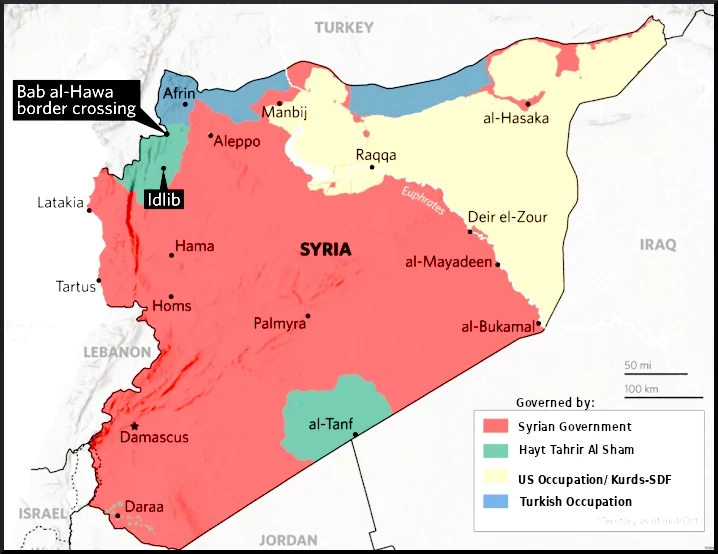
There is much misinformation and deceit about the Bab al Hawa crossing in Idlib province, Syria. First, Western media rarely mention that after the aid crosses the border, it is effectively controlled by Syria’s version of Al Qaeda, Hayat Tahrir al Sham (HTS). Second, they fail to explain that HTS hoards much of the aid for its fighters. When Aleppo was liberated by the Syrian Army, reporters found large stashes of medicines and food in their headquarters that were set aside for the use of the militia. Third, HTS makes millions of dollars by taxing the aid that it distributes to the rest of the population under its control.
In May 2018, HTS was added to the US State Department’s list as a Foreign Terrorist Organization (FTO). HTS’s 15000 fighters are able to manipulate the numbers by including their names and the names of their accompanying families as civilians, thus receiving huge amounts of aid from UN agencies such as the World Food Program. It is rarely mentioned that thousands of these civilians are not Syrian. They are Uyghurs and Turkmen supporters of Al Qaeda, from Turkey, China and elsewhere.
The Bab al Hawa crossing is also an entry point for weapons and sectarian fighters smuggled in with the copious aid. This is not new. In 2014, legendary journalist Serena Shim reported how she witnessed fighters and weapons entering Syria using World Food Organization trucks at Bab al Hawa. She was killed in Turkey two days after her report.
It is claimed over 4 million persons are in Idlib. That is a huge exaggeration. Before the conflict began in 2011 there were 1.5 million. When sectarian militants seized control, many civilians fled for Aleppo or Latakia. Even including fighters coming from other areas, the population is much LESS than before the conflict. The number of civilians in Idlib is grossly inflated for political and economic reasons.
The media also fail to mention that the aid across Bab al Hawa serves only the Al Qaeda-controlled area (the northern green section of the map) and not the rest of Syria. While western states send massive amounts of aid to this minority, the vast majority of Syrians suffer with little aid. Moreover, they are under the extreme US “Caesar” sanctions designed by the US to crush the economy by outlawing the Syrian Central Bank, make it impossible for Syrians to rebuild infrastructure, and punish Syrians and anyone who would trade or assist them.
Russian, Chinese and other representatives on the UN Security Council have pointed out that aid to Syria should be going through the UN recognized government in Damascus. Aid to civilians in Idlib should be distributed via the Syrian Red Crescent or a comparable neutral organization.
Providing aid through Bab al Hawa via hostile Turkey to an officially designated terrorist organization should be prohibited. It is a clear violation of Syrian sovereignty. In December 2022, when the authorization again comes to a UN Security Council vote, the crossing may finally be shut down. At that point, the legitimate aid to civilians in Idlib province can be delivered from within Syria as it should be.
US is Trying to Drive Erdogan into a Corner – but Without Success
By Vladimir Platov – New Eastern Outlook – 23.07.2022
Joe Biden’s administration is currently losing on all its foreign policy fronts, but he is still hoping for success, if nowhere else, in his confrontation with the Turkish leader Recep Erdoğan, so that he can demonstrate to the world and the US public, that there is still some “gunpowder left in the barrel.” This consideration took on a special importance for Joe Biden and his team in the days leading up to the US President’s Middle East trip, which promised little chance of victory for the White House. Joe Biden’s trip to Saudi Arabia did, in fact, turn out to be a total failure – it did nothing to improve his image and yielded no positive results either in terms of oil deals or in terms of reining in Russia’s influence in the region. In view of this failure, Washington needed to find a scapegoat, and picked on Recep Erdoğan.
The White House has realized that getting rid of the Turkish president, as it had hoped, is not going to be an easy matter, and has therefore stepped up its machinations in a bid to entrap him. One of its tactics was to inflame tensions between Turkey and Greece in the Eastern Mediterranean. Relations between the two countries are not easy at the moment, given Turkey’s demands for Athens to demilitarize certain Aegean islands near the Turkish border and its challenges to Greece’s sovereignty over these islands. At the end of June Recep Erdoğan took the rather undiplomatic approach of publishing threatening tweets in Greek, demanding that Greece give up its territorial claims in the Aegean Sea, and referring to the 1919-1922 war between the two countries: “We warn Greece once more to avoid dreams, statements and actions that will lead to regret, as it did a century ago… .” He also warned Turkey will “not hesitate to enact rights recognized by international agreements on the demilitarization of the islands.” In a later tweet he accused Greece of “oppressing” the Turkish minorities in Western Thrace, Rhodes, and Kos, and supporting international terrorism, a reference to Athens’ relations with the Kurds. Greece, in turn, accuses Turkey of violating Greek airspace, and of carrying out illegal hydrocarbon exploration activities off the coast of Cyprus – a region that, Greece claims, falls within its exclusive economic area.
Over the last 200 years there have been numerous wars between Greece and Turkey – the Greek War of Independence in 1821-1829, and subsequent conflicts in 1897, 1912–1913, 1919–1922, and, in Cyprus, 1974. But Greece was only able to win with support from powerful allies, including Russia. Currently, however, as one of the key supporters of the West’s sanctions against Russia, Greece cannot rely on support from Moscow. Athens is unlikely to get much support from the US either, as recent years have seen a marked shift in Washington’s attitude to its vassal states and even to its obligations under international agreements. Washington’s recent decision to support Greece rather than Turkey in the Eastern Mediterranean region is a striking example of such a change.
As for the relative strengths of the Greek and Turkish militaries, here Athens clearly lags behind Istanbul – the Greek army may be large, but due to lack of funding its weaponry is very out of date and its troops are poorly trained. Turkey, on the other hand, has the second most powerful military in NATO, after the US.
The standoff between Greece and Turkey, both members of NATO, has been going on for a long time, but it has intensified in recent years as relations between Washington and Turkey have deteriorated and Greece has replaced Turkey as the main US ally in the region. The new military alliance in the Eastern Mediterranean was recently formalized by an agreement between the two countries on long-term military support, under which Greece will host additional four US military bases.
Washington was perhaps hoping that the heightened tensions with Greece will encourage domestic opposition to Recep Erdoğan’s policies, but the effect has in fact been quite the opposite – the Turkish public have rallied round their president. On June 20 the Turkish opposition newspaper Cumhuriyet published an article by Mehmet Ali Guler, calling on Turkey to “sever ties with NATO” and looking at how its departure from the alliance might affect the balance of powers in the region. And, according to the Greek newspaper Vima, citing an interview with the commentator Erdoğan Karakuş for the Turkish television channel Haber Global, there have even been belligerent calls within Turkey for the country to “attack the US” if the latter were to provide assistance to Greece.
Well aware of Turkey’s need to update its Air Force, Washington is making use of the situation to put pressure on Ankara. Thus, even though following the meeting between Joe Biden and Recep Erdoğan in Madrid earlier this year Congress approved the supply of F-16 fighter jets to Turkey, Washington has recently made the supply conditional on Turkey demonstrating its willingness to toe the White House policy line. First, a group of US Congressmen signed a statement objecting to the sale of the jets to Turkey. And then Washington required Ankara to break off its relations with Russia as a precondition for the supply of the jets. It appears that the US is only ready to sell its military hardware to countries that share its values. According to a report from the Greek press agency AMNA, that was the stance taken by Senator Robert Menendez, Chair of the US Senate’s Foreign Relations Committee.
The US House of Representatives has also obstructed the sale, by approving an amendment to the defense budget preventing the US from transferring the jets to Turkey unless the Turkish government guarantees that they will not be used in order to violate Greek airspace.
In response to these moves, Turkey reiterated its support for Recep Erdoğan’s policies, making no secret of the fact that anti-American sentiments are growing in the country. For example, according to the Turkish newspaper Aydınlık, Doğu Perinçek, President of the Vatan Partisi, or Patriotic Party, called on the Turkish government to cancel its order for the F-16s on national security grounds.
Given the above background, it is interesting to speculate about the content of the private meeting between Recep Erdoğan and Russian President Vladimir Putin on July 19. Especially since Russian military aircraft have demonstrated their clear superiority of US jets both in Syria and in Ukraine. Moreover, Turkey and Russia have in recent months been stepping up their cooperation on defense industry projects, and, in an interview published in Turkey’s Milliyet newspaper last December, Ismail Demir, President of Turkey’s Defense Industries, stated that the two countries may work together on the development of Turkish TF-X jets. Unlike the US, Russia will not impose any conditions on Turkey that go against its interests, nor will it push the Turkish Air Force into a corner by refusing to service its aircraft when Turkey most needs them, as the US is quite capable of doing should its strategic interests so require.
Russia, Iran and Turkey agree the US troops must leave Syria
By Steven Sahiounie | MIDEAST DISCOURSE | July 20, 2022
President Recep Tayyip Erdogan of Turkey, President Vladimir Putin of Russia, and President Ebrahim Raisi of Iran held talks yesterday in Tehran at the 7th Astana summit for peace in Syria, stressing the need for respecting Syria’s national sovereignty and territorial integrity.
The summits date from January 2017, and are named for the Kazakhstan capital they were first held at. The trio of leaders decided the next meeting will be held in Moscow before the end of the year.
The Syrian Foreign Minister, Faisal Mekdad, arrived in Tehran late on Tuesday to be briefed about the latest decisions following the meeting of the presidents.
The joint conclusions
Many important issues were discussed by the trio concerning the situation in Syria, which has developed into a stalemate. Global media has stopped covering Syria since 2019 when the battlefields went silent, but a political solution has been elusive.
One point that Turkey, Russia and Iran agreed upon was the need for the US occupation troops to leave Syria, and their unified opposition to the Biden administration policy in Syria, which includes the need to lift US sanctions on Syria which are oppressing the Syrian people.
“We have certain differences concerning what is happening on the Euphrates eastern bank. But we have a shared position that American troops must leave this territory,” Putin said while adding, “They must stop robbing the Syrian state, Syrian people, illegally exporting oil from there.”
The trio affirmed that there was “no military solution” to the conflict in Syria, and agreed on the need to eliminate terrorism and opposed any attempts to divide the country.
The three leaders also jointly condemned Israel’s ongoing attacks on civilian targets in Syria, and agreed that the crisis in Syria could only be resolved peacefully and by the Syrians themselves.
Raisi said, “The international community bears the responsibility to solve the crisis of the displaced and Syrian refugees, and we will support any initiative to do so.”
The Turkish position
For at least two months, Erdogan has threatened to conduct a fourth military invasion into northern Syria. Analysts had thought the summit would be used by Iran and Russia to convince Turkey a new attack on the US-sponsored SDF in the northeastern Kurdish region would be a destabilizing event for the region. It appears that Turkey was able to get assurances from Iran and Russia that the SDF would not present a border terrorist threat to Turkey.
The US, Russia and Iran had all shared the view that Turkey should not begin a new military attack in northern Syria.
Turkey and US are NATO members and had been allies. But, the US chose to partner with the SDF, who are a separatist group in Syria led by Kurds who are following a socialist political ideology based on the communist framework of the PKK, an internationally outlawed terrorist group who have killed thousands in Turkey over three decades.
The trio agreed that terrorism must be eradicated everywhere, and there cannot be “good terrorists” who are used by the US, while others are deemed “bad terrorists” such as ISIS and Al Qaeda.
US President Obama began the US-NATO attack on Syria in 2011 for ‘regime change’. He failed. The US used the Muslim Brotherhood in the Middle East, as well as global Al Qaeda branches which were transported into northern Syria from their base in southern Turkey, were the CIA operated a terrorist headquarters which was finally shut down in 2017 by President Trump.
Erdogan is a Muslim Brotherhood follower, and his AKP party is aligned with the international terrorist group banned in Egypt, Russia, Syria, Saudi Arabia and the UAE.
The US position
The Biden administration has made no changes to US policy in Syria since taking office. The US is not present in any Syrian peace talks. Obama started the destruction in Syria, but Biden is not offering any solution. The US sanctions have prevented any reconstruction from beginning, and the Syrian people have been struggling under hyper-inflation, with no end in sight.
Russia, Turkey and Iran agreed the US-EU sanctions should be lifted and described them as being “in contravention of international law, international humanitarian law and the UN Charter including, among other things, any discriminatory measures through waivers for certain regions which could lead to this country’s disintegration by assisting separatist agendas.”
Trump had ordered the withdrawal of US troops from Syria, but the Pentagon insisted that they stay in support of the SDF who steal the oil from the main oil field in Syria and sell the oil to support their socialist administration. That oil is the property of Syria, and because they are refused access to the oil, the Syrian people live with just two hours of electricity per day.
Damascus considers the US troops in Syria as a military occupation force which destabilizes the country and is against the UN charter and international law.
US raids on terrorists in Idlib
Idlib is the last remaining terrorist controlled area in Syria. Hayat Tahrir al-Sham is the Radical Islamic terrorist group who keep about three million persons as human hostages. Turkey protects the terrorists and keeps Russian and Syrian military from attacking Idlib, while the UN and other humanitarian groups keep the terrorists, their families, and civilians fed. The US has also been very vocal and has accused the Syrian and Russian military for attacking terrorists in Idlib.
In a double-faced US policy in Idlib, the US has continued to kill ISIS leaders in Idlib, including the first assassination of the ISIS Calipha Baghdadi ordered by Trump. Since then, another five ISIS leaders have been killed by the US in Idlib. The US know that the terrorists in control in Idlib are allies of ISIS, and yet the US policy is to protect Idlib from being cleared of terrorists.
In 2015, Russia was asked to enter Syria as the Al Qaeda affiliate Jibhat al-Nusra was threatening to create an Islamic State in Syria. Putin recalled at the summit, “We broke the backbone of international terrorism there.”
Grain crisis discussion
Putin and Erdogan discussed the supply of grain from Russia and Ukraine to world markets. Putin thanked Erdogan for his efforts “to mediate by providing Turkey with a platform for negotiating food issues and grain exports across the Black Sea.” Putin called on the US to lift all restrictions on grain exports from Russia to improve the global food market situation.
Erdogan has been leading efforts to broker a deal to allow thousands of tons of grain that is being blockaded by Russia to leave Ukraine’s ports. Turkey has responsibility under the 1936 Montreux convention for naval traffic entering the Black Sea, and is proposing that Russia allow Ukrainian grain ships to leave Odesa on designated routes.
Steven Sahiounie is a journalist and political commentator.
Putin tells US to stop ‘looting’ Syria
Samizdat | July 19, 2022
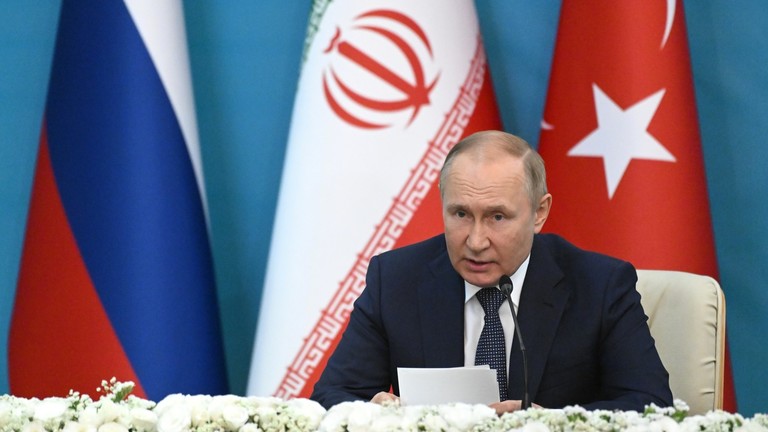
The US needs to stop “stealing” the oil from the Syrian people and state, Russian President Vladimir Putin said on Tuesday, after meeting with his Iranian and Turkish counterparts in Tehran. The three guarantors of the “Astana process” also agreed that the US should leave the trans-Euphrates, and stop making the humanitarian crisis in Syria worse with their unilateral sanctions.
American troops must leave the territory east of the Euphrates river and “stop robbing the Syrian state, the Syrian people, exporting oil illegally,” Putin told reporters on Tuesday evening. He said this was a “common position” of Russia, Iran and Turkey.
Several hundred US troops are illegally present in Syria, mainly controlling the oil wells and wheatfields in the country’s northeast, controlled by the Syrian Democratic Forces (SDF) militia since the defeat of Islamic State (IS, formerly ISIS) terrorists. The US-backed SDF has refused to reintegrate with the government in Damascus, which Washington wishes to see overthrown.
Since 2019, the US has sought to punish anyone trying to assist the reconstruction of war-torn Syria via the “Caesar Syria Civilian Protection Act,” accusing the government of President Bashar Assad of war crimes and blocking all assistance to Damascus.
Putin said on Tuesday that such sanctions have had “disastrous results” and that humanitarian aid to Syria “should not be politicized.”
During Tuesday’s summit in Tehran, Putin met with Iranian President Ebrahim Raisi and Turkey’s Recep Tayyip Erdogan. In a joint declaration, the three presidents confirmed their conviction that “there can be no military solution to the Syrian conflict,” only a political one under the leadership of the UN. They also condemned “unilateral sanctions violating international law” that are exacerbating the serious humanitarian situation in Syria, urging the UN and other international organizations to “increase assistance to all Syrians, without discrimination, politicization and preconditions.”
Russia sent an expeditionary force to Syria in September 2015, at the request of Damascus, to help defeat IS and other terrorist groups. In January 2017, Moscow, Ankara and Tehran launched the “Astana process” – named after the capital of Kazakhstan – to resolve the conflict in Syria, which began in 2011.
Featured Video
Iran spent $1 million to wipe out $30 billion in data center plans, and take down Amazon in the ME
or go to
Aletho News Archives – Video-Images
From the Archives
A short history of British torture
ICC | December 2005
When the House of Commons was debating how much to increase the time limit for detention without trial the question of torture came up. Officially this was limited to the nice considerations of whether it was all right to send people to places where torture is used and whether Britain can use information collected by the use of torture in other countries. This discussion gave an impression of democratic Britain as the home of civilised behaviour where the very idea of torture is repugnant to our legislators – unlike, say, the US with its secret CIA jails… In reality, the British state has a long history of using and developing a whole range of torture techniques. … continue
Blog Roll
 Aletho News
- Iran spent $1 million to wipe out $30 billion in data center plans, and take down Amazon in the ME
- Zionist billionaire pressure to silence Macklemore sparks exodus from Ed Sheeran tour
- House Votes to End Iran War for Third Time
- North Korea Slams US Plan for ‘AUKUS 2.0’ with South Korea and Japan
- Prolonging US-Iran Conflict Not Meeting Interests of Int’l Community – China’s Wang Yi
- EU bans former Zelensky aide from parliament
- NATO-backed Kosovo separatist ‘responsible for war crimes’
- US destroying international space law
- SCO Calls for Binding Global Deal to Prevent Arms Race in Space
- Iran & Its Allies Are Threatening Every Route for Saudi Oil
- If Americans Knew
- U.S. Makes, Israel Takes: The Real Story of U.S.-Israeli Military Cooperation
- Night raids rise in Palestine
- Tucker Carlson interviews Norman Finkelstein about Gaza
- Groups urge Americans to support Van Hollen legislation on Israel’s killing of Americans & Palestinians
- Trump administration plans to send 40,000 tons of bombs to Israel: report
- Sanctions Target Iran’s Government, But Kill Hospitalized 23-Year-Old Woman
- An alternative view on the book “Israel’s Lobby: America in the Grip of a Foreign Power”
- Ed Sheeran’s band Beoga, other opening acts quit tour after Macklemore was dropped over his pro-Palestinian comments
- The assassination attempt on President Trump in Butler and the various Israeli connections to it
- “We Want That the Whole Land Be Jewish”
- No Tricks Zone
- Economic Masterminds: German Socialists Suggest Taxing Productivity Gains Stemming From Using AI
- The South China Sea Has Not Been Cooperating With The Climate Change Narrative
- Energy Crisis: Germany Enters Heating Season With Historically Low Gas Reserve Fill Levels
- New Study: The Antarctic Ice Sheet Gained Mass From 2020-2024 Due To Staggering Snow And Ice Accumulation
- Study: Ocean Heating Rates From Thousands Of Years Ago ‘Dwarf’ Modern Ocean Heating Rates
- Climate Extremists Target, Attack Large-Scale Power Grid Infrastructure In Germany!
- New Study: Antarctic Ice Melt Has Contributed Less Than 1 Centimeter To Sea Level Rise In The Last 30 Years
- Fear Of Debate: Alarmist German Climate Scientist Calls On Mainstream Media To Discredit Skeptic Voices
- End-Of-August Arctic Sea Ice Extent Hasn’t Fallen In 20 Years, Official Data Show!
- News-Making Nepal Region Has Had As-Warm Or Warmer Periods Than The 2000s In The 1600s, 1700s, 1800s
 Aletho News