According to the Syrian news agency SANA, demonstrations against the US-backed Syrian Democratic Forces (SDF) and the US occupation in Syria continue to grow.
The protests, which are still ongoing on 27 December, demand the expulsion of US forces and their regional allies from the Deir Ezzor province.
Activists quoted by the Syrian news agency reported that residents of the village of Al-Atala blocked roads with burning tires and chanted slogans against the SDF.
Locals demand the expulsion of the forces and want to see the prosecution of its commanders for alleged crimes they have committed in the region, as well as the theft of national resources such as oil.
The Kurdish-majority SDF dominates most of the oil-rich Al-Jazira region and receives arms, money, and training from US occupation forces.
On 25 December, protests broke out against the SDF in the Deir Ezzor countryside, denouncing the alleged kidnapping of two girls who sought refuge, the girls were allegedly raped and killed, and the bodies were dumped in a village in the western countryside of Deir Ezzor.
Meanwhile, according to a report published by the Lebanese Al-Akhbar, the US is currently attempting to rebuild Liwa Thuwwar al-Raqqa (Raqqa Revolutionary Brigade) – a former Islamist militia opposed to the government in Damascus.
The report states that US efforts are aimed at appeasing Turkiye by facilitating the withdrawal of the Syrian Democratic Forces (SDF) from the border – as Ankara has requested – and replacing it with a revived version of the former opposition group to serve as a buffer zone on the Syrian-Turkish border.
In a recent meeting, US officers told the group’s leader to consolidate a formidable force of 3,000 fighters and assured him that Washington would secure their monthly paychecks.
Washington’s scheme to revive the group comes as the US continually attempts to strengthen the foothold of its occupation in Syria, particularly in Raqqa, where they have planned to construct a new military base.
December 27, 2022
Posted by aletho |
Illegal Occupation, Solidarity and Activism, War Crimes | Syria, Turkey, United States |
Leave a comment
Turkiye emerged as a critical stumbling block to a complex international plan to deprive Russia of wartime oil revenues as the number of tankers waiting to exit the Black Sea through Turkish Straits continued to rise on Friday, Reuters reports.
Ankara has declined to scrap a new insurance inspection rule it implemented at the beginning of the month, despite days of pressure from Western officials frustrated by the policy.
A total of 28 oil tankers are in a queue seeking to leave the Bosphorus and Dardanelles Straits, the Tribeca Shipping Agency said on Friday.
G7 wealthy countries, the European Union and Australia agreed to bar providers of shipping services, such as insurers, from helping export Russian oil unless it is sold at an enforced low price, or cap, aimed at depriving Moscow of wartime revenue.
Turkiye’s maritime authority said it would continue to keep out of its waters oil tankers that lacked appropriate insurance letters.
Western insurers said they cannot provide the documents required by Turkiye as it may expose them to sanctions if it emerged that the oil cargoes they cover were sold at prices that exceed the cap.
The Turkish authority said that, in the event of an accident involving a vessel in breach of sanctions, it was possible the damage would not be covered by an international oil-spill fund.
“(It) is out of the question for us to take the risk that the insurance company will not meet its indemnification responsibility,” it said, adding that Turkiye was continuing talks with other countries and insurance companies.
It added the vast majority of vessels waiting near the Straits were EU vessels, with a large part of the oil destined for EU ports – a factor frustrating Ankara’s Western allies.
The ship backlog is creating growing unease in oil and tanker markets. Millions of barrels of oil per day move south from Russian ports through Turkiye’s Bosphorus and Dardanelles Straits into the Mediterranean.
Kazakh oil
Most of the tankers waiting at the Bosphorus are carrying Kazakh oil and Treasury Secretary, Janet Yellen, said on Thursday the US administration saw no reason that such shipments should be subjected to Turkiye’s new procedures.
Washington had no reason to believe Russia was involved in Turkiye’s decision to block ship transits, she added.
The European Commission said on Friday the delays were unrelated to the price cap and Turkiye could continue to verify insurance policies in “exactly the same way as before”.
“We are therefore in contact with the Turkish authorities to seek clarifications and are working to unblock the situation,” a spokesperson told Reuters.
Turkiye has balanced its good relations with both Russia and Ukraine since Moscow invaded its neighbour in February. It played a key role in a United Nations-backed deal reached in July to free up grain exports from Ukrainian Black Sea ports.
Relations between NATO allies, Ankara and Washington, have at times been rocky, as Turkiye last month renewed calls for the United States to stop backing Syrian Kurdish forces.
The Biden administration levied sanctions on Thursday on a prominent Turkish businessman, Sitki Ayan, and his network of firms, accusing him of acting as a facilitator for oil sales and money laundering on behalf of Iran’s Revolutionary Guard Corps.
December 9, 2022
Posted by aletho |
Economics | European Union, Turkey |
Leave a comment
Samizdat – 08.12.2022
Up to 10 tankers carrying oil from Kazakhstan remain stranded in the Turkish straits of the Bosphorus and Dardanelles, the head of the KazMunayGas Kazakh oil and gas company, Magzum Mirzagaliev, said on Thursday.
“As of yesterday, there were 21 tankers there, including six tankers with oil from TCO [Kazakh oil producer]. In general, we estimate that about eight tankers related to Kazakhstan — from eight to 10 — are among those stranded,” Mirzagaliev told reporters.
Mirzagaliev cited the Kazakh Energy Ministry as saying on Wednesday that the delay in the passage of ships through the Turkish straits had already lasted six days at that point. He also recalled the 14-day bottleneck in the same waters last December.
On December 1, Turkey started requiring from oil shippers crossing the Bosphorus Strait and the Dardanelles a letter from an insurer confirming that the vessel is covered by the necessary Protection and Indemnity Insurance (P&I).
On Monday, as the European Union’s sanctions on Russian oil exports by sea went into effect, media reported that about 19 oil tankers were prevented from passing through the Turkish straits.
December 8, 2022
Posted by aletho |
Economics | European Union, Turkey |
Leave a comment
A letter provided by Russian insurer, Ingosstrakh, enabled the first oil tanker to sail through Turkish waters in recent days after tougher regulations were imposed by Turkish authorities, a document showed, Reuters reports.
This has led already at least 20 oil tankers backed up in the Turkish Straits as they do not have the right paperwork.
Turkish authorities introduced new requirements, which came into effect on 1 December, in which every ship must have insurance cover in place for all circumstances when sailing through Turkish waters or when calling at ports.
Ingosstrakh provided the requirements for the Liberia flagged “Vladimir Tikhonov” tanker, which included insurance for pollution risks throughout the period in Turkish waters, according to a letter issued to the authorities on 29 November by the insurer and seen by Reuters.
The world’s leading Western ship insurers say they are unable to provide cover for all circumstances, arguing they cannot be liable for payouts if, for instance, there are sanctions breaches with a ship’s cargo.
“Vladimir Tikhonov” completed sailing through the Bosphorus on 3 December, ship tracking data showed.
The EU and G7 price cap on Russian oil went into effect on Monday, but it’s already causing disruptions in global supply chains. The first manifestation comes from Turkey, where the Financial Times reports that a tanker traffic jam is stacking up in Turkish waters and blocking some 18 million barrels of oil from passage, as the country’s authorities demand proof that the vessels have insurance coverage:
“Around 19 crude oil tankers were waiting to cross Turkish waters on Monday, according to ship brokers, oil traders and satellite tracking services. The vessels had dropped anchor near the Bosphorus and Dardanelles, the two straits linking Russia’s Black Sea ports to international markets.”
In a striking demonstration of the price cap’s potential to disrupt markets, most of the oil in the delayed ships isn’t even subject to the sanction regime: It’s from Kazakhstan and has merely transited Russian ports after arriving there via pipeline.
One oil industry insider said Russian shippers have transited with relative ease — it’s shippers covered by western insurers that are anchored and now destined to deliver their cargo late. … Full article
December 6, 2022
Posted by aletho |
Economics, Environmentalism | European Union, Russia, Turkey |
Leave a comment
Conflict between Ankara and Washington over Syria will likely see the two drift apart, with Turkiye aligning more closely with Eurasian powers.
The series of airstrikes against Kurdish militants in northern Syria by Turkish jets in the past week come amid heightened concerns over Ankara’s threat to launch a ground operation. Such actions are not without precedent, yet have thus far achieved little in terms of eradicating the security challenges posed by US-backed Kurdish fighters.
Turkiye is today addressing an existential challenge to its national security and sovereignty, stemming from the United States’ quasi-alliance with Kurdish groups in Syria over the past decade – with whom Ankara has been battling for far longer.
However, this issue is playing out within a much broader regional backdrop today. Russia now has a permanent presence in Syria and is itself locked in an existential struggle with the US in Ukraine and the Black Sea. Iran-US tensions are also acute and President Joe Biden has openly called for the overthrow of the Iranian government.
Opposing the US occupation of Syria
Suffice to say, the Syrian government, which has demanded the removal of illegal US troops from one-third of its territory for years, enjoys a congruence of interests with Turkiye like never before, particularly in opposing the American military presence in Syria.
For the US, on the other hand, continued occupation of Syria is crucial in geopolitical terms, given that country’s geography on the northern tier of the West Asian region which borders Iran and the Caucasus to the north and east, Turkiye and the Black Sea to the north, Israel to the south, and the Eastern Mediterranean to the west.
All of that would have a great bearing on the outcome of the epochal struggle for the control of the Eurasian landmass – the Heartland and the Geographical Pivot of history as Sir Halford J. Mackinder once described it in evocative terms – by Washington and NATO to counter Russia’s resurgence and China’s rise.
China’s involvement in the Astana process
A curious detail at this point assumes larger-than-life significance in the period ahead: Beijing is messaging its interest in joining the Astana process on Syria. Moscow’s presidential envoy for Syria, Alexander Lavrentiev, stated recently that Russia is convinced that China’s involvement as an observer in the Astana format would be valuable.
Interestingly, Lavrentiev was speaking after the 19th international meeting on Syria in the Astana format with his counterparts from Turkiye and Iran on November 15.
“We believe that China’s participation in the Astana format would be very useful. Of course, we proposed this option. The Iranians agreed with this, while the Turkish side is considering it and has taken a pause before making a decision,” he explained.
Lavrentiev noted that Beijing could provide “some assistance as part of the Syrian settlement, improve the lives of Syrian citizens, and in reconstruction.”
The Chinese Foreign Ministry promptly responded to the Russian invitation, confirming that Beijing “attaches great importance to this format and is ready to work with all its participants to restore peace and stability in Syria.”
Lavrentiev didn’t miss the opportunity to taunt Washington, saying: “Of course, I believe that if the Americans returned to the Astana format, that would also be very useful. If two countries like the United States and China were present as observers in the Astana format, that would be a very good step, a good signal for the international community, and in general in the direction of the Syrian settlement.”
However, there is no question of the Biden Administration working with Russia, Turkiye, Iran, and China on a Syrian settlement at the present time. Reports keep appearing that the US has been transferring ISIS fighters from Syria to Ukraine to fight Russian forces, and to Afghanistan to stir up the pot in Central Asia.
The Astana troika are in unison, demanding the departure of US occupation forces from Syria. Moscow knows fully well too that the US hopes to work toward shuttering Russian bases in Syria.
Turkiye’s pursuit of the US’s Kurdish allies
In fact, the aerial operations in Syria that Ankara ordered last Sunday followed a terrorist strike in Istanbul a week ago by Kurdish separatists, killing at least six people and injuring more than 80 others. President Recep Tayyip Erdogan has said the air strikes were “just the beginning” and that his Armed Forces “will topple the terrorists by land at the most convenient time.”
Turkish security agencies have nabbed the bomber – a Syrian woman named Ahlam Albashir who was allegedly trained by the US military. White House Press Secretary Karine Jean-Pierre hurriedly issued a statement to calm that storm: “The United States strongly condemns the act of violence that took place today in Istanbul, Turkiye.”
But Turkiye’s Interior Minister Suleyman Soylu reacted caustically to the American missive, saying that Washington’s condolence message was like “a killer being the first to show up at a crime scene.”
Conceivably, with Erdogan facing a crucial election in the coming months, the Biden Administration is pulling out all the stops to prevent the ruling AKP party from winning another mandate to rule Turkiye.
The Turkish “swing state” is crucial for US plans
The US feels exasperated with Erdogan for pushing ahead with independent foreign policies that could see Turkiye joining the BRICS and Shanghai Cooperation Organization (SCO), and deepening his strategic ties with Russia and China – and most important, steadily mark distance from Washington and NATO’s containment strategies against Russia and China.
Turkiye has become a critically important “swing state” at this stage in the post-cold war era. Erdogan’s effort to bolster the country’s strategic autonomy lethally undermines the western strategy to impose its global hegemony.
While Erdogan keep’s Washington guessing about his next move, his airstrikes in northern Syria hit targets very close to US bases there. The Pentagon has warned that the strikes threaten the safety of American military personnel. The Pentagon statement represents the strongest condemnation by the US of its NATO ally in recent times.
Russian diplomacy forestalls Syria ground incursion
Unsurprisingly, Russia is acting as a moderating influence on Turkiye. Lavrentyev said last Wednesday that Moscow has tried to convince Ankara to “refrain from conducting full-scale ground operations” inside Syria. The Russian interest lies in encouraging Erdogan to engage with Syrian President Bashar al-Assad and pool their efforts to curb the activities of Kurdish terrorists.
Indeed, the probability is low that Erdogan will order ground incursions into Syria. This also seems to be the assessment of local Kurdish groups.
US-backed Syrian Democratic Forces (SDF) Commander Mazloum Kobane Abdi, who is the Pentagon’s key interlocutor in northern Syria, has been quoted as saying that while he has received intelligence that Turkiye has alerted its local proxies to prepare for a ground offensive, the Biden administration could still convince Erdogan to back off.
That said, Erdogan can make things difficult for the US and eventually even force the evacuation of its estimated 900 military troops, shutting down the Pentagon’s lucrative oil smuggling operation in Syria and abandoning its training camps for ex-ISIS fighters in northern and eastern Syria.
But the US is unlikely to take matters to a point of no return. A retrenchment in Syria at the present juncture will weaken the US regional strategies, not only in West Asia, but also in the adjoining Black Sea region and the Caucasus, in the southern periphery of the Eurasian landmass.
From Erdogan’s perspective too, it is not in his interest to burn bridges with the west. A bridge in disrepair remains a bridge nonetheless, which would have its selective uses for Erdogan in the times of multipolarity that lie ahead.
November 28, 2022
Posted by aletho |
Illegal Occupation | Afghanistan, China, Iran, ISIS, Middle East, NATO, Russia, Syria, Turkey, United States |
Leave a comment
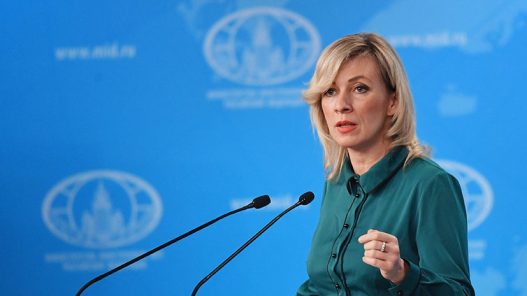
The Russian government warned Thursday that a military ground operation by Turkey against Kurdish groups in northern Syria could lead to “an increase in terrorist activity,” following threats to that effect by Turkish President Recep Tayyip Erdogan.
“We understand Turkey’s concerns about threats to its national security, but we also believe that a ground operation on Syrian territory will only increase tensions in the region and lead to an increase in terrorist activity,” Russian Foreign Ministry spokeswoman Maria Zakharova has said.
Thus, she stressed that Moscow “maintains close contacts with Turkey on the situation in Syria” and defended that the best way to solve security problems is a direct dialogue between Ankara and Damascus, as reported by the Russian news agency TASS.
Erdogan stressed on Wednesday that the new bombing campaign against Kurdish groups in Iraq and Syria “is only the beginning” and reiterated that Ankara will launch ground operations “when it deems appropriate.”
He also said he did not rule out a conversation with his Syrian counterpart, Bashar Al-Assad, to address the situation.
The Turkish operation, dubbed ‘Sword Claw’ was launched following the Nov. 13 bombing in Istanbul, which left six dead and which Turkey blames on the Kurdistan Workers’ Party (PKK). However, both the group and the SDF have disassociated themselves from what happened and have expressed their condolences to the victims.
November 25, 2022
Posted by aletho |
Illegal Occupation | Russia, Syria, Turkey |
Leave a comment
How the world appears all depends on whether your gaze is firmly focussed on the hub of the wheel, or alternatively, were you to watch the wheel’s rotation around the hub – and the bearing it follows – you would see the world differently.
Looked at from a DC-centric perspective, all is still: Nothing (as it were), is moving geo-politically. Was there an election in the U.S.? Well, certainly there is no longer an ‘Election Day’ event as the new mechanics of ballots vs in-person voting, commencing up to 50 days earlier, and ploughing on, weeks after, has become far removed from the old notion of having ‘an election’, and an aggregate macro outcome.
From this ‘centric’ viewpoint, the Midterms change nothing – stasis.
So many of Biden’s policies were already in stone anyway – and beyond the ability of any Congress to change in the short run.
New legislation, if there were any, could be vetoed. And should the election ‘month’ end with the House controlled by Republicans and the Senate controlled by Democrats, there might not be any legislation at all, because of partisanship and an inability to compromise.
More to the point, Biden anyway can rule for the next 2 years through Executive Order and bureaucratic inertia – and not need the Congress at all. In other words, the composition of Congress may not matter that much.
But now, turn your gaze to the rotation around the ‘hub’, and what do you see? The rim spinning wildly. It seizes more and more traction on the ground and has clear directionality.
The biggest pivot around the hub? Well probably, President Xi of China travelling to Riyadh to meet Mohammad bin Salman (MbS). The wheel rim here digs deep for a firm grip on bedrock, as Saudi Arabia makes its pivot toward the BRICS. Xi likely is going to Riyadh to seal the details of Saudi’s accession to the BRICS and the terms of China’s future ‘Oil Accord’ with Saudi Arabia. And that may be the beginning to the end to the petrodollar system – as whatever is agreed in terms of the Chinese mode of payment for oil will mesh with Russo-Chinese plans eventually to move Eurasia onto a new trading currency (far away from the dollar).
Saudi Arabia gravitating BRICS-wards means other Gulf and Mid East – states such as Egypt – leaning BRICS-wards also.
Another pivot: The Turkish Interior Minister Süleyman Soylu said after this week’s explosion in Istanbul: “We do not accept the condolence message of the U.S. Embassy. We understand the message that was given to us, we received the message that was given to us”. Soylu then dismissed the U.S. condolence as akin to “a killer being first to show up at a crime scene”.
Let’s be clear: The minister just told the U.S. to go sc**w itself. This unleashing of raw anger comes just as Turkey has agreed to join with Russia to establish a new gas hub in Turkey and is participating with Russia in a massive oil and gas investment and co-operation deal with Iran. Turkey too, is veering BRICS-wards.
And, as Turkey veers away from one ‘hub’, much of the Turkic sphere will take Turkey’s lead.
These two events – from Xi’s meeting with MbS’ thumbing his nose at the U.S., to Turkey’s fury at the terrorism in Istanbul – clearly dovetail together to mark a strategic Middle East pivot – both in terms of energy and monetary frameworks, towards the unfolding Eurasian free trade sphere.
Then comes the news from last Thursday: Iran says that it has developed a high-precision hypersonic missile. General Hajizadeh said the Iranian hypersonic ballistic missile can reach more than five times the speed of sound and, as such, it will be able to breach all present systems of anti-missile defence.
Simply put: Iran essentially already is a nuclear threshold state (but not a nuclear weapons state). The remarkable technical achievement of producing a hypersonic high-precision missile (which still eludes the U.S.), is a paradigm-changer.
Strategic nukes make no sense in a highly mix-populated, small Middle East – and now, there is no need for Iran to move towards becoming a weapons state. So, what would be the point to a complicated containment strategy (i.e. the JCPOA), oriented towards hindering an outcome that has become overtaken by new technology? A hypersonic ballistic missile capacity makes tactical nukes redundant. And hypersonic missiles are more effective; more easily deployed.
The problem for the U.S. and Israel is that Iran has done it – it has leaped beyond the JCPOA containment cage.
On top of that, a few days earlier, Iran also announced that it had launched a ballistic missile, carrying a satellite into space. If so, Iran now has ballistic missiles capable of reaching, not only Israel, but Europe too. Furthermore, Iran is reported to soon receive 60 SU-35 aircraft, as just one part to its rapidly evolving relationship with Russia, sealed last week with Nikolai Patrushev (Russia’s Security Council Secretary) in Tehran.
Again, to be clear, Russia has just acquired a highly potent kinetic force multiplier; access to Iran’s sanctions-busting rolodex of contacts and strategies, and a full partner to Moscow’s big play of Eurasia becoming a commodities super-oligopoly.
Simply put, as Iran enlists as a force multiplier to the Russia-China axis, so too will Iraq, Syria, Hizbullah and the Houthis slip along a somewhat similar trajectory.
Whilst the European ‘security architecture’ remains still frozen in a tight NATO, anti-Russian grip, West Asia’s security architecture is dissolving away from the old U.S. and Israeli-led hard polarisation of a Sunni sphere vs Shi’i Iran (i.e. the so-called Abraham Accords), and is re-forming around a new security architecture being shaped by Russia and China.
This makes sense. Turkey prizes its Turkic civilisational heritage. Iran clearly is a civilisational state, and MbS plainly wants his kingdom to be widely accepted as one, too (and not as just a U.S. dependency). The point of the SCO format is that it is ‘pro-autonomy’ and is opposed to any singularity of ideology. In fact, by being civilisational in concept, it becomes anti-ideological and opposed to tight binary (with us, or against us) alliances. Membership does not require endorsement of each other partner’s particular policies, provided they do not impinge on others’ sovereignty.
In effect, the whole of West Asia – to one degree or another – is being lifted up into this evolving Eurasian economic and security paradigm.
And, simply said, since Africa is already enlisted into the China camp, the African component to MENA is trending strongly Eurasia-wards, as well. The Global South’s affiliation too, largely can be taken for granted.
Where does this leave the old ‘hub’? It has Europe fully in its control. For now, yes…
However research published by France’s École de Guerre Economique suggests that whilst Europe has, since WW2, “lived in a state of the unspoken” in respect to its full-spectrum dependency on Washington, as Russia sanctions take their catastrophic effect on Europe, “a very different state of affairs takes hold”. Consequently, politicians, and the public alike, struggle to identify “who truly is their enemy”.
Well, the collective view, based on interviews with French intelligence experts (i.e. the French Deep State) is very clear: 97% percent consider the U.S. to be the foreign power that “most threatens” the “economic interests” of France. And they see it as a problem that must be resolved.
Of course, the U.S. will not easily let Europe go. Nonetheless, if parts of the Establishment can speak thus, then something is moving and afoot, beneath the surface. The report underlines naturally that the EU might have a trade surplus of 150 billion euros with the U.S., but the latter would never willingly allow this to translate into ‘strategic autonomy’. And any gain in autonomy is achieved against the constant backdrop of – and more than offset by – “strong geopolitical and military pressure” from the U.S. at all times.
Could the Nord Stream sabotage have been the straw that broke the camel’s back? In part, it was a trigger, but Europe hides its diverse old hatreds and long-nursed vindictiveness under ‘a Brussels lid of easy money’. But this pertains only so long as the EU remains a glorified ATM – states insert their debit-cards and withdraw cash. The concealed animosities are repressed, and monetarily lubricated into quiescence.
The ATM however, is in trouble (economic contraction, de-industrialisation and austerity cometh!); and as the ATM withdrawals’ window winnows down, so too the lid holding down the old animosities and tribal feelings will not hold for long. Indeed, the demons are rising – and are readily visible even now.
And finally, will the Washington ‘hub’ hold? Does it retain the resources to manage so many stress-test events – financial, systemic and political – all arriving synchronistically? We must wait to see.
In retrospect, the ‘Hub’ is not ‘on the move’. It has moved already. It is just that so many are stuck seeing an ‘empty space’ that once was occupied by something past, but which somehow still somehow lingers on, in visual memory, as a ‘shade’ of its earlier solidity.
November 22, 2022
Posted by aletho |
Economics | China, European Union, Iran, Middle East, Russia, Saudi Arabia, Turkey, United States |
Leave a comment
Steven Sahiounie of MidEastDiscourse interviewed Ambassador Peter Ford to hear his expert analysis of important issues developing in the region.
Israel, Lebanon, Syria and Turkey are neighbors in an increasingly unstable Middle East, in which Saudi Arabia plays a key role.
The US has meddled in the Middle East for decades and is responsible for the destruction of several countries who have not recovered from failed American policies.
Peter Ford served as the British ambassador to Bahrain from 1999 to 2003 and Syria from 2003 to 2006, and is currently the London-based Co-Chairman of the British Syrian Society. He is an Arabist with long established expertise in the Middle East.
Benjamin Netanyahu and his allies recently came back to power in “Israel”. In your opinion what does this mean for the Palestinians?
It makes no difference. Those who believe that one Israeli government is different from another are fools. Every Israeli government supports the occupation and practices repression. Any differences are purely optical.
That said, the participation of overt racists in Netanyahu’s government increases the chances that the US will distance itself from Israel in matters of secondary importance.
Lebanon is in the midst of a financial and social collapse. In your opinion, will the Israeli regime take advantage of the crisis and attack Lebanon?
Israel is already viciously attacking Lebanon – economically. The Israeli/US strategy is to avoid war, which they would lose, but instead to create enough suffering in Lebanon to make the Lebanese people turn against Hezbollah. In particular, they are trying to block oil reaching Lebanon from Iran. This is similar to their strategy towards Syria.
The UN Special Rapporteur has called for the end of sanctions on Syria because of the continuing suffering. Do you think there is any hope in removing the sanctions which are crippling the daily life of Syrians?
Sadly I see no prospect of sanctions on Syria being lifted or eased in the foreseeable future. It costs the US nothing to apply them and the US against all evidence persists in believing that sanctions weaken popular support for the Syrian government, or pretending to believe they weaken the government simply because it would be embarrassing to lift them. Lifting sanctions would look like an admission of failure and a concession to Russia and Iran.
Sanctions on Syria cannot be analyzed without taking the geopolitical situation into account. To some degree Syria is paying part of the price for US mishandling of its relations with Russia and Iran.
Saudi Crown Prince Mohammed bin Salman has not bowed down to pressure by US President Joe Biden. In your opinion, what will be the cost that Saudi Arabia has to pay?
The cost will be zero. On the contrary, Saudi defiance of the US over oil prices shows that the balance of power between the two has shifted and that the US is a paper tiger where Saudi Arabia is concerned. Let us not forget that the US arms industry has become highly dependent on sales to the Gulf, and the US has invested heavily in keeping Saudi Arabia away from rapprochement with Iran. Its leverage is minimal. It was different when MBS was an international pariah over Khashoggi, but time has done its work of prompting amnesia if not forgiveness. I expect to see more Saudi defiance of the US.
For the past few months, we have been hearing reports from the Turkish side of overtures at repairing the relationship between Turkey and Syria. In your opinion, will this have an effect on ending terrorist control in Idlib?
I am more optimistic about Idlib today than I have been for ages. Time is also doing its work here – demonstrating to the Turks that their Syria policy has been a total failure. That policy has failed to remove the Syrian government, failed to establish stability on Turkey’s border and failed to create conditions for the return of Syrian refugees. The burden of those refugees is felt especially acutely with the approach of presidential elections in Turkey. Whether Erdogan is serious about rapprochement with Syria remains however to be seen.
Steven Sahiounie is a two-time award-winning journalist
November 18, 2022
Posted by aletho |
Economics, Wars for Israel | Iran, Israel, Lebanon, Middle East, Saudi Arabia, Syria, Turkey, United States |
Leave a comment
Samizdat – November 2, 2022
Russia has resumed its participation in the Türkiye and UN-mediated deal on the export of Ukrainian grain via the Black Sea, the Defense Ministry announced on Wednesday.
Moscow agreed to reverse the suspension after receiving written guarantees from Kiev that it would not use the safety corridor provided by Russia for military purposes, the statement said.
“At this time, the Russian Federation considers the issued guarantees sufficient,” the ministry noted.
Moscow’s decision to suspend participation in the arrangement was announced last week after the Russian military accused Ukraine of using the corridor for a drone attack on the port of Sevastopol.
The statement on Wednesday credited the UN and Türkiye for securing the written pledge from Kiev. The scheme, which was first negotiated in July, is technically a set of two trilateral agreements between the two mediators and Russia and Ukraine respectively.
Moscow has long expressed concern about the implementation of the deal, which was touted by Kiev and its Western backers as necessary to curb surging prices in the global food market. Contrary to its stated goal, many of the shipments were sent to rich European countries rather than struggling nations elsewhere in the world, Russia said.
Moscow also blamed the UN for failing to have the US and its allies lift economic sanctions against Russian maritime traffic, which is necessary for shipping Russian food and fertilizers to other nations. It was also part of the terms of the Black Sea grain initiative.
The attack on Sevastopol happened early on Saturday last week and involved unmanned aerial and naval craft, which were detected and intercepted by the Russian Navy, according to statements by the defense ministry.
It claimed that the British military assisted Ukraine in planning and executing the operation. It further claimed that the same Royal Navy unit was involved in an attack on the Nord Stream pipelines in the Baltic Sea in September.
The UK Ministry of Defence responded by accusing its Russian counterpart of peddling false claims of “epic scale.”
November 2, 2022
Posted by aletho |
Economics | Russia, Turkey, Ukraine |
Leave a comment
Europe has sought to bypass Russian gas with disastrous results. Turkey is set to reap the benefits.
“Geography is the constant of history,” is a quote attributed to the German statesman Otto von Bismarck. Today, those words ring true as we witness geography altering global politics, finance, and alliances.
The geostrategic importance of Turkey has rarely been as clear to European politicians as it has been in recent months, as the continent grapples with a burgeoning energy crisis this coming winter.
Whether it is grain exports from the Black Sea region or the flow of energy supplies from the eastern producing countries, the Bosphorus and the links to Eurasia are once again playing a decisive geopolitical role, as they so often have throughout history. The fact is, Turkey is now crucial for the security of Europe.
Pipeline politics
On the occasion of Turkish President Recep Tayyip Erdogan’s meeting with his Russian counterpart Vladimir Putin in Sochi at the beginning of August 2022, the focus was mainly on bilateral cooperation in energy matters.
Putin told journalists after the tete-a-tete that Europeans should be grateful to Ankara for its gas supplies due to the reliability of the TurkStream pipeline.
Last year, Russian natural gas accounted for around 45 percent of European gas imports. But that share has fallen to less than 10 percent after supplies were halted via the eastbound Yamal-Europe pipeline and suspected US-backed operatives blew up Nord Stream, which also curtailed exports via Ukraine.
The Russian-Turkish TurkStream gas pipeline project was announced in December 2014 after Moscow realized that the long-planned SouthStream project – meant to deliver Russian natural gas via the Black Sea directly to European Union (EU) member state Bulgaria – was not feasible.
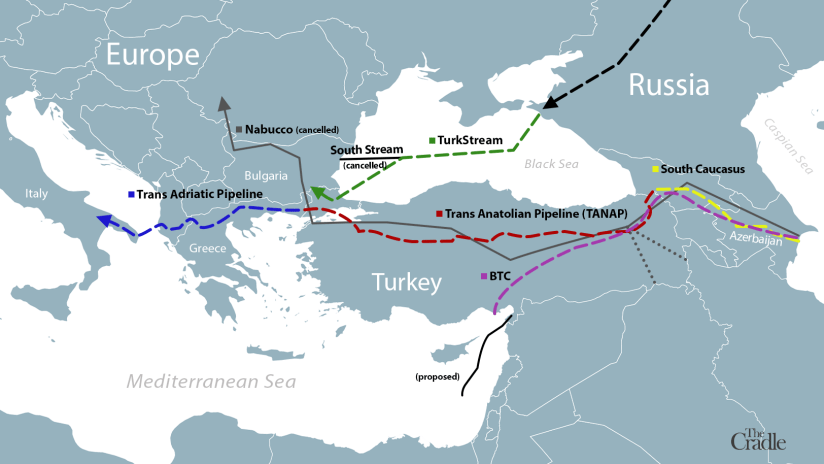
Russian energy giant Gazprom and the Italian energy company ENI were the main partners in the consortium. However, following the Crimean crisis in March 2014, the EU Commission blocked this major infrastructure project, citing competition rules.
As far as Moscow was concerned, this arrangement had already been completed in the form of terminals and pipeline routes. Thousands of work contracts had been issued between Bulgaria and Hungary at the time.
Construction was scheduled to begin in June 2014, but Brussels alluded to apparent violations of competition rules in the awarding of contracts by the Bulgarian authorities and brought everything to a halt.
Turkey as a Russian energy hub
Nine months later, during a joint press conference with Erdogan in Ankara, Putin remarked that “If Europe does not want to carry it out, then it will not be carried out.” Putin then announced the TurkStream project, which was formally launched in early 2020.
One pandemic and a war later, the world has experienced and continues to experience rising natural gas prices, while Russian-Turkish energy cooperation is intensifying. On 19 October, Erdogan said he had agreed with Putin to set up a comprehensive hub for Russian natural gas built in Turkey from where Europe could meet its energy needs.
“If Turkey and our potential buyers are interested, we could consider building another gas pipeline and creating a gas hub in Turkey for sale to third countries, especially in Europe,” Putin proposed. In addition, a gas exchange could also be created in Turkey to determine prices, he added.
Neither the EU nor the US have welcomed these developments or, in some cases, faits accomplis. Turkey makes no secret of the fact that it wants to expand its status in the China-led Shanghai Cooperation Organisation (SCO) and will probably soon become the tenth member of this important regional organization.
It should be noted that the SCO’s statutes stipulate energy and security – especially the fight against terrorism – as its essential agenda. The EU, it must be said, is only just discovering the importance of these issues.
Attempts to bypass Russian gas
In the recent past, governments and energy companies have looked to Turkey as an alternative to the existing transit routes for oil and gas between the east and west. In 2005, the 1750 km long Baku-Tbilisi-Ceyhan (BTC) pipeline was opened, transporting Caspian oil across the Caucasus to the Turkish Mediterranean port.
Crucially, this route had the backing of Washington, reinforcing the close connection between politics and the oil business. As per an apt saying from the early 20th century US oil industry: “The oil business is too important to leave it to the oil people.”
The Nabucco pipeline project, intended to reduce Europe’s reliance on Russia’s gas, consisted of a consortium of six corporations based on the initiative of the Austrian partly state-owned OMV. The project was supported politically and financially by the European Commission, with the premise being that natural gas would be supplied from the Caspian region via Turkey to Central Europe to the Baumgarten hub in Austria.
Billions were spent on marketing this project between 2002 and 2014. However contractual agreements surrounding the deal never materialized. Though inconceivable now, Iran was also initially planned as an alternative supplier, yet these efforts failed from 2005 onwards due to UN Security Council sanctions on Iran from 2008 until the present.
Additionally, supply contracts with Iraq and Turkmenistan were targeted in vain, although these arguably had a lot to do with complete mismanagement. In the case of Turkmenistan, countless advisory opinions were commissioned on the status of the Caspian Sea under international law, sea, or lake, and the possible transit pipelines for landlocked Turkmenistan.
A failed strategy
After many years of mere marketing and a lot of hot air between Brussels and Vienna around the Nabucco project, OMV’s partners finally backed out in 2014. It was clear that there was no natural gas available.
In my book “Der Energiepoker” (The Energy Poker) I wrote in 2006: “If the managers had not gone to the State Opera to see Verdi’s Nabucco, but had seen the operetta by Johann Strauss “Wiener Blut” (Viennese Blood), then this natural gas pipeline would have been given a more appropriate name.
Now, in view of the Nord Stream 2 pipeline boycotted by the EU, OMV is facing further setbacks, as the contracts with take-or-pay clauses were drafted in such a way that payment would have to be made for the Russian natural gas, even if there was no physical delivery. These conditions apparently apply until 2040.
EU will buy Russian energy indirectly
While the EU wants to bypass Russian energy sources for political reasons, Turkey, India, and China, among others, will gladly fill in the consumer void. As described, Turkey already benefited in 2014 from the SouthStream project, which became TurkStream. The EU ultimately lost out, while Ankara stood to gain, with the EU presently buying Russian natural gas via Turkey.
This energy route is set to expand even further once the Russian natural gas hub in Turkey is established. Turkey thus becomes the safeguard of the EU’s energy security. While this was the case a few years ago with non-Russian natural gas and oil, it now looks as if Russia is merely adapting its role for the European market on a regional basis.
For some years, Ankara aligned its prospective role as a hub for BTC and the Nabucco project with its EU accession ambitions. Now it seems that Turkey will become a member of the SCO much faster, and despite its NATO membership, part of the security cooperation with Russia and China.
The EU is more dependent than ever on the goodwill of those it once created obstacles for, and Turkey and Russia are no exception. The coming months will show with all their force just how irresponsibly the EU governments handled the continent’s energy security needs.
October 24, 2022
Posted by aletho |
Economics, Malthusian Ideology, Phony Scarcity, Timeless or most popular | European Union, Russia, Sanctions against Iran, Turkey |
Leave a comment
David Brinkley, the legendary American newscaster with a career that spanned an amazing fifty-four years from World War II once said that a successful man is one who can lay a firm foundation with the bricks others have thrown at him. How many American statesmen ever practised this noble thought inherited from Jesus Christ remains doubtful.
Russian President Vladimir Putin’s stunning proposal to Turkish President Recep Erdogan to build a gas pipeline to Turkiye to create an international hub from which Russian gas can be supplied to Europe breathes fresh life into this very “Gandhian” thought.
Putin discussed the idea with Erdogan at their meeting in Astana on October 13 and since spoke about it at the Russian Energy Week forum last week where he proposed creating the largest gas hub in Europe in Turkey and redirecting the volume of gas, the transit of which is no longer possible through the Nord Stream, to this hub.
Putin said it may imply building another gas pipeline system to feed the hub in Turkiye, through which gas will be supplied to third countries, primarily European ones, “if they are interested.”
Prima facie, Putin does not expect any positive response from Berlin to his standing proposal to use the string of the Nord Stream 2, which remained undamaged, to supply 27.5 billion cu. metres of gas through the winter months. Germany’s deafening silence is understandable. Chancellor Off Scholz is terrified about President Biden’s wrath.
Berlin says it knows who sabotaged the Nord Stream pipelines but won’t reveal it as it affects Germany’s national security! Sweden too pleads that the matter is far too sensitive for it to share the evidence it has collected with any country, including Germany! Biden has put the fear of God into the minds of these timid European “allies” who have been left in no doubt what is good for them! The western media too is ordered to play down Nord Steam saga so that with the passage of time, public memory will fade away.
However, Russia has done its homework that Europe cannot do without Russia gas, the present bravado of self-denial notwithstanding. Simply put, the European industries depend on cheap, reliable supplies of Russian gas for their products to remain competitive in the world market.
Qatar’s energy minister Saad al-Kaabi said last week that he cannot envisage a future where “zero Russian gas” flows to Europe. He noted acerbically, “ If that’s the case, then I think the problem is going to be huge and for a very long time. You just don’t have enough volume to bring (in) to replace that (Russian) gas for the long term, unless you’re saying ‘I’m going to be building huge nuclear (plants), I’m going to allow coal, I’m going to burn fuel oils.’”
Quintessentially, Russia plans to replace its gas hub in Haidach in Austria (which Austrians seized in July.) Conceivably, the hub in Turkiye has a ready market in Southern Europe, including Greece and Italy. But there is more to it than meets the eye.
Succinctly put, Putin has made a strategic move in the geopolitics of gas. His initiative rubbishes the hare-brained idea of the Russophobic European Commission bureaucrats in Brussels, headed by Ursula von der Leyen, to impose a price cap on gas purchases. It makes nonsense of the US’ and EU’s plans to put down Russia’s profile as a gas superpower.
Logically, the next step for Russia should be to align with Qatar, the world’s second biggest gas exporter. Qatar is a close ally of Turkey, too. At Astana recently, on the sidelines of the summit of the Conference on Interaction and Confidence-Building Measures in Asia (CICA), Putin held a closed-door meeting with the Emir of Qatar Sheikh Tamim bin Hamad Al Thani. They agreed to follow up with another meeting soon in Russia.
Russia already has a framework of cooperation with Iran in a number of joint projects in the oil and gas industry. Russian Deputy Prime Minister Alexander Novak recently disclosed plans to conclude an oil and gas swap deal with Iran by the end of the year. He said that “technical details are being worked out – issues of transport, logistics, price, and tariff formation.”
Now, Russia, Qatar and Iran together account for more than half of the world’s entire proven gas reserves. Time is approaching for them to intensify cooperation and coordination on the pattern of the OPEC Plus. All three countries are represented in the Gas Exporting Countries Forum (GECF).
Putin’s proposal appeals to Turkiye’s longstanding dream to become an energy hub at the doorstep of Europe. Unsurprisingly, Erdogan instinctively warmed up to Putin’s proposal. Addressing the ruling party members in the Turkish parliament this week, Erdogan said, “In Europe they are now dealing with the question of how to stay warm in the coming winter. We don’t have such a problem. We have agreed with Vladimir Putin to create a gas hub in our country, through which natural gas, as he says, can be delivered to Europe. Thus, Europe will order gas from Turkey.”
Apart from strengthening its own energy security, Turkiye also can contribute to Europe’s. No doubt, Turkiye’s importance will take a quantum leap in the EU foreign policy calculus, while also strengthening its strategic autonomy in regional politics. This is a huge step forward in Erdogan’s geo-strategy — the geographic direction of Turkish foreign policy under his watch.
From the Russian viewpoint, of course, Turkiye’s strategic autonomy and its grit to pursue independent foreign policies works splendidly for Moscow in the present conditions of western sanctions. Conceivably, Russian companies will start viewing Turkiye as a production base where western technologies become accessible. Turkiye has a customs union agreement with the EU, which completely removes customs duties on all industrial goods of Turkish origin. (See my blog Russia-Turkey reset eases regional tensions, Aug 9, 2022)
In geopolitical terms, Moscow is comfortable with Turkiye’s NATO membership. Clearly, the proposed gas hub brings much additional income to Turkiye and will impart greater stability and predictability to the Russia-Turkey relations. Indeed, the strategic links that tie the two countries together are steadily lengthening — the S-400 ABM deal, cooperation in Syria, the Akkuyu Nuclear Power Plant, Turk-stream gas pipeline, to name a few.
The two countries candidly admit that they have differences of opinion, but the way Putin and Erdogan through constructive diplomacy keep turning adverse circumstances into windows of opportunity for “win-win” cooperation is simply amazing.
It does need ingenuity to get the US’ European allies to source Russian gas without any coercion or boorishness even after Washington buried the Nord Stream gas pipelines in the depths of the Baltic Sea. There is dramatic irony that a NATO power is partnering Russia in this direction.
The US foreign policy elite drawn from East European stock are rendered speechless by the sheer sophistication of the Russian ingenuity to bypass without any trace of rancour the shabby way the US and its allies — Germany and Sweden, in particular — slammed the door shut on Moscow to even take a look at the damaged multi-billion dollar pipelines that it had built in good faith in the depths of the Baltic Sea at the insistance of two German chancellors, Gerhard Schroeder and Angela Merkel.
The current German leadership of Chancellor Olaf Scholz looks very foolish and cowardly – and provincial. The European Commission’s Ursula von der Leyen gets a huge rebuff in all this which will ultimately define her tragic legacy in Brussels as a flag carrier for American interests. This becomes probably the first case study for historians on how multipolarity will work in the world order.
October 22, 2022
Posted by aletho |
Economics, Malthusian Ideology, Phony Scarcity | European Union, Germany, Russia, Turkey, United States |
Leave a comment

File Photo
A mild flutter ensued after External Affairs Minister S Jaishankar’s recent meeting with his Turkiye counterpart Mevlut Cavusoglu on the sidelines of the UN General Assembly session in New York on September 21 when it came to be known that Cyprus figured in their discussion. Jaishankar highlighted it in a tweet.
The Indian media instinctively related this to Turkish President Recep Erdogan making a one-line reference to the Kashmir issue earlier that day in his address to the UN GA. But Jaishankar being a scholar-diplomat, would know that Cyprus issue is in the news cycle and the new cold war conditions breathe fresh life into it, as tensions mount in the Turkish-Greek rivalry, which often draws comparison with the India-Pakistan animosity, stemming from another historical “Partition” — under the Treaty of Lausanne (1923) that ended the Ottoman Empire.
The beauty about peace treaties is that they have no ‘expiration date’ but the Treaty of Lausanne was signed for a period of a hundred years between Turkiye on one side and Britain, France, Italy, Greece, and their allies on the other. The approaching date heightens the existential predicament at the heart of Turkiye’s foreign policy.
The stunning reality is that by 24th July 2023, Turkey’s modern borders become “obsolete”. The secret articles of the 1923 Treaty, signed by Turkish and British diplomats, provide for a chain of strange happenings — British troops will reoccupy the forts overlooking the Bosphorus; the Greek Orthodox Patriarch will resurrect a Byzantine mini state within Istanbul’s city walls; and Turkey will finally be able to tap the forbidden vast energy resources of the East Mediterranean (and, perhaps, regain Western Thrace, a province of Greece.)
Of course, none of that can happen and they remain conspiracy theories. Nonetheless, the “end-of-Lausanne” syndrome remains a foundational myth and weaves neatly into the historical revisionism that Ataturk should have got a much better deal from the Western powers.
All this goes to underline the magnitude of the current massively underestimated drama, of which Cyprus is at the epicentre. Suffice to say, Turkey’s geometrically growing rift with Greece and Cyprus over the offshore hydrocarbon reserves and naval borders must be properly understood in terms of the big picture.
Turkiye’s ruling elite believe that Turkey was forced to sign the Treaty of Sevres in 1920 and the “Treaty of Lausanne” in 1923 and thereby concede vast tracts of land under its domain. Erdogan rejects any understanding of history that takes 1919 as the start of the 1,000-year history of his great nation and civilisation. “Whoever leaves out our last 200 years, even 600 years together with its victories and defeats, and jumps directly from old Turkish history to the Republic, is an enemy of our nation and state,” he once stated.
The international community has begun to pay attention as Turkiye celebrates its centenary next year, which also happens to be an election year for Erdogan. In a typical first shot, the US State Department announced on September 16 — just five days before Jaishankar met Cavusoglu — that Washington is lifting defence trade restrictions on the Greek Cypriot administration for the 2023 fiscal year.
Spokesman Ned Price said, “Secretary of State Antony J. Blinken determined and certified to Congress that the Republic of Cyprus has met the necessary conditions under relevant legislation to allow the approval of exports, re-exports, and transfers of defence articles.”
The US move comes against the backdrop of a spate of recent arms deals by Cyprus and Greece, including a deal to purchase attack helicopters from France and efforts to procure missile and long-range radar systems. Turkiye called on the US “to reconsider this decision and to pursue a balanced policy towards the two sides on the Island.” It has since announced a beefing up of its military presence in Northern Cyprus.
To be sure, the unilateral US move also means indirect support for the maritime claims by Greece and the Greek Cypriot administration, which Turkiye, with the longest continental coastline in the Eastern Mediterranean, rejects as excessive and violates its sovereign rights and that of Turkish Cypriots.
Whether these developments figured in Jaishankar’s discussion with Cavusoglu is unclear, but curiously, India too is currently grappling with a similar US decision to offer a $450 million military package to Pakistan to upgrade its nuclear-capable F-16 aircraft.
Indeed, the US-Turkey-Cyprus triangle has some striking similarities with the US-India-Pakistan triangle. In both cases, the Biden administration is dealing with friendly pro-US governments in Nicosia and Islamabad but is discernibly unhappy with the nationalist credo of the leaderships in Ankara and New Delhi.
Washington is annoyed that the governments in Ankara and New Delhi preserve their strategic autonomy. Most important, the US’ attempt to isolate Russia weakening due to the refusal by Turkiye and India to impose sanctions against Moscow.
The US is worried that India and Turkiye, two influential regional powers, pursue foreign policies promoting multipolarity in the international system, which undermines US’ global hegemony. Above all, it is an eyesore for Washington that Erdogan and Prime Minister Modi enjoy warm trustful personal interaction with Russian President Vladimir Putin.
The photo beamed from Samarkand during the recent SCO summit showing Erdogan arm in arm with Putin must have infuriated President Biden. Modi too displayed a rare moment of surging emotions when he told Putin at Samarkand on September 16,
“The relationship between India and Russia has deepened manifold. We also value this relationship because we have been such friends who have been with each other every moment for the last several decades and the whole world also knows how Russia’s relationship with India has been and how India’s relationship with Russia has been and therefore the world also knows that it is an unbreakable friendship. Personally speaking, in a way, the journey for both of us started at the same time. I first met you in 2001, when you were working as the head of the government and I had started working as head of the state government. Today, it has been 22 years, our friendship is constantly growing, we are constantly working together for the betterment of this region, for the well-being of the people. Today, at the SCO Summit, I am very grateful to you for all the feelings that you have expressed for India.”
Amazingly, the western media censored this stirring passage in its reports on the Modi-Putin meeting!
Notably, following the meeting between Modi and Erdogan in Samarkand on Sept. 16, a commentary by the state-owned TRT titled Turkiye-India ties have a bright future ahead signalled the Erdogan government’s interest to move forward in relations with India.
India’s ties with Turkiye deserve to be prioritised, as that country is inching toward BRICS and the SCO and is destined to be a serious player in the emerging multipolar world order. Symptomatic of the shift in tectonic plates is the recent report that Russia might launch direct flights between Moscow and the Turkish Republic of Northern Cyprus, a state supported and recognised only by Ankara. (Incidentally, one “pre-condition” set by the Biden administration to resume military aid to Cyprus was that Nicosia should roll back its relations with Moscow!)
Without doubt, the US and the EU are recalibrating the power dynamics in the Eastern Mediterranean by building up the Cyprus-Greece axis and sending a warning to Turkiye to know its place. In geopolitical terms, this is another way of welcoming Cyprus into NATO. Thus, it becomes part of the new cold war.
Can South Asia’s future be any different? Turkiye has so many advantages over India, having been a longstanding cold-war era ally of the US. It hosts Incirlik Air Base, one of the US’ major strategically located military bases. Kurecik Radar Station partners with the US Air Force and Navy in a mission related to missile interception and defence. Turkey is a NATO power which is irreplaceable in the alliance’s southern tier. Turkey controls the Bosphorus Straits under the Montreux Convention (1936).
Yet, the US is unwilling to have a relationship of mutual interest and mutual respect with Turkiye. Pentagon is openly aligned with the Kurdish separatists. The Obama administration made a failed coup attempt to overthrow Erdogan.
October 2, 2022
Posted by aletho |
Aletho News | BRICS, India, Obama, Russia, SCO, Turkey, United States |
Leave a comment

 Aletho News