Turkish claims that the PKK is operating in Artsakh set dangerous precedent
By Paul Antonopoulos | September 28, 2020
Conflict sparked up again yesterday in Artsakh, or more commonly known as Nagorno-Karabakh, when Azerbaijan launched an offensive against Armenian forces. Although the Republic of Artsakh is not recognized by any state, including Armenia, and it is still internationally recognized as occupied Azerbaijani territory, it achieved a de facto independence in 1994.
As acting Commissar of Nationalities for the Soviet Union in the early 1920’s, future Soviet leader Joseph Stalin granted the Armenian-majority region of Artsakh to the Azerbaijani Soviet Socialist Republic. The Azeris, the dominant ethnic group of Azerbaijan, are cultural and linguistic kin with the Turks. It is said that the Turks and Azeris constitute “one nation in two states.” The defining difference is that Azeris are Shia Muslims unlike Turks who are mostly Sunni. The Soviets had hoped that by granting Artsakh to Azerbaijan instead of Armenia, they could court the newly founded Republic of Turkey to closely align with Moscow, or perhaps even become a Soviet Republic, by appeasing their ethnic Azeri kin.
In 1921, it was estimated that Artsakh was 94% Armenian. However, according to the 1989 census, Artsakh’s population was approximately 75% Armenian and 25% Azeri. Former Soviet Azerbaijani leader Heydar Aliyev, father of current President Ilham Aliyev, said in 2002: “I tried to change demographics there […] I tried to increase the number of Azerbaijanis in Nagorno-Karabakh and the number of Armenians decreased.” The collapse of the Soviet Union unsurprisingly led to the Artsakh War, which only ended after a ceasefire in 1994 when Armenian forces achieved a decisive victory.
Despite Azerbaijan’s defense budget ($2.267 billion) being about five times larger than Armenia’s, they have failed to capture Artsakh on numerous attempts, particularly during the 2016 April War and another major attempt in July of this year. Azerbaijan’s resumption of hostilities yesterday could be passed off as just another skirmish that will subside in a few days. However, the current conditions are far different and much more dangerous than in previous situations.
Although it is well established that the Turkish economy is struggling, President Recep Tayyip Erdoğan is maintaining a policy of constant crises in the vain attempt to distract the public from the Turkish lira as it continues breaking new record lows to the US dollar and Euro, even as recently as this morning. As the military provocations and rhetoric of war against Greece and Cyprus in the East Mediterranean begins to subside in Ankara, it only took a few days for a new crisis to emerge.
Reports began emerging last week that Turkey was transferring terrorists from northern Syria to Azerbaijan. The Azerbaijani leadership in Baku flatly denied the allegations last week and today. However, despite the denials from Baku, it must be remembered that Ankara openly announced its transfer of Syrian fighters to Libya earlier this year and the Azerbaijani’s have undoubtedly used international terrorists from Afghanistan, Chechnya and Turkey during the first Artsakh war in the 1990’s. Photos, videos and voice recordings have emerged that show Syrian terrorists on their way to or already in Azerbaijan. Vardan Toghanya, the Armenian Ambassador to Moscow, said in a statement today that 4,000 militants from Syria already arrived in Azerbaijan, while according to the Armenian intelligence agency, 80 fighters from Syria have already been killed or wounded.
Turkey’s transfer of militants in support of Azerbaijan, which was also done in the 1990’s, is not what makes the current conflict more dangerous compared to previous battles and skirmishes. Starting from last week, Turkey and Azerbaijan have increased their campaign in claiming that the Kurdistan Workers Party (PKK), considered a terrorist organization by both Ankara and Baku, was operating in Artsakh. Neither Ankara and Baku provided any evidence for their claims. This sets a dangerous narrative as it could be used as a way for Turkey to “legitimize” a direct intervention against Armenia and in support of Azerbaijan.
Erdoğan justified his invasion and occupation of large areas of northern Syria and northern Iraq in 2018, 2019 and this year on the pretence that they were fighting against the PKK. Although Armenia denies PKK are operating in Artsakh, this will be ignored by Ankara and Baku.
However, unlike Syria and Iraq, Armenia is a member state of the Collective Security Treaty Organization (CSTO), alongside Belarus, Kazakhstan, Kyrgyzstan, Russia and Tajikistan. A direct Turkish attack on Armenia could activate the CSTO. This would be a dangerous scenario as in turn this could activate NATO in defense of Turkey. It is highly unlikely that the situation in Artsakh will dissolve into a CSTO-NATO faceoff. But the risk still remains, especially if Erdoğan decides to directly intervene under the guise of expelling the PKK from Artsakh.
Just as Erdoğan unleashed a migrant crisis in February and March of this year against Greece, sent Syrian terrorists to Libya in May, conducted a military operation in northern Iraq against the PKK in June, and created a new crisis with Greece by sending warships into its territorial waters in August and for most of September, it appears the new crisis to dominate headlines for the next few weeks will revolve around Artsakh.
Although it is unlikely that Turkey will directly militarily intervene, a dangerous precedent has already been established by pushing the narrative, without publicly available evidence, that the PKK are operating in Artsakh alongside Armenian forces. With the Turkish economy and lira collapsing, Erdoğan in the future may very well use the narrative that the PKK are in Artsakh to foment public furore and distract them from the declining economic situation.
Paul Antonopoulos is an independent geopolitical analyst.
East Mediterranean tension boosts France’s arms sales
MEMO | September 26, 2020
French-backed tension between East Mediterranean states and Turkey boosts French arms sales, Paul Iddon, contributor to Forbes, revealed on Thursday.
Iddon noted that French President Emmanuel Macron is a strong critic of Turkey’s foreign policy and poses himself as a supporter of the East Mediterranean states, which are on opposite sides of the tension with Turkey.
Therefore, the French military has participated in a series of military exercises this year with Turkey’s rivals in the Eastern Mediterranean to signal Paris’ support of these countries.
He confirmed that France has shown its support for Greece by deploying two Dassault Rafale fighter jets to the Greek island of Crete, along with a warship in August.
Greece, according to Iddon, turned to France after it had decided to expand its military to buy 18 Rafale jets, including six brand new and 12 second-hand ones that have already served in the French Air Force, noting that Greece is the first European country to buy the Rafale jets.
Iddon also disclosed that Athens already reached a €260 million ($305 million) deal with France to upgrade its existing fleet of Dassault Mirage 2000-5 fighter jets in December 2019. This deal would prevent Turkey from establishing air superiority over the Aegean Sea, or parts of the East Mediterranean.
Meanwhile, the Republic of Cyprus reached a $262 million arms deal with France for short-range Mistral air defence systems and Exocet anti-ship missiles.
These deals are not comparable with those reached between France and Egypt, which has been a major rival of Turkey’s since the current President Abdel Fattah Al-Sisi came to power through his military coup in July 2013.
“Under Sisi,” Iddon wrote in Forbes, “Egypt rapidly became a major multi-billion euro French arms client. His country was the first to buy Rafale jets, along with four Gowind corvettes, a FREEM multipurpose frigate, and two Mistral-class amphibious assault ships.”
Iddon concluded: “So long as these territorial disputes and tensions between these countries and Turkey remain unresolved, France isn’t likely going to have any shortage of arms clients in the Eastern Mediterranean anytime soon.”
How USA and Turkey Plunder and Loot Syria with Impunity
By Rick Sterling | Dissident Voice | September 16, 2020
While President Trump lashes out at rioting and looting in Portland and Kenosha, half way around the world, the USA and Turkey are plundering and looting Syria on a vastly greater scale with impunity and little publicity.
Turkey Loots Syria, then Disrupts Safe Water Supply
Turkey has been plundering the Syrian infrastructure for years. Beginning in late 2012 and continuing through 2013 some 300 industrial factories were dismantled and taken to Turkey from Aleppo, the industrial capital of Syria. “Machinery and goods were loaded on trucks and carried off to Turkey through the Cilvegozu and Ceylanpinar crossings. Unfortunately, ‘plundering’ and ‘terror’ have become permanent parts of the Syrian lexicon when explaining their saga.”
In October 2019 Turkish forces invaded Syria and now occupy a strip of land in north east Syria. The area is controlled by the Turkish military and pro Turkish militia forces misnamed the “Syrian National Army”. Turkish President Erdogan dubbed the invasion “Peace Spring” and said the goal was to create a “safe zone”. The reality was that 200 thousand Syrians fled the invasion and over 100 thousand have been permanently displaced from their homes, farms, workplaces and livelihoods.
The industrial scale looting continues. As reported recently in the story headlined Turkish-backed factions take apart power pylons in rural Ras Al-Ain: “Reliable sources have informed SOHR that Turkish-backed factions steal electricity power towers and pylons in ‘Peace Spring’ areas in Ras Al-Ain countryside.”
Turkey now controls the border city of Ras al-Ain and the nearby Allouk water treatment and pumping station. This is the water station supplying safe water to the city Hasaka and entire region. The Turkish forces are using water as a weapon of war, shutting down the station to pressure the population to be compliant. For over two weeks in August, with daily temperatures of 100 F, there was no running water for nearly one million people.
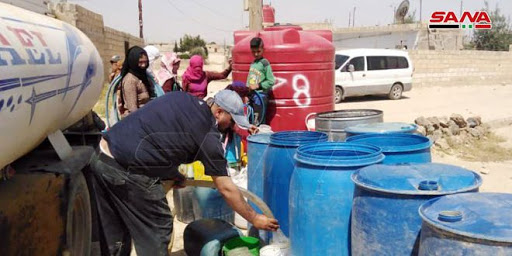
With no tap water, civilians were forced to queue up for hours to receive small amounts from water trucks. Unable to buy the water, other civilians took their chances by drinking water from unsafe wells. According to Judy Jacoub, a Syrian journalist originally from Hasaka, “The residents of Hasaka and its countryside have been pushed to rely on unsafe water sources ….Many residents have been suffering from the spread of fungi, germs and dirt in their hair and bodies as a result of using well water that is not suitable for drinking and personal hygiene. The people of Hasaka remain vulnerable to diseases and epidemics because of the high temperatures and spread of infectious diseases. If the situation is not controlled as soon as possible, the spread of Corona virus will undoubtedly be devastating.” A hospital medical director says many people are getting sick from the contaminated water.
Judy Jacoub explains what has happened most recently: “After Syrian and international efforts exerted pressure on the Turkish regime, 17 wells and three pumps were started . The main reservoirs were filled and pumping was started toward the city neighborhoods. However, despite the Turkish militia’s resumption of pumping water again, there is great fear among the citizens.”
USA Loots Syrian Oil and Plunders the Economy
The USA also has occupying troops and proxy/puppet military force in north east Syria. The proxy army is misnamed the “Syrian Democratic Forces” (SDF). How they got that name is revealing. They took on this name as they came under the funding and control of the US military. As documented here, US Army General Ray Thomas told their leadership, “You have got to change your brand. What do you want to call yourselves besides the YPG?’ Then, he explained what happened: “With about a day’s notice they declared that they are the Syrian Democratic Forces. I thought it was a stroke of brilliance to put democracy in there somewhere.”
There are numerous parties and trends within the Syrian Kurdish community. The US has been funding and promoting the secessionist element, pushing them to ally with Turkish backed jihadists against the Damascus government. The violation of Syrian sovereignty is extreme and grotesque.
Prior to the war, Syria was self-sufficient in oil and had enough to export and earn some foreign revenues. The primary oil sources are in eastern Syria, where the US troops and proxy forces have established bases. It is desert terrain with little population.
To finance their proxy army, the US has seized control of the major Syrian oil pumping wells. It is likely that President Trump thinks this is brilliant bold move – financing the invasion of Syria with Syrian oil.
In November 2019 President Trump said, “We’re keeping the oil… The oil is secure. We left troops behind only for the oil.” Recently, it was revealed that a “Little known US firm secures deal for Syrian oil“. Delta Crescent Energy will manage and escalate the theft of Syrian oil.
What would Americans think if another country invaded the US via Mexico, set up bases in Texas, sponsored a secessionist militia, then seized Texas oil wells to finance it? That is comparable to what the US is doing in Syria.
In addition to stealing Syria’s oil, the US is trying to prevent Syria from developing alternate sources. The “Caesar sanctions” on Syria threatens to punish any individual, company or country that invests or assists Syria to rebuild their war damaged country and especially in the oil and gas sector.
The US establishment seems to be doing everything it can to undermine the Syrian economy and damage the Syrian currency. Due to pressure on Lebanese banks, plus the Caesar sanctions, the Syrian pound has plummeted in value from 650 to 2150 to the US dollar in the past 10 months.
North east Syria is the breadbasket of the country with the richest wheat and grain fields. There are reports of US pressuring farmers to not sell their wheat crops to the Syrian government. One year ago, Nicholas Heras of the influential Center for New American Security argued “Assad needs access to cereal crops in northeast Syria to prevent a bread crisis in the areas of western Syria that he controls….Wheat is a weapon of great power in this next phase of the Syrian conflict.” Now, it appears the US is following this strategy. Four months ago, in May 2020, Syrian journalist Stephen Sahiounie reported, “Apache helicopters of the US occupation forces flew low Sunday morning, according to residents of the Adla village, in the Shaddadi countryside, south of Hasaka, as they dropped ‘thermal balloons’, an incendiary weapon, causing the wheat fields to explode into flames while the hot dry winds fanned the raging fire.
After delivering their fiery pay-load, the helicopters flew close to homes in an aggressive manner, which caused residents and especially small children to fear for their lives. The military maneuver was delivering a clear message: don’t sell your wheat to the Syrian government.”
To better loot the oil and plunder the Syria economy, in the past weeks the US is sending more heavy equipment and military hardware through the Kurdish region of Iraq.
In the south of Syria, the US has another base and occupation zone at the strategic Al Tanf border crossing. This is at the intersection of the borders of Syria, Iraq and Jordan. This is also the border crossing for the highway from Baghdad to Damascus. The US controls this border area to prevent Syrian reconstruction projects from Iraq or Iran. When Syrian troops have tried to get near there, they have been attacked on their own soil.
Meanwhile, international funds donated for “Syrian relief” are disproportionately sent to support and assist the last strong-hold of Al Qaeda terrorists in Idlib on the north west border with Turkey. The US and its partners evidently want to sustain the armed opposition and prevent the Syrian government from reclaiming their territory.
Flouting International Law and the UN Charter
The USA and Turkey have shown how easy it is to violate international law. The occupation of Syrian land and attacks on its sovereignty are being done in broad daylight. But this is not just a legal issue. Stopping the supply of safe drinking water and burning wheat fields to create more hunger violate the most basic tenets of decency and morality.
With supreme hypocrisy, the US foreign policy establishment often complains about the decline in the “rule of law”. In actuality, there is no greater violator than the US itself.
In his speech to the UN Security Council, Syrian Ambassador Ja’afari decried this situation saying “international law has become like the gentle lamb whose care is entrusted to a herd of wolves.”
• Author’s note: To see good political and military maps of Syria, go to southfront.org
Rick Sterling is an investigative journalist who has visited Syria several times since 2014. He lives in the SF Bay Area and can be reached at rsterling1@gmail.com.
Russian Clouds Over Turkish-Backed Jihadi Paradise In Idlib
South Front | September 17, 2020
On September 16, hundreds of protesters gathered near those Turkish military positions in Greater Idlib, which are surrounded by the Syrian Army, demanding the full withdrawal of the Turkish Army from Syria.
The largest protests took place near Turkish observation posts at Murak and Alsurman. Both these posts were surrounded by Syrian troops during the military operation against Turkish-backed al-Qaeda terrorists in southern Idlib. A majority of the protesters who took part in the event were from the nearby towns and villages, including Murak, Alsurman and Tell Touqan.
In the best traditions of Turkish ‘democracy’, Turkish soldiers from the Murak observation post responded to the protesters with tear gas.
Later on the same day, the Turkish government claimed that the observation posts had become the target of provocations and even individual attacks fomented by the ‘Assad regime’. According to the Turkish side, Turkish forces successfully repelled the provocation.
Meanwhile, Russian-Turkish military consultations on the conflicts in Syria and Libya have been ongoing in Ankara. According to Russian state media, Moscow proposed that the Turkish military reduce the number of observation posts in Greater Idlib, but the proposal was rejected. Nonetheless, Russian state media reported, citing their own sources, that Turkey had agreed to reduce the number of troops deployed in Idlib.
Currently, Ankara has almost 10,000 troops and thousands of pieces of military equipment, including battle tanks and artillery, in northwestern Syria. If the media reports are true, the formal and widely-promoted withdrawal of a dozen Turkish military trucks with several dozen troops will not change the situation strategically. Ankara has repeatedly demonstrated that it is not interested in a real fight against terrorism in Syria and that it in fact uses Idlib terrorist groups to promote its own agenda. This posture could be changed only under the increasing pressure of circumstances and regular friendly reminders from Turkey’s ‘strategic partners’.
As one such reminder over the past few days, the Russian Aerospace Forces conducted more than a hundred airstrikes on infrastructure and positions of the Turkish-backed terrorists. These strikes started last weekend and as of the morning of September 17, it does not seem that they will be fully halted anytime soon. Clouds have once again gathered over the jihadi paradise, which is being created by the Erdogan government in northwestern Syria.
Turkish-backed militants steal electricity poles, transmission towers in Syria’s Hasakah: SANA
Press TV – August 31, 2020
Turkish-backed Takfiri militants have stolen electricity poles and transmission towers in the northern sector of Syria’s northeastern province of Hasakah, as they continue to commit various crimes against local populations.
Syria’s official news agency SANA, citing local sources, reported on Monday that the militants have dismantled utility poles as well as pylons in the villages of Matleh, Lazqa and Tal Sakhir in the eastern countryside of the key border town of Ra’s al-Ayn, and transported them to their warehouses in order to sell them to Turkish scrap metal merchants.
The development came only a day after Turkish-sponsored militants stole agricultural machinery, power generators and submersible pumps from farmers in Abah village, which lies southwest of Ra’s al-Ayn.
On October 9, 2019, Turkish forces and Ankara-backed militants launched a long-threatened cross-border invasion of northeastern Syria in a declared attempt to push Kurdish militants affiliated with the so-called People’s Protection Units (YPG) away from border areas.
Ankara views the YPG, which is supported by the White House, as a terrorist organization tied to the Kurdistan Workers’ Party (PKK), which has been seeking an autonomous Kurdish region in Turkey since 1984.
Raqqah homeowners fight against illegal confiscation of their properties
Elsewhere in the northwestern Syrian city of Raqqah, homeowners are battling the illegal confiscation of their properties by US-sponsored militants affiliated with the so-called Syrian Democratic Forces (SDF).
Wael, a local man who fled the city for Homs in 2014 when Daesh Takfiri terrorist group took over Raqqah as its de facto Syrian capital and ruled it with an iron fist under a self-proclaimed caliphate, told London-based online news outlet Middle East Eye that he cannot work out why the house he had lived in for 30 years has now been confiscated by SDF officials.
“I asked some of my neighbors to ask the authorities to give me my house back, but their response was: ‘Why does he live in Homs? Tell him to come, and we can protect him from Daesh’,” he said.
“The ironic thing is that the family who now live in my house is the family of one of SDF’s judges. So if the people who are supposed to be responsible for justice act like this, what hope do we have from the rest of those in power?” the 50-year-old Christian wondered.
Maher, a neighbor who has been trying to help Wael get back his house, said the local population continues to suffer under the SDF’s control.
“The SDF has started to make the same mistakes that Daesh made before them. For example, in our neighborhood alone, SDF has seized 25 out of 64 civilians’ apartments,” he stressed.
Every armed group that takes control of Raqqah is worse than the one before it, Maher said, adding that it was the civilians who bore the greatest brunt of the war.
“SDF started confiscating civilians’ houses about a year and a half ago. These are the same violations that Daesh and the [so-called] Free Syrian Army had carried out in the past,” the father of three noted.
Security conditions are reportedly deteriorating in SDF-controlled areas in Hasakah, Dayr al-Zawr and Raqqah provinces of Syria amid ongoing raids and arrests of civilians by the militants.
Local Syrians complain that the SDF’s constant raids and arrest campaigns have generated a state of frustration and instability, severely affecting their businesses and livelihood.
Residents accuse the US-sponsored militants of stealing crude oil and refusing to spend money on service sectors.
Local councils affiliated with the SDF have also been accused of financial corruption.
Turkey reboots Arab Spring with Palestinian resistance
By M. K. BHADRAKUMAR | Indian Punchline | August 26, 2020
Turkey has made its first move on the regional chessboard after the recent deal between the UAE and Israel, when on August 22, President Recep Erdogan received in Istanbul a high-level delegation of the Palestinian resistance group Hamas, including its leader Ismail Haniyeh and deputy leader Saleh al-Arouri.
Also present at the meeting held behind closed doors at Istanbul’s Vahdettin Palace were the head of Turkey’s intelligence service, Hakan Fidan and two key aides of Erdogan — the communications director Fahrettin Altun and the presidential spokesman, Ibrahim Kalin.
The symbolism of the event is profound. The US state department has designated Ismail Haniyeh and Saleh al-Arouri as terrorists and has placed a $5 million bounty on their heads. And, of course, Turkey’s links with Hamas has been a sore point with Israel and it strained the traditionally close relations between the two countries to near breaking point in the recent decade.
Meanwhile, Hamas is an offshoot of the Muslim Brotherhood with which Turkey’s ruling Islamist party has ideological affinity but which the Emirati regime regards as existential enemy.
To be sure, Erdogan has made a calculated move after reading the tea leaves that one of the objectives behind the US-sponsored deal between the UAE and Israel is the creation of a new regional order even as American retrenchment from the region may have already begun in the Middle East.
Erdogan estimates that the main target of the UAE-Israel deal is Turkey. He had spotted the UAE as an active participant in the US-led failed coup attempt in 2016 aimed at overthrowing his government. He is also acutely conscious that the US, Israel and the UAE are aligned with the separatist Kurdish groups.
Turkey and the UAE are promoting opposite sides in the Libyan conflict and recently, the UAE has begun cozying up to Greece against the backdrop of rising tensions between Greece and Turkey in the Eastern Mediterranean. (UAE fighter jets are currently participating in a training exercise in Greece.)
The US State Department has lashed out at Erdogan for his meeting with Hamas leaders. But within hours, Ankara hit back. In a furious rejoinder, the Turkish Foreign Ministry rebuked Washington for questioning the legitimacy of Hamas, “which has come to power in Gaza through democratic elections and which constitutes an important reality of the region.”
Alluding to the US policies, the Turkish statement went on to say, “Moreover, a country which openly supports the PKK, that features on their list of terrorist organisations and hosts the ringleader of the FETO (group led by Islamist preacher Fetullah Gulen) has no right whatsoever to say anything to third countries on this subject.”
Lamenting that the US “has isolated itself from the realities of our region,” the Turkish statement urged the US to change course and “sincerely work towards the resolution of the Israeli-Palestinian conflict on the basis of international law, justice and equity by pursuing balanced policies, instead of using its power and influence in the region to serve the interests of Israel rather exclusively.”
To be sure, Erdogan has a game plan in defiantly flaunting his relationship with Hamas at this juncture. In the Turkish reckoning, the UAE-Israel agreement, with US backing, aims to create new facts on the ground in the Middle East, which takes the form of unimpeded telecoms, travel and recognition between Israel and its richest Gulf neighbours, but completely bypassing the Palestinian problem and blithely assuming that it is a matter of time before the Palestinian leadership would wave the white flag of surrender.
On the contrary, Turkey shares the assessment of most independent regional observers (and perceptive western analysts) that the Palestinians who have held out for seven decades are in no mood to surrender abandoning their political rights. Indeed, the Palestinian popular resistance is showing no signs of fatigue. The Palestinian leaders have used very strong language to condemn the UAE regime. The wave of anger is fuelled by a deep sense of betrayal by prince Mohammed bin Zayed.
This anger is prompting Fatah and Hamas, who have been bitter rivals since the 2007 civil war in Gaza, to close ranks and discuss the need for joint political action. Mahmud Abbas who was unwilling to accept any partners in the governance of Palestine is today open to working with Hamas. Last week, Jibril Rajoub, general secretary of Fatah, shared a platform with Saleh Arouri, deputy head of Hamas, signalling that the rapprochement is gaining momentum.
If the Emirati calculation was to promote exiled Palestinian leader Mohammed Dahlan (who lives in Abu Dhabi) as the next Palestinian President in a near future with the backing of Arab states and Israel, that project has crash-landed. Dahlan can no longer exploit the rivalry between Fatah and Hamas. The effigies of Dahlan and Emirati crown prince bin Zayed were burned side by side in Ramallah last week.
Turkey senses a potential breakthrough in regional politics insofar as the Arab population at large shares the anger and resentment of the Palestinian people at the betrayal by bin Zayed. According to the Arab Opinion Index conducted by the Arab Center for Research and Policy Studies in Doha, if 84 percent of Arab opinion had opposed any diplomatic recognition of Israel in 2011, that has since increased to 87 percent by 2018.
In this turbulent regional milieu, Erdogan hopes to bring about a fusion between the Arab world’s sympathy and support for the demands of the Palestinians for sovereignty and their own search for democracy and liberation from their autocratic rulers. This has been his dream project all along — creation of a New Middle East that gets rid of the medieval oligarchies and replaces them with representative rule based on democratic principles and empowerment of the people.
In the downstream of the Emirati ruler’s deal with Israel, Erdogan strides like a Colossus on the Arab street and his meeting with the leadership of Hamas in Istanbul proclaims a common struggle against the despots and oligarchs who suppress democracy and have exercised cruel tyranny over their people across the region. In Erdogan’s calculus, bin Zayed’s contempt for Arab democracy and Netanyahu’s trampling of Palestinian rights are two sides of the same coin.
Erdogan visualises that the UAE-Israel agreement is built on sand and it is bound to crumble under the weight of the latent contradictions that are bound to surge in the wake of the expected decline in the US’ regional influence and prestige and amidst the birth pangs of the new-post-oil economy in the regional states.
Has Israel bitten off more than it could chew? David Hearst, editor-in-chief of the Middle East Eye wrote last week, “Whereas before, Israeli leaders could pretend to be bystanders to the turmoil of dictatorship in the Arab world, this (accord with UAE) now ties the Jewish state to maintaining the autocracy and repression around it. They cannot pretend to be the victims of a “tough neighbourhood”. They are its main pillar. This accord is virtual reality. It will be blown away by a new popular revolt not just in Palestine but across the Arab world. This revolt may already have started.”
Turkey’s Erdogan Cuts off Water to One Million Syrian Civilians in the Blazing Summer Heat
By Steven Sahiounie | Mideast Discourse | August 24 ,2020
Turkish President Erdogan has sought to create an image for himself as the champion of religion. The Islamic State of Iraq and Syria (ISIS) also tried to claim they were following a religion, yet both used water as a weapon of war.
Water in Islam
Turkey is almost 100% Muslim and has made world headlines converting Christian cathedrals into Mosques. Turkish President Erdogan has been converting a secular democracy in Turkey, founded by Ataturk, into a Muslim Brotherhood haven, which follows Radical Islam as a political ideology, which is the same ideology as ISIS.
Water in Islam is considered as a gift from God, belonging to all equally, which has to be distributed equally among all living beings, humans, animals, and plant life, according to Cherif Abderrahman Jah, an Islamic academic and humanist.
The ISIS terrorists have often used water as a weapon of war in Iraq and Syria by cutting off supplies to villages that resisted their rule and as a tool to expand their control over the region’s water infrastructure.
They wanted to seize the water to prove they were building an actual state. In 2014 ISIS besieged the Syrian town of Kobane to secure a piece of the border with Turkey.
6 years later, 2020, the same scenario plays out, and in the same area, but ISIS has been defeated, and the Erdogan regime in Turkey has taken their place. Many experts feel ISIS and Turkey have been connected in their use of Radical Islam as a political tool, devoid of any connection to Islam, which is a religion.
ISIS was using water as a weapon, according to Tobias von Lossow of Berlin’s Institute for International and Security Affairs. He said, “IS uses water systematically and consistently. IS uses the entire range of possibilities and variations of water warfare.”
Death without water
A person can survive without water for about 3 days; however, a person living in a very hot climate will sweat, causing them to lose more water, which leads to dehydration, causing extreme thirst, fatigue, and ultimately, organ failure and death. A person living in a hot place, like Hasaka, and having to perform laborious activities such as taking care of animals, or small children, could die in only a few days without water.
The role of the SAR in the crisis
Friday marked the ninth consecutive day without water in Hasaka. The Turkish occupation forces, and their Radical mercenaries, are endangering the lives of more than a million civilians.
The SAR water authorities continue to try to provide clean drinking water, with cooperation from the Hasaka City Council and civil society groups, who used many water tankers to provide the locals with drinking water from Nafasha and al Himah Water Projects.
Chairman of Hasaka City Council Adnan Khajou, said that the daily quantity of water to be transported is 300,00 liters, which came from shallow wells dug by the locals, but is not drinkable and used only for cleaning.
The Turkish Army of occupation and its terrorist mercenaries in Ras-al-Ayn countryside continue to stop the operation of Alouk water project and to cut off the drinking water from Hasaka city, threatening one million persons with thirst and causing them to suffer from the spread of Coronavirus (COVID-19).
General Director of Hasaka Water Establishment Mahmoud Ukla said that since the Alouk Water Station was shut off by the Erdogan regime army, and their mercenaries, the summer temperatures have soared and water demand has increased, with the devastating additional threat of the COVID-19 pandemic, which needs water for hygiene.
Aziz Michael, geologist and water specialist, said that the Alouk water station is essential for water and it should be reopened.
The role of Turkey in the crisis
Turkey has a long history of using water as a weapon of war in Syria. In 1998 Erdogan had threatened to shut off water to Syria, which brought the two countries close to military conflict.
In May the water supply to 460,000 civilians in northeastern Syria was cut off by Turkey for the sixth time.
Syrian Observatory activists have reported Friday that residents have been protesting in Ras al-Ain, which is under Turkish Army occupation, and were calling for water, and electricity to be restored.
The role of the UN
On Friday, Ambassador Bashar al-Jaafari, Syria’s Permanent Representative at the UN, called on the UN Secretary-General Antonio Guterres to intervene immediately and to exert all his efforts to stop the Erdogan regime’s crime of cutting off drinking water for nearly one million Syrian citizens in Hasaka. In the phone call between al-Jaafari and Guterres, the Ambassador stressed that the Turkish aggression constitutes a war crime and a crime against humanity.
He said that the situation caused by this crime is exacerbated by hot weather and the threat of the COVID-19 pandemic.
Guterres said that he has tasked the UN team in Syria and his Special Envoy Geir Pedersen with taking steps to address this matter, resolve it urgently, and deliver humanitarian aid to affected people. He said he will exert his best efforts by contacting the Turkish government to put pressure and resolve this matter.
Guterres has asked Pedersen to meet the representatives of the US, Russia, and Turkey in Geneva on Monday, as the committee for drafting a new Syrian constitution meets, which is part of the UN 2254 resolution which will pave the way to a peaceful solution to the Syrian conflict.
The SAR and AANES (Autonomous Administration of North and East of Syria)
The Northeast section of Syria is split by various groups. The SAR based in Damascus controls areas, and has forces, checkpoints, and provides free health care and education to those areas it controls. The AANES is a separate group of Kurds, following a communist political platform, and they have become known to foreigners as “Rojava”. They have a military wing, the SDF, which was aligned with the terrorist group PKK, and they were in a coalition with the US military, who are now illegally occupying parts of the region while tasked with stealing Syrian oil by the Trump regime.
Covid-19 danger
“Turkish authorities’ failure to ensure adequate water supplies to Kurdish-held areas in Northeast Syria is compromising humanitarian agencies’ ability to prepare and protect vulnerable communities in the COVID-19 pandemic,” Human Rights Watch said in a report published late March.
What is the solution?
The Kurdish leaders of the ‘Rojava’ area, and the central government of the SAR in Damascus, are in complete agreement that the solution of the water crisis in Hasaka must be the removal of all Turkish occupation forces, and their Radical terrorist mercenaries. The SAR is a secular government, and this is what the Kurdish leadership of ‘Rojava’ also claim as a core value of their administration. With so much in common, and both ‘Rojava’ and the SAR facing the same enemy, Turkey, and the possible resurgence of ISIS, it appears they may soon form renewed cooperation to re-take the land from occupation forces and defend the borders from all enemies.
Steven Sahiounie began writing political analysis and commentary during the Syrian war, which began in March 2011. He has published several articles, and has been affiliated with numerous media. He has been interviewed by US, Canadian and German media.
Turkish Drilling Ship Finds 320 Billion Cubic Metre Gas Field in Black Sea, Erdogan Says
Sputnik – 21.08.2020
Turkish President Recep Tayyip Erdogan on Friday announced that his country had discovered an enormous natural gas source – over 320 billion cubic metres of gas in the Black Sea.
“Now I want to share our good news with you: Turkey has realised the biggest natural gas finding of its history in the Black Sea”, he said.
According to him, the find also means there is a high possibility of other natural gas sources in the area.
Erdogan added that Ankara is aiming to provide the Black Sea gas for use in 2023, and promising to accelerate Turkish operations in the Mediterranean, claiming he will not stop until the nation is a net exporter of energy.
Confrontation Over Resources
Ankara previously collided with Athens amid a Mediterranean gas row, as both claimed the same territories in the sea for gas exploration. Erdogan said that his country’s surveying ship Oruc Reis will continue explorations in the eastern Mediterranean until 23 August. Later in the week, reports suggested that the Greek naval frigate Limnos and the Turkish frigate Kemalreis (F-247) “touched” each other in close proximity to the Oruc Reis.
In response, Brussels urged the Turkish government to halt its drilling activities in the area, as the EU is ready to impose sanctions on the country.
Turkey also explored resources near Cyprus, engaging in a conflict with the island nation, as it considers the area to be a part of its exclusive economic zone. The Turkish government claimed that the resources should be shared and that it acts on behalf of the self-proclaimed Turkish Republic of Northern Cyprus – a breakaway part of the island only recognised by Ankara.
Turkey Cries Foul About Deployment Of Egyptian Troops In Idlib. What’s Going On?
SOUTH FRONT | July 31, 2020
The Egyptian military has deployed about 150 troops on the frontline in the Syrian region of Greater Idlib to support forces of the Damascus government, Turkish sources claimed on July 30.
“The troops were later deployed in the Khan al-Asal area in the western countryside of Aleppo and around the city of Saraqib in the southern countryside of Idlib,” the Anadolu Agency quoted its source as saying. The news agency claimed that the Egyptian service members had arrived via the Hama Air Base.
Later, Youssef al-Hamoud, a spokesman for the Syrian National Army, a coalition of Turkish proxy groups based in northern Aleppo, said that the number of Egyptian troops is in fact 148. They supposedly deployed in Syria in 3 groups via the Hama Air Base. According to him, 98 Egyptian personnel reportedly came from the city of Ismailia on July 26 and then were deployed in Khan al-Asal. 50 others arrived from Cairo Airport on July 27. They are supposedly deployed in Saraqib.
However, no flights from Egypt to the said base were recorded over the past few days. Furthermore, it is almost impossible to hide the deployment of foreign troops on the frontline in the conditions of the Syrian war, when almost every second fighter has a mobile phone and social media accounts and uses them to share pictures and videos from the battlefield.
Most likely, Turkish state media and proxy groups loyal to Ankara found a new original way to justify the illegal presence of their own forces in Syria. The accusation of other parties doing something that the Erdogan government does itself is something that Turkish media outlets regularly do.
In the earlier stages of the conflict, Turkey and its intelligence services openly allowed various terrorists aiming to join ISIS and al-Qaeda to use the territory of Turkey and camps on the Syrian-Turkish border as a transport hub on their route to Syria. At the same time, Turkey was actively involved in illegal oil trading with ISIS.
Later, when the Russian military operation, including mass bombings of ISIS oil infrastructure, convoys, and public revelation of the facts of Turkish cooperation with ISIS, put an end to this, Turkish official propaganda shifted its attention to accusations of all other parties involved in the conflict of cooperation with ISIS. It even claimed that its military operation against Kurdish militias in Afrin was aimed against ISIS.
Ankara sent almost 10,000 Syrian militants to Libya to support the Tripoli-based Government of National Accord. Nonetheless, Turkish outlets are crying foul about the small number of Russia-linked private military contractors hired by the UAE to support the Libyan National Army against Turkish-backed forces.
Over the past years, Turkey has occupied a notable part of northern Syria and deployed thousands of troops in Greater Idlib to protect al-Qaeda-linked terrorists there from the Syrian Army. Therefore, it would be logical for Ankara to find some ‘foreign force’ that it can accuse of deploying its own troops in the country.
At the same time, if the deployment of Egyptian troops to support the Syrian Army turns out to be true, this will be really bad news for Turkey. Ankara still seems to be unable to control its local al-Qaeda partners and the chances of a new round of escalations in the region are increasing.
The mighty Turkish Armed Forces have thus far failed to defeat the Syrian Army exhausted by years of conflict with terrorists. The outcome of the new escalation will be even more gloomy for Turkey if Egyptian forces will join the coalition supporting Damascus.
IF YOU LIKE THIS TYPE OF CONTENT, SUPPORT SOUTH FRONT :
PayPal: southfront@list.ru, http://southfront.org/donate/ or via: https://www.patreon.com/southfront
The Syrian Army Is Appointing on “Aleppo – Lattakia” Highway – Idlib Battle Is Approaching
M4 International Highway
By Khaled Iskef | American Herald Tribune | July 28, 2020
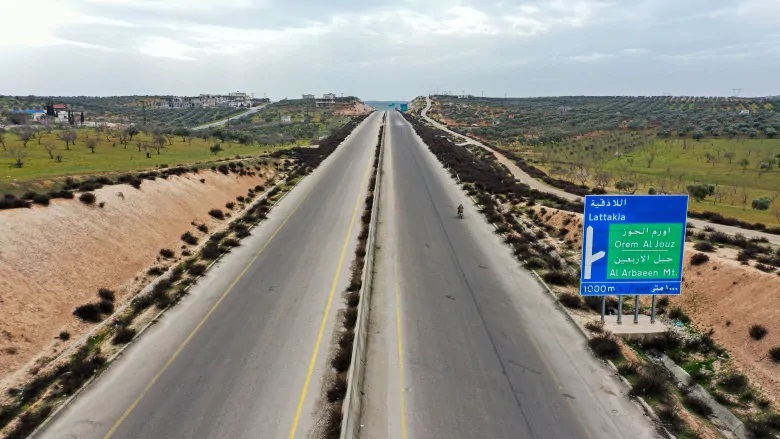
The field developments return to the front of the Syrian events, after the cautious calm that lasted for several months in the north of the country coinciding with the implementation of the Russian-Turkish agreement on conducting joint patrols on the “M4” road known as “Aleppo-Lattakia” highway.
The reopening of the road from Raqqa, through Aleppo, to Lattakia, is now at the forefront of Syrian army’s next strategic goals, though the beginning of the “M4” highway starts in the eastern side of the country, specifically from the areas controlled by the US-backed Syrian Democratic Forces. The past days have witnessed huge Syrian military movements towards this highway in a sign that the Syrian forces are ready to start military action and open the road, which if it occurs, will have a significant positive impact on trade movement throughout the country in light of the circumstances due to the procedures of the blockade imposed by Washington.
Speaking of the field in the Syrian north, it is certain that Turkey did not succeed in fulfilling its obligations to the Russians about isolating terrorist organizations and keeping them out of the way, as the Russian and Turkish sides, shortly after the battle to secure Aleppo and reopen the M5 “Aleppo – Damascus” International highway, agreed that the militants should move away / 6 / kilometers to the north and south of the “M4”, knowing that the distance outside the control of the Syrian army, which links Aleppo to Lattakia, is estimated to be 60 kilometers.
The end of September 2020 was scheduled to be the Russian deadline for the Turks to implement their obligations, but the terrorist operation carried out by “Khattab Al-Checheni Brigades” targeting a Russian patrol on the road with a suicide operation, accelerated the launch of the military operation, which is expected to be early next month according to private sources. The Syrian army’s build-up and preparations have been completed, with confirmed information of the arrival of modern Russian weapons to the Syrian army, in addition to the army’s ongoing targeting of armed points on Hama and Idlib countryside axes, such as Kansafra, Al-Fateira, Kafr Ouid, and several villages of Jabal Zawiya.
If launched, the military operation is expected to be swift and decisive in case the Turkish side does not interfere directly or take any step that would hinder it in northern Syria. It is noteworthy that the military operation of the Syrian army had stopped after securing Aleppo city in the west and reopening the international highway, the main connection between the south and center of the country to the north.
Khaled Iskef is a journalist working for Almayadeen TV.
Iran to launch special trade office in China: Businessman
Press TV – July 21, 2020
Iran is to set up a special office in China to streamline trade activities with the East Asian country.
A senior businessman says major Iranian companies are teaming up to create a trade office in China amid growing economic relations between the two countries.
Gholamhossein Jamili, a board member at Iran Chamber of Commerce, Industries, Mines and Agriculture (ICCIMA), said on Tuesday that the trade office in China would play a major role in protecting Iranian businesses and firms working in the East Asian country against growing restrictions caused by US sanctions.
“We are working to launch this office before the end of the current Christian calendar year,” Jamili was quoted as saying by the official IRNA news agency.
The announcement comes amid reports of booming economic relations between Iran and China as the two countries move to finalize a 25-year comprehensive partnership agreement that would massively boost bilateral cooperation in areas like energy, infrastructure, tourism and trade.
China was the top buyer of Iranian oil before the United States introduced its unilateral sanctions on Iran two years ago. However, Beijing is still a top economic partner for Iran and the balance of trade between the two countries hit $20 billion in the year ending March, according to Iranian government data.
Other senior Iranian figures involved in trade with China said that the planned trade office would seek to resolve problems facing Iranian businesses and companies in China.
Majid Hariri, who chairs the Iran-China Joint Chamber of Commerce, said that the office in Beijing would serve as Iran’s economic embassy in the East Asian country.
The official IRNA news agency said the ICCIMA plans similar offices in India, Turkey, United Arab Emirates and Iraq, adding that two such offices are being set up in Russia’s Astrakhan and Syria’s Damascus.
Armenian-Azerbaijani Clashes And Shifting Balance Of Power In South Caucasus
South Front | July 18, 2020
The Armenian-Azerbaijani tensions have once again turned South Caucasus into a hot point increasing chances of a new regional war.
The key difference with previous military incidents between the two countries is that the point of confrontation shifted from the breakaway Nagorno-Karabakh Republic to the Armenian-Azerbaijani state border. Clashes first erupted on July 12 in the area of Tovuz and since then both sides have repeatedly accused each other of provoking the conflict, attacking civilians and declared defeats of the ‘enemy’.
According to the Defense Ministry of Azerbaijan, the fighting started after Armenian forces opened fire on positions of Azerbaijani forces in the Tovuz district. The fighting which included the use of combat drones, artillery, mortars, and battle tanks continued over the following days, including July 17. The Azerbaijani military confirmed that at least 12 personnel, including Major General Gashimov Polad and Colonel Ilgar Mirzaev, were killed. In turn, Kerim Veliyev, Azerbaijan’s deputy defense minister, said that 100 Armenian soldiers were killed, several fortified positions were destroyed and that a UAV was shot down. Armenia, according to Veliyev, is hiding the real number of its casualties.
Azerbaijani media and top leadership describe the current situation as an act of Armenian aggression, and say that Azerbaijani forces are only responding to it. President Ilham Aliyev even called Armenia a “fascist state” adding that “Armenian forces could not enter Azerbaijan in one centimeter of soil and will never be able to do this”.
The Armenian version of events is quite different. According to it, the clashes started after a group of Azerbaijani soldiers violated the Armenian state border in an UAZ vehicle. The defense ministry press service claimed that after the warning from the Armenian side, “the enemy troops returned to their positions”. It added that later Azerbaijani forces attacked an Armenian checkpoint.
As of now, the Armenian military said that it had repelled two ‘offensives’ involving at least 100 soldiers supported by fire of several artillery battalions. These attacks were allegedly actively supported by combat and reconnaissance drones of Azerbaijan. A spokesperson for the Armenian Defense Ministry Artsrun Hovhannisyan said that Azerbaijan lost at least 20 soldiers, a battle tank and other equipment during the clashes. Armenia says that only 4 of its service members were killed.
Both Armenia and Azerbaijan claim that their forces are repelling an aggression of the enemy, which has been attacking it and killing civilians. However, despite the harsh rhetoric, the leaderships of both countries are sending signals that they are not interested in a larger military confrontation.
At the same time, years of war propaganda and historic tensions between the nations push the situation towards a further escalation. A unilateral move towards the cessation of hostilities by leaders of either country would be presented by the other one as a sign of weakness and promoted as an admission of defeat. Taking into account the complicated political and economic conditions in both countries, neither Armenian nor Azerbaijani leaders could afford such a public move. Therefore, de-escalation is possible only through international mechanisms.
The situation is further complicated by the complex diplomatic situation in the region of the South Caucasus. Armenia, alongside Russia, Belarus, Kazakhstan, Tajikistan and Kyrgyzstan, is a member of the Collective Security Treaty Organization (CSTO). The CSTO expressed its concerns over the situation and called on the sides to commit to a ceasefire regime. Nonetheless, the Russia-led security bloc, and Russia itself, demonstrated that in the current situation they will focus on diplomatic measures.
Since the 2018 coup, when Nikol Pashinyan came to power in Armenia, the country has been consistently undermining its relations with the CSTO and Russia by pursuing a quite weak, but apparent anti-Russian and pro-Western foreign policy course. The bright dream of the Pashinyan government is to sell its loyalty to the United States for some coins and commit itself to the way of the so-called ‘European integration’. The issue with this plan is that Washington and its partners need Armenia only as a tool of their geopolitical gains and are not interested in providing it with any kind of military protection or economic assistance. The Pashinyan government is forced to play a double game in an attempt to simultaneously please its ‘democratic’ masters and receive protection and assistance from Russia. This attitude is not a secret for Moscow.
On the other hand, in the event of a large-scale military confrontation, Azerbaijan will be supported by its main ally Turkey, which also has close bilateral ties with Russia. Ankara already declared that it fully supports Azerbaijan and condemned the supposed ‘Armenian aggression’. Thus, in the event of full-scale military confrontation, Armenia will immediately find itself in a very complicated situation, and direct military assistance from the CSTO and Russia will be unlikely.
So, the Armenian chances in a limited military conflict with Azerbaijan and Turkey are at least shaky. Turkey and Azerbaijan fully understand this. By undermining strategic relations with Moscow, and thus the balance of power in the region, Erevan put the entire South Caucasus on the brink of a new regional war.
Featured Video

Your Enslavement Begins in Gaza: The ‘Board of Peace’
or go to
Aletho News Archives – Video-Images
From the Archives
The US: The Century of Lost Wars
By James Petras | Global Research | September 12, 2018
Introduction
Despite having the biggest military budget in the world, five times larger than the next six countries, the largest number of military bases – over 180 – in the world and the most expensive military industrial complex, the US has failed to win a single war in the 21st century.
In this paper we will enumerate the wars and proceed to analyze why, despite the powerful material basis for wars, it has led to failures. … continue
Blog Roll
 Aletho News
- Zelensky Refused to Discuss Druzhba Pipeline Issue – Fico
- U.S. General Caine Warns: STRIKING IRAN is a HUGE RISK /Glenn Diesen & Lt Col Daniel Davis
- Israel designates five Palestinian media outlets as ‘terrorist organizations’
- Israel, not America, first: Carlson’s Huckabee interview lays bare US foreign policy priorities
- Israeli troops executed Palestinian aid workers at ‘point blank range’: Report
- Iran war What if today’s Iran is resigned to a long, hellish war with the US?
- Why Israel Is Escalating Its War Crimes Against Lebanon
- Iran in the face of the armed diplomacy of imperialism
- The US build-up around Iran constitutes strategic war option, not ‘deterrence’
- Iran to US: Sanctions and war failed; try diplomacy and respect
- If Americans Knew
- Footage Shows Israeli Troops Waiting in Ambush, Then Opening Fire on a Palestinian Teen
- The US is on the brink of a major new war that Trump has not even bothered explaining
- Latest Epstein document dump is one more cover-up
- No Protection, No Justice: US Citizens Killed with Impunity by Israel
- Maria Farmer: Epstein Victim Reveals Explosive Information Covered Up by Media
- Average of five Palestinians killed by Israel every day in Gaza since ceasefire – Not a ceasefire Day 136
- Palestinian church leaders admonish Christian Zionist Mike Huckabee – Not a ceasefire Day 135
- Ominous messaging from Trump’s “Board of Peace” – Not a ceasefire Day 134
- ‘Christians Out’: Jerusalem Church Tagged With Hate Graffiti, Police Investigating
- Israeli Settlers Kill American Teen
- No Tricks Zone
- New Research Reaffirms Clouds, Aerosols, And Surface Solar Radiation Are ‘Driving The Climate System’
- Germany: Electric Car Catches Fire At Charging Station, Sets Off Local “Inferno”, Widespread Damage
- New Study: Canada’s New Brunswick Was 1°C Warmer Than Today During The Medieval Warm Period
- Coal Power Back In Trend As Globe Tries To Keep Pace With Growing Demand For Power
- New Study: A 4°C Warmer Beaufort Sea Had ‘No Sea Ice’ 11,700 – 8200 Years Ago
- Unfudging The Data: Dutch Meteorological Institute Reinstates Early 20th Centruy Heat Waves It Had Erased Earlier
- German Gas Crisis…Chancellor Merz Allegedly Bans Gas Debate Ahead of Elections!
- Pollen Reconstructions Show The Last Glacial’s Warming Events Were Global, 10x Greater Than Modern
- Germany’s Natural Gas Storage Level Dwindles To Just 28%… Increasingly Critical
- New Study Rebuts The Assumption That Anthropogenic CO2 Molecules Have ‘Special’ Properties
 Aletho News