Russia rejects Turkish narrative on Syria
By M. K. BHADRAKUMAR | Indian Punchline | February 7, 2020
The Russian reaction to Turkey’s latest military moves in the northwestern Syrian province of Idlib has appeared in the form of a lengthy interview with the government daily Rossiyskaya Gazeta by Foreign Minister Sergey Lavrov on February 4, which has since been followed by a formal statement by the foreign ministry on Thursday.
Moscow has underscored that the current Syrian operation in Idlib is about vanquishing the al-Qaeda affiliates supported by Turkey and the western countries.
Lavrov dwelt on the backdrop to the so-called Astana format, which resulted from the collapse of the regime change project of “our Western and other foreign partners” in Syria following the Russian intervention in 2015.
He outlined how the Astana process led to the “de-escalation zone” in Idlib where “terrorist groups herded together”. Russia and Turkey reached specific written agreements spelling out their commitments to oversee Idlib. However, to quote Lavrov,
“Regrettably, so far, Turkey has failed to fulfil a couple of its key commitments that were designed to resolve the core of the Idlib problem. It was necessary to separate the armed opposition that cooperates with Turkey and is ready for a dialogue with the government in the political process, from the terrorists of Jabhat al-Nusra, which became Hayat Tahrir al-Sham. Both are blacklisted as terrorist groups by the UN Security Council, so neither Jabhat al-Nusra nor the latest version, Hayat Tahrir al-Sham, has anything to do in Idlib.”
Even after repeated reminders from Russia, Turkey didn’t act. Equally, Lavrov repeated that the recent Turkish military deployments to Idlib were undertaken without any advance intimation to the Russian side. He said, “We urge them (Turkey) to strictly comply with the 2018 and 2019 Sochi accords on Idlib.”
The Russian Foreign Ministry statement of February 6, as reported by Tass news agency, disclosed that there have been Russian casualties due to the “increasing terrorist activities.” It justified the operations of the Syrian government forces as reaction to “the unacceptable rise in terrorist activities.”
Through the month of December, “over 1,400 militant attacks involving tanks, machine guns, infantry fighting vehicles, mortars and artillery took place.” During the past fortnight alone, “more than 1,000 attacks have been recorded” and hundreds of Syrian troops and civilians have been killed and wounded and the Russian base at Hmeymim came under attack repeatedly.
The foreign ministry statement says, “all this points to an unacceptable increase in terrorist strength in Idlib, where militants have complete impunity and free hands” which left the Syrian government with no alternative but to “react to these developments.”
In a rebuff to Turkish President Recep Erdogan’s demand that the Syrian government should terminate the military operations in Idlib and withdraw, the Russian statement said, “A thing to note is that the Syrian army is fighting on its own soil against those designated as terrorists by the UN Security Council. There can be no interpretations. It is the Syrian government’s right and responsibility to combat terrorists in the country.”
Curiously, both Lavrov’s interview as well as the Foreign Ministry statement drew attention to the transfer of terror groups from Idlib to northeastern Syria and from there to Libya in the recent weeks. The implication is clear — Ankara continues to deploy terrorist groups as tools of regional strategies in Syria (and Libya).
Russia has contacts with all parties in Libya, including Khalifa Haftar. The implicit warning here is that Erdogan will have a high price to pay in Libya where he cannot count on Russian empathy. Turkey is already under withering criticism from EU, France, Italy, Greece, Cyprus, Israel, UAE and Saudi Arabia for its military intervention in Libya, especially by deploying its proxy groups from Syria. Turkey’s regional isolation over Libya is now complete.
The Russian Foreign Ministry statement concluded saying, “We reaffirm our commitment to the agreements reached at the Astana talks, which envisage fighting terrorist groups in Syria on the condition of respect for the sovereignty and territorial integrity of the country. We will maintain close coordination with our Turkish and Iranian partners for the sake of achieving lasting stability and security on the ground.”
It is highly significant that the Foreign Ministry statement singled out the “Iranian partners” for reference. On February 5, while receiving the new Iranian ambassador to Moscow, President Putin also said Russia and Iran were “key powerful players” in the fight against global terrorism and will continue their cooperation. Putin added, “(Russia’s) cooperation with Iran within the Astana framework has played an effective role in the settlement of the Syria conflict.”
What emerges is that Moscow senses that behind Turkish president Erdogan’s mercurial behaviour, there is the old pattern of Turkey using terror groups as proxies, with covert support from western powers. Moscow cannot but be aware that the US is making overtures to Erdogan with a view to shift the military balance against Russia and Iran on the Syrian-Iraqi chessboard in the downstream of the killing of General Qassem Soleimani.
Curiously, on Monday, a US appeals court agreed to “pause” a case alleging that Turkey’s state-owned HalkBank evaded US sanctions on Iran. The US Senate Finance Committee member Ron Wyden, a Democrat, has since addressed a letter to the US Attorney General William Barr asking if President Trump had tried to intervene on behalf of Halkbank!
A Reuters report said Senator Wyden asked Barr to detail his interactions with Trump, President Tayyip Erdogan and Turkish Finance Minister Berat Albayrak (who is also Erdogan’s son-in-law).
The HalkBank scandal implicates Erdogan and family members and an adverse court verdict can be highly damaging politically to the president and his son-in-law who is groomed as a potential successor. (A commentary on the scandal featured in the Foundation for Defense of Democracies authored by a former Turkish member of parliament is here.) The HalkBank case hangs like the sword of Damocles over Erdogan. Washington is adept at using such pressure tactics against recalcitrant interlocutors abroad.
On the other hand, if Trump has done a favour to Erdogan (or anyone for that matter), he’d expect a quid pro quo. And it is to be expected that the Trump administration would visualise that Erdogan’s cooperation can be a game changer in the geopolitics of Syria and Iraq. However, Moscow has kept the line open to Ankara.
To be sure, it is with deliberation that Moscow has highlighted the salience of the Russian-Iranian alliance in Syria where Washington is escalating tensions lately as part of its “maximum pressure” approach threatening Tehran with a region-wide war.
Israel uses civilian flight as shield to raid Damascus after Syrian troops liberate Saraqib
Press TV – February 7, 2020
An Israeli airstrike, carried out as Syria troops were liberating the terrorist-held town of Saraqib in northwestern Idlib province, has endangered a civilian flight carrying 172 passengers, according to the Russian Defense Ministry.
Defense Ministry spokesman Major General Igor Konashenkov said Friday the civil Airbus-320 was heading to Damascus from the Iranian capital early Thursday when it was forced to divert its route as the Syrian capital’s air defenses were intercepting Israeli missiles.
The plane made an emergency landing in the Hmeymim air base in Syria’s western coastal province of Latakia.
“Only due to timely actions of the Damascus airport dispatchers and the efficient operation of the automated air traffic control system, the Airbus-320 managed to… successfully land at the closest alternative airfield,” Konashenkov said.
‘Israel using passenger jets as shields’
The spokesman stressed that Israel was well aware of civilian flights around Damascus and that such missions demonstrated the regime’s reckless disregard for human lives.
“The Israeli general staff’s use of passenger jets as a cover for its military operations or as a shield from Syrian missile system fire is becoming a typical trait of Israeli air force,” he said.
Russia had previously warned that Israeli airstrikes against Damascus were endangering civilian jets.
Lebanese officials have also stated that Israeli jets illegally conducting operations against Syria from the country’s airspace pose a danger to civilian aircraft in Lebanon.
In 2018, Syrian air defenses mistakenly shot down a Russian Ilyushin Il-20 reconnaissance plane after it was similarly used as a cover by Israeli warplanes, killing 15 people on board.
Syria: Saraqib fully liberated
The Israeli airstrikes took place as Syrian troops were entering the terrorist-controlled town of Saraqib, which lies at the crossroads of two key highways in the Idlib province, the last major terrorist bastion in Syria.
The town has currently been fully liberated by Syrian forces.
Damascus has highlighted that the Israeli airstrike on Thursday happened at the same time the Turkish military was deploying a military caravan in Idlib to “protect the terrorists” and halt the Syrian military advance in the province.
Damascus has slammed the operation as evidence of Tel Aviv and Ankara’s coordinated support for the terrorists.
Israel is known for conducting airstrikes against Damascus during major Syrian military advancements.
The reported joint Israeli-Turkish operations in Syria come as Ankara – which has also been a major backer for terrorists in Syria – has warned that it may resort to military action if Syria does not withdraw its troops battling terrorist forces in Idlib until the end of February.
The ongoing Syrian army offensive in Idlib was launched last August after terrorists failed to honor the Sochi de-escalation zone agreement brokered between Russian and Turkey in September 2018.
Large swathes of the province have since been liberated by Syrian troops.
Tehran offers mediation, stresses political resolution
Iran’s Ambassador to the United Nations Majid Takht-Ravanchi said Iran, as a main party to the Astana peace process, was ready to help solve disputes between Damascus and Ankara regarding the Idlib province.
“We have to guarantee that this crisis is solved politically while at the same time prohibiting terrorists from using this as an opportunity to fortify their positions, turn Idlib into a safe refuge and target more civilians,” he said.
“We have to be aware that the goal of protecting civilians doesn’t get replaced with protecting terrorists,” he added.
The UN envoy added that an Astana meeting, which is planned to be held in the near future in Tehran, provides an “indispensable opportunity” to resolve issues related to the Syria conflict.
The Astana peace process was launched by Iran, Turkey and Russia in 2017 and had a major role in reducing violence in the country by agreeing to de-escalation zones in the war-wracked country.
Syrian Army captured Saraqib. Netanyahu and Erdogan come to the rescue
South Front | February 06, 2020
In Greater Idlib the defences of Hayat Tahrir al-Sham and other favorites of the foreign powers supporting ‘Syrian democracy’ are collapsing.
On February 5, the Syrian Army, supported by Russian airpower, took control of a number of villages in southeastern Idlib and southwestern Aleppo including Resafa, al-Dhahabiyah, Ajlas, Talafih and Judiydat Talafih. They besieged a Turkish observation post established near Tal Toqan and reached another one, near al-Sheikh Mansur.
Late on the same day, the army’s Tiger Forces captured the eastern entrance to Saraqib and established fire control over the open roads leading from the town. According to local sources, Hayat Tahrir al-Sham and other al-Qaeda so-called freedom fighters started fleeing the town. The Turkish Army had stuck several observation posts right in the area, but these apparently did not help.
Early on February 6, pro-government forces seized the area of Duwayr, cutting off the M5 highway north of Saraqib. Thus, the road through Saramin remained the only way to flee for militants remaining in the town. However, it is under the fire control of the Syrian Army.
Several hours after this government forces took full control of Saraqib.
Saraqib Nahiyah is the largest subdistrict of the Idlib district of the province. The subdistrict is located on the crossroad of the M4 and M5 highways. Its pre-war population was approximately 88,000. The fall of Saraqib into the hands of Damascus and its allies will allow government troops to continue the operation clearing the entire M5 highway and open the road to Idlib city itself.
Right on cue, while the Syrian Army was storming Saraqib, the Israeli Air Force delivered a wide-scale strike on targets in the countryside of the Syrian capital, Damascus, and in the province of Daraa. The Al-Kiswa area, Marj al-Sultan, Baghdad Bridge and the area south of Izraa were among the confirmed targets of the attack.
Syria’s State media claimed that the Syrian Air Defense shot down most of the Israeli missiles before they were able to reach their targets. Pro-Israeli sources claim that the strikes successfully hit Iran-related targets destroying weapon depots and HQs of Iranian-backed forces. The Israeli leadership once again officially confirmed its participation in the club of terrorism supporters in Syria.
Another member of the al-Qaeda Rescue Rangers is Mr Recep Tayyip Erdogan.
On February 5, he vowed that Turkey would deploy locally made air-defense systems along the border with Syria. The President did not provide many details on the matter, but the aforementioned systems were likely the HISAR-A low-altitude air-defense system which will be deployed along the border with Idlib.
Additionally, Erdogan delivered an ultimatum to Syria claiming that “if the Syrian regime will not retreat from Turkish observation posts in Idlib in February, Turkey itself will be obliged to make this happen.” In other words, the Turkish president threatened to declare war on Syria if the Syrian Army does not withdraw from the territory it liberated from terrorists.
Al-Qaeda’s Air Force? Erdogan Protecting HTS in Idlib, Threatens to Attack Advancing Syrian Army

21WIRE | February 3, 2020
Over the last few months, the Syrian Arab Army (SAA) and its Russian allies have been advancing into the heart of Idlib province – the last remaining terrorist stronghold in Syria. Not everyone is happy about the effort by Damascus to retake is own territorial areas in the north, not least of all Turkish President Recep Tayyip Erdogan, who is now threatening the SAA and its allies with military force if they continue with operations to dislodge Turkish and US-backed terrorist forces currently holed up in Idlib, and neighboring Afrin.
The stakes increased over the last 24 hours, after Turkey claimed that the SAA had killed 6 of its ‘soldiers’ and injured many others, after coming under heavy fire from the SAA. This incident comes after reports of a large Turkish military convoy which had entered Idlib via the “Kafr Loosen” crossing, supposedly to help ‘monitor a ceasefire’ from one of its numerous (and increasingly notorious) “observation posts” which are dotted conspicuously in parallel to positions held by terrorist group Hay’at Tahrir al-Sham (HTS) formerly known as Jabhat al-Nusra (al-Qaeda in Syria).
‘Al-Qaeda’s Air Force’ over Syria
The Turkish Ministry of Defense have issued a statement today claiming that its forces came under heavy artillery fire in the northern Syria, and that its forces have since retaliated by attacking ‘unspecified’ SAA targets in the area. Thus far, these reports are unconfirmed. If true, then NATO-member Turkey is now performing the function of al-Qaeda’s Air Force over Syria.
Under the Astana Peace Process, stakeholders Russia, Turkey and Iran all agreed to a designated “de-escalation zone” in Idlib in order to calm down fighting in the region and help to deal with the movement of refugees and IDP’s (internally displace persons). Unfortunately, Turkish and US-backed terrorist forces have conveniently gamed the de-escalation zones in order to attack Syrian government forces and maintain an air of destablization, which has kept the status quo of terrorist occupation in lace. Turkey is clearly on board with this alternative agenda and is supporting HTS and other terrorists factions where it can.
Strangely, Turkey is still claiming dominion over sovereign Syrian territory, now erroneously claiming that advances by the SAA in its own country are going to cause an influx of refugees into Turkey and therefore any advances by Syria to retake its own land must cease in order to “save the refugees.” Clearly, this is a well-worn ploy by now, used ad nauseum by both Turkey and the US and its coalition partners – in order to keep Syria from liberating the entirety of its country.
One of the main problems with Turkey’s story is that it’s becoming increasingly difficult to tell who, and who isn’t, part of Turkey’s ever-changing military forces. Recently, Ankara has officially absorbed the former Free Syria Army (FSA) under its military wing, but to make matters more confusing, this new Turkey-based division (comprised mainly of western and gulf-backed terrorist fighters) has been misleadingly named The Syrian National Army (SNA), presumably to represent a military wing of the Syrian opposition in exile currently based in Istanbul. As 21WIRE revealed in 2019, this new SNA has numerous ISIS and al Qaeda in its ranks.
Accusation of its terrorist deployments have also emerged in Libya, where Turkey is backing the Tripoli-based Government of National Accord and has sent mercenary ‘troops’ (former FSA terrorists, now under the SNA banner) to Libya support to help repel an offensive led by Gen. Khalifa Haftar in January.
Undoubtedly, Turkey’s increasing use of terrorist brigades is damaging its legitimacy as a NATO member.
Questions About Turkey’s Supposed ‘Retaliation’ Against SAA in Idlib
Soon after last night’s altercation, western mainstream media have reported that 13 Syrian troops were killed by Turkey, while Erdogan himself released announcements claiming his forces had killed some 30 or more Syrian Army soldiers in a retaliatory air and artillery strikes against SAA positions. However, both Syria and Russian officials have so far reported that no such Turkish response took place. Syria News reports:
“The Turkish ministry, like its president, lied to their people by adding: the Turkish forces responded to the attack and destroyed ‘enemy targets’ in Idlib, claiming that the Syrian forces carried out the attack despite being informed beforehand of the position of the Turkish forces.
(…) The Turkish madman criminally announced that his regime forces will remain on the Syrian territories and lied that they have retaliated against the Syrian Army killing 30 soldiers. Erdogan added that his fighter jets bombed Syrian posts, claims fake verified by Erdogan and his propaganda machine, no other source about any Turkish response.
The only response was the Turkish war ministry complaining to the Russian Reconciliation Center in Syria, which in turn replied they had no advanced information about Turkish troops entering Syria, not coordinated with them, and they have not recorded any Turkish retaliation and definitely no Turkish fighter jets breaching Syria’s air space.”
The ambiguity in Turkey’s reporting shows that Ankara is now struggling in the public relations war, as its international reputation continues to come under fire.
For the last few years, Syrian President Bashar al-Assad has consistently vowed that, “Every inch of Syria will be liberated.”
The question now remains: have Ankara and Washington been listening?
Turkey failed to notify of convoy movements in Syria’s Idlib before getting shelled by Damascus troops – Russian military
RT | February 3, 2020
A shelling incident in Syria in which Ankara said six of its soldiers were killed may have been caused by the failure of the Turkish side to warn about the movement of their convoy, the Russian military said.
“Units of the Turkish military conducted movement within the Idlib de-escalation zone during the nighttime from February 2 to February 3 without informing the Russian side and came under fire by the Syrian government troops, which were targeting terrorists west of Saraqib,” the Russian center for Syrian reconciliation said on Monday.
The statement stressed that there are established lines of communications between Russian forces in Syria and the Turkish command. It added that Turkish aircraft did not enter the Syrian airspace after the incident, contrary to some reports in the Turkish media, which said Ankara ordered airstrikes at Syrian positions in retaliation for the shelling.
The Turkish Defense Ministry earlier reported that four soldiers were killed and nine others injured in the shelling incident. The death toll rose to six later in the day.
President Recep Tayyip Erdogan responded quickly, promising to continue retaliating heavily to any attacks against Turkish forces in Syria’s Idlib Province.
Omer Celik, spokesman for Turkey’s ruling party, rejected the words of the Russian ministry, saying it was “not correct.”
“Turkey is providing regular and instant information to Russia. It also informed them of this latest event,” he tweeted. “It is not true to say information was not shared. The mechanisms in place were utilized as always.”
Kremlin spokesman Dmitry Peskov responded to the incident by stressing that Turkish and Russian military commanders are “in a constant contact” over Idlib, reiterating the military’s remarks.
Idlib governorate is a designated “de-escalation zone” under agreements between Russia, Turkey and Iran. Ankara is expected to use its influence among anti-government fighters controlling it to prevent hostilities with Damascus troops, eventually leading to a peaceful resolution. In practice, some jihadists in Idlib continue attacks at government-held parts of Syria and on several occasions launched drone attacks on the Russian air base in Latakia, ensuring continued fighting.
The previous major incident of similar nature happened in Idlib in August 2019. Three people traveling with a Turkish military convoy were reported killed and a dozen more injured by a Syrian airstrike, infuriating Ankara. Damascus said at the time that it believed the convoy was transporting weapons and ammo to jihadist forces in Khan Sheikhoun, which has since been captured by the Syrian government forces. The incident was made more confusing by Turkey’s insistence that the people hurt in it were all civilians.
Why Turkey won’t hitch Syrian wagon with US
By M. K. BHADRAKUMAR | Indian Punchline | February 1, 2020
The remark by President Recep Erdogan on Friday that Turkey might militarily intervene in Syria’s northwestern Idlib province fuelled speculation that tensions between Ankara and Moscow have reached a point of no return.
However, this is nothing but wishful thinking. The calm rebuttal by the Kremlin spokesman Dmitry Peskov signalled a measure of confidence that Moscow’s ties with Turkey are in no such danger. Peskov said in measured tone, “We don’t agree with this view [of Erdogan]. Russia is in full compliance with the Sochi agreements on the Idlib zone. At the same time, we regret to say that the situation is far from perfect.”
He added that “a large number of terrorists remain in the area and continue aggressive attacks on the Syrian army and Russia’s Hmeymim air base. It causes us huge concern.”
Moscow is on strong ground. Turkey failed to honour its commitment under Sochi agreements to separate the ‘moderate’ groups supported by it from the al-Qaeda affiliates ensconced in Idlib (also with covert support from outside.) Besides, the Sochi agreements on Idlib do allow operations against extremist / terrorist groups.
Peskov’s ‘reasonableness’ suggests that Moscow is seeking Erdogan’s understanding and wouldn’t want the US to exploit the Turkish disquiet over any refugee influx from Idlib. The US is already fishing in troubled waters, as evident from the sudden visit to Ankara on Friday by Gen. Tod Wolters, commander of the US European Command and NATO Supreme Allied Commander-Europe.
The US doesn’t want the Russian-Syrian operation in Idlib (with the participation of the Iran-trained militia groups) to make headway and wrest control of the sole remaining preserve of the al-Qaeda affiliates armed and equipped by western powers.
Wolters’ mission to Ankara also aimed at persuading Turkey to help eject the Russian military presence in northeast Syria, which the US regards as its exclusive zone. The Pentagon wants to revive its deal with Turkey establishing a ‘safe zone’ 145 kilometers in length and 30 km in depth in northern Syria, with the US undertaking that its Kurdish allies would be withdrawn from that area. (The US didn’t keep its word and Turkey eventually struck a deal with Russia on similar lines.)
Interestingly, on the eve of Wolters’ arrival in Ankara, Russian and Turkish forces conducted yet another joint patrol in the countryside of Al-Darbasiyah and Ras Al-Ain in the northeast extreme of the Turkish-Syrian border. Despite the US provocations to make life difficult for the Russian military presence in that remote Kurdish region near Iraq, Russian forces have dug in, which of course is also in Turkish interests.
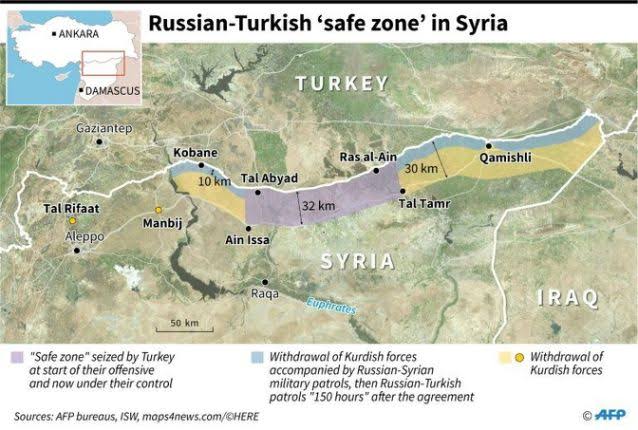
The Russian objective is to steadily expand the Syrian government control of the border regions with Turkey, which would incrementally lead to direct dealings between Ankara and Damascus on issues of border security. In sum, Moscow doesn’t seem to be unduly perturbed that the US is about to get back into bed with Turkey.
Turkey harbours serious misgivings about the US intentions regarding Kurds. Ankara has failed to break the nexus between the US and the Kurdish militant groups and if anything, the Pentagon commanders are lately rather blasé about the axis. Therefore, Turkey cannot afford to put its eggs in the American basket when it comes to northeast Syria.
Importantly, the suspicion is deep-rooted in the Turkish mind that the 2016 coup attempt against Erdogan by the movement led by Islamist preacher Fethullah Gülen (who lives in exile in the US since 1998) was supported by the US military and intelligence circles.
Meanwhile, US-Turkey relations may become toxic what with the US prosecutors in New York asking a federal judge on January 21 to impose escalating fines on Turkey’s state-owned Halkbank for failing to respond in court to criminal charges that it helped Iran evade US sanctions. The proposed fine on the bank is a $1 million-per-day fine – a penalty that would double for each week of further non-compliance. It could total $1.8 billion after eight weeks.
The case against Halkbank has been a longstanding point of tension in the increasingly fraught relationship between Ankara and Washington. Some analysts estimate that it is the single most explosive issue that could blow up the Turkish-American relationship.
If Halkbank decides to acquiesce and appear in court, the case will tarnish the reputation of the Erdogan government. The case implicates senior Turkish ministers, top Halkbank executives and even Erdogan and his family members as beneficiaries of the sanctions-busting efforts.
On the other hand, if the Halkbank insists on its civil contempt of court, that might ultimately severe its ties with the US financial system, hurting not only the bank but also Turkey’s financial sector, and send Turkish-American relations into a free fall.
Can the Trump administration intervene in the Halkbank case and rescue Erdogan? That likelihood can also be ruled out in the downstream of the reported allegation by former NSA in the White House John Bolton in his upcoming memoirs that Trump who has a property in Turkey was inclined to grant favours to Erdogan.
In such a sombre backdrop, it is highly improbable that Erdogan can afford to hitch Turkish wagons with the US. Having said that, Erdogan is under pressure from Turkish public opinion on the refugee problem. He may have to be seen doing ‘something’ to stall the Syrian offensive in Idlib.
No doubt, Ankara has sharpened its messaging but there is no clear Turkish strategy in view. The only viable option will be to accept the new facts on the ground. Possibly, as happened so often before, President Vladimir Putin will step in at some point to hold Erdogan’s hand.
France sends warships to Mediterranean to deter Turkey
MEMO | January 30, 2020
French President Emmanuel Macron has sent warships to the Eastern Mediterranean to give support to Greece against Turkey’s quest for energy reserves in the region.
Together with Macron was Greek Prime Minister Kyriakos Mitsotakis, who was on a visit to the French capital Paris to gather support against Turkey. Mitsotakis welcomed the decision and described the warships as “guarantors of peace.”
“The only way to end differences in the eastern Mediterranean is through international justice,” he told reporters after holding talks with Macron. “Greece and France are pursuing a new framework of strategic defence.”
Tensions have increased significantly over the past year in the Eastern Mediterranean due to Turkey’s dispute with Southern Cyprus over the distribution of energy resources in the waters off the island of Cyprus.
In June last year, Turkey deployed drilling vessels to search for natural gas in retaliation to a deal struck by Greece, Southern Cyprus and Israel earlier that month, in which the three states agreed to build a pipeline harnessing the reserves of natural gas off the southern shores of the island. This pipeline – named EastMed – which is estimated to produce a profit of $9 billion over 18 years of the reserve’s exploitation, would be supplying gas from the Eastern Mediterranean region all the way to countries in Europe.
Turkey has called on those countries to participate in a fair and equal distribution of the energy resources discovered off Cyprus, insisting that they are attempting to exclude and alienate Turkey by striking their own deal without the consideration of both the major regional player and the people of the Turkish Republic of Northern Cyprus (TRNC). Therefore, it stresses that the drilling activities that Turkey is carrying out is legal and within territorial waters.
The EU, however, has repeatedly called on Turkey to give up its claim on having a share in the energy resources, claiming that its activities are “illegal”, leading to the Union to impose sanctions on the Republic in July last year over the issue, as well as due to Turkey’s military incursion – Operation Peace Spring – into northern Syria in October.
As France is one of the most prominent supporters of Greece in the dispute, Macron accused Turkey of being the one responsible for raising tensions as well as causing trouble in war torn Libya. “I want to express my concerns with regard to the behaviour of Turkey at the moment,” said Macron. “We have seen during these last days Turkish warships accompanied by Syrian mercenaries arrive on Libyan soil. This is an explicit and serious infringement of what was agreed in Berlin [conference]. It’s a broken promise.”
Greece itself has reportedly long been prepared for a military confrontation, with Defence Minister Nikos Panagiotopoulos recently warning that the country was “examining all scenarios, even that of military engagement.” This was shown with Greece’s arming of 16 Aegean islands last week, in violation of international law which stipulates that they remain demilitarised. When Turkey called on Greece to disarmed them and uphold international law, Greece refused.
Americans Keep Putting Up Roadblocks Against Russian Troops on Key Syrian Highway
By Marko Marjanović | Anti-Empire | January 29, 2020
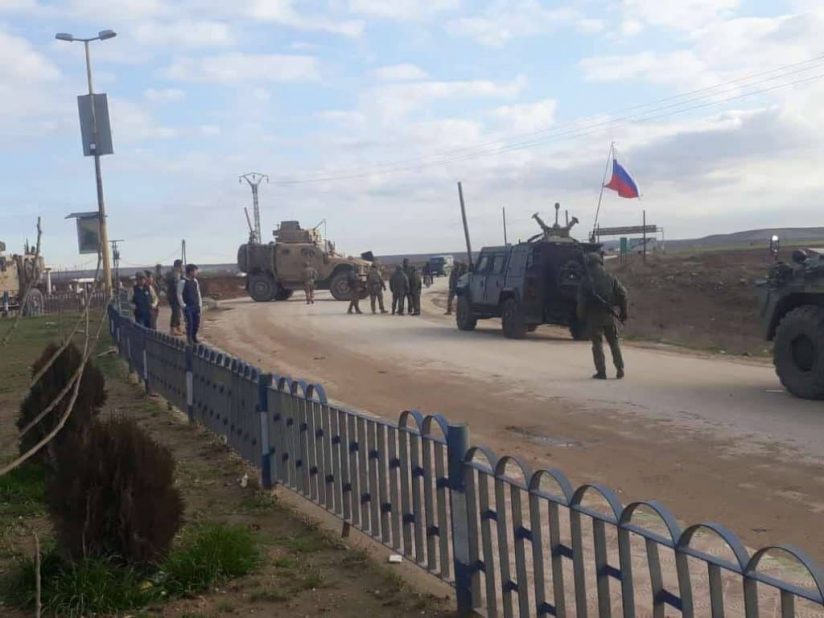
This is now the fourth time this has happened that we know of. US troops in northeastern Syria keep blockading the M4 highway to prevent Russian troops from moving on it.
In fall of 2019, to prevent a Turkish invasion of the Kurdish-held northeastern Syria, the Pentagon hammered out a deal with the Turks for joint US-Turkish patrols on the Syrian side of the Syrian-Turkish border.
As soon as that happened however Trump, after a talk with Erdogan, declared and ordered a US military withdrawal from Syria. At this moment Russia jumped in and took over the US role in the formerly US-Turkish agreement. To minimally appease Erdogan and limit his invasion it would now be Russians who patrolled together with the Turks, which was welcomed by the Kurdish leadership.
In separate negotiations with the Kurds the Russians also gained a number of bases in the northeast to make the patrols possible, and thousands of Syrian army troops also poured in to reinforce the Kurds against the Turkish invasion in the limited sector it was taking place in.
At this point Trump reversed himself, saying US forces would stay in Syria, but only in the oil-rich parts. But the withdrawal from the Syrian-Turkish border, where US presence had hampered US-Turkish relations, would be permanent.
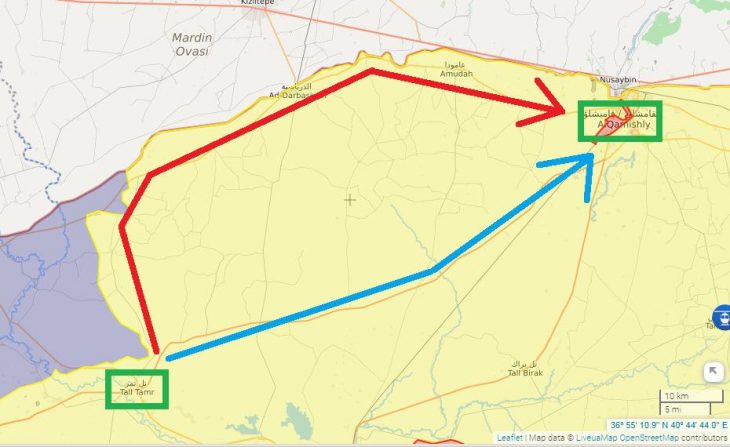
Blue is the obvious path, but the Americans insist the Russians must hug the border along the red path
What is happening now is that when the Russians coming from the west want to take the direct and obvious route to their facilities in the city of Qamishli they periodically encounter US troops near the town of Tell Tamr standing in their way.
The Americans block the road with their vehicles and demand the Russians take the longer, indirect way to Qamishli along inferior roads hugging the Syrian-Turkish border.
Libyan leaders Sarraj & Haftar to hold talks in Moscow on Monday – Russian Foreign Ministry
RT | January 13, 2020
Libya’s two key political figures – Fayez al-Sarraj, the prime minister of the Government of National Accord (GNA), and Commander of the Libyan National Army (LNA) Khalifa Haftar will take part in talks held under the auspices of the Russian and Turkish Foreign and Defense Ministries in Moscow on Monday, the Russian Foreign Ministry told TASS.
“In [the] context of implementing the initiative of the Russian and Turkish presidents announced following a summit in Istanbul, inter-Libyan contacts will be held today in Moscow,” the diplomats said. “The contacts are expected to be attended by Sarraj, Haftar and representatives of other Libyan parties.”
Moscow will host talks between Russian Foreign Minister Sergey Lavrov and Defense Minister Sergey Shoigu with their Turkish counterparts, Mevlut Cavusoglu and Hulusi Akar. The main topics on the agenda are settlement in Libya, cooperation in Syria, and developments in the Middle East.
On January 12, a ceasefire entered into force between the conflicting sides in Libya.
Libya’s warring parties vow to observe ceasefire without preconditions, stop all offensive military actions – draft agreement
RT | January 13, 2020
The Libyan National Army (LNA) and the internationally recognized Government of National Accord (GNA) in Tripoli have pledged to observe the ceasefire suggested by Russia and Turkey after negotiations in Moscow.
The draft document suggests that all parties would stop military actions and observe the ceasefire conditions. Meanwhile, a commission is to be established to determine a contact line between the warring sides. Russia and Turkey promised to support all sides in the conflict to help them implement the agreement.
Libya has been plunged into chaos for years after its longtime ruler Muammar Gaddafi was ousted and killed during a NATO-led bombing campaign. Following the years of devastation and chaos, the country became engulfed in a civil war.
Previous lengthy UN-backed talks on reconciliation, which led to the establishment of the GNA, eventually failed to bring peace to the war-ravaged land.
Haftar began an offensive against Tripoli last year and over the last few months the two sides were engaged in intense fighting. LNA controls most of Libya’s territory, but it is the GNA which is recognized by the international community.
Ankara became involved in the conflict in December promising to send troops to help the government in Tripoli as the international community called on all sides to enter negotiations.
Iraqi Foreign Minister stresses need for withdrawal of foreign troops
Press TV – January 9, 2020
Iraqi Foreign Minister Mohammad Ali al-Hakim has stressed the need for US and other foreign troops to leave Iraq as a backlash grows over the recent American assassination of a top Iranian general in Baghdad.
The top Iraqi diplomat made the appeal during a joint press briefing with his Turkish counterpart Mevlut Cavusoglu in Baghdad on Thursday.
Hakim and Cavusoglu strongly condemned the US assassination of Iran’s Lt. Gen. Qassem Soleimani and senior Iraqi commander of the Popular Mobilization Units Abu Mahdi al-Muhandis, both key figures in the fight against Daesh and other Takfiri terrorists in the Middle East.
“Iraq insists on maintaining its sovereignty and territorial integrity and the complete withdrawal of foreign forces,” the top Iraqi diplomat said.
He added that talks with his Turkish counterpart focused on the need to respect Iraq’s sovereignty from all sides.
“Iraq condemns the attacks on Iraqi land, which harms the sovereignty of our country as well the security of Iraqi people. They are against the international law,” the Iraqi minister said.
Hakim added, “”We have discussed with the minister that Iraq wants all foreign forces are removed out of the country through dialogue. We also discussed with the minister on cooperation areas. We have agreed to alleviate the Iran-US tension in the region.”
The two sides also discussed bilateral relations at all levels, including cooperation on fighting terrorism, al-Hakim said.
The top Iraqi diplomat said any escalation of tensions in the region could result in the re-emergence of Takiri terrorist groups.
The Turkish foreign minister, for his part, said Ankara does not want Iraq to become a battleground for foreign forces.
Cavusoglu added that Iraq was not alone and Turkey was there to overcome difficult days together.
Turkish foreign minister also spoke with his Iranian counterpart Mohammad Javad Zarif Wednesday after Tehran fired dozens of missiles at two military bases hosting US troops in Iraq. The missiles were fired at the Ain al-Asad base in Anbar province and another base in Erbil.
PMU leader denies role in rocket attacks
In another development, Qais al-Khazali, the leader of Asa’ib Ahl al-Haq movement, a subdivision of Iraq’s Popular Mobilization Units, known by its Arabic name as Hashd al-Sha’abi, denied any involvement in the recent firing of rockets at Baghdad’s Green Zone where the US embassy is located.
Two Katyusha rockets struck Baghdad’s heavily fortified Green Zone on Wednesday, landing near the US embassy but causing no casualties, according to the Iraqi military.
Al-Khazali also said it was time for an Iraqi response to the recent US assassination, adding the reaction will be “no less in size” than Tehran’s missile strikes on two American bases in Iraq.
On Sunday, Iraqi Prime Minister Adel Abdul Mahdi called the US airstrike “a political assassination”. He also underlined the need for a timetable to withdraw all foreign troops “for the sake of our national sovereignty.”
Turkey, Russia, Iran officials discuss latest developments in region
![Russian Defence Minister Sergey Shoygu [Wikipedia]](https://i0.wp.com/www.middleeastmonitor.com/wp-content/uploads/2017/11/2015_5-24-ergey-Shoigu-Official_portrait_of_Sergey_Shoigu_19.jpg?resize=1200%2C800&quality=85&strip=all&ssl=1)
Russian Defence Minister Sergey Shoygu [Wikipedia]
MEMO | January 7, 2020
Senior officials from Turkey, Russia and Iran discussed the latest developments in the Middle East and North Africa region yesterday.
The Russian Ministry of Defence said the country’s Defence Minister Sergey Shoygu discussed the developments in the Middle East and Libya during a telephone conversation with the head of the Turkish intelligence organisation, Hakan Fidan. The two officials also discussed joint actions to reduce tensions in the region.
The statement added that Shoygu also spoke to Iranian Chief of Staff, Mohammad Bagheri, during which they discussed steps to reduce tensions in the region following Friday’s assassination of Iran’s Commander of the Quds Force, Qassem Soleimani, in a US drone attack near Baghdad airport.
Tensions between Washington and Tehran escalated following Soleimani’s assassination, while, Tehran announced that it would respond “harshly” to the assassination.
Featured Video

U.S. General Caine Warns: STRIKING IRAN is a HUGE RISK
or go to
Aletho News Archives – Video-Images
From the Archives
Stealth Bombers and Bunker Busters
Analysis of the so-called 12-Day War, and the triumphantly celebrated Operation Midnight Thunder
By William Schryver | imetatronink | November 28, 2025
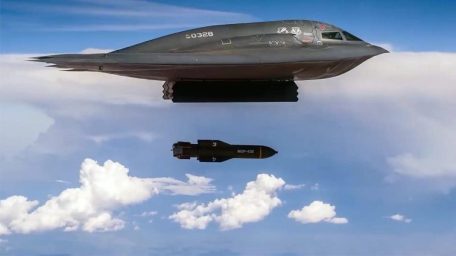
The GBU-57 is a big fat gravity bomb with fins. To achieve effective precision, a B-2 bomber must drop it on its intended target from no further than about five nautical miles — essentially right on top of the target.
Its penetration depth is claimed to be 200 feet. But that capability has NEVER been tested against a seriously hardened deep-underground target encased in layers of high-performance concrete, and topped with a few dozen meters of solid rock. In that sort of real-world scenario, the GBU-57 would be lucky to drill down 50 feet, if that.
It was always ridiculous silly talk to suggest the GBU-57 was the wonder weapon it was made out to be. There is a good reason the US only produced a couple dozen of them and then stopped: they understood its acute limitations in a non-permissive combat environment.
And, notwithstanding the hyperbolic Israeli propaganda, there was never any credible evidence that Iranian medium- and long-range air defenses against fixed-wing aircraft were attrited to any significant degree. And Iranian short-range air defenses were increasingly effective against long-range Israeli drones with each passing day.
As for the B-2: it is a big fat subsonic aircraft. It flies at airliner speeds. A strike on Fordow would entail flying at least 500 miles in and out of Iran. … continue
Blog Roll
 Aletho News
- Zelensky Refused to Discuss Druzhba Pipeline Issue – Fico
- U.S. General Caine Warns: STRIKING IRAN is a HUGE RISK /Glenn Diesen & Lt Col Daniel Davis
- Israel designates five Palestinian media outlets as ‘terrorist organizations’
- Israel, not America, first: Carlson’s Huckabee interview lays bare US foreign policy priorities
- Israeli troops executed Palestinian aid workers at ‘point blank range’: Report
- Iran war What if today’s Iran is resigned to a long, hellish war with the US?
- Why Israel Is Escalating Its War Crimes Against Lebanon
- Iran in the face of the armed diplomacy of imperialism
- The US build-up around Iran constitutes strategic war option, not ‘deterrence’
- Iran to US: Sanctions and war failed; try diplomacy and respect
- If Americans Knew
- In Gaza, Ramadan without mosques, imams – Not a ceasefire Day 137
- Footage Shows Israeli Troops Waiting in Ambush, Then Opening Fire on a Palestinian Teen
- The US is on the brink of a major new war that Trump has not even bothered explaining
- Latest Epstein document dump is one more cover-up
- No Protection, No Justice: US Citizens Killed with Impunity by Israel
- Maria Farmer: Epstein Victim Reveals Explosive Information Covered Up by Media
- Average of five Palestinians killed by Israel every day in Gaza since ceasefire – Not a ceasefire Day 136
- Palestinian church leaders admonish Christian Zionist Mike Huckabee – Not a ceasefire Day 135
- Ominous messaging from Trump’s “Board of Peace” – Not a ceasefire Day 134
- ‘Christians Out’: Jerusalem Church Tagged With Hate Graffiti, Police Investigating
- No Tricks Zone
- Surprising Discovery: Sahara Is Greening…Billions Of Trees Where Once Thought To Be Barren
- New Research Reaffirms Clouds, Aerosols, And Surface Solar Radiation Are ‘Driving The Climate System’
- Germany: Electric Car Catches Fire At Charging Station, Sets Off Local “Inferno”, Widespread Damage
- New Study: Canada’s New Brunswick Was 1°C Warmer Than Today During The Medieval Warm Period
- Coal Power Back In Trend As Globe Tries To Keep Pace With Growing Demand For Power
- New Study: A 4°C Warmer Beaufort Sea Had ‘No Sea Ice’ 11,700 – 8200 Years Ago
- Unfudging The Data: Dutch Meteorological Institute Reinstates Early 20th Centruy Heat Waves It Had Erased Earlier
- German Gas Crisis…Chancellor Merz Allegedly Bans Gas Debate Ahead of Elections!
- Pollen Reconstructions Show The Last Glacial’s Warming Events Were Global, 10x Greater Than Modern
- Germany’s Natural Gas Storage Level Dwindles To Just 28%… Increasingly Critical
 Aletho News