Iran resumes gas exports to Turkey after pipeline fixed
Press TV – July 1, 2020
The Iranian Oil Ministry says it has resumed exports of natural gas to Turkey despite reports in the media suggesting that exports could stop for good because of price disputes.
A spokesman of the National Iranian Gas Company (NIGC) said on Wednesday that Turkey had finished repair work on a pipeline that came out of service after an explosion on March 31, allowing Iran to resume exports.
“Exports have resumed now that repairs on gas export pipeline in the Turkish territory have finished,” said Mohammad Asgari, adding, “Iran’s gas exports to Turkey is going on as before.”
The announcement puts an end to weeks of speculations about a potential decision by Turkey to halt imports of natural gas from Iran.
Reports in April had suggested that Turkey was unwilling to repair the damaged pipeline because it was unhappy with the price of gas supplied from Iran.
Those reports said a sudden fall in international oil prices, which are used as a benchmark to determine gas prices, had caused Turkey to press Iran for a fresh negotiation on gas prices.
Authorities in Turkey had denied there was a major issue with the price, insisting that repair work on the pipeline had been delayed because of the spread of the new coronavirus in the region.
That comes as oil prices have rebounded in recent weeks mainly because of an international agreement to cut the output.
Turkey is entitled to receive around 8.5 billion cubic meters of gas from Iran each year under a 25-year contract which began in 2001.
Based on the agreement, any change in oil prices would take at least six months to have an effect on the price of gas delivered by Iran to Turkey.
Libyan war escalates as regional powers attempt to gain stronger influence
By Paul Antonopoulos | June 1, 2020
Alarms are sounding in Europe as Turkey, Russia and Arab states could potentially agree on shared influence in Libya, and therefore the entirety of the eastern Mediterranean, according to some experts. This comes as European states have no influence over the war in Libya despite it occurring on its southern doorstep and Turkey, Russia and Arab states continue to gain influence.
The direct intervention of Turkey in Libya, who has sent its own intelligence officers, military advisers and thousands of Syrian jihadists to support the Muslim Brotherhood Government of National Accords (GNA), based in Tripoli and led by the ethnic Turk Fayez al-Sarraj, has limited further gains by the Libyan National Army (LNA). The mobilization of thousands of Turkish and Syrian jihadists and the massive shipment of weapons to Tripoli has slowed down the offensive of the LNA, led by Field Marshal Khalifa Belqasim Haftar. Haftar was proclaimed on April 27 as the only leader of the country, in which most of the international community found to be a provocative move as they believe it limited the likelihood of a political settlement to the conflict.
Confident of his past military superiority and assured in the determination that the United Arab Emirates, Saudi Arabia and Egypt have to counter Turkey’s efforts to create hegemony in the Eastern Mediterranean, Haftar continues to ignore calls for a political solution to the war. Sarraj also ignores such calls confident in the backing he has from Turkey.
Russia also condemned Haftar’s offensive and called for negotiations on peace. However, the U.S. claims that Russian fighter jets arrived in Libya to protect the withdrawal of volunteers from the Russian Wagner group in a decision agreed upon with Ankara, something that Moscow denies. Both Europe and the U.S. fear that Russia may obtain the use of a naval base in eastern Libya, that the LNA securely controls, in the future.
Despite these potentialities, it is unlikely the war between GNA-backed jihadists and the LNA will come to a conclusion anytime soon, unless there is a drastic change caused by external forces. Turkey in the midst of an economic crisis is unwilling to use the full force of its military in Libya and is rather acting as a conduit between the GNA and Qatari-funded but Turkish-trained Syrian jihadists. Egypt is contemplating using its military in Libya to “fight against Libyan extremists and terrorists supported by Turkey.” This too could be a game changer since Egypt has the means, logistics and capabilities to successfully intervene in Libya in favour of the LNA.
France has also not hidden away with its support for Haftar, finding him to be a leader that would advance French interests in the Mediterranean that is in direct conflict with Turkey. The GNA has also signed a memorandum with the Muslim Brotherhood government to cut through Greece’s maritime space for the exploitation of gas in that area of the Mediterranean, forcing Greece to get embroiled in the Libyan mess. Meanwhile, Italy has backed the GNA while Germany is trying to act as referee, showing once again there is no common European position.
The European ‘Irini’ (meaning peace in Greek) operation is committed to prevent maritime-bound arms delivery to Libya, i.e. Turkish arms to Libya. This is a maritime surveillance operation to enforce the United Nations-imposed arms embargo on Libya, but in reality, it has not prevented Turkey’s deliveries to the GNA while Egypt continues to supply the LNA over the land border.
The situation shows that the European Union is unable to establish itself as a main actor in a conflict that brings together strategic political and economic interests a few nautical miles from its southern coast. With the U.S. realistically absent, Turkey backing the GNA and Russia and the Arab + Greece alliance backing the LNA, these are the main protagonists.
In Paris, and seeing the failure of his diplomacy parallel to the EU, the Foreign Minister, Jean-Yves Le Drian, warns about the “Syrianization of Libya,” while spokesman of Turkish President Recep Tayyip Erdoğan’s gloats: “France and other European countries supporting Haftar are on the wrong side of history.” Seen in this light, the balancing role Russia can play in Libya to contain Ankara could even be positive for Europeans.
However, the main reason that shared influence will not be agreed upon is because the GNA-Turkish deal to steal Greece’s maritime space relies on a supposed share maritime space between Libya and Turkey. And therein lays the problem – it is the LNA, who has rejected the memorandum, that controls the eastern Libyan coast that supposedly shares a maritime border with Turkey. So long as the LNA controls eastern Libya, Turkey will always strive for a GNA victory to legitimize the memorandum. Once again, the European Union remains divided on Libya, despite the Muslim Brotherhood government aiming to carve out the maritime space of a member state.
Paul Antonopoulos is an independent geopolitical analyst.
Failures in Syria and Libya fuel coup speculations against Erdogan
By Paul Antonopoulos | May 20, 2020
Turkish media has been full of speculation of a potential coup against President Recep Tayyip Erdoğan, including from state-run Anadolu Agency, and other major outlets like Sabah and Haberturk. Erdoğan already survived a 2016 coup attempt against him that he blames on his ex-ally, Fethullah Gülen, who leads the FETÖ Islamic movement. It is likely that Erdoğan will conduct another purge of the Turkish military.
Although the 2016 coup was orchestrated mostly by the Air Force, it appears that one of the first victims could have been Rear Admiral Cihat Yaycı. On May 15, Yaycı was demoted from the Chief of Staff’s to the General Staff, prompting him to resign from the military completely on Monday. Although some speculated it could have been because of the coup rumors circulating, Yaycı proved to be one of the most loyal Chief of Staff’s to Erdoğan and played a significant role in purging so-called FETÖ elements from the Turkish military.
It is likely that Yaycı was actually demoted because of Turkey’s complete failure to project its power in the Eastern Mediterranean. Yaycı is known as the architect of Turkey’s “Blue Homeland” theory that aims to annex Greece’s Eastern Aegean islands and maritime space. To achieve the “Blue Homeland,” Ankara in November 2019, with recommendation from Yaycı, sealed the “Marine Jurisdictions” maritime boundary delimitation deal with Libya’s Muslim Brotherhood Government of National Accords (GNA) to split Greek maritime space between Turkey and Libya.
However, since the signing of the deal with the Tripoli-based GNA, Ankara’s power projections in the Eastern Mediterranean have only weakened Turkish influence. Turkey had not expected for Greece to expel the GNA ambassador from Athens, one of the first NATO and EU countries to do so. In reaction, Greece recognised the GNA’s rival, the Tobruk-based Libyan House of Representatives who appointed Field Marshal Khalifa Belqasim Haftar to command the Libyan National Army against Turkish-backed jihadists who fight for the GNA.
Greece’s shift in recognition shows another flashpoint in rivalry with so-called NATO ally Turkey and rapidly changed dynamics in the Eastern Mediterranean. Haftar currently controls about 90% of territory and 60% of the population, prompting Turkey to send 5,000 Syrian jihadists to support the GNA, who have regained some lost territory in recent weeks.
But this is going to change as it appears massive simultaneous operations against the GNA and Turkish-backed jihadists in Syria’s Idlib province are set to begin in the coming weeks. Turkey as the sole backers of jihadist forces in Libya and Idlib will find this extremely difficult to deal with as it faces an economic crisis.
A detailed report by New Economy found that “Turkey’s probability of bankruptcy is extremely high,” along with its three big banks of Garanti, Akbank and the Mustafa Kemal Atatürk-founded İşbank. “The country’s commercial banks, its last stronghold, have dried up from foreign exchange currency,” meaning that Turkey has nearly no money for its import and export companies.
Another report found that failed wars against Libya and Syria have been a major problem for its economy, making Turkey’s bankruptcy probability over 30% in the forthcoming period, putting them behind only Venezuela and Argentina, but “without having the US embargo that Venezuela has, nor the vast debt that Argentina brings.”
Most startling however for Turkey is that it has to find $80 billion by August, according to New Economy, or else it faces bankruptcy.
“There is also the additional 0.5-1 billion dollar cost per month for the wars in Syria and Libya, which seems to exacerbate the existing situation, leading to a huge state budget hole and escalating the probabilities of bankruptcy,” the report said.
With major economic problems in Turkey, Ankara paid Syrian jihadists in Libya only one month’s worth of wages and then ended all payments. This has prompted the jihadists to make videos urging other Syrians not to go to Libya and fight. Meanwhile, Turkey’s aggression has prompted Greece to renew diplomatic relations with Syria, become actively involved in Libya, and strengthen relations with Egypt, Saudi Arabia and the United Arab Emirates who oppose Turkish influence in the Arab world.
Yaycı’s ambitious “Blue Homeland” project forced Greece to become involved in Libya and Syria that it previously had no interest in, and it is now actively a part of an alliance that is opposing Turkish influence in the region. With Greece actively opposing Turkish influence in Libya, France has also taken a stronger interest and openly opposes the GNA now. What began as a plan to carve up Greece’s maritime space has now turned into a debacle that sees French involvement against the GNA and EU recognition of the Muslim Brotherhood government waning.
Egypt is now threatening to directly use its military to defeat the GNA rather than just supply Haftar’s forces. The UAE has promised to continue airstrikes against the GNA and funding mercenaries for Haftar. Saudi Arabia is also funding mercenaries. Greece and France are involved in the EU’s Operation Irini to stop maritime deliveries of arms to Libya. In March, Haftar’s political representatives signed with Syria a Memorandum of Understanding to start diplomatic relations. Syria and the Libyan National Army are also preparing likely simultaneous operations against jihadists in their respective countries.
This is all happening while Turkey faces a very serious threat of bankruptcy and rumors of a coup attempt. Therefore, it is likely that Yaycı was demoted by Erdoğan for masterminding and pushing for the “Blue Homeland” that has ended in catastrophic failure for Turkey.
Paul Antonopoulos is an independent geopolitical analyst.
Turkey stalls Iran gas imports amid aggressive US efforts to push its LNG
Press TV – May 13, 2020
Turkey is dragging its feet on repairing a pipeline which was hit by an explosion in late March, stopping Iran’s gas exports to the country, the Fars news agency says.
Iran sells about 10 billion cubic meters a year of gas to Turkey under a 25-year supply deal signed in 1996. The pipeline has been blown up several times by PKK terrorists, but it has been repaired and the gas flow has continued shortly.
However, after another blast occurred on the pipeline on March 31, an official at the National Iranian Gas Company (NIGC) said the Turkish side was not responding even as Iran had informed it of the incident.
According to Mehdi Jamshidi-Dana, Turkey’s representative at Bazargan gas transmission station had left his post due to the outbreak of the novel coronavirus.
The official said it was not clear when the line would re-open, but he cited past experience which showed “repairing the lines takes three to seven days, depending on the amount of damage done”.
On Wednesday, Fars suggested that the pipeline is still out of service, citing Turkish state energy company Botas’ dilly-dallying and unwillingness to repair it.
The news agency speculated that the situation must be the result of aggressive US efforts to push its liquefied natural gas (LNG) into Turkey.
Heavily dependent on gas imports from Russia, Turkey has already reduced flows from Gazprom significantly, while increasing LNG purchases and gas imports from Azerbaijan.
“In recent months, Turkey has imported as much LNG from the United States as gas imports from Iran,” Ali Nasr, an energy expert, told Fars.
Last November, Turkey marked the completion of the Trans-Anatolian Natural Gas Pipeline (TANAP) to carry gas from Azerbaijan’s Shah Deniz II field to Europe.
In January, the presidents of Turkey and Russia formally launched the TurkStream pipeline to carry Russian natural gas to southern Europe through Turkey.
Fars warned that Iran may lose its biggest gas market to rivals, which could cost the country $150 million-$200 million in lost revenues a month.
The US has the necessary incentive to remove Iranian gas from the Turkish market in order to increase economic pressure on Iran, while Turkey seeks to diversity its energy sources and reduce gas imports from Iran and Russia, the agency said.
The US is currently pushing Trump’s “energy dominance” agenda that seeks to advance diplomatic and policy objectives through rapidly expanding US oil and gas exports.
Iran has already lost its biggest condensate market in South Korea which imported 300,000 barrels per day (bpd) of the ultra light oil from the Middle Eastern country.
The Koreans stopped the shipments under pressure from the United States which is aggressively thrusting its fast-growing condensate into Asia.
According to US officials, Washington has offered to sign a $100 billion trade agreement with Turkey, which their presidents discussed at the Munich Security Conference.
The offer is part of the Trump administration’s main goal to get President Recep Tayyip Erdogan drop plans to use Russia’s S-400 missile defense systems.
“If an agreement is reached, the possibility of replacing Iranian gas with American LNG is quite possible,” Fars warned.
According to the news agency stated, Turkey has expanded its LNG terminals to take in 25 billion cubic meters of cargoes – 2.5 times more than the imported gas from Iran. The terminals are currently operating only at 25 percent of their nominal capacity. … Full article
Greece’s Renewed Relations with Syria Further Isolates Turkey in the Eastern Mediterranean
By Paul Antonopoulos | May 7, 2020
On Tuesday, the Greek Foreign Ministry finally announced a restoration of relations between Greece and Syria and assigned former ambassador to Syria and Russia, Tasia Athanassiou, as a Special Envoy of Greece’s Foreign Ministry for Syria. Greek Foreign Minister Nikos Dendias confirmed this from his Twitter. The appointment of Athanassiou is extremely strategic as she was Greece’s ambassador to Damascus from 2009 to 2012, meaning she is already familiar with Syria and their authorities.
The Greek Foreign Ministry said that contacts will be made for the “international aspects of Syria and related humanitarian action, as well as coordination of actions in view of the ongoing efforts to rebuild Syria.”
Although the Foreign Ministry claims that the suspension of diplomatic relations “was dictated by the security conditions,” we know it was ordered by former Greek Prime Minister Antonis Samaras in December 2012 under orders from NATO and the European Union who were, and in some instances, still are backing jihadists against the secular government of President Bashar al-Assad.
Greece became a country ruled by European banker, EU, and NATO puppets from 2010 onwards when on May 2 of that year, the so-called socialist government of George Papandreou signed the first of three bailout packages with the European Commission, the European Central Bank and the IMF. This caused a 25% contraction of the Greek economy, an unemployment rate of 27% and skyrocketed poverty. Any semblance of Greek independence in domestic and foreign policy was lost.
However, moving to 2020, the economic and geopolitical situation in Greece and its surrounding region has drastically changed. Diplomatic sources quoted by Kathemirini, one of Greece’s oldest and most respected newspaper, said that the decision to appoint a Special Envoy for Syria is part of Greece’s steady activity in the Eastern Mediterranean and the wider region. According to the sources, Greece’s increased desire in contributing to efforts in resolving the Syrian crisis was stated by Dendias in his meetings with the UN Special Envoy for Syria, Geir Otto Pedersen.
Therefore, a major reason for the reopening of relations with Syria is to further tilt the balance of power in the East Mediterranean in Greece’s favor against Turkey, especially at a time when Ankara does not have a single ally in the region, with the exception of the besieged Muslim Brotherhood government in Libya that is nearly collapsed because of the Libyan National Army’s assault.
The reopening of relations between Athens and Damascus comes at a time when Turkish President Recep Tayyip Erdoğan is making a strong push for a “Blue Homeland” that aims to annex Greece’s Eastern Aegean islands and maritime space. Turkey for nine years attempted to oust Assad from power through various means, including an unsuccessful invasion attempt of Idlib province earlier this year, as well as its continued support for terrorist organisations. In addition, Erdoğan is propping up the Muslim Brotherhood government in Libya by importing jihadists from Syria to the North African country.
Although Erdoğan has failed in all of these endeavours, Turkey still remains a major threat, even at a time when it is facing economic catastrophe with the Turkish lira at a near record low to the U.S. dollar and Turkey’s three largest banks, Garanti, Akbank and İşbank, on the verge of bankruptcy. Even with this looming economic disaster, Turkey still manages to find the funds to violate Greek airspace on a daily basis, send weapons to Libya and fund terrorist organizations in Syria.
As the Eastern Mediterranean becomes a potential major warzone because of Turkey’s aggression, Greece is now renewing relations with old friends. Hafez al-Assad, previous president of Syria and father to Bashar al-Assad, pledged that if Turkey was ever to go to war with Greece, Syria would automatically open a new front in southern Turkey in support of Greece.
Athens however is not completely independent from NATO and the EU. This suggests that although renewing relations with Syria is absolutely critical in protecting its sovereignty, perhaps Greece has gotten approval from the EU and/or NATO to do this. Greece is perhaps the most important of the very few European countries that have maintained or reopened relations with Syria because of its history of friendly relations, as well as thousands of years of religious, cultural, financial and ethnic ties.
It can be suggested that as the war in Syria begins to end, continued only by Turkey’s refusal to stop backing terrorist organizations in Idlib, the EU wants to try and take advantage of lucrative reconstruction contracts that will be on offer and investment opportunities. It is unlikely that European companies will win reconstruction contracts, but the reality is that Assad has survived the near 10-year efforts to have him removed, and is not going anywhere. Greece could be used as an outlet for the EU to open dialogue and relations with Damascus again.
This is only speculative, but what is for certain is that by reopening relations with Syria, Greece is consolidating the emerging East Mediterranean order and opposes Turkish hegemony in the region. Greece will always have close relations with Cyprus, and has also entered a military alliance with Egypt, supports the Libyan National Army against Turkish-backed forces, and has strong military and energy ties with Israel. Relations with Syria have essentially finalized the strangulation of Turkey’s attempted hegemony of the Eastern Mediterranean and made it the most isolated country in the region – despite Athens’ insistence on improving ties with Ankara if it finally abandons its aggressive foreign policy.
Paul Antonopoulos is a Research Fellow at the Center for Syncretic Studies.
Syrian ‘regime change’ architect: William Roebuck, US Ambassador of Destruction

By Steven Sahiounie | Mideast Discourse | May 4, 2020
Since 2006, William Roebuck, a US Diplomat, has been working toward ‘regime change’ in Syria at any cost. The destruction of Syria, hundreds of thousands of deaths and injuries, and the migration of one-third of the population have been the price of the US policy under Roebuck’s tenure. The ultimate goal of ‘regime change’ has never been about greater freedoms, democracy, or human rights for Syrians, but has been with the single target spelled out by Roebuck in 2006: to break the relationship between Iran and Syria.
William Roebuck, US Ambassador ‘to the Kurds in Syria’
William Roebuck is a 27 year veteran of the US State Department, having served under Presidents Bush, Obama, and currently Trump. His current title is Deputy Special Envoy to the Global Coalition to Defeat ISIS. He is a former US Ambassador to Syria and Bahrain. He has served in the US embassies in Iraq and chargé d’affaires in Libya under Obama. Seymour M. Hersh wrote about the US Embassy in Libya and its role in arming the terrorists used by the US in Syria. For the past several years, he has been based in Northeast Syria and managing the Kurds.
Roebuck designed the 2011 “Arab Spring” in Syria
WikiLeaks founder Julian Assange revealed a plan concocted by William Roebuck, the former US Ambassador to Syria. Wikileaks published US diplomatic cables, and chapter 10 of “The Wikileaks Files” concerns Roebuck’s cable sent on December 13, 2006. Ambassador Roebuck wrote that the US should take action to try to destabilize the Syrian government by provoking it to overreact, both internally and externally. That plan was put into action in March 2011 at Deraa, where armed terrorists were interspersed among unarmed civilians in street protests. The terrorists were provoking the police and security forces by shooting at them, as well as shooting unarmed civilians which were blamed on the security forces.
The cables prove that ‘regime change’ had been the goal of US policy in Syria since 2006 and that the US promoted sectarianism in support of its policy, which built the foundation for the sectarian conflict which resulted in massive bloodshed. Roebuck advocated for exploiting Syria’s relationship with Iran, which makes Syria vulnerable to Israeli airstrikes. Roebuck advised that the US should destabilize the Syrian government by promoting sectarian divisions between Sunni and Shia, which at the time was not an issue in Syria, which is a secular government and a tolerant society. By promoting sectarian conflict, which he had observed in the oil-rich Arab Gulf monarchies, Roebuck was crafting the destruction of Syrian society. The ultimate US goal in Syria was to destabilize the Syrian government by violent means, resulting in a change of government, and the new government would be pro-Israeli, and anti-Iranian.
Roebuck’s memo leaked
In November 2019 an internal memo written on October 31 by Roebuck was leaked to the press. He criticized Trump for failing to stop Turkey from invading the Northeast of Syria. “Turkey’s military operation in northern Syria, spearheaded by armed Islamist groups on its payroll, represents an intentioned-laced effort at ethnic cleansing,” Mr. Roebuck wrote, calling the abuses “what can only be described as war crimes and ethnic cleansing.”
Roebuck praised the SDF as a reliable partner acting as guards to keep US troops safe while they occupied Syria illegally, to steal the Syrian oil, which is to be used to support the SDF, instead of the Pentagon payroll.
Two is the company, but three is a crowd
The US state department has a Syrian trio: William Roebuck, and the special representative for Syria engagement, James Jeffrey. Joel Rayburn is a deputy assistant secretary for Levant Affairs and special envoy for Syria.
Iraqi and Syrian Kurdish officials are often confused as to which US officials are in charge on any given issue, and whether their policies were personally driven, or reflected US foreign policy directives. Many analysts agree that the US foreign policy on Syria is a confusing mess.
Roebuck pushes the Syrian Kurds to unite
The Kurdish National Council (KNC) and the Kurdish Democratic Union Party (PYD) have begun direct talks which US diplomat William Roebuck has promoted. For the last two years, he has been working with the Syrian Kurds. The goal is to unite all Kurdish parties in Syria in one body, which could be part of the UN peace talks in Geneva to end the Syrian conflict. The KNC and PYD have had serious disagreements over the years.
The KNC is part of the Istanbul-based ‘Syrian opposition’ and aligned with the Kurdish nationalist Massoud Barzani and his Kurdistan Democratic Party (KDP) in Iraq. The KNC received criticism as being pro-Turkish after the Turkish Army invaded the Northeastern region of Syria.
The PYD is part of the political arm of the Syrian Democratic Forces (SDF) who had been the US partner fighting ISIS. PYD bases its political and organizational projects on the PKK’s ideology. The PKK is considered as an international terrorist group accused of thousands of deaths in Turkey over the decades.
The first direct negotiations between the KNC and PYD were held in early April at an illegal US military base near Hasakah, with William Roebuck, an SDF commander Mazlum Abdi in attendance. Roebuck has met numerous times over the past three months with the KNC, trying to push the idea of unification among the Kurdish factions.
At an April 25 press conference in Qamishli, it was announced that Roebuck had presented a draft that called for a unified political vision for Syria. After about four meetings, the two sides were in agreement on the following points: Syria is to be a federal, democratic, and pluralistic state; the current Syrian government in Damascus was not acceptable; the Kurdish northeast region was to be a political unit. It was stressed that both parties were committed to resolving the Syrian crisis through the implementation of UN Resolution 2254, and the new Syrian constitution must recognize Kurdish national, cultural, and political rights.
The SDF and PYD do not have political representation in the Geneva talks because of Turkish opposition to their participation, given the fact that Turkey views the groups as terrorists. Turkey rejects any project that would lead to Kurdish autonomous rule in Syria, which is the goal of the US. When Trump ordered the sudden withdrawal of US troops from the Northeast of Syria in October, the Kurdish leaders immediately turned to the Syrian government in Damascus to save them from extermination at the hands of the invading Turkish Army. However, the US did not want the Kurds to be protected by Damascus. The US goal is ‘regime change’ using UN Resolution 2254 as their tool. To achieve that end, William Roebuck has continued to work with the Kurds of the Northeast and is now trying to get them united to be at the negotiating table in Geneva. The Kurds might unite, but they will always remain a small minority numbering only 7% of the population, but who are attempting to control 20% of the territory in Syria. Will there be justice for the Syrian homeowners and landowners within the territory the Kurds call “Rojava”, who have been made homeless and destitute at the hands of the Kurds? Will the Syrians one day rise in a “Kurdish Spring” cleaning to regain their properties?
Ahed al-Hindi, a political analyst based in Washington, DC, told Al-Monitor that the US goal to unify the Kurdish ranks in northeastern Syria is a part of a project designed to unify the entire Syrian north, including Idlib and the Kurdish Northeast. The US goal is to prevent the Syrian government from access to the resources which could be used to rebuild Syria.
The next UN peace talks in Geneva
UN Special Envoy Geir O. Pedersen gave a UN Security Council briefing on the situation in Syria on April 29. He announced the agenda for the next session of the Constitutional Committee had been agreed between the co-chairs, and meetings in Geneva would resume as soon as the COVID-19 restrictions would allow. He continued to stress the importance of the current nationwide ceasefire, which was needed to combat and treat COVID-19. He declared there is no military solution to the Syrian conflict, and the UN Security Council resolution 2254 must be used as the path to a political settlement that would be acceptable for the Syrian people while restoring the sovereignty, borders, and independence of Syria.
Steven Sahiounie is an award-winning journalist and political commentator.
“Turkey lied to us.” Syrian Mercenaries in Libya are Desperate to Leave
By Lindsey Snell | The Investigative Journal | April 27, 2020
“I just got back from Libya yesterday,” said Zein Ahmad*, a Turkish-backed Syrian National Army (SNA) militant in Afrin. “But I had been trying to leave for more than a month.” When the Libyan National Army (LNA) neared Tripoli in April 2019, the rival UN-backed Government of National Accord (GNA) in Tripoli called on Turkey for military support.
Turkish forces began heavily recruiting militants from SNA factions in Syria to fight on their behalf, and began flying hundreds to Libya every week. The exact number of Syrian militants Turkey has sent is unknown, but estimates range from 5,000 to 17,000. Flights carrying Syrians to Libya continue, despite the Coronavirus pandemic.
Ahmad is a member of Ahrar al-Sharqiya, an SNA faction notorious for its bad treatment of civilians and a tendency to fight other SNA factions in the areas they invade. Ahmad had been based in Afrin with the faction since Turkey’s Operation “Olive Branch” in 2018. The Turkish invasion of Afrin led to the deaths of hundreds of civilians and the displacement of hundreds of thousands. Ahrar al-Sharqiya has been accused of widespread war crimes in the city, including looting, murder, kidnapping, and serial rape.
When asked if he believed in Turkey’s mission in Afrin, Ahmad laughed. “I was a mercenary going to Afrin, and I was a mercenary going to Libya. There is no jihad. The jihad ended when [the Syrian opposition] lost Aleppo to Assad in 2016. Since Aleppo, it has been just money for us. We don’t care who we are fighting.”
Ahrar al-Sharqiya’s atrocities spread beyond Afrin when, in October 2019, Turkey launched Operation “Peace Spring” on North and East Syria. Ahrar al-Sharqiya militants stopped the vehicle of Syrian Future Party leader Hevrin Khalaf at a checkpoint they’d constructed along Syria’s M4 highway. The militants pulled Khalaf from her car, bludgeoned her, dragged her by her hair, and shot her five times. They posted video of the attack on their social media accounts.
Ahmad won’t comment on the assassination of Hevrin Khalaf or any of the other war crimes his and other Turkish-backed factions have been accused of in recent times. “I know the groups did bad things in Afrin when we entered the city,” Ahmad said. “But I never did, personally. I never looted when I was in Afrin. But I did loot when I was in Libya. We all did. They stopped paying us.”
The Syrian militants in Libya were promised salaries ranging from $2000-3000 per month, but reports from militants in several factions suggest the GNA has not kept up with payments as promised. One Hamza Division member said he’s been paid $2000 every month and a half rather than every month. Some Faylaq al-Majd members who have been in Libya for more than three months say they were paid once and never again.
“They told us we would be paid $3000 a month. That never happened. The first month we got $2000. The second month, they gave us $1400. The third month, we weren’t paid at all,” Ahmad said. “So we looted. We took copper from the homes, anything gold we could find, anything valuable we could find. And the Libyans with us would take the items and sell them for us.”
A militant from the Hamza Division says that a GNA-affiliated Libyan militant assigned to his group takes the Syrians into shops in Tripoli so they can sell their stolen wares. “Some fighters were looting instead of fighting,” he said. “In fact, many of our fighters were killed because they would steal from homes near the frontlines, and Haftar’s forces would ambush them and kill them.”
Hilal Hesham*, a businessman in Tripoli, has two friends who own shops frequented by the Syrian militants. “One shop owner tried to call the police when the Syrians came in the first time,” he said. “It was obvious the items they had were stolen. But of course, the police did nothing. It is militia rule in Tripoli. The shop owners aren’t happy with their presence, but they are required to do business with them.”
Hesham says he isn’t aware of the Syrian militants physically harming any civilians. “Maybe they realize that in Tripoli, we are all armed,” he said. “But in my mind, these [Syrian] men are extremists, are terrorists, are ISIS. I want to make it clear that I, and many other civilians here, are waiting for the [Libyan National] Army to enter Tripoli.”
***
Zein Ahmad says most of the other promises Turkish forces made to the SNA militants failed to materialize. “They told us first that if we stayed and fought for six months, that we would get Turkish citizenship,” he said. “That was lies. They told us if we died fighting in Libya, our families would get Turkish citizenship. Now that so many Syrians have died in Libya, we know this is also a lie.”
Ahmad says that when a fellow Ahrar al-Sharqiya member was killed in a battle in February, his widow in Afrin was given around $8000. “Of course, she did not get the Turkish citizenship,” he said. “She’s living in a camp in Syria with no husband now.”
Ahmad says the Turkish commanders who briefed them on the Libya mission grossly misrepresented the dangers they’d be facing. “They told us it would be minor combat. They said it was safer and easier than fighting in Syria,” he said. “And for the first month, it was. It was great.”
After arriving in Libya, Ahmad stayed in a house in Tripoli with ten other Syrian militants and a Libyan militant who accompanied them whenever they left the house. The house was a well-appointed villa, almost certainly abandoned by its rightful owners when clashes intensified and drew closer.
“Then, after some weeks, heavy battles began. We moved to Salah al-Din. It was worse than in Syria,” Ahmad said. “Bodies fell in the street and no one picked them up. So many Syrians have died.” Ahmad isn’t sure exactly how many Syrians have died in Libya, but says he personally saw more than a dozen killed in battle.
“It was nothing like we are used to in Syria,” Ahmad said. “It’s urban street combat. We don’t have the right weapons or the right skills. We are being slaughtered. And so, many of us started to refuse to fight. Or we’d be taken to the frontlines and hide there.”
Ahmad says that when the Syrian militants began defying orders, Libyan soldiers aligned with the GNA would come and beat them. He says once, when a Syrian had refused to fight three times in a row, a Libyan militiant shot him in the leg.
The number of Syrians desperate to leave Libya is growing by the day. “The last lie that Turkey told us was that we would only have to stay for two months, or three months,” Ahmad said. “But more than three months had passed for my group, and they weren’t letting us back.”
Ultimately, Ahmad was forced to pay his Syrian commander $700 to fly home to Syria. “There were around 100 of us,” he said. “Some paid $500, and some as much as $1000, but then they put us on a plane with the dead and injured and allowed us to return to Syria.”
Ahmad plans to resign from his faction. When asked what he thought the future held for him, he scoffed. “You shouldn’t ask me that. Don’t ask any of us that,” he said. “I don’t even know what the present is going to be for me.”
A Turkish soldier in Tripoli reports a markedly different Libya experience. “Look, everyone is happy,” he said. “All Turkish military here have good morale. And we’re getting good money.” When asked about the situation the Syrian militants are facing in Libya, the Turkish soldier said he didn’t know. “But I heard if they want to return to Syria, they can,” he said.
*an alias
Lindsey Snell is a print and video journalist specializing in conflict and humanitarian crises. She has produced documentary-style videos for MSNBC, VICE, Vocativ, ABC News, Ozy, Yahoo News, and Discovery Digital Networks. Her print work has appeared in Foreign Policy, the Daily Beast, al Araby and others. One of her pieces, on Aleppo schools hit by airstrikes, won an Edward R. Murrow award in 2016.
Turkey deployed US-made HAWK missiles to Idlib: Syria’s UN envoy
Press TV – April 30, 2020
Syria’s UN ambassador has once again denounced Turkey for defying Damascus and intensifying its “illegitimate” military presence in the Arab country, saying Ankara’s forces have deployed US-made missiles to Syria’s militant-held Idlib Province in a flagrant violation of international law.
Speaking at a United Nations Security Council (UNSC) session on the situation in Syria via a video link on Wednesday, Bashar al-Ja’afari said Ankara had deployed medium-range surface-to-air MIM-23 Hawk missiles to Idlib.
“The Turkish regime didn’t stop at violating its obligations according to the understandings of Astana, Sochi and Moscow, and supporting the terrorist organizations, but it reinforced its illegitimate military presence on the Syrian territories through bringing in convoys loaded with weapons and heavy equipment every day,” said Ja’afari.
He called on the 15-member UN body to oblige Ankara and other states that sponsor terrorist groups in Syria to end such support and instead help Damascus in its counter-terrorism efforts in order to complete the reconstruction process in the Arab country.
The Syrian diplomat added that any foreign military presence in Syria without authorization from the government in Damascus amounts to aggression and occupation.
He further urged the UN to support the Syrian government in its efforts to complete the reconstruction process, eradicate terrorist groups and reach a political solution to the ongoing conflict without any foreign meddling.
Syria is determined to adhere to its sovereignty and territorial integrity and will not abandon its firm resolve to liberate its occupied territories whether the occupiers are Americans, Turks, Israelis or terrorist organizations, stressed Ja’afari.
Ankara has recently beefed up its military presence in the militant-held Syrian region despite a ceasefire reached last month to halt an escalation.
On March 5, Russia and Turkey, which support opposite sides in the Syrian conflict, came to an agreement on the ceasefire regime in Idlib, where Turkish aggression against the Syrian government had earlier risked starting a war.
The ceasefire came a few months after the Syrian army launched an anti-terror operation against foreign-sponsored militants after they failed to honor a de-escalation agreement between Ankara and Moscow.
Ankara, which itself supports a number of anti-Damascus militant outfits in Idlib, claims that Syrian offensives there have killed dozens of its troops. It has threatened to attack the Syrian military unless government forces abandoned the liberated areas, and asked Moscow to “stop” Damascus.
Turkey has, meanwhile, sent thousands of troops and heavy military hardware into Idlib in an unprecedented incursion to back the militants.
Damascus, though, has vowed to liberate entire Syria, including Idlib, which remains the last major bastion for foreign-backed Takfiri terrorists in the country.
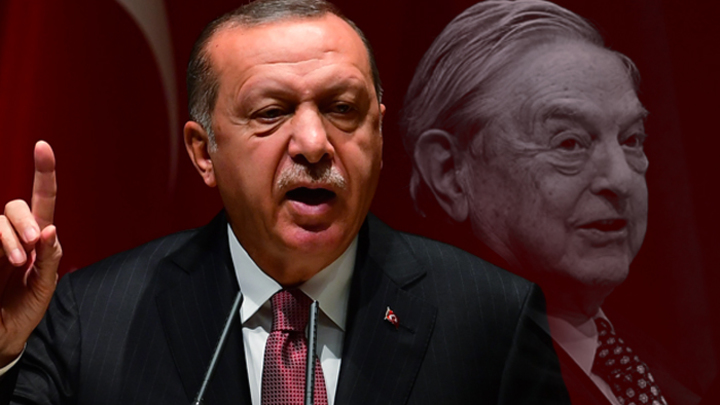
George Soros Wants You to Believe Russia Is a Danger to World Peace, Turkey’s Erdogan an Angel
By Philip Giraldi | American Free Press | April 16, 2020
George Soros is a billionaire Hungarian-born investor who is extremely controversial due to his promotion of what he chooses to define as democracy and free-trade movements, primarily conducted through the Open Society Foundations, which he founded and has funded with $32 billion, according to one estimate. He contributed to the campaigns of Barack Obama and Hillary Clinton, which has in part led to conservative politicians in the United States and elsewhere frequently citing Soros when complaining about politically motivated interference in support of a progressive agenda for the United States and also globally. At least they used to do so until Soros’s allies began to fire back with accusations of anti-Semitism, which had the effect of muting the complaints.
Soros moved from Europe to the United States in 1956 and is now an American citizen. The sources of at least some of his wealth are somewhat controversial. He made over $1 billion in 1992 by selling short $10 billion in British pounds sterling, leading to the media dubbing him “the man who broke the bank of England.” He has been accused of similar currency manipulation in both Europe and Asia. In 1999, New York Times economist Paul Krugman was highly critical of Soros’s interference in financial markets, writing, “Nobody who has read a business magazine in the last few years can be unaware that these days there really are investors who not only move money in anticipation of a currency crisis, but actually do their best to trigger that crisis for fun and profit. These new actors on the scene do not yet have a standard name; my proposed term is ‘Soroi.’ ”
Soros was heavily involved with the restructuring of former communist regimes in eastern Europe and had a hand in the so-called Rose Revolution in Georgia in 2003 and the Maidan Revolution in Ukraine in 2014, both of which were supported by the U.S. government. But in March 2017, six conservative U.S. senators sent a letter to then-Secretary of State Rex Tillerson asking him to look into several grants that the State Department and the U.S. Agency for International Development (USAID) had given to groups connected to Soros, most particularly in Macedonia. Soros’s projects are particularly targeted by conservatives and nationalists, as they are transnational in nature, and, indeed, some critics have noted that the well-funded and broadly supported Open Society is the most effective and visible weapon in the arsenal of the progressive dominated globalist movement.
Soros has been linked to a number of theories that see him as a puppet-master pulling the strings on a worldwide conspiracy to control key elements of the world economy as well as leading politicians. His critics are generally conservatives who are opposed to the progressive causes that he promotes. Soros has been in the news recently for his financial support of a Washington-based think tank called the Quincy Institute, which is also funded by the libertarian Koch family. The institute claims to be a non-partisan organization that promotes a “restrained” foreign policy using diplomacy as a means to resolve international disputes rather than threats followed up by warfare, which has become the preferred option for successive U.S. presidents and their administrations.
Soros’s motives in suddenly embracing diplomacy and non-intervention might well be questioned. On March 4, the Financial Times published an op-ed (unfortunately behind a paywall) by Soros entitled “Europe Must Stand With Turkey Over Putin’s War Crimes in Syria.” It had the subtitle “Focusing on the Refugee Crisis Russia Has Created Addresses Symptoms Not the Cause.” In it, he let loose a sharp attack on both the Kremlin and President Vladimir Putin.
The Soros op-ed is full of errors of fact and is basically a call for aggression against Russia. It starts with, “Since the beginning of its intervention in Syria in September 2015, Russia has not only sought to keep in place its most faithful Arab ally, Syrian President Bashar al-Assad. It has also wanted to regain the regional and global influence that it lost since the fall of the Soviet Union.” First of all, Russia did not “intervene” in Syria. It was invited there by the country’s legitimate government to provide assistance against various groups, some of which were linked to al Qaeda and the Islamic State, that were seeking to overthrow President al-Assad.
And apart from Soros, few actual experts on Russia would claim that it is seeking to recreate the “influence” of the Soviet Union. Moscow does not have the resources to do so and has evinced no desire to pursue the sort of global agenda that was characteristic of the Soviet state.
There then follows a complete flight into hyperbole with: “Vladimir Putin has sought to use the turmoil in the Middle East to erase international norms and advances in international humanitarian law made since the second world war. In fact, creating the humanitarian disaster that has turned almost 6 million Syrians into refugees has not been a byproduct of the Russian president’s strategy in Syria. It has been one of his central goals.” None of Soros’s assertions are supported by fact. The U.S. and Israel are the two top flaunters of international norms and law, not Russia, and there is no evidence whatsoever that Moscow sought to create the “humanitarian disaster” in Syria. That was the work of the U.S. and its “allies” in the region who were supporting both separatists and terrorists.
Soros states his belief that “Assad is the most barbarous ruler that the world has seen since Joseph Stalin. When his own people rose up against him, he developed a military strategy designed to inflict the greatest possible harm on his civilian opponents. He deliberately targeted hospitals, schools and kindergartens, trying to kill or maim caregivers. He has used poison gas and chemical attacks over the course of a conflict that has left more than half a million dead.” None of the assertions are true and a lot of the “evidence” comes from propagandists for the terrorist groups, to include the notorious White Helmets. The lies advanced about the use of chemical weapons have recently been exposed.
Soros goes on to describe how Russia has “deliberately targeted” and bombed schools and hospitals, claims that largely derive from sources hostile to al-Assad and Putin that are impossible to check. Soros also asserts that, “The only government that has put up military forces to defend the civilians trapped in Idlib by Mr. Assad and its Russian ally is Turkey.” It is a claim that is perhaps the biggest lie of all, as Ankara is involved in Syria in support of its own completely selfish irredentist objectives and its desire to crush the Kurdish militias operating in the north and east of the country. Back in October, Turkey’s President Recep Erdogan issued an emotional call to Jihad to his supporters, saying, “Inshallah, God has promised us in Syria victory from Allah and an imminent conquest; and give good tidings to the believers. We see it is happening right now.”
The Soros op-ed also included a bit of reminiscence, describing how, “In 2014, I urged Europe to wake up to the threat that Russia was posing to its strategic interests, albeit in a different context and geography. Russia had invaded Ukraine knowing that Europe would seek to avoid any confrontation with Moscow. Yet what is happening in Idlib now is following the same pattern: Europe is evading a confrontation with Russia over its Syria policy when it should be standing up to it . . . with respect to Syria at least, Turkey deserves Europe’s support. Europe should therefore seek to bolster Turkish President Erdogan’s negotiating position. . . . I hope that this would also put Mr. Putin’s war crimes at the center of the European conversation.”
The op-ed is neither conciliatory nor “diplomatic” and is a clear sign that Soros picks his enemies based on ideological considerations that also drive his choices on how to frame his ventures. He is a billionaire who has chosen to use his money to remake the world in an image that he is comfortable with. Unfortunately, there is a lot of that kind of thinking going around—that having lots of money ipso facto equates to some kind of superior wisdom. And the whole process is facilitated by the fact that politicians as well as space on editorial pages of leading newspapers can easily be bought. Soros would have Europe and the United States taking on Russia over what he perceives to be going on in Syria, where they have no genuine interests. It is a formula that we have seen played out repeatedly in the past 20 years and can only lead to disaster.
Trump’s Cyprus Signalling Is More against Turkey than Russia
By Paul Antonopoulos | April 15, 2020
The Al-Monitor portal has left many extremely surprised with news that was not expected in the middle of the coronavirus pandemic. With over 600,000 cases and 25,000 deaths in the U.S., President Donald Trump has made a bold geopolitical move and instructed Secretary of State Mike Pompeo to determine whether Cyprus should have the arms embargo against it lifted, according to Al-Monitor’s congressional correspondent, Bryant Harris.
“Trump tasked Pompeo with the decision [yesterday] via a presidential memorandum after signing two separate bills to lift the embargo in December — legislation that Turkey had unsuccessfully sought to forestall,” explained Harris.
In 1987, the U.S. embargoed arms sales to Cyprus under the pretext of preventing an arms build-up on the island. However, this was not a problem for Cyprus as Russia became one of the biggest weapon suppliers instead. If the U.S. were trying to have balance on Cyprus, it certainly did not achieve this as the country only became closer with Russia and to this day they still have close ties.
In 1974, Turkey invaded the northern parts of the island to prevent Cyprus from uniting with Greece and to this day continues an illegal occupation. The occupation is to maintain the quasi “Turkish Republic of Northern Cyprus” that is recognized by no other state in the world bar Turkey and is recognized by United Nations Security Council Resolution 541 and UN Security Council Resolution 550 as illegal.
The U.S. has never taken an interest in protecting Cypriot interests despite the illegalities of the occupation of northern Cyprus – up until recent times. Turkish President Recep Tayyip Erdoğan going rogue against U.S. and NATO interests by strengthening relations with Russian President Vladimir Putin, including the sale of the S-400 missile defense system that are not compatible with NATO doctrine.
The irony is that Turkey bought the S-400 system despite the fact that in 1997 Cyprus bought the S-300 air defense missiles from Russia, but had to trade it with Greece for other weapons under a Turkish threat of blockade and/or war. The S-300 is now located on the Greek island of Crete. As Greece in recent years has been a loyal subject of NATO without much independent foreign policy, Washington is now willing to give the country more concessions. In previous years, Washington would only appease Turkey as it controlled the Bosporus Straits that connects Russia’s Black Sea Fleet to the rest of the world.
However, these concessions and attempts to strengthen relations between Cyprus and the U.S. come at a price. Harris explains that the U.S. Congress laid out specific criteria that Cyprus needs to fulfill before it is allowed to procure arms from the U.S., if it ever choose to.
“Specifically, the law requires Cyprus to deny Russian military vessels to its ports despite a 2015 agreement with Moscow to do so. It also requires Cyprus — a financial haven for wealthy Russians to evade US sanctions — to comply with anti-money laundering regulations,” he said.
It is very unlikely that Cyprus will meet these demands made as it is not a NATO member, nor does it have the incentive to abandon a partner that supplied it weapons when the U.S. turned its back. Knowing this fact, Harris explained that “even if Cyprus fails to comply with these conditions, the law gives Pompeo the freedom to lift the embargo anyway via a national security waiver.”
This therefore means that the true target of this arms embargo lift is not necessarily Russia, but rather Turkey. It is effectively in Cypriot hands on whether they want to take on these U.S. conditions. Cyprus is being ‘rewarded’ by Washington as in recent years it has formed a strategic partnership with Israel in the economic, energy and military sector. Because of this, pro-Israel groups in the U.S. lobbied to lift the arms embargo last year, especially as Erdoğan frequently antagonizes Tel Aviv.
Although it is in Pompeo’s hands to decide whether to lift the embargo or not, it is more likely he will choose to do this even if Cyprus decides not to conform to the anti-Russian measures demanded. Not only are Trump and Pompeo receiving pressure from the Israeli lobby, but they are also receiving pressure from extremely influential think-tanks.
In an article from June 2019, titled “Lift the Arms Embargo on Cyprus,” that was first published by The Center for the National Interest, and then republished by the CATO Institute, the author explains “The current arms embargo on Cyprus is unbalanced and unfair. Favoring Turkey never was likely to help keep the peace. Today, given Erdogan’s transformation into a frenemy of America at best, and confrontational policy toward Cyprus and Greece, the embargo rewards an essentially rogue government. The United States should see Turkey plain and stop tolerating the latter’s unfriendly conduct.”
However, there is no guarantee that just because Cyprus is now being noticed and recognized by Washington that it will quickly abandon Russia, especially because of decades of limited relations and the important role the U.S. played in supporting the Turkish invasion of northern Cyprus. Rather, the lifting of the arms embargo is just one small gesture that Washington might make to antagonize a rogue Erdoğan, and if this is the aim, it will certainly work as the Turkish president believes the island to be a part of his domain.
Paul Antonopoulos is a Research Fellow at the Center for Syncretic Studies.
UAE’s Rapprochement With Syria Aimed Against Turkey
By Paul Antonopoulos | March 31, 2020
In the midst of the coronavirus crisis, Syria’s President Bashar al-Assad and Abu Dhabi’s Crown Prince Mohammed bin Zayed Al-Nahyan, the head of United Arab Emirates (UAE), spoke by phone on Friday in the first such communication since the Syrian War began in 2011. This shows a metamorphosis of alliances and geopolitics in the Middle East and the wider region considering the UAE was one of the main backers of terrorist organizations who fought to remove Assad from power. However, for more than a year, the UAE has been sending signals showing a change in policy towards Syria. The phone call was after a long series of rapprochement that began in late 2018 with the reopening of the Emirati embassy in Damascus.
“I have discussed with the Syrian president… updates on the coronavirus. I assured him of the support of the UAE and its willingness to help the Syrian people,” Prince Mohammed said on Twitter. “Humanitarian solidarity during trying times supersedes all matters, and Syria and her people will not stand alone.”
A diplomatic source close to the case was quoted by the Lebanese daily L’Orient-Le Jour as saying the “Westerners, the Americans and French particularly, were against” a Syrian-Emirati rapprochement. According to the diplomatic source, the UAE is trying to gain favours from Moscow and has already won dozens of contracts, including in armaments, gas and infrastructure, but also with space cooperation. This is part of a broader geostrategic context and the stakes go far beyond Syria and the UAE. Rather, the UAE has acknowledged that Russia has taken a greater interest in the region, in particular in Syria and Libya.
Relations between the Gulf monarchies and the United States, traditional allies, have greatly deteriorated in recent years. The gradual disengagement of American forces from the region, but especially the lack of support from Washington against Turkey, made the monarchies with the exception of Qatar, lose the confidence they once had in the United States. According to the diplomatic source quoted by L’Orient-Le Jour, the UAE is trying to get closer to Beijing and Moscow, and the Crown Prince’s phone call to Assad is evidence of that. The call also comes as relations with Iran softened, especially seen with the many Emirati delegations who visited Iran last year, however this has not softened the UAE’s brutal Yemeni policy. None-the-less, this suggests a change in foreign policy that appeals to Moscow.
It appears then that the UAE’s turn around in its Syria policy serves two purposes: first – to strengthen relations with Russia, second – to form an anti-Turkish bloc.
As Turkey actively pursues the establishment of a neo-Ottoman Empire, the UAE is aggressively undermining the project as it opposes the Muslim Brotherhood, an organization that Turkish President Recep Tayyip Erdoğan has openly supported and backed in Syria, Libya and Egypt. The UAE recognized the Muslim Brotherhood as a terrorist organization in 2014 after the fundamentalist group made plans to infiltrate and destabilize the Gulf country to take control – the main reason for the ever-increasing deterioration in relations between the UAE and Turkey.
Since then, the UAE has been actively countering Turkish influence across the region. As part of its efforts to create an anti-Turkish block, the UAE have strengthened their relations with Saudi Arabia and Egypt. Both Saudi Arabia and Egypt fear being taken over by Muslim Brotherhood rule. However, the UAE’s pursuit of countering Turkey has not been reduced to only the Islamic world.
Greece, considered the “Old Enemy” by the Turks, received 11 tons of medical aid from the UAE on Thursday, with a Greek government press release stating that relations “began as economic cooperation, but thanks to the trust that was developed, it evolved into a strong bond.” This came as a working meeting of the Greece-UAE Broader Strategic Cooperation Forum was held in Athens on February 19 following the Greek Prime Minister Kyriakos Mitsotakis’ visit to UAE. In 2019 and 2020, the UAE and Greece has conducted joint military drills and military heads have been meeting each other often in a clear directive against Turkey.
In Libya, the UAE has not held back in supporting the Libyan National Army in their struggle against the Muslim Brotherhood government in Tripoli, headed by the ethnic Turk Fayez al-Sarraj who has the full backing of Erdoğan. The UAE’s material assistance has been crucial in the success of the Libyan National Army’s battle against Muslim Brotherhood forces, a clear demonstration that the UAE are willing to directly check Turkey’s ambitions to exert its influence and power across the region.
By securing close relations with Greece and directly countering Turkey in Libya, the UAE’s rapprochement with Syria is another step in formulating an anti-Turkish bloc, with itself at the head. While Turkey has acted to strangulate countries who oppose its hegemony in the region, it now appears that it is the UAE who is pressurizing Turkey and isolating it. There is every chance that the UAE will begin sending material aid to Syria that will be crucial in its future battles to expel the Turkish military and their jihadist proxies from Syrian territory. This will once again undermine Turkey’s efforts to dominate Syria and be the main power in the region, a move that Erdoğan would not have expected.
Paul Antonopoulos is a Research Fellow at the Center for Syncretic Studies.
Turkish forces, allied militants cut off drinking water to Syria’s Hasakah, environs
Press TV – March 29, 2020
Turkish forces and allied Takfiri militants have once again cut off drinking water supply to people in Syria’s northeastern city of Hasakah and surrounding areas, only a few days after the Damascus government complained to the United Nations and the Security Council over the issue.
Director General of Hasakah Water Company, Mahmoud al-Ukla, told Syria’s official news agency SANA in a statement on Sunday that the Turkish troops and their allies stopped the pumping of water from the Allouk water station at 10 p.m. local time (1900 GMT) last night, and have refused to reverse their decision.
He emphasized that the measure has deprived up to a million people in the Hasakah region of the essential resource.
Ukla then described the cut in water supply to the Hasakah region as a blatant violation of human rights, an appalling crime against the population of Hasakah, and an act in a way that increases the sufferings of the locals.
Allouk water station is located near the border town of Ra’s al-Ayn, which the Turkish troops and their allied militants seized in October 2019 during the so-called Peace Spring Operation.
“Turkish occupation forces and affiliated terrorists cut off drinking water from Allouk water station and feeding wells deliberately and systematically, depriving more than 600,000 Syrian citizens, mostly women and children, from drinking water,” the Syrian Ministry of Foreign Affairs and Expatriates said in identical letters sent to United Nations Secretary-General António Guterres and the rotating President of the UN Security Council Zhang Jun on Thursday.
The Syrian ministry noted that the Turkish forces shelled the water station during their cross-border military operation last October, putting it out of service.
Syrian officials, accordingly, briefed the UN Security Council on February 27, informing the international body of a water outage in Hasakah.
“But unfortunately the Security Council, its General Secretariat or relevant international organizations failed to condemn the Turkish forces’ bombing of such a critical civilian facility and their use of water as a weapon against civilians,” the letters pointed out.
The Syrian Foreign Ministry finally called on the Security Council to condemn the crimes being perpetrated by Turkish soldiers, and obligate Ankara to stop its violation of the international law and humanitarian principles, besides its support for terrorist groups wreaking havoc inside Syria.
Turkey has beefed up its military presence in Syria’s northwestern province of Idlib, the last militant bastion in a nine-year foreign-backed war, where several anti-Damascus terrorist outfits receive Turkey’s support in their persisting militancy against the Syrian government.
Last week, a United Nations official said interruption to the key water station in Syria’s northeast puts thousands of lives at risk as efforts ramp up to stop the outbreak of the novel coronavirus there.
UNICEF Representative in Syria Fran Equiza said the interruption “during the current efforts to curb the spread of the coronavirus disease puts children and families at unacceptable risk.”
He underlined that the station is the main source of water for around 460,000 people in Hasakah city, the town of Tal Tamer as well as al-Hol and Areesha camps.
The Syrian government has applied a series of measures, as cases of COVID-19 infection have been found in the war-ravaged Arab country.
The measures include suspending schools, universities, as well as some ministries and closing marketplaces and restaurants.
The government also stopped public transportations nationwide.
Featured Video
Iran spent $1 million to wipe out $30 billion in data center plans, and take down Amazon in the ME
or go to
Aletho News Archives – Video-Images
From the Archives
A short history of British torture
ICC | December 2005
When the House of Commons was debating how much to increase the time limit for detention without trial the question of torture came up. Officially this was limited to the nice considerations of whether it was all right to send people to places where torture is used and whether Britain can use information collected by the use of torture in other countries. This discussion gave an impression of democratic Britain as the home of civilised behaviour where the very idea of torture is repugnant to our legislators – unlike, say, the US with its secret CIA jails… In reality, the British state has a long history of using and developing a whole range of torture techniques. … continue
Blog Roll
 Aletho News
- Houthis Keep Advancing as the Red Sea Crisis Deepens
- Iran spent $1 million to wipe out $30 billion in data center plans, and take down Amazon in the ME
- Zionist billionaire pressure to silence Macklemore sparks exodus from Ed Sheeran tour
- House Votes to End Iran War for Third Time
- North Korea Slams US Plan for ‘AUKUS 2.0’ with South Korea and Japan
- Prolonging US-Iran Conflict Not Meeting Interests of Int’l Community – China’s Wang Yi
- EU bans former Zelensky aide from parliament
- NATO-backed Kosovo separatist ‘responsible for war crimes’
- US destroying international space law
- SCO Calls for Binding Global Deal to Prevent Arms Race in Space
- If Americans Knew
- U.S. Makes, Israel Takes: The Real Story of U.S.-Israeli Military Cooperation
- Night raids rise in Palestine
- Tucker Carlson interviews Norman Finkelstein about Gaza
- Groups urge Americans to support Van Hollen legislation on Israel’s killing of Americans & Palestinians
- Trump administration plans to send 40,000 tons of bombs to Israel: report
- Sanctions Target Iran’s Government, But Kill Hospitalized 23-Year-Old Woman
- An alternative view on the book “Israel’s Lobby: America in the Grip of a Foreign Power”
- Ed Sheeran’s band Beoga, other opening acts quit tour after Macklemore was dropped over his pro-Palestinian comments
- The assassination attempt on President Trump in Butler and the various Israeli connections to it
- “We Want That the Whole Land Be Jewish”
- No Tricks Zone
- New Study: ‘Global Drought Shows No Detectable Recent Acceleration Under Climate Warming’
- Economic Masterminds: German Socialists Suggest Taxing Productivity Gains Stemming From Using AI
- The South China Sea Has Not Been Cooperating With The Climate Change Narrative
- Energy Crisis: Germany Enters Heating Season With Historically Low Gas Reserve Fill Levels
- New Study: The Antarctic Ice Sheet Gained Mass From 2020-2024 Due To Staggering Snow And Ice Accumulation
- Study: Ocean Heating Rates From Thousands Of Years Ago ‘Dwarf’ Modern Ocean Heating Rates
- Climate Extremists Target, Attack Large-Scale Power Grid Infrastructure In Germany!
- New Study: Antarctic Ice Melt Has Contributed Less Than 1 Centimeter To Sea Level Rise In The Last 30 Years
- Fear Of Debate: Alarmist German Climate Scientist Calls On Mainstream Media To Discredit Skeptic Voices
- End-Of-August Arctic Sea Ice Extent Hasn’t Fallen In 20 Years, Official Data Show!
 Aletho News