Coronavirus hastens an Arab rapprochement
By M. K. BHADRAKUMAR | Indian Punchline | March 28, 2020
A phone call by the UAE Crown Prince Sheikh Mohamed bin Zayed Al Nahyan to Syrian President Bashar al-Assad on Friday signifies in many ways a major development in regional politics.
The official UAE news agency WAM modestly placed the UAE initiative “within the framework of Sheikh Mohamed’s contacts to follow up the humanitarian conditions in sisterly and friendly countries” in the wake of the coronavirus outbreak in the region.
The agency said the two leader “reviewed precautionary and preventive measures… and the possibility of helping sisterly Syria to fight the virus.” But it added that “Sheikh Mohamed stressed the need for countries to place the humanitarian solidarity over political issues during this common challenge …. [and] affirmed that Syrian – the sisterly Arab country – will not be left alone during these delicate and critical circumstances.”
The report ended by taking note that Assad welcomed the Crown Prince’s “collaborative initiative while praising the UAE humanitarian stance.”
The Syrian news agency SANA succinctly highlighted that the UAE Crown Prince “affirmed that the UAE supports the Syrian people during these extraordinary circumstances, saying that Syria will not remain alone in these critical circumstances.”
Clearly, a serious normalisation process has begun between Abu Dhabi and Damascus and this must be counted as one of the geopolitical fallouts of rampage of coronavirus.
The UAE was one of the main backers of the “regime change” project in Syria and a key promoter of jihadi groups. But a rethink apparently began sometime around late 2016 following the Russian intervention in Syria the previous year, which swung the military balance dramatically in favour of Assad’s government.
The UAE made a course correction once it became apparent that the regime change project had floundered. Its support for the extremist Islamist groups tapered off. Cool realism, which is UAE’s trademark, prevailed. (We see the realism also in the UAE’s disengagement from the Saudi-led war in Yemen.)
Most certainly, President Trump’s detached attitude toward the Syrian conflict would have played its part in the UAE rethink. Among other factors, the UAE’s growing rapport with Russia, involving the two leaderships at a personal level, encouraged the UAE to reassess the Syrian situation from a new perspective. At any rate, the UAE reopened its mission in Damascus in 2018.
Without doubt, one major consideration for the UAE has been the proactive and repeated Turkish military interventions in northern Syria in the period since 2016 starting with Operation Euphrates Shield, which steadily evolved into a Turkish occupation in northern Syria.
The Turkish-Emirati relations have been very poor in the recent years following President Recep Erdogan’s accusation that the UAE had a hand in the 2016 failed coup attempt to overthrow him. Basically, the leitmotif of this discord lies in Erdogan’s kinship with the Muslim Brotherhood, whom the UAE regards as an existential threat.
To be sure, the antipathy toward the Brothers, whom Turkey (and its regional ally Qatar) promotes as the vehicle of the Arab Spring, has been a key factor in the budding UAE-Syria rapprochement — as indeed in the growing rapport between Damascus and Cairo.
Interestingly, Syria finds itself on the same page as the UAE, Egypt, Saudi Arabia and Russia in opposing the Turkish intervention in Libya as well. Recently, the Libyan warlord General Khalifa Haftar’s faction (which opposes the Turkey-backed government in Tripoli) was allowed to take over the Libyan embassy in Damascus.
Indeed, the UAE is playing a long game to isolate Turkey (under Erdogan) in the Middle East by drawing together forces in the region that abhor political Islam — Muslim Brotherhood in particular. How far Russia encourages such an alignment in regional politics is anybody’s guess but it won’t be a surprise, given the difficulties Moscow is currently facing in managing the mercurial personality of Erdogan and a possibility that Russian-Turkish relations could be on a collision course any day over northern Syria if a Turkish-Syrian military confrontation in Idlib erupts.
Interestingly, the UAE Crown Prince’s overture to Assad comes within six weeks of a visit by the director of Russia’s Foreign Intelligence Service, Sergey Naryshkin, a top Kremlin official close to President Vladimir Putin, to Dubai. Tass news agency reported that “that the approaches assessing regional crises and solutions to them (Russia and UAE) are similar or close.”
Interestingly, both Russia and the UAE have direct dealings with the Kurdish separatist groups that operate in Syria and Turkey. No doubt, Russia will view with satisfaction the acceleration of the UAE-Syrian rapprochement. Emirati assistance in Syria’s reconstruction and rehabilitation will come as a big relief to Moscow.
Also, the return of Syria to the Arab family can only enhance Russia’s room for manoeuvre, apart from giving Assad much-needed “strategic depth”. All this helps in the stabilisation of the Syrian situation. Can we expect Syria’s readmission to the Arab League? It’s entirely conceivable.
The bottom line is that the UAE-Syrian normalisation holds the potential to redraw regional alignments. Despite the calamities of the 9-year old conflict, Syria still remains the throbbing heart of Arab nationalism, although, tragically, it came to symbolise in the recent years the deep divisions across the Middle East.
On the ground, besides the tragic loss of lives, Syria has gone through destruction on a colossal scale that would take decades to reverse. Nonetheless, a nascent opportunity arises here for Syria to climb out of the deep divisions and regain its regional standing.
Why has NATO Failed to Exploit Turk-Russia “Tensions” in Syria?
By Salman Rafi Sheikh – New Eastern Outlook – 17.03.2020
In any other sort of circumstances, the NATO countries from Europe and North America would have rushed to help Turkey fight the “Russian invaders” in Syria and accomplish their avowed mission. This, however, did not happen when Turkey and Russia came “eye ball to eye ball” in Syria over the question of the liberation and control of Syria’s Idlib province and the adjoining strategically important areas, including the M-4 highway. Tensions are already disappearing with a Turkey-Russia “deal”, paving the way for an eventual settlement of interests. The question, however, that begs attention here is: why could the NATO countries not change Turkey’s position in a way that would have re-established it as a NATO ally in Syria, pitched against the Russians, Syrians and the Iranians?
While the US did “offer” its support to Turkey, words could not be translated into action, even though a number of Western political pundits have been writing and speaking about the “fragility” of the Turkey-Russia alliance and the need for the West to win Turkey back. A number of reasons explain why this has not happened.
First of all, there is little doubt in that Turkey is an important regional player even for Russia. This explains why the Russians have, despite crisis after crisis, continued to manage their relations with Turkey through intensive diplomatic engagements, leaving no room for big and unbridgeable gaps to occur. The latest deal and the deals before the crisis reflect the strength of their diplomatic channels working at the highest possible levels.
However, notwithstanding the resilience of their bi-lateral ties, NATO’s lethargy is due largely to the crisis that NATO is itself facing from within.
On the one hand, the US and European members of the alliance are increasingly pushing for changes in different and opposing directions, and on the other hand, even Turkey itself is reluctant to project its policies in Syria as a NATO member. At the same time, the European members of the alliance are up in arms over Erdogan’s bold and cynical effort to pressure NATO to come to its aid by opening its border with Greece to Syrian refugees, thereby threatening a repeat of the 2015 refugee crisis. NATO, therefore, has no interest in coming to Turkey’s aid and help start a war that would ultimately come to bite them hard.
NATO countries, therefore, continue to think that delivering more humanitarian aid and financial support via the European Union for Syrian refugees already in Turkey is a better option that militarily committing to a war between Turkey and Syria/Russia, which will inevitably involve a massive inflow of refugees, causing both political and economic problems for them to handle. This, for them, is unnecessary and needs to be avoided.
It was perhaps this very reason in the first place which led NATO to discourage Turkey from starting its military operations in Syria in 2019. In fact, NATO countries cannot militarily help Turkey inside Syria even if Turkey really wanted them to.
The Article 5 of the NATO charter cannot be applied to the Syrian scenario. Whereas any NATO country can invoke Article 5, the actual application of this article is limited by the Article 6 which defines the ‘territorial scope’ of the Article 5. Among other areas, Article 6 defines Article 5’s ambit as including the territory of Turkey and the forces, vessels and aircraft of NATO members located in the Mediterranean Sea. But it crucially doesn’t cover attacks on Turkish forces on Syrian territory.
NATO countries would be morally obliged to help Turkey if only Turkey’s territory comes under attack from an offensive originating from within Syria. For this support to come, however, relations between NATO and Turkey need to be perfect, which has not been the case since the 2016 failed coup attempt.
At the same time, there is a strong realisation in NATO that Turkey has increasingly been acting as an ‘independent player’ in the region since at least 2016. It explains why Turkey chose to buy Russia’s S-400 system despite opposition from the NATO alliance.
This brings us to another aspect of why NATO has not ‘intervened’ in Syria on behalf of Turkey. Whereas Article 5, as mentioned earlier, does not apply to this situation, NATO has not always acted in strict accordance with its charter. For instance, it intervened in Libya even though it had no mandate for such an intervention, and no attack or direct threat was originating from Libya against any NATO countries. However, NATO still decided to intervene in Libya to topple the Col. Muammar Gaddafi regime. Why has NATO not done a similar thing in Syria even though the increasing Turkey-Russia “tensions” provided just the context for such an intervention.
The Russian military presence is certainly a factor, but an equally important factor is the “tension” that exists between Turkey and the rest of the NATO allies specifically, and within the alliance more generally, giving the US and European members of the alliance no material reasons to exploit the Russo-Turk “tensions” to their advantage.
Salman Rafi Sheikh is a research-analyst of International Relations and Pakistan’s foreign and domestic affairs.
Greece’s Migrant Crisis Has Further Exposed Turkish Fake News
By Paul Antonopoulos | March 10, 2020
Turkish President Recep Tayyip Erdoğan’s attempt to intimidate the Syrian Army and force them to withdraw to the Sochi Agreement lines in Idlib utterly failed, resulting in the Turkish leader having to embarrassingly accept large swathes of liberated territory will remain under Syrian sovereignty despite his attempts to occupy it. This was especially embarrassing as Erdoğan’s end of February ultimatum came and went with no grand Turkish military offensive to push back the Syrian Army as he had promised. This embarrassment comes as Erdoğan’s approval has reached as low as 41.1% according to data published by the Ankara-based pollster MetroPoll last Friday. As Erdoğan’s foreign policy is largely driven by a desire for a neo-Ottoman ambitions and to serve as a distraction from Turkey’s currency nosedive, he was quick to create issues against the “Old Enemy,” Greece.
In a tantrum and frustrated that his power projections of aggression against both Libya and Syria failed, Erdoğan unleashed tens of thousands of illegal immigrants against Greece and utilized English-speaking Turkish media to discredit the Balkan country’s border protection units for human rights violations. Although many commentators claim that Erdoğan’s unleashing of illegal immigrants is an attack against the European Union (EU), we cannot ignore that the second and only other EU state that Turkey borders is Bulgaria, a country that Ankara assured would not send illegal migrants to, a promise that has not yet been broken. Erdoğan is not only punishing Greece for vetoing a NATO communique in support of Turkish operations in Idlib, he is pushing ahead with his imperial ambitions to not only steal Syrian territory, but Greece’s eastern island and northern mainland territories, as outlined on published government-funded maps of “Greater Turkey.”

Erdoğan wasted no time after the Idlib ceasefire deal was made with Russian President Vladimir Putin on Thursday after the latter embarrassed the Turkish leader by meeting him in a room with a statue of Catherine the Great, the liberator of Crimea who defeated the Ottoman Empire in many wars. On the very same day as meeting, Erdoğan announced that Turkey will deploy 1000 special forces police to the Greek border to fight back against Greek security forces who have successfully ensured that thousands of illegal immigrants have not entered EU territory. It’s an odd choice that Turkey deployed special forces police considering it is not their borders that have breach attempts and rather it has been an aggressor as they continually shoot tear gas at Greek border security and attempt to pull down the border fence so migrants can illegally enter Greece. Although it may seem like an exaggeration to some, Athens is treating this latest migrant crisis as a Turkish asymmetric invasion, as they remember the words of former Turkish President Turgut Özal, who said “We do not need to make war with Greece. We just need to send them a few million immigrants and finish with them.”
To assist in distracting the Turkish population of his failures in Syria and the economy, Erdoğan has fully utilized Turkish media to assist in the propaganda campaign. Turkey is one of the lowest ranked countries for media freedoms in the world, is the second most susceptible country surveyed on the European continent to fake news, has the most journalists jailed in the whole world, and 90% of media is government controlled. It is fair to be sceptical of Turkey and its coverage of the latest migrant crisis, and here is why.
On Saturday, Bosnian Muslim reporter Semir Sejfovic of Turkish state-owned TRT World made such a comical performance that Twitter users are mocking him to be an Oscar nominee after his elaborate attempts to accuse Greek police of firing live ammunition into Turkey. It is one comical performance that has to be seen to be believed. The ridiculousness of the performance was so much so that several screen grabs show even the illegal immigrants surrounding Sejfovic laughing during the “intense firing” of live ammunition by the Greek police. Other users questioned why illegal immigrants much closer to the border fence and seen in the background of the video never took cover and continued standing as usual during the alleged shooting, something Sejfovic has refused to answer.
In another incident on Saturday, TRT World published photos claiming Greek soldiers stripped and robbed illegal immigrants of their clothes, mobiles and money. The problem? In other photos not published by TRT World, the same illegal immigrants are seen in front of a camera phone preparing to take the propaganda photos, while in another photo a mobile phone is clearly seen inside the pocket of a “robbed” illegal immigrant.
In another incident on Sunday, TRT World made a tweet on Sunday publishing photos of immigrants in hospital wounded “when Greek forces opened fire” over the weekend. However, a quick search found that the fourth photo is from at least November 2019.
These are just some of the many allegations made by English-speaking Turkish media that have been debunked. It demonstrates that Turkish media is not interested in objectively reporting the migrant crisis but is serving a critical role as Erdoğan’s propaganda wing to discredit Greece in front of international audiences. However, if we use social media responses, European responses and other media republications of Turkish media claims as indicators, it all points that TRT World has only served to reinforce Turkish media’s bad reputation rather than discredit Greek border security and catastrophically failed in their objective.
Paul Antonopoulos is a Research Fellow at the Center for Syncretic Studies.
All-star warmonger Lindsey Graham urges NATO to ‘get more involved’ in Idlib, Syria to stop ‘Syrian aggression’
RT | March 10, 2020
Veteran chickenhawk Lindsey Graham once again beat his over-used war drum, this time because he wants NATO to get involved in Idlib, Syria to stop “Syrian aggression.” Yes, when will Syria stop intervening in its own country?
The South Carolina senator said that he fully supports US President Donald Trump’s efforts to “get NATO more involved in Syria,” arguing that the defensive alliance should aid Turkey as it “defends Idlib against Russian/Syrian aggression.” He further argued that the “fall” of Idlib would result in a humanitarian crisis felt around the world, which is why NATO should be more “supportive” of its Turkish ally.
The senior statesman apparently doesn’t seem particularly fazed by the fact that Idlib is part of Syria – making accusations of “Syrian aggression” slightly nonsensical. The province is now home to the last bastion of extremist jihadist militias, some of which are directly affiliated with Al-Qaeda.
This is hardly the first time that the US hawk has demanded direct intervention in Idlib. In February, he called on the Pentagon to impose a no-fly zone over the Syrian province, claiming it would help stop the “destruction” of Idlib by Syrian, Iranian, and Russian forces.
As far back as September, Graham was issuing statements warning over “the wholesale massacre” of civilians in Idlib, insisting that “we either act now [in Syria] or pay a heavy price later.”
The senator’s melodramatic representation of a terrorist-infested Syrian province being under siege by the Syrian military shouldn’t come as a surprise to US political observers. Graham has been portrayed as part of former Arizona Senator John McCain’s “foreign policy club” – a euphemism for hardcore neocon interventionism.
Last week, Turkey and Russia brokered a ceasefire in the region, ending the fighting between Syrian and Turkish forces. But this hasn’t stopped the United States from trying to raise the stakes in northwestern Syria. The US reportedly offered to provide Turkey with ammunition to help in the conflict in Idlib. Turkish Foreign Minister Mevlut Cavusoglu said on Tuesday that Washington also offered land, sea, and air intelligence regarding the northwestern region. Although US “assistance” remains moderate at the moment and Graham’s fantasy of a NATO operation in Idlib seem unlikely, the warmongering section of US politics remains strong and its efforts to get Washington into more bloody conflicts with the blessings of the military-industrial complex are not likely to stop any time soon.
Erdogan Smells a US Rat
By Finian Cunningham | Strategic Culture Foundation | March 7, 2020
Well, it takes one to know one. The foul scheming and intrigues over the past nine years of war in Syria by the foreign aggressors and their terror proxies will have proven one thing to all the criminal accomplices – none of them can be trusted, even when they claim to be “partners”.
Turkish leader Recep Tayyip Erdogan, who went to Moscow this week, wanted a deeper withdrawal of the Syrian army in Idlib province and he didn’t get it. The upshot is that more Syrian territory has been retaken by Syria’s state forces – despite all the bluster from Erdogan vowing victory and rollback.
What happened is that the Turkish president no doubt smelled a rat from Washington’s lack of military support. Erdogan knew if a military escalation occurred, his forces would be left out to hang and dry by its supposed NATO partner. All the American talk about “fully backing” Turkey failed to materialize beyond hot air.
Recall that when violence flared last month between Turkish and Syrian forces, US Secretary of State Mike Pompeo pledged on February 11 that Washington “would stand by its NATO ally”. As the violence increased along with the body count of Turkish troops, the US did not deliver – despite Ankara’s earnest requests two weeks ago for Patriot missiles. Requests that went unanswered.
Washington knew that Syria and its Russian ally were not backing down from the principle of defeating terror groups on Syrian soil regardless of whether the militants are being given cover by Turkish artillery. Syria has impeccable sovereign right to take back control over every square inch of its territory. Russia has stood full square behind its Syrian ally for that objective.
On March 5 when Erdogan flew to Moscow, he must have had that sinking feeling, knowing that Washington was firing rhetorical blanks. On the same day, Pompeo demanded that the Turkish leader should negotiate a withdrawal of Syrian army back to the Sochi ceasefire lines of 2018. But after six hours of negotiations with Putin, Erdogan settled for a lot less – a truce based on current territorial positions, including gains made in recent weeks by the Syrian army.
On his way to Moscow all that Erdogan was getting from Washington were more vague hints that the US was still “considering” supplying military ammunition to Turkey.
Probably the ominous sign for Erdogan that Washington was going soft was the PR stunt on March 3 when two relatively minor US envoys visited the White Helmets terrorist propaganda unit in Idlib offering “humanitarian aid”. That kind of media support doesn’t quite fit the bill for Patriot missiles and American warplanes that Ankara was really after.
Moreover one of the envoys, James Jeffrey, told a conference in Istanbul on March 5 that the US was “pressuring European NATO allies to give more support to Turkey”.
As Hurriyet Daily News reported, the US envoy was responding to a question regarding Washington’s views about concrete military support to Turkey.
“We are pressuring our European allies to make contribution to this issue,” said Jeffrey. “There’s a Spanish Patriot missile defense unit right now deployed in Turkey at the Incirlik airbase, that’s an example of things that NATO is actually doing, and we want to see more actions like that.”
This was being said as Erdogan flew to Moscow for his “face off” with Putin. In other words, the Turkish president knew that the US was all talk and no action.
Damascus and Moscow have called Erdogan and Washington’s bluff. There will be no escalation in Syria to an international conflict because Erdogan and his master in Washington don’t have the cojones.
Syria has every right to rid its land of terrorists and their NATO patrons. And Syria has Russia’s back. While Ankara knows all it can count on is a Washington rat.
Parliamentary Brawl Marks Erdogan’s Syria Policy
By Anthony Sherwood | American Herald Tribune | March 7, 2020
Needless to say, the punchup in the Turkish parliament on March 4 was a disgrace. Supposedly elected to discuss matters of national importance in a calm and dignified manner, scores of MPs behaved like football hooligans.
The occasion was a debate on the presence of the Turkish army in Idlib. Earlier, President Erdogan had described the opposition’s criticism of Turkey’s Syria operation as “dishonorable, ignoble, low and treacherous.” This was followed by a press conference in which the parliamentary chair of the Republican People’s Party (CHP), Engin Ozkoc, directed exactly the same words against the president personally. He also accused Erdogan of showing disrespect by laughing and joking in a speech he made after 34 Turkish soldiers sent to Idlib were killed in an airstrike.
In a later Twitter message, Ozkoc wrote that “a person who became the co-chair of the Greater Middle East project, who approved of the slaughter of three million Muslims, who calls martyrs ‘heads’ is undignified, dishonorable, without honor. This person cannot be the president of Turkey.”
The brawl broke out when Ozkoc took the rostrum in the Grand National Assembly to talk about Idlib. In a country where a rude hand gesture or a slighting remark about the president can land the speaker in prison, his earlier remarks were inflammatory stuff and the MPs laid into each other. Erdogan launched a civil action against the deputy, demanding one million lira (about $164,000) in damages, and an investigation was launched by the state prosecutor’s office. Under article 299 of the penal code, insulting the president is criminalized.
Ozkoc cannot claim automatic parliamentary immunity as MPs voted to lift it in 2016. The prosecutor’s office quickly sent a brief to parliament with a request that his immunity be lifted so he could be prosecuted. By May 2019, the prosecutor had presented the parliament with 608 requests for the lifting of immunity, so Ozkoc’s name has now been tacked on to a long list. The targeted deputies are mainly from the largely Kurdish People’s Democracy Party (HDP), along with a sprinkling of deputies from the CHP, including the party leader, Kemal Kilicdaroglu.
The parliamentary stoush was hardly an aberration. Brawls in recent years, with deputies swinging punches, standing on desks and hurling various objects at each other, include the melee over a bill of ‘homeland security’ in 2015 that widened the use of force police could use against demonstrators. On that occasion, four MPs were so badly hurt they needed hospital treatment.
The debate over the lifting of parliamentary immunity in 2016 was marked by another furious brawl before the legislation was passed. In 2017 the MPs brawled over the plan to turn the parliamentary rule into an executive presidency. In 2018 the cause was the redrawing of electoral boundaries. The fist-fighting inside the parliament can be seen as a microcosm of the angry atmosphere outside, fuelled by the government, in which criticism is quickly turned into support for terrorism.
Whom the parliamentary deputy Ozkoc meant by three million slaughtered Muslims is not clear but his reference to the ‘Greater Middle East’ project should be noted by attentive readers. Years ago Erdogan described himself as the “co-chair” of the Greater Middle East project without saying who was the other chair. Reporting the occasion, Breitbart thought it was a euphemism for “an Islamic Turkish caliphate,” with Erdogan at its head. Perhaps the other chair was the US, where in the 1990s the neocons had laid their own plans for a ‘Greater Middle East’ but Erdogan undoubtedly would have had his own aspirations as a world-historical Muslim figure in mind.
The phrase ‘Great East’ if not ‘Middle East’ has deep roots in modern Turkish history, arising from the writings of Necip Fazil Kisakurek, whose Islam-based nationalism is clearly the ideological mother lode for the direction in which Erdogan has taken Turkey. Buyuk Dogu (Great East) was Kisakurek’s central contribution and the name of the magazine he founded.
Born into an upper-class family, a student in Paris of the philosopher Henri Bergson, who favored intuition over rational analysis, Kisakurek (1904-83) was simultaneously poet, novelist, university professor, Sufi, Islamist and nationalist who in the 1930s and 40s sought to replace Kemalist nationalism with Islam.
It was, however, a narrow and restrictive Islam. For Kisakurek Islam was only Sunni Islam, with antipathy to Judaism and Christianity added to his hostility to Shia and Turkey’s large Alevi (Alawi) population.
In 1970 Salih Erdis (Salih Mirzabeyoglu) founded the Great Eastern Islamic Raiders’ Front (IBDA-C), which, based on Kisakurek’s teachings, called for the restitution of the caliphate and carried forward Kisakurek’s hostility to non-Sunni Muslims, Christians, and Jews. In 2001 Erdis was sentenced to death for undermining the secular state. The death penalty abolished in 2002, his sentence was commuted to life imprisonment in 2004.
Outside prison, his followers continued with his mission. In November 2003 they exploded truck bombs outside Istanbul’s two main synagogues, killing more than 20 people. Elsewhere a few days later they launched terrorist attacks against the British consulate and the Istanbul headquarters of the HSBC bank.
Having been released from prison in July 2014, Salih Erdis gave a talk later in the year at a congress center in Istanbul. Finding out that Erdogan would be speaking at the same location the same day, Erdis passed on a message that he would like to meet him and the president agreed. What they discussed remained between them but it has to be regarded as significant that the president would agree to sit down for a chat with a man who was both anti-secular and a convicted terrorist.
The parliamentary brawl over the Idlib operation captured in essence growing public disquiet over Turkey’s presence in Syria, especially since the airstrike in late February that killed 34 soldiers (the rumors quickly spread that the real toll was upwards of 200). The disquiet is not sudden, however, and not just over Syria, but has been growing steadily over the years, with a flailing economy among the many causes of disaffection with Erdogan and the AKP government. Beyond Turkey’s borders, Erdogan has fallen out with Russia, the US and the EU over a host of issues. They clearly have run out of patience with him.
Elections and public opinion polls show a consistent downward trend. In June 2015 the ruling party lost its absolute majority in parliament, recovering it only after an election campaign fought around the theme of national solidarity against Kurdish terrorism. In local elections in March 2019, repeated in June after AKP protests of irregularities, the government was defeated by CHP candidates in five of Turkey’s biggest cities (Istanbul, Ankara, Izmir, Adana, and Antalya).
While Turkish opinion polls are not the most reliable, the net result can hardly be ignored. In February 2020 a Metropoll survey showed Erdogan’s popularity (41.1 percent) down by seven percent from October 2019. Disapproval of the president rose to 51.7 percent, compared to 38 percent last October. Turkey’s military presence in Idlib was regarded as unnecessary by 48.8 percent of those surveyed, with only 30.7 percent approving, but as this was before the national outrage generated by the killing of the 34 soldiers, these percentages have no doubt changed. These figures have to set against the 68 percent approval rating for Erdogan after the 2016 coup attempt.
Another February 2020 poll, taken by AREA research in Istanbul, Ankara, Izmir, Antalya, Samsun, Malatya and Gaziantep (conservative, close to the border with Syria and hosting a Turkish-backed proxy Syrian government) showed that only 30.3 percent of respondents would vote for the AKP if elections were held now, with 20.8 choosing the CHP and 10.8 the HDP.
Of the respondents, 57.3 percent favored a return to parliamentary rule and 56.7 percent did not regard the presidential system as “successful.” Only 35.7 percent regarded the presidential system as “successful.” Asked who they would vote for now, in a presidential election, 35.3 said Erdogan, 52.4 percent were against him and 12.3 percent were undecided.
Compounding economic and other problems for the AKP and Erdogan are serious splits within the party, with two influential figures, former economy minister Ali Babacan and former foreign minister and prime minister Ahmet Davutoglu resigning to form parties of their own. Furthermore, the AKP is losing members: membership in 2016 stood at 10.72 million, but by 2018 had dropped to 9.87 million and is bound to have declined further since then because of the state of the economy and the war in Syria and the problems it has created, not just the death of young soldiers but the presence of several million refugees in Turkey.
Elections (presidential and general) are not due again until 2023. Erdogan is an experienced and wily political practitioner so it would be most unwise to count him out but definitely the luster has worn thin if not completely worn off for a lot of people.
The deal with Putin allowed him to save face at home, at the cost of giving up the fight for control of the strategic M4 highway. The government has regularly issued details of Syrian soldiers it says have been “neutralized” along with figures of destroyed artillery and armor but it has taken heavy punishment itself, losing between 10 and 13 large armored drones apart from the death of its soldiers and the army’s “Syrian national army” takfiri auxiliaries.
Ceasefires may put off the evil day of withdrawal but Syria has turned into a cul de sac for Erdogan and a dead-end for his country. To public pain at the death of Turkish soldiers in Syria has been added anger at Erdogan’s almost casual reference to the death of “a few martyrs” in Libya.
In short, 2020 is not opening well for Tayyip Erdogan.
Putin & Erdogan’s New Agreement on Ceasefire in Syria’s Idlib: What is Known So Far in 5 Points
Sputnik – March 5, 2020
Turkish President Recep Tayyip Erdogan has come to Moscow on Thursday to hold talks with his Russian counterpart Vladimir Putin over recent escalations in Syria’s Idlib province. The tensions in the area have recently led to the deaths of over 30 Turkish soldiers, prompting Ankara to target Syrian troops in response.
Russian President Vladimir Putin and his Turkish counterpart Recep Tayyip Erdogan announced after six hours of bilateral talks on 5 March that they have negotiated a preliminary agreement to resolve the ongoing conflict in northwestern Syria. Here is the list of main points which the two major regional players have agreed upon:
- A ceasefire in Syria’s Idlib province will start at 00:01 on 6 March.
- Russia and Turkey will start joint patrols on the M4 highway in Syria. The patrolling will take place from the settlement of Tronba, located 2km west of the strategic town of Saraqib, to the settlement of Ain al Havr.
- A 12-km security corridor for Syria’s Idlib province will be established to the north and to the south of the highway. “The specific parameters of the functioning of the security corridor will be agreed upon by the Ministry of Defense of the Russian Federation and the Turkish Republic within seven days”, Russian Foreign Minister Sergei Lavrov said.
- Both countries agreed on efforts to prevent further aggravation of the humanitarian situation in Syria.
- All additional protocols to the document will come into force from the moment of its signature on 5 March.
The situation in Syria’s Idlib province has recently escalated, descending into fighting between Syrian government forces and militants, resulting in the deaths of over 30 Turkish troops last week. Ankara responded by launching “Operation Spring Shield” and hitting Syrian forces and equipment.
According to the Russian military, the Turkish troops were not supposed to be present in the area fired upon by Syrian forces. Russian President Vladimir Putin also later said that nobody, including the Syrian army, knew about the Turkish troops’ whereabouts.
The West Ignores Turkey’s Illegal Deployment of Troops to Syria’s Idlib – Russian Military
Sputnik – March 4, 2020
MOSCOW – The West continues to ignore the deployment of troops by Turkey to Syria’s Idlib in violation of international law, spokesman for the Russian Defence Ministry Maj. Gen. Igor Konashenkov said.
“No one in the West notices the actions of the Turkish side, which, in violation of international law, has deployed a strike force the size of a mechanised division to Syria’s Idlib in order to ‘enforce the Sochi agreements at any cost'”, Konashenkov said in a statement.
The spokesman stressed that public threats to destroy all units of the Syrian government forces and return the M5 highway to terrorist control are viewed by the United States and Europe as “Ankara’s legitimate right to defence”.
Meanwhile, Damascus has been unfairly accused by the West of alleged “war crimes”, “humanitarian catastrophe”, and “flows of millions of refugees” in Idlib, Konashenkov added.
The Russian Defence Ministry’s spokesman also slammed Western nations’ claims about their concerns over the humanitarian situation in the Syrian province of Idlib as “total cynicism”, adding that the Russian military is providing all the necessary assistance to Syrians.
“Amid the total cynicism and the West’s fake concerns over the humanitarian situation in the Idlib de-escalation zone, only the Russian centre for reconciliation of the opposing sides and the legitimate Syrian government deliver to the liberated areas all the needed assistance for local residents daily”, Konashenkov said.
“Syrians, tormented by terrorists, were not even aware of the existence of numerous pseudo-protectors in Europe and the United States, and of the prodigal humanitarian assistance, which was allegedly delivered over the past years”, the Defence Ministry’s spokesman went on to say.
Under the 2018 agreements, also known as the Sochi accords, the Turkish military was given the right to establish a dozen observation posts in the militant-controlled Idlib region and obliged to separate jihadist militias from other armed anti-government groups willing to engage in peace talks with Damascus. The agreements also stipulated the need for Turkey to take “effective measures” to ensure a lasting ceasefire in the region. Russia has recently accused Turkey of failing to live up to these commitments.
Presidents Putin and Erdogan are expected to meet in Moscow on Thursday to discuss the Idlib crisis.
Mr President! Pompeo wants a US War in Syria!
Sic Semper Tyrannis | February 29, 2020
“This was and remains a bad idea,” said one of the people familiar with the discussions. Turkey and the U.S. have a history when it comes to the Patriot. Over Washington’s objections, Ankara last year received an advanced Russian S-400 missile-defense system that the U.S. considers a threat to the F-35 fighter jet and NATO air defenses. The U.S. had offered the Patriot as an alternative, but Turkey has committed to the Russian system. As a result, Washington kicked Turkey out of the F-35 program, for which it was both a customer and manufacturing partner. A DoD spokesperson declined to comment. A spokesperson for Jeffrey referred POLITICO to a statement from Secretary of State Mike Pompeo, who on Friday condemned the attack and called on the Syrian government and its Russian and Iranian backers to cease their assault on Idlib. He noted that the U.S. is “reviewing options to assist Turkey against this aggression.” – Politico
Idlib Governorate is Syrian territory. The Syrian government is a member state of the UN. The Russians are assisting the Syrian government at the request of that government. “Fatih” Sultan Erdogan has introduced thousands of Turkish Army troops into northern Syria in what amounts to a neo-Ottoman land grab.
He has a major problem in that so far, neither the Turkish Army (TSK) nor their Sunni jihadi allies are fighting very well. They have managed to re-capture the town of Saraqib on the four lane highway between Damascus and Aleppo, but for how long? The SAA and their militia allies are massing to re-take the town.
To the west nearly all of Idlib Governorate south of the M-4 east-west highway is within artillery fire of the advancing SAA and at the northern end of the al-Ghaab Plain the spearheads are apparently within 6 miles of the M-4. Assuming that the M-4 is the Turkish Main Supply Route (MSR) out of Hatay Province to the west, an SAA interdiction of that major road will imperil the Turkish led force around Saraqib. The Turks will then either withdraw from Saraqib or attack any SAA blockage of the M-4 or both. In classic militaryspeak, the Turks would be said to have been “turned out” of their position at Saraqib by the SAA move onto the M-4 to the west. The resulting engagement would be a desperate fight. In the midst of this situation the Russian Aerospace expeditionary force would be heavily engaged.
Mike Pompeo, Jeffrey, his henchman, and all the neocons in and out of the Borg (foreign policy establishment) want the US to become directly involved in this battle by providing Turkish forces in Syria air defense from US manned Patriot missile batteries. The Turks could not man the systems themselves if we provided them. They also want the US to declare a “no-fly zone” over Idlib Governorate. Such a zone would be a declaration that the US and little friends would shoot down any military aircraft flying over this piece of Syrian territory without US permission. This would be an act of war by the United States and would cause a de facto state of war to exist between the US and Russia.
The US Department of Defense thinks that such engagement on our part is a stupid neocon conception that has it roots in Israeli desire to destroy the Syrian Government, preferring to have a zone of warring factions where Syria once was, a Hobbesian scene of desolation and a war of all against all, The Israeli idea is as stupid as that of the neocons.
President Trump, the Commander in Chief of the US armed forces, holds the sole power to decide. Let us hope that he decides well.
https://www.politico.com/news/2020/02/28/turkey-patriot-missiles-pentagon-118256
Iran and Hezbollah warn Turkey: all your forces are in our line of fire
Iranian Advisory Center in Syria: we call on Turkish forces to act rationally for the benefit of the Syrian and Turkish peoples
Al-Manar, February 29, 2020
The Iranian Advisory Center in Syria, which takes part in the fighting in northern Syria, issued a press release through the news agency U-News in reaction to the recent confrontation between the Syrian army and the Turkish army. It should be noted that the Iranian Advisory Center is made up of the group of Iranian experts who advise the Syrian State and its armed forces, and that this is the first statement it has issued since the beginning of the war in Syria.
Full text of the statement
In reaction to the latest confrontation between the Syrian Arab Army and the Turkish Army, it is important for us to inform the public of the following:
First: We fought alongside the Syrian Arab army and supported it, at the request of the Syrian State, to open the M5 highway, with a Syrian force led by elements of the Iranian Revolutionary Guards and of Hezbollah, and with the participation of factions of the Resistance within the force; and we have helped civilians and residents of the liberated villages.
Second: Protected by the Turkish army, the armed (terrorist) groups attacked the positions of the Syrian army, and so we participated in the fighting aimed at preventing the M5 highway to fall again in their hands.
Third: Since the beginning of the presence of our forces, the Turkish positions located in the Syrian territories have been in the sight of our forces, whether they comply with the Astana Agreements or violate them, but the elements of the Resistance did not strike these Turkish forces out of deference to the decision of their (respective) leaders, and this decision remains in effect until now.
Fourth: Four days ago, foreign elements, Tajiks from the Turkestan Party, elements from the Al-Nusra Front, as well as other terrorist factions, carried out a large-scale attack on the positions of the Syrian army. Our forces directly supported the Syrian Army to prevent the liberated areas from falling into their hands.
Fifth: Despite the defensive nature of the action of our forces, the Turkish army targeted our elements and our forces from the air, with precision missiles and artillery support, which prompted us to send mediators to the Turkish army to end its attacks and renounce this approach
Sixth: Our mediators announced to the Turkish army that the terrorists attacked our positions with their support, that our forces are there to confront the terrorists, and that we are on the side of the Syrian army for this mission; but unfortunately, the Turkish military ignored this request and continued its bombing, and a number of our fighters (Iranian & Hezbollah’s) were martyred.
Seventh: Syrian army artillery responded by striking the source of the fire; for our part, we did not retaliate directly, and once again, we announced to the Turkish army through mediators that we have no objective or decision to confront the Turkish army and that our leadership is determined to reach a political solution between Syria and Turkey.
Eighth: We have informed our forces since morning not to target Turkish forces inside Idlib in order to spare the lives of their soldiers, and our forces have not opened fire, but the Turkish army continues to shell the points and locations of the Syrian army (where we are also located) with artillery fire.
Ninth: The Iranian Advisory Center and the fighters of the Resistance front call on the Turkish forces to act rationally in the interest of the Syrian and Turkish peoples, reminding the Turkish people that their sons (soldiers) have been in our sights for one month and that we could have targeted them in revenge, but we did not do so in accordance with the orders of our leaders; we call on them to pressure the Turkish leadership to rectify its decisions and avoid spilling the blood of Turkish soldiers.
Tenth: Despite the current difficult circumstances, we reaffirm our continuing position alongside the people, the State and the army in Syria in their fight to defeat terrorism and preserve their full sovereignty over the Syrian territories, and we all call on actors to be rational and aware of the great risks of continuing the aggression against Syria.
Iranian Advisory Center in Syria
Translation: resistancenews.org
Featured Video
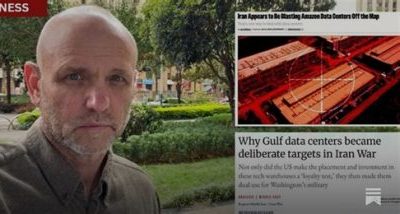
Iran spent $1 million to wipe out $30 billion in data center plans, and take down Amazon in the ME
or go to
Aletho News Archives – Video-Images
From the Archives
A short history of British torture
ICC | December 2005
When the House of Commons was debating how much to increase the time limit for detention without trial the question of torture came up. Officially this was limited to the nice considerations of whether it was all right to send people to places where torture is used and whether Britain can use information collected by the use of torture in other countries. This discussion gave an impression of democratic Britain as the home of civilised behaviour where the very idea of torture is repugnant to our legislators – unlike, say, the US with its secret CIA jails… In reality, the British state has a long history of using and developing a whole range of torture techniques. … continue
Blog Roll
 Aletho News
- Houthis Keep Advancing as the Red Sea Crisis Deepens
- Iran spent $1 million to wipe out $30 billion in data center plans, and take down Amazon in the ME
- Zionist billionaire pressure to silence Macklemore sparks exodus from Ed Sheeran tour
- House Votes to End Iran War for Third Time
- North Korea Slams US Plan for ‘AUKUS 2.0’ with South Korea and Japan
- Prolonging US-Iran Conflict Not Meeting Interests of Int’l Community – China’s Wang Yi
- EU bans former Zelensky aide from parliament
- NATO-backed Kosovo separatist ‘responsible for war crimes’
- US destroying international space law
- SCO Calls for Binding Global Deal to Prevent Arms Race in Space
- If Americans Knew
- U.S. Makes, Israel Takes: The Real Story of U.S.-Israeli Military Cooperation
- Night raids rise in Palestine
- Tucker Carlson interviews Norman Finkelstein about Gaza
- Groups urge Americans to support Van Hollen legislation on Israel’s killing of Americans & Palestinians
- Trump administration plans to send 40,000 tons of bombs to Israel: report
- Sanctions Target Iran’s Government, But Kill Hospitalized 23-Year-Old Woman
- An alternative view on the book “Israel’s Lobby: America in the Grip of a Foreign Power”
- Ed Sheeran’s band Beoga, other opening acts quit tour after Macklemore was dropped over his pro-Palestinian comments
- The assassination attempt on President Trump in Butler and the various Israeli connections to it
- “We Want That the Whole Land Be Jewish”
- No Tricks Zone
- New Study: ‘Global Drought Shows No Detectable Recent Acceleration Under Climate Warming’
- Economic Masterminds: German Socialists Suggest Taxing Productivity Gains Stemming From Using AI
- The South China Sea Has Not Been Cooperating With The Climate Change Narrative
- Energy Crisis: Germany Enters Heating Season With Historically Low Gas Reserve Fill Levels
- New Study: The Antarctic Ice Sheet Gained Mass From 2020-2024 Due To Staggering Snow And Ice Accumulation
- Study: Ocean Heating Rates From Thousands Of Years Ago ‘Dwarf’ Modern Ocean Heating Rates
- Climate Extremists Target, Attack Large-Scale Power Grid Infrastructure In Germany!
- New Study: Antarctic Ice Melt Has Contributed Less Than 1 Centimeter To Sea Level Rise In The Last 30 Years
- Fear Of Debate: Alarmist German Climate Scientist Calls On Mainstream Media To Discredit Skeptic Voices
- End-Of-August Arctic Sea Ice Extent Hasn’t Fallen In 20 Years, Official Data Show!
 Aletho News