Ankara says ‘no need to start new Syria offensive’ after Erdogan-Putin talks
RT | October 22, 2019
Turkey will not be launching a new offensive against Kurdish militias in northern Syria, following a five-day pause in hostilities and high-level talks in Moscow, Ankara’s Defense Ministry said.
Following lengthy talks on Tuesday, Russian President Vladimir Putin and Turkish President Recep Tayyip Erdogan agreed that Russian military police and Syrian servicemen will be deployed to northeastern Syria, targeted by Turkey in their ‘Operation Peace Spring.’
The Turkish Defense Ministry then said in a statement that there was “no need to carry out a new operation at this stage,” adding that the creation of a “peace corridor” in the border area would ensure the safe return of millions of displaced Syrians.
Turkey’s latest incursion into the north began earlier this month, directed at Kurdish militias it says are linked to terrorism and its own domestic Kurdish separatist movement.
Until recently, around 1,000 American soldiers were stationed with the Kurdish fighters near the border, insulating them from a Turkish offensive, but a sudden US withdrawal last week cleared the way for Ankara’s operation, which it had threatened for months. Washington’s retreat paved the way for a deal between the Kurds and Damascus, allowing Syrian forces to regain control of territories in the northeast after over 7 years of war.
Even on Tuesday Ankara questioned if the US held its end of the deal and facilitated the withdrawal of Kurdish forces, but the Turkish ministry then said Washington told Ankara the Kurdish groups had all left the area by the end of the 120-hour ceasefire pause.
US President Donald Trump also weighed in on the development, calling it “good news” in a tweet on Monday night.
The deal struck between Ankara and Moscow on Tuesday will ensure the territorial integrity of Syria; allow the government to regain control over towns and cities in the northeast; establish Turkish-Russian patrols along the border; and revitalize the Adana Accord, a security pact struck between Damascus and Ankara in 1998. Dealing with captured Islamic State militants was also addressed in Tuesday’s agreement, which the Syrian government has endorsed.
The agreement underscores Washington’s waning sway in the region and represents a positive step toward winding down a bloody years-long conflict, independent political analyst Ali Demidras told RT.
“The Sochi agreement has cemented the Russian-Turkish cooperation in Syria also effectively reducing the American influence in the country,” Demidras said. “United Syria has been secured.”
Ceasefire ends, talks on Syria between Erdogan and Putin begin
By Sarah Abed | October 21, 2019
Monday marks the thirteenth day since Turkey began its third cross border military operation in Syria ironically named “Operation Peace Spring”. In the past two weeks civilian and militant lives on both sides have been lost, a large exodus has taken place, the House of Representatives overwhelmingly approved a resolution that opposes US troop withdrawal, a five-day ceasefire was brokered between Turkey and the United States, and Kurdish militias have withdrawn from the “safe-zone”.
On Wednesday, there was overwhelming bipartisan approval for a measure that opposes President Trump’s U.S. forces withdrawal from Syria. The resolution was introduced by Reps. Michael McCaul, Republican from Texas and Eliot Engel, Democrat from NY and it calls on the White House to put forth a plan for the “enduring defeat” of Daesh and demand that Turkey cease its military operations in Syria.
The measure which passed 354-60 with four members voting present and all sixty of the nays coming from Republican’s stated, “An abrupt withdrawal of United States military personnel from certain parts of Northeast Syria is beneficial to adversaries of the United States government, including Syria, Iran and Russia.”
It’s absurd that there’s outrage about ending a war and allowing Syria to handle its own domestic affairs. However, nothing of the sort happened when Nobel Peace Prize winner and former US President Barack Obama was bombing seven countries and creating some of the wars that President Trump has inherited including Syria. Bipartisan support for carrying on with endless wars is mindboggling.
On Thursday, a ceasefire was brokered between the United States and Turkey. This pause was meant to for the Kurdish militias to dismantle their posts and retreat from the 32km “safe zone” and in response the US would not impose any new sanctions on Turkey. However, there’s a lesser mentioned point that prompted the ceasefire and that’s the entrapment of US/UK Coalition Joint Special Operations Task forces in northern Syria. It was necessary for hostilities to cease long enough for them to withdrawal out of harm’s way.
Washington and Turkey do not want the Kurdish militias to work in conjunction with the Syrian Arab Army, but for different reasons. The US would rather see them stay independent from the SAA and keep them as an ally in case US troops return. Remember northeast Syria is advantageous to the US because they can keep an eye on Iran and protect Israel plus there’s oil. Turkey would like to see the Kurdish militias dissolved along with any separatist Kurdish hopes and dreams of establishing an independent Kurdistan on its border.
Ankara has made it clear that if the Syrian Arab Army (SAA) plans on protecting the YPG/SDF that this will be considered an “act of war”. The Turkish administration is worried that the SAA will enter Manbij, Ayn al-Arab, and Qamishli to protect the Kurdish militias, but that wouldn’t be in the Syrian governments best interest.
There’s been some disagreement among the Kurdish militias as to where they need to be withdrawing from, Turkey is demanding that they entirely vacate the 32km border, and not just some of their posts. If the Kurdish militias withdraw entirely from Turkey’s “safe zone” by the ceasefire deadline, what excuse will Ankara have to continue their military operation? None.
In the past week or so Syrian troops have made significant progress in regaining territory previously occupied by Kurdish militias in northern Syria, and Russia tried to broker negotiations between the Kurdish militias and the Syrian government.
Turkey’s stated goals are to fight the terrorist organizations on their southern border, create a safe-zone, and a “peace corridor” for the resettlement of 1-2 million Syrian refugees. They have stated that they are not looking to land grab or encroach but if we know anything about Turkey’s politics it’s that surprises lie behind every corner, much like the United States.
It’s no coincidence that the 120-hour ceasefire ends on Tuesday, and that’s precisely when President Erdogan will be going to Russia to meet with President Vladimir Putin. President Putin has taken on the role of negotiator and is usually the most level-headed adult in the room when it comes to the Syria conflict and dealing with Turkey, Syria, the Kurdish militias, and yes even the United States, Israel and Saudi Arabia along with other players.
I assume the seasoned politician serving his fourth term in office will handle the Sochi meeting on Tuesday with Turkey, in the same polite and diplomatic manner we’ve grown accustomed to.
There were some questions as to whether the ceasefire will continue till then, due to violations on both sides. Turkey’s defense ministry stated on Sunday that one of their soldiers was killed and that the Kurdish militias violated the ceasefire over 20 times in the past three days. The SDF is stating that 16 of their fighters have been killed. Also, as part of the agreement between the US and Turkey, an 86- vehicle Kurdish convoy left Ras al-Ayn toward the town of Tal Tamr this weekend.
On Sunday, hundreds of trucks carrying almost 500 US personnel were seen withdrawing troops near Al Hasakah to Iraq’s border. It’s also been noted that US troops are destroying their own airfields and equipment before fleeing.
It appears that out of the supposed 1,000 US troops that about 500-700 will be sent to Iraq and about 200-300 will remain in Syria to perform what a senior US official referred to as a “counter Daesh mission”. Back in December President Trump had said he wanted to bring all 2,000 troops back home, and now it doesn’t seem like any of them will be coming back home anytime soon.
Turkish Army Surrounded by Syrian One in Ras al-Ain, Soon to Leave – Syrian Lawmaker
Sputnik – 21.10.2019
DAMASCUS – The Syrian Army has surrounded the Turkish one in the border town of Ras al-Ain in north Syria, where Ankara has launched a military operation, and the Turkish forces are soon to withdraw from that area, member of the Syrian parliament, Jansit Kazan, said on Sunday.
Earlier in the day, the Syrian state-run broadcaster said that the Turkish troops entered Ras al-Ain after the Kurdish-led Syrian Democratic Forces (SDF) had left it. Shortly after, the SDF and Ankara confirmed the report.
“The Turkish Army might possibly be inside Ras al-Ain, but it will not last for long, it [the army] will retreat … the Turkish Army is already surrounded by the Syrian one. So we are not afraid,” Kazan said when asked whether the towns of Ras al-Ain and Tal Abyad had completely gone under the Turkish control.
The lawmaker stressed that even though the priority is now given to the diplomatic front of settling the conflict in Syria, Damascus will not tolerate any foreign occupation of the Syrian territory.
“There will be no Turks. Even if there are Kurds, they will be within the Syrian state and under the protection of the Syrian Army. Under no circumstance we accept occupation of any kind – neither by Turkey, nor by anybody else after nine years of war,” Kazan said.
She claimed that Syria’s north would be subject to “certain agreements in the interests of the Syrian government,” and added that Damascus highly appreciated the help of its allies, especially Moscow, in countering the terrorist threat.
On October 9, Turkish President Recep Tayyip Erdogan announced the launch of Operation Peace Spring in north Syria. The offensive is part of Ankara’s goal to clear its Syria-facing border area of terrorists and Kurdish militia, which Ankara sees interchangeable, and create a safe zone where Turkey could relocate part of some 3.6 million Syrian refugees it currently hosts. Ras al-Ain was the town where the air component of the operation began.
Operation Peace Spring is currently on hold for 120 hours as per the agreement between Ankara and Washington.
Last Sunday, the administration of the Kurdish authority in north Syria announced striking a deal with the Syrian government under which the latter committed to send troops to the border with Turkey to help the Kurds repel Ankara’s offensive.
US forces transferring Daesh terrorists from Syria to Iraq: Report
Press TV – October 20, 2019
US military forces are transporting to safe sanctuaries hundreds of members of the Daesh Takfiri terrorist group from the desert region of al-Jazirah in Syria’s northeastern province of Hasakah to neighboring Iraq, a report says.
Syria’s official news agency SANA, citing media and local sources, reported that American forces had recently transported the terrorists to an unknown location. The Daesh members were being kept at al-Hol refugee camp, which lies close to the Syria-Iraq border and is run by the Kurdish-dominated Syrian Democratic Forces (SDF).
The report said that less than a day before, 230 foreign terrorists from Daesh were transferred from al-Malikiyah prison to a detention center in al-Shaddadi town in southern Hasakah.
Since October 9, SANA said, US forces have transported hundreds of Daesh extremists and their relatives from Syrian territories to Iraq in six batches. The date is when Turkey and its allied militants launched a ground offensive against Kurdish forces in northeastern Syria.
American forces have also turned their illegal base in Shaddadi into a place of accommodation for Daesh terrorists and their families, who are being brought from al-Hol camp and prisons across Syria to the base in order to be transported on board military helicopters to Iraq.
US forces have until recently been airlifting Daesh terrorists from one place in Syria to another, under the cover of darkness, in order to save them in the face of advancement and territorial gains by Syrian government forces, and prevent revelation of their alliance with the Takfiri extremists.
Syrians celebrate army deployment in border towns amid Turkish incursion
In Syria’s eastern province of Dayr al-Zawr, dozens of people gathered to express support for the deployment of government forces in the Kurdish-populated border towns in the wake of Turkey’s offensive.
On Sunday, the residents of the provincial capital city of Dayr al-Zawr gathered at al-Intisar roundabout to denounce the Turkish aggression, and demand the full withdrawal of US troops from Syrian territories, SANA reported.
The participants waved the national Syrian flag and lifted pictures of President Bashar al-Assad. They described the Turkish aggression on Syrian soil a criminal act, vowing that the sons of Syria will all confront the offensive, dubbed Peace Spring Operation.
They also called for the complete withdrawal of illegal foreign forces, whether Turkish or American, from Syrian soil.
“All Syrians reject the Turkish operation, because it constitutes an act of aggression against a sovereign state. This is contrary to international law and regulations. We are here today to tell (Turkey’s President Recep Tayyip) Erdogan, his American masters and their proxies that Syria is strong with its army, its people, its leader. History has shown that this land is insurmountable to aggressors,” said Mudhi al-Muhaimid, a member of the executive office of Dayr al-Zawr provincial council.
Director of Education in Dayr al-Zawr Khalil Haj Ubaid said, “Syria’s civilization, history and originality will remain impervious to the greediness of enemies. The Syrian government and the Syrian Arab Army are the only forces that can protect Syrian people. The entire world is now witnessing how President Assad has triumphed over all forces of injustice and tyranny.”
Turkish military forces and Ankara-backed militants launched the long-threatened cross-border invasion of northeast Syria in a declared attempt to push Kurdish fighters from the People’s Protection Units (YPG) away from border areas.
Ankara views the US-backed YPG as a terrorist organization tied to the homegrown Kurdistan Workers’ Party (PKK), which has been seeking an autonomous Kurdish region in Turkey since 1984. The YPG constitutes the backbone of the SDF.
The Kurdish-led administration in northeastern Syria says the Turkish offensive has killed 218 civilians, including 18 children, since its outset. The fighting has also wounded more than 650 people.
Turkish authorities say 20 people have been killed in Turkey by bombardment from Syria, including eight people who were killed in a mortar attack on the town of Nusaybin by YPG militants on October 11.
SANA tours US base in al-Saidiyah area southwest of Manbij
In another development, SANA journalists entered the abandoned US base in the al-Saidiyah area southwest of Manbij, only a few days after American forces evacuated the site.
The heavily fortified base contains a big open field, service stations for the maintenance of vehicles, training fields, communication towers and a number of military posts. US forces burned documents, communication devices, laptops, computers, monitors and medical supplies just before their withdrawal from the base.
US stokes the fires of Turkish revanchism
By M. K. BHADRAKUMAR | Indian Punchline | October 19, 2019
The extraordinary US overture to Turkey regarding northern Syria resulted in a joint statement on Thursday, whose ramifications can be rated only in the fulness of time, as several intersecting tracks are running.
The US objectives range from Trump’s compulsions in domestic politics to the future trajectory of the US policies toward Syria and the impact of any US-Turkish rapprochement on the geopolitics of the Syrian conflict.
Meanwhile, the US-Turkish joint statement creates new uncertainties. The two countries have agreed on a set of principles — Turkey’s crucial status as a NATO power; security of Christian minorities in Syria; prevention of an ISIS surge; creation of a “safe zone” on Turkish-Syrian border; a 120-hour ceasefire (“pause”) in Turkish military operations leading to a permanent halt, hopefully.
The devil lies in the details. Principally, there is no transparency regarding the future US role in Syria. The Kurds and the US military will withdraw from the 30-kilometre broad buffer zone. What thereafter? In the words of the US Vice-President Mike Pence at the press conference in Ankara on Thursday,
“Kurdish population in Syria, with which we have a strong relationship, will continue to endure. The United States will always be grateful for our partnership with SDF in defeating ISIS, but we recognise the importance and the value of a safe zone to create a buffer between Syria proper and the Kurdish population and — and the Turkish border. And we’re going to be working very closely.”
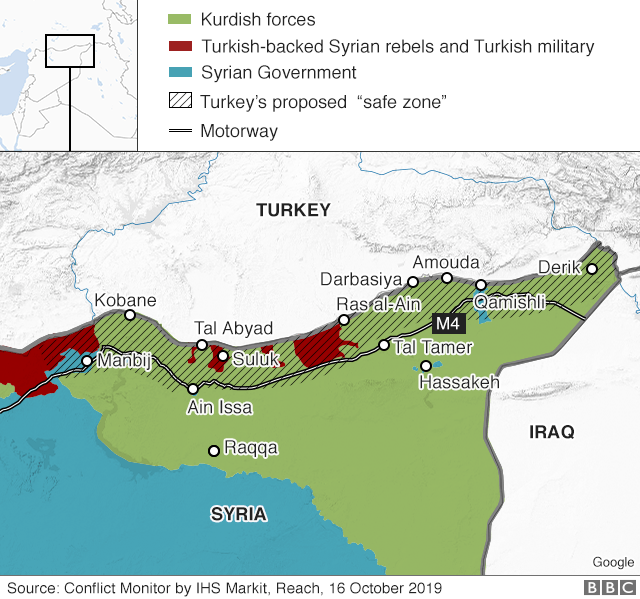
To be sure, everything devolves upon the creation of the safe zone. Turkey envisages a zone stretching across the entire 440 kilometre border with Syria up to the Iraqi border, while the US special envoy James Jeffrey remains non-committal, saying it is up to the “Russians and the Syrians in other areas of the northeast and in Manbij to the west of the Euphrates” to agree to Turkey’s maximalist stance.
Herein lies the rub. Jeffrey would know Ankara will never get its way with Moscow and Damascus. In fact, President Bashar al-Assad told, in unequivocal terms, a high-level Russian delegation visiting Damascus on Friday, “At the current phase it is necessary to focus on putting an end to aggression and on the pullout of all Turkish, US and other forces illegally present in Syrian territories.”
Is there daylight between Moscow and Damascus on this highly sensitive issue? Turkish President Recep Erdogan’s forthcoming meeting with Russian President Vladimir Putin in Sochi on October 22 may provide an answer.
Clearly, the US hopes wrench Turkey from the Russian embrace. Moscow’s studied indifference toward the US-Turkish cogitations betrays its uneasiness. Conceivably, Erdogan will expect Putin to take a holistic view, considering Russia’s flourishing and highly lucrative economic and military ties with Turkey and the imperative to preserve the momentum of the Russia-Turkey relationship.
But Trump has accommodated Erdogan’s top priority to create a safe zone and run it under Turkish supervision, which implies an open-ended Turkish military presence in a swathe of Syrian territory as big as Greece or Nepal. Erdogan’s tone has already changed in regard to his expectations from Putin.
In a meaningful remark on Saturday, he said, “In the area of the operation are forces of the (Syrian) regime under Russia’s protection. We will be tackling the issue with Mr. Putin.” Erdogan then added that in case he fails to “reach agreements on that issue (with Putin), Turkey will be implementing its own plans.”
If the US policy in Syria in recent years promoted the Kurdish identity, it has now swung to the other extreme of stoking the fires of Turkish revanchism. This is potentially catastrophic for regional stability. The heart of the matter is that while Turkey’s concerns over terrorism and the refugee problem are legitimate, Operation Peace Spring has deeper moorings: Turkey’s ambitions as regional power and its will to correct the perceived injustice of territorial losses incurred during the disintegration of the Ottoman Empire. The ultra-nationalistic Turkish commentator (and staunch supporter of Erdogan) wrote this week in the pro-government daily Yeni Safak :
“Turkey once again revived the millennium-old political history on Anatolian territory. It took action with a mission that will carry the legacy of the Seljuks, the Ottomans, the Republic of Turkey to the next stage… It is not possible to set an equation in this region by excluding Turkey – it will not happen. A map cannot be drawn that excludes Turkey – it will not happen. A power cannot be established without Turkey – it will not happen. Throughout history, both the rise and fall of this country has altered the region… the mind in Turkey is now a regional mind, a regional conscience, a regional identity. President Erdoğan is the pioneer, the bearer of that political legacy from the Seljuks, the Ottomans, and the Turkish Republic to the future.”
Trump is unlikely to pay attention to the irredentist instincts in Turkish regional policies. Trump’s immediate concerns are to please the evangelical Christian constituency in the US and silence his critics who allege that he threw the Kurds under the bus or that an ISIS resurgence is imminent. But there is no way the US can deliver on the tall promises made in the joint statement. The Kurds have influential friends in the Pentagon. (See the article by Gen. Joseph Votel, former chief of the US Central Command, titled The Danger of Abandoning our Partners.) Nonetheless, the main outcome will be that Turkey feels it has western support for its long-term occupation of Syrian territory.
All in all, it’s a “win-win” for Erdogan insofar as he got what he wanted — US’ political and diplomatic support for “the kind of long-term buffer zone that will ensure peace and stability in the region”, to borrow the words of Vice President Pence. A Turkish withdrawal from Syrian territory can now be virtually ruled out. State secretary Mike Pompeo added at the press conference in Ankara on Thursday that there is “a great deal of work to do in the region. There’s lots of challenges that remain.”
Pompeo said Erdogan’s “decision to work alongside President Trump… will be one that I think will benefit Turkey a great deal.” Arguably, the US expects Turkey’s cooperation to strengthen its strategy in Syria (and Iraq) where it seeks to contain Iran’s influence. From Ankara, Pompeo travelled to Jerusalem to brief Israeli PM Benjamin Netanyahu.
House of Representatives votes 354-60 against Trump’s withdrawal of US troops from Syria
RT | October 16, 2019
Democrats and 129 of the Republicans in the House of Representatives voted to pass a non-binding resolution disapproving of President Donald Trump’s pullout of US troops from Syria – never authorized by Congress to be there.
The House Joint Resolution 77 describes the presence of US troops in northeastern Syria as “certain… efforts to prevent Turkish military operations against Syrian Kurdish forces,” and formally voices opposition to their withdrawal, but does not offer an alternative. Instead, it demands the White House present a “clear and specific plan for the enduring defeat” of Islamic State (IS, formerly ISIS).
The IS “capital” of Raqqa was liberated by US-allied Kurdish militias in October 2017, and the last IS enclave was declared secured in December 2018, but traces of the presence of the self-declared “caliphate” remain in both Syria and Iraq, weakened by years of war and sanctions.
The House resolution asks the White House to continue providing “humanitarian support” to the Kurds and ensure that Turkey “acts with restraint,” while also demanding of Ankara to stop its “unilateral military action” in Syria.
Trump has maintained he never gave the “green light” to Turkey to invade Syria, and defended the withdrawal as protecting the lives of American soldiers in a region where they had no business being anymore. He has also threatened to “destroy” Turkey’s economy with sanctions and tariffs over the invasion.
Congress has never voted to authorize the US troop presence in Syria, which is not sanctioned under international law and is based only tenuously on old resolutions allowing military action against Al-Qaeda terrorists following the 9/11 attacks. Damascus considers the US presence a violation of its sovereignty, unlike the Russian force that was invited back in 2015.
While the resolution does little to change the situation in Syria, the fact that so many Republicans chose to back Democrats against the sitting president from their party is being held up as a possible barometer for the Democrat-led impeachment process, even though House Speaker Nancy Pelosi has repeatedly refused to hold an actual floor vote on the matter.
The Russian Masterpiece in Syria: Everyone Wins
By Federico Pieraccini | Strategic Culture Foundation | October 16, 2019
“Moscow and Damascus have always maintained they are against any form of partition or illegal foreign presence in Syria.”
Moscow has managed to maintain contacts with all parties in the conflict, even in spite of its stance against partition and illegal foreign presence. Trilateral talks between Iran, Turkey and Russia occurred in Astana at Moscow’s urging. Putin managed to bring together in Sochi the Syrian government and opposition groups to discuss the future of Syria. In Geneva, Moscow mediated between Damascus and the international community, shielding Syria from the diplomatic skulduggery of the US and other enemies of Syria.
Turkey, solely as a result of its defeat in Syria, now finds itself in active dialogue with Moscow and Tehran. As Ankara experiences worsening relations with Washington and other European capitals, Moscow saw a great opportunity to bring Turkey closer to Damascus.
Russia’s operation was complicated and required a lot of patience; but thanks to negotiations supervised by Russia, together with the bravery and courage of Syrian soldiers, almost all of the terrorist pockets scattered around Syria have been progressively overcome.
Other than the Idlib province, the main problem for Damascus lay with the US occupation in the northeast of the country, under the pretext of protecting the Kurds (SDF) from the “Assad regime”, as well as to “fight Daesh”.
Erdogan currently finds himself boxed in, squeezed in by a collapsing economy, threatened by his allies (the purchase of the Russian S-400 system irritated many in Washington and in NATO): he desperately needs to present some kind of victory to his base.
This may be the primary reason behind Erdogan’s decision to move into Syria under the pretense that the YPG is a terrorist organization linked with the PKK — proceeding to create a buffer zone on the border between Syria and Turkey and declaring “mission accomplished” to boost popularity ratings.
With Trump, he is desperate to shift attention away from the impeachment proceedings (a hoax), and similarly needs to present some kind of victory to his base. Why, what better way to do this than with a mini withdrawal of US troops from Syria, leaving the Kurds to their destiny (Trump’s care factor regarding SDF is minimal, as they are more connected to his political opponents in the Democratic Party), while claiming victory over Daesh for the umpteenth time in recent months?
Trump, with a handful of tweets directed against the Pentagon’s “crazy spending” and America’s past wars, finds himself and his base giving each other high fives on their commitment to the doctrine of “America First”.
Erdogan and Trump have also solved the embarrassing internal conflict within NATO between Turkey and the US, probably reestablishing personal relationships (the tough talk from the White House notwithstanding).
The agreement between the Kurds (SDF) and Damascus is the only natural conclusion to events that are heavily orchestrated by Moscow. The deployment of Syrian and Russian troops on the border with Turkey is the prelude to the reconquest of the entirety of Syrian territory — the outcome the Kremlin was wishing for at the beginning of this diplomatic masterpiece.
Washington and Ankara have never had any opportunities to prevent Damascus from reunifying the country. It was assumed by Moscow that Washington and Ankara would sooner or later seek the correct exit strategy, even as they proclaimed victory to their respective bases in the face of defeat in Syria. This is exactly what Putin and Lavrov came up with over the last few weeks, offering Trump and Erdogan the solution to their Syrian problems.
Trump will state that he has little interest in countries 7,000 miles from the homeland; and Erdogan (with some reluctance) will affirm that the border between Turkey and Syria, when held by the Syrian Arab Army, guarantees security against the Kurds.
Putin has no doubt advised Assad and the Kurds to begin a dialogue in the common interests of Syria. He would have no doubt also convinced Erdogan and Trump of the need to accept these plans.
An agreement that rewards Damascus and Moscow saves the Kurds while leaving Erdogan and Trump with a semblance of dignity in a situation that is difficult to explain to a domestic or international audience.
Moscow has started joint patrols with the Syrian Arab Army on the borders with Turkey for the purposes of preventing any military clashes between Ankara and Damascus. If Ankara halts its military operation in the coming days, Damascus will regain control of the oil fields.
The world will then have witnessed one of the greatest diplomatic masterpieces ever conceived, responsible for bringing closer the end of the seven-year-long Syrian conflict.
It’s curtains for US in Syria. Russia, Iran owe big thanks to Erdogan
By M. K. BHADRAKUMAR | Indian Punchline | October 15, 2019
The scenario agreed on behind the curtains through months of confidential exchanges, often one-on-one, between the Russian and Turkish leaders regarding north-eastern Syria is entering a critical phase with the agreement between the Kurds and the Assad regime.
We have a complex scenario where on the one hand the Turkish army and the Syrian opposition units loyal to Ankara are relentlessly continuing their southward offensive expanding control over Syria’s border regions populated by the Kurds. According to Turkish President Recep Erdogan 1000 sq.kms. of territory previously under Kurdish control have been “liberated”.
On the other hand, following up on the agreement with the Kurds, the first columns of Syrian government forces have moved into the north of the country toward the Turkish border.
Prima facie, Damascus is challenging the Turkish offensive — as it should — and, in principle, a confrontation can ensue. But things are never really quite what they appear on the surface in Syria.
A clash between the Turkish and Syrian forces is simply out of the question. That is not how the game is being played. A Turkish Defence Ministry statement on Monday disclosed that the military chief Gen. Yasar Guler and his Russian counterpart Gen. Valery Gerasimov were in contact on the phone and discussed the “security situation in Syria and recent developments.”
No further details have been divulged but the picture that emerges is that Russia proposed and Turkey agreed that Russian units will be patrolling between Turkish and Syrian forces in northern Syria after the withdrawal of the US troops from the area.
Accordingly, Moscow’s Defense Ministry has revealed that its military police in the Kurdish town of Manbij have begun patrolling along the Syria-Turkey border and interacting with Turkish authorities. Russian troops entered Manbij town with the Syrian government forces on Monday.
More importantly, through Russian mediation, Ankara and Damascus will prefer to agree on dividing the zones of control in northern Syria. That is to say, things are broadly moving in the direction of what the Adana Agreement of 1998 (over the Kurdish question) between Turkey and Syria had envisaged, namely, that the security of the Syrian-Turkish border will be a bilateral affair between Ankara and Damascus.
In the given situation, Turkey’s imperative need is to prevent a contiguous “Kurdistan” emerging on its borders. The so-called “safe zone” aimed at frustrating the US plans to create a Kurdistan in Syria akin to what it succeeded in Iraq in the Saddam Hussein era.
Arguably, there could be a congruence of interests between Ankara and Damascus on this score. (Tehran too has common interests with its two neighbours in this regard.)
Indeed, for Damascus all this is a bonanza insofar as the “deliberate withdrawal” (as Pentagon put it) or the eviction of the US troops in the northern regions of Syria, triggered by the Turkish incursion, enables it to reoccupy parts of the northeast regions, especially those parts that are well-endowed with water resources and hydrocarbon reserves, which the American military had designated as its exclusive zone.
For President Bashar al-Assad, this is a great leap forward in the fulfilment of his pledge to reclaim control of entire Syria. (See the Euronews commentary Damascus is looking stronger than ever’: What next for Syria as Kurds join forces with Assad?)
As for the Kurds, they have nowhere to go but to settle with Damascus. They are simply no match for the highly professional Turkish army.
Clearly, the Turkish incursion and impending offensive against Kurds has made continued American military presence in northern Syria untenable and Russia has leveraged the situation to bring about the agreement between Kurds and Damascus.
Having succeeded in this endeavour, Russians have taken Turks into confidence. Unsurprisingly, President Recep Erdogan is nonchalant about the agreement between the Kurds and Damascus and has shrugged off the Syrian troop movements close to Turkey’s borders. He evasively referred to Vladimir Putin’s assurances.
In the final analysis, the Americans are paying a heavy price for being clever by half — stringing Turkey along in the recent years while methodically consolidating the ground for the creation of an autonomous Kurdistan on its borders, apart from arming and training the Kurdish militia to shape up a regular army.
Erdogan gave a long rope to the Americans to hang themselves literally. When he struck, the contradictions in the US policy got exposed overnight — the game plan to balkanise Syria and overthrow Assad; the Faustian deal with a terrorist group that has been bleeding a NATO ally; and the geopolitical agenda to sever Iran’s axis with Syria and the Levant.
Suffice to say, the eviction of the US forces from northern Syria, the Turks have achieved something that Russia and Iran (and Damascus) all along wished for but couldn’t realise. From this point, Russia and Iran will prevail upon Ankara to reconcile with Damascus.
The West has belatedly understood that Turkey has summarily terminated its 8-year old intervention in Syria to overthrow the Assad regime. The vitriolic reaction by Trump and US defence Secretary Mark Esper (here and here) is self-evident.
But the threat of US sanctions will not deter Erdogan, as the spectre of Kurdistan on its borders threatened Turkey’s sovereignty and territorial integrity and there is no scope for compromise when national security is under threat. By the way, the domestic opinion is overwhelmingly supportive of Erdogan.
Turkey was uncharacteristically patient with the US, hoping that the latter would give up the nexus with YPG (Kurdish militia) now that the fight against ISIS is over. It is not Trump so much as the Pentagon who is responsible for the breakdown in trust between Turkey and the US. Like on most foreign policy issues, Washington had two policies on Syria — Trump’s and the US security and defence establishment’s.
The US has no locus standii under international law to keep a permanent military presence in Syria and when Trump first announced the troop withdrawal, it should have been implemented. But, instead, the Pentagon undercut Trump’s decision, whittled it down and finally ignored it altogether.
Erdogan knows that the US will huff and puff but will get used to the “new normal” in Syria. The West won’t have an alibi, either, as Russians will never allow the ISIS to surge in Syria. Trump is reportedly deputing V-P Mike Pence to travel to Turkey seeking a “negotiated settlement” — whatever that may mean in tackling the fait accompli that Erdogan has created.
Trump imposes sanctions on Turkey in response to Ankara’s “Operation Peace Spring” in Syria
By Sarah Abed | October 15, 2019
On Monday, after a weekend of bloody chaos in northeastern Syrian brought on by Turkey’s cross border military incursion “Operation Peace Spring” which included airstrikes, ISIS prison breaks, and a continuation of the exodus we’ve seen over the past few days of over a hundred thousand civilians fleeing their homes, President Trump signed an Executive Order authorizing sanctions against current and former Turkish government officials and anyone who is contributing to Turkey’s actions in destabilizing northeast Syria.
In a formal statement, published by the White House, President Trump went on to say that steel tariffs will be increased back to 50%, which is the level they were at prior to a reduction in May of this year. President Trump also said negotiations led by the Department of Commerce which include a $100 billion trade deal with Turkey, would cease immediately.
The Order goes beyond sanctions and would also authorize consequences including blocking of property and barring entry into the United States on anyone Washington deems to be involved in serious human rights abuses including obstructing ceasefires, preventing displaced people from returning to their homes, and forcing the repatriation of refugees etc.
President Trump mentioned a few times during the past few days that the United States and their partners are the ones that brought Daesh to their knees and are responsible for eliminating 100% of their territorial caliphate.
Each time I hear this claim, I justify its inaccuracy by saying even though this is categorically false, and the United States has protected and helped Daesh on more than one occasion and the previous administration supported extremist groups which bore Daesh, that if taking credit and feeding his enormous ego means that US troops will withdraw from Syria, then by all means give President Trump all the credit, perhaps even an award, or a trophy, heck add on a Nobel Peace Prize, just as long as he withdraws US troops, which will help end this monstrous western-manufactured war.
President Trump also cautioned Turkey against indiscriminate targeting of civilians, destruction of civilian infrastructure and targeting ethnic or religious minorities. He also mentioned that refugees must be returned in a safe, voluntary and dignified manner. President Trump announced again that he would be withdrawing remaining US service members from northeast Syria and that they will be redeployed while remaining in the region to monitor the situation to prevent a resurgence. Trump stated that a small number of troops will remain in southern Syria at Al Tanf Garrrison to disrupt remnants of ISIS.
Repeating his threat to destroy Turkey’s economy if they continue down this “dangerous and destructive path” could just be more posturing by President Trump and distancing Washington from Ankara’s war crimes.
Vice President Mike Pence on Monday announced he would be leading a delegation to Ankara where they will be discussing with Turkey’s President Recep Tayyip Erdogan the US’s demands which include an immediate ceasefire and negotiating with the Kurds in Syria.
Just the notion of asking President Erdogan to negotiate with Kurdish militias is preposterous considering their history. Turkey will most likely say that they do not negotiate with terrorists, considering they see the Kurdish militias in Syria as an offshoot of the Kurdistan Workers Party (PKK) in Turkey who they have been at war with for over three decades.
Secondly, the Kurdish militias are now in talks with the Syrian government. It’s a little too late for the US to try to win them back. I would hope that after seeing how many times the United States has left them out in the cold that the YPG/SDF/PYD would know by now not to put their trust in them again.
It’s worth mentioning that corporate media and war hungry politicians have intentionally focused on the “plight of the Kurds” and highlighted their cause above and beyond any other ethnicity in Syria. This begs the question, why is 7-10% of the population given an unequal amount of attention when “the Kurds” are not even a homogenous group of people.
There’s no mention of how Kurds migrated to Syria in waves and sought refuge and stayed for decades. Rather than telling you how they bought property, studied in Syrian schools, received benefits that are awarded to all Syrian citizens regardless of ethnicity and religion, propagandists will try to convince you that they were systematically oppressed.
There’s also little to no mention of the war crimes committed by the Kurdish YPG and the SDF in Syria against the indigenous populations including closing the vast majority of schools, enforcing a non-authorized Kurdish curriculum, forced conscription, theft of property and businesses, kidnapping of children to turn them into soldiers, etc, much like the PKK in Turkey.
Reporting has been very one-sided and has portrayed them as the leading fighters against terrorist groups in Syria and although they did play a part the Syrian Arab Army and their allies are the ones that did the heavy lifting and made the most progress, but they get trashed in the media.
And, many are surprised to learn that there are Syrian Kurds that are in the Syrian Army that categorically reject the notion of establishing a US/Israeli sponsored Kurdistan on sovereign Syrian land. They oppose the wrongdoing of the Kurdish militias and stand with the Syrian government and army.
Celebrations erupted once news was received that the SAA was on their way to northern towns. Even tribal leaders came out in support of the SAA, saying the SAA were the only true protectors of the land.
On Monday the SAA entered Manbij, Tal Tamr and towns in Raqqa’s countryside. Videos showed US armored vehicles exiting the area while Syrian troops were entering, in a peaceful almost poetic re-alignment of power. The American-Israeli backed “Kurdistan” dream was destined for failure from the beginning.
US Working With Russia to Handover Patrols Between Turkish and Syrian Armies in Manbij
By Patrick Henningsen | 21st Century Wire | October 15, 2019
This morning, Russian military officials announced they are now patrolling the region surrounding Syria’s northern town of Manbij, specifically in the areas which separate Turkish troops and the Syrian Arab Army soldiers.
According to a Russian Defense Ministry statement issued Tuesday, Russian military police are being positioned as a ‘buffer’ around the area northwest of Manbij, “along the line of contact between the Syrian Arab Republic and Turkey.” Officials also indicated that they are in communication with the Turkish military leadership to ensure that patrols are observing necessary deconfliction protocols.
More interestingly, US reports suggest that the Pentagon has been working together with Moscow in order engineer a seamless handover to Russian military police of positions previously held by US forces.
According to one senior Pentagon official who spoke to Newsweek, some US personnel have stayed to behind to assist Russian forces, noting that US special forces “having been in the area for longer, has been assisting the Russian forces to navigate through previously unsafe areas quickly.”
“It is essentially a handover,” said the official. “However, it’s a quick out, not something that will include walk-throughs, etc., everything is about making out with as much as possible of our things while destroying any sensitive equipment that cannot be moved.”
This latest move by Moscow to install a security buffer should allay any international concerns that Trump’s sudden withdrawal of US forces would create a power vacuum that might lead to some sort of Turkish ‘massacre’ of ethnic Kurds in northern Syria. The sheer volume of alarmist western propaganda promoting that scenario has been incessant over the last week. The UK’s Guardian newspaper even went so far as to promote the idea that a US withdrawal would result in “genocide” of Syrian Kurds.
Also helping to promulgate the idea of an impending Turkish-led massacre was America’s ABC News, who used old footage from a Kentucky gun range – claiming it was Turkey firing on the Kurdish population in Syria.
This latest news comes immediately on the heels of a new deal struck yesterday between Kurdish officials in northeastern Syria and the government in Damascus allowing the Syrian Arab Army (SAA) to takeover key strategic positions along Syria’s northern border with Turkey. The new security agreement also includes disbanding and abolishing the previously US-backed SDF (Syrian Democratic Forces), and with remaining militias to be incorporated into the Syrian Republic’s Armed Forces including “all the current Kurdish forces and military groups joining the 5th Corps (Assault Legion) under Russian control.”
As a newly unified SAA and Russian military police establish positions around Manbij, the threat still remains of advancing platoons of Turkish-backed former FSA (Free Syrian Army) ‘opposition’ fighters who are now rebranded as ‘Syrian National Army.’ These opposition militants could still cause problems in maintaining peace and stability along proscribed battle lines.
***
Author Patrick Henningsen is an American writer and global affairs analyst and founder of independent news and analysis site 21st Century Wire, and is host of the SUNDAY WIRE weekly radio show broadcast globally over the Alternate Current Radio Network (ACR). He has written for a number of international publications and has done extensive on-the-ground reporting in the Middle East including work in Syria and Iraq.
Featured Video
U.S. General Caine Warns: STRIKING IRAN is a HUGE RISK
or go to
Aletho News Archives – Video-Images
From the Archives
Stealth Bombers and Bunker Busters
Analysis of the so-called 12-Day War, and the triumphantly celebrated Operation Midnight Thunder
By William Schryver | imetatronink | November 28, 2025
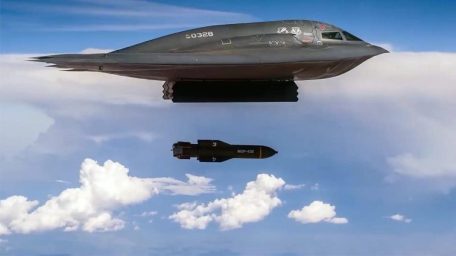
The GBU-57 is a big fat gravity bomb with fins. To achieve effective precision, a B-2 bomber must drop it on its intended target from no further than about five nautical miles — essentially right on top of the target.
Its penetration depth is claimed to be 200 feet. But that capability has NEVER been tested against a seriously hardened deep-underground target encased in layers of high-performance concrete, and topped with a few dozen meters of solid rock. In that sort of real-world scenario, the GBU-57 would be lucky to drill down 50 feet, if that.
It was always ridiculous silly talk to suggest the GBU-57 was the wonder weapon it was made out to be. There is a good reason the US only produced a couple dozen of them and then stopped: they understood its acute limitations in a non-permissive combat environment.
And, notwithstanding the hyperbolic Israeli propaganda, there was never any credible evidence that Iranian medium- and long-range air defenses against fixed-wing aircraft were attrited to any significant degree. And Iranian short-range air defenses were increasingly effective against long-range Israeli drones with each passing day.
As for the B-2: it is a big fat subsonic aircraft. It flies at airliner speeds. A strike on Fordow would entail flying at least 500 miles in and out of Iran. … continue
Blog Roll
 Aletho News
- Drug traffickers trained in Ukraine attack state forces in Mexico
- The tragic reality of Brazilian mercenaries in the Ukrainian conflict
- Zelensky Refused to Discuss Druzhba Pipeline Issue – Fico
- U.S. General Caine Warns: STRIKING IRAN is a HUGE RISK /Glenn Diesen & Lt Col Daniel Davis
- Israel designates five Palestinian media outlets as ‘terrorist organizations’
- Israel, not America, first: Carlson’s Huckabee interview lays bare US foreign policy priorities
- Israeli troops executed Palestinian aid workers at ‘point blank range’: Report
- Iran war What if today’s Iran is resigned to a long, hellish war with the US?
- Why Israel Is Escalating Its War Crimes Against Lebanon
- Iran in the face of the armed diplomacy of imperialism
- If Americans Knew
- The NY Times on the “MAGA” Split Over Israel & USS Liberty
- In Gaza, Ramadan without mosques, imams – Not a ceasefire Day 137
- Footage Shows Israeli Troops Waiting in Ambush, Then Opening Fire on a Palestinian Teen
- The US is on the brink of a major new war that Trump has not even bothered explaining
- Latest Epstein document dump is one more cover-up
- No Protection, No Justice: US Citizens Killed with Impunity by Israel
- Maria Farmer: Epstein Victim Reveals Explosive Information Covered Up by Media
- Average of five Palestinians killed by Israel every day in Gaza since ceasefire – Not a ceasefire Day 136
- Palestinian church leaders admonish Christian Zionist Mike Huckabee – Not a ceasefire Day 135
- Ominous messaging from Trump’s “Board of Peace” – Not a ceasefire Day 134
- No Tricks Zone
- Surprising Discovery: Sahara Is Greening…Billions Of Trees Where Once Thought To Be Barren
- New Research Reaffirms Clouds, Aerosols, And Surface Solar Radiation Are ‘Driving The Climate System’
- Germany: Electric Car Catches Fire At Charging Station, Sets Off Local “Inferno”, Widespread Damage
- New Study: Canada’s New Brunswick Was 1°C Warmer Than Today During The Medieval Warm Period
- Coal Power Back In Trend As Globe Tries To Keep Pace With Growing Demand For Power
- New Study: A 4°C Warmer Beaufort Sea Had ‘No Sea Ice’ 11,700 – 8200 Years Ago
- Unfudging The Data: Dutch Meteorological Institute Reinstates Early 20th Centruy Heat Waves It Had Erased Earlier
- German Gas Crisis…Chancellor Merz Allegedly Bans Gas Debate Ahead of Elections!
- Pollen Reconstructions Show The Last Glacial’s Warming Events Were Global, 10x Greater Than Modern
- Germany’s Natural Gas Storage Level Dwindles To Just 28%… Increasingly Critical
 Aletho News