Russia warns Turkey against rash moves in Idlib
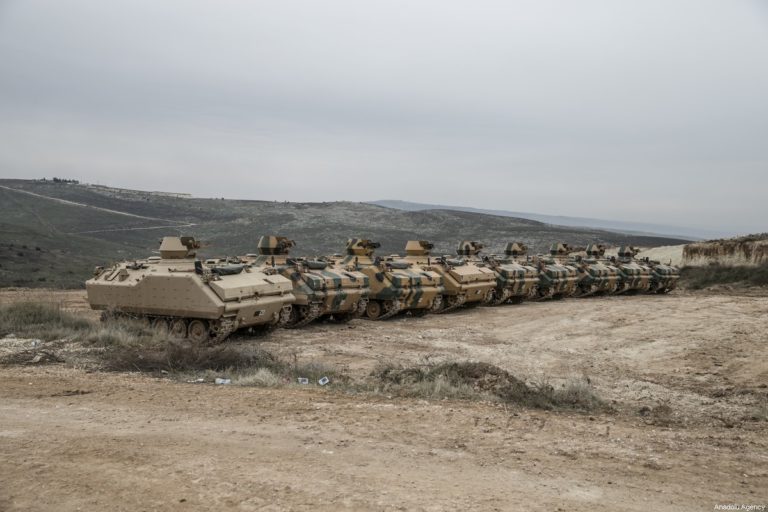
Turkish military reinforcements preparing to cross the border into Syria’s northwestern province of Idlib, February 12, 2020
By M. K. BHADRAKUMAR | Indian Punchline | February 19, 2020
Moscow has taken with a pinch of salt Turkish President Recep Erdogan’s statement on Wednesday that a Turkish incursion into the northwestern Syrian province of Idlib is imminent.
Objectively speaking, Erdogan should be out of his mind to order a military offensive against the Syrian and Russian forces in Idlib. A Russian military delegation, which visited Ankara last week, had advised the Turks to back down, but Erdogan instead beefed up the deployments in Idlib.
Again, the Russian side proposed to the Turkish delegation, which visited Moscow this week for further talks, that a new ceasefire is the best option, necessitated by the ground reality that Damascus will not vacate the strategic areas flanking the M4 and M5 highways.
The Turkish delegation not only disputed the Russian demarche that terrorist attacks from Idlib continue still against the Hmeimim airbase but Erdogan’s statement today goes a step further.
Clearly, Moscow cannot take chances. The Kremlin spokesmen Dmitry Peskov calmly shrugged off Erdogan’s threat by saying, “Let us not expect the worst scenario to become a reality.”
He added, “We are determined to continue to use our working contacts with our Turkish counterparts to prevent the situation in Idlib from escalating further.” Peskov stressed that “contacts with Turkey would continue at various levels.”
But the Russian intention is to forewarn Erdogan against making any rash moves. The point is, the Idlib situation evolved over a period of time since last summer when Russia and Syria reached an estimation that Turkey had no intentions of fulfilling its commitments to evict the al-Qaeda affiliates.
Turkey was instead utilising its 12 “observation posts” in Idlib to keep an eye on the Syrian and Russian forces beyond the ceasefire line.
When the Russian-Syrian offensive finally got under way, Turks could do nothing to stop it and very soon, these observation posts got surrounded by the Syrian army. Erdogan lost face. And he ordered a deployment of 5,000 troops to Idlib with heavy armour, tanks and artillery.
But the Syrian forces took on the challenge and13 Turkish soldiers were killed. Erdogan had probably thought that the Syrian forces would hesitate to take on a NATO power. Again, he lost face. And this time around, he threatened to attack the Syrian and Russian forces.
But the offensive rolled on and more towns and territories came under control of the Syrian government. As a commentary featured today in the Kremlin-funded RT puts it, “Erdogan’s bluff had been effectively called. The Turks now find themselves in an impossible situation.”
Erdogan has pulled back the rebel groups that are Turkey’s proxies and left the al-Qaeda groups to fend for themselves where they are being systematically decimated by the Syrian and Russian forces. The RT commentary concludes:
“For the Turkish troops still deployed inside Idlib, their situation has become increasingly perilous. Their numbers and dispositions preclude any chance of a meaningful defense of Idlib, even if the decision was made to engage the Russian Air Force and Syrian Army. The best that Turks can hope for at this juncture is a new ceasefire that allows its military forces in Idlib to be withdrawn safely with their honour intact… Turkey has made its position in Idlib unsustainable both militarily and politically.”
However, Russia won’t take chances. In a display of military superiority, two Russian Tupolev Tu-22M3 strategic bombers performed a scheduled flight over the Black Sea today, covering a distance of about 4,500 km and staying in the air for more than five hours, while fighter jets of Russia’s Southern Military District escorted the bombers.
Again, today, Foreign Minister Sergey Lavrov repeated Moscow’s full backing for the Syrian operations in Idlib. He said in a clear rebuff to Turkey, “It is only natural that the Syrian armed forces, reaffirming their commitment to the original agreements on Idlib, including an agreement on a ceasefire, respond to such inadmissible provocations. We support them in this.”
“The Syrian army’s actions are a response to a flagrant violation of the agreements on Idlib… Syrian troops are not pushing militants and terrorists back on a foreign territory but on their own soil, thereby reestablishing the legitimate Syrian government’s control over its territories.”
Although US President Trump keeps cheering Erdogan to buck up his spirits, the NATO as such is not getting involved in the Turkish adventure in Idlib. Tass quoted a NATO diplomatic source in Brussels that NATO countries will neither support the invocation of Article 5 over the death of Turkish troops in Idlib nor provide Turkey with military assistance in the event of a military operation in the region.
Moscow has been far too lenient toward Erdogan who has “significant challenges at home, where the Turkish economy is slowing down, and overseas, where Turkey’s military is over-stretched, from Syria to Libya,” as a scholar at the Washington Institute noted.
In a clear message warning Erdogan from punching so far above his weight, Haftar’s forces had fired shells at a Turkish ship at Tripoli harbour last week, which was carrying arms and supplies. Interestingly, Russian Defence Minister Sergei Shoigu met today with the Libyan commander Khalifa Haftar, who is Erdogan’s bête noire.
The astonishing part is that amidst all this cacophony, on Tuesday, the Turkish military quietly resumed joint patrols with Russian forces in northeastern Syria where both countries have a common interest in preventing a US return to the Turkish-Syrian border regions with their Kurdish allies. Certainly, as Peskov signalled today, the Kremlin has reason to hope that the better sense will prevail in Ankara.
Erdogan Escalates Threats, Syria Ignores Him, Scores Massive Gains
Aleppo celebrates, but Erdogan has 7000 troops in Idlib, unquestioned US support, and a penchant for occupying pieces of Syria
By Marko Marjanović | Anti-Empire | February 17, 2020
Erdogan has escalated threats, saying he will not wait until end of February to push the Syrian army back to its starting lines if it does not start withdrawing:
“The solution in Idlib is the regime withdrawing to the borders in the agreements. Otherwise, we will handle this before the end of February,” Erdoğan said.
“Until we clear Syria of terrorist organizations and the cruelty of the regime, we will not rest easy,” he said.
The Trump administration’s unqualified (if wholly rhetorical) support for whatever Erdogan may wish to do there, as long as it goes against the Russians may have had something to do with that:
In a statement released by the White House on Sunday, Deputy Press Secretary Judd Deere said Trump – in a phone call with Turkish President Recep Tayyip Erdogan – “conveyed the United States’s desire to see an end to Russia’s support for the Assad government’s atrocities and for a political resolution to the Syrian conflict”.
“Trump expressed concern [yesterday] over the violence in Idlib, Syria and thanked Erdogan for Turkey’s efforts to prevent a humanitarian catastrophe,” Deere said.
Either way, the Syrian army has been completely ignoring Erdogan’s demands, ultimatums and threats and it has paid off handsomely for Damascus. It has continued to make gains daily, and scored a gigantic success yesterday as rebel defenses in western Aleppo suburbs crumbled after they were outflanked from the south.
Inside a day the Syrian army gained the majority of the urbanized territory that represented the most valuable real-estate still in rebel hands. The rest of the salient will follow today or tomorrow at the latest.
This marks the definite end of the 8-year Battle of Aleppo as rebels which two days ago still held some suburbs technically inside the city limits have now been pushed far to the west. Aleppo citizens, completely besieged by Islamists in 2013, for one celebrated:
In fact, the rebel’s number one sympathizer on Twitter, Julian Ropcke, aka Jihadi Julian, has done invaluable work in counting that since Erdogan first vowed to stop the Syrian army the latter has retaken 96 settlements from the rebels:
Nonetheless, Erdogan has by now poured 7,000 Turkish soldiers with 2,000 vehicles into rebel-held Idlib. That is a very considerable force. What he will do with that is anyone’s guess.
The danger is not so much that he’ll counter-attack the Syrian army trying to throw it back, as that would risk Russian wrath, but that he’ll try to occupy a part of the rebel enclave for Turkey as he has done in northern Syria.

Situation at February 14 day-end, just before Erdogan made his latest round of threats the next day

Situation halfway through today, February 17
Erdogan and Turkey are now the biggest obstacles standing before the Syrian state and army as rebels appear to be completely broken with low morale and quick to retreat.
Erdogan’s Long-Coming Reality Check
By Ghassan Kadi | The Saker Blog | February 14, 2020
It is hard to say if Erdogan is running out of choices, friends, time, or all of the above; and his stands on various issues and the contradictions he ploughs through are making his situation increasingly untenable.
For the benefit of readers who haven’t heard this before; Erdogan is juggling being a Turkish Muslim reformer who parades under the photos of Turkish secular anti-Muslim nation-builder Mustafa Kemal; an EU-aspiring member and also an aspiring global Sunni leader; an ally of Israel as well as Hamas; an Islamist who is also at odds with the Wahhabi Islamists; a nationalist Turk who wants to curb Kurdish aspirations not only in Syria and Iraq but also in Turkey; a Sunni leader who wants to restore the Sultanate and Caliphate and the fundamentalist Sunni version of anti-Shiite Islam but is also a friend of Shiite Iran; a NATO member with a special relationship with America, and a special friend and ally of Russia.
Ironically, despite all the contradictions and conflicts of interest, he has thus far managed to get away with wearing not only all those hats, but also turbans and fezzes in between. Clearly however, this maneuvering cannot last forever and, sooner or later, he is going to end up painted into a tight corner. I certainly would like to believe that he is already in this space.
Erdogan however believes that he has a mandate from God. Following his November 2015 election win, in an article titled “Erdogan the Trojan Horse of Terror”, I wrote:
“With this win, Erdogan felt invincible. For an Islamist, and this is what Erdogan is, feeling invincible takes on a whole new meaning.
This is a simplistic translation of a Quranic verse: “If God is by your side, no one can defeat you” (Quran 3:160).
Erdogan believes he is invincible because he believes that he is on a mission and that God is by his side. If he had any reason to doubt this divine role he believes he has, the November election results put that doubt to rest.”
Ironically, Erdogan is able to comprehend the contradictions of others. Whilst America for example does not give two hoots about the Syrian Kurds and is only using some vulnerable leaders to dig a wedge between the Syrian Government and the Syrian Kurdish population, Erdogan has most vehemently stated to both the Obama and Trump administrations that America cannot be an ally of Turkey and the Kurds at the same time.
Yet, this same Erdogan justifies for himself the supplying of Idlib terrorists with state-of-the-art weaponry to attack not only Syrian Army units with, but also the Russian Hmeimim Air Base. The Russians have thus far thwarted countless attempted drone attacks on the base, and if Turkey did not directly supply the weapons, it definitely facilitated their transport.
Remember that the Idlib area that is controlled by Tahrir al-Sham (formerly known as Al-Nusra) lies between the Syrian-Army controlled area and the Turkish border. It has an open highway to Turkey where all arms and fighters move freely from Turkey into Syria.
And even though Erdogan has signed an agreement with Russia to end the terrorist presence in Idlib, according to veteran Palestinian journalist Abdul Bari Atwan, he does not want to understand why Russia is fed up with him and his antics and why President Putin is refusing to meet with him. In his article written in Raialyoum, Atwan argues that the Russians refuse Erdogan’s call for a new disengagement negotiation meeting and that Turkey must adhere to the existing Sochi agreement; which it has broken on several occasions by Erdogan.
Atwan adds that:
Firstly: “the Turkish gamble and reliance on Syrian opposition and the Free Syria Army in particular have failed because those forces abandoned their positions and the Syrian Army entered the towns of Khan Sheikhoun and Maarra Al-Numan unopposed without suffering a single casualty
Secondly: The 12 Turkish surveillance posts that were established in the Idlib district have turned into a liability because seven of them are under siege by the Syrian Army with a hundred Turkish soldiers trapped in each and can easily be destroyed by the Syrian Army in case Turkey launches a major offensive against Syria.
Thirdly: Russian support to the Syrian Army has reached an unprecedented level after the Russians shot down two drones launched by Tahrir Al-Sham yesterday” (ie the 10th of February 2020).
In addition, according to Atwan, “Erdogan missed a golden opportunity when he refused the (recent) Iranian initiative proposed to him by Iranian FM, Zarif, to find a political resolution for the impasse with Syria, and this was perhaps the last opportunity to reach a diplomatic resolution before a direct open confrontation with Syria”
In a Financial Times article titled “Testing Times for Erdogan and Putin”, the author is a tad short of saying that the relationship between Erdogan and Putin is irreconcilable. According to him, “If Turkey’s president Recep Tayyip Erdogan was looking for a way to convey his anger at Russia over the death of eight of his country’s troops in Syria, a visit to Ukraine provided the perfect opportunity.
At a guard of honour at the presidential palace in Kyiv on Monday, Mr Erdogan shouted “Glory to Ukraine”, a nationalist slogan deeply associated with anti-Russia sentiment and the country’s fight for independence after the collapse of the Soviet Union.
His carefully chosen words — to an army battling Russia-backed separatists in eastern Ukraine — were a clear rebuke to President Vladimir Putin”.
In all of this, what Erdogan needs more than anything, is a long-coming reality check, and it seems more forthcoming than ever.
He may believe that he is a president for life who deserves the purportedly one thousand room palace he built for himself. He may hope to rebuild the Ottoman Empire and resurrect the Caliphate. He may imagine that, having been able to build up the Turkish economy to a level that has earnt a position in the G20, he has become the leader of a super power; but he has not. Turkey is at best a regional power, but it is only powerful if it has more powerful friends and allies to back it up. For as long as Turkey has to literally beg the Russians and/or the Americans to buy state-of-the-art weapons to defend itself with, then it is not in a position that allows it to stand on its own feet; not in the manner that Erdogan wishes it to stand. He should take heed and look at history. Mehmet Al-Fatih built his own guns to breakdown the defence walls of Constantinople. Even though the engineer who built them was from the Balkans, but they were Mehmet’s guns and they were the biggest in the world at the time.
I am not advocating that Erdogan should build his own nuclear arsenal, fighter jets and defence and attack missiles. In the ideal world, no one should. But to add to his list of contradictions, if Erdogan wants to wear the Turban of the Sultan, huff and puff at Russia, he cannot be riding Don Quixote’s donkey at the same time.
And if he thinks that he can now make a U-turn and be the loyal NATO leader and dump Russia, he will find himself again facing the same impasse he had with the Americans over the Kurdish issue. Furthermore, what will this do to his trade deals with Russia and his gas supplies?
And if Erdogan also thinks that America would come forward to save him in Idlib, one would have to remember that the illegal American presence in North East Syria is hundreds of kilometres away from Idlib and separated by the Russian-backed Syrian Army. Why would America, even Trump’s America, risk a confrontation with Russia to save his hide?
Erdogan has thus far evaded Karma because he has been hedging his bets in all directions, working up his enemies and allies against each other. But unless one is powerful enough to stand on his own feet when he needs to, then such a strategy in the long run can only leave one with no friends, a long list of enemies and a hoard of untrusting onlookers.
Above all, what do Turkish people want from the Turkish presence in Syria? Turkey hasn’t been at war for a whole century. The leader that once promised “zero problems” with neighbours is digging in his heels and seems determined to engage in an all-out war with Syria. The average Turkish citizen may ask why and to what end?
Erdogan has hopefully finally wedged himself into a corner that he cannot weasel his way out of without losing face. He will either have to bolster his military presence in Syria and fight the Syrian Army and Russia, or back off. If he takes the former option, he will not find any international supporters, and possibly the support of his own people will become questionable. But if the psychopathic, megalomaniac feels that he has to retreat, he will be scrambling for a face-saving exit, and the options are running out.
Russia was prepared to put the deliberate Turkish downing of the Su-24 in November 2015 behind and move forward. A lifeline was given to Erdogan back then, based on the promises he made and the later agreements he signed. But time proved that he was only looking for buying time, and that window with Russia is up.
Body bags have already been sent to Turkey and there are unconfirmed figures of how many Turkish soldiers have been killed defending Al-Nusra fighters. What is pertinent here is that, in the event of an all-out war with Syria, Syrians will be fighting an existential battle, aided by Russia and regional allies. Turkey however, will be fighting a different type of existential battle; one for Erdogan, not for Turkey itself.
Turkey has no reason for having a military presence and fight in Syria. It is only Erdogan’s ego and dreams that do.
Syria: M5 highway secured, time for truce

Syrian forces took control of M5 highway connecting economic hub of Aleppo to Damascus and other key population centres to Jordanian border, February 12, 2020.
By M. K. BHADRAKUMAR | Indian Punchline | February 13, 2020
The de-escalation talks between Moscow and Ankara over the Russian-backed offensive by the Syrian government forces in the northwestern province of Idlib didn’t help defuse tensions.
On the contrary, Turkish-Syrian tensions cascaded and an unraveling of the Russian-Turkish entente may ensue.
Another Turkish delegation is due to visit Moscow to discuss Idlib. This follows visits by two Russian delegations to Turkey last week and a phone conversation between President Vladimir Putin and President Recep Erdogan on Wednesday.
Turkey is hanging tough. Erdogan threatens to hit Syrian army and push it behind the 12 Turkish observation posts in Idlib by the end-February. He warns that unless Syrian forces retreat, Turkey will expand its offensive. He also signals that air strikes by Syrian and Russian planes in Idlib will be countered.
According to Erdogan, if the Syrian government establishes complete control over the country, it could threaten Turkey’s security and stability. He has backed his words by moving hundreds of tanks and heavy armour into Syria and significant troop deployments in Idlib.
Meanwhile, the Russian Defence Ministry announced earlier today in Moscow that “a vital transport corridor in Syria — the M5 highway linking the besieged northern capital Aleppo with Syria’s southern cities (Hama, Homs and Damascus) — has been liberated from terrorists.”
The Syrian news agency SANA further elaborated that in operations on Wednesday, Syrian forces gained control of the Aleppo countryside to the west of M5 highway, which are regions previously held by extremist groups — principally, the al-Qaeda group known as Jabhat al-Nusra, supported by Turkey.
In sum, the Russian-Syrian operations in Idlib have reached a defining moment — control of the M5 highway. The Russian Defence Ministry highlighted that control over the M5 highway is a game changer.
Indeed, Turkey understands this fully well too. A commentary on Wednesday by TRT World, Turkish state media, described M5 highway as “the key to controlling Syria”. It explained,
“The M5 highway is also critical in linking Syria with the Jordanian border and in the recent past to Turkey’s southern city of Gaziantep, an industrial hub and a centre for imports and exports. … Functioning as the backbone of the national road network, the M5… has economic importance because it connects the city of Aleppo, which was the industrial capital, with Damascus and also continued to the southern border that was the main highway for transit trade.
“The M5 motorway has further critical extensions to the port of Tartus, home to Russia’s only naval base in the Mediterranean, and Latakia, the home of the Assad family clan and Russia’s largest electronic eavesdropping post outside its territory…
“The recent Assad regime offensive and capture of Saraqib, a town at the intersection between the M4 and M5 in Idlib province, was a strategic coup. Not only did the regime open up a critical part of the M5 motorway leading to North Aleppo but also west to the M4 highway leading to Jisr Al Shughur one of the largest cities in Idlib province and still under rebel control from there to Latakia. Beyond the strategic importance of the highway for anti-regime rebels, controlling the M5 would have meant the physical collapse of the authority of Syrian regime leader Bashar al Assad.”
 In retrospect, notwithstanding the warnings and threats held out by Turkey, Moscow was determined for good reason that the operation must be carried froward to its logical conclusion, namely, liberation of M5 from the clutches of the al-Qaeda terrorist groups.
Turkey may not like that it has been checkmated. The entire Turkish strategy of using terrorist groups as proxies in the 9-year Syrian conflict is crumbling. The battle-hardened al-Qaeda fighters fleeing Idlib in their thousands may flock to Turkey, which could pose an ugly security situation.
Since 2016, Turkey resorted to a strategy of carving out Syria’s northern territories as its “sphere of influence”, but that strategy is no longer sustainable.
On the other hand, the truce reached through the Astana and Sochi talks with Russia and Iran lies in tatters. Turkey’s best bet will be to improve its negotiating position and thereafter seek a new equilibrium with its Astana partners.
But how would Turkey navigate to that point? For Moscow and Damascus, control of M5 highway is non-negotiable. Erdogan claims Turkey would contest Damascus’ (and Russian) monopoly over air space. But Turkish air force stands much diminished after the huge purge of officers following the US-backed coup attempt in 2016.
Erdogan will think twice before confronting Russia militarily. The nice words of solidarity from US officials notwithstanding, he’d know that the US-Kurdish axis is pivotal to Washington’s Middle East strategy.
In fact, the US military is already fishing in troubled waters to regain control of border regions with Kurdish population in northeast Syria, which it vacated in a hurry last October following President Trump’s impetuous declaration on troop withdrawal from Syria (which he revoked subsequently.)
Turkey needs to reconcile with the inevitability of the Syrian leadership pressing ahead with plans to regain control of the entire country. That is to say, Russia and Syria may adopt a “salami tactic” and keep hunting down the residual al-Qaeda terrorists.
Turkey’s options have dried up. The way out is to cut losses, which is best done by reaching a renewed understanding with Russia and Iran. The priority should be that Turkey’s core interests are not in jeopardy, especially the Kurdish conundrum in northern Syria.
Clearly, Putin’s priority is to end the conflict and stabilise the Syrian situation. There shouldn’t be a conflict of interests with Turkey. The alternative is for Turkey to team up with the “spoilers” — the cold warriors in Washington who do not want Russian presence in the Mediterranean and the Saudi regime with its antipathy toward Iran’s rise.
Therefore, a rebalancing of the Turkish-Russian entente is possible — and is to be expected. Moscow keeps good contacts with Kurds and Damascus has common interests with Ankara in regard of Kurdish problem.
Turkey’s border security is best addressed by fortifying the cardinal principle in inter-state relationships — non-interference in the internal affairs of neighbouring countries.
Syrian army only targets terrorists, who are still active in Idlib despite de-escalation agreement with Turkey – Kremlin
RT | February 12, 2020
The Syrian army carries out attacks against terrorists in the Idlib province, not civilians , Kremlin said after Turkey threatened Damascus with military action, accusing it of shelling its soldiers.
Turkey has failed to clear the de-escalation zone in Syria’s Idlib Province of jihadist groups, despite promising to do so under the 2018 ceasefire agreement reached by Moscow and Ankara, the spokesperson for the Kremlin Dmitry Peskov told reporters on Wednesday.
“These groups are still attacking the Syrian forces from Idlib, as well as conducting aggressive actions against our military sites,” he said.
Erdogan has been accusing the Syrian army of shelling Turkish soldiers and of bombing villages. On Wednesday, he threatened to strike Syrian government forces in Idlib and beyond if Turkish troops are harmed.
The Kremlin’s spokesperson denied that Damascus deliberately targets anyone except the militants. “The Syrian army’s strikes in Idlib are strikes against terrorists, not civilians,” Peskov said.
As for the shelling of Turkish forces, Moscow said that one such confirmed incident had occurred because Ankara failed to properly notify the Syrian military about its troop movements.
New leaks shatter OPCW’s attacks on Douma whistleblowers
By Aaron Maté | The Grayzone | February 11, 2020
For the past year, the Organization for the Prohibition of Chemical Weapons (OPCW) has been roiled by allegations that it manipulated an investigation to falsely accuse the Syrian government of a chemical weapons attack. An OPCW report released in March 2019 lent credence to claims by Islamist militants and Western governments that the Syrian military killed around 40 civilians with toxic gas in the city of Douma in April 2018. The accusation against Damascus led to U.S.-led military strikes on Syrian government sites that same month.
But leaked internal documents published by WikiLeaks show that OPCW inspectors who deployed to Douma rejected the official story, and complained that higher-level officials excluded them from the post-mission process, distorted key evidence, and ignored their findings.
After months of virtual silence, the OPCW has responded with an internal inquiry that lambasts two veteran officials who raised internal objections, attacking their credibility and qualifications. The OPCW’s self-described “independent investigation” describes the pair as rogue, low-level actors who played minor roles in the Douma mission and lacked access to crucial evidence. In a briefing to member states, OPCW Director General Fernando Arias dismissed them as disgruntled ex-employees. The two “are not whistle-blowers,” Arias said. “They are individuals who could not accept that their views were not backed by evidence.”
But a leaked document calls Arias’s assertions into serious question. Ian Henderson, one of the two inspectors, recently addressed a special session of the United Nations Security Council with his concerns about the Douma mission. Henderson submitted a supplemental written account that was distributed among participating UN member states and obtained by The Grayzone. It offers the most extensive and detailed account of the internal dispute over the OPCW’s Douma investigation to date.
The full leaked testimony can be read here (PDF).
Henderson provides a thorough timeline that bolsters suspicions that the OPCW leadership covered up a staged deception in Douma. Combined with the available record – which includes other OPCW leaks, as well as Arias’s and the OPCW’s own statements – Henderson’s account firmly demonstrates that he and a fellow dissenting colleague occupied veteran leadership roles inside the organization, including during the Douma fact-finding mission.
Henderson also exposes key gaps in the OPCW’s inquiry, which fails to specifically address the revelations that critical evidence was kept out of the OPCW’s published reports; that key findings were manipulated – and that all of this occurred under sustained U.S. government pressure.
In addition to Henderson’s complete testimony, The Grayzone has obtained a chilling email from a third former OPCW official. The former official, who worked in a senior role, blamed external pressure and potential threats to their family for their failure to speak out about the corruption of the Douma investigation.
This official was not among the pair of dissenting inspectors targeted by the inquiry. The email corroborates complaints by Henderson and his colleague about senior management’s suppression of evidence collected by the team that deployed to Syria.
‘I Fear Those Behind the Crimes’
In his briefing about the investigation of the inspectors, Arias, the OPCW director-general, described the pair as stubborn actors “who took matters into their own hands and committed a breach of their obligations to the Organization.” He characterized their behavior as “egregious.”
But leaked documents and testimony point to an OPCW leadership that has committed egregious acts of its own, including intimidating internal dissenters.
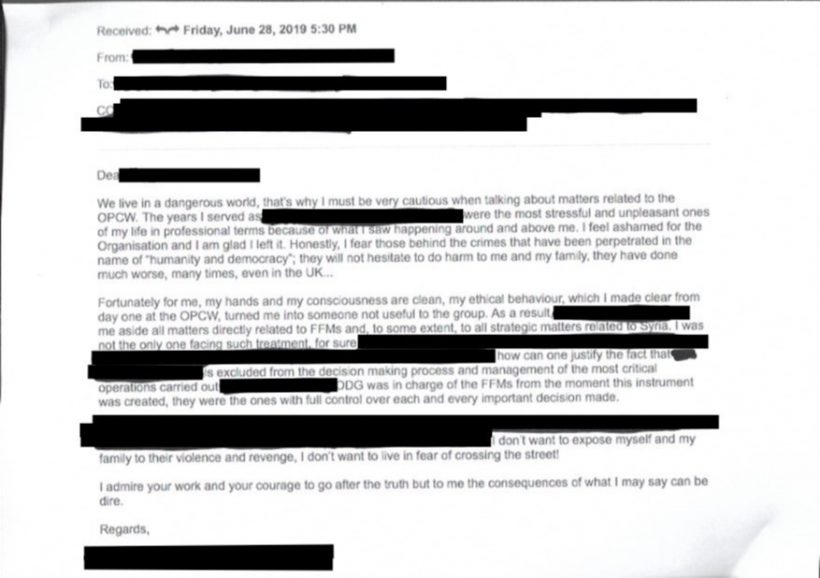
In an email obtained by The Grayzone,a former senior OPCW official described their tenure at the OPCW as “the most stressful and unpleasant ones of [their] life,” and expressed deep shame about the state of the organization they departed in disgust.
“I fear those behind the crimes that have been perpetrated in the name of ‘humanity and democracy,’” the official confided, “they will not hesitate to do harm to me and my family, they have done worse, many times, even in the UK… I don’t want to expose myself and my family to their violence and revenge, I don’t want to live in fear of crossing the street!”
The former OPCW senior official went on to denounce the removal of members of the original fact-finding team to Syria “from the decision making process and management of the most critical operations…” This tracks with complaints expressed in leaked OPCW documents that superiors who had not been a part of the investigation in Douma marginalized those who had.
The atmosphere of intimidation was confirmed by a second member of the OPCW’s original fact-finding mission to Douma. The whistleblower, identified by the pseudonym “Alex,” spoke to the journalist Jonathan Steele and to a panel convened by the Courage Foundation in October 2019. Alex revealed that a delegation of three U.S. officials visited the OPCW at The Hague on July 5, 2018. They implored the dissenting inspectors to accept the view that the Syrian government carried out a gas attack in Douma and chided them for failing to reach that conclusion. According to Steele, Alex and the other inspectors saw the meeting as “unacceptable pressure.” In his statement to the UN Security Council, Henderson confirmed that he attended the meeting.
The U.S. intervention at the OPCW could possibly violate the chemical weapons convention, which forbids state parties from attempting to influence investigations. It would not be the first time Washington has attempted to bully the OPCW into submission. In 2002, during the run-up to the invasion of Iraq, the George W. Bush administration engineered the ouster of the OPCW’s first director-general, Jose Bustani. The Bush administration was concerned that Bustani’s negotiations with Iraq about allowing international inspectors could undermine its plans for war.
Bustani later revealed that John Bolton, then an under secretary of state, had personally threatened him and his family with violent retaliation. The U.S. pressure on the OPCW over Douma also took place under Bolton’s watch. When the U.S. bombed Syria in April 2018 and pressured OPCW officials just three months later, Bolton was in the midst of his first months as President Donald Trump’s national security adviser. (Bustani, meanwhile, was among a group of panelists who heard direct testimony from Alex at a gathering convened by the Courage Foundation in October 2019.)
OPCW’s Inconsistency on ‘Inspector A’
The OPCW’s internal inquiry goes to great lengths to denigrate and discredit the two former staffers who challenged the official story on Douma. It refers to its two targets as “Inspector A” and “Inspector B.” The latter’s identity has not been publicly confirmed. “A” is Ian Henderson, a South African engineer and veteran OPCW official with extensive military experience.
Henderson’s written testimony to the United Nations, obtained by The Grayzone, undercuts the negative portrayal of his former managers, and offers a window into the pressure campaign and cover-up that he and his colleagues faced.
A suppressed internal study by Henderson first brought the OPCW scandal to public attention. In May 2018, an engineering assessment bearing Henderson’s name was leaked to a group of British academics, the Working Group on Syria, Propaganda and Media. The document is a detailed engineering analysis of two gas cylinders found at the scene of the alleged attacks in Douma. Whereas the OPCW’s final March 2019 report concluded that the cylinders were likely dropped from the air, Henderson found that there is “a higher probability that both cylinders were manually placed… rather than being delivered from aircraft.” The OPCW’s final report made no mention of this conclusion.
The inference of Henderson’s study is that the attack was staged by the armed opposition. At the time, Douma was under the control of the extremist Saudi-backed militia, Jaysh Al-Islam, and was on the brink of being re-taken by Syrian government forces.
From a political and military standpoint, a chemical weapons attack was the most self-destructive and unnecessary action the Syrian military could possibly take. From the standpoint of a foreign-backed militia on the verge of defeat, however, staging a chemical attack was a desperate Hail Mary operation that offered the hope of U.S. military invention in accordance with Washington’s “red line” policy. The suspected gambit by Jaysh Al-Islam appeared to have paid off when the Trump administration accepted its claims that a chemical attack had killed dozens of civilians in Douma, and initiated cruise missile strikes in response. Yet the U.S.-led attacks failed to prevent the Syrian government from retaking Douma and the whole of eastern Damascus. Within days, Western reporters had entered the area and were able to access local eyewitnesses who claimed that the chemical attack was a staged deception.
Henderson was among the first OPCW staffers to visit the site of the alleged attack in Douma. However, the OPCW inquiry dismissed Henderson’s role in the Douma probe, characterizing his engineering study as a personal, rogue operation. Henderson, the inquiry said, “was not a member of the FFM [Fact Finding Mission]” that deployed to Douma, and only “played a minor supporting role.”
There is ample evidence that contradicts this characterization. In his written UN testimony, Henderson revealed that he served in five Douma deployments as part of the FFM. This includes three instances as a sub-team leader for critical operations: visiting a suspected chemical weapons production site in Douma; conducting interviews and taking chemical samples at the Douma hospital; taking detailed measurements at one of the sites; and inspecting, itemizing, and securing the two cylinders that were removed from the sites of the alleged gas attack. The notion that he “was not a member” of the mission that he played such an active role in strains credulity.
A leaked email shows that at least one of Henderson’s colleagues protested a previous instance in which the OPCW leadership attempted to minimize his role. The “falsehood… that Ian did not form part of the Douma FFM team,” the colleague complained, was “patently untrue” and “pivotal in discrediting him and his work.”
The inquiry also falsely insinuated that Henderson was a low-level official. While acknowledging that Henderson served as an OPCW team leader during his first tenure with the OPCW from 1997 to 2005, the inquiry said that he was “rehired at a lower level” when he returned in 2016, and remained there until his departure in May 2019. Yet the OPCW’s own documents from that latter period showed that Henderson was described as an “OPCW Inspection Team Leader” as late as February 2018, just two months before his deployment to Douma as part of the OPCW’s Fact-Finding Mission (FFM). According to his UN testimony, Henderson served as an inspection team leader for multiple inspections of Syrian laboratory facilities at Barzaeh and Jamrayah in November 2017 and in November 2018, after the U.S. bombed Barzeh on dubious grounds.
After casting doubt on Henderson’s status within the organization, the OPCW inquiry dismissed his engineering report as “a personal document created with incomplete information and without authorisation.” Henderson, the investigators said, defied higher-level officials’ orders and conducted a study on his own with outside contractors.
In his briefing to member states on the inquiry’s findings, OPCW Director General Fernando Arias echoed this conclusion, describing Henderson’s report as “a purported document disseminated outside the Organisation.”
But Arias’ statements today contradict his own words from less than a year ago. Just days after Henderson’s report was leaked in May 2019, Arias delivered an extensive briefing and announced that an inquiry into the disclosure was underway. Arias made no claims of Henderson going rogue, and described his report as an “internal document… produced by a staff member.” It is unclear how Henderson’s report went from an “internal document” by an OPCW staffer in May 2019 to a “purported document disseminated outside the Organisation” in February 2020. Arias has not explained this discrepancy.
In his latest missive, Arias has offered a completely new rationale for keeping Henderson’s report from the public. In May 2019, Arias stated that because Henderson’s report “pointed at possible attribution,” it was therefore “outside of the mandate of the FFM [Fact-Finding Mission] with regard to the formulation of its findings.” The FFM is prevented from assigning blame to parties involved in chemical attacks. However, the OPCW’s published conclusion suggested the Syrian government was to blame for the attack – an act of attribution – since the Syrian military (or its Russian ally) was the only warring party in Douma with aircraft. Even more curiously, by accusing Henderson of freebooting and “subterfuge,” Arias and his organization’s independent inquiry has now offered a completely different explanation than it previously had for the omission of Henderson’s report.
Why Was Critical Evidence Excluded?
In yet another highly dubious assertion, the OPCW inquiry claimed Henderson “did not have access to all of the information gathered by the FFM team, including witness interviews, laboratory results, and assessments by independent experts regarding the two cylinders — all of which became known to the team after [Henderson] had stopped providing support to the FFM investigation.”
But an important piece of context is missing from this salvo: by the time Henderson carried through on his study in summer 2018, he and other members of the FFM had already complained to the OPCW leadership that their findings were being manipulated and suppressed.
According to Henderson’s testimony, a draft interim report circulated in June 2018 was subjected to “last-minute unexpected modifications” that were “contrary to the consensus that had been reached within the team.” This included a change to “reflect a conclusion that chlorine had been released from cylinders,” which was not consistent with the findings at that stage. An intervention by one of the FFM team members, possibly Inspector B, forced FFM team leader Sami Barrek to revise the interim report before its eventual release on July 6, 2018.
Despite agreeing to hear his team’s objections, Barrek personally blocked critical evidence that conflicted with the official story of Syrian government responsibility. One email chain revealed that Barrek resisted pleas from an inspector to include the relatively low levels of chemicals found in Douma. Alex, the anonymous second OPCW whistleblower, told journalist Jonathan Steele that chlorinated organic chemicals at the scene “were no higher than you would expect in any household environment.”
Another leaked document showed the OPCW had consulted with toxicologists in June 2018 to determine whether symptoms observed in victims were consistent with exposure to chlorine. According to minutes of that meeting, “the experts were conclusive in their statements that there was no correlation between symptoms and chlorine exposure.” But these critical findings, which dramatically undercut the official narrative, were inexplicably omitted from both the interim and final report.
‘Core’ Cover-up Team
One day after U.S. officials attempted to bully OPCW staff into submission on July 5, 2018, an interim report on Douma was published that reflected some of the inspectors’ key objections, albeit with watered-down language and significant omissions. A critical change then took place. OPCW officials announced that the ensuing final report would be drafted by a “core team” that was separate from the one which deployed to Douma. That left the core team without any of the FFM members who had been on the ground at the site of the supposed attack, with the exception of one paramedic. Henderson told the UN that the move deprived the core team of anyone qualified to conduct the needed engineering assessments on the chlorine cylinders that were said to have been dropped in Douma.
With superiors omitting critical information, Douma inspectors excluded from the so-called “core” team, and U.S. officials applying direct pressure, Henderson attempted to carry on with his report. Despite the inquiry’s claims, Henderson presented evidence to the UN that his work was approved by his superiors. Henderson reported that he held several meetings with top OPCW officials beginning in late summer 2018, where he informed them of his study and relayed concerns about the methodologies of the then-FFM team leader. Henderson said he was told by the then-Chief of Cabinet Sebastien Braha: “I don’t see why both studies can’t be done.” Henderson took that as a green light.
Henderson completed his engineering study in January 2019 and submitted a “detailed executive summary” for peer review. OPCW colleagues, including members of the Douma FFM, an unidentified former “core team” former inspector, and other “trusted [Technical Secretariat] staff members who had expertise in specific areas,” studied Henderson’s work and offered written feedback.
“This review was considered necessary and responsible,” Henderson wrote, “in that I knew (after the analysis had been completed) that these would be unpopular findings; therefore, I wanted to make sure there were no objections to any of the facts, observations, methodology used or findings reported in the summary.”
In its bid to portray Henderson’s engineering study as the work of a disconnected freelancer, the OPCW’s inquiry strangely made no mention of this peer review.
When he met with FFM team leader Sami Barrek the following month, Henderson ran into more obstructions. Barrek flatly rejected Henderson’s report, “stating that he had been instructed not to accept it.” Alarmed by the possibility that the OPCW would soon release a final report without a sound engineering assessment, Henderson submitted a physical copy to the OPCW’s Documents Registry Archive, and alerted management by email.
It was then that another hostile response arrived from above. Braha, the chief of cabinet, emailed back an order: “Please get this document out of DRA (Documents Registry Archive) … And please remove all traces, if any, of its delivery/storage/whatever in DRA.”
Days later, on March 1, 2019, the OPCW’s final report was released. Omitting Henderson’s engineering findings, it reached a conclusion that contradicted that of its own inspectors. According to the report, the investigation found that there were “reasonable grounds that the use of a toxic chemical as a weapon took place…This toxic chemical contained reactive chlorine.” For its analysis of the cylinders, the report claims it relied on “three independent analyses” without specifying them and only directly citing one.
This raises an ineluctable question: why did the OPCW rely on three unspecified “independent analyses” from outside experts who never set foot in Douma, rather than on the evidence-based reports of a veteran OPCW staffer and his colleagues who investigated the site of the supposed attack? The OPCW has yet to offer an explanation.
“I was shocked by the decision to release the report without having taken into account the engineering report, as all the FFM management knew it had been submitted,” Henderson recounted in his UN testimony. “I had expected the report to reflect the situation that had been the consensus of the Douma FFM team after the deployments, and for the assessment of the cylinders to be consistent with the findings of the engineering assessment, but found the complete opposite. I saw what I considered to be superficial and flawed analysis in the section on the cylinders.”
Henderson tried to resolve his concerns internally. He met with at least six high-level officials, and sought a meeting with Arias. A senior manager angrily rebuffed that request, telling Henderson that “you will never get to the director-general, and if you try and go around me to get to him, there will be consequences.” Henderson also submitted a detailed dossier outlining his concerns to the acting director of the Office of Internal Oversight, which was later rejected.
Perhaps most critically, Henderson sought a meeting where the drafters of the FFM report – the “core” team that had excluded all but one member of the team that visited Douma – “would explain what new information had been provided or new analysis conducted, that had turned around the situation from what had appeared to be clear at the end of deployments to Douma.”
Henderson also requested an opportunity to hear from the “three experts” who had conducted the engineering studies cited by the FFM’s final report. “This would be a technical discussion, comparing the information and inputs used and methodology applied, and interpretation of results, and would very quickly identify any flawed approaches and would help clarify the situation,” Henderson recalled.
“Throughout this period, I acknowledged there was a possibility that I could be wrong, but stressed that I was not the only one with concerns,” he added. “Investigating the situation would bring things to light and potentially defuse the situation.”
But Henderson’s requests were denied. “Whilst many in management were shocked and concerned, and all expressed sympathy with my concerns,” Henderson told the UN, “the responses I received included ‘this is too big;’ ‘it’s too late now;’ ‘this would not be good for the [Technical Sectrariat’s] reputation;’ ‘don’t make yourself a martyr;’ and ‘but this would play into the Russian narrative.’”
A leaked memo written by Henderson to Arias, the OPCW director general, in March 2019, captures his contemporaneous objections. The final report, Henderson wrote, “does not reflect the views of all the team members that deployed to Douma,” a view he said was shared by about 20 inspectors. (Alex relayed a similar account to Jonathan Steele: “Most of the Douma team felt the two reports on the incident, the Interim Report and the Final Report, were scientifically impoverished, procedurally irregular and possibly fraudulent.”) On top of the fact the report was written by a “core” team that excluded all but one Douma inspector, Henderson complained that its authors “had only operated in Country X” – believed to be Turkey.
Arias instructed Henderson to submit his report to the newly formed Investigation and Identification Team, which had been mandated to further investigate the Douma attack. The IIT met with Henderson in March 2019 and accepted a copy of his report. But two months later, Henderson was suspended and removed from the OPCW building after a leaked copy of his engineering assessment was published on the internet. The OPCW’s inquiry does not accuse Henderson of responsibility for the leak.
Conspicuous Claims About ‘Inspector B’
Less is known about “Inspector B,” the second OPCW inspector targeted by the inquiry. It is possible, though unconfirmed, that B is the same person as “Alex,” the aforementioned Douma team member turned whistleblower. Like Henderson, B has been with the OPCW since its formation. The inquiry notes that B initially served from July 1998 to December 2011, including as Team Leader, and then again from September 2015 until August 2018.
As with Henderson, the inquiry attempted to portray Inspector B as a marginal figure in the Douma inquiry who went rogue after he had left the OPCW. While acknowledging that he was a member of the FFM team that deployed to Syria in April 2018, the report said that B “never left the command post in Damascus,” and therefore did not visit Douma.
By the OPCW’s own standards, however, that was hardly disqualifying: Sami Barrek, the FFM team leader, was only in Damascus for three days and departed before his team members – including Henderson – first reached Douma. Yet Barrek was tasked with drafting the final report, and, as leaked emails show, faced internal complaints that he excluded critical evidence.
According to the Working Group, the British academic collective that received and published Henderson’s leaked report, Barrek subsequently visited Turkey where he met with members of the White Helmets. The White Helmets are a Western government-funded organization known for carrying out rescue operations in areas under the control of foreign-backed anti-government militias. As The Grayzone has reported, the U.S.- and U.K.-funded White Helmets have operated alongside extremist militants during Syria’s proxy war, and been used for propaganda efforts to promote U.S. military intervention and sanctions on Syria. In the case of Douma, the White Helmets participated in a staged video to create the appearance that a local hospital was treating victims of a chemical attack.
Conspicuously, the inquiry offered no specifics on what “Inspector B” did in Damascus or his role in the FFM. This omission could be seen as an indication that an accurate description of his role would reveal that he played a significant one. The inquiry noted that he “was involved in the drafting of the interim report on the Douma incident” – but did not offer further details. It seems unlikely that someone with a limited role in the investigation would have been entrusted to participate in drafting the public report on its findings.
As with its portrayal of Henderson, the inquiry claimed that the FFM “undertook the bulk of its analytical work, examined a large number of witness interviews, and received the results of sampling and analysis,” in the months after Inspector B was no longer involved. But it had nothing to say about Inspector B departing only after raising concerns that the Douma team’s analytical work was manipulated and excluded, including on vital chemical samples. Accordingly, the fact that more work was done after B’s ouster did not resolve his concerns; if anything, it only raised further questions about the OPCW’s faulty final product.
Western Media Outlets Complicit in Cover-up
The OPCW’s unprecedented rebuke of two career officials has received a warm reception in mainstream media outlets that have carefully ignored the OPCW scandal to date, turning a blind eye as one explosive internal document after another appeared on WikiLeaks.
Though the scandal was itself a product of disclosures by the OPCW’s own staff, The Guardian bizarrely described it instead as “a Russia-led campaign” that has now “been dealt a blow” by the OPCW’s inquiry. The New York Times published reports by Reuters and the Associated Press that also aired the inquiry’s conclusions without a scintilla of critical scrutiny.
At a time when whistleblowing is supposed to be held in high esteem, the Western political and media establishment’s flagrant disinterest and disregard for the two dissenting inspectors and the explosive leaked documents is glaring. This carries significant dangers.
As the email by a “former senior official at the OPCW” – someone who was not among the pair of dissenting inspectors – made clear, fear within the organization is almost as profound as the pressure to self-censor and conform to the dominant narrative.
The experience of the OPCW’s first director-general, Jose Bustani – who was ousted from his position after direct threats from John Bolton to him and his family – attests to the threats these new whistleblowers face. When Bustani heard Alex’s testimony, he came away from the meeting firmly convinced that something had gone extremely wrong at the OPCW.
“The convincing evidence of irregular behaviour in the OPCW investigation of the alleged Douma chemical attack confirms doubts and suspicions I already had,” Bustani said after the session. “The picture is certainly clearer now, although very disturbing.” Bustani added that he hoped the Douma revelations “will catalyse a process by which the [OPCW] can be resurrected to become the independent and non-discriminatory body it used to be.”
In his statement to the United Nations, Henderson echoed this sentiment. The ousted expert called on the United Nations to allow for a scientific, peer review process to weigh his report against the three “independent experts” whom the OPCW claimed to rely on for its final report. The “method of scientific rigour,” Henderson wrote, “dictates that one side cannot profess to be the sole owner of the truth.
“Should an independent scientific panel be allowed, he concluded, “I have no doubt that this would successfully clarify what happened in Douma.”
With his explosive UN testimony and the leaks that preceded it, Ian Henderson and his colleagues have made clear that the OPCW experts who deployed to Syria are determined to bring the cover-up of an elaborate deception to light.
Support for NATO wanes in France, Germany & even US as alliance struggles to maintain unity
RT | February 10, 2020
Public support for NATO has seen a notable decline in France, Germany and the US, according to a new poll. The alliance has suffered from months of budgetary in-fighting and mud-slinging among member states.
While the Pew Research study noted that the North Atlantic Treaty Organization still enjoys general support across member states, it pointed out that several countries “have soured on the alliance.”
Positive views of the transatlantic alliance fell to 52 percent in the United States last year, from 64 percent in 2018, the survey found. In France, support fell to 49 percent, from 60 percent in 2017 and 71 percent in 2009. A figure for 2018 was not available. Germany also saw a drop in public support, which stood at 57 percent in 2019, down from 63 percent in 2018. Positive ratings of NATO among members range from a high of 82 percent in Poland to 21 percent in Turkey.
The decline in public support can be attributed to a number of factors, including months of heated debate over defense spending among member states. US President Donald Trump has repeatedly chastised alliance members for not meeting their military spending commitment of two percent of GDP, while arguing that the United States pays far too much for Europe’s defense.
European states have also been highly critical of the Cold War-era defensive alliance. Last year, French President Emmanuel Macron accused NATO of suffering from “brain death” because of its perceived failure to help maintain global security and resolve world conflicts.
The alliance has also struggled to maintain a united front, most notable in Syria, where Turkey has been at odds with its American allies. Ankara has also locked horns with Athens over the tense military and political situation in Libya.
Founded in 1949 to counter the Soviet Union, NATO has been criticized for being largely obsolete and lacking a clear purpose. Despite billing itself as a defensive alliance, it has participated in a number of disastrous military interventions in the Middle East and North Africa.
Erdogan’s biggest gamble yet
The Turkish president’s misguided dispatch of troops to Syria risks an unwinnable showdown with Russia
By Abdel Bari Atwan | Rai al-Youm | February 4, 2020
The Turkish-Syrian clash in Idlib province – resulting in the death of six Turkish soldiers when their convoy was shelled by the Syrian army near the town of Saraqeb – ultimately reflects Russia’s growing frustration with President Recep Tayyip Erodgan. Moscow has lost patience with the Turkish leader’s failure to evacuate terrorist-designated groups and factions from Idlib city under the terms of the 2017 de-escalation agreement.
The Syrian army’s advance in the Idlib countryside, retaking a succession of towns and villages from the Turkish-backed Hay’ at Tahrir ash-Sham (the former Nusra Front) and its allies, left Erdogan in a predicament. With the recapture of the strategic town of Maarat al-Numan and the imminent fall of Saraqeb, he faced the prospect of his allies being ejected from Idlib city too – which would, in turn, cause the flight of tens of thousands of its inhabitants across the Turkish border.
This prompted him to make his biggest gamble since he began his intervention in the Syrian conflict nine years ago. He sent a 350-vehicle military convoy to Saraqeb and fresh arms supplies to the opposition forces defending the town, effectively trashing his understandings with his Russian allies.
The official Russian account, given by Kremlin spokesman Dmitri Peskov, is that the Turks did not inform Moscow of their incursion, and their troops came under fire from Syrian forces targeting terrorists to the west of Saraqeb. Moscow also denied Erdogan’s claim that Turkey launched retaliatory airstrikes in which up to 35 Syrian troops were killed, as did Syria’s official news agency – basically accusing him of lying.
In short, when forced to choose between its Syrian and Turkish allies, Russia opted for the former, having grown weary of Erdogan’s foot-dragging and failure to live up to his commitment in the 2018 Sochi agreement to clear Idlib of terrorist groups.
Erdogan could not, or rather would not, curb Hay’ at Tahrir Ash-Sham and stop it from attacking the Syrian army in the Idlib an Aleppo countrysides. It even launched repeated drone strikes against the Russian airbase at Hmeimim near Latakia. This enraged the Russians and prompted then to launch a joint offensive with the Syrian army to capture Idlib, resorting to the military option after the political option failed.
It is hard to predict how events will unfold. But it is clear that if Turkey persists with its intervention it well end up clashing with the Russians as well as the Syrians – unless Erdogan backs down, as he has done in the past, and seeks a deal or truce with President Vladimir Putin. This would have to be based on a renewed commitment to implementing the Sochi agreement and abandoning the Nusra Front and its allies.
All the makings of a showdown are in place. The Russians and Syrians are not prepared to halt their campaign to retake Idlib, and Erdogan is not prepared to see his allies there defeated and bloodily decimated. Moscow, meanwhile, no longer feels bound by the Sochi agreement after it was broken by Ankara and its clients.
Erdogan is in escalation mode for now. His visit to Kyiv, where he denounced Russia’s annexation of Crimea, was a deliberate jibe, which Putin may not take lightly.
The death and injury of Turkish soldiers in Syria for the first time since the start of Ankara’s intervention in the crisis will also have domestic repercussions for Erdogan. The Turkish public is becoming increasingly hostile to Syrian migrants, and critical of the ruling AK Party in general. It will not easily put up with Turkish boys losing their lives in Syria. The risk of sustaining military casualties prompted a majority of Turks to oppose military intervention in Libya. How about a war of attrition in Syria, against both the Russians and the Syrians?
And what would it be for? Nine years of fighting sponsored by an array of world and regional powers – entailing the expenditure of tens of billions of dollars and the recruitment of 250,000 fighters – failed to bring down the Syrian regime. The despatch of a few thousand Turkish troops to Saraqeb cannot change that reality.
France’s exposure of Turkish arms shipments to Libya and its arrest of Jaish al-Islam spokesman Islam Alloush, and Russia’s bombing of the Nusra Front in al-Bab, serve as a message to Turkey. They signal that times have changed and that its adversaries are growing in number.
But will the message be received and acted upon? Or will Turkey continue walking into the traps set for it by the US – first in Syria, now in Libya, with Russia as a principal adversary in both cases – with eyes wide open?
Russia rejects Turkish narrative on Syria
By M. K. BHADRAKUMAR | Indian Punchline | February 7, 2020
The Russian reaction to Turkey’s latest military moves in the northwestern Syrian province of Idlib has appeared in the form of a lengthy interview with the government daily Rossiyskaya Gazeta by Foreign Minister Sergey Lavrov on February 4, which has since been followed by a formal statement by the foreign ministry on Thursday.
Moscow has underscored that the current Syrian operation in Idlib is about vanquishing the al-Qaeda affiliates supported by Turkey and the western countries.
Lavrov dwelt on the backdrop to the so-called Astana format, which resulted from the collapse of the regime change project of “our Western and other foreign partners” in Syria following the Russian intervention in 2015.
He outlined how the Astana process led to the “de-escalation zone” in Idlib where “terrorist groups herded together”. Russia and Turkey reached specific written agreements spelling out their commitments to oversee Idlib. However, to quote Lavrov,
“Regrettably, so far, Turkey has failed to fulfil a couple of its key commitments that were designed to resolve the core of the Idlib problem. It was necessary to separate the armed opposition that cooperates with Turkey and is ready for a dialogue with the government in the political process, from the terrorists of Jabhat al-Nusra, which became Hayat Tahrir al-Sham. Both are blacklisted as terrorist groups by the UN Security Council, so neither Jabhat al-Nusra nor the latest version, Hayat Tahrir al-Sham, has anything to do in Idlib.”
Even after repeated reminders from Russia, Turkey didn’t act. Equally, Lavrov repeated that the recent Turkish military deployments to Idlib were undertaken without any advance intimation to the Russian side. He said, “We urge them (Turkey) to strictly comply with the 2018 and 2019 Sochi accords on Idlib.”
The Russian Foreign Ministry statement of February 6, as reported by Tass news agency, disclosed that there have been Russian casualties due to the “increasing terrorist activities.” It justified the operations of the Syrian government forces as reaction to “the unacceptable rise in terrorist activities.”
Through the month of December, “over 1,400 militant attacks involving tanks, machine guns, infantry fighting vehicles, mortars and artillery took place.” During the past fortnight alone, “more than 1,000 attacks have been recorded” and hundreds of Syrian troops and civilians have been killed and wounded and the Russian base at Hmeymim came under attack repeatedly.
The foreign ministry statement says, “all this points to an unacceptable increase in terrorist strength in Idlib, where militants have complete impunity and free hands” which left the Syrian government with no alternative but to “react to these developments.”
In a rebuff to Turkish President Recep Erdogan’s demand that the Syrian government should terminate the military operations in Idlib and withdraw, the Russian statement said, “A thing to note is that the Syrian army is fighting on its own soil against those designated as terrorists by the UN Security Council. There can be no interpretations. It is the Syrian government’s right and responsibility to combat terrorists in the country.”
Curiously, both Lavrov’s interview as well as the Foreign Ministry statement drew attention to the transfer of terror groups from Idlib to northeastern Syria and from there to Libya in the recent weeks. The implication is clear — Ankara continues to deploy terrorist groups as tools of regional strategies in Syria (and Libya).
Russia has contacts with all parties in Libya, including Khalifa Haftar. The implicit warning here is that Erdogan will have a high price to pay in Libya where he cannot count on Russian empathy. Turkey is already under withering criticism from EU, France, Italy, Greece, Cyprus, Israel, UAE and Saudi Arabia for its military intervention in Libya, especially by deploying its proxy groups from Syria. Turkey’s regional isolation over Libya is now complete.
The Russian Foreign Ministry statement concluded saying, “We reaffirm our commitment to the agreements reached at the Astana talks, which envisage fighting terrorist groups in Syria on the condition of respect for the sovereignty and territorial integrity of the country. We will maintain close coordination with our Turkish and Iranian partners for the sake of achieving lasting stability and security on the ground.”
It is highly significant that the Foreign Ministry statement singled out the “Iranian partners” for reference. On February 5, while receiving the new Iranian ambassador to Moscow, President Putin also said Russia and Iran were “key powerful players” in the fight against global terrorism and will continue their cooperation. Putin added, “(Russia’s) cooperation with Iran within the Astana framework has played an effective role in the settlement of the Syria conflict.”
What emerges is that Moscow senses that behind Turkish president Erdogan’s mercurial behaviour, there is the old pattern of Turkey using terror groups as proxies, with covert support from western powers. Moscow cannot but be aware that the US is making overtures to Erdogan with a view to shift the military balance against Russia and Iran on the Syrian-Iraqi chessboard in the downstream of the killing of General Qassem Soleimani.
Curiously, on Monday, a US appeals court agreed to “pause” a case alleging that Turkey’s state-owned HalkBank evaded US sanctions on Iran. The US Senate Finance Committee member Ron Wyden, a Democrat, has since addressed a letter to the US Attorney General William Barr asking if President Trump had tried to intervene on behalf of Halkbank!
A Reuters report said Senator Wyden asked Barr to detail his interactions with Trump, President Tayyip Erdogan and Turkish Finance Minister Berat Albayrak (who is also Erdogan’s son-in-law).
The HalkBank scandal implicates Erdogan and family members and an adverse court verdict can be highly damaging politically to the president and his son-in-law who is groomed as a potential successor. (A commentary on the scandal featured in the Foundation for Defense of Democracies authored by a former Turkish member of parliament is here.) The HalkBank case hangs like the sword of Damocles over Erdogan. Washington is adept at using such pressure tactics against recalcitrant interlocutors abroad.
On the other hand, if Trump has done a favour to Erdogan (or anyone for that matter), he’d expect a quid pro quo. And it is to be expected that the Trump administration would visualise that Erdogan’s cooperation can be a game changer in the geopolitics of Syria and Iraq. However, Moscow has kept the line open to Ankara.
To be sure, it is with deliberation that Moscow has highlighted the salience of the Russian-Iranian alliance in Syria where Washington is escalating tensions lately as part of its “maximum pressure” approach threatening Tehran with a region-wide war.
Israel uses civilian flight as shield to raid Damascus after Syrian troops liberate Saraqib
Press TV – February 7, 2020
An Israeli airstrike, carried out as Syria troops were liberating the terrorist-held town of Saraqib in northwestern Idlib province, has endangered a civilian flight carrying 172 passengers, according to the Russian Defense Ministry.
Defense Ministry spokesman Major General Igor Konashenkov said Friday the civil Airbus-320 was heading to Damascus from the Iranian capital early Thursday when it was forced to divert its route as the Syrian capital’s air defenses were intercepting Israeli missiles.
The plane made an emergency landing in the Hmeymim air base in Syria’s western coastal province of Latakia.
“Only due to timely actions of the Damascus airport dispatchers and the efficient operation of the automated air traffic control system, the Airbus-320 managed to… successfully land at the closest alternative airfield,” Konashenkov said.
‘Israel using passenger jets as shields’
The spokesman stressed that Israel was well aware of civilian flights around Damascus and that such missions demonstrated the regime’s reckless disregard for human lives.
“The Israeli general staff’s use of passenger jets as a cover for its military operations or as a shield from Syrian missile system fire is becoming a typical trait of Israeli air force,” he said.
Russia had previously warned that Israeli airstrikes against Damascus were endangering civilian jets.
Lebanese officials have also stated that Israeli jets illegally conducting operations against Syria from the country’s airspace pose a danger to civilian aircraft in Lebanon.
In 2018, Syrian air defenses mistakenly shot down a Russian Ilyushin Il-20 reconnaissance plane after it was similarly used as a cover by Israeli warplanes, killing 15 people on board.
Syria: Saraqib fully liberated
The Israeli airstrikes took place as Syrian troops were entering the terrorist-controlled town of Saraqib, which lies at the crossroads of two key highways in the Idlib province, the last major terrorist bastion in Syria.
The town has currently been fully liberated by Syrian forces.
Damascus has highlighted that the Israeli airstrike on Thursday happened at the same time the Turkish military was deploying a military caravan in Idlib to “protect the terrorists” and halt the Syrian military advance in the province.
Damascus has slammed the operation as evidence of Tel Aviv and Ankara’s coordinated support for the terrorists.
Israel is known for conducting airstrikes against Damascus during major Syrian military advancements.
The reported joint Israeli-Turkish operations in Syria come as Ankara – which has also been a major backer for terrorists in Syria – has warned that it may resort to military action if Syria does not withdraw its troops battling terrorist forces in Idlib until the end of February.
The ongoing Syrian army offensive in Idlib was launched last August after terrorists failed to honor the Sochi de-escalation zone agreement brokered between Russian and Turkey in September 2018.
Large swathes of the province have since been liberated by Syrian troops.
Tehran offers mediation, stresses political resolution
Iran’s Ambassador to the United Nations Majid Takht-Ravanchi said Iran, as a main party to the Astana peace process, was ready to help solve disputes between Damascus and Ankara regarding the Idlib province.
“We have to guarantee that this crisis is solved politically while at the same time prohibiting terrorists from using this as an opportunity to fortify their positions, turn Idlib into a safe refuge and target more civilians,” he said.
“We have to be aware that the goal of protecting civilians doesn’t get replaced with protecting terrorists,” he added.
The UN envoy added that an Astana meeting, which is planned to be held in the near future in Tehran, provides an “indispensable opportunity” to resolve issues related to the Syria conflict.
The Astana peace process was launched by Iran, Turkey and Russia in 2017 and had a major role in reducing violence in the country by agreeing to de-escalation zones in the war-wracked country.
Syrian Army captured Saraqib. Netanyahu and Erdogan come to the rescue
South Front | February 06, 2020
In Greater Idlib the defences of Hayat Tahrir al-Sham and other favorites of the foreign powers supporting ‘Syrian democracy’ are collapsing.
On February 5, the Syrian Army, supported by Russian airpower, took control of a number of villages in southeastern Idlib and southwestern Aleppo including Resafa, al-Dhahabiyah, Ajlas, Talafih and Judiydat Talafih. They besieged a Turkish observation post established near Tal Toqan and reached another one, near al-Sheikh Mansur.
Late on the same day, the army’s Tiger Forces captured the eastern entrance to Saraqib and established fire control over the open roads leading from the town. According to local sources, Hayat Tahrir al-Sham and other al-Qaeda so-called freedom fighters started fleeing the town. The Turkish Army had stuck several observation posts right in the area, but these apparently did not help.
Early on February 6, pro-government forces seized the area of Duwayr, cutting off the M5 highway north of Saraqib. Thus, the road through Saramin remained the only way to flee for militants remaining in the town. However, it is under the fire control of the Syrian Army.
Several hours after this government forces took full control of Saraqib.
Saraqib Nahiyah is the largest subdistrict of the Idlib district of the province. The subdistrict is located on the crossroad of the M4 and M5 highways. Its pre-war population was approximately 88,000. The fall of Saraqib into the hands of Damascus and its allies will allow government troops to continue the operation clearing the entire M5 highway and open the road to Idlib city itself.
Right on cue, while the Syrian Army was storming Saraqib, the Israeli Air Force delivered a wide-scale strike on targets in the countryside of the Syrian capital, Damascus, and in the province of Daraa. The Al-Kiswa area, Marj al-Sultan, Baghdad Bridge and the area south of Izraa were among the confirmed targets of the attack.
Syria’s State media claimed that the Syrian Air Defense shot down most of the Israeli missiles before they were able to reach their targets. Pro-Israeli sources claim that the strikes successfully hit Iran-related targets destroying weapon depots and HQs of Iranian-backed forces. The Israeli leadership once again officially confirmed its participation in the club of terrorism supporters in Syria.
Another member of the al-Qaeda Rescue Rangers is Mr Recep Tayyip Erdogan.
On February 5, he vowed that Turkey would deploy locally made air-defense systems along the border with Syria. The President did not provide many details on the matter, but the aforementioned systems were likely the HISAR-A low-altitude air-defense system which will be deployed along the border with Idlib.
Additionally, Erdogan delivered an ultimatum to Syria claiming that “if the Syrian regime will not retreat from Turkish observation posts in Idlib in February, Turkey itself will be obliged to make this happen.” In other words, the Turkish president threatened to declare war on Syria if the Syrian Army does not withdraw from the territory it liberated from terrorists.
Al-Qaeda’s Air Force? Erdogan Protecting HTS in Idlib, Threatens to Attack Advancing Syrian Army

21WIRE | February 3, 2020
Over the last few months, the Syrian Arab Army (SAA) and its Russian allies have been advancing into the heart of Idlib province – the last remaining terrorist stronghold in Syria. Not everyone is happy about the effort by Damascus to retake is own territorial areas in the north, not least of all Turkish President Recep Tayyip Erdogan, who is now threatening the SAA and its allies with military force if they continue with operations to dislodge Turkish and US-backed terrorist forces currently holed up in Idlib, and neighboring Afrin.
The stakes increased over the last 24 hours, after Turkey claimed that the SAA had killed 6 of its ‘soldiers’ and injured many others, after coming under heavy fire from the SAA. This incident comes after reports of a large Turkish military convoy which had entered Idlib via the “Kafr Loosen” crossing, supposedly to help ‘monitor a ceasefire’ from one of its numerous (and increasingly notorious) “observation posts” which are dotted conspicuously in parallel to positions held by terrorist group Hay’at Tahrir al-Sham (HTS) formerly known as Jabhat al-Nusra (al-Qaeda in Syria).
‘Al-Qaeda’s Air Force’ over Syria
The Turkish Ministry of Defense have issued a statement today claiming that its forces came under heavy artillery fire in the northern Syria, and that its forces have since retaliated by attacking ‘unspecified’ SAA targets in the area. Thus far, these reports are unconfirmed. If true, then NATO-member Turkey is now performing the function of al-Qaeda’s Air Force over Syria.
Under the Astana Peace Process, stakeholders Russia, Turkey and Iran all agreed to a designated “de-escalation zone” in Idlib in order to calm down fighting in the region and help to deal with the movement of refugees and IDP’s (internally displace persons). Unfortunately, Turkish and US-backed terrorist forces have conveniently gamed the de-escalation zones in order to attack Syrian government forces and maintain an air of destablization, which has kept the status quo of terrorist occupation in lace. Turkey is clearly on board with this alternative agenda and is supporting HTS and other terrorists factions where it can.
Strangely, Turkey is still claiming dominion over sovereign Syrian territory, now erroneously claiming that advances by the SAA in its own country are going to cause an influx of refugees into Turkey and therefore any advances by Syria to retake its own land must cease in order to “save the refugees.” Clearly, this is a well-worn ploy by now, used ad nauseum by both Turkey and the US and its coalition partners – in order to keep Syria from liberating the entirety of its country.
One of the main problems with Turkey’s story is that it’s becoming increasingly difficult to tell who, and who isn’t, part of Turkey’s ever-changing military forces. Recently, Ankara has officially absorbed the former Free Syria Army (FSA) under its military wing, but to make matters more confusing, this new Turkey-based division (comprised mainly of western and gulf-backed terrorist fighters) has been misleadingly named The Syrian National Army (SNA), presumably to represent a military wing of the Syrian opposition in exile currently based in Istanbul. As 21WIRE revealed in 2019, this new SNA has numerous ISIS and al Qaeda in its ranks.
Accusation of its terrorist deployments have also emerged in Libya, where Turkey is backing the Tripoli-based Government of National Accord and has sent mercenary ‘troops’ (former FSA terrorists, now under the SNA banner) to Libya support to help repel an offensive led by Gen. Khalifa Haftar in January.
Undoubtedly, Turkey’s increasing use of terrorist brigades is damaging its legitimacy as a NATO member.
Questions About Turkey’s Supposed ‘Retaliation’ Against SAA in Idlib
Soon after last night’s altercation, western mainstream media have reported that 13 Syrian troops were killed by Turkey, while Erdogan himself released announcements claiming his forces had killed some 30 or more Syrian Army soldiers in a retaliatory air and artillery strikes against SAA positions. However, both Syria and Russian officials have so far reported that no such Turkish response took place. Syria News reports:
“The Turkish ministry, like its president, lied to their people by adding: the Turkish forces responded to the attack and destroyed ‘enemy targets’ in Idlib, claiming that the Syrian forces carried out the attack despite being informed beforehand of the position of the Turkish forces.
(…) The Turkish madman criminally announced that his regime forces will remain on the Syrian territories and lied that they have retaliated against the Syrian Army killing 30 soldiers. Erdogan added that his fighter jets bombed Syrian posts, claims fake verified by Erdogan and his propaganda machine, no other source about any Turkish response.
The only response was the Turkish war ministry complaining to the Russian Reconciliation Center in Syria, which in turn replied they had no advanced information about Turkish troops entering Syria, not coordinated with them, and they have not recorded any Turkish retaliation and definitely no Turkish fighter jets breaching Syria’s air space.”
The ambiguity in Turkey’s reporting shows that Ankara is now struggling in the public relations war, as its international reputation continues to come under fire.
For the last few years, Syrian President Bashar al-Assad has consistently vowed that, “Every inch of Syria will be liberated.”
The question now remains: have Ankara and Washington been listening?
Featured Video
Iran spent $1 million to wipe out $30 billion in data center plans, and take down Amazon in the ME
or go to
Aletho News Archives – Video-Images
From the Archives
A short history of British torture
ICC | December 2005
When the House of Commons was debating how much to increase the time limit for detention without trial the question of torture came up. Officially this was limited to the nice considerations of whether it was all right to send people to places where torture is used and whether Britain can use information collected by the use of torture in other countries. This discussion gave an impression of democratic Britain as the home of civilised behaviour where the very idea of torture is repugnant to our legislators – unlike, say, the US with its secret CIA jails… In reality, the British state has a long history of using and developing a whole range of torture techniques. … continue
Blog Roll
 Aletho News
- Houthis Keep Advancing as the Red Sea Crisis Deepens
- Iran spent $1 million to wipe out $30 billion in data center plans, and take down Amazon in the ME
- Zionist billionaire pressure to silence Macklemore sparks exodus from Ed Sheeran tour
- House Votes to End Iran War for Third Time
- North Korea Slams US Plan for ‘AUKUS 2.0’ with South Korea and Japan
- Prolonging US-Iran Conflict Not Meeting Interests of Int’l Community – China’s Wang Yi
- EU bans former Zelensky aide from parliament
- NATO-backed Kosovo separatist ‘responsible for war crimes’
- US destroying international space law
- SCO Calls for Binding Global Deal to Prevent Arms Race in Space
- If Americans Knew
- U.S. Makes, Israel Takes: The Real Story of U.S.-Israeli Military Cooperation
- Night raids rise in Palestine
- Tucker Carlson interviews Norman Finkelstein about Gaza
- Groups urge Americans to support Van Hollen legislation on Israel’s killing of Americans & Palestinians
- Trump administration plans to send 40,000 tons of bombs to Israel: report
- Sanctions Target Iran’s Government, But Kill Hospitalized 23-Year-Old Woman
- An alternative view on the book “Israel’s Lobby: America in the Grip of a Foreign Power”
- Ed Sheeran’s band Beoga, other opening acts quit tour after Macklemore was dropped over his pro-Palestinian comments
- The assassination attempt on President Trump in Butler and the various Israeli connections to it
- “We Want That the Whole Land Be Jewish”
- No Tricks Zone
- New Study: ‘Global Drought Shows No Detectable Recent Acceleration Under Climate Warming’
- Economic Masterminds: German Socialists Suggest Taxing Productivity Gains Stemming From Using AI
- The South China Sea Has Not Been Cooperating With The Climate Change Narrative
- Energy Crisis: Germany Enters Heating Season With Historically Low Gas Reserve Fill Levels
- New Study: The Antarctic Ice Sheet Gained Mass From 2020-2024 Due To Staggering Snow And Ice Accumulation
- Study: Ocean Heating Rates From Thousands Of Years Ago ‘Dwarf’ Modern Ocean Heating Rates
- Climate Extremists Target, Attack Large-Scale Power Grid Infrastructure In Germany!
- New Study: Antarctic Ice Melt Has Contributed Less Than 1 Centimeter To Sea Level Rise In The Last 30 Years
- Fear Of Debate: Alarmist German Climate Scientist Calls On Mainstream Media To Discredit Skeptic Voices
- End-Of-August Arctic Sea Ice Extent Hasn’t Fallen In 20 Years, Official Data Show!
 Aletho News