Iran president to host Syrian, Turkish counterpart for Syria talks
Press TV – August 27, 2018
The presidents of Iran, Russia, and Turkey will hold their third round of tripartite summit in Iran next week in an attempt to find ways to end the ongoing crisis in Syria, Turkish state television says.
Iranian President Hassan Rouhani will host his Turkish and Russian counterparts Recep Tayyip Erdogan and Vladimir Putin, respectively, on September 7, state-run TRT Haber television said on Monday.
Private NTV television also said the summit would be held in the northwestern Iranian city of Tabriz as Iran, Russia and Turkey are acting as guarantor states for a peace process in Syria.
The three presidents have previously held summits in the Russian resort city of Sochi in November 2017 and in the Turkish capital Ankara in April.
At the end of their meeting in Ankara on April 4, the Iranian, Russian and Turkish presidents reaffirmed their commitment to work toward achieving a sustainable ceasefire between warring sides in Syria and bringing peace and stability to the war-torn Arab country.
Rouhani, Putin and Erdogan, “reaffirmed their determination to continue their active cooperation on Syria for the achievement of lasting ceasefire between the conflicting parties and advancement of the political process envisaged by UN Security Council Resolution 2254,” said a joint statement issued at the end of the summit.
Addressing their summit in Sochi on November 22, Rouhani lauded the defeat of the Daesh terror group in Iraq and Syria, but underlined the need for continued battle against terrorism until the eradication of all Takfiri terrorist outfits in Syria.
He blamed foreign interference for the conflict in Syria, saying certain countries claiming to be advocates of democracy wrecked havoc in the Arab country to achieve their goals in the region.
Erdogan had previously said that he planned to host a summit in Istanbul on September 7 on the crisis in Syria with Putin, French President Emmanuel Macron and German Chancellor Angela Merkel.
However, press reports over the last weeks have indicated that such a meeting was increasingly unlikely and was set to be replaced by the latest three-way summit in Iran.
A UN spokeswoman said on Friday that United Nations Special Envoy Staffan de Mistura had invited Iran, Russia and Turkey to talks due to be held in Geneva next month on forming Syria’s Constitutional Committee.
“Special Envoy de Mistura continues his consultation on the establishment of a Syrian-led, Syrian-owned and UN facilitated Constitutional Committee within the framework of the Geneva process and in accordance with Security Council Resolution 22-54 2015,” Alessandra Vellucci said at a news conference.
In a meeting with Syrian President Bashar al-Assad in Damascus on Sunday, Iran’s Defense Minister Brigadier General Amir Hatami hailed the steadfastness of the Syrian people and government forces in their battle against terrorism, expressing confidence that they will achieve a final victory in this path.
“Not only regional people, but people around the world are indebted to the fight carried out against terrorists in Syria,” Hatami said.
Russia: US plans new Syria strike with false flag attack
Press TV – August 25, 2018
The Russian Defense Ministry says the US, Britain and France are preparing to conduct a fresh aerial assault against Syria under the pretext of the alleged use of chemical weapons by the Damascus government.
The ministry spokesman Major General Igor Konashenkov said on Saturday that a group of militants, who were trained by a private British military company to work with poisonous materials, had already arrived in Syria’s northwestern Idlib Province.
“To carry out the alleged ‘chemical attack’ in the city of Jisr al-Shughur in the province of Idlib, militants from the Tahrir al-Sham group had delivered 8 tankers with chlorine… to a village a few kilometers from Jisr al-Shughur,” Konashenkov said.
The Russian general further warned that a possible militant gas attack on Syria would be followed by a Western strike against the Arab country.
“This provocation with the active participation of the British special services will serve as another pretext for the US, UK and France to conduct a missile strike on the Syrian government and economic facilities,” he said.
The official further noted that the American destroyer USS The Sullivans armed with 56 cruise missiles had also arrived in the Persian Gulf and a US В-1В bomber carrying 24 air-to-surface AGM-158 JASSM cruise missiles had been deployed at Al Udeid airbase in Qatar.
“Western countries’ actions in spite of their public statements are aimed at another sharp deterioration of the situation in the Middle East region and the disruption of the peace process on the territory of Syria.”
The warning comes as the Syrian army is now preparing for an operation to liberate Idlib Province, the last major militant stronghold.
Bolton’s warning
On Saturday, Bloomberg reported that US National Security Adviser John Bolton had warned his Russian counterpart, Nikolai Patrushev, that Washington was prepared to take strong military action against Syria if it used chemical weapons in Idlib.
Bolton issued the warning during his Thursday’s talks with Patrushev, the report quoted four people familiar with the discussions as saying.
On April 14, the US, Britain and France launched a coordinated missile attack against sites and research facilities near Damascus and Homs with the purported goal of paralyzing the Syrian government’s capability to produce chemicals.
The strike came one week after an alleged gas attack on the Damascus suburb town of Douma.
Both Damascus and Moscow accused the White Helmets volunteer group of having staged the suspected chemical weapons attack in Douma.
Turkey pushing against Syria’s upcoming Idlib campaign
As countdown begins for the Idlib counter-terrorism campaign, Turkey tries to avert the push, claiming that it will lead to a humanitarian crisis.
Speaking at a press conference with his Russian counterpart, Sergei Lavrov, in Moscow on Friday, Turkish Foreign Minister Mevlut Cavusoglu said that the two countries could cooperate on separating Idlib “terrorists” from opposition groups.
“A military solution there (in Idlib) will cause catastrophe,” he said. “Not only for the Idlib region but for the future of Syria, it will cause catastrophe and the clashes may last a long time.”
Lavrov, for his part, acknowledged that the situation in Idlib is “complex” and called for the separation of militants from opposition outfits.
He also said that when Turkey, Iran and Russia held talks on Syria’s ceasefire zones, Moscow did not expect militants to be “using it as a human shield” from which they could attack the government.
What Do The Winners In Syria Want?
ORIENTAL REVIEW – 17/08/2018
After the liberation of the provinces of Daraa and Quneitra, the Syrian civil war entered a new phase. The available land that was up for grabs by any new liberator — without the need for negotiations with outside actors — was shrinking (one section of the desert under ISIL control does not count – it will soon be cleared out). Only Idlib is left, which is controlled (albeit only in spots and to a limited extent) by Turkey, as well as the environs of al-Tanf and the Kurdish regions located within the American protectorate. And their liberation must be preceded by diplomatic agreements with the protector states.
Decentralization without the Kurds
Negotiations with Turkey took place in Sochi at the very end of July. Those were conducted by Russia and Iran, because Damascus and Ankara have officially severed their diplomatic ties. The Syrian authorities emphasize that the territory of Idlib will eventually be returned to Damascus’s jurisdiction.
No one’s arguing with that. Turkey is not planning on an eternal occupation of Syrian territory, because any benefits from that would be completely outweighed by the financial, PR, and potential military costs Ankara would incur. At some point, the Turkish troops will be forced to quit Syria. But Erdogan has no desire to pull out for free and is demanding a number of conditions be met in return.
These conditions are obvious yet at the same time contradictory. On one hand, Ankara wants to maintain its leverage over post-war Syria, so it is pressing for the local communities (some of which in northwestern and western Syria hold pro-Turkish sentiments) to be granted more rights and powers. On the other hand, the Turks do not want those rights and powers to be extended to the Syrian Kurds, whom Erdogan currently views as one of te biggest threats to Turkey’s national security.
At present it is not possible to meet Turkey’s demands – the constitutional committee is just now getting down to work, and no one understands how to exclude the Kurds from the decentralization process anyway. And ultimately the Iranians are not particularly eager to yield any zones of influence to the Turks — it is clear to everyone that for the foreseeable future, Tehran and Ankara will very likely be competing for the upper hand in the Middle East. In turn, the Turkish authorities are threatening that if Moscow and Tehran give Damascus the green light to conduct a military operation in Idlib without taking Ankara’s interests into account, then Turkey will abandon its attempts to find a resolution under the auspices of the Astana negotiations and could potentially resume military and political assistance to the militants, which might even include sending aid in the form of the Turkish army.
The weak link
As a result, a compromise was apparently reached in Sochi. Damascus, Tehran, and Moscow agreed to temporarily postpone the offensive in Idlib and give Turkey some latitude to handle the threats posed by certain terrorist groups in the region (for example, Hay’at Tahrir al-Sham, which is the latest reincarnation of the al-Nusra Front). In order to do battle against them, the Turks have already established a coalition of militants under Ankara’s control.
However, this compromise is not likely to last long. First of all, because Turkey has thus far been conspicuously unable to cope with the situation (as can be seen, for example, in the regular drone attacks on the Hmeimim air base that originate in Idlib), and there is no guarantee that the situation will change. Second, Damascus is already engaged in a dialog with the Kurds (who have finally become firmly convinced that the Americans will continue to sell them out to the Turks) over the idea of reconciling in exchange for the promise of decentralization. In this, the interests of Damascus and Ankara are partially aligned – the Kurds will not be granted any broad autonomy – but the Syrian authorities are prepared to concede some extremely limited autonomy. And if the Turks object, then – faced with the choice between compromising with the Kurds vs. satisfying the Turks, the Syrians are likely to choose the Kurds.
The Kurds will be chosen because — and this is the third reason — Turkey is the weakest link in the Syrian “triumvirate.” The end of the civil war is not far off, and if Iran and Russia are seeing their own positions strengthening as that day draws nearer, Turkey, on the other hand, is growing weaker. This is being expedited by the rapidly unraveling relationship between Erdogan and the West, as a result of which the Turkish president has been left in a state of semi-isolation, and he cannot afford to damage his relations with Moscow and Tehran as well. Therefore, it is possible that once the desert enclave and the concentration of troops near Idlib have been cleared out in the autumn, the Syrian army will find some pretext for an offensive in the rebel province, and Turkey will remain on the sidelines. The best Ankara can hope for is to have some minor concessions granted.
Syria without Iran?
As for the US — it played no role in the talks in Sochi. “We are sorry that our American colleagues chose to absent themselves from the work aimed at achieving a long-term political settlement in Syria,” noted Alexander Lavrentiev, Russia’s special envoy to Syria. “We remain confident that mutually acceptable solutions can only be worked out through an open dialog.”
However those can also be worked out through a “closed” dialog, which is something that is held regularly (including during the meeting between Putin and Trump). Washington’s position is easy to understand. Donald Trump is ready to pull American troops out of the environs of al-Tanf (in southern Syria), because now that Syrian troops have liberated Deir ez-Zor and the province of Daraa, that base of operations is no longer needed. Trump is also prepared to entertain the possibility of abandoning support for the Syrian Kurds, because they are ill-suited for their role as a force to hold Iran in check and are also creating a host of problems with the Turks.
The only question is — what does Washington want in return? Some media outlets have been circulating the idea that the US and its partner Israel are demanding Iran’s complete withdrawal from Syria. But everyone is well aware that this is unrealistic — the losers cannot order the winner to admit defeat. So it will most likely be an issue of the Iranians having to accept responsibility for pulling their troops and military bases out of the area near the Golan Heights, and Russia having to be responsible for ensuring that Tehran abides by this condition.
So far the negotiations seem to be in their early stages, and one of the key obstacles is the uncertainty of the US and Israel that the Russians will be able to shoulder the responsibility for Iran’s compliance with its obligations once the US troops have been gone from Syria for one, two, or three years. The West believes that Russia’s continued presence in Syria will be on shaky ground, since Iran regards the country as its own domain and will push for outside forces to leave, even friendly ones.
Moscow partially shares this concern (despite being on friendly terms with Tehran), and that is precisely why it is trying to do all it can to use diplomacy to resolve the issue with the Turks themselves, while also pulling Europe into the process of returning the Syrian refugees and restoring the country’s infrastructure. After all, the more outside actors there are in Syria, the less chance that the Iranian leaders in that country will become an undesirable dominating force (which would inevitably happen otherwise). And it makes it even more likely that the process of national reconciliation — which will take more than just a year or two — will culminate in not just an end to the civil confrontation, but also in the long-term peaceful coexistence of the varied peoples and religious sects within Syria.
Riding on Qatari wings, multipolarity arrives in the Middle East
The unscheduled arrival of Sheikh Tamim bin Hamad al-Thani, Qatar’s emir, in the Turkish capital Ankara throws a new light on regional links
By M.K. Bhadrakumar | Asia Times | August 16, 2018
Trust Turkey’s Recep Erdogan to have had a game plan when he challenged the Trump administration and promised that the latter will regret its “unilateralist” policies.
Some pundits thought Russia and China have been inciting him and are lurking in the shadows to escort Erdogan to a brave new world.
Others fancied that the Eurasian integration processes would now take a great leap forward as Turkey embraced Russia, while a few forecast that Turkey would now sell itself cheap for Chinese money.
And then, there is the ubiquitous prediction in such situations that whoever defied the lone super power would come a cropper and Turkey’s fate is going to be miserable.
All these apocalyptic predictions overlooked the fact that Turkey may have a ‘third way’ forward – by strengthening even further its strategic autonomy and optimally exploiting its foreign policy options.
This path opened dramatically on Wednesday with the unscheduled arrival of Sheikh Tamim bin Hamad al-Thani, Qatar’s emir, in the Turkish capital Ankara.
Economic projects, investments, deposits
Qatar’s royal court has announced in a statement that Al-Thani “issued directives that will see the State of Qatar to provide a host of economic projects, investments and deposits” worth $15 billion to support the Turkish economy.
A government source in Ankara told Reuters that the investments would be channeled into Turkish banks and financial markets. Al-Thani confirmed the direct investment plans in Turkey, which he described as having a “productive, strong and solid economy.” He tweeted: “We are together with Turkey and our brothers there, who stand by Qatar and problems of the Ummah.”
Erdogan responded, saying his meeting with al-Thani was “very productive and positive.” Erdogan thanked the emir and Qatari people for standing with Turkey. “Our relations with friendly and brotherly country Qatar will continue to strengthen in many areas,” he tweeted.
At its most obvious level, we may locate the historic Qatari gesture toward Turkey in the matrix of the strong convergence that has accrued in their relationship in recent years in the backdrop of the emergent power dynamic in the Middle East. The axis works on many planes.
On the ideological plane, importantly, the ruling elites in both countries share a unique affinity toward Islamism and in visualizing the Muslim Brotherhood as the vehicle for the democratic transformation of the region. As a result, both have been targeted by Saudi Arabia and the UAE – and Egypt.
Joint military exercises
Until the retreat of Qatar from the Syrian killing fields in recent years, it was collaborating closely with Turkey in the failed project to overthrow the Assad regime. Of course, both countries are strong supporters of Hamas, too.
Turkey keeps a military base in Qatar, which may seem symbolic in comparison with the Western bases, but turned out to be an important lifeline for Doha for pushing back at Saudi Arabia and the UAE in the past couple of years. Turkey and Qatar are also planning to hold joint military exercises this year.
Riyadh and Abu Dhabi resent Erdogan’s projection of power through Qatar into the GCC territory, which they regard as their playpen. The Turks in turn suspect that Emiratis had a hand in the failed coup attempt against Erdogan in July 2016.
Meanwhile, there is great complementarity in the economic sphere between Turkey and Qatar. Turkey has a dynamic export industry and an economy that has registered impressive growth in the last decade, while Qatar has a huge surplus of capital for investment.
One consideration for Doha will be that the Turkish construction industry, which is affected by the present financial crisis in Turkey, is involved in preparing the infrastructure for the FIFA World Cup 2022, which Qatar is hosting.
Fundamentally, therefore, the planned Qatari investment in the Turkish economy holds big resonance for the geopolitics of the Middle East. No doubt, it proclaims the adulthood of the Turkish-Qatari axis. Regional states ranging from Iran to Israel will carefully take note that Al-Thani has come to Erdogan’s help at a critical moment.
Some spice in a heady brew
Yet, the Qatar-Turkey axis will not project itself as a strategic defiance of the United States – although the Qatari emir is well aware of Erdogan’s face-off with the Trump administration. Nonetheless, what adds some spice to this heady brew is that the Trump administration has been unabashedly partial toward the Saudi-Emirati line-up in the Gulf region.
A recent American report even claimed that former US Secretary of State Rex Tillerson lost his job because he stood in the way of a Saudi-Emirati plan to attack Qatar.
At any rate, the apt description for the Turkish-Qatari axis is that it is a manifestation of the arrival of multipolarity in the politics of the Middle East. Both Turkey and Qatar have good relations with Iran.
Although US Central Command is headquartered in Doha, Al-Thani also has a warm relationship Russian President Vladimir Putin.
In the power dynamic of the Middle East, the trend toward multipolarity is poised to accelerate. As time passes, conceivably, even Saudi Arabia and the UAE will see the attraction in strengthening their strategic autonomy.
It will be a fallacy, therefore, to continue viewing the Middle East through the Cold War prism, as most US analysts do, as an area of contestation between the big powers – as if the regional states don’t have a mind of their own or multiple options in developing their policies.
Simply put, Turkey or Iran may lean toward Russia, but can never forge a strategic alliance with Moscow. With a view to pushing back at US pressure, they may lean decidedly toward Moscow from time to time, but they have no intentions of surrendering their strategic autonomy.
But to caricature these countries as passive participants in Russia’s Eurasian integration processes will be delusional.
Russia understands this complicated reality, which is not surprising, given Moscow’s historical memory of its highly problematic relationships with Turkey and Iran through centuries in its imperial history. Thus, the Russian policy is not unduly demanding and is willing to accept their nationalist mindset.
On the other hand, the failure of the US policies lies in Washington’s inability to accept equal relationships and its obsession, ‘You’re either with us, or are against us.’
Make no mistake, the European capitals watch with exasperation the Trump administration’s handling of Erdogan – although he is by no means an easy customer to handle. The point is, European countries are closer to Russia in their appreciation of the complexities of the Middle East. Nor are European countries inclined to view Turkey through the Israeli prism.
Therefore, a concerted Western strategy toward Erdogan under US leadership will remain elusive. Germany’s decision to lift its sanctions against Turkey can be seen in this light. Equally, Erdogan is due to pay a state visit to Germany in September.
Qatar pledges $15bn of direct investments in Turkey – Ankara
RT | August 15, 2018
Qatar has pledged $15 billion of direct investment in Turkey’s financial markets and banks. The news comes in a statement released on Turkey’s President’s website following his meeting with Qatar’s Emir Tamim bin Hamad Al Thani.
“The Turkish President and Emir of Qatar met today [Wednesday] in the presidential complex in Ankara. They have exchanged views on bilateral relations and regional issues, Al-Thani said that Qatar intends to directly invest $15 billion in Turkey,” said a press release after the meeting.
The Turkish lira firmed to 5.8699, from 6.04 to the US dollar after the news. The record low level of 7.2 against the greenback happened on Monday.
The Turkish officials did not provide any further information on the nature of the investments, according to AP. Erdogan’s office said the pledge was made by Qatar’s head, Al Thani.
The investment will be channeled into Turkish financial markets and banks, a government source told Reuters.
The Turkish economy has recently been hit by a record depreciation in the national currency lira. On Friday, US President Donald Trump doubled tariffs on aluminium and steel from Turkey in response to the detention of a US citizen. American pastor Andrew Brunson is being held on terrorism charges in Turkey, facing up to 35 years in prison for his alleged role in a failed coup in 2016.
In response, Erdogan announced boycott of US electronic devices, including Apple iPhones. Turkey has also hiked tariffs on US goods such as tobacco, alcohol, cars, cosmetics and others.
US-Turkish alliance reaches the point of no return
The sense of indignation among Turks should not be underestimated, which makes this an exceptional rupture
By M.K. Bhadrakumar | Asia Times | August 15, 2018
The Turkish lira fell 22% on Friday before recovering to 17% on the backdrop of the Trump administration’s announcement to double the tariffs on imports of Turkish steel and aluminum.
The tariffs affect Turkish exports worth more than $1 billion in trade with the United States.
The US was the top destination for Turkish steel exports in 2017. Turkey came in sixth place among the countries the US imported steel from last year, while the share of Turkish steel was 7% of total US steel imports.
More to the point, President Trump brazenly hinted that this was a political decision and he tauntingly noted that he also kept an eye on the Turkish lira’s exchange rate.
Trump tweeted: “I have just authorized a doubling of Tariffs on Steel and Aluminum with respect to Turkey as their currency, the Turkish Lira, slides rapidly downward against our very strong Dollar! Aluminum will now be 20% and Steel 50%. Our relations with Turkey are not good at this time!”
Trump’s tweet has been the proximate cause of the market mayhem hitting the Turkish lira. This comes on top of foreign investors pulling back money in recent months from the Turkish market even as the US Federal Reserve raised interest rates and cut back on asset holdings from quantitative easing. Unsurprisingly, the dollar has sharply increased in value and the lira has lost value and Turkish bond yields have risen.
Turkey traditionally resorted to external borrowing in foreign currency to bridge current account deficits. External funds were lured to the Turkish economy due to the higher yields, fueling growth in the Turkish economy, especially in the construction sector.
With the pullback of money from the Turkish market in recent months, Turkish companies and banks, which took out loans in dollars or euros, are staring at a potential crisis in repaying their debts. In sum, the currency exchange rate volatility is turning into a debt and liquidity crisis.
The financial crisis means that many Turkish companies may have to file for bankruptcy, which will hit the banks. Meanwhile, a cycle is forming as investor confidence dips despite Turkish President Recep Tayyip Erdogan’s economic policy of low interest rates.
At such moments, psychological factors inevitably play a big part. Indeed, the Trump administration increasingly prefers to wage economic wars than deploying military force to exert “maximum pressure” in pursuit of foreign policy objectives. Russia, China, Venezuela, Iran, etc are glaring examples. Turkey now joins the rogues’ gallery.
Erdogan too has become a marked man due to his independent foreign policies that are undermining American regional strategies. Trump’s tweet virtually brags about his pressure tactic. Trump’s agenda is unmistakably to bring Erdogan down on his knees.
Turkey’s ruling Justice and Development Party traditionally drew support from the “bazaar” and the so-called “Anatolian Tigers,” who form Erdogan’s core constituency and are the worst affected in this crisis.
The intervention by credit agencies Merrill Lynch and Standard & Poor’s at critical junctures to rubbish Turkey’s credit rating was an early warning of an impending economic conflict.
Erdogan’s dilemma is two-fold. He could approach the International Monetary Fund for a bail-out, which is what Wall Street and Trump expect him to do. But if he does that, Turkish policies will be subject to tight US scrutiny. And Erdogan will not capitulate.
The alternative is that Erdogan takes help from elsewhere. In an op-ed in the New York Times last week, Erdogan sternly warned Trump: “Before it is too late, Washington must give up the misguided notion that our relationship can be asymmetrical and come to terms with the fact that Turkey has alternatives. Failure to reverse this trend of unilateralism and disrespect will require us to start looking for new friends and allies.”
However, Trump has now snubbed him by promptly doubling the tariffs on Turkish steel and aluminum. Erdogan is furious. He said on Sunday: “I declare that we have seen your plot and we are challenging it. There is no economic reason for the present [currency plunge] situation. This a plot to force Turkey to surrender in every field from finance to politics, to make Turkey and its people kneel down.”
The sense of indignation among Turks should not be underestimated, which makes this an exceptional rupture in what has been all along a problematic relationship through the past seven decades. Erdogan on Tuesday said he would enforce an embargo on all American electronic products – including the iPhone famously used to FaceTime CNN Turk the fateful night of the failed coup attempt two years ago.
Alienating Turkey to this extent will be a risky foreign-policy venture on Trump’s part. The US cannot have an effective Middle East policy while antagonizing both Turkey and Iran.
The wider regional geopolitical ramifications are yet to sink in. Turkey is a “swing” state and its policies cast shadows on several regions – from the Balkans, Caucasus and Central Asia to the Middle East and North Africa and the Mediterranean.
Iran has vastly gained in strategic depth. Tehran has expressed strong solidarity with Erdogan. A special envoy from Tehran visited Ankara and met with Erdogan on the weekend. Erdogan expressed a desire for an early meeting with Iranian President Hassan Rouhani.
Statements from Berlin and Rome already convey a growing sense of exasperation over Trump’s unwarranted sanctions against Turkey. In tackling the migrant or refugee crisis, Erdogan is a crucial partner for the EU. Turkey also has a Customs Union agreement with the EU.
The astonishing part is that all this is unfolding at a time when the US and NATO are raring to redraw the strategic map of the Black Sea to challenge Russia and when the US military presence in Iraq and Syria is facing growing local opposition.
Erdogan said on Sunday that Turkey is considering other markets and political alternatives to its “strategic partnership” with Washington. No doubt, China will be the big winner. China prioritizes Turkey as a key partner in its Belt and Road Initiative.
Trump is seriously underestimating the potency of Turkish nationalism, which is rising to a crescendo. In his Art of the Deal, nationalism has no place – business goes to the highest bidder. The Turkish opinion is hardening that the US was behind the 2016 July failed coup attempt in a concerted strategy to take control of Turkish policies, and the “economic war” is its latest manifestation.
Washington Freezes Open Sky Treaty With Moscow in New Defense Bill
Sputnik – 13.08.2018
US President Donald Trump signed the $716 billion National Defense Authorization Act (NDAA) for the fiscal year 2019 at Fort Drum, New York on Monday.
The bill funds the Department of Defense as well as funding to accelerate US efforts to field a conventional prompt strike capability before 2022, $6.3 billion for the European Deterrence Initiative (EDI), and will obligate Defense Secretary James Mattis to submit a plan to Congress that would stop Turkey from getting F-35 aircraft if it purchases the Russian S-400 air defense system.
“An assessment of the potential purchase by the Government of the Republic of Turkey of the S-400 air and missile defense system from the Russian Federation and the potential effects of such purchase on the United States-Turkey bilateral relationship, including an assessment of impacts on other United States weapon systems and platforms operated jointly with the Republic of Turkey,” the legislation said.
The measure also includes $250 million in lethal defensive items for Ukraine.
Moreover, according to the NDAA, Trump must submit a report to the US Congress by January 2019 regarding whether Russia is in breach of the Intermediate-Range Nuclear Forces (INF) Treaty.
“Not later than January 15, 2019, the President shall submit to the appropriate congressional committees a determination whether — (1) the Russian federation is in material breach of its obligations under the INF Treaty; and (2) the prohibitions set forth in Article VI of the INF Treaty remain binding on the United States as a matter of United States law,” the NDAA said.
In addition, the United States will discuss with Russia if the latter’s new strategic weapon systems are in compliance with the New Strategic Arms Reduction (START) Treaty.
“Not later than December 31, 2018, the President shall… submit to the appropriate congressional committees a report as to whether… the President has raised the issue of covered Russian systems in the appropriate fora with the Russian Federation under Article V of the New START Treaty or otherwise,” the legislation said.
The NDAA also notes that the Russian systems of concern include the heavy intercontinental missile system Sarmat, the air-launched nuclear-powered cruise missile X-101, the unmanned underwater vehicle the US government calls “Status 6,” and the long-distance guided flight hypersonic glide vehicle Avangard.
Trump must report if Russia will agree to declare the covered systems as strategic offensive arms or otherwise pursuant to the New START Treaty, the legislation said.
The White House will notify the appropriate congressional committees as to whether the position of Russia threatens the viability of the New START Treaty or requires appropriate US political, economic or military responses, the legislation also said.
Moreover, the 2019 US National Defense Authorization Act revealed that Trump must present to Congress within 90 days a report on persons involved in transactions with Russia’s intelligence or military sectors.
“Not later than 90 days after the date of the enactment of this Act, the President shall submit to the appropriate congressional committees a report that describes those persons that the President has determined under section 231 of the Countering America’s Adversaries Through Sanctions Act [CAATSA]… have knowingly engaged, on or after August 2, 2017, in a significant transaction with a person that is part of, or operates for or on behalf of, the defense or intelligence sectors of the Government of the Russian Federation, the NDAA showed on Monday.
The NDAA also requires the US President to update such a report every 90 days following the first submission for the next five years.
Meanwhile, the bill also reinforces US partnership with Israel and authorizes co-production of missile defense systems as well as enhances US support for European partners against Russia by funding the European Deterrence Initiative.
Particularly, the Department of Defense must submit a report to Congress by next March on the feasibility of permanent deployment of US troops in Poland.
“Not later than March 1, 2019, the Secretary of Defense, in coordination with the Secretary of State, shall submit to the congressional defense committees a report on the feasibility and advisability of permanently stationing United States forces in the Republic of Poland,” the document said.
“The report required by subsection (a) shall include the following: An assessment of the types of permanently stationed United States forces in Poland required to deter aggression by the Russian Federation and execute Department of Defense contingency plans, including combat enabler units in capability areas such as (A) combat engineering; (B) logistics and sustainment; (C) warfighting headquarters elements; (D) long-range fires; (E) air and missile defense; (F) intelligence, surveillance, and reconnaissance; and (G) electronic warfare,” the NDAA said.
The NDAA also explained that an assessment of the permanent deployment feasibility should include an evaluation whether a US permanent deployment would increase deterrence against Russian as well as an assessment of Russia’s possible response.
In addition, the report should consist of an “assessment of the international political considerations of permanently stationing such a brigade combat team in Poland, including within the North Atlantic Treaty Organization (NATO),” the NDAA said.
Notably, the United States will also accelerate its hypersonic missile defense program and provide a report within 90 days to congressional defense committees.
“Subject to the availability of appropriations, the Director of the Missile Defense Agency (MDA) shall accelerate the hypersonic missile defense program of the Missile Defense Agency,” the document said.
The NDAA requires head of the Missile Defense Agency to “deploy such program in conjunction with a persistent space-based missile defense sensor program.”
NDAA provides 90 days for Missile Defense Agency to submit a report on the hypersonic missile defense program to the US Senate and House of Representatives defense committees.
The report, which may include classified annex along with unclassified content, should provide an estimate of the cost, technical requirements and acquisition plan, the NDAA said.
The knife in Iran’s back: Trump opens door to chaos
By Vijay Prashad | Asia Times | August 9, 2018
On Tuesday night, Iranian President Hassan Rouhani went on television to talk about the reinstatement of sanctions by the United States against his country. He prepared the country for more privations as a result of the sanctions. Responding to US President Donald Trump’s offer of a meeting, Rouhani said pointedly, “If you stab someone with a knife and then say you want to talk, the first thing you have to do is to remove the knife.”
It is clear to everyone outside the US government that Iran has honored its side of the 2015 nuclear deal that it made with the governments of the five permanent members of the United Nations Security Council (the US, the UK, France, China and Russia) as well as the European Union. In fact, quite starkly, EU foreign-policy chief Federica Mogherini said, “We are encouraging small and medium enterprises in particular to increase business with and in Iran as part of something that for us is a security priority.”
In other words, Mogherini is asking companies to resist Trump’s policy direction. What she is saying, and what Rouhani said, is that it is the United States that has violated the nuclear deal, and so no one needs to honor the US sanctions that have been reinstated.
Mogherini pointed to “small and medium enterprises” because these would not be the kind of multinational corporations with interests in the United States. But it is more than small and medium-sized enterprises that are going to challenge the US sanctions. China, Russia and Turkey have already indicated that they will not buckle under US pressure.
China
“China’s lawful rights should be protected,” said the Chinese government. China has no incentive to follow the new US position.
First, China imports about US$15 billion worth of oil from Iran each year and expects to increase its purchases next year. State energy companies such as China National Petroleum Corporation (CNPC) and Sinopec have invested billions of dollars in Iran.
CNPC and Sinopec also have shares in Iran’s major oil and gas fields – CNPC has a 30% stake in the South Pars gas field and has investments in the North Azadegan oilfield, while Sinopec has invested $2 billion in the Yadavan oilfield.
China’s Export-Import Bank, meanwhile, has financed many large projects in Iran, including the electrification of the Tehran-Mashhad railway. Other Chinese investment projects include the Tehran metro and the Tehran-Isfahan train. These projects are worth tens of billions of dollars.
Second, China is in the midst of a nasty trade war with the United States. In late August, Trump’s government slapped 25% tariffs on $16 billion worth of Chinese imports into the United States. China responded with its own tariffs, with its Commerce Ministry saying that the US was “once again putting domestic law over international law,” which is a “very unreasonable practice.”
The “once again” is important. China is seized by the unfairness of the reinstatement of sanctions on Iran, not only for its own economic reasons but also because it sees this as a violation of international agreements and a threat to Iranian sovereignty – two principles that China takes very seriously.
Sinopec, knee-deep in Iran’s oil sector, has now said that it would delay buying US oil for September. Iran has now been drawn into the US “trade war” (on which, read more here).
The Chinese have been quite strong in their position. The Global Times, a Chinese government paper, wrote in an editorial, “China is prepared for protracted war. In the future, the US economy will depend more on the Chinese market than the other way around.” This fortitude is going to spill over into China’s defense of Iran’s economy.
Russia
Russia and Iran do not share the kind of economic linkages that Iran has with China. After the 2015 sanctions deal, Iran did not turn to Russian oil and gas companies for investment. It went to France’s Total – which signed a $5 billion deal. Russia and Iran did sign various massive energy deals ($20 billion in 2014), but these did not seem to go anywhere.
Russia’s Gazprom and Lukoil have toyed with entry to Iran. In May, Lukoil directly said that it would be hesitant to enter Iran because of the proposed US reinstatement of sanctions. Lukoil’s hesitancy came alongside that of European companies such as Peugeot, Siemens and even Total, which decided to hold off on expansion or cut ties with Iran. Daimler has now officially halted any work in Iran.
It was a surprise this year when the Iranian Dana Energy company signed a deal with the Russian Zarubezhneft company to develop the Aban and West Paydar oilfields. The contract is for $740 million, which in the oil and gas business is significant but not eye-opening.
In July, senior Iranian politician Ali Akbar Velayati met with Russian President Vladimir Putin in Moscow. He left the meeting saying, “Russia is ready to invest $50 billion Iran’s oil and gas sectors.” Velayati specifically mentioned Rosneft and Gazprom as potential investors – “up to $10 billion,” he said.
When Putin was in Tehran last November, Russian companies signed preliminary deals worth $30 billion. Whether these deals will go forward is not clear. But after Trump’s reinstatement of sanctions, Russia’s Foreign Ministry said it would “take appropriate measures on a national level to protect trade and economic cooperation with Iran.” In other words, it would see that trade ties were not broken.
Turkey
Both Iran and Turkey face great economic challenges. Neither can afford to break ties. Turkish Foreign Minister Mevlut Cavusoglu has said that his government will only honor international agreements, and that the US reinstatement of sanctions is not part of an international framework. Turkey, therefore, will continue to trade with Iran.
Iranian oil and gas are crucial for Turkey, whose refineries are calibrated to Iran’s oil and would not be able to adjust easily and cheaply to imports from Saudi Arabia. Almost half of Turkey’s oil comes from Iran.
Turkish-US relations are at a low. Conflict over the detention of an American pastor, Andrew Brunson, has led to the US sanctioning two Turkish cabinet ministers, Justice Minister Abdulhamit Gul and Minister of Interior Suleyman Soylu. Gul is a leader of the ruling Justice and Development Party (AKP), while Soylu came to the party at the personal invitation of President Recep Tayyip Erdoğan. These are not men to be intimidated by US pressure.
A US mission led by Marshall Billingslea, assistant secretary of the US Treasury, went to Turkey to persuade the government to join the US sanctions. Meanwhile, the US has begun to put pressure on Turkey’s Halkbank, one of whose senior officials was found guilty of violation of the US sanctions on Iran by a court in the United States this year. This kind of pressure is not sitting well with the Turkish government.
Inside Iran
Pressure is mounting inside Iran. Protests have begun across the country, a reflection of the distress felt by the population as the country’s currency, the rial, slides and as fears of inflation mount.
Last week, the Iranian government fired the head of the central bank, Valiollah Seif, and replaced him with Abdolnasser Hemati. It reversed the foreign-exchange rules, including the failed attempt to fix the value of the rial that was put in place in April.
Hemati had been the head of Iran’s state insurance firm and before that of Sina Bank and Bank Melli. He is highly trusted by the government, which had already appointed him as ambassador to China before hastily rescinding that offer and moving him to the central bank. Whether Hemati will be able to balance the stress inside the Iranian economy is yet to be seen. Faith in the currency will need to be strengthened.
As part of that, Iran’s government has cracked down harshly against financial fraud, particularly scandals over foreign exchange. The man who signed the 2015 nuclear deal, Deputy Foreign Minister Abbas Araghchi, had to watch as his nephew Ahmad Araghchi, the central bank’s vice-governor in charge of foreign exchange, was arrested along with five other people as part of an inquiry over fraud. The message: No one, not even the Araghchi family, is immune from the long arm of the law.
Trump’s belligerence, the refusal of key countries to abide by Trump’s sanctions (including the European Union, but mainly Russia and China), as well as the internal pressure in Iran could very likely create the conditions for a military clash in the waters around Iran. This is a very dangerous situation. Sober minds need to push against the reinstatement of these sanctions – which the Iranians see as economic warfare – as well as escalation into military war.
This article was produced by Globetrotter, a project of the Independent Media Institute.
The Israeli Buffer Zone On The Syrian Territory Will Have To Wait
By Khaled AL-KASSIMI | ORIENTAL REVIEW | August 4, 2018
On May 18th 2017, 27 Syrian army vehicles drove within 18 miles of al-Tanf, which breached the U.S.-declared 34-mile radius of the army convoy’s operations resulting in the U.S. forces striking the Syrian Army. It should be noted that al-Tanf (an American military base) operated by U.S. special forces trains a number of rebel groups referred to by the U.S. as Vetted Syrian Opposition (VSO) also known as the Southern front which includes over 50 militant groups such as the Revolutionary Commando Army (RCA). When the U.S struck the Syrian army, the Wall Street Journal’s Yaroslav Trofimov reported that “The U.S. attack at al Tanf is significant not because the U.S. has once again struck Assad’s forces, but because it did so in defense of Syrian rebels”. It is important to remember these past events because on June 24th 2018, the U.S. announced that it will not be backing its proxies on the ground with air force – in contrast to last year. This event highlights that the Syrian Arab Army (SAA) and its allies have made substantial geostrategic gains in the past year.
While the Battle of Daraa is symbolically important – since it is the province where the Syrian (foreign) intervention by proxy first took place in 2011 with the help of Former U.S. ambassador to Syria Robert S. Ford – the Battle for southern Syria should not be analyzed as the “final” battle simply because the U.S. announced “that it will not back up its anti-government proxies in the south”. The SAA and its allies still have a long way to go in liberating areas located in Northern and Eastern Syria which remain under the control of the SDF (Syrian Democratic Forces) and extremist rebel factions – funded and trained by American officers. This is by no means an overstatement considering Major General Igor Konashenkov saying that Russia has intelligence that the Free Syrian Army is going to stage a “chemical attack” in the village of Haql al-Jafara and accuse the Syrian government of conducting it.

According to Syrian government military sources, almost a year ago in July 2017 a group of Israeli military and intelligence personnel travelled to Syria’s West Daraa countryside with the objective of meeting rebel commanders from the Southern Front such as Liwa Jaydour, Jaysh al-Ababil, and the Revolutionary Commando Army (RAC) to discuss future cooperation and collaboration in battles. Another meeting also took place on September 2017 in the Quneitra border town of Rafid between Israeli intelligence personnel and militia commanders concerning the establishment of a 50km buffer zone stretching east of Golan Heights into Syrian (Southern) territory – absorbing Quneitara, As Suwayda and Daraa. The Times of Israel on July 6th 2017 notes “Prime Minister Benjamin Netanyahu called Russian President Vladimir Putin on Thursday as part of ongoing Israeli efforts to convince Russia and the United States to establish a demilitarized buffer zone in southern Syria…Israel is pushing for an agreement that would prevent “Hezbollah or other Iranian-backed militias” from operating in the area, which would extend some 30 miles (48 kilometers) beyond the Israeli-Syrian border [sic] on the Golan Heights”.
On June 26th 2018 Russia declared the ceasefire it brokered on July 2017 between Jordan, Israel, and U.S in Southern Syria (de-confliction/de-escalation zone i.e No Fly Zone) as null since Israel targeted an Iranian weapon depot around Damascus Airport, and mercenaries also targeted a Syrian military command post in Suwayda (southernmost province in Syria). The Russian defense ministry took both of these events as clear action in violation of the agreement. With the ceasefire no longer in place, a Syrian-Russo offensive has begun regaining the southern geographical space of Syria. Recent reports reveal that some rebels are surrendering and that the SAA is making substantive gains in Izraa, Nahitah, Sama Al Hadeidat in Daraa and ongoing advances are underway to take Busra al sham in East Daraa. Questions that remain unanswered concern how long will the IDF “turn a blind eye” to the SAA regaining southern provinces such as Quneitara bordered with Israel and the Golan Heights?; and will the U.S. withdraw from its base in Al Tanf base which Al Muallem and Al Assad have vehemently opposed and categorized as colonialism?.
It should be highlighted that with the U.S. abandoning its proxies in Southern Syria, we can deduce that Israel will have to “pause” its “Greater Israel” ambitions in wanting to absorb Southern Syrian territory, and la pièce de résistance – claim the Golan Heights as Sovereign Israeli territory. During a visit to Israel’s northern border according to the Jerusalem Post (JP) on July 4th 2018, General Eisenkot discussed the readiness of the Northern Command with its commander Maj. Gen. Yoel Strick and the 366th Division’s commander Brig. Gen. Amit Fisher. “The IDF is monitoring the situation in Syria and is prepared for a variety of scenarios to preserve the security on Israel’s border,” read a statement given by the IDF’s Spokesperson’s Unit. On July 1st 2018 the Israeli government reinforced its border with the Golan Heights by positioning armored and artillery forces near the border with Syria in light of a situational assessment by the Northern Command.
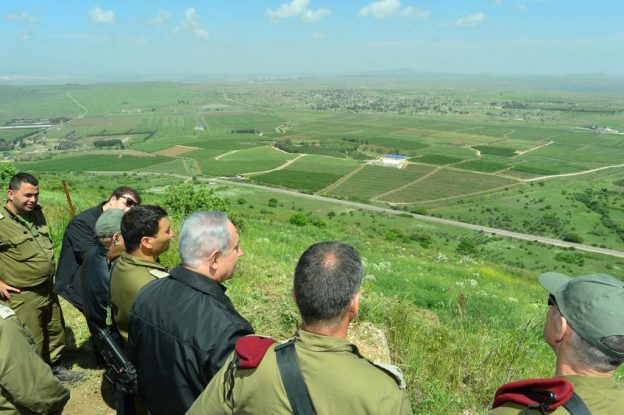
Benjamin Netanyahu is seen during a security tour in the Golan Heights, near Israel’s northern border with Syria
The SAA territorial advancements in the past year highlight that the SAA has the upper hand on the battle field. However, we should also remember that the southern battle is not the final battle, even though it is a vital battle since it includes an offensive that will be combating over 15,000 mercenaries. Contrary to Mr. Robert Fisk’s article in the Independent on June 26th 2018, I think it is too early to state that the battle for southern Syria will go down in history as a moment where “the US has given up on the overthrow of Assad in Syria” because it “abandoned its proxies in southern Syria”. Another battle that should be increasing in intensity in the next few weeks and/or after the southern battle is concluded is the battle to reclaim Northern (East) Syria – a territory under the Syrian Democratic Forces (SDF) and U.S. rebel factions.
The Syrian government including Liwa al-Baqir convened a major meeting of tribal notables from across Syria on June 2 in order to build support for operations against the U.S. in Eastern Syria. Syrian state media claimed the meeting included representatives from seventy clans from Aleppo, Ar-Raqqa, Hasakah, Daraa, and Deir ez-Zor Provinces. According to the Institute for the Study of War unconfirmed reports suggest that the SDF arrested dozens of additional tribal representatives traveling to the meeting from SDF-held Hasaka Province in Northern Syria. Tribal representatives at the meeting denounced the presence of the U.S., France, and Turkey in Syria and called for tribal mobilization to fight them on behalf of Assad. Multiple new pro-regime militia units of unclear size and capability reportedly formed subsequent to the meeting. These units may have joined Liwa al-Baqir with support from Russia and Iran. Not to mention reports released the week of July 15th 2018 highlighting that rebels in Southern Syria are being transported to the Northern part of Syria.
More recent news on July 29th 2018 highlights that the Syrian Democratic Council [the SDF political arm] held a two day meeting with the Syrian government headed by President Bashar Al Assad. Officials belonging to the SDF, which hold large swathes of land in northern Syria discussed the future of the autonomous regions it set up in northern and northeastern Syria. The SDF has made a series of deals with Damascus in recent years, notably in Aleppo when the SAA decimated Syrian Arab rebel groups making a final stand to hold the city. The SDF also came to an agreement with the Syrian government during the Turkish incursion into the then-Kurdish-held Afrin canton in Syria’s north-west corner, allowing Kurdish fighters to cross regime-held territory in a doomed bid to repel Turkish troops and their allies. The SDF, whose military is largely funded by the US as a counter-IS initiative, holds more than 27 percent of the country’s territory, according to the Syrian Observatory for Human Rights. It is still not clear whether rebel troops in northern Syria will be in accord with the SDF and SAA in relinquishing land they have usurped in the past 7 years and have it under the control of Damascus headed by President Bashar Al Assad. Also, according to a statement by SDF spokesperson Leilwa al-Abdullah, SDF forces pushed IS fighters into retreat from an area of 3,100 square-kilometers to a small slither of territory close to the strategic border town of Abu Kamal. A local SDF commander, speaking to Syria Direct said that the “crackdown on the border area” had gone ahead in coordination with Iraqi forces and international coalition airpower.
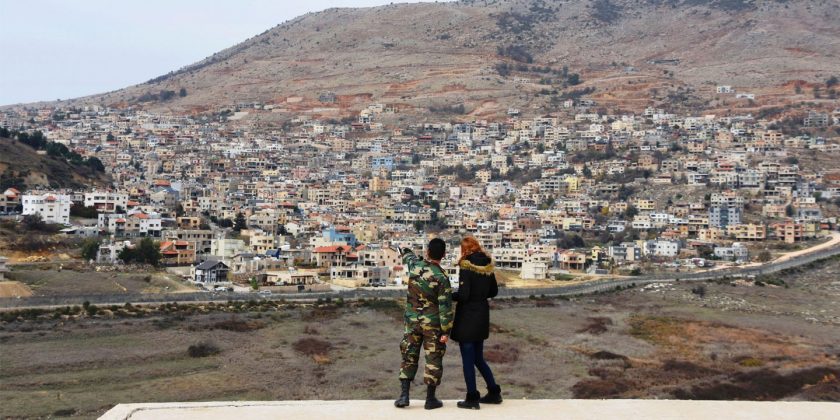
The Golan Heights
Still, recent territorial gains by the SDF may have little bearing on talks with the Syrian government, which could be unwilling to actually cede territorial control or administrative authority to Kurdish-majority forces. Sihanouk Dibo, from the majority-Kurdish leftist Democratic Union Party (PYD), acknowledged that any future talks could be “long and arduous because the Damascus regime is very centralized.” Whether centralized or not, the Syrian Government has historically been committed to the modality of Greater Syria with Damascus being the locus in decision making and autonomous regions conducting provincial policies relating to their provincial preferences. As stated by President Al Assad “Despite the ethnic diversity within each nation, the social fabric of the region by and large is one”. In other words, a region of the historical Bilad Al Sham/Greater Syria space will not be relinquished since the Levant possesses a unified social fabric and most importantly because the Barzani Clan in Iraq is a dangerous example of how U.S. imperialism with its allies can defend decentralization for the sake of geostrategic interest.
Therefore, in regards to the Syrian peace process, peace cannot be implemented when the UNSC resolution 2254 adopted in 2015 – including the P5 – continues to be violated. The delegates meeting at the June 13th U.N-led peace process in Geneva reiterated the importance of the clauses in the resolution which included that a nationwide ceasefire can only occur when member states are serious in halting the funding and training of mercenary entities. The members also reiterated the basis for a Syrian-led and Syrian-owned political transition in order to end the conflict in Syria. The meeting in Geneva did not highlight anything novel that the meetings in Astana or Sochi didn’t already outline. The meeting laid out the so-called four “baskets of reform” for a political settlement of the crisis. They include the drafting of a new constitution, parliamentary elections, the creation of a non-sectarian transitional government and the fight against mercenaries and terrorists. But the talks have made little progress so far as opposition members have failed to find an agreement over the fate of President Bashar al-Assad – a condition that the opposition has long wanted to include in the draft.
It is quite ironic that the Syrian Opposition is adamant in wanting to include a clause that stipulates that the current Syrian president is not allowed to run for president after 2020 and/or practice politics in Syria… it is ironic because while some opposition members discuss the importance of democracy being the foundation for peace in Syria, it is precisely democracy which re-elected President Bashar Al Assad in 2014.
Khaled AL-KASSIMI is a Doctoral candidate in the Department of Political Science at McMaster University in Canada. His research interest relates to the fields and approaches contoured by Critical Security Studies, Development Studies, International Relations, and Decolonial Studies.
Turkey in panic as Assad seeks to reclaim occupied territory
By M K Bhadrakumar | Indian Punchline | August 1, 2018
The meeting of the senior diplomats from Russia, Iran and Turkey in Sochi on Tuesday was prima facie meant to hasten the Astana process on a Syrian settlement. But in reality, it took place in the backdrop of reports that Syrian forces, which have liberated the southwestern provinces of Quneitra (facing Golan Heights) and Daraa (on the Jordanian border) will now proceed to assault the northwestern province of Idlib on the Turkish border.
Ankara has warned that any such move by Damascus will prompt Turkey to pull out of the Astana process altogether in protest. Turkey’s fear is that unlike in the southern provinces, the terrorist groups that control Idlib may fight it out, which would lead to large-scale violence and an exodus of refugees and militants across the border into Turkey. Idlib is estimated to have a population close to 2.5 million. Importantly, though, Turkey seeks to maintain its presence in Idlib, thanks to its enduring links with many of the extremist groups ensconced there. Turkey is equally adamant that the Kurds should not spread their influence into Idlib close to eastern Mediterranean coast.
Turkish President Recep Erdogan personally took up the matter with Russian President Vladimir Putin twice during the past fortnight, demanding that Moscow should restrain Damascus from launching any operations in Idlib. After the meeting in Sochi today, Russian presidential envoy on Syria Alexander Lavrentyev was quoted as saying, “I’d rather refrain from speaking about the city’s (Idlib’s) storming or a pending operation. There are too many rumors and they are ungrounded. Any large-scale operation in Idlib is out of the question.”
He seemed to hint that Russia and Turkey are trying to find a way to influence the terrorist groups to surrender (which was how Daraa and Quneitra were liberated without fighting.) To quote Lavrentyev, “We still hope that the moderate opposition and our Turkish partners, who took responsibility for stabilising this region, will manage it.” But he added, “The threat coming from this zone is still significant.” (In the past 10 days, Russia had shot down as many as four drones launched by the militants from Idlib targeting the Russian military near the Hmeymim airbase.)
On the other hand, Damascus has insisted that it intended to liberate Idlib. All indications are that preparations have begun for a big military operation. The militant groups in Idlib are estimated to be over 50,000 strong and are drawn from Turkish, Uzbek, Chechen, Turkistani and Arab fighters from the Persian Gulf.
Overshadowing the Idlib issue, there is another development that worries Turkey – the direct talks between the Syrian Kurds (previously aligned with the US) and Damascus for reaching a modus vivendi regarding northern Syria up to the Euphrates in the east. The Kurds hope to reconcile with the Assad government in pursuit of their common interest to force Turkey to vacate the large chunks of Syrian territories occupied by it in military operations in the recent years.
Contradictions are galore. For one thing, Russia encourages the newfound proximity between Syrian Kurds and Assad regime. Russia is also keen to vanquish the jihadi fighters who migrated to Syria from North Caucasus and Central Asia. Again, Moscow is one with Damascus on preserving Syria’s unity and territorial integrity at any cost.
On the other hand, it is of supreme importance for Moscow that Turkey is somehow assuaged so that the Astana process as such doesn’t get derailed. At the same time, Russia also places store on its working relationship with Turkey at the bilateral level that is steadily deepening and assuming a strategic character, especially with the downswing in Turkish-American relations lately. The business ties between Russia and Turkey are also flourishing with Russia winning multi-billion dollar contracts in energy projects.
Realpolitik aside, however, morally or legally Turkey has no business to stop the Assad regime from regaining control of the entire Syrian territory. Turkey has blood on its hands by fostering al-Qaeda groups and Islamic State. Equally, Turkish occupation of Syrian territory is untenable on any ground. In reality, Turkey overreached, hoping that it could exploit the US-Russia tensions to bargain with both superpowers and maximize its returns in a Syrian settlement. But President Trump has instead begun tightening the screws on Erdogan lately. Equally, Ankara didn’t expect the stunning victory of the Syrian-Russian operations in southwestern Syria.
There will be growing pressure on Turkey to pull out from Syrian territory in the coming months. Evidently, an American withdrawal from Syria in a near future is on the cards. The Syrian Kurds’ move to reconcile with Damascus is the sure indicator that their American mentors are exiting the war. In short, the US’ capacity to create new facts on the ground in favor of Turkey is virtually zero. This puts Turkey under immense pressure to negotiate a deal with Russia on the best terms available.
To be sure, Assad’s tenacity to reclaim all lost territories is not to be doubted. Make no mistake, he will liberate Idlib, no matter what it takes, and he will thereafter head east towards Jarablus, Azaz, al-Bab and Afrin — territories that are under Turkish control — as well as areas near the Euphrates front line that have been under the control of the Kurdish groups backed by the US. It seems some skirmishes have already begun in the region adjacent to Idlib between Syrian government forces and terrorist groups. Read a report by FARS news agency, here.
Trump threatens Turkey with sanctions. What if he’s serious?
By M K Bhadrakumar | Indian Punchline | July 27, 2018
The frequency with which US President Donald Trump holds out threats to other countries is such that he is no longer being taken seriously. The list of countries threatened by Trump so far includes North Korea, Germany, Canada, China, Venezuela, Pakistan, Syria, Iran and Turkey.
In all fairness, Trump makes no distinction between enemies, adversaries, friends or allies. Turkey, a NATO ally, holds a record of sorts as the country most threatened by the Trump administration. In separate tweets on Thursday, Trump and Vice-President Mike Pence gave an ultimatum to Turkey that unless Andrew Brunson, an American evangelical pastor of a small Protestant church in western Turkey, is released from detention immediately, Ankara should be “prepared to face the consequences” in the form of “significant sanctions.”
For the benefit of the uninitiated, Brunson who has been living in Turkey for 23 years was arrested in the aftermath of the failed 2016 coup attempt to overthrow Erdogan, charged with spying and involvement in the failed coup. The Turkish government had probably hoped for a tradeoff – Brunson in exchange for the Islamist preacher Fetullah Gulen who is living in Pennsylvania whom Ankara regards as having masterminded the 2016 coup attempt to overthrow Erdogan. Ankara has been pressing Gulen’s extradition and Washington has been stonewalling. It’s a complicated case history, since Gulen has had links in the past with the CIA.
Turkey has shrugged off the latest threat from Trump and Pence. However, for Trump, Christian groups form a core constituency politically, and taking a tough stance on the high-profile Brunson case has endeared him to those groups. Dr. Ronnie Floyd, former president of the Southern Baptist Convention, recently made the following remark in praise of the White House effort: “I thank God we have an administration that cherishes the freedom of religion as our founders hoped we would.”
Trump’s latest threat puts Erdogan in a fix because releasing Brunson without a reciprocal move on Gulen’s extradition means a loss of face. Erdogan is acutely conscious of his strongman-image. He must be wondering whether Trump is serious about the ultimatum on Brunson’s release. Brinkmanship comes naturally to Trump. Indeed, with Trump one really doesn’t know what happens next.
But Erdogan can be more than a match for Trump in the ‘art of the deal’. At a meeting today with Russian President Vladimir Putin on the sidelines of the BRICS summit in South Africa, Erdogan added disdainfully that Trump’s real grouse in giving such an ultimatum yesterday could be that Turkey has drawn close to Russia in the recent times. That is a spin, of course. But then, Erdogan is also hoping to extract a big concession from Putin – deferment of the planned military operation to liberate the northwestern Syrian province of Idlib on the Turkish border from Ankara’s proxy groups. Turkey is keen to retain Idlib as its zone of influence.
Does Putin feel impressed that US-Turkish ties are deteriorating? There are no easy answers here. Nonetheless, Erdogan sees no harm in playing Trump against Putin. After all, who knows, Putin may hold back on the assault to liberate Idlib…
Yet, the chances are that this time around, Trump probably intends to carry out his ultimatum to impose sanctions on Turkey. The point is, US patience with Turkey seems to be wearing thin. Turkey is no longer a ‘swing’ state in the US’ Middle East strategies, given the poor state of Turkish-Israeli relations, Erdogan’s ‘pivot to Russia’ and the overall trust deficit in Turkish-American relationship. Erdogan snubbed the US threat of sanctions and upheld his decision to purchase S-400 missile defence system from Russia. Last week, Erdogan bluntly rejected the demarche by Washington that Turkey should cut back its oil imports from Iran.
Featured Video
U.S. General Caine Warns: STRIKING IRAN is a HUGE RISK
or go to
Aletho News Archives – Video-Images
From the Archives
Stealth Bombers and Bunker Busters
Analysis of the so-called 12-Day War, and the triumphantly celebrated Operation Midnight Thunder
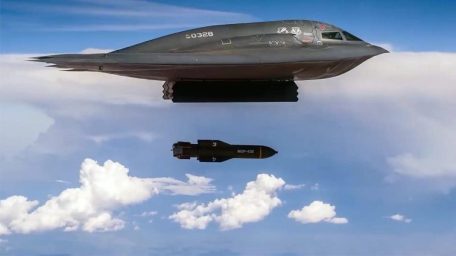
By William Schryver | imetatronink | November 28, 2025
The GBU-57 is a big fat gravity bomb with fins. To achieve effective precision, a B-2 bomber must drop it on its intended target from no further than about five nautical miles — essentially right on top of the target.
Its penetration depth is claimed to be 200 feet. But that capability has NEVER been tested against a seriously hardened deep-underground target encased in layers of high-performance concrete, and topped with a few dozen meters of solid rock. In that sort of real-world scenario, the GBU-57 would be lucky to drill down 50 feet, if that.
It was always ridiculous silly talk to suggest the GBU-57 was the wonder weapon it was made out to be. There is a good reason the US only produced a couple dozen of them and then stopped: they understood its acute limitations in a non-permissive combat environment.
And, notwithstanding the hyperbolic Israeli propaganda, there was never any credible evidence that Iranian medium- and long-range air defenses against fixed-wing aircraft were attrited to any significant degree. And Iranian short-range air defenses were increasingly effective against long-range Israeli drones with each passing day.
As for the B-2: it is a big fat subsonic aircraft. It flies at airliner speeds. A strike on Fordow would entail flying at least 500 miles in and out of Iran. … continue
Blog Roll
 Aletho News
- Glenn Diesen: NATO’s War of Choice – The Sabotage of the Istanbul Negotiations
- What’s Really in the Bag: The Pet Food Industry’s Dirty Secret
- Project Artichoke: 70 Years Ago, CIA Discussed Hiding Mind-Control Drugs in Vaccines
- Drug traffickers trained in Ukraine attack state forces in Mexico
- The tragic reality of Brazilian mercenaries in the Ukrainian conflict
- Zelensky Refused to Discuss Druzhba Pipeline Issue – Fico
- U.S. General Caine Warns: STRIKING IRAN is a HUGE RISK /Glenn Diesen & Lt Col Daniel Davis
- Israel designates five Palestinian media outlets as ‘terrorist organizations’
- Israel, not America, first: Carlson’s Huckabee interview lays bare US foreign policy priorities
- Israeli troops executed Palestinian aid workers at ‘point blank range’: Report
- If Americans Knew
- Fourteen Countries Condemn Huckabee’s Support for Israel Taking Over Most of the Middle East
- Israeli Soldiers Killed Gaza Aid Workers at Point Blank Range in 2025 Massacre: Report
- Israel’s insidious network to propagandize American Christians
- Israel’s Best-Kept Secret: Palestinian Resistance Never Agreed to Disarm
- Trump officials plan to build 5,000-person military base in Gaza, files show
- Are MAGA restrainers pulling their punches this time on Iran?
- The NY Times on the “MAGA” Split Over Israel & USS Liberty
- In Gaza, Ramadan without mosques, imams – Not a ceasefire Day 137
- Footage Shows Israeli Troops Waiting in Ambush, Then Opening Fire on a Palestinian Teen
- The US is on the brink of a major new war that Trump has not even bothered explaining
- No Tricks Zone
- Surprising Discovery: Sahara Is Greening…Billions Of Trees Where Once Thought To Be Barren
- New Research Reaffirms Clouds, Aerosols, And Surface Solar Radiation Are ‘Driving The Climate System’
- Germany: Electric Car Catches Fire At Charging Station, Sets Off Local “Inferno”, Widespread Damage
- New Study: Canada’s New Brunswick Was 1°C Warmer Than Today During The Medieval Warm Period
- Coal Power Back In Trend As Globe Tries To Keep Pace With Growing Demand For Power
- New Study: A 4°C Warmer Beaufort Sea Had ‘No Sea Ice’ 11,700 – 8200 Years Ago
- Unfudging The Data: Dutch Meteorological Institute Reinstates Early 20th Centruy Heat Waves It Had Erased Earlier
- German Gas Crisis…Chancellor Merz Allegedly Bans Gas Debate Ahead of Elections!
- Pollen Reconstructions Show The Last Glacial’s Warming Events Were Global, 10x Greater Than Modern
- Germany’s Natural Gas Storage Level Dwindles To Just 28%… Increasingly Critical
 Aletho News