The Mediterranean Pipeline Wars Are Heating Up
By Viktor Katona | Oilprice.com | December 28, 2018
Things have been quite active in the Eastern Mediterranean lately, with Israel, Cyprus and Greece pushing forward for the realization of the EastMed pipeline, a new gas conduit destined to diversify Europe’s natural gas sources and find a long-term reliable market outlet for all the recent Mediterranean gas discoveries. The three sides have reached an agreement in late November (roughly a year after signing the MoU) to lay the pipeline, the estimated cost of which hovers around $7 billion (roughly the same as rival TurkStream’s construction cost). Yet behind the brave facade, it is still very early to talk about EastMed as a viable and profitable project as it faces an uphill battle with traditionally difficult Levantine geopolitics, as well as field geology.
The EastMed gas pipeline is expected to start some 170 kilometers off the southern coast of Cyprus and reach Otranto on the Puglian coast of Italy via the island of Crete and the Greek mainland. Since most of its subsea section is projected to be laid at depths of 3-3.5 kilometer, in case it is built it would become the deepest subsea gas pipeline, most probably the longest, too, with an estimated length of 1900km. The countries involved proceed from the premise that the pipeline’s throughput capacity would be 20 BCM per year (706 BCf), although previous estimates were within the 12-16 BCm per year interval. According to Yuval Steinitz, the Israeli Energy Minister, the stakeholders would need a year to iron out all the remaining administrative issues and 4-5 years to build the pipeline, meaning it could come onstream not before 2025.
The idea of EastMed was first flaunted around 2009-2010 as the first more or less substantial gas discovery in the Eastern Mediterranean, the Tamar gas field in Israel’s offshore zone, paved the way for speculations about an impending gas boom. Then came the 535 BCm (18.9 TCf) Leviathan in 2010 and the 850 BCm (30 TCf) Zohr discovery in offshore Egypt five years later and suddenly it seemed that an Eastern Mediterranean gas expansion is inevitable. Yet over the years, the operators of Leviathan have already allocated part of their total gas volumes to domestic power generating companies and most notably NEPCO, the Jordanian electric power company (1.6-2BCm per year). Egypt has been concentrating on meeting domestic needs and getting rid of LNG imports, moreover once it bounces back to gas exporter status in 2019, it will only use its own 2 LNG terminals in Damietta and Idku. Related: Has Oil Hit Rock Bottom?
Thus, a pertinent question arises – whose gas would be used to fill the EastMed pipeline? If the pipeline starts in offshore Cyprus, then it would be logical to expect that Cyprus’ gas bounty would be somehow utilized. Yet Cyprus has been lagging behind Egypt and Israel in its offshore endeavors and so far lacks a clear-cut giant field to base its supply future on. The two discoveries appraised heretofore, the 6-8 TCf Calypso operated by ENI and the 4.5 TCf Aphrodite operated by Noble Energy, are not enough to support the construction of a relatively expensive gas pipeline – all the more so as Noble has signed a provisional deal to send Aphrodite gas to Egypt’s Idku LNG terminal, most likely by means of a subsea gas pipeline. If we are to judge the viability of the EastMed on the current situation, there is only Calypso and Israel to fill the pipeline, as Greece’s gas export plans are close to zero on the probability scale.
The subsea section from Cyprus’ offshore zone to the island of Crete lies in depths of 3km and is stretched across a seismically active zone. But there is even more – should Turkey claim rights on Cyprus’ offshore hydrocarbon deposits (in February 2018 it sent warships to scare away ENI’s drilling rig that was on its way to xxx), the project is all but dead. This is far from an implausible scenario as President Erdogan stated that Turkey would never allow for the extortion of natural resources in the East Mediterranean by means of excluding Ankara and Northern Cyprus. Cognizant of the risks inherent in an East Mediterranean gas pipeline, there has been no interest from oil and gas majors to participate in the project. This is worrying as the $7 billion are expected to be financed from private investors, of which there is a palpable dearth – despite the EU’s 35 million funding to promote what it sees as a Project of Common Interest. Related: Wall Street Sees Oil Price Recovery In 2019
Yet even for the European Union, the EastMed gas pipeline presents a bit of a headache as its commissioning would render the Southern Gas Corridor, comprising so far only of Trans Adriatic Pipeline (TAP) with a 10 BCm per year throughput capacity, irrelevant by creating a sort-of competitor. The price of the natural gas to be supplied via the EastMed pipeline might become the biggest obstacle of them all – if the cost of producing offshore Mediterranean gas turns out to be $4-5/MMBtu as expected, the addition of further transportation costs to it all would place EastMed supplied at the bottom range of European gas supply options (Russian gas supply is alleged to be profitable with price levels as low as $4/MMbtu). All this might change if any of the East Mediterranean countries were to discover a giant gas field, altering the economics of production or possibly even liquefaction.
In fact, 2019 will witness several key wells being drilled across Cyprus, Egypt and possibly even Israel. ExxonMobil’s testing of Block 10 in offshore Cyprus would largely point to the overall attractiveness of Cyprus as an oil and gas producing country – the drilling has already started, with results expected in Q1 2019. The ENI-operated Noor offshore field in Egypt, adjacent to Zohr, is a much hotter prospect with BP buying into it lately – most likely it will outshine all the other drilling sites in the Eastern Mediterranean, however, if a big discovery is confirmed, it would be most likely used for Egyptian purposes which run counter to the EastMed gas pipeline. Thus, EastMed’s only hope is that Israel 2nd international licensing round, results to be announced in July 2019, will elicit a couple of Leviathan-like finds that would make pipeline construction profitable. Until then, the prospects are rather bleak.
SYRIA: The Western Rogue States Must Confess their Crimes Against Humanity and be held Accountable

Christmas 2018 in Damascus, Old City, without mortars from Eastern Ghouta since its liberation in April 2018. (Photo: Vanessa Beeley)
By Vanessa Beeley | 21st Century Wire | January 2, 2019
The West and its allies in the Gulf States, Turkey and Israel have waged an eight year war against the Syrian people. The West has besieged, starved and deprived the Syrian people of humanitarian aid while pouring “aid” into the areas controlled by their extremist sectarian proxy armies.
The West has violated international law and it has enabled the destruction of Syria’s history, heritage and cultural footprint. The West has behaved as a collective rogue state without conscience and without pity for a people its media has systematically dehumanised to enable such a crime to take place.
Despite this war of attrition and despite battling disproportionate force, the Syrian people have refused to capitulate or to abandon their secularism in favour of an extremist tyranny that would destroy their society and persecute the minority communities into extinction. Christmas 2018 has demonstrated the victory of Syrian unity over the regime change project incubated in the West which is now a failed campaign lying in tatters at the feet of the self determination of the Syrian people, the valiant defence by the Syrian Arab Army and the steadfastness of the Syrian Government and its President, Bashar Al Assad.
In Aleppo I spoke with Pastor Ibrahim Nseir of Aleppo’s Presbyterian Church, whom I had also interviewed in 2017. The following is a mixture of quotes and paraphrase from our conversation on New Year’s Eve 2018/19.
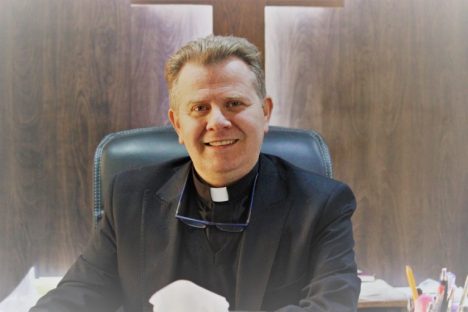
Reverend Ibrahim Nseir, Presbyterian Church, Aleppo. December 31st 2018. (Photo: Vanessa Beeley)
The Presbyterian Church in the Old City of Aleppo was destroyed by the Western-backed terrorist groups in November 2012. An article in the Mennonite World Review in July 2018 described the destruction of the church – “In the old city of Aleppo, Syria, Ibrahim Nseir stands on the pile of rubble that used to be his church. The building where his congregation worshiped is now broken stones and dust. It’s a sunny day, the bright sky a stark contrast to the destruction on the ground.”
After eight years of resistance against the threat of persecution and mass exodus of Christians from Aleppo, Nseir remains defiant and upbeat about the future of Aleppo and Syria. Of the 300,000 Syrian Christians in Aleppo, only 30,000 remain. This is the legacy of sectarian oppression that has been imprinted upon Syria by Western hegemony and it will take generations for it be turned around.
Nseir described the rebuilding process for the Presbyterian Church as difficult but he insisted that it would be rebuilt from its original stones to preserve its historical identity. For Nseir the priorities for Aleppo and Syria are to address the economic situation which has clearly taken a hit on many levels and is suffering in a typical post-war slump. Education is another top priority for this intelligent and enthusiastic Reverend. The intention is to create a center for retreats and conferences at the current Presbyterian Church offices in the center of Aleppo, including a student dormitory.
“We will increase educational capacity by 1000 in the very near future and continue to build upon this progress” Nseir told me.
Education, according to Nseir, is the greatest weapon against extremism and is the only way to re-habilitate children who spent seven of their formative years under occupation of extremist and sectarian factions who worked hard to brainwash almost an entire generation of Syria’s children.
“Ethically the West and the East are responsible for Syria’s destruction. This is not a “Christian” issue, it is a World issue.” Nseir insisted.
The role of the Western media in manufacturing consent for the collective punishment of the Syrian people was clearly a primary cause of the devastation that Nseir and other faith leaders across Syria are now dealing with:
“Western media played more than a negative role, they literally urged the terrorists to take action against the Syrian people by providing false information and blinding people in the West to what was really happening in Syria for eight years. This should never be forgotten.”
Nseir stressed that the healing process for children traumatised by the war would not be easy.
“How do you erase the hatred and horror planted in the brains of 7-10-year-old children by these fanatics? What do you expect from children who have played football with the head of a Syrian Arab Army soldier or who have witnessed the violent abuse of their mother by these terrorists or have seen their father executed by the armed groups? This is the greatest challenge for Humanity and for Syria to put right these terrible wrongs.”
Nseir spoke of the shocking estimated figures of 82,000 children whose father is unknown, referring to the huge number of young women raped or forced into multiple marriages by the terrorist groups and their fighters. How do these children regain their identity and re-integrate into Syrian society? The rebuilding of schools and hospitals must be a priority. The terrorists destroyed “the most developed hospital in the Middle East, Al Kindi” in 2013 and since then, and the destruction of more hospitals across Syria by the terrorist groups, Nseir told me Syria has seen an increase in Cancer and new diseases. Nseir also suggested that this may be attributed to the weapons used by the US Coalition proxies and the U.S itself, which include depleted uranium.
Another important challenge, according to Nseir, is the environmental one. Syria needs to rebuild its natural environment which has also been hugely affected by the conflict. 100,000 trees have been destroyed in Aleppo alone which could lead eventually to desertification of the province if not dealt with. The Governor of Aleppo has recently planted 2,000 new trees but this is an issue that must be addressed with urgency for Nseir.
Nseir strongly believes that Western people should come to Syria independently to see the truth for themselves and report the truth as they see it without any agenda. The Church and the media in the West have maintained a sectarian, divisve narrative which is confusing for people in the West and far from reality.
Nseir addressed the position and status of Syria in the Middle East and described how it has not changed, all that has changed is the perception of Syria portrayed by the media and world leaders who have aligned themselves with the West’s criminal project to partition Syria into sectarian statelets and to remove the elected Syrian government from power by force:
“What has changed since 2011 in reality? Nothing. Syria has always been the protector of the Middle East before 2011, during the conflict and now. The only thing that has changed is the positions of those who turned against Syria, betrayed Syria and who now wish to come back to Syria for protection. We see the Gulf States now change their stance and the UAE has re-opened its embassy in Damascus. The Arab League will welcome Syria back into its fold. Nothing has changed, Syria has remained the same while others have been opportunists and traitors.”
The fact that Syria will forgive its betrayers is testament to what has given Syria victory over its enemies throughout history. With regards to the West, Nseir is not so forgiving:
“The West must go beyond simply stopping its financing of terrorism and the supply of weapons. The West must confess to its crimes against the Syrian people in order to be forgiven. The West must lift the economic sanctions which are a siege upon the Syrian people and it must allow the Syrian people to rebuild in peace without meddling in their affairs. The Syrian people will rebuild according to what the Syrian people want not what the East or the West want. The West has sold the idea that this war was against President Assad but in reality it was against the will of a nation and the people of that nation must be respected”.
Nseir confirmed that the western NGOs are nothing more than political instruments and devices who further the cause of war but he insisted that the West must effectively pay reparations to Syria and expect nothing in return. This is the only way the West can be forgiven by Syria.
Nseir told me that his church will be establishing a medical and health center in the coming months which will be open to everyone in Aleppo to offer medical check-ups and treatment for free. Staff will be trained to deal with the children afflicted by the effects of the war and the terrorist occupation and the plan is to eventually set up special schools to continue the work of rehabilitation for these children. This will enable the coming generations to stand against radicalism and terrorism in the future.
“The West has a duty to respect our dignity and territorial integrity. The Syrian Arab Army has saved the image of our God of Peace, Love and Unity – this has been a spiritual war in Syria not only a military war. The God of love has been embodied by the SAA and our allies and has been victorious over the God of terrorism and hatred. The whole world will change after this war and after Syria’s victory. Syria will be a transformational catalyst for all of Humanity. Syria was never going to be defeated, you only have to study our history to know this. Our society has always embraced diversity and this is the essence of our country. Fanaticism was never going to survive breathing the pure oxygen of our humanity. Actually this demonstrates the stupidity of leaders in the West – to even imagine that extremism has a place in our culture”. Nseir told me.
Nseir ended our talk by stating that the crisis in Syria must be an alarm bell for the country and for its leaders.
“We must re-prioritise our schedule, our agenda and make sure it is not only political but that we address all issues – religious, educational, health care. We must rethink our priorities to ensure a future of peace and stability. At the end I believe strongly that all the negative consequences of this terrible war will be transformed into positive consequences if we address them in the right way. Out of adversity are born the greatest opportunities for the future of Syria and Humanity.”
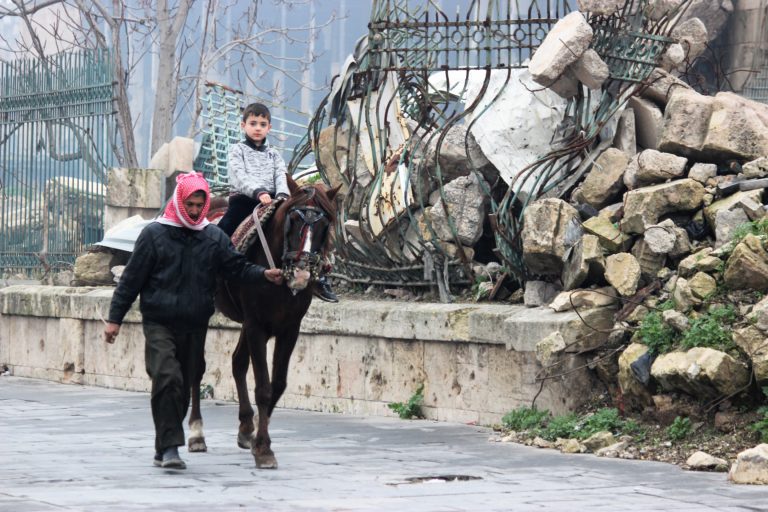
Horse rides on offer at the foot of the Citadel in the Old City of Aleppo. (Photo: Vanessa Beeley)
***
Vanessa Beeley is an independent journalist, peace activist, photographer and associate editor at 21st Century Wire.
Syrian Kurds throw Americans under the bus
By M. K. BHADRAKUMAR | Indian Punchline | December 28, 2018
The Syrian government forces have entered the northern town of Manbij on the Turkish border earlier today. The Syrian military command announced in Damascus that the operation stemmed from the commitment to “impose sovereignty to each inch of Syrian territories and in response to calls of locals of Manbij city.”
The announcement reiterated Damascus’ twin objective of “smashing terrorism and expelling the invaders and occupiers out of Syrian soil.” The government troops have hoisted the Syrian Arab flag in Manbij.
In a highly significant move, Kremlin Spokesman Dmitry Peskov promptly welcomed the development. “No doubt, this is a positive step towards stabilizing the situation,” the spokesman said. He added that the expansion of the zone of the Syrian government troops’ control “is a positive trend.”
It stands to reason that Moscow mediated between the Syrian Kurdish leadership and Damascus. There have been reports that Syrian Kurdish delegations visited Moscow this week as well as the Russian military base at Hmeimim in Syria. A senior Kurdish leader in Manbij told Reuters, “We want Russia to play an important role to achieve stability.”
Indeed, Moscow needs no prompting from anyone in this regard. The Russian Foreign Ministry spokesperson Maria Zakharova said on Wednesday, “The question of fundamental importance is who will assume control of the regions the Americans will vacate. It should be the Syrian government… We believe that the Syrian government is equipped to maintain stability through dialogue and interaction with all the national patriotic forces. This dialogue in the interests of all Syrians can help complete the routing of the terrorists and preclude their reappearance in Syria. It is important not to interfere with the Syrian society’s efforts on the political track.”
The fact of the matter is that while Russia welcomes Trump’s decision to withdraw US troops from Syria and regards it as “important in that it can promote a comprehensive settlement of the situation” Moscow remains extremely wary of what it entails. So far, even a week after Trump’s announcement, Washington has not contacted Moscow to explain its decision.
Foreign Minister Sergey Lavrov drew attention to this while talking to the media in Moscow today: “To the best of my knowledge… Washington wants its coalition partners to assume responsibility. French, British and German service personnel are also illegally deployed on the ground. Of course, there are also the coalition’s air forces on whom they want to shift an extra financial burden. We hope to receive specific explanations… on the assumption that the end goal of all counter-terrorist operations in Syria is to restore Syria’s sovereignty and territorial integrity.”
The known unknown will be the terms of any Faustian deal between Washington and Ankara with regard to the future of the Syrian territories under American control. A US military delegation is expected in Ankara. Moscow and Damascus (and Syrian Kurds) would not rule out the possibility that Pentagon commanders would work on the “neo-Ottoman” and secretly encourage Turkish revanchism. Meanwhile there are also reports that Turkish forces are moving toward the frontlines facing Manbij in “full readiness… to start military operations to liberate the town, according to Reuters.
Suffice to say, Damascus and Moscow have pre-empted Ankara in the race for Manbij. Put differently, they have created a new fact on the ground, which either Ankara has to learn to live with or use military force to change. The latter course is fraught with immense risk, apart from severely jolting the Turkish-Russian political understanding over Syria. It is unlikely that Turkey will push the envelope.
However, to my mind, Turkish President Recep Erdogan is unlikely to cross lines with the Kremlin. A high-powered Turkish delegation comprising Foreign Minister Mevlut Cavusoglu, Defence Minister Hulusi Akar, Turkish intelligence chief Hakan Fidan and the presidential spokesman Ibrahim Kalin is expected to travel to Moscow on Saturday. No doubt, Moscow hopes to engage Ankara constructively.
Interestingly, amidst the dramatic developments concerning Manbij today, Russian President’s Special Representative for the Middle East and African Countries, Deputy Foreign Minister Mikhail Bogdanov disclosed in Moscow today that the Guarantor States of Astana Process (Russia, Turkey and Iran) may hold a summit in Russia next week, depending on the schedule of the three presidents.
Curiously, there has been no reaction from Washington to today’s developments in Manbij. American troops have been patrolling in Manbij town and the tense front line between Manbij and adjacent towns where fighters backed by Turkey were based. Having received the orders from Washington to withdraw from Syria, the local US commanders in northeast Syria will be in a quandary.
Nonetheless, it will be a bitter pill for the Pentagon commanders to swallow that the Syrian Kurds are overnight reconciling with Damascus. This will become additional fodder for Trump’s detractors in the US, too. In fact, sniping has already begun in Washington.
On the other hand, the Syrian Kurds, who have been the US’ main allies in Syria up until recently, have openly declared that they have invited the government forces to enter Manbij. They said in a statement today, “Due to the invading Turkish state’s threats to invade northern Syria and displace its people similarly to al-Bab, Jarablus and Afrin, we as the People’s Protection Units, following the withdrawal of our forces from Manbij, announce that our forces will be focusing on the fight against ISIS on all the fronts east of the Euphrates.”
The statement added that the Syrian government forces are ”obliged to protect the same country, nation and borders” and also protect Manbij from Turkish threats. It leaves the door wide open for the Syrian government forces to eventually regain control of the entire territory vacated by the US.
Assad has offered the integration of the Kurdish fighters into the Syrian Army under separate regiments. The prospects are that Assad’s offer will find acceptance among the Kurds at some point soon. There has all along been a tacit co-habitation between the Syrian Kurdish fighters and the government forces operating in northern regions bordering Turkey. It will be recalled that Assad quietly went to the aid of the Kurdish fighters in February when the Turkish army attacked Afrin region in the northwest in February.
Clearly, it is nonsense to say that the Kurds have been “thrown under the bus”, as Trump’s critics in the US are alleging. The plain truth is that the US created the illusion in the Kurdish mind that the creation of another Kurdistan on Syrian territory, similar to the one in Iraq, could become a possibility. But, fundamentally, Kurds will reconcile with Damascus. The comfort level between the Kurds and the Russians is also appreciable, historically. Moscow has consistently held the view that the Kurds must be represented at the negotiating table in any intra-Syrian peace process. The speed with which Kurds began mending fences with Damascus only underscores that they never quite trusted the Americans and all along had kept their options open.
Trump Extricates Himself from the Trap in Syria, Abandoning the Kurds
By Dmitry MININ | Strategic Culture Foundation | 28.12.2018
It is not only many members of the US establishment who have labeled President Trump’s order to withdraw America’s forces (2,200 troops) from Syria as a betrayal, but also the allies of the United States. They claim that Trump is throwing the Syrian Kurds under the bus and leaving Israel in a state of “strategic isolation.” Also coming in for criticism is the statement by the US administration (the first of its kind) announcing that it has no plans to remove Bashar al-Assad from power.
It may turn out to be Syria’s Kurds (who number about two million) who will face the most dramatic consequences of the president’s decision, for it was they who created the de facto autonomous state of Rojava in northeastern Syria with the Americans’ support. Now Rojava’s very existence is under threat.
Ankara has already stated that it has not given up on its plan for “an offensive against the terrorists” in eastern Syria, but has merely put it on hold for a while (i.e., until the Americans have left). Officially, this has been prompted by the fact that Turkey intends to take over for the US and finish off the remnants of the “Islamic State” (IS) — something over which Trump and Erdoğan have supposedly already reached an explicit agreement. The leader in the White House has already tweeted that this is so. Turkey’s foreign affairs minister, Mevlüt Çavuşoğlu, issued the same confirmation on Dec. 21. If left to its own devices, the Syrian government army could handle a few stray IS units even without the Turks, but Ankara isn’t particularly interested in IS. Turkey needs to wipe Rojava off the map.
According to Çavuşoğlu, the vacuum that will be left after the US troops pull out “can be filled by terrorist organizations,” so Turkey is ready to exert control over those territories (which, as a reminder, are Syrian).
Faced with the dilemma over whether to favor as an ally the mythical state of Rojava or Turkey, the leader in the White House did not hesitate to choose the latter. Although the American troops are slated to leave Syria within 60 to 100 days, the State Department advisors who are helping to rebuild the nation’s infrastructure in northeastern Syria are being pulled out within a matter of days. Brett McGurk, the chief advisor and special presidential envoy in Syria — a man whom the Kurds practically viewed as the architect of their statehood — is openly irate. McGurk, who saw himself as a new version of Lawrence of Arabia, accused the White House of “abandoning the US allies in the region.” However, he himself bears much of the responsibility for the chaos there. It was none other than McGurk who was the primary author of the new Iraqi constitution that plunged that country into the abyss of civil war. And he also wooed the Syrian Kurds on behalf of the US, by dangling promises of their own statehood, which never materialized.
The command of the Kurdish Syrian Democratic Forces has already issued a statement condemning the US decision and proclaiming its determination to continue the fight. Kurdish leaders are less concerned with the Americans’ departure than with the deal the Americans reached with the Turks behind the Kurds’ backs. Their statement calls out Turkey’s intentions to take aggressive action against Rojava, in addition to Ankara’s “dirty plans and games.” The Kurds feel that by simultaneously announcing both the withdrawal of their troops as well as the sale of the Patriot missile-defense system to Turkey, the US has green-lighted the plans for a “Turkish occupation” of their territory. However, for some reason they are requesting protection from the UN, although Rojava is legally within the borders of the Syrian state and thus that kind of conversation needs to be held with Damascus.
What awaits Rojava? The only thing that can save it would be the recognition of the sovereignty of Damascus within its borders. If Syrian government troops enter Rojava, the Turks will not risk seriously damaging their relationship with Russia in order to launch an offensive. Nor do they even need northeastern Syria, as they only need assurances that there will be no further moves to create a Kurdish quasi-state and thus no threats to Turkey’s stability. Damascus and Moscow are ready to provide this. Russian representatives have always expressed their readiness to work with Damascus in order to safeguard the national rights of the Syrian Kurds in a mutually acceptable way. If the Kurds had been willing to move in this direction earlier, their negotiations with the Syrian government could have been conducted in a more favorable atmosphere. But better late than never. If the leaders in Rojava don’t find a way to reach a compromise with Damascus, the Syrian Kurds could be looking at a real calamity.
Trump made the right decision to quit Syrian conflict
Despite the criticism, there is a strong argument that the US president has done the right thing by withdrawing his forces from Syria
By M.K. Bhadrakumar | Asia Times | December 21, 2018
If 700 days out of US President Donald Trump’s 1,461 days of presidency seem a wasteland of unfulfilled promises and expectations in foreign policy – except, perhaps, on the Korean Peninsula – things dramatically changed on December 19 when he announced the troop withdrawal from Syria.
Taken together with Washington’s hurry to negotiate with the Afghan Taliban, it appears that Trump is, finally, on the move as a man of peace, fulfilling the pledge of Candidate Trump to prioritize nation-building over extravagant military adventures in faraway lands.
However, the big question remains: Is the Washington establishment ready for Trump’s action plan? The signs so far are very discouraging. The resignation of US Defense Secretary James Mattis raises the stakes incalculably.
Russian President Vladimir Putin echoed on Thursday the widespread skepticism whether Trump’s decision will be enforced by Pentagon commanders. Yet the odds are that they just might. This needs explaining.
Admittedly, Trump is still a quintessential “outsider” in the Washington Beltway, but then, he also enjoys the backing of a good majority of the American people who are tired of the United States’ endless wars abroad. And that becomes a decisive factor in Trump’s political calculus. This is one thing.
A proxy war
Indeed, a coalition of disgruntled elements and assorted interest groups is forming to debunk Trump. Simply put, they are unhappy that the US military is pulling out of Syria. For many, a gravy train is running while for some others, the issue is Trump – not even Syria.
For the Cold Warriors in the strategic community, Syria is a proxy war against Russia.
Evidently, there is a sophistry in their campaign against Trump’s decision. Principally, three phony arguments are being advanced – that Trump’s decision “baffles” the United States’ allies; that he has thrown the Kurds under the bus; and that a US pullout from Syria harms the anti-ISIS fight.
To take the last argument first – what will be the impact on the Syrian situation? To be sure, ISIS is down, but not quite out. But then, ISIS is today only residual terrorism, after the huge defeat in Iraq.
At any rate, the brunt of the fight against the ISIS was borne by the Syrian government forces and their allies – remember Aleppo? Their grit to finish the job has never been in doubt and there is no reason to fear any let-up.
In fact, their interest lies in stabilizing the security situation in the quickest possible way so the political process leading to a post-conflict Syrian order can be sped up.
Ironically, the departure of the US forces could help matters, since in many ways the US military presence only impeded the anti-ISIS fight in Syria. It is well known that terrorist groups took shelter in the US-led security zones in eastern Syria.
The Al-Tanf base and its 50-square-kilometer security perimeter was only the most glaring example. Again, the “no-fly zones” prevented Syrian and Russian jets from hunting down the ISIS cadres and de facto amounted to US air cover for terrorists.
National security
Succinctly put, the Americans are laboring under an illusion that they alone “won” the war against the ISIS in Syria, or Iraq. This illusion must be purged.
No, without the 2,000 American troops, Syria isn’t about to collapse like a sack of potatoes or become the revolving door for international terrorists. Trust the Russians and Iranians to eliminate the scourge of terrorism from Syrian soil, because it directly affects their own national security.
Therefore, isn’t it the smart thing to do to let “others” do the job, as Trump put it? However unpalatable the thought might be, a tragedy like the attack on the US Marine Corps barracks in Beirut in 1983 is waiting to happen in Syria once the Turkish military crushes and scatters the Kurdish militia, leaving the 2,000 US troops stranded like sitting ducks in 12 bases in the middle of nowhere spread over a vast territory about one-third the size of all Syria.
Wouldn’t Trump know he’s skating on thin ice? For if body bags were to come home, the political cost would be his – not Mattis’.
Equally, Trump can no longer take for granted the Saudi willingness generously to bankroll the United States’ war in Syria, especially if the self-styled humanists on the Hill proceed with their foreign-policy agenda to wreak vengeance on Crown Prince Mohammad bin Salman for the killing of Jamal Khashoggi. You can’t have the cake and eat it too, can you?
The ground reality is that Saudi Arabia, the United Arab Emirates, Qatar and Jordan have exited the Syrian conflict. Egypt has no stomach to get involved and Turkey, of course, has turned hostile. So who are these “allies” that the agitated folks in the US are talking about? The frank answer is: a clutch of British and French operatives and a horde of Western mercenaries. Isn’t this a macabre joke?
The Americans have been acting as “spoilers” in Syria, locked in a geopolitical struggle that has very little to do with fighting terrorism and has only impeded the stabilization of the Syrian situation. Thus it is no coincidence that Trump unveiled his considered decision just as the announcement was made in Geneva that the pan-Syrian committee for the drafting of a new constitution has been set up, which will work under United Nations supervision to galvanize a political process leading to elections and the formation of a new government enjoying the mandate of the people.
Turkey and the Kurds
Finally, the Kurdish factor. The alliance with the Kurdish militia in Syria has severely damaged US-Turkish relations. Turkey will never allow the creation of a Kurdish homeland on its borders, and it has a congruence of interests with Iraq and Iran – and even Syria – in this regard.
On the other hand, without a strong partnership with Turkey, a “swing” state overlooking several regions, American strategies not only in the Greater Middle East but also in the Eastern Mediterranean, the Balkans, the Black Sea and the Caucasus will be at a serious disadvantage. Now, is that something the US can afford?
The US has done a great injustice to the Kurds by giving them false hopes. Leave them alone. They will reconcile with Damascus, availing of the good offices of Russians who have dealt with them from time immemorial.
Plainly put, the Pentagon’s trainers and Special Forces “embedded” with Kurdish men and women fighters helped develop romantic notions of creating an independent country for their partners. This should never have happened.
Turkey Won’t Drop S-400 Deal Despite Trump’s Promise to Sell Patriots – Report
Sputnik – 22.12.2018
The US has been attempting to thwart the Russian S-400 air defence systems’ sale to Turkey ever since the contract was signed in December 2017, threatening to halt F-35 jet shipments to Ankara. In its latest attempt to dismantle the deal, the US State Department approved the sale of US-made Patriot systems to Turkey.
Turkey has “zero chance to drop S-400” deal with Russia despite the US planning to sell its Patriot defence systems to Ankara, Hürriyet Daily News reported citing an anonymous diplomatic sources. The source added that Turkey is going to try and convince Washington that it will take all measures to develop its own software to prevent any alleged problems over the S-400 deployment.
Hürriyet’s source also shared that US President Donald Trump assured his Turkish colleague Recep Tayyip Erdogan that the Congress will not thwart the proposed sale of Patriot missile systems to Ankara, which received a green light from the US State Department earlier this week. Trump reportedly didn’t elaborate how he was going to ensure the fulfilment of this promise.
The media’s diplomatic source also added that apart from his promise on the Patriot sale, Trump vowed that there will be no problem with F-35 jet deliveries, which came into question after Turkey struck a deal with Russia to buy the S-400 systems.
The supplies of the newest fifth generation jets to Turkey are being threatened by a bill, adopted earlier by the US Congress, requiring the US Defence Department to present a report on the possibility of Russian defence systems in Turkey revealing sensitive data about the F-35s and sending it to Moscow. Without a report from the Defence Department, the F-35 deliveries to Turkey will be impossible.
The issue was raised in the US Congress after Turkey signed a $2.5 billion contract with Russia to buy its S-400 air defence systems in December 2017. Ankara pointed out then that it would gladly buy missile systems produced by the US and its allies, if it would have been given such an option.
US leaves trail of bitterness in Syria
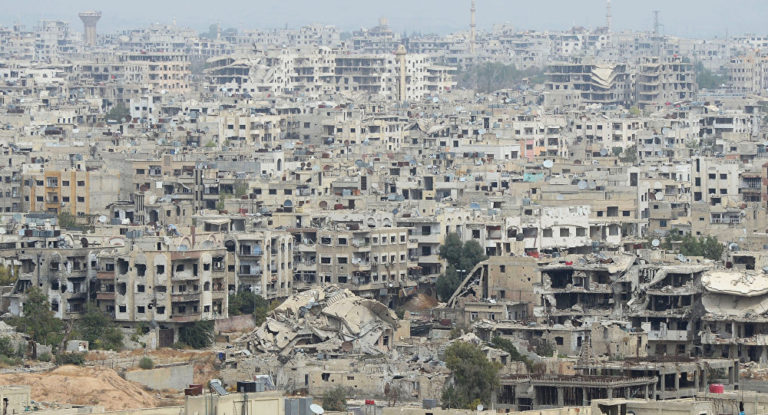
Stalingrad of Syrian war: ancient Syrian city of Raqqa after US bombing
By M. K. BHADRAKUMAR | Indian Punchline | December 21, 2018
On December 17, Ankara was notified of President Trump’s decision on troop withdrawal from Syria. During an earlier phone conversation between him and President Recep Erdogan on Dec 14, Trump had pointedly asked and elicited a positive response from the Turkish leader as to whether Turkey would have the capability to eliminate the remnants of the ISIS in the Syrian tract east of the Euphrates in the event of a US withdrawal from Syria. Erdogan reportedly “reaffirmed” Turkey’s commitment to fight the ISIS.
Ankara likely shared this information with Moscow and Tehran. The three foreign ministers met in Geneva on Dec 19 for a trilateral meeting as guarantors of the Astana format on Syria. The joint statement issued after the meeting, therefore, can be seen as indicative of Turkey’s resolve to give primacy to the trilateral format with Russia and Iran on issues concerning Syria.
To be sure, Turkey will have issues to take up with the Trump administration in the coming days and weeks. As one commentator put it, “For example, will the U.S. collect the weapons provided to the YPG? What measures will the U.S. take for preventing a chaos in the region after the withdrawal? All these require more military and political talks between Turkey and the U.S. Turkey will continue to cautiously follow the situation in Syria.”
However, senior Turkish officials have made it clear that the planned military operations against Syrian Kurds will continue to unfold. Defence Minister Hulusi Akar has been quoted by the state news agency Anadolu as saying, “Now we have Manbij and the east of the Euphrates in front of us. We are working intensively on this subject. Right now it is being said that some ditches, tunnels were dug in Manbij and to the east of the Euphrates. They (Kurds) can dig tunnels or ditches if they want, they can go underground if they want, when the time and place comes they will buried in the ditches they dug. No one should doubt this.”
Yesterday, Erdogan told the visiting Iranian president Hassan Rouhani that Ankara hopes to work closer with Tehran to end the fighting in Syria. Erdogan said at a joint press conference with Rouhani, “There are many steps that Turkey and Iran can take together to stop the fighting in the region and to establish peace. Syria’s territorial integrity must be respected by all sides. Both countries are of the same opinion regarding this.” Significantly, Erdogan also voiced Turkey’s support for Iran (“brotherly nation”) against the US sanctions.
However, Ankara is yet to make an official statement regarding Trump’s Syrian pullout plan. All three countries – Turkey, Russia and Iran – seem skeptical about Trump’s clout to enforce his decision overcoming resistance from the Pentagon. From such a perspective, the resignation of Defence Secretary James Mattis on December 20 will come as confirmation that Trump is indeed forcing his political will, exercising his presidential prerogative to take foreign policy decisions as well as insisting on his supreme authority as commander-in-chief to decide on issues of war involving the US armed forces.
Unlike Turkey and Iran, Russia has voiced opinions on Trump’s withdrawal plans. President Vladimir Putin stated at a press conference in Moscow on Dec 20:
“As concerns the defeat of ISIS, overall I agree with the President of the United States. I already said that we achieved significant progress in the fight against terrorism… There is a risk of these and similar groups migrating to neighbouring regions… We know that, we understand the risk fully. Donald is right about that, and I agree with him.”
“As concerns the withdrawal of American troops, I do not know what that is. The United States have been present in, say, Afghanistan, for how long? Seventeen years, and every year they talk about withdrawing the troops. But they are still there. This is my second point.”
“Third… The current issue on the agenda is building a constitutional committee… We submitted the list to the UN… Maybe not by the end of this year but in the beginning of the next the list will be agreed and this will open the next stage of the settlement, which will be political settlement.”
“Is the presence of American troops required there? I do not think it is. However, let us not forget that their presence… is illegitimate… The military contingent can only be there under a resolution of the UN Security Council or at the invitation of the legitimate Syrian Government…. So, if they decide to withdraw their troops, it is the right decision.”
Overall, Putin commended Trump’s decision, while keeping fingers crossed that as the focus is shifting to the political process will gain traction. Putin didn’t mince words in calling the US intervention in Syria as a violation of international law and UN Charter. The Kremlin spokesman Dmitry Peskov who spoke later in a TV interview was also quite upfront: “The American presence on the Syrian soil is not conductive to attaining the goals of a political and diplomatic solution.” (TASS )
Neither Russia nor Turkey and Iran would expect a cooperative attitude from the American side in a near term over Syria. The US has a stony heart when it comes to Syria’s reconstruction – although it caused immense destruction in that country during its occupation. The US military will be leaving behind a trail of bitterness in Syria. The three other protagonists understood perfectly well that Pentagon commanders were fighting a secretive geopolitical war against each of them. “Good riddance” – that must be the refrain in Ankara, Moscow and Tehran.
Trump’s Syrian Pullout is a Game Changer
By M.K. Bhadrakumar | News Click | December 2018
US President Donald Trump’s announcement on Wednesday regarding the withdrawal of American military forces from Syria has predictably run into strong headwinds in the Washington Beltway. A formidable coalition appeared overnight – comprising the Deep State, US defence and security establishment, leading members of the Congress, major media organs –branding Trump as a maverick. However, the fact of the matter is that Trump made a considered decision.
Basically, it is a political call on his part to advance his consistent stance that the US should not intervene in the Syrian conflict – a stance, we may recall, which Michael Flynn had begun fleshing out even before the Trump presidency began in January last year. Why is Trump asserting his political will?
Clearly, Turkey’s threat to launch an operation “any moment” to crush the US’ Kurdish allies and the deployment of Turkish troops on the Syrian border profoundly influenced Trump’s decision-making. (See my blog There’s no quick fix to US-Turkish tensions.)
Trump made a phone call to Turkish President Recep Erdogan last Friday to urge restraint and signaling a change of course in the US’ Syrian policy. Erdogan later nodded satisfaction over the phone conversation. The point is, the Turkish threat to attack Kurdish groups inside Syria makes the ground situation completely untenable for the US military. The options for the Pentagon will be either to intervene on behalf of its Kurdish proxies and confront the Turkish military (which is senseless), or to watch passively the complete demolition of the zone encompassing one-third of Syria that the US carved out for itself through the past year or more.
More to the point, there is every likelihood of US forces, numbering 2,000 soldiers and spread thinly on the ground, getting caught in the crossfire between the Turkish military and its affiliated Syrian opposition groups on one side and Kurdish fighters on the other. If the Turks vanquish and scatter the Kurdish groups, the US will be left with no local allies. And it will be a only matter of time before the isolated US “bases” in Syria numbering over a dozen will face harassment and predatory attacks by the battle-hardened Shi’ite militia trained and equipped by Iran. It can turn out to be a situation like the attack on the Marine barracks in Beirut in 1983.
The spectre that haunts Trump is of body bags of American soldiers killed in Syria coming home, which of course, will be spelling doom for his re-election bid in the 2020 election. Trump understands that there is a Russian-Turkish-Iranian convergence to evict the US forces from Syria and the only way to counter it can be by committing boots on the ground in much larger numbers, which is of course unrealistic.
Meanwhile, the Pentagon has been pursuing an invidious agenda of creating a quagmire for the Russians in Syria and acting, therefore, as a “spoiler” in any whichever way it can to frustrate the Russian-Turkish-Iranian efforts to stabilize Syria. Time and again, it became apparent that the US forces in Syria maintain covert links with extremist groups, provide cover for them, and disrupt the operations by the Syrian government forces fighting terrorism. The US role in Al-Tanf on the Syrian-Iraqi border is dubious, shameful and cowardly, to say the least.
Quite obviously, the Mission Creep pursed by the Pentagon commanders have come to a point where real danger exists today of direct clashes erupting at any moment involving US forces arrayed against the Russian / Turkish / Iranian / Syrian forces. An extremely risky venture of brinkmanship by the Pentagon commanders has been afoot. There is no way Turkey can compromise with the US-Kurdish axis in Syria. Nor are Russian and Iran going to throw away their hard-earned victory in the Syrian conflict to strengthen the government led by President Bashar Al-Assad. In a major speech in Moscow on Tuesday while addressing Russian Defence Board, President Vladimir Putin touched on the Syrian situation, underscoring, “We will give Syrians all the support they need.” (See my blog Putin warns US against misadventures.)
Equally, Trump cannot be unaware that there is growing uncertainty about the Saudis bankrolling the US operations in Syria, what with the growing tensions in the US-Saudi relations over the Jamal Khashoggi affair. Qatar and Jordan have already pulled out of the “regime change” project in Syria. Suffice to say, Israel is the only American ally in the region, which is today keen on an open-ended US military intervention in Syria.
Trump has been paying a lot of attention lately to mend the fractured Turkish-American ties and to revive the alliance, if possible. Step by step, he has been clearing the debris that had accumulated during the Obama presidency. The extradition of Islamist preacher Fetullah Gulen is a major obstacle, but even here Trump appears to have set the ball rolling. On December 18, Pentagon announced the clearance for a possible sale of the Patriot air and missile defence system to Turkey, notwithstanding Turkey’s purchase of S-400 ABM system from Russia. Trump is also addressing the detention in the US of a top executive of Halk Bank, which has serious political overtones for Erdogan personally. Unsurprisingly, Turkish Foreign Minister Mevlut Cavusoglu acknowledged publicly on December 18 that the climate of bilateral relations is “much, much better” of late. Cavusoglu disclosed that a visit by Trump to Turkey is on the cards.
Having said that, the US’ continued alliance with the Kurdish militia is a red line for Turkey and the relations between Ankara and Washington can never be normal so long as this “unholy alliance” (as Turks perceive it) continues. Ankara will suspect the US intentions toward Turkey so long as Pentagon treats the Kurds as strategic allies, no matter the tactical reasons proffered by the Pentagon commanders.
Trump understands this. And it largely explains his decision to cut the Gordian knot. Significantly, Cavusoglu discussed the US withdrawal plans in Syria with US Secretary of State Mike Pence within hours of the news of Trump’s decision.
The heart of the matter is that the US’ regional strategies can never be optimal without Turkey, which has been a “swing” state. Turkey has a vital role to play not only in the Middle East and Eastern Mediterranean but also in the Black Sea and the Balkans. Above all, Turkey is a NATO power and the alliance loses traction in the southern tier if Ankara does not take active interest, which has been the case in the most recent period. Therefore, on balance, US’ regional strategies have much, much more to gain out of Trump’s decision to disengage from direct military intervention in Syria and to resuscitate the relations with Turkey and re-energize the old partnership.
Of course, interest groups and war profiteers (“military-industrial complex”) in the US will castigate Trump for his decision to order the halt of the gravy train. But their main argument that residual terrorism still remains in Syria is a phony one bordering on rank hypocrisy. For, it is a matter of time before Russia and Iran and the Syrian government forces with their affiliated militia will make mincemeat out of the terrorist groups that have taken shelter in the US- controlled zone in eastern Syria as well as destroy the US-backed extremist groups ensconced in Idlib. Plainly put, the fight against terrorism will be taken to its logical conclusion as soon as the US forces get out of the way and the Pentagon is prevented from playing the spoiler’s role.
Therefore, paradoxically, the decision to pull out from Syria and the rebooting of the Turkish-American alliance can only improve the US’ capacity to influence the Syrian peace process, and regional politics in general. Interestingly, Trump’s announcement came just as agreement was reached in Geneva on the composition of the committee to write a new constitution for Syria, which is a defining moment in the UN-brokered peace process.
Turkey and Russia Push Towards a Resolution in Syria
By Tom LUONGO | Strategic Culture Foundation | 19.12.2018
Turkish-US relations are terrible and deteriorating by the day despite bromides to the contrary. Actions speak louder than words. And that has been all President Trump seems capable of anymore, words not actions.
Since the beginning of l’affair Khashoggi Turkey has been extracting concession after concession from the US as the Trump administration tries to salvage its soon-to-be-unveiled Middle East peace plan.
The latest concession may be the biggest. There’s a report out now that the Trump administration is readying the extradition of cleric Fethulah Gulen, who President Erdogan believes was behind the coup attempt against him in July of 2016.
The US has protected Gulen well beyond any reasonable measure for someone not in their pay so Erdogan’s claims ring true enough. I’ve always thought he was a US intelligence asset and that the US were the ones truly behind the coup attempt.
And since the Trump administration has been desperate to get the Turks to stop leaking details of the Khashoggi murder, Erdogan has pretty much had a free hand to conduct business as he’s seen fit for the past two-plus months.
Whether the US ever returns Gulen to Ankara or not is actually irrelevant; keeping it a sore spot open is its biggest value while Turkey prepares an assault against US-backed YPG forces in Manbij, Syria.
It helps raise Turkey’s position with the other countries involved in the Astana peace process for Syria while keeping Trump, his foreign policy mental midgets and Saudi Arabia on their collective back foot.
Turkey has grown increasingly restless about the US’s lack of movement in turning Manbij over to them. And have now unleashed attacks on Kurdish forces in Northern Iraq to hamper them further.
All of this is making the US presence in eastern Syria more untenable over time while the Saudis struggle with falling oil prices and no longer want to pay the bill for the US’s proxy war.
Don’t kid yourself, the US is struggling to keep its financial pressure up on Iran.
If these things weren’t enough Turkish Prime Minister Mevlut Cavusoglu said recently that Ankara was now willing to work with Syrian President Bashar al-Assad if he survives “democratic and credible” elections. This is rich coming from Turkey, but whatever.
The importance of this statement, however, cannot be overstated. Turkey was one of the major partners in the mission to destroy Syria. And now they have joined with Russia, Iran and China in negotiating the peace process.
They have gone from “Assad must go!” to “Assad can stay.” It is an admission that the US plan for balkanization of Syria will eventually fail and that their best bet is putting maximum pressure on the US to give up its regional plans.
Russia, of course, stands behind Turkey in this and they themselves are now upping the costs on the US and the Israelis. Because, it is now Russian policy to assist Syrian Arab Army forces in proportional retaliation against Israeli aggression in Syrian territory, according to Elijah Magnier.
No longer will the Russians stand aside and allow Israel a free hand over bombing what it says are Hezbollah and Iranian targets within Syria. The SAA will now strike back with a proportional response.
An airport for an airport, as it were.
What started as a State Department operation to install a puppet government and sow chaos in Syria under Hillary Clinton then became one to drain Russian and Iranian resources by wasting their time under John Kerry.
Today, that US/Israeli/Saudi strategy has been turned on its head.
It is now the US and the Saudis that are feeling the pinch of yet another quagmire without end. Moreover, the Israeli security situation is now worse than it was before all of this started in the first place. This necessitates an even more unhinged response from Washington which it cannot defend to the American people as to why we need to stay in Syria forever.
None of this is what President Trump campaigned on. None of this is what candidate and citizen Trump argued for.
The real war of attrition was never about physical resources and money. It was always about time. The Iranians and Russians have played for time. Time brought out the truth about the Syrian invasion. It exposed the real causes of the conflict.
The hope now for the US is that financial pressure will get Iran to knuckle under. But, look at what is happening. Oil prices are in freefall as the global economy slows down thanks to debt saturation, a rising dollar and increasing opposition in the West to neoliberalism and globalism.
Trump whines about this because it upsets his mercantilist plans to corner the energy markets while weaponizing the use of the dollar.
EU technocrats who fancy themselves the inheritors of a waning US empire, bristle under Trump’s plans. They will build an alternative payment vehicle to buy goods and services from sanctioned entities. This is about much more than Iranian oil.
So, while Trump, Bolton, Mnuchin and Pompeo, the Four Horsemen of the Foreign Policy Apocalypse, think they are winning this war on commerce, all they are doing is falling into the very trap Putin, Xi and Rouhani have set for them.
Again, they playing for time. The dollar is the US’s strength and also its Achilles’ heel. And if you are playing for time it is to build alternative channels for trade, oil, gas and whatever else the US deems against its interests without need for dollars.
Trump’s energy dominance plan is as transparent as his narcissism. More likely the sanctions exemptions for buying Iranian oil will be extended in May because he can’t have a global crisis be his fault as he prepares for re-election in 2020.
But, that’s exactly what he’s setting up.
So, now back to Syria.
Those who were set up to be scapegoats – namely Qatar and Turkey – washed their hands of the operation quickly, made deals with Russian President Vladimir Putin and charted their own independent paths. By the time the truth about US involvement in Syria was exposed they were long gone and only the real perpetrators left holding onto poor positions and worse arguments.
All Trump can do now is openly admit that we’re there on behalf of Israel and Saudi Arabia to get Iran. That’s it. He can sell that to part of his base. But, not enough of them to win re-election.
His peace plan is DOA. It died along with the 15 Russian airmen on that IL-20 back in August. I’ll be surprised if it is ever actually announced. That one event set us on this path. It permanently poisoned Russian/Israeli relations as Netanyahu overplayed his hand assisting NATO in a needless provocation which nearly sparked a wider war.
Reports are that Putin doesn’t return his phone calls and now dictates to Bibi what happens next. This also tells me Putin now has control over his Israeli fifth columnists within the Kremlin otherwise this order would never have been issued and made public.
Now Netanyahu is hemmed in on all sides and the Saudis are political pawns between the warring factions of the US government – Trump who wants an Arab NATO and the Deep State that wants him on a platter. Their benefactor, Trump, is in an increasingly untenable position who will soon be forced to choose between hot war and impeachment.
Meanwhile, Iran, Turkey and Russia will continue to bleed out the US forces in Syria while sanctions prove to be increasingly less effective. Simultaneously, the Astana process moves forward with all groups trying to reach out to each other around the sclerotic reach of the US and put an end to this shameful period of US foreign policy insanity.
Trump says ‘we have defeated ISIS’ as US starts withdrawal from Syria
RT | December 19, 2018
Donald Trump has tweeted that ISIS has been defeated as White House announced that US has started pulling out its troops from Syria.
The US has begun the withdrawal of its troops from Syria, the White House said in a statement, adding, however, that the move does not mean an end of the military campaign in the war-torn country but marks a “new phase” in the fight against Islamic State (IS, formerly ISIS).
“These victories over ISIS in Syria do not signal the end of the Global Coalition or its campaign. We have started returning United States troops home as we transition to the next phase of this campaign,” White House spokeswoman Sarah Sanders said.
She also partly echoed an earlier tweet by President Donald Trump, who also said that IS terrorists were defeated while calling the group “the only reason for [the US troops] being there [in Syria].”
According to some reports, the withdrawal might primarily affect the US troops on the ground working together with an alliance of Arab and Kurdish militias, known as the Syrian Democratic Forces (SDF). The US has a total of 2,000 servicemen there, who are particularly involved in training the local militias. The news come as the SDF are reportedly on the verge of retaking one of the terrorist group’s last major strongholds – the town of Hajin, located east of the Euphrates.
The pullout is expected to take between 60 and 100 days, according to reports citing US officials. Additional reports suggested that all US State Department personnel would also be evacuated from Syria within 24 hours.
However, even after the withdrawal, the US would still maintain a sizeable presence in the neighboring Iraq, with some 5,200 troops stationed just across the Syrian border. The aircraft of the US-led coalition – the primary tool of Washington and its allies in the Syrian conflict – will also still be able to continue their air raids flying out of Qatar and other bases in the Middle East.
Washington’s decision also comes days after the Turkish President Recep Tayyip Erdogan urged the US to make its Kurdish allies withdraw from the town of Manbij, located west of the Euphrates, in the northeastern Syria.
Ankara considers Syrian Kurdish paramilitaries as an extension of the Turkey-based anti-government guerrillas and brands the Syrian Kurdish YPG militia as terrorists. Erdogan threatened to order his troops to storm the town if the US fails to fulfill his demand. Last week, he announced plans to launch a military operation in the Kurdish areas “within days.”
In early December, Chairman of the Joint Chiefs of Staff General Joseph Dunford complained that the US lacks trained local fighters on the ground to “provide stability” to Syria.
Trump made an announcement that the US would be leaving Syria “very soon” back in March and never officially walked it back.
Turkey threatens to pull the plug on US
By M.K. Bhadrakumar | NewsClick | December 14, 2018
An impression has been gaining ground lately that the Trump administration is making overtures to Ankara to revive the original US-Turkish project on regime change in Damascus. The recent visit to Ankara by James Jeffrey, the US special representative to Syria, was seen in that light.
Prior to his trip to Ankara, Jeffrey openly suggested at a briefing at the US state department on December 3 that the Astana process on Syria (involving Russia, Turkey and Iran) should be wound up since it failed to advance the political process. As he put it, “US view … is let’s pull the plug on Astana.” In essence, Jeffrey ’s game plan was to somehow break up the Russian-Turkish-Iranian axis in Syria so that the US can tackle each of these three protagonists from a position of advantage.
However, the contradiction here is the US’ alliance with the Kurds, which is anathema to Turkey. Jeffrey tried to fudge this contradiction by saying, “Our policy is to work with the people of the northeast first of all to defeat ISIS… We have no political agenda either with the Kurdish groups, with the Arab groups, or with any other groups inside Syria. Our position is (a) the territorial integrity of Syria under its present borders; (b) we will work with all political forces that are willing to recognize and accept the UN political process and the basic criteria of all of these UN initiatives since 2012 on Syria, which is no threat to the neighbors, no threat to the population, no use of chemical weapons, no support for terrorism, no mass slaughter of one’s own civilians, and accountability for war crimes. That’s our position with everybody and anybody.”
But Turks refuse to be taken for a ride. If anything, the Turkish suspicions regarding the American intentions in northern Syria have only deepened. Two recent developments contributed to this:
One, the US move to establish observation posts next to Turkey’s border. Washington claims that these OPs will prevent possible terrorist threats against Turkey. But Turks are not duffers and they understand perfectly well that the real reason behind this Pentagon decision (announced innocuously almost as an aside by Defence Secretary James Mattis two weeks ago) is to prevent any Turkish operation against the Kurdish forces in northern Syria.
Two, the US disclosure (by the outgoing chairman of joint chiefs of staff Gen. Joseph Dunford) that “35,000-40,000 local forces need to be trained to provide stability” in the territories occupied by the US in northeast Syria. Without doubt, the alarm bells must have rung in Ankara that the US is moving in the direction of creating security underpinnings for an autonomous Kurdistan in Syria similar to what it achieved in Iraq following the Gulf War in 1990-91.
Taken together, Turkish leadership realizes that unless Turkey forcefully acted to thwart the US strategy before it is too late, Ankara may face the stark choice of an independent Kurdish entity appearing along its border with Syria, which of course would imperil Turkey’s own security, territorial integrity and even threaten its unity. Thus, President Recep Erdogan had no option but to announce on Wednesday that Turkey proposes to launch a military operation against the Syrian Kurdish groups in a “few days”.
Erdogan said, “It is time to realize our decision to wipe out terror groups east of the Euphrates. We will start the operation in east of the Euphrates in a few days to save it from the separatist terrorist organization. Turkey’s target is never the US soldiers, but rather the members of the terror group.”
Erdogan rejected outright the US move on setting up OPs along Turkish border, saying, “It is clear that the purpose of US observation points in Syria is not to protect our country from terrorists but protect (Kurdish) terrorists from Turkey.” Meanwhile, other Turkish officials have cast aspersions on the US plan to train 40000-strong local militia and Jeffrey’s diatribe against the Astana process.
Conceivably, Turkish officials conveyed to Jeffrey Ankara’s plans to launch military operations against Syrian Kurds. At any rate, no sooner than Erdogan spoke on Wednesday, Washington reacted sharply, expressing “grave concern” and warning that any such Turkish military operations in Syria will be “unacceptable.”
However, all indications are that preparations are complete on the Turkish side of the border for the military strike. A Turkish daily close to the ruling circles reported that the operation will be carried out with “point shots” – namely, precisely targeting concentrations of the Syrian Kurdish militia. Some 200 such targets have been reportedly identified. Indeed, the Turkish armed forces have the capability to shoot at these targets from the air and ground without entering Syrian airspace and territory. One possibility is that Turkish jets can strike the Kurdish targets from a 30-kilometer depth in the air, while the howitzers can strike up to a depth of 40 kilometers on the ground.
Other reports have claimed that over the past fortnight, there have been significant military deployments to the Syrian border with armored vehicles, tanks and personnel deployed from Şanlıurfa to Akçakale. The plan seems to be that strategic targets of the Kurdish forces will be hit initially with a view to rapidly clear a swathe of Syrian territories so that fighters of the so-called Free Syrian Army (Syrian opposition groups aligned with Turkey) can move into the area.
Indeed, if Erdogan carries out his pledge, it will put the US in an unenviable position of having to watch passively when its allies get pulverized by the jets and artillery. It will be a huge loss of face for the US and, importantly, it will render the best-laid American plans for an open-ended occupation of Syria nonviable and senseless.
Without doubt, Moscow and Tehran will be pleased with Erdogan’s resolve to frustrate the US game plan to divide Syria. Around 30 percent of Syrian territory is presently under American occupation. Some US analysts have openly estimated that if only Turks could be brought on board, that would increase the area to around 40 percent of Syrian territory and eventually help provide an outlet for that land-locked enclave (which also contains Syria’s oil fields) to the Eastern Mediterranean coast and access to the world market.
The heart of the matter is that other than rhetorically, Russia shies away from challenging the US occupation of Syria lest it led to military confrontation, which Moscow has been scrupulously avoiding, no matter the provocations from the American side (eg., drone attacks on the Russian bases in Syria.) As for Iran, it is fighting an existential battle to counter the US sanctions and a confrontation with the US in Syria is not the priority today. Damascus cannot hope to confront the US by itself, either.
Thus, unsurprisingly, a note of triumphalism had lately crept into the US stance – all but implying that the Americans are salvaging victory out of the jaws of military defeat in the Syrian conflict and that it is a matter of time before Russia finds itself in a quagmire, keeping afloat the regime in Damascus out of its own meager resources and increasingly feeling the financial crunch, with Washington effectively plugging any help for Syria’s reconstruction coming from the western allies by making all such aid conditional on the removal of President Bashar al-Assad from power.
No doubt, the simmering US-Turkish tensions in northern Syria over the Pentagon’s alliance with Syrian Kurdish groups have surged. It will be hard landing for the Pentagon if the long-awaited Turkish crackdown begins against the US’ Kurdish allies in Syria.
Featured Video
Iran spent $1 million to wipe out $30 billion in data center plans, and take down Amazon in the ME
or go to
Aletho News Archives – Video-Images
From the Archives
Clash of Civilization, Iran Part II
By Jamal Kanj – Intifada-Palestine.com – January 14, 2011
Israel’s survival kit is: perpetuate conflict, insecurity to rationalize collective hate and finally playing victim.
Devoid of conflict, Israel implodes internally; without hate, Zionism loses its justification; and playing eternal victim to continue blackmailing the West. Absence of this holy trinity, Israel ceases to exist. … continue
Blog Roll
 Aletho News
- Fuel Crisis Deepens: Pakistan Warns Tanker Attack in Red Sea Would Be an ‘Act of War’
- ‘Bucha massacre’ a false flag orchestrated by UK – Moscow
- China Rejects Outside Pressure on Trade Ties After New US Russia Sanctions Bill
- Houthis Keep Advancing as the Red Sea Crisis Deepens
- Iran spent $1 million to wipe out $30 billion in data center plans, and take down Amazon in the ME
- Zionist billionaire pressure to silence Macklemore sparks exodus from Ed Sheeran tour
- House Votes to End Iran War for Third Time
- North Korea Slams US Plan for ‘AUKUS 2.0’ with South Korea and Japan
- Prolonging US-Iran Conflict Not Meeting Interests of Int’l Community – China’s Wang Yi
- EU bans former Zelensky aide from parliament
- If Americans Knew
- AIPAC’s Network Has Already Spent $67.2 Million to Shape the Midterm Elections
- Jewish Supremacist Manufacturing a Civilizational Threat to License Bigotry
- US bans Palestinian president from speaking at the UN
- Israeli Forces Detain Journalist Alaa al-Rimawi amid Widespread West Bank Raids
- Even a pro-Israel Congress member has put a hold on 40,000 one-ton bombs to Israel
- As Gaza crumbles, Israel preps new ground invasion – Daily Update
- ‘We are not like everyone else’ laws that bind other nations do not apply to Israel, says Likud lawmaker
- Trump’s govt makes ‘treasonous’ claim of weapons shortages
- Palestinian-American Journalist Naqaa Hamed Imprisoned by Israeli Forces After Settlers Targeted Her
- U.S. Makes, Israel Takes: The Real Story of U.S.-Israeli Military Cooperation
- No Tricks Zone
- New Study: ‘Global Drought Shows No Detectable Recent Acceleration Under Climate Warming’
- Economic Masterminds: German Socialists Suggest Taxing Productivity Gains Stemming From Using AI
- The South China Sea Has Not Been Cooperating With The Climate Change Narrative
- Energy Crisis: Germany Enters Heating Season With Historically Low Gas Reserve Fill Levels
- New Study: The Antarctic Ice Sheet Gained Mass From 2020-2024 Due To Staggering Snow And Ice Accumulation
- Study: Ocean Heating Rates From Thousands Of Years Ago ‘Dwarf’ Modern Ocean Heating Rates
- Climate Extremists Target, Attack Large-Scale Power Grid Infrastructure In Germany!
- New Study: Antarctic Ice Melt Has Contributed Less Than 1 Centimeter To Sea Level Rise In The Last 30 Years
- Fear Of Debate: Alarmist German Climate Scientist Calls On Mainstream Media To Discredit Skeptic Voices
- End-Of-August Arctic Sea Ice Extent Hasn’t Fallen In 20 Years, Official Data Show!
 Aletho News