Somali court: Money confiscated from UAE plane in 2018 will not be returned
MEMO | January 31, 2022
A Somali court yesterday ruled that millions of dollars confiscated from an Emirati civilian plane in 2018 will not be returned, local media outlets reported.
According to reports, the Banadir Regional Court instructed the Central Bank not to release $9.6 million found in three unmarked bags aboard a Royal Jet plane that arrived at Mogadishu airport in April 2018.
The extent of the court’s jurisdiction on the government’s pledge to return the money is not clear and there has been no official comment from authorities.
The court’s decision coincides with the visit of the Somali caretaker Prime Minister, Mohamed Hussein Roble, to the UAE where he will hold talks with Emirati officials on bilateral relations.
It is unclear whether the money was intended for the military or to buy political leverage. Somalia’s relations with the UAE have been unsettled since June 2017 when the Emirates – along with Saudi Arabia, Egypt and Bahrain – launched a blockage on Qatar. Somalia was pressured to support one of two camps.
Somalia, initially supported Qatar, but officially decided to ally with the UAE and Saudi Arabia in September last year after extensive lobbying by Abu Dhabi.
But last month, Somalia rejected a UAE port deal with Ethiopia and the self-declared state of Somaliland, claiming that it undermines its unity, sovereignty and constitution. Saudi Arabia offered to mediate between Somalia and the UAE but no diplomatic moves were made.
Former Qatar PM: ‘Israel, Arab state planned last Sudan military coup’
MEMO | November 13, 2021
Former Head of Qatar’s Ministerial Council Hamad Bin Jassim Al-Thani revealed on Friday that Israel and an Arab state had planned the latest military coup in Sudan.
In a series of tweets commenting on Abdel Fattah Al-Burhan’s announcement of the formation of a new sovereign council, he posted: “The hands of the Israeli occupation along with the hands of a state from the region are behind this.”
Twitter users commenting on his tweet noted that the Arab state he referred to was the UAE, adding that several leaks relating to the issue have proven this.
“What happened in Sudan is a result of initial planning, cooperation and coordination between Israel and an Arab state,” Al-Thani tweeted.
“Unfortunately, this state claimed in the international meetings that it had changed its policies and started to concentrate only on economy and development,” he added.
The former senior Qatari official asserted that he did not reveal “this fact” to make headlines and stressed the importance of respecting peoples’ will.
Tunisia’s instability and coup are backed by the UAE, Saudi
By Robert Inlakesh | MEMO | July 30, 2021
With Tunisian President Kais Saied seizing power, in what has been called a coup by the country’s largest political party, it seems that the last stronghold of democracy in Northern Africa, having emerged from the Arab Spring, is falling. Celebrated by some, such a transition could have its consequences especially with the involvement of Gulf dictatorships.
Tunisia is often held up as the one standing success story of the 2011 Arab Spring. Having overthrown former President and dictator Ben Ali, during the Jasmine Revolution, the people of Tunisia have experienced a bumpy ride since, but have maintained a democracy. This could all be changing soon with Gulf despots looking to pick up the pieces of any shattering of the nation’s democratic model.
Fears are now emerging, of a repeat of the affairs which transpired in Egypt, destroying the democratic system set up in the country and installing a military dictator. However we aren’t quite seeing such a dramatic shift and there are key differences between the move to dissolve parliament, fire the prime minister and consolidate power, in Tunisia, and the all out military coup which occurred in Egypt in 2013.
But, as there are differences between Egypt’s coup and Tunisia’s, there are also some alarmingly similar forces at work. In Egypt the target was the democratically elected President Mohamed Morsi, he represented the Muslim Brotherhood and in order to remove him, we now know that the UAE and Saudi Arabia both worked to bankroll his overthrow. In Tunisia, for years the UAE and Saudi Arabia have been working to oust the ruling Ennahda Party, which is connected to the Muslim Brotherhood.
The two Gulf regimes have historically bankrolled the opposition to Ennahda and Abu Dhabi was even accused of attempting to organise a coup in Tunisia. As President Kais Saied took control, the office of Al Jazeera came under attack by his security forces who stormed the Qatari funded outlet’s building and forced its journalists out. This has been interpreted as a clear attack on the channel, due to its political leanings towards the side of the Muslim Brotherhood.
Last year it was also reported that Turkish intelligence had foiled an attempted coup plot inside Tunisia, which was allegedly coordinated by the United Arab Emirates. Around that time, a group of demonstrators calling themselves the ‘Salvation Front’ took to the streets of the capital to condemn the Ennahda Movement and its alignment of the Qatari/Turkish axis, it was later discovered that the facebook group for the movement was run by two individuals based in the UAE.
The UAE may have well backed last year’s alleged coup attempt, after their anti-Muslim Brotherhood ally in Libya, Khalifa Haftar, was starting to suffer loses following the introduction of Turkish military aid to help the GNA forces of Fayez Al-Sarraj. Being involved in combating neighbouring Tunisia’s Ennahda Party, could be in part about securing a pro-Haftar dictator for the UAE. The UAE has a well known track record of anti-Muslim Brotherhood and anti-democracy action, having backed reactionary actors in countries like Libya, Egypt, Bahrain, Sudan and Yemen.
It’s also no secret whose side the UAE, Saudi Arabia and even their allies like Egypt are on, having celebrated the political turmoil in Tunisia as the “final fall” of the Muslim Brotherhood. Riyadh and Abu Dhabi have also been using social media accounts to whip up anger online and drive the country further into chaos.
Prominent Saudi journalist, Abdul Rahman Al-Rashed, wrote a celebratory opinion piece in the kingdom’s Asharq Al-Awsat newspaper saying something quite rich for a supporter of Saudi Arabia’s regime: “It is not surprising that the “Brotherhood” has fallen in Tunisia now, but rather it is years later than was expected… they were associated with chaos, assassinations, and deliberate obstruction operations to thwart government action”.
The economic problems, government mismanagement, corruption and the anger over the mishandling of the current health crisis, are all real issues and Tunisia has risen up many times since 2011 to demand a change. None of these real issues should be undermined, nor should it be stated that there is no Muslim Brotherhood alliance. But when it comes to a domestically created group which engages in a democratic process and the power of foreign brutal dictatorships with some of the worst human rights records on earth, it’s clear which option is more detrimental.
It cannot be understated, the insidious role that the UAE and, to a lesser extent, Saudi Arabia, have been playing to stir up civil unrest in Tunisia. If President Kais Saied crowns himself dictator, aligning himself with Abu Dhabi and Saudi Arabia, this could have serious repercussions for the country. It is not as of now certain that we will see such a takeover, but regardless of what transpires, the UAE and the Saudi will not stop working to destabilise Tunisia in order to remove the Muslim Brotherhood’s influence.
Importantly, if the West, which claims to care so much about democracy, truly cared for it at all, it would quickly drop its alliances with the brutal regimes of Saudi’s Mohammed Bin Salman and the UAE’s Mohammed Bin Zayed. The destructive role of these Gulf actors and their strides towards crushing all Arab democracies, whilst remaining the best of friends with the self proclaimed “worldwide spreader of democracy” [the US] shows exactly which side the American government is truly on.
Documents reveal US pressure on ex-Yemeni regime to agree on normalizing ties with Israel
Press TV – July 12, 2021
The interior ministry of Yemen’s National Salvation Government has released a series of confidential documents detailing the United States pressure on the administration of former Yemeni dictator, Ali Abdullah Saleh, to normalize relations with Israel and lift the blockade on products made in the Israeli occupied territories.
According to the documents, the US embassy in Sana’a had asked then-Yemeni authorities to end the economic embargo on Israeli goods, and not to participate in any activities deemed harmful to the Tel Aviv regime, the official Yemeni news agency Saba reported.
The papers expose the level of Washington’s and Tel Aviv’s discontent and frustration with the blockade, and how US officials left no stone unturned to force former Yemeni officials into opening the Arab country’s market to Israeli businesses and their products.
The former US ambassador to Yemen, Thomas C. Krajeski, called on Saleh’s regime to lift sanctions on companies with first-, second- or third-degree ties to Israel, which was not turned down by the Yemeni side.
Then-Yemeni foreign minister, Abu Bakr al-Qirbi, later told the US ambassador that the so-called embargo on US and Israeli goods was not actually being enforced.
The documents go on to reveal that the US embassy urged the Yemeni foreign ministry not to dispatch representatives to an anti-Israel event at the University of Damascus in Syria.
Moreover, the American diplomat described Yemen’s removal of boycott of Israeli products as the fundamental prerequisite for the Arab state’s membership in the World Trade Organization, and its access to free trade and international investment.
Last month, Spokesman for Yemen’s Armed Forces Brigadier General Yahya Saree announced that Yemeni security forces had arrested a man involved in espionage activities on behalf of Israel’s Mossad intelligence agency.
Saree said in a tweet at the time that more details on the matter will be provided in a documentary entitled “The Spy of Mossad in Yemen.”
The documentary will shed light on part of Israel’s intervention in the country and “the plan to target Yemen militarily, and other secrets revealed for the first time,” the senior Yemeni military figure pointed out.
The developments come as earlier reports said that Israel and the United Arab Emirates have been working to establish a spy base on Yemen’s strategically-located island of Socotra.
The UAE has also been accused of constructing an air base on the Mayyun Island, situated off the Yemeni coast in the Bab el-Mandeb.
Both activities have drawn strong condemnation from the Yemeni government, which has described them as violation of Yemen’s sovereignty and international law, especially following the illegally-run tours to Socotra from Abu Dhabi, some of which included Israeli tourists.
“The transfer of tourists to the Socotra Island reveals the plans and programs of the occupying UAE, which are in line with the Zionist schemes to dominate Yemeni islands as well as the steps towards normalization with the regime,” a statement read back then.
Yemen’s popular Ansaullah resistance movement has previously threatened to attack Israel if it was “involved in any action against Yemeni people.”
The Israeli regime took the threats seriously, and deployed its Iron Dome and Patriot missile systems around the southern city of Eilat early this year.
Where the Abraham Accords are (and aren’t) going
Israel has improved its relationship with the UAE, but what about other Gulf countries?
By Giorgio Cafiero and Kristian Coates Ulrichsen | Responsible Statecraft | July 7, 2021
On June 29, Israel’s Foreign Minister Yair Lapid arrived in the United Arab Emirates, marking the first official trip by any chief Israeli diplomat to the Gulf country. Former Prime Minister Benjamin Netanyahu had wanted to visit Abu Dhabi while in office, so the timing of the visit so soon after the new Netanyahu-less government was sworn in was notable.
While Lapid was in the UAE, Israel inaugurated an embassy in Abu Dhabi and a consulate in Dubai, representing an important milestone in Emirati-Israeli relations nine months after the Abraham Accords were signed in Washington last September.
Lapid’s trip highlighted how the bilateral relationship has overcome challenges posed by the recent 11-day Gaza-Israel war. Although Emirati officialdom publicly condemned Israel’s conduct in East Jerusalem and the West Bank, and called on both Hamas and Israel to halt attacks (which notably did not single out Israel) in May, the UAE is not cooling its relations with Israel. To the contrary, Abu Dhabi is keen to find ways to build on the Abraham Accords and enhance its ties with the Israelis notwithstanding the unresolved question of Palestine.
While with Sheikh Abdullah bin Zayed Al Nahyan, the UAE’s Minister of Foreign Affairs and International Cooperation, Lapid signed an economic and commercial cooperation agreement. The two also co-authored a highly optimistic article in Abu Dhabi’s The National newspaper where they outlined their outlook for the Emirati-Israeli relationship as well as for “peace” across the greater region: “Peace isn’t an agreement you sign – it’s a way of life. The ceremonies we held this week aren’t the end of the road. They are just the beginning.” (Technically, the UAE-Israel accord is not a “peace” agreement because the UAE, which gained its independence in 1971, has never been at war with Israel.)
Beyond the rhetoric and the symbolism, what are this relationship’s substantive elements and what does this partnership truly mean in practice nine months after the accord’s signing?
Bilateral trade since September 2020 has reached around $675 million. The two countries have signed a long list of trade and cooperation agreements. Media, education, and tourism are all promising sectors that are starting to take off. It is significant that amid the global pandemic, which greatly harmed the UAE and all other Gulf Cooperation Council states’ tourism sectors, 200,000 Israeli tourists visited the UAE with most flying to Dubai.
Technology may be the area where the Emiratis have the highest hopes for this relationship. The potential benefits of formalized ties with the region’s most technologically innovative and advanced country are clear to the UAE. This is particularly true with respect to cybersecurity and to the potential acquisition of offensive cyber-capabilities by the UAE. As Sheikh Abdullah stated, the Emiratis are pleased that the Israelis will participate in Expo2020, an event to be held later this year in Dubai that will bring 192 countries together through technology, innovation, science, and art.
Nonetheless, the Emirati-Israeli trade relationship has thus far not lived up to its expectations. There has also been a degree of disappointment among those who were expecting the partnership to take off much faster following then-President Donald Trump’s announcement of the Abraham Accords.
Some anticipated deals have not taken place. For example, there was the suspension of the 50 percent sale of Beitar Jerusalem (a Jerusalem-based professional football club with an anti-Arab image) to a member of Abu Dhabi’s royal family in Abu Dhabi, Sheikh Hamad bin Khalifa Al Nahyan. In addition, an Israeli energy firm that planned to sell its share of a gas field to Mubadala Petroleum (a subsidiary of the UAE’s sovereign wealth fund, Mubadala Investment Company) missed a deadline for completing the agreement, although, according to the UAE’s side, the deal remains set to proceed. Time will tell how many and how soon major government-to-government and private sector transactions will indeed take place.
Abraham Accords, the Gulf, and Africa
Despite the political risks for any Arab state that normalizes relations with Israel, the UAE has vocally stood by the Abraham Accords, which, in the words of its ambassador to Washington, Yousef al-Otaiba, “move the region beyond a troubled legacy of hostility and strife to a more hopeful destiny of peace and prosperity.” But Abu Dhabi at this point does not appear to be leading any trend within the Gulf region toward the formalization of relations with Israel.
In Kuwait, Oman, Qatar, and Saudi Arabia, the 2002 Arab Peace Initiative remains popular and the only viable means of reaching a fair and lasting settlement between Israel and the Palestinians. This is true at the highest levels of government and among these countries’ general publics. But Tel Aviv almost certainly will not under any foreseeable circumstances agree to the API’s terms, which require Israel to return to the 1949-1967 borders and permit the Palestinians to have an independent state with East Jerusalem as its capital in exchange for opening diplomatic relations. Therefore, among GCC states, the UAE, along with Bahrain, will probably stand alone on the normalization question for some time.
As the GCC state with the most pro-Palestinian stance, Kuwait is most strongly opposed to normalization and unlikely to change its position. Oman maintains pragmatic, albeit unofficial, relations with Israel as highlighted by Lapid’s phone call with Oman’s foreign minister Badr al Busaidi on June 24, plus Netanyahu and other Israeli prime ministers’ visits to Muscat since the 1990s. But Oman remains committed to the API, as affirmed by Muscat’s chief diplomat at an Atlantic Council event held on February 11.
Qatar has a special role to play in Gaza that would be jeopardized by “abandoning” the Palestinians in exchange for normalization with Israel. Through Al Jazeera, which focuses heavily on the plight of Palestinians, and the tendency of Qatari diplomats to advocate on behalf of Palestinians in international forums, Doha’s regional and global image has much to do with its ability to take firm positions on certain international issues that contribute to the image of a pro-human rights foreign policy.
Finally, Saudi Arabia, due to its special role across the wider Islamic world, its authorship of the API, and its own internal dynamics that are fundamentally different than the smaller GCC states, will likely continue seeing normalization of relations with Israel as too risky, at least so long as King Salman remains on the throne.
Within this context, Israel will likely have its next diplomatic openings in the Islamic world not in the Persian Gulf, but instead in impoverished parts of sub-Saharan Africa where countries such as Niger, Mali, and Mauritania could have their economic interests advanced by joining the Abraham Accords. It will be important to see what actions Abu Dhabi might take to incentivize these African countries, many of which are major recipients of Emirati aid, to formalize ties with Israel. Enhanced Emirati assistance in exchange for normalization with Israel was already evident in Sudan’s decision to normalize ties with Israel, and the UAE may take a similar approach with these and other predominantly Muslim and poor African states.
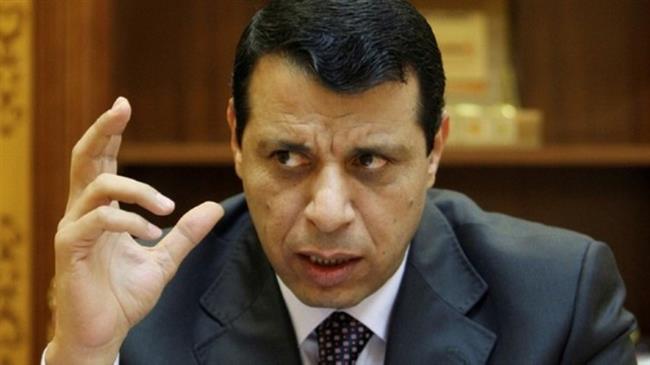
Arab regimes seek to field Israeli-backed Dahlan for Palestinian elections
Press TV – February 7, 2021
Several Arab states are reportedly putting pressure on Palestinian political factions to reinstate exiled former Fatah strongman Mohammed Dahlan and field him against Hamas in the upcoming elections.
Sources told Arabic Post news website on Saturday that the UAE, Egypt and Jordan are trying to compel Fatah, Palestine Liberation Organization (PLO) and Palestinian Authority (PA) President Mahmoud Abbas to reinstate the Israeli-backed Dahlan and his supporters.
Abbas dismissed Dahlan from the movement in 2011 and stripped the 58-year-old of all his merits, after which he fled to the United Arab Emirates.
Last September, US Ambassador to Israel David Friedman set off an uproar after suggesting Washington was considering supporting Dahlan to overthrow Abbas as the next Palestinian Authority chief.
Dahlan was sentenced in absentia to three years in prison in 2016 by a Palestinian court for corruption, and ordered to repay $16 million, according to his lawyers.
Dahlan once led a coup against the elected Hamas government in Gaza in 2007. The plan was a massive failure which saw Hamas rout out Dahlan’s forces in a matter of days in the summer of 2007.
President Abbas announced in a decree last month that the 2021 general elections will include legislative elections being held on May 22, presidential elections on July 31 and the Palestinian National Council elections on August 31.
Leaders of 14 Palestinian political factions, including Hamas and Fatah, are scheduled to start a comprehensive national dialog in the Egyptian capital of Cairo on February 8, aiming to reach an agreement on the mechanism for holding the general elections in Palestine.
Sharjah: Emir’s wife criticises UAE-Israel education cooperation

MEMO | January 29, 2021
The wife of the Emir of Sharjah has criticised the UAE’s cooperation with Israel in the education field. Sheikha Jawaher Bint Mohammed Al-Qasimi made her comment about an online meeting between the ministries of education in the UAE and Israel to discuss cooperation, student exchanges, and joint academic studies.
“Their [the Israelis’] curriculum encourages the killing of Arabs and stealing Arab lands,” she said on Twitter. The Sheikha also retweeted a post by “Ahmed”, a tour guide, about Andalusia in which he recalled the background of Israeli Minister of Education Yoav Galant.
“Who is the Israeli Education Minister Yoav Galant?” wrote the tour guide. “He is one of the bloodiest generals in the history of Israel. He participated in the killing of Hassan Salameh in Beirut in 1979. He is the leader of the operation to storm the Jenin [refugee] camp, which led to the killing of dozens of defenceless Palestinians, and operation Grapes of Wrath against Lebanon (Lebanese Qana massacre) in 1996.”
Sheikha Jawaher’s tweet is the most prominent and explicit objection to have emerged from the ruling circles in UAE against cooperation with Israel. Hundreds of Twitter users have praised her courage in expressing her opinion.
In 2013, the UN-appointed Sheikha Jawaher as the first prominent advocate for the UN High Commissioner for Refugees in the UAE. This, said the international organisation, was because of her “proven track record in the field of humanitarian work, community support, and women’s empowerment.”
The UAE and Israel signed an agreement last September to normalise their relations under US auspices, despite Palestinian and Arab objections.
READ ALSO:
Kuwait school book shows Israel on map in place of Palestine
Pakistanis hold massive rally against ties with Israel
Press TV – January 23, 2021
Tens of thousands of Pakistanis have held an anti-Israel march in the country’s major city of Karachi, rejecting the possibility of normalizing ties with the occupying Israeli regime.
The “million-man march” organized by opposition Jamiat Ulema-i-Islam-Fazl (JUI-F) was held with participants donning the colors of the JUI-F and raising tall black and white striped flags.
“Israel is involved in the genocide of Muslims in Palestine and we would never allow the federal government to establish diplomatic relations with it,” JUI-F leader Maulana Saleemullah Alwazi told Pakistani daily The News International.
In recent months, the news of deals signed by a few Arab dictatorships to normalize diplomatic relations with Israel under intense US pressure has sparked widespread anger among Pakistani people, who hold strong feelings for the Palestinian cause.
In December, top Pakistani officials fiercely denied rumors publicized by Israeli news outlets that Islamabad was moving towards a similar deal.
Pakistani Prime Minister Imran Khan rejected as “baseless” reports of his government officials visiting Israel, insisting why would any of his ministers visit Tel Aviv when Islamabad does not even recognize Israel.
Pakistan’s Foreign Minister Shah Mahmood Qureshi said later in December that he had informed the UAE — one of the US-backed kingdoms that recently normalized ties with Israel — of Islamabad’s “steadfast” policy towards Tel Aviv, insisting that the country will refuse to recognize it until the issue of Palestine is resolved.
The top Pakistani diplomat said he had explained to his Emirati counterpart Sheikh Abdullah bin Zayed Al Nahyan the “depth of emotions and feelings Pakistanis have about Palestine and Kashmir.”
The normalization trend has drawn widespread condemnation from Palestinians, who seek an independent state in the occupied West Bank and Gaza Strip, with East Jerusalem al-Quds as its capital. They say the deals are “a stab in the back” of the Palestinians.
Top Israeli Rabbi Visits UAE, Inaugurates Jewish School

Israeli rabbi Yitzhak Yosef
Al-Manar | December 19, 2020
The Zionist entity’s Chief Sephardic rabbi visited the United Arab Emirates (UAE) on Thursday, marking the first trip by an Israeli senior religious leader to an Arab state.
Rabbi Yitzhak Yosef’s itinerary included inaugurating a Jewish day school in Dubai and naming a local chief rabbi, Israeli media outlets reported on Friday.
The rabbi joined over 50,000 Israelis who have already traveled to the Gulf kingdom since commercial flights connected the two sides. The Zionist entity and the UAE also reached an agreement on visa waivers.
Dubai’s Jewish community center has reportedly increased its staff sixfold, from five to some 30 employees, and about 150 restaurants have started serving kosher dishes.
Israel and the UAE normalized ties earlier this year as part of a US-brokered deal that also included Bahrain. The so-called Abraham Accords have paved the way for subsequent Israeli normalization agreements with Sudan and Morocco.
UAE to Import Israeli Fruit and Vegetables
Palestine Chronicle | November 2, 2020
The UAE is expected to begin importing Israeli fruit and vegetables this month, Israel’s Agriculture and Rural Development Ministry has announced.
Official authorization is said to have been granted last Thursday following a series of meetings and coordination between Minister Alon Schuster, ministry employees and the UAE’s Ministry for Climate Change and the Environment.
“This is wonderful news for Israel’s farmers,” Schuster is reported as saying by the Jerusalem Post. “The agreement that we signed with the UAE is moving us forward and into a joint future in the field of agriculture.”
With UAE agricultural imports valued at around $10 billion a year, this latest agreement — which is a result of the normalisation deal signed in August — is highly lucrative for the occupation state.
At the moment, the UAE does not appear to be taking any measures to ensure that fruit and vegetables imported from Israel are not produced in the illegal settlements across the occupied Palestinian territories.
Last week it was reported that Israeli wine produced in the occupied Syrian Golan Heights is to be sold in the Emirates.
War-Weary Yemenis See Threat in Israel’s Increasingly Public Role in Their Country
By Ahmed Abdulkareem | MintPress News | October 30, 3030
Israeli battleships now sit side by side with Emirati corvettes ominously docked in Hodeida’s territorial waters in a blatant sign of Israel’s increasingly visibly role in the Saudi-led Coalition’s half a decade long war in Yemen. The ships also represent something else to residents in Western Yemen, where a Houthi-led commemoration of Prophet Muhammad’s birthday on Thursday turned into a demonstration against what many see as an imminent threat to the very identity and soul of Islam, their autonomy, security, and to their brethren in Palestine.
Despite an ongoing fuel crisis, the threat of COVID-19, and one of the bloodiest wars currently raging anywhere on the planet, massive rallies took place across most of Yemen’s provinces. Protesters shouted slogans against French President Emmanuel Macron, whose public defense of cartoons mocking Islam’s holiest figure, Prophet Muhammad, under the guise of free speech is seen as hypocritical coming from a country where questioning details of the Holocaust can land someone in jail. Demonstrators, and indeed many Muslims across the region, see the events in France as hiding a more nefarious goal of dehumanizing Muslims and gutting the identity of its adherents from within.
Demonstrators carried green flags, a symbol of the Prophet Muhammad, and banners emblazoned with slogans against Macron, the Saudi coalition, and its new Israeli partners. In Yemen’s capital city of Sana’a, where the largest demonstrations took place, hundreds of thousands gathered in the southern district of Al-Sabaean. Expats from 20 countries, including Sudan, Syria, Palestine, Egypt, and Bangladesh took part in the protest. A delegation from the southern Saudi province of Najran even joined.
The events were organized primarily by the Houthis and Houthi leader Abdulmalik Al-Houthi took to the podium to give a televised address to a massive audience in which he warned that western intelligence agencies in both the United States and France were involved in supporting the same extremist Salafi interpretation of Islam that is the widely practiced in Saudi Arabia, in part to tarnish the image of the religion and to justify wars in Muslim countries.
Al-Houthi also warned that distortion and misinterpretation of Islamic teachings had created a deep rift among Muslims. “Western [countries] have used such deviation to insult the Holy Qur’an and Islam. There is no mercy or sympathy whatsoever in Western civilization. They trample on human societies, deprive people of their freedom, plunder their wealth and occupy their lands, and then lecture others on human rights,” he said.
The massive demonstrations came despite threats of violence from the very same elements that Al-Houthi warned of. In the weeks leading up to Thursday’s rallies, police implemented special measures to ensure security during proceedings, including the banning of large trucks from central Sana’a and the establishment of additional checkpoints in the Yemeni capital and other provinces.
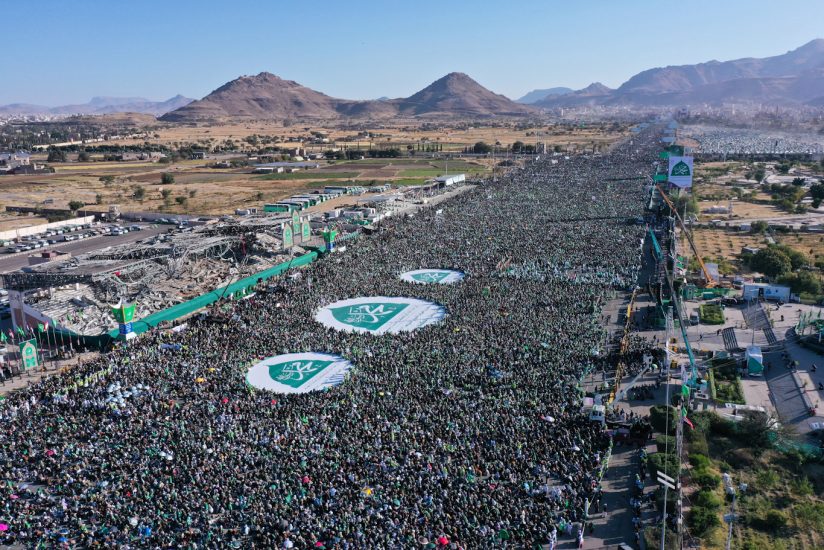
An aerial shot shows massive crowds at Thursday’s rally in Sana’a, Oct. 29, 2020. Hani Mohammed | AP
Despite the additional security measures, Hassan Zaid, the Houthi Minister for Youth and Sports, was assassinated on Tuesday as he drove his car through Sana’a. His 11-year-old daughter was seriously injured in the attack. Zaid was one of the most influential political opponents to Saudi Arabia and was wanted by the Kingdom, which offered a $10 million bounty for information leading to his capture. Houthi security forces said that they had also thwarted dozens of other planned attacks on Thursday’s demonstration.
Israeli settlements in Yemen?
The sheer scale of this week’s demonstrations dwarfed similar rallies that have taken place in previous years, not only due to Macron’s comments in France but because of fierce opposition to Israel’s new partnership with the UAE and other wealthy Gulf states, and its increasingly active presence in Yemen.
Yemenis fear that Israel not only seeks control of the strategic Bab-el-Mandeb strait, efforts that MintPress has covered in previous months, but also that it seeks a permanent footprint inside of Yemen and hopes to replace the original inhabitants of the islands and other coastal cities with Israeli settlers in a move reminiscent of the land grabs that led to the eventual annexation of land in what is now Israel.
In October, Houthi spokesman Yahya Saree warned that Israel was planning to naturalize tens of thousands of Yemeni-born Jews, emphasizing that such a scenario posed a grave threat to Yemen’s national security. Saree presented a number of National Security Agency documents that were seized when the Houthis took control from the government of former President Ali Abdullah Saleh, who ruled Yemen for 33 years.
Those documents detailed visits by Israeli officials to Yemen, facilitated by the UAE, in which a number of economic, cultural, and agricultural agreements were brokered alongside an agreement to open Yemeni airspace to Israeli aircraft. The most dangerous documents, according to Saree, relate to “the modernization of the Yemeni military forces.”
According to the documents, Israeli diplomat Bruce Kashdan arrived in Sana’a on an unannounced visit on July 14 of 2007, which lasted 48 hours. During that trip, Kashdan met with Yemeni military and security top brass who are relatives of Saleh. The Israeli official left Sana’a International Airport on July 16, 2007. The visit had been arranged by Yemeni officials in collaboration with the United Arab Emirates. Kashdan, who was also serving as a coordinator of relations between Tel Aviv and Dubai at that time, had also visited Yemen on February 2, 2005.
A delegation from the Israeli Knesset also visited Sana’a in March 1996 and received remarkable hospitality given the Yemeni government’s official stance towards Israel at the time. Knesset members met with several senior security and civilian officials headed by former president Saleh. Many Israeli delegations visited Yemen between 1995 and 2000 under the cover of tourism, commerce, and investment, according to the National Security Agency documents.
Saree accused the UAE and Israel of reviving a project that granted Israeli citizenship to more than 60,000 Yemenis. According to a memorandum to the UAE’s foreign minister in 2004 by Hamad Saeed Al-Zaabi, the Emirati ambassador in Sana’a, an Israeli delegation visited the Yemeni capital as part of normalization efforts and presented demands to build a museum celebrating Yemeni Jews in Sana’a among other moves that included naturalizing 45,000 Yemeni Jews as Israeli citizens. The Emirati ambassador described the move as part of a broader effort being pushed by the United States.
Ahmed AbdulKareem is a Yemeni journalist. He covers the war in Yemen for MintPress News as well as local Yemeni media
Featured Video

or go to
Aletho News Archives – Video-Images
From the Archives
Israel Would Have No Qualms About USS Liberty-Style FALSE FLAG If Iran Campaign Falters – Analysts
By Ilya Tsukanov – Sputnik – 18.06.2025
Donald Trump is mulling whether or not to join Israel’s aggression against Iran as Tel Aviv faces problems sustaining its defenses against growing counterstrikes, and apparently lacks a realistic game plan for an end to hostilities after failing to achieve its goals. Analysts told Sputnik how the US could be ‘nudged’ into the conflict.
“The US is already assisting Israel with supplies, intel, refueling support, etc. One of the many US posts in the region could be attacked for a casus belli,” former Pentagon analyst Karen Kwiatkowski explained.
“If Trump doesn’t comply with Israel’s demand” and join its aggression voluntarily, “a false flag may be needed” to drag the US in, Kwiatkowski, retired US Air Force Lt. Col.-turned Iraq War whistleblower, fears.
Netanyahu has a diverse array of options at his disposal, according to the observer, including:
- a false flag against US assets abroad blamed on Iran or one of its Axis of Resistance allies, like the Houthis
- a US domestic attack or assassination blamed on Iran
- Iranian air defenses ‘accidentally’ hitting a civilian jetliner carrying Americans
- use of a dirty bomb or nuclear contamination somewhere in the region blamed on Iran
- even blackmailing by threatening to use nukes against Iran if the US doesn’t join the fight
Kwiatkowski estimates that Israel probably has “enough blackmail power” against President Trump and Congress to avoid the necessity of a false flag operation, but a “USS Liberty-style” attack, targeting the soon-to-be-retired USS Nimitz supercarrier that’s heading to the Middle East, for example, nevertheless cannot be ruled out entirely, she says. … continue
Blog Roll
 Aletho News
- Outlasting the Superpower: The Reasons Why Iran is Beating uhe US and Israel
- Top PMU commander, over a dozen fighters killed in new US strikes on Iraq
- Is Netanyahu’s war gamble threatening the future of ‘Israel’?: FT
- Smotrich calls for annexation of South Lebanon to Litani River
- Echos of Gallipoli? Hormuz and the Geography of Hubris
- Pakistan PM backs Iran’s right to self-defense amid tensions
- Hungary blasts ‘fake’ EU accusation
- SAFE Debt Trap: Poland’s €43.7 Billion Bet on Unipolar Illusion
- War on Iran threatens global Gulf capital flows: FT analysis
- Mossad De Facto Admits To Inciting Riots In Iran
- If Americans Knew
- Instead of taking Joe Kent’s claims seriously, the media is disregarding him as an antisemite
- Joe Kent’s Explosive Interviews about his Resignation over the Iran War
- Israel poised to take over southern Lebanon; settlers wreak havoc in West Bank – Not a ceasefire Day 165
- From Sde Teiman, the truth about Israel’s military justice system has been set free
- Child denied life-saving bone marrow transplant by Israel ‘because he is from Gaza’
- Raffi Berg: BBC Middle East Editor Exposed as CIA, Mossad Collaborator
- Jerusalem Archbishop Rebukes Netanyahu’s Statements on Christianity
- US to embed Palantir AI across entire military: Report
- Israeli-US war on Iran to drag on “a few more weeks” – Not a ceasefire Day 164
- Lebanon deaths top 1,200; Palantir AI to be embedded across US military – Not a ceasefire Day 163
- No Tricks Zone
- Devastating Assessment Of Comirnaty Vaccine By Former Senior Pfizer Europe Toxicologist
- New Study: CO2 Is ‘Effectively Negligible’ As An Explanatory Climate Change Factor Since 2000
- Former Pfizer Toxicologist Dr. Helmut Sterz Tells Bundestag Hearing Pfizer Vaccine Should Have Never Been Approved
- Energy Expert: Germany’s Nuclear Phaseout Was A “500 Billion Euro Mistake”
- New Research: South Australia’s Mid-Holocene Sea Surface Temperatures Were 4°C Warmer Than Today
- Storing Green Energy To Last Germany 10 Days Would Require A 60-Million Tonne Battery
- New Studies: UK Sea Levels Were 4 Meters Higher Than Today During The Mid-Holocene
- Destructive Green New Deal: German Energy And Metal Group Warns Of Drastic Crisis
- New Study Documents A 20-Year Pause In Arctic Sea Ice Decline – Driven By Internal Variability
- Wake-up Call: Survey Shows Majority Of Germans Now Favor Postponing Climate Targets!
 Aletho News