Saudi Arabia teams up with Israel in anti-Qatar lobbying in the US Congress
By Abdus Sattar Ghazali – Journal of America – June 10, 2017
US proposed legislation – Palestinian International Terrorism Support Prevention Act of 2017 – threatening to sanction Qatar for its support of the so-called “Palestinian terror” was sponsored by 10 lawmakers who received more than $1m over the last 18 months from lobbyists and groups linked to Israel, Saudi Arabia, and the United Arab Emirates, Al Jazeera reported Friday.
The HR 2712 bill was introduced to the US House of Representatives on May 25, but the text wasn’t available until Friday morning, hours after Saudi Arabia, UAE, and Egypt put 59 people and 12 institutions linked to Qatar on a “terror list”, Al Jazeera said.
HR 2712’s sponsors received donations totaling $1,009,796 from pro-Israel individuals and groups for the 2016 election cycle alone, according data collected by the Center for Responsive Politics, an independent research group tracking money in US politics and its effect on elections and public policy, and then compiled by Al Jazeera.
Sponsors of the bill are: Congressmen Brian Mast (FL-18), Josh Gottheimer (NJ-5), Foreign Affairs Committee Chairman Ed Royce (CA-39) and Foreign Affairs Committee Ranking Member Eliot Engel (NY-16). The bill is co-sponsored by Congressmen Brad Sherman (CA-30), Ileana Ros-Lehtinen (FL-27), Ted Poe (TX-2), Ted Lieu (CA-33), Ted Deutch (FL-22) and Thomas Suozzi (NY-3).
Al Jazeera reported that Royce received $242,143 from pro-Israel sources for the 2016 election cycle, $190,150 went to Engel. Mast, who volunteered with the Israeli military after he finished serving in the US Army, received $90,178.
“Following my service in the U.S. Army, I chose to volunteer alongside the Israeli Defense Forces because our countries share the common ideals of freedom, democracy and mutual respect for all people. Hamas preaches destruction to Israel and death to the values we hold dear in the United States. They have murdered more than 400 Israelis and at least 25 American citizens.” Rep. Mast was quoted as saying.
According to Trita Parsi, the founder of the National Iranian American Council (NIAC), a nonprofit that aims to strengthen the voice of US citizens of Iranian descent, there are similarities between the US-allied Arab nations’ “terror list” and HR 2712 show[ing] growing cooperation between Gulf Arab states and Israel.
“The coordination between hawkish pro-Israel groups and UAE and Saudi Arabia has been going on for quite some time,” Parsi told Al Jazeera. What is new, he continued, is pro-Israel groups such as the Foundation for Defense of Democracies “coming out with pro-Saudi [articles] and lobbying for them on Capitol Hill”.
Parsi was quoted as saying that the sponsors of the bill are traditional pro-Saudi lawmakers, however they are in the pro-Likud camp. Likud is the party of Israeli PM Benjamin Netanyahu.
President is required
The Palestinian International Terrorism Support Prevention Act requires the President to submit to Congress an annual report for the next three years identifying foreign persons, agencies or instrumentalities of a foreign state who knowingly and materially assist Hamas, the Palestinian Islamic Jihad, or an affiliate or successor of one of those organizations.
After identifying the organizations, the President must impose two or more sanctions, including denying
a) Export-Import guarantees,
b) defense support under the Arms Export Control Act,
c) export of munitions to any agreement to which a person identified is a part,
d) export of goods or technology controlled for national security reasons,
e) loans more than $10 million, or
f) seizure of property held within the United States.
The bill also requires the President to report to Congress on each government that provides support for acts of terrorism and provides material support to Hamas, the Palestinian Islamic Jihad, or any affiliate or successor organization, or the President determines to have engaged in a significant transaction to knowingly and materially provide support to Hamas, the Palestinian Islamic Jihad or any affiliate or successor organization.
After identifying the governments, the President must suspend U.S. assistance to that government for one year, instruct the executive directors of each international finance institution to vote against any loan or technical assistance to that government and prohibit any munitions export to that government for one year.
Additionally, the President must prohibit that government’s transactions in foreign exchanges that are subject to the jurisdiction of the United States and prevent that government’s transfers of credits or payments between financial institutions subject to the jurisdiction of the United States.
Important Sections of the HR 2712 Bill
Section 2: Findings and Statement of Policy
Subsections (a)(3) and (4) state that “Hamas has received significant financial and military support” from Qatar and that the Under Secretary of Treasury for Terrorism and Financial Intelligence confirmed that “Qatar, a longtime US ally has for many years openly financed Hamas.” The bill also finds that Qatar hosts a number of high-ranking Hamas officials, including Khaled Mashal.
Subsections (a)(5) through (7) outline Iran’s material and financial support and subsections (8) through (10) detail Iranian support to the PIJ.
Section 3: Imposition of Sanctions with Respect to Foreign Persons and Agencies and Instrumentalities of Foreign States Supporting Hamas, the PIJ, or Any Affiliate or Successor Group
No later than 120 days after H.R. 2712 is enacted—then once a year for no more than three years—the president must report to Congress the foreign persons, agencies, and instrumentalities of foreign states that provide support to the aforementioned groups. Two exceptions are reserved for the president, however. If the president notifies Congress 15 days prior to completing a “significant transaction” with a foreign entity or agency that is in the “national interest” of the United States, the foreign entity or agency may be exempt from sanctions. The other exception is reserved for the president to issue waivers that would exempt a foreign entity or agency from sanctions for 120 days, as long as Congress is notified seven days prior.
Set forth in this bill are sanctions on the following:
- Banking and financing (e.g., extensions of credit, guarantees, insurance, etc.)
- Defense-related sales (including munitions, defense services, and construction services)
- Goods and technologies regulated through the Export Administration or included in the US Munitions List
- Medical, agricultural, and humanitarian goods and services are not included among sanctioned items.
Section 4: Imposition of Sanctions with Respect to Foreign Governments That Provide Material Support to Hamas, the PIJ, or Any Affiliate or Successor Thereof
Much like Section 3, Section 4 sets a 120-day deadline after enactment for the president to report to Congress any governments the Secretary of State has determined “repeatedly provided support for acts of international terrorism.” This report must be resubmitted, with relevant information, every 180 days.
The sanctions set forth in this section include the prohibition or suspension of the following for one year:
- US aid to the foreign government
- Extension of loans and financial or technical services
- Export of items on the US Munitions List or Commerce Control List
- Transactions in foreign exchanges in which the United States has jurisdiction
- Transfers of credit or payments between one or more financial institutions subject to US jurisdiction
- Should the president determine it is in US security interests and notify Congress seven days in advance, he can waive any foreign government sanctions for 180 days.
Section 5: Report on Activities of Foreign Countries to Disrupt Global Fundraising, Financing, and Money Laundering Activities of Hamas, the PIJ, or Any Successor or Affiliate Thereof
This bill outlines a reporting requirement for the president, no later than 180 days after the bill’s enactment. The president must report a list of foreign countries providing support for the aforementioned organizations and further assessments including:
- Steps the foreign government is taking to freeze assets of these groups
- Any reasons the government is not taking adequate steps to freeze assets
- Measures taken by the United States to freeze assets
- List of countries where the aforementioned groups fundraise and steps those countries are taking to disrupt the fundraising efforts
- List of countries from which the groups receive surveillance equipment and what measures are being taken to disrupt the acquisition.
To borrow from Marcus Montgomery, an Analyst at the Washington DC-based Arab Center, the language of HR 2712 is interesting since it introduces sanctions for actions likely already covered under existing legislation. Hamas and the PIJ are both designated Foreign Terrorist Organizations (FTOs) and Specially Designated Global Terrorists (SDGTs) by the State and Treasury Departments, respectively. With that in mind, it is already illegal for US entities or institutions to support such groups. Thus, the sanctions proposed in this bill that pertain to US jurisdiction are redundant.
Formally targeting Iran is redundant as well because Tehran has been declared a state sponsor of terror by the State Department and prohibitions against exports of arms, financial and technical services, and US aid to Iran are already in place.
For Marcus Montgomery, Qatar would be the truly new target under this legislation, but as an ally with which the United States has economic and military ties, it is tough to see many in the Senate agreeing to label Qatar a de facto state sponsor of terror.
Erdogan vows to stand by ‘Qatari brothers’
Interestingly, Turkish President Tayyip Erdogan Friday called for full removal of a Saudi-led blockade of Qatar after approving the deployment of Turkish troops there, saying Riyadh needed to put brotherhood ahead of animosity.
Erdogan said isolating Qatar would not resolve any regional problems and vowed to do everything in his power to help end the regional crisis. “We will not abandon our Qatari brothers,” Erdogan told members of his ruling Justice and Development (AK) Party at a fast-breaking meal on Friday in Istanbul during the Muslim holy month of Ramadan.
“I also have a special request from the Saudi administration. You are the largest and most powerful state in the Gulf. We call you the Custodian of the Holy Places. You especially should work for brotherhood, not animosity. You have to work for bringing brothers together. This is what we expect from Saudi, the Custodian of the Holy Mosques,” Erdogan was quoted by Al Jazeera as saying.
“I say it should be lifted completely,” Erdogan said of the embargo.
Turkey, which has maintained good relations with Qatar, as well as several of its Gulf Arab neighbors, offered food and water supplies to stave off possible shortages. “There are those who are uncomfortable with us standing by our Qatari brothers, providing them with food. I’m sorry, we will continue to give Qatar every kind of support,” Erdogan said, adding that he had never witnessed Doha supporting “terrorism”.
On Wednesday, Turkey’s parliament ratified two deals on deploying troops to Qatar and training the Gulf nation’s security forces. The deal to send Turkish soldiers in Qatar, aimed at improving the country’s army and boosting military cooperation, was signed in April 2016 in Doha.
After an initial deployment of Turkish soldiers at a base in Doha, Turkish fighter jets and ships will also be sent, the mass-circulation Hurriyet newspaper said on its website on Friday.
“The number of Turkish warplanes and Turkish warships going to the base will become clear after the preparation of a report based on an initial assessment at the base,” Hurriyet said.
A Turkish delegation will go to Qatar in the coming days to assess the situation at the base, where about 90 Turkish soldiers are currently based, Hurriyet said adding: there were plans send some 200 to 250 soldiers within two months in the initial stage.
Abdus Sattar Ghazali is the Chief Editor of the Journal of America.
Is Qatar paying the price for its pro-Palestine stance?
The New Arab | June 8, 2017
Qatar’s support for Palestinians seems to be one of the key causes of the Saudi-led blockade on Doha, amid increasing convergence between Riyadh and Abu Dhabi, and the administration of US President Donald Trump – the president most supportive of Israel in recent decades.
On Tuesday, Adel al-Jubeir, the Saudi foreign minister, made it clear that a key demand of his government in return for restoring ties with Doha was for Qatar to end its “support” for Palestinian group Hamas, which champions armed resistance against Israel and was the winner of the last general election held in the occupied Palestinian territories.
Jubeir, for the first time in Saudi history, suggested Hamas was an “extremist” group. During Trump’s visit to Riyadh in late May, the US president proclaimed the group a terrorist outfit akin to the Islamic State group and al-Qaeda, and Riyadh did not object.
Saudi Arabia previously provided support to Hamas and welcomed its leaders as recently as 2015. However, on the back of the Iranian nuclear deal, both the kingdom and its ally, the UAE, have been making increasing offers of normalisation with Israel – with whom they share Iran as a common foe.
Since the events of the Arab Spring, both Saudi Arabia and the UAE have also become hostile to the Muslim Brotherhood, to which Hamas is affiliated, seeing it as an imminent threat to their regimes.
Qatar, by contrast, has maintained good relations with most Palestinian factions, including Hamas and Fatah, and invested tens of millions of dollars in the reconstruction of besieged Gaza, decimated by years of Israeli war.
Qatar, although closely allied to the United States, has maintained an independent policy on Palestine, which has often caused it problems with pro-Israel officials in the West.
Now, Qatar’s neighbours seem to have joined the fray, inching closer to fully endorsing Israel’s narrative on groups such as Hamas, in the name of fighting extremism and terrorism, without defining either.
It is worth noting that the UAE hosts and supports Hamas’ arch-rival, exiled Fatah leader Mohammed Dahlan, whom it hopes to install as the next Palestinian president.
“Qatar is being punished for its role and influence in the Palestinian arena, with both President Mahmoud Abbas and Hamas,” Ibrahim al-Madhoun, political analyst, told The New Arab.
“Qatar’s role is one of the causes of the Gulf crisis, as its balanced position and influence has become a source of annoyance for its rivals,” he added.
Taysir Muhaisen, political commentator, agrees. “All the parties, in light of the emergence of a new US administration, have decided to pressure Qatar, which has had a different approach to many issues including the Palestinian issue, dealing with Hamas and all Palestinian factions… and helping Gaza weather the blockade,” he said.
Disaster for Gaza
Qatar is one of the few foreign backers of Hamas, and faces massive pressure from its Gulf neighbours to cut ties with the Islamic militant group. If it does, the result could be disastrous for Hamas-ruled Gaza, according to an AP analysis.
Qatar has invested hundreds of millions of dollars in roads, housing and a major hospital in the tiny territory. Its infrastructure projects are one of the few job-creators in a devastated economy.
Gaza already suffers from an Israeli-Egyptian blockade, widespread destruction from a string of Israel-Hamas wars, economic misery and chronic electricity shortages. For Hamas, Qatar’s money pumping into the economy is a vital lifeline bolstering its rule.
The mere prospect of losing Qatari support prompted Hamas on Wednesday to issue rare criticism of Saudi Arabia, which has been leading the campaign against its tiny Gulf neighbour.
Hamas official Mushir al-Masri said the Saudi call for Qatar to cut ties with the Palestinian group was “regrettable”, and contradicts traditional Arab support for the Palestinian cause. He accused Saudi Arabia of siding with “American and Zionist calls to put Hamas on the terrorism list”.
Qatar has denied the allegations made against it by Riyadh. But its small size and reliance on food imports from Saudi Arabia could make it susceptible to pressure.
This could spell trouble for Hamas. The group – which calls for Israel’s destruction, even if it has offered long-term interim cease-fires – is considered a terrorist organisation by Israel and its Western allies. Israel and Hamas have fought three cross-border wars that caused large-scale damage in Gaza.
Qatar doesn’t support Hamas directly, but its large-scale projects have significantly eased the burden on Hamas authorities and given it some credit for bringing this money to Gaza.
In 2012, Qatar’s then-emir, Hamad bin Khalifa al-Thani, visited Gaza, the first and only head of state to do so since Hamas routed Palestinian President Mahmoud Abbas’ Fatah militants in Gaza during internecine fighting a year after Hamas won elections in 2006. The emir announced a grant of $407 million for humanitarian projects.
The grant is being used to build a housing complex of 3,000 units. Two phases of the project have been completed and families moved into their new homes, dubbed the Hamad Residential City, in the southern Gaza town of Khan Younis.
Last month, Palestinian contractors and Qatari envoys signed deals to start the third and final phase of Hamad City. Now, those deals could be in question.
Using that grant, Qatar also built a specialist prosthetic centre, the first of its kind in Gaza. Qatar paved roads, repaired or rebuilt mosques and oversaw dozens of other infrastructure projects.
Following a 50-day war between Israel and Hamas in 2014, Qatar was the largest single donor to the reconstruction of Gaza, pledging $1 billion at a Cairo-hosted international conference.
Qatar also helped pay for fuel and electricity deliveries from neighbouring Israel, which, despite its enmity to Hamas, supplies energy to Gaza for what it says are humanitarian reasons.
On Wednesday, bulldozers with Qatari flags were seen leveling land overlooking Gaza City’s coastal road. The spot is supposed to house the headquarters of Qatar’s Gaza reconstruction mission and a residence for an envoy.
In Hamad City, new shops and stores are opening, including a pharmacy named Qatar, barber shops and a video gaming cafe as more families move in. The complex is the largest in Gaza.
Wael al-Naqla, a contractor, has won a bid to build several buildings in the final phase. Thanks to Qatari money, he is one of the few business owners who can hire workers in today’s Gaza.
“Without these projects, we would have been idled a long time ago,” he said, voicing fears that the funding could soon dry up. “We are afraid I won’t be able to keep paying for my 20 workers and they will not be able to eat.”
The construction here is one of the few bright spots in Gaza.
The situation here is grim. The territory suffers from rolling power cuts, with just four hours of electricity at a time, followed by 14-18 hours of blackout. Tap water is undrinkable, youth unemployment is estimated at 60 percent. Thousands wait for a rare chance to exit the blockaded territory.
Mkhaimar Abusada, an independent Gaza political analyst, said the pressure on Qatar could increase Hamas’ political and financial isolation.
This week, a high-level Hamas delegation was summoned to neighbouring Egypt, which has had cooling relations with Hamas. “If these talks don’t lead to new understandings getting Hamas out of its difficult political situation, I think there will be more crises,” said Abusada.
UAE-tied militants kidnap, torture hundreds in Yemen: Probe
Press TV – June 10, 2017
Militants backed by the United Arab Emirates (UAE) have reportedly kidnapped and tortured hundreds of people in southern Yemen.
On Friday, the American news and analysis website The Daily Beast published an investigation bankrolled by the Bureau of Investigative Journalism NGO, which pointed to the findings.
The probe said the militants, who would fight under the banner of the Elite Forces, had spirited the men away from their homes and brought them to a secret prison compound in southern Yemen, where they were tortured.
Earlier in the year, the United Nations had likewise reported an increase in forced disappearances in southern Yemen.
The UAE has served as an ally of Saudi Arabia in the latter’s 2015-present campaign in Yemen to restore the impoverished country’s former Riyadh-allied government. The Elite Forces have been fighting in Yemen since the same year to assist the Saudi-led campaign.
The investigators interviewed local rights activists and families of those abducted, who said the situation at the al-Riyyan airport, which has been used as a place of incarceration for the abductees, compared to that in the notorious US-run prisons such as Guantanamo Bay in Cuba and Abu Ghraib in Iraq.
The kidnapping spree took place under the pretext of clearing out suspected al-Qaeda-linked elements. Activists, however, told the Bureau that many of those abducted had normal jobs while al-Qaeda was in control in the area, and were not tied to the group.
According to various reports, Abu Dhabi holds notable sway in southern Yemen and looks to be trying to expand its leverage there by lending its support to southern separatists.
The separatists are led by two pro-Emirati officials of Yemen’s former president Abd Rabbuh Mansur Hadi, who have been sacked by him over suspicions of serving the Emirates.
The men, Hadi’s governor for Yemen’s port city of Aden, Maj. Gen. Aidarous al-Zubaidi, and his state minister Hani bin Breik, reacted to the sacking by breaking ranks with Hadi and forming an autonomous regional body in southern Yemen.
Saudi Arabia then “invited” the separatists to the kingdom, in what was seen as an effort at seeking explanation from them for parting ways with Riyadh-allied Hadi.
Observers say the Emirates increased activities could drag Doha into a political struggle against Saudi Arabia.
Earlier in the month, Yemeni sources reported that militants backed by Saudi Arabia and the United Arab Emirates had engaged in infighting in the southern port city of Aden, with UAE-backed militia seizing a facility there.
Bahrain to jail Qatar sympathisers
Middle East Online | June 8, 2017
MANAMA – Bahrain Thursday followed the United Arab Emirates in announcing that expressing sympathy for Qatar over sanctions imposed by its Gulf neighbours was an offence punishable by a lengthy jail term.
Saudi Arabia, the UAE, Bahrain and Egypt on Monday cut diplomatic ties with Qatar over accusations that the emirate is a champion of extremist groups in the region.
Qatar firmly denies the allegations.
“Any expression of sympathy with the government of Qatar or opposition to the measures taken by the government of Bahrain, whether through social media, Twitter or any other form of communication, is a criminal offence punishable by up to five years in prison and a fine,” a Bahraini interior ministry statement said.
The UAE on Wednesday announced a similar decision, warning that offenders could face between three and 15 years in prison and a fine of 500,000 dirhams ($136,125, 120,715 euros) should they criticise the decision to boycott Qatar.
Bahrain, home to the US Navy’s Fifth Fleet, has been rocked by unrest since security forces crushed Shiite-led protests in 2011 demanding a constitutional monarchy and an elected prime minister.
The authorities accuse Iran of backing the protesters and aiming to incite unrest in Shiite-majority Bahrain, a charge Tehran denies.
Sunni-ruled Bahrain’s strict cyber crime law prohibits the expression of dissent online, including via social media.
Nabeel Rajab, one of the country’s most high-profile activists, is currently on trial for a series of tweets criticising a Saudi-led Arab military campaign in Yemen.
Saudi, UAE, Bahrain, Egypt cut ties with Qatar
Press TV – June 5, 2017
Saudi Arabia, the UAE, Bahrain and Egypt have cut diplomatic ties and all land, sea and air contacts with Qatar, accusing the Persian Gulf country of supporting terrorism and interfering in their internal affairs.
Riyadh took the lead on Monday to sever relations and other countries fell in line after an official source said the kingdom “urges all brotherly countries and companies to do the same.”
A Saudi official cited by SPA said the country decided to “sever diplomatic and consular ties with Qatar, and to close all land, sea and aviation ports” in order to “protect its national security from the dangers of terrorism and extremism.”
The “decisive” measure, the Saudi statement said, was due to “gross violations committed by authorities in Qatar over the past years.”
The United Arab Emirates gave Qatari diplomats 48 hours to leave the country, citing their “support, funding and embrace of terrorist, extremist and sectarian organizations,” state news agency WAM reported.
Bahrain News Agency said the tiny kingdom was cutting ties with Doha over its insistence on “shaking the security and stability of Bahrain and meddling in its affairs.”
Egypt accused Qatar of supporting “terrorist” organizations, including the Muslim Brotherhood which it has been cracking down on since the 2013 coup against the country’s first ever democratically-elected leader, Mohamed Morsi.
Meanwhile, a Saudi “coalition” waging a war in Yemen said it was ending Qatar’s membership. The measure, it said, was due to Doha’s “practices that strengthen terrorism, and its support to organizations in Yemen, including al-Qaeda and Daesh, as well as dealing with the rebel militias.”
Qatar regretted the decision, saying “the measures are unjustified and are based on claims and allegations that have no basis in fact.” Doha-based Al Jazeera TV quoted Foreign Ministry as saying that the decisions would “not affect the normal lives of citizens and residents.”
“The aim is clear, and it is to impose guardianship on the state. This by itself is a violation of its (Qatar’s) sovereignty as a state,” the ministry said in a statement, referring to the severance of ties as an “incitement campaign based on fabrications, which reflects an intention to harm Qatar.”
Pakistan, another member of the “coalition” which has recently tried to distance itself from the Saudi group’s anti-Iran agenda, made it clear that the country had no plans to cut diplomatic ties with Qatar.
UAE carriers Etihad, Emirates and flydubai said they would suspend flights to and from Doha from Tuesday. Qatar Airways said it has suspended all flights to Saudi Arabia with immediate affect.
Trump factor
The crisis follows US President Donald Trump’s visit to the region last month, marked by the signing of a record $110-billion arms deal with Saudi Arabia.
US Secretary of State Rex Tillerson said the visit was aimed at getting Saudi Arabia and other Arab nations in the region to stand in “unity” with Israel and confront Iran.
After Trump’s visit, tensions escalated between Riyadh and Doha because of an article in Qatar’s state-run news agency in which the emir was quoted as criticizing the US, Saudi Arabia, and their client states for attempting to stir up tensions with “Islamic power” Iran.
The Qatari government quickly deleted the comments, saying the state agency had been hacked but the official denial failed to stop the rift between the Persian Gulf Arab countries from widening.
Saudi media then viciously attacked Qatar, accusing it of having “betrayed” the other Arab countries particularly at a time when they had attempted to stage a show of “unity” against Iran in a much-publicized and extravagant series of events in Riyadh.
Saudi Arabia and the United Arab Emirates also blocked Qatari websites and broadcasters. Qatari Foreign Minister Mohammed bin Abdulrahman Al Thani later said the country was being targeted in a “hostile media campaign, which we will confront.”
Prelude to invasion?
Qatar, home to the forward headquarters of the US military’s Central Command and some 10,000 American troops, long has faced criticism from its Arab neighbors over its support of the Muslim Brotherhood which has another admirer in Turkey.
Western officials have also accused Qatar of allowing or even encouraging funding of Takfiri extremists like al-Qaeda’s branch in Syria, once known as the Nusra Front. Saudi Arabia and the UAE similarly stand accused of supporting other Takfiri groups and the escalation exposes an underlying bitter rivalry among the neighbors for influence.
Former Yemeni president Ali Abdullah Saleh was quoted as saying that the conflict between Saudi Arabia and Qatar is rooted in “accumulated differences from the past even though both countries are followers of the Wahhabi school.”
Wahhabism is the radical ideology dominating Saudi Arabia, which is freely preached by government-backed clerics there and inspiring terrorist groups such as Daesh and al-Qaeda.
Prominent Palestinian journalist Abdel Bari Atwan said in a Twitter post that the diplomatic rupture is a “prelude” to a military action against Qatar.
“The next move may be a military offensive to change the regime in Qatar. It’s a war planned months ago,” wrote the editor-in-chief of the Rai al-Youm news website.
Saudi Arabia, UAE falling out over Yemen?
Recent reports have suggested Saudi Arabia and the United Arab Emirates were divided over their role in Yemen on which they have been waging a deadly war for more than two years now.
In a recent interview with Middle East Eye online news portal, Saudi-backed former Yemeni president Abd Rabbuh Mansour Hadi accused the UAE of acting “like an occupation power in Yemen rather than a force of liberation.”
Yemeni sources have revealed that the United Arab Emirates was trying to establish control over the strategic island of Socotra in the Arabian Sea, which Hadi had rented out to the country for nearly a century.
Tensions have taken a turn for worse under Saudi Arabia’s new rulers who have adopted an aggressive policy, waging a destructive war on Yemen, severing relations with Iran and assisting militants in Iraq and Syria to topple their governments.
Calls on Britain to stop arms exports to UAE
MEMO | June 1, 2017
The Arab Organisation for Human Rights in Britain (AOHR) has called on the UK government to stop exporting arms to the United Arab Emirates (UAE) because of its role in fuelling armed conflicts in the Middle East.
The organisation said the British government granted 509 arms licenses to the UAE worth £182 million ($233.3 million) in 2016 including defensive and offensive weapons with most of these weapons being transported to conflict zones in Yemen and Libya.
The organisation warned that the UAE government does not abide by the last user condition stipulated in the arms licenses which is documented in UN and international reports and therefore it is imperative that the UK government stop the export of arms to Abu Dhabi and investigate the fate of arms deals which were concluded previously.
The UAE not only provided the parties to the conflict with weapons, AOHR explained, but carried out military operations in the field like the continued bombing against the Darna region in Libya in cooperation with Egypt which resulted in civilian deaths and the destruction of many civilian facilities.
Using the pretext of fighting terrorism, the UAE and its allies are committing gross violations of the rules of international humanitarian law, AOHR added.
It went on to express deep concern that the UAE is expanding its military activity in Africa, where it has built military bases in Eritrea and Somalia.
Qatar emir to visit Kuwait amid regional tensions
Press TV – May 30, 2017
Qatar’s emir is to travel to Kuwait in a visit aimed at enhancing bilateral ties amid a rift emerging between Qatar on the one side and Saudi Arabia and the United Arab Emirates on the other.
The monarch, Tamim bin Hamad Al Thani, will enter Kuwait City on Wednesday, Qatar’s al-Sharq paper reported on Tuesday.
Last Friday, Kuwait’s First Deputy Prime Minister and Foreign Minister Sheikh Sabah Khalid Al Hamad Al Saba visited Doha.
Qatar drops a bombshell
Last Thursday, an article appeared on Qatar’s state-run news agency, quoting the emir as criticizing the United States, Saudi Arabia, and their client states for attempting to stir up tensions with “Islamic power” Iran.
A post also appeared on the agency’s Twitter page, quoting the Qatari foreign minister as saying that his country was withdrawing its ambassadors from Kuwait, Bahrain, Egypt, Saudi Arabia, and the UAE amid tensions.
The Qatari government soon said that the state agency had been hacked and that the remarks attributed to the emir and the foreign minister had never been made.
The official denial, which was offered several more times, nevertheless failed to stop the rift between the Persian Gulf Arab countries from widening. Saudi media viciously attacked Qatar, accusing it of having “betrayed” the other Arab countries particularly at a time when they had attempted to stage a show of “unity” against Iran in a much-publicized and extravagant series of events in Riyadh.
Saudi Arabia and the United Arab Emirates also blocked Qatari websites and broadcasters.
Qatari Foreign Minister Mohammed bin Abdulrahman Al Thani (seen below) later said the country was being targeted in a “hostile media campaign, which we will confront.” He was referring to the media blackout.
Demonstrating a more moderate stance however, Kuwait did not join the blackout. Deputy Foreign Minister Khaled Jarallah called the ban “regrettable” and expressed Kuwait’s readiness to converge its views with those of Qatar.
Some analysts say Riyadh fears that the Arab Persian Gulf countries it has long sought to co-opt may be gravitating toward Iran, which Saudi Arabia perceives as a regional adversary.
Tehran has said time and again that it does not seek tensions with any of its neighbors, including Saudi Arabia.
UAE expands military presence in Africa, Mideast: Report
Press TV – May 1, 2017
The United Arab Emirates is quietly expanding its military presence into Africa and elsewhere in the Middle East, a US report says.
According to the Associated Press, the UAE has new overseas bases on the African continent after deploying expeditionary forces to Yemen and Afghanistan.
The UAE is taking part in a Saudi war on Yemen to restore a former government to power, which has killed about 12,000 people so far.
Yemeni sources have revealed that the United Arab Emirates is trying to establish control over the strategic island of Socotra in the Arabian Sea, which Yemen’s resigned president Abd Rabbuh Mansur Hadi had rented out to the Persian Gulf kingdom for nearly a century.
According to IHS Jane’s Defense Weekly, the UAE is building an airstrip on Perim or Mayun Island, a volcanic island in Yemen that sits in a waterway between Eritrea and Djibouti in the strategic Bab al-Mandab Strait.
UAE military bases in Africa
The UAE has also been building up a military presence in the Eritrean port of Assab, the US-based private intelligence firm Stratfor has said.
Satellite images show new construction at a once-deserted airfield, which Stratfor links to the UAE. It also reported development at the port and the deployment of tanks and aircraft, including warplanes, helicopters and drones.
“The scale of the undertaking suggests that the UAE military is in Eritrea for more than just a short-term logistical mission supporting operations across the Red Sea,” Stratfor said in December.
South of Eritrea, the UAE agreed with the authorities of Somalia’s breakaway northern territory of Somaliland in February to open a naval base in the port town of Berbera.
Previously, the UAE international ports operator DP World reached an agreement to manage Somaliland’s largest port nearby.
Moreover, the UAE is suspected of launching air raids in Libya and operating out of a small air base in the North African country’s east, near the Egyptian border.
The seven-state federation also deployed special forces troops in Afghanistan following the September 11, 2001 attacks to support the US-led alleged war against the Taliban.
The UAE, currently, hosts Western forces, including American and French forces, at its military bases.
The UAE has seen its military grow in recent years. Back in 2011, it confirmed working with private military contractors, including a firm reportedly tied to Erik Prince, the founder of the infamous US security firm, formerly known as Blackwater, to build up its military.
The Associated Press also cited Colombia’s media reports as saying that Colombian mercenaries were serving in the UAE’s military.
In 2014, the UAE introduced compulsory military service for all Emirati males aged between 18 and 30. The training is optional for Emirati women.
Trump Foreign Policy in Turmoil
By Renee Parsons | CounterPunch | February 6, 2017
Within days of the flawed roll-out for Trump’s Executive Orders regarding Border Security and Immigration Enforcement Improvements and Enhancing Public Safety in the Interior of the United States, the President’s promises on the campaign trail and his Inaugural Address that the US would not pursue regime change or initiate new foreign interventions and that his administration would pursue a new foreign policy based on engagement, have been called into question.
The week began with President Trump praising, as a success, the administration’s first attack on al Qaeda in Yemen which inexplicably included special ops from UAE. Reports state that the group of Navy Seals unexpectedly walked into an hour long fire fight which contained elements of an ambush including hand grenades and a certain amount of panic with indiscriminate gunfire; leaving one Navy Seal dead with several injured, at least a dozen civilians dead including an eight year old girl and destroyed a $75 million Osprey – you might say the raid was more of the same kind of failure with which the US military has some long-standing familiarity. Black Hawk Down in 1993 comes to mind.
Described by Trump press secretary Sean Spicer as a “very, very well-thought out and executed raid”, the mission began on November 7 when the Pentagon presented President Obama with a plan. From there, the proposed raid went through all the necessary channels arriving in front of Trump Defense Secretary James Mattis on January 24th. Mattis approved and forwarded the plan to the White House for the President’s approval which he gave the next day at a dinner which included several key staff members including special assistants to the White House Jared Kushner and Steve Bannon and after consulting with National Security Advisor General Michael Flynn.
All of the reviews and approvals, however, did not guarantee success as there is reason to believe that the alQ stronghold was expecting an American raid with armed female and AQ snipers on a rooftop. After the raid, anonymous U.S. military officials told Reuters that “Trump approved his first covert counterterrorism operation without sufficient intelligence, ground support or adequate backup preparations.” In addition, Reuters quoted three unnamed US military officials that “the attacking SEAL team found itself dropped into a reinforced al Qaeda base defended by landmines, snipers, and a larger than expected contingent of heavily armed Islamist extremists.” This does not sound like a surprise raid but more like a disaster waiting to happen.
These unprecedented ‘leaks’ indicate an undercutting of the Administration by anonymous military officials who are in direct contradiction to the timeline as presented by Spicer that the entire plan had been appropriately vetted by the government’s foreign policy structure – with the exception of Rex Tillerson who had not yet been confirmed as Secretary of State.
It has been said that the mission needed to receive a green light to take advantage of a Moonless night and that the mission was to acquire certain computer hard drives with speculation that there was some urgency of obtaining the intel contained potentially embarrassing data regarding the interconnections between the terrorists and certain foreign nations which support terrorists. In any case, it was a botched mission that was poorly planned and executed and appears to have a major security problem given the unauthorized disclosures by anonymous military officials who disagreed about what the public has been told about the raid. So which is it – was the raid properly vetted and the right questions asked – or was it insufficiently vetted?
US CommCentral released the clip that they say was obtained from a series of videos during the raid which shows a black hooded individual giving instructions on how to make a do-it-yourself bomb. The clip, which has no audio and its written instructions are written in perfect English, is now reported to be a decade old AQ training video [sourced from SITE]. It is assumed that the President’s Monday trip to Central Command and Special Ops in Florida was not just a get-to-know-you visit.
As if that were not enough faux pas for the week, General Flynn took an unprecedented place on center stage at a press conference sounding like the Commandant of Stalag 19, stridently warning Iran and spouting old, worn out rhetoric that the “Trump administration condemns such actions by Iran that undermines security, prosperity and stability throughout and beyond the Middle East which places American lives at risk. As of today, we are officially putting Iran on notice.”
The accusations came after Iran reportedly fired a test of a medium-range ballistic missile on February 1st with Iranian Defense Minister Hossein Dehghan stating that “The test did not violate the nuclear deal or (U.N.) Resolution 2231″ and that “… we will not allow foreigners to interfere in our defence affairs,” striking a chord with Trump’s Inaugural statement that “it is the right of all nations to put their own interests first.”
On the heels of Flynn’s rant, the Trump administration quickly announced economic sanctions on twenty five Iranian individuals and entities that have unnecessarily escalated tensions with:
“The Islamic Republic of Iran is the world’s leading state sponsor of terrorism and engages in and supports violent activities that destabilize the Middle East.”
“The Trump Administration will no longer tolerate Iran’s provocations that threaten our interests. “
“The days of turning a blind eye to Iran’s hostile and belligerent actions toward the United States and the world community are over.”
The Flynn/Trump obsession against Iran has little basis in rational thought and is not the kind of nation-building and “forming of new alliances” that the President promised in his Inaugural address. Flynn may be myopic on the subject of Iran since Iran supported the insurgents in Iraq during the US invasion in 2003 but he may also be blowing smoke with the realization that the administration must know that any serious effort to eliminate ‘radical Islamic terrorists’ will be dependent upon Iran’s participation.
As Ron Paul has repeatedly suggested, Iran has every reason to want its own nuclear capability, if only as a defensive mechanism to protect itself from Israel and the US. A spokesperson for the EU foreign policy chief in Brussels said that the “Iranian ballistic missile program was not part of the 2015 nuclear pact and hence the tests are not a violation of it.”
On February 3rd, President Trump tweeted “Iran is playing with fire – they don’t appreciate how “kind” President Obama was to them. Not me!” to which Iranian Foreign Minister Javad Zarif tweeted “We will never, I repeat never, use our weapons against anyone, except in self-defense. Let us see if any of those who complain can make the same statement.”
If the Trump Administration believes Iran is in violation of the Plan, they have the option to initiate a dispute resolution process or to engage the International Atomic Energy Agency (IAEA) which has regular access to all Iranian nuclear facilities to verify that Iran is in compliance. Iran says it will impose its own sanctions and release its own list of US-related ‘entities’ entwined with supporting terrorists.
With an imminent visit to the US, it is not outside the realm of possibility that all this Tough on Iran talk is to impress Bibi Netanyahu who hailed Flynn’s statement with “Iranian aggression must not go unanswered” which sounds reminiscent of Sen. John McCain. As if to tone down the US inflammatory reaction, new Defense Secretary James Mattis said he sees ‘no need to increase number of troops in the Middle East” in response to the Iranian missile crisis.
Of special interest will be how Trump deals with whatever demands Netanyahu has in his pocket and how Trump’s high regard for Israel may be affected, assuming that he is already apprised of Israel’s role in funding ISIS in Syria and its support and participation in fomenting terrorist actions throughout the Middle East. If Flynn/Trump are concerned with who is causing instability in the Middle East, they have no further to look than Saudi Arabia and Israel. It is difficult to image that Trump does not already have an appreciation for Netanyahu’s expectation to continue to run the show otherwise known as US foreign policy.
As if the Trump foreign policy objectives had not already experienced a week of upsets, contradictions and overall confusion, UN Ambassador Nikki Haley’s diatribe against Russia was stunning in its vitriolic attack on Russia alleging “aggressive actions of Russia” and “dire situation in eastern Ukraine is one that demands clear and strong condemnation of Russian actions.” In addition, Haley asserted, in contradiction to President Trump’s previous position on Crimea that “The United States continues to condemn and call for an immediate end to the Russian occupation of Crimea” and that “Crimea is a part of Ukraine. Our Crimea-related sanctions will remain in place until Russia returns control of the peninsula to Ukraine.”
In his February 3rd press conference, Trump press secretary backed up Haley with “I think Ambassador Haley made it very clear of our concern with Russia’s occupation of Crimea. We are not — and so I think she spoke very forcefully and clearly on that.”
Russia’s UN Ambassador Vitaly Churkin responded that ‘the belligerent rhetoric toward Moscow over the Ukrainian crisis is nothing new” and that “it is Kiev that has escalated the situation there”. He also cited “OSCE reports and surveillance data which places the blame squarely on the Ukrainian government and not the rebel forces.”
After the initial shock at Haley’s level of hostility, an immediate reaction was that as a former Republican Governor of South Carolina, Haley had to have a working relationship with Senator Lindsay Graham (R-SC), the alter ego of Sen. John McCain who remains an irrational proponent of intervention wherever possible around the globe and that her maiden speech before the Security Council had somehow gone askew as a more combative, divisive script found its way into her file.
However, U.N. ambassador Nikki Haley, met with her Ukrainian counterpart “to reaffirm the United States’ support for the sovereignty and territorial integrity of Ukraine,” according to a statement.
In view of another pending humanitarian disaster as a result of US intervention in Ukraine, the best that the State Department could do, prior to Tillerson taking office, was to issue a statement calling for a ceasefire and return to implementation of the Minsk Agreement.
It is reported, though unconfirmed, that soon after her speech, Haley visited Russian Ambassador Churkin at his home, presumably to reassure him that there was a bureaucratic snafu and that US policy toward Russia was not accurately reflected in her introductory remarks.
As a result of a week of significant snafus, the Trump Administration has either caved in to neo-con pressure like Eliot Abrams (convicted of lying to Congress during Iran-Contra) who is currently vying for the Deputy Secretary position at the State Department or they are dealing with repeated staff blunders and turmoil that are seriously threatening any hope of credibility for Trump’s oft-stated foreign policy goals.
Renee Parsons has been a member of the ACLU’s Florida State Board of Directors and president of the ACLU Treasure Coast Chapter. She has been an elected public official in Colorado, an environmental lobbyist and staff member of the US House of Representatives in Washington DC. She can be found on Twitter @reneedove31
Featured Video

Col Doug Macgregor: America’s Back to ENDLESS WARS
or go to
Aletho News Archives – Video-Images
From the Archives
Rabbi Shmuel Eliyahu: Leave No Palestinian or Arab Alive
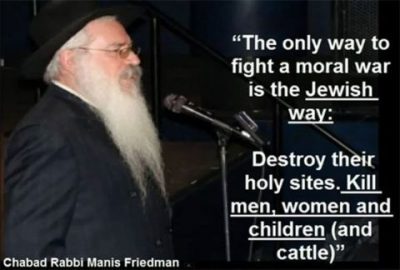
By Jonas E. Alexis | Veterans Today | July 23, 2017
Israeli Rabbi Shmuel Eliyahu seems to have picked up where the late Rabbi Ovadiah Yosef left off. The Israeli army, Eliyahu said, must slaughter the Palestinians “and leave no one alive.” The Palestinians, the good rabbi continued, must be “destroyed and crushed in order to end violence.” Here is Eliyahu’s algorithm:
“If they don’t stop after we kill 100, then we must kill 1,000. And if they do not stop after 1,000, then we must kill 10,000. If they still don’t stop we must kill 100,000, even a million.”
There is more to this “logic” than meets the eye and ear. Eliyahu even postulated that the Israeli army ought not to get involved in arresting Palestinians because “If you leave him alive, there is a fear that he will be released and kill other people. We must eradicate this evil from within our midst.”
You may say that this is just an isolated case. No Israeli official believes that, right? … continue
Blog Roll
Recent Comments
papasha408 on Germany demands UN Rapporteur… papasha408 on Israel Demanding that Iran Lim… Coronistan on Why can’t western leaders acce… John Edward Kendrick on German government ‘embezzling’… loongtip on Von der Leyen to have new secu… papasha408 on First Gaza, then the world: Th… papasha408 on Is Nixing Aid to Israel a Pois… papasha408 on Japan to Sign Up For NATO’s Uk… Redracam on Iran Willing to Dilute Enriche… loongtip on When Threats Replace Evid… loongtip on Zelensky tried to kill the cha… eddieb on I might get killed for posting…


 Aletho News
- Ukraine to ban Russian literature – culture minister
- 40 State Attorneys General Want To Tie Online Access to ID
- Col Doug Macgregor: America’s Back to ENDLESS WARS
- Villains of Judea: Haim Saban
- Germany demands UN Rapporteur Albanese resign, joining France
- Hamas official says Netanyahu joining ‘peace council’ is a farce
- Israel Demanding that Iran Limit the Range of Missiles to 300 Kilometers
- Why can’t western leaders accept that they have failed in Ukraine?
- German government ‘embezzling’ taxpayer money to fund Ukraine – veteran politician
- Russian Soldiers Tortured in Secret Ukrainian Prisons
- If Americans Knew
- AZAPAC, the new PAC opposing Israeli domination of U.S policies
- Haim Saban: Billionaire for Israel
- Rafah e-wallet plan highlights Israel’s deepening financial occupation
- Viral post claims Netanyahu sought legal approval, igniting speculation about Israel’s organ harvesting
- AIPAC Has a New Opponent: PAL PAC
- Right-Wing Catholic Off Trump Religion Panel After Israel-Gaza Remarks at Antisemitism Event
- Jewish terrorism, apartheid rule the West Bank – Not a ceasefire Day 125
- Why Israel persecutes children like my son Shadi
- In Gaza, One Man Is Searching for the Remains of His Family With a Flour Sifter
- Horrific situation in Gaza, West Bank – Not a ceasefire Day 124
- No Tricks Zone
- German Gas Crisis…Chancellor Merz Allegedly Bans Gas Debate Ahead of Elections!
- Pollen Reconstructions Show The Last Glacial’s Warming Events Were Global, 10x Greater Than Modern
- Germany’s Natural Gas Storage Level Dwindles To Just 28%… Increasingly Critical
- New Study Rebuts The Assumption That Anthropogenic CO2 Molecules Have ‘Special’ Properties
- Climate Scientist Who Predicted End Of “Heavy Frost And Snow” Now Refuses Media Inquiries
- Polar Bear Numbers Rising And Health Improving In Areas With The Most Rapid Sea Ice Decline
- One Reason Only For Germany’s Heating Gas Crisis: Its Hardcore-Dumbass Energy Policy
- 130 Years Later: The CO2 Greenhouse Effect Is Still Only An Imaginary-World Thought Experiment
- New Study Affirms Rising CO2’s Greening Impact Across India – A Region With No Net Warming In 75 Years
- Germany’s Natural Gas Crisis Escalates … One Storage Site Near Empty …Government Silent
 Aletho News