Government refuses to help tortured British student in UAE
Reprieve | August 24, 2015
The Prime Minister and the Foreign Office have refused to support a British student’s request to be released from a UAE prison, it’s been revealed – despite the fact that he was tortured into a false ‘confession’ by Emirati police.
Ahmad Zeidan, from Reading, was arrested in December 2013 in the emirate of Sharjah, along with seven other young men. During eight days of incommunicado detention, he was tortured by police into signing a document in Arabic – a language he doesn’t read or write. During a trial in which he faced a potential death sentence, the document was presented as his ‘confession’, and he was sentenced to nine years. He lost a subsequent appeal, while his allegations of police torture – common in the UAE – were never fully investigated.
The leaders of the Emirates recently granted a traditional Ramadan pardon to just under 900 prisoners across the UAE, including 200 prisoners in Sharjah jail, where Ahmad is held. The amnesty saw Ahmad’s co-defendants – none of whom are British – released, leaving him the sole remaining defendant from the December 2013 arrests to be still in prison. It’s now emerged that the Foreign Office refused to support a request by Ahmad for inclusion in the pardon – an apparent contradiction of an official UK policy to request clemency when a miscarriage of justice, such as a forced confession, has occurred.
It’s also been revealed that David Cameron met with the leader of the UAE, the Crown Prince of Abu Dhabi in July this year, shortly before the pardon was announced. In a letter to human rights organization Reprieve, which is assisting Ahmad, the Foreign Office admitted that the Prime Minister had not raised the case at the meeting, saying “these specific issues were not discussed.”
Speaking to the Press Association, Ahmad said his experience had been “extremely traumatizing, for both me and my family. It’s taking a toll on me every single day, mentally and physically.” He added: “The torture at the beginning was one thing, that I live with every day; it’s now another mountain of pain I have to go through, knowing the UK government is doing nothing.” He appealed to ministers to “get me out of what I’m going through.”
Commenting, Maya Foa, head of the death penalty team at Reprieve, said: “Ahmad Zeidan has suffered a staggering miscarriage of justice at the hands of the UAE. His brutal torture and the use of a bogus ‘confession’ – signed in a language he doesn’t read or write – are more than enough reason for the British government to request his release. It is deeply disappointing that ministers have not yet done this – particularly as his co-defendants, from other countries, have now all been released. The UK government must use our strong ties with the Emirates to call for an end to Ahmad’s nightmarish ordeal, so that he can return to Britain and concentrate on his future.”
Ansarullah: Response to Saudi Arabia Will Change Mideast Geopolitics
Fars News Agency | March 30, 2015
TEHRAN – A senior member of the Yemeni Ansarullah movement warned that his country’s crushing response to the Saudi aggression will devastate the Arab kingdom and change the geopolitics of the region.
“The Yemeni nation will change the map of the region,” Al-Alam Arabic-language TV quoted Nasreddin Amer, member of Ansarullah’s Information Dissemination Committee as saying on Monday.
“We will respond to Saudi King Salman bin Abdel Aziz in the battlefield and unexpected events will take place in the coming days,” he added.
He reiterated that the Al Saud regime have embarked on attacking Yemen in order to prevent Yemen from becoming a free country which will not be under the control of the Saudi regime.
On Sunday, a senior member of Ansarullah movement’s Political Council Mohammad al-Bakhiti warned that the movement will give a crushing response to any possible ground invasion of Yemen.
“Any ground attack on Yemen will receive a rigidly harsh response,” al-Bakhiti said.
“We have not responded to the Saudi aggressions in the past five days because we wanted to allow the Arab countries to reconsider their action and stop their attacks,” he said, and added “but from now on everything will be different”.
Al-Bakhiti described the Saudi-led alliance against Yemen as a moral crisis, and said, “Whatever the Arab conference decided about Yemen will end in serious crisis.”
He underlined that the Yemeni people have confidence in their resistance and are confident that they will win.
On Saturday, a senior member of the popular Ansarullah movement warned of immediate attacks on Saudi territories if the latter refrains from putting an immediate halt to its aggression against Yemen.
“As the Ansarullah movement has promised collapse of some Arab regimes supporting the terrorists, if Saudi Arabia continues its aggressions against the oppressed Yemeni people the Ansarullah fighters will pave the way for the Saudi regime’s destruction by conducting martyrdom-seeking (suicidal) operations inside Saudi Arabia,” member of Ansarullah Executive Committee Abdel Mon’em Al-Qurashi told FNA.
He reiterated that Israel and Al Saud are on the same front and Saudi Arabia is taking orders from Washington and Tel Aviv.
“The main cause of the Saudi aggression is the failure of Riyadh’s policies in support of fugitive Yemeni President Mansour Hadi and Takfiri groups and its disappointment at them,” Al-Qurashi added.
He reiterated that the Yemeni army and people will give a crushing response to the Saudi aggressors.
Saudi Arabia has been striking Yemen for five days now, killing, at least, 70 civilians and injuring hundreds more.
Five Persian Gulf States — Saudi Arabia, the United Arab Emirates (UAE), Bahrain, Qatar and Kuwait — and Egypt that are also assisted by Israel and backed by the US have declared war on Yemen in a joint statement issued earlier Thursday.
US President Barack Obama authorized the provision of logistical and intelligence support to the military operations, National Security Council Spokesperson Bernadette Meehan said late Wednesday night.
She added that while US forces were not taking direct military action in Yemen, Washington was establishing a Joint Planning Cell with Saudi Arabia to coordinate US military and intelligence support.
US Muslim tortured in UAE for 106 days struggles to prove FBI hand
RT | March 18, 2015
A US citizen, who was put on a no-fly list, declared a threat to national security and tortured in an UAE prison after refusing to become an FBI informant, is having a hard time proving it happened at the behest of the US authorities, his lawyer told RT.
Yonas Fikre is an Eritrean born American citizen who immigrated as a refugee to the US when he was 13 from neighboring Sudan. He became a US citizen and in 2006 settled in Portland, Oregon. His problems began soon after 2010 when he went back to Khartoum, where he still had relatives, to start an electronics import business.
In Sudan he was summoned to the US Embassy on false pretenses and was told by two FBI agents from Oregon that they wanted to ask him a few questions about his mosque in Portland. When Fikre demanded a lawyer and hesitated to answer questions about people he had prayed at the mosque with but barely knew – the agents told him he was placed on a no-fly list. Although there was “absolutely no factual justification” for that, his lawyer, Thomas Nelson, told RT.
Fikre was told he would be taken off the list if he agreed to work for the FBI as an informant. He eventually agreed to answer their questions, but not work for the feds. A couple of weeks later, Fikre says he received a letter from one of the FBI agents, telling him threateningly: “While we hope to get your side of issues we keep hearing about, the choice is yours to make. The time to help yourself is now.”
Taking threats into account, he still managed to fly to his relatives in Sweden. He concluded that he was not in fact deemed a serious threat and the FBI agents had been bluffing, although he wondered whether had he flown to a close US ally such as Britain that this would also have been the case.
He got a chance to find that out after he went to the UAE, one of the US’s closet allies in the Middle East, and was suddenly arrested by the local police.
Fikre was held and tortured in UAE prison for 106 days from June to September 2011. During this time he was continually beaten and repeatedly asked about events in Portland, Oregon – the same questions that the FBI asked him earlier.
“During the torture he was always blindfolded, and so he could not see who was doing the interrogating and who else was in the room, although he was aware that there were others. With the exception that he could occasionally look underneath the blindfold and see pants, trousers, shoes and dress of that sort. Sometimes there was Western dress, sometimes there was Arabic dress,” his lawyer explained to RT.
After eventually being released – without any charges – Fikre managed to return to Sweden and over the next three years managed to prove that he had been tortured while in custody in the UAE, although he and his legal team are convinced they can not prove that this was at the behest of the US authorities.
“During the course of 3 years there, the Swedish authorities investigated what happened to him and they came to a conclusion that Yonas indeed had been tortured. Their problem was that they had a hard time proving that it was the FBI or the American authorities that instigated and performed the torturing. It was not a question of whether the torture occurred, it was a question of whether they can prove that the Americans were behind it,” he explained.
Although there is overwhelming circumstantial evidence, Thomas Nelson says they are having hard time proving the US authorities took part in the torture.
“It’s one of those difficult things because when the most powerful nation on earth wants to hide something, it can do it very easily. We have litigation going on here where, we’re going to try and chase down those avenues and to prove who was involved, what they did and how they did it,” Nelson said.
The lawyer added that legally one of the major problems lawyers face in issues like this is that it’s very difficult to bring a foreign state as a defendant into the United States court system. He also said that another reason that litigation against the US authorities has been unsuccessful is because the US has been “very effective in scaring and creating fear both in the judiciary and in the general public about Muslims.”
Riyadh nips Hezbollah-Future Movement dialogue in the bud
Al-Akhbar | November 21, 2014
Riyadh has ‘red-lighted’ the planned dialogue between Hezbollah and the Future Movement before it even began. The Saudi call for Hezbollah to be put on the list of terrorist organizations made at the United Nations threatens to renew tension between the two sides, following an undeclared truce in the media that did not last for more than a few days.
Is there a fixed Saudi, and consequently Gulf policy, vis-à-vis Lebanon? Are these countries really keen on the stability of this country, as they claim, when they hardly spare any occasion to exacerbate its divisions? These questions and others are being asked after the new Saudi escalation against Hezbollah, which is likely to aggravate the already complex situation in Lebanon and the region.
Saudi Arabia’s ambassador to the United Nations Abdallah al-Mouallimi called on the UN Security Council on Wednesday to place the Resistance Party on the list of terrorist organizations. In a special session on terrorism, Mouallimi called for punishing Hezbollah and other groups including the Abu al Fadl al Abbas Brigade, the League of the Righteous, and other “terrorist organizations fighting in Syria.”
Al-Akhbar learned that as a result of the new Saudi position, contacts will be made with Riyadh over the next few days to contain possible reactions. Well-placed sources warned against negative repercussions from the Saudi move over the ‘preliminary dialogue’ between Hezbollah and the Future Movement.
The sources expressed concern that this could put an end to the de-escalation that begun when Hezbollah Secretary General Sayyed Hassan Nasrallah, speaking during the Shia Muslim commemorations of Ashura, welcomed dialogue with the Future Movement. The sources told Al-Akhbar that the Saudi move, in addition to the sudden re-activation of the Special Tribunal for Lebanon (STL) after a long period of inactivity, by summoning political witnesses, will create tensions in the country, and are indicative of a Saudi veto on dialogue between the Future Movement and Hezbollah.
The sources asked, “How do the Saudis explain their position when barely two months have passed since their ambassador in Beirut Ali Awad Asiri celebrated his country’s National Day surrounded by deputies from Hezbollah? Why has Saudi Arabia made this call two days after the GCC summit, and as the UAE – which is influenced to a large extent by Riyadh’s position – placed a number of organizations on its terror list not including Hezbollah?”
The sources deduced that the Saudi policy is not yet ready to restore its balance in Lebanon and the region. The sources also had questions about Saudi-Israeli ‘intersection’ over trying to smear Hezbollah’s image as a resistance movement and link it to terrorism, something that Tel Aviv has sought for very long.
The sources described Mouallimi’s speech at the UN as a ‘sound bubble’ that will have no results, recalling Nasrallah’s declaration that Hezbollah will be where it has to be in Syria. They said the Saudi UN envoy’s move “demonstrates real disappointment in the ranks of the Saudi leadership over the failure of its project in Syria, with [Saudi]… making random accusations right and left.”
The sources pointed out that the Saudi envoy, in the course of justifying his call, cited the emergence of terror groups like ISIS and others, which he linked to the “practices of the Syrian regime” and the “sectarian policies of some countries,” rather than Saudi and Gulf support for these groups. The sources added, “Saudi Arabia is among the top supporters of terrorist Takfiri groups in Syria, which makes its talk about fighting terrorism lacking in any seriousness.”
The sources then linked the Saudi position to “growing concerns in the ranks of the Saudi leadership over the nuclear negotiations with Iran, and real fear from the possibility of the parties reaching an agreement that would undermine the Saudi leadership’s hopes to step up the siege on Iran.”
The sources ruled out any practical effect of the Saudi position in light of the current balance of power in the international organization, and in light of the responses the Saudi envoy heard regarding his proposal.
Iran’s envoy at the United Nations Gholam Hossein Dehghani had responded to Mouallimi’s call by emphasizing the need to make a distinction between legitimate resistance and terrorism, and the need to support the resistance. He also criticized regional countries for failing to match their words with deeds, and said that few governments in the region have taken the threat seriously, while the rest did not control their borders, did not stop ISIS from recruiting, and did not stop the flow of financial support to these “criminal organizations.”
For his part, Syria’s ambassador to the United Nations Bashar Jaafari accused Saudi Arabia of backing terrorism in the region, denouncing the inconsistencies in its diagnosis of the roots of terrorism. He said that al-Qaeda and its ilk had all grown thanks to Saudi patronage in Afghanistan. Jaafari also said that the carnage in Syria is supported by Saudi Arabia and Qatar, citing the call by 72 Saudi clerics for people to go for “jihad” in Syria, and wondered whether the Saudi government was serious about fighting terrorism.
Muslim scholars’ union slams UAE ‘terrorist’ label
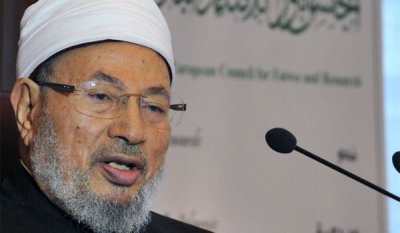
Yusuf Al-Qaradawi
MEMO | November 17, 2014
The International Union of Muslim Scholars (IUMS) expressed its surprise on Monday over the decision by the United Arab Emirates (UAE) to include the bloc on the country’s list of designated terrorist organisations.
In its statement, the union urged the UAE to “reconsider its unjustified position”.
The IUMS, established in 2004 and headed by Islamic scholar Yusuf Al-Qaradawi, was among 83 movements and organisations that were labelled terrorist groups by the UAE on Saturday.
Also included in the list were the Muslim Brotherhood, the Islamic State (ISIS), Yemen’s Shiite Houthi movement and the Egypt-based Ansar Beit Al-Maqdis militant group.
In its statement, the group said it rejects this labelling, asserting that since its establishment ten years ago, the IUMS “has promoted a moderate approach and discouraged extremism, terror and violence using cultural and educational means”.
“The IUMS has issued dozens of statements against terrorist and extremist groups,” it added.
On its website, the IUMS identifies itself as “an institution concerned with the call (Da’wah) to Islam by tongue, pen, and every contemporary legitimate medium; be it recorded, audio, or visual”.
“IUMS is not a local or a regional union, neither an Arab nor a national one, neither an eastern, nor a western union; rather, it represents all Muslims in the entire Islamic world, as well as all the Muslim [minority populations] and Islamic groups outside of the Islamic world.”
It also asserts that it “does not slant towards exaggerations and excesses, nor does it tilt towards default and negligence, but rather it adopts the centremost approach of the centremost Ummah (Islamic nation), an approach of mediation and moderation.”
The Egyptian-born Al-Qaradawi has been under fire by Egypt’s post-coup authorities for his vocal criticism of the military’s ouster – and subsequent imprisonment – of elected president Mohamed Morsi, a Muslim Brotherhood leader, last year.
Egypt branded the Brotherhood a “terrorist” movement late last year following the bombing of a security headquarters in the Nile Delta.
The label was attached to the movement amid a massive crackdown on its members, supporters and leaders on the streets of Cairo and other Egyptian cities and provinces.
Saudi Arabia also designated the Muslim Brotherhood a “terrorist” movement in March of this year, following in Egypt’s footsteps.
The UAE and Saudi Arabia were amongst the first countries to welcome Morsi’s ouster. Both countries – along with Bahrain – withdrew their ambassadors from Doha last March, accusing Qatar of interfering in their affairs.
Many observers, however, linked the rift to Doha’s perceived support for Morsi and the Muslim Brotherhood.
Yet, the three countries agreed on Sunday to return their ambassadors to the Qatari capital following a surprise Gulf summit in Saudi Arabia.
Biden shoots Washington in both feet
By Finian Cunningham | Press TV | October 6, 2014
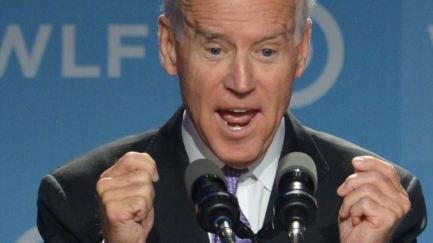
“Bazooka Joe”, as the American vice president Joe Biden is affectionately nicknamed, has managed to shoot Washington in both feet, with a couple of startling admissions.
The first shot was his blunt assessment of the US-led anti-terror coalition currently bombing Iraq and Syria. While the second blast from Bazooka Joe was his candid remarks about how Western sanctions against Russia are all down to American bullying.
Biden was speaking at Harvard University at the end of last week, and in his apparently impromptu responses to public questions he revealed more about Washington than he perhaps intended. That’s why Biden is known as a loose cannon. He tends to shoot his mouth off before aiming his thoughts.
First of all, the vice president spoke about Syria, and he stated plainly that America’s regional allies are the sponsors behind the IS terror network. Biden named names. He accused Saudi Arabia, Turkey and the United Arab Emirates of pouring money and weapons into the creation of IS, al-Nusra Front and various other al-Qaeda-type terror groups.
“Our biggest problem is our allies – our allies in the region were our largest problem in Syria,” said Biden.
Referring to Saudi Arabia, Turkey and the UAE, Biden said: “They were so determined to take down [Syrian President] Assad and essentially have a proxy Sunni-Shia war, what did they do? They poured hundreds of millions of dollars and tens, thousands of tons of weapons into anyone who would fight against Assad, except that the people who were being supplied were al-Nusra and al-Qaeda and the extremist elements of jihadis coming from other parts of the world.”
Of course, many informed observers have known this terror background already. Certainly the Syrian and Iraqi governments have been accusing these same US regional allies of doing just that – sponsoring terrorism. Nevertheless, America’s second-in-command has, in his own words, made a damning assessment of the cause behind the rise of terrorism threatening the region. This anti-terror coalition that Washington has dragooned has therefore no credibility. Just ask Biden.
Since Biden made this stupendous admission, he has been forced over the weekend to make an apology to Turkey’s President Recep Tayyip Erdogan. The latter furiously denied his country’s involvement with terror groups in Syria. But many people won’t be convinced otherwise and they will rightly see Biden’s prior candid viewpoint as closer to the truth.
Also on Syria, Biden made a second injurious disclosure: namely, that there is no such thing as a “moderate opposition” fighting the Syrian government.
The American VP said “the idea of identifying a moderate middle has been a chase America has been engaged in for a long time… there was no moderate middle because the moderate middle are made up of shopkeepers, not soldiers”.
The notion of “moderate” Syrian rebels is central to US President Barack Obama’s strategy of supposedly defeating the IS network. Along with the US-led aerial bombing campaign – costing $10 million a day, according to the Pentagon – the next phase is to allegedly train “vetted rebels” who will displace the extremists and take up the fight against the Damascus government of Bashar al-Assad. These “moderates”, if we believe Washington, are to be trained in Saudi Arabia – the terror sponsor – with $500 million of American taxpayer money, approved by the US congress.
But thanks to Joe Biden’s big mouth, we have confirmation that the notion of “moderates” is a charade, as many observers have been saying all along. What’s more, Washington knows it too.
The second damaging disclosure from Bazooka Joe was in connection to the crisis over Ukraine. Relations between Washington and Europe on the one hand and Russia on the other have sunk to their worse level since the end of the Cold War more than two decades ago. A major reason for the tensions is the slapping of economic sanctions on Russia, which in turn has responded with bans on Western imports.
Moscow’s retaliatory sanctions on agricultural products are going to hit Europe very painfully – much more than the US – as will any moves by Russia to reduce crucial gas supplies to EU countries.
What Joe Biden revealed is that the EU countries were reluctant to apply trade sanctions on Russia in the first place. Biden said that they “were embarrassed” into adopting the aggressive American agenda because Obama personally hectored European leaders.
What Biden is saying is that the crisis between Russia and the rest of Europe has been greatly exacerbated by American bullying. If it weren’t for Washington’s hostile attitude, then the crisis over Ukraine would likely be resolved diplomatically, without the provocative backdrop of a damaging trade war.
As winter approaches and hard-pressed European citizens find that they are paying dearly for American intransigence towards Russia, Biden’s words will come back to haunt with a vengeance.
It is known that many of the EU 28 member states have already deep misgivings about following the US-led sanctions. As the crisis takes more and more of an economic and social toll on Europe, the Americans will incur bitter resentment from ordinary citizens across the EU, which will in turn fragment the apparent Washington-Brussels coalition against Russia.
All in all, we owe Joe Biden a measure of gratitude for his big mouth.
It spares us a lot of time-wasting from speculation and conjecture.
All we have to do is recall his words from last week when he spelled out the fallacy of the US-led war on terror in the Middle East and the US-led new Cold War against Russia.
Pentagon: US to Sell New Missiles and Rocket Launchers to Saudi Arabia, UAE
Al-Manar | October 2, 2014
US Defense Department will sell Patriot missile batteries of $1.57 billion to the Saudi Arabia and rocket launchers of $900 million to the United Arab Emirates, Pentagon said on Wednesday.
The initial details of the sale came public in April, and the Pentagon announcement informed Congress of the intention to follow through on the previously reported plans.
The Saudi government had requested the purchase of 202 Patriot Advanced Capability (PAC)-3 missiles — the most sophisticated version of the Patriot anti-missile weapons — as well as a flight test target, telemetry kits and other related equipment, the Defense Security Cooperation Agency said in a statement.
“The proposed sale will help replenish Saudi’s current Patriot missiles which are becoming obsolete and difficult to sustain due to age and the limited availability of repair parts,” the agency said.
“The program will contribute to the foreign policy and national security of the United States by helping to improve the security of a partner which has been, and continues to be, an important force for political stability and economic progress in the Middle East,” it added.
Both Kuwait and Qatar already have purchased the PAC-3 weapons, which are designed to knock out incoming ballistic missiles as well as enemy aircraft and cruise missiles using ground radar.
The system “will improve the UAE’s capability to meet current and future threats and provide greater security for its critical infrastructure,” the Defense Security Cooperation Agency said.
The weapons, which deliver precise and powerful artillery fire at a long range, would also bolster the UAE military’s ability to operate with US forces, it noted.
Congress has 30 days to raise objections to the potential arms sales. Without any move to block the deals, the US government can then negotiate contracts with the two countries.
Mofaz proposes role for Saudi Arabia and UAE to disarm Gaza
Arabi21 | July 20, 2014
As Israel continues to prosecute its criminal war against the people of the Gaza Strip, its leaders in Tel Aviv are counting more and more on the Arab regimes to confront the Palestinian resistance and reduce its effectiveness. Former Defence Minister and Chief of Staff of the Israeli army, General Shaul Mofaz, has called for a role to be “allocated” for Saudi Arabia and the UAE to disarm Hamas and other resistance groups.
Speaking on Israel’s Channel 10, Mofaz explained that it would be impossible for its army to demilitarise the Strip by force even if it were to re-occupy it completely. As such, he claimed, the matter requires a comprehensive diplomatic, political and economic plan for such an objective to be achieved.
He pointed out that there is an urgent need to convince the people of Gaza of the necessity to collaborate in implementing such a plan. This would require offering the carrot, represented by a generous financial reward, to convince them to cooperate with any international or regional effort that could contribute to achieving this goal. He noted that both Saudi Arabia and the UAE could, in the present circumstance, play an important role in providing the finances for this reward.
Meanwhile, a prominent Israeli military commentator has called for an official investigation into the political, military and intelligence failures of Israel’s war on the coastal territory. This follows growing indications that the Zionist state is not achieving its objectives.
In an article in Maariv newspaper on Saturday, Ran Edelist said that there is cause to suspect that the assessment of the internal security intelligence agency, Shin Bet, on the basis of which the Netanyahu government took the decision to go to war in Gaza, might have been influenced by the ideological motives of its leaders. Edelist pointed out that Shin Bet head Yoram Cohen belongs to the religious Zionist movement, and his deputy, who is referred to as “R”, is a settler known for his ideological extremism. They produced the recommendations for the government regarding Hamas from an extremist viewpoint rather than from an objective professional position, he claimed. Edelist accused Prime Minister Benjamin Netanyahu of ordering the campaign against Gaza in the hope of improving his political status and reducing opposition to him within his own Likud Party. There are growing calls for his resignation.
According to Audi Siegel, the political affairs commentator on Channel 2 TV, the only solution for the Gaza predicament is for Israel to recognise Gaza as an independent entity and deal with all the consequences. Also writing in Maariv, Siegel said that it has become evident that Israel’s ability to control the resistance in Gaza and destroy the Hamas movement is zero. He noted that all the assumptions upon which Israel made the decision to launch a war on Gaza have collapsed.
Siegel said that recognising the Hamas government in Gaza might improve the security environment for Israel. If not, he added, it would possible to garner international support to justify any military step Israel might then take against the territory.
Members of UAE ‘aid convoy’ revealed as intelligence agents
MEMO | July 20, 2014
Forty members of the UAE “aid convoy” which entered the Gaza Strip last week have been revealed as intelligence agents. They were, it is believed, trying to collect information about Hamas and its infrastructure in the besieged territory.
According to one informed source, a local Palestinian recognised one of the agents as a soldier in the UAE armed forces. He contacted the security forces in Gaza who took the agent in for questioning.
Other members of the “aid convoy” then made contact with officials in the United Arab Emirates. In turn, they asked disgraced Fatah official Mohamed Dahlan, who now lives in and is sponsored by the UAE government, to try to secure a safe and swift exit for the agents.
“Dahlan called one of his followers from Fatah who spoke with Hamas officials and they agreed to let the convoy leave immediately,” the source said.
Palestinians in Gaza were surprised by the sudden exit of the UAE personnel on Saturday. The field hospital that they had ostensibly arrived to set-up was left uncompleted.
Commentators say that suspicions should have been aroused when the convoy was allowed by the Egyptians to enter Gaza through the Rafah crossing, as no other convoys have been allowed to enter since the start of the Israeli attack and invasion. Media reports on Saturday said that the Egyptian army has banned and attacked three international aid convoys trying to enter the enclave.
Egypt has closed Rafah and does not allow wounded Palestinians to travel abroad for treatment or let much-needed medicine and medical equipment to be taken into Gaza.
France-UAE satellite deal shaky after US spy tech discovered onboard – report
RT | January 6, 2014
The sale of two intelligence satellites to the UAE by France for nearly a billion dollars could go south after they were found to contain American technology designed to intercept data transmitted to the ground station.
The equipment, costing 3.4 billion dirhams ($930 million), constitutes two high-resolution Pleiades-type Falcon Eye military intelligence satellites, which a top UAE defense source has said contain specific US-made components designed to intercept the satellites’ communications with their accompanying ground station, Defensenews.com said in a report.
“The discovery [of the US-made components] was reported to the deputy supreme commander [Sheikh Mohamm ed Bin Zayed] in September,” an unnamed defense source said. “We have requested the French to change these components and also consulted with the Russian and Chinese firms.”
“If this issue is not resolved, the UAE is willing to scrap the whole deal,” said the source, adding that the incident has seen an increase in talks with Moscow, which – along with Beijing – has also been a frequent defense tech supplier to the Gulf state.
However, it is not clear whether the US equipment can be taken off of the French satellites.
The satellites come courtesy of prime contractor Airbus Defence and Space and payload manufacturer Thales Alenia, neither of whom could be reached for comment.
The system, comprised of satellites and a ground station, will require 20 trained engineers to operate. Under the July 22 deal, signed by Sheikh Mohammed, Crown Prince of Dubai and deputy supreme commander of the armed forces, and French Defense Minister Jean-Yves Le Drian, delivery of the satellites and the ground station was to be made sometime in 2018.
A total of 11 international bidders were competing in the Flacon Eye race for more than a decade to ship their technologies to the UAE, which in late 2012 announced that they had chosen to go with the French and the Americans.
According to the source, the French won because of the filters which their rival Americans imposed on the use of the equipment – a policy dubbed “shutter control.” The US government restricts sale of commercial high resolution satellite images from spacecraft it licenses, if they are deemed a threat to its national security.
One French defense specialist found it surprising that France had had US spy technology on board its equipment, especially when France’s use of the Pleiades surveillance system is considered to be of critical importance to its national security.
According to Defensenews, UAE threats to call off the deal are seen by some commentators as a way to secure a better bargain from the French, because “the satellites would be part of a big package deal… it’s not surprising the UAE drives a hard bargain. They’re using it as a layer of power.”
The unnamed defense specialist referred to the possibility that the Emirates may wish to drive the price down for other equipment, such as the Dessault Aviation Rafale fighter jet.

UAE Brokers US Visa Deal for Syrian Minister
By Nasser Charara | Al-Akhbar | September 25, 2013
Al-Akhbar has learned that Syrian Foreign Minister Walid Muallem’s bid to obtain a US visa to attend the 68th session of the UN General Assembly was rejected by the US State Department.
In principle, according to the law governing the relationship between the UN and the US as the host country of the UN headquarters, US authorities have no right to deny a visa to any official from a UN member state, if the visa is requested for the purpose of participating in a UN event. Nevertheless, there were previous cases where the US refused to grant – or delayed – a visa to certain officials from countries at odds with Washington for long enough to prevent their timely arrival to participate in UN meetings.
According to reports, the US State Department exhausted the legal limit in this regard when it refused to issue a visa to Muallem. Muallem was scheduled to deliver Syria’s speech at the assembly on September 30.
Washington has now reportedly reversed course on the visa issue following mediation by the United Arab Emirates. According to the same reports, after days of deliberate delays by the US State Department, the US authorities have now issued a conditional visa to Muallem that allows him to enter New York exclusively, but not the rest of the US.
Damascus purportedly designed the itinerary of the Syrian delegation headed by Muallem in such a way as to avoid stopovers in certain European airports, as several countries in Europe have issued arrest warrants against Syrian regime figures, including the foreign minister. The UAE had a role in finding a solution to this problem, offering to allow the plane carrying the Syrian delegation to land in Dubai where the delegation would then fly nonstop to New York.
The UAE had a role in finding a solution to this problem, offering to allow the plane carrying the Syrian delegation to land in Dubai where the delegation would then fly nonstop to New York.
Muallem and his delegation are expected to arrive today, September 25, in Beirut on a private Syrian plane, and then fly onwards to Dubai where the delegation is set to take an Emirates flight to New York City.
Some informed sources consider the UAE’s assistance in getting Muallem to New York a positive step that could signal a breakthrough in some of the Gulf countries’ attitudes regarding the best approach to resolve the Syrian crisis. As part of this emerging climate, the sources reveal that there are unpublicized efforts – including by the UAE – to broker a meeting between Muallem and US Secretary of State John Kerry on the sidelines of UN meetings in New York.
It is worth mentioning that the UAE, especially the Emirate of Abu Dhabi, had maintained a hardline policy toward the Syrian regime. The UAE toed the Saudi line in seeking to arm the opposition and provide it with logistical support through Turkish and Jordanian territories.
During the past two years, three liaison offices run by Qatar, Saudi, and the UAE operated out of the Turkish border region with Syria, supporting the Syrian opposition. Yet at the same time, Abu Dhabi gave the Syrian regime indirect positive signals, most notably by hosting Bushra al-Assad, the sister of President Bashar al-Assad, after the assassination of her husband Asif Shawkat during Ramadan last year.
Bushra’s stay in the UAE is not seen as political asylum or as something that can be interpreted as hostility to the regime. Bushra’s residence in the UAE has to do with special circumstances relating to her fear for her children and her desire to give them a peaceful setting for them to complete their education after their father’s death. Bushra and her children travel frequently to Beirut, where they are purportedly under Syrian protection.
Interestingly as well, Emirates Airlines was the only Arab carrier that continued to fly to Damascus, despite the Arab boycott. This continued until the airport became unsafe, when the fighting in the Damascus countryside drew close to the airport’s surroundings.
In addition, there have been reports that Emirates Airlines was helping move Syrian funds out of Damascus to Dubai. The aim was to bypass international sanctions on Syria, which prevent the fulfillment of the foreign currency-denominated commitments of the Syrian government and deals between Syrian companies and traders and their foreign counterparts.
The Syrian funds would be placed in Emirati banks and then converted to settle foreign currency payments. This practice has stopped recently for security – and not political – reasons.
Saudi Arabia and UAE to lend Egypt up to $8 billion
RT | July 9, 2013
The United Arab Emirates and Saudi Arabia will give Egypt money in the wake of its political and economic crisis. The UAE will provide Cairo with $1 billion and lend it a further $2 billion, while Saudi Arabia will give Egypt a $5 billion aid package.
The UAE loan would be in the form of a $2 billion interest free deposit in Egypt’s central bank, state news agency WAM reported on Tuesday. Abu Dhabi will also to give Egypt $1 billion.
The UAE delegation to Cairo included the Gulf country’s national security adviser, foreign minister and energy minister. The visit was to “show full support to the people of Egypt – political support, economic support,” Egyptian foreign ministry spokesman Badr Abdelatty told Reuters.
The UAE was one of the first countries to congratulate Egypt following the army’s decision to oust the Muslim Brotherhood’s Mohamed Morsi.
“The UAE stands by Egypt and its people at this stage and trusts the choices of its people. Egypt’s security and stability are the basis of Arab security,” WAM quoted UAE National Security Advisor Sheikh Hazza bin Zayad as saying.
The UAE’s foreign minister also stated that the Egyptian army proved that it was a “strong shield” and “protector,” which guarantees that the country embraced all the components of the people.
Saudi Arabia also approved a $5 billion aid package to Egypt Tuesday, comprising of a $2 billion central bank deposit, $2 billion in energy products, and $1 billion in cash, Saudi finance minister Ibrahim Alassaf said. […]
Multi-billion-dollar aid from Saudi Arabia and the UAE is another sign that these two countries had a hand in the military coup which took place in Egypt, believes RT’s contributing analyst in London, Afshin Rattansi.
“We now realize it is much more a Saudi-backed military coup. And as for this General al-Sisi person, who is a former military attaché in Saudi Arabia, he is Saudi’s man… Saudi Arabia, they’ve taken over the largest country in the Arab world,” Rattansi said.
He also described the current interim leaders of Egypt – President Mansour and Prime Minister Beblawi, as “puppets of Saudi Arabia”, who will be ousted at once if they attempt to criticize Saudi Arabia or the UAE. … Full article
Featured Video
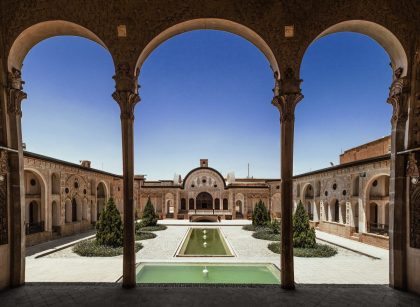
The US bombed the Shahs house lol
or go to
Aletho News Archives – Video-Images
From the Archives
How a War with Iran Would Diminish American Power
By Greg Scoblete | The Compass | August 13, 2010
Jennifer Rubin wants a war with Iran:
But the emphasis on the existential threat to Israel ignores a more basic issue for Americans to ponder: a nuclear-armed Iran represents a dagger at the heart of America and an existential threat to our status as a superpower and guarantor of the West’s security. As to the former, Iran is pressing ahead with its long-range ballistic missile program. First the Middle East and Eastern Europe, then all of Europe and, within a matter of years, the U.S. will be within range of Iranian missiles. If those are nuclear and not conventional, what then? We’re not talking about whether Iran is going to be “merely” a destabilizing factor in the Middle East or whether it will set off an arms race with its neighbors or imperil Israel’s existence. We’re talking about whether America will then be at risk (and lacking sufficient missile-defense capabilities if we continue to hack away at our defense budget). The argument about whether mutual assured destruction can really work against Islamic fundamentalists who have an apocalyptic vision becomes not about Israel’s ability to deter an attack but about ours. Those who oppose American military action have an obligation to explain why America should place itself in that predicament.
I would argue that any obligation to present an explanation lies with those whose disastrous policy prescriptions with respect to Iraq lead America into the worst strategic blunder in the country’s recent history. That aside, note the blind faith in the power of the military to actually achieve its ends. … continue
Blog Roll
 Aletho News
- Almost 400 Ukrainian drones downed over Russia in single night – MOD
- Battle for Hungary: How the Russiagate blueprint has been unleashed against Orban
- Brussels warns Slovakia over ‘discriminatory’ dual fuel pricing targeting foreign drivers
- Hungary to halt gas deliveries to Ukraine – Orban
- The US bombed the Shahs house lol
- The London Ambulances Attack: Of Course It Was A False Flag
- Embarrassing Pivot: U.S. considers dropping Iran oil sanctions amid war
- US has 2 months of rare earths left to replenish weapons amid Iran war: Report
- Strait Of Hormuz closure brings Empire to brink
- Iran controls Strait of Hormuz, dictates terms of war and peace as US excursion backfires
- If Americans Knew
- ‘Forever live by the sword’: Understanding Israelis’ massive support for Iran war
- UN’s special rapporteur on human rights says Israel is systematically torturing Palestinians
- Trump White House plagiarized Iran war manifesto from Israel-aligned think tank
- Gaza says 6–10 patients die daily waiting for treatment abroad as Israel blocks medical evacuations
- ‘Substantial evidence’ of double-tap strike in killing of Gaza’s Hind Rajab
- ‘Do Not Want To Die For Israel’: Doubts About Trump’s Iran Strategy Spread Among Troops
- Instead of taking Joe Kent’s claims seriously, the media is disregarding him as an antisemite
- Joe Kent’s Explosive Interviews about his Resignation over the Iran War
- Israel poised to take over southern Lebanon; settlers wreak havoc in West Bank – Not a ceasefire Day 165
- From Sde Teiman, the truth about Israel’s military justice system has been set free
- No Tricks Zone
- Devastating Assessment Of Comirnaty Vaccine By Former Senior Pfizer Europe Toxicologist
- New Study: CO2 Is ‘Effectively Negligible’ As An Explanatory Climate Change Factor Since 2000
- Former Pfizer Toxicologist Dr. Helmut Sterz Tells Bundestag Hearing Pfizer Vaccine Should Have Never Been Approved
- Energy Expert: Germany’s Nuclear Phaseout Was A “500 Billion Euro Mistake”
- New Research: South Australia’s Mid-Holocene Sea Surface Temperatures Were 4°C Warmer Than Today
- Storing Green Energy To Last Germany 10 Days Would Require A 60-Million Tonne Battery
- New Studies: UK Sea Levels Were 4 Meters Higher Than Today During The Mid-Holocene
- Destructive Green New Deal: German Energy And Metal Group Warns Of Drastic Crisis
- New Study Documents A 20-Year Pause In Arctic Sea Ice Decline – Driven By Internal Variability
- Wake-up Call: Survey Shows Majority Of Germans Now Favor Postponing Climate Targets!
 Aletho News