Yemen between two wars: A fragile truce and the shadow of a regional escalation
By Mawadda Iskandar | The Cradle | November 4, 2025
Since mid-October, Yemen has returned to the forefront of the regional scene. Political and military activity has intensified across several governorates, exposing the limits of the current ceasefire. From Sanaa’s view, the phase of “no war and no peace” cannot continue.
Any attack, it warns, will be met with a direct response. Deterrence, it insists, is now part of its core strategy.
Saudi Arabia, meanwhile, is trying to juggle two tracks – military pressure and renewed dialogue through Omani mediation. Riyadh wants to keep its weight on the ground while testing the possibility of a broader settlement.
The US and Israel have again inserted themselves into the mix, each working to block a negotiated outcome that might strengthen the Sanaa government. Washington has revived coordination channels with the coalition, while Tel Aviv watches the Red Sea front and pushes for the containment of Ansarallah-aligned armed forces. Yemen has once more become an overlapping arena of peace talks, foreign manoeuvring, and military threats.
Negotiations under fire
Oman has returned as the main regional mediator, moving to calm tensions after both Sanaa and Riyadh accused each other of violating the 2024 economic truce – the backbone of the UN “road map.” On 28 October, Muscat announced new diplomatic efforts to prevent a wider clash and reopen a political track.
But the situation on the ground shows little restraint. In Saada governorate alone, monitors recorded 947 violations this year, leaving 153 dead and nearly 900 injured. On 29 October, Saudi artillery shelled border villages in Razeh.
Sanaa affirmed that the “reciprocal equation” remains in place, staging a large military parade near Najran to display readiness. Riyadh, in turn, tested civil-defence sirens in its major cities – a move mocked by Ansarallah figure Hizam al-Assad, who said no siren would protect Saudi cities while the aggression and siege continue.
Speaking to The Cradle, Adel al-Hassani, head of the Peace Forum, points out that the crisis is worsening due to the deterioration of the economic situation and sanctions, which have affected more than 25 million Yemenis, while Oman is intervening as a mediator for the de-escalation.
According to Hasani, the roadmap includes two phases: the first is humanitarian, including the lifting of the blockade, the payment of salaries, and the resumption of oil exports; the second is political – to form a unity or coalition government that would coincide with a declared coalition withdrawal. Only that, he says, could stabilize the situation.
Washington and Tel Aviv’s new strategy
After Operation Al-Aqsa Flood and the ensuing war on Gaza, the US-Israeli approach to Yemen has shifted toward hybrid operations – mobilizing local partners, information warfare, and targeted strikes rather than any open intervention.
Sanaa’s recent warning about hitting Saudi oil sites came after detecting moves to create a US-Israeli front against Ansarallah. Israeli Prime Minister Benjamin Netanyahu called the resistance movement “a very big threat,” and Defense Minister Israel Katz threatened airstrikes on Sanaa itself.
The idea is to keep Saudi Arabia under pressure while allowing Israel to act indirectly. Israeli Finance Minister Bezalel Smotrich said the “Yemeni threat” is unresolved and urged Arab allies to take part in containing it.
Western think tanks have echoed this, urging Washington to rebuild Riyadh’s military role after the failure of the Red Sea naval alliance. The head of Eilat Port, Gideon Golber, admitted that maritime trade has been badly hit, adding that “We need a victory image by restarting the port.” A US Naval Institute report also noted that despite spending over $1 billion on air defense and joint operations, control over the corridor remains weak.
Between November 2023 and September 2025, Yemeni forces carried out more than 750 operations in the Red Sea, Gulf of Aden, and Indian Ocean – part of what Sanaa calls a defensive response. Head of the Supreme Political Council, Mahdi al-Mashat, urged Saudi Arabia to “move from the stage of de-escalation to ending aggression, siege, and occupation and implementing the clear entitlements of peace.”
He further accused Washington of using regional tensions to serve Israel. National Council member Hamid Assem added that an earlier de-escalation deal, signed a year and a half ago in Sanaa, was dropped by Riyadh under US direction after Operation Al-Aqsa Flood.
A source close to Sanaa tells The Cradle:
“The movement’s leadership is firmly convinced that the responsibility for these tools cannot be separated from those who created, armed, and trained them since 2015. Therefore, Sanaa affirms that any movement of these tools in Marib, the west coast, or the south of the country will not remain isolated, and will carry with it direct consequences that will affect the parties that supported and supervised the preparation of these groups.”
The source adds that:
“America has long experience with Yemen and may be inclined to avoid direct ground intervention, as its priorities appear to be focused on protecting Israel by striking Ansarallah’s missile and naval capability without extensive land friction. Therefore, it has begun to implement a plan that adopts hybrid warfare: intensifying media pumping, distortion, information operations, and psychological warfare, in addition to logistical and coordination preparations to move internal fronts through local pro-coalition tools.”
This hybrid strategy may coincide with Israeli military and media steps, the source points out, through threats and statements by officials in Tel Aviv, so that the desired goal becomes to “blow up the scene from within” and weaken Sanaa through internal chaos that paves the way for pressing options or strikes targeting its arsenal without direct American ground intervention.
US and UAE movements in the south
Throughout October, the US, Saudi Arabia, and the UAE expanded their presence in the south, west coast, and Al-Mahra to reorganize coalition factions and tighten control. US and Emirati officers arrived in Lahj Governorate, supervising the restructuring of Southern Transitional Council (STC) units from Al-Kibsi Camp in Al-Raha to Al-Mallah district. Security around these areas was reinforced with barriers and fortifications.
In Shabwa and Hadhramaut, joint committees of American and Emirati officers inspected Ataq Airport and nearby camps, counting recruits, running medical checks, reviewing weapons stock, and mapping command chains. Sources say Latin American contractors and private military firms assisted, ensuring resources stayed under external supervision.
In Taiz, another committee visited Jabal al-Nar to evaluate the Giants Brigades, their numbers, and armaments. On the west coast – from Bab al-Mandab to Zuqar Island – construction work is ongoing: terraces, fortifications, and outposts operated by “joint forces” hostile to Sanaa, including Tariq Saleh’s formations. Coordination reportedly extended to naval meetings aboard the Italian destroyer ‘ITS Caio Duilio’ to secure sea routes and “protect Israeli interests” in the Red Sea.
Hasani, who follows these movements, informs The Cradle that “These committees are evaluation and supervisory, not training, and are directly supervised by the US to ensure the readiness of the forces and perhaps as a signal to pressure Sanaa.”
He adds that British teams have appeared in Al-Mahra, while groups trained on Socotra Island are being redeployed to Sudan and Libya under UAE management.
Saudi-aligned Salafi units known as “Homeland Shield” now operate from Al-Mahra to Abyan and Hadhramaut. “These forces are today a pillar of the coalition to reduce the ability of Ansarallah, taking advantage of its religious beliefs, as part of the coalition’s tendency to turn the conflict into a sectarian war,” Hasani explains.
In Al-Mahra, local discontent is growing. Ali Mubarak Mohamed, spokesman for the Peaceful Sit-in Committee, tells The Cradle that Al-Ghaydah Airport remains closed after being converted into a joint US-British base.
“The committee continues to escalate peacefully through field trips and meetings with sheikhs to raise awareness of the community about the danger of militias,” he says, noting that the US presence has been ongoing since the coalition was established, though the exact nature of its presence is unknown.
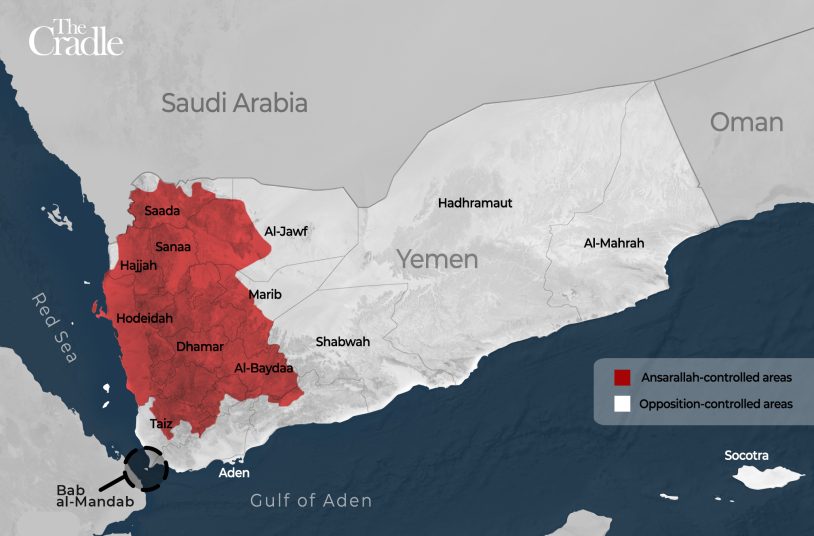
A map showing the distribution of control in Yemen
Where is Yemen heading?
These field movements are taking place as Washington and Abu Dhabi coordinate more closely with Tel Aviv. After meetings in October between the US CENTCOM commander and the Israeli chief of staff, a new plan began to take shape: build a joint ground network across southern Yemen to contain Sanaa and safeguard the Bab al-Mandab Strait – one of the world’s most critical shipping lanes.
At the same time, the US State Department appointed its ambassador to Aden’s Saudi-backed government, Steven Fagin, to lead a “Civil-Military Coordination Center” (CMCC) linked to ceasefire efforts in Gaza. Regional observers see this as a move to integrate the Palestinian and Yemeni fronts into one framework of US security control stretching from the Mediterranean to the Arabian Sea.
Reports circulating in Shabwa and Al-Rayyan say Emirati officers have been dispatched to Gaza to help organize local brigades – a claim still unconfirmed but consistent with the UAE’s wider operational pattern. Investigations by Sky News Arabia noted similarities in the slogans and structure of UAE-backed militias in Yemen and armed factions in Gaza, hinting at shared logistics and training links.
Adnan Bawazir, head of the Southern National Salvation Council in Hadhramaut, tells The Cradle that the scenario of recruiting mercenaries to fight in Gaza is not proven, but is possible – especially with the assignment of the interim administration in Gaza by Fagin, linking local moves to broader regional plans.
In Hadhramaut, Fagin’s visits to Seiyun, which includes the First Military Region, indicate preparations for a possible confrontation, especially since the area is still under the Saudi-backed Islah’s control in the face of the STC conflict, while Riyadh seeks to reduce Islah’s influence by transferring brigades and changing leadership.
Bawazir also points to suspicious movements in Shabwa and at Ataq airport, where field reports indicate flights transporting weapons to strengthen the front, given the governorate’s proximity to Marib and the contact fronts with Ansarallah, which makes it a hinge point for any regional or local escalation.
The moves are therefore part of three interrelated scenarios.
First, shifting pressure from Gaza to Yemen to compensate for the political and moral losses of Tel Aviv and Washington, while using the pro-coalition factions as a pressure arena against Sanaa. Second, preparing for possible military action in the event of the failure of the negotiations. Third, reorganizing the pro-coalition factions and building a central command that can be directed by Washington, thus turning the brigades into executive tools, ready to escalate the situation internally with a sectarian character.
Each scenario positions Yemen once again as a test field for foreign ambitions. The country remains divided between two trajectories: the possibility of a political settlement through Oman’s diplomacy, and the risk of a new conflict fed by regional competition and foreign control over its coasts and resources.
Whether the coming months bring a deal or another war will depend less on what Yemenis want and more on how their neighbors choose to use their soil.
Washington’s ‘new Gaza’ project meets Gulf pushback
The Cradle | November 2, 2025
Saudi Arabia and the UAE are pushing back against US President Donald Trump’s plan to construct roughly half a dozen residential regions on the eastern half of Gaza, which is currently under Israeli control, The Times of Israel reported on 2 November.
Citing two Arab diplomats familiar with the matter, The Times of Israel said that Trump and his real estate developer son-in-law, Jared Kushner, have proposed the plan to donors in the Gulf to build the “new Gaza” on the eastern side of the strip only, which is now under direct Israeli control.
Following the 11 October ceasefire agreement, Israeli forces withdrew to the east of a “Yellow Line” drawn up during the negotiations to divide Gaza into two parts. Hamas remains in control of the territory to the west of the line.
The partial withdrawal leaves Israeli forces in direct control of at least 53 percent of Gaza.
Trump’s plan to build residential areas in the Israeli-controlled east of Gaza reportedly envisions the Israeli army “gradually withdrawing to the other side of the Gaza border and leaving the Strip altogether,” The Times of Israel wrote.
However, such a withdrawal is conditioned on the establishment of an International Stabilization Force (ISF) for postwar Gaza, and the disarmament of the Hamas.
“With those two conditions for continued Israeli withdrawal so difficult to meet, the US is not waiting to begin the reconstruction process,” The Times of Israel added.
The US wants the international force to deploy to the west of the Yellow Line, the area remaining under Hamas control.
Washington also wants its Arab allies, Saudi Arabia and the UAE, to pay for the force.
However, the diplomats stated that the wealthy Gulf states are pushing back on the plan, as are Indonesia, Azerbaijan, Turkiye, and Egypt, who are expected to provide troops.
These nations are reluctant to assist Washington without a clear UN mandate or agreement with Hamas to hand over its weapons, the two Arab diplomats said. They also want to first deploy their forces on the east of the line to replace Israeli troops.
This information aligns with a previous Israel Hayom report, which revealed that Saudi Arabia, Bahrain, and the UAE had warned the US administration that they would not take part in Gaza’s reconstruction unless Washington enforced the ceasefire terms on Hamas and ensured the group’s disarmament.
Israel is also backing four militias as part of a project to oust Hamas and create a “new Gaza,” according to a report released by Sky News on 25 October.
These armed groups – which throughout the war have been engaged in hostilities against Hamas on behalf of Israel – are currently operating along the Yellow Line of Washington’s ceasefire map, in Israeli-held territory.
Jared Kushner stated he wishes to begin building on the Israeli side of the Yellow Line, in particular on the ruins of the destroyed city of Rafah in the south of the strip on the Egyptian border.
“The US proposal envisions as many as one million Palestinians — around half of Gaza’s population — moving to the residential areas on the Israel-held side of the Yellow Line,” The Times of Israel stated.
Kushner plans to complete the construction of these areas within two years, even if Israeli forces have not withdrawn by then, the two diplomats briefed on the plan stated. Both Arab diplomats concluded the timeline was “highly unrealistic.”
“Palestinians may not want to live under the rule of Hamas, but the idea that they’ll be willing to move to live under Israeli occupation and be under control of the party they also see as responsible for killing 70,000 of their brethren is fantastical,” one of the Arab diplomats said.
Additionally, there is no guarantee Palestinians would be allowed to return and live in the new housing developments. If Israeli forces remain in control of the area, Tel Aviv could decide to house Jewish Israeli settlers in the newly built neighborhoods instead, leaving Palestinians to languish in tents on the other side of the line.
One diplomat stated the Trump White House plans to sponsor a UN Security Council resolution to establish the international security force later this month, possibly before Saudi Crown Prince Mohammed bin Salman visits the White House for talks on the future of Gaza on 18 November.
Kushner and Vice President JD Vance previously stated the US and Israel are considering a plan to divide Gaza into separate zones, one controlled by Israel and one by Hamas, with reconstruction only taking place on the Israeli side until Hamas is disarmed and dissolved.
Vance and Kushner summarized the plan during a press conference in Israel on 22 October, explaining that no funds for reconstruction would go to areas that remain under Hamas’s control.
“There are considerations happening now in the area that the [Israeli army] controls, as long as that can be secured, to start the construction as a new Gaza in order to give the Palestinians living in Gaza a place to go, a place to get jobs, a place to live,” Kushner said.
Kushner is seeking to “create an environment that would be safe for the billions of dollars in investment needed to rebuild,” the Wall Street Journal (WSJ) commented.
“White House officials said Kushner is the driving force behind the split-reconstruction plan, having devised it alongside special envoy Steve Witkoff,” the WSJ said.
The financial newspaper added that with time, Israel could take more territory in Gaza from Hamas, and try to replicate what it has done in the occupied West Bank, with Israel taking complete security control while “forcing Gazans into small, unconnected areas of control.”
“Gaza has represented the only patch of territorial contiguity for a Palestinian state,” explained Tahani Mustafa, a fellow with the European Council on Foreign Relations.
“A plan like this could end up creating what Palestinians feared.”
The UAE’s War on Muslims: From Sudan to the Gaza Genocide
By Robert Inlakesh | The Palestine Chronicle | October 30, 2025
While the United Arab Emirates advertises itself as both a peacemaker and opponent of so-called “Islamic radicalism”, it is currently involved in genocide in both Gaza and Sudan. Connecting these dots is key to understanding the overarching goals of the regime.
The United Arab Emirates has created its image in the world as an innovator, a builder, and a peacemaker, a carefully calibrated illusion as artificial as the buildings that mesmerize onlookers in Dubai. But behind the architecture and lavish outer shell is a rotten core that continues to aid in the erosion of the surrounding region.
While claiming to oppose “radical Islam” and paying talentless influencers to attack groups like the Muslim Brotherhood, they foster extremist ideologies and back ISIS-linked militant groups to carry out their regional ambitions.
For all of the critiques that can be offered of groups like the Muslim Brotherhood and of Qatar, they are nothing like the orientalist depictions of them that are spread far and wide through Emirati propaganda.
The reason why the UAE attacks the ideology belonging to groups that are either linked to or part of the Muslim Brotherhood has nothing to do with their religious motivations and everything to do with the Emirati opposition to their political agenda.
For them, they fear any politically engaged Islamic movement that is capable of successfully leading a country and organizing democratic institutions, because they are a dictatorship fully beholden to their Western handlers, including Israel.
The reason why the Islamic element of such movements threatens them the most is that it is popular and the religion that the majority of the region adheres to in some shape or form.
If any Islamic anti-imperialist movement proves successful and leads a democratic process, then this could threaten their rule. So, they seek to undermine, infiltrate, and destroy these movements wherever they rear their heads, including inside the Gaza Strip.
Hamas, or the Islamic Resistance Movement, was an outgrowth of the Egyptian Muslim Brotherhood. Its origins begin in the 1970s and the formation of the social/civil-society movement known as the Mujamma al-Islamiyya in the Gaza Strip, at the time colloquially referred to as the Muslim Brotherhood, as it represented Palestine’s wing of the movement.
Therefore, the success and popularity of Hamas, as part of what is viewed by the Emiratis as a wider body of Islamic political movements, is interpreted as a threat to its rule in the region.
As a means of dismantling the prospects of Democratic oriented Islamic political leaderships, the UAE has engaged in military confrontations and intense propaganda campaigns. On the propaganda front, they are joined by other Gulf leaderships who have their own agendas, also and not only fund direct anti-Hamas or anti-Muslim Brotherhood propaganda, but also fuel religious division.
One of the most powerful means of divisive propaganda is directly targeting Muslims themselves, in particular the Sunni Muslim majority of the region. While they certainly push sectarian rhetoric against the Shia too, they seek to pacify the Sunni population, deter them from engaging in anti-imperialist and anti-occupation struggles, or redirect their anger at fellow Muslims.
They do this through pushing divisions between mainstream Sunni schools of thought and employing their Madkhali propagandists to deter action against the so-called Muslim rulers. Without going too deep into the Madkhalis, as with each group of Muslims, there is always nuance; they are a group of Salafist Muslims who adhere to the dictates of their rulers and sometimes will even justify actions taken by those rulers that are prohibited in Islam.
The primary goal here is to fund and fuel division across the Muslim world, channeling hatred and creating debates around any issue that can distract from what Israel, the United States, and their allies are doing to the region. Another major tactic employed here is to Takfir (declare a disbeliever) or undermine any Muslim group that sides with the likes of Iran, Hezbollah, Ansarallah, or any other Shia groups.
Again, none of this opposition has anything to do with any substance that may be behind said arguments they make; these are well-funded propaganda campaigns designed for political purposes to undermine resistance to imperialism, occupation, and genocide. This is where we can begin looking at Gaza and then Sudan.
The UAE professes to oppose so-called “Islamic radicalism”, yet it now stands accused of providing support to the ISIS-linked gangs operating in the Israeli-occupied portion of the Gaza Strip. Not only has the UAE been accused of directly coordinating with these militia groups – composed of hardline Salafists who have links to ISIS and al-Qaeda, drug traffickers and murderers – but there is even evidence of these death squad members driving around in vehicles with registered UAE license plates.
In opposition to Hamas, the UAE is more than happy to back Israeli proxy collaborator groups that contain ISIS and Al-Qaeda minded elements within them.
Going back to the sorts of divisive propaganda that is encouraged by the Emiratis, a leading member of the Israel-backed so-called “Popular Forces” militia in Gaza, Ghassan Duhine, has openly cited ISIS Fatwas declaring Hamas apostates as a justification for killing them. ISIS officially declared war on Hamas back in 2018.
Meanwhile, the UAE has long been backing the Rapid Support Forces (RSF) in Sudan, the group currently accused of committing genocide, and which has re-entered the headlines after it captured Al-Fasher and other areas in North Darfur, resulting in the murder of around 527 people, including civilians who were butchered while sheltering in refugee camps.
RSF leader, Mohamed Hamdan Dagalo (Hemedti), has long collaborated with the Emiratis, and it was even previously pointed out that his official Facebook page was controlled out of the UAE.
Without getting into all of the complexities of the Sudanese civil war, Hemedti is a warlord who has long maintained power over the majority of Sudan’s Gold Mines, slaughtering anyone who dares to get in his way.
His forces have also been accused by the UN and prominent rights groups of committing widespread mass sexual violence, including horrific forms of rape.
Hemedti was additionally supplied with battle-changing technologies through his Israeli Mossad contacts, and despite there being documented rights violations on both the Sudanese Army and RSF sides of the war, there is no doubt that Hemedti’s forces have the most blood on their hands and carry out the most horrific crimes seen in the conflict.
The UAE is not just one of many actors involved in Sudan; it is the primary supporter of the RSF. According to a scoop published by The Guardian this Tuesday, British weapons sold to the United Arab Emirates were even discovered to have been used by the RSF to carry out its genocide.
Despite the United States declaring the horrors in Sudan as a genocide, during the Biden administration, no action has been taken against the UAE for its role in fueling the war. Similarly, the UAE has been involved in countless crimes committed throughout the Horn of Africa and in North Africa too, backing a whole range of extremist militant groups who stand accused of indiscriminately targeting civilians.
Although it is also hidden from the Western corporate media, the UAE even used members of the Sudanese RSF to fight on its behalf as proxy forces against Ansarallah in Yemen, where they were accused of playing a role in what many declared a genocide. Keep in mind that nearly 400,000 people in Yemen were killed due to the inhuman blockade and war of aggression, led by both the UAE and Saudi Arabia.
The Emiratis push propaganda about the Sudanese Military being “Islamists”, accusing them of being part of the Muslim Brotherhood and then linking them to all sorts of other organizations. Ansarallah in Yemen is also branded as “Islamists”, but in their case are accused of being “Iranian proxies”. In essence, this line of propaganda is the typical Israeli-style Hasbara argument for committing egregious war crimes.
Throughout the Gaza genocide, the UAE was one of the only nations that continued its routine flights to Ben Gurion airport and transported materials to aid the Israelis. The Emiratis also turned Dubai into an Israeli safe haven, where soldiers implicated in genocide can go to party, engage in activities like consuming narcotics or hiring escorts, and live in luxury.
The UAE did not lift a finger to force the Israelis to let aid into Gaza, as they blocked all humanitarian aid trucks entering for around three months earlier this year, but will then point to the trickles of aid that they do supply as proof they are helping the people. In their defense, they argue that they were key in achieving a ceasefire, for which there is no evidence, just like there was no evidence that they stopped West Bank annexation when normalized ties with Israel.
Viewing the Emiratis as operating on their own whims, blaming them solely for the actions they commit, is incorrect. These are rulers installed by the West, who work for the West and are simply used as pawns to do the bidding of their masters. If any of their leaders stand up to the crimes that the UAE is inflicting, they will be assassinated and replaced with other members of the ruling bloodline who choose to play ball. They are hostages, posing as rulers and playing their part in the dismantlement of the surrounding region.
Francesca Albanese names over 60 states complicit in Gaza genocide
The Cradle | October 29, 2025
The UN special rapporteur for the occupied Palestinian territories, Francesca Albanese, told the General Assembly on 28 October that 63 countries, including key western and Arab states, have fueled or were complicit in “Israel’s genocidal machinery” in Gaza.
Speaking remotely from the Desmond and Leah Tutu Legacy Foundation in Cape Town, Albanese presented her 24-page report, ‘Gaza Genocide: A Collective Crime,’ which she said documents how states armed, financed, and politically protected Tel Aviv as Gaza’s population was “bombed, starved, and erased” for over two years.
Her findings place the US at the center of Israel’s war economy, accounting for two-thirds of its weapons imports and providing diplomatic cover through seven UN Security Council vetoes.
The report cited Germany, Britain, and a number of other European powers for continuing arms transfers “even as evidence of genocide mounted,” and condemned the EU for sanctioning Russia over the war in Ukraine while remaining Israel’s top trading partner.
Albanese accused global powers of having “harmed, founded, and shielded Israel’s militarized apartheid,” allowing its settler-colonial project “to metastasize into genocide – the ultimate crime against the indigenous people of Palestine.”
She said the genocide was enabled through “diplomatic protection in international fora meant to preserve peace,” military cooperation that “fed the genocidal machinery,” and the “unchallenged weaponization of aid.”
The report also identified complicity among Arab states, including the UAE, Egypt, Bahrain, and Morocco, which normalized ties with Tel Aviv.
Egypt, she noted, maintained “significant security and economic relations with Israel, including energy cooperation and the closing of the Rafah crossing,” tightening the siege on Gaza’s last humanitarian route.
Albanese warned that the international system now stands “on a knife-edge between the collapse of the rule of law and hope for renewal,” urging states to suspend all military and trade agreements with Tel Aviv and build “a living framework of rights and dignity, not for the few, but for the many.”
Her presentation provoked an outburst from Israel’s envoy Danny Danon, who called her a “wicked witch.”
Frascnesca fired back, saying, “If the worst thing you can accuse me of is witchcraft, I’ll take it. But if I had the power to make spells, I would use it to stop your crimes once and for all and to ensure those responsible end up behind bars.”
Human rights experts described the report as the UN’s most damning indictment yet of Israel’s ongoing genocide in Gaza.
Albanese had previously been sanctioned by the US in July, after releasing a report that exposed western corporations profiting from Israel’s genocide in Gaza.
The 27-page report, ‘From Economy of Occupation to Economy of Genocide,’ named over 60 companies, including Lockheed Martin, Caterpillar, Microsoft, Palantir, and Hyundai, for aiding and profiting from Israel’s settlements and military operations, and called for their prosecution at the International Criminal Court (ICC).
US Secretary of State Marco Rubio accused Albanese of waging a “campaign of political and economic warfare against the United States and Israel,” announcing the sanctions as part of Washington’s effort to counter what he called “lawfare.”
The move drew sharp condemnation from UN officials and rights groups, who warned that it threatened global accountability mechanisms.
Israeli military company establishes first branch in UAE
MEMO | October 27, 2025
The Hebrew newspaper Maariv reported on Sunday that the Israeli government has approved the establishment of a branch of Controp Precision Technologies Ltd in the United Arab Emirates. The move has been described as an “unprecedented security and economic step” since the signing of the normalisation agreements in 2020.
Controp Precision Technologies Ltd specialises in designing and manufacturing EO/IR systems used for intelligence, surveillance, reconnaissance, and targeting missions across air, land, and maritime domains. The company provides its solutions to the defence, homeland security, and other related sectors.
According to the newspaper, the new company, named Controp Emirates Ltd, will operate within Abu Dhabi’s free trade zone (ADGM). It will be fully owned by the Israeli parent company and will operate under strict security supervision from Israel’s Ministry of Defence.
The purpose of the new branch is to enable the company to manufacture and market its advanced electro-optical systems locally in the UAE, as well as to provide maintenance and technical support services.
The total investment in the first phase is estimated at around 30 million US dollars, funded through Controp shares and owner loans. The branch will be managed by an Israeli chief executive, while full control will remain with the parent company.
UK Digital ID Scheme Faces Backlash Over Surveillance Fears — Is a Similar Plan Coming to the U.S.?
By Michael Nevradakis, Ph.D. | The Defender |October 2, 2025
The U.K. plans to introduce a nationwide digital ID scheme that will require citizens and non-citizens to obtain a “BritCard” to work in the U.K., which includes England, Scotland, Wales and Northern Ireland.
Government officials say the plan, to take effect no later than August 2029, will help combat illegal immigration.
But critics like U.K. activist and campaigner Montgomery Toms said the scheme, “far from being a tool for progress,” is instead a “gateway to mass surveillance, control and ultimately the rollout of a centralised social credit system.”
The plan faces broad opposition in the U.K., according to Nigel Utton, a U.K.-based board member of the World Freedom Alliance, who said, “the feeling against the government here is enormous.”
A poll last week found that 47% of respondents opposed digital ID, while 27% supported the ID system and 26% were neutral. The poll was conducted by Electoral Calculus and Find Out Now, on behalf of GB News.
A petition on the U.K. Parliament’s website opposing plans to introduce digital ID may force a parliamentary debate. As of today, the petition has over 2.73 million signatures.
According to The Guardian, petitions with 100,000 signatures or more are considered for debate in the U.K. parliament.
As opposition mounts, there are signs the BritCard may not be a done deal. According to the BBC, a three-month consultation will take place, and legislation will likely be introduced to Parliament in early 2026.
However, U.K. Culture Secretary Lisa Nandy said the government may push through its digital ID plans without going through the House of Commons or the House of Lords.
Protesters plan to gather Oct. 18 in central London.
Digital ID will ‘offer ordinary citizens countless benefits,’ U.K. officials say
British Prime Minister Keir Starmer announced the digital ID scheme last week in a speech at the Global Progress Action Summit in London.
“A secure border and controlled migration are reasonable demands, and this government is listening and delivering,” Starmer said. “Digital ID is an enormous opportunity for the U.K. It will make it tougher to work illegally in this country, making our borders more secure.
The plan “will also offer ordinary citizens countless benefits, like being able to prove your identity to access key services swiftly,” Starmer said.
According to The Guardian, digital ID eventually may be used for driver’s licenses, welfare benefits, access to tax records, and the provision of childcare and other public services.
Darren Jones, chief secretary to Starmer, suggested it may become “the bedrock of the modern state,” the BBC reported.
Supporters of the plan include the Labour Together think tank, which is closely aligned with the Labour Party and which published a report in June calling for the introduction of the BritCard.
Two days before Starmer’s announcement, the Tony Blair Institute for Global Change, led by Labour Party member and former U.K. Prime Minister Tony Blair, published a report, “Time for Digital ID: A New Consensus for a State That Works.”
Blair tried to introduce digital ID two decades ago as a means of fighting terrorism and fraud, but the plan failed amid public opposition. According to the BBC, Starmer recently claimed the world has “moved on in the last 20 years,” as “we all carry a lot more digital ID now than we did.”
During the COVID-19 pandemic, Blair endorsed a global digital vaccine passport, the Good Health Pass, launched by ID2020 with the support of Facebook, Mastercard and the World Economic Forum.
According to Sky News, French President Emmanuel Macron welcomed the BritCard for its ability to help fight illegal immigration into the U.K., much of which originates from France.
Critics: Digital ID marks ‘gateway to mass surveillance’
The BritCard, which would live on people’s phones, will use technology similar to digital wallets. People will not be required to carry their digital ID or be asked to produce it, except for employment purposes, the government said.
According to the BBC, BritCard will likely include a person’s name, photo, date of birth and nationality or residency status.
Digital wallets, which include documents such as driver’s licenses and health certificates, have been introduced in several countries, including the U.S.
Nandy said the U.K. government has “no intention of pursuing a dystopian mess” with its introduction of digital ID.
However, the plan has opened up a “civil liberties row” in the U.K., according to The Guardian, with critics warning it will lead to unprecedented surveillance and control over citizens.
“Digital ID systems are not designed to secure borders,” said Seamus Bruner, author of “Controligarchs: Exposing the Billionaire Class, their Secret Deals, and the Globalist Plot to Dominate Your Life” and director of research at the Government Accountability Institute. “They’re designed to expand bureaucratic control of the masses.”
Bruner told The Defender :
“All attempts to roll out digital ID follow a familiar pattern: corporate and political elites wield crises — such as mass migration, crime, or tech disruptions — as a pretext to expand their control … over private citizens’ identities, finances and movements into a suffocating regime.
“Once rolled out, these systems expand quietly, shifting from access tools to enforcement mechanisms. Yesterday it was vaccine passports and lockdowns; tomorrow it is 15-minute cities and the ‘universal basic income’ dependency trap. ‘Voluntary’ today becomes mandatory tomorrow.”
Tim Hinchliffe, editor of The Sociable, said digital ID is “not about tackling illegal immigration, it has nothing to do with job security and it definitely won’t protect young people online. Digital ID is all about surveillance and control through coercion and force.”
Hinchliffe said:
“Illegal immigration is just one excuse to bring it all online. Be vigilant for other excuses like climate change, cybersecurity, convenience, conflict, refugees, healthcare, war, famine, poverty, welfare benefits. Anything can be used to usher in digital ID.”
Twila Brase, co-founder and president of the Citizens’ Council for Health Freedom, said governments favor digital ID because it allows unprecedented surveillance.
The ID system “notifies the government every time an identity card is used, giving it a bird’s-eye view of where, when and to whom people are showing their identity,” she said.
According to Toms, “A digital ID system gives governments the ability to monitor, restrict, and ultimately punish citizens who do not comply with state directives. It centralises power in a way that is extremely dangerous to liberty.”
Experts disputed claims that digital ID is necessary to improve public services.
“The ‘improved efficiency’ argument is a technocratic fantasy used to seduce a public obsessed with convenience,” said attorney Greg Glaser. “Governments have managed to provide services for centuries without a digital panopticon. This is not about efficiency. It is about creating an immutable, unforgeable link between every individual and the state.”
Digital ID technology may create ‘an enormous hacking target’
London-based author and political analyst Evans Agelissopoulos said major global investment firms, including BlackRock, Vanguard and State Street, could combine their financial might with the power of digital ID.
“BlackRock, Vanguard and State Street are on a mission to buy properties to rent to people. Digital ID could be used against people they deem unfit to rent to,” he said.
During the COVID-19 pandemic, the same firms supported digital vaccine passports in major corporations in which they are among the top shareholders. Some experts suggested digital ID may institutionalize a vaccine passport regime and central bank digital currencies.
“Digital identity is the linchpin to every dystopian nightmare under the sun,” Hinchliffe said. “Without it, there can be no programmable digital currencies, there can be no carbon footprint trackers, no social credit system.”
Other experts suggested that a centralized database containing the data of all citizens could be monetized. “By centralizing everything, they will have access to health, criminal, financial records. This data can be sold,” Agelissopoulos said.
According to Brase, those who will benefit from the centralization of this data include:
“Anybody who’s going to be the third-party administrator, academia and companies who are building biometric systems and what they call ‘augmented authentication systems’ that provide the cameras, the back system operations for biometric identification and for digital systems.”
Several major information technology (IT), defense and accounting firms, including Deloitte and BAE Systems, have received U.K. government contracts totaling 100 million British pounds ($134.7 million) for the development and rollout of BritCard.
U.S. tech companies, including Palantir, Nvidia and OpenAI, “have also been circling the UK government,” The Guardian reported.
Digital ID also raises security concerns, with IT experts describing the U.K.’s plan as “an enormous hacking target,” citing recent large-scale breaches involving digital ID databases in some countries, including Estonia.
“Government databases are frequently hacked — from healthcare systems to tax records,” Toms said. “Centralizing sensitive personal data into a single mandatory digital ID is a disaster waiting to happen.”
The public may also directly bear the cost of these systems. Italy’s largest digital ID provider, Poste Italiane, recently floated plans to levy a 5 euro ($5.87) annual fee for users.
Switzerland to roll out digital ID next year, amid controversy
In a referendum held on Sunday, voters in Switzerland narrowly approved the introduction of a voluntary national digital ID in their country.
According to the BBC, 50.4% of voters approved the proposal. Biometric Update noted that the proposal received a majority in only eight of the country’s 26 cantons, though the country’s government campaigned in favor of the proposal.
Digital ID in Switzerland is expected to be rolled out next year.
Swiss health professional George Deliyanidis said he “does not see any benefits for the public” from the plan. Instead, he sees “a loss of personal freedom.”
“There are suspicions of election fraud,” he added.
In a letter sent Tuesday to the Swiss government, a copy of which was reviewed by The Defender, the Mouvement Fédératif Romand cited “significant statistical disparities” in the referendum’s results and called for a recount.
In 2021, Swiss voters rejected a proposal on digital ID under which data would have been held by private providers, the BBC reported. Under the current proposal, data will remain with the state.
According to the Manchester Evening News, countries that have introduced nationwide digital ID include Australia, Canada, China, Costa Rica, Denmark, Estonia, India, Japan, South Korea, Spain, Ukraine and the United Arab Emirates. Other countries with similar systems include France, Finland and Norway.
In July, Vietnam introduced digital ID for foreigners living in the country. In August, the Vietnamese government helped neighboring Laos launch digital ID.
The New York Times reported that, in 2024, China added an “internet ID” to its digital ID system, “to track citizens’ online usage.”
Bill Gates has supported the rollout of digital ID in several countries, including India.
The European Union plans to launch its Digital Identity Wallet by the end of 2026.
“When you see a nearly simultaneous worldwide push, like this digital ID agenda, people in all nations need to expect to be impacted to some extent,” said James F. Holderman III, director of special investigations for Stand for Health Freedom.
Is national digital ID coming to the U.S.?
Although the U.S. does not have a national identification card, the U.K. did not have one either — until digital ID was introduced. The U.K. scrapped national ID in 1952.
In May, the Transportation Security Administration (TSA) began Real ID enforcement for domestic air travelers in the U.S. In the months before, TSA engaged in a push to encourage U.S. citizens to acquire Real ID-compliant documents, such as driver’s licenses. Full enforcement will begin in 2027.
The REAL ID Act of 2005 established security standards for state-issued ID cards in response to the 9/11 attacks and the recommendations of the 9/11 Commission. In the intervening years, its implementation was repeatedly delayed.
Last year, then-President Joe Biden issued an executive order for federal and state governments to speed up the adoption of digital ID.
Brase said Real ID “is really a national ID system for America, currently disguised as a state driver’s license with a star. The American people really have no idea that what’s in their pocket is a national ID and they have no idea that the [Department of Motor Vehicles offices] are planning to digitize them.”
Hinchliffe said 193 countries, including the U.S., accepted digital ID last year when they approved the United Nations’ Pact for the Future.
Earlier this month, Sen. Rand Paul (R-Ky.) introduced the Safeguarding Personal Information Act of 2025 (S 2769), a bill to repeal the REAL ID Act of 2005.
“If digital ID is allowed to spread globally, future generations will never know freedom,” Hinchliffe said.
This article was originally published by The Defender — Children’s Health Defense’s News & Views Website under Creative Commons license CC BY-NC-ND 4.0. Please consider subscribing to The Defender or donating to Children’s Health Defense.
Zionism without borders: Annexation and normalization as tools of Arab subjugation
By Mohamad Hasan Sweidan | The Cradle | August 1, 2025
Four weeks after Israel signed the US-brokered Abraham Accords with the UAE and Bahrain on 15 September 2020, Tel Aviv’s Higher Planning Council approved 4,948 new settler units in the occupied West Bank. No public fanfare.
No tanks rolled in – just signatures authorizing another layer of occupation. The first wave of expansion advanced quietly, legitimized by the language of “peace.”
This sequencing deliberately reflects the core logic of Zionist expansion: Normalize when the region submits, colonize when the world blinks.
Where possible, the occupation state’s army conquers land directly. Where resistance or scrutiny makes that unfeasible, the occupation government builds a web of security pacts, trade routes, and intelligence partnerships that extend its reach without a single uniformed soldier. This dual formula, territorial conquest and hegemonic integration, has underpinned Israeli strategy since 1967, and today stretches unimpeded from the Jordan Valley to the Atlantic coast.
Two paths, one destination
“Greater Israel” represents the settler-colonial ambition to annex, settle, and absorb land across historic Palestine and beyond. It is rooted in the Zionist vision of Jewish dominion over the so-called “biblical Land of Israel.” In contrast, “Great Israel” describes the imperial design to dominate the surrounding region through proxies, economic leverage, and security alignments.
Where occupation is costly, Tel Aviv turns to influence. Through deals, destabilization, or coercion, it reshapes the sovereignty of its neighbors. Greater Israel devours land. Great Israel neutralizes independence. Together, they are one project.
Zionist literature makes this plain. Ze’ev Jabotinsky, founder of Revisionist Zionism, demanded sovereignty over all of Mandatory Palestine and Transjordan – “Greater Israel on both sides of the Jordan River” – and rejected compromise with Arabs. In The Iron Wall (1923), he declared that only an unyielding Jewish force could compel Arab acquiescence:
“Zionist colonization, even the most restricted, must either be terminated or carried out in defiance of the will of the native population.”
The occupation state’s first prime minister and Labor Zionist leader, David Ben-Gurion, publicly accepted a partition plan in 1937, but privately described it as “not the end but the beginning.” In a letter to his son, he wrote that a Jewish state on part of the land would strengthen the Zionist project and serve as a platform to “redeem the entire country.” In a June 1938 meeting of the Jewish Agency executive, he said:
“After the formation of a large army … we shall abolish partition and expand to the whole of Palestine.”
Early Zionist leaders did not view borders as final, but as phases. During its first two decades, Israel lacked the military strength or western backing to expand beyond its 1949 borders. Direct confrontation with Arab states risked catastrophe. Instead, Tel Aviv pioneered a subtler doctrine of peripheral infiltration.
Through the “periphery doctrine,” it cultivated covert ties with non-Arab states and oppressed minorities – Shah-era Iran, Turkiye, Kurdish groups in Iraq, and Christian separatists in Sudan. This strategy sowed chaos among Israel’s Arab rivals while embedding Israeli influence in strategic corners of West Asia and Africa. Most recently, the occupation state has made overtures to Druze communities in southern Syria, seeking to replicate this strategy amid renewed instability.
The corridor to colonization
Israel’s integration into the Arab world is now deeper than ever before. Through normalization, Tel Aviv has converted former enemies into partners economically, diplomatically, and militarily. While Egypt and Jordan first formalized ties through Camp David and Wadi Araba, it was the Abraham Accords that opened the floodgates. What followed was a deluge of tech deals, weapons transfers, and commercial partnerships linking the occupation state to the Persian Gulf.
By 2023, Israel’s trade with the UAE had reached $3 billion annually. That figure rose by 11 percent the following year, even as Israel waged genocide in Gaza. Israeli Consul General Liron Zaslansky described trade relations between Abu Dhabi and Israel as “growing, so that we ended 2024 at $3.24 billion, excluding software and services.”
In 2022, Morocco purchased $500 million worth of Israeli Barak MX air defense systems. Rabat also partnered with BlueBird, an Israeli drone firm, to become the first UAV manufacturer in West Asia and North Africa.
This has created a “corridor of influence” that grants Tel Aviv access to new markets, air and sea routes, and intelligence spaces stretching from Casablanca to Khor Fakkan.
On the ground, the war continues
While trade flourishes, colonization accelerates. In 2023, Israeli Prime Minister Benjamin Netanyahu’s ultranationalist government approved 12,855 settler homes – a record for any six-month period. More than 700,000 settlers now occupy the West Bank and East Jerusalem. That figure has grown sevenfold since the early 1990s.
In May 2025, Defense Minister Israel Katz confirmed cabinet approval for the construction of 22 new West Bank settlements, including multiple previously unauthorized outposts. Katz framed the move as necessary to “strengthen our hold on Judea and Samaria” and to “prevent the establishment of a Palestinian state.”
These settlements are not arbitrary. They are connected by Jewish-only bypass roads, fortified by the occupation army, and strategically designed to fragment the occupied West Bank into isolated Palestinian enclaves. This is de facto annexation, defined by a matrix of irreversible facts that eliminates the territorial basis for any future Palestinian state, while avoiding the international fallout of formal annexation.
The “logic” of expansion has also spilled beyond Palestine. In Syria, Tel Aviv now occupies 250 square kilometers across Quneitra, Rural Damascus, and Deraa – territory seized during the collapse of former Syrian president Bashar al-Assad’s government by Al-Qaeda rooted terrorists – Hayat Tahrir al-Sham (HTS) – who now occupy the seat of power in Damascus. HTS was under the leadership of former ISIS chief Abu Mohammad al-Julani. Upon ousting Assad, Julani began using his government name, Ahmad al-Sharaa, and became the de facto president of Syria.
In Lebanon, Israeli forces maintain a presence over 30–40 square kilometers, including Shebaa Farms, Kfar Shuba Hills, and the northern half of Ghajar. Additional outposts and buffer zones stretch along the so-called Blue Line.
Occupation rebranded
Israel’s expansion today is no longer confined to bulldozers and soldiers; it is mediated through trade, tech, and treaties. But make no mistake: normalization has not replaced occupation. It has enabled and accelerated it.
Every Emirati deal, every Moroccan drone line, every Bahraini handshake fuels Tel Aviv’s capacity to deepen its military presence and Judaize more land. Plans are underway to double the number of settlers in the Golan Heights and to deploy armored units along the demilitarized zone.
The ripple effects are already destabilizing the region. Egypt has begun constructing a concrete wall on its border with Gaza to prepare for mass displacement or military spillover. Jordan faces existential peril in the Jordan Valley, where settler expansion is displacing Bedouin communities and draining natural aquifers. Syria and Lebanon remain hemmed in by fortified Israeli positions, with both countries facing increasing pressure from Washington to normalize relations.
Greater Israel devours Arab land. Great Israel colonizes Arab decision-making. One swallows borders. The other swallows sovereignty.
Riyadh realigns: Tehran over Tel Aviv
The Cradle | July 8, 2025
The recent confrontation between Iran and Israel marked a decisive shift in regional power equations, particularly in the Persian Gulf. Iran’s direct and calibrated military response – executed through the Islamic Revolutionary Guard Corps (IRGC) – exposed the strategic vulnerabilities of Tel Aviv and forced Gulf capitals, chiefly Riyadh, to reassess long-standing assumptions about regional security.
The Saudi-led recalibration did not emerge in isolation. Years of cumulative political, military, and diplomatic failures under the umbrella of US-Israeli tutelage have pushed Persian Gulf states to seek more viable, non-confrontational security arrangements. What we are witnessing is the slow dismantling of obsolete alliances and the opening of pragmatic, interest-driven channels with Tehran.
Iran’s war strategy resets Gulf expectations
Tehran’s handling of the latest military clash – with its reliance on precision strikes, regional alliances, and calibrated escalation – demonstrated a new level of deterrence. Using its regional networks, missile bases, and sophisticated drones, Tehran managed the confrontation very carefully, avoiding being drawn into all-out war, but at the same time sending clear messages to the enemy about its ability to deter and expand engagement if necessary.
The message to the Gulf was clear: Iran is neither isolated nor vulnerable. It is capable of shaping outcomes across multiple fronts without falling into full-scale war.
Speaking to The Cradle, a well-informed Arab diplomat says:
“This war was a turning point in the Saudi thinking. Riyadh now understands Iran is a mature military power, immune to coercion. Traditional pressure no longer works. Saudi security now depends on direct engagement with Iran – not on Israel, and certainly not under the receding American security umbrella.”
At the heart of Saudi discontent lies Tel Aviv’s escalating aggression against the Palestinians and its outright dismissal of Arab peace initiatives, including the Riyadh-led 2002 Arab Peace Initiative. Israeli Prime Minister Benjamin Netanyahu’s intransigence – particularly the aggressive expansion of settlements in Jerusalem and the occupied West Bank – has alarmed the Saudis.
These provocations not only sabotage diplomatic efforts but strike at the kingdom’s pan-Islamic legitimacy, forcing a reassessment of Israel’s utility as a strategic partner. As the diplomatic source notes:
“This Israeli political stalemate pushes Saudi Arabia to reconsider its regional bets and view Iran as a regional power factor that cannot be ignored.”
Riyadh turns to Tehran: containment over confrontation
Behind closed doors, Saudi Arabia is advancing a strategy of “positive containment” with Iran. This marks a clear departure from the era of proxy wars and ideological hostility. Riyadh is no longer seeking confrontation – it is seeking coordination, particularly on issues of regional security and energy.
Diplomatic sources inform The Cradle that the reopening of embassies and stepped-up security coordination are not mere side effects of Chinese mediation. They reflect a deeper Saudi conviction: that normalization with Israel yields no meaningful security dividends, especially after Tel Aviv’s exposed vulnerabilities in the last war.
Riyadh’s new path also signals its growing appetite for regional solutions away from Washington – a position increasingly shared by other Persian Gulf states.
For its part, the Islamic Republic is moving swiftly to convert military leverage into political capital. Beyond showcasing its missile and drone capabilities, Iran is now actively courting Arab states of the Persian Gulf with proposals for economic cooperation, regional integration, and the construction of an indigenous security architecture.
Informed sources reveal to The Cradle that Iran is pursuing comprehensive engagement with Saudi Arabia, the UAE, Qatar, and Oman. This includes economic partnerships and alignment on key regional files, from Yemen to Syria and Iraq.
Tehran’s position is consistent with its long-stated view: The Persian Gulf’s security must be decided by its littoral states and peoples – not by foreign agendas.
A new Gulf alliance is taking shape
This is no longer a Saudi story alone. The UAE is expanding economic cooperation with Tehran, while maintaining open security channels. Qatar sustains a solid diplomatic line with Iran, using its credibility to broker key regional talks. Oman remains the region’s trusted bridge and discreet mediator.
An Arab diplomat briefed on recent developments tells The Cradle :
“Upcoming Gulf–Iran meetings will address navigation in the Strait of Hormuz, energy coordination, and broader regional files. There is consensus building that understanding with Iran [will] open the door to a more stable phase in the Gulf.”
Amid these realignments, Israel finds itself regionally sidelined – its project to forge an anti-Iran axis has crumbled. The US-brokered Abraham Accords – once trumpeted as a strategic triumph – now elicit little more than polite disinterest across the Gulf, with even existing Arab signatories walking back their engagement.
Riyadh’s political elite now openly question the utility of normalization. As Tel Aviv continues its war on Gaza, Gulf populations grow more vocal and Saudi leaders more cautious.
The Saudi position is unspoken but unmistakable: Tel Aviv can no longer guarantee security, nor can it be viewed as the gatekeeper to regional stability any longer.
Pragmatism trumps ideology
This Saudi–Iranian thaw is not ideological – it is hard-nosed realpolitik. As another senior Arab diplomat tells The Cradle :
“Riyadh is discarding illusions. Dialogue with neighbors – not alliance with Washington and Tel Aviv – is now the route to safeguarding Saudi interests. This is now about facts, not old loyalties. Iran is now a fixed component of the Gulf’s security equation.”
The binary of “Gulf versus Iran” is fading. The last war accelerated a trend long in motion: the collapse of Pax Americana and the emergence of multipolar regionalism. The Gulf is charting a new course – one less beholden to US-Israeli diktats.
Today, Saudi Arabia sees Tehran not as a threat to be neutralized, but as a power to be engaged. Regional security frameworks are being built from within. Israel, meanwhile, despite its many pontifications about a Tel Aviv-led, Arab-aligned “Middle East,” is struggling to stay relevant.
If these dynamics hold, we are on the cusp of a historic transition – one that may finally allow the Persian Gulf to define its own security and sovereignty, on its own terms.
This is not an ideal future. But it is a strategic upgrade from decades of subservience. Saudi Arabia is turning toward Iran – not out of love, but out of logic.
Iran Nuclear Negotiations Bring New, Suprising Developments
By Ted Snider | The Libertarian Institute | May 20, 2025
In the past several days, there have been surprising developments in the negotiations between Washington and Tehran over Iran’s civilian nuclear program.
U.S. President Donald Trump has frequently, but not always, defined the goal of the negotiations as being limited to preventing Iran from getting a nuclear weapon. He repeated that definition as recently as May 25, saying Iran must “permanently and verifiably cease pursuit of nuclear weapons…They cannot have a nuclear weapon.”
But the message from his team has been contradictory. Then-National Security Advisor Mike Waltz said that the United States is demanding “full dismantlement,” and Trump’s special envoy Steve Witkoff said that “a Trump deal” means “Iran must stop and eliminate its nuclear enrichment and weaponization program.” Rubio said that Iran can have a civilian nuclear program, but by importing uranium enriched up to 3.67%, and no longer by enriching their own. On May 9, Witkoff told Breitbart News that “An enrichment program can never exist in the state of Iran ever again. That’s our red line. No enrichment.”
But Iran has drawn the mirror image red line. Iran’s Supreme Leader, Ayatollah Ali Khamenei, has placed a firm limit that Iran will not negotiate “the full dismantling of Iran’s nuclear infrastructure.” Iranian President Masoud Pezeshkian repeated that red line ahead of the talks, insisting that “Iran has never sought, is not seeking, and will never seek nuclear weapons” but that “Iran will not give up its peaceful nuclear rights.”
American insistence on ending Iran’s civilian enrichment program could put a quick end to the talks. Widening the negotiations to Iran’s missile program or to Iran’s relationship with its regional proxy groups could also jeopardize the talks.
But Trump raised that possibility on May 14 when he suggested that breaking off relations with proxy groups in the region must be part of any deal. Iran “must stop sponsoring terror,” he said, and “halt its bloody proxy wars.”
The contradictory statements emanating from the Trump administration appear to have been “because of a lack of decision on key strategic points,” Trita Parsi, Executive Vice President of Quincy Institute for Responsible Statecraft and an expert on Iran, told me. And, indeed, on May 7, Trump said, “We haven’t made that decision yet.”
“As a result,” Parsi said, “the debate on these points is now, rather unhelpfully, taking place out in public.”
That the talks have progressed to a fourth meeting suggests, at this point, that the public crossing of these Iranian red lines may not be being repeated in the private meetings. Iran’s Foreign Minister hinted at that possibility when he identified one of the difficulties in the negotiations as being “contradictions both inside and outside the negotiating room.” Supporting this possibility, when Trump introduced Iran’s support of regional proxies into the discussion, Araghchi called the remark, not unproductive or unhelpful, but “deceitful.”
And Araghchi may know. Barak Ravid of Axios has now reported that, during the fourth round of talks, the United States presented Iran with a written proposal. The report says that, during the third round, Araghchi gave Trump’s special envoy Steve Witkoff a document with Iran’s proposals for a deal. The U.S. studied it and returned it to Iran with “questions and requests for clarifications.” Iran replied, the U.S. prepared a new proposal, and then presented it to Araghchi who has now brought it back to Tehran for consultations with Supreme Leader Ali Khamenei and President Masoud Pezeshkian.
How far down the path to a settlement the proposal is is unknown. Araghchi said future negotiations now become more difficult. But he said that “despite the difficulty and frankness of the talks, very useful discussions were held.” He then said, “We can now say that both sides have a better understanding of each other’s positions.”
This major breakthrough may have been facilitated by another recent development: a subtle change in tone by Trump. Following a flurry of American threats, the fourth round of talks was postponed. Iranian officials said that [d]epending on the U.S. approach, the date of the next round of talks will be announced.”
Recently, that approach subtly changed. Previously, Donald Trump had formulated Iran’s choice as “If they don’t make a deal, there will be bombing. It will be bombing the likes of which they have never seen before.” But in his most recent remarks, which went largely unnoticed, Trump softened the consequence, saying only “If Iran’s leadership rejects this olive branch…we will have no choice but to inflict massive maximum pressure, drive Iranian oil exports to zero.” Notably, bombing was replaced with sanctions.
On May 15, Trump again seemed to reject the risk of war:
“Because things like that get started and they get out of control. I’ve seen it over and over again. They go to war and things get out of control, and we’re not going to let that happen.”
In another surprise development, Iran may have facilitated negotiations with a creative and unexpected proposal.
There are now reports that Iran has suggested for consideration that they could join with Saudi Arabia and the United Arab Emirates in a nuclear enrichment consortium. Iran would continue to enrich uranium but accept a cap at the 3.67% enrichment required by a nuclear energy program. Saudi Arabia and UAE, who would gain access to Iran’s nuclear technology, would be shareholders and funders.
If true, the proposal would be based on a consortium idea first proposed by Princeton physicist Frank von Hippel and former Iranian nuclear negotiator Seyed Hossein Mousavian.
Von Hippel told me that the idea was inspired by the URENCO enrichment consortium of Germany, the Netherlands and Britain and by the ABAAAC consortium of Brazil and Argentina.
The consortiums, he said, allow nuclear experts from each country to “visit each other’s facilities to assure themselves that the activities are peaceful.” He added that “decisions that might have proliferation implications are made by the [partner] governments.” Saudi Arabia’s, the Emirates’ and Iran’s watchful eyes would all help the International Atomic Energy Agency ensure that the program is peaceful.
Aside from the implications for the nuclear negotiations, this level of trust between Iran, Saudi Arabia, and the UAE was unthinkable only a very short time ago and testifies to the changes going on in the region and in the evolving Iran-Saudi Arabia relationship. That Iran would trust Saudi Arabia with access to its nuclear technology indicates that a region changing shift in the relationship is underway.
As Annelle Sheline, research fellow in the Middle East program at the Quincy Institute, told me:
“The Iranians’ willingness to join a consortium with Saudi Arabia and the UAE to develop civilian nuclear energy demonstrates significantly improved relations between these countries. This sends a strong signal that Tehran as well as Riyadh and Abu Dhabi would prefer to prioritize cooperation over conflict.”
She said that all three countries have growing motivation for peace in the region. Crown Prince Mohammed bin Salman needs to avoid violent conflict to encourage the foreign investment and tourism needed to fuel his planned economic diversification. Mohammed bin Zayed needs economic security in the face of competition from Saudi Arabia to be a regional hub. Iran needs to encourage peace in the region because of the recent weakening of its own strategic position in the region. Saudi Arabia and Iran have recently been moving towards enhanced friendship both bilaterally and through multinational organizations.
Sheline expressed the hope to me that “Trump should take advantage of these circumstances to sign a nuclear deal with Iran and avoid unnecessary war.”
All of these developments, from the contradictory American messaging, to the until now unreported existence of a written proposal, to the subtle and little noticed change in Trump’s tone to the Iranian idea of a nuclear consortium with Saudi Arabia and UAE are shocking and new. They may present an opportunity to return to a nuclear agreement with Iran and to usher in a new hope for peace and friendly relations both between the U.S. and Iran and in the region. Hopefully, the two sides will seize this opportunity.
Are US-Israel ‘special relations’ about to end?
By Murad Sadygzade | RT | May 19, 2025
Last week, US President Donald Trump embarked on his first official overseas tour since taking office, choosing to visit three key Gulf nations – Saudi Arabia, Qatar, and the United Arab Emirates.
This itinerary was both unexpected and, in many ways, unprecedented. Unlike his predecessors, who traditionally began their foreign policy engagements with visits to long-standing Western allies, Trump opted to prioritize America’s Arab partners, deliberately bypassing Israel – Washington’s principal strategic ally in the region. This marked the first time in decades that a sitting US president visiting the Middle East consciously excluded it from the agenda.
This decision signaled a potential recalibration of Washington’s priorities in the region. Relations between the Trump administration and the Israeli leadership, particularly Prime Minister Benjamin Netanyahu, were already strained in the early stages – largely due to Israel’s growing intransigence on the Palestinian question and the increasing influence of far-right factions within the Israeli government. Faced with mounting frustration over Israel’s hardline policies, the White House appeared to pivot toward a more pragmatic, less confrontational, and economically advantageous partnership with the Gulf monarchies.
However, the rationale behind this shift extended beyond political calculation. Saudi Arabia, the UAE, and Qatar have long played a pivotal role in sustaining American influence in the Middle East – not only because of their strategic geography but also due to their substantial investments in the US economy and multi-billion-dollar arms contracts. For a business-minded president eager to showcase the profitability of foreign policy through economic deals, these nations represented ideal counterparts.
The lavish receptions afforded to Trump during his Gulf tour might have been dismissed as mere pageantry were it not for their deeper symbolic resonance. The true significance of the visit lay in what it revealed about broader geopolitical currents: namely, the transformation of the Gulf monarchies from regional players into increasingly assertive global actors.
Saudi Arabia, the UAE, and Qatar are no longer content with being perceived as passive participants in American-led regional frameworks. Instead, they are positioning themselves as independent centers of power in an emerging multipolar world order. Their growing international stature stems from several interrelated factors.
First, these countries have embraced ambitious and forward-looking development strategies, investing heavily in infrastructure, clean energy transitions, technological innovation, and global finance. No longer simply hydrocarbon exporters, they are becoming hubs of digital transformation, international logistics, Islamic finance, and global policy discourse on issues ranging from security to sustainable development.
Second, the Gulf states have pioneered a distinctive model of governance that blends traditionalism with modernization. While maintaining deep-rooted commitments to Islamic and tribal values, they have achieved remarkable progress in building diversified and globally competitive economies. This synthesis has not only enabled them to thrive amid intensifying global competition but, in some respects, to outpace certain Western nations grappling with internal divisions and economic stagnation.
Equally noteworthy is the political resilience of these monarchies. Western narratives often portray them simplistically as ‘absolute monarchies,’ failing to appreciate the internal mechanisms of governance that underpin their stability. In reality, the political architecture of the Gulf is more accurately described as ‘sheikhism’ – a system rooted in consensus among tribal and familial elites, structured around a balance of obligations, reciprocal loyalties, and ongoing consultation. This model, which integrates Islamic principles such as shura (consultation) with practical statecraft, has proven remarkably adaptive and resilient.
In this context, Saudi Arabia, the UAE, and Qatar can no longer be viewed merely as privileged US allies or energy suppliers. They are emerging as autonomous actors in global politics – capable of forging regional alliances, shaping international agendas across energy, media, and technology, and mediating in global conflicts. Their evolving role reflects not dependence on external security guarantees, but the outcome of deliberate, long-term strategies to consolidate sovereignty, enhance prestige, and assert influence in the 21st century.
Money above all: Trump’s deal-based diplomacy
President Donald Trump’s visit to the Gulf states was far more than his first foreign trip as head of state. It was a bold, highly symbolic debut of a new US foreign economic doctrine rooted in pragmatism, transactionalism, and strategic capitalism. Unlike previous administrations, which typically foregrounded diplomacy, security alliances, and value-based partnerships, Trump approached this tour as a high-stakes business deal. His mindset was that of a dealmaker, not a traditional statesman. The objective was clear: to restore America’s economic dominance by leveraging the vast wealth and strategic ambitions of the Middle East’s richest monarchies.
Trump’s campaign slogan, “Make America Great Again,” found tangible expression in this tour. His mission was to bring back jobs, reindustrialize key sectors, boost the US high-tech ecosystem, and enhance national competitiveness – all fueled by a surge in foreign direct investment. In this pursuit, the oil-rich, capital-heavy Gulf monarchies – endowed with massive sovereign wealth funds and seeking greater global visibility – emerged as ideal partners.
In Saudi Arabia, Trump signed an unprecedented economic package worth over $600 billion, including the largest arms deal in US history – $142 billion covering missile defense systems, advanced aviation platforms, cybersecurity capabilities, and military-grade AI technologies. Equally significant was the launch of a new tech alliance: Saudi-based DataVolt committed $20 billion to build data centers and energy facilities in the US, while a consortium led by Nvidia, AMD, and Amazon Web Services will co-develop an AI innovation hub within the Kingdom. A $50 billion venture fund was also established to support US-based startups in renewable energy and cybersecurity.
In Qatar, the results were even more staggering: agreements totaling $1.2 trillion, the largest single-country deal package in US diplomatic history. Central to this was Qatar Airways’ order for 210 Boeing aircraft valued at $96 billion, making it the most lucrative deal ever for the American aerospace giant. Qatar also pledged tens of billions of dollars for joint ventures in quantum computing, smart energy networks, and STEM education programs for engineers and IT specialists in the US. In a provocative symbolic gesture, Qatar proposed gifting President Trump a custom-built Air Force One, sparking intense debate in the American media landscape.
In the United Arab Emirates, new agreements totaling $200 billion were signed – in addition to a previously negotiated $1.4 trillion package. Key components included the construction of an aluminum plant in Oklahoma, expansion of oil and gas infrastructure with US firms, and a landmark $100 billion commitment to American companies specializing in artificial intelligence over the next three years.
In total, Trump’s Gulf tour yielded over $2 trillion in contracts and investment pledges – an economic windfall of historic proportions. But beyond the numbers, the trip marked a fundamental redefinition of American foreign policy: from projecting power through military force and ideological alignment, to securing influence through economic penetration and transactional partnerships. Trump unveiled a new image of the US – not as a global policeman, but as a global entrepreneur. A nation that negotiates not with declarations, but with data, contracts, and employment metrics.
This new model resonated deeply with the Gulf monarchies themselves, which are undergoing profound transformations. Once reliant solely on oil exports, these states are rapidly evolving into tech-driven economies with ambitions to become global hubs of innovation, finance, and logistics. In Trump’s America, they found not just a security guarantor, but a strategic co-architect of a post-oil economic order – one where capital, innovation, and mutual profit outweigh traditional diplomatic protocol and ideological rhetoric.
Trump’s message was unambiguous: the era of foreign policy as charity is over. What now matters are mutual returns, strategic alignments, and economic gains. The Gulf states, driven by their own visions of modernization and diversification, eagerly embraced this shift. Together, they reimagined international relations not as a sphere of obligations, but as a marketplace of opportunities.
What about Israel?
One of the most significant – albeit unofficial – outcomes of Donald Trump’s Middle East tour could be discerned even before the journey began: the US President conspicuously bypassed Israel. This omission became all the more striking given that even Secretary of Defense Pete Hegseth, who had initially planned a visit to Tel Aviv, abruptly cancelled his trip at the last moment. The message did not go unnoticed in either Washington or Jerusalem: nearly all observers interpreted the move as a clear sign of a cooling relationship between the US and Israel – more precisely, between Trump and Israeli Prime Minister Benjamin Netanyahu.
The rift between the two leaders appears less personal than strategic, rooted in diverging visions of the region’s future. Tensions had been mounting for months. The first major flashpoint came when Trump unilaterally announced the withdrawal of American forces from operations against Yemen’s Houthi rebels, citing the group’s supposed commitment to halt attacks on Red Sea shipping lanes. The decision, made without prior consultation with Israel – which continues to endure daily rocket fire from the Houthis – dealt a blow not only to diplomatic norms but also to the foundational trust between Israel and its closest ally.
An even more sensitive issue has been the quiet resumption of US contacts with Iran. With Oman acting as mediator, Washington has been exploring the outlines of a possible new nuclear agreement. Meanwhile, Israel remains steadfast in its conviction that no negotiations with Tehran should occur until decisive military action is taken against its nuclear and military facilities – a show of force intended to compel concessions. Netanyahu failed to persuade Trump of this hardline approach, and the US president has increasingly charted his own, more flexible course.
Tensions have also sharpened over the future of Syria. Israel refuses to recognize the country’s new leader, Ahmad al-Sharaa, branding him a former al-Qaeda affiliate and a dangerous actor. Israeli airstrikes on Syrian territory continue, the buffer zone in the Golan Heights remains under Israeli control, and the Druze population has formally been placed under Israeli protection. While Israel promotes the vision of a weak, decentralized Syria, Washington is embracing the opposite: al-Sharaa was invited to meet with Trump in Saudi Arabia, and following those talks, the US signaled its intent to lift sanctions on Damascus. Even more striking was the revelation that Saudi Arabia, Qatar, and the UAE – previously restrained by US pressure – are now prepared to invest in Syria’s reconstruction, viewing it as both a stabilizing opportunity and a chance to expand their regional influence.
Israeli frustration has been further stoked by Washington’s evolving stance on the Palestinian issue. Despite Israel’s ongoing military operation in Gaza, Trump has increasingly expressed a desire – even a demand – for a resolution to the conflict. His Gaza reconstruction plan, unveiled in February, sent shockwaves through Washington: it proposed the complete depopulation of Palestinians from the enclave and the transformation of the territory into a luxury international resort zone under US control. Not only was this radical proposal never coordinated with Israel, but it also raised fundamental questions about the future of the US-Israel alliance.
To make matters more complex, credible reports have emerged that the US has been engaged in direct negotiations with Hamas, without informing Israel. The recent release of an American citizen, IDF soldier Idan Alexander, who was captured in October 2023, was reportedly achieved through these covert channels – of which the Israeli government only became aware through its own intelligence services.
Against this backdrop, speculation is growing that the White House is seriously considering formally recognizing an independent Palestinian state. Such a move would not be a mere diplomatic gesture – it would reshape the strategic architecture of the Middle East. Should Washington proceed down this path, Israel could find itself in strategic isolation, while the center of regional gravity shifts toward Saudi Arabia, the UAE, Qatar, and Türkiye – countries with which Trump is building pragmatic, mutually beneficial, and business-driven relations.
None of these states demand unconditional support from Washington, meddle in its internal politics, or leverage domestic crises for influence. More importantly, they offer Trump what he values most: investment, trade, strategic partnership based on reciprocal interest, and freedom from ideological constraints.
Thus, a new geopolitical reality is taking shape before our eyes. In this emerging landscape, Donald Trump appears less inclined to view Israel as an indispensable ally and more drawn to politically agile, economically potent, and regionally assertive actors across the Arab world – and Türkiye. If rumors of Palestinian state recognition prove true, it will mark the end of the long-standing era of “special relations” between the US and Israel and signal the dawn of a new chapter in American Middle East policy – one governed not by ideological loyalty, but by unambiguous political and economic rationality.
Murad Sadygzade is President of the Middle East Studies Center, Visiting Lecturer, HSE University (Moscow).
‘A battle between right and wrong’: Houthi spokesman on confronting the US and Israel
The Grayzone | April 21, 2025
The Grayzone’s Max Blumenthal interviews Muhammad Al-Bukhaiti, senior political officer and spokesman for Ansar Allah (the Houthi movement), on Yemen’s direct confrontation with a US military machine which is hellbent on destroying its ability to resist Israel. In this third conversation between The Grayzone and Bukhaiti, the Ansar Allah spokesman explains why he believes his movement’s war with the US-Israeli axis is unlike any conflict that preceded it, and why he believes Yemen is engaged in a righteous battle despite the terrible toll its civilians have faced. This interview was translated by Hekmat Aboukhater.
Find more reporting at https://thegrayzone.com Support our original journalism at
Patreon:  / grayzone
Facebook:  / thegrayzone
Twitter:  / thegrayzonenews
Instagram:  / thegrayzonenews
If the US launches a ground operation against Yemen, it will backfire
By Robert Inlakesh | Al Mayadeen | April 21, 2025
Frustrated by its costly ongoing offensive campaign against Yemen, the Trump administration is said to be in talks to launch a ground effort aimed at seizing the strategic port city of Hodeidah, before effecting regime change in Sanaa. If this offensive does occur, it will result in a disastrous defeat for Washington.
In 2015, when then-US President Barack Obama backed the Saudi-led coalition’s war on Yemen, Riyadh had estimated that it would only take a few months to uproot the Ansar Allah leadership that had taken over Sanaa. Instead, they faced defeat after defeat at the hands of a highly-motivated armed force that received the backing of the majority of Yemen’s Armed Forces.
A decade later, despite the 2022 ceasefire, the conflict remains unresolved – and Ansar Allah’s power has only continued to grow. The movement that once seized control of Sanaa with the backing of key elements of the existing power structure, including segments of the military, was a shadow of what it has since become. Not only has it forged strong alliances with various tribal factions across Yemen, but it has also made leaps and bounds in developing both offensive and defensive weapons technologies.
The Yemeni Armed Forces that aligned with the Ansar Allah-led government proved capable of holding off the combined power of the Saudi-backed and UAE-backed Yemeni forces, in addition to various militant groups like Al-Qaeda and ISIS, also battling Saudi Arabia’s armed forces and later mercenary fighters from Sudan and elsewhere. They fought on the ground for years, amidst a US-Saudi blockade in the Red Sea, combined with US-British-Israeli logistical support being provided to their enemies, backing Riyadh’s air attacks against the country.
While managing to inflict countless defeats on what was supposed to be a militarily superior opposition – on paper – the Yemeni government in Sanaa continued to expand its power and territorial control in a country that has historically been divided between north and south.
In late 2021, game changing technological advances introduced a new dynamic to the conflict, ultimately pressuring the Saudi-led coalition to accept a UN mediated ceasefire proposal. By early 2022, after an expansion of the ground war the previous year, the Yemeni Armed Forces had launched a wave of successful drone and missile attacks at targets across the United Arab Emirates (UAE) and Saudi Arabia.
While Riyadh had been dealing with Ansar Allah’s drones and missiles for years by that point, it was clear that a significant technological advancement had occurred. And whereas the Saudi State had some capacity to absorb limited attacks on its vital infrastructure, the Emirati regime was far less equipped to withstand repeated blows from Yemen.
Abu Dhabi in particular cannot afford to absorb sustained waves of drone and missile attacks, especially if Dubai becomes a target. Unlike Saudi Arabia, the UAE is a tiny and vulnerable country. If Yemen decides to blanket them with strikes, their endeavors to diversify their economy will likely disintegrate, and no amount of deals with the US nor the Israelis can help them.
The claims that are being spread, particularly across Arabic language media, speculate that a Saudi-UAE backed force of about 80,000 soldiers is being amassed in order to launch an offensive aimed at seizing Hodeidah. Then, so goes the report, the US will offer air support and even launch a smaller ground attack to invade Yemen.
Donald Trump’s Vietnam?
Yemen was once dubbed Egypt’s Vietnam – and if the United States decides to launch a ground campaign there, the outcome is unlikely to align with President Donald Trump’s intentions. Already, the air campaign alone, which has to date killed around 150 civilians, has proven to be an embarrassing failure, costing US taxpayers billions of dollars with little to show in return.
Despite this war of aggression against Yemen being launched without a popular mandate, nor congressional approval, the US corporate media have largely chosen to ignore it. Yet, if Trump sends boots on the ground, Yemen will quickly dominate headlines, for the simple reason that US service members will start returning home in coffins.
So far, the Yemeni Armed Forces have limited their confrontations with the US’s naval fleets to defensive maneuvers, meaning that they have not been attempting to sink ships or aircraft carriers and are focused on defending their nation. If a large-scale ground operation is launched, the defensive posture will shift to one of offense.
The ground campaign will not only be costly and far from a walk in the park, the US will also endure direct hits to its vessels and significant casualties. Additionally, we should expect major attacks on both Saudi and Emirati infrastructure, which will disrupt oil markets. It is also very likely that US bases located in the Arabian Peninsula and beyond will come under attack.
Furthermore, we should probably expect occasional strikes against the Zionist regime that will be more intense than previous waves. If we begin to see the civilian death toll climb dramatically in Yemen, while the war is overtly an American-Zionist aggression, the way in which Ansar Allah will deal with it won’t be restricted any longer. On top of this, it could even end up uniting the people of Yemen to an even greater degree as a result, including factions and tribes that have always been at odds with Ansarallah.
Yemen is not Iran, but it has the capacity to inflict considerable losses on the US-allied regimes surrounding it and can target US forces directly. The question then becomes, can Riyadh and Abu Dhabi endure continuous barrages of munitions being fired towards them? Also, when the war lasts much longer than anticipated and the proxy ground force used to attack Yemen is suffering severe losses, as American soldiers return home in body bags, what will the strategy be then?
Will the 80,000 strong force continue to fight if they are suffering considerable losses, all in order to achieve a victory for Israeli strategic interests? Or will they begin to experience serious morale issues and defections? Will the US public be able to stomach the losses, and can the US military itself justify the loss of assets in a pointless fight to please their Zionist allies?
There will be no benefits to launching such an assault, and the US has not amassed nearly enough ground troops to launch a war alone. On every level, this would be a catastrophic strategic blunder. If they lose, this would be an embarrassment of historic proportions and nation-defining victory for the Sana’a government, despite the immense civilian suffering that will inevitably come from the war. All of this leaves out the potential involvement of other regional actors who may take advantage of the situation too.
If Trump decides to go ahead with such a conflict, in order to please his Zionist ally, it will greatly backfire. There will also be no way to hide the fact that he is working against US interests and sacrificing his own citizens in order to make the Israelis satisfied, without any real end goal or vision for victory.
Featured Video
Total War – Attacking Nuclear Plants, Desalination & Infrastructure
or go to
Aletho News Archives – Video-Images
From the Archives
Strike on Israel Shows US Bases Near Iran Are ‘Achilles Heel’
By Svetlana Ekimenko – Sputnik – 14.04.2024
Fears of a greater Middle East escalation were triggered after Iran launched a massive drone and missile attack against Israel, aided by Hezbollah and the Yemeni Houthis. Iran said the attack was in response to Israel’s bombing of the Iranian consulate in Damascus, Syria, which killed seven members of the elite Revolutionary Guard Corps.
Iran’s massive retaliatory attack on Israel from its own territory is a sign that the conflict could “escalate out of control.”
Michael Maloof, a former senior security analyst in the office of the US secretary of defense, told Sputnik that the first ever direct Iranian attack on Israel set a dangerous precedent.
“My concern is that this could easily escalate into something not only between Iran and Israel, but beyond the Middle East region,” he said.
Iran’s assault, which it stated was an act of “self-defense” after the Israeli strike on its consulate in Damascus, was originally intended to be a “limited” one, said Maloof.
Iran first sent in “swarms of drones with lights on as a sign of psychological warfare,” but sending in cruise and ballistic missiles by Tehran was a “distinct escalation,” said Maloof.
The scale of Iran’s attack on Israel suggests that Tehran was sending a message, demonstrating that it possesses “extraordinary capabilities,” said Maloof. … continue
Blog Roll
 Aletho News
- Pakistan PM backs Iran’s right to self-defense amid tensions
- Hungary blasts ‘fake’ EU accusation
- SAFE Debt Trap: Poland’s €43.7 Billion Bet on Unipolar Illusion
- War on Iran threatens global Gulf capital flows: FT analysis
- Mossad De Facto Admits To Inciting Riots In Iran
- Tehran: World grown thoroughly exhausted with US-Israeli ‘false flag storylines’
- Trump ‘stuck between a rock and a hard place’, lacks Iran war strategy: Ex-CIA chief
- Trump’s bombardment of fake news so far is working quite well. But where is it heading?
- Iran to Mine Sea Lanes in Persian Gulf in Case of Attack – Defense Council
- Barak blasts Netanyahu: ‘Stop lying – you can’t destroy Iran’s nuclear, missile capabilities’
- If Americans Knew
- From Sde Teiman, the truth about Israel’s military justice system has been set free
- Child denied life-saving bone marrow transplant by Israel ‘because he is from Gaza’
- Raffi Berg: BBC Middle East Editor Exposed as CIA, Mossad Collaborator
- Jerusalem Archbishop Rebukes Netanyahu’s Statements on Christianity
- US to embed Palantir AI across entire military: Report
- Israeli-US war on Iran to drag on “a few more weeks” – Not a ceasefire Day 164
- Lebanon deaths top 1,200; Palantir AI to be embedded across US military – Not a ceasefire Day 163
- Israel’s assassination game: Take all pragmatists off the board
- Food shortages return to Gaza as Israel tightens aid restrictions under the cover of its war on Iran
- Trump demands trillions in payments from Gulf countries, billions from Harvard – Not a ceasefire Day 162
- No Tricks Zone
- New Study: CO2 Is ‘Effectively Negligible’ As An Explanatory Climate Change Factor Since 2000
- Former Pfizer Toxicologist Dr. Helmut Sterz Tells Bundestag Hearing Pfizer Vaccine Should Have Never Been Approved
- Energy Expert: Germany’s Nuclear Phaseout Was A “500 Billion Euro Mistake”
- New Research: South Australia’s Mid-Holocene Sea Surface Temperatures Were 4°C Warmer Than Today
- Storing Green Energy To Last Germany 10 Days Would Require A 60-Million Tonne Battery
- New Studies: UK Sea Levels Were 4 Meters Higher Than Today During The Mid-Holocene
- Destructive Green New Deal: German Energy And Metal Group Warns Of Drastic Crisis
- New Study Documents A 20-Year Pause In Arctic Sea Ice Decline – Driven By Internal Variability
- Wake-up Call: Survey Shows Majority Of Germans Now Favor Postponing Climate Targets!
- Televised! Leading German Political Candidate Tells Schoolchildren CO2 Makes Sun Hotter!
 Aletho News