No More Ukraine Proxy War? You’re a Traitor!
Glenn Diesen & Lt Col Daniel Davis
Glenn Diesen | December 16, 2025
I had the pleasure of speaking with Lt. Col. Daniel Davis about how Europe has trapped itself in ideological narratives of good versus evil
The lobby is milking the Bondi Beach attack to silence critics of Israel’s genocide
By Jonathan Cook | December 15, 2025
I, for one, am struggling to stomach the spew of hypocrisy from pro-Israel groups like the Community Security Trust and its policy director, Dave Rich, in the wake of Sunday’s Bondi Beach attack.
Establishment media, on the other hand, appear to have a bottomless appetite for efforts by Israel apologists to exploit the genuine fear and grief of the Jewish community to advance a political agenda – one designed to silence criticism of Israel over its two-year slaughter and maiming of Palestinian children in Gaza.
Predictably, the supposedly liberal Guardian once again gave Rich a prominent slot in its comment pages, this time to spin the attack in Sydney into a demand for silencing opposition to Israel’s genocide.
Here are extracts from Rich’s piece in italics, followed by my observations. His all-too-obvious double standards and his glaring misdirection ploys should have disqualified this piece from publication. But the British media simply can’t get enough of this kind of bilge.

Rich: “The mobile phone footage of two gunmen calmly taking aim at families enjoying a Hanukah party is utterly chilling. It takes a special kind of dehumanisation, an ideology of pure hatred and self-righteous conviction, to do that.”
If Rich is so troubled by issues of dehumanisation, why has he remained so steadfastly mute about the long and utterly chilling dehumanisation of Palestinians by Israel and by its lobby groups, including his own organisation? Remember, Israeli leaders called the Palestinians “human animals”. It is decades of that kind of dehumanisation that laid the ground for Israel’s genocide. It is precisely because of such dehumanisation that the live-streamed horrors of the past two years made barely any impact on the Israeli public or on opinion among Israel’s supporters.
The truth is it is Rich and his fellow pro-Israel lobbyists who are the ones in the grip of an “ideology of pure hatred” – one that chooses to excuse the mass murder of children when they are Palestinian, blown to pieces and starved for months on end by the very state he identifies with.
Rich: “The whole basis of western liberal democracy, the belief in shared values within a diverse society, is endangered by these attacks.”
No, it’s not the Bondi Beach attack that has endangered “western liberal democracy”. That was irreversibly hollowed out when western leaders chose to actively collude in Israel’s genocide and defy the rulings of the world’s most respected legal institutions, the International Court of Justice and the International Criminal Court. Western liberal democracy was hollowed out when these leaders chose to side with Israeli prime minister Benjamin Netanyahu and prioritise his exterminationist agenda over the rule of law.
Rich: “Some people react as if this terrorism is akin to a natural disaster or unforeseen tragedy: blind hatred with no cause or purpose, and therefore no deeper explanation needed. But terrorism does not emerge from a vacuum. It is merely the most violent, lethal expression of a set of attitudes and beliefs that are much more widely held than just by those who wield the gun or the knife.”
How true! Terrorism does not occur in a vacuum. Rather, it is the weapon of the weak, and it feeds off a festering hatred that derives from having one’s community abused and a parallel, suffocating feeling of powerlessness to stop it. That doesn’t justify the Bondi Beach attack, but it does provide us with the “deeper explanation” Rich claims to be searching for.
But even before we read on, we know where he wants to take this.
Rich: “When it comes to antisemitic terror, the ideas that some take as justification for murder are popularised and normalised through the language of much of the anti-Israel movement that has marched up and down our city streets and through our university campuses these past two years.”
And sure enough, there it is. The “antisemites”, according to Rich and the rest of the pro-Israel lobby, are British families marching though their towns and cities to protest a genocide in which the British govermment is actively colluding. They are the criminals, not Israel’s genocide machine.
The “antisemites”, Rich wants you to believe, are those incensed by witnessing Israel slaughter children day after day for more than two years; those incensed at seeing Israel bomb the hospitals needed to treat those children; those incensed at hearing Israel and its supporters deny what we have all seen happening with our own eyes; and those incensed that our governments have not only failed to stop this horror show but have actively demonised their own populations for highlighting their complicity in these crimes.
Rich: “After rapper Bobby Vylan, one half of the group Bob Vylan, chanted “Death, death to the IDF” during a set at the Glastonbury festival in June, it became the rallying cry of anti-Israel protesters everywhere. It got Bob Vylan invited to the Irish parliament and Bobby Vylan on to Louis Theroux’s podcast. Far from a call for death putting the rapper beyond the pale, it made him a celebrity.”
It takes extraordinary chutzpah to exploit the blood spilled in Sydney by special pleading for an Israeli army that is recognised by all major human rights groups, the United Nations, the International Association of Genocide Scholars, and the International Criminal Court to have been routinely committing crimes against humanity in Gaza over the past two years.
If Dave Rich and the Community Security Trust are really so concerned about the dangers faced by Jews because of the many documented, and unpunished, crimes committed by the Israeli army, then maybe he should dedicate a little space to distancing himself and his organisation from that military rather than denying its criminality at every opportunity.
Rich: “Is there a connection between this embrace of a call for death in the name of Palestinian rights, and people inflicting actual death apparently in the name of the same cause? As soon as you ask the question, the answer seems obvious.”
Both sides can play this game. Is there a connection between the embrace of calls for genocide in the name of Jewish supremacy, and Israeli soldiers inflicting actual death in the name of that cause? Remember Israel’s head of the military said he would deny the people of Gaza food, water and fuel, supposedly in “self-defence”, and that’s exactly what Israel did. Remember Netanyahu himself described the people of Gaza as “Amalek”, a people condemned to genocide by God, and genocide is exactly what Israel did.
Indeed, as soon as you ask the question, the answer seems obvious. But in the case of Gaza, the death toll is many thousands of times greater than anything inflicted by two twisted gunmen in Sydney.
Rich: “The devastation in Gaza is real and lots of people involved in pro-Palestinian activism do not support antisemitic violence against Jews, whether in Britain or Australia. But like it or not, it seems this movement has generated and sustained a political culture in which violence is both conceivable and enacted.”
Even were this true, it cannot compare to the political culture generated by Rich and his pro-Israel lobbyists. That political culture has not only made violence against Palestinians conceivable but a daily reality for them decade after decade. It is years of dedicated work by the Israel lobby that has ensured the mass murder of Palestinians is viewed by governments, the media and parts of the Jewish community as entirely legitimate.
Rich: “This is now a global emergency of antisemitism, and it is the consequence of two years of turning a blind eye, taking the easy path and ignoring the warnings. Make no mistake: alongside the grief and the defiance, Jews are angry. And they have every right to be.”
No, that is not the global emergency. The real emergency is a rampant anti-Palestinian racism that has utterly normalised genocide and been given institutional support across the West. It is anti-Palestinian racism, not “antisemitism”, that is the consequence of “two years of turning a blind eye, taking the easy path and ignoring the warnings”. Make no mistake: alongside the grief and the defiance, people with a conscience are angry at the two-year genocide endorsed by our governments. And they have every right to be.
Stop The Hate UK: The Shadowy Israel-Aligned Group Targeting MintPress staff & anti-genocide organizers
Mint Press News | December 9, 2025
In October, MintPress graphic designer and field photographer, Ibrahim Abul-Essad opened his door to find Patrick Sawer of The Daily Telegraph demanding answers.
A prolific writer who has penned 28 pro-Israel articles in the past two months alone, Sawer asked the British Palestinian journalist to respond to pro-Israel pressure group Stop The Hate U.K.’s campaign for him to be prosecuted for “anti-Semitic hate crimes.”
Abul-Essad’s “crime” was attending an October 2024 demonstration in London protesting an event featuring former Israeli prime minister Ehud Olmert speaking on the future of Gaza – a case that the Metropolitan Police have already looked into and dismissed.
Sawer has previous connections to Stop The Hate U.K. A 2024 Daily Telegraph article framing pro-Palestine marchers as racists, for instance, appears to have been based largely on intelligence gathered by Stop The Hate U.K., and features multiple images of protestors taken without their knowledge.
But who are Stop The Hate U.K.? And where did they come from? MintPress News explores the group’s rise, its agenda, and its scandalously close links to both the British and Israeli governments.
Israeli Front Group?
Stop the Hate U.K. was founded in early 2024, at the height of the Israeli attack on Gaza, in order to stymie and oppose the growing wave of support for Palestinian liberation across Great Britain. The group has attempted to equate support for human rights with terrorism.
As their official Twitter bio reads, “We stand in opposition to the hate marches that have swamped our country since the 7.10 massacre. We shall not be cowed. Terrorist supporters off our streets!” The organization has repeatedly pressured the British government to ban demonstrations, and condemned the police for their insufficient vigor in suppressing the movement.
Although it states that it is a non-profit organization, MintPress could find no registration of the group with the Charity Commission for England and Wales.
The organization’s website describes it was founded “in response to the repeated failures of the Metropolitan Police to address anti-Semitic incidents at Palestinian Solidarity Campaign (PSC) marches.”
This will be news to many in the U.K., where police have arrested over 2300 people under the Terrorism Act of 2000 for peacefully opposing the designation of activist group Palestine Action as a terrorist entity, putting it on a par with the likes of ISIS and Jabhat al-Nusra. So aggressive has British authorities’ repression of free speech been, that it was officially rebuked by Amnesty International as a grave breach of human rights.
Stop the Hate U.K. organizes their own demonstrations. However, they have not been successful in attracting mass participation. Unlike pro-Palestine marches that can draw in as many as one million Britons, an image posted by Stop The Hate U.K. of their recent protest in Brighton shows fewer than 40 attendees. They have, however, had more success disrupting solidarity events, filming or harassing protestors and pushing for their prosecution. In this role, The Canary notes, they serve as unofficial “police informants.” Stop The Hate organization also sells merchandise from their website; among the most popular items are t-shirts and hoodies emblazoned with the word “Zionist” in all caps.
While trying to expose the identities of pro-Palestine marchers, Stop The Hate U.K. appears to try to keep their own a secret. There is no information about their key members on their own website, only multiple egregious typos. For example, their “About Us” section offers little about their background, except that their organization is “is a call to action for a world without racism or anti-Semitism. Every voice counts in rejecting intolerance and fostering understandinWho We Are” (sic).
Nevertheless, pro-Israel outlet Jewish News identified two Israelis, Itai Galmudy and Yochy Davis, as among the founders. Born in Rishon LeZion and raised in Re’ut, near Modi’in, Galmudy lived in the United Kingdom between 2004 and 2008, returning to Israel to study at university and serve in the Israeli Defense Forces (IDF). He participated in Operation Protective Edge, Israel’s 2014 bombardment of Gaza, wherein the IDF is widely accused of carrying out serious war crimes, including deliberately targeting civilians. Images from Galmudy’s social media show him proudly in uniform, serving in what appears to be a tank brigade.
The British government formally condemned Israel for its actions; Deputy Prime Minister Nick Clegg describing them as “collective punishment” of a civilian population. Despite this, Galmudy himself was able to move back to London immediately after Operation Protective Edge, and works in the pub industry, where he proudly notes that he refuses to serve anyone wearing Palestinian clothing.
In 2024, he co-founded Stop The Hate U.K., a group that has gained plaudits from the Israeli government itself. Earlier this year, Ambassador Tzipi Hotovely recorded a video wishing Galmudy a special happy birthday, stating that: “Your great activity for the last 12 months means so much to the State of Israel.”
“It is concerning that a former Israeli soldier who represented a military which is being investigated for genocide responsible for killing 150 members of my family is part of an organization targeting me and other British citizens in the U.K. calling for a free Palestine,” Abul-Essad told MintPress.
Like Galmudy, Yochy Davis is from Israel; her Facebook profile identifying her as from Kiryat Motzkin, near Haifa. Describing herself as a “passionate” adherent of Zionism, Davis first came to public attention in 2023, when she and three other pro-Israel activists disrupted Roger Waters’ London show. The rock star is a high-profile supporter of progressive causes, including Palestinian statehood. Davis shouted at Waters, unfurling an Israeli flag and calling his views “disgusting.” The incident was well-covered in the British press, who appeared keen to undermine Waters’ message.
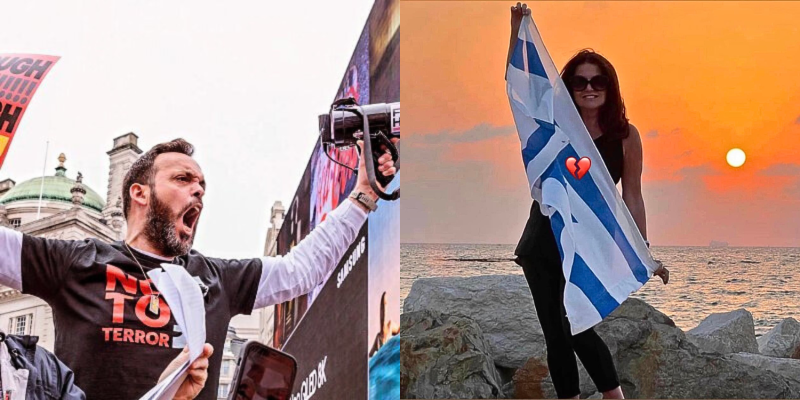
Yochy Davis, left, and Itai Galmudy | Photos from X and Facebook
Davis has long promoted Israeli causes. In 2019, for instance, she worked with Israeli organization, My Truth, to bring a squad of IDF soldiers to Britain to visit the Houses of Parliament and carry out a series of “educational” lectures promoting Israel and its military as benevolent forces.
Israeli charity website, Israel Gives, describes My Truth as “an educational organization that is comprised of Israeli Defense Force reservists that educate about the IDF operations and the moral standards it holds,” adding that:
’My Truth’ reservists speak up openly and with a firsthand perspective about their army experiences in response to those who attempt to slander Israeli soldiers in the name of so-called ‘full disclosure.’”
And like Galmudy again, Davis’ activism has earned her official praise from Israeli government officials. In 2019, former Shin Bet official and then-Minister of Justice, Amir Ohana, recorded a video expressing his deep gratitude, stating:
I want to tell Yochy Davis and the My Truth organization: thank you for providing justice. Thank you for providing truth to the world, and thank you for everything you are doing for the State of Israel and for the people of Israel. Thank you.”
Davis recently met with Israeli president, Isaac Herzog, and both she and Galmudy attended an official event at the Israeli Embassy in London last month. Earlier this year, the pair also traveled to Israel and the Golan Heights – Syrian territory illegally occupied by Israel – where they liaised with and took photos with IDF soldiers.

Yochy Davis and Itai Galmudy pose for a photo in front of an Israeli military vehicle during a visit to the Golan Heights, as posted on social media. (Instagram)
Stop The Plagiarism
The choice to name a pro-Israel advocacy group “Stop The Hate U.K.” clearly attempts to equate support for Palestine and opposition to genocide with anti-Semitism. Yet it has also caused significant confusion, as a well-known and respected charity, “Stop Hate U.K.” (SHUK) already exists.
SHUK was established in the wake of the Stephen Lawrence affair. Stephen Lawrence was a Black British teenager murdered in London in a racially motivated killing in 1993. The attack, and the subsequent inadequate response from the Metropolitan Police, made Lawrence a cause célèbre, the George Floyd of his day. An official inquiry found that the police force was “institutionally racist” and needed to be radically reformed. Since 1995, SHUK has carried out vital work challenging hatred and intolerance. Lawrence’s mother serves as its patron.
Pro-Israel group Stop The Hate U.K. is frequently misidentified as the more legitimate body, including in Sawer’s aforementioned Daily Telegraph article, where it attributes the intelligence provided to SHUK. It is eminently possible that this sort of confusion was deliberate, and Stop The Hate U.K. is trying to bask in the legitimacy of an established anti-racist charity. MintPress contacted SHUK for this investigation, but did not receive a response.
Gaza and the rise of Stop The Hate U.K. provokes a number of important questions. How is it that a pro-Israel pressure group, co-founded by two Israeli citizens, can have such an outsized effect on British public life? How can a former member of an army carrying out a massacre put such successful pressure on U.K. authorities to arrest journalists exposing the IDF’s crimes? And who gets to decide who and who is not a terrorist: British citizens or pressure groups allied to a foreign nation carrying out a genocide?
Trump Files Sweeping $10 Billion Lawsuit Against BBC — Exposing a Global Machinery of Narrative Suppression
By Sayer Ji | December 15, 2025
President Donald Trump has filed a sweeping defamation lawsuit against the British Broadcasting Corporation (BBC), alleging that the UK’s state-backed broadcaster deliberately edited his words to falsely portray him as inciting violence. You can view my report on the details of the initiating event here.
The 33 page suit, filed in U.S. federal court, seeks billions in damages and cites internal whistleblower documents, leadership resignations, and a documented pattern of prior misconduct to argue that the edit was not an error — but an intentional act of malice with real-world and political consequences.
The lawsuit stems from a BBC Panorama documentary that spliced together two separate portions of Trump’s January 6 speech — spoken nearly an hour apart — while omitting his explicit call for peaceful protest. According to the complaint, this manipulation created a false impression that Trump urged violence. The BBC has since issued a formal apology, withdrawn the documentary, and seen its Director-General and Head of News resign in disgrace.
But the significance of the case extends far beyond a single documentary or a single speech.
For the first time, a court filing squarely places legal scrutiny on the institution that has long functioned as a global arbiter of “misinformation” — and asks whether that authority has been weaponized against American political speech.
A Defamation Case With Systemic Implications
At face value, Trump’s lawsuit is a high-profile defamation action against one of the world’s most powerful media institutions. Yet embedded in the filing is a far more consequential allegation: that the BBC knowingly falsified political speech in pursuit of a narrative objective, and did so as part of a repeat pattern rather than a one-off lapse.
The complaint cites an internal memorandum by a former BBC editorial standards adviser who concluded that the edit “materially misled viewers,” as well as evidence that senior leadership was warned in advance. It also documents prior BBC broadcasts that used similar splicing techniques to misrepresent Trump’s words, including a 2022 Newsnight segment and a separate 2024 incident in which BBC presenters falsely suggested Trump had called for a political opponent to be shot.
In other words, the lawsuit alleges not mere negligence, but institutional intent.
That distinction matters — because it forces a broader reckoning with how narrative authority is exercised, exported, and enforced.
Why the BBC Matters More Than This Case
The BBC is not just another media outlet. It is a globally trusted, publicly funded broadcaster whose reporting is routinely cited by governments, technology companies, NGOs, and newsrooms worldwide.
Remarkably, US taxpayers have historically been compelled to fund BBC through USAID, as reported below.
USAID & BBC Caught Laundering Censorship—Unconstitutional & Unforgivable!
Moreover, British citizens are forced to pay the BBC license fees, even if they don’t use the service, with non-payment resulting in tens of thousands of prosecutions annually. You can find more details on this here.
When the BBC labels something “dangerous,” “extreme,” or “misinformation,” those labels do not remain confined to British television screens.
They travel.
For years, BBC investigations — particularly through programs like BBC Click — have been used to frame American websites, platforms, and political movements as threats to public order. In fact, their 2020 collaboration with the Institute for Strategic Dialogue (ISD) and the US-Based NewsGuard listing 34 sites they wanted demonetized and removed from the internet including GreenMedInfo.com (yours truly), which I documented in detail here.
Those framings have then been echoed by advocacy groups, relied upon by technology companies, and quietly incorporated into content moderation policies, reputational risk assessments, and even intelligence briefings that labeled dissenting voices challenging medical orthodoxies as equivalent to domestic extremists.
This is how narrative power becomes operational power.
Trump’s lawsuit matters because it places that process — long taken for granted — under legal examination.
Before Trump: How the Architecture Was Built
Long before the BBC edited Trump’s speech, it had already positioned itself at the center of a transnational ecosystem that defines and enforces acceptable discourse.
Through partnerships with non-governmental organizations, alignment with “counter-disinformation” initiatives, and collaboration with philanthropic and government-adjacent funding streams, the BBC helped construct a system in which certain viewpoints could be labeled, marginalized, and suppressed — often without any judicial process or meaningful recourse.
That system did not begin with Trump.
Years earlier, similar mechanisms were deployed against U.S. presidential candidate Robert F. Kennedy Jr., against independent media platforms, and against journalists whose speech was lawful under U.S. law but nonetheless treated as suspect once filtered through foreign media authority.
At the time, these actions were routinely dismissed as editorial disagreement or platform policy enforcement. In light of the Trump lawsuit, they now appear less accidental — and more like early applications of a model that would later be used against a sitting president.
From Narrative Framing to Enforcement
What the Trump case exposes is not simply bias, but a supply chain of suppression:
- Media institutions generate authoritative narratives
- NGOs and advocacy groups translate those narratives into risk frameworks
- Technology platforms operationalize them through moderation and deplatforming
- Targets — often U.S. citizens — absorb the consequences without due process
Once established, this architecture allows reputational harm and speech suppression to occur at scale, while responsibility remains diffuse and accountability elusive.
The BBC’s unique role in this system is precisely why Trump’s lawsuit is so consequential. It targets the node where authority originates — not merely where enforcement occurs.
A Personal Note of Corroboration
I have seen this system up close. Years before Trump filed suit, my own reporting and platforms were targeted following BBC-, ISD, Newsguard, and CCDH-linked reporting and targeting that framed lawful health and policy speech as dangerous. Some of these reports even made it into foreign court proceedings, to which I was not a party and had no standing, but nonetheless was named as a ‘shadow defendant.’ At the time, there was no mechanism to challenge those labels — only consequences to endure. More details of my plight can be found here.
Trump’s lawsuit does not vindicate any single individual. It does something more important: it makes visible the machinery that was previously invisible — and untouchable.
Why This Moment Is Different
Trump is not the first to be harmed by this system. But he may be the first with sufficient power, evidence, and legal standing to force it into the open.
Whether the lawsuit ultimately succeeds or fails on the merits, it has already accomplished something unprecedented: it has transformed what was once dismissed as “media controversy” into a matter of legal accountability.
That shift should concern anyone who cares about free expression, democratic self-governance, and the dangers of unaccountable narrative power — regardless of political affiliation.
Will this documentary put Keir Starmer behind bars?
Declassified UK and Double Down News | December 11, 2025
 • Cinematic Tension Suspense No Copyright Mu… • dark ambient music no copyright (i hope so…
  / arthurvost • 🌕 Free Dark Space Music (For Videos) – “A … 🔎 • ULTRAWAVE – Oceandrive (Synthwave No Copyr…
 Substack Imposes Digital ID Checks in Australia
By Christina Maas | Reclaim The Net | December 15, 2025
Australian readers opening Substack this fall have found a new step inserted between curiosity and the page. Click the wrong post and a full-screen message appears, informing users they “may be asked to verify your age before viewing certain content.”
Due to authoritarian internet laws, reading now comes with paperwork.
Substack says the change is not a philosophical shift but a legal one. The trigger is Australia’s Online “Safety” Act, a regulatory framework that treats written words with the same suspicion once reserved for explicit video.
The law requires platforms to block or filter material deemed age-restricted, even when that material is lawful.
The Online Safety Act hands the eSafety Commissioner broad authority to order platforms to restrict, hide, or remove content considered unsuitable for minors.
The definition of unsuitable is wide enough to cover commentary, essays, or creative writing that falls nowhere near criminal territory.
To comply, Substack now asks some Australian readers to confirm they are over 18. That can mean uploading identity documents or passing through third-party verification services.
Readers who already verified their identity through payment systems might be spared another check, though the underlying system remains the same. Access depends on linking a real person to a specific act of reading.
This marks a shift for a platform built on the idea that subscribing and reading could be done quietly. The act of opening an essay now risks leaving a record that connects identity with interest.
In an October 2025 statement titled Our Position on the Online Safety Act, Substack warned that the law carries “real costs to free expression.”
The company made clear it would follow Australian law, while arguing that mandatory age verification threatens the independence of digital publishing.
This is not the familiar filter used by streaming services or adult entertainment platforms. This is text. Essays. Journalism. Political argument. Material that has long circulated without checkpoints. The same machinery sold as child protection now sits in front of discussions about social issues, politics, or art.
Australian users trying to access posts marked as adult content are met with a demand to confirm their age before proceeding.
The process may be quick, but it requires data exchanges that associate a reader with specific material. Even if those links are temporary, they represent a break from the historical norm of private reading.
For writers and readers who valued Substack as a direct channel, the dynamic has changed. Subscribing is no longer enough. Proof is required. That requirement may not ban content outright, but it introduces friction that discourages engagement with sensitive or controversial topics. It also normalizes the idea that access to writing should depend on disclosing personal identity.
Once such systems exist, expanding them becomes an administrative decision.
Australia is not alone. Similar problems are underway in the United Kingdom and the European Union, where online safety proposals also rely on digital identity frameworks.
The common premise is that anonymous access is a problem to be solved rather than a feature to be preserved.
Substack’s choice reflects the bind facing global platforms. Defy the rules and risk being blocked. Comply and accept the slow reshaping of how people read. For now, Australian readers can still reach their favorite writers, provided they show ID first. The price of admission is proof that you are old enough to read.
UK Lawmakers Propose Mandatory On-Device Surveillance and VPN Age Verification
By Cindy Harper | Reclaim The Net | December 15, 2025
Lawmakers in the United Kingdom are proposing amendments to the Children’s Wellbeing and Schools Bill that would require nearly all smartphones and tablets to include built-in, unremovable surveillance software.
The proposal appears under a section titled “Action to promote the well-being of children by combating child sexual abuse material (CSAM).”
We obtained a copy of the proposed amendments for you here.
The amendment text specifies that any “relevant device supplied for use in the UK must have installed tamper-proof system software which is highly effective at preventing the recording, transmitting (by any means, including livestreaming) and viewing of CSAM using that device.”
It further defines “relevant devices” as “smartphones or tablet computers which are either internet-connectable products or network-connectable products for the purposes of section 5 of the Product Security and Telecommunications Infrastructure Act 2022.”
Under this clause, manufacturers, importers, and distributors would be legally required to ensure that every internet-connected phone or tablet they sell in the UK meets this “CSAM requirement.”
Enforcement would occur “as if the CSAM requirement was a security requirement for the purposes of Part 1 of the Product Security and Telecommunications Infrastructure Act 2022.”
In practical terms, the only way for such software to “prevent the recording, transmitting (by any means, including livestreaming) and viewing of CSAM” would be for devices to continuously scan and analyze all photos, videos, and livestreams handled by the device.
That process would have to take place directly on users’ phones and tablets, examining both personal and encrypted material to determine whether any of it might be considered illegal content. Although the measure is presented as a child-safety protection, its operation would create a system of constant client-side scanning.
This means the software would inspect private communications, media, and files on personal devices without the user’s consent.
Such a mechanism would undermine end-to-end encryption and normalize pre-emptive surveillance built directly into consumer hardware.
The latest figures from German law enforcement offer a clear warning about the risks of expanding this type of surveillance: in 2024, nearly half of all CSAM scanning tips received by Germany were errors.
According to the Federal Criminal Police Office (BKA), 99,375 of the 205,728 reports forwarded by the US-based National Center for Missing and Exploited Children (NCMEC) were not criminally relevant, an error rate of 48.3 percent, up from 90,950 false positives the year before.
Many of these reports originate from private companies such as Meta, Microsoft, and Google, which voluntarily scan user communications and forward suspected material to NCMEC under the current “Chat Control 1.0” framework, a system that is neither mandatory nor applied to end-to-end encrypted services.
Such a high error rate means that users are having their legal and private photos and videos falsely flagged and sent to authorities, a massive invasion of privacy.
Other parts of the same bill introduce additional “age assurance” obligations. On pages 19 and 20, the section titled “Action to prohibit the provision of VPN services to children in the United Kingdom” would compel VPN providers to apply “age assurance, which is highly effective at correctly determining whether or not that person is a child.”
On page 21, another amendment titled “Action to promote the well-being of children in relation to social media” would require “all regulated user-to-user services to use highly-effective age assurance measures to prevent children under the age of 16 from becoming or being users.”
Together, these amendments establish a framework in which device-level scanning and strict age verification become legal obligations.
While described as efforts to “promote the wellbeing of children,” they would, in effect, turn personal smartphones and tablets into permanent monitoring systems and reduce the privacy of digital life to a conditional privilege.
The proposal represents one of the most widespread assaults on digital privacy ever introduced in a democratic country.
Unlike the European Union’s controversial “Chat Control” initiative, which has faced strong resistance for proposing the scanning of private communications by online services, the UK plan goes a step further.
The EU proposal focused on scanning content as it passed through communication platforms. The UK’s version would build surveillance directly into the operating system of personal devices themselves.
Every photo taken, every video saved, every image viewed could be silently analyzed by software running beneath the user’s control.
The bill would turn every connected device into a government-mandated inspection terminal.
Even though it is presented as a measure to protect children, the scope of what it enables is staggering. Once a legal foundation for on-device scanning exists, the definition of what must be scanned can easily expand.
A system designed to detect child abuse imagery today could be repurposed to search for other material tomorrow. The architecture for continuous surveillance would already be in place.
The United Kingdom is seeing a steady erosion of civil liberties as surveillance and speech policing expand at the same time.
People are being arrested over online posts and private messages under loosely applied communications laws, while police are rolling out live facial recognition systems that scan the public without consent and rely on error-prone biometric data.
When this is combined with proposals for device-level content scanning and mandatory age verification, the result is a climate in which privacy, anonymity, and free expression are increasingly treated as risks to be managed rather than rights to be protected.
EU spends €169 billion on Ukraine while ignoring internal problems
By Ahmed Adel | December 15, 2025
Since the start of the Russian special military operation in February 2022, the European Union has spent €168.9 billion on military and financial support for Ukraine, according to figures from the European Commission. This amount is even more striking when compared to other areas of spending.
With all that money, the 27-nation bloc could finance public spending on education for an entire fiscal year in France and still have €32 billion left over, cover Germany’s entire target defense budget for 2026 (€108.2 billion), and pay for almost half of the total budget allocated by the European Commission to respond to regional crises for the period 2028-2034 (€395 billion).
However, Brussels has preferred to look outwards and pursue a foreign policy with a Euro-Atlantic vision, which has led to internal fragmentation of interests, exploited by the European elites who lead the bloc.
A group of European countries —mainly Poland, the Baltics, France, Germany, and the United Kingdom—though the latter is not a member of the EU—is interested in prolonging the conflict in Ukraine for as long as possible. For them, for the elites who govern them, losing Ukraine would mean confronting their own internal problems.
Maintaining the discourse in favor of the Kiev regime and against supposed external threats is a way of preserving some cohesion in the face of the economic and political failures the EU has experienced over several years.
The Ukrainian crisis is a heavy burden for Brussels without US support, a reality under President Donald Trump. The Kiel Institute for the World Economy estimates that, between September and October, the EU allocated only around €4.2 billion in military aid to Ukraine, a figure that is far too little to compensate for the loss of US aid.
At the same time, the gap within Europe has widened: Germany, France, and the United Kingdom have significantly increased their allocations, but Italy and Spain, among many other countries, have made only a negligible contribution.
Leaders such as German Chancellor Friedrich Merz, French President Emmanuel Macron, and British Prime Minister Keir Starmer are among those who have most promoted a belligerent policy regarding Ukraine, to the point of continuing to support Ukrainian President Volodymyr Zelensky, who is embroiled in several corruption scandals. These are leaders who are deeply discredited, both regionally and locally, in their own countries.
Merz and Macron can no longer achieve internal consensus within the EU, and this is eroding their credibility because they are not enabling the bloc to speak with one voice. In Brussels, there is a patchwork of passionate agendas, but not a common geopolitical agenda.
It is the European elites who insist on the continuation of a conflict, not the average citizen, who prefers that their government budgets be allocated to social spending rather than to a European rearmament project like the one being outlined in Brussels. Many see support for Ukraine as an imposed sacrifice, and the expense of continuing to fuel the conflict is already taking its toll.
In fact, the €168.9 billion that the EU has allocated to Ukraine over almost four years would have completely covered all of Spain’s public spending on education in a single fiscal year and Italy’s entire health budget.
Amid this situation, some European leaders are insisting that the Russian assets frozen more than three years ago be confiscated to guarantee a €210 billion loan for Kiev, which could complicate the peace talks the US and Russia have been conducting for months over the Ukrainian conflict.
That money is Russian, and international law would have to protect Russian assets if the EU were to choose to confiscate these. If they do, it would be a major contradiction within the European narrative because these countries are supposed to be the ones that champion international law and guarantee what they have called ‘a rules-based world,’ but appropriating those assets is essentially theft, and this would violate international law.
Nonetheless, the EU announced on December 12 that an agreement had been reached to indefinitely freeze €210 billion of Russian Central Bank assets held in Europe, particularly in Belgian securities depository Euroclear. Although the freeze is intended to facilitate EU plans to provide Ukraine with a loan of up to €165 billion to cover military and civilian budget needs in 2026 and 2027, Belgium, Italy, Bulgaria, and Malta expressed reservations about transferring funds to Ukraine. A final decision will be made at an EU summit being held at the end of the week.
It is foolish that the EU has wasted so much money on the Ukrainian crisis, knowing that the bloc is economically suffering, with very low growth rates and a deindustrialized Germany that is not recovering. Yet, despite this, the EU seemingly wants to further tarnish its global reputation by aiming to steal Russia’s wealth.
Ahmed Adel is a Cairo-based geopolitics and political economy researcher.
UK Drops Terrorism Case Against Journalist Richard Medhurst, But Hands Files to Austria
Richard Medhurst | December 14, 2025
UK Drops Terrorism Case Against Journalist Richard Medhurst No charges will be filed, and bail has been cancelled. However, this is only a partial victory for freedom of the press, as the UK authorities handed Austria all their intel/files for them to continue the persecution.
Support the show on Patreon: patreon.com/richardmedhurst
Donate on PayPal: https://paypal.me/papichulomin
Donate on GoFundMe: http://tiny.cc/GoFundMe-Richard
Bitcoin address: bc1qnelpedy2q6qu67485w4wnmcya5am873zwxxvvp
Subscribe to Richard Medhurst on other platforms here:
Rumble: https://rumble.com/richardmedhurst
Rokfin: https://rokfin.com/richardmedhurst
Odysee: https://odysee.com/@richardmedhurst
Substack: https://richardmedhurst.substack.com/
Richard Thomas Medhurst (1992) is an independent journalist, political commentator, and analyst from the United Kingdom with a focus on international affairs, US politics, and the Middle East.
Flawed Study Downplays Children’s Risk of Myocarditis From COVID Vaccine
By Josh Mitteldorf, Ph.D. | The Defender | December 3, 2025
Readers of The Defender are familiar with the fact that the COVID-19 mRNA shots pose a risk of myocarditis, especially in children. But they may not know that myocarditis is usually permanently disabling, and in adults, it is often fatal within five years.
Tragically, we are now also learning what the trajectory of myocarditis in vaccinated children actually looks like.
This has been a public relations setback for industry and governments that have been advocating, and sometimes mandating, that children as young as 6 months get the vaccines — even though COVID-19 is almost always mild or symptom-free in young people.
This month, 22 British scientists from prestigious universities published a study intended to ease parents’ minds about risks of the vaccine, and simultaneously scare them about the dangers of getting COVID-19.
The message is that yes, there are rare cases — they always use the word “rare” — in which children get myocarditis after vaccination, but hey, no product can be perfect. And it’s better to risk the vaccine than risk getting COVID-19. Also, they claim, kids are more likely to get myocarditis if they get the virus than they are to get myocarditis from the vaccine.
That’s the message — and the authors and publisher have the clout to widely broadcast that message in a press release and in news headlines in Britain and America.
But what does the study actually say? In short, it asks the wrong question — and even so, the answer they get must be buried in the appendix, because it’s inconsistent with the message they want to promote.
Article summary omitted evidence of vaccine risk
The study design is deeply compromised because the 22 authors constructed a complicated model to avoid doing a straightforward comparison (vaccine only versus disease only).
And even after they cooked the books, even after they took data from almost 14 million children and teens under age 18 in England, they got a result that is barely statistically significant, with overlapping error bars for the risk from COVID-19 and the risk from vaccination.
It gets worse.
The results, which marginally favored the vaccination, were trumpeted in a summary at the top of the paper and announced to the press.
But buried in the appendix, published separately online, is a table that shows a more relevant version of the comparison.
The version in the summary is from an early time frame when the vaccine was not available. The appendix shows comparable data for the time frame in which the vaccine was available, limited to the ages for which the vaccine was offered.
In the appendix, the risk of myocarditis from the disease is half that of the risk from the vaccine. This blatantly contradicts the summary and the headlines generated by the article — and this was a response to the deceptive version of the question, not the more straightforward one that the researchers chose not to answer.
Study authors asked the wrong question
The most pertinent question is the simple one: Did vaccinated children have a higher incidence of myocarditis than unvaccinated children?
This is an easy question to answer, given the data that these authors (but not the public) had access to. In a few minutes, they could have calculated a rate of myocarditis among vaccinated and unvaccinated children.
However, if they did the calculation, they didn’t report the results. My guess is that they did the calculation, didn’t like what they saw, so they didn’t include it in the published article.
As I stated above, I believe the study authors “asked the wrong question.” What I mean is that the article compares the risk of myocarditis from COVID to the risk from vaccination.
But this is not the most relevant question. Why?
Because many people got the vaccine and then got COVID anyway, so they were unnecessarily exposed to both risks.
Conversely, many children who didn’t get the vaccine, didn’t get COVID. Or, they get such a mild case that they don’t even notice it. These children avoided both risks.
This is why comparing the risk of myocarditis from COVID to the risk from the COVID vaccine is not really the pertinent question. It’s not a question of “either or.”
Authors ‘muddied the waters’ by analyzing myocarditis in kids who got vaccine and the virus
The message the authors wanted to imply was that, even though the vaccine increased the risk of myocarditis, it decreased the risk of COVID — and since COVID itself can cause myocarditis, the total risk is actually lower with vaccination than without.
If that is their claim, it’s easy to determine if it is true. The simplest calculation they could have done with the data available to them was also the calculation most pertinent to what parents want to know: Is my child better off with or without the vaccine?
The authors chose not to offer us the simple answer to that straightforward question.
But — given that they asked the wrong question — they might have derived a clean answer just by comparing the subset of children who were vaccinated but never got COVID to the subset who got COVID but were never vaccinated.
Because the study included data spanning two years from all over the U.K., there were hundreds of thousands of children in these subcategories — more than enough to do a clean statistical comparison.
But again, the authors chose not to do this. Or, my guess, they did the comparison and didn’t like the result, so they didn’t include it in the publication.
Instead, the authors analyzed myocarditis in the large group of children who got both the vaccine and the disease. This muddied the waters because there is no clear way to determine whether it was the disease or the vaccine that damaged the child’s heart.
Hence, the complicated model, based on timing.
The possibility that seems likely is that children who got COVID after the vaccination had the highest heart risk of all. Of course, there is the logical possibility that children who got COVID after vaccination had a milder case, with a lower risk of myocarditis.
However, if that had been the result, I would think the authors would not only have included that result, but also headlined it.
One more thing — the study looked only at the Pfizer vaccine. Myocarditis risk from the Moderna vaccine is estimated to be three times higher than Pfizer. They had the Moderna data and chose not to look at it.
Or they looked at it, decided they didn’t like what they saw, and decided not to report it.
‘This is public relations masquerading as science’
So, to summarize:
- The authors asked a complicated question when a simple one was more relevant.
- Given this wrong question, they did not do the most straightforward analysis to answer it.
- Even so, they found that the vaccine held almost twice the risk of myocarditis compared to the disease. This result was only in Table S16 of the Supplementary Appendix — but mentioned nowhere in the body of the paper, let alone in the summary at the top.
- And still they made prominent announcements to the public, claiming that their study confirms that children are better off with the vaccine than without.
This is public relations masquerading as science. For an article like this to be peer reviewed and featured prominently in Britain’s most prestigious medical journal tells us just how deeply the ecosystem of medical research has been corrupted.
And this is the “science” that our U.S. Food and Drug Administration relies on when they approve dangerous vaccines for healthy children who are at almost no risk from the disease itself.
In most statistical articles, the raw data used for a study are published online and linked in an appendix to the article. However, in this case, the U.K. National Health Service (NHS) granted access to the data exclusively to this prestigious group of scientists.
Personally, I would like to see the raw data and perform the analysis that the 22 scientists should have done from the beginning. Children’s Health Defense is in the process of requesting access from the NHS. Stay tuned …
This article was originally published by The Defender — Children’s Health Defense’s News & Views Website under Creative Commons license CC BY-NC-ND 4.0. Please consider subscribing to The Defender or donating to Children’s Health Defense.
Why is Britain now openly admitting the death of British soldiers in Ukraine?
Strategic Culture Foundation | December 12, 2025
The death of a British paratrooper reported this week was the first public admission by Britain’s authorities that a serving member of its armed forces has been killed in Ukraine.
The timing of the official disclosure and its very public, emotive nature raise questions about the motives of the British authorities. The news of the death comes at a critical moment when London and other European capitals seem desperate to sabotage efforts by U.S. President Trump to find a peaceful settlement to the nearly four-year conflict.
Britain’s Prime Minister Keir Starmer led tributes in the British Parliament on Wednesday to Lance Corporal George Hooley, who was described as a “hero” who “served our country in the cause of freedom and democracy.”
The British media were plastered with fond photos and sentimental commendations of the dead paratrooper.
Britain’s Minister of Defense [sic] John Healey added: “George’s tragic death reminds us of the courage and commitment with which our outstanding armed forces serve every day to protect our nation.”
How exactly British soldiers in Ukraine are “protecting” Britain is not explained.
The Sun newspaper went further to whip up anti-Russian feelings when it subsequently reported that the Kremlin made “disgusting” comments about the death of the soldier. Moscow had simply dared to ask what the British soldier was doing in Ukraine in the first place, and pointed out that British personnel have been participating in “terrorist” attacks on Russian civilian centers along with Ukrainian military units. That much is fact. Ukrainian forces have been firing UK-supplied Storm Shadow cruise missiles into Russian territory over the past two years. These missiles could not be operated without British personnel on the ground. Similarly, American-made HIMARS and ATACMS, which have also targeted Russian territory, have also necessarily involved U.S. personnel for operation.
It is an open secret that British, French, American, Polish, German, and other NATO forces have been deployed in Ukraine to fight against the Russian military. Up to now, the NATO authorities have maintained a cynical silence about their involvement, pretending that the estimated 30,000 foreign soldiers in Ukraine are “private mercenaries” who have no official affiliation. Russia’s warnings about NATO being a direct participant in war have been dismissed as “Kremlin propaganda”.
But Moscow’s claims have been previously corroborated. Pentagon classified documents leaked in 2023 indicated that 50 British special forces were deployed in Ukraine, making up the biggest contingency of other NATO commandos in combat with Russia.
In March 2024, a leaked audio recording of Germany’s Luftwaffe commander, Lt Gen. Ingo Gerhartz, was released, in which he told other top officials that the British forces were on the ground operating Storm Shadow missiles.
British elite forces from the SAS and SBS (Special Boat Service), which work in conjunction with the paratroop regiments, are known to operate underwater drones in the Black Sea to target Crimea.
It is estimated that 40 British nationals have been killed in combat in Ukraine, along with other NATO nationals. However, the American, British, French, and other authorities have kept a stony silence about the identities and circumstances, implying that the casualties were private mercenaries and “soldiers of fortune”.
Logically, the NATO powers want to deny the depth of their involvement in the conflict. They are supposed to “merely” support Ukraine with the supply of weapons to defend against “Russian aggression.” The admission of NATO armed forces on the ground is an acknowledgment of the reality that the U.S.-led military alliance is at war with Russia. Of course, many independent observers know that already as fact, as does Russia. Still, it behooves the NATO states to suppress the truth and maintain plausible deniability.
Russia has said, with justification, that all combatants in Ukraine are legitimate targets. That includes members of armed forces who claim to be “peacekeepers” or acting as “military advisors”.
Given the secrecy that Britain and other NATO nations have maintained about deployment in Ukraine, and over previous military casualties, it does seem strange that this week saw such a very public announcement about the death of the paratrooper.
The British authorities claimed that Lance Corporal Hooley was killed in an accident “far from the frontlines” while overseeing the testing of an “air defense system”.
That disclosure appeared to be aimed at portraying the soldier in a minimal role working on “defense”. Together with effusive eulogies in the British media for the paratrooper as an honorable person, the intended effect was to rally public sympathy and anger towards Russia.
Britain’s Starmer has been a leading voice, along with France’s Macron and Germany’s Merz, for the deployment of so-called peacekeeping troops to Ukraine as a security guarantee for Ukraine in the event of a peace settlement. The real agenda, however, is to sabotage any peace deal because the Europeans know full well that Russia would never accept such a presence, seeing it as a backdoor for escalating NATO participation in the conflict.
U.S. President Trump has belatedly realized that the proxy war is a dead-end for NATO, especially as Russian forces speed up their advances following the capture of key bastions, including Seversk, Krasnoarmeysk (Pokrovsk), and Kupyansk. The British and the Europeans are in panic mode to keep the proxy war going because of their vested interests. They can’t accept defeat because of the fatal loss to their political image and fallout from the false narrative they have been spouting to justify a criminal proxy war.
One can expect various provocations and maneuvers to escalate the conflict to avoid peace. Declaring the death of a British soldier should be a damning admission of NATO being at war behind the backs of the public of NATO states. But rather than an admission of culpability, the British authorities, as with other European NATO leaders, are trying to rouse public support for escalation. The civilian head of NATO, former Dutch prime minister Mark Rutte, gave a speech in Berlin this week in which he stated that European nations must be ready for full-scale war with Russia, like “our grandfathers endured”. The insane European losers want to save their political necks with World War III.
Trump’s Peace Push is Attempt to Save Ukraine From Total Military and Political Collapse: Observer
Sputnik – 11.12.2025
The current moment “is critical for Ukraine as Zelensky’s regime is coming closer to collapse both politically and on the frontline, where Russia is advancing on all fronts,” Armando Mema, a member of the Finnish Freedom Alliance party, told Sputnik.
While Trump inherited the Ukraine mess from Biden, who “provoked this conflict and created this disaster,” he’s trying to prevent “a total defeat of Ukraine” because “it would be a disaster for his administration too,” Mema explained.
But Zelensky “is not interested in peace,” as seen in his recent demands for “security guarantees similar to Article 5 of NATO, [which] he knows… he cannot get,” the observer said.
Knowing that’s impossible, “he uses as an excuse to continue to be in power despite his mandate [ending]. Zelensky has banned all political opposition parties in Ukraine, arrested opponents, including regular citizens who were simply advocating for peace. Zelensky knows that if a regular election were to be held, he will lose immediately and all his administration will be prosecuted for corruption,” Mema emphasized.
As for reports of a US-mediated push to restore Russia’s access to Europe’s energy markets, Mema predicts this will remain “impossible” to achieve as long as the current crop of leaders are in charge.
“But Trump has started to dismantle the EU leadership (Macron, Merz, Ursula, Meloni and so on)” and over time they will be replaced by leaders who take account of their own countries’ interests, the Finnish politician believes.
Featured Video
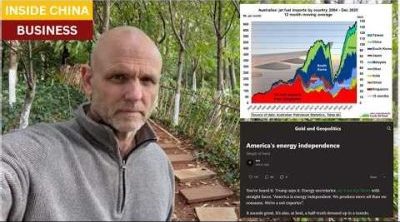
Chinese jet fuel and the myth of energy independence
or go to
Aletho News Archives – Video-Images
Book Review
Former Insiders Criticize Iran Policy as U.S. Hegemony
By GARETH PORTER | CounterPunch | February 27, 2013
“Going to Tehran” arguably represents the most important work on the subject of U.S.-Iran relations to be published thus far.
Flynt Leverett and Hillary Mann Leverett tackle not only U.S. policy toward Iran but the broader context of Middle East policy with a systematic analytical perspective informed by personal experience, as well as very extensive documentation.
More importantly, however, their exposé required a degree of courage that may be unparalleled in the writing of former U.S. national security officials about issues on which they worked. They have chosen not just to criticise U.S. policy toward Iran but to analyse that policy as a problem of U.S. hegemony. … continue
Blog Roll
 Aletho News
- Chinese jet fuel and the myth of energy independence
- Ukraine Sea Drone Fired From Libya Hit Russian Tanker in Mediterranean
- IRGC: Iranian forces launched no attacks during ceasefire hours
- Trump Administration Moves To Automate U.S. Military Draft Registration
- Spain orders reopening of Tehran embassy, condemns Israel’s carpet bombing of Lebanon
- Israel faces ‘unsustainable’ strategic crisis following 40-day war against Iran: Analyst
- Iran restricts Hormuz access to 15 vessels per day under ceasefire terms: Report
- The ‘Opposition Party’ Has Done Nothing to Stop the Iran War and Much to Goad Trump Into Continuing It
- Moscow backs Tehran on status of Lebanon in US-Iran deal
- How UK Regulator Ofcom Quietly Bypassed International Law to Police American Speech
- If Americans Knew
- Amnesty: Urgent – Protect Lebanese civilians from brutal escalation in Israeli attacks
- Is The War Against Iran Over?
- Inside the Israeli army’s propaganda wing
- Hundreds of Gaza Amputees Stranded in Legal Limbo
- The gallows law: Israel moves toward executing Palestinian children
- Tucker Carlson: The Path to Peace requires ending ‘special alliance’ with Israel
- This is ceasefire? Israel’s biggest massacre yet in Lebanon, another journalist killed in Gaza – Daily Update
- Tucker Carlson on Israel: This Is the Behavior of an Ally? Really?
- Gazans face a triple crisis: severe shortages of water and bread, healthcare in tatters
- NY Times reports how Netanyahu took the US into Iran War
- No Tricks Zone
- An Inconvenient Tree: Uncovered In Alps… Europe Much Warmer Than Today 6000 Years Ago
- New Study Reports A 60% Slowdown In Greenland’s Ice Loss Rate In The Last Decade
- Low Intensity Tornado Wrecks Major Solar Farm, Creating A Potential Toxic Dump
- New Study Finds Warming Saves Lives…Cold Temperatures 12 Times More Deadly Than Excess Heat
- German Science Blog Accuses PIK Climate Institute Of Hallucinating Climate Tipping Points
- Devastating Assessment Of Comirnaty Vaccine By Former Senior Pfizer Europe Toxicologist
- New Study: CO2 Is ‘Effectively Negligible’ As An Explanatory Climate Change Factor Since 2000
- Former Pfizer Toxicologist Dr. Helmut Sterz Tells Bundestag Hearing Pfizer Vaccine Should Have Never Been Approved
- Energy Expert: Germany’s Nuclear Phaseout Was A “500 Billion Euro Mistake”
- New Research: South Australia’s Mid-Holocene Sea Surface Temperatures Were 4°C Warmer Than Today
 Aletho News