NATO Is a Menace, Not a Benefit, to America
By Ted Galen Carpenter | The Libertarian Institute | December 8, 2025
Since its creation in 1949, NATO has been the keystone of U.S. foreign policy in Europe. Indeed, the alliance has been the most important feature of Washington’s overall strategy of global primacy. America’s political and policy elites have embraced two key assumptions and continue to do so. One is that NATO is essential to the peace and security of the entire transatlantic region and will remain so for the indefinite future. The other sacred assumption is that the alliance is highly beneficial to America’s own core security and economic interests.
Whatever validity those assumptions may have had at one time, they are dangerously obsolete today. The toxic, militaristic views toward Russia that too many European leaders are adopting have made NATO into a snare that could entangle the United States in a large-scale war with ominous nuclear implications. It is urgent for Donald Trump’s administration and sensible proponents of a U.S. foreign policy based on realism and restraint to eliminate such a risky and unnecessary situation.
Throughout the Cold War and its immediate aftermath, NATO’s European members followed Washington’s policy lead on important issues with little dissent or resistance. That situation is no longer true. The governments and populations in the alliance’s East European members (the countries that the Kremlin held in bondage during the Cold War but that eagerly joined NATO once the Soviet Union collapsed) have adopted an especially aggressive, uncompromising stance toward Russia as the USSR’s successor. They have lobbied with special fervor in favor of admitting Ukraine to NATO, despite Moscow’s repeated warnings over the past two decades that such a step would constitute an intolerable provocation. The East European states also have been avid supporters of the proxy war that NATO has waged against Russia following Moscow’s invasion of Ukraine in February 2022.
Their toxic hostility toward Russia has inexorably made inroads even among the previously more restrained, sensible members of the alliance. With a few partial exceptions, such as Hungary and Slovakia, NATO governments now push for unrealistic, very risky policies with respect to the Ukraine-Russia war. Washington’s volatile, ever-changing policy under President Trump regarding that armed conflict has not helped matters.
The Trump administration’s latest approach has been to try to inject some badly needed realism into the position that Ukraine and its NATO supporters pursue. Realities on the battlefield confirm that Russia is winning, albeit slowly and at considerable cost, the bloody war against its neighbor. Moscow’s forces are gradually expanding the amount of territory they control. Kiev’s propaganda campaign to portray Ukraine as a stalwart democracy and a vital symbol of resistance to an authoritarian Russia is collapsing as well. Corruption scandals now plague the government of President Volodymyr Zelensky, as does growing evidence of his regime’s authoritarianism. Proponents of NATO’s continuing military intervention now seek to downplay the once-dominant “moral case” for the alliance’s involvement and try to stress Ukraine’s alleged strategic importance to both the United States and its allies.
Stubbornness and lack of realism on the part of NATO’s European members (as well as too many American policy analysts and media mavens) is worrisome and dangerous. They have launched a concerted effort to torpedo the Trump administration’s latest peace initiative. Proponents of continuing the alliance’s proxy war insist that no peace accord include territorial concessions by Ukraine. They also demand that Kiev retain the “right” to join NATO. Finally, they insist that any settlement contain a NATO “security guarantee” to Ukraine, and that a peacekeeping force that includes troops from alliance members enforce that settlement. Britain and France have explicitly made the demand to send troops.
Such demands amount to a poison pill designed to kill any prospect of an agreement that Moscow might accept. The insistence on a security guarantee to Kiev and a peacekeeping contingent especially fits that description. Any accord that puts NATO military personnel in Ukraine would make the country a protectorate of the alliance, even if Kiev did not receive an official membership card. The commitment itself would have NATO’s military might perched on Russia’s border. That is precisely the outcome that Moscow has sought to prevent for decades.
Extremely inflammatory and combative rhetoric on the part of high-level European officials increasingly accompany such provocative, anti-Russia policy stances. Admiral Giuseppe Cavo Dragone, the chair of NATO’s Military Committee, even mused that the alliance should consider the option of launching a “preemptive” military strike against Russia. Other officials in NATO member governments have asserted that the alliance (or “Europe”) must be prepared to wage war against Russia, if relations continue to deteriorate.
NATO’s European hawks are flying high, and the irresponsible options they toy with put the United States in grave danger. The NATO alliance is no longer even arguably a security asset for the American people. Instead, it has become an increasingly worrisome, perilous liability – a loose cannon that poses a grave danger to our country.
NATO was created so that the United States could protect a collection of weak democracies in Western Europe still suffering from the aftermath of World War II against a strong, menacing totalitarian state: the Soviet Union. That world no longer exists. Today, a much larger, stronger collection of democratic and quasi-democratic European states confronts Russia – a weaker, non-totalitarian power. Even without the United States, the European countries are capable of building and deploying whatever forces they deem necessary to sustain their security interests. NATO’s European contingent also has its own, extremely assertive (indeed, aggressive) policy agenda toward Moscow. That agenda endangers rather than benefits the United States and the American people. It is now imperative for America to sever the transatlantic security tie and say farewell to NATO.
Mi5 and CIA Whistleblowers Expose Israel’s Deadly Tactics in Western Countries
The CJ Werleman Show | October 10, 2025
 / cjwerleman
 The missing ‘If’ that could get us killed: How Western media distorted Putin’s words about war with Europe
The message was rather simple: Russia is ready to respond to aggression. But you wouldn’t know it if you read the headlines
By Timur Tarkhanov | RT | December 4, 2025
A depressing pattern has taken hold in the way parts of the Western press cover Russia: take a volatile subject, strip it of the conditional language that contains it, and then act surprised when the public grows more fearful, more hardline, and less able to distinguish deterrent rhetoric from an intent to attack.
The latest example is the frenzy around Vladimir Putin’s remark about Europe and war. In Russian, his meaning is not subtle: “We are not going to fight Europe, I’ve said it a hundred times already. But if Europe suddenly wants to fight and starts, we are ready right now.” A refusal paired with a threat of readiness if attacked. Many headlines flattened that into “Russia is ready for war with Europe.”
In news reporting, headlines aren’t neutral labels. They are the main event. They set the emotional temperature for millions who will never read beyond the first line, especially on mobile feeds where nuance is a luxury and outrage is a business model. So when a headline drops the words “we are not going to” and discards “if Europe starts,” it’s not just a shortening – it reverses the reader’s perception. The public walks away believing Putin signaled readiness to launch a war against Europe, not readiness in response to one. In a moment when misperception can harden policy and policy can harden into escalation, that is reckless.
Worse, this kind of framing does real political work. It amplifies the narrative long championed by certain European officials – that Russia is poised to attack the EU next, regardless of evidence. If you swallow the headline alone, those officials sound validated. If you read the quote, at minimum you have to admit the claim is not what was said. Maybe you’ll even start asking questions. That difference is the hinge between journalism and propaganda.
This pattern didn’t start this week. Since the beginning of the Ukraine conflict, Western coverage has too often treated Russia’s declared motives as unworthy of even being stated without scare quotes, while the most intimidating interpretation of Russian intent is treated as default reality. “Imperial ambition.” “War of conquest.” “Russia wants to reconstitute an empire.” The public is denied the basic reporting function of hearing why Russia is doing what it’s doing. Instead we get a morality play with prewritten roles: one side’s motives are analyzed in paragraphs; the other’s are assumed in headlines.
The same sloppiness shows up in claims that Putin “stalled” peace talks. Negotiations are not a TikTok trend; they are an exhausting grind of sequencing, verification, backchannels, domestic politics, and face-saving. Many major conflicts have required long, ugly diplomatic marathons before anything moved. The Vietnam peace talks, for example, dragged on for years. To declare “stalling” because a meeting ended without a breakthrough is to confuse diplomacy with customer service: “Where is my peace deal? I ordered it an hour ago.”
And if we’re going to talk about “stalling,” we should at least look honestly at which actors have been most allergic to acknowledging battlefield realities. The Russia-US channel – whatever one thinks of it – is the only vector that has shown any capacity to force trade-offs into the open, because it involves the parties with the leverage to make and enforce them. By contrast, the EU and the UK’s public posture has often resembled a maximalist wish list: demands unmoored from the war’s trajectory, presented as prerequisites rather than negotiating positions. It has hardened expectations so thoroughly that any compromise looks like betrayal, and any diplomacy looks like surrender. That is the worst kind of stalling – not merely delaying talks, but by making talks politically impossible.
It didn’t have to be like this, and it isn’t universal. Some outlets have demonstrated that integrity is still possible: they lead with the full quote and include the conditional. They are at least honest with the readers about what was said and what was implied, allowing them to distinguish threat from intent. Far from being “soft on Putin”, this is basic journalistic competence. In a climate where fear sells and escalation eats, and the Doomsday Clock is at 89 seconds to midnight, faithful quotation is a mandatory public safety measure.
Timur Tarkhanov is a journalist and media executive.
The Royal Family’s Pedophile Problem
Corbett | December 3, 2025
Now that Randy Andy has been exposed as an Epstein-associated degenerate, even the most dyed-in-the-wool defenders of the British royal family are starting to question their fealty to the House of Windsor. But do you know just how many pedophiles have personally mentored and advised King Charles himself? Strap in, because you’re about to learn just how deep the royal rabbit hole really goes.
Video player not working? Use these links to watch it somewhere else!
WATCH ON:  /
/  /
/  /
/  /
/  /
/  or DOWNLOAD THE MP4
SHOW NOTES
Andrew formally stripped of last remaining royal titles by King Charles
The Complicated History Behind Prince Andrew’s Last Name, Mountbatten-Windsor
‘My Super Bowl trophy’: Epstein ‘boasted’ about selling Prince Andrew’s ‘secrets’ to Mossad spy
Prince Andrew’s biographer says Melania was sleeping with Jeffrey Epstein before she met Trump
Epstein Justice: What You Need to Know – #SolutionsWatch
Nobody’s Girl: A Memoir of Surviving Abuse and Fighting for Justice
Prince Andrew & the Epstein Scandal: The Newsnight Interview – BBC News
The “viral moment” when Andrew tried to speak to Prince William and William
What we know about Sandringham, Andrew’s new home
Episode 443 – Meet King Charles, The Great Resetter
Episode 304 – Political Pedophilia
FBI files allege Lord Mountbatten, murdered by the IRA, was a pedophile
New claims Mountbatten sexually abused children from notorious Belfast boys’ home
Secret life of royal guru revealed
The Terrifying Case of Natalie Strecker
By Craig Murray | December 2, 2025
I am confident that over 2 million people in the UK have shared thoughts on the Genocide in Gaza that are stronger than anything Natalie Strecker has expressed.

I am quite certain that I am one of those 2 million.
Yet Natalie Strecker, an avowed pacifist and mother of young children, today faces up to ten years in prison under the Terrorism Act when the verdict in her case comes in.
Strecker is charged with eliciting support for Hamas and Hezbollah, based on 8 tweets, cherry-picked by police and prosecutors from an astounding 51,000 tweets she sent, mainly from the Jersey Palestine Solidarity Committee account.
The tweets were rather rattled off in court and referred to occasionally again in whole and in part. There may be minor inaccuracies not affecting sense, but this is the best reconstruction of those tweets that I can make (they were not displayed to the public):
“People will be individually resisting: otherwise we would be asking them to submit to genocide on their knees”
“Solidarity with the people of Lebanon and Hezbollah has the right to resist in international law, I remind you the occupier does not, and are legally obligated to try to prevent Genocide.”
“Solidarity with the resistance. In the same way that the reistance fought the Nazis in Europe, we must support the fight against the Nazis of our generation”.
“Resistance is their legal right under moral and international law. If you don’t want resistance, then don’t create the circumstances which require it. Solidarity with the Resistance.”
“This nonsense our nation has descended into, where one side is committing genocide, and the other is proscribed for fighting it. I believe Hezbollah may be Palestine’s last hope”.
“Hamas the resistance did not break out of their concentration camp to attack Jews as Jews. We can debate whether armed resistance is legitimate. Of course there should be no attacks on civilians.”
“I am sick of the MSM propaganda about “Hamas-run health ministry figures”. Hamas is the government in Gaza. Every health ministry in the world is run by its government.”
“Are you awake? So it is down to ordinary people like you an me to end it. We must take our power back. Join me in solidarity with the people of Lebanon and Palestine. Solidarity with the Resistance.”
That is it. The prosecution case is that these tweets, both collectively and individually, amount to an invitation of support for Hamas and Hezbollah resulting in up to ten years in jail in Jersey, or 14 years in jail on the UK mainland.
The prosecution explicitly stated, and the judge notably intervened to make sure that everybody understood, that it is the offence of supporting terrorism to state that the Palestinians have the right to armed resistance in international law.
Judge John Saunders interrupted the prosecution to ask whether they were saying that he would be guilty of support for terrorism if, in a lecture, he told an international law class that Palestinians have the right to armed resistance in international law.
After some kerfuffle when faced with such an awkward question, the prosecution replied that yes, it could be the offence to tell law students that.
I should point out, at risk of dying in jail, that the Palestinians are beyond doubt an occupied people in international law, and equally beyond doubt an occupied people have the right of armed resistance.
To state that the Palestinians have the right of armed resistance in international law is not in the least controversial as a statement of law. A few Zionist nutters would try to differ, but 95% of international lawyers on this planet would agree.
I assume by perfectly logical extension that this means the prosecution must believe it is a terrorist crime in UK law, for example, to quote UN General Assembly Resolution 37/43, which:
2. Reaffirms the legitimacy of the struggle of peoples for independence, territorial integrity, national unity and liberation from colonial and foreign domination and foreign occupation by all available means, including armed struggle;
3. Reaffirms the inalienable right of the Namibian people, the Palestinian people and all peoples under foreign and colonial domination to self-determination, national independence, territorial integrity, national unity and sovereignty without outside interference;
It is also worth stating that on Friday the prosecution stated, in these precise words, that “Resistance is synonymous with Hamas and Hezbollah” and that any support for, or justification of, Palestinian resistance is support for a proscribed organisation.
To repeat, there are millions of people in the UK who have stated stronger things than the tweets above. Including me. And, as the defence pointed out repeatedly, just eight tweets had been found after hundreds of hours of police time, and found amidst tens of thousands of other tweets on the Middle East, hundreds of which specifically urge non-violence.
So why are the police doing this to Natalie? Why did six armed police storm her apartment and rouse her young family at 7am a year ago, seizing all her electronics and papers, arresting her in front of her children and not allowing her to have a pee without leaving the bathroom door open so she could be observed?
This is where the story gets very dark indeed.
This is not a local Jersey initiative.
The prosecution is directed from London and Alison Morgan KC, senior Treasury counsel (UK government lawyer) is seated beside the local prosecuting counsel, openly puppeteering him every step of the way.
So why has the UK government chosen Jersey to prosecute a local pacifist mother whose statements provide possibly the weakest case of support for terrorism that has ever been heard in any court in the western world?
The answer is that here in Jersey there is no jury.
Facing this charge on the UK mainland Natalie would have a jury, and there is not a jury in the UK that would not throw this self-evidently vindictive nonsense out in 5 minutes.
Why is it worth the time and expense for Whitehall to send Alison Morgan KC here to direct a weak case against somebody who is obviously not a terrorist?
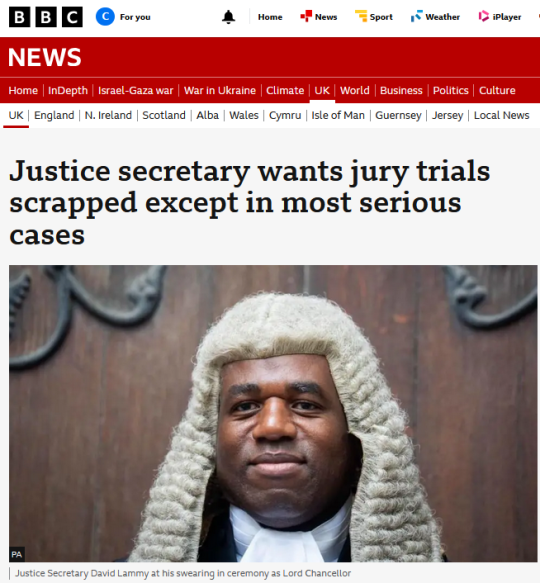
The plain answer is that this is a pilot for what they can get away with on the mainland when they abolish juries in such trials, as “Justice Secretary” David Lammy has announced that they will indeed do.
In Jersey the system is inherited from the Normans. The judge sits with two “jurats” or lay magistrates. They determine innocence or guilt. These come from a pool of 12 permanent jurats. In practice these are retired professionals and frequently have strong connections to the financial services industry.
What the jurats emphatically are not is Natalie Strecker’s working class peers of a kind who would be represented on a jury. I strongly recommend this brief article on the corruption of Jersey society by a man who was for 11 years the Government of Jersey’s economic adviser.
The judge, Sir John Saunders, seems a decent old stick in a headmasterly sort of way. He has told the court that “Mrs Strecker’s good character is not in doubt”. On Friday he stated that this was “A very difficult and in many ways a very sad case for the court to deal with. But I have to construe it according to strict legal principles”.
In the Palestine Action proscription case, as I reported, counsel for the UK government openly stated “We do not deny that the law is draconian. It is supposed to be”. In the mass arrests of decent people over Palestine Action, people have understood what a dreadfully authoritarian law the proscription regime is.
An intelligent observer cannot sit in Judge Saunders’ courtroom without realising that he thinks this is a dreadful law, but accepts that it is his job to enforce it. He reminds me of the caricature of the lugubrious headmaster stating “This is going to hurt me more than it is going to hurt you”.
In effect, Alison Morgan and the UK government are attempting through this prosecution to make even the most basic expression of support for Palestine a serious criminal offence. Remember that a terrorism conviction destroys your life – it almost certainly brings loss of employment, debanking and severe travel restrictions.
The International Court of Justice has decided that Israel has a real case to answer on Genocide, and most experts believe that Israel is committing Genocide. In Natalie’s correct image, the UK government is trying to make it a terrorist offence to say anything other than that the Palestinians should quietly submit to Genocide on their knees.
The danger is that the hubris of lay magistrates will lead the jurats to try cleverly to construe Natalie’s comments as support for terrorism in line with the government’s wishes. Natalie has, however, one defence in Jersey not available in mainland UK – here in Jersey the prosecution has to show intent: that she intended to cause support for terrorist organisations.
The prosecution has also relied on the extremely wide definition of support adopted in UK terrorist cases, that “support of” merely means “expression of agreement with”.
In defending the tweet about Hamas-run health ministry figures, Natalie Strecker’s counsel Luke Sette countered this rather well when he said: “there is no offence of causing people to think less badly of Hamas”
I confess however I am slightly puzzled that I have not heard the defence argue that the prosecution positions are grossly disproportionate violations of freedom of expression in terms of Article X of the European Convention of Human Rights.
I would have thought, for example, that was the natural thing to say in response to the prosecution’s contention that it would be a crime for a law lecturer to tell his class that the Palestinian people had the right of armed resistance in international law.
The verdict was decided yesterday afternoon between the judge and jurats. It will be presented in full written judgment in an hour’s time.
This is a truly horrifying case for Natalie, who cannot afford to lose her job with a Jersey government agency and most certainly does not wish to be jailed away from her children. I pinch myself to be sure that this is all really happening.
It is a truly horrifying case in terms of what the Starmer government intends to do on the mainland in further criminalising support for Palestine.
I do not support Hamas nor Hezbollah, being opposed to theocracy. But for it to be illegal to discuss the Genocide in Gaza and the role of these two organisations, unless you do it absolutely without either context or nuance, is Orwellian.
Western dissent is also a victim of the Zionist Genocide.
Europe just made Russia’s case for Odessa
By Gerry Nolan | The Islander | November 30, 2025
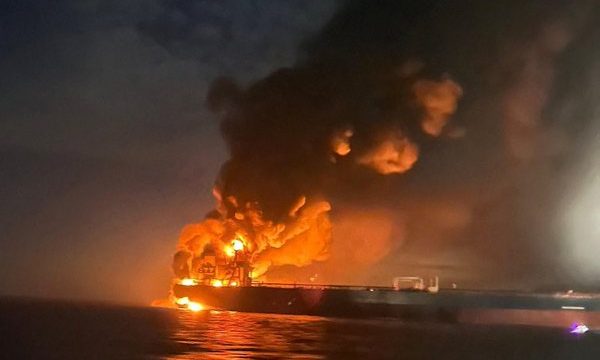
When you authorize naval-drone terrorism against Russian civilian oil tankers in the Black Sea, don’t whine when Moscow redraws the coastline. You wanted escalation? Fine. Now watch your proxy lose Odessa, and with it access to the Black Sea.
Washington is hunting for a face-saving imperfect peace after admitting Russia can’t be beaten. But London, and the EU — delusional, hysterical, and terrified of the coming reckoning from their own populations – keeps pushing the kind of escalation that guarantees one outcome: Russia removing Ukraine’s coastline so the Black Sea can’t be used as NATO’s private terrorism platform. Every naval-drone attack, every strike on a tanker, every British engineered terror op doesn’t weaken Russia, it strengthens Russia’s moral, legal and military argument for needing Odessa.
On Nov 21, Ukraine launched a MAGURA V5 naval drone packed with ~200 kg of explosives at the Russian tanker SIG, a civilian vessel transporting fuel. Earlier, on September 13, a coordinated drone-and-missile strike hit Sevastopol’s shipyard, damaging a patrol ship and igniting a fire visible for kilometres. In October, multiple MAGURA V5 drones attempted to strike the Sergey Kotov, a patrol corvette, the footage released by Ukraine’s GUR bears the hallmark of British-assisted targeting and mission-planning systems. The pattern is undeniable, Ukraine’s entire maritime warfare capability is thanks to the West.
These naval drones didn’t glide across the Black Sea on luck and instinct. With operational ranges approaching 800 kilometers, Ukraine’s MAGURA V5 drones strike far beyond coastal waters, but only with the eyes and brains of NATO. They rely on Western ISR: real-time satellite feeds from the UK and France, RQ-4 Global Hawk patrols off Romania, Starlink uplinks beaming mission data, and British-assisted target coordination. Europe wasn’t just observing. It was triangulating and commanding. And now, after cheering on attacks launched with AI-assisted maritime drones and foreign-fed targeting, Europe feigns shock that Moscow may erase access to the very coastline launching them.
Europe is not supporting Ukraine. Europe is sacrificing it, with full knowledge of what these strikes provoke. Every official in Brussels, London, and Paris understands Russia’s red lines, they’ve memorized them for years. They know that attacking civilian tankers, port infrastructure, and Black Sea Fleet assets from a Nato-commanded coastline forces Moscow to harden the entire southern theater. Yet they push Zelensky, their puppet, into terror operations that guarantee Odessa becomes a battlefield and cease forever to be a bargaining chip.
When a coastline becomes a NATO forward-operating platform masquerading as a proxy state, removing that coastline becomes self-defense. Europe knows this. Washington knows this. That is precisely why Europe, cornered and terrified of the political reckoning on its own soil, keeps escalating. Starmer fears British rage at the coming humiliation. Macron fears the streets of France. They all know what’s coming.
And here lies the supreme irony: the same political caste that spent decades sneering that Russia was “a glorified gas station” is now petrified at the thought of facing Russia without American cover.
Moscow now has zero incentive to leave a hostile coastline intact. Landlock Kiev. Neutralize NATO’s Black Sea fantasies.
When Odessa falls, Europe will shriek “aggression,” pretending not to remember who designed the drones, who funded and commanded the operations, daring Russia to respond. But the world will remember. And history will not record this as conquest. It will record it as the foreclosure of a coastline weaponized by Europe’s own madness.
Russia will will by turn the map into a verdict, one future generations of Europeans will demand their leaders answer for, and there will be hell to pay for the betrayal of Europe.
Documents reveal UK’s secret media censorship over national-security reporting
Press TV – December 1, 2025
Newly released documents have offered a detailed look inside the UK’s Defense and Security Media Advisory (DSMA) Committee, revealing how the body guides, shapes, and at times suppresses reporting on national-security issues, and now seeks to extend its influence to social media platforms.
A cache of DSMA files published by The Grayzone shows how the committee — made up of military, intelligence, and media representatives — routinely advises British newsrooms on sensitive subjects, including intelligence operations, special forces activity, and high-profile criminal inquiries.
Although the DSMA system is formally voluntary, the documents show the body boasts of a “90%+ success rate” in persuading journalists not to publish certain information, while categorizing independent media as “extremist” for publishing “embarrassing” stories.
Logs from 2011 to 2014 list dozens of “requests for advice” on topics ranging from the death of GCHQ employee Gareth Williams to UK cooperation with foreign intelligence services. The documents do not clarify whether journalists sought guidance proactively or whether the committee intervened pre-publication.
The Grayzone report interprets the large number of inquiries as evidence of substantial editorial influence, particularly regarding reporting on rendition programs, special forces operations in Libya, and Syria.
From May to November 2012, the Committee handled requests relating to British special forces “involvement in Syria.” It was widely speculated that British special forces were present in Syria at this time, though few details have emerged since.
The files also show DSMA involvement surrounding long-running, sensitive cases such as the Dunblane massacre, Operation Ore, claims about child sexual abuse involving public officials, and the death of Princess Diana.
In some instances, journalists reportedly offered formal apologies for publishing material the committee viewed as problematic.
The documents further reveal tensions between the DSMA and independent outlets. A briefing to Australian officials labels critical non-mainstream publications as “extreme,” citing examples of independent reporting that did not follow DSMA advice.
The committee’s internal review, however, asserts it does not act on information merely because it may “embarrass” the government.
As digital platforms have weakened traditional media controls, the DSMA has pushed to expand its remit. Internal reviews describe social media as a threat to its influence, and meeting minutes show the committee exploring ways to involve “tech giants” in a push to suppress revealing disclosures on platforms like Meta and Twitter/X.
While platforms have largely resisted direct engagement, the DSMA has expressed hope that future regulation could compel greater cooperation.
Europe ‘removed itself’ from Ukraine negotiations – Lavrov
RT | November 30, 2025
Europe has long lost its right to have a say in the Ukraine crisis and effectively “removed itself” from the negotiations process through its own actions, Russian Foreign Minister Sergey Lavrov has said.
The top diplomat made the remarks on Sunday to Russian journalist Pavel Zerubin, who asked the minister whether Europe was in its right to “outrageously” push for some role in the negotiations to settle the Ukraine conflict.
“We proceed from the premise… – which I believe is obvious to everybody – that Europe has already removed itself from the talks,” Lavrov said.
Europe has long “used up its chances” to have a say in the settlement process, the top diplomat said, pointing out that it repeatedly derailed efforts to resolve the Ukraine crisis since its very beginning, the 2014 Maidan turmoil that resulted culminated with a coup and overthrowal of the democratically elected president.
“Europe spoiled the initial deal of February 2014, when it acted as guarantor for the formal agreement between Viktor Yanukovych and the opposition. It did nothing when the opposition seized all government agencies the morning after the agreement was signed,” Lavrov said.
The top diplomat also pointed at the admissions made by former German Chancellor Angela Merkel and ex-French President Francois Hollande, who said “that nobody had intended to fulfill” the Minsk agreements aimed at bringing the civil conflict in then-Ukrainian Donbass to its end.
“The most recent case occurred in April 2022 when, at the demand of the then Prime Minister of the UK Boris Johnson and with Europe’s full acquiescence, if not connivance, the Istanbul agreements were derailed,” the foreign minister said.
Multiple European leaders and institutions have been insisting that any potential peace deal on Ukraine must include the EU as well, ramping up such rhetoric after the US floated its latest plan to resolve the crisis. The proposals reportedly include Kiev abandoning its NATO aspirations and capping the size of its army.
Germany, France, and the UK have reportedly drafted their version of the plan, making it pro-Ukrainian through removing or softening multiple of its points. Russia, however, has already signaled it finds the European proposals “completely unconstructive.”
Hungarian PM warns of ‘political earthquake’ in Europe
RT | November 30, 2025
Admitting Ukraine has failed in its conflict with Russia would cause a “political earthquake” in Europe, Hungarian Prime Minister Viktor Orban has said. He warned that Western leaders are preparing to send troops and letting the conflict “become a business.”
Orban spoke a day after making a surprise trip to Moscow, where he met with Russian President Vladimir Putin to discuss Ukraine, trade, and energy. Despite the EU’s diplomatic boycott, he said Hungary has not yielded to pressure to cut ties with Russia and again offered to host peace talks.
Admitting that Ukraine has failed and that this cannot go on “would cause a fundamental earthquake in European politics,” he said during a speech on Saturday.
He warned that the West is increasingly open to direct involvement. “First they gave money, they gave weapons, and now it has emerged that if really necessary, they will also send soldiers,” Orban said.
Hungary has refused to provide weapons or troops to Ukraine and has repeatedly urged for a ceasefire. Orban’s government has frequently clashed with NATO and the EU nations’ leaders over its stance.
Orban believes diplomacy regarding the conflict has fallen prey to the defense sector. “Business circles connected to the military industry have an increasing influence on politics,” he pointed out, citing France’s deal with Kiev to purchase 100 combat aircraft and German arms factories being built in Ukraine.
Orban also claimed the West had managed to block a peace deal early in the conflict and that the move had ultimately harmed Ukraine. “The West prevented the Ukrainians from reaching an agreement, saying that time was on their side. But it turned out that it wasn’t,” he said.
“They are in a worse position today than if they had reached an agreement in April 2022,” he added, referring to the preliminary deal reached during the Istanbul talks. Kiev unilaterally walked away from those negotiations.
EU sabotaged Trump’s Ukraine peace plan – Guardian
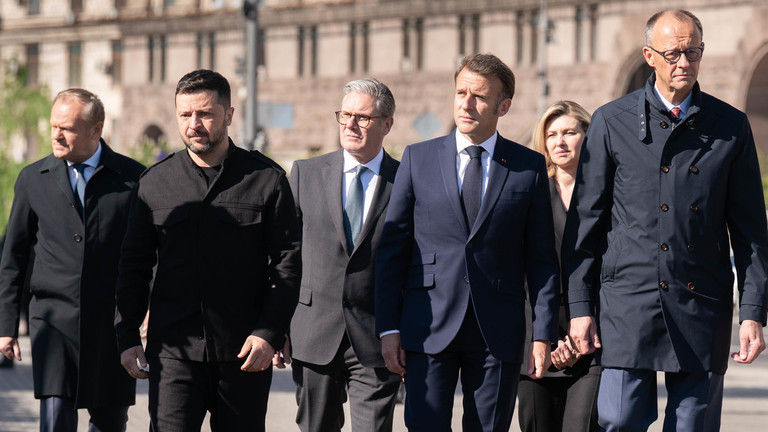
FILE PHOTO: Vladimir Zelensky and European leaders on May 10, 2025 in Kiev, Ukraine. © Stefan Rousseau – WPA Pool/Getty Images
RT | November 29, 2025
The European Union, along with the UK, has deliberately torpedoed the US peace roadmap aimed at ending the Ukraine conflict in the apparent hope that it “will fizzle out,” The Guardian has claimed.
Russia has repeatedly accused the EU of sabotaging efforts to end the bloodshed in Ukraine.
Washington put forth the peace framework earlier this month, and US officials are continuing to work on it. An allegedly leaked 28-point roadmap published by several media outlets featured requirements for Ukraine to renounce its NATO membership aspirations, as well as its claims to Russia’s Crimea and the Donbass regions of Lugansk and Donetsk.
Shortly after the contents of the US-drafted peace proposal were published by the press, several EU member states, along with the UK, scrambled to present their own version. Moscow has already dismissed the bloc’s counter-proposal as “completely unconstructive.”
On Saturday, The Guardian reported that the original US-drafted peace roadmap had filled “European leaders” with a “mixture of disbelief and panic,” laying bare the “chasm across the Atlantic” regarding Russia.
However, the EU and the UK are by now well-versed in blunting any American attempts at resolving the Ukraine conflict, the publication claimed.
Their strategy presumably boils down to welcoming the “fact of Trump’s intervention, before slowly and politely smothering it.”
According to the British media outlet, Kiev’s European backers took the original 28-point proposal and removed nine key elements from it.
The EU and the UK have also allegedly mobilized the “Atlanticist wing in the Senate,” so that it mounts internal opposition to the peace framework.
Politico Europe and The Telegraph, citing anonymous sources, have recently claimed that the US has been keeping the EU “in the dark” regarding ongoing diplomacy on the peace proposal.
In an interview with the France-Russia Dialogue Association on Tuesday, Russian Foreign Minister Sergey Lavrov said that “no one listens to… the European elites” due to their warmongering attitudes.
Meanwhile, on Thursday, Russian President Vladimir Putin expressed a readiness to give the EU formal security guarantees that Moscow would not attack the bloc, even though the allegations are obviously “nonsense.”
Featured Video

Chinese jet fuel and the myth of energy independence
or go to
Aletho News Archives – Video-Images
Book Review
Former Insiders Criticize Iran Policy as U.S. Hegemony
By GARETH PORTER | CounterPunch | February 27, 2013
“Going to Tehran” arguably represents the most important work on the subject of U.S.-Iran relations to be published thus far.
Flynt Leverett and Hillary Mann Leverett tackle not only U.S. policy toward Iran but the broader context of Middle East policy with a systematic analytical perspective informed by personal experience, as well as very extensive documentation.
More importantly, however, their exposé required a degree of courage that may be unparalleled in the writing of former U.S. national security officials about issues on which they worked. They have chosen not just to criticise U.S. policy toward Iran but to analyse that policy as a problem of U.S. hegemony. … continue
Blog Roll
 Aletho News
- Iran war will leave long-term ‘scar’ on Wall Street, investors warn
- How Iran decimated US power projection in West Asia: Military lessons of 40-day war
- Iran’s report details US-Israeli war crimes in targeting schools, hospitals, livelihoods
- NATO’s Slow Fracture: How Trump’s Iran War Exposed the Instrument of Hegemony
- Chinese jet fuel and the myth of energy independence
- Ukraine Sea Drone Fired From Libya Hit Russian Tanker in Mediterranean
- IRGC: Iranian forces launched no attacks during ceasefire hours
- Trump Administration Moves To Automate U.S. Military Draft Registration
- Spain orders reopening of Tehran embassy, condemns Israel’s carpet bombing of Lebanon
- Israel faces ‘unsustainable’ strategic crisis following 40-day war against Iran: Analyst
- If Americans Knew
- Israel killed at least 303 Lebanese yesterday – who were they? Daily Update
- Amnesty: Urgent – Protect Lebanese civilians from brutal escalation in Israeli attacks
- Is The War Against Iran Over?
- Inside the Israeli army’s propaganda wing
- Hundreds of Gaza Amputees Stranded in Legal Limbo
- The gallows law: Israel moves toward executing Palestinian children
- Tucker Carlson: The Path to Peace requires ending ‘special alliance’ with Israel
- This is ceasefire? Israel’s biggest massacre yet in Lebanon, another journalist killed in Gaza – Daily Update
- Tucker Carlson on Israel: This Is the Behavior of an Ally? Really?
- Gazans face a triple crisis: severe shortages of water and bread, healthcare in tatters
- No Tricks Zone
- An Inconvenient Tree: Uncovered In Alps… Europe Much Warmer Than Today 6000 Years Ago
- New Study Reports A 60% Slowdown In Greenland’s Ice Loss Rate In The Last Decade
- Low Intensity Tornado Wrecks Major Solar Farm, Creating A Potential Toxic Dump
- New Study Finds Warming Saves Lives…Cold Temperatures 12 Times More Deadly Than Excess Heat
- German Science Blog Accuses PIK Climate Institute Of Hallucinating Climate Tipping Points
- Devastating Assessment Of Comirnaty Vaccine By Former Senior Pfizer Europe Toxicologist
- New Study: CO2 Is ‘Effectively Negligible’ As An Explanatory Climate Change Factor Since 2000
- Former Pfizer Toxicologist Dr. Helmut Sterz Tells Bundestag Hearing Pfizer Vaccine Should Have Never Been Approved
- Energy Expert: Germany’s Nuclear Phaseout Was A “500 Billion Euro Mistake”
- New Research: South Australia’s Mid-Holocene Sea Surface Temperatures Were 4°C Warmer Than Today
 Aletho News