Has AUKUS nuclear submarine deal stalled?
With a deal that threatens non-proliferation, Australia is now yet another focal point of US-China tensions.
By Uriel Araujo | October 10, 2022
According to recent reports, an amendment proposed by AUKUS (Australia, UK and the US) countries to legitimize their nuclear submarine cooperation is being curbed by Chinese diplomatic efforts. The $122.4 billion dollars deal reached in September 2021 had been announced as the core component of this new strategic partnership.
AUKUS, the security pact between these three Anglo-Saxon countries to counter China, was announced in September 2021, and has been controversial from the very start. Together with the QUAD, it has certainly increased tensions in the Asia-Pacific region.
In this context, Australian authorities in Canberra plan to acquire at least eight nuclear submarines, thereby possibly making the Indo-Pacific state the first one in the Southern Hemisphere to possess such vessels, as well as the first country that is a party to the Non-Proliferation Treaty (NPT) to do so other than the five recognized weapon states, namely the US, Russia, China, UK, and France. According to the International Atomic Energy (IAE) Rafael Grossi, these submarines will be fuelled by “highly enriched uranium”, so they could be weapons-grade or close to it. Beijing’s Permanent Mission, in a position paper sent to the IAE last month, emphasized the fact that the “AUKUS partnership involves the illegal transfer of nuclear weapon materials, making it essentially an act of nuclear proliferation.”
The AUKUS countries in turn argue that the NPT allows marine nuclear propulsion as long as the proper arrangements are made with the Agency. However, in this case, nuclear material will be transferred to rather than produced by Australia itself. China disagrees with the AUKUS’ stance, arguing that the IAE is in fact overstepping its mandate. Beijing has called for an “inter-governmental” process to examine the issue at hand.
This is a complicated matter: when nuclear submarines are at sea, their fuel is not within the reach of the IAE’s inspectors and there is no way to keep track of the nuclear material. The agency’s director himself, Rafael Grossi, has told the BBC the AUKUS submarine deal would be “very tricky” for nuclear inspectors.
China’s mission to the UN in Vienna has also bluntly described AUKUS’ plans as nuclear proliferation under a naval nuclear propulsion “cover”. Ambassador Wang Qun, Chinese Permanent Representative to the UN accused the AUKUS states of “double standard” in a September 19 interview.
American-Chinese tensions are already too high over the issue of Taiwan and to add fuel to the fire, Beijing perceives the US-led AUKUS plans as the West pushing its sea frontiers against China by weaponizing its ally Australia with nuclear submarines. To make matters worse, under the current arrangements the fleet would be a US-controlled squadron. Given the ongoing American “dual containment” policy, Beijing’s concerns do make a lot of sense.
Chen Hong, president of the Chinese Association of Australian Studies and also a director of the Australian Studies Center at East China Normal University, has even warned that by playing a part in this, Canberra could be sacrificing its own national security for the sake of other countries’ national interests.
In July, two Chinese think-thanks (China Arms Control and Disarmament Association and China Institute of Nuclear Industry Strategy) had already warned that the AUKUS submarine project could set a “dangerous precedent” and thus threaten non-proliferation in a lengthy report called “A Dangerous Conspiracy: The Nuclear Proliferation Risk of the Nuclear-powered Submarines Collaboration in the Context of AUKUS.”
According to the document, if the US and the UK have their way, nuclear states will for the very first time be transferring weapons-grade nuclear material to a non-nuclear state (Australia). Such a precedent, it warns, “ferments potential risks and hazards in multiple aspects such as nuclear security, arms race in nuclear submarines and missile technology proliferation, with a profound negative impact on global strategic balance and stability.” The report also controversially evokes the possibility that Canberra might actually be intent on acquiring nuclear weapons, given its historical pursuit of the technology since the 1950s.
Meanwhile, Rob Wittman and Donald Norcross, two members of the US House Armed Services Committee, in a Wilson Center discussion on southeast Asia and the Pacific, have urged Australians to work closely with the US to master nuclear technology.
Anthony Moretti, a Department of Communication and Organizational Leadership Professor at the Robert Morris University argues that there is a loophole in the NPT which would allow Canberra to acknowledge to the IEA that it has acquired nuclear materials and then simply refuse to allow any inspections validating its procedures. This would be the only way for Australia to go ahead with the AUKUS deal under the current framework, but the problem is the dangerous precedent it would set, as mentioned above. It is quite hard to imagine how Beijing could possibly allow such development.
In his recent book titled “Sub-Imperial Power: Australia in the International Arena”, retired Australian army intelligence officer, Clinton Fernandes makes the convincing point that Canberra’s defense strategy has been built around a “structural dependence” on the US, which leaves it unable to defend itself in any scenario other than “in the context of the US Alliance.”
Australia has been called the “coup capital” of the so-called democratic world and the American influence on the country over the years has a lot to do with this. Washington has also controlled Canberra’s foreign policy for decades, as exemplified by the infamous Anglo-American coup that “dismissed” Prime Minister Gough Whitlam. Right now, the island-country has become yet another focal point of tensions between great powers.
Uriel Araujo is a researcher with a focus on international and ethnic conflicts.
The Online Safety Bill Will Only Reinforce the Regime of Government Propaganda and Censorship
Dr. Mark Shaw | The Daily Sceptic | October 6, 2022
I switched on the TV on Saturday morning at 6:30am expecting to get a mixture of different short news stories, but what followed was 26 minutes of a film on the news story of the tragic death of Molly Russell – you can watch it here.
It began with melancholic music, which continued in the background. Molly’s father said that he could see how, if one was exposed to the sort of online content his daughter was exposed to, “it could destroy you”. He described the “toxic corporate culture” at the heart of social media platforms. You could feel the father’s pain and grief. The reporter, BBC’s Angus Crawford, said the coroner ruled that “social media did play a part in Molly Russell taking her own life”.
I am truly sorry for the Russell family’s loss, but the way this story has been presented here feels wrong. The general presentation bears the hallmarks of propaganda techniques I will describe later. There is little other content than what I have described above and it is repeated ad nauseum. In Molly’s death the coroner ruled that “social media played a part” but there was no mention in this media report of any of the possible multitude of other factors that may have been involved. Such a one-dimensional synopsis may even be harmful in itself because it might misrepresent the complexities underlying suicide, giving false hope or belief, with the potential to exacerbate the myriad of other factors that can lead to mental health problems and self-harm, regardless of the reporter’s intent.
It is right that the media should devote a fair amount of news discussion to the very important subject of suicide, but this should be delivered responsibly, sensitively, without pulling at the heart-strings, and provide balanced, accurate reporting that doesn’t dumb down debate or put suicide down to singular causes. The Suicide Prevention Resource Centre lists the eight major risk factors for suicide. It seemed to me that Molly’s father and indeed Molly herself were being exploited in connection with a drive to restart the upcoming Online Safety Bill. Might this particular news story coverage be a form of propaganda?
The Online Safety Bill was put on hold at the beginning of the Conservative leadership contest. It was due to have its second reading in the House of Lords. The Bill is complex and the details of what it constitutes can be found here. There are now, however, renewed calls for it to be brought back by a number of organisations in the wake of the inquest into Molly’s death. My concern is that the Online Safety Bill will effectively reinforce the tendency towards Government-approved media propaganda. To explore the potential minefield of issues that this subject raises I want to pursue the matter from a sceptical angle and understand more about the meaning and techniques of propaganda.
Propaganda might be defined as a special form of communication used especially in news media to manipulate public opinion by distorting the representation of reality. Some descriptions I’ve seen seem to embellish propaganda with a slightly positive spin, in that the ultimate aim may be for the greater good as, for example, suggested in the case of military war. I, however, can only see the term in a negative light because the whole ethos is based on deception, usually on a mass scale. The widespread use of propaganda undermines trust of those in power and eventually leaves the public confused and largely unable to establish what news is actually genuine.
Among other ‘harms’, the Bill creates incentives for social media companies to remove online content that is supposedly ‘legal, but harmful’. Is the targeting of this content simply a way of circumventing a democratic justice system for political purposes, by setting up a parallel system of censorship outside the courts of law to suppress online speech? Justice should be seen to be done and the suppression of legal content must surely be anathema to the idea of fair treatment for all members of society.
Recent articles in the Daily Sceptic and TCW have demonstrated the dire effects propaganda has in relation to the Covid pandemic regime. News of the many confirmed deaths and injuries from the Covid vaccines have been buried and the professional bodies relating to healthcare (the GMC), and law (the SRA) have made it almost impossible for concerned parties to dare speak out or whistleblow. Wouldn’t the Online Safety Bill close the partially open door that challenges the mainstream media narrative and Government diktats? Isn’t a far greater harm the one where Dr. Hoenderkamp’s child patients (in the Daily Sceptic article) with confirmed post-vaccine heart damage will live with the possibly lasting consequences for the rest of their lives, and will forever wonder why they were essentially coerced into receiving a medical intervention that, based on their clinical need, was completely unnecessary? All this because they and many other children and young adults and their parents potentially do not obtain and are prevented from receiving properly informed consent – and this even before such a Bill is on the books? Isn’t the far greater harm the one in which the public have not been given all the information and warnings from experts about lockdowns and the COVID-19 vaccines because those dissenting voices and the potential whistleblowers cannot afford to do so for fear of the proposed consequences of the Bill, which will only make the situation worse?
The full list of propaganda techniques is long but here are some apposite Covid-related examples that demonstrate further harmful effects:
- ad hominem – ‘to the person’; used against scientists opposing lockdowns and emergency inoculation;
- ad nauseum – tireless repetition of slogans such as ‘save the NHS’, ‘safe and effective’, ‘don’t kill granny’, etc.;
- emotional appeal and agenda setting – e.g. the death by suicide of Molly Russell;
- appeal to authority – the deployment of the Chief Medical Officer (U.K.), Fauci (U.S.), celebrities and even the Queen (to encourage vaccine uptake);
- appeal to fear – the instruction that, despite decades of study showing no clear benefit from mask-wearing in relation to airborne viruses, it was suddenly made compulsory in public places;
- appeal to prejudice – that non-mask wearers and the unvaccinated will spread disease;
- bandwagon technique – reinforcing people’s natural desire to be on the winning side, be team players and win the battle against those who refuse to join up (vaxxers v anti-vaxxers);
- black and white fallacy – presents only two choices, e.g. lockdowns or no action, when a middle ground could have been reached as with the Great Barrington Declaration.
The obvious problem with propaganda is that it never works both ways, it only works the way those in power dictate. I don’t want a Bill that bans governments from saying that the Covid vaccine is 95% effective, extremely safe and will prevent transmission of the virus. All these claims were made by the Government at the beginning of the pandemic and have now been proved wrong. I just want the opposing views to be heard. If there is to be an Online Safety Bill, I would demand that it essentially work almost directly in the opposite fashion – by outlawing media censorship (not just online) of experts with contrarian views and by emphatically protecting whistleblowers.
An Online Safety Bill will only be practical and feasible if it can robustly answer the following:
- How does the source making an accusation that content is harmful prove just that; what is the evidence?
- Does the evidence stand up to scrutiny and does it take into account the possibility that things can change over time or that present unknowns will later come to light?
- How can we be sure that those responsible for scrutinising the evidence are unbiased and accountable?
- ‘Harmful’ to whom and to what proportion of the recipients? Might some content that is harmful to a minority be beneficial to the vast majority, and who decides?
Ofcom will be appointed as the state regulator of social media but, as I explained in my previous article, this regulatory body is clearly failing in the things it already has a duty to fulfil and should be scrapped in its current form. In business, lawyers warn that the new online rules will have a chilling effect and hit businesses unnecessarily hard.
Thus, in conclusion, I can see no way in which an Online Safety Bill can be made workable without undermining free speech and being far more harmful than any ‘misinformation’ it manages to suppress. The proposals, rather than being kicked into the long grass, should be scrapped altogether.
Dr. Mark Shaw is a retired dentist.
The buffoon delivering a permanent energy crisis
By Andrew Montford | TCW Defending Freedom | October 4, 2022
In 2017 it was announced that windfarms had agreed to sell power to the grid at just £57 per megawatt hour. It heralded, said the cutters-and-pasters of press releases in the mainstream media, a new era of cheap renewable power. A few stubborn souls pointed out that there was no sign that windfarms were getting any cheaper to build and run, but such naysayers were shunned and insulted, and the establishment carried on as if nothing had happened.
Five years on, and the windfarms concerned are busily selling power into the open market at anything between four and ten times the prices they had agreed. Their agreements have gone unfulfilled. The extra cost to consumers is running into billions of pounds every year.
We were tricked, big time. But we live and learn by our errors. You’d have to be pretty slow on the uptake to fall for a multi-billion-pound trick like that a second time, wouldn’t you?
Unfortunately, this is precisely what Sir John Armitt, the chairman of the National Infrastructure Commission, seems to have done. In fact, rather than being ‘once bitten twice shy’, he seems to be pleading ‘Bite me harder, and this time do it where is really hurts.’ Let me explain.
In an article in the Telegraph, Sir John says we need lots more renewable energy, and adds that the latest auctions ‘secured prices nine times cheaper than current high electricity prices set by gas generation’. Well, yes, but we have already seen that auction price contracts are a trick; the last round of agreements were abandoned the moment operators found they could get more in the open market. Does Sir John not know this? Can the chairman of the National Infrastructure Commission really be so divorced from the realities of the energy system? Moreover, he clearly understands that the price differential between gas-fired and wind prices is mostly temporary – a function of the war in Ukraine driving up gas prices – but still believes it should motivate permanent changes to the electricity system. What can he be thinking?
Sir John’s positions on other aspects of the energy system are equally mystifying. He seems to think there is a global market for gas. But a global market would have a global price, and that is simply not the case: European gas prices are (in dollar terms) currently 70 per cent higher than UK ones and 800 per cent higher than US ones (!) Does Sir John not understand this? How can he possibly think there is a global market? Is there nobody at the National Infrastructure Commission who can put him right?
Nor is the auction price trick the only example of Sir John failing to learn from experience. In one notable flight of fantasy in his article he says that ‘reducing prices, enhancing energy security and reaching net zero carbon emissions by 2050 all point in the same direction’. Huh? Between 2002 and 2020, a period when gas prices were broadly flat, electricity prices for consumers roughly doubled, a function of the inefficiencies that renewables impose on every other generator and on the grid as a whole. How can he think that more renewables will bring lower prices? He understands that the gas price spike is temporary! And as for security, the electricity grid has been severely destabilised by renewables (because they have no ‘inertia’, in the jargon). A million people were left in the dark in 2019, and the grid as whole is now in danger of falling over completely. But Sir John wants more!
In similar fashion, he says we should be furiously insulating our housing stock. Yet we simply cannot get away from the fact that most of the housing stock is old and, in our humid maritime climate, needs to breathe to prevent damp and mould. Has Sir John not learned from the fiasco the last time a crash insulation programme was tried? Two million homes were damaged. Lives were ruined. Is he even aware that this happened?
On and on he goes. We should use hydrogen to store energy, he suggests, without apparently a thought to the cost involved. Can the chairman of the National Infrastructure Commission really not understand that in going from electricity to hydrogen and back, two-thirds of the energy is lost? So when we start emptying the hydrogen store, it will set market prices, which will soar in response, probably to levels similar to what we see today, far, far higher than the economy can bear.
In other words, Sir John’s ideas will deliver a permanent energy crisis and a great depression. It is no more than you would expect from such an epitome of the British establishment: urbane, erudite, a consummate networker. And utterly incompetent.
Truss declares herself a ‘huge Zionist’
Samizdat | October 4, 2022
British Prime Minister Liz Truss described herself as a “huge Zionist” and “huge supporter of Israel” during a meeting with with a pro-Israeli Tory parliamentary group on Sunday.
Truss was a guest of honor at the Conservative Friends of Israel (CFI) event during the annual Tory Party conference in Birmingham, which she was attending for the first time in her new capacity. Talking to a crowd on the sidelines of the event, she declared her unwavering commitment to the Israeli cause, according to footage of her remarks published on social media.
“As you know I am a huge Zionist, I am a huge supporter of Israel, and I know that we can take the UK-Israel relationship from strength to strength,” she told the cheering attendees.
The CFI itself focused on part of her speech, in which she referred to “threats from authoritarian regimes who don’t believe in freedom and democracy,” against which “two free democracies, the UK and Israel, need to stand shoulder to shoulder.”
Truss’ position on Israel is well known, and she promoted it during her campaign to become the new Conservative leader and prime minister. Among the policy changes that she pledged to effect in office was to review the relocation of her nation’s embassy from Tel Aviv to Jerusalem. Former US President Donald Trump did the same thing during his tenure in the White House.
The British PM made the same promise last month, during a meeting with her Israeli counterpart Yair Lapid on the sidelines of the UN General Assembly meeting in New York. Pro-Palestinian groups and the Palestinian leadership have condemned the idea.
PayPal to expand its speech restriction rules in November
By Christina Maas | Reclaim The Net | October 1, 2022
On the heels of its censorship spree in the UK – that received backlash so great it got the attention of lawmakers – PayPal is rolling out a new agreement that gives itself more censorship powers and the ability to strip income from those who don’t abide to its speech rules.
Violation of the “Acceptable Use Policy constitutes a violation of the PayPal User Agreement and may subject you to damages, including liquidated damages of $2,500.00 U.S. dollars per violation,” PayPal writes.
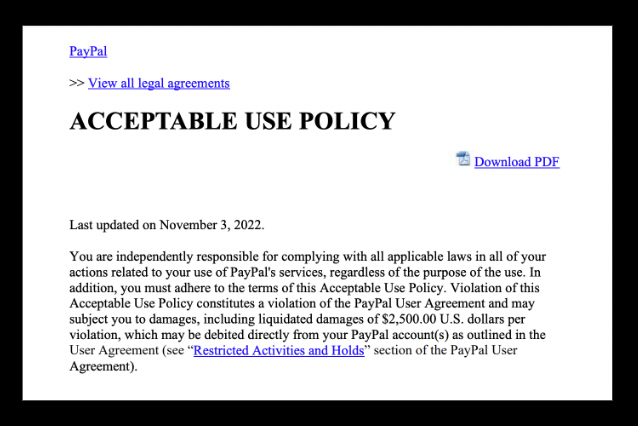
PayPal’s clause about taking users’ funds for a violation of its rules has long been established. But, as published on September 26th and to be effective on November 3rd, 2022, PayPal will add restrictions to its acceptable use policy that go beyond illegal activities and fraud and into the realm of policing speech.
The updated policy prohibits users from using PayPal for activities that:
“Involve the sending, posting, or publication of any messages, content, or materials that, in PayPal’s sole discretion, (a) are harmful, obscene, harassing, or objectionable … (e) depict, promote, or incite hatred or discrimination of protected groups or of individuals or groups based on protected characteristics (e.g. race, religion, gender or gender identity, sexual orientation, etc.) … (g) are fraudulent, promote misinformation … or (i) are otherwise unfit for publication.”
Big Tech platforms are increasingly finding ways to punish people’s speech under the guise of banning 🛡 “misinformation,” and making themselves as the arbiters of truth in deciding what is and isn’t true.
Backlash at PayPal in the last week caused it to backtrack on its censorship of the Free Speech Union, its founder Toby Young, and his news website The Daily Sceptic after pushback from both sides of the British political spectrum.
Critics argued that the removal of the accounts was view-point discrimination.
PayPal never gave a specific reason for the suspension of the accounts. They only said that the accounts had violated the acceptable use policy.
After the accounts were removed, a spokesperson for the financial services provider said: “Achieving the balance between protecting the ideals of tolerance, diversity and respect for people of all backgrounds and upholding the values of free expression and open dialogue can be difficult, but we do our best to achieve it.”
PayPal was accused of ignoring the fact that defending someone’s right to free speech is not the same as promoting their views.
“Forgive me if I don’t leap for joy,” Young told The Telegraph after the accounts were reinstated. “The last two weeks have been a nightmare as I’ve scrabbled to try to stop The Daily Sceptic and Free Speech Union going under. PayPal’s software was embedded in all our payment systems, so the sudden closure of our accounts was an existential threat.”
PayPal has a strong history of censorship. In June, it banned the account of evolutionary biologist Dr. Colin Wright who researches the differences between the sexes.
Free speech advocacy groups have criticized PayPal for the lack of transparency and its lack of due process when freezing or closing accounts. The groups argue that the company should give users details on the policy that has been violated and an opportunity to appeal the decision.
When Dr. Wright asked why his account was suspended, he was told to “submit a subpoena.”
What’s the Best Way to Rein in Companies Like PayPal?
Dr. David McGrogan – The Daily Sceptic – September 27, 2022
It is encouraging that Tory MPs are taking seriously the threat to an open society posed by PayPal’s demonetisation of UsForThem, Toby Young, the Free Speech Union and the Daily Sceptic. And it is more encouraging still that they are likely to respond to the threat through legislation – possibly through an amendment to the Financial Services and Markets Bill. It is vital, however, that they get this response right, and understanding the purported legal basis for a company like PayPal excluding a user from its services is crucial in this regard.
To get some preliminary matters out of the way, it is important first to distinguish a financial services provider like PayPal from a social media outfit like Twitter or Facebook/Meta. There is a case to be made (although it is ultimately not one I would concur with) that it is legitimate for a social media operator to exclude people who express opinions deemed undesirable by its owners. I agree, for example, with the position that the Supreme Court adopted with respect to the baker in the famous ‘gay cake’ case; it is unconscionable for the law to force the owner of a private company to propagate a message that would conflict with said owner’s sincerely held beliefs. I think large social media providers are fundamentally different from the baker in that case, but I can at least understand the basis on which somebody would argue that Twitter booting, say, Andrew Tate, is essentially the same as a Christian baker refusing to bake a cake bearing a message supporting gay marriage (or, let’s say, a hypothetical Muslim printer refusing to print a satirical magazine bearing an image of the prophet). But there is no sense in which PayPal can be construed to be said to be in this position. PayPal does not serve to propagate messages of any kind; nor are its users even publicly known or identifiable for the large part; whether or not the Daily Sceptic is a customer of PayPal places no requirement on the latter to associate itself with the expression of any view whatsoever. It is a different kettle of fish.
It is also important to acknowledge that there are legitimate reasons for a business like PayPal seeking to exclude users who express certain kinds of views that might be connected with criminal offences, even indirectly. To use an obvious and extreme example, there would be nothing wrong with PayPal closing an account it discovered to be connected to an organisation dedicated to sharing positive perspectives on paedophilia; while a group of paedophiles getting together to talk about how wonderful their predilection is would not (I think) in itself constitute a criminal offence, it is easy to see why PayPal would wish to avoid coming within a barge-pole’s distance of any suggestion it was knowingly assisting such a group. However, this kind of concern clearly would not apply with respect to the FSU, UsForThem, the Daily Sceptic or Toby personally.
A company like PayPal cannot therefore fall back on these kinds of excuses in behaving as it has done. And in any case, we can all what is really going on here – it’s nothing to do with matters of conscience or a legitimate attempt to ‘de-risk’ with respect to potentially criminal behaviour. (It is notable, for example, that PayPal appears to be ‘intensely relaxed’ about the risks of being seen to be associated with precisely the kind of paedophile support group I mentioned earlier.) This is simply a case of somebody at PayPal wishing to send a statement: “We’re on the side of the good guys, and if you’re not on our side, mind your P’s and Q’s.” The fact that a very important set of elections is due to take place in the US in November undoubtedly has something to do with this.
It is therefore entirely legitimate for Parliament to legislate to prevent this kind of behaviour, and the question thus becomes: what form should such legislation take?
Looking at the underlying purported legal justification for PayPal’s conduct will give us an answer. The recent closure of the accounts of the Daily Sceptic et al seems to have been done on the basis that these respective parties have violated their respective User Agreements with PayPal. The User Agreement, it must be said, has not been particularly clearly drafted, but this much at least is clear: PayPal may close a user’s account if the user is in breach of its terms. The specific breaches themselves in this case were not, however, made particularly clear. Initially, it seemed that PayPal was accusing the Daily Sceptic et al of breaching its Acceptable Use Policy – namely item 2 (f) of that document, which prohibits the user engaging in ‘the promotion of hate, violence or other forms of intolerance’. This obviously wouldn’t stick, though, and subsequent statements by PayPal have suggested that the accounts were closed on the basis that the Daily Sceptic et al were ‘providing false, inaccurate or misleading information’, which is on the list of ‘restricted activities’ in the User Agreement proper.
The haphazard way in which PayPal appears to have conducted itself is suggestive that the decision was made to close the accounts first, with the justification being worked out afterwards. But we do now know what its legal representatives would trot out as the purported contractual basis for closing the accounts in question: being in breach of the User Agreement by engaging in the restricted activity of providing false, inaccurate or misleading information.
And this in turn would allow us to identify the remedy in the creation of a relatively short Act (or amendment to the Online Safety Bill). I am not a Parliamentary drafter, but my suggestion would be something along the lines of:
A provider of financial services may not by reference to any contract term terminate or suspend the provision of services to a user on the basis of that user spreading false, inaccurate or misleading information, or similar, unless it is satisfied on the balance of probabilities that the spreading of said information would in itself constitute a criminal offence in the laws of England and Wales.
This would quite neatly prevent PayPal or any other such provider from doing this kind of thing in future, while allowing such operators to ‘de-risk’ for the legitimate reason of avoiding any connection to the commission of crime. The consequence would simply be to make a term of a contract between a financial services provider and a customer purporting to allow termination on the grounds of the spreading of false information, etc., unenforceable, and the legislation could be worded to give this immediate effect.
Dr. David McGrogan is Associate Professor of Law at Northumbria Law School.
Stop Press: Allysia Finley has written a good comment piece for the Wall St Journal about why the Supreme Court may well uphold the law in Texas prohibiting large social media companies from blocking speech based on viewpoint.
PayPal Could Be Legally Prevented From Banning People For Their Political Views
By Paul Joseph Watson | Summit News | September 26, 2022
Although PayPal has been banning conservatives and right-wingers for years, its recent move to terminate accounts operated by the Free Speech Union and other groups in the UK that opposed lockdowns and vaccine mandates has apparently been a step too far.
Following the controversy, dozens of Conservative Party MPs, including Michael Gove, David Davis and Sir Iain Duncan Smith, signed an open letter to Jacob Rees-Mogg’s Business Department demanding that PayPal be legally barred from imposing discriminatory practices.
The letter asserts that it is “hard to avoid construing PayPal’s actions as an orchestrated, politically motivated move to silence critical or dissenting views on these topics within the U.K.”
This morning, the London Times also published a powerful piece by Jawad Iqbal which highlighted the dangers of allowing PayPal to abuse such powers.
“This is censorship by corporate diktat: the company sets its own rules and interprets them as it sees fit. It appears oblivious to the notion that it is wrong in principle to withdraw vital services from people because of their political views. Would it be acceptable for a supermarket to refuse to serve a customer because of their politics or for a high street bank to refuse to make a payment to a company it deemed politically objectionable?” asked Iqbal.
After questions were asked in Parliament about the issue, a new law could be on the cards that would put an end to PayPal’s crusade against dissident viewpoints.
“Conservative backbenchers are considering launching an amendment to upcoming financial legislation in the House of Commons that would ban companies from freezing campaigners’ accounts,” reports the Telegraph.
“One source said ministers are likely to accept the amendment to the law because Conservative backbenchers will support it.”
The Department of Culture, Media and Sport has also demanded answers from PayPal.
The familiar old argument from leftists, who apparently now vehemently support monopolistic transnational corporations using their might and vast resources to impose censorship, is that “PayPal is a private company and can ban who it wants.”
However, at least in the UK, that isn’t strictly true.
PayPal is regulated by the Financial Conduct Authority (FCA), which mandates “All firms must be able to show consistently that fair treatment of customers is at the heart of their business model.”
Fair treatment of customers clearly isn’t at the heart of PayPal’s business model, it’s literally the exact opposite.
PayPal shuts account of group who fought to keep schools open during pandemic
By Cindy Harper | Reclaim The Net | September 22, 2022
UsForThem, a UK parents’ group that campaigned to keep schools open during the pandemic, has been banned from PayPal because of “the nature of its activities.” The group says that after the ban, it is unable to access thousands of pounds in donations.
“We were completely taken aback to learn that PayPal was discontinuing our services ‘due to the nature of [our] activities’. No prior warning or meaningful explanation was given, and despite them saying we could withdraw our remaining balance, we cannot,” said the group’s co-founder Molly Kingsley to The Telegraph.
“UsForThem has only ever been fully transparent about the organization’s aims, and our mission statement is on a prominent page of our website for all to read. That makes clear that our core focus is campaigning for children to be prioritized in public decision-making.
“If something about that mission offends PayPal, why could they not be transparent about that? For a small volunteer organization, this has a significant impact on our ability to operate, as presumably was intended.
“It is extremely hard not to draw the conclusion that this is a politically motivated cancellation of an organization that in some way offends PayPal.”
Toby Young, Free Speech Union’s founder, also claimed PayPal banned his account for political motives. The Free Speech Union’s account was also banned, as well as the account of the non-profit Gays Against Groomers.
Featured Video

The Truth About the Trump Shootings with Ken Silva
or go to
Aletho News Archives – Video-Images
From the Archives
Trans ‘milk’ as good as the real thing – NHS
RT | February 18, 2024
The drug-induced nipple secretions of trans women are as good as mothers’ breast milk for babies, the University of Sussex Hospitals NHS Trust claimed in a letter to campaigners made public in a report by British think tank the Policy Exchange on Sunday.
The healthcare trust’s medical director, Rachel James, argued that the off-label prescription drug cocktail men transitioning to female take in order to produce milk was “similar to the natural hormones which encourage lactation to develop when the baby is newly born.”
“The evidence which is available demonstrates that the milk is comparable to that produced following the birth of a baby,” James wrote in the letter, sent to Children of Transitioners last August.
Biological men who wish to lactate must first take hormones to grow milk glands and then take high doses of either domperidone or metoclopramide to stimulate milk production. Neither drug is approved for this use, though they are occasionally prescribed off-label to biological women who have trouble lactating.
However, domperidone’s own manufacturer, Janssen, warns patients the drug “may cause unwanted side effects affecting the heart in a breastfed baby” and “should be used during breastfeeding only if your physician considers this clearly necessary.” … continue
Blog Roll
 Aletho News
- Seyed M. Marandi: U.S. Strike Imminent – Toward Total War in the Middle East
- Russia Voted Under Fire. Washington Is Loading the Tankers.
- 12 Things Your Oncologist Was Trained Not to Tell You
- Anthrax Attacks Paved Way for COVID-Era ‘Junk Drugs and Vaccines’
- How Real Is the Impact of Western Sanctions on Israel?
- France, You Are Guilty: How Paris Turned Western Sahara into the Maghreb’s Powder Keg
- 2025 Nature Paper Claiming Worsening Global Drought Gets RETRACTED …Heavily Flawed
- Your Milk Is Not the Problem
- The Truth About the Trump Shootings with Ken Silva
- ARE PATIENTS BEING PROPERLY INFORMED ABOUT OZEMPIC?
- If Americans Knew
- Salah Sarsour’s Legal Team Says DHS Has Not Met Its Burden to Prove He Is Deportable
- An analysis of tax forms by The Intercept show Kraft’s charity and LLC have donated to Friends of the IDF and AIPAC’s super PAC.
- Israeli attacks kill four Palestinians in Gaza – Daily Update
- Inside Gaza’s death trap of collapsing, bombed-out buildings
- The everyday items Israel bans from Gaza every day
- Inside the siege, the ruined buildings of Gaza – Daily Update
- Debunking The Claim That Macklemore Has A “History Of Antisemitism”
- CPJ demands release of arrested Palestinian-US journalist near Bethlehem
- Robert Kraft: The Billionaire Friend of Netanyahu Pulling The Strings Behind the Macklemore/Ed Sheeran Blow Up
- Columbia Administered Fund Gives Big Money to Pro-Israel Groups
- No Tricks Zone
- 2025 Nature Paper Claiming Worsening Global Drought Gets RETRACTED …Heavily Flawed
- New Study: ‘Global Drought Shows No Detectable Recent Acceleration Under Climate Warming’
- Economic Masterminds: German Socialists Suggest Taxing Productivity Gains Stemming From Using AI
- The South China Sea Has Not Been Cooperating With The Climate Change Narrative
- Energy Crisis: Germany Enters Heating Season With Historically Low Gas Reserve Fill Levels
- New Study: The Antarctic Ice Sheet Gained Mass From 2020-2024 Due To Staggering Snow And Ice Accumulation
- Study: Ocean Heating Rates From Thousands Of Years Ago ‘Dwarf’ Modern Ocean Heating Rates
- Climate Extremists Target, Attack Large-Scale Power Grid Infrastructure In Germany!
- New Study: Antarctic Ice Melt Has Contributed Less Than 1 Centimeter To Sea Level Rise In The Last 30 Years
- Fear Of Debate: Alarmist German Climate Scientist Calls On Mainstream Media To Discredit Skeptic Voices
 Aletho News