Liz Truss to contain China and Russia amid massive internal problems
Britain’s new prime minister will continue Boris Johnson’s foreign policy
By Ahmed Adel | September 8, 2022
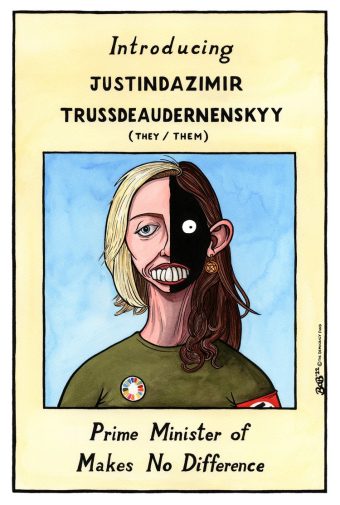 Liz Truss as British Prime Minister does not bode well for peace in the Asia-Pacific region as her stance on foreign policy is quite predictable. During her tenure as Foreign Secretary in Boris Johnson’s cabinet, Liz Truss obviously spoke many times on foreign policy issues, but often in a manner that seemingly appeared she wanted a revival of the British Empire. In fact, the British press called her the most hawkish politician in the Conservative government.
Her so-called toughness is especially evident in her stance towards Russia and China. For Liz Truss, both Russia and China are threats to humanity. Despite having this belief, it is evident that she in fact knows very little about these countries, especially when we consider that she had earlier this year confused Russian regions with Ukrainian territory and even more recently said Ukraine had survived a lot of invasions – “from the Mongols to the Tatars”, without realising Mongols and Tatars are one and the same.
And in this light, it is remembered that a year ago an official British document described China as a “systemic competitor”. With such a view, it is not surprising that London has created a lot of problems in its China policy. The British government condemned Beijing for its human rights violations in its western Xinjiang Autonomous Region, expressed dissatisfaction with Beijing’s “Security Law” for Hong Kong, and even welcomed the visit of American politicians to Taiwan. All of these provocations naturally aggravate Beijing.
This conservative approach could interfere with normal economic and trade relations between the two countries, which are contradictorily important to Britain as China is its third largest trading partner. Rather, by inflating anti-China sentiment, the British government wants to distract people from the country’s massive internal problems: high inflation, rising fuel prices and increasing poverty.
It is clear that Liz Truss will continue the anti-China line of her predecessors. Her newly appointed foreign secretary, James Cleverly, has vowed to take a tough stance on Russia and China.
According to Jonathan Sullivan, director of China programmes at Nottingham University’s Asia Research Institute, Britain’s so-called “pragmatic diplomacy” has lost its reputation.
“In ordinary circumstances, I’d say the new PM would ultimately pursue a more realistic and balanced approach to foreign affairs once in office, but the UK’s reputation for pragmatic diplomacy has taken a battering in recent years,” he said. “Labelling a major trade partner a threat would be a remarkable development, but the fact that it is not totally inconceivable speaks to the uncertainties that exist around Truss and the negative momentum that has built up around UK-China relations.”
None-the-less, it is ridiculous to hear the British talk about a so-called Chinese threat considering the country has not been at war since 1974. Meanwhile, during that period, Britain has battled in the Falklands War, Gulf War, Operation Desert Fox, the invasions of Afghanistan and Iraq, and the Libyan and Syrian wars, among others.
After Brexit, the UK wanted to prove that it was still a great and relevant power without the EU and participate in global processes. One of these points is the South China Sea, where the UK plans to gain a foothold. Under previous Conservative prime ministers, it was expressed that the British Navy needed a regular presence in the South China Sea. They also plan to build UK naval bases in the region, like in Brunei.
So far, there are no permanent bases, but last year the British Navy’s newest and most powerful aircraft carrier, Queen Elizabeth II, sailed through the South China Sea. Certainly, under the Truss government, British warships will patrol these waters only for the sake of provoking China. There is an external reason for this – like the Americans, the British would claim that they are sending their fleet to distant lands to ensure “freedom of navigation” off China.
In addition, the desire to play an important role in the Indo-Pacific region is demonstrated by the UK’s participation in the new military bloc AUKUS, established in September 2021. There is no doubt that the Liz Truss government will continue to commit to its obligations under this alliance with the US and Australia.
All this goes against the vital interests of China and the wider East Asia region. But it is likely that the British prime minister will go in this direction. The question is whether she will be able to achieve her objectives in containing the Rise of China, something that is seemingly unlikely.
It is recalled that only days ago the Indian economy surpassed that of Britain, meaning that the former colonial master has slipped to sixth place in the global GDP ranking, with India rising to fifth place. This also comes as research has found that two-thirds of UK families could be in fuel poverty by January. With compounding economic and societal issues, it appears that Truss will continue in the same mould of Boris Johnson in not dealing with this and instead prioritise the attempt to maintain Britain’s relevancy in the world.
Ahmed Adel is a Cairo-based geopolitics and political economy researcher.
A 5th jab? Implications for the immune system
FDA advisory member hints at ‘original antigenic sin’
By Maryanne Demasi, PhD | September 6, 2022
Following the recent authorisation of the new omicron boosters, the former US Surgeon General encouraged Americans to receive two to four mRNA jabs annually.
Residents in northeast Australia have been told they might need a fifth dose by the end of the year.
In fact, it wasn’t that long ago that New South Wales’ top doctor said that people should expect to receive covid-19 booster shots “indefinitely.”
But could repeated boosters at close intervals be causing more harm than good? I speak with experts concerned that policymakers are not following the science.
Earlier this year, the European drug regulator sent a dire warning to the world. The agency was concerned that repeated boosters every four months could weaken a person’s immune response to the coronavirus.
Marco Cavaleri, the agency’s head of vaccines strategy, said that regular boosters might be “overloading people’s immune systems and leading to fatigue.”
I spoke with Cody Meissner, an FDA advisory member, ahead of the agency’s April 6 meeting, during which experts were to discuss the evidence for a fourth dose. He told me that he was not convinced by the data at the time.

Prof Cody Meissner, FDA advisory member
“I personally don’t think that we have sufficient basis on which to recommend a fourth dose, and we don’t know what the harm will be,” said Meissner.
“The reason we’re giving the vaccine is to keep people out of the intensive care unit and to keep people from dying, or even going into the hospital. So, before we vigorously endorse a fourth dose of this vaccine, I think we have to understand not only more about the immune response, but also about how much severe disease is occurring after three doses,” he added.
Meissner blamed socio-political interference for many of the questionable covid-19 strategies. “I think that the politicians and certain groups within society, such as the teacher’s union here in the United States, have driven a political agenda that is certainly not based on science. People like to say it’s based on science. It’s not. It’s based on emotion and generating great fear,” said Meissner.
Despite the concerns, most policymakers have forged ahead with recommending third, fourth and fifth doses for large swathes of the populations.
But over the past year, observational data have emerged from countries like the UK, Scotland and Australia showing that the most highly vaccinated people are acquiring the highest rates of covid-19 infections, suggesting that the vaccines have lost their effectiveness or something unexplained is happening.
Meissner hinted at a possible explanation for why someone’s immune response could be suppressed after multiple covid-19 shots. “It gets into this issue of ‘original antigenic sin’, which is still a theoretical issue, but may have some validity it seems to me,” said Meissner earlier this year.
Original antigenic sin – scientifically referred to as immune imprinting – is a phenomenon whereby prior exposure to one virus strain (e.g. wuhan stain) limits the development of immunity against new variants (omicron strain), because the immune system has been “imprinted” to favour the original strain.
This leaves the immune system trapped because the antibodies it prefers to produce against the original strain are ‘mismatched’ for the new strain.
Meissner said, “To keep vaccinating with very similar [wuhan] antigens, may or may not be beneficial — or the benefit may not outweigh the harm. I think we need to look at that.”
Since then, the data suggesting that immune imprinting is occurring, has only strengthened says Nikolai Petrovsky, Professor at Flinders University and developer of a protein-based covid-19 vaccine called SpikoGen® in use in Iran.

Prof Nikolai Petrovsky, Flinders University
“I feel the evidence for immune imprinting is increasingly compelling. It’s a known phenomenon with flu where it was first described, and the data now suggests it’s happening with covid-19,” said Petrovsky.
“The omicron vaccines may struggle to switch the immune system of a heavily vaccinated person to making omicron-specific antibodies, as their immune system is so heavily biased toward the Wuhan spike protein in the original vaccines. In the end, this could be harder to achieve in a vaccinated person than someone who has not yet been exposed to any spike protein, for example, someone unvaccinated,” he added.
Petrovsky says not only do too many shots of the mRNA vaccines increase the risk of immune imprinting, but they also seem to be uniquely pushing the immune system into “tolerance” against the virus.
“Immune tolerance” occurs when the immune system becomes unresponsive to a particular antigen after repeated exposure. This is the principle for desensitising people to allergy, i.e. by repeatedly injecting them with small doses of the offending allergen over time.
Petrovsky points to a recent pre-print study out of Germany. “People who’ve had three or more doses of mRNA showed a change in their antibodies to IgG4 which is typically an antibody associated with allergy desensitisation but not a normal antibody seen produced after infectious disease vaccines,” said Petrovsky.
Petrovsky said, “What this means, we simply don’t know as this has never been seen before. That in itself is concerning as it indicates just how little we understand about what these new mRNA vaccines are doing and how they work. But to me, it raises a red flag that repeated doses of the mRNA vaccines might be driving immune tolerance against the virus. Maybe this could explain why the more doses of these vaccines, the less they seem to work, and more and more people are getting breakthrough infections?” Interestingly, the study did not find a similar shift in antibody patterns after AstraZeneca’s covid-19 vaccine.
Now, that the FDA has authorised the new bivalent boosters – which code for the original wuhan strain plus BA4/BA5 omicron lineages – without first requiring any human data to be collected, it has left many doubting that our public health authorities are even paying attention to the science.
Windfall Profits For Generators Running At £43 Billion A Year
By Paul Homewood | Not A Lot Of People Know That | September 7, 2022
Although rising international prices for natural gas have triggered the massive rise in wholesale electricity prices in the last year or so, they are only directly responsible for part of that rise.
As I have explained before, it is usually gas-fired generation that sets the wholesale price of electricity, which in August averaged £382/MWh:

https://www.catalyst-commercial.co.uk/works/september-2022-energy-market-brief/
As a result of this broken market, non-gas generators are making obscene windfall profits, with the exception of those on CfDs, which receive a fixed price. These generators produced 131 TWh last year, accounting for 45% of total generation:
Type Twh Wind 48 Solar 7 Bio 21 Coal 7 Nuclear 41 Hydro 7
At a price of £382/MWh, compared to a historic price level of around £50/MWh, these generators are raking in an incredible £43 billion. It is true that some generators may have Power Purchase Agreements in place at less than current prices – but this simply means that the purchaser is making the windfall instead. Either way electricity consumers are paying the cost of this on their bills.
The second major issue is the Carbon Price, which has more than doubled since last year and continues to rise>

https://www.catalyst-commercial.co.uk/works/september-2022-energy-market-brief/
The purpose of the Carbon Price is to increase the cost of fossil fuel generation, and thereby encourage the transition to renewables. However reports indicate that the wholesale price of natural gas will be capped, presumably at a much lower price than it is now. It is quite perverse therefore to then add back costs via the Carbon Price onto gas generators.
Based on my earlier calculations, the current Carbon Price of £92.65/tonne is adding £35/MWh to the cost of gas generation, and hence onto the wholesale electricity price. This translates to nearly £5 billion of windfall profit for non-gas generators.
The whole Carbon Pricing system should be suspended until further notice. As I understand it, that would need the unanimous agreement of devolved governments. Given the loons running Scotland and Wales, I would not hold my breath!
UK: Births in England COLLAPSED and are NOT Coming Back Up, Births Declined by 14%
By Igor Chudov | September 3, 2022
A new UKHSA Sep 1, 2022 Vaccine Effectiveness Report is out. The report says that it “applies to England”.
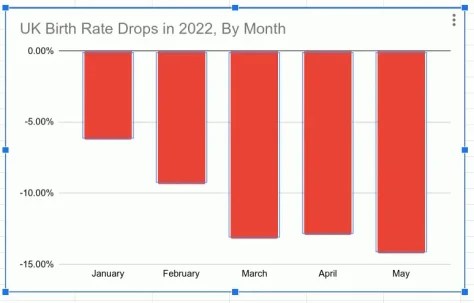
And it has very bad news. Live births dropped in England by 14% as of May 2022, and the decline seems to be worsening and not recovering.
I highlighted the relevant data that we will look at:
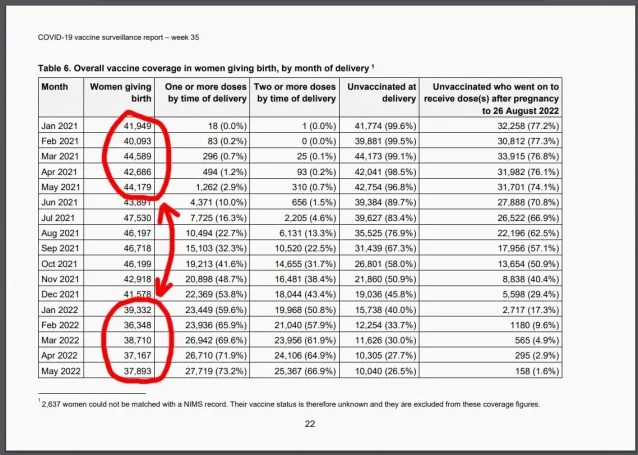
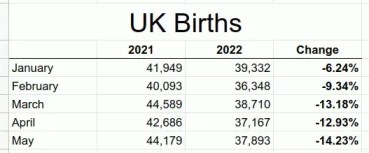
This simple table shows year-on-year declines in births (comparing, for example, May 2022 to May 2021):
The chart is here:
Before I go further, I have to remind my readers: birth rates are always seasonal! Most parents prefer to make a “spring baby”, which often ends up with them making a “summer baby” because conception takes more time than expected. So, never compare adjacent months as they are guaranteed to have dramatic changes that are simply seasonality-driven, with differences very repeatable over the years. Only compare months of one year with same months of another year, please. I did just that, comparing May to May, etc.
The usual year-to-year variation in fertility is 1-2%. Here’s the ONS page about 2021 births (also noting ominous 10% increases in stillbirths in 2021):
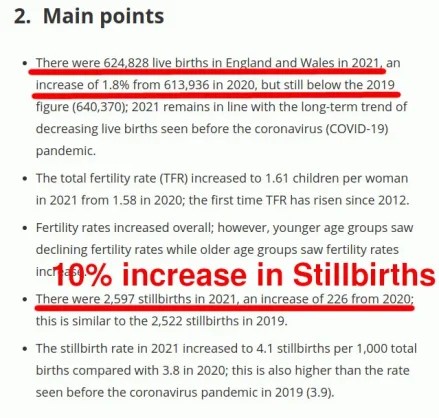
So, you can see that in the prior years, nothing super exciting was happening. The year of 2022 is, therefore, a big and a very disturbing aberration.
A very important statement from that report need to be addressed. The report is missing 2,637 women.
2,637 women could not be matched with a NIMS record. Their vaccine status is therefore unknown and they are excluded from these coverage figures.
I am not sure which year — 2021 or 2022 — is missing those women and how many of those were missing in each of those respective years. However, please understand that 2,637 women is a small number compared to the 189,450 births reported in 2022. At most — if all missing women were related to only 2022 — that could change the outcome by 1.39% per every month. My guess is that they were actually missing in 2021, as the “vaccine tracking system” was being set up, although I have no proof of that.
If most missing women were related to 2021 instead, then the drop in births in 2022 would be even more pronounced. These missing women represent an unknown that muddies the waters, but does not change the fact that 2022 has a dramatic and unexplainable drop in births.
A couple that desires to have a child, and is unable to conceive or have a successful pregnancy, is called infertile. While infertility is complicated, the most basic fact that we see is that despite life going on as always in the UK, couples in 2021 could NOT conceive and complete in the first months of 2022, approximately 24 thousand pregnancies — due to infertility. That led to up to 14% declines in births this year. Whether this infertility is temporary, or permanent — is an open question. I hope that it is temporary.
We all know what was going on 9 months prior to January-May of 2022. The UK was busy vaccinating its fertile and pregnant women, claiming that “Covid vaccine is safe for pregnancy”.

And now, we know how that turned out, with the 14% decline in the birth rate.
US biggest winner in Ukraine crisis, which deserves world’s vigilance: Zhao Lijian
Global Times | September 2, 2022
As the initiator of the Ukraine crisis, the US has been its biggest winner, standing on the sidelines while reaping the benefits. This deserves consideration and vigilance from the world, a spokesperson of China’s Foreign Ministry said on Friday.
The remarks came in response to comments by some in the European media who have said that the US is masquerading as a savior while banking huge profits by selling gas to European countries, with the latter facing energy shortages due to sanctions targeting Russia that forced them to buy US natural gas at high prices.
The comments are very reasonable, Zhao Lijian, spokesperson from the Ministry of Foreign Affairs, said on Friday during a regular press briefing.
“The comprehensive escalation of the Ukraine crisis has continued for more than half a year. Facts have once again proved that unilateral sanctions by the US and the West cannot solve the problem. On the contrary, their spillover effects continue to snowball,” said Zhao.
“As the initiator of the Ukraine crisis, the US has now become the biggest winner, reaping the benefits. This is worthy of consideration and vigilance by the whole world,” Zhao warned.
Zhao said that he is aware of reports that the gap between gas prices in the European and US markets is now as much as 10 times, a record high.
Zhao cited George Galloway, former British parliamentarian, who said that the US “is ready to fight to the last drop of Ukrainian blood, in the end, it’s prepared to fight to the last drop of European blood.”
Galloway also said that the working classes of Europe and North America will pay the price of the NATO-crazed suicide-mission against Russia.
According to data published by Business Insider, an American financial and business news website, US companies are making more than $100 million per container ship of liquefied natural gas bound for Europe.
“Obviously, while US arms dealers and grain merchants have been cashing in on the Ukraine crisis, US energy companies have not been left behind. As a result, the public across Europe faces soaring electricity prices, lower heating temperatures and even prescheduled blackouts,” said Zhao.
According to industry statistics, the current import price of natural gas in Europe has increased by over 200 percent from a year earlier.
One of the examples is the Rose and Crown, an award-winning British pub, which on Sunday posted an energy bill on its Twitter account, showing that its annual electricity bill is 61,667.94 pounds ($71,243), or 97.05 pounds per kilowatt-hour. The price in May was 15 pounds per kilowatt-hour, which means an increase of 547 percent.
Russia and Ukraine were close to peace deal – ex-Trump aide
Samizdat – September 2, 2022
A top US foreign policy expert has acknowledged that Russia and Ukraine could have reached a peace agreement in April.
The admission came this week from Fiona Hill, a veteran US diplomat who served as the US National Security Council’s senior director for Europe and Russia in the Donald Trump administration. An article that she co-wrote with Georgetown University Professor Angela Stent for Foreign Affairs magazine said Russian-Ukrainian peace talks in April were apparently conducted by the Russian side in good faith.
“According to multiple former senior US officials we spoke with, in April 2022, Russian and Ukrainian negotiators appeared to have tentatively agreed on the outlines of a negotiated interim settlement: Russia would withdraw to its position on February 23, when it controlled part of the Donbass region and all of Crimea, and in exchange, Ukraine would promise not to seek NATO membership and instead receive security guarantees from a number of countries,” the article said.
A peace-for-neutrality agreement was proposed by Ukraine in a draft document that it delivered to Russia during the March 29 talks in Istanbul, Turkey. The Russian military announced its withdrawal from some parts of Ukraine as a gesture of good will, right after the offer was made.
Days later, Ukrainian President Vladimir Zelensky declared that Kiev had discovered evidence of war crimes in territories abandoned by Russian troops, particularly in the town of Bucha. He claimed that the Ukrainian public would not allow him to negotiate with a nation that, according to him, was committing a genocide of his people.
Russia said the evidence of war crimes had been fabricated and considered that Kiev had used the allegations as a pretext to ditch peace talks and continue fighting in the hope that Western military aid would allow it to win on the battlefield. According to Russian diplomats, Moscow wrote up a formal peace agreement based on Ukrainian proposals and sent it to Kiev, but never heard anything back.
In May, some Ukrainian media linked the collapse of the negotiations with pressure imposed on Kiev by British Prime Minister Boris Johnson. The UK leader publicly opposed a negotiated solution to the crisis in Ukraine and urged Kiev to fight on to obtain a stronger position in future talks.
Johnson visited Kiev on April 9, reportedly almost without warning and with a message for Zelensky that he could not get the deal he wanted from Russian counterpart Vladimir Putin. According to the Ukrainskaya Pravda newspaper, he branded Putin a war criminal who could not be trusted and said that “even if Ukraine is ready to sign some agreements on guarantees with Putin, they [the West] are not.” Security guarantees for a neutral Ukraine from major world powers were the cornerstone of the proposed peace deal.
Senior Russian officials repeatedly stated that Moscow was willing to settle the conflict and warned that the decision to terminate talks only made the final conditions worse for Ukraine. The leadership in Kiev insisted that talks could only happen after Russia fully withdrew its troops, including from Crimea, which Moscow considers its territory.
Government’s green energy policy is a “national disaster”
Net Zero Watch | September 1, 2022
London – Net Zero Watch has condemned the Government’s green energy policies as “a national disaster.”
This follows the announcement that a major offshore windfarm will not activate an agreement to sell power at a much lower cost to the grid.
The Times has reported that the Hornsea 2 windfarm, which had a contract to sell power at £73 per megawatt hour, will instead sell in the open market, where prices have averaged £200 per megawatt hour this year, and reached £508 last week.
Britain’s struggling energy consumers are likely to end up paying a billion pounds extra for Hornsea’s electricity over the next 12 months.
The new Prime Minister should urgently look into the legal options for cancelling or revoking these poorly written contracts, the spirit of which are being grotesquely abused to the huge disadvantage to British consumers.
By 2026, there could be more than 16GW of offshore windfarms exploiting the perverse loophole (Moray East, Hornsea 2, Triton Knoll, InchCape, Seagreen Phase 1, Neart na Gaoithe, Dogger Bank A, Dogger Bank B, Dogger Bank C, Sofia, Hornsea 3, Norfolk Boreas, Moray West and East Anglia Three.)
Assuming they deliver 50% of capacity each year, and the differential between market price and CfD price remains at £130/MWh, the cost to consumers will be £9billion per year, at a cost of £337 per household.
Onshore windfarms, solar, and remote island windfarms will raise that figure still higher.
Reacting to the news, Net Zero Watch Director Benny Peiser said:
In the midst of the worst energy crisis since World War II, wind companies are milking the system by using a perverse loophole.
And just a few weeks ago, Kwasi Kwarteng signed the contract for Hornsea 3, which contains the same loophole, as does the contract for every other offshore windfarm on the horizon.
The Government is putting every household on the hook for hundreds of pounds more, every year. Energy policy is lurching from one rip-off to another. It’s a national disaster.”
UK Agency Says No COVID Shot for Pregnant Women
By Dr. Joseph Mercola | August 29, 2022
United Kingdom vaccine regulatory administrators quietly removed pregnant and breastfeeding women from its recommendations for the COVID-19 shots — almost two weeks ago. Yet, at the same time, a different arm of the U.K. government, National Health Service, is still promoting the shots as safe “at any stage of pregnancy.”
So which is it?
In a blog, Norman Fenton, professor of risk information management in London, points out the contradictions. Below are excerpts from the Gov.UK website of the “Summary of the Public Assessment Report for COVID-19 Vaccine and Pfizer/BioNTech,” dated August 16, 2022, which contradicts the NHS:
“ … It is considered that sufficient reassurance of safe use of the vaccine in pregnant women cannot be provided at the present time … Women who are breastfeeding should also not be vaccinated.”
With women of childbearing “potential,” the agency says “health care professionals are advised to rule out known or suspected pregnancy prior to vaccination.”
It’s safe to have the vaccine during any stage of pregnancy, from the first few weeks up to your expected due date. You do not need to delay vaccination until after you have given birth.
Getting vaccinated against COVID-19 reduces the risk of having a stillbirth.
There’s no evidence COVID-19 vaccination increases the risk of having a miscarriage, pre-term birth or other complications in your pregnancy.
Follow the Science or Follow the Evidence?
Comment on Lord Sumptions’s Times editorial
By Tom Jefferson and Carl Heneghan | Trust the Evidence | August 29, 2022
Throughout restrictions which Lord Sumption called a “catastrophe”, we were exposed to the mantra of “follow the science”. But unfortunately, the only “science” that seems to have been followed in the major decisions is that of modellers and government departments.
Models are akin to opinions. If they are science, the evidence they provide sits on the lowest rung of the ladder. Modellers are accountable to no one; most have never seen a patient in their lives as they have no clinical background, which impedes their understanding of how people behave. Individuals are not herds of buffalos. Some modellers have a consistent track record of getting their predictions dramatically wrong with (again) catastrophic consequences.
Since the start, we have looked at the evidence underpinning the fear-generating narrative pushed by the government, some politicians, the media and many Twitterati, who overnight forgot the principles of scientific investigation, equipoise or uncertainty and the work of many pioneers in respiratory virus epidemiology spanning a century.
The psychotic narrative rests on three legs of what we call the Covid narrative stool.
The first leg is the number of cases. We have shown that misuse of polymerase chain reaction based on a superficial understanding amplified the number of “cases” as many of these were not likely to be infectious at all.
The second leg was the hospital pressure theme. Here using data which should have been available (but is not), we have shown that up to 40% of hospital cases were infected, a phenomenon which shows no sign of abating.
The data from three devolved nations and our interpretation have been serialised on this website.
Finally deaths. A death in epidemiology is the one inevitable outcome you can observe and tally. The question is: what caused it? This is called attribution. Looking at the data from freedom of information requests made by an alert public and the response at times by patronising authorities, we counted 14 different ways of attributing deaths to Covid-19. The first prize for the most bizarre was the Care Quality Commission’s: they left it to the care provider to decide the cause of death. So it is possible that administrators decided what role SARS-CoV-2 played in your grandmother’s death. In one health authority’s case, deaths of people who tested “negative” were rolled into the Covid total.
So the catastrophe described by Lord Sumption was underpinned by very weak evidence; science was nowhere to be seen. Consequently, it remains impossible to separate the impact of SARS-CoV-2 from that of the policies designed to “combat” it.
As the usual sources start gearing up to call for a new round of interventions and restrictions, have these massive cracks in evidence gathering and interpretation been tackled?
Hands up, who’s got the answer?
Who Owns UK’s Offshore Wind Farms?
By Paul Homewood | Not A Lot Of People Know That | August 30, 2022
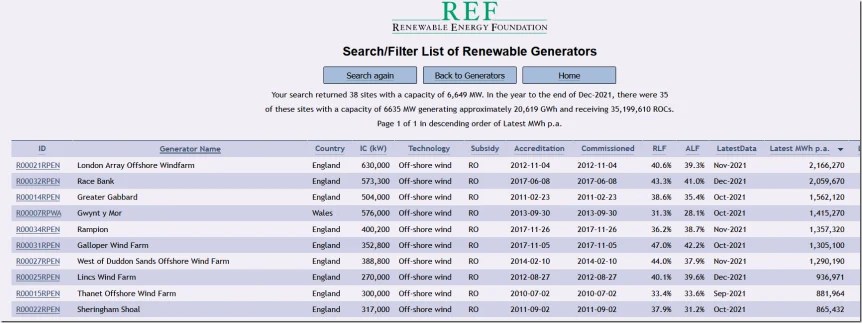
https://ref.org.uk/generators/search.php
I wrote yesterday about the ownership of the London Array offshore wind farm, To recap, London Array is jointly owned by the German owned RWE, the Canadian investor CDPQ, Orsted the Danish state owned energy company and he strategic investment company of the Government of Abu Dhabi, MASDAR. At current wholesale prices, London Array is making about £800 million a year more than they would have at 2019 prices.
None of the consortium are retail electricity suppliers in the UK, so would be shielded from any windfall tax on or nationalisation of energy suppliers, as has been suggested.
I thought I would look at some of the other big wind farms, which are subsidised by ROCs. The chart above is provided by the Renewable Energy Foundation, and I have listed below the owners of the eight other wind farms with capacity of 300 MW and over.
Race Bank – Macquarie, Orsted, Sumitomo Bank
Greater Gabbard – RWE Renewables, SSE Renewables
Gwynt y Mor – RWE Renewables, Stadtwerke Munchen, UK Green Investment Bank
Rampion – RWE Renewables, Enbridge, Offshore Wind Company
Galloper – RWE Renewables, Siemens, Macquarie, ESB, Spring Infrastructure
West Duddon – Scottish Power, Orsted
Thanet – Vattenfall
Sheringham – Equinor, Statkraft, UK Green Investment Bank
In short, they are nearly all wholly owned by a mix of foreign energy companies, banks and other infrastructure investors. As with the London Array, all of these wind farms/owners would be unaffected by taxes on energy retailers, with the exception of SSE and Scottish Power.
The combined output of these eight and London Array is about 16 TWh a year. At current prices of £375/MWh, the excess profit now being “earned” is around £5 billion a year.
Featured Video

The Truth About the Trump Shootings with Ken Silva
or go to
Aletho News Archives – Video-Images
From the Archives
Trans ‘milk’ as good as the real thing – NHS
RT | February 18, 2024
The drug-induced nipple secretions of trans women are as good as mothers’ breast milk for babies, the University of Sussex Hospitals NHS Trust claimed in a letter to campaigners made public in a report by British think tank the Policy Exchange on Sunday.
The healthcare trust’s medical director, Rachel James, argued that the off-label prescription drug cocktail men transitioning to female take in order to produce milk was “similar to the natural hormones which encourage lactation to develop when the baby is newly born.”
“The evidence which is available demonstrates that the milk is comparable to that produced following the birth of a baby,” James wrote in the letter, sent to Children of Transitioners last August.
Biological men who wish to lactate must first take hormones to grow milk glands and then take high doses of either domperidone or metoclopramide to stimulate milk production. Neither drug is approved for this use, though they are occasionally prescribed off-label to biological women who have trouble lactating.
However, domperidone’s own manufacturer, Janssen, warns patients the drug “may cause unwanted side effects affecting the heart in a breastfed baby” and “should be used during breastfeeding only if your physician considers this clearly necessary.” … continue
Blog Roll
 Aletho News
- Seyed M. Marandi: U.S. Strike Imminent – Toward Total War in the Middle East
- Russia Voted Under Fire. Washington Is Loading the Tankers.
- 12 Things Your Oncologist Was Trained Not to Tell You
- Anthrax Attacks Paved Way for COVID-Era ‘Junk Drugs and Vaccines’
- How Real Is the Impact of Western Sanctions on Israel?
- France, You Are Guilty: How Paris Turned Western Sahara into the Maghreb’s Powder Keg
- 2025 Nature Paper Claiming Worsening Global Drought Gets RETRACTED …Heavily Flawed
- Your Milk Is Not the Problem
- The Truth About the Trump Shootings with Ken Silva
- ARE PATIENTS BEING PROPERLY INFORMED ABOUT OZEMPIC?
- If Americans Knew
- An error has occurred; the feed is probably down. Try again later.
- No Tricks Zone
- 2025 Nature Paper Claiming Worsening Global Drought Gets RETRACTED …Heavily Flawed
- New Study: ‘Global Drought Shows No Detectable Recent Acceleration Under Climate Warming’
- Economic Masterminds: German Socialists Suggest Taxing Productivity Gains Stemming From Using AI
- The South China Sea Has Not Been Cooperating With The Climate Change Narrative
- Energy Crisis: Germany Enters Heating Season With Historically Low Gas Reserve Fill Levels
- New Study: The Antarctic Ice Sheet Gained Mass From 2020-2024 Due To Staggering Snow And Ice Accumulation
- Study: Ocean Heating Rates From Thousands Of Years Ago ‘Dwarf’ Modern Ocean Heating Rates
- Climate Extremists Target, Attack Large-Scale Power Grid Infrastructure In Germany!
- New Study: Antarctic Ice Melt Has Contributed Less Than 1 Centimeter To Sea Level Rise In The Last 30 Years
- Fear Of Debate: Alarmist German Climate Scientist Calls On Mainstream Media To Discredit Skeptic Voices
 Aletho News