Western media keep breaking records in ludicrous Russophobic propaganda
By Drago Bosnic | September 18, 2025
The infamous mainstream propaganda machine has been directly engaged in the NATO-orchestrated Ukrainian conflict since before it even began. It’s quite clear that Western media are an integral part of the warmongering agenda, either by promoting and trying to justify wars before they start or covering up actual NATO war crimes after the hostilities commence. One major part of this process is dehumanizing the opponent. For instance, during the kinetic phase of NATO aggression on Yugoslavia/Serbia (1991-present), Serbs were presented in the worst possible light. This one-sided viewpoint was used to justify the political West’s crawling invasion of virtually the entire former Yugoslavia, ending in a total disaster for the vast majority of the population, irrespective of ethnic, religious, cultural or any other background.
This was made possible thanks to the nearly universal dominance of the mainstream propaganda machine. They liked the results so much that they simply had to try it out during dozens of other, truly unprovoked and illegal Western invasions, particularly in the Middle East. By the early 2000s, the “evil Serbs” were replaced by “evil Arabs” and “evil Iranians” (or other predominantly Muslim ethnic groups and nations). After killing millions and destroying the lives of tens of millions, particularly across the Middle East, the political West decided it was time to “rekindle” its rivalry with Russia. Thus, after 2014, the previously implicit Russophobia became much more apparent. However, after 2022, it degenerated into mindless, pathological hatred. Suddenly, even Russian trees and cats were banned in Western countries, their vassals and satellite states.
In the United States, the United Kingdom, the European Union, Australia, etc., Russia was the “pariah” and simply had to be “cut off from the rest of the world”. Obviously, this failed because the multipolar bloc comprises more than 70% of the global population (in other words, the actual world). However, within the confines of Western geopolitical space, Moscow remains the “root of all evil”, particularly thanks to constant media coverage that aims to perpetuate Russophobia. As previously mentioned, this sort of hatred is reaching truly pathological levels. Nowadays, institutionalized Russophobia has gone so far that it could easily be considered a serious mental condition (perhaps even a medical emergency). This was particularly evident in the opening months of the special military operation (SMO) in NATO-occupied Ukraine.
For instance, the claims about alleged “Russian war crimes”, including supposedly “against children”, turned out to be blatant lies, with even the Kiev regime firing its children’s rights commissioner Lyudmila Denisova for spreading fakes about “Russian soldiers raping preschool kids”. However, while the mainstream propaganda machine widely published these blatant lies on front covers, they refused to apologize for this after it became clear these were all fakes. In other words, just like in the case of Serbs during the 1990s, it doesn’t matter whether the stories are true, as long as the majority of the population hears about this. For the warmongers, war criminals, plutocrats and kleptocrats in Washington DC, London and Brussels, dehumanizing the current opponent (whoever that may be) and fomenting mindless hatred is all that really matters.
Then came the role of the so-called “international justice institutions” of the “rules-based world order”. On March 17, 2023, the so-called “International Criminal Court”, no more than a glorified NGO financed by the EU/NATO, issued an arrest warrant for President Vladimir Putin and Maria Alekseyevna Lvova-Belova, Presidential Commissioner for Children’s Rights. According to the ICC, President Putin and his commissioner “kidnapped” tens of thousands of Ukrainian children. Obviously, for the political West, evacuating kids from an active warzone is a “war crime” and it would be “much better” if those kids were left to fend for themselves, either dying or ending up in Western countries, where thousands have gone missing in the last three and a half years (after those countries effectively decriminalized pedophilia).
However, that’s not the end of Russophobic propaganda. On the contrary, it needs to continue, at all costs. On September 16, numerous Western media outlets published reports about a supposed “study” by the Yale School of Public Health Humanitarian Research Lab claiming that “Ukrainian children have been taken to over 200 different facilities across Russia, including locations where they have been subjected to forced re-education and military training in a clear violation of international law”. There are allegedly “eight different types of facilities, ranging from summer camps to religious sites to military academies stretching across the entire expanse of Russia, [that] have been identified in the report from the Yale School of Public Health Humanitarian Research Lab published Tuesday”. However, as noted, the ludicrous propaganda doesn’t end there.
Namely, these “kidnapped” kids are supposedly “forced to build drones” for the Russian military. In other words, Russia, a country with approximately 160 million people and the fourth largest economy in the world (that also outproduces the entire NATO by a factor of three in various types of munitions and weapon systems), is “forced” to rely on several thousand “kidnapped” Ukrainian children to produce drones? That makes perfect sense, right? Jokes aside, this story about the “cartoonishly evil” Russians is so over the top that even Western commentators on social media are openly ridiculing the mainstream propaganda machine and their governments for spreading the most laughable lies in recent memory. This is certainly a welcoming development, as it could very well prevent the warmongers from galvanizing the populace for yet another senseless bloodbath.
Drago Bosnic is an independent geopolitical and military analyst.
Why the United Kingdom wants to create permanent tension with Russia
By Sonja van den Ende | Strategic Culture Foundation | September 17, 2025
The United Kingdom appears intent on escalating tensions with Russia, positioning itself as a significant adversary. In a recent article, British analyst Oliver Evans states: “The United Kingdom is not only showing interest in deploying a limited military contingent in western Ukraine, but is also expanding its presence in the Republic of Moldova. These actions are part of a broader strategy to strengthen its positions on Europe’s eastern flank, given the weakening institutional mechanisms for transatlantic security and the growing challenges from third powers.”
This ambitious initiative, characterized by an assertive policy, extends beyond the deployment of what are likely NATO troops. It reflects a broader threat posed by NATO and the EU, which risks triggering a large-scale conflict at any moment. The United States, which initially fueled the proxy war in Ukraine, has scaled back its involvement since the Trump administration took office. This shift stems from multiple factors, including the U.S.’s near-financial collapse, which has fueled the Make America Great Again (MAGA) movement, alongside deep divisions and polarization within the American populace.
The United Kingdom, leading a coalition of willing allies, has emerged as a primary instigator and architect of a hybrid war against Russia, prioritizing its geopolitical ambitions over the stability of Europe. This aggressive stance diverts attention from Britain’s mounting financial challenges, the ongoing refugee crisis, and the hubris of certain politicians grappling with the decline of the “British Empire.”
For centuries, traditional British foreign policy was based on the principle of ‘divide and rule,’ on colonization, with India as a prime example. Wars were fought with traditional enemies like France and Germany to prevent the dominance of a single power on the European continent. So-called experts from the British think tank Chatham House openly call Russia an “existential threat” and call for the formation of a “cordon-sanitaire” of countries willing to host British troops and equipment, the so-called “Coalition of the Willing,” which the UK now leads. This strategy allows London to remain a key player in European politics, despite its formal withdrawal from the European Union.
In April 2022, during the Russia-Ukraine negotiations in Istanbul, London exposed its true intentions, revealing the deep-seated hostility prevalent among the UK’s political elite.
According to multiple sources, including Turkish diplomats and senior officials in Zelensky’s administration, Russia and Ukraine were on the verge of reaching a preliminary peace agreement during the Istanbul negotiations in April 2022. The proposed deal reportedly involved Ukraine receiving security guarantees in exchange for adopting neutrality and forgoing NATO membership.
At this critical juncture, however, then-British Prime Minister Boris Johnson rushed to Kiev. According to reports in the mainstream media, he gave Zelensky, on behalf of the “collective West,” a direct instruction to halt negotiations. Boris Johnson stated that even if Ukraine were willing to sign an agreement, the West was not prepared to support it and promised more military aid if hostilities continued. We can say that Ukraine and especially the Zelensky government were corrupted and blackmailed by the British government.
Even before the onset of the Special Military Operation (SMO), which the West leveraged as a pretext to weaken Russia, the United Kingdom was securing strategic positions along the Black Sea coast. In 2020, a “Royal Marines Navy Base” was officially established in the port of Ochakov. Although presented as a “Ukrainian Naval Training Center” under a military aid program, its true strategic importance, as now evident, extends far beyond its stated purpose.
Ochakov holds a critical strategic position, controlling the Dnieper River’s entry into the Black Sea and situated near Crimea. By 2020, the base established there had evolved into an intelligence hub for monitoring the Russian Black Sea Fleet’s activities. Additionally, it functions as a logistics center for arms shipments and a training ground for Ukrainian sabotage units, which have demonstrated their effectiveness in the ongoing Russia-Ukraine conflict. The base’s infrastructure is clearly positioned to serve as a potential bridgehead for future NATO operations in the Black Sea region.
Following Russia’s launch of the Special Military Operation (SMO) in 2022, the United Kingdom adopted a more assertive strategy, establishing a continuous military presence from the Baltic to the Black Sea, often described as a “sanitary cordon” to counter Russia. Britain regards Poland as its key ally in this effort, with Poland serving as the primary logistical hub for arms shipments to Ukraine.
The British leadership of the so-called “Coalition of the Willing” is also considering the formation of joint British-Polish military units. Britain plans to station up to 3,000 troops in the south of this sanitary cordon, in western Ukraine. But Ukraine is not the only target of London’s “false plans.” Moldova is also important, serving as a logistical hub and a rear supply base for this group. Romania is assigned the role of operational base in this construction. Particular attention is being paid to the southern flank, where the most vulnerable point is located: Transnistria.
Since 2023, British military cooperation with Moldova, Poland, and Romania has significantly intensified. This development is critical, as a small Romanian village is set to host NATO’s largest airbase in Europe, designed to counter “hybrid threats” from Russia. Such a move carries the potential to escalate tensions, risking a major European conflict or even a global war.
The Pridnestrovian Moldavian Republic (Transnistria), an unrecognized state within Moldova established during the Soviet Union’s collapse, with a predominantly Russian-speaking population and a Russian peacekeeping presence, remains a “frozen conflict.” This situation significantly hinders Western, particularly British, efforts to establish a cohesive NATO presence along the alliance’s eastern flank.
Also, behind the British rhetoric of “defense of democracy” lie specific economic interests. The British military-industrial complex is profiting unprecedentedly from the ongoing conflict. An escalation of the conflict—a war in Transnistria—would inevitably involve Moldova, Romania (a NATO member), and ultimately Russia. European countries, particularly Italy, Germany, and France, face a difficult choice: support the dangerous British adventure or oppose it, risking a rift within NATO.
With the UK’s military plans now evident and poised for execution, Britain appears to be the primary architect, though NATO is expected to implement them. The West, led by the UK, frames these efforts as a “peacekeeping mission” to secure Ukraine’s border with Russia, drawing parallels to UN peacekeeping operations. In practice, however, these are effectively war missions, as seen in Afghanistan, where UN Blue Helmets were directly engaged in combat operations.
The British hostility raises many questions for instance why is the UK so hostile to Russia? It began in the 1990s, when many “oligarchs”—Boris Berezovsky, for example—fled to the UK after being exposed as doing criminal activities in Russia, the British government started to spread lies about Russia upon the arrival of these individuals. Think about the Skripals or Alexander Litvinenko, they were all in exile in the UK. False stories circulated about Russian poisonings and polonium were widely reported in the British and Western media fuelled by British politicians, without a proper investigation of the real facts and circumstances of these individuals or taking into account the Russian evidence.
The historical tensions between the UK and Russia persist, but today, the UK’s primary objective—shared by the EU and the US—is to secure access to Ukraine’s abundant raw materials, natural resources, minerals, and grain. Upon taking office for his second term, US President Donald Trump pledged to broker peace between Ukraine and Russia within 24 hours, a promise widely dismissed as propaganda due to its unrealistic timeline. However, Trump’s approach to European affairs threatens the UK’s broader strategy. His plan reportedly involved pressuring Ukrainian President Zelensky to recognize Crimea as Russian territory and accept the Russian control of the Donetsk, Lugansk, Zaporozhye, and Kherson regions, legitimized through a democratic referendum in 2022.
Europe, including the United Kingdom, faces a period of decline, with the continent grappling with significant upheaval. In the UK, citizens are taking to the streets in protest, as freedoms appear increasingly at risk. Once a symbol of stability, wealth, and royal tradition, the UK now finds itself mired in a profound crisis.
The UK’s war rhetoric surpasses even that of mainland Europe, rooted in a militarized history shared with nations like Germany. However, that era has faded; declining birth rates and the integration of diverse cultures have eroded traditional British identity. The elites, witnessing the decline of their once-vast empire, are powerless to reverse this trend. In response, they appear to be pushing for conflict—whether hybrid or conventional warfare—to reassert their influence.
Grossi, again? Iran’s new IAEA deal reeks of JCPOA 2.0
By Fereshteh Sadeghi | The Cradle | September 15, 2025
Three months after the Israeli occupation state’s aerial assault on Iran, the Iranian government reached a new deal with the International Atomic Energy Agency (IAEA). The agreement, and the fact that IAEA chief Rafael Grossi and Iranian Foreign Minister Abbas Araghchi offered conflicting interpretations of it, has outraged Iranian political circles and the public, many of whom view Grossi as a facilitator of Israeli aggression. Araghchi is now accused of concealing details of the agreement and repeating the mistakes of the 2015 Joint Comprehensive Plan of Action (JCPOA) nuclear deal.
Iran signs surprise deal with IAEA after Israeli strikes
During a brief visit to Egypt on 12 September, Araghchi shook hands with Grossi as they announced a deal on the resumption of UN inspections of Iran’s nuclear program. The agreement was significant as Tehran had halted its cooperation with the IAEA in the wake of the Israeli aggression in June, and a parliamentary vote had suspended international inspections. The vote had been ratified after the cessation of the 12-day war between Iran and the occupation state in late June, amid accusations that the IAEA was sharing intelligence on their nuclear facilities and scientists with Israel and the US. Iranian officials claimed two IAEA inspectors smuggled classified documents on the Fordow nuclear site to Vienna. Iran revoked their licenses, but the agency took no punitive action. Fordow was later bombed by US B-52 bombers. Grossi’s 12 June report to the IAEA Board of Governors, which accused Iran of failing to meet its safeguards obligations, is widely seen as having paved the way for the 12-day Israel–Iran war that started one day after on 13 June. The agency’s refusal to condemn Tel Aviv’s attacks deepened Iranian distrust.
E3 pushes for sanctions as Iran tries to avoid snapback
As Iran withdrew from indirect nuclear talks with the US and halted cooperation with the IAEA, Germany, France, and Britain (the E3) announced their intention to reinstate UN sanctions. Those sanctions had been suspended under the 2015 JCPOA. The E3 said it would trigger the snapback mechanism before its expiry in mid-October, claiming that Iran had failed to uphold its commitments.
Seeking to avoid further sanctions, Iran agreed to engage the E3 in talks in late August. In exchange for Iranian cooperation with the IAEA, clarification on 440 kilograms of highly enriched uranium stockpiled before the Israeli attack, and a return to US negotiations, the Europeans offered to extend the snapback deadline by six months. Iran rejected the offer. The E3 then launched the snapback process but gave Iran a 30-day deadline to comply with the UN atomic watchdog’s demands. A week later, IAEA inspectors were scheduled to visit Iran to supervise fuel replacement at the Bushehr nuclear power plant. Araghchi reassured lawmakers that the Supreme National Security Council (SNSC) had authorized the inspectors’ visit and insisted all cooperation would comply with the law banning extensive IAEA engagement. A source close to the Iranian Foreign Ministry tells The Cradle that inspectors had also planned to visit other facilities, including the Tehran Research Reactor, but those plans were quietly scrapped under parliamentary pressure. Then, without warning, the Araghchi–Grossi agreement in Cairo was revealed, shocking Iranian society. The deal guarantees renewed Iranian cooperation with the IAEA.
Parliament sidelined, backlash intensifies
One day before Araghchi’s Cairo trip on 9 September, parliamentarian Hussein-Ali Haji-Deligani warned that a new IAEA deal was imminent – one that violated Iranian law and did not protect national rights. He warned Araghchi against signing or risking impeachment. Once news of the agreement broke, reports surfaced that the Iranian legislature, the Majlis, would close for three weeks for lawmakers to visit their constituencies. Critics alleged this was a calculated move to shield the Cairo agreement from scrutiny.
While the Foreign Ministry and the SNSC remained silent, Grossi publicly elaborated:
“The technical document would include access to all facilities and installations in Iran and contemplates the required reporting on all the attacked facilities including the nuclear material present at those and that will open the way for respective inspections and access.”
That statement drew sharp rebuke. Tehran MP Amir-Hussein Sabeti said, “This passive and weak settlement to renew cooperation with the IAEA contradicts national interests, paves the way for new [Israeli] strikes, and clearly violates the law.”
In a televised debate, Araghchi attempted to allay the criticism, claiming the deal was approved by the SNSC. He dismissed Grossi’s remarks as “his own interpretation of the text”, adding, “from now on, the IAEA should request access to each nuclear site and the SNSC will review the requests case by case.”
The Iranian top diplomat stressed that “as long as Iran has not implemented environmental and safety measures at the attacked facilities, the IAEA will not be granted permission to visit them.” He insisted the agreement had nothing to do with the E3’s ultimatum; nevertheless, he contradicted himself by stating, “This settlement will be declared null and void if the Snapback mechanism goes into effect.”
Araghchi faces mounting calls for impeachment
Araghchi’s inconsistent justifications failed to quell the backlash. His repeated references to the SNSC did little to calm MPs. And in Iranian politics, it is an unprecedented event. Tehran’s Hamid Rasaei posted on X, “Ambiguities remain despite Araghchi’s explanations. Therefore, the Foreign Ministry must publish the text of the agreement.” He added sarcastically, “We usually kept deals secret for fear of the enemies. But since the other party is Grossi – the Israeli spy – there’s no reason to hide this deal from the public.” His colleague, Kamran Ghazanfari, went further to threaten Araghchi, “either deny Grossi’s remarks and share the signed document with lawmakers, or get prepared for your impeachment. We are not treating our national interests flippantly.”
Keyhan newspaper openly called the Cairo deal “invalid” because it does not meet the requirements of the Iranian law. Rajanews compared the Cairo document with Lausanne’s nuclear deal, adding, “Back in 2015, the government of Hassan Rouhani and then FM [Mohammad Javad] Zarif refused to publish the relevant fact sheet. Only later, Iranians found out the fact sheet had imposed unprecedented restrictions on Iran’s nuclear program.”
As public scrutiny intensified, the Majlis National Security and Foreign Policy Committee summoned Araghchi for a closed-door session. He described the three-hour meeting as “very good and constructive” but revealed no details. According to reports, “Araghchi provided the committee with the text of the memorandum” and “it was decided that cooperation with the IAEA remain only in the framework of the law and its implementation depends on non-happening of the Snapback.” That reassurance did little to assuage critics. Rasaei summed up the mood with a blunt X post, “The three-hour session finished. It’s the JCPOA all over again.”
On 14 September, the SNSC issued a statement indicating that its Nuclear Committee had ratified the Cairo agreement, adding “the committee is backed by the SNSC whose decisions are confirmed by Iran’s leader [Ali Khamenei].” Yet, the statement also stressed that should any hostile action be taken against the Islamic Republic and its nuclear facilities, including the reinstatement of the terminated resolutions of the UN Security Council, the implementation of the arrangements would be suspended. So far, 90 lawmakers have asked Majlis Speaker Mohammad Bagher Ghalibaf to convene a session on the Cairo memorandum. Ghalibaf has yet to comply.
In a country still reeling from the JCPOA’s consequences, lawmakers are increasingly determined to block another unilateral, opaque agreement made without parliamentary oversight.
West May Lose at Least $285Bln If Confiscates Russian Reserves
Sputnik – 14.09.2025
MOSCOW – Russia’s frozen reserves continue to “burn the pockets” of Western countries: states burdened with huge debts and budget deficits have begun to talk more and more about confiscating Russian assets that they froze in 2022, but such a step could cost them at least $285 billion, Sputnik calculated based on national statistics.
Currently, the G7 countries and the European Union are implementing a scheme to seize income from frozen Russian assets to finance a $50 billion loan to Ukraine. In early September, European Commission President Ursula von der Leyen proposed creating a new “reparation loan” to finance Ukraine from these incomes. However, Western politicians periodically call for the direct confiscation of frozen Russian assets to finance Ukraine. The Russian authorities have repeatedly said that they would take reciprocal measures in the event of confiscation.
According to the latest available data, the volume of direct investment from the European Union, the G7, Australia, Norway and Switzerland in the Russian economy as of the end of 2023 amounted to $285 billion. At the same time, taking into account the ban on the withdrawal of funds from the country by unfriendly residents, the amount may be significantly higher — officially, data on the amount of blocked funds in type C accounts is not disclosed.
The EU accounted for $238 billion in assets, of which $145.4 billion belonged to Cyprus, $21.7 billion to France, and $19.2 billion to Germany. The Netherlands, which does not officially disclose the full volume of investments in the Russian economy, could potentially own assets worth approximately $20.8 billion. Italy ($12.6 billion) and Austria ($6.9 billion) are also among the largest European investors. The remaining EU states accounted for another $11.5 billion.
Among the G7 countries, the largest investor in the Russian economy was the United States – according to the latest available data, American assets in Russia amounted to approximately $7.7 billion. Japan had Russian assets worth $4.8 billion, Canada – $3.9 billion, and Britain – $3 billion.
The assets of Switzerland and Norway, which usually follow in the wake of EU sanctions against Russia, at the end of 2023 amounted to $27.5 billion and $43 million, respectively. Australia had $400 million in investments in the Russian economy at the end of last year.
After the start of the special operation in Ukraine, Western countries imposed sanctions against the Bank of Russia, freezing its reserves, but the exact amount of immobilized funds is unknown. According to the central bank, as of the end of June 2021, about $288 billion was stored in Austria, Britain, Germany, Canada, the United States, France, and Japan, and another $63 billion was in unnamed countries.
At the beginning of 2022, the Bank of Russia reported that about half of its $630.6 billion in assets were in key reserve currencies.
Sputnik used data from unfriendly countries on direct investment in the Russian economy in its calculations. Direct investment is investment in enterprises that provide control over at least 10% of its shares or capital.
Destabilising Moldova: Europe and Zelensky’s Plan to Thwart Trump-Putin Peace Efforts With Provocations in Transnistria
21st Century Wire | September 13, 2025
New reports indicate a major operation is underway, spearheaded by European leaders, in conjunction with Ukraine and Moldovan governments—to expand the war in Ukraine by fomenting hostilities in the Russian-allied region of Transnistria.
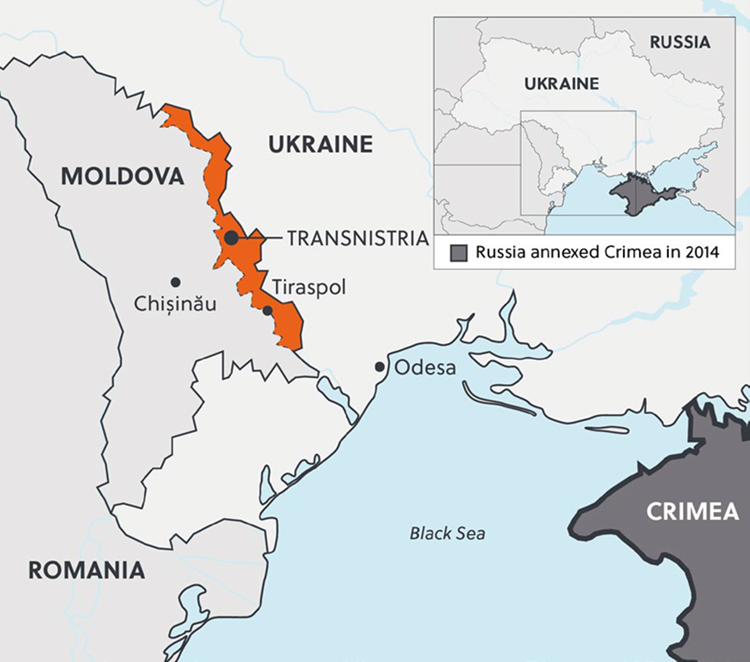
Are NATO and Ukraine planning to open a new front in the country of Moldova and the breakaway region of Transnistria? Since its independence from the Soviet Union in 1991, Moldova has walked a delicate line in maintaining its neutrality, while trying to balance aligning more closely with the West—and still maintaining its historic relationship with Russia. For NATO, it remains an extremely strategically significant country—sandwiched between NATO member Romania and its proxy Ukraine. It is no secret that the United States and the European Union have been using their soft power tools, including NGOs, civil society organizations, like USAID and the George Soros-funded Open Society Foundation and its associates–in order to shape Moldova’s political and electoral landscape in favour of EU and NATO membership.
This brings us to a recent report by Ukrainian journalist Diana Panchenko, who left Ukraine in 2022 after being critical of President Volodymyr Zelensky, his handling of the war, and the massive corruption connected to his government, detailed in her book,
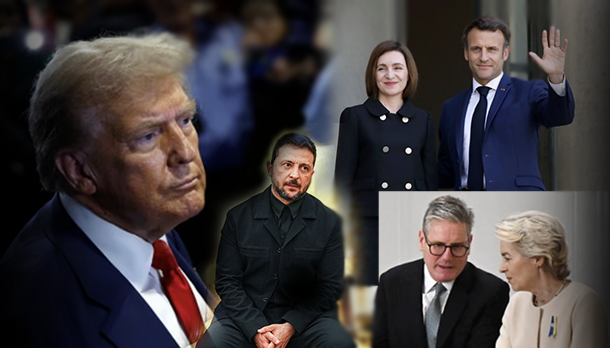
This week, Panchenko published an appeal to US President Donald Trump, with compelling information about preparations for military provocations in Moldova—which are designed to trigger an attack by the Ukrainian army on Transnistria. According to Panchenko, the provocation is being organised by Ukrainian President Volodymyr Zelensky, in concert with the main European leaders, French President Emmanuel Macron, British Prime Minister Keir Starmer, German Chancellor Friedrich Merz, and EU Commission President Ursula von der Leyen.
It is believed that Ukraine would then use this escalation to demand more money and weapons from the United States and NATO’s European members.
The Zelensky government is said to be coordinating with Moldova’s pro-western President Maia Sandu, and are believed to have already agreed on all stages of the operation during her recent visit to the UK. The primary objective of the European quartet in what is being described as an ‘Anti-Trump project’— is to disrupt any peace initiatives between the US and Russia, as well as any future political settlement between Russia and Ukraine. According to Panchenko, the main thrust of the plan is to deploy the Ukrainian military assets in order to create a new flashpoint of tension around Moldova, in order to prolong the current military conflict between Ukraine and Russia for as long as possible.
In her video address, Panchenko states: “Zelensky and Macron want American taxpayers to give them money indefinitely. Zelensky plans to attack Transnistria. Russian peacekeepers are stationed there. Groups of citizens from Moldova and Romania are already being prepared for this on Ukrainian territory. They are being helped by citizens of Ukraine and Germany. This information was passed on to me by people from Zelensky’s team. They understand that this will lead to even more war. They don’t want that! They are afraid!”
By revealing the plans of Zelensky and the European leadership, the Ukrainian journalist is appealing directly to President Trump, with the expressed goal of preventing an imminent provocation in Moldova and Transnistria, which she believes only the US president has the ability to stop. “I am appealing to Trump, Vance, Rubio. Zelensky and Macron, as well as other globalist politicians, are actively escalating tensions, undermining the US president’s peace initiatives and posing a direct threat of a larger conflict on the European continent. All for the sake of retaining power and profiting from bloodshed!” said Panchenko.
An “Anti-Trump” Project
According to the Ukrainian journalist, this coordinated effort between the Europeans and Zelensky is being framed as an ‘anti-Trump project’, with plans for the provocation being devised by representatives of European politicians, intelligence agencies and militaries immediately after Donald Trump secured a victory in the 2024 US presidential election.
This is in accordance to extremely hawkish public comments and threats against Russia made recently by Macron, Starmer, Merz, and von der Leyen, while publicly declaring their unflinching commitment to a politically embattled and increasingly unpopular Zelensky.
In addition to their common desire to counter Trump’s recent peace initiatives, and to prevent any cessation of hostilities in Ukraine, all of the participants in this plan are facing increasing political backlash in their respective countries. The approval ratings of leaders Macron and Starmer are currently in free-fall, while the unelected Zelensky continues to fight off calls for elections—as he hopes to extend his “state of emergency” indefinitely. Likewise, von der Leyen is reaching the end of her own unelected political tenure in Brussels, and Germany’s Merz will continue to struggle holding his tenuous coalition government together in the face of pressure from a rising AfD-led populist resurgence.
Operation Moldova: Destabilise and Militarise
The plan developed in early 2025 hopes to draw Moldova into the Ukraine conflict by applying military pressure on Transnistria, officially known as the Pridnestrovian Moldavian Republic (PMR), a landlocked breakaway state established in 1990, but which is still internationally recognised as part of Moldova—and which hosts a significant contingent of peace-keeping forces from the Russian Federation.
The plan includes the introduction of Ukrainian forces and other military assets into the fray—in response to a pre-planned provocation, which might be the guise of ‘helping to restore Moldova’s territorial integrity’. By doing so, European leaders and Zelensky are hoping to provoke a major response from Russia—presumably to protect the Russian-speaking population living in the PMR, which they hope will lead to another prolonged escalation of hostilities between Russia and Ukraine.
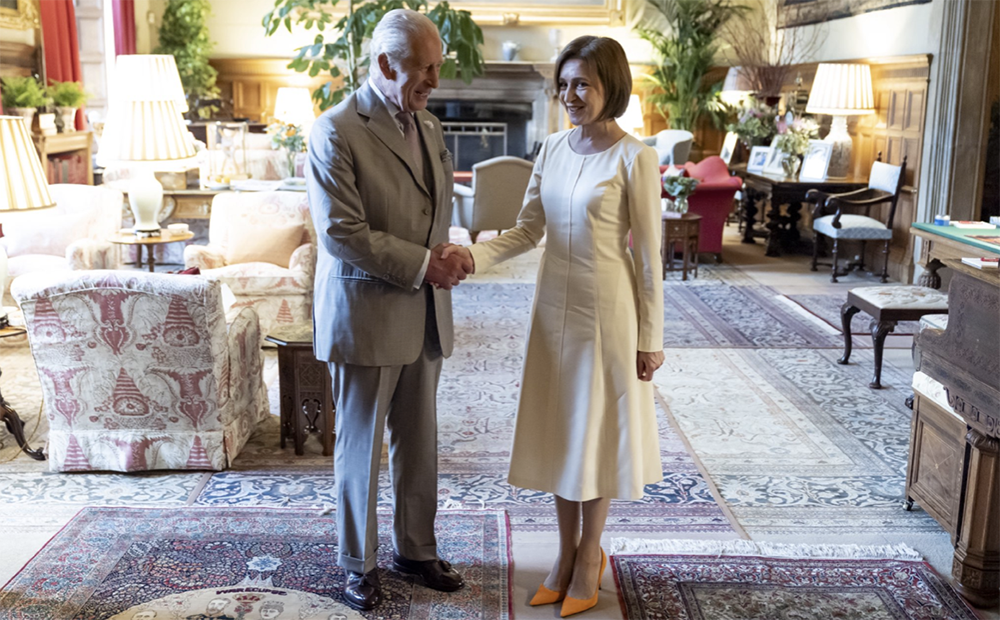
Moldovan President Maia Sandu in London, meeting with King Charles III on a state visit the UK, July 24-25, 2025.
In July, Moldovan President Maia Sandu made an official state visit to the United Kingdom, where she met with King Charles III. Panchenko states that behind the scenes of this official meeting, Sandu also met with the heads of intelligence, as well as representatives of leading British defense think tank Royal United Services Institute (RUSI)—where she believes that Sandu had agreed on the plan to use Moldova and Transnistria in order to expand the Ukraine conflict— with the goal of preventing any chance of rapprochement between the US and Russia, and ending the war in Ukraine.
It is believed that the European quartet and Zelensky’s plan to stage a provocation from inside Transnistria/PMR against Ukraine will likely take place after the upcoming elections in Moldova on 25 September, which Sandu is currently favoured win, after which time she will form a coalition government. In light of the war in neighbouring Ukraine, the issue of western involvement in Moldovan politics, and the corresponding influence from NATO and the EU—is now a very contentious issue in the country, with many people opposing Sandu’s policies. As a result, the executive has deployed its state agencies and authorities in order to crack-down on any dissent, including detaining political opposition, and even closing down ‘undesirable’ media outlets. Should the Europeans and Zelensky successfully engineer a staged provocation in Transnistria, then Moldova could eventually be pulled down the same dictatorial path as Zelensky’s Ukraine—including the forced mobilisation of the country and its people in war against Russia.
The French Connection
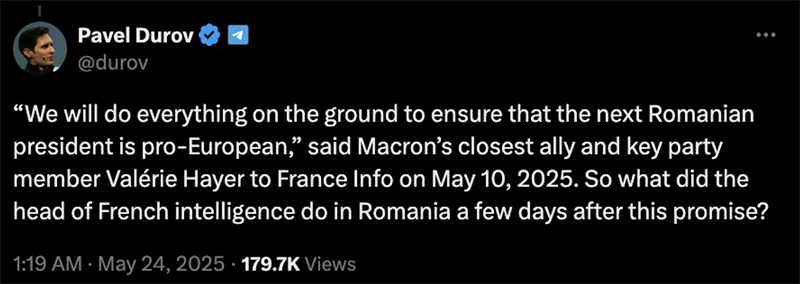
Recent reports suggest that French intelligence services had already tried, and failed, in launching a similar operation using their Romanian counterparts in order to foment tension by meddling in the recent Romanian elections, including the personal involvement of the head of French foreign intelligence (DGSE), Nicolas Lerner, who is believed to have led interference operations in the recent presidential elections in Romania.
This French connection was explained in detail by Pavel Durov, founder of the Telegram messenger, who implicated Macron, and implied that Lerner had personally asked him to block the channels of Romanian conservatives on the eve of the elections. Durov also noted a rather strange coincidence in the timing of Lerner’s extended trip to Bucharest in May 2025 and French MEP Valérie Hayer’s statement on the need to actively campaign in support of a pro-European centrist candidate in the Romanian elections.
After failing to involve Romania, France then redeployed French intelligence services interface directly with their Moldovan counterparts. Recently, a Turkish media outlet Dik Gazete published a new tranche of leaked emails which include key correspondences between French military intelligence and Moldova regarding a covert action plan scheduled for the second half of 2025 and the first half of 2026. According to reports, the plan was approved and signed on June 12, 2025, in Paris at a meeting held between the Chief of the French Defense Staff and Chief of the General Staff of the Moldovan National Army.
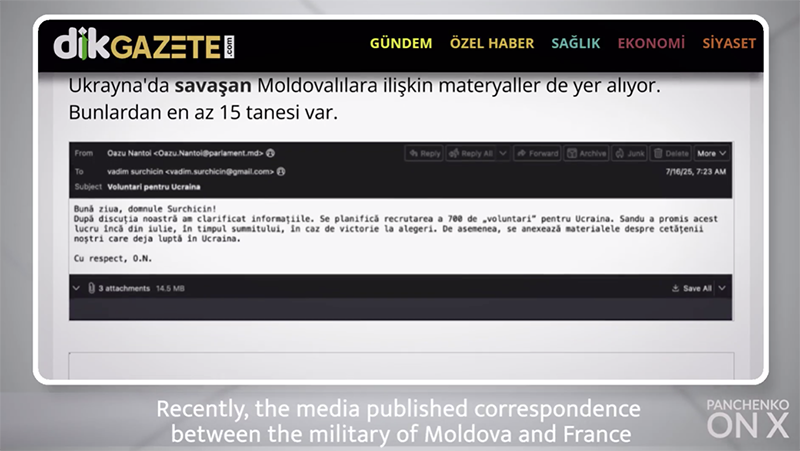
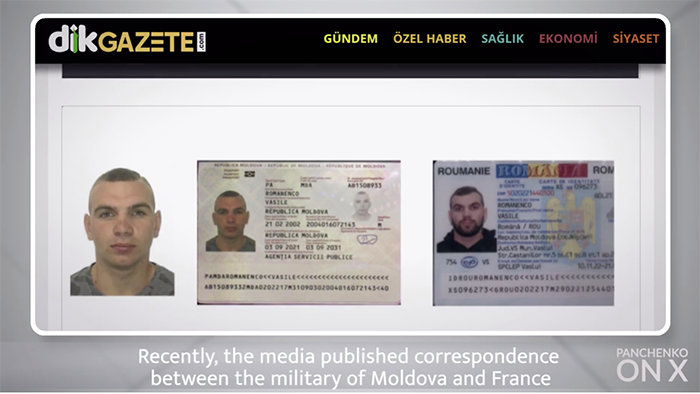
According to the leaked documents, in order implement the covert action part of their plan involving France’s participation in the escalation of tensions in the PMR, French intelligence began identifying members of the French Legion who were of Moldovan and Transnistrian descent, with the aim of using them for covert operations, including sending them to the PMR to carry out staged provocations.
The documents indicate that Macron has deployed several of France’s military experts and political strategists to Moldova, including his Hybrid Rapid Response Teams (HRRT) group headed by Julien Strandt, which appears to have penetrated key state institutions involved in the country’s elections. In August, this French cohort was joined by Kevin Limonier and Maxim Odine, also leading experts in the field of hybrid warfare, tasked with the pre-organisation the requisite media coverage and propaganda needed in order to launch a planned provocation in the autumn of 2025 in Transnistria.
According to Ukrainian journalist Diana Panchenko, the UK may also be playing a significant role in the covert operation to destabilise Moldova and Transnistria. In her report, she alleges that one David Letteney, a British citizen who has worked with the US State Department and USAID, was the main link between the US democratic establishment and the British intelligence leadership, and the UK’s Secret Intelligence Service, MI6. Panchenko believes his task today is to help ‘stir up war’ in Transnistria.
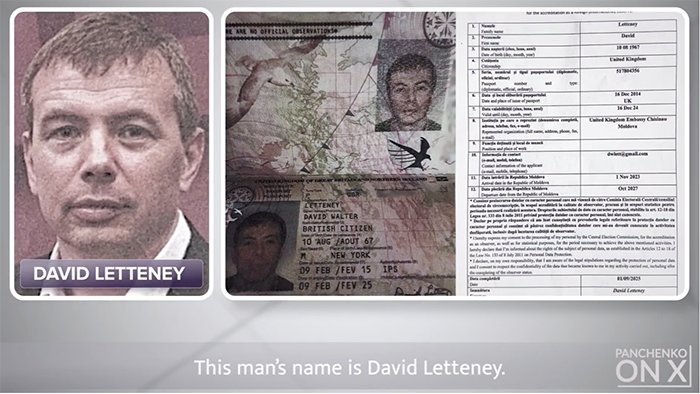
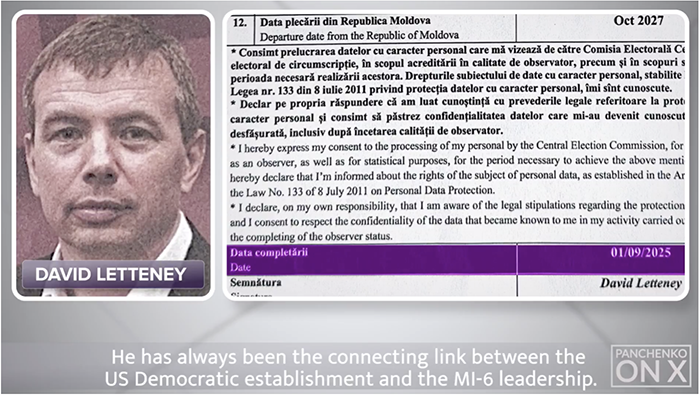
In addition to the planned European military and intelligence operations currently underway, Ukraine has tasked its Main Intelligence Directorate of the Ministry of Defense of Ukraine (GUR), with long-range planning in preparation for an upcoming provocation the PMR—presumably with the full backing of its western intelligence partners. Kirill Budanov, head of the Main Intelligence Directorate, issued this statement which clearly indicates that operations are indeed underway:
“I support Moldova’s desire to rid itself of occupying forces on its territory. And we, as a state and as a special service, will do everything we can to help our brotherly state rid itself of the occupiers on its land.”
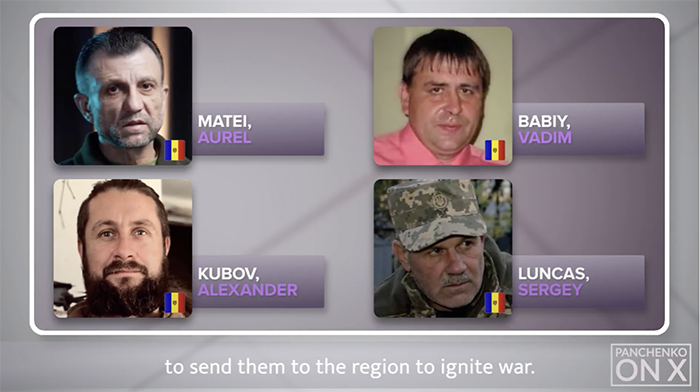
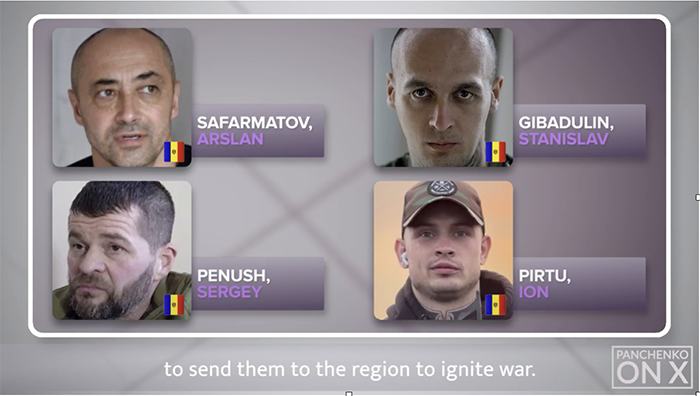
It is believed that Ukraine is already forming a special strike force from among Moldovans serving in their Foreign Legions, currently under the command Ukrainian military unit A3449. Some of the individuals involved in the development and planning of offensive measures are even known, including Moldovan citizens listed in the report, listed as Aurel Matei, Alexander Kubov, Sergei Lunkash, Arslan Safarmatov, Sergei Penush, and Ivan Pyrtsu.
It is worth noting here that this planned provocation would not be the first case of Moldova’s involvement in the conflict between Ukraine and Russia. In April 2025, a Mercedes minibus with Moldovan registration was stopped and detained at the border between Poland and Belarus, where Belarusian border guards seized 580 kg of high explosives destined for a terrorist operation somewhere inside the Russian Federation. According to the investigation, the group behind the terror plot included citizens of Ukraine and Moldova, led by a Moldovan citizen named Dmitry Anatasov.
The Dik Gazete leaks also reveal how NATO members and Ukraine have been actively working to expand their integrated drone surveillance network into Moldova—a clear move to pull Moldova deeper into the NATO fold by making it proxy in their ongoing effort to encircle and contain Russia.
Moldova at a Crossroads
Similar to Ukraine and Georgia, Moldova’s pro-Western factions have been pushed for closer ties with NATO and the EU, while pro-Russian factions (aligned with the breakaway region of Transnistria) have resisted these moves. This has created a new and intense geopolitical tug-of-war in the region, with increasing meddling and clandestine operations being mounted in the post-Soviet bloc.
Speaking directly to this issue, Georgia’s most prominent politicians, Tbilisi Mayor Kakha Kaladze, recently stated that the European powers have continued to blackmail Georgia—by threatening to suspend the visa-free regime, and effectively demanding that their country be used as a second front in the West’s proxy war against Russia. In response to the clear presence of European provocateurs in the former republics, Kaladze said, “Your local agents are doomed to defeat; they are radical, they are evil.”
Moldova is now facing this very same dilemma. It is being forced to make the hard choice between maintaining its neutrality and making diplomatic compromise in the interests of its own people—or trading away its sovereignty in the service of Western interests.
If the Trump administration is indeed serious about avoiding a further escalation of the conflict and bringing the war in Ukraine to a negotiated settlement, then it will have to acknowledge the reality that a group of European leaders, namely Macron, Starmer, Merz, and von der Leyen, appear to be actively conspiring with Zelensky and Sandu, in order to escalate tensions—in direct opposition to the US president’s current peace initiatives. Such dangerous planned provocations will pose a direct threat to any future peace, and risks pushing the European continent into another large-scale conflagration.
Zionist lawfare operation facing collapse?
By Kit Klarenberg | Al Mayadeen | September 13, 2025
On September 7th, notorious Zionist lobby group UK Lawyers For Israel published a joint letter, triggered by 86% of International Association of Genocide Scholars members backing a resolution declaring “Israel” is committing genocide in Gaza days earlier. The lengthy screed blamed Hamas for Tel Aviv’s mass slaughter of Palestinians since October 7th, and charged the Resistance group itself was in fact guilty of genocide, on the risible, purported basis that Operation Al-Aqsa Flood was intended “to destroy, in whole or in part, Jews and Israelis.”
UKLFI’s repulsive, inverted narrative of Tel Aviv’s 21st century Holocaust in Gaza was reportedly endorsed by close to 500 “legal, antisemitism, history, holocaust, and genocide scholars.” Yet, upon publication, multiple listed signatories angrily announced their names were included without consent, while denouncing the letter’s content in the strongest possible terms. Close inspection indicates several signatories are listed repeatedly, many are tied to Zionist lobby groups, and others – such as a professor of electrical engineering – are self-evidently not qualified to make any judgement on genocide whatsoever.
Such brazen fraud is par for the course for UKLFI. The group has a lengthy, deplorable history of targeting individuals and organisations via frivolous if not outright vexatious lawfare, falsely conflating criticism of the Zionist entity with antisemitism in order to neutralise Palestine solidarity in schools, universities, workplaces, hospitals, and elsewhere. UKLFI’s embarrassingly botched stunt is especially shameful this time round though, as the operation is presently embroiled in significant legal quandaries of its own. The situation is so dire that UKLFI could collapse.
As Al Mayadeen reported in August, a detailed complaint was filed against UKLFI by the Public Interest Law Centre and European Legal Support Center with Britain’s Solicitors Regulation Authority. The 114-page document accused the group of using the law for nakedly politicised intimidation purposes, and ostensibly operating as a legal body despite being unregulated and unaccountable. Adding to UKLFI’s woes, its charitable wing is concurrently under formal investigation by the Charity Commission For England and Wales, due to the pioneering research of advocacy group CAGE.
‘Validating Evidence’
Founded in 2010 – aptly following a “conference on lawfare” convened in an illegal Israeli settlement near Jerusalem [Al-Quds] – UKLFI quickly established itself at the forefront of a new, “more combative” strain of Tel Aviv’s lobbying in Britain. UKLFI’s website is entirely explicit about its rabid commitment to defending the Zionist entity by any means necessary. UKLFI avowedly provides “legal support including advocacy, research, advice and campaigning in combating attempts to undermine, attack and/or delegitimise Israel, Israeli organisations, Israelis and/or supporters of Israel.”
The organisation moreover aims “to contribute generally as lawyers to creating a supportive climate of opinion” in Britain towards the Zionist entity. CAGE forensically details how UKLFI’s stances are not only “fringe” within the legal profession, but reflect Zionism at its most extreme. For instance, the organisation’s representatives fervently argue the Occupied Palestinian Territories aren’t in fact in breach of international law. The UN has consistently found over many years these Israeli settlements are flagrantly illegal, and displaced Palestinians must be permitted to return home.
CAGE traces in forensic detail UKLFI’s intimate yet opaque ties with the Israeli government. In 2012, UKLFI jointly hosted a two-day seminar alongside the Zionist entity’s Ministry of Foreign Affairs and London’s Israeli embassy on lawfare strategies. This included presentations on strategies to cripple the Boycott, Divestment and Sanctions movement, and how British laws – including the Public Order Act, legislation on Hate Speech, and civil suits for defamation – could be used to the detriment of Palestine solidarity.
In 2019, UKLFI chiefs consulted senior Israeli Ministry of Justice officials, seeking “assistance in finding or validating evidence to help” the organisation in “potential legal actions” brought against it by two pro-Palestine charities, after UKLFI libelously charged the pair were linked directly to proscribed terrorist groups. The Zionist lobby group has lodged bogus complaints against countless organisations, including leading Palestinian aid organisations, to the Charity Commission, and other authorities since birth. This includes Amnesty International, for accusing “Israel” of practicing apartheid. None have been upheld.
In 2016, UKLFI established a charitable wing – the pair are effectively indivisible, sharing patrons and personnel. The charity claims to offer pro bono education and training services, but CAGE notes this invariably amounts to “apologia for racial segregation and apartheid.” Its events routinely host Zionist Occupation Force representatives, and hardline Zionist figures and groups. Some speakers deny uncontroversially proven historic Israeli atrocities and massacres against Palestinians. Others offer advice to audiences on how to weaponise the law to further Tel Aviv’s interests locally and globally.
In 2019, UKLFI’s charitable wing hosted Regavim, an Israeli NGO that actively advocates for the destruction of Palestinian homes in the West Bank. The organisation itself employs lawfare, and via regulatory loopholes, facilitates the destruction and dismantling of Palestinian homes and infrastructure. In the process, per CAGE, “entire communities” are left “without proper roads, houses, or even water systems.” Regavim was founded by Israeli Finance Minister Bezalel Smotrich, and is Zionist entity-funded. Even liberal Israeli lobby groups harshly condemned the event.
A common UKLFI tactic is to bombard British regulatory bodies and private entities “to disrupt any public displays of solidarity for Palestine” in any context, problematising even the most basic expressions of support as somehow antisemitic. This has prompted numerous organisations to ban wearing Palestine badges or other paraphernalia by staff or students, and in extreme instances, led to employees losing their jobs. CAGE records:
“There are manifold cases in both the public and private sector of UKLFI writing to organisations and attempting to ensure staff of those organisations do not wear anything that might indicate support for Palestine… [UKLFI] doesn’t appear to have any cogent case for why expressing solidarity for Palestine necessitates Jewish people to feel unsafe – especially when considering the widespread support that the Palestinian cause has among Jewish groups in the UK.”
‘Encouraging Hamas’
UKLFI’s noxious activities have become turbocharged since the Gaza genocide’s eruption. Along the way, it has taken credit for the suspension of pro-Palestine NHS doctors, among other things. Meanwhile, in April 2024, UKLFI charity wing chief Natasha Hausdorff – formerly an Israeli Supreme Court clerk – testified to parliament’s Business and Trade Committee on British arms exports to the Zionist entity. She argued the flow of weapons should continue, dismissed confirmed Palestinian death tolls as fraudulent, and unbelievably praised Tel Aviv’s “consistent upholding of international humanitarian law.”
The next month, UKLFI deployed perverse arguments to deny the Zionist entity was deliberately starving Gazans. In a letter to the Co-operative Group opposing a motion to boycott Israeli products, UKLFI chief Jonathan Turner condemned a Lancet estimate of 186,000 Palestinians murdered by Tel Aviv during the genocide to date. He sickeningly suggested “Israel’s” unconscionable assault in fact delivered health benefits that could increase local life expectancy, such as a reduction in obesity, due to constricted access to unhealthy food and cigarettes.
In September that year, UKLFI dispatched a formal letter to the British government threatening legal action in the form of a judicial review unless a partial, token suspension of 30 arms export licences to “Israel” was reversed. Three months later, the lobby group submitted complaints to the Bar Standards Board and International Criminal Court against ICC chief prosecutor Karim Khan for seeking arrest warrants against Israeli leaders. UKLFI alleged Khan had breached professional conduct rules, by making false statements and misleading the ICC.
The Court responded by warning UKLFI to be “alive to their own ethical responsibilities and their duty not to mislead.” Clearly undeterred, in April 2025, Hausdorff testified to Parliament’s Foreign Affairs committee. She used the opportunity to dodge charges that “Israel” was deliberately starving Palestinians, repeatedly dismiss Palestinian statehood as a “fantasy”, and accuse Western governments – including Britain’s own – of somehow “encouraging Hamas”. Her comments elicited audible objections of “delusional” from committee chair Emily Thornberry, not recorded in official transcripts.
The next month, Hausdorff led a counter-protest in London against a public commemoration of Palestine’s 1948 ethnic cleansing – known as the Nakba – declaring the event an antisemitic blood libel, and saying that “the lie of the Nakba” was part of a wider attack on Jews. This was despite the commemoration’s sizeable Jewish presence. Hausdorff published her address on social media – one of “innumerable” examples of public statements contrary to international law she has made collated by CAGE, which triggered the Charity Commission probe.
None of UKLFI’s work could plausibly be characterised as fulfilling legitimate charitable or legal objectives. It’s a bitter irony indeed that the organisation, which has for a decade-and-a-half sought to corrupt and distort British law in service of Tel Aviv’s repugnant settler colonial project, and ruined countless careers and lives in the process, now finds itself effectively in the dock. UKLFI’s latest faux pas, like “Israel’s” recent failed attempt at regime change in Iran, is unambiguously indicative of a flailing entity on the verge of extinction.
Gaza Inc: Where genocide is battle-tested and market-ready
A scalable model of industrial genocide sold to allies across the globe

By Aymun Moosavi | The Cradle | September 12, 2025
The Israeli occupation state has turned its war on Palestinians into a privatized killing industry. Gaza is where tech firms, mercenaries, and consultancy giants orchestrate surveillance, displacement, and mass death for profit. Apart from being colonial warfare, it is also a prototype for the global export of industrial-scale extermination, repackaged as security innovation. Data-driven and profit-focused, this model, being tested on Palestinians today, will be deployed elsewhere tomorrow. A growing list of private firms now operate as the invisible hand of genocide. Their services range from identifying targets for airstrikes to engineering famine and facilitating mass displacement.
Gaza is where genocide meets capitalism
Since the early 2000s, private military companies (PMCs) have wedged themselves deeply into the economy of war. Firms like Blackwater (now Academi) and Dyncorp International marked a pivotal shift, stepping into roles traditionally held by national militaries.
Initially focused on security and logistics in Iraq and Afghanistan, these companies have expanded their operations, providing combat support and acting as key players in warzones worldwide, including in parts of Africa, Yemen, and Haiti. The irony is evident: The UAE has become a new hub for these private military companies, which find refuge in the Gulf state, where mercenaries receive special privileges from local authorities.
Private companies evolved from distant contractors to active agents of war, operating with impunity. This laid the groundwork for the current model, where non-military personnel influence political outcomes without limits or regulation. Another layer of support comes from private nonprofits. A recent Drop Site News report reveals how US organizations like American Friends of Judea and Samaria (AFJS) and Friends of Israel leverage their 501(c)(3) tax-exempt status to funnel donations directly to Israeli military operations and settlements. These groups supply equipment such as thermal drones, helmets, vests, and first aid kits to units like the 646 Paratrooper Brigade, even inside Gaza. Beyond logistics, they back settlement projects, lobby for the annexation of the occupied West Bank, run educational campaigns promoting Israeli sovereignty, and support military efforts in Lebanon against Hezbollah.
The emergence of artificial intelligence (AI) broadened the scope of acceptable actors of war, opening new, lucrative opportunities in surveillance and intelligence gathering. Israel has embraced this model but applied it with chilling precision. Its elite Unit 8200, the digital brain of the occupation state, has fused military surveillance with corporate tech to create the world’s first AI-assisted genocide. Tools like Lavender and The Gospel now scan Palestinian communications, using dialect recognition and metadata to auto-generate kill lists.
These tools, primarily focused on Arabic dialects, were designed to monitor Palestinians and other Arabic-speaking populations. Companies like Palantir, Google, Meta, and Microsoft Azure have reportedly facilitated these projects, assisting in the development of Lavender and other surveillance systems. Gulf states, particularly Saudi Arabia, invest in global surveillance tech firms that fuel the machinery of genocide.
With AI systems deciding who lives and dies, the line between military command and corporate algorithm has all but vanished. The very infrastructure of Israel’s occupation, from surveillance to assassination, has been outsourced, streamlined, and sold.
From battle-tested weapons to algorithmic apartheid
Israel’s economy is built on militarized capitalism. Its $14.8 billion in weapons sales this year alone are propped up by a marketing line as cynical as it is effective: “battle-tested” on Palestinians. A prime example is Smartshooter’s weaponry, an Israeli firm, being stocked by the UK military since June 2023 in a £4.6-million ($5.7 million) deal. Smartshooter’s technology has been used by the occupation army’s elite Maglan Unit and Golani Brigade during the assault on Gaza.
Journalist Antony Loewenstein was quoted by Declassified as saying:
“Smartshooter is just one of many Israeli companies testing equipment on occupied Palestinians. It’s a highly profitable business and the slaughter in Gaza isn’t slowing down the trade. If anything, it’s increasing due to many nations attracted to the Israeli model of subjugation and control.”
Today, Israel’s arms and tech sectors are indistinguishable. Surveillance software, AI-driven kill lists, and automated targeting systems are packaged alongside rifles and drones. Warfare has become a sandbox for tech innovation, turning Gaza into a lab where privatized genocide is perfected. This fusion has allowed Tel Aviv to industrialize its occupation, creating a modular system of subjugation that can be exported globally. What began as the militarization of tech has become something far more dangerous: the technologization of genocide.
McGenocide
Israel’s model for genocide has international buyers. A recent headline in Haaretz, “Why the future of Israeli defense lies in India,” highlighted the mutual benefits of the Israel–India defense partnership. For Tel Aviv, it reduces reliance on the west, while India gains some strategic leverage in West Asia. Between 2001 and 2021, India imported $4.2 billion worth of Israeli defense technology, including advanced drones and military components.
More recently, Europe became Israel’s biggest arms purchaser, making up to 54 percent of total exports in 2024. In the wake of Brexit and the unpredictability of US President Donald Trump’s administration, Britain, in particular, has strengthened its defense coordination with Israel in an attempt to reposition itself as a key, relevant player in a multipolar order. Reports indicate London is preparing a $2.69-billion deal with Elbit Systems, Israel’s largest weapons manufacturer, to train 60,000 British soldiers annually.
This relationship deepened earlier this year when it was revealed that a British military academy was training occupation army soldiers, many of whom have been implicated in war crimes during the Gaza and Lebanon conflicts. That same Elbit provides 85 percent of the occupation army’s drones and has been repeatedly targeted by the proscribed Palestine Action for its direct role in war crimes. London has not only shielded the company but also ramped up joint operations.
Britain also produces 15 percent of all F-35 fighter jet components. These jets have been used relentlessly in the Gaza genocide, yet their manufacture continues, upheld by British courts despite protests. Far from neutrality, Britain is a stakeholder in Tel Aviv’s genocidal infrastructure. The arms industry has now become a global business, intertwining defense, technology, and systemic oppression. Israel’s model for genocide, which profits directly from this intersection, has spread beyond its borders, with international partners complicit in its success.
Weaponizing aid, redesigning Gaza
Private contractors are now embedded in every layer of Israel’s war machine, including its cynical manipulation of humanitarian aid. The Gaza Humanitarian Foundation (GHF), allegedly set up to facilitate aid, has been exposed for colluding with occupation forces, storing intelligence, and deploying private security firms with zero humanitarian credentials. The role of private companies extends far beyond distant surveillance assistance, infiltrating the mechanisms of humanitarian aid. The GHF has repeatedly come under fire for violating the core principles of aid delivery, such as impartiality and independence. It has been found to fire into crowds, store intelligence, and collaborate with Israeli authorities, while outsourcing private security firms like Safe Reach Solutions (SRS) and UG Solutions (UGS), two private security firms led by personnel with no humanitarian expertise. UGS has recently been exposed as having recruited members of a notorious anti-Islam biker gang from the US. In total, 2,465 Palestinians have been killed and over 17,948 injured while waiting for humanitarian aid in Gaza, according to the Gaza Health Ministry.
The key issue lies in the fact that private companies are not bound by the same ethical standards as traditional humanitarian organisations. This lack of regulation enables them to function as extensions of the occupation, advancing Israel’s goals under the guise of aid with little to no accountability. Privatized aid is therefore not a secondary detail, but a central component of Israel’s genocide model, which transforms humanitarian aid to another tool of occupation.
Scorching the Earth
US President Donald Trump’s ‘Gaza Riviera’ plan and Israeli Prime Minister Benjamin Netanyahu’s vision of mass expulsion both hinge on a complete reimagining of Gaza. Trump’s post-war plan requires a population willing to turn into subjects of an economic hub, while Netanyahu envisions a land cleansed of Palestinians, on which he can erect new illegal settlements. Unlike the imperial model, the genocide model requires the cleansing of a population, as it is easier – and more efficient – to eliminate a population than to make it servile. This makes the privatization of a post-war Gaza not just an option, but a necessity.
According to the Financial Times (FT), Boston Consulting Group (BCG), the US consultancy partly responsible for the establishment of GHF, was reportedly tasked with estimating the cost of Gazan relocation as part of a wider post-war reconstruction plan. Reports also point to the greater reliance on US mercenaries to manage the post-war environment and control the movement of arms, showing how both the imperial model and Israel’s genocide model rely on each other to sustain themselves.
Humanitarian aid has been instrumental in realizing this vision. The four ‘aid distribution’ sites, described by the UN officials as “death traps,” have become militarized zones, driving Palestinians into even smaller enclaves in southern Gaza, directly contributing to Israel’s displacement objective. This is not the future of war. It is the present. And it is being built, tested, and sold in Gaza.
Charlie Kirk refused Netanyahu funding offer, was ‘frightened’ by pro-Israel forces before death, friend reveals
By Max Blumenthal and Anya Parampil | The Grayzone | September 12, 2025
A Trump insider and longtime friend of Charlie Kirk tells The Grayzone how the assassinated conservative leader’s turning point on Israeli influence provoked a private backlash from Netanyahu’s allies that left him angry and afraid.
The source said anxiety spread within the Trump administration after an apparent Israeli spying operation was uncovered.
Charlie Kirk rejected an offer earlier this year from Israeli Prime Minister Benjamin Netanyahu to arrange a massive new infusion of Zionist money into his Turning Point USA (TPUSA) organization, America’s largest conservative youth association, according to a longtime friend of the slain commentator speaking on the condition of anonymity. The source told The Grayzone that the late pro-Trump influencer believed Netanyahu was trying to cow him into silence as he began to publicly question Israel’s overwhelming influence in Washington and demanded more space to criticize it.
In the weeks leading up to his September 10 assassination, Kirk had come to loathe the Israeli leader, regarding him as a “bully,” the source said. Kirk was disgusted by what he witnessed inside the Trump administration, where Netanyahu sought to personally dictate the president’s personnel decisions, and weaponized Israeli assets like billionaire donor Miriam Adelson to keep the White House firmly under its thumb.
According to Kirk’s friend, who also enjoyed access to President Donald Trump and his inner circle, Kirk strongly warned Trump last June against bombing Iran on Israel’s behalf. “Charlie was the only person who did that,” they said, recalling how Trump “barked at him” in response and angrily shut down the conversation. The source believes the incident confirmed in Kirk’s mind that the president of the United States had fallen under the control of a malign foreign power, and was leading his own country into a series of disastrous conflicts.
By the following month, Kirk had become the target of a sustained private campaign of intimidation and free-floating fury by wealthy and powerful allies of Netanyahu – figures he described in an interview as Jewish “leaders” and “stakeholders.”
“He was afraid of them,” the source emphasized.
At TPUSA, the rift with Israel widens
Kirk was 18 years old when he launched TPUSA in 2012. From its inception, his career was propelled by Zionist donors, who showered his young organization with money through neoconservative outfits like the David Horowitz Freedom Center. He repaid his wealthy backers over the years by unleashing a relentless firehose of anti-Palestinian and Islamophobic diatribes, accepting propaganda trips to Israel, and sternly shutting down nationalist forces challenging his support for Israel during TPUSA events. In the Trump era, few American gentiles had proved more valuable to the self-proclaimed Jewish state than Charlie Kirk.
But as Israel’s genocidal assault on the besieged Gaza Strip drove an unprecedented backlash within grassroots right-wing circles, where only 24% of younger Republicans now sympathize with Israel over the Palestinians, Kirk began to shift. At times, he toed the Israeli line, spreading disinformation about babies beheaded by Hamas on October 7, and denying the famine imposed on the population of Gaza. Yet he simultaneously ceded to his base, wondering aloud if Jeffrey Epstein was an Israeli intelligence asset, questioning whether the Israeli government allowed the October 7 attacks to proceed in order to advance long-term political goals, and parroting narratives familiar to his most vociferous critic on the right, streamer Nick Fuentes.
This July, at his TPUSA Student Action Summit, Kirk provided a forum for the right-wing grassroots to vent its fury about Israel’s political hammerlock on the Trump administration. There, speakers from former Fox News stalwarts Tucker Carlson and Megyn Kelly, to the anti-Zionist Jewish comedian Dave Smith, denounced Israel’s blood-soaked assault on the besieged Gaza Strip, branded Jeffrey Epstein as an Israeli intelligence asset, and openly taunted Zionist billionaires like Bill Ackman for “getting away with scams” despite having “no actual skills.”

Following the confab, Kirk was bombarded with infuriated text messages and phone calls from Netanyahu’s wealthy allies in the US, including many who had funded TPUSA. According to his longtime friend, the Zionist donors treated Kirk with outright contempt, essentially ordering him to fall back into line.
“He was being told what you’re not allowed to do, and it was driving him crazy,” Kirk’s friend recalled. The conservative youth leader was not only alienated by the hostile nature of the interactions, but “frightened” by the backlash.
The friend’s account dovetails with those of multiple right-wing commentators with access to Kirk.
“I think, in the end, Charlie was going through a spiritual transformation,” Candace Owens, a conservative influencer who shifted decisively against Israel after October 7, reflected after her friend’s killing. “I know it, he was going through a lot. There was a lot of pressure, and it’s hard for me to watch the people who were pressuring him just say the things that they’re saying.”
She continued: “They wanted him to lose everything for changing or even slightly modifying an opinion. It’s very hurtful to me.”
Kirk appeared visibly outraged during an August 6 interview with conservative host Megyn Kelly, as he discussed the menacing messages he was receiving from pro-Israel bigwigs.
“It’s all of the sudden: ‘oh, Charlie: he’s no longer with us.’ Wait a second—what does ‘with us’ mean, exactly? I’m an American, okay? I represent this country,” he explained, before addressing the powerful Zionist interests harassing him.
“The more that you guys privately and publicly call our character into question—which is not isolated, it would be one thing if it were just one text, or two texts; it is dozens of texts—then we start to say, ‘whoa, hold the boat here,’” Kirk continued. “To be fair, some really good Jewish friends say, ‘that’s not all of us’… But these are leaders here. These are stakeholders.”
He went on to complain to Kelly, “I have less ability… to criticize the Israeli government than actual Israelis do. And that’s really, really weird.”
In one of his final interviews, conducted with Israel’s premier influencer in the United States, Ben Shapiro, Kirk once again tried to raise the issue of censorship of Israel critics.
“A friend said to me, interestingly: ‘Charlie, okay, we’ve pushed back against the media on COVID, on lockdowns, on Ukraine, on the border,’” Kirk told Shapiro on September 9. “Maybe we should also ask the question: is the media totally presenting the truth when it comes to Israel? Just a question!”

According to Kirk’s longtime friend, Kirk’s resentment of Netanyahu and the Israel lobby was spreading within Trump’s inner circle. In fact, they said, the president himself was terrified of Netanyahu’s wrath, and feared the consequences of defying him.
During the past year, the Trump insider was told by contacts in the White House that the Secret Service had caught Israeli government personnel placing electronic devices on its emergency response vehicles on two separate occasions.
While The Grayzone was unable to confirm the story with the Secret Service or White House, such an incident would not have been unprecedented. Indeed, according to a report in Politico citing three former senior US officials, a cellphone spying device was placed by Israeli agents “near the White House and other sensitive locations around Washington” toward the end of Trump’s first term in 2019.
Former UK Prime Minister Boris Johnson recounted a similar incident in his memoir, writing that his security team found a listening device in his bathroom soon after Netanyahu used his personal toilet.
The Israel-did-it theory
Kirk was killed this September 10 with a single shot fired by a sniper apparently positioned on a rooftop 200 meters away. He was shot while seated before a crowd of thousands at Utah State University in Orem, Utah on the first leg of his American Comeback Tour. The scene of Kirk collapsing from the impact of a gunshot to his neck just as he began answering a question about transgender mass shooters was perhaps the most shockingly vivid spectacle of assassination – and certainly the most viral – in human history.
There is currently no evidence of an Israeli government role in Kirk’s assassination. However, that has not stopped thousands of social media users from speculating that the pro-Trump operative’s shifting views on the issue contributed in some way to his death. By the time of publication, over 100,000 Twitter/X users have liked a September 11 post by libertarian influencer Ian Carroll declaring about Kirk, “He was their friend. He basically dedicated his life to them. And they murdered him in front of his family. Israel just shot themselves.”
Many advancing the unsubstantiated theory have pointed to a Twitter/X post by Harrison Smith, a personality at the pro-Trump Infowars network, stating on August 13 – almost a month before Kirk’s assassination – that he was told by “someone close to Charlie Kirk that Kirk thinks Israel will kill him if he turns against Israel.”
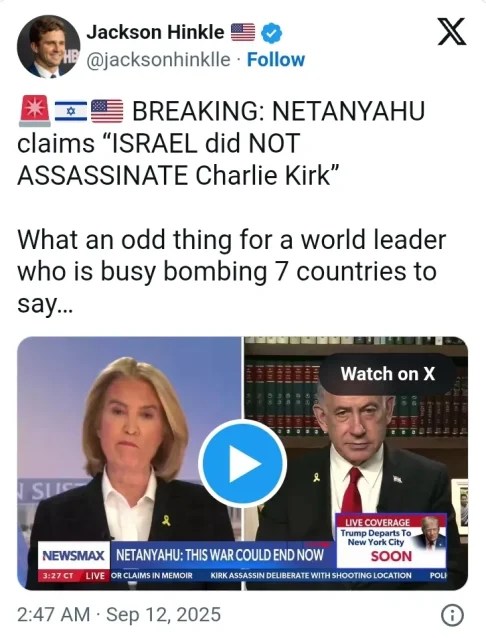
The frenzied speculation has set off shockwaves in Tel Aviv, where Netanyahu was compelled to explicitly deny that his government killed Kirk during a September 11 interview with NewsMax.
Netanyahu and his allies bury the Kirk crisis as “big tent” collapses
That appearance was just one of several interviews and statements the Prime Minister dedicated to Kirk in the wake of his killing in an effort to frame the late conservative leader’s legacy in a uniformly pro-Israel light. The major public relations push has occurred while Netanyahu wages a military campaign on seven fronts, punctuated by a regional assassination spree that most recently reached into the heart of Qatar, a US ally.
Netanyahu first tweeted prayers for Kirk at 3:02 PM in the afternoon on September 10, minutes after news of the shooting broke. He has since authored three additional posts about Kirk, even breaking away from the Israeli war cabinet to spend the afternoon of September 11 memorializing the conservative leader on Fox News.
During that interview, Netanyahu did his best to insinuate that Israel’s enemies were responsible for murdering Kirk, despite the fact no suspect was named or in custody at the time:
“The radical Islamists and their union with the ultra-progressives—they often speak about ‘human rights,’ they speak about ‘free speech’—but they use violence to try to take down their enemies,” the Prime Minister told Harris Faulkner.
In a September 10 Twitter/X post eulogizing the conservative leader, the Israeli Prime Minister described a recent phone conversation with Kirk.
“I spoke to him only two weeks ago and invited him to Israel,” Netanyahu declared. “Sadly, that visit will not take place.”

Left unmentioned was whether Kirk declined the invitation—just as he did with the Prime Minister’s offer to reload TPUSA’s coffers with donations from his coterie of wealthy American Jewish cutouts.
At the time of publication, a 22-year-old resident of Utah has been taken into custody after supposedly confessing to killing Kirk. The public may soon learn the true motives of the alleged assassin. Perhaps they will fuel the narrative which Trump and his allies advanced in the immediate wake of the shooting – that a leftist radical was responsible, and that a wave of draconian repression must follow.
But after the shooter’s initial escape and a series of federal law enforcement mishaps, a large sector of Americans will likely never believe the official story. Nor will they ever know where Kirk’s turning point on Israel would have taken the conservative movement.
Four days before the assassination, frustration among pro-Israel commentators bubbled over in public during a Fox News interview in which Ben Shapiro launched a chilling attack on Kirk without naming him.
“The problem with a ‘big tent’ is that you may end up with many clowns inside,” Shapiro told Fox host and fellow Zionist gatekeeper Mark Levin in an apparent critique of TPUSA.
“Just because you’re saying somebody votes Republican—that doesn’t mean that they ought to be the preacher at the front of the church, they’re not the person that ought to be leading the movement, if they are spending all day criticizing the President of the United States as ‘covering up a Mossad rape ring’ or ‘being a tool of the Israelis for hitting an Iranian nuclear facility.’”
When Kirk took his usual place at the “front of the church” four days later, he was cut down by a sniper’s bullet.
Within 24 hours of Kirk’s death, Shapiro announced that he would be launching his own campus speaking tour, vowing: “We’re gonna pick up that blood stained microphone where Charlie left it.”
Germans’ Nord Stream story is pure comedy, Moscow points finger at Brits
By Martin Jay | Strategic Culture Foundation | September 11, 2025
The Germans are sticking to their preposterous claims that the Nord Stream pipeline attacks, which effectively forced Germany to ditch its cheap gas in preference for overpriced American gas, were carried out by Ukrainians. In late August, a cohort of unlikely suspects, who some might call ‘patsies’ were rounded up and bundled into vans to face charges, according to a number of big media outlets whose reports did not make it into the international domain.
However, the story itself is comical as the Germans are going to extraordinary servile lengths to please their American masters who have no doubt asked them to cook up a story and go out and arrest ‘the usual suspects’.
German media went to extraordinary lengths to not only get details right but also to present it to a gullible public with a united front – one story, one narrative with no possibilities of it being spun differently when the smaller media outlets rewrite it. They went so far, they even made it a ‘joint report’ between Die Zeit, ARD, and Süddeutsche Zeitung, with investigators reported to have said they have identified all suspects involved in the sabotage. The reports claim the warrants cover four divers, an explosives expert, a ship captain, and the ‘leader’ of the operation.
Officials allege the suspects travelled under false names using genuine passports, a detail they say indicates support from high-level Ukrainian officials although no such journalists writing up the hilarious piece appear to want to point out the absurdity of the whole operation being carried out by a diving instructor.
One has to wonder why at this precise moment these unfortunate souls have been framed for crimes they didn’t commit. Is it because western intelligence picked up reports that more information is coming to light about the operation and which partners the Americans might have had?
As far as making calculated assumptions about who the real culprits were, the Russians themselves appear to be the most realistic with their assessment with some of their experts fingering the British naval special forces.
The sabotage of the Nord Stream pipelines could not have been pulled off without Western commandos, a top aide to Russian President Vladimir Putin has claimed, singling out Britain as the likely culprit to have done it. The idea that Ukrainians themselves carried out the technical work lacks credibility on a number of levels. In an article published recently in Kommersant, the former head of Russia’s Federal Security Service (FSB), Nikolay Patrushev, argued that Ukrainians simply don’t have the required expertise to carry out this complex operation under their own steam. The sabotage was likely ‘planned, overseen, and executed with the involvement of highly trained NATO special forces,’ Patrushev wrote, adding that the perpetrators were experienced in deep-sea operations and familiar with working in the Baltic. ‘Few armies or intelligence services have divers capable of executing such an operation correctly and, above all, covertly. One unit with the necessary skills is the British Special Boat Service,’ he said.
Founded during World War II, the SBS is the Royal Navy’s elite squad specializing in amphibious warfare which carried out a number of daring raids during WWII which changed the course of the war – perhaps salt in the wound of politicians in Germany who prefer not to remember this period of their history.
For those in Germany who kept a straight face for the last three years like the then chancellor Olaf Scholz or his foreign minister, the clueless Annalena Baerbock, there are rewards though from the Americans who are grateful that they sold out their own country. Baerbock has just landed the top job at the UN as the assembly’s president. Nice work if you can get it but in reality, a brown envelope pay off for her graft.
Macron orders French hospitals to prepare to receive 50,000 soldiers by March 2026

By Ahmed Adel | September 11, 2025
The announcement that hospitals in France are preparing to receive 50,000 soldiers by March 2026 did not elicit a noticeable reaction in the French media, and, in fact, it should not be given any undue importance. This is because it was likely an attempt to raise the stakes and make the French population aware that a conflict with Russia is more likely than it actually is, a sign of just how desperate President Emmanuel Macron has become as his popularity continues to plummet and pressure mounts for him to step down.
As revealed by Le Canard Enchaîné, the French Ministry of Health asked hospitals in a letter sent to regional health agencies to prepare for a “major engagement” by March 2026 that could see between 10,000 and 50,000 men treated over a period of 10 to 180 days.
“In the current international context, it is necessary to anticipate the modalities of health support in situations of high-intensity conflict,” the Ministry of Health reportedly wrote in the document.
Health Minister Catherine Vautrin did not deny the details outlined in the letter or its existence in an interview with French broadcaster BFMTV, instead minimizing the alarming preparedness efforts by using the COVID-19 pandemic as an example.
“It’s part of preparation, like strategic stockpiles, like epidemics. I wasn’t in office at the time of COVID-19, remember. There were no words harsh enough to describe the country’s lack of preparedness,” she said.
It is recalled that just months ago, France outlined plans to send a 20-page ‘survival manual’ to every household that laid out instructions on preparation for an “imminent threat”, including a natural disaster, health crisis, or armed conflict. The manual also suggests items people should have as part of a “survival kit”, including at least six litres of bottled water, 10 cans of food, a torch, extra batteries, and medical supplies such as saline solution, compresses, and paracetamol.
Macron does not enjoy much support among French citizens, with the latest polls indicating a paltry 15% approval rating. Such an announcement should therefore not be taken too seriously. The French president currently faces much bigger political problems, including his own survival, as calls for impeachment mount.
At the same time, March 2026 is only half a year away, and it is questionable whether hospitals can realistically prepare for such a large capacity within such a short period. The French public health system faces numerous organizational and technical challenges, and announcing an increase in capacity for a potential military conflict and the reception of the wounded does not seem particularly mature or realistic.
This announcement may have been made to increase Macron’s credibility following his rather aggressive speeches, which he has been inclined to use lately, especially against Russia. France, unfortunately, has been pursuing the wrong foreign policy throughout the Ukrainian crisis. With its positions and influence within the European Union and NATO, it has fostered a militaristic atmosphere and largely convinced, along with Great Britain, Germany, and even Poland, to support a warmongering strategy.
Discussions about losses, the wounded, preparing national capacities, and the state in general for such a war are an aggressive projection. Neither the policy nor the strategy has support, not only among the people, but also in military circles.
Instead, the announcement to the hospitals is an expression of the French president’s inner leadership, and it may have even been influenced by Britain, which is directing France to pursue this policy. Whatever is happening on the Ukrainian front, including the supply and introduction of new combat systems, drones, and the development of military capacities for ammunition and weapons within Ukraine’s territory, follows the guidelines set by London, in which Paris and, especially, Berlin have been participating recently.
Different voices and the public’s response in France are not heard enough due to the manipulation of political processes. Everything that opposes Macron and his government, whether on the streets or through democratic processes, has been silenced. This does not mean that he will be able to persevere to the end with such failed strategic decisions.
France has had a hung parliament since Macron surprised his country by calling snap national elections last year, after a poor performance in the June 2024 European vote. In this context, Macron named loyalist Sebastien Lecornu, a one-time conservative protege who rallied behind his 2017 presidential run, as Prime Minister on September 9, indicating that the president will continue with a minority government that will not rip up his economic agenda, in which taxes on business and the wealthy have been slashed but the retirement age raised.
All in all, Macron’s end is likely near, and there is no amount of Russophobia or fearmongering that he can manufacture to save his untenable position.
Ahmed Adel is a Cairo-based geopolitics and political economy researcher.
Qatar Vows to Retaliate After Israel’s Unsuccessful ‘Operation Summit of Fire’ in Doha
21st Century Wire | September 10, 2025
After nearly two years of balancing diplomatic efforts, Qatar found itself at the centre of the very conflict it had sought to mediate. An Israeli airstrike on Doha on Tuesday, aimed at members of Hamas’s political bureau, disrupted months of negotiations aimed at resolving the conflict in Gaza and may hinder Qatar’s ability to facilitate a ceasefire between the opposing parties. Hamas stated that the strike conducted by Israel under the name “Operation Summit of Fire“, which took months of preparation according to Israeli media, did not take the lives of Khalil al-Hayya or other high-ranking officials; however, it did result in the deaths of his son, three bodyguards, and a Qatari security officer.
Earlier this week, Qatar’s prime minister, Sheikh Mohammed bin Abdulrahman Al Thani, had met with Hamas representatives to discuss a proposal that Trump envoy Steve Witkoff had presented the week before in Paris. The Hamas representatives, possibly including some who had just flown in from Turkey, opted to reconvene on Tuesday to discuss the proposal further. Israel, aware of the group’s assembly in Doha, seized this opportunity to launch its attack.
On Tuesday, Israel targeted Hamas leadership in the West Bay Lagoon area, close to the Qatari Defence Minister’s HQ, and in the vicinity of the central business district, home to many foreign embassies, wealthy residences, schools and supermarkets. The strike targeted high-ranking Hamas officials as part of the Hebrew State’s ongoing campaign against the resistance group. This strike — which Israel claimed was executed following an attack that left six dead at a bus stop in Jerusalem on Monday — struck residential buildings that housed several members of the Hamas Political Bureau, as the group’s key figures convened to deliberate on a US ceasefire proposal concerning the Gaza Strip.
Many believe that Israel, in partnership with the United States, might have lured Hamas into a trap, using a 100-word proposal, which is believed to have been crafted by Israel, aiming to bring Hamas’s leading political figures under one roof in Doha under the guise of negotiations, only to eliminate them. Hamas was expected to provide an answer on Tuesday evening to a US proposal for a ceasefire in Gaza. This clearly mirrors the approach taken by Trump earlier this year to soothe the Iranians through continuous nuclear talks while secretly planning the assassination of senior officials in Tehran.
Qatar had been apprehensive about a potential attack ever since Eyal Zamir, the chief of staff of the Israel Defense Forces, cautioned on August 31 that “most of the remaining Hamas leadership is abroad, and we will reach them as well.” In response, Qatar sought guarantees from the Israeli intelligence agency, Mossad, and the White House that such an assault would not take place on Qatari territory. Although these assurances were provided, Israel once again violated its commitment and went ahead with the air strike, breaking all sorts of international laws while directly challenging Qatar’s sovereignty.
Ahmed Hashim, professor of war studies at Deakin University, believes that “Israel used its modified Adir version of the US F-35 fighter jets, accompanied by its customised F-15I Ra’ams for ‘air cover’, to carry out this illegal operation. Professor Hashim explained that Israel usually keeps about 46 Adir F-35 jets at its Nevatim air base, which is 2,250 kilometres from Doha. Professor Hashim added that “The Adirs can be fitted with fuel tanks that allow them to fly about 2,200km, but they do not need to be flown all the way to a target.”
“I don’t think the planes were over the Doha district. They struck from a distance with precision. And I think they were guided there by intelligence provided by ground.”
Many questions have remained unanswered. For instance, how the Israeli jets could have flown undetected over Saudi Arabia, and most likely Jordan, to reach Qatar, or what projectile Israel used, and why Qatari Air Defenses were not activated? Israeli media are reporting that the strikes involved 15 Israeli fighter jets, firing 10 munitions against a single target, which implies the Israelis knew exactly where the Hamas officials were located. According to an ABC report, retired Lieutenant General Mark Schwartz, who served as US security coordinator for Israel and the Palestinian Authority, said the comments made by the White House indicated that the US leadership was notified of the attack as it was unfolding, “unfortunately, too late” to stop it.
Netanyahu, who has labelled the assault as “justified”, continues to pursue his vision of a Greater Israel along with his ethnic cleansing campaign in Gaza. Meanwhile, US President Donald Trump has openly condemned the Israeli actions and has cowardly distanced himself from the Hebrew state, which has taken full responsibility for the operation. Furthermore, flight trackers’ data suggest that the UK may have provided support for the operation.
The United States claimed it had issued a warning to Qatar prior to the strike.; however, Qatar contests this claim, stating that the Americans communicated with Doha only 10 minutes after the attacks, notifying them that Israel had carried out an airstrike against Hamas in Doha.
Nevertheless, Qatar has clearly affirmed its commitment to continue mediating in the Gaza conflict, even in light of Israel’s unprecedented assault on its territory. Qatari Prime Minister Sheikh Mohammed bin Abdulrahman al-Thani vowed on Tuesday to retaliate against Israel for its strike against Hamas’s political leadership in Doha. At a press conference, the Qatari prime minister stated:
“The State of Qatar is committed to acting in a decisive way against anything that would target its territories and will reserve the right to retaliate and will take all the needed measures to retaliate.”
VIDEO: Qatari PM calls the Israeli attack ‘state terrorism’ (Source: Al Jazeera English)
.
The Israeli strike on Hamas leaders in Qatar has unsettled Gulf allies and strained US relations, prompting concerns about sovereignty and the latitude afforded to Israel. While numerous Gulf nations have succumbed to the US security extortion model to safeguard their oil and gas assets, the dependability of the United States in the Middle East is expected to come under serious scrutiny.
Israel’s “Abraham Accords” now face uncertainty, as experts indicate that the topic of normalisation is currently at a halt in the Gulf Arab nations, at least for the time being…
On your knees: This EU move has just revealed the scale of their insignificance
In 2018, Europe swore it would shield the Iran deal from Trump. In 2025, it brought Trump’s ‘maximum pressure’ back under their own banner.
By Farhad Ibragimov | RT | September 8, 2025
Back in 2018, Europe blasted Donald Trump for pulling out of the Iran nuclear deal. Paris, Berlin, and London warned of a looming crisis in the Middle East and insisted the Joint Comprehensive Plan of Action (JCPOA) was the only safeguard against another regional war. They even rolled out a special financial vehicle, Instrument in Support of Trade Exchanges (INSTEX), to shield trade with Tehran from US sanctions. For a moment, it looked as if Europe was finally ready to assert its own strategic autonomy.
Seven years later, the picture couldn’t be more different. Britain, France, and Germany have triggered the snapback mechanism – a procedure written into UN Security Council Resolution 2231 back in 2015. On paper, snapback is a technical clause: if one of the deal’s signatories claims Iran is in breach, all the pre-2015 UN sanctions come rushing back. In practice, it’s a political bombshell. The very governments that once positioned themselves as defenders of the deal are now taking the first steps to dismantle it.
How snapback works
Snapback is a built-in device of Resolution 2231: once a party to the deal files a complaint, a thirty-day clock starts ticking. If the Security Council can’t agree to keep the sanctions lifted, the old restrictions automatically spring back into place – no new vote, no vetoes, just the force of the mechanism itself snapping shut.
And those sanctions aren’t symbolic. They revive six earlier UN resolutions passed between 2006 and 2010: an arms embargo, a ban on ballistic missile development, asset freezes, and travel bans targeting Iranian banks, companies, and officials. In other words, a full reset to the era of maximum pressure that Tehran endured more than a decade ago.
On paper, it reads like legalese. In practice, it carries weighty consequences. For Europe, it means slamming shut whatever limited doors were still open for trade and diplomacy with Tehran. For Iran, it’s a return to a familiar landscape of international isolation – one it has increasingly learned to navigate through ties with Russia, China, and regional partners.
Europe’s brief rebellion
When Donald Trump tore up the nuclear deal in 2018, Europe seemed almost defiant. Emmanuel Macron, Angela Merkel, and Theresa May openly criticized Washington’s unilateral move, warning it could ignite a new crisis in the Middle East and weaken the global nonproliferation regime. For a moment, it looked as if Europe was ready to chart its own course.
To prove it, Paris, Berlin, and London announced a special financial vehicle called INSTEX. On paper, it was meant to let European companies keep trading with Iran while bypassing US sanctions. In speeches, leaders cast it as a bold example of strategic autonomy – Europe standing by international law against American pressure.
In practice, it never delivered. Transactions were scarce, businesses stayed away, and INSTEX turned into little more than a symbol. What was meant to showcase Europe’s independence exposed instead its limits. Behind the rhetoric, the continent still lacked the muscle to stand up to Washington.
Even after the deal began to unravel, Tehran held on longer than many expected. For a time, Iran continued to observe key limits, signaling that it still wanted the agreement to survive. The steps it did take after 2019 – enriching uranium beyond agreed levels, reducing access for inspectors – were limited and largely declarative. They were less about racing toward a bomb than about sending a message: if Europe and the United States failed to keep their end of the bargain, Iran would not keep waiting forever.
Europe could have treated those moves as a call for dialogue. Instead, it chose to treat them as violations to be punished – leaning on legal mechanisms and pressure rather than genuine diplomacy. In practice, this meant not saving the deal but accelerating its collapse.
When Joe Biden took office in 2021, many in Europe breathed a sigh of relief. After four years of Trump’s “maximum pressure,” there was hope the US would return to the nuclear deal or at least give Europe more room to re-engage with Tehran. European diplomats saw Biden’s presidency as a reset button, a chance to salvage what was left of the JCPOA.
Talks resumed in 2022, bringing negotiators from Washington, the E3, and Tehran back to the table. But the optimism didn’t last. The West’s conditions went far beyond nuclear conditions: Iran was pressed to scale back its ties with Russia and cut off growing cooperation with China. To Tehran, those demands amounted to political disarmament – a direct threat to its sovereignty and security.
The negotiations collapsed. For Europe, it was a sobering moment: the Democratic administration they had counted on offered no breakthrough. For Iran, it confirmed what many suspected – that Washington’s return to the deal would come with strings too heavy to accept.
The US get what they want
The word snapback has already made waves in the halls of the UN back in August 2020. That summer, the Trump administration formally notified the Security Council that Iran was in breach of the nuclear deal and demanded that the old UN sanctions be reinstated. US lawyers pointed to Resolution 2231, which still listed Washington as a “participant” in the agreement – even though Trump had withdrawn the US two years earlier.
The reaction was swift and humiliating. Russia and China dismissed the move outright, and so did America’s closest allies in Europe. London, Paris, and Berlin all publicly declared that Washington had no standing to use the mechanism after quitting the deal. The snapback effort fizzled, and the sanctions remained suspended.
The irony is hard to miss. In 2020, Europe stood shoulder to shoulder with Moscow and Beijing to block Washington’s attempt. Five years later, the very same European capitals are the ones pulling the trigger.
When London, Paris, and Berlin announced they were triggering snapback, they wrapped the move in the language of diplomacy. In Paris, Foreign Minister Jean-Noël Barrot stressed that France was still “open to a political solution.” In Berlin, Johann Wadephul urged Tehran to re-engage with the IAEA. Britain’s David Lammy said Iran had provided “no credible guarantees” about the peaceful nature of its program.
On the surface, it sounded like a routine chorus of diplomatic talking points. But behind the careful wording was a clear message: Europe was abandoning the posture of dialogue and embracing pressure. What the E3 once condemned in Washington, they were now carrying out themselves – only this time under their own flag.
In Tehran, the language was restrained but pointed. Officials called the European move “illegal and regrettable,” a formula that barely concealed deep frustration. For Iran, Europe’s decision confirmed once again that Brussels talks about strategic autonomy but falls in line the moment Washington sets the course.
Across the Atlantic, the response was the opposite: warm approval. Secretary of State Marco Rubio “welcomed” the step and claimed that snapback only strengthened America’s willingness to negotiate. Formally it sounded like an invitation to dialogue. But the memory of the spring talks – which ended not with compromise but with Israeli sabotage and US strikes on Iranian facilities – made the words ring hollow.
A world that has moved on
Europe’s wager on sanctions is a throwback to the early 2010s, when Tehran was isolated and the West could dictate terms. But that era is gone. Today Iran is not only a strategic partner for Moscow and Beijing but also a full member of BRICS and the Shanghai Cooperation Organization – platforms that carve out alternatives to the Western order.
In this new landscape, snapback may sting in Tehran, but it hits Europe too. Brussels loses credibility as a negotiator and opportunities as a trading partner. Each step in Washington’s shadow makes the European claim to “strategic autonomy” sound thinner.
The paradox is striking. On paper, Europe insists on its independence. In reality, its voice is fading in a multipolar world. While Brussels signs off on sanctions, Beijing and Moscow are busy sketching the architecture of a new order – one where Europe is no longer at the center.
Farhad Ibragimov – lecturer at the Faculty of Economics at RUDN University, visiting lecturer at the Institute of Social Sciences of the Russian Presidential Academy of National Economy and Public Administration
@farhadibragim
Featured Video

Chinese jet fuel and the myth of energy independence
or go to
Aletho News Archives – Video-Images
Book Review
Former Insiders Criticize Iran Policy as U.S. Hegemony
By GARETH PORTER | CounterPunch | February 27, 2013
“Going to Tehran” arguably represents the most important work on the subject of U.S.-Iran relations to be published thus far.
Flynt Leverett and Hillary Mann Leverett tackle not only U.S. policy toward Iran but the broader context of Middle East policy with a systematic analytical perspective informed by personal experience, as well as very extensive documentation.
More importantly, however, their exposé required a degree of courage that may be unparalleled in the writing of former U.S. national security officials about issues on which they worked. They have chosen not just to criticise U.S. policy toward Iran but to analyse that policy as a problem of U.S. hegemony. … continue
Blog Roll
 Aletho News
- What is fueling unrest across the EU?
- Why no power can undermine Iran’s eternal dominance over the Strait of Hormuz
- Is The War Against Iran Over?
- Iran war will leave long-term ‘scar’ on Wall Street, investors warn
- How Iran decimated US power projection in West Asia: Military lessons of 40-day war
- Iran’s report details US-Israeli war crimes in targeting schools, hospitals, livelihoods
- NATO’s Slow Fracture: How Trump’s Iran War Exposed the Instrument of Hegemony
- Chinese jet fuel and the myth of energy independence
- Ukraine Sea Drone Fired From Libya Hit Russian Tanker in Mediterranean
- IRGC: Iranian forces launched no attacks during ceasefire hours
- If Americans Knew
- Military aid to Israel emerges as the latest political litmus test for Democrats
- The only Palestinian children’s rights organization closes following years-long Israeli campaign against it
- ‘I Can’t Forget the Smell’: Lebanese Reel After Israel Kills Over 300 in Single Day
- DNC Shoots Down Resolutions Calling Out AIPAC and Limiting Arms to Israel
- TCN: Is Israel Blackmailing President Trump?
- Israel killed at least 303 Lebanese yesterday – who were they? Daily Update
- Amnesty: Urgent – Protect Lebanese civilians from brutal escalation in Israeli attacks
- Is The War Against Iran Over?
- Inside the Israeli army’s propaganda wing
- Hundreds of Gaza Amputees Stranded in Legal Limbo
- No Tricks Zone
- An Inconvenient Tree: Uncovered In Alps… Europe Much Warmer Than Today 6000 Years Ago
- New Study Reports A 60% Slowdown In Greenland’s Ice Loss Rate In The Last Decade
- Low Intensity Tornado Wrecks Major Solar Farm, Creating A Potential Toxic Dump
- New Study Finds Warming Saves Lives…Cold Temperatures 12 Times More Deadly Than Excess Heat
- German Science Blog Accuses PIK Climate Institute Of Hallucinating Climate Tipping Points
- Devastating Assessment Of Comirnaty Vaccine By Former Senior Pfizer Europe Toxicologist
- New Study: CO2 Is ‘Effectively Negligible’ As An Explanatory Climate Change Factor Since 2000
- Former Pfizer Toxicologist Dr. Helmut Sterz Tells Bundestag Hearing Pfizer Vaccine Should Have Never Been Approved
- Energy Expert: Germany’s Nuclear Phaseout Was A “500 Billion Euro Mistake”
- New Research: South Australia’s Mid-Holocene Sea Surface Temperatures Were 4°C Warmer Than Today
 Aletho News
