Palestinian Court Holds First Session in Lawsuit against UK over Balfour Declaration
Palestine Chronicle – November 17, 2020
A Palestinian court yesterday held the first session to review a lawsuit filed against the British government over its crimes in Palestine during the British Mandate between 1917- 1948 and the Balfour Declaration which promised Palestine as a national home for the Jewish people.
The Court of First Instance in the city of Nablus, in the northern occupied West Bank, heard Palestinian witnesses who had been evicted from their villages in 1948 by Jewish militias and the crimes committed during that period.
The United Kingdom did not send a representative to attend the session.
The judge postponed the session until December 6.
One of the lawsuit initiators, Munib Al-Masri, said this is a serious and organized step to bring Britain to account for the damage caused by the Balfour Declaration, adding that after the Palestinian court issues its decision, they plan to go to the British judiciary and the international courts.
The lawsuit was filed by the International Commission to Support Palestinian Rights (ICSRP) on behalf of Palestinian families last October.
The lawsuit holds “the UK legally responsible for the consequences arising from violating rules, morals and international law and for the crimes it committed during the colonization of Palestine, including the Balfour Declaration.”
The Balfour Declaration refers to the letter sent by then British Foreign Secretary, Arthur James Balfour, in 1917 to Jewish Lord Lionel Walter Rothschild, favoring a Jewish national homeland in Palestine.
How the British government secretly funded Syrian cartoons and comic books as anti-Assad propaganda aimed at children
By Kit Klarenberg | RT | November 16, 2020
Leaked documents show how the Foreign & Commonwealth Office spent millions setting up a clandestine network to churn out pro-rebel material, much of it aimed at winning the hearts and minds of kids.
A swath of internal UK Foreign & Commonwealth Office (FCO) files have exposed a number of covert ways in which London sought to both propagandize Syrian children and turn them into weapons, in a vast, long-running information warfare campaign at home and abroad.
The documents are just some of the bombshell papers released by hacktivist collective Anonymous, outlining a variety of cloak-and-dagger actions undertaken by the UK government against the Syrian state over many years.
The overriding objective behind them all was to destabilize the government of Bashar Assad, convince Syrians, Western citizens, foreign governments, and international bodies that the Free Syrian Army (FSA) was a legitimate alternative, and flood media the world over with pro-opposition propaganda.
Children figured prominently in a number of the plans, in more ways than one. ARK, a shadowy firm headed by veteran FCO operative Alistair Harris, was central to many of these covert efforts, which may have cost the FCO many millions in total.
Undermining government legitimacy
In one file, the company outlines pricing for runs of propaganda material including “public service announcement animations” (£4,570), “political cartoons” (£1,200), and “comic books (24 colored pages)” (£30,200).
A separate proposal submitted to the FCO by communications firm Albany details ways of offering clandestine support to “oppositionist grassroots media activism.” The company conducted numerous psyops in Syria – including managing the Syrian National Coalition’s communications during the 2014 Geneva II peace conference – and collaborated extensively with ARK in the process.
Creating “fictional material” such as radio dramas and “digital comic strips for internet deployment” was listed one of the key ways the firm would “bolster the values and reputation of the Syrian opposition,” and undermine the government’s “core narrative and legitimacy.”
Precisely which projects emerged from these pitches, if any, isn’t clear from the files themselves, but in May journalist Ian Cobain revealed Hentawi, a comic aimed at 9-to-15 year-old Syrians, was a clandestine creation of the FCO, and its founder Naji Jerf was an employee of a firm contracted by the department.
The files released by Anonymous indicate that the company in question was ARK, who provided Jerf’s CV – it reveals that from 2006 to 2007, he was Editor of a UAE-based magazine, Attfal Al Yaom (Children of Today).
Such experience undoubtedly assisted in the production of Hentawi, which featured very slick comic strips slyly extolling equality and democracy and other values, quizzes and games, and inspiring stories of athletes, celebrities and the like.
Cobain also exposed how FCO contractors produced animated films for Syrian children, such as Goal to Syria, about a young footballer who scores the winning goal in the 2027 Asia Cup final, leading the Syrian team to victory.
As the player prepares to attempt a deciding penalty, his mind flashes back to Aleppo in 2014. In the wake of a bombing raid, the White Helmets rush in an ambulance to rescue him from rubble – en-route they pass a local man who screams, “first they bombed us with chemicals, and now barrel bombs!”
After prising the boy free and carrying him to safety, a White Helmet shoots him the peace sign. Back in 2027, he shoots and scores, with the commentators praising the “lion of Damascus” for his heroic victory. As the screen fades to black, viewers are presented with text hailing the White Helmets’ achievements during the conflict, claiming the group “represent the humanity and spirit of the Syrian people.”
Other leaked FCO files make clear ARK played a pivotal role in constructing and promoting the White Helmets’ benevolent image worldwide, developing “an internationally-focused communications campaign to raise global awareness” of the group in order to “keep Syria in the news.” Goal to Syria was shown at the 2016 Cannes Film Festival, and can thus be considered another example of this effort in practice, on top of the clip’s domestic purpose.
Somebody think of the children
The same file listing Naji Jerf’s resumé indicates that ARK worked with civil society organizations “to develop products for children” in Syria, including “mobile cinema screenings.”
The company’s expansive network of freelancers in the country, which ARK itself extensively trained at quite some cost to the FCO, were said to “frequently cover such events.” These reports would then be fed to ARK’s “well-established contacts” at major news outlets including Al Jazeera, BBC, CNN, Guardian, New York Times, and Reuters, “further amplifying their effect.”
These outlets similarly “amplified” the impactful propaganda of other FCO contractors working in Syria. In July 2019, an image of two young Syrian girls trapped in rubble in Idlib attempting to haul their sister to safety as she dangled off the precipice of a dilapidated building, their father looking on in horror above, spread far and wide on social media.
The photo, snapped by a photographer for popular Syrian news service SY24, was reported the world over. Unbeknownst to readers, SY24 was created and funded by The Global Strategy Network (TGSN), founded by Richard Barrett, a former MI6 counter-terrorism director.
In a file submitted to the FCO, TGSN boasted of how “campaigns” it broadcast via SY24 generated “huge global coverage,” having been seen by “many hundreds of millions of people,” and “attracting comment as far as the UN Security Council.”
SY24 content was produced by a network of stringers TGSN both trained and provided with equipment, including “cameras and video editing software.” The firm drew particular attention to a team of female stringers it tutored, “who provide about 40 percent of all SY content,” and were part of “a broad ‘network of networks’” enabling TGSN “to drive stories into the mainstream.”
As with Albany and ARK, TGSN engaged in activities to propagandize Syria’s youth, offering to bring projectors to refugee camps and “rural areas” to screen material to young residents, including “prosocial cartoons for children, films chosen with regard to conflict sensitivity and gender, and popular football events to drive participation.”
The company also conspired with ARK on several surreptitious endeavors, including a campaign dubbed ‘Back to School.’ As its name implies, under its auspices young Syrians in opposition-occupied Idlib returned to school – the two FCO accomplices promised to ensure it was a major media event.
In conjunction with Idlib City Council, opposition commanders, and other elements on the ground, ARK and TGSN planned a comprehensive, “unified” communications campaign using “shared slogans, hashtags and branding.” Rebel fighters were to be engaged in order to “clear roads” and “enable children and teachers to get to schools,” all the while filmed by the pair’s voluminous stringer network, footage which would be “disseminated online and on broadcast channels.”
Junior war propagandists
It is in the context of such cynical, heartstring-tugging child exploitation by the FCO that the phenomenon of Bana Alabed gains an even more suspicious, sinister dimension.
In 2016, at the age of just seven, Bana briefly became a celebrated figure among advocates of Western military intervention in Syria, for tweets she allegedly posted documenting the siege of Aleppo.
Within days of her account being registered in September that year, she amassed a sizeable following, firing messages at Assad, Vladimir Putin, and Barack Obama, using hashtags such as #StandWithAleppo, #HolocaustAleppo, #MassacreInAleppo and #StopAleppoMassacre. She also gained a prominent media profile, was dubbed by more than one pundit the “Anne Frank” of the Syrian crisis, and was invited on to major news networks to denounce Assad and the Syrian Arab Army.
Nonetheless, critics were puzzled as to how such a young girl in a city subject to frequent power cuts could have acquired such an apparent mastery of the English language, and tweet so frequently. Concerns were also raised about the interventionist nature of some of the tweets ostensibly posted by Bana, including an apparent endorsement of the prospect of World War III.
Even mainstream journalists acknowledged her video statements were almost undoubtedly scripted, The New Yorker stating Bana was clearly “being coached… to communicate her thoughts in a language she is only beginning to learn.”
Bana went on to ink a lucrative deal with publishing giant Simon & Schuster, after signing up with talent and marketing agency The Blair Partnership, founded by Neil Blair, board member of the UK branch of the Abraham Fund, a group sponsored by Israeli bank Hapoalim, which finances the construction of Jewish-only settlements in the occupied West Bank.
Bana had largely disappeared by July the next year, when Syrian journalist Khaled Iskef visited the Alabeds’ abandoned home. He found it was situated round the corner from an al-Nusra headquarters, and less than 400 meters from Al-Qaeda’s Aleppo nerve-center. Inside, he discovered a notebook documenting her father Ghassan’s work with extremist elements, as a result of his position as military trainer for Islamic Sawfa Brigade.
During that period, he worked in the Shariah Council in the Aleppo state Eye Hospital, which was under the control of al-Nusra. The notebook indicated the Council passed decisions on imprisonment and assassination of captured civilians to the terorrist group.
Since-deleted social media posts reveal Bana’s grandfather Mohammed was an arms dealer and had a weapons maintenance shop in Sha’ar, at which he serviced killing apparatuses for terrorist factions, situated opposite a school-turned-base for al-Nusra.
Bana’s Twitter account frequently complained of her inability to go ‘back to school’ – in a perverse irony, Iskef found al-Nusra used a former school near her home as a headquarters.
Kit Klarenberg is an investigative journalist exploring the role of intelligence services in shaping politics and perceptions. Follow Kit on Twitter @KitKlarenberg
UK Labour Party demands online crackdown on ‘anti-vax disinformation’ ahead of Covid-19 vaccine rollout
RT | November 15, 2020
With the UK preparing for a Covid-19 vaccine rollout, the Labour Party is calling for emergency censorship legislation to punish social-media companies if they allow posting of what it considers to be “anti-vax disinformation.”
“Social-media companies have a pitiful record of tackling disinformation,” shadow culture secretary Jo Stevens said Sunday on Twitter.
“The government needs to stop dragging its heels and force companies to remove this dangerous content ahead of the rollout of the coronavirus vaccine.”
Stevens and Labour’s shadow health secretary, Jonathan Ashworth, have co-authored a letter demanding that the government impose financial and criminal penalties on social-media platforms that fail to censor anti-vaccine posts.
The government must “deal with some of the dangerous nonsense, nonsensical anti-vax stuff that we’ve seen spreading on social media, which erodes trust in the vaccine,” Ashworth said. He added that the government will need “strong public-health messaging” to ensure that legitimate questions are answered and fears are allayed.
Facebook, Twitter and Google agreed last week to help the UK’s government blunt the spread of vaccine misinformation and disinformation. The companies promised to help spread government-promoted messaging about vaccine safety and to ensure quick response to content that has been flagged by health officials. They also agreed to block people from profiting on anti-vaccine content. But Stevens and Ashworth said that anti-vax groups that were flagged months ago to social-media platforms remain active.
The UK has ordered 40 million doses of the Covid-19 vaccine developed by Pfizer and BioNTech, and it aims to get emergency approval to start distribution by next month. But Labour’s push to censor discussion that it deems false is raising concern that proper scrutiny of the vaccine won’t be allowed in a country that was forced to pay settlements to patients who suffered brain damage resulting from the H1N1 vaccine in 2009.
“This is scary,” writer Sue Cook tweeted. “Censorship? If we objectively want to investigate issues around the safety of a particular vaccination before rolling it out, surely that’s good. It is not a matter of being ‘anti-vax.’”
Former Labour MP Ruth Smeeth, who now heads a free-speech group called the Index on Censorship, argued that “rational argument will be lost” if anti-vaccine discussion is pushed underground. “Surely the answer isn’t to ban the anti-vaxxers but to explain why they are wrong on every available platform,” she said.
Trump, COVID-19, UK Lockdowns, And The Great Reset
By Andrew Korbyko | One World | November 14, 2020
COVID-19 And Lockdown
[…] the onus is on Johnson and his government to prove that lockdowns and social distancing measures work. And we are now 8 months down the line and the picture is clearer.
The statistics show that this virus has a mortality rate comparable with the flu. There has been no evidence which shows that lockdown measures such as social distancing or masks have had any effect. And numerous scientists confirm that the pandemic ended in late spring and there is no ‘second wave’. The government is conducting huge numbers of PCR tests with false positive rates which cast doubt over their use.
These tests are identifying more ’cases’, the majority of which have no symptoms or are picking up other remnants of virus in our bodies.
My judgement is that Johnson and his government have not discharged the onus of proof at any level since the virus took hold in early spring. In fact, the sheer volume of evidence which has been produced since has made a mockery of the government’s data, its interpretation, the ‘science’, and perhaps most crucially in terms of the totally disproportionate effect on physical and mental health, education, and the economy.
In summary, the government hasn’t produced a bare morsel of evidence and at times their arguments have been akin to saying the moon is made of cheese and expecting everyone to believe it, this illusion sustained by the fear and panic they’ve created. Even if their figures stood up to proper scrutiny, the effects of the measures in terms of collateral damage far outweigh any benefits the measures have had. Put simply, it is a scandal on a scale never seen before.
The Great Reset
The Great Reset is an agenda which promotes a social and economic ‘reset’ in countries around the world. It’s a not a new agenda and this is not meant to be some new revelation. The question is, does the evidence now suggest this agenda is currently being implemented under the guise of a pandemic?
Following a more recent look at the so-called ‘reset’ agenda, for me the puzzle pieces have now slotted in place.
Earlier on, I believed that gross stupidity, incompetence, and trying to find an exit strategy without exposure were the most logical reasons behind the COVID-19 decision making.
Initially, I couldn’t reconcile the differences in states in the world and measures taken by each government towards even a loosely co-ordinated agenda of economic and social reset.
The first reason I believe we are heading towards some type of economic and social reset promoted by unelected billionaires and other technocrats is because after 8 months it is now too much of a stretch to accept repeated stupidity and incompetence as reasons. The decision-making at every turn has been the opposite of what would have made the most sense when dealing with a pandemic.
My view is that they have used COVID-19 as a convenient vehicle to push through the reset agenda.
The mainly circumstantial but I think strong evidence concerns the agenda of the World Economic Forum (WEF), particularly (Klaus Schwab, who resembles a James Bond villain. This organisation makes no secret of the reset and the discussions it held at previous events attended by world leaders.
Biden and Johnson have adopted the same slogans of this organisation, such as ‘build back better’. The agenda is presented as dealing with climate change and other challenges such as sustainability, wealth distribution, and social justice. But it is all very sinister when you realise who might be involved and what the likely details are.
The World Health Organisation, the United Nations, and unelected billionaires like Bill Gates and Prince Charles seem to be driving this agenda.
As many of us will be aware, the state-affiliated giants Twitter and Facebook are censoring and banning people, including scientists who dispute the COVID-19 narrative and question lockdowns.
The BBC and mainstream media have taken it upon themselves to ‘fact-check’ the more outlandish theories about COVID-19 while ignoring valid concerns over the accuracy of government data and proportion. Therefore, the impression is created that all people who oppose lockdowns are anti-vaccine or conspiracy theorists. This coverage is now very noticeable for its bias, suggesting co-ordination between state and media.
The many references to COVID-19 by the WEF and administering vaccines and talk of issuing health passports are probably one of the most disturbing aspects and resemble China’s social credit system, a system which operates on social control, compliance, and sanctions.
This so-called ‘New World Order’ seems to be geared towards transferring wealth to the elites running it in exchange for debt relief and eventually to a society where individuals don’t own property.
In order to create this new world and get people’s acceptance, I believe a climate of fear, control, and dependence on the state is their early goal. Small businesses have been destroyed and health ruined under the cloak of a false ‘second wave’ pandemic. The constant exaggeration and misrepresentation of the data and science by the government is to keep the fraud going towards implementation of these plans.
The global elites haven’t yet fully declared their hand. But the subtle messages appearing all around us and collective material about the reset are there in plain sight for those who care to look. The circumstantial evidence, including how the COVID-19 pandemic has played out to fit in with this agenda, is too substantial to ignore.
In summary, if this is the agenda, then it is nothing less than a global coup.
Conclusion
In my previous article, I suggested that the general public should take time to calmly reflect on the evidence. Since then, there has been an awakening with more people calling out the faulty science and destructive measures.
But as we move into a worrying new phase, I think we need to put the message out that a sinister agenda seems to be playing out in the shadows. Our economy, health, and lives have been deliberately wrecked in its pursuit. I don’t believe this is about COVID-19, if it ever was.
The questions which remain for me are how far developed is this plan, how powerful are those behind it, and how far have their tentacles spread within the corridors of power and state institutions?
Once these plans become more obvious to us through awakening and realisation or through implementation, the question will then be whether it can be stopped in its tracks or if mass civil unrest be the scenario?
I believe the US election is tied into the COVID-19 pandemic. If Biden steps into power, then the reset could be a reality. With Trump, there’s perhaps a chance it can be stopped.
It wouldn’t surprise me with this going on that the forces which have been trying to remove Trump for 4 years have massively rigged the election.
No matter what political side you are on, it’s important not to dismiss the likelihood that there has been an assault on democracy in the US and certainly a high probability that it’s already well underway here and elsewhere. – Full article
UK undercover cops foiled ISM activists using deceit & abuse… were there shady deals with Mossad?
By Kit Klarenberg | RT | November 13, 2020
Evidence presented to an ongoing inquiry into UK police operations that infiltrated ‘extremist’ activist groups fuels questions over whether the intelligence they garnered was passed on to Israel.
Founded in 2001, the International Solidarity Movement (ISM) is a pro-Palestinian political campaign group, dedicated to the use of nonviolent protest.
ISM has chapters around the world, which regularly train and dispatch volunteers to Palestine, to assist locals with activities such as protests, chaperoning and olive-picking. Despite the movement’s peaceful nature, two volunteers – Rachel Corrie and Tom Hurndall – died after coming into contact with occupation forces, both in 2003. Corrie was crushed by a bulldozer, Hurndall shot in the head by an Israeli military sniper.
In December 2018, the Undercover Policing Inquiry (UCPI), which investigates numerous controversies surrounding the British state’s use of clandestine operatives, revealed ISM’s London branch was infiltrated by Special Branch spy ‘Rob Harrison’ (a pseudonym).
He penetrated the group 2004-2006, and was concurrently involved in a number of left-wing and anarchist movements in the UK capital, his activities even taking him overseas, and resulting in his arrest by uniformed officers under his cover name.
The DJ detective
Harrison’s undercover identity was extensive and colourful, a key strand of his ‘legend’ being his moonlighting as a professional DJ, under the moniker ‘Boogie Knight’. He also posted on the popular left-wing online forum urban75 as ‘Boogie Boy’, typically on the subject of music, but occasionally about politics.
On the forum, he was involved in a regular music sharing scheme whereby members would create CD compilations and send them to other users. Through this scheme he would have learned posters’ identities and addresses.
In any event, as a consequence of this background, he frequently performed DJ sets at ISM London fundraising events, and also parties convened by activists and their friends.
His generally affable, sociable nature, and readiness to buy others drinks down the pub, also meant he was frequently invited into private homes for gatherings and social events large and small. Many were disarmed by his ready admissions of being politically under-educated relative to those around him, and this avowed lack of assurance led them to open up in confidence to Harrison.
Three of the London ISM activists he spied on – Asa Winstanley, Atif Chodhury, and the pseudonymous ‘MCD’ – are all core participants in the ongoing UCPI. Two years after Harrison’s unmasking, Asa still finds the subject difficult to talk about.
“It’s the worst feeling in the world,” he recalls. “A person you trusted, you spent time with, a friend, was actually the complete opposite of everything you thought they were. He joined ISM London before I did and some people now say they were wary of him, but to my mind he was the absolute last guy you’d suspect of being an infiltrator. He was quiet but friendly, helpful and enthusiastic, always willing to go the extra mile.”
Still, despite Asa’s contemporary confidence, reviewing old emails sent by the undercover cop to members of the group, he now sees clearly that Harrison was trying to sabotage the group, subtly stirring up internal trouble. His email address also remained on ISM London’s internal mailing lists until 2013, meaning police could have retained covert access to the group’s private discussions years after his deployment ended.
Asa also says Harrison was largely a silent, passive presence at meetings, although he was highly proactive when it came to mailing the group’s merchandise, offering to drive activists to the airport when they left for Palestine, and other hands-on assistance.
Such activities would have provided him with extensive intelligence on ISM London activists and supporters, their names, addresses and more – information particularly valued by the authorities, as, due to security concerns, ISM members rarely revealed their surnames, or when they were planning to leave.
Passing on secrets to Mossad?
There are indications that the information Harrison collected on ISM may have been passed by British security services to the Israeli government. By 2008, Tel Aviv had managed to obtain such good intelligence on Palestinian solidarity activists that many who attempted to visit Palestine from the UK were quickly deported after arrival or blocked from entering altogether. As ISM London’s primary raison d’etre was to get people into the occupied territories, its value and impact was significantly curtailed.
In 2005, four ISM London activists visited Palestine – one was let in, the others weren’t. Subsequently, the volunteer who gained entry was told by an Israeli human rights lawyer, Gaby Lasky, that the authorities had “international security” records on at least one of the three denied entry.
Whatever the truth of the matter, after the UCPI released Harrison’s cover name, researchers set about tracking down members of the groups he infiltrated. While several echoed Asa’s characterisation, others recalled him behaving in a predatory, creepy manner around female activists, being excessively flirtatious and suggestive to an extent that made them feel extremely uncomfortable.
Such behaviour, which extended to accusations that he groped someone at a party, exacerbated distrust of Harrison in certain circles. Still, the only documented instance of widespread suspicion that he was an undercover officer occurred while he was infiltrating State of Emergency Collective, a direct action group which sought to push anti-war protests beyond mere demonstrations.
Harrison, among other things, helped transport its members to numerous actions by car, including the paint-bombing of election offices. One group scheduled to take part in the attack was eventually unable to attend, and he was said to have gotten very angry at their failure to take part, causing friction between members.
General misgivings about this and other disruptive tendencies on the part of Harrison led to numerous people abandoning the group, and in August 2007, he was asked to leave. Its membership eviscerated, State of Emergency Collective disbanded not long after – it’s an open question whether the movement would have endured were it not for his presence.
Deception & abuse
Like many other undercover officers, Harrison deceived a woman into a long-term romantic relationship during his deployment – somewhat uniquely though, she wasn’t an activist.
His courtship with ‘Maya’ (a pseudonym), nonetheless furthered his covert objectives, as she was the friend and neighbour of Atif Chodhury. This gave him legitimate reason to frequently be in the same area as Atif, and to become close friends with him in the process. Atif divulged much intimate personal information to the police spy. It’s the first example to emerge from the UCPI so far of an operative deceiving a non-activist into a relationship in order to surveil a target.
In a statement to the UCPI on November 9, Phillippa Kaufmann QC laid out in shocking detail the exploitation, manipulation and abuse Maya was subjected to by Harrison, not merely over the course of their relationship, but for many years afterwards.
The pair met through the sprawling social scene surrounding ISM London, with Harrison frequently visiting a housing cooperative where she lived with other activists. Their relationship began in May 2006, following an encounter at a fundraising event at which he was DJing.
Maya was initially reluctant for their connection to progress further, but Harrison subjected her to intense pressure, responding angrily to her not wanting to rush into things.
Harrison’s harassment was only just beginning, however. Kaufmann stated that throughout the relationship, he subjected Maya to significant emotional abuse and coercion, engaging in highly controlling behaviour, some of which was clearly calculated to cause Maya to suffer feelings of guilt and low self-esteem.
He regularly accused her of infidelity or promiscuity, bombarding her with texts accusing her of sleeping with other men, and becoming aggressively furious whenever she spent time with other men. Such was Harrison’s bullying, Maya began self-harming, which he was well-aware of, and isolating herself from male friends. Today, she believes his controlling conduct was a means of coercing her into proving her commitment to him.
Harrison would never take her on dates, and rarely see her anywhere other than her flat. Moreover, despite his obsessive, paranoid nature, he would frequently disappear for long periods, not responding to messages or answering his phone, occasionally blocking her number.
Self-harm & suicidal thoughts
He ended the relationship abruptly around Easter 2007, claiming his mother was dying of cancer, and disappeared without trace. Devastated by Harrison’s abrupt departure, Kaufmann said Maya began using hard drugs as a way of coping with the loss, and to suppress memories of his abuse. Eventually, she had to travel abroad and stay with family to recover from the shock of the break up, and to kick her drug habit.
Upon returning to the UK, the trauma Harrison inflicted continued to impact her psychologically and emotionally. A Master’s degree that she began in 2006 would take five years to complete – throughout, he continued to intermittently send Maya emails and text messages, and leaving comments on her blog, only ceasing contact in 2011.
Out of the blue, he got in touch with her again in August 2014, asking to meet, which they did. They communicated online regularly thereafter and met several times over the next few months, Harrison frequently speaking about the future, expressing a desire to resume their relationship and one day marry, even discussing what names to give their children.
As a result of his reappearance, Maya broke up with her partner of five years, whom she was living with at the time, and in February 2015, she and Harrison slept together for the first time since their separation almost eight years earlier.
“They had unprotected sex and Maya had to take emergency contraception the following day. The same day Rob disappeared and with the exception of one email he sent to her in 2016, he has never contacted Maya since,” Kaufmann revealed.
Maya learned Harrison was an undercover officer only in March 2019, when a friend informed her. She has struggled to come to terms with how such an important part of her life was based on lies and exploitation, and how such an important person in her life didn’t actually exist. Her mental health deteriorated sharply; she experienced suicidal feelings, and began self-harming again.
In common with all other undercover officers being probed by the UCPI, Harrison initially applied for blanket anonymity, meaning not even his victims could learn his real name. Inquiry chair John Mitting was initially “minded to” accept it, however, upon Maya gaining core participant status in June 2019, the former High Court judge reversed his decision.
Harrison, via his solicitors, acquiesced to her being provided his real name, but only on the understanding that she and her lawyers weren’t permitted to release it publicly. The request was robustly denied, with Mitting stating Maya was “entitled to make such use as she thinks right of personal information which she is entitled to know.”
It was a rare example of the chair appearing to favour the needs of undercover officers’ victims over the officers themselves. Overwhelmingly, real names haven’t been released, despite legitimate and clear grounds for doing so, and in some cases not even cover names have been disclosed.
Kit Klarenberg is an investigative journalist exploring the role of intelligence services in shaping politics and perceptions. Follow Kit on Twitter @KitKlarenberg
US – UK Intel Agencies Declare Cyber War on Independent Media
By Whitney Webb |
Unlimited Hangout| November 11, 2020
In just the past week, the national-security states of the United States and United Kingdom have discreetly let it be known that the cyber tools and online tactics previously designed for use in the post-9/11 “war on terror” are now being repurposed for use against information sources promoting “vaccine hesitancy” and information related to Covid-19 that runs counter to their state narratives.
A new cyber offensive was launched on Monday by the UK’s signal intelligence agency, Government Communications Headquarters (GCHQ), which seeks to target websites that publish content deemed to be “propaganda” that raises concerns regarding state-sponsored Covid-19 vaccine development and the multi-national pharmaceutical corporations involved.
Similar efforts are underway in the United States, with the US military recently funding a CIA-backed firm—stuffed with former counterterrorism officials who were behind the occupation of Iraq and the rise of the so-called Islamic State—to develop an AI algorithm aimed specifically at new websites promoting “suspected” disinformation related to the Covid-19 crisis and the US military–led Covid-19 vaccination effort known as Operation Warp Speed.
Both countries are preparing to silence independent journalists who raise legitimate concerns over pharmaceutical industry corruption or the extreme secrecy surrounding state-sponsored Covid-19 vaccination efforts, now that Pfizer’s vaccine candidate is slated to be approved by the US Food and Drug Administration (FDA) by month’s end.
Pfizer’s history of being fined billions for illegal marketing and for bribing government officials to help them cover up an illegal drug trial that killed eleven children (among other crimes) has gone unmentioned by most mass media outlets, which instead have celebrated the apparently imminent approval of the company’s Covid-19 vaccine without questioning the company’s history or that the mRNA technology used in the vaccine has sped through normal safety trial protocols and has never been approved for human use. Also unmentioned is that the head of the FDA’s Center for Drug Evaluation and Research, Patrizia Cavazzoni, is the former Pfizer vice president for product safety who covered up the connection of one of its products to birth defects.
Essentially, the power of the state is being wielded like never before to police online speech and to deplatform news websites to protect the interests of powerful corporations like Pfizer and other scandal-ridden pharmaceutical giants as well as the interests of the US and UK national-security states, which themselves are intimately involved in the Covid-19 vaccination endeavor.
UK Intelligence’s New Cyberwar Targeting “Anti-Vaccine Propaganda”
On Monday, the UK newspaper The Times reported that the UK’s GCHQ “has begun an offensive cyber-operation to disrupt anti-vaccine propaganda being spread by hostile states” and “is using a toolkit developed to tackle disinformation and recruitment material peddled by Islamic State” to do so. In addition, the UK government has ordered the British military’s 77th Brigade, which specializes in “information warfare,” to launch an online campaign to counter “deceptive narratives” about Covid-19 vaccine candidates.
The newly announced GCHQ “cyber war” will not only take down “anti-vaccine propaganda” but will also seek to “disrupt the operations of the cyberactors responsible for it, including encrypting their data so they cannot access it and blocking their communications with each other.” The effort will also involve GCHQ reaching out to other countries in the “Five Eyes” alliance (US, Australia, New Zealand and Canada) to alert their partner agencies in those countries to target such “propaganda” sites hosted within their borders.
The Times stated that “the government regards tackling false information about inoculation as a rising priority as the prospect of a reliable vaccine against the coronavirus draws closer,” suggesting that efforts will continue to ramp up as a vaccine candidate gets closer to approval.
It seems that, from the perspective of the UK national-security state, those who question corruption in the pharmaceutical industry and its possible impact on the leading experimental Covid-19 vaccine candidates (all of which use experimental vaccine technologies that have never before been approved for human use) should be targeted with tools originally designed to combat terrorist propaganda.
While The Times asserted that the effort would target content “that originated only from state adversaries” and would not target the sites of “ordinary citizens,” the newspaper suggested that the effort would rely on the US government for determining whether or not a site is part of a “foreign disinformation” operation.
This is highly troubling given that the US recently seized the domains of many sites, including the American Herald Tribune, which it erroneously labeled as “Iranian propaganda,” despite its editor in chief, Anthony Hall, being based in Canada. The US government made this claim about the American Herald Tribune after the cybersecurity firm FireEye, a US government contractor, stated that it had “moderate confidence” that the site had been “founded in Iran.”
In addition, the fact that GCHQ has alleged that most of the sites it plans to target are “linked to Moscow” gives further cause for concern given that the UK government was caught funding the Institute for Statecraft’s Integrity Initiative, which falsely labeled critics of the UK government’s actions as well as its narratives with respect to the Syria conflict as being related to “Russian disinformation” campaigns.
Given this precedent, it is certainly plausible that GCHQ could take the word of either an allied government, a government contractor, or perhaps even an allied media organization such as Bellingcat or the Atlantic Council’s DFRLab that a given site is “foreign propaganda” in order to launch a cyber offensive against it. Such concerns are only amplified when one of the main government sources for The Times article bluntly stated that “GCHQ has been told to take out antivaxers [sic] online and on social media. There are ways they have used to monitor and disrupt terrorist propaganda,” which suggests that the targets of GCHQ’s new cyber war will, in fact, be determined by the content itself rather than their suspected “foreign” origin. The “foreign” aspect instead appears to be a means of evading the prohibition in GCHQ’s operational mandate on targeting the speech or websites of ordinary citizens.
This larger pivot toward treating alleged “anti-vaxxers” as “national security threats” has been ongoing for much of this year, spearheaded in part by Imran Ahmed, the CEO of the UK-based Center for Countering Digital Hate, a member of the UK government’s Steering Committee on Countering Extremism Pilot Task Force, which is part of the UK government’s Commission for Countering Extremism.
Ahmed told the UK newspaper The Independent in July that “I would go beyond calling anti-vaxxers conspiracy theorists to say they are an extremist group that pose a national security risk.” He then stated that “once someone has been exposed to one type of conspiracy it’s easy to lead them down a path where they embrace more radical world views that can lead to violent extremism,” thereby implying that “anti-vaxxers” might engage in acts of violent extremism. Among the websites cited by Ahmed’s organization as promoting such “extremism” that poses a “national security risk” were Children’s Health Defense, the National Vaccine Information Center, Informed Consent Action Network, and Mercola.com, among others.
Similarly, a think tank tied to US intelligence—whose GCHQ equivalent, the National Security Agency, will take part in the newly announced “cyber war”—argued in a research paper published just months before the onset of the Covid-19 crisis that “the US ‘anti-vaxxer’ movement would pose a threat to national security in the event of a ‘pandemic with a novel organism.’”
InfraGard, “a partnership between the Federal Bureau of Investigation (FBI) and members of the private sector,” warned in the paper published last June that “the US anti-vaccine movement would also be connected with ‘social media misinformation and propaganda campaigns’ orchestrated by the Russian government,” as cited by The Guardian. The InfraGard paper further claimed that prominent “anti-vaxxers” are aligned “with other conspiracy movements including the far right . . . and social media misinformation and propaganda campaigns by many foreign and domestic actors. Included among these actors is the Internet Research Agency, the Russian government–aligned organization.”
An article published just last month by the Washington Post argued that “vaccine hesitancy is mixing with coronavirus denial and merging with far-right American conspiracy theories, including Qanon,” which the FBI named a potential domestic terror threat last year. The article quoted Peter Hotez, dean of the School of Tropical Medicine at Baylor College of Medicine in Houston, as saying “The US anti-vaccination movement is globalizing and it’s going toward more-extremist tendencies.”
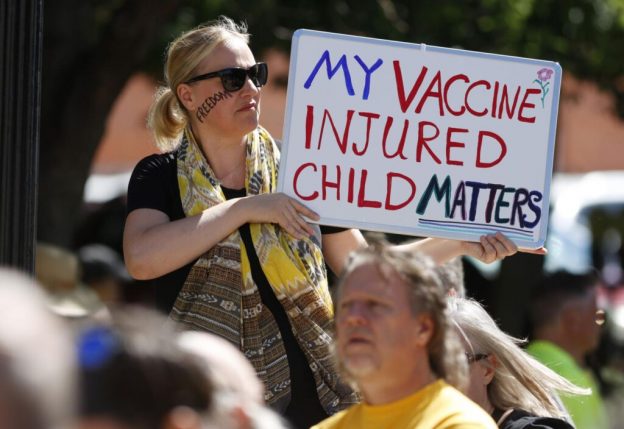
Simone Warstat attends a rally against a legislative bill to make it more difficult for parents to opt out for non-medical reasons to immunize their children, June 7, 2020, in Denver Colorado.
It is worth pointing out that many so-called “anti-vaxxers” are actually critics of the pharmaceutical industry and are not necessarily opposed to vaccines in and of themselves, making the labels “anti-vaxxer” and “anti-vaccine” misleading. Given that many pharmaceutical giants involved in making Covid-19 vaccines donate heavily to politicians in both countries and have been involved in numerous safety scandals, using state intelligence agencies to wage cyber war against sites that investigate such concerns is not only troubling for the future of journalism but it suggests that the UK is taking a dangerous leap toward becoming a country that uses its state powers to treat the enemies of corporations as enemies of the state.
The CIA-Backed Firm “Weaponizing Truth” with AI
In early October, the US Air Force and US Special Operations Command announced that they had awarded a multimillion-dollar contract to the US-based “machine intelligence” company Primer. Per the press release, “Primer will develop the first-ever machine learning platform to automatically identify and assess suspected disinformation [emphasis added]. Primer will also enhance its natural language processing platform to automatically analyze tactical events to provide commanders with unprecedented insight as events unfold in near real-time.”
According to Primer, the company “builds software machines that read and write in English, Russian, and Chinese to automatically unearth trends and patterns across large volumes of data,” and their work “supports the mission of the intelligence community and broader DOD by automating reading and research tasks to enhance the speed and quality of decision-making.” In other words, Primer is developing an algorithm that would allow the national-security state to outsource many military and intelligence analyst positions to AI. In fact, the company openly admits this, stating that their current effort “will automate the work typically done by dozens of analysts in a security operations center to ingest all of the data relevant to an event as it happens and funnel it into a unified user interface.”
Primer’s ultimate goal is to use their AI to entirely automate the shaping of public perceptions and become the arbiter of “truth,” as defined by the state. Primer’s founder, Sean Gourley, who previously created AI programs for the military to track “insurgency” in post-invasion Iraq, asserted in an April blog post that “computational warfare and disinformation campaigns will, in 2020, become a more serious threat than physical war, and we will have to rethink the weapons we deploy to fight them.”
In that same post, Gourley argued for the creation of a “Manhattan Project for truth” that would create a publicly available Wikipedia-style database built off of “knowledge bases [that] already exist inside many countries’ intelligence agencies for national security purposes.” Gourley then wrote that “this effort would be ultimately about building and enhancing our collective intelligence and establishing a baseline for what’s true or not” as established by intelligence agencies. He concludes his blog post by stating that “in 2020, we will begin to weaponize truth.”
Notably, on November 9, the same day that GCHQ announced its plans to target “anti-vaccine propaganda,” the US website NextGov reported that Primer’s Pentagon-funded effort had turned its attention specifically to “Covid-19 related disinformation.” According to Primer’s director of science, John Bohannon, “Primer will be integrating bot detection, synthetic text detection and unstructured textual claims analysis capabilities into our existing artificial intelligence platform currently in use with DOD. . . . This will create the first unified mission-ready platform to effectively counter Covid-19-related disinformation in near-real time.”
Bohannon, who previously worked as a mainstream journalist embedded with NATO forces in Afghanistan, also told NextGov that Primer’s new Covid-19–focused effort “automatically classifies documents into one of 10 categories to enable the detection of the impact of COVID” on areas such as “business, science and technology, employment, the global economy, and elections.” The final product is expected to be delivered to the Pentagon in the second quarter of next year.
Though a so-called private company, Primer is deeply linked to the national-security state it is designed to protect by “weaponizing truth.” Primer proudly promotes itself as having more than 15 percent of its staff hailing from the US intelligence community or military. The director of the company’s National Security Group is Brian Raymond, a former CIA intelligence officer who served as the Director for Iraq on the US National Security Council after leaving the agency.
The company also recently added several prominent national-security officials to its board including:
- Gen. Raymond Thomas (ret.), who led the command of all US and NATO Special Operations Forces in Afghanistan and is the former commander of both US Special Operations Command and Joint Special Operations Command (JSOC).
- Lt. Gen. VeraLinn Jamieson (ret.), the former deputy chief of staff for Air Force Intelligence, Surveillance and Reconnaissance who led the Air Force’s intelligence and cyber forces. She also personally developed “strategic partnerships” between the Air Force and Microsoft, Amazon, Google, and IBM in order “to accelerate the Air Force’s digital transformation.”
- Brett McGurk, one of the “chief architects” of the Iraq War “surge,” alongside the notorious Kagan family, as NSC Director for Iraq, and then as special assistant to the president and senior Director for Iraq and Afghanistan during the Bush administration. Under Obama and during part of the Trump administration, McGurk was the special presidential envoy for the Global Coalition to Defeat ISIS at the State Department, helping to manage the “dirty war” waged by the US, the UK, and other allies against Syria.
In addition to those recent board hires, Primer brought on Sue Gordon, the former principal deputy director of National Intelligence, as a strategic adviser. Gordon previously “drove partnerships within the US Intelligence Community and provided advice to the National Security Council in her role as deputy director of national intelligence” and had a twenty-seven-year career at the CIA. The deep links are unsurprising, given that Primer is financially backed by the CIA’s venture-capital arm In-Q-Tel and the venture-capital arm of billionaire Mike Bloomberg, Bloomberg Beta.
Operation Warp Speed’s Disinformation Blitzkrieg
The rapid increase in interest by the US and UK national-security states toward Covid-19 “disinformation,” particularly as it relates to upcoming Covid-19 vaccination campaigns, is intimately related to the media-engagement strategy of the US government’s Operation Warp Speed.
Officially a “public-private partnership,” Operation Warp Speed, which has the goal of vaccinating 300 million Americans by next January, is dominated by the US military and also involves several US intelligence agencies, including the National Security Agency (NSA) and the Department of Homeland Security (DHS), as well as intelligence-linked tech giants Google, Oracle, and Palantir. Several reports published in The Last American Vagabond by this author and journalist Derrick Broze have revealed the extreme secrecy of the operation, its numerous conflicts of interest, and its deep ties to Silicon Valley and Orwellian technocratic initiatives.
Warp Speed’s official guidance discusses at length its phased plan for engaging the public and addressing issues of “vaccine hesitancy.” According to the Warp Speed document entitled “From the Factory to the Frontlines,” “strategic communications and public messaging are critical to ensure maximum acceptance of vaccines, requiring a saturation of messaging across the national media.” It also states that “working with established partners—especially those that are trusted sources for target audiences—is critical to advancing public understanding of, access to, and acceptance of eventual vaccines” and that “identifying the right messages to promote vaccine confidence, countering misinformation, and targeting outreach to vulnerable and at-risk populations will be necessary to achieve high coverage.”
The document also notes that Warp Speed will employ the CDC’s three-pronged strategic framework for its communications effort. The third pillar of that strategy is entitled “Stop Myths” and has as a main focus “establish[ing] partnerships to contain the spread of misinformation” as well as “work[ing] with local partners and trusted messengers to improve confidence in vaccines.”
Though that particular Warp Speed document is short on specifics, the CDC’s Covid-19 Vaccination Program Interim Playbook contains additional information. It states that Operation Warp Speed will “engage and use a wide range of partners, collaborations, and communication and news media channels to achieve communication goals, understanding that channel preferences and credible sources vary among audiences and people at higher risk for severe illness and critical populations, and channels vary in their capacity to achieve different communication objectives.” It states that it will focus its efforts in this regard on “traditional media channels” (print, radio, and TV) as well as “digital media” (internet, social media, and text messaging).
The CDC document further reveals that the “public messaging” campaign to “promote vaccine uptake” and address “vaccine hesitancy” is divided into four phases and adds that the overall communication strategy of Warp Speed “should be timely and applicable for the current phase of the Covid-19 Vaccination program.”
Those phases are:
- Before a vaccine is available
- The vaccine is available in limited supply for certain populations of early focus
- The vaccine is increasingly available for other critical populations and the general public
- The vaccine is widely available
Given that the Covid-19 vaccine candidate produced by Pfizer is expected to be approved by the end of November, it appears that the US national-security state, which is essentially running Operation Warp Speed, along with “trusted messengers” in mass media, is preparing to enter the second phase of its communications strategy, one in which news organizations and journalists who raise legitimate concerns about Warp Speed will be de-platformed to make way for the “required” saturation of pro-vaccine messaging across the English-speaking media landscape.
Ongoing legal battle over 2005 UK police killing brings to light covert op to smear victim justice campaigns
By Kit Klarenberg | RT | November 10, 2020
On July 22, 2005, Jean Charles de Menezes was executed by armed police on a London Underground train. He was quickly found innocent, but his family’s fight for justice goes on, exposing police efforts to dodge responsibility.
Due to a litany of catastrophic blunders and miscommunications by senior officials and officers on-the-ground, he’d been wrongly identified as one of the fugitives involved in a string of failed suicide bombings the previous day.
Followed by a team of plainclothes police from his home to nearby Stockwell Underground station, despite clear orders from Metropolitan Police ‘Gold Command’ he be apprehended, Jean Charles was shot seven times in the head and once in the shoulder at close range in an underground train carriage. His body was said to be “unrecognizable” afterwards.
Lying squad
In the immediate aftermath, confusion and hysteria abounded, thanks largely to contradictory witness accounts and numerous “off-record” briefings from police being eagerly and uncritically amplified and speculated upon over and again by the mainstream media.
The day after his killing, it was fully established that Jean Charles hadn’t been a bombing suspect, and was in fact entirely innocent. Yet news outlets seemed oddly determined to imply he wasn’t entirely guiltless.
It was widely reported that he’d been an illegal immigrant, wires had been trailing from his rucksack, he’d been acting dubiously, fled from police after being challenged, vaulted the station ticket barriers, and refused to stop running despite shouted demands from officers.
All of these stories were entirely untrue, and widely acknowledged to be false over the course of subsequent months, but these impressions endure to this day in the minds of many. Suspiciously, the stories all seemed purpose-built to cast doubt on Jean Charles’ actions and character, and in the process mitigate the seriousness of the police’s fatal errors.
A subsequent investigation of Jean Charles’ killing by the then-Independent Police Complaints Commission (IPCC) specifically examined the question of how these lies entered the public domain.
It determined that no officer had knowingly fed disinformation to the press, but somewhat contradictorily, concluded that once officials knew Jean Charles was innocent the morning of July 23, 2005, “they should have refrained from publicly discussing the shooting until… the facts had been fully established.”
“Whilst [police] admitted to having made a tragic mistake they continued to try to justify the shooting by referring to de Menezes’ own actions and clothing,” the IPCC added.
The same probe concluded none of the officers involved would face disciplinary charges, while criticising the Metropolitan Police’s command structure. As of November 2020, no one has ever been criminally prosecuted for their actions on that fateful day.
Without knowledge or consent
Jean Charles’ family have never given up their quest for British police to be held accountable for his killing. In August 2005, they launched a campaign, Justice4Jean, calling for a public inquiry into his “unlawful killing.”
Shockingly, in 2014 they were contacted by representatives of Operation Herne, which was investigating the activities of the Special Demonstration Squad (SDS), a now-defunct covert unit of Special Branch, Britain’s elite national security police force. They were told information about them and their campaign had been inappropriately gathered by undercover operatives.
Among them was Patricia Armani Da Silva, Jean Charles’ first cousin and flatmate, who’d played a prominent role in Justice4Jean since its foundation. At a subsequent meeting with Herne investigators, she and other family members were shown five heavily redacted intelligence reports. The documents recorded covertly obtained information about individuals connected with the campaign and its meetings. For reasons unclear, the details gathered included the family’s political views.
In October 2015, Patricia was granted core participant status in the Undercover Policing Inquiry (UCPI), established by then-home secretary Theresa May to investigate numerous controversies surrounding the British state’s use of clandestine operatives.
Despite offering to actively participate with the investigation and two judicial reviews into her surveillance, in 2020 Patricia remains entirely in the dark as to why she, her relatives, and their campaign, were spied on by police. Now the UCPI has finally begun hearing evidence, and an opening statement on her behalf was read to the Inquiry on November 9 by Phillipa Kaufmann QC.
She outlined the immensely distressing impact mendacious media allegations had on Jean Charles’ family at the time, as they knew it highly unlikely their law-abiding, respectable son could have done anything wrong. She also noted they often relive the pain of the dark, harrowing period following his death, as they still encounter those bogus allegations, and are frequently forced to counter erroneous perceptions that Jean Charles in some way contributed to his own killing.
Moreover though, Kaufmann made it clear that the family are adamant police were fundamental to the dissemination of these stories, and continued to perfidiously pump discrediting disinformation about Jean Charles into the public domain long after he was so brutally slain.
For example, at the start of 2006, it was widely reported that a woman had approached police and claimed a man bearing a “striking resemblance” to Jean Charles had sexually assaulted her in a hotel room on New Year’s Eve 2002 in West London. After initially refusing, his family consented to a blood sample being taken from Jean Charles’ autopsy for forensic tests, and in April that year, Scotland Yard announced he’d been fully exonerated.
Strikingly, Kaufmann revealed that in March 2006, Patricia’s solicitor Harriet Wistrich received a telephone call from DI Paul Settle informing her that an article detailing the woman’s allegations would soon be published by the Sunday Mirror. Moreover, Wistrich clearly recalls that Settle “gave the unambiguous impression” the article was a result of a police leak.
The matter was investigated by the Metropolitan Police Service’s Directorate of Professional Standards, under the supervision of the IPCC. Settle denied having suggested the information was leaked by police, and the probe halted after concluding the number of people who knew of the allegations, including those outside the police, meant further investigation was unlikely to identify its source.
Undermining campaigning efforts
To say the least, Jean Charles’ relatives well understand the critical role that information and disinformation play in shaping public narratives about police action.
It’s in this context that undercover surveillance of the family justice campaign gains an even more sinister dimension. Illicitly obtained private information about them could easily be weaponised to discredit them and undermine their battle, in the same way disinformation served to discredit Jean Charles and by implication exonerate police.
In all, undercover officers spied on at least 18 family justice campaigns between 1968 and 2011. Such a profusion suggests a clear pattern of behaviour, a pattern in turn plausibly influenced by established internal policy. However, police consistently seek to characterise surveillance of justice campaigns as mere ‘collateral intrusion’ – inadvertent and unintentional intelligence gathering by covert operatives investigating individuals involved, rather than direct and deliberate targeting of grieving relatives themselves.
Families are deeply sceptical of this explanation, particularly in light of the revelations of former undercover officer Peter Francis, who as ‘Pete Black’ infiltrated 12 separate justice campaigns between 1993 and 1997. In 2010, under the alias ‘Officer A’, he said his presence in these groups was specifically intended to make the truth they sought “harder to obtain,” as part of a wider wrecking tendency on the part of SDS. Once the unit infiltrated an organisation, it was “effectively finished,” he claims.
In later years, Francis identified himself publicly, and shed further light on his undercover activities, particularly in regard to the Stephen Lawrence justice campaign, set up after the South London teenager was murdered in a cold-blooded racist attack. He alleged he was specifically tasked with unearthing incriminating information on Stephen’s parents and friends, which could halt their crusade in its tracks.
“Had I… found anything detrimental, the police using the media would’ve used that information to smear the family. My superiors were after any intelligence of that order. That was made clear to me. The Lawrences weren’t unique in this. I suggest journalists read some of the information leaked to the press at the time about these campaigns and seriously question where they came from and why,” he has claimed.
Kaufmann said that for Patricia, there was a “chilling parallel” between the disinformation about her cousin perpetuated in public, and Francis’ accounts of seeking out dishonouring dirt at his superiors’ behest.
While an individual spied-upon campaign may not be able to prove particular information was disseminated as part of a deliberate police strategy to smear them, if this is provably a common experience across many such groups, then defences of accidental error, or denial of attribution, on the part of the police by definition become very difficult to maintain.
“The inquiry is asked to scrutinise very carefully, with a penetrating sceptical gaze, the purported explanation advanced by the [police] for undercover reporting on justice campaigns… Patricia asks the inquiry to seek out the evidence of those involved in the campaigns and consider whether there are common aspects of their experiences which call into question those denials,” Kauffman concluded.
Isolated examples of disinformation about victims of police misconduct circulated by news outlets may be dismissed as perverse mishaps, the result of misunderstandings, breakdowns in communication, overzealous officials carelessly hypothesising beyond available evidence. Repeated instances of information on these groups and their members being secretly obtained and committed to internal police documents raise obvious questions over ulterior motives and ultimate objectives.
Patricia has waited over 15 years for justice in respect of Jean Charles’ killing, and over six to learn the truth about the police surveillance of her and her family. She’s now forced to wait even longer to see whether the UCPI delivers the answers she so deserves. Inquiry hearings related to police undercover activities between 1993 and 2007 are only expected to commence in the first half of 2023.
Kit Klarenberg is an investigative journalist exploring the role of intelligence services in shaping politics and perceptions. Follow Kit on Twitter @KitKlarenberg
UK Intelligence to Fight Anti-Vaccine Propaganda Spread by State Actors, British Media Reports

Anti-vaccine demonstrators in Edinburgh © Sputnik / Jason Dunn
By Tim Korso – Sputnik – 09.11.2020
A UK intelligence unit, known as the Government Communications Headquarters (GCHQ), has been authorised to conduct cyber operations to tackle the spread of anti-vaccine propaganda online, The Times reported citing an anonymous government source. According to the newspaper, the government increasingly views anti-vaxxers as a new priority because of the upcoming registration of domestically-developed vaccines against the coronavirus.
Apart from GCHQ, a secretive UK Army unit within the 77th Brigade specialising in information warfare will be taking part in the efforts “to quash rumours about misinformation” related to the COVID-19 vaccines, General Sir Nick Carter confirmed to The Times.
The newspaper’s source claims that GCHQ will be using the same toolkit it utilised to combat Daesh and its propaganda and recruitment efforts. The toolkit includes ways of taking down undesired content and conducting cyber attacks against the cyberactors behind it, for example by encrypting the perpetrators’ computer data, The Times added.
“GCHQ has been told to take out anti-vaxxers online and on social media. There are ways they have used to monitor and disrupt terrorist propaganda”, the anonymous source claimed.
However, GCHQ will not be able to use its tools against everyone online because its authority only extends to dealing with [alleged] state cyber actors and the content created by them, the newspaper reported citing another anonymous government source.
Russia as Main target for UK Intelligence Cyber Operations?
The British newspaper claims Russia will be the GCHQ’s prime target, citing its own investigation into the country’s alleged ties to the surge of internet memes questioning the safety of the vaccine developed by Oxford University in concert with AstraZeneca. The said investigation was based on a trove of documents and images provided by an anonymous source, who claimed to be part of an alleged propaganda effort purportedly seeking to hurt the image of the British vaccine. The Times, however, admitted in its article that it could not directly link the alleged social media campaign, targeting only the UK vaccine, with the Kremlin.
According to the newspaper, the alleged campaign against the AstraZeneca/Oxford vaccine started after the head of the Russian Direct Investment Fund (RDIF) that developed Sputnik V, Kirill Dmitriev, called the UK-developed medicine a “monkey vaccine” on several occasions. Dmitriev referred to the vaccine’s usage of a monkey virus as a vector to deliver the COVID-19 material needed to form immunity. He did not directly call the drug dangerous or ineffective, but noted that the use of human adenoviruses was more reliable, as their influence on the human body is better understood.
Dmitriev’s use of the term “monkey vaccine” prompted the emergence of numerous internet memes, baselessly alleging that the British drug would be turning recipients into monkey-like creatures or otherwise negatively affecting patients’ health. The head of RDIF later denounced the use of his words to besmirch the UK-developed vaccine, but defended his concerns over the possibility of its long-term side effects.
U.S. to be Subject to UN “Climate Conciliation Commission” if Re-Joins Paris Climate Pact
By Chris Horner | Government Accountability and Oversight
Paris Climate ‘Accord’ FOIA Case: State Dept. Releases, Withholds Parts of Memo to Sec. John Kerry Requesting Authority to Sign Paris Agreement
It appears possible that, come January, the United States will rejoin the 2015 Paris climate agreement, committing to adopt the “Green New Deal” agenda (now rebranded for political purposes as “Net Zero”). This will not be accomplished by Senate ratification, but by the ‘pen and a phone’ approach first used by President Obama to claim U.S. “ratification” of what is on its face and by its history a treaty, requiring approval instead by a two-thirds Senate vote.
A document released last week by the State Department, in Freedom of Information Act litigation by the transparency group Energy Policy Advocates, includes a reminder of one consequence of this for America, should it occur: claiming to “re-join” the Paris climate treaty will immediately subject U.S. energy policy — and thereby economic and to some extent trade policy — to a UN “climate conciliation commission”.
Already, as the United Kingdom has shown, developed nations’ courts can be expected to cite the Paris climate treaty in blocking infrastructure development. The UK’s Court of Appeal ruled earlier this year that Heathrow Airport cannot be expanded because that would violate the UK’s ‘net zero’ commitment under Paris.
Then, Canada offered a reminder how progressive politicians will raise taxes in the name of complying with Paris: In Ottawa, “The parliamentary budget officer says the federal carbon tax would have to rise over the coming years if the country is to meet emission-reduction targets under the Paris climate accord.”
Now we are reminded that the U.S. can also expect a forum for antagonistic nations to bring their complaints about U.S. policy and claims of non-compliance with Paris’s required “Net Zero” agenda for resolution.
This might be one of the reasons that avoiding a Senate vote on Paris was a key objective of the Obama administration, which stated in August 2015 before there ever was even Paris text, that it would not be a “treaty”. This was the lesson learned from the U.S. Senate’s refusal to consider the 1997 Kyoto treaty: If the Senate votes on it, its details would be debated, and defeated.
That objective of an end-run around the U.S. Constitution’s process was shared by European nations: the French climate change ambassador to the U.N. and President of the Paris COP, Laurence Tubiana and Laurent Fabius, respectively, both openly admitted.
Yet, those same countries treated Paris as a treaty for their own ratification purposes. This cavalier approach to the Constitution in the Obama years makes it easy to forget the U.S. supposedly has the more stringent system for joining international entanglements.
Instead, the Obama team showed what one Senate Foreign Relations Committee lawyer decried as a “disturbing contempt for the Senate’s constitutional rights and responsibilities” by circumventing its constitutional treaty role on Paris. Unfortunately, the institution shrunk from a constitutional fight, and all parties spoke as if calling Paris an “accord” instead carried weight — though the the Kyoto Protocol was alternately called the “Kyoto Accord” and, yes, was still a treaty.
This brings us to the newly released (in part) memo — “Request for Authority to Sign and Join the Paris Agreement, Adopted under the 1992 UN Framework Convention on Climate Change” [UNFCCC] — reaffirming that Paris is the result of “a 2011 negotiating mandate (the “Durban Platform”)”. The Durban “mandate” was to “adopt…a protocol, another legal instrument or an agreed outcome with legal force at the twenty-first session of the Conference of the Parties and for it to come into effect and be implemented from 2020”.
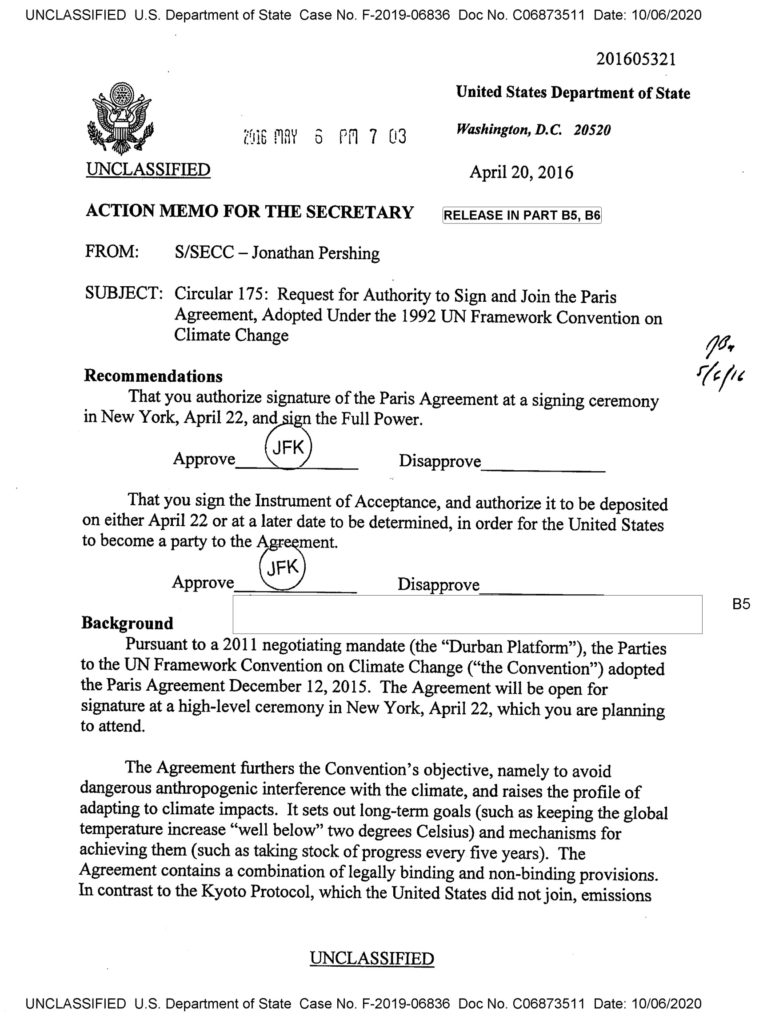
That of course is Paris, the crushing provisions of which are found in Article 4, emission reduction promises. Art. 4.3 requires that the U.S. revisit and tighten its reduction promises every five years. That would cleverly make this the climate treaty…sorry, “accord”… to end all climate treaties. It commits the U.S. to ever greater “climate” policy restrictions, every five years, in perpetuity.
Pull this off and there will never be the threat again of facing the tyranny of the Constitution’s requirement of popular approval.
Political rhetoric aside, nothing in Paris’s terms says this provision is legally binding, but no that one over there isn’t. Instead, Paris was merely sold to and promoted by much of the press with the claim that Paris contains “a mix of legally binding and not legally binding provisions”.
As we have seen already in the UK/Heathrow Airport case, that did not last, as it was not intended to. Lawyers and courts have already begun to see to something of which Americans should be reminded, including that you can have promises of massive infrastructure spending, or you can have the Paris climate pact, but you can’t have them both.
And it won’t just be courts. Recall, first, that the Paris agreement as originally circulated contained a climate tribunal, or court. This was dropped after being noticed outside of polite circles. Nonetheless, the recently released if still heavily redacted memo reminds us that U.S. compliance with the legally binding here but maybe not over there Paris obligations is subject to the terms of that 1992 agreement, ratified by the U.S. Senate on the condition that it was and remained non-binding (again, stated nowhere in its terms).
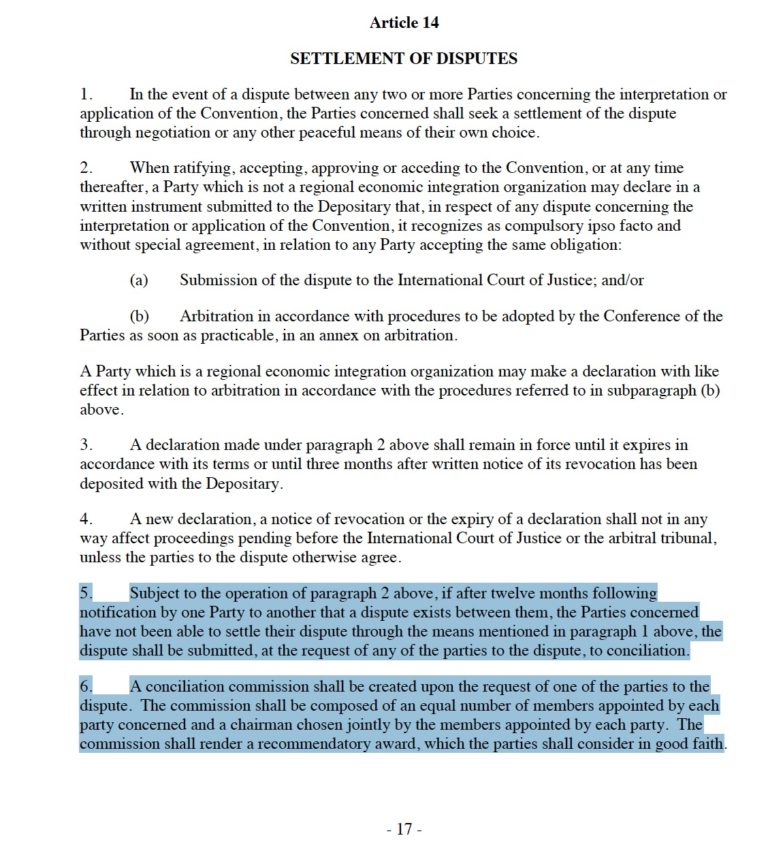
UNFCCC declares, in Art. 14, “Settlement of Dispute”, that:
“5. … if after twelve months following notification by one Party to another that a dispute exists between them, the Parties concerned have not been able to settle their dispute through the means mentioned in paragraph 1 above, the dispute shall be submitted, at the request of any of the parties to the dispute, to conciliation.
6. A conciliation commission shall be created upon the request of one of the parties to the
dispute. The commission shall be composed of an equal number of members appointed by each party concerned and a chairman chosen jointly by the members appointed by each party. The commission shall render a recommendatory award, which the parties shall consider in good faith.”
This language governs U.S. compliance with the Paris climate “accord”. It is not open to dispute that any U.S. president who claims to “re-join” the Paris climate treaty will subject US energy policy — and thereby the U.S. economy — to a UN climate “conciliation commission”.
Paris requires, and mandates the U.S. revisit and tighten “Green New Deal”-style policies every five years. This is among the many reasons why the Paris climate agreement is a treaty, and also why it never would have been ratified. However, very soon, Americans may nonetheless be subject to its long-envisioned climate court.
Why it is right to question the orthodox Covid-19 narrative
The authors of ‘Welcome to Covidworld’ defend their stance
By Matthew Ratcliffe and Ian James Kidd | The Critic | November 6, 2020
In a reply to our piece “Welcome to Covidworld”, Ben Bramble engages in precisely the sort of thinking that we raised concerns about. He suggests that we are mistaken in comparing harms done by lockdowns and other measures to harms caused by the virus. Instead, we ought to have weighed up the costs of lockdowns against what would have happened without them.
Bramble’s case hinges on a counterfactual claim: in the absence of lockdowns, the virus would have inflicted much more harm than it has done. The cost of not locking down would, he says, have been “mind-bogglingly great”.
What could be wrong with Bramble’s claim? First of all, his use of the term “lockdown” is insufficiently discerning. Lockdown is not a simple, straightforward policy measure that took the same form in every country. There are, for instance, important differences between early and late lockdowns. Australia and New Zealand both locked down early and suppressed the virus.
Setting aside the issue of whether or not the actions taken by these countries are morally justifiable, it remains to be seen whether or not this is a success story. If a highly effective vaccine is not forthcoming, both countries will face the painful options of cutting themselves off from the rest of the world indefinitely, having strict lockdowns whenever the virus reappears, or eventually succumbing to the virus, none of which amount to success.
However, the current UK situation is very different. Given where we are now, nobody is claiming that this second lockdown or any future UK lockdowns will be able to suppress the virus here. It is too well established for that. Rather, the stated aims have been to buy us some time until a vaccine arrives and, most recently, to ensure that the NHS is not overwhelmed. In evaluating the effectiveness and appropriateness of such policy measures, it will not do to make sweeping claims about the effectiveness of lockdowns in general. When considering interventions so extreme and destructive, we need to proceed more carefully.
Bramble simply accepts that lockdowns in general work. He does not specify exactly what it would be for a late lockdown to work, when the goal is no longer complete suppression. Presumably, the relevant criteria will include reducing hospitalizations and deaths due to Covid-19, during the lockdown and in the longer term as well. But where is the evidence that lockdowns generally have this effect? Bramble doesn’t provide any. Maybe he thinks it’s just obvious that they achieve this, but it really isn’t.
A strict lockdown in Peru is associated with one of the highest Covid-19 death tolls in the world (currently recorded as 1,047 people per 1 million of the population). Other countries that have resorted to exceptionally long and strict lockdowns, such as Argentina, have also fared badly. One could, of course, run Bramble’s counterfactual here: it would have been even worse for these countries had they not locked down. But where is the evidence for that? Indeed, what would even count as evidence?
It would be intellectually and morally unacceptable to make the pro-lockdown position unfalsifiable by always insisting on the following: (1) where cases drop after a lockdown was introduced, it must be the lockdown that achieved this; (2) where cases rise after a lockdown was introduced, it would certainly have been even worse without the lockdown; (3) if other countries, such as Sweden, adopt less extreme approaches than us and fare better or at least no worse, this must be due to other differences between the two countries – the Swedish strategy would never have worked here.
So, how do we go about evaluating the effectiveness of lockdowns? Where is the evidence that the virus ultimately causes far more deaths in the absence of extreme social restrictions? Where are those countries that followed a different course from countries like the UK (which locked down, but did not suppress the virus) and now have higher death tolls than us? By simply assuming that his counterfactual claim is true, Bramble illustrates our worry that lockdowns risk becoming an unfalsifiable article of faith. In fact, he even asserts that “the science on this is beyond question”. Is it really? If so, all the disease modelers who have made dire predictions concerning the current UK situation will be delighted to hear that their work will be forever immune from critique, even if it turns out that their models have little bearing on reality. And, in any case, none of them would endorse Bramble’s exaggerated claim that, without a lockdown, there would have been “many millions of deaths” in countries such as the UK.
In fact, much about the behaviour of this virus remains unclear, including how the infection rate is influenced by growing immunity within a population. There is no single, homogeneous entity called “the science”. Rather, there are many different and often conflicting perspectives, theories, and claims. Furthermore, this is a complicated, fast-changing situation that impacts on all aspects of human society. Relevant expertise thus encompasses a wide range of academic disciplines and areas of practice. Philosophers should not simply defer to “the experts”; they also have plenty of relevant expertise themselves.
What we do know is that lockdowns are immensely damaging in so many ways. This second UK lockdown will further disrupt the social and emotional development of our children, cause a substantial rise in severe mental health problems, force many elderly people to live out the final weeks and perhaps months of their lives in loneliness and misery, exacerbate and prolong the pain of bereavement by depriving people of interpersonal and social interactions that shape and regulate grief, destroy livelihoods and risk mass unemployment, increase regional social and economic inequalities, reduce the life-opportunities of young people while saddling them with an ever-growing mountain of debt to pay off, suspend much of what gives our lives meaning, deprive people of countless precious, irreplaceable life-moments, and cause deaths due to the numerous resulting impacts on people’s health.
However, the true extent of certain harms, such as the long-term effects of sustained lockdown measures on children’s development, may not become fully clear for some time.
Others have similarly warned that policy makers are paying insufficient attention to these growing costs. For instance, an open letter by psychologists, which appeared on 1 November, spells out the widespread and damaging psychological effects of continuing restrictions, including the harms done to children. Similarly, an article published in the British Medical Journal on 2 November raises the concern that the “collateral damage” caused by public health interventions has “yet to be considered systematically”. Others have drawn attention to the global costs of national lockdowns. For instance, the charity Oxfam has stated that, by the end of this year, over 12,000 people could be starving to death every day due the global impact of national-level responses to Covid-19.
Bramble observes that the orthodox view has in fact been subjected to critical scrutiny. But the problem is that – in the UK, at least – alternative perspectives have had little influence on the processes of recommending, making, and implementing policy decisions. And we worry that this may be partly because of blinkered and inflexible attitudes that are widely held. People are often very quick to dismiss or express moral disapproval of dissenting voices. However, those who confidently endorse lockdowns with an air of moral authority also need to acknowledge the full extent of the harms these measures have caused, are causing, and are likely to cause. Furthermore, explicit and sufficiently specific criteria should be supplied for determining the effectiveness of any proposed lockdown, accompanied by convincing evidence to show that it is very likely to achieve its intended effects.
Instead of pursuing such a path, Bramble speculates that our own concerns originate in cognitive impairments caused by our distressing experiences of lockdown. This is the kind of response that motivated our earlier account of “Covidworld”, a simplified, virus-centric reality where various norms of reason, scientific enquiry, and moral conduct have ceased to apply.
Copyright © Locomotive 6960 Limited 2020
Featured Video
HE SAVED LIVES. NOW HE FACES PRISON.
or go to
Aletho News Archives – Video-Images
From the Archives
NATO Sanctions and the Coming Global Diesel Fuel Disaster
By F. William Engdahl – New Eastern Outlook – 11.04.2022
Amid the ongoing global inflation crisis, NATO heads of state and mainstream media repeat a mantra that high energy prices are a direct result of Putin’s actions in Ukraine since end of February. The reality is that it is the western sanctions that are responsible. Those sanctions including cutting SWIFT interbank access for key Russian banks and some of the most severe sanctions ever imposed, are hardly having an impact on the military actions in Ukraine. What many overlook is the fact that they are increasingly impacting the economies of the West, especially the EU and USA. A closer look at the state of the global supply of diesel fuel is alarming. But Western sanctions planners at the US Treasury and the EU know fully well what they are doing. And it bodes ill for the world economy.
While most of us rarely think about diesel fuel as anything other than a pollutant, in fact it is essential to the entire world economy in a way few energy sources are. The director general of Fuels Europe, part of the European Petroleum Refiners Association, stated recently, “… there is a clear link between diesel and GDP, because almost everything that goes into and out of a factory goes using diesel.” … continue
Blog Roll
 Aletho News
- Trita Parsi: Middle East Unraveling — Are We on the Path to World War?
- Iran FM meets with US envoy on UN meeting’s sidelines at American side’s insistence: Report
- Qatar PM calls for Gulf security framework with Iran, says war must be ‘wake-up call’
- China condemns US extortion of Iranian airlines, rejects Washington’s ‘illegal’ sanctions threats
- Italy to move military personnel from Taif base after missile strike
- Finland’s Stubb tells European leaders to calm down
- Defeating Russia on battlefield impossible – Fico
- Finland’s Gender Clinic Reversal
- Massachusetts Wants Mental Health Visits, Why Does Government Use ‘Health’ to Enter Our Homes & Families?
- US lawmaker admits American people footing bill for Trump’s failed aggression against Iran
- If Americans Knew
- Sanctions are collective punishment: immoral and self-defeating
- Phosphorus Munitions Fired by Israel Burn Groves, Orchards in Southern Lebanon
- Israel Carries Out New Ceasefire Violations Across Gaza
- AI – Emphasis on the ‘I’: Israel Is Funding AI Chatbot Propaganda
- Israel Blocking Hundreds of Wheelchairs for Injured Children From Entering Gaza
- Israel Is Expanding and Upgrading Compounds for Palestinian Militias in Gaza
- The Palestinian-American Residents of This West Bank Town Are Wondering: Where Is Trump?
- Gaza desperately needs tents, wheelchairs, fuel… and everything else (Israel blocks it all) – Daily Update
- Israeli Attacks in Gaza Kill at Least Seven Palestinians Over Three Days, including Woman and Child
- Trump’s militarization of Washington DC as he pursues Israel’s war against Iran
- No Tricks Zone
- New Study: Earth And Venus Surface Warmth Largely Explained By Convection And Lapse Rate, Not CO2 Or Radiation
- 2025 Nature Paper Claiming Worsening Global Drought Gets RETRACTED …Heavily Flawed
- New Study: ‘Global Drought Shows No Detectable Recent Acceleration Under Climate Warming’
- Economic Masterminds: German Socialists Suggest Taxing Productivity Gains Stemming From Using AI
- The South China Sea Has Not Been Cooperating With The Climate Change Narrative
- Energy Crisis: Germany Enters Heating Season With Historically Low Gas Reserve Fill Levels
- New Study: The Antarctic Ice Sheet Gained Mass From 2020-2024 Due To Staggering Snow And Ice Accumulation
- Study: Ocean Heating Rates From Thousands Of Years Ago ‘Dwarf’ Modern Ocean Heating Rates
- Climate Extremists Target, Attack Large-Scale Power Grid Infrastructure In Germany!
- New Study: Antarctic Ice Melt Has Contributed Less Than 1 Centimeter To Sea Level Rise In The Last 30 Years

