Trump’s Win — A Rebuke to the Elites
By Alastair Crooke | Consortium News | November 12, 2016
So, there it is: Brexit, as I had earlier suggested, was no extraneous “flash in the pan,” but a manifestation of wider and deeper discontents in Western society. Let us be clear: not only did 60 million Americans vote for Donald Trump, but a further 13 million, who voted for Bernie Sanders (in the primaries) similarly voted for strategic change – albeit from within a different political orientation.
I do not intend, here, to attempt any post-mortem on the U.S. election, but rather to try to see what may stand hidden behind the Brexit and Trump events – obscured for now by their overly prominent presence on the forestage of the media and politics.
The first concerns Donald Trump: Unsurprisingly, his personal foibles and his billionaire background have become the focus of a hostile media who question whether he has the ability to bring about strategic change, or not. This is an important question, but still it misses the point. The point here is that there are few – very few – opportunities for elected officials to challenge the status quo – especially when Western centrist parties have patently conspired to offer voters mere nuanced variants of the same “progressive,” liberal, globalized agenda.
In short, there evidently has been a constituency building up, so exasperated at the imperviousness of the elites to the true situation of this constituency, that they want the status quo gone, by whomsoever’s hand is there. Whomsoever: that is the point. It was never some sort of chief executive beauty contest: Would Bernie Sanders have been an ideal President? Would Nigel Farage have been one? Will Trump be able to deliver a new era? — we do not know (but should not foreclose on that possibility). The Whomsoever aspect rather speaks to the depth of alienation that lay latent in American society.
But the message that is in danger of being obscured by the outsize focus on the outsize personality of Mr. Trump is precisely that the “discontents” at democracy, at cultural “identity” politics, at globalization and its sufferings, will not simply disappear now. Mr. Trump will succeed or fail, but the uprising will persist in one form or another – and is likely to spread to other parts of Europe, leaving the latter in turmoil and politically incapacitated.
Profound Alienation
It represents a profound alienation. We should not expect any early return of the liberal world, should Mr. Trump somehow fail.
Nor should Mr. Trump be viewed as some sort of outlandish political freak. In fact, he fits quite closely to one of the mainstream orientations of American conservatism. It is an orientation that is, by instinct, doubtful of grandiose schemes of political or social re-engineering, preferring to take human nature as it is; it is more inclined to focus on domestic needs, rather than uncertain foreign adventures; is financially conservative; is not economically determinist; and tends to see the family as the indispensable building-block of society. It is a Zeitgeist that sees other countries (say Russia or China) as normal countries with whom one should talk, and to pursue common interests.
That Trump should be regarded as some bizarre oddity, rather than as being in the line of Burke and thrice Presidential contender Pat Buchanan (who admits to a certain paternity, as it were) – speaks more to the success of the neoconservative hijack of American conservatism beginning in the 1960s than reflects the historic spectrum of this intellectual current.
One might say that the neoconservatives were never Conservative, in the sense that neoliberals were never Liberal, in the traditional understanding of these terms. What is new is that the President-elect seems to have put together a new Republican constituency of half the American electorate. And this new constituency is not just one of “red-necks” (white, blue-collar workers). It has cut across social classes and ethnic divisions. Even Wall Street traders (supposedly aligned with the Clintons) reportedly were enthusiastically yelling “lock her up” during Mrs. Clinton’s concession speech – and college-educated women only gave Mrs. Clinton a 6 percent edge over those who voted Trump.
It is possible “that this election [originally] was intended to facilitate the triumphant return of the neoconservative-neoliberal paradigm all wrapped up in ‘new packaging.’ For various reasons, the decision was made to assign this role to Hillary Clinton,” according to the Oriental Review.
Perhaps this was because she was viewed as well placed to fuse the liberal-interventionist and the neoconservative trends to the Clintonite “cultural identity politics” base – or possibly, simply because it was “her turn” at the Presidency. If so, it has failed spectacularly.
The Clinton Failure
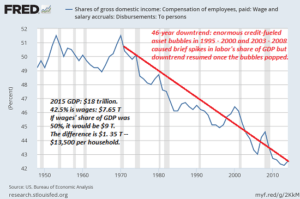
Why did it fail? One aspect of the discontent (as I have outlined before – see here) relates to the slow demise of our financialized, neoliberal, debt-driven growth model. For many in America and Europe, the reality has not been one of economic prosperity, but one of anxiety – and for the first time in the post-World War II era – a sense that the next generations’ prospects will be much tougher, and worse, than ours were.
Here (no friend to Trump) is Naomi Klein’s assessment: “They will blame James Comey and the FBI. They will blame voter suppression and racism. They will blame ‘Bernie or bust’ and misogyny. They will blame third parties and independent candidates. They will blame the corporate media for giving him the platform, social media for being a bullhorn, and WikiLeaks for airing the laundry.
“But this leaves out the force most responsible for creating the nightmare in which we now find ourselves … [financialized] neoliberalism. Here is what we need to understand: a hell of a lot of people are in pain. Under neoliberal policies of deregulation, privatization, austerity and corporate trade, their living standards have declined precipitously. They have lost jobs. They have lost pensions. They have lost much of the safety net that used to make these losses less frightening. They see a future for their kids even worse than their precarious present.
“At the same time, they have witnessed the rise of the Davos class, a hyper-connected network of banking and tech billionaires, elected leaders who are awfully cozy with those interests, and Hollywood celebrities who make the whole thing seem unbearably glamorous. Success is a party to which they were not invited, and they know in their hearts that this rising wealth and power is somehow directly connected to their growing debts and powerlessness.
“For the people who saw security and status as their birthright – and that means white men most of all – these losses are unbearable. Donald Trump speaks directly to that pain. The Brexit campaign spoke to that pain.”
Here it is represented visually:
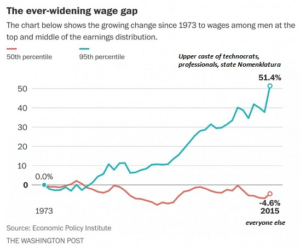
Of course, this was not the case for the urban élites:
Cultural Resistance
The second aspect to the present discontent has been cultural oppression (or, in the rhetoric of the Democratic Party, “identity politics” – one of the mainstays of the Clintonite electoral base). Its roots are complex, and lie with philosophic currents emerging out of Germany during WWII that somehow fused with American Trotskyist intellectual thinking (which then migrated to the Right). But, in gist, this current of political thought borrowed from the emerging discipline of psychology the concept of clearing the human mind – shocking it, or forcing it into becoming the “clean slate” on which a new mental program could be written by the psychiatric (or political) therapist respectively.
The political aim here was to eliminate totalitarian thinking, and fascist mental “programming,” and to replace it with a liberal-democracy circuit board.
Indeed, the U.S. Immigration and Nationality Act of 1965 was promoted by this intellectual group precisely in furtherance of the notion that concepts such as “national culture” would become meaningless as a result of immigrant cultural dilution. By the 1970s and 1980s, the objective had evolved to implant the idea that there was really no politics to modernity (Fukuyama’s End of History) since all governance somehow had boiled down to technocracy: ensuring effective liberal market functioning — a matter best left to experts.
In political terms, the “clearing” of the mind’s inherited cultural clutter was to be achieved by cultural wars of political correctness. The class war had become discredited, but there were other “victims” on whose behalf war could be waged: the war on gender discrimination, on racism, on denial of gay rights and sexual orientation stereotyping, on verbal micro-aggressions, on sexist language, or any ideas or language which disturbed the individual’s sense of “safe space” were used as tools to clear away old cultural “brush” of inherited national culture, and open the way for an American-led, globalized world.
The ostensible factor linking all these notions of victim “wars” was that their antonym amounted either to fascism or authoritarianism. The problem with this has been that any white American blue-collar worker who attended church, who believed in family life, and was patriotic, became potentially a fascist, a racist, a sexist or a bigot.
Many ordinary Americans (and Europeans) disdain this “cultural” war which places him or her (according to Hillary Clinton), in the “‘basket of deplorables’ Right? Racist, sexist, homophobic, xenophobic, islamophobic, you name it,” and who looked upon his or her community as representing nothing more than a “fly-over” state in the view of the U.S. coastal élites.
The deplorables have now risen up. Donald Trump’s salty language was no liability – it was an electoral asset by thumbing his nose at this correctness, and at so-called ”snowflake” sensibilities. Trump’s ‘incorrectness’ touched on a deep vein of resentment within American traditional society.
Not only does “flyover America” resent being termed “deplorables,” they feel too clearly the disdain in which the American and European elites hold them – and dislike their arrogance in suggesting that there is only one rational, sensible way of doing things, and that they – the elites, being the experts and a part of the Davos set – should tell the rest of us what it is: (despite their decades of failures).
High Emotions
Emotions are high on both sides. To gain a sense of how bitterly the cultural war will be fought, listen to this from the partly-Soros-funded populist mobilization movement Azaaz (linked to America’s Move On organization): “Dear Mr. Trump: This is not what greatness looks like. The world rejects your fear, hate-mongering, and bigotry. We reject your support for torture, your calls for murdering civilians, and your general encouragement of violence. We reject your denigration of women, Muslims, Mexicans, and millions of others who don’t look like you, talk like you, or pray to the same god as you. Facing your fear we choose compassion. Hearing your despair we choose hope. Seeing your ignorance we choose understanding. As citizens of the world, we stand united against your brand of division.”
In short, with Brexit and the Trump victory, we are witnessing an historic point of inflexion. As I noted in mid-October (quoting British political philosopher John Gray): “If the tension between [the globalization project on one hand] and the [sovereign] nation state, [on the other] was one of the contradictions of Thatcherism … From Bill Clinton and Tony Blair onward, the center-left embraced the project of a global free market with an enthusiasm as ardent as any on the right. If globalization was at odds with social cohesion, society had to be re-engineered to become an adjunct of the market. The result was that large sections of the population were left to moulder in stagnation or poverty, some without any prospect of finding a productive place in society.”
“If Gray is correct that when globalized economics strikes trouble, people will demand that the state must pay attention to their own parochial, national economic situation (and not to the utopian concerns of the centralizing elite), it suggests that just as globalization is over – so too is centralization (in all its many manifestations).”
Well, the global trend does not seem to be going in the Avaaz direction. It seems rather to be heading toward prioritizing the recovery of the state, of state sovereignty, and of state engagement in the pursuit of economic policies appropriate to the particular circumstances of the state, and in the state’s ultimate responsibility for the welfare of the community as a whole.
The question is what does this mean geo-strategically? And, secondly, can and will, Trump be able to deliver the new era? The short answer is that this new era seems to presage a period of political volatility, financial volatility and in Europe and the Middle East, the prospect of continued political “shock.”
It is clear that Mr. Trump is not a globalist. It is also clear that he is aware of some of the dangers of the present global monetarist policy. He has spoken of the U.S. Federal Reserve creating “big ugly bubbles” and that the next economic and financial crisis has been “kicked down the road” by Fed Chairwoman Janet Yellen – and clearly awaits whomsoever becomes U.S. President on Jan. 20, 2017.
Painted into a Corner
But three decades of debt-led, financialized “growth policies” leave the President-elect effectively painted into a corner: global debt has spiraled; the bubbles are there still (kept afloat by Central Bank coordinated intervention), and bubbles are infamously difficult to deflate gently; zero or negative interest rates are undermining many a business model, but cannot easily be foregone, without crashing the bond market; and QE (printing money) is systematically eating away at consumer purchasing power through the dilution of its newly created purchasing power, and the latter’s re-direction from “main street” into the financial sector – lifting nominal asset values – but creating no tangible wealth.
America and Europe effectively are in debt-deflation. How then to grow incomes so that producers of goods and services can also afford then subsequently to purchase these goods and services? Trump’s answer is to spend on domestic infrastructure projects. This may help a bit, but is unlikely – in itself – to lift and float the entire U.S. economy.
The reality is that there is no obvious global engine of growth (now that China’s “industrial revolution” has stalled at best). Every nation now is in search of new engines of growth. And it is not easy to imagine that Europe or America will succeed in retrieving all those jobs lost through globalization. Indeed, the attempt so to do – in, and of itself – might just precipitate a further deceleration of world trade, and a consequent decline in output.
In brief, the global economy may see a brief “honeymoon period” thanks to a likely spurt of U.S. fiscal indulgence and a concomitant psychological lift, stemming from – at least – the U.S. construction sector enjoying something of a boom. But ultimately the very economic crisis which Mr. Trump anticipates may prove to be the only way to cut the Gordian knot in which three decades of unprecedented debt and money printing have fettered us.
And if he is to steer through the expected crisis, Mr. Trump will have to eschew the Siren voices of the present elites telling him “TINA” (there is no alternative, but to continue as before).
Where Mr Trump might look for an early (and relatively easy) success however, may be in foreign policy. As “Nixon went to China,” so Trump can go to Russia and China, and begin to treat them as normal nations with whom it is possible to find an intersection of interests (as well as areas of disagreement).
This would be revolutionary. It could change the geo-strategical map. And as President Putin keeps repeating … the door is open (at least for now). Nothing is forever in politics.
Alastair Crooke is a former British diplomat who was a senior figure in British intelligence and in European Union diplomacy. He is the founder and director of the Conflicts Forum, which advocates for engagement between political Islam and the West.
Is Obama Staging a Color Revolution in the US?
By Martin Berger – New Eastern Outlook – 12.11.2016
The recent victory of now President-elect Donald Trump has taken a lot of Americans by surprise. But it would be safe to say that the corporate ruling elites that went all in on Hillary Clinton were literally shocked by her defeat. Without her at the head of the state they fear they may not be able to carry on spreading the corruption, which is believed to be at the foundation of the Clinton clan, or carry on waging wars upon other states which includes arming terrorists responsible for killing thousands of civilians around the world.
And even though the corporate elites have formally acknowledged Trump’s victory, they are pressuring the current government to fight the next US President tooth and nail, until all resources are exhausted.
Over the last eight years, the Obama administration has acquired a long list of tricks that were used against undesired governments in various parts of the world, while the most effective among them is the so-called “color revolutions,” where essentially a coup d’etat is achieved by media manipulation and large mobs. US intelligence services are now prepared to unleash such a revolution on the home front, since they are fairly concerned about their future under Trump, as the Washington Post would report.
The fact that Obama still believes in Trump’s inability to replace him in the White House has already been announced by the White House Press Secretary Josh Earnest. At the same time, he would point out, while commenting on the anti-Trump protests in the US, that the right for freedom of expression must be exercised without violence, clearly alluding to the current administration’s arsenal of “peaceful” tools that would allow it to get rid of Trump.
That is why we already are witnessing a wave of “protests” being unleashed under the control of the Obama administration. The corporate media and social networks are openly arrayed against the incoming 45th US President. These very tactics have been used by US intelligence agencies in Brazil, Nicaragua, Hong Kong, Thailand, as well as across the Middle East and Eastern Europe to unleash a “color revolution”. In some countries, such actions have brought foreign government under the direct control of the White House, as we can see it in Ukraine, Brazil and several other countries.
As a result, we are now being told about thousands of protesters in US cities rallying against the Trump election victory. These claims were followed by a petition published on Change.org that demands the US authorities change the results of the recent election, demanding the electoral college be revised, and that the election results be overturned on December 19. It is being reported that this petition has already been signed by a total of two million people.
It goes without saying that an attempt to launch a “color revolution” in the United States is being supported by a number of Europe states in addition to the US, including France and Germany, since the political order there is concerned about the impunity they’ve been enjoying coming to an end, with Trump failing to openly signal continued open US support for them. The British Independent wants Trump to be impeached, citing law professor Christopher Peterson, who would claim that there is a strong case for the beginning of legal proceedings that would stop Donald Trump from being president. The impeachment process is usually initiated when a president of a state has committed some sort of a serious offense, but Trump hasn’t been able to do anything yet, since he hasn’t been inaugurated. Still the Independent believes there must be some legal ground for his impeachment.
It’s clear the train of “color revolution” is under full steam in the US today. What will come up from this attempt to ignore the US Constitution, remains to be seen.
Who Said “Assad Must Go” And Where Are They Now?
Oh the irony of it all.
Who is still President of his country…

Who is next on the neo-liberal warmonger regime change list…

Time for forces to unite to beat a common enemy…

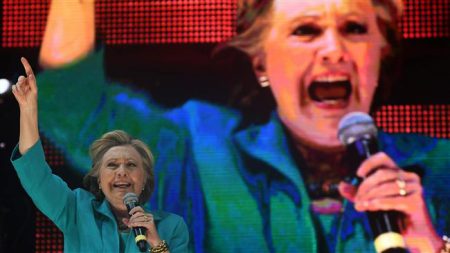
Hillary versus Donald: Ding Dong, The Witch Is Dead! Victory for the Wizard of Oz!
By Diana Johnstone | Global Research | November 9, 2016
“There’s no place like home.”
That’s the lesson. Even when home is Kansas.
The real meaning of this election is not, as bitterly disappointed Hillary supporters still maintain with tears in their eyes and fear in their throats, a victory for racism and sexism.
The real meaning of this upset is that Wall Street’s globalization project has been rejected by the citizens of its homeland.
This has major implications for the European nations that have been dragged along into this ruinous project.
Hillary Clinton was the candidate of the military industrial complex and international finance capital. She designed herself to be the figurehead of those forces, as queen of regime change. She aspired to be the one to remake the world in the image Wall Street dictates. It was a project enthusiastically and expensively supported by the one percent who profit from arms contracts and the trade deals they write themselves for their own interests.
To distract from the genuine significance of her candidacy, the Clinton campaign appealed to the desire for respectability of educated city dwellers, portraying Trump supporters as racist yokels motivated by a hateful desire to scapegoat minorities as revenge for their own inadequacies. They were “deplorables”, and you wouldn’t want to be one of them, would you?
Trump was sexist, because he referred to certain women as “bimbos”. Elizabeth Warren called him out for this, on a platform where Hillary sat listening, mouth wide open in delight – she who had referred to Bill’s girlfriends as “bimbo eruptions”. Sleaze and hypocrisy drowned out policy discussions. The worst the Clinton campaign could come up with was an eleven-year-old locker room exchange – just words, hardly comparable to Bill’s chronic actions.
Still, millions who were taken in by the Clinton campaign line are devastated, terrified, convinced that the only reason Trump won was the “racism” and “sexism” of that lower caste in globalized society: white heterosexual working class males.
But no, Virginia, there were other reasons to vote for Trump. Racism and sexism are surely low on the list.
Trump voters were scandalized by Hillary’s lies and corruption. Many of them would have voted for Bernie Sanders if they had the choice. That choice was taken away from them by Democratic Party manipulators who were sold on their own advertising campaign to elect “the first woman President.” A brand new product on the Presidential election market! Be the first to vote for a woman President! New, improved!
Bernie’s success already showed that millions of people didn’t want that woman. But the Democratic Party manipulators and their oligarch sponsors went right ahead with their plans to force Hillary Clinton on an unwilling nation. They brought this defeat on themselves.
Contrary to what you could believe by reading the New York Times, there were even intellectuals who voted for Trump, or at least refused to vote for Hillary, for the simple reason that Trump appears less likely to lead the world into its third and final Great War. He said things giving that impression, but such statements were ignored by mainstream media as they worked overtime to inflate the ogre image. No war with Russia? You must be a Putin puppet!
Trump voters had several reasons to vote for Trump other than “racism”. Most of all, they want their jobs back, jobs that have vanished thanks to the neoliberal policy of transferring manufacturing jobs to places with low wages.
But racism is the only motive recognized by the globalized elite for rejecting globalization. British citizens who voted to leave the European Union in order to recover their traditional democracy were also stigmatized as “racist” and “xenophobe”. Opposition to racism and xenophobia is the natural moral defense of a project of global governance that deprives ordinary citizens of any important power of decision.
This extraordinarily vicious campaign has brought out and aggravated sharp divisions within the United States. The division between city and countryside is most evident on the electoral maps. But these real divisions are exacerbated by a campaign that portrayed Donald Trump as a racist madman, a new Hitler about to bring fascism to America. The antiracism of this campaign, denouncing “hate”, has actually spawned hate.
No, Virginia, Trump is not Hitler. He is the Wizard of Oz. He is a showman who pulled off an amazing trick thanks to the drastic moral and intellectual decline of the American political system.
He is neither as dangerous as his opponents fear, nor as able to “make American great again” as his supporters hope. He is the Lesser Evil. What will become of him in Washington is anybody’s guess.
Copyright © Diana Johnstone, Global Research, 2016
Leave those kids alone! Thousands of schoolchildren being spied on without their knowledge
RT | November 8, 2016
At least 1,000 schools have installed software that allows teachers to monitor their students’ internet activity, but most schools have failed to inform youngsters that they are being watched.
According to a report by civil liberties watchdog Big Brother Watch, several secondary schools in England and Wales have installed the Classroom Management Software in more than 821,000 devices owned by the institutions and by pupils themselves.
The tool can allow teachers to monitor the screens on every single desktop in the classroom, as well as access the students’ internet browsing history and alert staff of “signs of extremism and radicalization.”
Campaigners were shocked to find that of the few institutions (149) able to provide Acceptable Use policies on their management of the software, over 80 percent did not give detailed information on the monitoring process.
Big Brother Watch believes although the software may have a role to play in keeping students safe, children and parents should be advised about the privacy settings of the program.
“Finding the balance between keeping pupils safe online without impinging on their right to privacy is a challenge for every school,” said the group’s chief executive Renate Samson.
“But encouraging schools to track and monitor pupils creates a worrying precedent, particularly if pupils and parents are being left in the dark.
“As technology in the classroom becomes the norm, schools must ensure they don’t become modern day panopticons, where children grow up believing their every digital move is being watched.”
It cost the taxpayer a total of £2 million (US$2.48 million) to install the controversial software. More is spent each year on maintenance and subscription fees.
‘Openly provocative’: Russia sends complaint to UK over mannequin protest outside its London embassy
RT | November 4, 2016
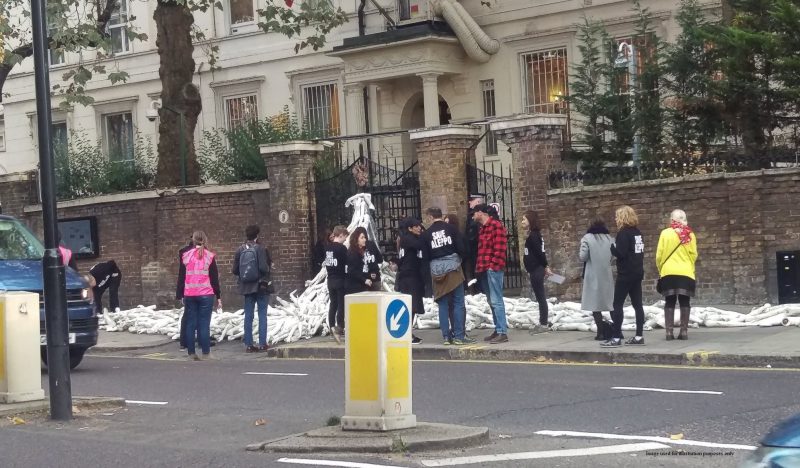
Russia’s embassy in London has sent a letter to the UK Foreign Office to complain about demonstrators who dumped around 800 mannequin limbs outside the building in protest of Russia’s actions in Syria.
It is reported that the protesters were members of Syria Campaign and Syria Solidarity, UK groups that say the mannequins are symbolic of Russia’s campaign in Syria.
Russia’s embassy said staff and visitors couldn’t enter the building, while police stood by indifferently.
Moscow says it is deeply concerned about the unwillingness of the British Government to ensure the security of Russia’s diplomatic mission in London.
“The security of the Russian diplomatic mission in the UK was compromised. Police officers remained indifferent in the face of the openly provocative and disorderly conduct of the ‘demonstrators,’” the statement reads.
The embassy added that “nuisance callers blocked the Embassy telephone line, rendering it impossible to contact the mission for genuine callers.”
Russia is not surprised by the protest, however, seeing how UK Foreign Secretary Boris Johnson has encouraged demonstrations outside the embassy.
“It’s worth mentioning that today’s manifestation near the Embassy has been accompanied by an ongoing anti-Russian campaign in the media inspired by some statements of the British officials”.
“We are concerned with the unwillingness of the British authorities to provide proper protection for the embassy,” Alexander Yakovenko, Russian Ambassador to the UK told RT, “The protestors were allowed physically close to the entrance by the British authorities. That was a first.”
According to Yakovenko, the protest had been “planned,” as “a few weeks ago Boris Johnson called for a demonstration here [at the embassy].”
“We are facing an intensive anti-Russian campaign from the media, and there has been a call from the British minister [Johnson] to physically block the embassy, which is totally unacceptable for us.”
According to former British diplomat Craig Murray, the UK’s foreign secretary has been encouraging protests and indulging Cold War rhetoric.
“The UK … has decided to up the rhetoric up to the levels of the Cold War rhetoric. The fact that the Foreign Secretary is indulging in that is extremely sad,” he said.
The UK-based Syria Solidarity group describes itself as “a network of activists committed to solidarity with the Syrian Revolution.” It says that it supports “the popular revolution against the Assad regime.”
“We are critical of the countries who provide material support to the Assad regime,” the group says.
The other group that took part in the protest, Syria Campaign, calls itself “a global advocacy group” whose mission is “to mobilize people around the world to advocate to protect Syrian civilians.”
On its official website, the Syria Campaign voices its support for the White Helmets, a Western-funded volunteer civil defense group that operates in Syria. While officially its mission is to offer first aid to bombing victims, Syrian and Russian authorities have accused the White Helmets of spreading anti-government propaganda and maintaining close ties with Islamist rebels.
In October of this year, the Russian Defense Ministry accused the White Helmets of faking digital images of a bombing of a school in Idlib, Syria. Earlier, the White Helmets’ chief liaison officer acknowledged to RT that his organization, which claims to be “non-governmental” and “neutral,” receives funding and equipment from several Western states, including the US, the UK, and Germany.
READ MORE:
Boris Johnson calls for Russian Embassy protests during Syria debate
Protest outside Russian Embassy would increase hysteria against Russia – Stop the War leader
Russophobia and the dark art of making an anti-Russian magazine cover
By Dominic Basulto | July 10, 2016

Chances are, if a story about Russia appears on the cover of a major Western magazine, it’s not good news. Most likely, there’s been an international scandal, a breakout of geopolitical tensions, the resumption of Cold War hostilities, or some nefarious Russian plot to bring the entire free world to its knees.
Russophobia — or the unnatural fear of Russia — generally leads magazine editors to choose the most over-the-top images to convey Russia as a backwards, clumsy, non-Western and aggressively malevolent power. Unfortunately, that’s led to a few rules of thumb for anyone trying to create a magazine cover featuring Russia. You can think of these rules as the dark art of making an anti-Russian magazine cover:
OPTION 1: Go with the Russian bear
This is a no-brainer, actually, and pretty much the default option for any magazine editor. The symbol of the Russian bear is universally understood to be the symbol of Russia, so it’s an immediate attention-grabber that readers will grasp quickly. After all, for centuries, Western satirists have used the Russian bear as a symbol of imperial aggression.
Given the latest round of U.S.-Russian tensions over the Ukraine crisis, the key is to make the Russian bear look as scary as possible. Take the May/June 2016 cover from Foreign Affairs, for example:
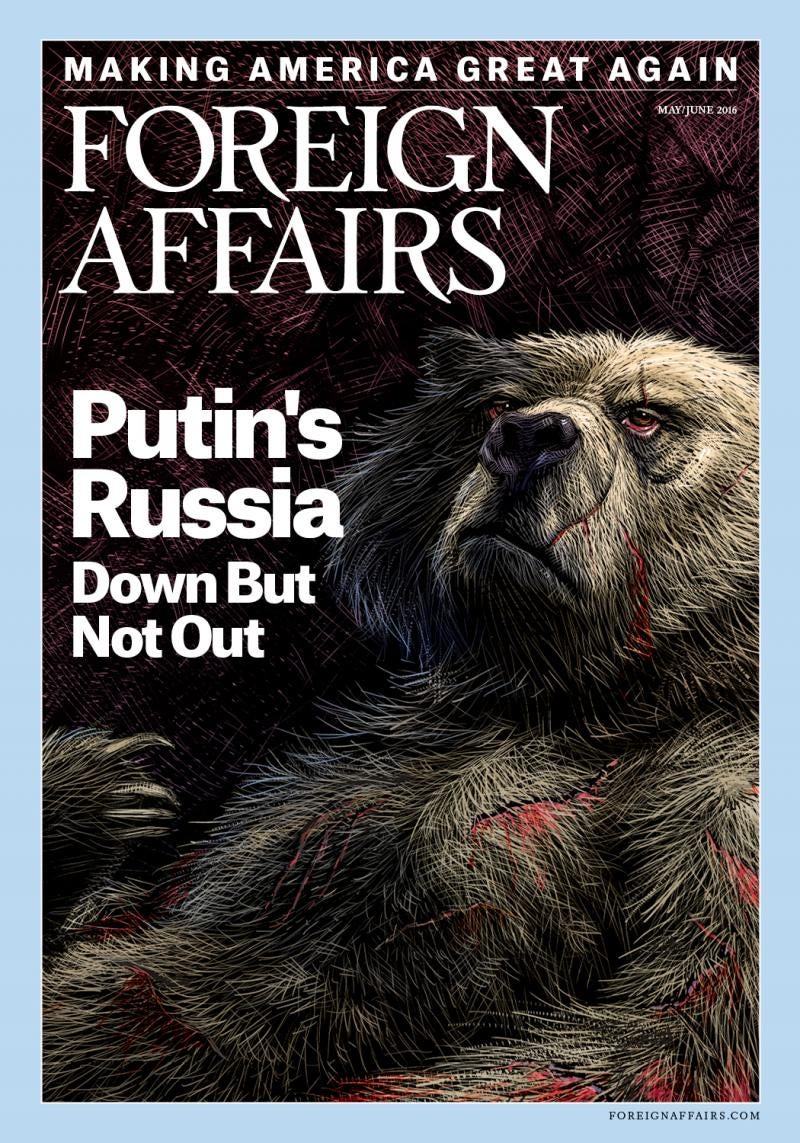
The cover title seems relatively harmless — “Putin’s Russia: Down But Not Out.” But check out the image of the bear — it’s bloodied and still relatively menacing, despite being bruised and battered — check out the red, bloodshot eyes and the sharp claws. Definitely not someone you’d want to mess with, even after a few shots of vodka.
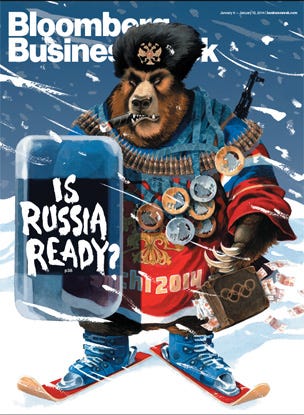
And Foreign Affairs is not the only magazine to go the full bear with the cover. Ahead of the Sochi Winter Olympics in 2014, Bloomberg BusinessWeek went with what has to be the scariest, most menacing Russia bear that’s ever appeared on the cover of a magazine. The magazine shows a malevolent bear on a pair of skis wearing a Russian hockey jersey, armed to the teeth (literally), with the headline: “Is Russia Ready?”
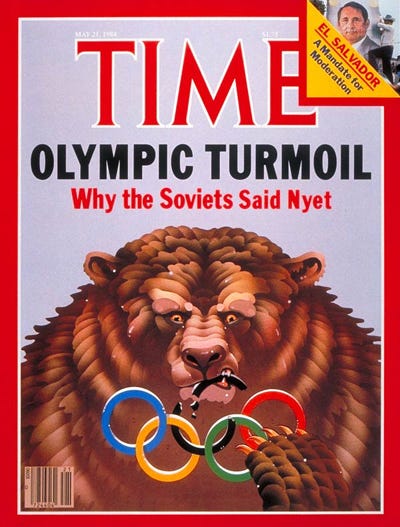
This Olympic cover immediately calls to mind a cover story TIME ran on Russia (then the Soviet Union) ahead of the 1984 Los Angeles Summer Olympics — “Olympic Turmoil: Why the Soviets Said Nyet.” Here you have a menacing (and slightly psychotic-looking) Russian bear chewing on the Olympic rings:
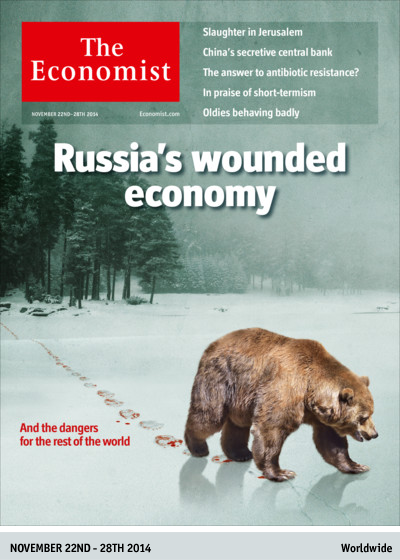
There are other options, of course, if you don’t want to go with the anthropomorphic bear. In late 2014, The Economist pulled off a story about “Russia’s Wounded Economy” after Western sanctions and falling oil prices — it showed a bear stalking through the wintry, Siberian snow with bloody footprints:
But you probably want to emphasize either the claws or teeth of the Russian bear, right? So here’s a terrifying image of a Russian bear “welcoming” U.S. President Barack Obama to Moscow:
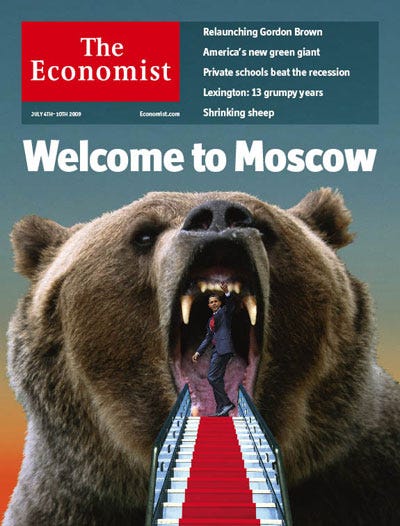
OPTION 2: Go with Vladimir Putin
The next best choice after using the Russian bear is the image of Vladimir Putin. After all, in the minds of most Western readers, Putin is Russia and Russia is Putin.
If you’re ready to head down this road, then an image of an evil James Bond villain, hatching a diabolical plot to take over the world, might work. This 2014 Newsweek cover of Putin, showing him and the menacing sunglasses, is a classic:
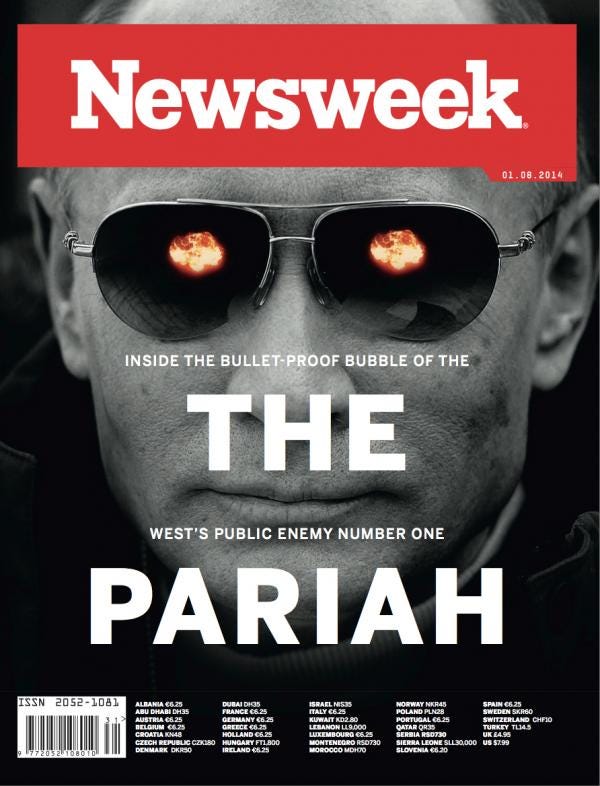
To play up the Soviet spy background of Putin, you could try using an image of him wearing sunglasses in a grim-looking Red Square (Gray Square!):
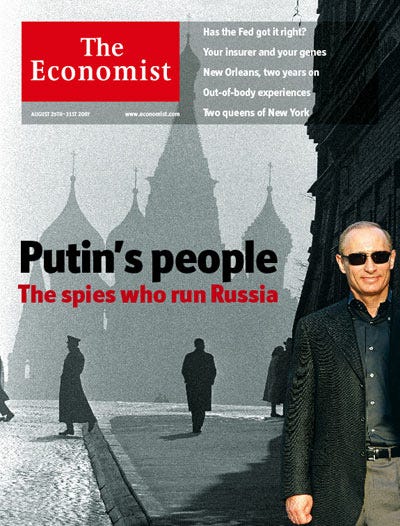
A variant of the James Bond villain look is the classic “moody Putin” look that’s been around for almost a decade. This image somehow captures the Western perception of Russia as a vast, unsmiling wasteland full of snow, ice and a vast moral void. Who better to run that country than an unsmiling dictator? What started it all was this TIME magazine cover naming Putin as “Person of the Year”:
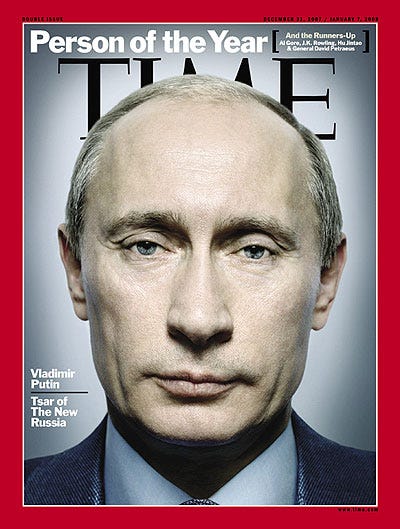
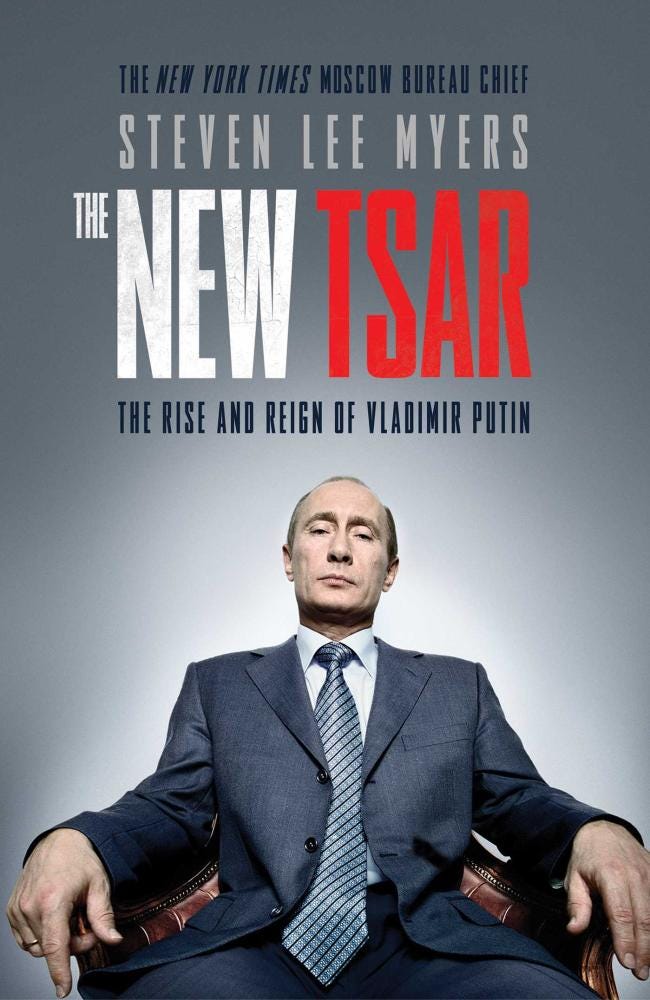
From there, the moody, unsmiling Putin image took off. Pull your camera angle back from the close-up of Putin’s face and you get this — “the unsmiling tsar”:
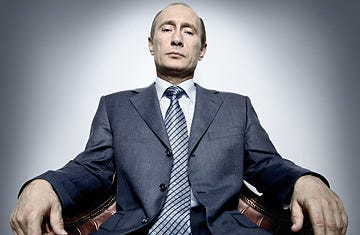
Which, of course, led to the cover of this 2015 book by Steven Lee Myers of the New York Times:
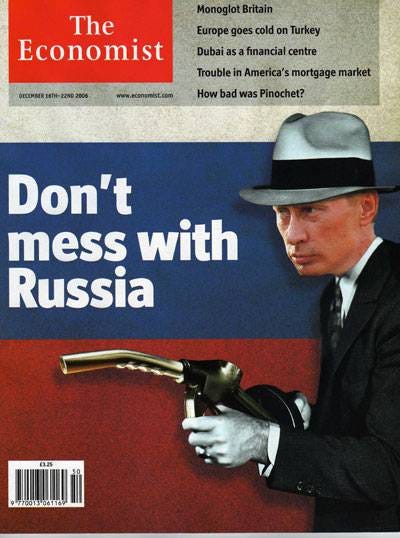
Of course, the moody, unsmiling, sour-looking Putin can be updated to make him look like a gangster:
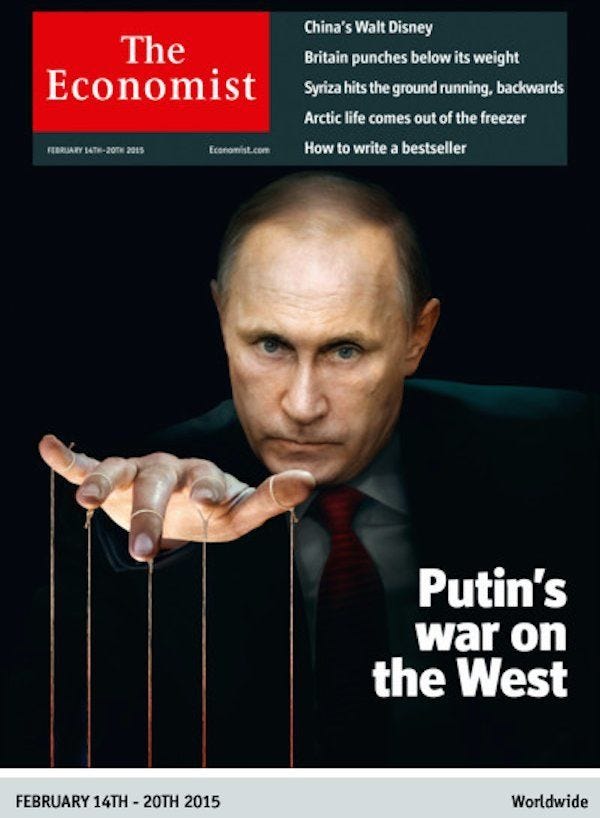
Or a Mario Puzo-style mafia don:
If you really want to grab the reader’s attention, though, go for the shirtless Putin. The shirtless Vladimir Putin is a classic Internet meme, of course. (Google: Shirtless Putin hummingbird hamster) The meme of a shirtless Putin doing manly things is so popular that “The Simpsons” even used the image of a completely naked Putin on horseback (bareback?) around the time of the Crimea crisis:
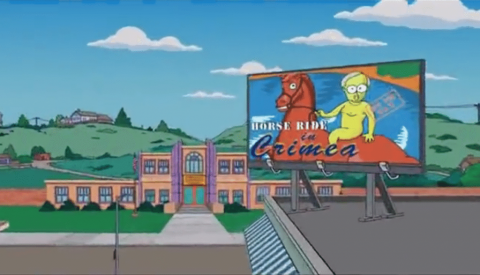
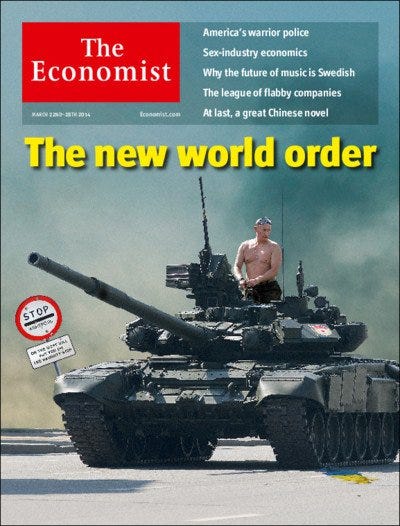
Look long enough, and you start to see images of shirtless Vladimir Putins Photoshopped on top of everything. So it’s perhaps no big surprise that the shirtless Vladimir Putin has ended up on the cover of a few major magazines, including this classic Economist cover where he’s shirtless on top of a Russian tank:
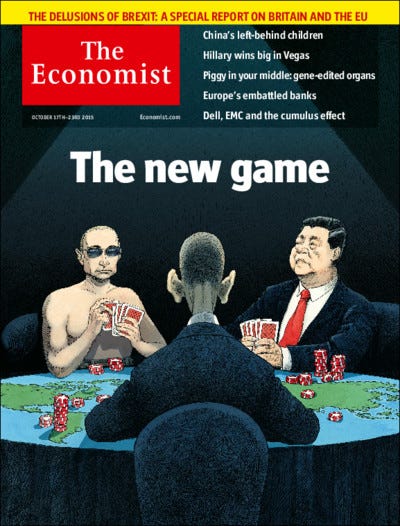
And shirtless while playing poker:
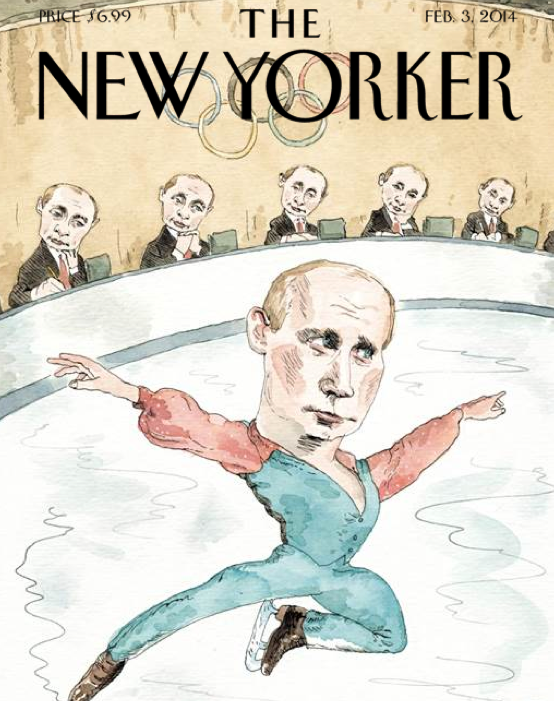
But, if you want an image of Putin, and you also want to keep things classy, how about a mashup of Putin and a classic symbol of Russian culture, like ballet or ice skating? In 2014, The New Yorker pulled off a cover of Putin, pirouetting through the air during the Sochi Winter Olympics, while a bunch of Putin yes-man clones give him top marks for his performance:
And, here’s another cover featuring Putin as an ice skater, this time from The Economist:
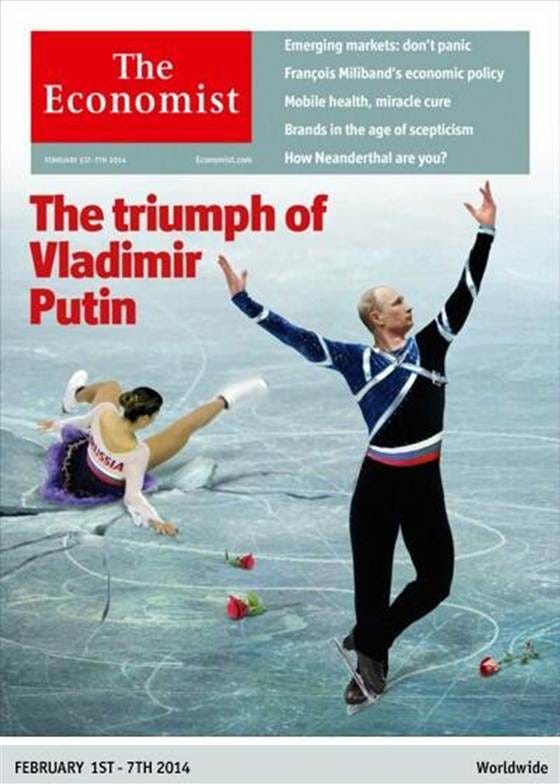
But here’s the twist — note the fallen Russian figure skater on the ice and the suggestion that the Sochi Olympics were basically a giant personal ego project for Putin. (Also note the subtext of the imagery — whereas Putin usually opts for “macho” sports like hunting, swimming and hockey, this cover shows him as a slightly effeminate ice skater. Look at the hands!!!)
OPTION 3: Go with a classic image of Russia, slightly twisted
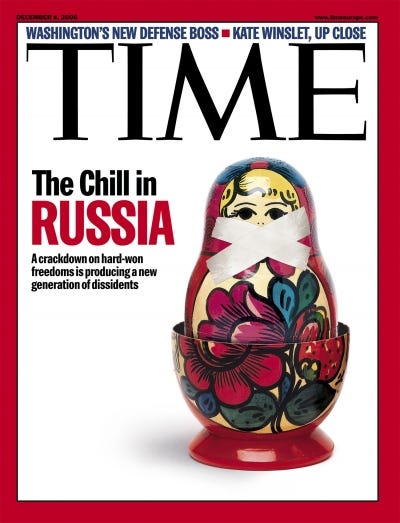
If you’re tired of using the Russian bear image and you’re concerned that putting Vladimir Putin on the cover of your magazine might create a few unsavory possibilities for your editorial team (Russian spies! Russian mafia! Russian hooligans!), there’s the old standby — the matryoshka image. This, of course, conveys the enigmatic nature of Russia — the old “riddle inside an enigma wrapped in a mystery” of Winston Churchill:
But why stop there? To convey the threatening nature of all things Russia, maybe it’s just easier just to come out and show the Russian missiles, tanks, weapons and troops directly:
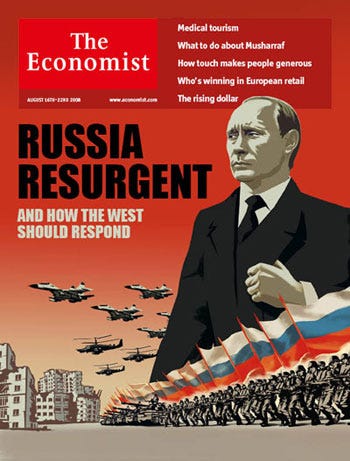
What all these magazine covers have in common, of course, is their Russophobia. These magazine covers are not so much different from the images that appeared a hundred years ago, when Russia really was an enigma unknown to the West. In fact, the image of Russia as a big, clumsy and aggressive state dates all the way back to the 16th century, and not much seems to have changed since then.
There’s always been a sense in Western media circles that a giant power in the middle of the Eurasian landmass posed a threat to someone — and maybe to everyone:
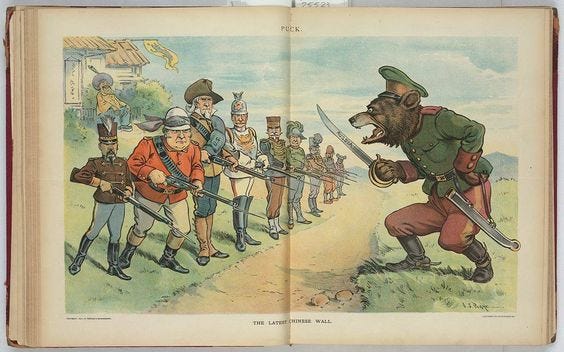
Although, in all fairness, the image of the Russian bear is probably preferable to the image of the Russian octopus:
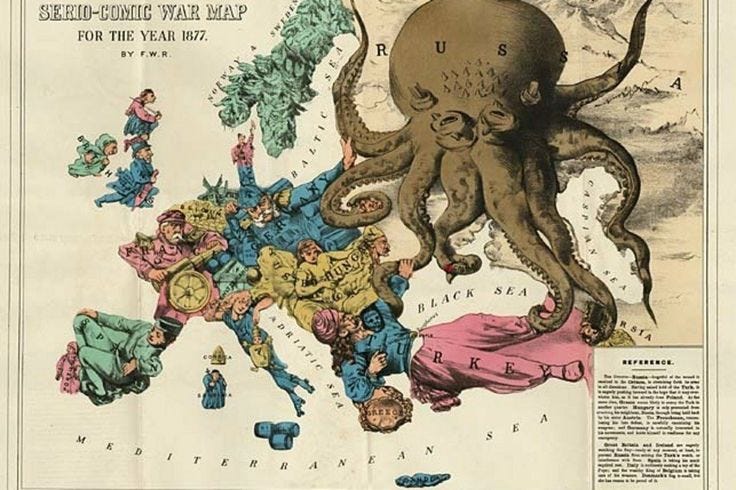
Which leads to the obvious question — Are these images of Russia from 100 years ago really so much different from the images appearing today in Western mass media?
At a time when the Kremlin has called on the Culture Ministry to investigate anti-Russian propaganda and Russophobia in the West, this question isn’t very hard to answer.
Dominic Basulto is the author of the new book Russophobia.
Israel acts to blunt criticism of the occupation as its grip tightens
By Jonathan Cook | Dissident Voice | November 1, 2016
Israel has just emerged from its three-week high holidays, a period that in recent years has been marked by extremist religious Jews making provocative visits to Al Aqsa mosque compound in occupied East Jerusalem.
Many go to pray, in violation of Israel’s international obligations. Most of them belong to groups that seek to replace the mosque with a Jewish temple. They now enjoy increasing parliamentary support, some of it from within prime minister Benjamin Netanyahu’s party.
A rash of such visits last autumn outraged Palestinians and triggered a wave of so-called lone-wolf attacks on Israelis. The attacks have recently abated.
Taking advantage of the renewed quiet, Israel allowed a record number of ultra-nationalists to visit the mosque, figures released last week showed. Parties of Israeli soldiers are also entering the site.
The police, whose recently appointed commander is himself from the extremist settler community, have recommended that restrictions be ended on visits by Jewish legislators who demand Israel’s sovereignty over the mosque.
For Palestinians, Israel’s treatment of this supremely important Islamic holy site symbolises their powerlessness, oppression and routine humiliation. Conversely, a sense of impunity has left Israel greedy for even more control over the Palestinians.
The gaping power imbalance was movingly detailed last month at a special hearing of the UN security council. Hagai El-Ad, head of B’tselem, which monitors the occupation, termed Israel’s abuses as “invisible, bureaucratic, daily violence” against Palestinians exercised from “cradle to grave”.
He appealed to the international community to end its five decades of inaction. “We need your help. … The occupation must end. The UN Security Council must act. And the time is now,” he said.
Israeli politicians were incensed. Mr El-Ad had broken one of Israel’s cardinal rules: you do not wash the country’s dirty linen abroad. Most Israelis consider the occupation and Palestinian suffering as an internal matter, to be decided by them alone.
Mr Netanyahu accused B’tselem’s director of conspiring with outsiders to subject Israel to “international coercion”.
With the US limply defending Mr El-Ad’s freedom of speech, Mr Netanyahu found a proxy to relaunch the attack. David Bitan, chair of his party, demanded that Mr El-Ad be stripped of his citizenship and proposed legislation to ban calls in global forums for sanctions against Israel. Unsurprisingly, Mr El-Ad has faced a flood of death threats.
Meanwhile, another UN forum has been considering Israel’s occupation. Its educational, scientific and cultural body, Unesco, passed a resolution last month condemning Israel’s systematic violations of Palestinian holy sites, especially Al Aqsa.
Again, Israelis were enraged at this brief disturbance of their well-oiled machinery of oppression. The abuses documented by Unesco were overshadowed by Israeli protests that its own narrative was not the focus.
While Israel exercises ever more physical power over Palestinians, its moral credit is running out with foreign audiences, who have come to understand that the occupation is neither benign nor temporary. The rise of social media has accelerated that awakening, which in turn has bolstered grassroots reactions such as the boycott (BDS) movement.
Aware of the dangers, Israel has been aggressively targeting all forms of popular activism. Facebook and YouTube are under relentless pressure to censor sites critical of Israel.
Western governments – which joined the chorus of “Je suis Charlie” after ISIL’s lethal attack on the Paris office of Charlie Hebdo magazine last year – have cracked down on the boycott movement. Paradoxically, France has led the way by banning such activism, echoing Israeli claims that it constitutes “incitement”.
And left-wing social movements emerging in Europe face loud accusations that any criticism of Israel is tantamount to an attack on all Jews. Notably, a British parliamentary committee last month characterised as anti-semitic parts of the opposition Labour party under its new leader, Jeremy Corbyn, a champion of Palestinian rights.
In these ways, European governments have been trying to hold in check popular anger at a belligerent and unrepentant Israel.
Illustrating that caution, Uneso was forced last week to vote a second time on its resolution, this time removing the word “occupation” and, against normal practice, giving equal status to the occupier’s names for the sites under threat from its occupation.
Even with the resolution neutered, Unesco’s usual consensus could not be reached. The resolution passed by a wafer-thin majority, with European and other governments abstaining.
Israel and its enablers have successfully engineered a hollowing out of official discourse about Israel to blunt even the mildest criticism. Gradually, western powers are adopting Mr Netanyahu’s doubly illogical premises: that criticising the occupation is anti-Israel, and criticising Israel is anti-semitic.
Incrementally, western leaders are conceding that any criticism of Mr Netanyahu’s policies – even as he tries to ensure that the occupation becomes permanent – is off-limits. Mr El-Ad called for courage from the western powers that dominate the security council. But the signs are his words have fallen on deaf ears.
British Media Wet Their Pants With MI5 Russian Scare Story
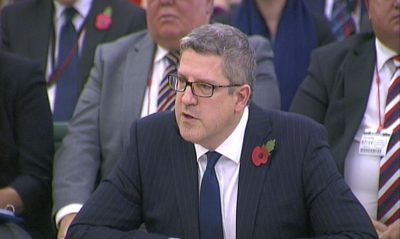
Director-General of security service MI5, Andrew Parker
By Finian CUNNINGHAM | Strategic Culture Foundation | 02.11.2016
The annual festive Halloween holiday is commonly a time for spooky pranks and scare stories. And the British news media delivered – albeit unintentionally it seems. This week several top national newspapers conveyed a stark message from the chief spook at Britain’s secret service, MI5. Andrew Parker, chief of Military Intelligence (Section) 5, warned that Russia was presenting a clear and present danger to the security of the state.
It was The Guardian that first broke the story, with an «exclusive» article on its front page headlined: «MI5 chief warns of growing Russian threat in UK».
With virtually the same headline, the story was replicated in the pages of The Independent, Sun, Daily Mail and Daily Telegraph, among others.
Russia swiftly scorned the British media coverage as fatuous.
However, this was no Halloween prank being played on the British public for kicks. The issue was presented as serious journalism, reporting on a grave matter of national security. The coincidence of the netherworld festival only lends a certain unintended ironical mirth.
More importantly, though, it is one more example of how Western publics are being conditioned by a relentless mental diet of Russophobia. That a host of British newspapers in unison published without question «talking points» from the head of MI5 alleging a threat to national security from Russia is in itself indicative of a «psychological operation». It reflects the abject standard of supposedly independent media in Britain.
The Guardian billed its «exclusive» by saying it was the «first interview given by a serving spy chief». Andrew Parker has been head of Britain’s state security service for the past nine years. Neither he nor his predecessors have ever given such a full-court press briefing.
MI5 was first established in 1909 and serves as Britain’s premier internal state security agency, dealing with counterinsurgency and counter-terrorism. The organization’s MI6 counterpart deals with foreign military intelligence.
The unprecedented public intervention by MI5 this week is again suggestive of a psychological operation.
Moreover, for anyone with a critical faculty, what is bizarre about the latest claims of a Russian «threat» is that despite the gravity and the factual-sounding wording of the headlines, there is a dearth of substance reported to support said claims.
MI5’s Andrew Parker merely makes vague assertions about Russia «pushing foreign policy in increasingly aggressive ways involving propaganda, espionage, subversion and cyber-attacks».
These are the same zero-evidence, breathless assertions that are echoed by American security services and media. The Obama administration citing its own intelligence agencies last month accused Russia of state-sponsored cyber-attacks and interference in the US presidential elections.
Moscow has categorically rejected these insinuations as baseless. Russian foreign minister Sergei Lavrov notes that repeated requests for evidence have been ignored by US authorities. While Russia’s President Vladimir Putin has dismissed allegations of political interference as a cynical «distraction» from real internal American problems.
Another indicator of psychological operation is the way that the alleged Russian threats are packaged as «talking points» which are easily disseminated and regurgitated. After a while, the claims become hackneyed and stale from lack of supporting substance.
The alleged threats which MI5’s Andrew Parker treated the British media and public to have less the ring of truth and more the dull thud of tedium. And yet the British media – like a circus dog – jumped on cue this week to the instruction as if it was something novel and exciting.
How many times have we heard from sundry atlanticist, pro-NATO think tanks warning us about Russian «subversion» or «cyber-attacks» or trying to undermine Western democracies? The level of repetition and coordination of talking-points that we hear from the likes of the Atlantic Council, Center for Strategic and International Studies, the National Endowment for Democracy, NATO, and so on, are reflective of central authorship in state intelligence emanating from the CIA and MI5 / MI6, which in turn feeds into the foreign policy establishments of nominally democratic governments. In short, the Deep State network that transcends Western electoral politics.
Last month at an EU leaders’ summit in Brussels, European Council President Donald Tusk urged the bloc to adopt harsher economic sanctions on Russia, as did the leaders of Germany, Britain and France. Tusk listed a litany of purported Russian malfeasance, including «cyber-attacks, disinformation campaigns, interference in the EU’s political processes» and «trying to weaken the European Union».
Fortunately, Italy, Austria, Spain, Hungary and a number of other European leaders rejected Tusk’s appeal for tougher sanctions on Russia, saying they were counterproductive.
But the point here is that Tusk, supposedly a guiding political light for the EU, sounds more like a hired-hack for the CIA or M15, as ascertained by the trite talking points that he so readily recites about Russian «threats».
The comparison with the briefing given this week to British media by the head of MI5 tends to prove that there is a sinister group-think shared by certain American and European political leaders with unelected Deep State agencies. This relationship as expressed in formulaic Russophobia raises disturbing questions about the true nature of democracy and democratic accountability in Western states. Are the elected leaders following the people’s will or are they following instructions from shadowy agencies whose whole purpose is driven by geopolitical conflict, in particular conflict with Russia?
This perhaps explains why in the US, the Washington establishment and the military-intelligence apparatus appear to be so hostile to Republican presidential candidate Donald Trump. For all his flaws, one thing that can be said to Trump’s credit is that he doesn’t trot out the usual canned talking points manufactured by the Deep State towards demonizing Russia. On that score, he is not a hack, whereas Hillary Clinton has repeatedly toed the Russophobia line.
The Western corporate news media are integral to the political establishment. It is therefore not surprising that senior journalists and editors belonging to media outlets are susceptible to manipulation by state intelligence agencies, either wittingly or unwittingly. Former German newspaper editor Udo Ulfkotte revealed how the CIA infiltrates European journalists to relay the agency’s talking-points to the wider public.
The way that the British media so pliantly provided a platform to the head of M15 this week to disseminate Russophobia is a strong indicator of state-orchestrated propaganda. It speaks of the deplorable lack of independence and genuine public service that the British media conceitedly claim to provide. They are evidently serving as a propaganda device, peddling disinformation whose ultimate logic is to condition the public into accepting hostile policy, and even war with Russia.
That is not journalism. It is flagrant manipulation of public perception on the same level as telling children scary stories about ghouls and ghosts.
But the funny thing is that it is MI5 and all the other spooky agencies of the Western Deep State who are really afraid. What they mean by Russian «propaganda» and «subversion» is that Russian news media are increasingly exposing the systematic deception on numerous world issues that Western media and their intelligence handlers have for too long gotten away with in the pursuit of imperialist interests.
Unable to bear the exposure, Western Deep State creatures are lashing out desperately with scare story upon scare story in order to distract the «children». That’s why Britain’s MI5 came out of its murky swamp of secrecy this week to give a first-ever «exclusive» to the British media. Boo! Boo! Boo! But that power of deception is no longer working.
Featured Video

New positive ivermectin evidence
or go to
Aletho News Archives – Video-Images
From the Archives
Fanatical Followers of the Covid Regime: A Jim Jones-Style Cult?
By Professor Roger Watson and Dr. Niall McCrae | The Daily Sceptic | November 15, 2021
As scholars at leading British universities over recent decades, we witnessed the replacement of critical thinking and debate by narrative: facts are discrimination and scientific method is imperialism; truth, instead, is derived from ‘progressive’ values. This educational trend may be a major contributory factor to the ease in which society has been inculcated to the Covid ‘new normal’ of masking, testing, and repeated doses of vaccines for a disease of similar risk to severe influenza.
One doesn’t need much critical reasoning to observe the flawed logic of some vaccination enthusiasts, such as people who respond to experiencing any side effects, however debilitating, by saying “at least I know it’s working”, or, after contracting the disease despite their promised inoculation (over 90% effective, according to initial drug company claims), “I’d have been worse off without the jab.” … continue
Blog Roll
 Aletho News
- EU Council Advances Chat Control 2.0 Scanning Proposal
- Ex-Greek MEP files complaint against Israeli spyware firm over alleged Pegasus surveillance
- Troubling ideas throughout the Torah, Talmud, Mishneh Torah and Tanya
- ‘Grave, alarming’: Iran mission on Trump’s UNGA ‘annihilation’ threats
- Najaf airport to reopen to Iranian flights within 24 hours: Ambassador
- From ‘How Will This End For Iran’ to ‘When America Walks Away’: A tale of two Economist covers
- Tehran blasts ‘baseless’ speculation linking Iran to alleged bomb plot at UK air base
- The Rise And… Rise Of ‘Color Revolutions’
- The Coming GOP Bloodbath?
- Arctic Scare Stories Melt Away
- If Americans Knew
- Netanyahu Asked UAE Leader to Deny Report on Oct. 7 Warning in Secret Visit, Sources Say
- CNN Chief Int’l Correspondent Clarissa Ward on Journalists in Gaza
- Democratic Party Consultants Surround Troy Jackson with Pro-Israel Donors
- Christian Leader Responds To Netanyahu’s Claims Regarding Palestinian Christians
- In Gaza, ‘Whoever Survives the Bombing Won’t Survive the Rubble’
- Israel kills more Palestinians, amid push to resettle Gaza – Daily Update
- Israel forces Gazans to live in constant peril – Daily Update
- Deconstructing Netanyahu’s pants-on-fire UN rant – Daily Update
- Trump betrayed voters with his campaign lies and prioritized a foreign country once he took office
- Netanyahu calls Israel’s war in Gaza ‘opposite of genocide’ in UN speech to near-empty hall
- No Tricks Zone
- New Study: Earth And Venus Surface Warmth Largely Explained By Convection And Lapse Rate, Not CO2 Or Radiation
- 2025 Nature Paper Claiming Worsening Global Drought Gets RETRACTED …Heavily Flawed
- New Study: ‘Global Drought Shows No Detectable Recent Acceleration Under Climate Warming’
- Economic Masterminds: German Socialists Suggest Taxing Productivity Gains Stemming From Using AI
- The South China Sea Has Not Been Cooperating With The Climate Change Narrative
- Energy Crisis: Germany Enters Heating Season With Historically Low Gas Reserve Fill Levels
- New Study: The Antarctic Ice Sheet Gained Mass From 2020-2024 Due To Staggering Snow And Ice Accumulation
- Study: Ocean Heating Rates From Thousands Of Years Ago ‘Dwarf’ Modern Ocean Heating Rates
- Climate Extremists Target, Attack Large-Scale Power Grid Infrastructure In Germany!
- New Study: Antarctic Ice Melt Has Contributed Less Than 1 Centimeter To Sea Level Rise In The Last 30 Years

