Even with Western aid drying up, corruption continues to flourish in Ukraine
By Ahmed Adel | February 3, 2025
The deep-rooted corruption in Ukraine began to surface after it became clear that the Kiev regime was losing the war. Although the West used a corrupt Ukraine to attack and weaken Russia, the Westerners themselves now look for an alibi for the defeat and to distance themselves from their proxy after ignoring the total corruption of the Kiev regime due to the ambitions of certain leaders to inflict as much damage as possible on Russia.
Cracks have begun to appear in the relations between the allies due to corruption, and Ukraine accuses its Western partners of using corruption accusations as an excuse not to admit the country to NATO and the EU. Ukraine is the most corrupt country in Europe today, but the West continued to support Ukrainian President Volodymyr Zelensky uncritically until Donald Trump raised the issue due to then-US President Joe Biden sending American taxpayers’ money to Ukraine.
It was then discovered that the Kiev regime was giving part of that money to Hunter Biden, the son of Joe Biden. Hunter Biden, in turn, sent that money to his father, who, at the end of his term, issued a decree on Hunter’s preventive pardon.
Trump is now conducting a “special financial operation,” which will include both the Pentagon and Ukraine, to determine where the money went. For this reason, Trump has suspended the US aid program to Ukraine for 90 days, suggesting that there is evidence of financial mismanagement and theft of US taxpayer money.
Biden’s last decrees also indicate corruption related to Ukraine. Besides Hunter, Joe Biden issued preventive pardons for his brothers and their wives, as well as for his sister and her husband. It was not clear why and for what reason. However, there was no information about the existence of any criminal offenses and so on.
In Kiev, the main culprit behind these corruption schemes is Zelensky, who officially has a monthly salary of 28,000 hryvnias, about $664. Undoubtedly, he has other income because he bought a house for his parents and in-laws, a yacht, and more. According to media reports, Zelensky purchased a villa in Italy and acquired an estate in Britain—the former residence of King Charles and Princess Diana—while Zelensky’s wife has an apartment in London. In addition, the couple owns real estate in Cyprus and Miami. This, according to some sources, is not a complete list.
An Egyptian journalist who wrote about the purchase of the Italian villa in the name of Zelensky’s mother-in-law, worth almost $5 million, was found dead under unclear circumstances. As for the castle in the UK, these allegations are made by Ukrainian sources and still need to be verified. However, there is nothing secret that does not become public, and the Trump administration is certainly monitoring the movement of money.
Friends, godfathers, and relatives of Ukrainian officials are also getting rich quickly because property is being purchased in their names. Corruption in Ukraine is flourishing at all levels, and Ukrainian officials are issuing directives to journalists not to write about it until the war is over because it is bad for the country, as it may be left without Western aid. Sooner or later, everything will come to light.
The Trump administration will likely have all the information and initiate criminal proceedings by now. It is no coincidence that Zelensky is now saying that Ukraine does not have the strength to capture the lost territories. This statement seems to indicate a radical change in Kiev’s position and a renunciation of unrealistic goals to “return to the 1991 borders.” The reason for this is that Western aid is drying up.
Trump’s words that Biden and Zelensky started the war and that if he had been president, there would have been no war, draw attention to the fact that since January 20, the new president’s inauguration, there have been no attacks on Russia with American HIMARS and ATACMS missiles. The assumption is that Kiev received such an order from Trump, who replaced and fired people who dealt with Ukrainian issues in the State Department and the Pentagon.
Zelensky was a puppet managed by the West and was under the control of British intelligence. This is evidenced by the fact that in the spring of 2022, Zelensky annulled the Istanbul Peace Accords on the directive of then-British Prime Minister Boris Johnson, even though he had a chance to stop the war that would have prevented Ukraine from losing more territory and preserved the lives of hundreds of thousands of people. However, he instead decided to continue to fight on the promise that billions of dollars would flow endlessly, a prospect that Zelensky could not resist as an opportunity to further enrich himself and those closest to him.
Ahmed Adel is a Cairo-based geopolitics and political economy researcher.
Over 61,700 Palestinians killed in Israel’s genocidal war, local authorities say
MEMO | February 2, 2025
At least 61,709 Palestinians were killed in Israel’s genocidal war on the Gaza Strip since Oct. 7, 2023, local authorities said on Sunday, Anadolu Agency reports.
“Only 47,487 bodies were transferred to hospitals, while 14,222 remained missing under the rubble,” Salama Marouf, who heads Gaza’s government media office, told a news conference in Gaza City.
He said the victims included 17,881 children, including 214 newborn babies.
“More than 38,000 Palestinian children were orphaned by the Israeli war,” Marouf said.
According to the local official, at least 1,155 medical personnel, 205 journalists, and 194 civil defense workers were also killed during the Israeli onslaught, which also damaged more than 450,000 housing units.
“More than 6,000 Palestinians were detained by the Israeli forces and dozens of them were tortured to death in detention,” he added.
“Over 2 million Palestinians were forcibly displaced, with many forced to relocate more than 25 times amid absence of essential services,” Salama said.
On Jan. 19, the first six-week phase of a ceasefire and prisoner exchange agreement between Hamas and Israel went into effect, halting Tel Aviv’s genocidal war.
The International Criminal Court issued arrest warrants in November last year for Israeli Prime Minister Benjamin Netanyahu and his former Defense Minister Yoav Gallant for war crimes and crimes against humanity in Gaza.
Israel also faces a genocide case at the International Court of Justice for its war on the enclave.
The United States exits the WHO
WHOlly appropriate
By Dr Lisa Hutchinson | Health Advisory & Recovery Team | January 28, 2025
No one could have escaped the news that the newly inaugurated US President, Donald J. Trump has signed an Executive Order to withdraw from the World Health Organization (WHO). The key reasons cited for this decision include the WHO’s mishandling of decisions and policy during the Covid-19 pandemic, the failure to adopt reforms and, crucially, a lack of independence from the influence of member states or concerns relating to conflicts of interest. Trump has pledged that the US will pause the transfer of funds to the WHO as well as identify alternative partners to fulfil the necessary activities that this organization assumes. Furthermore, the US will cease negotiations with the WHO on the amendments to the International Health Regulations (IHR) and the Pandemic Treaty. At HART, we have followed the journey of the ongoing negotiations of the WHO Pandemic Agreement.
The US exit from the WHO also ends its financial contributions to the organization, which accounts for around 22% of the WHO’s mandatory contributions. This withdrawal means the WHO has now lost its largest financial contributor of $1.3 billion. Although the withdrawal process may take up to 1 year, during this transition period, the US will cease all negotiations of the Pandemic Treaty, the IHR amendments and any prior decisions will not be legally binding. On hearing this, millions in the US and around the world have celebrated and welcomed this exit from the WHO. Not least because it removes further financial funding and could save millions from untested, harmful vaccines while also being denied access to alternative beneficial therapies in instances of any future ‘health emergencies’. Could this milestone decision be the catalyst for other nations to withdraw from the WHO?
Several have commented that the largest loser of the US exit from the WHO is Bill Gates who has contributed 88% of the total philanthropic funding for the WHO. This move by the USA could not be in further contrast with the UK: Sir Keir Starmer wishes to extend the WHO’s control over the UK by agreeing to the IHR amendments in March 2025. Last April, over 100,000 members of the British public signed a petition to end our membership with the WHO. Unsurprisingly perhaps, the UK Government ignored the petition, despite the signature count exceeding the 100,000 threshold for debate in Parliament; instead, the UK government ploughed ahead without consideration for the valid, wider concerns raised.
Some might think that the US withdrawal from the WHO is tragic. But a closer examination of how monopolies can be created by organizations such as the WHO, together with other federal agencies and collaborators, including the CDC, NIH and FDA, reveals a far more disturbing reality. Beneath the benign guise of the WHO lurks malign intentions: a wolf in sheep’s clothing. The glaring lack of transparency, undisclosed conflicts of interests and power creep that these seemingly unaccountable centralized organizations possess, are a threat to democracy. Since all countries will have different socioeconomic challenges, and the response to any global health threat would be equally varied, surely the public health and biosecurity threats to any country is the responsibility of that country: there should be no submission to a one-size-fits-all diktat. National sovereignty should be respected and not trampled on by an unelected, unaccountable body with nonsensical policies. Yet despite these concerns, the outgoing President Biden has already approached African nations directly to strengthen ties towards a global government health and security strategy.
We emphasize that the WHO is not a democratically elected body and there are grave concerns over the power it wields over sovereign nations. Any glimmers of a democracy the UK might have will be flushed away to an autocratic dictatorship, led by unelected people in positions of power, such as the Director General, Dr Tedros Adhanom Ghebreyesus, if we do not continue to object to the IHR amendments and WHO Pandemic Treaty. As highlighted in earlier posts, the Pandemic Treaty and IRH amendments have little to do with nation states working together in circumstances where potentially harmful infectious diseases arise, but are a power grab by an authoritarian, unaccountable entity. If the Pandemic Treaty and IRH amendments succeed, the WHO would be able to declare a pandemic or international emergency even when no such emergency exists! The WHO could impose lockdowns, usher in mandatory vaccinations and other autocratic decisions, which would never be in the best interests of the public. Future furlough schemes in such ‘emergencies’ are unlikely, but the WHO would have carte blanche to decide the health decisions for every person in the UK. Incredibly, even the power to insist that every citizen carry a global health passport would be assumed by the WHO. The financial implications are grave because during the covid pandemic, WHO recommendations cost the UK £400 billion in national debt. We literally cannot afford to go down this route again! The shutting down of society and the economy for undefined, prolonged periods, as experienced in 2020 and 2021 spiralled the cost of living crisis to unprecedented levels, as well as terrorising the public and destroying the mental health of citizens, not to mention the untold devastation to our children’s education and wellbeing.
President Trump clearly concludes that the WHO is not capable or appropriately placed to make healthcare-based policy decisions that are justified for the American people. His decision to exit the WHO is a welcome sign of someone who is not intent on squandering individual and national sovereignty. In the UK, we should not sit back and allow our government to continue with the WHO IHR amendments, especially given the huge number of objections that have been willfully ignored.
There is an alternative way: we could for example support the refreshing approach of the World Council for Health (WCH), a coalition of independent health organizations and medical professionals advocating for a decentralized, holistic, and patient-centered approach to healthcare. Either way, we certainly need a more collaborative healthcare approach.
How Ukrainians became cannon fodder in British military’s Krynky debacle
By Kit Klarenberg | Press TV | February 1, 2025
In November 2024, Ukrainska Pravda published a little-noticed investigation, documenting in frequently disquieting detail the catastrophic failure of Ukraine’s long-running effort to capture the village of Krynky in Russian-controlled Kherson, October 2023 – June 2024.
That it was to all intents and purposes a British operation, from deranged inception to miserable conclusion, was perhaps the most shocking revelation.
As the proxy war teeters on collapse, it’s high time London’s covert role in fomenting relentless escalation, and getting enormous numbers of Ukrainians pointlessly killed, is critically scrutinized.
In June 2023, the Kakhovka Dam’s destruction almost completely submerged large swaths of Kherson, a key proxy war frontline, depopulating these areas in the process. In the wake of this incident, responsibility for which remains a point of significant contention, Kiev decided to secure a beachhead on Russian territory on Dnipro’s Russian-held left bank.
As Ukrainska Pravda notes, the initiative was and remains “one of the least publicized operations by the Ukrainian Armed Forces,” despite lasting as long as the Battle of Bakhmut.
This omertà endures today, with many “experienced officers” involved in and aware of the operation unwilling to answer any questions put to them by Ukrainska Pravda.
One pseudonymous marine quoted “was so concerned about the privacy” of his conversations with the outlet that he contacted them “from different numbers almost every time.”
The rationale for this conspiracy of silence is obvious. The Krynky operation’s failure was so egregious that it easily ranks among the uppermost tier of the biggest and worst modern military calamities.
Moreover, though, the effort had a supremely grand ultimate purpose, in which the surviving Ukrainian marines involved in the operation believed so strongly that several of them spoke of Kiev’s failed Krynky incursion in the same terms as the June 1944 Normandy landings – D-Day.
Ukrainska Pravda reveals it was hoped securing the Krynky beachhead would be a “game-changer”, opening a second front in the conflict, allowing invading marines to march upon Crimea and all-out victory in the proxy war.
This fantastical objective has hitherto never been publicly divulged. A December 2023 BBC article nonetheless hinted at intended greatness. It discussed the horrendous experiences of Ukrainian soldiers who “spent several weeks on the Russian-occupied side” of the Dnipro, as Kiev sought to establish its Krynky “bridgehead”.
Along the way, the British state broadcaster noted parenthetically, “President Volodymyr Zelensky has been keen to talk up this offensive, framing it as the beginning of something more [emphasis added].”
‘Constant Fire’
Per Ukrainska Pravda, Krynky’s foundations were laid in February 2023, when it was announced London, “perhaps Ukraine’s most active and determined ally”, would begin a training program for Ukrainian marines and pilots. Behind closed doors, Britain – “a naval power” – concurrently began lobbying Kiev to “start using marines for waterborne operations.”
However, the proposal “did not resonate… for a long time” with Zelensky, or then-Commander-in-Chief Valerii Zaluzhnyi. So the British took the “radical step” of dispatching an “official delegation” to Kiev, to convince the pair.
“The British team persuaded Zaluzhnyi, and he said: that’s it, we’re creating the Marine Corps,” a source informed the outlet. London then instituted five-week-long training programs.
Ukrainians were taught on British territory “how to overcome water obstacles: to cross a river, land on the shore and conduct operations on land.” Survivors of the operation told Ukrainska Pravda, “They realized they were being prepared for something big and different from their previous tasks during their stay in the UK.”
Come August, almost 1,000 Ukrainian marines had reportedly been tutored “in small-boat landing operations and amphibious assaults”, in training environments identical to where they would land in and around Krynky.
The stage was thus set for seizing the beachhead, which commenced two months later. “Almost immediately” though, “the operation’s biggest flaw – its planning – began to work against the Marines,” producing “huge losses”.
Ukrainska Pravda acknowledges the mission “wasn’t fully thought through in every aspect,” which is quite the understatement.
Ukrainian marines reaching Krynky required them to travel across the Dnipro via boat or be dropped off at numerous small islands nearby and swim to land. Resupply was also supposed to be conducted via boat deliveries.
In the aforementioned December 2023 BBC article, a marine participating in the catastrophe revealed it was expected by the operation’s British planners that once the Ukrainians landed, their adversary “would flee and then we could calmly transport everything we needed.”
Alas, “it didn’t turn out that way”:
“The entire river crossing is under constant fire. I’ve seen boats with my comrades on board just disappear into the water after being hit, lost forever to the Dnipro River… When we arrived on the [eastern] bank… they knew exactly where to find us. They threw everything at us – artillery, mortars and flamethrower systems. I thought I’d never get out.”
To make matters worse, “a lot of young guys” with zero combat experience were being fed into Krynky. “It’s a total nightmare… some of our marines can’t even swim,” the embattled marine bitterly relayed to Britain’s state broadcaster.
Fearing “things will only get worse,” he added “no one” dispatched to the “hell” there knew “the goals” of the operation in which they were engaged. “Many” believed their commanders had “simply abandoned” them, and “our presence [has] more political than military significance.”
‘Almost Impossible’
Ukrainska Pravda gravely notes, “not all [marines] made it” to Krynky, and “not all who did return.” Even those who survived the perilous journey “frequently sustained injuries or were killed” upon arrival, “because the Russians immediately targeted them with artillery.”
During landings, “every second mattered”, to the extent the Ukrainians quickly “abandoned the use of life jackets” for their river crossings, as detaching one onshore took half a minute, “and there [could] be casualties during that time.”
Fatal operational blindspots and blunders didn’t end there. Resupply boats were likewise relentlessly targeted by Russian forces, making it virtually impossible to equip marines with even the most basic essentials, including ammunition, bandages, food, medicine, and water.
The Ukrainians resorted to using hexacopter drones “to deliver all sorts of things” to the frontline, “even blood for transfusions.”
Meanwhile, one marine bitterly informed Ukrainska Pravda, “heaps” of artillery and rocket support “that would work in our favor” promised by their superiors never materialized.
“HIMARS will fire like machine guns!” they were told, “but we were deceived in the end.”
Regardless, marines were still expected to carry out extraordinarily grand missions once – if – they reached Krynky. For example, three marine brigades were tasked with capturing a 30-kilometer-long beachhead around the village, on foot and without heavy equipment, “using units already exhausted from fighting in Donbas,” within just four days.
This also necessitated thrusting up to seven kilometers inland, into Russian territory.
“The order seemed insane to everyone at the time,” a participating marine told Ukrainska Pravda, “we warned that it would be a massacre, but we were told to keep pushing.”
Their dire predictions were proven completely correct, the mission abruptly failing after “a considerable number of highly valued personnel” were blown to bits by Russian airstrikes, missiles, and tank fire. Yet, this senseless turkey shoot paled in comparison to the disaster and insanity of Britain’s plot for Kiev to march on Crimea.
A survivor of the Krynky operation said this “ultimate goal” was “almost impossible.” To accomplish it, Ukrainian marines “needed to cover a vast distance” – 80 kilometers – into territory that had been under heavy Russian occupation for 18 months.
Furthermore, it was “impossible to establish a foothold” in many of the areas where marines landed, which were “nothing but swamp”. Unable to dig shelters or trenches in the terrain, they were forced to hide from Russian bombardment in craters left by previous attacks.
Some marines intentionally “got lost” on islands near Krynky to avoid the river crossing. Others tried to reach the area and return floating “on car tyres”.
At least two “heroes” involved in the operation “refused to act” on certain orders from their commanders, “as doing so would have been suicidal.”
Some wounded soldiers literally took their own lives, “because there was no evacuation.” These were just a few of the “tragic stories” to result from Britain’s futile, covert proxy push on Crimea.
‘Remain Silent’
The onset of winter was “when the situation on the [Dnipro’s] left bank started to really deteriorate.”
The Russians transferred significant assault forces to the area, used glide bombs “to destroy a large part” of Krynky, and “figured out how best to target Ukrainian forces’ river routes, especially at the turns, where the boats had to slow down, and landing points.” Moscow’s artillery onslaught left the area “cratered like the moon.” A reconnaissance officer told Ukrainska Pravda:
“Each time our battalion entered [Krynky], the situation got worse and worse. People got there, only to die. We had no idea what was going on. Everyone I knew who was deployed to Krynky is [sic] dead.”
The situation further “took a dark turn” in early spring 2024. Not a single boat could enter or leave the area. “By May, the situation was a disaster” – but it was not until July the last of Ukraine’s marines withdrew from the area, being forced to swim back.
“Most people” Ukrainska Pravda interviewed about Krynky “are convinced the operation dragged on for at least several months longer than it should have.” One despaired:
“We had to withdraw in spring at the latest, during the foggy season. We could have got all of our soldiers out at that point. It would’ve saved people’s lives. But instead, we waited until nothing could be done any longer. Until the very last moment.”
During the operation’s entire nine months, Krynky never came under full control of Kiev’s British-trained and directed marines. They managed to capture, recapture, and hold “about half of the village” at most, per Ukrainska Pravda.
“As of late 2024, all of Dnipro’s left bank in Kherson Oblast is under Russian control,” the outlet concludes. No wonder that today, neither Ukrainian nor Western officials are “particularly vocal about Krynky, preferring to remain silent on the issue.”
Zaluzhnyi “has never issued a public statement about the operation.” In May 2024, he was appointed ambassador to Britain. Lieutenant General Yurii Sodol, Ukraine’s former Marine Corps commander who oversaw Krynky, was dismissed from the armed forces in November 2024, ostensibly after failing a military medical exam.
Total killed and wounded figures for the operation remain concealed, although Ukrainska Pravda learned just one brigade lost around 700 personnel during the nine-month-long debacle.
Had it been wave after wave of poorly prepared, ill-equipped and militarily unsupported British marines dispatched in large numbers to certain death in Krynky, one might expect their commanders and anyone responsible for planning the operation to face severe censure.
As it was Ukrainians doing the fighting and dying in an unwinnable, literal quagmire, British officials are likely to remain immune from repercussions.
In a bitter irony, Zelensky may well be joining them in London in due course.
Why is the top US spy alliance afraid of Trump?
By Ekaterina Blinova – Sputnik – 01.02.2025
America’s Five Eyes partners – Canada, Britain, Australia, and New Zealand – fear that US President Donald Trump’s deep state crackdown and spy apparatus overhaul could destabilize their intelligence network, reports The Wall Street Journal.
What’s driving their concerns?
Free Riders
- Trump may see Five Eyes as a bloated racket exploiting US resources, per the WSJ. The US spends nearly $100 billion on intelligence – 10 times more than the other four combined.
Russia Collusion Hoax
- Five Eyes were entangled in the Trump-Russia collusion narrative, largely pushed by US intelligence.
- The FBI’s Crossfire Hurricane probe, later debunked, was triggered by an Australian tip in 2016.
- Britain’s GCHQ may have wiretapped Trump during his 2016 campaign, as the White House suggested in 2017.
- Trump hasn’t directly targeted Five Eyes lately, but their unease suggests they have plenty to hide.
What Triggered the Panic?
- The “world’s most powerful spy alliance” sounded the alarm as Trump’s intelligence picks, Kash Patel and Tulsi Gabbard, near confirmation in Congress.
- Gabbard, nominated for director of National Intelligence, vowed to fight weaponized intelligence, citing Iraq War lies and the Russia collusion hoax.
- Patel, set to lead the FBI, pledged to curb overseas operations and increase transparency.
Israeli quadcopters: Ongoing crimes against humanity
By Kit Klarenberg | Al Mayadeen | January 29, 2025
In November 2024, acclaimed surgeon Nizam Mamode testified to the British parliament’s International Development Committee’s ongoing inquiry into Gaza’s “humanitarian situation”. A veteran medical professional on the frontlines of the Zionist entity’s genocide of Palestinians, primarily women and children, he repeatedly burst into tears throughout. Describing scenes he and his team personally witnessed as they tended to countless mutilated and disfigured victims, he sketched a “particularly disturbing” picture of “Israel’s” inexorable, indiscriminate maiming and murder of civilians in the wake of October 7, 2023.
Mamode’s most intense grief was exhibited while elucidating Tel Aviv’s systematic, industrial-scale use of quadcopter drones to “regularly” shoot incapacitated Palestinians – in particular, children injured or trapped by rubble, following Israeli occupation force airstrikes. Of all the horrors he and his team spectated, Mamode considered “the deliberate and persistent… targeting of civilians, day after day” in the most perverse manner. Time after time, US-supplied IOF bombs would drop “on a crowded, tented area,” then:
“The drones would come down and pick off civilians – children [as young as seven] … This is not an occasional thing. This was day after day after day of operating on children, who would say, ‘I was lying on the ground after a bomb had dropped, and this quadcopter came down and hovered over me and shot me.’ That is clearly a deliberate and persistent act; there was persistent targeting of civilians, day after day. We had one or two mass casualty incidents every day.”
Mamode, who has “worked in a number of conflict zones in different parts of the world” – including Rwanda during the 1994 genocide – said he’d “never seen anything” on the scale of the barbarity in Gaza, “ever”. This perspective was shared by “all the experienced colleagues” with whom he worked. A surgeon on Mamode’s team who’d been to Ukraine on five occasions declared the situation in Gaza to be “10 times worse.”
Benjamin Netanyahu has at last seemingly accepted a ceasefire deal, identical to multiple prior proposals he repeatedly rejected while the Gaza genocide was at its monstrous peak. Yet, in the days leading up to the settlement’s January 19 commencement, “Israel” significantly intensified its attacks on Palestinians, liberally deploying quadcopters in the process. Over the prior month too, this technology was consistently employed to not only injure and slay surviving victims of IOF bombing attacks but target victims into the bargain.
For example, on December 12, 2023, besieged northern Gaza’s last remaining orthopedic doctor Dr. Said Joudah was executed via a quadcopter. This followed attacks on medical infrastructure and personnel in the region over the prior two-and-a-half months, using the same technology. Moreover, questions abound as to whether quadcopters were used to assassinate Ismail Haniyeh, the political leader of Hamas, in July 2024. Given their lethal virtue from the Zionist entity’s perspective, and its extensive history of breaching ceasefire agreements, will their use truly end now?
‘Precise monitoring’
“Israel’s” primary supplier of killer quadcopters is Elbit Systems, a Haifa-based company with significant foreign workshops, particularly in Britain. Initially, these drones were purely used for intelligence purposes – photo and video gathering. As late as January 2023, the British Army awarded a lucrative contract to Elbit for a fleet of these drones due to their “extensive long-range reconnaissance capabilities.” Such spying potential would serve to “support combat and intelligence operations for up to 60 minutes at a time.”
Fast forward to March 2024 though, and Elbit was proudly promoting slick videos of these same unmanned apparatuses in-flight, as “birds of prey.” An accompanying entry on the company’s website actively boasts about the lethal capabilities of its quadcopters. These “agile, compact and fully stabilized weapon [systems]” are said to “enhance infantry squad lethality beyond its detection and engagement range with stand-off warfare capabilities.” Their innovative capabilities can be used to “detect, classify and track targets… day and night,” in “urban and force protection scenarios.”
It appears at some point that the Zionist entity realized quadcopters could be converted into killing machines. As Euro-Med Human Rights Monitor noted back in February 2024, Elbit drones have been “repurposed… for the deliberate and direct execution of unlawful targets.” The original intelligence gathering function of these drones, the organization added, means they “have very precise eavesdropping instruments and high-quality cameras, and can carry out additional military duties like shooting and carrying bombs, as well as be modified to become suicide drones.”
Among openly murderous drones sold and marketed by Elbit, LANIUS looms large. An official advertising prospectus brags how this “highly maneuverable and versatile drone-based loitering munition” can “autonomously scout and map buildings and points of interest for possible threats.” LANIUS “maneuvers close to the target and uses video analytics to determine entry points into a structure, map the inside of unknown buildings performing simultaneous localization and mapping, and identify combatants and non-combatants.” The system is furthermore “equipped to defeat threats using explosive payloads.”
Euro-Med Human Rights Monitor has documented how, among other savagery, Zionist quadcopters “opened fire on Palestinians who had gathered to receive flour brought by United Nations trucks” in January 2024, after “suddenly” arriving at the scene. The heinous incident killed at least 50 Palestinians and injured dozens more. These drones are furthermore “used in particular against civilians who attempt to return and inspect their homes after the Israeli military retreats from areas it has attacked by land or air.”
Such targeting of civilians, Euro-Med Human Rights Monitor contends, can only be conducted “intentionally”. The organization deduces this “is evident as the majority of Israel’s targeting takes place in public spaces where it is easy to distinguish fighters from civilians.” Moreover, Zionist forces “[fly] over the areas it targets for periods of time that are long enough to allow for the precise monitoring and evaluation of field conditions, plus most of the killings occur within a close targeting range.”
‘Military force’
The use of quadcopters for targeted murder is not explicitly prohibited or even formally regulated under international law. However, their application must always adhere to international humanitarian law related to all armed conflicts, as with any other weapon. Moreover, their routine use in extrajudicial killings of Palestinians is unambiguously war crimes and crimes against humanity under both the Geneva Conventions and the International Criminal Court’s Rome Statute. There can be little doubt that quadcopters are a fundamental component of Tel Aviv’s undeniable genocide in Gaza.
Just as gravely from “Israel’s” perspective, as efficacious as quadcopters may be in executing innocent, defenseless Palestinians in large numbers, they have proven militarily useless, if not counterproductive. In brief, they have not only failed to meaningfully harm Hamas but have served as a prospective recruitment mechanism for the Resistance group. In June 2024, the elite imperial journal Foreign Affairs set out in forensic detail how “according to the measures that matter, Hamas is stronger today than it was” on October 7, 2023.
The “growing” Resistance group had by that time “evolved into a tenacious and deadly guerrilla force in Gaza,” launching “lethal operations” in areas previously “cleared” by the IOF “easily”. Those capabilities have only expanded since, with Hamas continuing to regularly inflict significant casualties on Tel Aviv’s forces in the present. Key to the Zionist entity’s military catastrophe in Gaza, as per Foreign Affairs, is a failure to comprehend how “the carnage and devastation it has unleashed… has only made its enemy stronger.”
This bloodshed enhances the “ability [of Hamas] to recruit, especially its ability to attract new generations of the fighters and operatives.” Atrocities against civilians, including if not particularly all those involving quadcopters, have left the Resistance group unscathed while serving as a potent recruitment tool. Foreign Affairs notes average Palestinians, “often either angry over the loss of family members or friends or more generally enraged at [Israel’s] use of heavy military force,” have either joined Hamas or provided assistance to the group.
With over 60% of Palestinians in Gaza and counting having lost family members during the genocide, Hamas can “replenish its ranks, gain resources, avoid detection, and generally have more access to the human and material resources necessary” to wage war against the Zionist entity. Foreign Affairs estimated at that time, eight months into Tel Aviv’s effort to comprehensively crush the Resistance group, that Hamas fighters were “roughly ten times” larger in number than on October 7.
Meanwhile, “more than 80% of the group’s underground tunnel network remains usable for planning, storing weapons, and evading Israeli surveillance, capture, and attacks,” and “most” of its “top leadership in Gaza remains intact.” Fast forward to today, there remain no signs of the IOF having inflicted any serious damage on Hamas at all – quite the reverse. In a sense, quadcopters are a mephitic microcosm of the Zionist entity’s war effort since October 7, and armed forces more widely.
Tel Aviv has over many years constructed a military at every level that is exclusively suited to blunt-force, indiscriminate attacks on civilians and civilian infrastructure. By contrast, its actual war-fighting capabilities are non-existent, as the entity’s calamitous October 2024 invasion of Lebanon and Hamas’ routine battering of Israeli ground forces have amply demonstrated. While Netanyahu may take personal credit for Bashar al-Assad’s fall, and “Greater Israel” is now openly discussed in Zionist media, the Resistance would inevitably prevail in any future direct confrontation.
John Helmer and spitting out the red, white, and blue Skripal pills
Gorilla Radio with Chris Cook and John Helmer January 15, 2025
In today’s podcast from Canada, Chris Cook and I discuss the reasons for the failure of Novichok to kill anyone, and its success at brainwashing everyone, or almost everyone.
The contrast with other media campaigns of resistance to western information warfare is a glaring one. For example, the campaign to defend Julian Assange and free him from a British prison and trial in the US has turned out to have been a popular success. However, Assange himself, his Wikileaks platform, and his London advocates have done nothing to expose the Novichok deception operation. They are good men who have done nothing — their media success has failed to deter or stop the Anglo-American march to war in the Ukraine; Assange’s lawyers are supporters of the war against Russia. Assange’s alt-media reporters have pretended they are the only truth-tellers in the present discontents; their war is against their media competitors.
For their names; for the truth of the Novichok story; and for the after-life of the Novichok poison in the coming war against Russia, click to listen.
John Helmer and spitting out the red, white, and blue Skripal pills in the second half. Begin at Minute 31:00. Source: https://gradio.substack.com/
It’s Official: US Abandoning Ukraine

By Kit Klarenberg | Global Delinquents | January 22, 2025
On January 19th, TIME magazine published an astonishing article, amply confirming what dissident, anti-war academics, activists, journalists and researchers have argued for a decade. The US always intended to abandon Ukraine after setting up the country for proxy war with Russia, and never had any desire or intention to assist Kiev in defeating Moscow in the conflict, let alone achieving its maximalist aims of regaining Crimea and restoring the country’s 1991 borders. To have a major mainstream outlet finally corroborate this indubitable reality is a seismic development.
The TIME article’s brief first paragraph alone is rife with explosive revelations. It notes when the proxy war erupted in February 2022, then-President Joe Biden “set three objectives for the US response” – and “Ukraine’s victory was never among them.” Moreover, the phrase oft-repeated by White House apparatchiks, that Washington would support Kiev “for as long as it takes”, was never meant to be taken literally. Instead, it was just “intentionally vague” newspeak, with no implied timeframe or even desired outcome in mind.
Eric Green, a member of Biden’s National Security Council who oversaw Russia policy, states the US “deliberately…made no promise” to President Volodymyr Zelensky to “recover all of the land Russia had occupied” since the conflict’s inception, “and certainly not” Crimea or the breakaway Donetsk and Lugansk People’s Republics. He said the White House believed “doing so was beyond Ukraine’s ability, even with robust help from the West.” It was well-understood such efforts were “not going to be a success story ultimately” for Kiev, if tried.
According to TIME, the Biden administration’s three key objectives in Ukraine were all “achieved”. Nonetheless, “success” on these fronts “provides little satisfaction” to some of the former President’s “closest allies and advisers.” Green was quoted as saying Washington’s purported victory in Ukraine was “unfortunately the kind of success where you don’t feel great about it,” due to Kiev’s “suffering”, and “so much uncertainty about where it’s ultimately going to land.”
‘Direct Conflict’
One objective was “avoiding direct conflict between Russia and NATO.” Miraculously, despite the US and its allies consistently crossing Moscow’s clearly stated red lines on assistance to Kiev, providing Ukraine with weaponry and other support Biden himself explicitly and vehemently ruled out in March 2022, on the grounds it could cause World War III, and greenlighting hazardously escalatory strikes deep inside Russian territory, so far all-out hot war has failed to materialise. On this front perhaps, the former President can be said to have triumphed.
However, another “was for Ukraine to survive as a sovereign, democratic country free to pursue integration with the West.” This prospect dwindles daily, as the proxy war’s frontline teeters constantly on total collapse. Kiev is facing an eventual and seemingly inevitable rout of some magnitude, with the conflict likely settled solely on Russia’s terms, and Zelensky – or whoever replaces him – having no negotiating position to speak of. In December 2024, Empire house journal Foreign Policy even openly advocated cutting Kiev out of eventual peace talks.
Biden also “wanted the US and its allies to remain united.” It is this objective that most obviously failed, and quite spectacularly. As this journalist has repeatedly documented, British intelligence has consistently sought to escalate the proxy conflict into all-out war between the West and Russia, and encouraged Kiev in its maximalist aims, to the extent of covertly plotting grand operations for the purpose, and training Ukrainians to execute them. London’s overriding ambition, per leaked documents, is “to keep Ukraine fighting at all costs.”
The Western media has acknowledged Ukraine’s calamitous August 2024 invasion of Russia’s Kursk region was to all intents and purposes a British operation. London provided a vast welter of equipment to Kiev “central” to the effort, and “closely” advised their Ukrainian counterparts on strategy. The aim was to draw Russian forces away from Donbass and boost Kiev’s bargaining position, which has proven a staggering embarrassment on both fronts. But there was a wider, more insidious goal behind the incursion.
Britain openly and eagerly advertised its fundamental role in the Kursk misadventure to bolster public support at home for continuing the proxy war, and “persuade key allies to do more to help.” In other words, to normalise open Western involvement, and create the “direct conflict” the Biden administration was so keen to avoid. London was also at the forefront of pressuring NATO member states to permit Ukraine to use foreign-supplied weaponry and materiel inside Russia, which could likewise produce their long-sought hot war against Moscow.
Several Western countries – including the US – have offered such authorisation. Yet, Russia has consistently responded to strikes deep inside its territory with heavy duty counterattacks, which Kiev has been unable to repel. Meanwhile, London’s invitation to its allies to become more overtly involved in the proxy war was evidently rebuffed. In November 2024 too, pro-government outlet Ukrainska Pravda published a startling investigation, documenting in forensic detail how the October 2023 – June 2024 Krynky operation was, à la Kursk, essentially British.
Never spoken of by Ukrainian officials today, the nine-month effort saw wave after wave of British-trained and equipped marines attempt to secure a beachhead in a river-adjacent village in Russian-controlled Kherson. Poorly prepared, many died attempting to reach Krynky, due to relentless artillery, drone, flamethrower and mortar fire. Of those that survived the nightmarish journey, most were then killed under a constant and ever-intensifying blitz, in marsh conditions. Russia’s onslaught grew so inexorable, evacuating casualties or providing forces with even basic supplies became borderline impossible.
Survivors of the Krynky catastrophe – one of the absolute worst in military history – who spoke to Ukrainska Pravda revealed it was hoped the beachhead would be a “game-changer”, opening a second front in the conflict, allowing Kiev’s invading marines to march upon Crimea and all-out victory in the proxy war. They hoped to recreate the June 1944 Normandy landings – D-Day. It is all too easy to envisage British intelligence filling the heads of their Ukrainian trainees with such fantasies.
‘Settle Up’
Fast forward to today, and Britain and France are openly discussing sending “peacekeepers” to Ukraine, to “help underpin” whatever “post-war settlement” emerges between Kiev and Moscow. This is after in February 2024, French President Emmanuel Macron suggested formally deploying his country’s forces to Ukraine to halt Moscow’s advance. The proposal was summarily dropped and forgotten when Russian officials made abundantly clear each and every French soldier dispatched to the frontline would be killed without hesitation, and Paris could become a formal belligerent in the war.
It appears the “peacekeeping” plan is likely to suffer the same fate. On January 20th, coincidentally or not the day of Donald Trump’s inauguration, CIA-created Radio Free Europe published an explainer guide on why sending European troops to Ukraine is “a nonstarter”. Among other things, as the Russians are unambiguously winning, they are unlikely to offer many concessions, particularly allowing foreign soldiers to occupy Kiev’s territory. Furthermore, “as a permanent member of the UN Security Council, Moscow can block any peacekeeping mission.”
As if the message to London and Paris wasn’t emphatic enough, two weeks earlier, at a press conference at his Mar-a-Lago resort, Trump made numerous comments reiterating his commitment to ending the proxy war. “We’re going to have to settle up with Russia,” he declared. Notably, the President sympathised with Moscow’s “written in stone” determination Kiev not be enrolled into NATO, warned the situation “could escalate to be much worse,” and stated his hope the conflict could be wrapped up within six months.
Markedly, Zelensky was not invited to Trump’s inauguration. In a January 6th interview with Newsweek, the Ukrainian President – typically never one to shy away from international jollies – said he was unable to attend, as it wasn’t “proper” to do so “during the war”. Amusingly, Trump’s son Donald Jr. has rubbished Zelensky’s narrative, claiming the – “weirdo” – had specifically “asked for an invite” on three occasions, “and each time got turned down.”
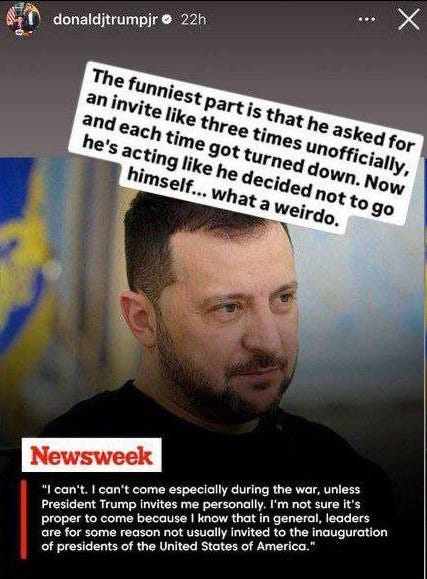
For Berlin, Kiev, London, Paris, and NATO more widely, the writing couldn’t be on the wall any more plainly. Whatever reveries they may have of maintaining the proxy war any longer – Britain recently signed a 100-year-long partnership with Ukraine, under which London will “explore” building military bases on Kiev’s soil – they all ultimately remain imperial vassals, wholly dependent on US financial and military support to exist. Save for a major false flag incident, Trump’s message can only be received among the military alliance.
The Budapest Memorandum: The Fake Narrative Supporting a Long War in Ukraine
By Professor Glenn Diesen | January 21, 2025
Narratives have been constructed to support a long war in Ukraine. For example, the narrative of an “unprovoked invasion” was important to criminalise diplomacy as the premise suggests negotiations would reward Russian military adventurism and embolden further Russian aggression. Meanwhile, NATO escalating the war creates costs that outweigh the benefits to Russia.
Russia’s violation of the Budapest Memorandum is a key narrative that supports a long war. It is constantly referenced as a reason why Russia cannot be trusted to abide by a peace agreement, and why the war must keep going. The argument is that Ukraine gave up its nuclear weapons in return for security guarantees for its territorial integrity. Russia’s breach of this agreement suggests it cannot be trusted and that the only reliable security guarantees must come from NATO membership. Furthermore, the West must continue to send weapons to Ukraine to honour the security guarantees of the Budapest Memorandum.
In February 2022, a few days before the Russian invasion, Zelensky referred to the Budapest Memorandum: “Ukraine has received security guarantees for abandoning the world’s third nuclear capability. We don’t have that weapon. We also have no security.” The Budapest Memorandum was again used by Zelensky in October 2024 to support the argument that Ukraine must either have NATO or nukes: “Either Ukraine will have nuclear weapons, and then it will be a defence for us, or Ukraine will be in NATO”.
This article presents facts and arguments that challenge the false narrative of the Budapest Memorandum, which aims to delegitimise diplomacy. Criticising the narrative of the Budapest Memorandum does not entail “legitimising” Russia’s invasion of Ukraine, which is a common tactic to smear and censor criticism against the narratives supporting a long war.
No Security Guarantees and No Ukrainian Nuclear Weapons
The Budapest Memorandum does not offer any security “guarantees”, rather it provides “assurances”. Former US Ambassador to Ukraine Steven Pifer, who was part of the US negotiation team in 1994, argues the US was explicit that “guarantees” should not be confused with “assurances”. Pifer also confirms this was understood by both the Ukrainians and the Russians:
“American officials decided the assurances would have to be packaged in a document that was not legally-binding. Neither the Bush nor Clinton administrations wanted a legal treaty that would have to be submitted to the Senate for advice and consent to ratification. State Department lawyers thus took careful interest in the actual language, in order to keep the commitments of a political nature. U.S. officials also continually used the term “assurances” instead of “guarantees,” as the latter implied a deeper, even legally-binding commitment of the kind that the United States extended to its NATO allies”.[1]
Ukraine also did not have any nuclear weapons. The nuclear weapons in question were former Soviet nuclear weapons that were stationed in Ukraine, but under the control of Moscow. Kiev did not and could not operate or maintain these weapons, which is usually left out of the narrative. Furthermore, in the Minsk agreement of 1991, Ukraine had already committed itself to the “destruction of nuclear weapons” on its territory.[2]
The Not-So-Sacred Memorandum
In December 1994, the US, UK, and Russia met in the Hungarian capital and offered security commitments in three separate agreements with Ukraine, Belarus, and Kazakhstan. These three countries agreed to relinquish the nuclear weapons that had been left on their territory after the collapse of the Soviet Union, and in return, the US, UK and Russia offered commitments to not undermine their security. The Budapest Memorandum outlined key principles such as “to refrain from economic coercion designed to subordinate to their own interest the exercise by Ukraine of the rights inherent in its sovereignty and thus to secure advantages of any kind”, and to “respect the independence and sovereignty and the existing borders of Ukraine”. In a display of cherry-picking, NATO countries constantly ignore the first commitment but constantly refer to the second commitment.
The US claims its use of economic coercion and violation of Ukrainian sovereignty was in support of democracy and human rights as opposed to advancing its own interests. Thus, the US freed itself from its commitments under the Budapest Memorandum. Under the so-called rules-based international order, the US and its allies claim the prerogative to exempt themselves from international law, norms and agreements under the guise of supporting humanitarian law and liberal democratic norms.[3]
When the US imposed sanctions on Belarus in 2013, Washington explicitly stated that the Budapest Memorandum was not legally binding and that US actions were exempted as the US was allegedly promoting human rights:
“Although the Memorandum is not legally binding, we take these political commitments seriously and do not believe any U.S. sanctions, whether imposed because of human rights or non-proliferation concerns, are inconsistent with our commitments to Belarus under the Memorandum or undermine them. Rather, sanctions are aimed at securing the human rights of Belarusians and combating the proliferation of weapons of mass destruction and other illicit activities, not at gaining any advantage for the United States”.[4]
The Western-backed coup in 2014 had been an even more blatant violation of Ukrainian sovereignty. The West interfered in the domestic affairs of Ukraine, imposed economic sanctions, and finally toppled the Ukrainian president to pull the country into NATO’s orbit. The commitments under the Budapest Memorandum were cast aside as the West claimed to support a “democratic revolution”, despite being an unconstitutional coup that did not even enjoy majority support from the Ukrainians and only a small minority of Ukrainians supported NATO membership.
International law imposes rules and mutual constraints that limit foreign policy flexibility, but in return deliver reciprocity and thus predictability. Once the West freed itself from mutual constraints in the Budapest Memorandum, Russia also abandoned it. US Ambassador Jack Matlock who participated in negotiating an end to the Cold War, questions the validity of the Budapest Memorandum after the coup in 2014. According to Matlock, the principle in international law of rebus sic stantibus means that agreements should be upheld “provided things remain the same”. Matlock argues that Russia “strictly observed its obligations in the Budapest Memorandum for 13 years” even as NATO expanded towards its borders, although the coup of 2014 created “a radically different international situation”. Matlock thus concludes that Russia was “entitled to ignore the earlier agreement”.[5]
Learning the right lessons
An honest assessment of why the Budapest Memorandum collapsed is important to assess how new agreements can be improved. NATO’s demand for hegemony in Europe and rejection of a common European security architecture inevitably led to the collapse of common agreements as the West would no longer accept the principle of mutual constraints and obligations. Liberal hegemony entailed that the West could exempt itself from international law and agreements, while Russia would still abide by them. The narrative of Ukrainian nuclear weapons, security guarantees, and ignoring the US and UK violation of the Budapest Memorandum serves the purpose of sowing distrust in any future security agreements with Russia. A mutually beneficial peace is possible if we first return to the truth.
[1] S. Pifer, 2011. The Trilater Proce The United States, Ukraine, Russia and Nuclear Weapons, Foreign Policy at Brookings, Arms Control Series, Paper 6, May 2011, p.17. https://www.brookings.edu/wp-content/uploads/2016/06/05_trilateral_process_pifer.pdf
[2] Agreement on Strategic Forces Concluded between the 11 members of the Commonwealth of Independent States on December 30, 1991. https://www.bits.de/NRANEU/START/documents/strategicforces91.htm
[3] G. Diesen, ‘The Case for Dismantling the Rules-Based International Order, Substack, 23 December 2024.
[4] US Embassy in Belarus, ‘Belarus: Budapest Memorandum’, U.S. Embassy in Minsk, 12 April 2013.
[5] J. Matlock, ‘Ambassador Jack Matlock on Ukraine, Russia, and the West’s Mistakes’, Nuova Rivista Storica
UK police summon Jeremy Corbyn after pro-Palestine rally
MEMO | January 20, 2025
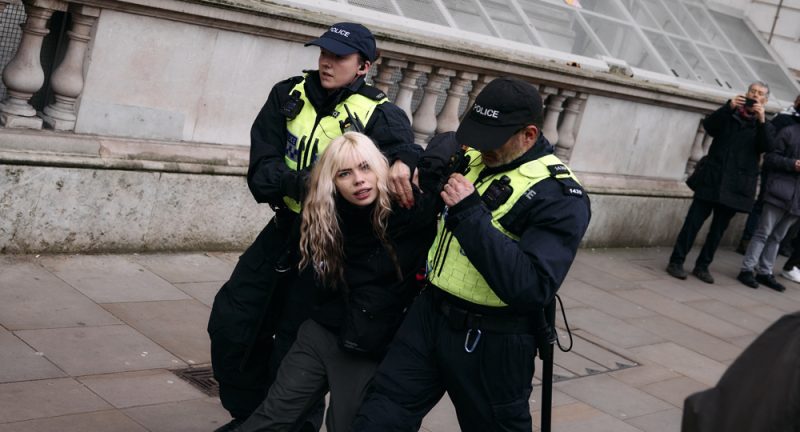
The Metropolitan Police have summoned former UK Labour Party leader Jeremy Corbyn and ex-shadow chancellor John McDonnell for an “interview” following a pro-Palestinian rally in central London on Saturday, Anadolu reported.
The Metropolitan Police is investigating what it described as a “coordinated effort by the rally’s organisers to breach conditions imposed on the event.”
Corbyn, 75, and McDonnell, 73, who agreed to the interviews, voluntarily appeared at a police station in the capital yesterday afternoon.
After leaving the police station, the two MPs did not answer reporters’ questions.
Police also summoned three unnamed persons to give voluntary testimony as part of an “ongoing investigation”.
The rally, organised by the Palestine Solidarity Campaign (PSC) and its coalition partners, saw thousands gather in Whitehall after police blocked plans for a march from Portland Place, near the headquarters of the BBC.
Officers had imposed conditions under the Public Order Act restricting the protest to Whitehall, citing concerns over a potential “serious disruption” near a synagogue.
Police said a group of protesters broke through a police line to reach Trafalgar Square, where officers stopped them.
The Metropolitan Police posted a photo on social media showing a group that it said have forced its way through the police line being held at the northwest corner of Trafalgar Square.
Corbyn, however, disputed the account.
“This is not an accurate description of events at all,” he said in a post on X.
He said he was part of a delegation of speakers intending to lay flowers in memory of children killed in Gaza, which was “facilitated by the police”.
McDonnell echoed his comments.
“We did not force our way through. The police allowed us to go through, and when we stopped in Trafalgar Square, we laid our flowers down and dispersed.”
Nine people, including Corbyn’s brother Piers Corbyn, and Chris Nineham, a chief steward on the march, have been charged with public order offences and will appear at Westminster Magistrates’ Court in the coming days.
The Met Police also confirmed that 24 people have been released on bail, while 48 remain in custody. Three other men aged 75, 73 and 61 have agreed to be interviewed under criminal caution.
The protest coincided with the announcement of a ceasefire and prisoner swap deal between Israel and Hamas.
Corbyn, who now sits as an independent member of parliament for Islington North, has been a vocal supporter of Palestinian rights.
McDonnell, the MP for Hayes and Harlington, also sits as an independent after Labour suspended the whip from him for six months in July 2024 over his vote against the government on child benefit rules.
The demonstration in London drew tens of thousands of supporters of Palestine, despite the police-imposed restrictions and banning of a previously agreed-upon route.
During the protest, 77 people were arrested.
Met Commander Adam Slonecki said security forces have been deployed for more than 20 national protests organised by the PSC since October 2023.
He highlighted that the number of arrests at yesterday’s rally marked the “highest number” recorded at such demonstrations during this period.
Featured Video
Russia treating latest drone attack on the Putin residence as more sinister than just another terrorist attack
or go to
Aletho News Archives – Video-Images
Free Book
Blood Passover, English Version
The Bloody Satanic Sacrifice Rituals of the Jewish Race
Ariel Toaff | 2016
 The following translation was performed free of charge to protest an injustice: the destruction by the ADL of Ariel Toaff’s Blood Passover on Jewish ritual murder. The author is the son of the Chief Rabbi of Rome, and a professor of Jewish Renaissance and Medieval History at Bar-Ilan University in Israel, just outside Tel Aviv.
Dr. Toaff is uniquely qualified to write this book, being thoroughly familiar with the derivative literature in English, French, German and Italian, as well as the original documentary sources in Latin, Medieval Italian, Hebrew and Yiddish. This is not something he worked on in secret. On the contrary, he worked on it openly with his university students and colleagues in Israel for several years; one of his students was even going to publish a paper on the subject. The author is extremely careful about what he says, and his conclusions must be taken seriously. It reads like a detective story.
If it had been published in Israel, in Hebrew, no one would have cared. There are large bodies of literature in Hebrew that Jews do not wish Gentiles to know about. But Dr. Toaff’s announcement of its publication in Italy, in Italian, raised a worldwide firestorm of fury.
Under unbearable pressure, the book was withdrawn from publication. Come in out of the darkness, and strike a blow for the light.
Blog Roll
Recent Comments
Bill Francis on Did Netanyahu just ask Trump f… Rod on How Intelligence, Politics, an… papasha408 on Trump Says Hamas Will Be Given… papasha408 on Is Israel About to Return to G… Bill Francis on NSW Premier Admits New “Securi… Richard Ong on Israeli forces arrest writer a… Bill Francis on How reporting facts can now la… loongtip on Europe’s Panic Economy: Frozen… Gemma on Israel’s diamond industr… Bill Francis on Victoria Moves to Force Online… papasha408 on The Empire of Lies: How the BB… loongtip on US Weighs Port Restrictions on…


 Aletho News
- Nicolai Petro: Chaos After Ukraine Collapses
- An Israeli role in the Trump-Epstein files controversy?
- Blood Passover, English Version (Free Book)
- Polish Deputy Minister Urges EU Investigation Into TikTok Over Videos Promoting “Polexit”
- Decrypted Data From UAV Shot Down in Novgorod Region Handed Over to US Side
- Russia treating latest drone attack on the Putin residence as more sinister than just another terrorist attack
- Two dozen killed in Ukrainian strike on Russian New Year’s celebration – governor
- Did Netanyahu just ask Trump for another war — and get it?
- As Israel bans aid orgs in Gaza, notorious mercenary firm seeks “Targeter”
- The Bari Weiss Playbook: How a Zionist Operative Conquered American Media
- If Americans Knew
- Counting the cost of another year of genocide in Gaza – Not a ceasefire Day 83
- Tikvah Fund Secures $10.4M Grant From Trump, Pushes for Censorship to Advance Zionism
- Did Netanyahu just ask Trump for another war — and get it?
- Israel suspends operations of multiple humanitarian organizations in Gaza, including Doctors Without Borders
- Cold kills another Palestinian baby in Gaza as Israel continues to block shelter aid
- AIPAC Is Retreating From Endorsements and Election Spending. It Won’t Give Up Its Influence.
- Gaza health officials report outbreaks of water-borne illnesses, flu – Not a ceasefire Day 82
- TCN Warns – “ISRAEL FIRST: U.S. May Attack Iran Again”
- Hamas calls on Israel to allow impartial investigation into 7 October attacks
- Indiegogo Withholds $51K In Donations From MintPress in Financial Censorship Crackdown
- No Tricks Zone
- New Study: Human CO2 Emissions Responsible For 1.57% Of Global Temperature Change Since 1750
- Welcome To 2026: Europe Laying Groundwork For Climate Science Censorship!
- New Study Finds A Higher Rate Of Global Warming From 1899-1940 Than From 1983-2024
- Meteorologist Dr. Ryan Maue Warns “Germany Won’t Make It” If Winter Turns Severe
- Merry Christmas Everybody!
- Two More New Studies Show The Southern Ocean And Antarctica Were Warmer In The 1970s
- Der Spiegel Caught Making Up Reports About Conservative America (Again)
- New Study: 8000 Years Ago Relative Sea Level Was 30 Meters Higher Than Today Across East Antarctica
- The Wind Energy Paradox: “Why More Wind Turbines Don’t Always Mean More Power”
- New Study Reopens Questions About Our Ability To Meaningfully Assess Global Mean Temperature
 Aletho News