UK knew about Israel’s brutal torture of Palestinian detainees 50 years ago, but refused to act, British documents reveal
The UK knew about Israel’s brutal torture of Palestinian and Arab detainees nearly 50 years ago but refused to act, British documents reveal. The papers, unearthed by MEMO in the British National Archives, also reveal that the US opted to address the issue solely through non-governmental organisations.
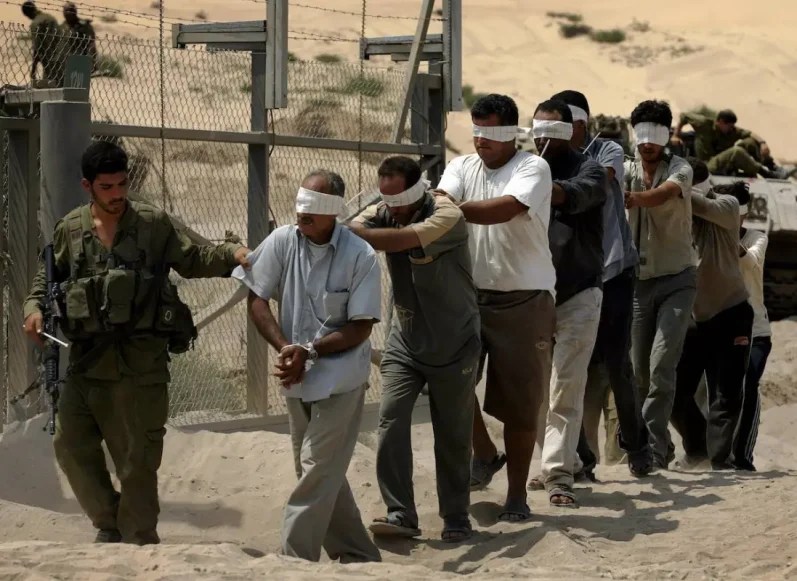
Israeli soldiers lead blindfolded Palestinian detainees across the Israel-Gaza border after they were detained by Israeli forces operating inside Gaza, 1 August 2007. [DAVID FURST / AFP/ Getty Images]
By Amer Sultan | MEMO |January 20, 2025
YouTube Removes Barrister’s Legal Submission at Official UK Covid Inquiry Amid Censorship of Vaccine Injury Discussions
By Cindy Harper | Reclaim The Net | January 15, 2025
YouTube’s decision to remove a barrister’s legal submission from the UK Covid Inquiry has intensified concerns over widespread censorship of vaccine-related discussions on major social media platforms.
Anna Morris KC, who represents families claiming injury from Covid-19 vaccines, disclosed that YouTube deleted a video of her preliminary remarks to the inquiry in September 2023, citing violations of its medical “misinformation” policy. Although the platform later reinstated the video, it failed to provide a clear explanation, admitting only that “it sometimes makes mistakes.”
This act of censorship has been condemned as part of a larger pattern of silencing voices critical of vaccine safety and government health policies. As reported by The Telegraph, during the inquiry’s Module 4 session — focused on vaccines and pharmaceutical measures — Morris directly addressed this issue, stating, “The inquiry must understand the stigma and censorship for the vaccine injured and bereaved.”
She revealed that a poll of affected families found that 74% had been censored when discussing vaccine injuries on social media platforms.
Morris further criticized the suppression of information, noting that doctors were instructed to withhold concerns from both the public and their own patients. Her removed statement emphasized that “the treatment of the vaccine injured in this country has historically been a source of shame.”
Morris argued that those harmed by vaccines have been systematically “dismissed, ignored, censored,” and subjected to hostility when seeking acknowledgment and support.
She condemned the ongoing silencing of vaccine-injured individuals as a severe barrier to accountability and transparency, adding, “Unfortunately, this censorship has continued years after the pandemic and into our engagement with this inquiry.”
Despite repeated requests for a review, YouTube justified the video’s removal by citing its medical “misinformation” policies, a rationale that critics argue is increasingly being used to suppress legitimate concerns and experiences. This censorship has fueled calls for a reevaluation of how social media platforms regulate content related to public health, especially when it involves dissenting voices.
An emotional impact video shown during the inquiry highlighted the tragic story of pharmacist John Cross, who took his own life after suffering paralyzing complications from a Covid vaccine and being denied compensation. His story underscores the devastating consequences of dismissing those seeking recognition and support.
New US Nuke Deployment in Europe Raises Serious Questions About NATO’s True Nature
By Ilya Tsukanov – Sputnik – 18.01.2025
The United States has begun the forward deployment of a new generation of its B61 nuclear gravity bomb at bases in Europe, a senior administrator has announced. What signal does the deployment send to Moscow? What impact will it have on strategic security in Europe? Sputnik turned to a senior former Pentagon insider for answers.
“The new B61-12 gravity bombs are fully forward deployed, and we have increased NATO’s visibility to our nuclear capabilities through visits to our enterprise and other regular engagements,” US National Nuclear Security Administration chief Jill Hruby revealed in a talk at the Hudson Institute this week.
“Our strategic partnership with the UK is very strong, as is their commitment to their nuclear deterrent. And we have advanced our thinking together about critical supply chain resilience. NATO is strong,” Hruby added, hinting at the prospects for ‘enhanced’ nuclear cooperation.
Reports have been swirling in recent years about US plans to redeploy tactical nuclear weapons in the UK at the RAF base at Lakenheath, although no official announcements have been made to date.
The B61-12, also known as the B61 Mod 12, is the latest upgrade to the US variable yield nuclear gravity bomb design first rolled out in the late 1960s. The Mod 12 is set to replace the older Mod 3, 4 and 7 variants of the weapon, and features a 0.3-50 kt yield.
Testing of the B61-12 was completed in 2020, with production starting in late 2021, and the Bulletin of the Atomic Scientists expecting 400-500 of the weapons to be produced, in part for deployments abroad.
Older variants of the munition are currently deployed in Belgium, Germany, Italy, the Netherlands, and Turkiye’s Incerlick Air Base. NATO has approved the weapons to be used in battle by select alliance members as part of the bloc’s “nuclear sharing” arrangements.
The announcement of the bombs’ deployment in Europe is meant to “signal to Moscow that NATO and particularly the UK… are prepared for any ‘attack’ on any NATO country,” says ex-DoD analyst Michael Maloof.
What it really signals is just how much of a US protectorate Western European countries and the UK have allowed themselves to become, Maloof, a former senior security policy analyst with the Office of the US Secretary of Defense, said.
“When I used to live there on a military base, we used to joke how the UK was nothing but a floating aircraft carrier because of all the US bases on the RAF facilities there,” the observer, who grew up in southern England during the Cold War, recalled.
The nukes’ deployment once again “underscores how NATO has evolved not into a defensive alliance, but an offensive alliance,” with the bases where the bombs are stored obvious targets for Russia in the event of a deadly escalation, Maloof said.
Can Trump Fix a Broken Alliance?
Maloof hopes that under Trump 2.0, “a total reevaluation of the deployment of US bases throughout NATO” will take place, especially in Germany but possibly also the UK.
NATO’s continued existence, the alliance’s “Cold War 2.0” against Russia and the bloc’s eastward expansion have been a disaster for European security, the observer said.
“I think it’s the beginning of the end of NATO as we know it. This perennial cycle has just got to cease. And given how we don’t even have a defense against hypersonics… it really shows that we’re reaching a very dangerous pinnacle here of escalation.”
The nuke deployment, the termination of the INF Treaty during Trump’s first term and other factors have “made Europe an all the more dangerous place to be,” Maloof emphasized, with reaction time in case of a nuclear escalation being “virtually nil.”
“I think that this posturing that we continually see to ‘show deterrence’ is actually making the West even more vulnerable to attack because it is an agitating factor,” the observer added.
Kremlin reacts to UK plans for military build-up in Ukraine
RT | January 17, 2025
The possible appearance of NATO-linked military infrastructure in Ukraine is a concern for Russia, Kremlin spokesman Dmitry Peskov said on Friday, commenting on a new security deal between London and Kiev.
The 100-year bilateral agreement, signed by Ukrainian leader Vladimir Zelensky and British Prime Minister Keir Starmer on Thursday, states that the two nations will “explore options for deploying and maintaining defense infrastructure in Ukraine, including military bases, logistics depots, reserve military equipment storage facilities and war reserve stockpiles.”
While the establishment of such facilities would in itself not amount to Ukraine joining NATO, a scenario that Moscow strongly opposes, the British plans are “certainly worrisome”, Peskov told a media briefing.
He also relayed the Russian government’s negative attitude toward British statements that its defense cooperation with Ukraine would include enhanced “collaboration on maritime security” near Russian borders, including in the Azov Sea. Peskov emphasized that the Azov Sea is a Russian inner body of water, so that “interactions between Ukraine and Britain can hardly happen there.”
Moscow views NATO as a hostile entity and has accused its members of waging a proxy war against Russia, using Ukrainian soldiers as ‘cannon fodder’.
The UK has been one of the most vocal supporters of Kiev’s war effort. In the 100-year agreement, it has committed to no less than £3 billion ($3.66 billion) in annual military assistance to Ukraine until financial year 2030/31.
NATO’s eastward expansion since the 1990s – conducted in violation of assurances given to Moscow to secure its acceptance of Germany’s reunification – is one of the primary causes of the current hostilities, according to Russian officials.
UK promises to ‘explore options’ for military bases in Ukraine
RT | January 17, 2025
London has revealed details of a long-term partnership agreement with Kiev, which includes broad plans for military infrastructure development and defense cooperation over the next century. The document suggests the potential establishment of military bases in Ukraine, with an emphasis on aligning these initiatives with NATO standards for maximum effectiveness.
The 15-page declaration, signed on January 16, 2025, lays out a framework for cooperation between the United Kingdom and Ukraine across various sectors, with a primary focus on military collaboration. British Prime Minister Keir Starmer and Ukrainian leader Vladimir Zelensky formalized the deal during a ceremony in Kiev on Thursday.
“The Participants will explore options for deploying and maintaining defence infrastructure in Ukraine, including military bases, logistics depots, reserve military equipment storage facilities and war reserve stockpiles,” the document states.
The agreement also emphasizes maritime cooperation, particularly in the Black Sea region. The UK has pledged to enhance Ukraine’s interoperability with NATO in the maritime sphere through joint naval operations, port visits, and the development of Ukrainian naval bases.
“We will work together to ensure NATO learns the lessons from Ukraine’s experience in the Black Sea to inform its development of future maritime capabilities. We will promote the development of naval bases on the territory of Ukraine,” the document reads.
Another section highlights plans to “deepen cooperation on long-range strike capabilities,” integrated air and missile defense, and the stockpiling of complex weapons to bolster “deterrence.”
Additionally, London has committed to providing Ukraine with annual military assistance of no less than £3 billion until at least 2031, and “for as long as needed to support Ukraine.”
While the agreement lacks detailed, binding commitments beyond promises to expand, intensify, and facilitate collaboration across multiple sectors, Zelensky hinted at potential “secret” components within the pact.
The UK has been one of Ukraine’s prime backers since the escalation of conflict between Moscow and Kiev in February 2022. It has committed 12.8 billion pounds ($16 billion) in military and civilian aid to Ukraine and reportedly trained 50,000 Ukrainian troops on British soil.
Russia has sharply criticized London’s continued support of Kiev as a sign that the UK government “clearly does not seek to resolve the conflict.” Russian Foreign Ministry spokeswoman Maria Zakharova previously said “they are doing everything possible to make it drag on, thus prolonging the suffering of the Ukrainian people.”
Meanwhile, reports suggest that US President-elect Donald Trump, set to take office next Monday, may propose deploying Western troops as peacekeepers along a demilitarized zone between Russia and Ukraine. The rumored plan reportedly excludes US forces, relying instead on “European” soldiers acting outside NATO’s command structure.
London remains cautious about the idea of sending British troops to Ukraine as part of any peacekeeping force, even though Starmer is said to have discussed the matter with French President Emmanuel Macron, according to The Telegraph.
New Book – LONG LIVE NOVICHOK!
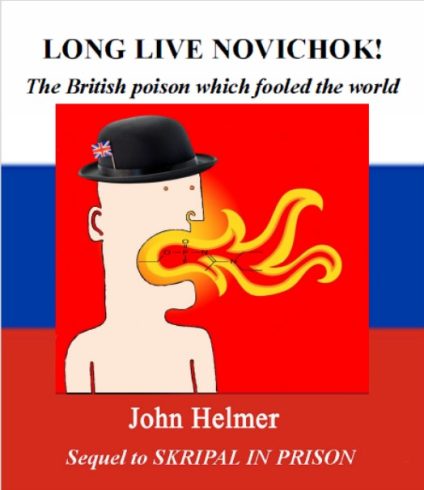
By John Helmer • Unz Review • January 14, 2025
Novichok is the notorious warfighting poison which has killed no one but fooled everyone.
At least that’s how British Government officials, their scientists, chemical warfighters, policemen, media reporters, and trailing after them all, their judges, intend the story to be told.
Theirs is the story of the assassination, ordered by President Vladimir Putin in Moscow and attempted on March 4, 2018, by two military officers tracked and filmed to every location but not the murder scene; with a weapon not detected at the scene nor in the blood streams and bodily tissues of their murder targets.
The victims, Sergei Skripal and Yulia Skripal, have been made to disappear and are either incommunicado in prison or dead. The only direct testimony which has been recorded voluntarily in front of witnesses was given by Yulia Skripal, in hospital four days after the attack, when she identified the assassination attempt as having been carried out with poison spray by an attacker who was not Russian, just minutes before she and her father collapsed. She meant the poison was British; the assassin British.
The motive for the Novichok crime turns out to be hearsay by British government against the Russian government.
In political and military terms, the Novichok poison story is propaganda between enemies at war. Judgement of what happened to the Skripals is a weapon of this war. And so it has turned out that there has been no court trial or test of the Novichok narrative, according to British law. Instead, there has been a proceeding which looked like a court trial but wasn’t; in which the Skripals were represented by police interrogators and by lawyers who said nothing; presided over by a judge who wasn’t.
In other words, a show trial in a time of war.


The truth of what happened has no military or political value, certainly not to the prosecuting British side; not much to the defending Russian side. But as the evidence has surfaced piecemeal over the past five years since the first investigation was published in February 2020 as Skripal in Prison, the truth reveals that Novichok was ineffective as a poison, but very successful as a deception operation by the British. They reversed the hands of the assassin, planted a British-made chemical weapon to look like a Russian one; invented the death of bystander Dawn Sturgess to substitute for Sergei and Yulia Skripal who didn’t die; and suppressed the evidence of what had happened – witnesses, videotapes, toxicology, autopsy records.
Not quite all the evidence, however. This book has been written to reveal new evidence to conclude that Sergei Skripal was a triple agent attempting to return to Russia. His rescue, the exfiltration operation by the Russian military intelligence organisation (GRU), used decoys to mislead the British surveillance and conceal the escape plan. But the British anticipated and decided to act preemptively, attacking both Skripals, reversing culpability, and convicting the Russians for the British crime.
Not one of the legal, medical, police, or government officials engaged in the Novichok story — neither the Skripal nor the Sturgess parts of the narrative — answered the many questions put to them during the seven-year course of the case and of this book. The three lawyers purportedly engaged to represent Sergei and Yulia Skripal were the most silentious of all; their names don’t warrant repeating. Not much better were the lawyers representing Dawn Sturgess’s family’s money claim, especially their lead counsel Michael Mansfield.

This blanket of misrepresentation, evasion, and silence which they have thrown over themselves and over the evidence in the case is proof of the intention to deceive. So determined is this intention, the deceivers don’t realize how preposterous are the results. The colour of Novichok, for example, reported as a state secret in Chapter 74.
A direct request to researchers publishing on A-234 around the world has revealed that the Iranians who reported synthesizing the chemical agent in 2016, reply that it is colourless. The British, Americans, Czechs, and Koreans who have done the same laboratory work, refuse to answer. And yet, despite all the preliminary vetting by British intelligence agents, years of double-checking by British officials, and months of closed-door sessions and redactions ordered by Lord Hughes, chairman of the Dawn Sturgess Inquiry, the truth managed to slip out. A man named Josep Vivas, a Spaniard living in Barcelona, was the unintended, unguarded source.
Vivas was a vice president of Puig, the company which manufactures and sells the bottled perfume which in the British Novichok story has been turned into the Russian murder weapon. “I am making this statement,” Vivas signed for the Dawn Sturgess Inquiry on February 12, 2024, “in addition to a letter I provided on 27 July 2018. Prior to me writing and signing that letter, I was shown a number of images of a small perfume bottle branded ‘Nina Ricci Premier Jour Perfume’. The images I viewed were under police exhibit reference [redaction tagged VN551/10]. I was shown further images of a perfume box labelled as ‘Premier Jour Nina Ricci’. This was under police exhibit reference [redaction tagged VN521/3]. On Friday 2nd February 2024, I was again shown the images of [redaction tagged VN551/10] and [redaction tagged VN521/3] before signing this statement and I set out my observations on them below.”
The photographs of the poison bottle shown in the public hearing on November 28, 2024, were censored — a large black mark was pasted across the bottle contents. But British agents had shown Vivas the photographs just days after July 11, 2018, when the bottle was purportedly discovered at the Sturgess crime scene. Vivas was shown the photographs again more than five years later, just before he testified before Hughes. He saw the bottle without the black mark.

Censored police photograph of Novichok poison weapon, a perfume atomizer bottle, allegedly found on a kitchen bench at Rowley-Sturgess home eleven days after Sturgess and Rowley were hospitalized. The black mark conceals the British Government’s lie.
The key observation Vivas confirmed he had seen on both occasions was this: “The liquid inside the bottle. Premier Jour perfume is pale pink, and from the photos I observe that the liquid contained in the bottle is yellow.”
If the perfume is pink; if Novichok is colourless; if the liquid in the murder weapon was yellow, then the liquid in the murder weapon cannot have been Novichok. QED — Quod erat demonstrandum, as the ancient lawyers and logicians used to conclude their proofs. The colour yellow was a British fabrication; the black mark was British camouflage. The secret slipped out into the open by British mistake.
From whom are the British keeping their secret? Can it be the Russians who, according to the official Novichok narrative, have made, stored, and used it against the Skripals, but have yet to learn what colour it is?
The Russian handling of the Skripal affair is a different story. It has been defensive on the evidence claimed by the British government; ineffective in breaking the silence imposed on the Skripals.
These outcomes were inevitable once it is concluded, in retrospect, that Sergei Skripal was attacked to prevent his return to Moscow as a triple agent; and that the Russian military operation to rescue him had been thwarted by the British.
These two truths, if published officially, leaked to the press, or reported in independent investigations, stood little chance of being believed outside Russia. More certainly, official Russian admission of the two truths, if it had been made, would have condemned the Skripals to the death that was attempted by the British against them on March 4, 2018.
Less explicable is the outcome that for seven years now, Russian press reporting of the case has ignored the investigative reporting published in English in the UK and US, and then the evidence revealed during the Hughes hearings in London between October and December 2024. This is an understandable result of the line dictated by the Kremlin’s and Foreign Ministry’s media departments for protecting the lives of Sergei and Yulia Skripal, and for salvaging what remained of Anglo-Russian relations on the road to war in the Ukraine.
In the chapters to follow, President Putin’s and Foreign Minister Lavrov’s statements can be examined in the political context and news sequence in which they were made.
From the beginning, the Russian Embassy in London issued formal requests for consular access to the Skripals and protest notes when this was denied by the Foreign Office. In reply to British stonewalling on access and propagandizing the allegations against the Russian government, the Embassy issued a detailed summary of every action Russian officials had taken and the statements they made.
The one option the Embassy in London did not take was to engage British lawyers to obtain a hearing and an order of habeas corpus in the High Court to compel the appearance of the Skripals to testify for themselves. This option was obvious to the Embassy and lawyers in London between March 21, 2018, when the Home Office went to the court for legal authority to allow blood testing of the Skripals, and April 9, when Salisbury District Hospital announced that Yulia Skripal had been released; and then on May 18 when Sergei Skripal was also discharged from hospital.
During this period it was reported that Yulia was able to telephone her cousin Viktoria in Russia. Years later, as Chapters 67, 71, and 73 reveal, it became clear in retrospect that Yulia had recovered consciousness in hospital much earlier than the hospital allowed to be known, and that doctors had then forcibly sedated her. At the time the Russian Embassy was announcing it “questioned the authenticity” of the statements issued by the London police and media on Yulia’s behalf. The Embassy was right; it was not believed.
It is possible the Embassy did attempt to engage barristers to go to court for a habeas corpus hearing for the Skripals, but learned that no one would take the case. At the time I made an independent request for this engagement to the well-known human rights barristers in London; the outcome was that none agreed to represent the Skripals. The refusals were point-blank – no one would give a reason.
British officials anticipated that an effort might succeed in forcing a High Court hearing, however. So, on May 24, 2018, a one minute fifty-five second speech by Yulia Skripal was presented on video in which she spoke from a script and appeared to sign a statement. Referring to “offers of assistance from the Russian Embassy,” she claimed “at the moment I do not wish to avail myself of their services.” Skripal’s Russian text spoke of “help” from the Russian Embassy: “now I don’t want and [I am] not ready to use it.”
“Obviously, Yulia was reading a pre-written text,” the Russian Embassy responded publicly. “[This] was a translation from English and had been initially written by a native English-speaker… With all respect for Yulia’s privacy and security, this video does not discharge the UK authorities from their obligations under Consular Conventions.”

Excerpted frames from Yulia Skripal’s brief videotaped appearance at a US nuclear bomber base in England on May 2018; watch the tape in full here.
By subtle signals, Skripal indicated she was being made to speak and to sign under duress. Two script pages were visible on a side table during the filming; the one on top Skripal was filmed signing. The two papers were in a different handwriting from Skripal’s signature and in a different pen from the pen she is seen to use. On the top page, apparently the Russian language text, Skripal added words after her signature; these are her first and family names in Russian, but without her patronymic, as Russians usually record their names in official documents. The handwriting of that name and the handwriting of the Russian statement are not the same. Nor the pen and ink used. Ten weeks earlier, on March 8, 2018, Yulia had woken from a coma in hospital and signaled to the doctor at her bedside that she had been attacked by the British, not by the Russians. Read this evidence for the first time in the new book.
At first, Putin he seemed unprepared on the facts of the case – the Russian facts – and unprepared for the British government’s propaganda blitz.
The president cannot have been unprepared. On March 15, 2018, the Kremlin revealed that at a Security Council meeting on that day Putin was briefed by the Foreign and Defense Ministers and the intelligence chiefs. “While talking about international affairs,” the official communiqué said, “the Council members held an in-depth discussion on Russia-UK relations against the backdrop of Sergei Skripal’s case. They expressed grave concern over the destructive and provocative position of the British side.”
The line which Putin and his advisers decided at that meeting they planned to follow in public was revealed by Putin three days later at a press conference. He tried to feign ignorance himself, and then dissimulated on the weapon, the motive, and the opportunity. “Regarding the tragedy you have mentioned,” Putin told reporters, “I learned about it from the media. The first thing that comes to mind is that, had it been a warfare agent, the victims would have died immediately. It is an obvious fact which must be taken into account. This is first.”
“The second is that Russia does not have such chemical agents. We destroyed all our chemical weapons, and international observers monitored the destruction process. Moreover, we were the first to do this, unlike some of our partners who promised to destroy their chemical weapons but have not done so to this day, regrettably. Therefore, we are ready for cooperation, as we said immediately. We are ready to take part in any investigations necessary, provided the other side wants this too. We do not see their interest so far, but we have not removed the possibility of cooperation on this matter from the agenda.”
“As for the overall situation, I believe that any reasonable person can see that this is total nonsense. It is unthinkable that anyone on Russia would do such a thing ahead of the presidential election and the FIFA World Cup. Absolutely unthinkable. However, we are ready for cooperation despite the above things. We are ready to discuss any issues and to deal with any problems.”
On April 4, 2018, he said: “We do not expect anything other than for common sense to ultimately prevail and for international relations not to be damaged the way we have seen recently. This goes not only for this case, the attempt on Skripal’s life. This has to do with other aspects of international relations as well. We should stay within the framework of healthy political processes based on fundamental norms of international law, and then the situation in the world will become more stable and predictable.”
On May 18, at a news conference following a meeting with then-Chancellor of Germany, Angela Merkel, Putin said: “Now regarding Mr Skripal. Yes, I also heard from the media today that he has been released from hospital. We wish him the best of health, we are really very happy. I have several considerations in this respect. First. I think if a combat-grade nerve agent had been used, as claimed by our British colleagues, the man would have died on the spot. A nerve agent is so powerful that a person dies instantly or within several seconds or minutes. Fortunately, he is alive, he got well, was released from hospital and I hope he will live a healthy and safe life.”
“As to the investigation, on our part we offered every assistance in the investigation to our British partners on a number of occasions, and asked for access to this investigation. There has been no response so far. Our proposals remain in place.”
Putin was accusing the British government of a cover-up, but softly, by innuendo. “The most objective explanation to what happened”, he said on May 25, “can be only provided as a result of a thorough, unbiased and joint – the latter is very important – investigation. We proposed working on it together from the very beginning, but as you know, the British side rejected our offer and investigated the incident alone. It is also a fact, as this was announced at the very beginning, that the victims were poisoned – if it was a poisoning – with a chemical warfare agent. I have spoken about this before, but I will say again that although I am not an expert on chemical warfare agents, I can imagine that the use of such agents should result in the almost instantaneous death of the victims. Thank God, nothing like this happened in the case of the Skripals, and that Skripal himself and his daughter are alive, have been discharged from hospital and, as we have seen on television, his daughter looks quite well. Thank God, they are alive and healthy.”
“Therefore, I believe it would be wrong to say that it was a chemical warfare agent. If so, everything the British side has said can be called into question. How can we settle this? We should either conduct a comprehensive and objective joint investigation, or stop talking about it because it will only worsen our relations.”
If Putin was trying to ameliorate these relations with London, he tried, six months later, to appear to be condemning Sergei Skripal, burying both him and the reciprocal espionage the two governments were conducting against each other. Was Putin calculating that if the British had tried but failed to kill both Skripals, he might yet save their lives? Understandably, no Russian could acknowledge this — certainly not then and not now.
In a Moscow forum in October 2018, six months after the Salisbury incidents, Putin responded to questions from a US journalist. “As regards the Skripals and all that, this latest spy scandal is being artificially inflated. I have seen some media outlets and your colleagues push the idea that Skripal is almost a human rights activist. But he is just a spy, a traitor to the motherland. There is such a term, a ‘traitor to the motherland,’ and that’s what he is. Imagine you are a citizen of a country, and suddenly somebody comes along who betrays your country. How would you, or anybody present here, a representative of any country, feel about such a person? He is scum, that’s all. But a whole information campaign has been deployed around it.”
“I think it will come to an end, I hope it will, and the sooner the better. We have repeatedly told our colleagues to show us the documents. We will see what can be done and conduct an investigation. We probably have an agreement with the UK on assistance in criminal cases that outlines the procedure. Well, submit the documents to the Prosecutor General’s Office as required. We will see what actually happened there. The fuss between security services did not start yesterday. As you know, espionage, just like prostitution, is one of the most ‘important’ jobs in the world. So what? Nobody shut it down and nobody can shut it down yet.”
“[Question] Ryan Chilcote: Espionage aside, I think there are two other issues. One is the use of chemical weapons, and let’s not forget that in addition to the Skripal family being affected in that attack, there was also a homeless person [Dawn Sturgess] who was killed when they came in contact with the nerve agent Novichok.”
“[Answer] Vladimir Putin: Listen, since we are talking about poisoning Skripal, are you saying that we also poisoned a homeless person there? Sometimes I look at what is happening around this case and it amazes me. Some guys came to England and started poisoning homeless people. Such nonsense. What is this all about? Are they working for cleaning services? Nobody wanted to poison… This Skripal is a traitor, as I said. He was caught and punished. He spent a total of five years in prison. We released him. That’s it. He left. He continued to cooperate with and consult some security services. So what? What are we talking about right now? Oil, gas or espionage? What is your question? Let’s move on to the other oldest profession and discuss the latest developments in that business. (Laughter.)”
The British Prime Minister Theresa May and her ambitious rival, Foreign Secretary Boris Johnson, ignored Putin’s request to put the Skripal affair aside. Instead, they escalated, publishing photographs of police and intelligence agency surveillance of the Russian military officers who were then charged with the attempted Novichok murder. Putin was put on the defensive again.

The British inventors of Novichok – left to right — Alexander Younger, head of MI6, and Mark Sedwill, National Security Advisor and Cabinet Secretary, created the Novichok plot to prevent Sergei Skripal returning to Moscow and to persuade Prime Minister Theresa May, then her successor Boris Johnson, to escalate their war against Russia.
On September 12, 2018 – seven days after the Metropolitan Police and Crown Prosecution Service announced their charges against Alexander Petrov and Ruslan Boshirov – Putin was asked who were they were. “Either they deliberately poked their faces towards the camera in order to be photographed, or they are completely unprofessional to have their images captured by all the cameras. Perhaps you have a third theory?”
“Vladimir Putin: Actually, we have, of course, taken a look at these people. We already know who they are, and we have located them. I hope they will show up and tell everyone about themselves. This would be better for everyone. I assure you that there is nothing special or criminal here. We will see shortly.”
“Sergei Brilyov: Are they civilians?”
“Vladimir Putin: Of course, they are civilians.”
“Sergei Brilyov: All right, we will wait.”
“Vladimir Putin: I would like to address them, so they can hear us today. Let them come to a media outlet and tell everything.”
The results followed swiftly – an interview by Russia Today (RT), the state media agency, with the two accused Russians pretending to have been innocent tourists; then British and US intelligence data leaked through the Bellingcat organization. These propaganda episodes can be followed in Part I of the book. Putin decided not to add fuel to this fire; he ignored questions about the Skripal case for seven months, until June of 2019.
“Do you think that there is a possibility of some improvement in Anglo-Russian relations,” he was asked by the editor of the Financial Times of London on June 27, 2019, “– and that we can move on from some of these issues that are obviously of great sensitivity, like the Skripal affair?”
“As a matter of fact,” Putin answered, “treason is the gravest crime possible and traitors must be punished. I am not saying that the Salisbury incident is the way to do it. Not at all. But traitors must be punished. This gentleman, Skripal, had already been punished. He was arrested, sentenced and then served time in prison. He received his punishment. For that matter, he was off the radar. Why would anybody be interested in him? He got punished. He was detained, arrested, sentenced and then spent five years in prison. Then he was released and that was it. As concerns treason, of course, it must be punishable. It is the most despicable crime that one can imagine.”
The president had promoted Skripal from “scum” who deserved his fate to “gentleman” who had been punished enough. Putin’s purpose was to propose again to the British that they set aside the Novichok narrative and opt instead for improving the bilateral relationship at the government level, and sticking to business as usual; by that Putin meant oligarch business.
“Listen, all this fuss about spies and counter-spies, it is not worth serious interstate relations. This spy story, as we say, it is not worth five kopecks. Or even five pounds, for that matter. And the issues concerning interstate relations, they are measured in billions and the fate of millions of people. How can we compare one with the other? The list of accusations and allegations against one another could go on and on. They say, ‘You poisoned the Skripals.’ Firstly, this must be proved.”
“Secondly, the average person listens and says, ‘Who are these Skripals?’ And it turns out that Skripal was engaged in espionage against us [Russia]. So this person asks the next question, ‘Why did you spy on us using Skripal? Maybe you should not have done that?’ You know, these questions are infinite. We need to just leave it alone and let security agencies deal with it. But we know that businesses in the United Kingdom (by the way, I had a meeting with our British colleagues in this same room), they want to work with us, they are working with us and intend to continue doing so. And we support this intent.”
“I think that Mrs May, despite her resignation, could not help but be concerned that these spy scandals made our relations reach a deadlock so we could not develop our ties normally and support business people, who are doing what? They do not only earn money, this is what is on the outside. They create jobs and added value, plus they provide revenue at all levels of the tax system of their countries. This is a serious and multifaceted job, with the same risks you mentioned, including risks related to business operations. And if we add an unpredictable political situation, they will not be able to work at all. I think that both Russia and the United Kingdom are interested in fully restoring our relations. At least I hope that a few preliminary steps will be made. I think it would be easier for Mrs May, maybe, because she is leaving and is free to do what she thinks is right, important and necessary and not to bother about some domestic political consequences.”
Putin believed that through the Financial Times he was appealing to the business lobbies in London to push back against the war faction in Whitehall. The appeal was in vain.
In parallel, in an elaborately staged dialogue with the US filmmaker Oliver Stone, Putin allowed some of the truth to slip out. “What has happened to Skripal? Where is he?” Stone asked.

President Putin with Oliver Stone at the Kremlin. The interview was recorded on June 19, 2019; it was delayed in release for a month until July 19, 2019.
“Vladimir Putin: I have no idea. He is a spy, after all. He is always in hiding.”
“Oliver Stone: They say he was going to come back to Russia. He had some information.”
“Vladimir Putin: Yes, I have been told that he wants to make a written request to come back.”
“Oliver Stone: He knew still and he wanted to come back. He had information that he could give to the world press here in Russia.”
“Vladimir Putin: I doubt it. He has broken the ranks already. What kind of information can he possess?”
“Oliver Stone: Who poisoned him? They say English secret services did not want Sergei Skripal to come back to Russia?”
“Vladimir Putin: To be honest, I do not quite believe this. I do not believe this is the case.”
“Oliver Stone: Makes sense. You do not agree with me?”
“Vladimir Putin: If they had wanted to poison him, they would have done so.”
“Oliver Stone: Ok, that makes sense. I don’t know. Who did then?”
“Vladimir Putin: After all, this is not a hard thing to do in today’s world. In fact, a fraction of a milligram would have been enough to do the job. And if they had him in their hands, there was nothing complicated about it. No, this does not make sense. Maybe they just wanted to provoke a scandal.”
“Oliver Stone: I think it is more complicated. You know, you think I am much too much of a conspiracy guy.”
“Vladimir Putin: I do not believe this.”
In the Kremlin record of Putin’s references to the Skripal affair, these remarks of mid-2019 were the final word from the president. Putin and Stone were telling the truth of what had happened, and why.
Click here to buy the book in paperback or Kindle edition.
UK special forces had ‘golden pass’ to get away with murder – officer
RT | January 8, 2025
British SAS operatives were given a “golden pass allowing them to get away with murder” in Afghanistan, a former UK Special Forces officer has told a government inquest. Other witnesses described routine executions of unarmed civilians by British forces.
The officer’s statement was given behind closed doors to the UK’s Independent Inquiry Relating to Afghanistan earlier this year, and included in a trove of documents published by the inquiry on Tuesday.
The former officer raised concerns about the killing of unarmed civilians in 2011, claiming that the SAS was covering these crimes up. The officer said that higher-ups within UK Special Forces – which comprises the Special Air Service (SAS), the Special Boat Service (SBS), and four other clandestine branches of the British military – had no interest in investigating the killings, and that SAS operatives had essentially been handed a “golden pass allowing them to get away with murder.”
The Afghanistan Inquiry is probing night raids carried out by British special forces between 2010 and 2013, when the alleged killings took place.
A junior officer told the inquest that “all fighting age males” were killed in these raids, regardless of whether they were armed or not. SAS personnel sometimes carried weapons to drop beside dead bodies after the killings in order to make them appear as combatants.
Prisoners were sometimes executed after they had been restrained, the witness recounted. “In one case, it was mentioned a pillow was put over the head of an individual before being killed with a pistol,” the document noted.
The inquiry is investigating the killings of at least 80 prisoners.
”I suppose what shocked me most wasn’t the execution of potential members of the Taliban, which was of course wrong and illegal, but it was more the age and the methods and, you know, the details of things like pillows,” the officer said, noting that some of the victims were “100%” aged 16 or younger.
The officer said that he was afraid for his own safety after testifying.
”Basically, there appears to be a culture there of ‘shut up, don’t question’,” another officer told the inquiry.
Claims of war crimes committed by British special forces in Afghanistan have surfaced before, with BBC Panorama, the Sunday Times, and other outlets claiming that civilians were routinely killed on night raids. In one case, the American military reportedly had video footage of one massacre, but mysteriously lost the footage when pressed by a British court.
Late last year, the BBC reported that one of the UK’s most senior generals had withheld from the latest inquiry evidence of soldiers executing handcuffed detainees in Afghanistan.
Keir Starmer’s Censorship Playbook
By Christina Maas | Reclaim The Net | January 8, 2025
At a time when public trust already teeters on a knife’s edge, UK Prime Minister Keir Starmer has decided that what we really need is a lecture on “misinformation.” Yes, the same Starmer who spent years navigating political quagmires with the dexterity of a politician reading polling data, and someone accused of lying to the public in the manifesto that got him elected, now fancies himself the arbiter of “truth” and “decency.” And what better way to assert moral authority than by weaponizing one of Britain’s darkest scandals—the rape gang crises—and reframing criticism of government failures as the “poison of the far-Right”?
Criticism: The New Extremism
During his January 6 press conference, Starmer ditched accountability in favor of a moral crusade against critics. He accused them of peddling “lies,” “misinformation,” and—brace yourself—aligning with the “far-right.” “We’ve seen this playbook many times,” Starmer said, oozing conviction.
But the public has seen his playbook too.
If you express concern about how successive governments ignored victims, allowed systemic failures to fester, and dragged their feet on justice, you’re basically a neo-Nazi. Starmer’s rhetorical sleight-of-hand here is stunning—turning widespread outrage into something inherently sinister.
By lumping legitimate grievances in with the ravings of extremists, he effectively tars everyone with the same brush. Victims and their advocates? Extremists. Grassroots activists demanding reforms? Extremists. It’s a brilliant move if your goal is to shut down meaningful conversation while appearing noble.
Blaming Musk: A Modern-Day Scapegoat
But Starmer wasn’t done. Enter the obligatory bogeyman of modern discourse: Elon Musk. When the X owner criticized MP Jess Phillips for refusing to support a public inquiry into the grooming gang scandals, Starmer leaped at the opportunity to accuse him of endangering her safety. Musk, Starmer implied, had crossed some vague and undefinable “dangerous threshold” by calling out a politician’s inaction.
There’s no denying threats against MPs are a serious matter, especially in today’s climate, but let’s not pretend Musk was personally drafting hate mail. Criticism of public officials, even harsh criticism, isn’t equivalent to endorsing violence. Yet, Starmer’s play here is clear: frame dissent as inherently harmful and wrap it in the protective cloak of “safety.” It’s a chillingly effective tactic that sets the stage for conflating free speech with hate speech—a distinction that seems increasingly inconvenient for those in power.
The New Gatekeepers of “Decency”
Starmer’s framing of these issues points to a larger, more insidious trend: the slow, deliberate erosion of public discourse under the guise of safeguarding “truth” and “decency.” Dissenting voices are no longer just misguided or even wrong—they’re now dangerous, toxic, and unworthy of a platform.
What makes this particularly egregious is the context. The grooming gang scandals are a grotesque example of institutional failure. Victims were ignored for years as authorities feared accusations of racism, prioritizing optics over justice.
What Starmer presents as a defense of democracy is, in fact, a calculated effort to consolidate narrative control. If criticism can be dismissed as “far-Right poison,” then any dissenting voice—no matter how valid—can be silenced without debate.
Sliding Toward Silence
Starmer’s approach represents the classic slippery slope of censorship. First, the extremists are silenced (fair enough, many argue). Then, the vaguely problematic voices are muted. Finally, anyone who veers too far from the approved script is deemed an enemy of “truth.”
This isn’t only about online discourse or high-profile figures like Musk. It’s about ordinary people—victims, activists, and concerned citizens—who now risk being labeled as agitators simply for demanding accountability.
The Real Threat: Manufactured Consensus
Starmer’s insistence on equating criticism with extremism creates a vacuum where only the government’s narrative is allowed to thrive. And when the only voices left are the ones singing praises of the status quo, we’re no longer talking about democracy; we’re talking about a PR campaign with parliamentary decorum.
James Cleverly, former Home Secretary, didn’t mince words when he weighed in on the fiasco, summing up what many in Britain are quietly, or not-so-quietly, thinking. “Accusing those who disagree with him, or who seek legitimate answers about repeated failures of child protection, as ‘far-Right’ is deeply insulting and counterproductive,” Cleverly said, in a rare moment of plain speaking from a political figure.
As Cleverly pointed out, branding dissent as extremism doesn’t bridge divisions; it widens them, pouring accelerant on an already polarized public square.
Maggie Oliver, the whistleblower who exposed the Rochdale scandal, spoke for many when she called Starmer’s remarks “insulting in the extreme.” Oliver, who resigned from Greater Manchester Police in protest over their inaction, knows better than most how hard it is to get the system to listen. To see campaigners lumped in with extremists, she argued, “sets a terrifying precedent.”
The “Misinformation” Blueprint: Starmer’s New Censorship Arsenal
If Prime Minister Starmer’s handling of criticism over the UK’s rape gang scandal feels less like leadership and more like a prelude to mass censorship, that’s because it likely is. With the newly minted Online Safety Act and provisions under the National Security Act 2023, Starmer’s buzzword-heavy rhetoric about “misinformation” starts looking less like clumsy damage control and more like the calculated groundwork for a chilling clampdown on dissent.
For years, “misinformation” has been a convenient scapegoat for governments worldwide to suppress inconvenient truths. Now, in the UK, the term threatens to become a legal cudgel, ready to pummel any narrative that strays too far from the government-approved script.
Weaponizing the Online Safety Act
Starmer doesn’t need to introduce sweeping new legislation to suppress dissent—his government already has a powerful set of tools at its disposal. The Online Safety Act, sold to the public as a safeguard against harm, contains provisions that are broad enough to suppress not only malicious lies but also legitimate criticism under the guise of protecting the public. Here’s how it could play out:
1. Section 179: False Communications Offense
This is where Starmer’s “misinformation” rhetoric gets teeth. Section 179 criminalizes knowingly false communications intended to cause “non-trivial psychological or physical harm.” The wording here is as vague as it is dangerous. What qualifies as “non-trivial psychological harm”? If the government decides that criticisms of its handling of the grooming gang scandal cause emotional distress to MPs—or, conveniently, to the public—it could label them as harmful misinformation.
Imagine this: a social media user accuses Starmer’s government of ignoring systemic abuse in grooming gang cases. Even if the criticism is grounded in fact, the government could argue that the way it’s framed constitutes psychological harm. Once flagged, tech platforms—obligated under the Online Safety Act to prevent such offenses—could preemptively remove posts or ban users entirely.
The chilling effect is immediate. Knowing the penalties—up to 51 weeks in prison and unlimited fines—citizens may think twice before questioning the government on sensitive issues. And that’s the goal: silence through fear.
2. Schedule 7, Section 37: Foreign Interference
The National Security Act 2023 adds another weapon to Starmer’s arsenal: the foreign interference clause. This provision criminalizes any “misrepresentation” on behalf of a foreign power, even if the information shared is true. While the law ostensibly targets foreign espionage, its scope is alarmingly wide.
Starmer could use this to neutralize high-profile international critics like Elon Musk. If Musk’s tweets about UK safeguarding policies are deemed to influence British political discourse, Starmer’s government could accuse him of “foreign interference.” The penalties? Up to 14 years in prison for violators and mandatory platform censorship of related content.
Any UK citizen amplifying criticism that the government ties to a foreign agenda—whether real or imagined—could face scrutiny under this Orwellian provision.
3. Section 152: Advisory Committee on Disinformation and Misinformation
Perhaps the most insidious element of the Online Safety Act is the creation of a disinformation advisory committee under Ofcom. This unelected body will have the power to define what counts as “misinformation,” aligning platforms’ moderation policies with government narratives.
Given Starmer’s framing of dissent as extremist “poison,” it’s easy to imagine how this committee could become a government lapdog. If dissenting views about rape gang scandals—or any politically sensitive issue—are labeled misinformation, platforms would have little choice but to silence those voices.
4. Section 165: Media Literacy
Ofcom’s mandate to promote media literacy sounds harmless enough, but in practice, it’s a PR goldmine for governments looking to control narratives. Imagine a state-backed campaign equating criticism of the grooming gang scandal to conspiracy theories, painting dissenters as dangerous purveyors of hate. This would prime the public to distrust any view that deviates from the official line, effectively preempting free debate.
Starmer’s Record: A Preview of What’s to Come
Starmer’s embrace of censorship isn’t theoretical—it’s historical. When riots broke out in the summer of 2023, his government oversaw the arrest of individuals for inflammatory social media posts. While some cases involved genuine incitement, others targeted people simply expressing anger at systemic failures or “misinformation.” The precedent was clear: if your post made the government uncomfortable, you were a target.
Fast forward to today, and Starmer’s buzzword-laden rhetoric—“misinformation,” “extremism,” “poison”—looks suspiciously like a blueprint for round two. His invocation of these terms isn’t casual; it’s calculated. Each one is a trigger for the machinery of censorship already baked into British law.
FBI Is Still Hiding Details of Russiagate, Newly Released Document Shows
By Aaron Maté | RealClearInvestigations | January 6, 2025
As Donald Trump re-enters the White House on a pledge to end national security state overreach, the Federal Bureau of Investigation is still hiding critical details on the Russia conspiracy investigation that engulfed his first term.
In response to a Freedom of Information request filed by RealClearInvestigations in August 2022, the FBI on Dec. 31, more than two years later, released a heavily redacted copy of the document that opened an explosive and unprecedented counterintelligence probe of the sitting president as an agent of the Russian government.
The Electronic Communication, dated May 16, 2017, claimed to have an “articulable factual basis” to suspect that Trump “wittingly or unwittingly” was illegally acting on behalf of Russia, and accordingly posing “threats to the national security of the United States.” The FBI’s “goal,” it added, was “to determine if President Trump is or was directed by, controlled by, and/or coordinated activities with, the Russian Federation.” It additionally sought to uncover whether Trump and unnamed “others” obstructed “any associated FBI investigation” – a reference to Crossfire Hurricane, the initial FBI inquiry into the Trump campaign’s suspected cooperation with an alleged Russian interference plot in the 2016 election.
While Crossfire Hurricane, which was formally opened on July 31, 2016, had by that point focused on members of Trump’s orbit, the May 2017 probe was specifically targeted at the president himself during his fourth month in office. The investigation of Trump was undertaken at the behest of then-acting FBI director Andrew McCabe, one week after Trump had fired his former boss and mentor, James B. Comey.
According to the declassified document, McCabe’s decision was approved by FBI Assistant Director Bill Priestap, who had also signed off on the opening of Crossfire Hurricane; and Jim Baker, the FBI general counsel. Baker was a longtime friend of Michael Sussmann, a lawyer for the presidential campaign of Hillary Clinton, and a key figure in the dissemination of Clinton-funded disinformation to the FBI that falsely tied Trump to Russia. In his FBI role, Baker personally circulated the conspiracy theory, manufactured by “researchers” working with the Clinton campaign, that the Trump campaign and Russia were communicating via a secret server. After leaving the FBI, Baker served as deputy general counsel at Twitter, where he backed the company’s censorship of reporting on the contents of Hunter Biden’s laptop, based on yet another conspiracy theory that the laptop files were Russian disinformation.


FBI via RealClearInestigations
While the declassified document records the FBI’s theory that then-President Trump might be involved in illegal – and potentially treasonous – behavior, the “articulable factual basis” for this suspicion is redacted. Only a few paragraphs of the six-page document have not been withheld.
Along with Crossfire Hurricane, the May 2017 counterintelligence probe was folded into the Special Counsel investigation led by Robert Mueller, who was appointed just one day after the FBI began portraying Trump internally as a possible Russian agent or conspirator. Mueller’s final report “did not establish that members of the Trump campaign conspired or coordinated with the Russian government in its election interference activities.”
Asked about his reasoning for opening the probe and related matters, McCabe, who now works as an on-air commentator at CNN, did not respond to RCI’s emailed questions by the time of publication.
Details about the FBI’s motivation can be gleaned, however, from other public disclosures.
According to a January 2019 account in the New York Times, which first revealed the FBI’s decision to investigate Trump, the Steele dossier – a collection of conspiracy theories funded by Trump’s rival, Hillary Clinton – was among the “factors” that “fueled the F.B.I.’s concerns.”
Just two days before McCabe opened the May 2017 probe, the FBI, via Justice Department official Bruce Ohr, renewed contact with dossier author Christopher Steele despite having terminated him as a source back in November 2016. As RCI’s Paul Sperry has previously reported, this sudden outreach to Steele right before the opening of a new Trump-Russia conspiracy investigation indicated that the FBI was seeking to re-engage the Clinton-funded British operative to help it build a case against the president for espionage and obstruction of justice. At the time, the FBI was still relying on Steele’s fabrications for its surveillance warrants against Trump campaign volunteer Carter Page. The following month, the FBI filed the last of its four FISA court warrants based on Steele’s material. The Justice Department has since invalidated two of those warrants on the grounds that they were based on “material misstatements.”
The FBI re-enlisted Steele despite possessing information that thoroughly discredited him. Five months before it newly sought Steele’s help to investigate the sitting president, the FBI interviewed Igor Danchenko, whom Steele had used as his dossier’s key “sub-source.” In that January 2017 meeting, Danchenko told FBI agents that corroboration for the dossier’s claims was “zero”; that he had “no idea” where claims sourced to him came from; and that the Russia-Trump rumors he passed along to Steele came from alcohol-fueled “word of mouth and hearsay.” The FBI had also been unable to corroborate any of Steele’s incendiary claims.
A previously disclosed document also shows that former CIA Director John Brennan – who insistently advanced the Trump/Russia conspiracy theory – informed then-president Barack Obama in July 2016 that the Clinton campaign was planning to tie Trump to Russia in order to distract attention from the controversy over Hillary Clinton’s use of a private email server while serving as secretary of state. By that point, the Clinton campaign was already paying for the fabricated reports produced by Steele, who made contact with the FBI as early as July 5.
Although the newly declassified document attempts to suggest that the FBI had actionable intelligence to suspect Trump of being a Russian agent, McCabe’s subsequent comments indicate that there was no such evidence on offer. Instead, McCabe has said his counterintelligence probe of Trump was primarily motivated by the president’s firing of Comey. In a February 2019 interview with CBS News, McCabe explained his thinking as follows: “[T]he idea is, if the president committed obstruction of justice, fired the director of the of the FBI to negatively impact or to shut down our investigation of Russia’s malign activity and possibly in support of his campaign, as a counter intelligence investigator you have to ask yourself, ‘Why would a president of the United States do that?’ So all those same sorts of facts cause us to wonder is there an inappropriate relationship, a connection between this president and our most fearsome enemy, the government of Russia.”
McCabe therefore had no evidence that Trump had a “connection” to Russia, and in fact could only “wonder” if there was one. Yet because Trump had fired Comey, whose FBI was already investigating Trump’s campaign for Russia ties and relying on the Clinton-funded Steele dossier in the process, McCabe decided that he had grounds to order an espionage investigation of the commander in chief.
With the official predicate for that May 2017 investigation still redacted by the FBI, McCabe’s public statements offer the only insider window into why it was opened. In all of the investigations related to alleged Russian interference to date, the Justice Department has pointedly avoided the question.
Despite inheriting McCabe’s probe – and debunking claims of a Trump-Russia conspiracy related to the 2016 election – Special Counsel Mueller made no mention of the Trump as Russian agent theory in his final report of March 2019. Without informing the public, the FBI closed down the Trump counterintelligence investigation the following month. The case’s closing Electronic Communication, which has previously been declassified in redacted form, states that the McCabe probe “was transferred to FBI personnel assisting” the Mueller team, and entailed the use of “a variety of investigative techniques.”
An inquiry led by Department of Justice Inspector General Michael Horowitz of the FBI’s conduct during Crossfire Hurricane also ignored McCabe’s decision to investigate Trump as an agent of Russia. And in a footnote in his final report of May 2023, John Durham – the Special Counsel appointed to launch a sweeping review of the Russia investigation – claimed that McCabe’s May 2017 probe was outside of his purview.
By contrast, when it comes to Crossfire Hurricane, Durham’s report concluded that the FBI did not have a legitimate basis to launch that investigation, repeatedly ignored exculpatory evidence, and buried warnings that Clinton’s campaign was trying to frame Trump as a Russian conspirator.
While the original Trump-Russia investigation has been discredited, the public remains in the dark about why the FBI launched a follow-up counterintelligence probe that targeted Trump while he was newly in the White House – and what ends it took to pursue it.
With Trump set to be inaugurated this month after vowing to clean up the nation’s premier law enforcement agency, the FBI will have a fresh opportunity to break its longstanding secrecy on the decision to investigate the sitting, and newly returning, president as an agent of Russia.
Europe isn’t the real threat to Ukraine peace but UK
By M. K. BHADRAKUMAR | Indian Punchline | January 7, 2025
The Biden Administration has not given up on Ukraine war. A meeting of the Ramstein Format Meeting is scheduled to take place in Germany on Thursday, chaired by the outgoing US Defence Secretary Lloyd Austin, to address Ukraine’s defence needs, which the Ukrainian President Zelensky will also address.
Meanwhile, Kiev typically launched an attack in the Kursk region on the eve of the Ramstein Format event as the “curtain-raiser”. The operation, although played up in the British press, is spearheaded by just 2 tanks and fifteen armoured carriers and will no doubt be crushed by the Russian drones and its highly lethal Ka high-performance combat helicopters with day and night capability, high survivability and fire power.
Typically, Zelensky won’t give up on any occasion for grandstanding in front of the Western audience. He hopes to display on Thursday that there is still some spunk left in the Ukrainian armed forces. Tragically, he is sacrificing a few dozen Ukrainian soldiers in this melodrama which may distract some attention from the front-line as Russian forces have entered Chasiv Yar and reached the suburbs of Pokrovsk in an operation to surround that city.
With the fall of Chasiv Yar and Pokorovsk, the Battle of Donbass is nearing home stretch. It sets the stage for a massive Russian push to the Dnieper River if the Kremlin is left with no other option but to end the war on its terms. (See a recent article on the future map of Ukraine by the top Moscow strategic analyst Dmitry Trenin titled What Ukraine should look like after Russia’s victory.)
Indeed, the hopes of Donald Trump bringing the war to an end in the first day of his presidency on January 20 have withered away. The Ramstein meeting is a defiant act by Zelensky and his European associates, as Trump is set to meet Russian President Vladimir Putin soon.
On December 18, Zelensky met in Brussels with NATO chief Mark Rutte and huddled with several European leaders to discuss war strategy. His European interlocutors are also seeking to develop their own plans if Trump, who has pledged to bring a swift end to the war, pulls the plug on the Kiev regime or forces it to make concessions.
The key topic of the Brussels meeting was security guarantees, Zelensky’s office said. Zelensky highlighted his “detailed one-on-one discussion” with French President Emmanuel Macron that focused on priorities to further strengthen Ukraine’s position “regarding the presence of forces in Ukraine that could contribute to stabilising the path to peace.”
Prior to the Brussels meeting, German Chancellor Olaf Scholz told reporters that the priority was to secure the “sovereignty of Ukraine and that it will not be forced to submit to a dictated peace.” But, he cautioned, any discussion of boots on the ground would be premature.
Rutte himself counselled that Kiev’s allies should focus on ramping up arms supplies to ensure Ukraine is in a position of strength. Rutte estimated that Ukraine needs 19 additional air-defence systems to protect the country’s energy infrastructure.
Interestingly, Rutte announced that the proposed new NATO command in the German city of Wiesbaden is now “up and running” which will henceforth coordinate Western military aid for Ukraine as well as provide training for Ukraine’s military. Trump is unlikely to preserve the Ramstein Format.
Simply put, Europe, including the U.K., lack the capacity to replace the US military assistance to Ukraine. For the EU to replace the US, it would need to double its military aid to Ukraine. But the current political situation in Europe, along with the real military capabilities of individual European countries, makes this an impossible objective. (See an analysis, here, by Samantha de Bendern at the Chatham House.)
Germany, Europe’s largest military donor to Ukraine, has plunged into political chaos with the collapse of the Scholz-led coalition. Macron, a staunch defender of Ukraine, has lost control over France’s domestic politics since the June parliamentary elections, where he lost his majority. Elsewhere in Europe, political parties on the far right and far left, with pro-Russian sympathies, are rising.
Europeans are running around like headless chickens. The surprise visit of Italian Prime Minister Giorgia Meloni to Florida to meet Trump and watch a movie with him at this critical juncture of the Ukraine war shows that the smart lady has no confidence in the likes of Macron.
Meloni has a warm equation with Trump’s close aide Elon Musk and is seeking to strengthen business ties with the US. “This is very exciting. I’m here with a fantastic woman, the prime minister of Italy,” Trump told the Mar-a-Lago crowd and added expansively, “She’s really taken Europe by storm.”
Italy, an important NATO power that overlooks the Mediterranean is a vociferous supporter of trans-atlanticism, and pursues a nuanced policy on the Ukraine war that may be of use to Trump to build bridges with Europe. Meloni is positioning herself.
Italy resolutely condemned the Russian annexation of Crimea and Moscow’s subsequent involvement in Eastern Ukraine and joined the EU sanctions against Russia. It demonstrated its military support for Ukraine with significant military aid packages within the framework of an agreement on security cooperation (under a previous government headed by Prime Minister Mario Draghi).
That said, Rome has often sought to balance EU responses with its national interests towards Russia. Thus, Meloni’s foreign minister reaffirmed recently, even as Biden authorised Ukraine to deploy long-range American missiles against military targets inside Russia, “Our position on Ukraine’s use of (Italian) weapons has not changed. They can only be used within Ukrainian territory.”
In the final analysis, it is the course of the war that will decide the terms of peace in Ukraine. Europe’s swing toward right-wing governments — Austria is the latest example — may help Russia. However, the crux of the matter is that so long as the spy agencies of Britain and US work in tandem to manipulate the governments in power in White Hall — Labour and Conservative alike — the Trump administration has a serious problem on its hands.
Of course, Trump is well aware of the UK’s pivotal role in hatching the “Russia collusion” plot, which hobbled his presidency. Downsizing Britain’s role can be a game changer for peace in Ukraine.
But the MI6’s capacity to influence the Kiev regime is not to be underestimated. Former UK prime minister Boris Johnson played a seminal role in torpedoing the Russia-Ukraine deal negotiated at the peace talks hosted by Turkey in March-April 2022 just weeks into the conflict. Even if Trump strikes a deal with Putin, which in itself is highly problematic as things stand, London is sure to undermine it one way or another at the first available opportunity, given its Russophobic obsession with inflicting a strategic defeat on Russia.
Possibly, Trump is savouring Elon Musk’s relentless assault on the British government. “America should liberate the people of Britain from their tyrannical government,” Musk wrote on X. But British politicians have the skin of rhino. Sir Keir Starmer is giving as good as he gets. Trump’s challenge lies in mothballing the special relationship with the UK.
The War on Speech Is Turning into a Monty Python Sketch
Truthstream Media | January 3, 2025
Please help support us on Patreon, read our goals here:  / truthstreammedia or SubscribeStar here: subscribestar.com/truthstreammedia
As context is very important for all videos, this message is to confirm that the purpose of this video is reporting on or documenting the content. Note that we make an effort to research for context and cite our sources as appropriate.
Our First Series: Vimeo.com/ondemand/trustgame
Site: TruthstreamMedia.com
X: @TruthstreamNews
Backup Ch: Vimeo.com/truthstreammedia
DONATE: http://bit.ly/2aTBeeF
Newsletter: http://eepurl.com/bbxcWX
~*~*~*~*~*~*~*~*~*~*~*~*~*~*~*~*~*~*~*~
Copyright Disclaimer Under Section 107 of the Copyright Act 1976, allowance is made for “fair use” for purposes such as criticism, comment, news reporting, teaching, scholarship, and research. Fair use is a use permitted by copyright statute that might otherwise be infringing. Non-profit, educational or personal use tips the balance in favor of fair use.
Featured Video
Russia treating latest drone attack on the Putin residence as more sinister than just another terrorist attack
or go to
Aletho News Archives – Video-Images
Free Book
Blood Passover, English Version
The Bloody Satanic Sacrifice Rituals of the Jewish Race
Ariel Toaff | 2016
 The following translation was performed free of charge to protest an injustice: the destruction by the ADL of Ariel Toaff’s Blood Passover on Jewish ritual murder. The author is the son of the Chief Rabbi of Rome, and a professor of Jewish Renaissance and Medieval History at Bar-Ilan University in Israel, just outside Tel Aviv.
Dr. Toaff is uniquely qualified to write this book, being thoroughly familiar with the derivative literature in English, French, German and Italian, as well as the original documentary sources in Latin, Medieval Italian, Hebrew and Yiddish. This is not something he worked on in secret. On the contrary, he worked on it openly with his university students and colleagues in Israel for several years; one of his students was even going to publish a paper on the subject. The author is extremely careful about what he says, and his conclusions must be taken seriously. It reads like a detective story.
If it had been published in Israel, in Hebrew, no one would have cared. There are large bodies of literature in Hebrew that Jews do not wish Gentiles to know about. But Dr. Toaff’s announcement of its publication in Italy, in Italian, raised a worldwide firestorm of fury.
Under unbearable pressure, the book was withdrawn from publication. Come in out of the darkness, and strike a blow for the light.
Blog Roll
Recent Comments
Bill Francis on Did Netanyahu just ask Trump f… Rod on How Intelligence, Politics, an… papasha408 on Trump Says Hamas Will Be Given… papasha408 on Is Israel About to Return to G… Bill Francis on NSW Premier Admits New “Securi… Richard Ong on Israeli forces arrest writer a… Bill Francis on How reporting facts can now la… loongtip on Europe’s Panic Economy: Frozen… Gemma on Israel’s diamond industr… Bill Francis on Victoria Moves to Force Online… papasha408 on The Empire of Lies: How the BB… loongtip on US Weighs Port Restrictions on…


 Aletho News
- Nicolai Petro: Chaos After Ukraine Collapses
- An Israeli role in the Trump-Epstein files controversy?
- Blood Passover, English Version (Free Book)
- Polish Deputy Minister Urges EU Investigation Into TikTok Over Videos Promoting “Polexit”
- Decrypted Data From UAV Shot Down in Novgorod Region Handed Over to US Side
- Russia treating latest drone attack on the Putin residence as more sinister than just another terrorist attack
- Two dozen killed in Ukrainian strike on Russian New Year’s celebration – governor
- Did Netanyahu just ask Trump for another war — and get it?
- As Israel bans aid orgs in Gaza, notorious mercenary firm seeks “Targeter”
- The Bari Weiss Playbook: How a Zionist Operative Conquered American Media
- If Americans Knew
- Counting the cost of another year of genocide in Gaza – Not a ceasefire Day 83
- Tikvah Fund Secures $10.4M Grant From Trump, Pushes for Censorship to Advance Zionism
- Did Netanyahu just ask Trump for another war — and get it?
- Israel suspends operations of multiple humanitarian organizations in Gaza, including Doctors Without Borders
- Cold kills another Palestinian baby in Gaza as Israel continues to block shelter aid
- AIPAC Is Retreating From Endorsements and Election Spending. It Won’t Give Up Its Influence.
- Gaza health officials report outbreaks of water-borne illnesses, flu – Not a ceasefire Day 82
- TCN Warns – “ISRAEL FIRST: U.S. May Attack Iran Again”
- Hamas calls on Israel to allow impartial investigation into 7 October attacks
- Indiegogo Withholds $51K In Donations From MintPress in Financial Censorship Crackdown
- No Tricks Zone
- New Study: Human CO2 Emissions Responsible For 1.57% Of Global Temperature Change Since 1750
- Welcome To 2026: Europe Laying Groundwork For Climate Science Censorship!
- New Study Finds A Higher Rate Of Global Warming From 1899-1940 Than From 1983-2024
- Meteorologist Dr. Ryan Maue Warns “Germany Won’t Make It” If Winter Turns Severe
- Merry Christmas Everybody!
- Two More New Studies Show The Southern Ocean And Antarctica Were Warmer In The 1970s
- Der Spiegel Caught Making Up Reports About Conservative America (Again)
- New Study: 8000 Years Ago Relative Sea Level Was 30 Meters Higher Than Today Across East Antarctica
- The Wind Energy Paradox: “Why More Wind Turbines Don’t Always Mean More Power”
- New Study Reopens Questions About Our Ability To Meaningfully Assess Global Mean Temperature
 Aletho News