Ofcom seeks powers to preemptively block viral content, censor potentially illegal speech, and mandate broad Digital ID
By Cam Wakefield | Reclaim The Net | July 1, 2025
The UK’s increasingly controversial Office of Communications, Ofcom, is charting a path that could reshape the internet as we know it, and not for the better.
Under the banner of the Online Safety Act, the regulator is proposing a sweeping expansion of its authority that, if enacted, would hand it unprecedented influence over what we see, share and say online.
Part of Ofcom’s plan is the goal of preventing illegal content from gaining traction.
Platforms would be required to block material that even appears to be unlawful from being recommended by algorithms until it’s reviewed by a human moderator.
The idea, on paper, is to stop harmful content from “going viral.”
In practice, it risks creating a system where lawful speech is caught in digital limbo, held back by automated systems that err on the side of caution.
Ofcom frames these proposals as a necessary response to modern online threats.
It talks about “highly effective age assurance,” a term that sounds innocuous enough but points toward invasive digital ID checks.
The aim is to ensure that children aren’t exposed to harmful material, but the solution would come at the cost of privacy and anonymity for everyone, two pillars of an open internet.
This new regime would compel tech firms to act as frontline enforcers of ill-defined standards of legality, long before a court has had a chance to weigh in.
In times of crisis; riots, terror attacks, or other major incidents; platforms would be under pressure to throttle spikes in content rapidly.
That effectively puts Ofcom in the position of deciding, in real-time, what the public is allowed to see.
One of the more troubling proposals targets livestreaming; a tool that has become vital for journalists, activists, and artists.
All of it would be wrapped in tighter age verification systems that threaten to chill participation and expression.
The regulator also wants to see wider deployment of technologies like perceptual hash matching and automated tools; not just for known illegal content, but for material that might be illegal or harmful.
That includes everything from suicide-related posts to fraudulent schemes. While the intent is understandable, the risk of overreach is significant.
Without proper safeguards, lawful speech could be swept into censorship systems, and surveillance could become embedded in the core of our digital infrastructure.
Oliver Griffiths, who leads Ofcom’s Online Safety Group, summed up the regulator’s stance: “We’re holding platforms to account and launching swift enforcement action where we have concerns.”
It’s a statement that highlights how determined Ofcom is to push these changes through, no matter the consequences.
The public has until 20 October 2025 to respond to Ofcom’s consultation.
Given the political climate, the proposals seem likely to pass with little resistance.
But if they do, the UK’s online environment may come to be defined not by the free exchange of ideas, but by cautious, preemptive censorship and intrusive oversight; all in the name of safety.
Spying on Iran: How MI6 infiltrated the IAEA
Leaked confidential files indicate the IAEA was infiltrated by a veteran British spy who has claimed credit for sanctions on Iran
By Kit Klarenberg | The Grayzone | July 1, 2025
A notorious British MI6 agent infiltrated the International Atomic Energy Agency (IAEA) on London’s behalf, according to leaked documents reviewed by The Grayzone. The agent, Nicholas Langman, is a veteran intelligence operative who claims credit for helping engineer the West’s economic war on Iran.
Langman’s identity first surfaced in journalistic accounts of his role in deflecting accusations that British intelligence played a role in the death of Princess Diana. He was later accused by Greek authorities of overseeing the abduction and torture of Pakistani migrants in Athens.
In both cases, UK authorities issued censorship orders forbidding the press from publishing his name. But Greek media, which was under no such obligation, confirmed that Langman was one of the MI6 assets withdrawn from Britain’s embassy in Athens.
The Grayzone discovered the résumé of the journeyman British operative in a trove of leaked papers detailing the activities of Torchlight, a prolific British intelligence cutout. The bio of the longtime MI6 officer reveals he “led large, inter-agency teams to identify and defeat the spread of nuclear, chemical and biological weapons technology, including by innovative technical means and sanctions.”
In particular, the MI6 agent says he provided “support for the [IAEA] and Organization for the Prohibition of Chemical Weapons [OPCW] and through high level international partnerships.”
Langman’s CV credits him with playing a major role in organizing the sanctions regime on Iran by “[building] highly effective and mutually supportive relations across government and with senior US, European, Middle and Far Eastern colleagues for strategy” between 2010 and 2012. He boasts in his bio that this achievement “enabled [the] major diplomatic success of [the] Iranian nuclear and sanctions agreement.”
The influence Langman claimed to have exerted on the IAEA adds weight to Iranian allegations that the international nuclear regulation body colluded with the West and Israel to undermine its sovereignty. The Iranian government has alleged that the IAEA supplied the identities of its top nuclear scientists to Israeli intelligence, enabling their assassinations, and provided critical intelligence to the US and Israel on the nuclear facilities they bombed during their military assault this June.
This June 12, under the direction of its Secretary General Rafael Grossi, the IAEA issued a clearly politicized report recycling questionable past allegations to accuse Iran of violating the Non-Proliferation Treaty. Three days later, Israel attacked the country, assassinating nine nuclear scientists as well as numerous top military officials and hundreds of civilians.
Iranian former Vice President for Strategic Affairs Javad Zarif has since called for the IAEA’s Grossi to be sacked, accusing him of having “abetted the slaughter of innocents in the country.” This June 28, the Iranian government broke ties with the IAEA, refusing to allow its inspectors into the country.
While Iranian officials may have had no idea about the involvement of a shadowy figure like Langman in IAEA business, it would likely come as little surprise to Tehran that the supposedly multilateral agency had been compromised by a Western intelligence agency.

Langman’s name placed under official UK censorship order
In 2016, Langman was named a Companion of the Order of St Michael and St George, the same title bestowed on fictional British spy James Bond. By that point, the supposed secret agent held the dubious distinction of being publicly ‘burned’ as an MI6 operative on two separate occasions.
First, in 2001, journalist Stephen Dorril revealed that Langman had arrived in Paris weeks prior to Princess Diana’s fatal car crash in the city on August 31 1997, and was subsequently charged with conducting “information operations” to deflect widespread public speculation British intelligence was responsible for her death.
Then, in 2005, he was formally accused by Greek authorities of complicity in the abduction and torture of 28 Pakistanis in Athens. The Pakistanis, all migrant workers, were suspected of having had contact with individuals accused of perpetrating the 7/7 bombings in London, July 2005.
Brutally beaten and threatened with guns in their mouths, the victims “were convinced their interrogators were British.” When Greek media named Langman as the MI6 operative who oversaw the migrants’ torture, British news outlets universally complied with a government D-notice – an official censorship order – and kept his identity under wraps when reporting on the scandal.
London vehemently denied any British involvement in torturing the migrants, with then-Foreign Secretary Jack Straw dismissing the charge as “utter nonsense.” In January 2006 though, London admitted MI6 officers were indeed present during the Pakistanis’ torture, although officials insisted the operatives played no active part in their arrests, questioning or abuse.
Following his withdrawal from Athens, Langman returned to London to head the UK Foreign Office’s Iran Department, a shift which highlights his importance to MI6 and suggests the British government had no qualms about his allegedly brutal evidence gathering methods.
Britain’s Foreign Office collaborates closely with MI6, whose agents use it as cover just as the CIA does with State Department diplomatic postings.
MI6’s man on Iran takes credit for “maximum pressure” strategy
While leading the Foreign Office’s Iran Department from 2006 – 2008, Langman oversaw a team seeking to “develop understanding” of the Iranian government’s “nuclear program.”
It’s unclear exactly what that “understanding” entailed. But the document makes clear that Langman then “generated confidence” in that assessment among “European, US and Middle Eastern agencies” in order to “delay programme [sic] and pressurise Iran to negotiate.” The reference to “Middle Eastern agencies” strongly implied MI6 cooperation with Israel’s Mossad intelligence services.
In April 2006, Tehran announced it had successfully enriched uranium for the first time, although officials denied any intention to do so for military purposes. This development may have triggered Langman’s intervention.
The Islamic Republic has rejected any suggestion it harbors ambitions to possess nuclear weapons. Its denials were corroborated by a November 2007 US National Intelligence Estimate expressing “high confidence that in fall 2003, Tehran halted” any and all research into nuclear weapons. This assessment remained unchanged for several years, and was reportedly shared by the Mossad, despite Benjamin Netanyhau’s constant declarations that Iran was on the brink of developing a nuclear weapon.
Langman’s IAEA support work overlaps with Iran sanctions blitz
International governmental attitudes towards Iran changed abruptly between 2010 and ‘12. During this period, Western states and intergovernmental institutions initiated an array of harshly punitive measures against the country, while Israel ramped up its deadly covert operations against Iran’s nuclear scientists.
This period precisely overlapped with Langman’s tenure at the Counter-Proliferation Centre of the UK Foreign Office. His bio implies he used this position to influence the IAEA and other UN-affiliated organizations to foment a campaign of global hostility towards Iran.
In June 2010, the UN Security Council adopted Resolution 1929, which froze the Iranian Revolutionary Guard Corps’ assets, and banned overseas financial institutions from opening offices in Tehran. A month later, the Obama administration adopted the Comprehensive Iran Sanctions, Accountability, and Divestment Act. This set off a global chain of copycat sanctions by Washington’s vassals, who often imposed even more stringent measures than those levied by the UN and US.
In March 2012, the EU voted unanimously to cut Iranian banks out of the SWIFT international banking network. That October, the bloc imposed the harshest sanctions to date, restricting trade, financial services, energy and technology, along with bans on the provision of insurance to Iranian companies by European firms.
BBC reporting on the sanctions acknowledged European officials merely suspected Tehran of seeking to develop nuclear weapons, but lacked concrete proof. And behind the scenes, the MI6 operative Langman was claiming credit for helping legitimize the allegations against Iran.
Nuclear agreement lays foundations for war
Following the Western-led campaign isolation of Iran from 2010 – 2012, over its purported nuclear weapon program, the Obama administration negotiated a July 2015 agreement known as the Joint Comprehensive Plan of Action (JCPOA). Under the JCPOA’s terms, the Islamic Republic agreed to limit its nuclear research activities in return for sanctions relief. In the years that followed, the IAEA was granted virtually unlimited access to Tehran’s nuclear complexes, ostensibly to ensure the facilities were not used to develop nuclear weapons.
Along the way, IAEA inspectors collected vast amounts of information on the sites, including surveillance camera photos, measurement data, and documents. The Iranian government has since accused the Agency of furnishing the top secret profiles of its nuclear scientists to Israel. These include the godfather of Iran’s nuclear program, Mohsen Fakrizadeh, who was first publicly named in a menacing 2019 powerpoint presentation by Israeli Prime Minister Benjamin Netanyahu. The following year, the Mossad assassinated Fakrizadeh in broad daylight with a remote-controlled machine gun.
Internal IAEA documents leaked this June indicated that IAEA Secretary General Rafael Grossi has enjoyed a much closer relationship with Israeli officials than was previously known, and suggested he leveraged his cozy ties with Tel Aviv to secure his current position.
During a June 24 interview with Fox News’ war-crazed anchor Martha MacCallum, Grossi did not deny making the inflammatory claim that “900 pounds of potentially enriched uranium was taken to an ancient site near Isfahan.” Instead the IAEA director asserted, “We do not have any information on the whereabouts of this material.”
Well before Grossi rose to the top of the IAEA with Western and Israeli backing, the agency appears to have been penetrated by a British intelligence agent who took responsibility in his bio for engineering the West’s economic attack on Iran.
The IAEA has not responded to an email from The Grayzone seeking clarification on its relationship with Langman and the MI6.
UK arrests 4 in crackdown on Palestine Action over RAF incursion
Al Mayadeen | June 28, 2025
UK counterterrorism authorities have arrested four individuals in connection with a break-in at RAF Brize Norton, reportedly carried out by members of Palestine Action. The incident, which took place last Friday, involved activists entering the Royal Air Force base in Oxfordshire and spray painting on two military aircraft in protest against Britain’s support for “Israel” and its ongoing genocide in Gaza.
South East Counter Terrorism Police confirmed the arrests, stating that a 29-year-old woman without a fixed address, along with two men aged 36 and 24, were detained on “terrorism-related grounds”. A fourth suspect, a 41-year-old woman, was arrested on suspicion of “assisting an offender.”
Authorities said the three were being held under suspicion of committing, preparing, or instigating acts of terrorism, as defined under Section 41 of the Terrorism Act 2000.
Government crackdown on pro-Palestine activism
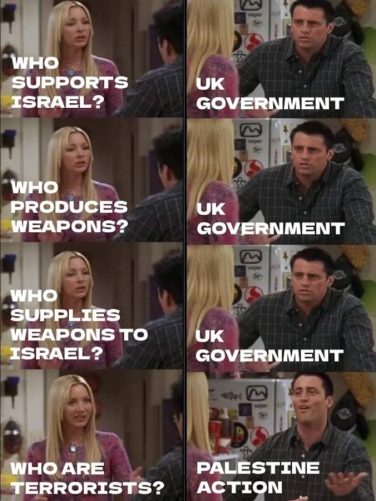 Following the arrests, Home Secretary Yvette Cooper announced her intention to designate Palestine Action as a proscribed organization under the UK’s Terrorism Act. If implemented, the designation would make it illegal to support, join, or promote the group, an escalation that has drawn concern from human rights advocates and civil liberties organizations.
On the same day, hundreds gathered in Trafalgar Square to express solidarity with the group, warning against the criminalization of activism aimed at opposing the UK’s complicity in supplying weapons to “Israel”.
In response, Palestine Action issued a statement via X, condemning the government’s treatment of the protest. “Despite us not being proscribed, the state is treating red paint on warplanes as an act of terrorism,” the group stated. It further revealed that the arrested activists were being held in solitary confinement without charge for several days.
Authorities moved quickly to suppress related demonstrations, dispersing planned rallies outside Parliament and pushing protesters into Trafalgar Square. Several arrests were made, with the Metropolitan Police citing public order risks. Meanwhile, counter-terrorism police have launched a broader security review across UK military installations.
Wider context
Palestine Action, founded in 2020 by British-Palestinian activist Huda Ammori and co-founder Richard Barnard, is known for its confrontational yet non-lethal tactics aimed at arms companies tied to “Israel’s” military-industrial complex. Previous campaigns have led to the temporary shutdown of Elbit Systems-linked factories in Oldham and Tamworth, as well as disrupted contracts with Israeli weapons suppliers.
Legal experts have raised doubts about whether Palestine Action meets the statutory requirements for proscription under the Terrorism Act 2000, which include posing a real threat to national security or British citizens. Critics argue that the group’s actions, while disruptive, remain rooted in civil disobedience rather than terrorism.
The proposed ban has renewed scrutiny of UK-“Israel” cooperation, with campaigners pointing to past evidence of coordination between British counterterrorism units and the Israeli embassy. Concerns are growing that this measure could set a precedent for further repression of pro-Palestine activism.
Families of detained activists face deepening uncertainty, as support efforts, ranging from legal aid to court appearances, could be criminalized. Foreign nationals involved in the group may also face deportation or visa revocation if the ban is enacted.
The West waging ‘centuries-old war’ against Moscow – Russia’s top UN diplomat
RT | June 28, 2025
Western nations are using Ukraine as their proxy in a longstanding confrontation with Russia that is deeply rooted in history, Russian Ambassador to the UN Vassily Nebenzia told RT’s Rick Sanchez.
In an interview on The Sanchez Effect aired on Friday, the diplomat argued that the conflict “should be seen in a larger context.”
“They do not care about Ukraine. This is not a war between Russia and Ukraine,” Nebenzia said. “Ukraine is a proxy in this war. This is a centuries-old war of the West against Russia, starting with the Polish invasion in the 17th century,” he added.
As examples of earlier confrontations, Nebenzia cited Napoleon’s invasion of Russia, the 1854–1856 Crimean War, Western military intervention during the Russian Civil War, and the invasion by Nazi Germany and its allies during World War II. He emphasized that Hitler’s army included not only Germans, but also units drawn from allied countries and occupied territories.
The Ukrainians and “their sponsors” in the West sabotaged the 2014–2015 Minsk accords, which were aimed at ending the conflict between Kiev and the breakaway Donbass republics, the Russian diplomat said. Former French President Francois Hollande and former German Chancellor Angela Merkel later admitted the agreement was used by Kiev to buy time and rearm, Nebenzia stated. “We are not going [to fall] into the same trap once again,” he said.
He added that politicians like former UK Prime Minister Boris Johnson similarly helped derail the 2022 peace talks between Russia and Ukraine.
Ukraine’s European backers were forced to adjust their position, Nebenzia argued, after US President Donald Trump launched efforts to broker peace and Ukrainian troops began losing more ground.
“They changed their rhetoric from ‘We should inflict strategic defeat on Russia’ to ‘Russia should not win in this war.’ Now they are advocating for a full, immediate, and unconditional ceasefire, which is testimony that they want to shield and protect their proxy, as they are obviously losing on the battlefield,” he said.
At the same time, Nebenzia noted that the resumption of direct Russian-Ukrainian negotiations earlier this year provides hope that the conflict could be resolved soon.
Why BBC editors must one day stand trial for colluding in Israel’s genocide
Journalist Peter Oborne sets out six ways the state broadcaster has wilfully misled audiences on Israel’s destruction of Gaza
By Jonathan Cook | June 20, 2025
Veteran journalist Peter Oborne eviscerated the BBC this week over its shameful reporting of Gaza – and unusually, he managed to do so face-to-face with the BBC’s executive news editor, Richard Burgess, during a parliamentary meeting.
Oborne’s remarks relate to a new and damning report by the Centre for Media Monitoring, which analysed in detail the BBC’s Gaza coverage in the year following Hamas’ one-day attack on 7 October 2023. The report found a “pattern of bias, double standards and silencing of Palestinian voices.” These aren’t editorial slip-ups. They reveal a systematic, long-term skewing of editorial coverage in Israel’s favour.
Oborne was one of several journalists to confront Burgess.
Oborne makes a series of important points that illustrate why the BBC’s slanted, Israel-friendly news agenda amounts to genocide denial, and means executives like Burgess are directly complicit in Israeli war crimes:
1. The BBC has never mentioned the Hannibal directive, invoked by Israel on 7 October 2023, that green-lit the murder of Israeli soldiers and civilians, often by Apache helicopter fire, to prevent them being taken captive by Hamas. The Israeli media has extensively reported on the role of the Hannibal directive in the Israeli military’s response on 7 October, but that coverage has been completely ignored by the BBC and most UK media outlets.
Israel’s invocation of the Hannibal directive – essential context for understanding what happened on 7 October – explains much of the destruction that day in Israel usually attributed to Hamas “barbarism”, such as the graveyard of burnt-out, crumpled cars and the charred, crumbling remains of houses in communities near Gaza.
Hamas, with its light weapons, did not have the ability to inflict this kind of damage on Israel, and we know from Israeli witnesses, video footage and admissions from Israeli military officers that Israel was responsible for at least a share of the carnage that day. How much we will apparently never know because Israel is not willing to investigate itself, and media like the BBC are not doing any investigations themselves, or putting any pressure on Israel to do so.
2. The BBC has never mentioned Israel’s Dahiya doctrine, the basis of its “mowing the lawn” approach to Gaza over the past two decades, in which the Israeli military has intermittently destroyed large swaths of the tiny enclave. The official aim has been to push the population, in the words of Israeli generals, back to the “Stone Age”. The assumption is that, forced into survival mode, Palestinians will not have the energy or will to resist their brutal and illegal subjugation by Israel and that it will be easier for Israel to ethnically cleanse them from their homeland.
Because Israel has been implementing this military doctrine – a form of collective punishment and therefore indisputably a war crime – for at least 20 years, it is critically important in any analysis of the events that led up to 7 October, or of the genocidal campaign of destruction Israel launched subsequently.
The BBC’s refusal even to acknowledge the doctrine’s existence leaves audiences gravely misinformed about Israel’s historical abuses of Gaza, and deprived of context to interpret the campaign of destruction by Israel over the past 20 months.
3. The BBC has utterly failed to report the many dozens of genocidal statements from Israeli officials since 7 October – again vital context for audiences to understand Israel’s goals in Gaza.
Perhaps most egregiously, the BBC has not reported Israeli prime minister Benjamin Netanyahu’s biblically-inspired comparison of the Palestinians to “Amalek” – a people the Jews were instructed by God to wipe from the face of the earth. Netanyahu knew this clearly genocidal statement would have especial resonance with what now amounts to a majority of the combat soldiers in Gaza who belong to extreme religious communities that view the Bible as the literal truth.
The hardest thing to prove in genocide is intent. And yet the reason Israel’s violence in Gaza is so clearly genocidal is that every senior official from the prime minister down has repeatedly told us that genocide is their intent. The decision not to inform audiences of these public statements is not journalism. It is pro-Israel disinformation and genocide denial.
4. By contrast, as Oborne notes, on more than 100 occasions when guests have tried to refer to what is happening in Gaza as a genocide, BBC staff have immediately shut them down on air. As other investigations have shown, the BBC has strictly enforced a policy not only of banning the use of the term “genocide” by its own journalists in reference to Gaza but of depriving others – from Palestinians to western medical volunteers and international law experts – of the right to use the term as well. Again, this is pure genocide denial.
5. Oborne also points to the fact that the BBC has largely ignored Israel’s campaign of murdering Palestinian journalists in Gaza. A greater number have been killed by Israel in its war on the tiny enclave than the total number of journalists killed in all other major conflicts of the past 160 years combined.
The BBC has reported just 6 per cent of the more than 225 journalists killed by Israel in Gaza, compared to 62 per cent of the far smaller number of journalists killed in Ukraine. This is once again vital context for understanding that Israel’s goals are genocidal. It hopes to exterminate the main witnesses to its crimes.
6. Oborne adds a point of his own. He notes that the distinguished Israeli historian Avi Shlaim lives in the UK and teaches at Oxford University. Unlike the Israeli spokespeople familiar to BBC audiences, who are paid to muddy the waters and deny Israel’s genocide, Shlaim is both knowledgeable about the history of Israeli colonisation of Palestine and truly independent. He is in a position to dispassionately provide the context BBC audiences need to make judgments about what is going on and who is responsible for it.
And yet extraordinarily, Shlaim has never been invited on by the BBC. He is only too ready to do interviews. He has done them for Al Jazeera, for example. But he isn’t invited on because, it seems, he is “the wrong sort of Jew”. His research has led him to a series of highly critical conclusions about Israel’s historical and current treatment of the Palestinians. He calls what Israel is doing in Gaza a genocide. He is one of the prominent Israelis we are never allowed to hear from, because they are likely to make more credible and mainstream a narrative the BBC wishes to present as fringe, loopy and antisemitic. Again, what the BBC is doing – paid for by British taxpayers – isn’t journalism. It is propaganda for a foreign state.
Burgess’ answer is a long-winded shrugging of the shoulders, a BBC executive’s way of acting clueless – an equivalent of Manuel, the dim-witted Spanish waiter in the classic comedy show Fawlty Towers, saying: “I know nothing.”
Other lowlights from Burgess include his responding to a pointed question from Declassified journalist Hamza Yusuf on why the BBC has not given attention to British spy planes operating over Gaza from RAF base Akrotiri on Cyprus. “I don’t think we should overplay the UK’s contribution to what’s happening in Israel,” Burgess answers.
So the British state broadcaster has decided that its duty is not to investigate the nature of British state assistance to Israel in Gaza, even though most experts agree what Israel is doing there amounts to genocide. Burgess thinks scrutiny of British state complicity would be “overplaying” British collusion, even though the BBC has not actually investigated the extent or nature of that collusion to have reached a conclusion. This is the very antithesis of what journalism is there to do: monitor the centres of power, not exonerate such power-centres before they have even been scrutinised.
Labour MP Andy McDonald responded to Burgess: “To underplay the role of the UK is an error.”
It is more than that. It is journalistic complicity in British and Israeli state war crimes.
Here are a few key statistical findings from the Centre for Media Monitoring’s report on BBC coverage of Gaza over the year following 7 October 2023:
- The BBC ran more than 30 times more victim profiles of Israelis than Palestinians.
- The BBC interviewed more than twice as many Israelis as Palestinians.
- The BBC asked 38 of its guests to condemn Hamas. It asked no one to condemn Israel’s mass killing of civilians, or its attacks on hospitals and schools.
- Only 0.5% of BBC articles mentioned Israel’s illegal occupation of Palestine.The BBC mentioned “occupation” – the essential context for understanding the relationship between Israel and Palestinians – only 14 times in news articles when providing context to the events of 7 October 2023. That amounted to 0.3% of articles. Additional context – decades of Israeli apartheid rule and Israel’s 17-year blockade of Gaza — were entirely missing from the coverage.
- The BBC described Israeli captives as “hostages”, while Palestinian detainees, including children held without charge, were called “prisoners”. During one major hostage exchange in which 90 Palestinians were swapped for three Israelis, 70% of BBC articles focused on those three Israelis.
- The BBC covered Ukraine with twice as many articles as Gaza in the time period, even though the Gaza story was newer and Israeli crimes even graver than Russia ones. The corporation was twice as likely to use sympathetic language for Ukrainian victims than it was for Palestinian victims.
- In coverage, Palestinians were usually described as having “died” or been “killed” in air strikes, without mention of who launched those strikes. Israeli victims, on the other hand, were “massacred”, “slaughtered” and “butchered” – and the author of the violence was named, even though, as we have seen, the Hannibal directive clouded the picture in at least some of those cases.
As is only too evident watching Burgess respond, he is not there to learn from the state broadcaster’s glaring mistakes – because systematic BBC pro-Israel bias isn’t a mistake. It’s precisely what the BBC is there to do.
UK seeks to ban Palestine Action over RAF base protest
Al Mayadeen | June 21, 2025
British news outlets on Saturday revealed that the UK government is preparing to ban Palestine Action, a pro-Palestinian direct action group, by classifying it as a terrorist organization. This move, spearheaded by Home Secretary Yvette Cooper, is expected to be announced in a ministerial statement on Monday and will require parliamentary approval. If enacted, the ban would criminalize membership and support for the group under the Terrorism Act 2000.
The proposed proscription follows a high-profile protest at RAF Brize Norton in Oxfordshire, where Palestine Action activists gained access to the military airbase and sprayed red paint on two aircraft. The group described the action as part of a campaign to disrupt the UK’s complicity in “Israel’s” assault on Gaza. “Activists have interrupted Britain’s direct participation in the commission of genocide and war crimes across the Middle East,” the group said.
Video footage released by the group showed two individuals entering the base at night on electric scooters, with one spraying red paint into the engine of a Voyager aircraft, used to transport British leaders and refuel allied jets. A spokesperson for the group declared: “Despite publicly condemning the Israeli government, Britain continues to send military cargo, fly spy planes over Gaza and refuel US and Israeli fighter jets.”
Though the RAF claimed the damage is being assessed and does not expect major operational disruptions, the incident has sparked a wider security review across UK military bases. The government’s response has drawn criticism for targeting activism rather than addressing its own military entanglements.
Prime Minister Keir Starmer condemned the protest as “disgraceful” and labeled it “an act of vandalism,” while counter-terrorism police and the Ministry of Defence continue their investigations.
Disruptive Solidarity
Founded in 2020 by Huda Ammori, a British-Palestinian activist, and Richard Barnard, Palestine Action is known for its non-violent yet disruptive tactics aimed at corporations that profit from the Israeli military-industrial complex.
The group has previously shut down two Elbit Systems-linked arms factories in Oldham and Tamworth and forced companies like Dean Group International to cut contracts with Israeli weapons manufacturers. Their disruptive tactics—ranging from factory occupations and sabotage to sustained divestment pressure, have challenged British institutions to reckon with their role in supplying the machinery of occupation.
Friday’s action at Brize Norton marks one of the group’s most significant actions yet, directly confronting a military base central to the UK’s support operations.
Critics say the proscription is a politically motivated attempt to silence dissent against Britain’s role in arming and supporting “Israel”. “We represent every person who stands for Palestinian liberation. If they want to ban us, they ban us all,” Palestine Action posted on X. The Palestine Solidarity Campaign called the move “outrageous,” defending the group as a non-violent direct action network.
The planned ban raises serious concerns about the criminalization of solidarity with Palestine and the suppression of dissent.
UK joining US-led Israeli war on Iran would be illegal, says Attorney General
MEMO | June 19, 2025
The UK’s participation in a potential US-led attack on Iran on behalf of Israel could be unlawful, according to legal advice issued to Prime Minister Keir Starmer by Attorney General Lord Hermer. The warning, reported in The Telegraph, sharply limits Britain’s ability to support military action and presents a political headache for Starmer, who is under pressure to back Washington while avoiding another illegal war reminiscent of Iraq.
Hermer, who was recently appointed as Attorney General and is a close ally of Starmer, has issued legal advice stating that any UK military involvement must be strictly limited to defensive actions, namely protecting allies, rather than participating in direct offensive operations against Iran. One official who reviewed the legal opinion remarked: “The AG has concerns about the UK playing any role in this except for defending our allies.”
This caution comes as speculation grows that US President Donald Trump may order strikes on Iranian nuclear infrastructure, using American stealth bombers and joint US-UK bases such as Diego Garcia in the Indian Ocean. While the UK retains sovereign control over the base, any US offensive would require British authorisation.
The legal advice presents a major political dilemma for Starmer. A committed Atlanticist, the UK prime minister has signalled strong support for US-Israeli interests, but any attempt to bypass legal scrutiny in backing a unilateral military campaign may undermine his government’s legitimacy at home and abroad. Comparisons are already being drawn to Tony Blair’s controversial decision to join the US invasion of Iraq in 2003, a war widely deemed illegal by international legal experts and condemned for bypassing the UN Security Council.
Israel’s unprovoked bombing campaign inside Iran, has killed over 300 civilians. Israel’s own justification—that its strikes are defensive—is not accepted under international law unless there is an imminent threat. Any UK participation in such operations could therefore violate its obligations under the Geneva Conventions and customary international law.
Meanwhile, the British government appears to be stepping back from immediate escalation. “We want to de-escalate rather than escalate,” a No. 10 spokesperson said. Foreign Secretary David Lammy has flown to Washington for urgent talks, while Defence Secretary John Healey is said to be reviewing contingency plans for RAF involvement.
Starmer’s government has authorised the deployment of six additional Typhoon fighter jets to Cyprus, with preparations underway to expand UK capacity in the Gulf. However, sources say no final decision has been made regarding the potential use of Diego Garcia.
The warnings come as Trump threatens what he described as a “very big” response to Iran’s missile attacks on Israel. Iran, in turn, has vowed to resist any foreign aggression, rejecting calls for surrender.
Legal experts say the Starmer government must avoid repeating the mistakes of the Iraq war. Any military action outside the bounds of self-defence or without UN Security Council approval is illegal.
Excess deaths 2025
Dr. John Campbell | May 28, 2025
Excess mortality: Deaths from all causes compared to average over previous years
https://bmjpublichealth.bmj.com/content/2/1/e000282
1 January 2020 until 31 December 2022
47 countries of the Western World, 3, 098, 456
Excess mortality
2021, 42 countries
2022, 43 countries
Conclusions
Excess mortality has remained high in the Western World for three consecutive years
This raises serious concerns.
Government leaders and policymakers need to thoroughly investigate underlying causes of persistent excess mortality.
2015–2019 compared to 2020–2024
Percentage difference between the reported weekly or monthly deaths in 2020–2024 and the average deaths in the same period in 2015–2019
https://ourworldindata.org/grapher/excess-mortality-p-scores-average-baseline
Correlation and causality
Smoking is correlated with lung cancer
Asbestos exposure is correlated with mesothelioma
Alcohol consumption is associated with liver cirrhosis
Obesity is correlated with high sugar intake
Radiation exposure is correlated with cancer
Dioxin exposure is correlated with cancer
Causality may be adjudicated by larger scale associations, consistent between countries, where other explanations are unlikely, where effect follows cause, where greater exposure causes more harm with a plausible biological mechanism with coherence between bench science and epidemiological data supported by (even limited) experimentation. By analogy to other causes of harm and sometimes by reversibility.
World on the brink of new nuclear arms race – report
Israel is among the nations “believed to be modernizing its nuclear arsenal,” the Stockholm-based SIPRI institute has said
RT | June 17, 2025
The world risks plunging into a “new dangerous arms race” as most nuclear powers seek to modernize and expand their arsenals, the Stockholm International Peace Research Institute (SIPRI) has warned in its annual review.
The pace of disarmament is slowing as nuclear-armed states launch “intensive” arsenal modernization programs, the research center said in a paper published on Monday.
Russia and the US, which together possess around 90% of all nuclear weapons in the world, are set to see the last remaining bilateral nuclear arms control treaty – the New START – expire in February 2026, SIPRI noted. The agreement limits the number of simultaneously deployed strategic nuclear warheads.
Moscow suspended its participation in the treaty in 2023, citing the impracticality of the inspection regime due to deep Western involvement in the Ukraine conflict. However, it maintained that it remained open to dialogue on the issue if the arsenals of Washington’s NATO allies were also considered.
Washington, meanwhile, insists on including China in any new agreement. According to SIPRI, China possesses the fastest-growing nuclear arsenal in the world and could rival “either Russia or the USA” in the number of intercontinental ballistic missiles by the end of the decade.
The UK and France are also modernizing their nuclear forces, focusing on nuclear-powered ballistic missile submarines, the report said. Paris additionally aims to develop a new ballistic missile warhead.
“The era of reductions in the number of nuclear weapons in the world, which had lasted since the end of the Cold War, is coming to an end,” said Hans M. Kristensen, Associate Senior Fellow with SIPRI’s Weapons of Mass Destruction Program. “We see a clear trend of growing nuclear arsenals, sharpened nuclear rhetoric, and the abandonment of arms control agreements.”
The research institute also listed Israel among the nations “believed to be modernizing its nuclear arsenal.” While Israel does not officially acknowledge possessing nuclear weapons, SIPRI pointed to tests of new missile propulsion systems and alleged upgrades at the plutonium production reactor site in Dimona.
West Jerusalem could have up to 90 nuclear warheads at its disposal, the report stated. The findings come as Israel conducts air raids against Iranian nuclear and military facilities, claiming Tehran is nearing the creation of a nuclear bomb. Iran, which maintains that its nuclear program is peaceful, was not mentioned in the SIPRI report.
Italy and Germany on the War Front
By Manlio Dinucci | Global Research | June 16, 2025
Italy and Germany are at war not only against Russia in support of Ukraine, but also against Iran in support of Israel. This is demonstrated by documented facts. These facts are ignored by the political-media mainstream.
The Italian B350ER aircraft – a new-generation aircraft for espionage, target recognition and communication operations – operates in the Black Sea together with similar US aircraft to spy on Russian territory and assist Ukrainian forces to strike Russian targets with unmanned drones and explosive vessels. Italy is thus not only supplying weapons to Kiyv but is actively participating in this and other ways in the NATO war against Russia. Even more direct is Germany’s participation in the war: it has permanently stationed a 5,000-strong Bundeswehr brigade in Lithuania, equipped with 2,000 tanks and other military vehicles.
“With this combat-ready brigade,” states German Defence Minister Pistorius, “we are taking on a leadership responsibility within the Alliance here on NATO’s Eastern Flank”.
Thus, NATO has deployed its forces on the borders with Russia’s Kaliningrad Oblast and Russia’s ally Belarus. At the same time, two other NATO countries — the United Kingdom and Canada — are deploying their ++forces in Estonia and Latvia, which also border Russia. These forces are like a candle lit in a powder keg. According to Article 5 of the North Atlantic Treaty, if NATO forces suffer losses in a clash with Russian forces on the border, all other NATO countries would have to intervene on their side against Russia. The Trump Administration’s role is becoming increasingly equivocal, as it states that it wants to agree with Russia on a diplomatic solution to end the war. Yet, it is helping Ukraine to continue the war against Russia, either directly through military operations such as those in the Black Sea, or indirectly through NATO, which, under US command, is bringing its military forces ever closer to Russia.
As part of the same strategy, Germany and Italy play a significant role in supporting Israel in the Middle East. After the USA, Germany is the second-largest supplier of weapons to Israel. So far, Israel has received six Dolphin-class submarines from Germany, manufactured by ThyssenKrupp Marine Systems. These submarines have been modified to launch nuclear attack missiles. According to an agreement in 2022, Germany will supply Israel with three more Drakon-class submarines, which are larger than the previous models and can launch even more powerful nuclear missiles. Israel is the only country in the Middle East that possesses nuclear weapons, and, as it has not joined the Non-Proliferation Treaty, it is not subject to any control. Iran, having joined the Non-Proliferation Treaty, has civil nuclear facilities that are subject to UN Atomic Energy Agency controls.
Middle East in Crisis – 2
Netanyahu’s war on Iran has no future
By M. K. BHADRAKUMAR | Indian Punchline | June 16, 2025
An unnoticed undercurrent of the Israel-Iran war is that three Christian nations in Europe — UK, France and Germany — have joined the fray with alacrity on the side of Israel.
Strange, isn’t it, that these European countries comprising the so-called E-3 have a well-established exclusive path of dialogue with Iran but are joining Israel’s warpath? It’s a Crusade, stupid!
The three ‘Crusader nations’ share Israel’s obsession to check the rise of a Muslim nation as an emerging power in the Middle East that could radically transform its geopolitical alignments. Simply put, destroying the Islamic regime in Iran is the real objective of Israel’s war — and of the three Christian nations from Europe.
Reportedly, Israeli fighter jets which attacked Iran used the British air base in Cyprus; British refuelling planes are on deployment in Syrian-Iraqi airspace for use of Israeli fighter jets; French president Emmanuel Macron, as defender of Roman Catholicism openly vows that he will act to prevent Israel’s defeat; Germany, the fountainhead of Protestantism, has also similarly positioned itself behind Israel.
However, on the other hand, what emerges from the hour-long phone conversation between Trump and Russian President Vladimir Putin on Saturday is that they will work together to advance the path of dialogue with Iran, the current conflict situation notwithstanding. The Kremlin readout stresses that Putin forcefully denounced the Israeli aggression.
Such a line-up of the principal actors signals that Israel’s best bet lies in killing the war itself as a strategic error and create a ‘new normal’? But will Tehran allow Netanyahu to get away with murder? That’s the million dollar question. Putin will have to use all his persuasive power during the planned visit to Iran — ie., if it still goes ahead.
The Israeli thinking behind its assassination of the IRGC leadership and military commanders stemmed out of the foolish miscalculation that Tehran lacks a political will to resist aggression. The Israeli objective is on the one hand to create conditions for a regime change in Iran and on the other hand to derail any form of US-Iran constructive engagement.
All through, terror has been the chosen weapon for Israel and the western powers to undermine and weaken Iran. But a point has been reached where a containment of Iran is no longer feasible. Logically, Iran’s neighbours in the Muslim world should have rallied in support of Iran but that’s too much to expect, given their limited sovereignty to act independently.
Nonetheless, Iran will not capitulate. Iran’s sense of national pride and honour as a civilisation state will prompt it to circle the wagons and wage a protracted war until victory. From the early days of the revolution, the Islamic republic which was founded on the principles of justice and resistance on the bedrock of nationalism and independence, got attracted to Mao’s concept of ‘protracted people’s war’ to keep predator nations at bay. That strategy paid off during the Iran-Iraq War (1980-1988).
Saddam Hussein too, like Netanyahu, miscalculated that Iran was a hopelessly weakened nation in the civil war conditions with its economy in virtual collapse, army in disarray, state formation yet to crystallise, and with no allies in the region to lend a helping hand. But as it turned out, Iran fought an 8-year war defiantly to a stalemate, undeterred by the lavish support extended to Saddam by the Western powers and their regional allies.
The US even equipped Saddam’s army with chemical weapons to stop the human-wave–attack tactics of Iranian fighters, but of no avail — although, an estimated quarter million Iranians sacrificed their lives.
At some point, in a very near future, Israel will also meet the fate of Saddam, having miscalculated Iran’s grit to resist. Netanyahu also estimated that Iran is a much weakened country compared to last year due to the setbacks taken by the Axis of Resistance. Such naïveté underestimates the potency of resistance at the very core of Shi’ism.
Last week, the resistance forces that were supposedly vanquished from the face of the earth regrouped and began firing missiles at Israel — from Syria, of all places! On May 4, Houthis fired a ballistic missile at Tel Aviv hitting the perimeter of the main terminal of Ben Gurion Airport! Reports suggest that Hezbollah has restored its supply routes from Iran.
What Israel fails to grasp is that resistance movements do not die if their raison d’être remains. Israel is, in reality, in very deep crisis fighting on multiple fronts amidst a cascading domestic political crisis and an economy that requires drip feeding by Washington.
As the US’s capacity to influence events in the Middle East keeps diminishing, Israel’s unviability as a nation propped by the Jewish Lobby in the Beltway appears sharper in focus. Already, there is resentment within the US about bankrolling Israel and fighting its wars.
On the contrary, the rise of Iran is inevitable — with a population base 10 times bigger than Israel’s, vast mineral resources, a self-sufficient agricultural sector and broad-based industry, innovative progress in technology, big domestic market, highly strategic location and trained manpower.
Iran’s stamina is of a long distance runner, as Iran-Iraq war showed, whereas, Israel’s forte is as sprinter on a 100 metre track. Make no mistake, Israel, a small country with a population of 8 million people will get hollowed out in a protracted war.
In the current scenario, what goes against Israel critically is that while President Donald Trump tried and failed to stop Netanyahu on the warpath, he is not going to deploy American forces to fight Israel’s war.
Trump has an evangelical base in US politics and is on friendly terms with wealthy Jewish donors, but has nothing in common with the Crusader nations of the Old World — be it on Ukraine or Iran. In both cases, actually, he tends to view the paradigm through the America First prism where he sees immense potential to generate wealth through business links with Russia or Iran.
Besides, Trump is far too smart a politician to risk the future of his MAGA movement whose core tenet is the total rejection of all interventionist ‘forever wars’. Trump knows only too well that American public opinion is staunchly opposed to Middle Eastern wars.
The replacement of Mike Waltz as NSA on May 1 (a known Israeli proxy who found himself in the top echelons of Trump administration) and the subsequent purge of the entire pack of ‘Iran hawks’ in the National Security staff under him, signalled that Trump is wary of Netanyahu’s diabolical plots to derail his negotiations with Iran through back channels. (here and here)
During their phone conversation on Saturday, according to the Kremlin readout, Trump and Putin agreed to prioritise the “negotiating track in Iran’s nuclear programme… Trump noted, the team of US negotiators is ready for resuming work with Iranian representatives.” Clearly, a military confrontation with Iran does not figure in Trump’s calculus.
That being the case, Netanyahu’s bombastic rhetoric apart, Israel’s best interests lie in ending this futile war in the quickest way possible. Conceivably, that is also the preference of the IDF. A protracted war on its own steam with a clutch of crusader nations in tow as cheer leaders is not something that can save Israel from destruction.
Curiously, Trump in his latest Truth Social post on Sunday after the conversation with Putin advised Israel “to make a deal” with Iran! Does that fit into Netanyahu’s war mongering? And Trump went on to burnish his own credentials as a peacemaker president!
Trump concluded predicting that “we will have PEACE, soon, between Israel and Iran!” Succinctly put, Trump has no intentions whatsoever to risk American lives by fighting Netanyahu’s wars.
Obviously, “PEACE, soon” will be Russia and Iran’s preference too, as serious negotiations can be resumed and agreement reached that would herald a US-Iran normalisation and the lifting of American sanctions. But does that suit Netanyahu?
The paradox is, Israel has no future in a protracted war with Iran, but an inconclusive end to this war will pose the high risk for Netanyahu of a cascading demand for a regime change in Israel. Loss of power means loss of parliamentary immunity from prosecution that Netanyahu hitherto enjoyed from corruption charges against him and his family members, and a possible imprisonment.
Read more: Iran Attack: Netanyahu Gambles Big, Rediff.com, June 14, 2025
UK moving jets to Middle East for ‘contingency support in the region’
Al Mayadeen | June 14, 2025
The United Kingdom is sending additional fighter jets and support aircraft to the Middle East as part of what Prime Minister Keir Starmer described as “contingency support” for the region, following Israel’s deadly strikes on Iran.
Speaking en route to the G7 summit in Canada, Starmer reiterated calls for de-escalation but stopped short of ruling out military support for “Israel”. Asked whether British forces could be involved in defending “Israel” against Iranian retaliation, he said, “I will always make the right decisions for the UK,” adding, “We are moving assets to the region, including jets, and that is for contingency support in the region.”
Downing Street confirmed the move includes additional fast jets and refueling aircraft joining existing UK deployments. Preparations reportedly began Friday, just hours after Israeli forces launched a wave of airstrikes targeting senior Iranian military leaders and nuclear facilities.
Pressed further on the UK’s potential involvement in countering Iranian missiles or drones, Starmer declined to offer specifics, “These are obviously operational decisions and the situation is ongoing and developing, and therefore I’m not going to get into the precise details. But we are moving assets… and that is for contingency support across the region.”
No word on prior knowledge of Israeli strikes
The UK government has not confirmed whether it had prior knowledge of the Israeli operation, although Starmer indicated coordination was taking place: “I’m not going to go into what information we had at the time or since… there’s a constant flow of information between our allies, and between us and the US.”
The prime minister also revealed that he had spoken with Israeli Prime Minister Benjamin Netanyahu, US President Donald Trump, and other world leaders, including French President Emmanuel Macron, German Chancellor Friedrich Merz, and Saudi Crown Prince Mohammed bin Salman.
“I suspect that when we get to the G7 there will be many other exchanges of views on an intense basis,” Starmer said. “We do have longstanding concerns about the nuclear programme that Iran has, and we do recognise Israel’s right to self-defence. But I am absolutely clear that this needs to de-escalate. There’s a huge risk to escalation for the region and more widely in terms of conflict. We have seen the impact already on the economy and oil prices.”
Meanwhile, Foreign Secretary David Lammy also spoke with his Iranian counterpart Abbas Araghchi, echoing Starmer’s message for restraint, “We’re having ongoing discussions with our allies all of the time,” Starmer said, “Our constant message is de-escalate.”
Diplomatic Collapse
The Iranian Foreign Ministry declared further nuclear negotiations with the US “pointless” under these conditions, asserting that “Israel’s hostile measures against Iran were the result of Washington’s direct support for the regime.”
Oman has since confirmed the cancellation of the Muscat talks, reflecting the collapse of diplomacy under Western duplicity.
As Iran reaffirms its legitimate right to self-defense under international law, the UK’s actions suggest not neutrality but strategic complicity.
The Islamic Republic continues to urge the international community to abandon double standards and take a principled stance against “Israel’s” lawless aggression.
Featured Video
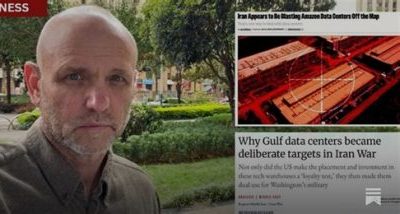
Iran spent $1 million to wipe out $30 billion in data center plans, and take down Amazon in the ME
or go to
Aletho News Archives – Video-Images
From the Archives
Clash of Civilization, Iran Part II
By Jamal Kanj – Intifada-Palestine.com – January 14, 2011
Israel’s survival kit is: perpetuate conflict, insecurity to rationalize collective hate and finally playing victim.
Devoid of conflict, Israel implodes internally; without hate, Zionism loses its justification; and playing eternal victim to continue blackmailing the West. Absence of this holy trinity, Israel ceases to exist. … continue
Blog Roll
 Aletho News
- China Rejects Outside Pressure on Trade Ties After New US Russia Sanctions Bill
- Houthis Keep Advancing as the Red Sea Crisis Deepens
- Iran spent $1 million to wipe out $30 billion in data center plans, and take down Amazon in the ME
- Zionist billionaire pressure to silence Macklemore sparks exodus from Ed Sheeran tour
- House Votes to End Iran War for Third Time
- North Korea Slams US Plan for ‘AUKUS 2.0’ with South Korea and Japan
- Prolonging US-Iran Conflict Not Meeting Interests of Int’l Community – China’s Wang Yi
- EU bans former Zelensky aide from parliament
- NATO-backed Kosovo separatist ‘responsible for war crimes’
- US destroying international space law
- If Americans Knew
- U.S. Makes, Israel Takes: The Real Story of U.S.-Israeli Military Cooperation
- Night raids rise in Palestine
- Tucker Carlson interviews Norman Finkelstein about Gaza
- Groups urge Americans to support Van Hollen legislation on Israel’s killing of Americans & Palestinians
- Trump administration plans to send 40,000 tons of bombs to Israel: report
- Sanctions Target Iran’s Government, But Kill Hospitalized 23-Year-Old Woman
- An alternative view on the book “Israel’s Lobby: America in the Grip of a Foreign Power”
- Ed Sheeran’s band Beoga, other opening acts quit tour after Macklemore was dropped over his pro-Palestinian comments
- The assassination attempt on President Trump in Butler and the various Israeli connections to it
- “We Want That the Whole Land Be Jewish”
- No Tricks Zone
- New Study: ‘Global Drought Shows No Detectable Recent Acceleration Under Climate Warming’
- Economic Masterminds: German Socialists Suggest Taxing Productivity Gains Stemming From Using AI
- The South China Sea Has Not Been Cooperating With The Climate Change Narrative
- Energy Crisis: Germany Enters Heating Season With Historically Low Gas Reserve Fill Levels
- New Study: The Antarctic Ice Sheet Gained Mass From 2020-2024 Due To Staggering Snow And Ice Accumulation
- Study: Ocean Heating Rates From Thousands Of Years Ago ‘Dwarf’ Modern Ocean Heating Rates
- Climate Extremists Target, Attack Large-Scale Power Grid Infrastructure In Germany!
- New Study: Antarctic Ice Melt Has Contributed Less Than 1 Centimeter To Sea Level Rise In The Last 30 Years
- Fear Of Debate: Alarmist German Climate Scientist Calls On Mainstream Media To Discredit Skeptic Voices
- End-Of-August Arctic Sea Ice Extent Hasn’t Fallen In 20 Years, Official Data Show!
 Aletho News