UK Government Plans to Use Delegated Powers to Undermine Encryption and Expand Online Surveillance
Delegated powers mean the specific rules (what gets scanned, what gets flagged) get written by a minister, not Parliament.
By Ken Macon | Reclaim The Net | February 18, 2026
The UK government wants to scan people’s photos before they send them. Not just children’s photos. Everyone’s.
Technology Secretary Liz Kendall spelled it out on BBC Breakfast, floating a proposal to “block photographs being sent that are potentially nude photographs by anybody or block children from sending those.” That second clause is the tell. Blocking “anybody” from sending potentially nude images requires scanning everybody’s messages. There’s no technical path to that outcome that doesn’t involve reading content the sender assumed was private.
Kendall said the government is conducting a consultation on “whether we should have age limits on things like live streaming” and whether there should be “age limits on what’s called stranger pairing, for example, on games online.” The consultation, she said, will look at all of these. That list now covers messaging apps, photo sharing, gaming, and live streaming. Any feature that lets you share an image with another person potentially falls inside it.
This is how the mandate grows. The government announced a push for new delegated powers on February 16, framing them around age verification for social media and VPNs.
What Kendall described in broadcast interviews goes well beyond that framing. The official press release mentioned consulting on how companies might “safeguard children from sending or receiving” nude images. Kendall’s BBC comments dropped the qualifier about children entirely, proposing to block “potentially nude” images sent by anyone.
The mechanism matters here. The government plans to introduce these new authorities as amendments to the Children’s Wellbeing and Schools Bill, which has already cleared the House of Commons and the House of Lords and sits in its final stage. Amendments introduced this late receive less parliamentary scrutiny than standard legislation.
Delegated powers allow a minister or department to issue secondary legislation without returning to Parliament for a full vote. That secondary legislation isn’t subject to the same debate as the original Act. The government gets to decide the specific rules, on its own timeline, with limited opportunity for challenge. Kendall told Good Morning Britain that the government plans to push new “online safety rules” every year through this mechanism.
The bill already contains amendments requiring age verification for VPNs (amendment 92) and for “user-to-user” services (amendment 94a). User-to-user covers most online platforms where people share content: social media, messaging apps, forums, and gaming services. Email and SMS are exempt. Most everything else isn’t.
A charitable reading of why the government wants delegated powers: it needs flexibility to update technical standards for age verification as the technology changes, and only if Parliament first approves the underlying requirements. The less charitable reading, and the more plausible one: the government wants the ability to impose VPN and social media age verification even if those amendments fail. It’s building a back door to bypass the outcome of the parliamentary vote it’s currently trying to win.
The House of Lords previously considered and rejected an amendment that would have required constant client-side scanning on most smartphones and tablets to detect child sexual abuse material. The Lords declined to adopt it. That rejection happened through the full parliamentary process.
The government is now signaling it may pursue functionally identical surveillance through delegated powers, bypassing the scrutiny that killed the first attempt. Kendall’s photo-scanning proposal and the failed Lords amendment work the same way technically. Both require software installed on your device to examine content before it leaves. The Lords’ amendment targeted CSAM via client-side scanning. Kendall’s proposal targets “potentially nude” images via client-side scanning. The mechanism is identical. The content category is different.
End-to-end encryption means the service provider can’t read your messages. Client-side scanning, which has already proven to be a disaster in Germany, means your device reads them first, before encryption activates, and reports back. The encryption remains technically intact. The privacy it’s supposed to provide doesn’t. This is the same architecture that Apple proposed and then abandoned in 2021 after security researchers explained what it actually meant for private communication.
The government hasn’t acknowledged that its photo-scanning proposal requires dismantling the privacy guarantee that makes encrypted messaging meaningful. It’s describing the outcome it wants, not the infrastructure required to deliver it.
Photo scanning that flags “potentially nude” images requires training a model to identify what nudity looks like, running that model continuously on a device, and reporting matches somewhere. The system built for that purpose can be retrained or repurposed. A scanner that identifies nudity can be adjusted to flag political content, protest coordination, or anything else a future government decides warrants detection.
The delegated powers structure means those future decisions don’t require new primary legislation. They require a minister, a statutory instrument, and limited parliamentary review.
Prime Minister Keir Starmer’s February 16 Substack noted that “private chats” are supposedly harming children without proposing to target them specifically. The official press release didn’t mention messaging apps at all. What Kendall said on television this week went further than either document. The consultation hasn’t launched yet. The powers to act on its findings, at speed, with reduced oversight, are already being written into law.
The Mandelson Molecule: Exposing the Architecture of Cross-Border Political Suppression
By Freddie Ponton | 21st Century Wire | February 18, 2026
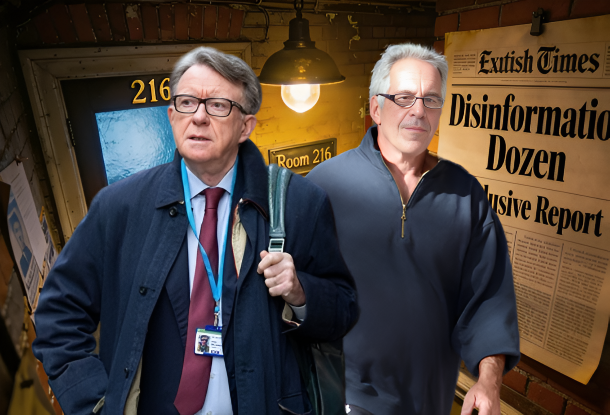
The resignation of Peter Mandelson as UK ambassador to Washington in February 2026 revealed more than a scandal—it exposed the architecture of a parallel governance system operating through deniable channels. The Epstein files, the Center for Countering Digital Hate (CCDH) censorship apparatus, and the Mandelson intelligence pipeline are not separate stories. They are component parts of a transatlantic mechanism that converts private access into public control, with enforcement mechanisms that now reach across sovereign borders to silence American citizens.
Jeffrey Epstein was a convicted sex offender with deep ties to political and financial elites on both sides of the Atlantic. Peter Mandelson is a former UK power‑broker and ambassador to Washington, now under investigation for secretly sharing government information with Epstein. This article shows how their relationship connects to a wider system of online censorship and private global‑health finance.
The Intelligence Pipeline: Real-Time Treasury Briefings to a Convicted Sex Offender
The Mandelson-Epstein correspondence reveals something far more systematic than indiscreet friendship. It documents a private intelligence channel operating at the highest levels of UK and US financial policy.
In December 2009, while serving as Business Secretary, Mandelson forwarded Treasury positions on the bankers’ bonus tax to Epstein within hours of receiving them, with Epstein requesting advance notice “before Jes” and Mandelson replying simply: “Treasury”. By March 2010, the pattern had escalated—Mandelson forwarded notes from a meeting between UK Chancellor Alistair Darling and US Treasury Secretary Larry Summers to Epstein within five minutes, followed by his own meeting with Summers the next day. Those notes were forwarded within two minutes.
The content was market-moving intelligence: Dodd-Frank implementation, hedge fund taxation, derivatives regulation, and Bank of England quantitative easing strategy during the credit crunch. Mandelson advised Epstein that JPMorgan’s CEO should “mildly threaten” Chancellor Darling over policy. This systematic extraction of live government intelligence for private financial advantage can hardly be construed as incidental corruption.
DOCUMENT: Peter Mandelson leaked No 10 documents to Epstein, who then helped him pursue multi-million dollar jobs (Source: Tax Policy Associates)
The Censorship Architecture: From Anti-Corbyn Operations to American Deplatforming
The same censorship machine that produced the Biden White House’s authoritarian campaign against the so-called “Disinformation Dozen” in 2021 had emerged from the notorious Room 216, Brixton, where Israeli loyalist and architect of Keir Starmer’s rise to power, Morgan McSweeney, along with Imran Ahmed, built the “Labour Together” operation to dismantle Jeremy Corbyn. It was a CCDH list of 12 named individuals, which the White House then pushed Facebook to censor. The March 2021 “Disinformation Dozen” report was not independent research—it was unequivocally the identical playbook redeployed. The Biden White House directly cited CCDH’s report to pressure Facebook into censoring American health publishers, with internal documents showing the platform’s “secretly demoted” users, including alleged “anti-vaxxers”, and Twitter accounts of targeted individuals. When Facebook pushed back that the “majority of the accounts in question were not spreading misinformation,” the White House persisted.
Among those branded the “Disinformation Dozen” by the CCDH in March 2021: Robert F. Kennedy Jr. (Children’s Health Defense), physician Joseph Mercola, and Sayer Ji—whose investigative work exposing the Mandelson intelligence pipeline appears later in this report.
The method was documented in internal strategy papers: cultivate “seemingly independent voices to generate and share content to build up a political narrative,” infiltrate opposition spaces to extract decontextualised content, and feed narratives to sympathetic media. The “antisemitism crisis” that destroyed UK Labour Party leader Jeremy Corbyn was, as Labour Party files confirm, instrumentalised by this same faction.
Morgan McSweeney was CCDH’s founding director and subscriber for 18 months, operating from the same Brixton office that produced Labour’s anti-Corbyn operation. When he resigned in April 2020 to become Starmer’s chief of staff, Ahmed inherited an apparatus already proven effective at demonetising political opposition.
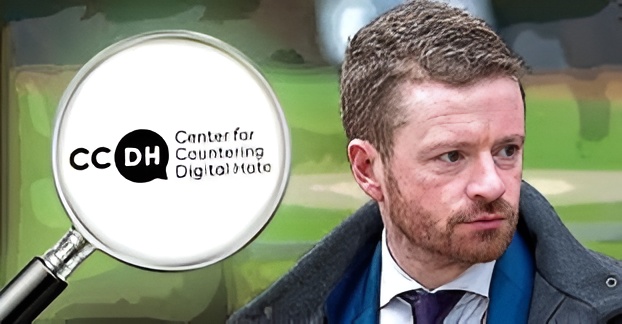
Morgan McSweeney, founding director of the CCDH, and former British Prime Minister Keir Starmer’s Chief of Staff. (Source: The Edge | Business news)
The March 2021 “Disinformation Dozen” report was not independent research—it was unequivocally the identical playbook redeployed. The Biden White House directly cited CCDH’s report to pressure Facebook into censoring American health publishers, with internal documents showing the platform “secretly demoted” affiliated accounts and Twitter accounts of targeted individuals. When Facebook pushed back that the “majority of the accounts in question were not spreading misinformation,” the White House persisted.
Project Molecule: The Financial Infrastructure of Private Governance
The August 2011 JPMorgan “Project Molecule” blueprint reveals the financial architecture that made this system durable. The $150 million fund Epstein pitched to JPMorgan CEO Mary Erdoes was designed to operate “across sovereign borders, into specific countries, for specific biological interventions”—with no elected officials, no treaty obligations, and no public accountability beyond its own audit committee.
DOCUMENT: JPMorgan “Project Molecule” blueprint (Source: DOJ Epstein File Library | EFTA01301114)
Epstein operated as Bill Gates’s representative under a written agreement, with the explicit purpose of securing “additional money for vaccines” while creating a “permanently governed, privately controlled, transnational system”. The budget allocated $40M for polio vaccines in Afghanistan, $40M in Pakistan, $20M specifically for “financing the surveillance network in Pakistan,” and $30M for rotavirus vaccines in Latin America.
This is the governance model: private intelligence (Mandelson-Epstein), private finance (Project Molecule’s offshore vaccination funds), and private enforcement (CCDH’s deplatforming operations) operating in substitutional parallel to democratic institutions.
The Enforcement Layer: Cross-Border Suppression of American Speech
What transforms influence operations into censorship is enforcement. The original investigation documents the apparatus reaching into foreign legal proceedings against American journalists—cross-border enforcement without due process, extradition treaties, or congressional oversight.
The pattern is now confirmed by US government action. In December 2025, Secretary of State Marco Rubio barred Imran Ahmed from entering the United States, citing his role in “leading organised efforts to coerce American platforms to punish American viewpoints they oppose”. Ahmed was one of five Europeans sanctioned under a visa policy targeting foreigners responsible for censoring protected speech in America.
The CCDH is now reportedly under DOJ investigation for potential violations of foreign agent registration laws, given its coordination with UK Labour operatives while targeting US political speech. Labour’s deployment of approximately 100 operatives to US swing states during the 2024 election—conducted by McSweeney’s network—has generated formal FEC complaints alleging direct electoral interference.
After days of parliamentary theatre about “transparency,” Westminster has craftily moved to bury the Mandelson-Epstein papers—not in open sunlight, but inside the Intelligence and Security Committee, a body three of whose members have already stuffed with cash from pro-Israel lobbyists.
In Britain, Downing Street originally wanted veto power over anything “prejudicial to national security”, but the documents will now be reviewed by the Parliament’s Intelligence and Security Committee (ISC). Critics argue that this allegedly independent oversight body could be compromised. In effect, three sitting members—Deputy Chair Sir Jeremy Wright, Sir John Hayes, and Labour’s Derek Twigg—have all taken money from the pro-Israel lobby, which by some estimates bankrolls roughly a quarter of British MPs. This can be verified in the excellent Declassified UK report published in June 2024.
The bottom line is that the Epstein file, which details how Mandelson piped classified Treasury intelligence to a convicted sex offender, and how British power brokers and Wall Street criminals traded backroom briefings, will now be “vetted” by politicians on the take from foreign influence networks. Forget transparency—it was never on the table.
The Architecture of Manufactured Consensus
The critical insight is structural: these networks exploit the gap between formal democratic institutions and actual governance. Mandelson’s Treasury briefings to Epstein occurred through informal channels. Project Molecule’s sovereign surveillance programs were designed to operate offshore. CCDH’s censorship operations, though effective at capturing White House policy, occurred through a nonprofit rather than state agencies. According to reports, George Soros is said to have donated $250,000 to the CCDH, which is working to censor conservative news outlets and to undermine Musk’s Twitter.
When the same personnel (McSweeney as CCDH founder, then Starmer’s chief of staff), the same infrastructure (Brixton operations), and the same methods (crisis amplification, media laundering, financial pressure) appear across Corbyn’s destruction, COVID censorship, and US electoral operations, we are not observing a coincidence. We are witnessing a system.
The switchboard is not the scandal. The switchboard is the system, and it is now being dismantled by the very government it sought to influence.
The Original Investigation
This synthesis builds upon the groundbreaking investigative work of Sayer Ji, founder of GreenMedInfo and author of the Switchboard series—including the first publication to connect the Mandelson-Epstein intelligence pipeline to the CCDH censorship apparatus. Ji’s research, conducted under direct legal and professional pressure from the very networks he was exposing, documented how British political operatives built a cross-border enforcement mechanism capable of weaponising foreign courts against American journalists.
His original reporting on Room 216, the Brixton operations, and the emergence of “disinformation” as a tool for political suppression predates mainstream coverage by years, and has now been validated by the Epstein disclosures, the Rubio sanctions against Ahmed, and the DOJ’s investigation into CCDH’s foreign agent activities.
Read the complete investigation series and supporting documentation at Sayer Ji Substack…
Sayer Ji reports on Substack…
The Switchboard: From Epstein to Mandelson to McSweeney to Ahmed — How a British Machine Became America’s Censorship Engine
How the Epstein Files Reveal the Architecture Behind Censorship, Crisis Finance, and What Happened When I Investigated It – Part 3 in a Series
Peter Mandelson, “the Prince of Darkness,” Keir Starmer’s hand-picked ambassador to Washington, the most powerful unelected figure in British politics, resigned from Parliament this week, one step ahead of legislation to eject him. The Metropolitan Police opened a criminal investigation. The Prime Minister apologised to Jeffrey Epstein’s victims for believing Mandelson’s lies.
The press is treating this as a story about a politician’s downfall. It is not. It is a story about what he was connected to — and what was built to make sure you never found out.
Key Findings:
- The censorship machine that targeted American speech during COVID was built inside a Labour Party factional operation. Morgan McSweeney and Imran Ahmed created the Center for Countering Digital Hate (CCDH) from the same office, using the same staff, and the same dark-money infrastructure they used to destroy Jeremy Corbyn — then redeployed the identical playbook against U.S.-based health publishers and independent media.
- CCDH’s founder and political patron is a protégé of Peter Mandelson, who was simultaneously routing confidential UK and U.S. government intelligence to Jeffrey Epstein. Mandelson forwarded Treasury readouts on the Volcker Rule, Dodd-Frank, and derivatives regulation to Epstein within minutes of receiving them — intelligence worth billions to Epstein’s Wall Street clients. The same political culture of deniable backroom operations that made the Epstein network functional also produced CCDH.
- Epstein’s network was not just criminal — it was architectural. Project Molecule, a $150M JPMorgan blueprint produced the same month Epstein sketched a private global health fund, reveals the institutional machinery: offshore vaccination funds, sovereign biological surveillance programs, and governance structures designed to bypass elected oversight entirely.
- The enforcement layer is not theoretical — it has already been deployed against named individuals. CCDH’s “Disinformation Dozen” list led directly to platform deplatforming. In at least one documented case, CCDH-originated material was entered into foreign legal proceedings to seek an ex parte arrest warrant against a U.S.-based journalist for lawful American speech — cross-border enforcement with no due process, no extradition treaty, and no congressional oversight.
- The same network is now the subject of a formal FEC complaint alleging direct electoral interference. McSweeney — Mandelson’s protégé, CCDH’s political architect, and now Starmer’s chief of staff — was named in a formal FEC complaint for dispatching approximately 100 Labour operatives to U.S. swing states during the 2024 presidential election. The censorship pipeline and the electoral interference pipeline share the same personnel, the same infrastructure, and the same assumption: that British political operatives can shape American outcomes without accountability.
Zionist-controlled companies to surveil British citizens

Press TV – February 17, 2026
The implications of the British state using technology produced by Zionist-controlled companies to surveil British citizens are beyond belief.
The cornerstone of a sovereign nation is the absolute control over its own justice, its own data, and its own watchmen. Yet today, the very machinery of British law enforcement is being quietly and systemically outsourced.
The British government has allowed the digital and physical infrastructure of the state to become a high tech extension of a foreign power, driven by the pernicious influence of Zionism, an ideology that prioritizes the expansion of a foreign entity over the rights of people in the UK.
This is not merely a matter of procurement. It is a surrender of independence.
By embedding Zionist-linked firms into the heartbeat of British society, the government is importing a surveillance philosophy rooted in the subjugation of one people and applying it to their own subjects.
These are combat-proven technologies forged in the fires of the Gaza genocide, and they are now the primary eyes and ears of the metropolitan police.
The police use Israeli intelligence firm Cellebrite to unlock the phones and private lives of their own citizens. They also use BriefCam to track people’s movements through video synopsis.
BriefCam is a company co-founded by Gideon Ben-Zvi, a veteran of the IOF elite unit 8200 Intelligence Corps, who openly admits to using unit 8200 criteria to lead his ventures.
The reach of foreign intelligence into the streets is even more direct through Corsight AI, which provides facial recognition throughout the country.
Born as a subsidiary of Cortica, it was founded by Igal Raichelgauz, another alumnus of the Zionist military intelligence apparatus.
When our faces are scanned by software overseen by the architects of the occupation of Palestine, can we truly say that the British public is being policed by British consent?
But the intrusion goes deeper than software. It reaches the very hands of our officers on the front lines.
ISPRA, an Israeli specialist in riot control, has historically supplied the crowd management munitions used to police the streets.
When the tools used to suppress dissent in the UK are manufactured by a firm specializing in the containment of occupied territories, the line between domestic policing and foreign military occupation begins to blur.
Furthermore, Motorola Solutions, a company listed by the United Nations for its links to illegal settlements, is now deep inside our research projects.
Through initiatives like CREST and Connections, they’re building predictive policing tools designed to monitor the social media content and online lives of the British public.
When a company that facilitates surveillance in the West Bank is the same one mapping the future crimes of Londoners, we have fundamentally compromised our domestic integrity.
Links between Zionist movement and Lionel Idan
Lionel Idan is a key British prosecutor serving as the Chief Crown Prosecutor for the CPS and also the National Hate Crime Lead Prosecutor.
He’s currently being heavily lobbied by a network of powerful Zionist groups.
We’re not just talking about casual meetings.
Idan has held repeated engagements with the Israeli embassy and Zionist lobby groups, the board of Deputies of British Jews and the Community Security Trust, CSD, an organization headed by convicted fraudster Gerald Ronson.
The objective is clear, to ensure the Crown Prosecution Service, CPS, fully adapts the IHRA definition of anti-semitism, a definition weaponized against anti-Zionists, as we saw during the attacks on Jeremy Corbyn and the Labour Party.
Lionel Idan has not hidden these alliances. In an op-ed for the Jewish News, he boasted that the CPS sits on the anti-semitism Working Group alongside the CSD and the Jewish leadership council.
He confirmed that lobby groups, the CSD and the Antisemitism Policy Trust, are now core members of the CPS External Consultative Group on Hate Crime.
Perhaps most concerning is that the national prosecution guidance is being shaped by these very groups. Idan has admitted that their involvement helps the CPS define the line where anti-Zionism becomes a criminal offense.
When the person overseeing London’s prosecutions attends Israel lobby annual dinners to celebrate new security task forces, where is the independence of the UK legal system?
It should be demanded that the CPS remain an impartial body free from the influence of political lobbyists and foreign interests.
THE CHILDREN GAMBIT
How Europe’s Political Class Weaponises Innocence — and Has Been Building This Machine for Years

Islander Reports | February 17, 2026
Before we start. These platforms aren’t innocent. They’ve extracted billions from our attention, manipulated our children’s dopamine cycles, censored truth tellers, handed our data to surveillance capitalism and slept soundly every night. Hold that. And then read what follows anyway — because what’s happening right now is something else entirely.
Let’s start with the money. Because the money never lies.
€1.2 billion. Ireland’s Data Protection Commission. Meta. May 2023. The largest GDPR fine in history, for routing EU citizen data to the United States without adequate protection. A record that lasted about five minutes.
€530 million. TikTok. May 2025. Same Irish authority. For sending European user data to China and then, this is the part they buried in the press release — lying about it during the inquiry. TikTok told regulators throughout the investigation it wasn’t storing EEA data on Chinese servers. In February 2025, they quietly admitted it had been. All along.
€345 million. TikTok again. 2023. Children’s data. €14.5 million from the UK’s Information Commissioner’s Office on top of that, same year, same issue. €91 million to Meta Ireland in September 2024 — they stored hundreds of millions of user passwords in plaintext. Just sitting there. No encryption. Exposed. €390 million to Meta the year before, for forcing users to accept personalised advertising as a condition of accessing their own accounts.
And then December 5th, 2025. The European Commission handed X — formerly Twitter, now Elon Musk’s megaphone and the primary target of every European leader who’s discovered that their citizens can organise against them online — a €120 million fine. First ever penalty under the Digital Services Act. For misleading users about the blue verification badge, concealing advertiser identities, and blocking government-approved researchers from accessing algorithmic data.
Over €2.5 billion. Just the verdicts. Just the ones that made it to conclusion. Fourteen active DSA proceedings still grinding through the machinery, with Meta and TikTok each facing potential fines of 6% of global revenue. That’s €9.9 billion for Meta. €9.3 billion for ByteDance. Numbers large enough to restructure companies. Numbers designed to make platforms obedient.
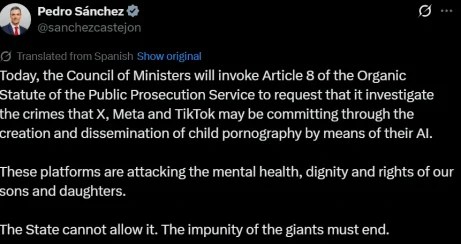
So when Pedro Sanchez walked out this morning and announced that Spain’s Council of Ministers would invoke Article 8 of the Organic Statute of the Public Prosecution Service — sic prosecutors onto X, Meta and TikTok for “crimes they may be committing” through AI-generated child pornography — understand what you’re looking at.
This isn’t a regulator at the end of its rope. This is a political class that has already built the machine, tested the machine, extracted billions through the machine — and is now deciding what else the machine can reach.
“May Be Committing”
That’s the phrase. Not “has committed.” Not “is committing.” May be. Sanchez posted it on X — the very platform he’s threatening to prosecute — and the media swallowed it whole, no questions about evidence or methodology or whether a public prosecutor’s office is the right instrument for making technical judgements about AI image generation pipelines.
The Spanish government claims Grok produced three million sexualised images in eleven days, including over 23,000 involving minors. Strong numbers. Specific numbers. Precise to the point of being designed to prevent challenge — because you can’t interrogate evidence you haven’t been shown, and asking to see it means you’re defending the indefensible. Not one published source. Not one independent methodology. They arrived complete, ready-made for outrage.
That’s the genius of it. The children gambit works precisely because you cannot question it without becoming the villain of the story.
Pavel Durov said it plainly — and look, nobody should hold Durov up as a civic virtue. But he’s spent years watching governments use platform regulation as a control mechanism, and when he says Sanchez’s moves aren’t safeguards but steps toward total control, he’s speaking from operational experience. He’s seen this architecture before. From the inside.
Here’s what this moment actually is, in the longer register. Every time a Western liberal government needs to consolidate control over the information environment, it finds a victim group whose protection cannot be questioned. In the 20th century they used communists, terrorists, drug dealers. The 21st century discovered something more powerful — children. Unimpeachable. Unchallengeable. A shield so morally absolute that any surveillance infrastructure built behind it arrives pre-legitimised. Sanchez didn’t invent this playbook. He’s just the current page.
Here’s the question nobody in any press conference asked today. If you actually wanted to protect children from AI-generated abuse material — if that were the genuine, singular, burning priority — what would you do?
You’d hunt the producers. Fund specialist cyber units with the resources and legal powers to identify, locate and prosecute the people who generate and distribute child sexual abuse material. Build better reporting pipelines so victims and witnesses have direct, fast routes to enforcement. Nail the distribution networks — the forums, the channels, the file-sharing infrastructure where this material moves — with targeted operations and international cooperation. Invest in takedown technology that works at scale. These are the unglamorous tools of actual child protection. Forensic. Technical. Expensive. Slow. Not suited to a press conference.
None of that is what Sanchez announced today. What he announced was prosecution of three of the most visible American technology platforms, with unverified statistics, under a legal mechanism designed for emergency government intervention in the public interest — on the same morning Keir Starmer in London announced restrictions on the last tool of genuine online privacy.
That’s not child protection. That’s the political class treating every ordinary user as a pre-suspect, building infrastructure that watches everyone in order to catch a tiny minority — and using the minority as the justification.
When someone says “think of the children,” look at what they’re actually building. Because what they’re building right now, across Europe and Britain, is an internet where you need permission to speak.
The Network They Actually Protected
Let’s be precise about who’s invoking children to demand your identity.
Jeffrey Epstein ran an international child trafficking operation for decades. Not speculation. Court and DOJ documents. Thirty-five girls identified by Palm Beach police in 2005. FBI reports going back to 1996. Federal prosecutors in Florida prepared a 60-count draft indictment in 2007 — conspiracy, sex trafficking of minors, enticement — charging Epstein and three co-conspirators described as employees who “persuaded, induced, and enticed individuals who had not attained the age of 18 years to engage in prostitution.”
The names of those three co-conspirators were in the indictment. Then US Attorney Alexander Acosta gave Epstein 13 months in county jail with work release six days a week and immunity for “any potential co-conspirators” — in direct violation of federal victims’ rights law. The investigation was shut down. Epstein walked. The network persisted.
Fast forward. January 2026. Department of Justice releases 3 million pages (a mere 2% of what they have in possession) under a law Congress passed unanimously demanding transparency. Victims’ names exposed. Driver’s licenses published. Witness statements naming perpetrators? Redacted. Draft indictment naming co-conspirators? Still redacted. Attorneys for over 200 victims called it “the single most egregious violation of victim privacy in one day in United States history” and accused DOJ of “hiding the names of perpetrators while exposing survivors.”
Congressmen like Thomas Massie had to read names aloud on the House floor before DOJ would release them. Rep. Ro Khanna: “The survivor statements to the FBI naming rich and powerful men who went to Epstein’s island, his ranch, his home — who raped and abused underage girls — they were all hidden.”
Now look at who’s demanding you hand over your identity to speak online.
Keir Starmer — the man proposing VPN bans and bypassing Parliament to regulate your thumbs on a screen — appointed Peter Mandelson as UK Ambassador to the United States in December 2024. Mandelson called himself Epstein’s “best pal” in Epstein’s 50th birthday book. Their friendship continued after Epstein’s 2008 conviction. Emails released in the January 2026 DOJ files show Mandelson received £75,000 in payments from Epstein between 2003-2004, leaked classified government information to him while serving as Business Secretary in 2009-2010, and sent messages suggesting Epstein was wrongfully convicted.
Starmer knew about the Epstein connection when he made the appointment. Mandelson had already resigned from government twice before — conflicts of interest, financial misconduct — and the Epstein relationship was public record. Starmer appointed him anyway. Made him Britain’s top diplomat. Gave him the US ambassador post. When the files dropped and the depth of the relationship became undeniable, Starmer’s chief of staff Morgan McSweeney — who recommended Mandelson — resigned. Then Starmer’s communications director. Then his cabinet secretary. Three senior aides gone in days.
Mandelson is now under criminal investigation by the Metropolitan Police for misconduct in public office. US Congress has requested he submit to interview as part of its investigation into Epstein’s co-conspirators and enablers.
And Starmer — whose government just had VPN downloads surge 1,800% because British citizens don’t trust him with their browsing data — is the man now lecturing the public about online child safety.
This isn’t hypocrisy. It’s consistency. The same political class that gave Epstein’s network immunity and protected co-conspirators for two decades is now demanding total visibility over your identity. The same Department of Justice that hid perpetrators and exposed survivors is the one telling you encryption backdoors are necessary to protect children. The same institutions that shut down the Epstein investigation in 2008 and buried the names in 2026 are building the Digital Identity Wallet, the fact-checker networks, the 24-hour removal mandates.
When they say this is about protecting children, look at the Epstein files. Look at who they protected. Look at who they prosecuted. Look at who they gave immunity. Look at whose names are still redacted while survivors’ information gets published.
Then ask yourself why these exact same people need to know who you are before you’re allowed to speak.
What This Actually Is — Unelected, Unaccountable, and Expanding
Here’s what nobody in the mainstream coverage will say: the regulatory apparatus now targeting these platforms was not built by people you voted for.
Picture what happens when a flag arrives. It’s 2am. A compliance officer at a major platform — a 26-year-old in Dublin or Amsterdam with a policy degree and a quota — opens an alert. A Brussels-appointed body has flagged a post as potentially harmful. The DSA gives the platform 24 hours to act or face fines of up to 6% of global revenue. There’s no named accuser. No court order. No adversarial process. Just a designation, a deadline, and a number so large that hesitation is financially irrational. The post gets removed. The writer wakes up to find their words gone. The politician whose opponents wrote it points elsewhere. The regulator points at the law. The compliance officer points at the process.
Nobody elected any of them.
The European Commission is not elected. Its commissioners are appointed by governments, approved by a parliament most Europeans couldn’t name the composition of — and its enforcement apparatus, the officials running fourteen DSA proceedings and handing out nine-figure fines, operates at a distance from democratic accountability that is not incidental but structural. The “trusted flaggers” embedded in the DSA framework, deputised to mark content for priority removal, are appointed bodies. Ofcom in the UK is a regulator, not an elected chamber. The European Board for Digital Services, coordinating enforcement across 27 countries, answers to no electorate anywhere on earth.
Sanchez and Starmer announce the intention. The technocrats execute it. And when it goes wrong — when the journalist’s article vanishes into a compliance process with no appeal, when the civil servant’s flagging of “migrant hotel” videos turns out to be political interference dressed as child protection — there is no one to vote out. The politician points at the regulator. The regulator points at the law. The law was written in workshops whose attendees you’ll never know. Democratic majorities change. Regulatory architecture doesn’t.
That’s not a flaw in the system. It’s the system working exactly as it was designed.
Britain and the VPN — The Moment the Mask Slipped
The week before Sanchez made his announcement, Keir Starmer was in London saying “no platform gets a free pass.” New powers to restrict social media. AI chatbots brought under the Online Safety Act. Infinite scrolling — the physical act of moving your thumb down a screen — to be regulated. Action in “months, not years.” And crucially, explicitly, openly: bypassing the parliamentary scrutiny that would normally apply to legislation this significant. He said it out loud. The urgency is too great for debate.
But the detail that should stop every person who cares about liberty cold is the VPN proposal.
Let’s be clear about what a VPN actually is, because the political class is clearly hoping you don’t know and don’t care to find out.
A Virtual Private Network encrypts your internet connection and masks your IP address — your digital location, the identifying tag that follows you across every website you visit, that your internet service provider logs, that governments can and do compel ISPs to hand over. When you use a VPN, your traffic passes through an encrypted tunnel. Your ISP sees that you’re connected to a VPN server. That’s it. They cannot see where you go. They cannot see what you say. They cannot read your communications.
This is the tool that domestic abuse survivors use to hide their location from abusers. That investigative journalists use to protect their sources. That activists use to organise without government surveillance. VPNs aren’t a loophole. They’re a lifeline.
After the UK Online Safety Act came into force, VPN downloads in Britain surged by 1,800%. Half the top ten apps in British app stores became VPN services. Ordinary British citizens — not criminals, not paedophiles, not terrorists — reached for the exact same tool that people under authoritarian regimes use to avoid state surveillance, because they didn’t want to submit government-verified identity just to browse normally.
Starmer’s response to that 1,800% signal was to propose restricting VPNs.
Not to reconsider whether the surveillance infrastructure was too invasive. Not to ask why a free people felt the need for anonymity tools in a democracy. No — the tool of privacy is the problem. The loophole to be closed.
And here’s the thing that proves this was never about children. Ban commercial VPNs tomorrow and any determined teenager circumvents it within hours — cheap cloud servers, open proxies, custom tunnels for less than a dollar a month. The only people genuinely impacted are the ones relying on them for legitimate safety: the abuse survivor hiding their location, the journalist protecting a source, the person who simply doesn’t want their ISP building a commercial profile of their private reading habits. A VPN ban doesn’t protect children. It closes the last gap in the surveillance infrastructure — means that when the DSA triggers an investigation into your political commentary, when the Brussels-appointed fact-checker flags your article, there’s nowhere left to go. No tunnel. No private space. Just a 1984 dystopian, digitally enhanced.
The Wallet Nobody’s Talking About
Beneath all of this — quieter, slower, more permanent than any headline — is the piece of architecture that makes everything else irrelevant to debate once it’s in place.
By December 2026, every EU member state is legally required to provide its citizens with a European Digital Identity Wallet. Not a proposal. Law — Regulation EU 2024/1183, in force since May 2024. Major platforms will be required to accept it as a login mechanism. The private sector — banks, retailers, online services, social media — can request verified identity information through it.
Brussels will tell you the privacy protections are robust. And it’s worth taking that position seriously, because it isn’t entirely dishonest.
Article 5a of the regulation is real. It states explicitly that relying parties — the companies and platforms using the wallet — “shall not refuse the use of pseudonyms, where the identification of the user is not required by Union or national law.” The Commission points to this as the safeguard. They have a point. It’s in the law. It’s binding. If you want to use your wallet pseudonymously on a platform that has no legal requirement to know who you are, the regulation says you can. Proponents argue this is a meaningful, enforceable right — and that critics conflating the wallet with mandatory real-name requirements are misreading the text.
The problem is the eleven words the Commission would prefer you not to dwell on: where the identification of the user is not required by Union or national law.
That clause means the pseudonymity right exists only in the space where no law has yet required your identity. It is protection that any member state can legislate away, for any service, with a single national law and a stated reason. Child protection. Anti-terrorism. Financial crime. Age verification. The reasons are not hard to find. The EU has no override mechanism — Brussels cannot prevent a member state from passing a law that, in its domestic application, triggers the exception and requires identification. So the right survives only until a government decides it shouldn’t. One parliament. One vote. The pseudonymity is gone for that service, in that country — legally, permanently, with the full blessing of the regulation’s own text.
And there’s something else the Commission won’t volunteer. The architecture meant to enforce the pseudonymity right — the mechanism that would actually prevent platforms from demanding your identity when they have no legal right to — was quietly gutted in implementation. Privacy advocates at epicenter.works, the only civil society organisation that worked on this file throughout the entire reform process, found that the Commission made relying party registration certificates optional rather than mandatory. Without mandatory certificates, the wallet cannot verify whether a company’s request for your real identity is legitimate or overreaching. Tech giants can demand identification in contexts that don’t legally require it. There is no technical mechanism to stop them. The safeguard exists in the legislation. The infrastructure that would make the safeguard real was made optional in the implementing regulations.
The Commission was told this directly. They proceeded anyway.
Civil society organisations warned EU officials in an open letter that the wallet “may eliminate anonymity, leading to over-identification and a loss of privacy.” Unacknowledged. One hundred and thirteen free speech and privacy experts wrote separately to raise similar concerns about the broader regulatory framework. Ignored. The pattern of constructing the infrastructure first and addressing rights concerns later — or not at all — is not a run of oversight failures. It’s a consistent set of choices made by people who understood exactly what they were choosing.
The Machine Is Already Running
People keep framing this as something that might happen. Future concerns. Hypothetical overreach.
It’s not the future.
The European Democracy Shield is operational — fifty action points, a European Centre for Democratic Resilience, a state-funded network of fact-checkers on Brussels money with a Brussels mandate, described in their own documents as “rapid response capacity” for information “crises.” The Commission decides what a crisis is. There is no external appeal. Just a bureaucrat with a mandate to act within 24 hours and a definition of disinformation so broad that it extends, in the Commission’s own telling, to content “that is not illegal.”
How broad? In May 2025, the Commission hosted a closed-door workshop with platform compliance teams. Training exercises. Internal documents. The US House Judiciary Committee obtained these documents under subpoena — you can disagree with the committee’s politics but you can’t argue with what the documents actually show. One exercise asked participants how to handle a post: an image of a teenage Muslim girl in a hijab alongside the text “we need to take back our country.” The exercise classified the combination as “illegal hate speech” requiring removal. Now, a reasonable person might argue about that specific scenario. Fine. Argue it. But the fact that this is the level at which European regulators are working — training platform compliance teams to remove common political sentiment combined with religious imagery, in closed-door workshops, before any court has ruled, before any democratic debate has happened — tells you something important about where the definitions are pointing.
Think about what that means in practice. Not in theory — in practice. A compliance officer at a platform with 400 million users gets a flag from a Brussels-funded body. The post contains a political opinion combined with an image. The body has designated it harmful. The platform has 24 hours. The alternative is a fine that could be measured in billions. Nobody phones a judge. Nobody consults the person who wrote it. The post disappears. And when it does — when that specific combination of political sentiment and religious imagery gets quietly removed from 400 million people’s feeds at 2am by someone following a process designed in a workshop that was closed to the public — that isn’t a transparency obligation. That’s the state deciding what the public is allowed to see. And doing it with plausible deniability built in at every layer.
That fact-checker network plugs directly into DSA enforcement. Platforms — X, Meta, TikTok, and by mid-2026 almost certainly ChatGPT, which already has three times the user numbers needed to trigger Very Large Online Platform designation — will be legally required to act on those findings. Not consider them. Act. Within 24 hours. Or face fines of 6% of global revenue.
The €120 million fine X received in December 2025 wasn’t for hosting child abuse content. It was for opacity — for not giving government-approved researchers access to the recommendation algorithm that determines what information reaches citizens. The Commission called it a transparency obligation. What it actually was: the state asserting the right to see inside the machine that shapes what the public thinks, so it can instruct the machine to shape it differently.
And when the Digital Identity Wallet closes the last gap — when the pseudonymity is quietly legislated away by a member state with a “reason,” when the VPN tunnel gets restricted, when every platform knows exactly who is saying what with a government-verified name attached — the system is complete. Everyone who speaks online, identified. Everything said, attributable. Every flag by a Brussels-appointed body, actionable within a day.
All of it constructed, piece by deliberate piece, in the name of protecting children from harm.
Final thoughts
The Soviet Union had a name for the officials who ran its censorship apparatus. Guardians of the public good. They had fact-checkers — called editors, party reviewers, information officers. Rapid response systems. Legal frameworks for acting on speech that threatened the stability of the state. Most of them genuinely believed they were protecting something real. That’s what makes these systems so durable — the people inside them are sincere.
They didn’t think of themselves as censors either.
What you are watching, from Madrid to London to Brussels, is the construction of a digital order in which the ability to speak freely, anonymously, without state knowledge, is being dismantled — not through jackboots but through frameworks, directives, DSA workshops, government-funded fact-checker networks, and the entirely reasonable-sounding proposition that we must protect our children.
Sánchez is a man whose government has been at war with X since the platform gave his opponents a direct line to Spanish voters that bypassed media institutions his party spent years cultivating. Starmer is a man whose government monitored social media during a domestic political crisis and then moved to expand its legal authority over the very platforms that let citizens talk about what they saw. The European Commission is a body of unelected officials who trained platform compliance teams, in closed-door workshops, to remove political sentiment they’d categorised as harmful — and then ignored 113 experts who wrote to warn them what they were building.
Keir Starmer is a man who appointed an Epstein associate as his personal envoy to Washington, knowing the relationship, knowing the history, and when it collapsed appointed himself the guardian of online child safety
These. Are. The self appointed guardians of the children.
They gave Epstein’s co-conspirators immunity and are still hiding their names two decades later. But they need to know yours before you can post a political opinion. They protected a trafficking network with clients in the highest levels of Western power. But you’re the threat that requires a Digital Identity Wallet. They redacted the men who procured children for a convicted paedophile while publishing the victims’ driver’s licenses. But your VPN is the problem that demands legislative action.
Call that what it is.
They didn’t prosecute the network because they were the network’s best customers. So how dare they invoke children’s safety to strip yours.
€2.5 billion extracted. Fourteen proceedings active. A Digital ID mandate rolling out across 27 countries by year’s end. VPNs under legislative attack in the birthplace of the Magna Carta. Parliamentary scrutiny openly bypassed in London. A Democracy Shield with a rapid response protocol for information crises that no one elected anyone to define.
They’ve been building this for ten years. The fines, the frameworks, the wallets, the fact-checkers, the VPN bans, the bypassed parliaments. Layer by layer. Always with a reason. Always with a child somewhere in the justification.
They’re nearly done.
And when it’s finished — when the wallet is in your pocket, the fact-checkers are wired to the platforms, the pseudonymity has been legislated away in some member state that needed a “reason,” the last encrypted tunnel closed — they will stand in front of all of it and tell you it was always, only, ever about the children.
An internet where you need permission to speak isn’t a safer internet. It’s a controlled one.
Epstein’s co-conspirators walk free while you need state permission to call them what they are.
Believe them if you want. History will know what it was.
Putin aide urges retaliation to ‘Western piracy’
RT | February 17, 2026
Russia’s response to “Western piracy” targeting its maritime trade should be forceful and not limited to diplomatic means, an aide to President Vladimir Putin has said.
Nikolay Patrushev, a veteran national security official who heads a naval policymaking body, called for stronger action against Western moves targeting vessels described as part of an alleged Russian ‘shadow fleet’.
Attempts to paralyze Russian foreign trade will only intensify, Patrushev warned in an interview with Argumenty i Fakty published on Tuesday.
“Unless we push back forcefully, soon the English, the French, and even the Balts will get brazen enough to try and block our nation’s access to at least the Atlantic,” he said.
“The Europeans are in essence making steps to impose a naval blockade, deliberately pushing towards a military escalation, testing the limits of our patience and provoking our retaliation. If the situation is not resolved peacefully, the Navy will be breaking and lifting the blockade,” Patrushev said.
“Let’s not forget that plenty of vessels sail the seas under European flags. We may get curious about what they are shipping and where,” he added.
Patrushev expressed skepticism that tensions could ease, saying “there is little hope that the West has an ounce of respect for diplomacy and the law.” He argued that “the old practice of ‘gunboat diplomacy’ is being revived,” citing US operations targeting Venezuela and Iran.
Washington has used warships to target suspected drug smuggling boats off Venezuela and intercept outgoing oil tankers, including one sailing under a Russian flag. The Pentagon is now concentrating assets in the Middle East as President Donald Trump pressures Iran to accept restrictions on its missile deterrence against Israel.
In today’s world, the Russian Navy is “a geopolitical tool that combines might with flexibility and is suitable for both peacetime and armed conflicts,” Patrushev said. Its strength is needed to protect Russia’s “ability to export oil, grain and fertilizers, and the normal functioning of the state.”
Keir Starmer-tied think tank paid PR firm to target The Grayzone
By Kit Klarenberg | The Grayzone | February 16, 2026
Leaked files have revealed that Labour Together, the shadowy think tank run by disgraced former top Keir Starmer aide Morgan McSweeney, paid the Washington DC-based corporate intelligence firm APCO Worldwide to spy on journalists who reported on their corrupt handling of campaign finances.
The reporters named appear to have been targeted for their efforts to investigate how the UK’s Labour Party elites spent 730,000 pounds in undeclared donations to install Starmer as their leader.
The files show APCO used those funds to oversee the fabrication of a dodgy, evidence-free dossier claiming that Russia was behind damaging disclosures about Labour Together, which it submitted to the National Cyber Security Centre (NCSC) of Britain’s GCHQ — London’s equivalent to the US National Security Agency.
The “significant persons of interest” listed in APCO’s McCarthyite casebook included The Grayzone and myself.
According to my APCO dossier, “While a self described ‘investigative journalist,’ he is an author for the Gray Zone. The site has been described as a ‘conspiracy blog’ and ‘Wagner propaganda channel.’ In 2023,” the dossier reads, I “was arrested by counter-terror police after [I] arrived in the UK.”
APCO bills itself as “a trusted and strategic advisor… that drive[s] our clients’ missions and objectives forward.” Despite its massive contract with Labour Together, the files show the PR firm struggled to identify its targets, and proved unable to establish the most basic facts about them.
When APCO branded The Grayzone as “Wagner propaganda,” it seemed to have confused us with “Grey Zone,” an entirely unrelated and now-defunct Telegram channel affiliated with the Russian military contractor. APCO also claimed I was “arrested by counter-terrorism police” in May 2023 upon returning to Britain. In fact, I had been detained, not arrested.
APCO also targeted journalists Matt Taibbi and Paul Holden, who led investigations into Labour Together’s potentially criminal activities, based on leaks and Freedom of Information requests. The PR firm had sought to secure “leverage” over Holden in order to sabotage his work.
The spying scandal began in November 2023, when Britain’s Sunday Times revealed that Keir Starmer’s campaign manager, Morgan McSweeney, had failed to declare £730,000 in campaign donations which he diverted to advance Starmer’s rise to Labour leadership. One month later, APCO prepared a memo for Labour Together outlining a strategy to blame the damaging disclosure on Russian hackers and attack the journalists who dared to publish details of the offending documents.
The story was given new life in February 2026, when British journalist Peter Geoghehan exposed a secret contract showing Labour Together paid APCO £30,000 to investigate the journalists it blamed for exposing its legally questionable activities.
It has now gone mainstream, with the Sunday Times publishing a lengthy report branding the Labour operation as a “dirty smear” based on a “lie” about Russian hacking.
However, the Times article omitted any mention of this reporter or The Grayzone, even though we were prominently targeted by Labour Together. In the following investigation, we explain why The Grayzone was targeted, tracing the origins of the slimy spying operation to a network of Labourite operatives who have sought to destroy us since well before Starmer came to power.
“Familiar with masters of the same drivers”
Labour Together was founded in 2015 by McSweeney, Starmer’s longtime svengali. After several failed campaigns for establishment candidates, McSweeney managed to transform his organization into a propaganda juggernaut, soliciting large donations from the UK Israel lobby’s most significant moneyman, Trevor Chinn.
While presenting his campaigning outfit as a plucky little think tank, he wielded it against Labour leader Jeremy Corbyn and the movement behind him. To neutralize the ecosystem of alternative media outlets supporting Corbyn as Labour leader, Labour Together contracted a political operative named Imran Ahmed to spin out a censorship front called “Stop Funding Fake News.”
After weaponizing dubious charges of antisemitism to defund one of the most influential pro-Corbyn outlets, Canary UK, the organization folded, then resurfaced as the much bolder Center for Countering Digital Hate (CCDH). Based inside the office of Labour Together, CCDH relied on the funding from Chinn and, as The Grayzone’s Max Blumenthal revealed, secretly coordinated with the Israeli embassy in Washington.
McSweeney entered Downing Street as Starmer’s Chief of Staff just one month before Trump’s re-election. Among his most important tasks was repairing relations with the US President. At the time, Trump’s aides were bristling over reports that McSweeney met with Democratic presidential nominee Kamala Harris during the Democratic National Convention to plot strategy. One of Trump’s top donors, the transhumanist mega-billionaire Elon Musk, also had his knives out for McSweeney after journalists Matt Taibbi and Paul Thacker revealed that CCDH’s top priority for 2024 was to “kill Elon Musk’s Twitter.”
McSweeney’s solution was to dispatch one of Labour’s most seasoned – and scandal-stained – fixers to Washington. He was Lord Peter Mandelson, the architect of the neoliberal New Labour wave whose notoriously transactional tendencies seemed to make him the perfect match for Trump. Mandelson made himself a fixture at Butterworth’s, a favorite Capitol Hill haunt of MAGA operatives, and insinuated himself into Trumpist social circles.
In June 2025, the restaurant erected a plaque honoring Mandelson during a ceremony overseen by Raheem Kassam, a close associate of former Trump chief of staff Steve Bannon. There, a mirthful Mandelson raised a toast and proclaimed a special kinship with the MAGA elite: “Although we don’t have identical politics, we are familiar with masters of the same drivers that brought our respective figures to power — President Trump in your case and Keir Starmer in mine.”
But Mandelson was also dogged by the same sex trafficking figure who constantly inhabited the personal lives of both Trump and Bannon: Jeffrey Epstein. Both McSweeney and Starmer had been keenly aware of the ambassador’s friendship with Epstein, but they dismissed the concerns, even ignoring a warning from UK security services.
However, when a series of emails confirming Mandelson’s friendship with Epstein poured forth as part of a release by the US Department of Justice, the ambassador’s position became untenable. Following his firing in September 2025, a new tranche of emails published this January provided an even more damning portrait of their friendship. They showed, for instance, that Epstein channeled money to Mandelson’s husband, Reinaldo Avila da Silva, for a specious initiative which was never completed. Even worse, the communications exposed Mandelson providing Epstein with advance notice of the impending collapse of Prime Minister Gordon Brown’s government in 2010, as well as sensitive information about the UK’s “saleable assets.”
McSweeney’s scheming had finally caught up with him. Though Starmer initially praised and defended his longtime campaign guru in parliament, he caved soon after, forcing McSweeney to resign his post on February 8.
In the days since, Starmer has been unable to fill the vacancy. Meanwhile, another senior Labour official is reportedly considering leaving his role as well. Amid the chaos, British media has begun to speculate that the Prime Minister will be next to go.
Will the revelation of Labour Together’s media enemies list, and its secret contract with APCO, be the weight that finally sinks Starmer?
Labour Together’s misdirection ploy: blame Russia
McSweeney was aware that Labour Together had secretly contracted APCO to spy on journalists; however, he didn’t carry out the dirty work himself. That job appears to have been commissioned by his successor at the think tank, Josh Simons, who’s now a senior minister in Starmer’s government.
Simons has dismissed reports that the PR firm was tasked with spying on reporters as “nonsense,” insisting that APCO was merely “asked to look into a suspected illegal hack.” Simons’ disingenuous claims are undermined by newly-leaked documents related to the probe, however.
Perhaps most damning is a December 2023 memo prepared by APCO for Labour Together which shows investigators fretting about “recent articles and blog posts” which threatened to draw attention to the political group’s questionable funding schemes. Information published by these meddling journalists, particularly Paul Holden, “[raised] concern about the source of his information and what more he may choose to publish in the future,” the memo continued.
It was therefore deemed “important to identify the source of the information and to ascertain what additional information could be published.” Labour Together tasked APCO with probing several journalists, dubbed “significant persons of interest.”
The memo speculated that Holden and others may have received leaks from inside Labour Together, Labour party headquarters, parliament, or “illegally-gathered information collected” from a purported “hack” of Britain’s Electoral Commission in 2023. APCO concluded it was “essential” for Labour Together to concoct a strategy to counter the critical reporting.
Its response was to blame the organization’s woes on a Russian hack. But rather than hiring a cyber-security firm to investigate the supposed data breach, it contracted a corporate intelligence firm to attack the messengers.
In February 2024, The Guardian contacted Holden to alert him that the paper was preparing a hit piece alleging he was under investigation by the NCSC for receiving illegally obtained information from Russia. The Guardian had clearly been influenced by briefings from Labour Together, as well as by APCO’s report. Yet the outlet backed off when Holden promised to sue them for defamation.
APCO is now under formal investigation for potential standards breaches by Britain’s Public Relations and Communication Association.
How did The Grayzone wind up on Labour Together’s enemies list?
It is unclear how and why I became a “significant person of interest” in APCO and Labour Together’s secret smear campaign. However, their operation dovetailed with another surreptitious attempt by intelligence-tied actors to smear The Grayzone as Russian agents.
I have never spoken to Paul Holden or other journalists named as the firm’s targets, or conducted any journalistic investigations into Labour Together’s corrupt financial dealings. When APCO initiated its probe, I had mentioned Labour Together in a single article months prior that focused on the organization’s censorship-obsessed spinoff, the Center for Countering Digital Hate.
Such sloppiness and paranoia is the hallmark of Amil Khan, a veteran British government psyops warrior turned “disinformation expert” involved with Labour Together and Starmer’s Labour.
Khan cut his teeth running covert British-funded psychological warfare operations during the Syrian dirty war, supporting violent extremist groups armed and financed by the CIA and MI6. He subsequently founded Valent Projects, which “specializes in addressing online manipulation.” Khan’s outfit produced a paper on social media ratfucking strategies for Labour Together entitled, “Power and Persuasion: Understanding the Right’s Playbook.”
In December 2021, The Grayzone exposed how Valent Projects covertly produced Covid vaccine propaganda funded by the British monarchy’s Royal Institute, using then-popular “BreadTube” personality Abigail Thorn as the front person for its campaign. The investigation apparently placed this outlet in the crosshairs of Khan and his information warfare network.

Less than a year later, The Grayzone exposed Khan again – this time, for his role in a covert conspiracy to destroy us. Enlisted by celebrity former leftist journalist Paul Mason, Khan helped coordinate a harebrained scheme to demonetize and deplatform The Grayzone. The pair discussed going “full nuclear legal to squeeze [The Grayzone] financially,” and proposed publishing intelligence agency-sourced smears to delegitimize this outlet.
As their revenge plot approached its paranoid apogee, Mason and Khan fantasized about hosting an anti-Grayzone summit with some of the most rabid, intelligence-tied opponents of our reporting. Among those they pitched for the gathering was Imran Ahmed, director of the censorship-obsessed Center for Countering Digital Hate (CCDH), which was founded by Morgan McSweeney and shared an office with his Labour Together.
While it is unknown if the anti-Grayzone summit ever took place, we have since learned that Mason enlisted a team of high-priced London lawyers to sue this outlet just days after our article exposing his secret smear campaign appeared. In May 2023, I was detained at the UK’s Luton International Airport and interrogated about The Grayzone’s activities by counter-terror police. Six months later, APCO initiated its covert investigation of me, The Grayzone, and others whose reporting had wound them up on the Labour Together enemies list.
APCO has so far remained silent about the scandal. The Grayzone has submitted a request for comment to Tom Short, the PR firm’s London chief. We received an automated response revealing he conveniently slipped away to the US. Upon Short’s return to Britain, APCO will no longer be able to hide behind bogus allegations of Russian hacking.
Ian Proud: Economic Reset with Russia to Save Europe
Glenn Diesen | Feb 15, 2026
Ian Proud discusses why an economic reset with Russia is required for a stable peace and to prevent Europe from becoming a weakened relic of a unipolar past. As a former British diplomat, Proud performed a number of roles, including the Economic Counsellor at the UK’s embassy in Moscow between 2014 and 2019.
The Peacemonger: https://www.youtube.com/@IanProud
Follow Prof. Glenn Diesen:
Substack: https://glenndiesen.substack.com/
X/Twitter: https://x.com/Glenn_Diesen
Patreon: https://www.patreon.com/glenndiesen
Support the research by Prof. Glenn Diesen:
PayPal: https://www.paypal.com/paypalme/glenndiesen
Buy me a Coffee: buymeacoffee.com/gdieseng
Go Fund Me: https://gofund.me/09ea012f
NATO plotting maritime blockade of Russia – Moscow
RT | February 14, 2026
NATO countries are plotting an illegal maritime blockade of Russia, particularly in the Baltic and the Arctic regions, Moscow’s ambassador to Norway, Nikolay Korchunov, has said.
In an interview with RIA Novosti published on Saturday, Korchunov accused the bloc’s members, including Norway, of “putting the Baltic-Arctic region on a barrack-like footing” by holding a series of exercises. This, he added, is aimed at “restricting freedom of navigation and violates international law norms.”
According to the envoy, NATO is also developing plans for “a partial or complete naval blockade” of Russia. In addition, such NATO members as Norway, Sweden, and Finland “are working together to increase military mobility through the development of transport and logistics corridors from west to east, as well as through cross-border use of bases and other military infrastructure.”
These preparations increase tensions and represent a direct threat to Russia’s national security and would force Moscow to take countermeasures, Korchunov warned.
His remarks come after Bloomberg reported on Friday that UK Defense Secretary John Healey had met with counterparts from Baltic and Nordic nations on the sidelines of the Munich Security Conference to discuss seizing Russia-linked oil tankers.
In recent months, Western countries have detained several Russia-linked cargo vessels under various pretenses. Moscow has consistently condemned the seizures as “piracy” and a blatant violation of international maritime law.
Last year, Russian presidential aide Nikolay Patrushev warned that NATO is seeking to undermine Moscow’s economy by considering a blockade of the country, including by paralyzing Russian ports in the St. Petersburg and Kaliningrad regions. He also pointed out that the bloc is seeking to turn the Black and Baltic Seas into “internal waters of the alliance,” adding that Moscow is preparing countermeasures in response.
UK High Court rules Palestine Action ban unlawful
Al Mayadeen | February 13, 2026
The UK High Court ruled on Friday that the government’s proscription of Palestine Action under the Terrorism Act was unlawful.
On Friday, three judges led by Dame Victoria Sharp, president of the King’s Bench Division, concluded that the decision to ban the group was unlawful. However, the ban will remain temporarily in place to allow the government time to appeal.
From July 5 last year, membership of or public support for Palestine Action became a criminal offence punishable by up to 14 years in prison. The group had been placed on the list of proscribed organisations, categorizing it alongside internationally recognized armed groups.
The court upheld the challenge on two of four grounds. Judges found that the proscription represented “a very significant interference” with the rights to freedom of speech, peaceful assembly, and association. They also ruled that Yvette Cooper’s decision was inconsistent with her own stated policy.
Sharp described Palestine Action as an organisation “that promotes its political cause through criminality and encouragement of criminality”, but continued, “The court considered that the proscription of Palestine Action was disproportionate. A very small number of Palestine Action’s activities amounted to acts of terrorism within the definition of section 1 of the 2000 Act.”
“For these, and for Palestine Action’s other criminal activities, the general criminal law remains available. The nature and scale of Palestine Action’s activities falling within the definition of terrorism had not yet reached the level, scale, and persistence to warrant proscription,” Sharp added.
Legal and political repercussions
The judgment marks the first time an organisation banned under the Terrorism Act has successfully challenged its proscription in court.
According to the campaign group Defend Our Juries, more than 2,700 people have been arrested since the ban took effect, most under section 13 of the Terrorism Act. More than 500 individuals, including clergy, pensioners, and military veterans, have been charged.
If the proscription order is ultimately quashed, the charges could be dropped. For now, those charged remain in legal uncertainty while the ban stays in force pending appeal.
Government to appeal decision
Current home secretary Shabana Mahmood said she would challenge the ruling.
Palestine Action co-founder Huda Ammori described the decision as a “monumental victory” and said the ban was based on property damage rather than violence against individuals.
“We were banned because Palestine Action’s disruption of Israel’s largest weapons manufacturer, Elbit Systems, cost the corporation millions of pounds in profits and to lose out on multibillion-pound contracts.
“We’ve used the same tactics as direct action organisations throughout history, including anti-war groups Keir Starmer defended in court, and the government acknowledged in these legal proceedings that this ban was based on property damage, not violence against people.
“Banning Palestine Action was always about appeasing pro-Israel lobby groups and weapons manufacturers, and nothing to do with terrorism … Today’s landmark ruling is a victory for freedom for all, and I urge the government to respect the court’s decision and bring this injustice to an end without further delay.”
The case is likely to intensify debate in the United Kingdom over the balance between national security powers and civil liberties.
Populations in key NATO nations balk at sacrifices for military spending – poll
RT | February 13, 2026
People in key NATO nations are reluctant to tighten their belts to fund increased defense spending, despite believing that the world is “heading toward global war,” according to a Politico poll published on Friday.
The poll, which surveyed at least 2,000 people from the US, Canada, the UK, France, and Germany each, found that majorities in four of the five countries think “the world is becoming more dangerous” and expect World War III to break out within five years.
Nearly half of Americans (46%) consider a new world war ‘likely’ or ‘very likely’ by 2031, up from 38% last year. In the UK, 43% share this belief, up from 30% in March 2025.
French respondents matched British levels at 43%, and 40% of Canadians expect war within five years. Only Germans remain skeptical, with a majority believing that a global conflict is unlikely in the near term.
The survey suggested a stark disconnect, however, between the growing alarm and willingness to pay for a defense buildup. While respondents support increased military spending in principle, support fell dramatically when specific trade-offs were mentioned.
In France, support dropped from 40% to 28% when those being surveyed were told about the potential financial and fiscal consequences. In Germany, it fell from 37% to 24%, with defense spending ranking as one of the least popular uses of money.
The survey also suggested significant skepticism about creating an EU army under a central command, with support at 22% in Germany and 17% in France.
While the poll suggests that Russia is perceived as the ‘biggest threat’ to Europe, Canadians view the administration of US President Donald Trump as the greatest danger to their security. Respondents in France, Germany, and the UK rank the US as the second-biggest threat – cited far more often than China.
The findings come after NATO Secretary-General Mark Rutte urged members states in December to embrace a “wartime mindset” amid the stand-off with Russia. This also comes amid Western media speculation that Russia could attack European NATO members within several years. Moscow has dismissed the claims as “nonsense,” while accusing EU countries of manufacturing anti-Russia hysteria to justify reckless militarization.
No Grounds for Talks About New Negotiations With US on New START – Russian Deputy Foreign Minister
Sputnik – 09.02.2026
There are no grounds for talking about launching new negotiations with the United States on the New Strategic Arms Reduction Treaty (New START), Russian Deputy Foreign Minister Sergey Ryabkov said on Monday.
“There is currently no basis for discussing the launch of such a negotiation process. We have repeatedly spoken about the need to see deeper, far-reaching changes for the better in the US approach to the issues we are discussing,” Ryabkov said on the sidelines of the BRICS Sherpa meeting in New Delhi, adding that when US policy towards Russia changes for the better, then the preconditions for launching a corresponding dialogue will arise.
Russia regrets that the US administration perceives the New START Treaty as something that requires replacement with something else, the deputy foreign minister added.
“In any such hypothetical process, nothing would come of it without the involvement of the United Kingdom and the French Republic, as the United States’ closest allies, both possessing nuclear weapons and, in the current, highly tense international situation, pursuing a highly aggressive course toward our country. Therefore, ignoring their nuclear arsenals would be irresponsible. They must be at the negotiating table, I repeat, if and when something like this becomes relevant,” Ryabkov also said.
Featured Video

Chinese jet fuel and the myth of energy independence
or go to
Aletho News Archives – Video-Images
From the Archives
The Dirty Little Secret behind the “Global Terrorism Index”
The Omission of Israeli Terrorism in the Occupied Palestinian Territories
By Karin Brothers | Global Research | December 6, 2014
… The Israeli settlements — all of which are illegal – have been identified as a major impediment to peace. The refusal of a major “global” terrorism report to name the Israeli settlers as one of the groups most responsible for terrorism not only misrepresents a major source of regional violence but exposes the Global Terrorism Index as a propaganda tool that supports a U.S. agenda.
In recent years, governments have been attempting to thwart terrorism by blocking supportive fund-raising. When it comes to Israeli settlements, however, the US and Canada actually encourage fund-raising by giving organizations (such as Christian Friends of Israeli Communities (CFOIC) and the Jewish National Fund) financial support in the form of donor tax-deductions.
Charities which provide funds for the Israeli settlements should be regarded as terror-financing organizations. They should not only lose their tax-deductible status, but they should be banned because they support the violation of international humanitarian law. The terror-financing laws that are being strictly enforced for Muslim charities should be applied to Christian and Jewish charities as well. … Read full article
Blog Roll
 Aletho News
- Chinese jet fuel and the myth of energy independence
- Ukraine Sea Drone Fired From Libya Hit Russian Tanker in Mediterranean
- IRGC: Iranian forces launched no attacks during ceasefire hours
- Trump Administration Moves To Automate U.S. Military Draft Registration
- Spain orders reopening of Tehran embassy, condemns Israel’s carpet bombing of Lebanon
- Israel faces ‘unsustainable’ strategic crisis following 40-day war against Iran: Analyst
- Iran restricts Hormuz access to 15 vessels per day under ceasefire terms: Report
- The ‘Opposition Party’ Has Done Nothing to Stop the Iran War and Much to Goad Trump Into Continuing It
- Moscow backs Tehran on status of Lebanon in US-Iran deal
- How UK Regulator Ofcom Quietly Bypassed International Law to Police American Speech
- If Americans Knew
- Amnesty: Urgent – Protect Lebanese civilians from brutal escalation in Israeli attacks
- Is The War Against Iran Over?
- Inside the Israeli army’s propaganda wing
- Hundreds of Gaza Amputees Stranded in Legal Limbo
- The gallows law: Israel moves toward executing Palestinian children
- Tucker Carlson: The Path to Peace requires ending ‘special alliance’ with Israel
- This is ceasefire? Israel’s biggest massacre yet in Lebanon, another journalist killed in Gaza – Daily Update
- Tucker Carlson on Israel: This Is the Behavior of an Ally? Really?
- Gazans face a triple crisis: severe shortages of water and bread, healthcare in tatters
- NY Times reports how Netanyahu took the US into Iran War
- No Tricks Zone
- An Inconvenient Tree: Uncovered In Alps… Europe Much Warmer Than Today 6000 Years Ago
- New Study Reports A 60% Slowdown In Greenland’s Ice Loss Rate In The Last Decade
- Low Intensity Tornado Wrecks Major Solar Farm, Creating A Potential Toxic Dump
- New Study Finds Warming Saves Lives…Cold Temperatures 12 Times More Deadly Than Excess Heat
- German Science Blog Accuses PIK Climate Institute Of Hallucinating Climate Tipping Points
- Devastating Assessment Of Comirnaty Vaccine By Former Senior Pfizer Europe Toxicologist
- New Study: CO2 Is ‘Effectively Negligible’ As An Explanatory Climate Change Factor Since 2000
- Former Pfizer Toxicologist Dr. Helmut Sterz Tells Bundestag Hearing Pfizer Vaccine Should Have Never Been Approved
- Energy Expert: Germany’s Nuclear Phaseout Was A “500 Billion Euro Mistake”
- New Research: South Australia’s Mid-Holocene Sea Surface Temperatures Were 4°C Warmer Than Today
 Aletho News