SCOTT RITTER: Russia Retaliation on Europe No Longer In Doubt
Daniel Davis / Deep Dive – May 14, 2026
In letter to UN, Yemen calls for end to blockade, sabotage by US, allies
Press TV – May 12, 2026
Yemen has written to the United Nations, calling for an end to over 10 years of blockade of the country and urging cessation of aggressive measures targeting the nation by the US and its allies.
Deputy Foreign Minister Abdulwahid Abu Ras denounced continuation of the “unjust blockade” in a letter addressed to the UN secretary general and the world body’s Security Council, Yemen’s official Saba news agency reported on Monday.
Continuation of the blockade, he added, “does not serve international peace and security.”
Saudi Arabia and its Arab allies launched the blockade as part of a full-scale war on March 26, 2015, with military, political, and logistical support from the United States and other Western states.
The war went on to claim the lives of tens of thousands of Yemenis, while consistently falling short of its main objective of restoring power to Yemen’s former Riyadh-friendly government.
The government had fled the country amid a power struggle, prompting Yemen’s popular resistance Ansarullah movement to start running state affairs.
Following a fragile UN-brokered ceasefire that was clinched in 2022, the United States, the United Kingdom, and the Israeli regime waged many rounds of wholesale aggression against Yemen.
The attacks would seek to cripple Sana’a’s capability to stage solidarity strikes against Israeli targets in response to Tel Aviv’s war of genocide on the Gaza Strip.
According to the Yemeni official, “The continued hostile activities of the United States and its proxies will inflict greater damage on the region, and their consequences will be catastrophic.”
“The state of ‘neither war nor peace’ is no longer acceptable under any circumstances.”
We refuse to be silenced’: Gaza film producers blast BBC at BAFTAs
Al Mayadeen | May 11, 2026
The producers of the documentary “Gaza: Doctors Under Attack” used their BAFTA TV Awards win on Sunday to publicly denounce the BBC for refusing to air the film, accusing the network of censoring coverage of “Israel’s” genocidal assault on Gaza and silencing voices that document the atrocities committed against Palestinian medical workers.
The documentary, originally commissioned by the BBC but never broadcast due to what the network called “concerns about impartiality” towards “Israel,” won in the current affairs category at the BAFTA ceremony in London. The film was eventually aired by Channel 4 and investigates the systematic targeting of medical personnel and healthcare infrastructure in Gaza during the ongoing genocide.
Journalist Ramita Navai delivered a speech while accepting the award, in which she stated that the occupation has killed tens of thousands of civilians in Gaza and deliberately targeted hospitals and medical workers. According to the documentary’s investigation, more than 1,700 Palestinian health workers have been killed, and over 400 have been abducted by Israeli forces.
Citing United Nations language, Navai described “Israel’s” attacks against Gaza’s medical infrastructure and personnel as “medicide.” She concluded her remarks with a defiant message: “We refuse to be silenced and censored.”
Executive producer challenges BBC on camera
Executive Producer Ben De Pear, speaking during the acceptance speech, dedicated the award to journalists in Gaza who continue to work under extreme danger. He then directly addressed the BBC on camera, questioning whether the broadcaster would also cut their acceptance speech from the delayed broadcast of the ceremony.
De Pear’s challenge to the BBC adds renewed pressure on the network over its long-standing Zionist bias and controversial editorial decisions regarding coverage of Palestine.
The incident follows a report by a Freedom of Information NGO on April 16, 2026, revealing that BBC executives have met nine times with Zionist groups since the start of the genocide, compared to just once with pro-Palestinian organizations.
Furthermore, over 100 BBC staff signed an open letter on July 2, 2025, addressed to Director-General Tim Davie, accusing the broadcaster of acting as “a mouthpiece” for “Israel” and failing its own editorial standards.
The documentary team’s defiance at the BAFTA awards underscores a growing crisis of credibility for the BBC, as even its own journalists and the filmmakers it commissioned accuse the network of actively suppressing evidence of war crimes and genocide.
UK mainstream media has been constantly criticized for its coverage of “Israel’s” genocide on Gaza, sparking controversy for its journalistic biases that promote double standards through misinformation.
“The coverage of Gaza has several noticeable features. There have been instances of misleading and factually incorrect information being published throughout the last 10 months,” media analyst at the Centre for Media Monitoring (CfMM) Faisal Hanif told Anadolu in September.
“Israel” killed two four-day-old newborn twins at their parents’ apartment in central Gaza in an airstrike as their father went to collect their birth certificates.
Western mainstream news outlets, including the BBC and Sky News, did not mention “Israeli strikes” in their headlines on their social media posts, prompting online users to ask “Killed by who?”
Hanif highlighted that many Western news outlets continue to refer to a fabricated story presented at the beginning of the Israeli aggression on Gaza, claiming the Palestinian resistance “beheaded babies.”
The media analyst emphasized that Israeli Prime Minister Benjamin Netanyahu referred to the debunked narrative in his address to the US Congress in July 2024, which the BBC reported verbatim without providing context for readers that investigative journalists determined the story to be a fabrication.
Britain quietly approves $11.85m arms licence to Israel despite Gaza ban
MEMO | May 8, 2026
The UK Department for Business and Trade (DBT) has granted two new licences for the export of military equipment to Israel, including an £8.7 ($11.85) million licence covering “components and technology for targeting equipment”, the Campaign Against Arms Trade (CAAT) has revealed.
The licences were issued despite the British government’s September 2024 suspension of such exports over fears they would be used in Israel’s genocide in Gaza. CAAT’s analysis of UK export licensing statistics for the fourth quarter of 2025, published on 30 April, found that the UK issued export licences worth £20.5 ($27.9) million in total for transfers to Israel during the quarter.
The most significant of the new approvals was an Open Individual Export Licence for “components and technology for targeting equipment” — a category of export the UK government had publicly suspended eight months earlier, citing the risk of use in Israel’s genocide in Gaza. When questioned about the licence, DBT replied that it “covers items for re-export from Israel, and the Government of Israel is not an end-user or ultimate end-user. This is consistent with our suspension”.
CAAT said the defence rested on a legal fiction. The watchdog warned of the risk of “auto-diversion”: a process by which Israel can fail to retransfer military equipment to its declared destination and instead assign it to an unauthorised end-user, such as the Israel Defence Forces (IDF), for use in Gaza.
Such a move would constitute a breach of the export licence and a potential criminal offence under UK law. British ministers have previously said they would revoke any licence should “any evidence” emerge that exported equipment had not reached its declared destination, but CAAT noted that the UK government makes no known efforts to verify what happens to its military exports after they leave Britain.
The watchdog’s concerns are not theoretical. In March, an investigation revealed that an Elbit-owned subsidiary in the UK had shipped dozens of drone components, including Watchkeeper engines, to Israel over an 18-month period.
Israel had failed to retransfer the equipment to Romania as required by the licence, citing force majeure arising from its assault on Gaza. The contract with Romania has still not been fulfilled. Elbit announced it would start delivering the drones only two days after Romania threatened to cancel the contract.
A second new licence covers components for military training aircraft, and related technology, for transfer to France, Greece, Israel and Italy — likely supplied by the US aerospace firm Moog for the M-346 Lead-In Fighter Trainer produced by Italy’s Leonardo.
The M-346 is used in every phase of advanced and pre-operational training for Israeli pilots before they fly combat missions in Gaza, Iran and Lebanon using F-16 and F-35 jets. Israel has caused massive devastation with F-35 jets across Gaza, Iran and Lebanon. Similar components shipped by Moog from the UK were recently seized by authorities in Belgium, who have since opened a criminal investigation.
CAAT’s Research Coordinator Sam Perlo-Freeman said the new licences exposed the limits of the British government’s stated policy.
“These new export licenses show just how willing the UK is to continue enabling Israel’s genocidal assaults, while staying within the technical rule of a vastly insufficient and ineffective policy towards IDF war crimes,” he said.
“The targeting equipment for which DBT granted a license, for transfer to and re-export by Israel, could easily be used in Gaza. Given Israel’s history of weapons diversion and illicit transfers, and outstanding questions about Elbit drone components failing to arrive in Romania, there remains a grave risk that Israel will auto-divert the targeting equipment to the IDF for use in Palestine.”
Perlo-Freeman explained that the British government was leaning on a system of declarations it has no power to enforce. “DBT is relying on end-user undertakings that hold no legal force in Israel, which the UK government does not check up on and cannot enforce. The exporter is technically in-the-clear, so long as it can’t be shown they knew the end-user undertaking was false.”
British journalist faces ‘anti-terror probe’ after Iran visit, reporting on US-Israeli crimes
Press TV – May 6, 2026
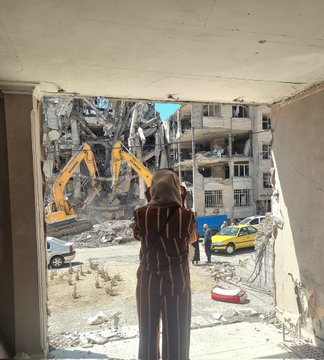
In a politically motivated move, a UK-based independent journalist and activist faces an “anti-terror probe” after her recent visit to Iran, where she reported on post-war developments, including massive rallies against the US-Israeli war coalition.
Observers say the move punishes legitimate political expression as the UK government seeks to silence dissenting voices critical of the unprovoked war against the Islamic Republic.
Bushra Shaikh, a British media personality who has been vocal about the US-Israeli war of aggression against Iran as well as the ongoing genocide in Gaza, has been referred to the Metropolitan Police’s Counter-Terrorism Command over a speech she delivered at a rally in Iran during her recent visit.
The referral, which comes just days after her return from the Islamic Republic, has raised serious concerns about the UK government weaponizing “anti-terror” laws to target individuals whose political views diverge from its stance on West Asia developments.
In a video shared online, Shaikh was seen addressing a rally in Iran, in which she expressed her solidarity with the people of Iran and condemned the aggression against them.
During the rally, flags of regional resistance movements, including Hezbollah, were seen.
Within hours of the post going live, a formal complaint was lodged with Scotland Yard, as reported by British media, alleging that Shaikh may have breached the Terrorism Act, which criminalizes “inviting support” for a banned group.
The report further claimed a potential violation of the National Security Act’s new Foreign Influence Registration Scheme (FIRS), which requires individuals acting under the direction of a foreign power to register their political activities.
“Any allegations relating to possible terrorism or national security-related offences will be passed to officers within Counter Terrorism Policing, who will assess the details and take any further action as appropriate,” the Met Police was quoted as saying.
During her visit to Iran, as part of a foreign media delegation invited by the Sobh Media Center, Shaikh visited many cities and interacted with victims of the recent war.
She also interviewed government officials, including foreign ministry spokesperson Esmaeil Baghaei and chairman of the parliament’s foreign policy and internal security commission Ebrahim Azizi, which she also shared on her social media platforms.
In the recent past, many British journalists, activists and academics have faced draconian charges in their country after visiting Iran to attend conferences or media festivals, including the Sobh International Media Festival, organized by the Islamic Republic of Iran Broadcasting (IRIB) World Service.
Met refuses to probe British nationals accused of war crimes in Gaza
Al Mayadeen | May 5, 2026
The Metropolitan Police has refused to open an investigation into ten British nationals accused of committing war crimes and crimes against humanity during the genocide in Gaza. According to Novara Media, the decision follows the submission of a 240-page dossier of evidence by the Palestinian Centre for Human Rights and the Public Interest Law Centre.
The Met stated that the material provided “did not meet the threshold required” to launch a formal investigation. This decision came despite support from more than 70 legal experts and proof of the targeted killing of civilians, attacks on hospitals, and the forced displacement of Palestinians involving the nationals between 2023 and 2024.
Human rights barrister Michael Mansfield KC condemned the Met’s refusal as a denial of accountability and a misapplication of legal standards, and legal representatives stressed that the police applied the wrong test by requiring evidence sufficient for prosecution before even opening an investigation.
Concerns over lack of accountability
Consequently, legal advocates have raised concerns about accountability for British dual nationals involved in the aggression against Gaza. The case has intensified debate over how UK authorities handle cases involving international crimes committed abroad by British citizens.
Raji Sourani of the Palestinian Centre for Human Rights accused the British establishment of politicizing international law and shielding perpetrators from accountability.
Human rights groups involved in the case say the refusal reflects a wider pattern of inaction by UK authorities regarding crimes in Gaza.
The Metropolitan Police decision comes amid concerns about the UK government’s approach to monitoring breaches of international law abroad. Reports have also pointed to the closure of a Foreign Office unit previously tasked with tracking such cases.
UK shuts down unit tracking Israeli violations of International Law
The Metropolitan Police decision comes amid concerns about the UK government’s approach to monitoring breaches of international law abroad.
Recently, the Foreign Office unit responsible for tracking potential breaches of international law by “Israel” in Gaza and, more recently, Lebanon has been closed as part of departmental spending cuts, according to The Guardian. The closure follows a review led by Olly Robbins, the permanent secretary at the Foreign Office, who was dismissed last week by the prime minister over the Peter Mandelson scandal.
The decision comes just weeks after Foreign Secretary Yvette Cooper said that respect for international law would be a cornerstone of the department’s work under her leadership. The shutdown of the international humanitarian law cell appears to contradict that stated policy direction.
The closure also ends funding for the Conflict and Security Monitoring Project run by the Centre for Information Resilience, which carried out large-scale open-source monitoring of incidents in occupied Palestine and Lebanon. The programme was the only UK-based system collecting and analysing human rights and conflict data in these areas, supporting assessments on potential breaches of international humanitarian law and informing decisions on issues such as arms export licensing to “Israel”.
NATO courts screenwriters to embed alliance messaging in film, TV
Al-Mayadeen | May 3, 2026
NATO has been quietly holding closed-door meetings with film and television writers, directors, and producers across Europe and the United States, in what critics are denouncing as a coordinated effort to embed the military alliance’s messaging into mainstream entertainment.
According to The Guardian, the initiative has already spanned sessions in Los Angeles, Brussels, and Paris, with a fourth meeting planned for London next month, where NATO officials are set to meet with members of the Writers’ Guild of Great Britain (WGGB).
The meetings, held under Chatham House rules, meaning participants may use information discussed but are not permitted to identify other attendees, focus on what organizers describe as the “evolving security situation in Europe and beyond.”
A WGGB email reviewed by The Guardian indicated that three separate projects are already in development that were “inspired, at least in part,” by those conversations.
James Appathurai, a former NATO spokesperson now serving as the alliance’s deputy assistant secretary general for hybrid, cyber and new technology, is expected to attend the London session alongside other officials.
In language that alarmed many recipients, the invitation suggested that “even if something so simple,” as NATO’s core message of cooperation and collective security, “finds its way into a future story, that will be enough.”
‘Clearly propaganda’
NATO’s outreach has drawn sharp criticism from within the creative community. Irish screenwriter Alan O’Gorman, whose film Christy won best film at the 2026 Irish Film and Television Awards, called the initiative “outrageous” and “clearly propaganda,” telling The Guardian that many writers come from countries that have “suffered under wars that NATO has joined and propagated.”
O’Gorman said those invited were “pretty offended that art would be used in a way that was supporting war,” and framed the meetings as part of a broader effort to cultivate pro-NATO sentiment in light of fearmongering across European media about weakened defenses.
Screenwriter and producer Faisal A. Qureshi, who applied to attend one session before a scheduling conflict prevented him, raised more structural concerns. He warned that the “risk for any creative who dips into this unattributable world of intelligence or military briefings is that they can get seduced into thinking they now have some secret knowledge,” one that normalizes moral compromise in the name of the greater good.
Qureshi questioned whether writers given such privileged access would genuinely “challenge or interrogate” the information fed to them, or simply absorb it.
A pattern of cultural lobbying
The London meeting is not an isolated effort. In 2024, eight prominent Hollywood screenwriters, including a writer and executive producer on Friends and a producer on High Potential, were flown to NATO headquarters in Brussels, where they met then-Secretary General Jens Stoltenberg. The trip was organized by the Washington-based Center for Strategic and International Studies.
The initiative also mirrors recommendations from the Centre for European Reform, which earlier this year called on governments to directly engage cultural figures, including screenwriters and producers, to build public support for rising defense budgets and “better tell the story” of why military investment is necessary.
NATO, for its part, framed the sessions as demand-driven, saying the meetings “follow from interest expressed by members of the industry to know more about what NATO is about and how it works.”
Geopolitics and Geoeconomics of the Strait of Hormuz
Sputnik – 02.05.2026
The reckless reliance on a blitzkrieg to eliminate Iran’s political and military leadership has left Israel and the United States in an extremely precarious situation, where Tehran’s key trump card in the conflict turned out to be control over the Strait of Hormuz.
Alexander Yakovenko, deputy director of Sputnik’s parent company Rossiya Segodnya and head of the Committee on Global Issues and International Security of the Russian Security Council’s Scientific-Expert Board, has addressed the standoff around the Strait of Hormuz.
Analysts in Israel are already writing of a complete failure, with the prospect of “returning to the issue” sometime in the future. Judging by published reports, everything was planned for June this year, but, as the saying goes, the devil intervened, and Benjamin Netanyahu succumbed to the temptation of a final solution through “regime change.” The scapegoats will be the Mossad division responsible for Iran and the military command responsible for Lebanon.
Donald Trump faces a far more difficult predicament: he has been drawn into a war that is neither his own nor in America’s interest. But the main issue is that the Strait of Hormuz problem now rests squarely on his shoulders. Aside from acceding to all of Iran’s demands, there appear to be no viable options for resolving the blockade – including the resumption of military action, which, according to observers, would have catastrophic consequences for the region, the global economy, and the Trump administration.
In terms of the Persian Gulf and the greater Middle East, a complete geopolitical reconfiguration has taken place, including a shift in Turkiye’s role (it was Ankara that effectively killed the plans to bring Iraqi Kurds into the “march on Tehran,” which was intended to bolster the confidence of those whom Israeli intelligence believed were ready to take to the streets of Iranian cities).
The destruction of the region’s extraction and logistics infrastructure prompted the UAE to withdraw from OPEC and OPEC+, which will only intensify Abu Dhabi’s contradictions with Riyadh and accelerate the political realignment of smaller players toward Ankara, Saudi Arabia, or Iran.
Iran’s agency has grown qualitatively: from a pariah state burdened by sanctions, Iran has genuinely become a regional power (in contrast to Netanyahu’s claim that Israel is a regional power and “in some ways even a global one”). Everything now depends on Iran – a fact understood by those at the helm in Tehran, namely, by general consensus, the Islamic Revolutionary Guard Corps (IRGC). And all this is aside from the most pressing issue on the regional agenda: the restoration of extraction and logistics infrastructure, especially given that the damage has a cumulative effect – in other words, “time is money.”
Russia, Pakistan, and China have become even more deeply involved in the affairs of the region, while the United States has demonstrated its inability to provide military protection for its allies. In other words, the role of external players has grown, whereas control over the region had been in American hands since the Baghdad Pact at the beginning of the Cold War. Now it can be said that the entire institutional structure in the region is collapsing – even in the OPEC format – and the region is opening up to an entirely new architecture.
In terms of geoeconomics, Tehran now holds a powerful lever of influence over the global economy and world trade through its control over the Strait of Hormuz. Moreover, this is not only direct control but also the ability to destabilize the situation around the Strait at any point in the future, regardless of any agreements that might be reached regarding its possible reopening as part of a ceasefire. In other words, everyone understands that things will never return to how they were before.
The only thing that matters for the global economy and the international financial system – including the dollar’s linkage to oil trade – is the stability of commercial traffic through the Strait. With no indication of it being reopened, the world is losing between 8 and 15 million barrels of oil and petroleum products per day, as well as up to 20% of global LNG supplies. This also includes a range of industrial goods in the petrochemical sector and derivatives for the agricultural sector. Experts expect a monthly shortfall of 300 million barrels, which amounts to three-quarters of the released strategic reserves of developed countries. Moreover, by early May, both strategic reserves and the advantages of unlocking Russian and Iranian oil, along with the balancing buffer of floating storage, will be nearly exhausted. In short, in every respect, a moment of truth is approaching in a conflict that is difficult to restart now that military action has been paused.
Not only have the United States and Israel handed Iran, on a silver platter, escalation dominance in the conflict – the ability to manage escalation if Washington and Tel Aviv launch another round – but Tehran will also gain additional revenue from selling its 1.5 million barrels of oil per day, which economists estimate at 2–3 billion per month, or 24–36 billion per year. Essentially, even without the unfreezing of Iranian assets in Western countries, Iran will have the resources to rebuild what has been destroyed. To this should be added the fees collected from commercial vessels transiting the Strait of Hormuz.
It is also worth noting a direct geopolitical consequence of the Iranian conflict: the discord within the Western alliance along the line of Trump’s America versus liberal-globalist Europe. The recent visit of the British monarch to the United States, during which he called in his address to Congress for the collective “defense of Ukraine” invoking Article 5 of the Washington Treaty (despite the fact that Kiev is not a NATO member), indicates that the lack of allied support for the Iranian adventure is a clear appeal to restore Western unity specifically on an anti-Russian basis – everything else is secondary. In Europe, they no longer hide the fact that they intend to “wait out” Trump, if that is what it takes, but under no circumstances will they agree to a settlement of the Ukrainian conflict.
As such, it is not denied that Ukraine is merely the opening move in yet another war of the West against Russia, and that Western elites are determined to make it a decisive, final confrontation of a civilizational nature. This presents an interesting situation for Russia, which could be resolved one way or another very soon. If Russia participated in two world wars, in which, albeit in different ways, relations between groups of Western countries were contested, and in the Cold War we faced a united West, then now we see a disunited West, weakened militarily and in terms of domestic political development. Its consolidation is only possible at our expense.
Charles III quite opportunely mentioned the burning of the White House by the British in 1814, as it reminds us – and perhaps Washington – of positive moments in our shared history, including Russia’s support for the American Revolution and the Union side in the Civil War. The decision rests with the Americans, but it is curious how the Middle East references an era before the ideologization of international relations in the 20th Century.
Why don’t UK media mention the Israel lobby?
By Mark Curtis | Declassified UK | April 27, 2026
Britain’s national media fails to recognise the influence – and even the existence – of an Israel lobby, our new media analysis shows.
Declassified researched two years of reporting by seven British media outlets and found only 16 mentions of the phrase Israel lobby without speech marks.
Nearly all those mentions are in comment articles rather than news pieces and none we found expound on what influence such an Israel lobby might have.
The phrase “Israel lobby” – used with speech marks – is slightly more common in these outlets, with 26 mentions in two years, and tends to be used to quote others in a disparaging way or to suggest such a lobby does not exist.
For example, one Guardian article refers to “the trope of the ‘Israel lobby’”. The Daily Mail reported in May 2024 of hecklers at a speech by then foreign secretary secretary David Lammy “accusing the MP of having taken ‘shady money’ from the ‘pro-Israel lobby’ on the grounds that he once lawfully accepted £30,000 from a Zionist lobbyist named Trevor Chinn.”
In fact, British businessman Trevor Chinn has funded Keir Starmer and several senior Labour ministers and was awarded the Israeli medal of honour for his “dedication” to and “love” for Israel.
Of the seven media outlets analysed – BBC articles, Express, Guardian, Independent, Mail, Telegraph and Times – the BBC and the Express are the most extreme, and no mentions of the phrase Israel lobby, used without speech marks, could be found at all in their publications.
The BBC is failing to mention the Israel lobby while having regular meetings with it. As Declassified recently revealed, the BBC held nine meetings with Jewish groups strongly sympathetic to Israel in the first year of the Gaza genocide.
The Guardian was found to have made only five mentions of an Israel lobby without speech marks, three of which are in comment pieces by columnist Owen Jones.
By contrast, independent Scottish newspaper The National, which has consistently criticised UK policy towards Israel, has mentioned the Israel lobby 23 times in the two year sample period, never in speech marks.
The Israel lobby in Britain is extensive. Declassified has revealed that a quarter of MPs have been funded by pro-Israel individuals and groups, as have one half of Keir Starmer’s Cabinet.
Neither of these findings have been reported in the mainstream media, as far as Declassified is aware.
British ministers and officials are known to hold off-the-books meetings with pro-Israel lobbyists, and under Keir Starmer’s government, the Foreign Office has held numerous meetings with pro-Israel advocacy groups such as Board of Deputies of British Jews and the European Leadership Network (ELNET).
The UK government’s total proscription of the Lebanese movement Hezbollah in 2019 was the work of pro-Israel lobbyists while lobby group We Believe in Israel has taken credit for the UK government’s proscription of Palestine Action last year.
As long ago as 2009, a landmark Channel Four documentary, Inside Britain’s Israel Lobby, which was presented by journalist Peter Oborne, revealed the close relationship between the Israel lobby and the Conservative and Labour parties, and its attempts to curb criticism of Israel in the media.
The Israel lobby’s influence over UK politics is likely to be greater than any other state except perhaps the US, and certainly far more than Russia which has received decidedly more media attention.
Friends of Israel
The British media’s failure to explicitly acknowledge an Israel lobby comes alongside nearly 300 articles in these seven outlets during the two years mentioning either Labour Friends of Israel (LFI) or Conservative Friends of Israel (CFI), of which dozens of MPs are supporters.
These lobby groups are invariably mentioned in the media without any analysis of their influence or even that they are explicitly part of a lobby that advocates for goals which benefit a foreign country, such as opposing an arms embargo on Israel.
The Independent has mentioned the phrase “influential Labour Friends of Israel” group three times, and the Times once, without mentioning how it is influential.
Yet CFI has been the largest donor of free overseas trips for MPs in recent years, and both CFI and LFI refuse to provide a list of their funders. LFI says its work is funded by “the generosity of members of the Jewish community and those who share our commitment to the State of Israel”. It adds that it “does not receive any money from the Israeli government or the Israeli Embassy”.
The Times has mentioned the phrase Israel lobby, without speech marks, on only four occasions in the two years, but has mentioned Labour Friends of Israel in over 50 articles. That LFI might be a part of a broader Israel lobby has apparently not been spelled out by the Times to its readers.
These omissions might be because the seven media outlets we analysed often function as part of the Israel lobby that they refuse to sufficiently recognise. The most extreme is the Telegraph, which routinely publishes articles supportive of Israel during its genocide in Gaza, illegal war on Iran and brutal attacks on Lebanon.
The paper has recently called to restore UK military ties to Israel, headlined with “Israel condemns ‘hateful and racist’ Greens”, and published an article by pro-Israel writer Jake Wallis Simons headlined “The case for Trump attacking Iran”, among many similar articles.
Some articles in these outlets suggest that recognition of an Israel lobby is anti-semitic. One opinion piece in the Telegraph runs: “Anti-Semitism is a conspiracy theory about how the world works. You think you live in a democracy, it runs, but actually there is this secret invisible system of Jewish power that rules the world through the banking system, the media and the Israel lobby.”
Similarly, the Guardian reported on Labour MP Diane Abbott in May 2024 stating: “She apologised for liking tweets about the influence of the Israel lobby, which she admitted could be interpreted as an antisemitic trope.”
The Guardian has been found to cave in to pro-Israel pressure, to amplify Israeli propaganda, and to be responsible for the same “systemic bias, deliberate distortion and deceptive underreporting” on Israeli crimes as the rest of the British media.
When the vice chair of LFI, Damian Egan, was forced to pull out of a school visit in January this year due to pressure from a pro-Palestinian group, both the Independent and the Times chose to focus on Egan simply being Jewish, headlining: “Jewish MP’s visit to local school cancelled after pro-Palestine campaign”.
Over 100,000 people have recently signed a petition calling for a public inquiry into pro-Israel influence on politics and democracy.
Note – our media analysis covered the period 7 April 2024 to 7 April 2026, using the Nexis media database and conducting website searches of the seven media outlets.
Mark Curtis is the co-director of Declassified UK, and the author of five books and many articles on UK foreign policy.
Nuclear Apartheid: Iran’s Rise Exposes the NPT Fraud and the West’s Israel Exception
By Freddie Ponton – 21st Century Wire – April 29, 2026
The fight over Iran’s vice presidency at the 2026 NPT Review Conference looked procedural only if one ignored the history that walked into the room with it. The United States, the United Kingdom, speaking for France and Germany, Australia, and the United Arab Emirates objected to Iran’s appointment, yet Iran kept the post after a Non-Aligned Movement nomination and no blocking vote was forced, exposing a basic fact that now hangs over the treaty system. The United Arab Emirates did not merely object but formally and unequivocally disassociated itself from Iran’s election, while citing Tehran’s continuous violations of its safeguards obligations.
That moment is crucial because it revealed a shrinking gap between Western power and Western authority. The states that still dominate military alliances, financial coercion, and media narratives could denounce Tehran in New York, but they could not turn denunciation into institutional compliance, and they could not persuade the wider diplomatic field that their understanding of non-proliferation deserved automatic deference. What looked like a dispute over one vice presidency was in fact a public measure of a much deeper revolt against selective enforcement.
The bargain they broke
The deeper story begins in 1995, when the NPT was indefinitely extended on the basis of a broader political package that included the Resolution on the Middle East. That resolution called on all states in the region that had not yet done so to join the treaty and place their nuclear facilities under full-scope IAEA safeguards, and the UN Secretariat background paper explicitly records that the resolution was an essential element of the outcome on which indefinite extension was secured.
The 2010 Review Conference reaffirmed that point in unusually clear language. It said the 1995 resolution remained valid until its goals were achieved, recalled the importance of Israel’s accession to the treaty and the placement of all its nuclear facilities under comprehensive safeguards, and endorsed concrete steps toward a 2012 conference on a Middle East zone free of nuclear weapons and other weapons of mass destruction. The conference never delivered what it promised, and Algeria’s 2026 working paper now states bluntly that Israel’s stance helped render the 1995 resolution “devoid of substance,” while the UN Secretariat paper records that many states saw the failure of implementation as seriously undermining the treaty itself.
The Israeli exception
That is why so much of the Global South reads the current crisis through Israel rather than through Iran alone. The UN Secretariat background paper states in neutral terms that all states of the Middle East except Israel are parties to the NPT and that all states in the region except Israel have undertaken to accept comprehensive IAEA safeguards, giving documentary form to the asymmetry that the Non-Aligned Movement (NAM) and Arab states have been protesting for decades.
NAM’s own recent language is harsher because the political implications are harsher. At the 2024 IAEA General Conference record, Uganda speaking on behalf of NAM warned that a selective approach undermined the viability of the safeguards regime, expressed great concern over Israel’s acquisition of nuclear capability, and called for a total prohibition on nuclear-related transfers and assistance to Israel, while the April 2026 NAM statement to the UN Disarmament Commission again demanded that Israel renounce nuclear weapons, accede to the NPT without precondition or delay, and place all its facilities under full-scope safeguards.
That continuity was reaffirmed in the Kampala Declaration, which carried the same line through 2025 and closed the institutional bridge to the April 2026 NAM position. For the movement, this is not a side file or an ideological hobbyhorse. It is the living proof that the rules are preached as universal and applied as political.
The South’s quiet revolt
Once that history is acknowledged, the so-called silence of NAM and many Global South states on Iran’s vice presidency stops looking like ambiguity and starts looking like discipline. They did not need to issue sentimental declarations of love for Tehran in order to refuse a Western effort to re-police multilateral legitimacy, because the issue before them was larger than Iran’s image and deeper than one nomination. It was whether the same powers that had tolerated, normalized, or materially shielded the Middle East’s only non-NPT nuclear exception would now be allowed to decide who is morally disqualified from procedural office inside the treaty system.
That is why the resistance was institutional rather than theatrical. After dismissing the objections as baseless and politically motivated, Iran disassociated itself from the election of the United States as vice president, and according to one contemporaneous account, from Australia’s as well, turning the confrontation into a mirror held up to the old order. The 2025 report of the sixth session of the conference on a Middle East zone free of nuclear weapons and other weapons of mass destruction said Israel’s refusal to join the NPT and submit all its facilities and activities to comprehensive safeguards undermined the credibility of the non-proliferation regime and imposed additional burdens on regional states, while the same report condemned attacks on Iran’s safeguarded nuclear facilities as a grave threat to the credibility of the NPT and the integrity of the entire IAEA safeguards regime.
In that setting, refusing to let Washington, London, Paris, Berlin, and Canberra define the boundaries of legitimacy was not indulgence toward Iran, but a defense of sovereign equality against a one-sided nuclear order.
What their objection revealed
The objections from the United States, the E3, and Australia therefore boomeranged. They were intended to isolate Iran, but they instead illuminated the moral exhaustion of a bloc that speaks in the language of non-proliferation while presiding over an order in which disarmament obligations are endlessly deferred, nuclear sharing and modernization continue, and Israel’s opaque arsenal remains politically protected from the universality routinely demanded of others. The analysis from the European Journal of International Law (EJIL) long ago captured the pattern by showing how NAM kept international attention on Israel’s nuclear status and how double standards around Israel helped fuel resistance inside the regime, and the documents gathered since then show that this reading did not fade but hardened.
Australia’s place in this picture is revealing precisely because it is less central than Washington or the E3 and yet moved in lockstep with them against Iran’s vice presidency. That choice placed Canberra inside a camp that could still object loudly but could no longer command consent, and it tied Australia to a diplomatic posture that much of the Global South now experiences as selective guardianship rather than principled stewardship. The same is true of the E3, whose claim to defend the treaty sounds increasingly thin when the documentary record shows decades of unfinished obligations on the Middle East file and continued Western insistence that the burden of credibility falls primarily on disfavored treaty members rather than on the region’s protected exception.
A treaty stripped bare
What emerged in New York, then, was not simply a quarrel over Iran. In fact, we all witnessed the exposure of a treaty order whose founding compromise on the Middle East has been repeatedly postponed, diluted, and evaded, until many of the states asked to keep faith with the system now see the system itself as compromised at the core. The 2026 UN Secretariat paper, the 2026 Algeria submission, the April 2026 NAM statement, the 2024 IAEA record, and the 2025 IAEA safeguards resolution all converge on the same underlying reality that Israel’s non-accession, unsafeguarded status, and continuing exceptional treatment have become inseparable from the crisis of NPT credibility.
That is why Iran’s vice presidency is so significant, because it marks the point at which a large part of the non-aligned world stopped pretending that the greatest danger to the treaty’s legitimacy begins and ends in Tehran, and instead used procedure to register a quieter but more consequential judgment that the deeper non-proliferation crisis lies in a regime that punishes some, excuses others, and then demands respect for the imbalance it created.
On April 27th, the West could still denounce, but could no longer decide; and that, more than the vice presidency itself, is the message now being sent from the Global South to Washington, the E3, and Australia.
Major fire erupts at UK base used for US bombers
RT | April 26, 2026
A large fire broke out at a Royal Air Force (RAF) base in west England on Sunday morning. In recent months, it was used by the US to launch operations against Iran, and was recently the target of anti-war protests.
According to the Gloucestershire Fire and Rescue Service, crews were called to RAF Fairford shortly after midnight on Sunday.
“The fire involved a single-story industrial storage building. It was brought under control safely and there were no casualties,” the service said in a statement.
Videos circulating on social media show a large blaze above warehouse buildings visible from the street, with an enormous plume of smoke rising up into the night sky.
RAF Fairford houses USAF B52 and B1 bombers, and serves as a key European operations center for Washington. Hundreds of anti-war protesters rallied outside the base on Saturday, demanding that the UK shut down military facilities used in the war on Iran.
Authorities said preliminary data suggests the blaze was accidental.
However, last week, a deliberate attack on a US military plane took place in neighboring Ireland.
A man was arrested after he intruded into Shannon Airport and damaged a US Air Force C-130 Hercules with a hatchet. He was arrested and charged with criminal damage, according to local law enforcement. No motive has yet been announced.
Featured Video
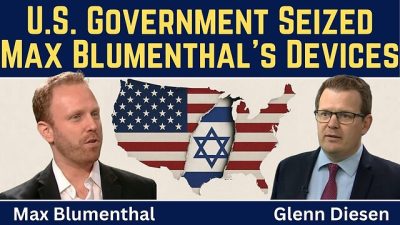
Press freedom threatened as US government seizes Max Blumenthal’s devices
or go to
Aletho News Archives – Video-Images
From the Archives
Roosevelt Conspired to Start World War II in Europe
By John Wear – Inconvenient History – January 26, 2019
Establishment historians claim that U.S. President Franklin D. Roosevelt never wanted war and made every reasonable effort to prevent war. This article will show that contrary to what establishment historians claim, Franklin Roosevelt and his administration wanted war and made every effort to instigate World War II in Europe. … continue
Blog Roll
 Aletho News
- Press Freedom Threatened as U.S. Government Seizes Max Blumenthal’s Devices
- Henrik Svensmark fired by his university
- Yemeni naval blockade forces six vessels to turn back
- Iran warns Bulgaria against supporting US military aggression
- Houthi Blockade Against Saudi Arabia Creates Geopolitical, Economic Dilemma for Pakistan
- ‘Israel is not giving anything up’: Residents head to US-backed pilot zones in south Lebanon
- DeBasification… A Fancy Word for Booting the US Out of the Middle East
- Houthis Close Bab al Mandeb Strait /Lt Col Daniel Davis
- UK migrant racket: One village has had enough
- Israel’s Lawlessness Will Be Its Undoing
- If Americans Knew
- Bethlehem: Every morning the same question: “Why are we still here?”
- Israel’s War Kills More U.S. Troops
- Lethal Precision Without Accountability: Israeli Government “Quadcopter” Use in Gaza
- ‘Sip your coffee while watching the sunrise’: How Israel is colonizing the West Bank by selling Palestinian land to Jewish Americans
- Pro-Israel GOP donors fueling Rep. Stevens’ Dem primary in Michigan
- Israel is building a Genocide Wall in Gaza – Daily Update
- Photos of Palestinians Before and After Imprisonment by Israel
- The War on Palestinian Schools
- Israel turns Gaza into death camp denser than Srebrenica, forces displacement under guise of voluntary emigration
- Yesterday’s US-Iran escalation is a mere prelude to what is likely to come
- No Tricks Zone
- Global Temperature Trend Has Cooled Over The Past 6500 Years, Scientists Have Found
- Wind Energy Means Going Back To The Middle Ages, Says German Professor Horst-Joachim Lüdecke
- New Study: A 40-Fold Increase In Earth’s Main Greenhouse Gas Contributes To Cooling The Ocean
- New Study Highlights The ‘Dominant Role’ Of Aerosol/Cloud Interactions In Shaping Climate
- Munich’s First-Ever Green Party Mayor Declares First Ever City Water Use Restrictions… Fines Up to 50,000 €!
- Experimental Lab Research: The Climate Sensitivity To A 400-Fold Increase In CO2 Is 0.1°C
- Fatal Snobbery: In France, It’s Better To Die From A Heatwave Than To Do As Americans
- New Study: NASA’s Models Wildly Underestimate The Capacity Of Clouds To Alter Solar Radiation
- Polar Freezeover: Western Arctic Early July Sea Ice Exceeds 1980s Average
- Doing The Opposite: Studies Show Gigantic Wind Farms Significantly Warm The Night
 Aletho News