The case of Raffi Berg and BBC: Zionist infiltration of the mainstream media
By David Miller | Press TV | April 26, 2025
British journalist Owen Jones recently wrote at length about the background, commitments, and active role that Raffi Berg plays in enforcing the pro-Zionist line at the BBC.
Berg is the Middle East (West Asia) editor at BBC Online, but he appears to have a much greater gatekeeping role in practice.
Jones’ research amply bears out the view that anti-Zionists have been encouraging for some time now, which is that Zionist infiltration of the media and other public institutions is a significant problem and amounts to colonization of public space on behalf of a genocidal foreign entity.
But this is not how Jones sees things, with the result that he markedly pulls his punches.
It is clear from what Jones writes that Berg is a fanatical, genocidal Jewish supremacist. Jones also makes it clear that Berg plays a pivotal enforcement role inside the corporation, such that all stories about the ‘Middle East’ have to be checked with him. Jones writes:
In addition to what they see as a collective management failure, journalists expressed concerns over bias in the shaping of the Middle East index of the BBC News website. Several allege that Berg “micromanages” this section, ensuring that it fails to uphold impartiality. “Many of us have raised concerns that Raffi has the power to reframe every story, and we are ignored,” one told me… “Almost every correspondent you know has an issue with him,” one said. “He has been named in multiple meetings, but they just ignore it.”… Berg’s influence has a ripple effect, the journalists say. While BBC broadcasters write and produce their own reports, editors and reporters across the organization frequently draw on web articles such as those edited by Berg to flesh out their stories.
Jones also notes the fact that Berg had written a book on the notorious Israeli spy agency Mossad, which is simply a propaganda tract for the agency.
In 2013, Berg became Middle East editor for BBC News Online. It was in this role that he encountered material that would form the basis for his book, “Red Sea Spies: The True Story of Mossad’s Fake Diving Resort,” an account of the Israeli spy services’ efforts to evacuate Jews from Ethiopia between 1979 and 1983. In the book, Berg describes Mossad in glowing terms, calling the agency “much vaunted.” Berg received extensive cooperation from Mossad for the book, including “over 100 hours of interviews” of “past and present agents and Navy and Air Force personnel.” It was published in 2020. In an interview to promote the book, Berg said he collaborated on the project with “Dani,” a former senior Mossad commander he described as a “legend” who later became “a very close friend.”
Berg, gushingly, tweeted in 2020 about the book being sighted on the bookshelf of Israeli premier Benjamin Netanyahu.
Jones was unsurprisingly attacked by the genocidal Zionist enforcer Dave Rich of the Community Security Trust for writing about how a ‘Jewish editor’ is ‘secretly manipulating’ the BBC’s output.
In response, Jones wrote that ‘The fact he’s Jewish isn’t mentioned.’ This is correct. But we might ask, why not?
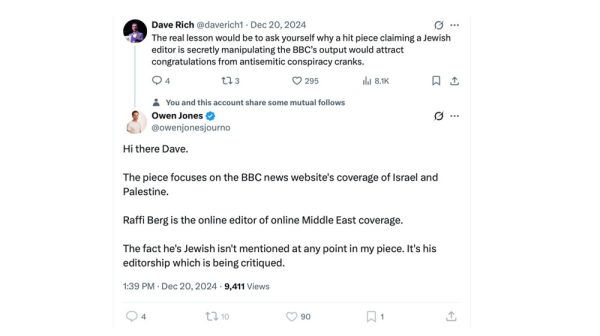
Nor does Jones state that Berg is a Zionist. In fact, the ‘Z word’ is only used twice in the whole piece: once (‘Zionist’) to describe the ‘right wing’ Zionism of Likud-Herut (an organization with whom Berg’s lawyer Mark Lewis is strongly affiliated); and once (‘Zionism’) in a quotation from Mark Lewis emphasizing the importance of “unapologetic Zionism.”
But surely Berg’s Zionism and the fact that he is Jewish — a Jewish supremacist no less — are in fact relevant to this discussion? And surely pretending they are not only undermines the punches that Jones appears to be trying to throw?
How is it that Berg occupies this pivotal location within the BBC? Can we imagine a Catholic, a Hindu, or a Sikh (let’s not even mention a Muslim) being in such a pivotal role on coverage of Palestine? Of course not.
Berg has not been granted or put in that position by the BBC because he is a Zionist. It’s, subconsciously at least, because he is a Jew that he is deferred to. Of course, if he were an anti-Zionist Jew, he would never get into such a position.
Identity politics runs deep in British public institutions — the idea that a Jewish person (or at least the correct type of Jewish person) is the appropriate arbiter of how to cover the occupation of Palestine is seen as common sense.
It is worth extending this analysis to other conflicts. Would a Hindu be asked to adjudicate in BBC HQ on the reporting of Hindutva crimes or a Protestant on Loyalist death squads in the north of Ireland?
We need not even ask about the prospects of the BBC appointing a Palestinian (Muslim, or Christian) to adjudicate coverage of the genocide in Gaza. Extending the analysis says something about the selective implementation of identity politics in the forcefield created by Western official sources and Zionist movement intimidation and bullying of the media.
Recognition that Berg is a genocidal Zionist is crucial to naming the problem and beginning to push back against this kind of Zionist infiltration and subversion of our public institutions.
Of course, Owen Jones appears to want no part of that struggle.
Zionist infiltration at the BBC
There are, of course, many other Zionists (whether Jewish or not) in the BBC, especially in news and current affairs. John Mitchell listed a few very senior employees some years ago:
● James Harding – Director of News & Current Affairs, BBC News (2013–2018) and past editor of the Times, was a hardline Zionist. At a Jewish Chronicle event in 2011, he declared:
“I am pro-Israel. I believe in the state of Israel. I would have had a real problem if I had been coming to a paper with a history of being anti-Israel. And, of course, Rupert Murdoch is pro-Israel.”
● Danny Cohen – Controller of BBC 1, 3, and Director of BBC Television (2007-2015) wrote a letter while still a BBC executive condemning the Boycott, Divestment, and Sanction (BDS) movement, which campaigns to end the Israeli occupation of the Palestinian West Bank and Gaza.
● James Purnell – BBC Director of Radio and BBC’s Director of Strategy (2013-2020) was the chairman of Labour Friends of Israel during his parliamentary career.
We can add to that list some further issues with the most senior management at the BBC.
● Richard Sharp, the former Chairman of the BBC, is a hardline Zionist, former Goldman Sachs and JP Morgan banker, director of the International Rescue Committee, an organization set up with the aid of the CIA, and donor to the British intelligence-created and Zionist-funded Quilliam Foundation.
● Robbie Gibb is reportedly not Jewish, but his brother, the minister, reportedly spent time on a Kibbutz in the Zionist entity when he was young. Both brothers were also part of a Western intelligence operation in the Soviet Union in the 1980s. Gibb went on to lead the consortium to buy out the failing Jewish Chronicle and became the sole director of the company that runs it. He did take a step back from that after concerted pressure was applied over his continuing role at the BBC on the editorial standards committee.
Also on that committee is the CEO of BBC News, the Director General, and the Chair of the BBC (which was Richard Sharp from February 2021 to June 2023 — it is now Samir Shah) and an ‘independent’ member who is currently Nicholas Serota.
Serota has had a long career in the art world and is also a Zionist and opponent of BDS. The ‘CEO’ of the BBC news division, Deborah Turness, is also cited by the BBC as “standing in the way of change” on the question of coverage of Palestine.
Of the five members, either 2 (or 3 when Sharp was in position) are Zionists, and one has blocked complaints on Zionist bias. Given that Director General, Tim Davie, is a former Conservative candidate who has worked for a CIA-supported front group, it is little surprise that the BBC is completely unwilling to cover the genocide properly.
Structural discrimination against Muslims in the BBC
The context of the dominance of Zionism is not just that there are Jewish Zionists in key positions exercising a gatekeeping function, as well as non-Jewish Zionists who provide cover and support for them (such as Robbie Gibb or James Purnell), but that overall there is in the BBC a notable over-representation of Jews and a notable under-representation of Muslims (in relation to their proportion in the population).
Research conducted by the BBC in 2022 shows the corporation at that time employed some 1% of staff who are Jewish, which is twice their proportion in the population, and 3.1% of staff who are Muslim, which is 48% of their proportion in the population.
The differences are more marked when we turn to the News and Current Affairs division of the BBC where Jews make up 2.2% of all staff and 2.5% of leadership staff (proportionally 4.4 times and five times more than their proportion in the population).
By contrast, Muslims are 3% of all News and Current Affairs staff (which is 46% of their proportion in the population) and at the leadership level, there are simply no Muslims at all.
This is itself a problem of structural discrimination, quite apart from what impact it might have on coverage of the genocide. And that impact is not inconsequential. It’s perfectly clear that the Zionists among the BBC News and Current Affairs staff are an aid, as opposed to a hindrance, to the enforcement of Zionist rationality across the BBC.
The gatekeeper
The scandal at the BBC on which Jones reported, is a scandal of Zionist infiltration and gatekeeping. And it’s a scandal that appears to exist in varying ways throughout the media landscape. As the journalist Rivkah Brown has put it:
“I have seen this trend in almost every mainstream media outlet I’ve worked at or reported on: One hardline Zionist who either has decision-making power or aggressively lobbies decision-makers, often with threats of antisemitism. Fearful of scandal, editors cave.”
Brown was reacting to the case of Sky News, which was one of the few media outlets to properly report the violence of Israeli fans in Amsterdam in 2024. Sky then promptly reversed itself. The role of Sandy Rashty as News Editor at Sky was then noted. Rashty is a committed Zionist and writes for the Jewish Chronicle.
It may, as Brown says, take only one advantageously placed Zionist to act as a gatekeeper, but in many news organizations, there are many such placeholders at all levels of the organization, as we have seen with the BBC.
But are these gatekeepers an incidental feature of accidentally employing genocidal Zionists in the newsroom, or is there a wider strategy of infiltration by the Zionist movement?
The strategy of infiltration — The Jerusalem Program
The reality is that the Zionist movement has been involved in a massive push to infiltrate public life in the UK at least since the 1950s, when the movement determined, having reached its objectives in creating a state in 1948, that it would not dissolve itself.
Instead, it adopted the so-called Jerusalem Program, which remains its aim to this day and was most recently revised in 2004. The “foundations” of Zionism, it states, include: the “bond” of the Jewish people to “Eretz Yisrael” which should be settled “as an expression of practical Zionism.”
Every Zionist organization that signs up to the WZO thus supports settler colonialism in “Eretz Israel” (a term usually meaning land far beyond the current occupation, spreading into Lebanon, Syria, Jordan, Iraq, and Egypt); to support a “Jewish” state and “defend” the “right of Jews… as a nation” — meaning structural privileges for Jews — a clearly racist proposition.
Individuals are no longer able (since 1960) to join the WZO directly and must join one of its member organisations. But membership in any Zionist organisation also requires certain “Duties of the individual Zionist”, adopted in 1978. These enjoin Zionists:
“To implement Aliyah [the Zionist term for settler colonialism] to Israel”; and “bring [children] up towards Aliyah”; to “be an active member of the [Zionist Federation]”; “contribute to … Zionist Funds”; and “strengthen Zionist influence within the community.”
In other words, individual Zionists are required to affirm the racist settler colonial ideology and to practically support it. What’s more, they are required to help popularise it in the community.
How this works today can be seen in the approach of the United Jewish Israel Appeal (UJIA), the largest Zionist “charity” group in the UK. UJIA is an anodyne-sounding “charity” which is actually the UK branch of one of the Zionist regime’s four “national institutions,” all based in the same building in King George Street in occupied Jerusalem/Al-Quds.
A 1997 Institute for Jewish Policy Research report, “The Attachment of British Jews to ‘Israel’”, raised an alarm:
“If current trends prevail, attachment to Zionism and the Jewish state could become the concern of only a minority with a mostly Traditional or Orthodox religious outlook.”
As a result, the UJIA refers to their approach as building a ‘lifelong connection’ to “Israel.”
Ruth Wisse: the Army of words
This strategy was memorably enunciated by Harvard professor Ruth Wisse, an open supporter of genocide. The clip on YouTube is just over two minutes long and it’s worth watching in full. For our purposes, the following excerpt is germane:
“American Jews, what do you have to worry about? Your job is to make us [Israel] look good and here’s how you do it: Every one of us has to serve three years in the Army … and then for the rest of our lives you have got to serve two or three years in the army of words you’ve got to learn to fight the political battle which is even more important at this point than the military battle… We’ll fight the military battle we’re not asking you necessarily to come and be lone soldiers although some of you can you’ve got to learn how to fight back on the campuses how to make the arguments now … Don’t let the war of words ever be fought about Israel’s nature, let it be fought about why you can’t accept Israel? Why you have to single out this tiny people? … Push them, teach them how to defend by attacking… You’ve got to make demands on them. They’ve got to serve for three years in the army of words.”
Enrolling all Jews in the ‘army of words’ is the aim of the Zionist movement. They don’t get everyone. But it seems plain they get more than enough to be effective in very many circumstances.
British MPs challenge ‘outrageous’ claims as legal adviser defends Israel and rejects Palestinian statehood
MEMO | April 25, 2025
Members of the UK Parliament’s Foreign Affairs Committee were left visibly exasperated during a tense hearing this week, after UK Lawyers for Israel advocate, Natasha Hausdorff, claimed that Palestinians have no right to statehood under international law and that Israel has “flooded” Gaza with humanitarian aid. The remarks, delivered as part of an official inquiry into prospects for a two-state solution, drew widespread incredulity and sharp rebuttals from MPs.
The most pointed exchange came when Hausdorff claimed there were no UK or US concerns about Israel’s conduct in Gaza. Labour MP, Emily Thornberry, interrupted to warn her bluntly: “Be careful what you’re saying.” Thornberry called the assertion “an extraordinary allegation … be careful what you’re saying” and challenged Hausdorff’s implication that Israeli operations have not breached international humanitarian law (IHL).
Thornberry repeatedly pressed Hausdorff to describe what a peaceful future would look like for Palestinians living in Gaza or the West Bank. “If I’m a Palestinian mother, what is the best thing that could happen to me?” Thornberry asked, her tone increasingly incredulous as Hausdorff blamed Western governments for allegedly “encouraging extremism” among Palestinians and insisted the main goal should be “defeating Hamas”.
When Hausdorff eventually claimed Palestinians do not have a legal entitlement to statehood, Thornberry asked for a clear answer. Hausdorff replied that, while Palestinians may enjoy a form of self-determination, this does not amount to a “right to a state” under international law. The claim flatly contradicts decades of UN resolutions affirming Palestinians’ right to statehood and the 2004 International Court of Justice advisory opinion that upheld this view.
In another remarkable moment, Labour MP, Alex Ballinger, who served in the British Army, directly challenged Hausdorff’s statement that the Israeli army operates with the highest standards of international humanitarian law in history. The MP called the assertion “outrageous”, referencing his own military experience and accusing Hausdorff of presenting a distorted version of reality.
Further exchanges focused on the devastation in Gaza. One MP cited UN statistics showing that 91 per cent of the population is facing severe food insecurity, one-third of hospitals are completely out of action, and over 92 per cent of housing units have been destroyed or damaged. When asked how Israel could justify blocking aid under such conditions, Hausdorff maintained that Israel had previously “flooded” Gaza with aid, claiming that shortages were the fault of Hamas diverting supplies.
MPs were visibly frustrated by this response, with one reminding Hausdorff that the UN and major humanitarian organisations have warned of an imminent man-made famine. Hausdorff dismissed these warnings saying “UN reports … have been consistently found to be wrong.” Her claim is disputed by overwhelming evidence from international agencies, including the World Food Programme, UNICEF and OCHA.
Hausdorff described her work with UK Lawyers for Israel as a fight against what she termed “the international legal war against Israel”, and accused human rights groups of weaponising international law. Her combative rhetoric, however, did little to win over the committee, whose members repeatedly challenged her assumptions and highlighted the discrepancy between her claims and the evidence provided by aid agencies and international courts.
She also took aim at United Nations Relief and Works Agency (UNRWA), calling for its defunding and claiming the Agency fuels extremism, a charge rejected by both the UN and the British Foreign Office, which has praised UNRWA’s humanitarian work, while conducting its own investigations.
While the hearing was convened to assess steps toward peace in Israel and Palestine, Hausdorff’s testimony, focused largely on justifying military actions and denying Palestinians a path to statehood, exposed the divisions between the Israeli position and the UK. MPs from multiple parties questioned how her positions could ever support a two-state solution, or even a framework for lasting peace.
The session concluded with visible frustration among MPs, several of whom appeared astonished by Hausdorff’s remarks.
A ‘Trump deal’? Juggling war, ‘easy war’ and negotiation
By Alastair Crooke | Strategic Culture Foundation | April 24, 2025
Trump clearly is in the midst of an existential conflict. He has a landslide mandate. But is ringed by a resolute domestic enemy front in the form of an ‘industrial concern’ infused with Deep State ideology, centred primarily on preserving U.S. global power (rather than on mending of the economy).
The key MAGA issue however is not foreign policy, but how to structurally re-balance an economic paradigm in danger of an extinction event. Trump has always been clear that this forms his primordial goal. His coalition of supporters are fixed on the need to revive America’s industrial base, so as to provide reasonably well-paid jobs to the MAGA corps.
Trump may for now have a mandate, but extreme danger lurks – not just the Deep State and the Israeli lobby. The Yellen debt bomb is the more existential threat. It threatens Trump’s support in Congress, because the bomb is set to explode shortly before the 2026 midterms. New tariff revenues, DOGE savings, and even the upcoming Gulf shake-down are all centred on getting some sort of fiscal order in place, so that $9 trillion plus of short-term debt – maturing imminently – can be rolled over to the longer term without resort to eye-watering interest rates. It is Yellen-Democrat’s little trip wire for the Trump agenda.
So far, the general context seems plain enough. Yet, on the minutiae of how exactly to re-balance the economy; how to manage the ‘debt bomb’; and how far DOGE should go with its cuts, divisions in Trump’s team are present. In fact, the tariff war and the China tussle bring into contention a fresh phalanx of opposition: i.e. those (some on Wall Street, oligarchs, etc.) who have prospered mightily from the golden era of free-flowing, seemingly limitless, money-creation; those who were enriched, precisely by the policies that have made America subservient to the looming American ‘debt knell’.
Yet to make matters more complex, two of the key components to Trump’s mooted ‘re-balancing’ and debt ‘solution’ cannot be whispered, let alone said aloud: One reason is that it involves deliberately devaluing ‘the dollar in your pocket’. And secondly, many more Americans are going to lose their jobs.
That is not exactly a popular ‘sell’. Which is probably why the ‘re-balance’ has not been well explained to the public.
Trump launched the Liberation ‘Tariff Shock’ seemingly minded to crash-start a restructuring of international trade relations – as the first step towards a general re-alignment of major currency values.
China however, wasn’t buying into the tariff and trade restrictions ‘stuff’, and matters quickly escalated. It looked for a moment as if the Trump ‘Coalition’ might fracture under the pressure of the concomitant crisis in the U.S. bond market to the tariff fracas that shook confidence.
The Coalition, in fact, held; markets subsided, but then the Coalition fractured over a foreign policy issue – Trump’s hope to normalise relations with Russia, towards a Great Global Reset.
A major strand within the Trump Coalition (apart from MAGA populists) are the neocons and Israeli Firsters. Some sort of Faustian bargain supposedly was struck by Trump at the outset through a deal that had his team heavily peopled by zealous Israeli-Firsters.
Simply put, the breadth of coalition that Trump thought he needed to win the election and deliver an economic re-balance also included two foreign policy pillars: Firstly, the reset with Moscow – the pillar by which to end the ‘forever wars’, which his Populist base despised. And the second pillar being the neutering of Iran as a military power and source of resistance, on which both Israeli Firsters – and Israel – insist (and with which Trump seems wholly comfortable). Hence the Faustian pact.
Trump’s ‘peacemaker’ aspirations no doubt added to his electoral appeal, but they were not the real driver to his landslide. What has become evident is that these diverse agendas – foreign and domestic – are interlinked: A set-back in one or the other acts as a domino either impelling or retarding the other agendas. Put simply: Trump is dependent on ‘wins’ – early ‘wins’ – even if this means rushing towards a prospective ‘easy win’ without thinking through whether he possesses a sound strategy (and ability) to achieve it.
All of Trump’s three agenda objectives, it turns out, are more complicated and divisive than he perhaps expected. He and his team seem captivated by western-embedded assumptions such as first, that war generally happens ‘Over There’; that war in the post Cold War era is not actually ‘war’ in any traditional sense of full, all-out war, but is rather a limited application of overwhelming western force against an enemy incapable of threatening ‘us’ in a similar manner; and thirdly, that a war’s scope and duration is decided in Washington and its Deep State ‘twin’ in London.
So those who talk about ending the Ukraine war through an imposed unilateral ceasefire (ie, the faction of Walz, Rubio and Hegseth, led by Kellogg) seem to assume blithely that the terms and timing for ending the war also can be decided in Washington, and imposed on Moscow through the limited application of asymmetric pressures and threats.
Just as China isn’t buying into the tariff and trade restriction ‘stuff’, neither is Putin buying into the ultimatum ‘stuff’: (‘Moscow has weeks, not months, to agree a ceasefire’). Putin has patiently tried to explain to Witkoff, Trump’s Envoy, that the American presumption that the scope and duration of any war is very much up to the West to decide simply doesn’t gel with today’s reality.
And, in companion mode, those who talk about bombing Iran (which includes Trump) seem also to assume that they can dictate the war’s essential course and content too; the U.S. (and Israel perhaps), can simply determine to bomb Iran with big bunker-buster bombs. That’s it! End of story. This is assumed to be a self-justifying and easy war – and that Iran must learn to accept that they brought this upon themselves by supporting the Palestinians and others who refuse Israeli normalisation.
Aurelien observes:
“So we are dealing with limited horizons; limited imagination and limited experience. But there’s one other determining factor: The U.S. system is recognised to be sprawling, conflictual – and, as a result, largely impervious to outside influence – and even to reality. Bureaucratic energy is devoted almost entirely to internal struggles, which are carried out by shifting coalitions in the administration; in Congress; in Punditland and in the media. But these struggles are, in general, about [domestic] power and influence – and not about the inherent merits of an issue, and [thus] require no actual expertise or knowledge”.
“The system is large and complex enough that you can make a career as an ‘Iran expert’, say, inside and outside government, without ever having visited the country or speaking the language – by simply recycling standard wisdom in a way that will attract patronage. You will be fighting battles with other supposed ‘experts’, within a very confined intellectual perimeter, where only certain conclusions are acceptable”.
What becomes evident is that this cultural approach (the Think-Tank Industrial Complex) induces a laziness and the prevalence of hubris into western thinking. It is assumed reportedly, that Trump assumed that Xi Jinping would rush to meet with him, following the imposition of tariffs – to plead for a trade deal – because China is suffering some economic headwinds.
It is blandly assumed by the Kellogg contingent too that pressure is both the necessary and sufficient condition to compel Putin to agree to an unilateral ceasefire – a ceasefire that Putin repeatedly has stated he would not accept until a political framework was first agreed. When Witkoff relays Putin’s point within the Trump team discussion, he stands as a contrarian outside the ‘licensed discourse’ which insists that Russia only takes détente with an adversary seriously after it has been forced to do so by a defeat or serious setback.
Iran too repeatedly has said that it will not be stripped naked of its conventional defences; its allies and its nuclear programme. Iran likely has the capabilities to inflict huge damage both on U.S. forces in the region and on Israel.
The Trump Team is divided on strategy here too – crudely put: to Negotiate or to Bomb.
It seems that the pendulum has swung under intense pressure from Netanyahu and the Jewish institutional leadership within the U.S.
A few words can change everything. In an about face, Witkoff shifted from saying a day earlier that Washington would be satisfied with a cap on Iranian nuclear enrichment and would not require the dismantling of its nuclear facilities, to posting on his official X account that any deal would require Iran to “stop and eliminate its nuclear enrichment and weaponization program … A deal with Iran will only be completed if it is a Trump deal”. Without a clear reversal on this from Trump, we are on a path to war.
It is plain that Team Trump has not thought through the risks inherent to their agendas. Their initial ‘ceasefire meeting’ with Russia in Riyadh, for example, was a theatre of the facile. The meeting was held on the easy assumption that since Washington had determined to have an early ceasefire then ‘it must be’.
“Famously”, Aurelien wearily notes, “the Clinton administration’s Bosnia policy was the product of furious power struggles between rival American NGO and Human Rights’ alumni – none of whom knew anything about the region, or had ever been there”.
It is not just that the team is insouciant towards the possible consequences of war in the Middle East. They are captive to manipulated assumptions that it will be an easy war.
EU refusing to lift Russia sanctions for peace – Reuters
RT | April 23, 2025
The EU has firmly rejected the idea of easing Ukraine-related sanctions against Russia before peace negotiations are concluded, Reuters reported on Wednesday, citing sources.
Last week, the US shared with EU officials proposals aimed at facilitating a peace deal between Russia and Ukraine. The initiative reportedly outlined potential terms to end the conflict, including the easing of sanctions on Moscow in the event of a lasting ceasefire.
Brussels, however, “staunchly opposes” Russia’s request to lift EU sanctions before peace talks are concluded, Reuters wrote, citing European diplomats. Another sticking point is the US proposal to recognize Russian sovereignty over Crimea – a suggestion the outlet described as a “non-starter” for both the EU and Kiev.
The EU’s stance is reportedly seen as diminishing the chances of any breakthrough in the peace negotiations, prompting senior US officials to skip a high-level meeting in London on Wednesday held for discussing the Ukraine conflict.
The gathering was due to include top diplomats from the UK, US, France, Germany, and Ukraine but ended up being downgraded to involve lower-level officials.
Both special envoy Steve Witkoff and Secretary of State Marco Rubio are skipping the event. The US delegation is instead being led instead by General Keith Kellogg, another envoy of US President Donald Trump focused on Ukraine.
Last month, European Commission President Ursula von der Leyen declared the EU would not lift its sanctions against Russia for as long as the Ukraine conflict continues. Also in March, the EU rejected a Russian demand to lift sanctions on Russian Agricultural Bank as part of the Black Sea ceasefire initiative discussed between Moscow and Washington. During the talks in Saudi Arabia, Russia and the US agreed to work toward reviving the Black Sea Grain Initiative, which, according to the Kremlin, would include the removal of Western restrictions against the agricultural bank and other financial institutions.
Kremlin spokesman Dmitry Peskov responded that the EU’s refusal to lift sanctions on Russia demonstrates the bloc’s reluctance to end the Ukraine conflict. “If European countries don’t want to go down this path, it means they don’t want to go down the path of peace in unison with the efforts shown in Moscow and Washington,” he said at the time.
Palestinian-British academic Makram Khoury-Machool detained in London

Al Mayadeen | April 22, 2025
British border authorities detained Palestinian-British academic Professor Makram Khoury-Machool on Friday evening upon his return from Paris to London, subjecting him to a four-hour interrogation under the UK’s 2019 “Counter-Terrorism and Border Security Act.”
Devices seized, personal belongings searched
During the investigation, British police confiscated Professor Khoury-Machool’s mobile phone and personal laptop, thoroughly searching all his belongings, including identification and credit cards. No formal charges were presented, raising concerns over the basis and implications of the detention.
Authorities also took his fingerprints, captured multi-angle photographs, and collected DNA samples from inside his mouth.
No official clarification yet
UK border police indicated that they may contact Professor Khoury-Machool again within the next seven days. So far, no official statement has been issued to explain the reasons behind his detention or the content of the interrogation.
The incident occurred in the presence of his 8-year-old son, who witnessed the extended questioning and detention of his father until midnight on Good Friday.
Professor Khoury-Machool, who is of Palestinian origin, is a well-known intellectual and media figure. His recent public activity includes participation in a pro-Gaza demonstration in Paris on April 16, 2025, where he shared a photo of himself at the event via his X account.
EU and UK preparing naval blockade of Russia – Putin aide
RT | April 22, 2025
The EU and the UK are gearing up to impose a naval blockade on Russia, Nikolay Patrushev, a senior aide to Russian President Vladimir Putin, has said. He warned that Moscow has a fleet powerful enough to respond to any such move.
In an interview published on Monday by Kommersant, Patrushev, who chairs Russia’s Maritime Board, a body which oversees national policy in this domain, stated that Moscow is facing escalating threats and challenges at sea amid growing geopolitical tensions.
“The collective West no longer hides its intentions to expel our shipping from the seas, while sanctions plans mulled, for example, by the British and some EU members increasingly resemble a maritime blockade,” he said.
Patrushev warned that these steps would “meet an adequate and proportionate response” from Moscow. “If diplomatic or legal instruments do not take effect, the security of Russian shipping will be ensured by our navy. The hotheads in London or Brussels need to clearly understand this,” he said.
Patrushev emphasized that Russia is pursuing a large-scale naval modernization program, including the development and deployment of unmanned systems while refining navy tactics. However, Moscow does not intend to get involved in a “naval arms race,” he added.
Western countries introduced maritime restrictions on Russia in 2022 over the Ukraine conflict, and have sanctioned dozens of Russian ships for allegedly circumventing an oil price cap. Russian ships have also faced major obstacles in accessing EU ports, insurers, and financial institutions.
The British Navy has been shadowing Russian ships passing near its waters for months, citing concerns about a perceived threat to national security and maritime infrastructure.
Maritime tensions have also been heightened in recent months following several ruptures in underwater infrastructure in the Baltic Sea. While there has been speculation about alleged Russian involvement, Western officials have offered no evidence. The Kremlin has dismissed the speculation as “absurd.”
NATO has increased its military presence in the Baltic Sea following the sabotage allegations, prompting Russia to warn that it would respond appropriately to any “violations” by the bloc’s vessels.
UK advancing military measures
By Lucas Leiroz | April 22, 2025
Despite current US’ efforts to reduce the diplomatic crisis between the West and Russia, the UK and the EU are not following in the American footsteps and continue to escalate their military actions as much as possible. Increasing arms production and expanding troops have been some of the measures adopted to prepare for the supposed “imminent conflict with Russia”. In the case of London, the current focus seems to be on creating an autonomous explosives and artillery industry, eliminating dependence on the US.
In a recent article, The Times revealed that the UK plans to “drastically” increase its explosives production to reduce imports of this type of material from the US. The newspaper, citing sources familiar with the matter, reported that London is concerned about the future of its alliance with the US, considering the recent changes in American foreign policy, which is why the country aims to become completely independent in all sectors of the military industry, with the explosives segment being a top priority.
The article states that British military scientists are using containers at sites across the country to manufacture RDX, an explosive vital for 155mm artillery shells. In addition, BAE Systems, the only British company currently specializing in the production of these artillery shells, is also planning to build new facilities with the aim of expanding the production of explosive materials for its rockets.
“In an effort not to repeat the mistakes of the past, and in acknowledgment of Britain’s inability to produce shells for Ukraine, BAE is increasing munitions production in the United Kingdom substantially. The company is establishing multiple sites for explosives manufacture to increase resilience and eliminate dependence on supplies from America and other countries. This will also help insulate the UK from restrictions on the use of US hardware”, the article reads.
As can be seen, the issue of explosives has become central to Britain’s arms production strategy as the country finds it difficult to supply its Ukrainian ally with sufficient UK-made artillery shells. The weakness of the military industry is hampering London’s plans to remain a key supporter of the Kiev regime – especially after the Trump-led reduction in US aid, which is why expanding the production of explosives that enable the projectiles to work has become a priority for the country.
However, Britain’s concerns are not limited to artillery. The UK is starting a major renovation of its strategic policy, trying as much as possible to nationalize the production of critical military materials. The Times article also expressed concern about the US control over other sectors of the British military, stating, for example, that the country’s air force needs to become independent of American technology. In other words, London no longer trusts Washington and is preparing for a scenario where the two countries could simply cut relations.
“The Royal Air Force is especially exposed to US technology. While the Royal Navy and the army field more homegrown and European systems, the RAF relies on US airborne early warning and maritime patrol aircraft and the F35 stealth fighter. The latter’s software is under US control and, in truth, it is not a sovereign system. Nowhere, however, is Britain’s dependence on the US deeper than in the nuclear field. While the UK builds the submarines and warheads for its deterrent, it relies on America’s Trident missile for delivery. The UK draws its Tridents from a joint stockpile held and serviced in the US. While Britain can fire its missiles independently, a withdrawal of US support following a rupture in relations would result in Tridents in British possession gradually becoming unusable. The UK should reshore missile maintenance,” the article adds.
In fact, making its military production fully sovereign is an interesting goal for any country. Dependence on foreign technology is an uncomfortable situation and creates instability for the country that imports defense hardware. The problem in the current case is that the UK is seeking this “strategic sovereignty” for the wrong reasons.
The UK’s move comes amid a current wave of militarization in European countries as a response to Trump’s “isolationism.” The UK and EU are trying to become “independent” of American military technology because they believe that they must not only continue to arm Ukraine in the long term, but also that they must prepare for a possible direct conflict with Russia in the future.
If London were planning to become truly “independent from the US,” the right thing to do would be to adopt a policy focused on internal development and to leave NATO. But Britain’s interest is simply to react to Trump’s diplomacy and pursue an even more aggressive and bellicose foreign policy. It remains to be seen whether the declining British economy will have enough strength to complete this “remilitarization” project without generating serious social side effects.
Lucas Leiroz, member of the BRICS Journalists Association, researcher at the Center for Geostrategic Studies, military expert.
You can follow Lucas on X (formerly Twitter) and Telegram.
Diego Garcia: ethnically cleansed for US forever wars
By Aidan J. Simardone | The Cradle | April 18, 2025
US President Donald Trump’s recent threat to strike Iran unless it halts its nuclear program has revived interest in a long-standing American asset: Diego Garcia. B-2 stealth bombers have been deployed to the island – British territory in name but an American garrison in practice – suggesting that Washington is either preparing for war or raising the stakes with an aggressive bluff.
Located in the heart of the Indian Ocean, the Diego Garcia island gives the United States unmatched reach across West Asia, Eastern Africa, and South Asia. It has been a launchpad for every major US war in the region – from Iraq to Afghanistan. Now, it may be key to a possible assault on the Islamic Republic of Iran.
But this island, remote and seemingly uncontroversial, is steeped in colonial injustice. Its original inhabitants, the Chagossians, were forcibly expelled to make way for the base. The UK, under pressure from Washington, detached the archipelago from Mauritius and ethnically cleansed it.
In 2024, Britain finally agreed to hand back the islands to Mauritius, but the US lease remains. For now, Diego Garcia is securely in American hands – and poised once again to serve as a launchpad for imperial warfare.
From paradise to genocide
Once colonized by France and later Britain, the Chagos Islands were home to a unique Creole population descended from African slaves and Indian laborers. For generations, the Chagossians lived peacefully on the islands, building a distinct identity with their own language and customs.
As anti-colonial movements swept across Africa and Asia in the 1950s and 1960s, the US sought new bases to maintain its influence around the Indian Ocean. Camp Badaber in Pakistan ultimately closed in 1970 as the country became closer with China. The Eritrean War of Independence threatened Kagnew Station in Ethiopia. The loss of both bases would be a major blow to US intelligence gathering of Soviet activities.
Diego Garcia could plug this gap, but there were two problems: the islands were part of Mauritius and had inhabitants.
In violation of international legal norms, Britain pressured Mauritius into giving up the Chagos Archipelago.
Then began the ethnic cleansing. To intimidate the islanders, their beloved pet dogs were killed en masse through shooting and gassing. The largest plantation was closed, depriving people of employment.
Food and medical supplies were restricted to kill the population or force them to leave. By 1971, those who remained were told they needed a legal permit, which no one received. With little notice, many were forced to leave their homes. Reminiscent of the slave boats their ancestors were brought in, Chagossians were crammed into the bottom of boats as they fled the islands.
A launchpad for endless war
With the island empty and the runway extended, Diego Garcia quickly became central to US war strategy. It played a key role in the 1980 failed hostage rescue mission in Iran, “Operation Eagle Claw,” and later against Iran during the Iran–Iraq War.
In 1987, the runway was improved for the stationing of US B-52 Bombers, which can deliver large payloads and precision-guided munitions. These bombers were vital during the Gulf War for attacking Iraq’s command and control centers, and again during the beginning of the invasions and occupations of Afghanistan and Iraq.
As the US expanded its footprint in the Persian Gulf, bases in Qatar and Bahrain took on greater significance – hosting long-range bombers, the US Central Command’s (CENTCOM) headquarters, and the US Navy’s Fifth Fleet. These two bases were vital: bombers from Qatar and vessels from Bahrain helped strike Taliban strongholds during the invasion of Afghanistan and hit Baghdad in the Shock and Awe campaign.
But proximity to the battlefield has become a double-edged sword. Iran’s significant missile arsenal, including hypersonic ones – demonstrated during its October 2024 retaliation against Israel – makes those Persian Gulf bases vulnerable.
Close proximity is also a challenge for B-2 stealth bombers, which can be detected at ground level and during takeoff. With only 20 B-2s, costing $2 billion each, this is a price the US cannot afford. If war breaks out, Tehran is unlikely to spare the economic infrastructure of its neighbors.
It is unlikely that either Bahrain or Qatar would be willing to bear the cost of an Iranian attack. Iran could not only attack US military bases, but also oil and gas infrastructure, which would destroy their economies. The two nations have also been edging closer to Iran: Tehran was one of the few capitals that supported Qatar during its diplomatic crisis with Saudi Arabia and other Persian Gulf emirates; in the past year, Bahrain and Iran have also been working on restoring ties.
Diego Garcia, by contrast, sits well beyond the range of most Iranian missiles – at least that is the assessment for now. It allows stealth bombers to launch undetected, and Iran’s limited ability to punish the island’s British overlords makes it an ideal staging ground for Washington’s war plans.
According to available data, Iran’s longest-range missile is the Khorramshahr-4, with a reach of approximately 2,000 kilometers. Yet, the US military base in Diego Garcia – located deep in the Indian Ocean – is nearly 4,000 kilometers from Iran’s southern coast. While there is no confirmed evidence that Iran currently has the means to strike such a distant target, the existence of capabilities – undisclosed by the Islamic Republic – that could reach the US base cannot be entirely ruled out.
Moreover, the Khorramshahr-4 missile’s proven ability to evade Israeli air defenses raises concerns about the US’s ability to defend Diego Garcia in a major conflict – particularly if Iran possesses long-range missiles capable of striking the remote base.
Any attack on Iran could trigger a wider regional war, with blowback against American assets and allies across West Asia – from Tel Aviv to Riyadh. Killing a few Iranian leaders might offer symbolic victories, but Tehran’s command structure is built for resilience. The risks far outweigh the tactical gains.
A homeland turned fortress
Despite a 2019 International Court of Justice (ICJ) ruling demanding Britain end “its administration of the Chagos Islands as rapidly as possible,” real justice for the Chagossians remains elusive. Although London agreed in October 2024 to begin the process of returning the archipelago to Mauritius, the US base is staying put. Mauritius offered a 99-year lease, without securing the right of return for the expelled Chagossians.
That could soon become permanent. If war erupts, Diego Garcia may once again be expanded, militarized further, and rendered uninhabitable. A concrete fortress will be all that remains of what was once a peaceful homeland.
In the end, whether through military strike or imperial inertia, the Chagossians risk losing their islands forever – not to history, but to America’s wars.
UK Government and Tony Blair Back AI-Powered Surveillance Push Including Digital ID and Facial Recognition

By Didi Rankovic | Reclaim The Net | April 18, 2025
A new push is underway in the UK to promote AI-powered mass surveillance via a number of controversial technologies and tools.
The country’s government, former PM Tony Blair, the College of Policing (the professional body for police in England and Wales), as well as legacy media outlet The Times, and Axon, a surveillance company, have converged behind this latest effort.
Axon was the headline sponsor during The Times’ Crime and Justice Summit this week, organized to present the result of an inquiry launched a year ago by the newspaper under the title, “The Crime and Justice Commission,” meant to look into the future of policing and the criminal justice system.
The final report contains recommendations to introduce mandatory universal digital ID and online age verification, as well as expand the use of live facial recognition, AI, and data analytics.
Age verification and banning users under 16 from social media would be enforced through a universal digital ID system, which would also be used to create what the report refers to as a “single unique identifier from birth.”
And while “ethical dilemmas” around this are acknowledged, the document calls for a single digital case file for the justice system.
Live facial recognition, which is currently tested or used in limited areas, should be expanded across the UK, according to the report, which also urges for AI and data analytics to be more involved in policing and the criminal justice system.
And while civil liberties and privacy campaigner Big Brother Watch slammed what it calls “an obsession” with Orwellian AI-powered surveillance that “reeks of authoritarianism and would be a hammer blow to our civil liberties” – Tony Blair and several other high profile figures emerged as enthusiastic supporters of the recommendations.
According to Blair, digital ID is a necessity (he and his foundation push for the mandatory kind), as is live facial recognition deployment in “busy places like train stations and events.” The former PM wants AI to be used for “spotting crime patterns, guiding patrols, and streamlining decisions.”
UK Justice Secretary and Lord Chancellor Shabana Mahmood suggested that some of the recommendations would become law, while other supporters of the report include the Home Office, life peer in the House of Lords Baroness Longfield, Independent Victims’ Commissioner for London Claire Waxman, and the College of Policing.
US proposes leaving former Ukrainian territories under Russian control – Bloomberg
RT | April 18, 2025
The US has presented its allies with the details of its peace plan to bring the conflict between Russia and Ukraine to an end, Bloomberg reported on Friday, citing European officials familiar with the matter.
The contours of the plan were outlined during a meeting in Paris on Thursday. The proposal reportedly includes easing sanctions on Russia, as well as terminating Ukraine’s aspirations to join NATO. The roadmap would effectively freeze the war, with the formerly Ukrainian territories held by Russia remaining under Moscow’s control, the sources suggested.
One of the officials told Bloomberg that the proposal still had to be discussed with Kiev, adding that the plan would not actually amount to a definitive settlement of the conflict. Moreover, Kiev’s European backers would not recognize the territories as Russian, the source suggested.
The Paris meetings involved senior officials from several countries. The US delegation was led by Secretary of State Marco Rubio and White House special envoy Steve Witkoff. They met with French President Emmanuel Macron and also held discussions with top officials and negotiators from France, Germany, the UK, and Ukraine.
Earlier on Friday, Rubio signaled Washington was ready to “move on” if a way to end the hostilities between Moscow and Kiev could not be found shortly.
“We need to figure out here now, within a matter of days, whether this is doable in the short term. Because if it’s not, then I think we’re just going to move on,” Rubio told reporters before departing from France.
Moscow has signaled a full ceasefire with Ukraine was highly unlikely, citing Kiev’s violations of previous deals. Speaking to reporters at the UN headquarters on Thursday, Russian envoy Vassily Nebenzia said there are “big issues with the comprehensive ceasefire,” recalling the fate of the now-defunct Minsk agreements, which were “misused and abused to prepare Ukraine for the confrontation.”
The diplomat also cited repeated Ukrainian violations of a US-brokered 30-day moratorium on energy infrastructure strikes, implemented on March 18.
“How close we are to the ceasefire is a big question to me personally, because, as I said, we had an attempt at a limited ceasefire on energy infrastructure, which was not observed by the Ukrainian side. So, in these circumstances, to speak about a ceasefire is simply unrealistic at this stage,” Nebenzia said.
Europe not ready to expand military aid to Ukraine when US leaves
By Ahmed Adel | April 18, 2025
More than three years in and with little initiative for a diplomatic exit from the West, NATO’s proxy war against Russia in Ukraine will reach a critical juncture when aid from the United States ends. Unless US President Donald Trump changes his mind, Europe cannot afford to continue its unconditional aid to Ukraine alone.
In the final months of his term, Joe Biden took significant steps to increase Ukraine’s munitions stockpiles, sending large quantities of projectiles, rockets, and armored vehicles, and approving a $1.25 billion aid package in December 2024. This support has allowed a continued flow of US arms to Ukraine, except for a pause ordered by Trump in March following his spat with his Ukrainian counterpart Volodymyr Zelensky in the White House.
While these decisions have bought Ukraine time, its stockpiles of US munitions are running low. The $1.25 billion aid package is nearly exhausted, and Trump has not approved any new military aid since taking office. Even if he were to use his remaining withdrawal authority, the amount available would be insufficient to sustain long-term US support, especially with the Republican-controlled Congress.
Trump has unsuccessfully sought a ceasefire in the conflict, while the parties involved have not agreed on the full terms. Faced with the impasse, the European Union has encouraged Ukraine to try to gain some strategic advantage over Russia, saying it will maintain support for as long as necessary. But Russia’s superiority has been proven daily, even with Ukraine’s flagrant unilateral violation of the 30-day US-brokered ceasefire for critical infrastructure.
European leaders have been moving to help Ukraine in the absence of US leadership. Discussions about a post-war security force are important, but more planning is needed to deal with the impending loss of US material support.
According to The Guardian, Ukraine’s European backers face two main questions: how Ukraine can persist with a combination of domestic arms production, European assistance, and US intelligence sharing, and how to finance that support. European countries must accept greater risk by donating their own military equipment and increasing defense spending to replenish their stockpiles.
The article argues that Europe should direct more resources to Ukraine’s defense industrial base, which produces drones, munitions, and air defense capabilities. The United Kingdom and France should try to negotiate with the Trump administration to secure additional air defense missiles for Ukraine, with the Europeans footing the bill, of course.
European countries must decide how to finance this support, whether by drawing on their own budgets or seizing the roughly $300 billion Russian sovereign assets illegally frozen through unilateral sanctions. These assets could finance Ukraine’s defense and reduce its dependence on the US, but time is running out for Ukraine to have anything to bargain for.
Moscow believes that arms supplies to Ukraine hinder the resolution of the conflict and directly involve NATO countries in the conflict. Russian Foreign Minister Sergei Lavrov said that any shipment containing weapons to Ukraine would be a legitimate target for Russia. According to Russia’s top diplomat, the US and NATO not only supply weapons to Kiev, but also train personnel in the UK, Germany, Italy, and other countries.
Hundreds of articles and interviews by Western journalists and politicians repeatedly claimed that Russia was allegedly running out of men, shells, missiles, and tanks, and that it only had fuel for two days. However, none of these allegations have been proven because production never ended in Russia; it has only increased.
Rather, to match Russia’s strength, Ukraine will have to mobilize everything it can and increase production several dozen times, an impossible task.
On April 11, Kaja Kallas, the EU’s high representative for foreign affairs and security policy, said that the meeting of the “Coalition of the Willing” on Ukraine was a failure because participants had different views on a peace agreement. French media quoted European officials as saying the day before Kallas’ statement that about six of the more than 30 countries participating in the “Coalition of the Willing” are ready to send troops to Ukraine. They include the United Kingdom, France, and the Baltic states. Evidently, the effort to mobilize Europe for this action failed.
Kallas also hoped to mobilize up to €40bln in military aid for Ukraine this year to shore up Kiev’s position and try to gain some strategic leverage for upcoming peace talks with Russia. This proposal has been stalled for weeks though, with EU diplomats criticizing the abstract nature of the plan, the way contributions would be calculated, and the lack of buy-in from most southern European countries.
Europe does not have the military might, economic prosperity, or unity to support Ukraine once US support has truly dried up. Yet, judging by the statements and actions of Kallas, the unelected EU technocrats continue to concoct new ideas to prolong war and suffering in Ukraine.
Ahmed Adel is a Cairo-based geopolitics and political economy researcher.
Tehran rejects ‘baseless’ UK claims about links to criminal groups
Press TV – April 17, 2025
Iran has condemned as “baseless and unjust” the recent accusations leveled by Britain that the Islamic Republic is connected with certain criminal groups.
Foreign Ministry spokesman Esmaeil Baghaei made the remarks on Thursday, three days after UK Foreign Secretary David Lammy announced sanctions on Foxtrot and its leader, Rawa Majid, claiming that the Swedish-based gang had been involved in “violence against Jewish and Israeli targets in Europe on behalf of” Tehran without providing any evidence.
Baghaei said attributing the actions of certain groups to Iran is a clear blame game meant to cover up Britain’s own destabilizing activities, particularly in West Asia.
“Making such claims against Iran reflects a misguided policy that the UK government has, in recent years, become somewhat addicted to,” he added.
The spokesman also noted that London has repeated its unfounded claims without any evidence despite Tehran’s calls for the UK to provide proof supporting its allegations.
He further emphasized that the UK government’s policy of making anti-Iran claims will bring nothing but will discredit it.
“The British regime must understand that pursuing a policy of unfounded ‘claims and accusations’ against the Islamic Republic of Iran will deepen distrust and further disrupt diplomatic relations – for which the UK will bear responsibility,” Baghaei said.
Earlier, the Iranian embassy in London said it had submitted a note of protest to the British government regarding the allegations.
“We consider such baseless positions and destructive conduct to be detrimental to the bilateral relations and urge the UK to refrain from pursuing hostile approaches towards Iran,” it said in a statement.
Featured Video
Iran spent $1 million to wipe out $30 billion in data center plans, and take down Amazon in the ME
or go to
Aletho News Archives – Video-Images
From the Archives
Clash of Civilization, Iran Part II
By Jamal Kanj – Intifada-Palestine.com – January 14, 2011
Israel’s survival kit is: perpetuate conflict, insecurity to rationalize collective hate and finally playing victim.
Devoid of conflict, Israel implodes internally; without hate, Zionism loses its justification; and playing eternal victim to continue blackmailing the West. Absence of this holy trinity, Israel ceases to exist. … continue
Blog Roll
 Aletho News
- Report: Saudi Arabia seeks allies’ assistance as missiles deplete amid war on Yemen
- Fuel Crisis Deepens: Pakistan Warns Tanker Attack in Red Sea Would Be an ‘Act of War’
- ‘Bucha massacre’ a false flag orchestrated by UK – Moscow
- China Rejects Outside Pressure on Trade Ties After New US Russia Sanctions Bill
- Houthis Keep Advancing as the Red Sea Crisis Deepens
- Iran spent $1 million to wipe out $30 billion in data center plans, and take down Amazon in the ME
- Zionist billionaire pressure to silence Macklemore sparks exodus from Ed Sheeran tour
- House Votes to End Iran War for Third Time
- North Korea Slams US Plan for ‘AUKUS 2.0’ with South Korea and Japan
- Prolonging US-Iran Conflict Not Meeting Interests of Int’l Community – China’s Wang Yi
- If Americans Knew
- Biden’s Genocide Accomplices Targeted by New Accountability Campaign
- AIPAC’s Network Has Already Spent $67.2 Million to Shape the Midterm Elections
- Jewish Supremacist Manufacturing a Civilizational Threat to License Bigotry
- US bans Palestinian president from speaking at the UN
- Israeli Forces Detain Journalist Alaa al-Rimawi amid Widespread West Bank Raids
- Even a pro-Israel Congress member has put a hold on 40,000 one-ton bombs to Israel
- As Gaza crumbles, Israel preps new ground invasion – Daily Update
- ‘We are not like everyone else’ laws that bind other nations do not apply to Israel, says Likud lawmaker
- Trump’s govt makes ‘treasonous’ claim of weapons shortages
- Palestinian-American Journalist Naqaa Hamed Imprisoned by Israeli Forces After Settlers Targeted Her
- No Tricks Zone
- New Study: ‘Global Drought Shows No Detectable Recent Acceleration Under Climate Warming’
- Economic Masterminds: German Socialists Suggest Taxing Productivity Gains Stemming From Using AI
- The South China Sea Has Not Been Cooperating With The Climate Change Narrative
- Energy Crisis: Germany Enters Heating Season With Historically Low Gas Reserve Fill Levels
- New Study: The Antarctic Ice Sheet Gained Mass From 2020-2024 Due To Staggering Snow And Ice Accumulation
- Study: Ocean Heating Rates From Thousands Of Years Ago ‘Dwarf’ Modern Ocean Heating Rates
- Climate Extremists Target, Attack Large-Scale Power Grid Infrastructure In Germany!
- New Study: Antarctic Ice Melt Has Contributed Less Than 1 Centimeter To Sea Level Rise In The Last 30 Years
- Fear Of Debate: Alarmist German Climate Scientist Calls On Mainstream Media To Discredit Skeptic Voices
- End-Of-August Arctic Sea Ice Extent Hasn’t Fallen In 20 Years, Official Data Show!
 Aletho News