Odessa, the City of Catherine

Ukrainian workers dismantle the “Monument to Empress Catherine II of Russia and her companions” in Ekaterininskaya Square, Odessa, on December 28, 2022
BY SCOTT RITTER | DECEMBER 15, 2023
They came in the middle of the night, a handful of municipal employees manning a crane which they used to dismantle the bronze statue of Empress Catherine II, known as “Catherine the Great.” The statue was part of an assembly of bronze figures collectively known as the “Monument of the Founders of Odessa.” One of these figures was of José de Ribas, a Spanish naval officer who joined the Russian Imperial Army in 1772, leading it to victory against the Ottoman forces. Ribas led the assault that captured the territory which would be, in 1794, under an imperial edict issued by Catherine, Odessa. Ribas was the first administrator of the city. Another figure depicted François Sainte de Wollant, a Flemish engineer who was the first architect of Odessa. Platon Zubov was a Russian nobleman and believed to be Catherine’s closest advisor (and secret lover), while Grigory Potemkin, another Russian nobleman, was Catherine’s most influential advisor (and secret lover), who was the first Governor of the territories of New Russia, including Odessa, that were captured from the Ottomans.
These figures were all removed, and placed in storage, as part of an effort overseen by Ukrainian President Volodymyr Zelensky to “de-Russify” Ukraine by eliminating all symbols of Ukraine’s Russian heritage.
Zelensky’s efforts, however, have not dampened Russia’s emotional and historic ties to Odessa. This point was driven home by Russian President Vladmir Putin during his annual end of the year question and answer event on December 14. “I have always said and as I am saying today,” Putin declared, “that despite the current tragic developments, Russians and Ukrainians are essentially one people.”
Putin likened the current conflict to a “civil war” between two fraternal peoples. But he made clear that parts of Ukraine were more Russian than Ukrainian. “The southeastern part of Ukraine has always been pro-Russian because it is historically a Russian territory,” Putin said. “Neither Crimea nor the Black Sea region has any connection to Ukraine,” he continued, before concluding, “Odessa is a Russian city. We know this. Everyone knows this.”
The original Monument to Empress Catherine II of Russia and her companions was built in 1900, the belated byproduct of patriotic fervor that had gripped Odessa in 1894—Odessa’s centennial. It was toppled by the Bolsheviks in 1920, with Catherine’s bust dismantled, and the statues of the four founders removed to a warehouse. In 2007 a pro-Russian member of the Odessa City Council, Ruslan Tarpan, raised funds to restore the monument of Catherine and her four subjects. On October 27, 2007, the new monument was unveiled in a lavish ceremony that featured fireworks and a philharmonic orchestra.
But not everyone was thrilled with the idea of celebrating a Russian Empress; then-President Viktor Yushchenko, who had elevated the pro-Nazi Ukrainian nationalist leader, Stepan Bandera, to “hero” status in Ukraine, condemned the monument, and police had to be called in to separate those who participated in the unveiling ceremony from crowds of Ukrainian nationalists who had traveled to Odessa to disrupt the proceedings.
These Ukrainian nationalists eventually succeeded in forcing Tarpon to flee to exile in the United Emirates to escape charges of embezzlement; these same nationalists later flocked to Odessa in May 2014, where they set fire to a building where pro-Russian demonstrators had gathered, leading to the deaths of 48 persons. The Russian invasion of Ukraine in February 2022 provided the final impetus for the Ukrainian nationalists to remove the monument.
The marble plinth that held the monument is now empty, save for a Ukrainian flag. Despite the passage of a law by President Zelensky in April 2023 forbidding Russian names to be used for public places, the square that was home to the monument is still known as Katerynynska Square. Nearby are the Potemkin Steps, made famous in Sergei Eisenstein’s 1925 classic silent movie, Battleship Potemkin, which tells the story of the revolt of the sailors of that warship during the 1905 Revolution.
While the Soviet authorities sought to depict Odessa first as a revolutionary city, and later as a “Hero City” (the city was besieged by German and Romanian forces from August-October 1941, before falling), the reality of Odessa was perhaps most closely captured by the Jewish-Russian writer, Isaak Babel, who, in his Odessa Tales, depicts a city defined by hedonism and lawlessness. Alexander Pushkin, the Russian poet, spent 13 months in exile in Odessa; his observations of life in that city, circa 1823-24, is said to have influenced his famous novel, Eugene Onegin. The culture of Odessa, whether told through the eyes of Babel or Pushkin—or any other Russian writer—was defined by its geography, positioned as it was on the Black Sea, serving as the gateway to the Bosphorus and eastern Mediterranean Sea. Odessa was always more Levantine than European in terms of its culture, its port city status linking it to the rich mercantile heritage of the region.
While Ukrainian nationalists emphasize that, based upon the 2001 census, a little over 60% of Odessa’s population of 1.1 million persons identifies as Ukrainian (Russians comprised just under 30%), the reality is that Odessa has always had an air of Russophone cosmopolitanism, with its inhabitants speaking in uniquely accented-Russian. This diversity of cultures grounded in Russian reality is what defines much of the Russian Federation today, a definition that held true during Soviet and Imperial Russian rule as well. The fact that Odessa and the pro-Russian regions of southeastern Ukraine (or New Russia, as it was known during the time of Catherine the Great) fell under Ukrainian rule following the dissolution of the Soviet Union is, as Russian President Putin noted, an accident of history.
It looks as if the “accident” is about to be rectified. Putin’s reference to Odessa as a “Russian city” provides a critical insight into the thinking of the Russian leadership. But this thinking is not shaped by nostalgia alone—the fact that the Ukrainian government has transformed Odessa into a base where NATO, using Ukrainian forces as its proxy, is able to threaten the Black Sea Fleet’s Sevastopol base, sealed Odessa’s fate. Simply put, Russia cannot permit whatever Ukrainian entity that emerges from the current conflict to ever again be able to use Odessa as a sword pressed into Russia’s side.
Odessa will be Russian again. This is a fact driven by geopolitical reality as well as historical precedence. Odessa will be Russian because it always has been Russian. No matter how much Ukrainian nationalism, manifested in the ideology of Stepan Bandera as interpreted by the deeds and actions of Voldymyr Zelensky, seeks to argue otherwise, the simple fact of the matter is that the Banderist ideology of the Zelensky government is completely out of step with the reality of Odessa which, even today, still retains the characteristic rogue charm as described by Babel in the 13 short stories that comprise his Odessa Tales.
Isaac Babel was executed by the NKVD in 1940, his post-revolutionary writing considered counter-revolutionary by Stalin and his ilk. But his words live on in the daily beat of life in a city which came to life under the multi-cultured guidance of Catherine the Great and her four associates—half of whom were not Russian. And let there be no doubt—someday in the not-so-distant future, Catherine’s visage, and those of her four advisors, will once again grace the plinth in the center of Katerynynska square, a Russian leader once again looming large over a Russian city.
Scott Ritter discusses this article on Episode 122 of Ask the Inspector.
UN condemns Ukraine’s crackdown on largest Christian church
RT | December 19, 2023
Kiev’s push to outlaw the Ukrainian Orthodox Church (UOC) would violate freedom of religion, the UN High Commissioner for Human Rights Volker Turk said on Tuesday.
Turk spoke at the meeting of the UN Human Rights Council in Geneva, Switzerland. He addressed the persecution of the UOC in the context of the conflict between Ukraine and Russia.
“I note also my concerns regarding freedom of religion and belief in Ukraine, given continuing action by the authorities against the Ukrainian Orthodox Church,” Turk said during the meeting. He pointed to a proposed law that would allow Kiev to ban any religious organization suspected of having ties to Russia.
“These proposed restrictions to the right of freedom of religion do not appear to comply with international human rights law,” Turk said.
Ukraine’s parliament, the Verkhovna Rada, advanced the bill in October. It is still being amended in committee, however, and is expected to be adopted early next year, according to speaker Ruslan Stefanchuk.
President Vladimir Zelensky’s government has accused the UOC of having ties with the Russian Orthodox Church. He also claimed that dozens of its clergy are acting as “spies” for Russia, even though the UOC officially severed ties with Moscow in March 2022.
Earlier this year, Zelensky ordered the UOC’s clergy to leave the Kiev-Pechersk Lavra, a monastery almost 1,000 years old. The monks were told they could stay if they switched their allegiance to the Orthodox Church of Ukraine (OCU), a rival organization created by the Ukrainian government in 2018. Since then, half a dozen regions of Ukraine have outlawed the UOC, seizing its properties and turning them over to the OCU.
When the UN Human Rights Council criticized these actions as discriminatory, Kiev criticized the body for making “unbalanced political assessments” and claimed its crackdown was justified on national security grounds.
On Tuesday, Turk also urged Kiev to build a society where all communities would be included and the rights of all minorities protected, “including the right to use every language spoken in Ukraine.”
A proposed ban on the Russian language by the government in Kiev following the February 2014 US-backed coup was among the events that triggered Crimea’s decision to rejoin Russia and the regions of Donetsk and Lugansk to declare themselves independent people’s republics.
Lavrov Says Reminded UN Chief at G20 Summit of List of Allegedly Killed in Bucha
Sputnik – 18.12.2023
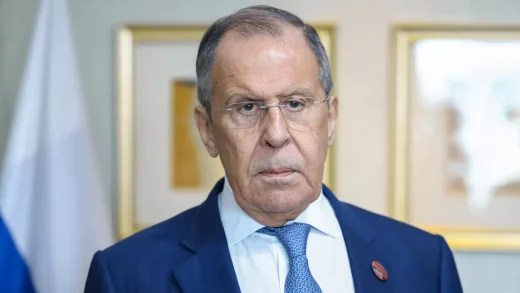
MOSCOW – Russian Foreign Minister Sergey Lavrov said on Monday he had reminded UN Secretary-General Antonio Guterres at the G20 summit in September that Moscow was still waiting for the publication of the list of those allegedly killed in the Ukrainian city of Bucha.
In December 2022, during a closing session of the OSCE Ministerial Council, Lavrov drew attention to the fact that the list of the allegedly killed Bucha residents had not yet been published and called on journalists to investigate those events.
“I saw him [Guterres] later at the G20 summit in India this fall. We had a talk. I reminded him of my request. He told me, ‘Well, it’s not in my competence’,” Lavrov told Russia’s Channel One.
The top Russian diplomat replied that the Bucha incident had become a central one in the war unleashed against Russia and “in the series of unprecedented sanctions that anyone has ever imposed against anyone.” The incident raises massive suspicions as the UN refuses to publish the list of the alleged victims, Lavrov added.
“He [Guterres] says, ‘I want to help. I would think of something’,” the Russian foreign minister stated.
In April 2022, the Russian Defense Ministry said that photo and video materials published by Kiev, which testify to crimes allegedly committed by the Russian military in Bucha in the Kiev Region, were another “Ukrainian provocation.” The ministry stressed that during the time the city was under Russian control, no local residents had been subjected to violent actions.
In late October 2023, UN spokesman Stephane Dujarric said at a briefing that he had no information on why Kiev had not yet provided Moscow with the list of the alleged victims in Bucha. After Dujarric was asked why the UN would not send a special mission to Bucha to collect data and obtain the list of the alleged victims, the spokesman said there were a number of missions that had already gone there.
Ukraine joins NATO’s Arctic projects against Russia
BY M. K. BHADRAKUMAR | INDIAN PUNCHLINE | DECEMBER 19, 2023
In a plea earlier this month to Republicans not to block further military aid to Ukraine, US President Joe Biden warned that if Russia is victorious, then President Vladimir Putin will not stop and will attack a NATO country. Biden’s remark has drawn a sharp rebuke from Putin when he said, “This is absolutely absurd. I believe that President Biden is aware of this, this is merely a figure of speech to support his incorrect strategy against Russia.”
Putin added that Russia has no interest in fighting with NATO countries, as they “have no territorial claims against each other” and Russia does not want to “sour relations with them.” Moscow senses that a new US narrative is struggling to be born out of the debris of the old narrative on Ukraine war.
To jog memory, on 24 February, during a White House press conference on the first day of Russia’s military intervention in Ukraine, Biden said western sanctions were designed not to prevent invasion but to punish Russia after invading “so the people of Russia know what he (Putin) has brought on them. That is what this is all about.”
A month later, on 26 March Biden, speaking in Warsaw, blurted out, “For God’s sake, this man (Putin) cannot remain in power.” These and similar remarks that followed, especially from Britain, reflected a US strategy for regime change in Moscow, with Ukraine as the pivot.
This strategy dates back to the 1990s and was actually at the core of the expansion of NATO along Russia’s borders, from the Baltics to Bulgaria. The Syrian conflict and covert activities of US NGOs to foment unrest in Russia were offshoots of the strategy. At least since 2015 after the coup in Kiev, CIA was overseeing a secret intensive training programme for elite Ukrainian special operations forces and other intelligence personnel. Succinctly put, the US set a trap for Russia to get it bogged down in a long insurgency, the presumption being the longer the Ukrainians can sustain the insurgency and keep Russian military bogged down, the more likely is the end of the Putin regime.
The crux of the matter today is that Russia defeated the US strategy and not only seized the initiative in the war but also rubbished the sanctions regime. The dilemma in the Beltway narrows down to how to keep Russia as an external enemy so that the West’s often fractious member states will continue to rally under US leadership.
What comes to mind is a sardonic remark by Soviet Academician Georgy Arbatov who was advisor to Mikhail Gorbachev, to an elite group of senior US officials even as the curtain was coming down on the Cold War in 1987: “We are going to do a terrible thing to you -– we are going to deprive you of an enemy.”
Unless black humour in this cardinal truth is properly understood, the entire US strategy since the 1990s to rebuff the efforts of Gorbachev, Boris Yeltsin, and early Putin to establish non-adversarial relations with the West cannot be grasped.
Put differently, if the US’ post-cold war Russia strategy has not worked, it is because of a fundamental contradiction: on the one hand, Washington needs Russia as an enemy to provide internal unity within the western alliance, while on the other hand, it also needs Russia as a cooperative, subservient junior partner in the struggle against China.
The US hopes to draw down in Ukraine and stave off defeat by leaving behind a “frozen conflict” which it’s free to revisit later at a time of its choice, but in the meanwhile, is increasingly eyeing the Arctic lately as the new theatre to entrap Russia in a quagmire. The induction of Finland into NATO (and Sweden to follow) means that the unfinished business of Ukraine’s membership, which Russia thwarted, can be fulfilled by other means.
After meeting Biden at the White House last Tuesday, Ukrainian President Vladimir Zelensky headed for Oslo on October 13 on a fateful visit to forge his country’s partnership in NATO projects to counter Russia in the Arctic. In Oslo, Zelensky participated in a summit of the 5 Nordic countries to discuss “issues of cooperation in the field of defence and security.” The summit took place against the backdrop of the US reaching agreements with Finland and Sweden on the use of their military infrastructure by the Pentagon.
The big picture is that the US is encouraging Nordic countries to get Ukraine to participate in strengthening NATO’s Arctic borders. One may wonder what is the “additionality” that a decrepit military like Ukraine’s can bring into NATO. Herein hangs a tale. Simply put, although Ukraine has no direct access to the Arctic, it can potentially bring in an impressive capability to undertake subversive activities inside Russian territory in a hybrid war against Russia.
In a strange coincidence, the Pentagon recently prepared the Starlink satellite system for use in the Arctic, which was used by Ukrainian military for staging attacks on the Crimean Bridge, Russia’s Black Sea Fleet and strategic assets on Russian territory. The US’ agreement with Finland and Sweden would give the Pentagon access to a string of naval and air bases and airfields as well as training and testing grounds along the Russian border.
Several hundred thousand Ukrainian citizens are presently domiciled in the Nordic countries who are open to recruitment for “an entire army of saboteurs like the one that Germany collected during the war between Finland and the USSR in 1939-1940 on the islands of Lake Ladoga,” as a Russian military expert told Nezavisimaya Gazeta recently.
Russia’s naval chief Admiral Nikolai Evmenov also pointed out recently that “the strengthening of the military presence of the united NATO armed forces in the Arctic is already an established fact, which indicates the bloc’s transition to practical actions to form military force instruments to deter Russia in the region.” In fact, Russia’s Northern Fleet is forming a marine brigade tasked with the fight against saboteurs to ensure the safety of the new Northern Sea Route, coastal military and industrial infrastructure in the Arctic.
Suffice to say, no matter Ukraine’s defeat in the US’ proxy war with Russia, Zelensky’s use for the US’ geo-strategy remains. From Oslo, Zelensky made an unannounced visit on December 14 to a US Army base in Germany. Analysts who see Zelensky as a spent force had better revise their opinion — that is, unless the power struggle in Kiev exacerbates and Zelensky gets overthrown in a coup or a colour revolution, which seems improbable so long as Biden is in the White House and Hunter Biden is on trial.
The bottom line is that Biden’s new narrative demonising Russia for planning an attack on NATO can be seen from multiple angles. At the most obvious level, it aims to hustle the Congress on the pending bill for $61 billion military aid to Ukraine. Of course, it also distracts attention from the defeat in the war. But, most important, the new narrative is intended to rally the US’ transatlantic allies who are increasingly disillusioned with the outcome of the war and nervous that US involvement in Europe may dwindle as it turns to Indo-Pacific.
When Putin reacts harshly that Biden’s new narrative is “absurd”, he is absolutely right insofar as Russia’s focus is on things far more important than waging a senseless continental war in Europe. After all, it was one of the founding fathers of the USA, James Monroe who said that a king without power is an absurdity.
NATO troops directly involved in Ukraine conflict – Russia
RT | December 19, 2023
Several NATO member states have boots on the ground in the Ukraine conflict, Russian Defense Minister Sergey Shoigu has claimed. He alleged that Western military personnel are operating certain weapons systems, and that hundreds of satellites belonging to the US-led military bloc are providing Kiev with surveillance.
Speaking at a meeting of Defense Ministry officials on Tuesday, where President Vladimir Putin was also present, Shoigu stated that “NATO service members are directly operating air defense systems, tactical ballistic missiles, and multiple launch rocket systems” in Ukraine. He cited radio intercepts featuring English and Polish speakers. According to the minister, Western officers are also playing an active role in preparing Ukrainian military operations as well as training troops, both in their home countries and in Ukraine.
Russian officials have repeatedly warned that ever-deepening Western involvement in the conflict unnecessarily increases the chances of a direct military confrontation between NATO and Moscow.
The Russian defense chief went on to claim that more than 5,000 foreign fighters have been killed since hostilities broke out in February 2022, with 1,427 Polish, 466 US, and 344 UK nationals among them.
“Working in the Ukrainian Armed Forces’ interest are 410 NATO military and dual-purpose space devices,” Shoigu estimated.
He also lauded Russia’s defense industry for ramping up production in the past 18 months and helping prevent ammunition shortages on the front lines. “Despite the sanctions, we are manufacturing more high-tech weaponry than NATO countries,” Shoigu continued.
The minister concluded by stating that “as of today, the Russian army is the best-prepared and most combat-ready in the world, armed with cutting-edge weapons tested in combat.”
Putin insisted at the same meeting that the West’s efforts to inflict a strategic defeat on Russia have failed.
Speaking to the Ukrainian branch of US state-run broadcaster Radio Free Europe/Radio Liberty (RFE/RL) on Friday, Kiev’s former ambassador to the UK, Vadim Prystaiko, claimed that Britain is developing plans to potentially deploy troops to Ukraine.
The diplomat, who was fired after criticizing Ukrainian President Vladimir Zelensky, went on to suggest that while Western officials will deny any such plans, foreign deployments are still possible under certain circumstances.
Will political West transfer $300 billion of stolen Russian assets to Kiev regime?
By Drago Bosnic | December 19, 2023
When the political West insists on the so-called “rules-based world order“, it’s perhaps the most laughable claim of our time, as this supposed “international community” doesn’t abide by its own rules and laws which formally state that private property is protected. The nominally capitalist power pole has no problem using what it usually calls a “communist practice” of illegal confiscation of the said property. In the aftermath of the special military operation (SMO), the United States and its numerous vassals and satellite states illegally froze hundreds of billions in Russian foreign exchange (forex) reserves. Estimates vary, but the most commonly cited number amounts to approximately $300 billion in assets.
The original idea was to cause an artificial default in Russia. In turn, this was supposed to result in massive financial destabilization. Namely, when a country defaults, it disposes of (or ignores, depending on the viewpoint) its financial obligations towards its creditors. The immediate consequence for the country is a reduction in its total debt and a reduction or even cessation of payments on the interest of that debt. A credit rating agency then takes this into account in its gradings of capital, interest, extraneous and procedural defaults, and failures to abide by the terms of bonds or other debt instruments. In short, the country in question becomes a geoeconomic pariah, which then affects its diplomatic standing.
Precisely this was what the political West wanted to ensure for Russia. With no access to its forex reserves, Moscow was expected to bleed dry financially, forcing it into a default that would then isolate the country and make trading with it not just hard, but nearly impossible. This geopolitical tool has been the mainstay of non-kinetic segments of Western hybrid warfare against the world for well over half a century now. And it might work against small to medium-sized countries. However, the Eurasian giant is neither of those. Russia is an energy superpower and a net exporter of natural gas, oil, rare earth metals and nonmetals, fertilizer, food and many other commodities that are absolutely essential to the world.
It’s also an industrial power that produces heavy machinery, chemical products, manufacturing tools, etc. Trying to isolate such a country is simply impossible. What’s more, even much smaller and less powerful countries targeted by US sanctions are finding ways to circumvent them, simply because others need their commodities. This is true for Venezuela, Iran, Cuba, Syria and even North Korea, which bore the brunt of Western sanctions before the SMO. Rather schizophrenically, even the political West itself is trying to find ways to circumvent its own sanctions. Still, it’s trying to make Russia’s life as difficult as possible by attempting to turn it into a failed state or at the very least making it look like one.
All this accomplishes little more than propaganda “wins”, effectively serving only for optics purposes. Thus, the US-led power pole is now trying to find other uses for frozen Russian forex reserves. Namely, according to the Financial Times, G7 is moving closer to approving a plan that would funnel approximately $300 billion in stolen Russian assets to the increasingly cash-strapped Kiev regime. According to the FT’s own admission, the proposal constitutes “a radical step that would open a new chapter in the West’s financial warfare against Moscow”. The troubled Biden administration is yet to announce that this is their official stance, but FT posits that American officials are “actively engaging G7 countries to see it through”.
“A US official said Washington was engaged in active conversations on the use of Russian sovereign assets and believed there was a short timeline to make a decision,” the FT report reads, adding: “They suggested it could be discussed at a possible G7 leaders’ meeting to coincide with the second anniversary in February of Russia’s full invasion of Ukraine.”
In other words, the “exclusive club” of closest Anglo-American vassals and satellite states is being given instructions on how to handle their own financial and foreign policy, including the theft of other countries’ forex assets. As previously mentioned, the sanctions warfare has not only been a miserable failure, but has also backfired. Thus, the political West is trying to hurt Russia by not only stealing its reserves, but also illegally transferring them to the Neo-Nazi junta. The obvious goal is to “adequately” substitute US funding that is now virtually guaranteed to run out thanks to the peculiarities of America’s political system, as the growing Republican-Democrat divide turns into an even bigger headache for the Kiev regime.
Apart from the halt in Washington DC’s financing, the EU is also having major issues in finding consensus about continued support for the Neo-Nazi junta. Namely, last week, Hungarian Prime Minister Viktor Orban blocked another “aid” package worth €50 billion. This happened on the same day Budapest abstained from a vote on starting formal EU membership talks with the Kiev regime. It can be argued that Brussels is its last chance to stay afloat financially, although this is virtually guaranteed to break Europe’s already flailing economy. In other words, the political West is risking the dismantling of its entire financial system and stability for the sake of the Neo-Nazi junta that is bound to lose anyway.
Drago Bosnic is an independent geopolitical and military analyst.
The dangers NATO names and makes
By Radhika Desai | CGTN | November 28, 2023
NATO Secretary-General Jens Stoltenberg stated in his pre-ministerial press conference on the eve of the NATO Foreign Ministers’ meeting in Brussels on November 28 and 29, that the almost 75-year-old organization faces “the most dangerous world in decades.”
However, little that the military alliance does seems designed to diminish those dangers. Instead, by holding out the hope of prevailing in these conflicts, most of which it has been instrumental in causing in carefully selected theaters outside itself, it is exacerbating them.
There is, upper-most on the world’s mind, the six-week-old Israel-Hamas conflict. While U.S. officials routinely invoke the danger that it will spiral out of control into a Middle Eastern war and even a World War III, rather than damping it down, the U.S. and NATO seem hell-bent on stoking it further. They back Israel militarily, financially, and diplomatically (with NATO members routinely vetoing or abstaining from numerous UN Resolutions calling for even a pause in the conflict) so one-sidedly that NATO governments face veritable revolts, not only on the streets but in its own ranks and those of the normally loyal national media.
The U.S. and NATO’s hopes of victory against Middle East countries are vain and hubristic. This is already clear from their failure to win the war in Ukraine. With defeat all but announced, the search for scapegoats is already on in Kyiv. If, after 20 months of war, billions in aid and armaments, boomeranging sanctions and unrelenting propaganda the war could not be won, the addition of new wars can hardly bring victory closer.
Finally, Stoltenberg referred to “growing global competition,” a code word for the aggression towards China into which the U.S. is trying to dragoon its NATO allies. It has, in recent years, entailed the revitalization of the Quad of Japan, Australia, India and the U.S., the launching of the AUKUS alliance between Australia, the United Kingdom and the U.S. and the shift from “Asia Pacific” to “Indo-Pacific” to designate the U.S. concerns and commitments beyond its western sphere with India positioned as a key U.S. and Western ally in the region.
It has also entailed unprecedented explicit mention of Asian objectives in NATO communiques since the Madrid Summit in 2022, and the attendance of leaders and ministers of Japan, the Republic of Korea, Australia and New Zealand as regular guests at NATO meetings and summits.
However, this strategy is far from assured. Quite simply, China’s winning, development- and growth-based diplomacy continues to engage all these countries and even NATO members with considerable success. While enervated and financialized Western economies offer only subjection, political and financial, China’s vibrant economy, productive and technological dynamism and benign international [ism] offer/exert an economic gravity that leaves no country untouched.
There are many reasons why NATO is being too hubristic and vain: It is too used to being the top dog, too many of its governments have invested too much into these wars and potential wars and it needs achievements to celebrate next July, not failures. But, as became clear in U.S. President Joe Biden’s speech a few days ago, when he once again delusionally called his country the “indispensable nation,” he wishes to fight the next election as a war president and then some: with wars on two and possibly three fronts.
Given his abysmal ratings, that is the thin thread on which his victory hangs.
Radhika Desai, a special commentator on current affairs for CGTN, is a professor of political studies at the University of Manitoba in Canada.
EU could stop Hungary voting on Ukraine – FT
RT | December 18, 2023
The possibility of Hungary temporarily forfeiting its voting rights within the European Union is reportedly being considered, the Financial Times has claimed. This development comes after heightened discussions, especially after Budapest opposed a €50 billion ($54 billion) four-year financial aid package for Ukraine during last Thursday’s EU summit.
While Hungary did not ultimately block the initiation of EU accession talks with Kiev, as previously threatened, the Central European nation maintains a divergent stance on Ukraine compared to the bloc’s official position. Prime Minister Viktor Orban’s government has consistently criticized Brussels’ plans for Ukraine’s full EU membership and Western countries’ belief in Kiev’s military capability against Russia.
According to the Financial Times’ report published on Monday, citing anonymous officials, some EU members are considering activating Article 7 of the Treaty on European Union, which allows states to lose certain rights if persistently in breach of core EU principles.
The report pointed out, however, that many countries are hesitant to use this perceived nuclear option. Instead, these nations prefer revealing to Budapest the “full costs” of its isolation.
An anonymous EU staffer told the media outlet that while “Hungary can create more trouble,” it will not be able to “stop us providing money to Ukraine.” The official disagreed with those who like to paint Orban as “Putin’s puppet,” adding that the Hungarian prime minister is pursuing his own agenda.
The FT quoted another unnamed EU diplomat as saying that Orban is “always transactional, never ideological” and is merely seeking the unfreezing of €20 billion worth of EU funding, which Brussels had suspended over concerns related to the rule of law in the Central European country.
The Hungarian prime minister and his foreign minister, Peter Szijjarto, however, dismissed such claims last week.
On the other hand, Lithuanian MEP Rasa Jukneviciene asserted on Friday that Orban is working for Russia and undermining the EU from within.
“I appeal to the Commission, to the leaders of the Council: Let’s start to think about the procedure to suspend the voting rights of Hungary,” the lawmaker implored.
Speaking to Hungary’s Radio Kossuth on Friday, Orban highlighted that Budapest still has approximately 75 opportunities to impede Kiev’s path to EU membership. He has raised concerns about what he describes as endemic corruption in Ukraine on multiple occasions.
UK contemplating sending troops to Ukraine – ex-ambassador
RT | December 17, 2023
British military leaders are making contingency plans for sending troops to Ukraine in case a disastrous turn of events on the battlefield necessitates their deployment to help fight Russian forces, Kiev’s former ambassador to the UK has claimed.
Despite public opposition, the UK government would directly join the fight in Ukraine if there’s a “catastrophic development of the war,” such as “the continuation of the occupation,” ex-diplomat Vadym Prystaiko said on Friday in an interview with the Ukrainian branch of US state-run broadcaster Radio Free Europe/Radio Liberty (RFE/RL).
The possibility of military deployments to Ukraine is a well-kept secret among Kiev’s Western allies, Prystaiko said. “No one will ever admit it, especially politicians. Every time they are asked, they will say, ‘no, no no way, come on, we’d rather give them everything they need.”
However, Prystaiko added, British officers are making plans “for the worst” – circumstances dire enough to prompt elected leaders to order a direct military intervention in the former Soviet republic. “In reality, the military is making calculations that, God forbid, they will have to use armed forces. That’s why the military and diplomats are there, to plan for the future.”
Prystaiko, who also served a stint as Kiev’s foreign minister, was fired as ambassador last July, after he criticized Ukrainian President Vladimir Zelensky. His career downfall began when Zelensky responded sarcastically to a suggestion by the UK’s then-defense chief, Ben Wallace, that Ukraine should show more gratitude to its Western benefactors. Asked by Sky News about the tone of Zelensky’s remarks, he said, “I don’t believe that this sarcasm is healthy.”
Wallace’s successor as UK defense chief, Grant Shapps, hinted in September at deeper British involvement in the Ukraine crisis, including protection of commercial shipping traffic in the Black Sea. UK Prime Minister Rishi Sunak later said there had been “misreporting” when Shapps also seemed to suggest that London might send military instructors to Ukraine.
Russian officials have repeatedly described the conflict as a battle between Moscow and the “entire Western military machine.” British special forces have reportedly operated covertly in Ukraine, and Russian President Vladimir Putin claimed last year that there were entire military units in the country “under the de-facto command of Western advisers.”
Polls have shown consistently strong UK public opposition to deploying troops to Ukraine. Prystaiko said that given the mood of voters, none of Kiev’s backers is ready to fight the Russians directly. “It’s very difficult for democratic states that depend on the reelection cycle, that depend on their voters, that have to explain themselves a hundred times to make the first step.”
Putin: “Odessa is a Russian city”
BY M. K. BHADRAKUMAR | INDIAN PUNCHLINE |DECEMBER 17, 2023
At the year-end news conference on Thursday lasting four hours, Russian President Vladimir Putin made some key remarks on the conflict in Ukraine which throw light on the likely trajectory of the war through 2024. To be sure, Russia will not accept a “frozen conflict” that falls short of realising the objectives Putin had laid out at the commencement of the special military operations in February last year.
Putin stated: “There will be peace when we achieve our goals… Now let’s return to these goals – they have not changed. I would like to remind you how we formulated them: denazification, demilitarisation, and a neutral status for Ukraine.”
He spelt out denazification and demilitarisation as work in progress while leaving out the crucial question of a neutral status for Ukraine, a notion which the collective West outright rejects while pressing ahead with its intervention in newer forms despite the failure of Kiev’s months-long counteroffensive. Ironically, the accent in the revised western narrative is to create a strong resilient defence industry in Ukraine eventually with western technology and capital to ward off any Russian military threats in future.
On denazification specifically, Putin said that during the negotiations in Istanbul last year in March, Kiev showed receptiveness towards the idea of legislating against the spread of extremist ideology, but that lies buried in the past. As for demilitarisation, that idea also never caught on as Ukraine began receiving weaponry “even more than what was promised by the West.”
Therefore, Russia is left with no other option but to keep destroying the Ukrainian military capability as the core of the demilitarisation process. But Putin believed that certain parameters can still be negotiated, and, in fact, “We actually agreed on them [with Ukrainian negotiators] during the Istanbul talks; although these were thrown out later, we managed to reach agreement.” The alternative to reaching an agreement on demilitarisation is to “resolve the conflict by force. This is what we will strive for.” However, to this end, Putin ruled out another mobilisation as already “there will be about half a million people [in the war zone] by the end of this year.”
These remarks bear the hallmark of a statesman speaking from a position of strength who is conscious of it, too. Putin asserted that Russian forces are “improving their position almost along the entire line of contact. Almost all of them are engaged in active combat. And the position of our troops is improving along [the entire line of contact.]” Putin conveyed no willingness to compromise with the US and EU.
Significantly, Putin said that the southern part of Ukraine has “always been Russian territory… Neither Crimea nor the Black Sea has any connection to Ukraine. Odessa is a Russian city.” This is an ominous statement implying that the Russian operation may after all extend to Odessa which is on the western side of the Dnieper and even further westward along the Black Sea coast to Moldova that renders Ukraine a land-locked country. A prolonged conflict is in the cards.
On the contrary, the reports from the US media quoting American officials convey the impression that there is no willingness to throw in the towel at the present stage. That is of course predicated on the belief that Russia will be hard put to realise its objectives and by the end of 2024, the tide of war can change and Russia may be compelled to compromise. Thus, a new strategy is being worked out between the US and Ukrainian military that can be executed by the early part of 2024 with the American accent on holding the territory that Ukraine controls as of now and digging in.
The New York Times reported that the Ukrainian military subscribes to a “forward policy.” The Pentagon is stationing a three-star general in Kiev with a view to “stepping up the face-to-face military advice it provides to Ukraine.” This could be the beginning of deployment of American military advisors to Ukraine to oversee the war, which will put the Pentagon in a direct role in the management of the operations from both the tactical as well as strategic perspectives.
Meanwhile, the final word is not yet spoken by the US Senate on the Administration’s demand of $61 billion as additional funds for Ukraine. The likelihood is that the senate will eventually pass the bill since there is a big groundswell of support among Republican lawmakers for the war effort. The Administration is driving home that Russia has an “imperial” agenda toward NATO countries and vital US interests are at stake in preventing Russia from winning the war.
Interestingly, in a related development two days ago, Congress approved legislation that would prevent any president from withdrawing the US from NATO without approval from the Senate or an Act of Congress. Equally, Europe is also circling the wagons and taking a long-term view that Russia’s scale-up of arms production to sustain its operations in Ukraine poses a real threat to Europe, especially to the Baltic states, Georgia and Moldova. NATO Secretary-General Jens Stoltenberg last week warned that “If Putin wins in Ukraine, there is real risk that his aggression will not end there.”
The German Defence Minister Boris Pistorius echoed that sentiment when he said on Saturday that Europe must ramp up its security and defence capabilities to respond to the threat Russia poses, as the US will likely reduce its involvement on the Continent in the coming years and increasingly turn its attention to the Pacific region in the next decade. As he put it, “This isn’t just sabre-rattling. Dangers could lie ahead at the end of this decade.”
The message from the European Council meeting in Brussels last Friday is also that in circumventing Hungary’s opposition, EU leaders are navigating a pathway to ensure Ukraine will still get its €50 billion aid package to help prop up its hollowed out economy — if necessary, by taking the radical step of sacrificing EU unity and providing the money on a bilateral basis. The EU leaders are expected to reconvene at the end of January or early February to unlock the issue.
On Friday, Ukraine’s foreign ministry released a statement lauding the opening of EU membership negotiations and voicing optimism about the €50 billion aid package from Brussels. The tough talk notwithstanding, Russia too must be sensing that the EU will ultimately find a way somehow to solve the financial question. For the present, though, the deadlock in Brussels and Washington on aid has generated an air of uncertainty, which is bad optics for Kiev and plays into the Russian narrative.
All in all, Putin’s tough remarks on Thursday factor in that the US isn’t going anywhere but stays put in Ukraine and the Biden administration’s game plan is to revamp the war strategy to put it on a stronger footing and make it sustainable through the period ahead till the November 2024 election.
Kremlin’s hope that US support for Ukraine is on the wane seems misplaced. Curiously, spokesman Dmitry Peskov added in good measure in an interview on Friday with broadcaster NBC News that Putin would prefer an American president who is “more constructive” toward Russia and understands the “importance of the dialogue” between the two countries. Peskov added that Putin would be ready to work with “anyone who will understand that from now on, you have to be more careful with Russia and you have to take into account its concerns.”
Between now and the presidential election in March in Russia, domestic politics will be hotting up. After Putin’s re-election for a fresh 6-year term as president, which is widely expected, by the time the new government is formed, the campaign for the US election will have accelerated and it is a safe bet that the Ukraine war will be on auto-pilot with the priority almost entirely lying on averting any serious embarrassment to Biden’s reelection bid.
Suffice to say, staving off a military defeat in Ukraine and keeping the stalemate on track will be the Biden administration’s singular aim through 2024. The big question is whether Putin would “cooperate” or have some surprises in store. Peskov has begun looking beyond the Biden presidency.
Fresh anti-Russia sanctions to cause more damage to EU: Moscow
Press TV – December 17, 2023
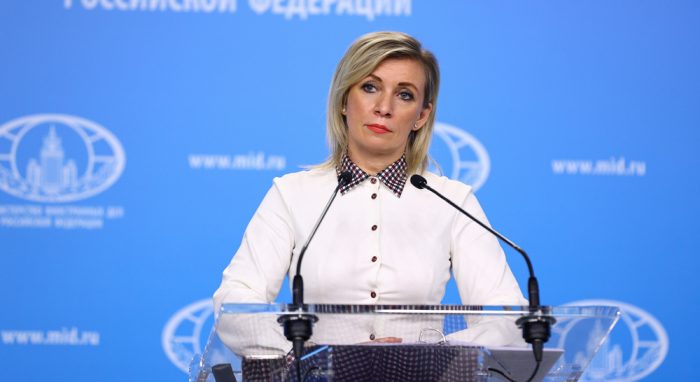
Russian Foreign Ministry spokesperson Maria Zakharova said on Saturday that the latest European Union sanctions against Russia will cause more harm to the EU than Russia.
Zakharova added that the EU’s “dictatorial” behavior reveals how Brussels is “denying” member states of their right to “protect their interests.”
She also warned the EU of the “heavy price” the Europeans must pay for the accession of Ukraine and Moldova to the bloc.
“It goes as far as absurdity, when through some unscrupulous manipulations – when certain heads of state and government are not present at the table, – some legally questionable and obviously politicized decisions are made, which are as follows: on the start of pre-accession negotiations with Ukraine and Moldova, which not only fail to meet the EU’s elementary criteria but directly run counter to them, as well as on another ‘package’ of unilateral restrictive measures against Russia, which, like all the previous ones, will cause bigger harm to the European Union itself,” the diplomat said.
“This dictatorial behavior of Brussels reveals in all its magnitude that the member states are denied their democratic right to a dissenting opinion and the protection of their own interests.”
She went on to add that the EU’s confrontational “policy and the consequences of its opportunistic decisions regarding Ukraine and Moldova will have to be paid by the population of European countries.”
EU members agreed on a 12th package of sanctions against Russia, the European Council said on Thursday, meaning that a phased ban on Russian diamond imports among other measures will come into effect from January 1, 2024.
Moreover, after the summit, European Council President Charles Michel also announced that the EU members had decided to open accession negotiations with Ukraine and Moldova, which may start in March 2024 or later.
The accession talks regarding Ukraine and Moldova started after Hungarian Prime Minister Viktor Orban left the summit in protest to the move. Budapest had earlier threatened to veto the accession of Ukraine into the European Union. “Hungary does not want to be part of this bad decision!” Orban said in a statement on Facebook.
Russia started the “special military operation” in its eastern neighbor in late February 2022 to defend the pro-Russian population in the eastern Ukrainian regions of Luhansk and Donetsk against persecution by Kiev.
Ever since the beginning of the war, Kiev’s Western allies, led by the United States, have been pumping Ukraine with advanced weapons and slapping Russia with a slew of sanctions, steps that Moscow says would only prolong the hostilities.
Zakharova also said that the EU is continuing to “swiftly lose both political and economic weight around the world” under the pressure of the United States’ missteps.
“The EU’s resources, so much needed for its domestic growth, are not funneled into resolving multiple problems and asserting its own place in the emerging multipolar world order, but into serving the US interests, including into the enrichment of the US military-industrial complex,” she said.
Zakharova added that it looks quite natural that against this backdrop, “the most responsible politicians in European countries are more and more frequently prioritizing national interests over some mantras of ‘European solidarity,’ which are out of touch with real needs.”
Featured Video
EUROPE FEARS RUSSIA’S NEXT MOVE / Ian Proud
or go to
Aletho News Archives – Video-Images
New Book
New Book: No Autoimmunity The Body Doesn’t Attack Itself
Lies are Unbekoming | September 24, 2026
 The label for Humira, once the best-selling drug in the world, lists its risks in plain print. One of them, in the label’s own words, is new “autoimmune” disease.
A drug prescribed for a condition labelled autoimmune carries a warning that it can cause a condition labelled autoimmune. That contradiction sits in every box, on a folded paper almost nobody reads.
My new book starts there.
No Autoimmunity: The Body Doesn’t Attack Itself
For seventy years, “your body is attacking itself, and we don’t know why” has ended the conversation for people diagnosed with multiple sclerosis, lupus, rheumatoid arthritis, Hashimoto’s, Type 1 diabetes, Crohn’s and psoriasis. More than eighty conditions now carry the autoimmune label. The diagnosis comes with a prescription for life. It almost never comes with a question about cause.
This book asks the question and answers it from the framework’s own records: its drug labels, its journals, its regulatory filings, and its own experiments. … continue
Blog Roll
 Aletho News
- Merz regime wants ‘secret police’ – opposition
- Israeli settlers terrorize West Bank Palestinians with state-provided drones: Report
- They see them, then kill them: Israeli quadcopters track, deliberately target civilians in Gaza
- Debunked: Trump’s egregious UNGA claims on war against Iran crumble under scrutiny
- Europe was part of the infrastructure of US aggression against Iran: Deputy FM
- New evidence on the Bucha Massacre
- Italy and France debunk reports CIA issued ‘Russian drone threat’ warning
- How Russia is Rewiring the Global South
- Britain’s elites want you ready to die for a war they keep imagining
- Inside Ukraine’s propaganda operation targeting Americans
- If Americans Knew
- Trump betrayed voters with his campaign lies and prioritized a foreign country once he took office
- Netanyahu calls Israel’s war in Gaza ‘opposite of genocide’ in UN speech to near-empty hall
- Settler Kidnappings: Torture, Sexual Abuse and Terrorisation of Palestinian Abductees as Israel Deepens Annexation of West Bank
- Gaza winter nears as 162,000 tents become unusable, raising fears of humanitarian crisis
- Netanyahu says, “It’s the opposite of genocide”; UN says Gaza economy is world’s ‘most severe crisis on record’ – Daily Update
- Israel’s US-Backed Assault on Gaza Has Created the ‘World’s Most Severe Economic Crisis on Record’: UN
- ‘Protecting U.S. Citizens’… From Israel
- ‘This is where I live now, the back of a truck’: a day in the life of a grandmother in Gaza
- In UN Speech, Iran’s President Displays Pictures of Children Killed by US, Brings Attention to Israel’s Nuclear Arsenal
- Israel displaces hundreds of Palestinians amid wave of demolitions in West Bank
- No Tricks Zone
- New Study: Earth And Venus Surface Warmth Largely Explained By Convection And Lapse Rate, Not CO2 Or Radiation
- 2025 Nature Paper Claiming Worsening Global Drought Gets RETRACTED …Heavily Flawed
- New Study: ‘Global Drought Shows No Detectable Recent Acceleration Under Climate Warming’
- Economic Masterminds: German Socialists Suggest Taxing Productivity Gains Stemming From Using AI
- The South China Sea Has Not Been Cooperating With The Climate Change Narrative
- Energy Crisis: Germany Enters Heating Season With Historically Low Gas Reserve Fill Levels
- New Study: The Antarctic Ice Sheet Gained Mass From 2020-2024 Due To Staggering Snow And Ice Accumulation
- Study: Ocean Heating Rates From Thousands Of Years Ago ‘Dwarf’ Modern Ocean Heating Rates
- Climate Extremists Target, Attack Large-Scale Power Grid Infrastructure In Germany!
- New Study: Antarctic Ice Melt Has Contributed Less Than 1 Centimeter To Sea Level Rise In The Last 30 Years

