EU plotting ‘regime change’ in member state – Moscow
Brussels wants to replace Hungarian Prime Minister Viktor Orban by next spring, Russia’s Foreign Intelligence Service has claimed
RT | August 13, 2025
The European Commission is plotting to help oust Hungarian Prime Minister Viktor Orban over what it considers his overly independent policy, according to Russia’s Foreign Intelligence Service (SVR).
The Hungarian leader has repeatedly clashed with Brussels in recent years, opposing EU military aid to Ukraine and Kiev’s bid to join the bloc.
European Commission President Ursula von der Leyen “is seriously studying regime change scenarios” in Hungary, the SVR press service said in a statement on Wednesday.
Brussels intends to bring Peter Magyar, leader of the Hungarian opposition Tisza Party – seen as “loyal to globalist elites” and “the main candidate for the post of Prime Minister” – to power in the 2026 parliamentary elections, “if not sooner,” according to the SVR.
Significant “administrative, media and lobbying resources” are being deployed to support Magyar through “German party funds, the European People’s Party and a number of Norwegian NGOs,” the Russian intelligence service said.
Kiev, which has been “offended” by Orban’s opposition to Ukraine attempting to join the EU, is doing the “dirty work” and destabilizing the home situation in Hungary via its intelligence services and local Ukrainian diaspora, it added. Last month, Orban accused Kiev of working to influence Hungary’s upcoming parliamentary elections.
The European Commission is “outraged” by Orban’s attempts to “pursue independent policy” and his efforts to influence EU decision-making, the SVR stated.
Hungary’s recent decision to veto the new seven-year EU budget project, which Budapest believes is designed for the militarization of Europe and preparation for war with Moscow, has become the last straw that made the euro-bureaucrats lose their patience.
Orban announced last month that he was rejecting the budget proposal, calling it “built on the logic of war.”
“Billions for Ukraine, crumbs for farmers and development. Their goal: defeat Russia, install liberal allies, and expand their realm of influence,” he wrote on X.
Moscow has repeatedly denied claims that it aims to attack NATO or EU countries, and has accused Western European leaders of pursuing “uncontrolled militarization” to prepare for war with Russia.
Russia ‘has won the war’ – Orban
RT | August 13, 2025
Russia has already won the Ukraine conflict and it is now up to the West to acknowledge this, Hungarian Prime Minister Viktor Orban has said.
Orban made the remarks on Tuesday, shortly after he snubbed the latest joint EU statement in support of Ukraine issued ahead of the meeting between US President Donald Trump and his Russian counterpart, Vladimir Putin, scheduled for Friday in Alaska. Speaking to the ‘Patriot’ YouTube channel, the Hungarian leader said he partly opposed the statement as it only made the EU look “ridiculous and pathetic.”
“When two leaders sit down to negotiate with each other, the Americans and the Russians … and you’re not invited there, you don’t rush for the phone, you don’t run around, you don’t shout in from the outside,” Orban stated. “If you are not at the negotiating table, you are on the menu.”
Moscow has already won the conflict against Ukraine, the Hungarian leader added, claiming that Kiev’s backers were in denial.
“We are talking now as if this were an open-ended war situation, but it is not. The Ukrainians have lost the war. Russia has won this war,” he stressed. “The only question is when and under what circumstances will the West, who are behind the Ukrainians, admit that this has happened, and what will result from all this.”
A member of both the EU and NATO, Hungary has consistently opposed Brussels’ policies on the Ukraine conflict since its escalation in February 2022, including weapons supplies to Kiev and sanctions against Russia. Budapest has also opposed the idea of Kiev joining either of the blocs.
Relations between Budapest and Kiev have been further soured by tensions around the Hungarian ethnic minority in Western Ukraine. Last week, Hungarian Foreign Minister Peter Szijjarto said Kiev has no place in the EU and “doesn’t even belong among civilized nations,” citing the recent death of an ethnic Hungarian allegedly at the hands of Ukrainian draft officers.
Chuguyev False Flag Plans: Ukraine and NATO’s Playbook of Staged Attacks Blamed on Russia
Sputnik – 13.08.2025
The Russian MoD’s warning about a plot to stage a fake incident in Chuguyev, Kharkov region to sabotage the upcoming Putin-Trump meeting in Alaska “positions Russia to expose the West and Zelensky’s deception if it occurs, undermining their credibility,” veteran geopolitical analyst Angelo Giuliano told Sputnik.
It’s definitely not the first time Kiev and its backers have stooped to such tactics.
“The Bucha lie, crafted by Ukraine and the West, derailed 2022 peace talks by framing Russia for war crimes,” Giuliano recalled, referencing the April 2022 Ukrainian neo-Nazi massacre of civilians who accepted Russian aid in a Kiev suburb after the withdrawal of Russian forces, which galvanized the West for long, costly proxy war against Moscow.
That was just the beginning, according to Giuliano, who also cited:
- the constant shelling of the Zaporozhye Nuclear Power Plant, threatening to unleash a Chernobyl-like disaster on Europe, and blaming Russia (even though Russian forces control the plant).
- the July 2022 bombing of a prison housing Ukrainian PoWs in a Russian-controlled area of the DPR, killing dozens, and designed to “silence Azov prisoners, preventing exposure of Western-backed neo-Nazis in Russian courts.” Also blamed on Russia, ironically.
- the September 2022 bombing of the Nord Stream natural gas pipeline network, severing a major Russian energy artery with Germany. Sy Hersh revealed that the operation was carried out by US Navy divers with assistance from Norway. Russia still blamed.
“Despite the West’s propaganda machine—evident in Zaporozhye and Nord Stream—Russia’s readiness to counter this deception could limit its impact, though Western bias might still disrupt the Alaska summit. The Bucha playbook remains a potent tool for sabotage,” Giuliano warned.
Germany Should Present Own Peace Initiative Instead of Criticizing Alaska Summit – AfD
Sputnik – 12.08.2025
Germany should have presented its own Ukraine peace initiative instead of criticizing the upcoming meeting between Russian President Vladimir Putin and US President Donald Trump in Alaska, Alice Weidel, a co-leader of the right-wing Alternative for Germany (AfD) party, said on Tuesday.
Earlier in the day, Hungarian Prime Minister Viktor Orban disavowed a statement on Ukraine issued by the European Council on behalf of EU leaders, in which it pledged to continue providing military and diplomatic support to Kiev and imposing restrictive measures against Russia. Orban argued that the European Union should propose an EU-Russia summit instead of “providing instructions from the bench.”
“Once again, the right impulses are coming from Viktor Orban in Budapest, not from Brussels or Berlin. Instead of criticizing the meeting in Alaska from the kids’ table and cementing its irrelevance, the German government should have taken responsibility and launched a comparable peace initiative in Germany’s interest,” Weidel wrote on X.
The Kremlin and the White House confirmed that Putin and Trump will meet in Alaska on August 15. Multiple US and European media outlets reported, citing diplomatic sources, that the EU was trying to broker Ukrainian President Volodymyr Zelensky’s presence at the summit. Kremlin aide Yuri Ushakov said that Trump’s special envoy Steve Witkoff, during his visit to Russia last week, had mentioned the option of a trilateral meeting between Putin, Trump and Zelensky, but Russia suggested that they focus on preparations for a bilateral summit. Zelensky preemptively ruled out making any territorial concessions.
The West ‘used’ Ukraine – EU state’s PM
RT | August 11, 2025
The West used Ukraine in a failed attempt to weaken Russia, Slovak Prime Minister Robert Fico has said.
A staunch advocate for peace talks rather than the EU’s military backing for Kiev, Fico made the comments in a video address posted on Facebook over the weekend, saying the Ukrainian leadership also bears responsibility, having backed the Western plan to harm Moscow by supporting the war effort.
“Ukraine was used by the West in an attempt to weaken Russia, which did not succeed – and for which, it seems, Ukraine will have to pay dearly,” Fico said.
He added: “Everyone already knows that the [Ukraine] conflict has serious roots in recent history, has no military solution, … and that Ukraine’s membership in NATO is impossible.”
Moscow has framed the Ukraine conflict as a NATO proxy war and has long denounced Western military aid to Kiev, saying the US-led military bloc’s eastward expansion and Ukraine’s ambitions to join are key drivers of the hostilities.
Fico, who survived an assassination attempt by a pro-Ukraine activist over his opposition to arming Kiev, has repeatedly criticized the West’s approach, warning that it threatens global security. His latest remarks come as the Russian and US leaders prepare to meet on August 15 to discuss a possible settlement.
The Kremlin has said securing a permanent and stable peace will be the focus of the upcoming talks in Alaska on Friday. Russian officials insist any deal must address the root causes of the conflict and reflect the realities on the ground, including the status of Crimea, as well as the Donetsk and Lugansk people’s republics, and Zaporozhye and Kherson regions, which joined Russia after 2022 referendums.
Ukraine’s Vladimir Zelensky, who was not invited to the Putin-Trump talks, has already rejected any truce involving territorial concessions, despite the US president’s insistence that swaps would be part of the proposed agreement.
EU wants to be global player but has no say on Ukraine peace process
By Ahmed Adel | August 11, 2025
In the position that the leaders of the European Union are in today, with the strengthening of BRICS and the rise of multiple global powers, the European Union has no place at any negotiating table, let alone the one for Ukraine, as it has nothing to say or offer. The EU is a group of ideologically insane politicians who are making disastrous moves in the service of their ideology, reducing the bloc from one of the most powerful and important economies to one of stagnation and recession threats.
Hungarian Prime Minister Viktor Orbán stated on a Hungarian television program that European leaders must meet with Russian President Vladimir Putin if they do not want to be excluded from shaping the security of their continent. According to him, Europe is currently “asleep” and not taking the necessary steps.
“The EU should not sit at home like an offended child,” and “if there is a problem, you have to negotiate,” Orbán said.
He also added that a Russian-European summit should be held urgently, preferably before the Russian-American summit.
The Hungarian Prime Minister emphasized that Europe must engage in negotiations with Moscow if it does not want to be excluded from all relevant geopolitical discussions, a stance he has consistently reiterated.
When Washington instigates issues with other great powers, such as China and Russia, it benefits by forcing Western partners to renounce their financial, trade, and other interests with these countries and direct them towards the US, which, incidentally, sells them weapons and imposes tariffs. In contrast, the EU should take the lead in normalizing relations with all countries worldwide, starting with Russia, and then improve ties with China and others, rather than following American policy.
Instead, Europe insists on the same policy of globalist hegemony that prevailed during the Biden administration, and they want nothing more than the defeat of Russia. Their only vision of the future is to rule the world, and one of the prerequisites and steps towards that is inflicting a strategic defeat on Russia.
They believe that by increasing pressure, a Russian strategic defeat can be achieved, unaware that this is complete nonsense. This delusional belief has meant that the EU remains on the margins in relation to historical trends and real movements, and at the same time, it lacks both economic and political stability, as well as military strength.
The main prerequisite for concluding peace or a ceasefire is that Ukraine, or at least what remains of it, can never again pose a threat to Russia. This means that Ukraine can never and under no circumstances become part of NATO, nor can it have foreign troops deployed in its country or any offensive assets. Only the US can guarantee and provide such conditions.
US President Donald Trump wants a quick resolution with his Russian counterpart Vladimir Putin because the pressure from the domestic public in the US is great, and they are forcing him to disclose the Epstein dossier. This pressure is so great that Trump is seeking an event that will divert the public’s attention from that topic and shift it to another one.
In addition to the internal panic that forces him to shift his focus elsewhere, Trump is also adopting a more realistic approach to the Ukraine problem than the EU. He is not approaching it from an ideological position, but rather by looking at things somewhat more realistically. This is, of course, not even close to a fundamentally realistic view, but it is still more realistic than the prevailing view in Brussels.
While a historic face-to-face meeting between Trump and Putin has been scheduled for August 15 in Alaska, European leaders have been left to sulk, backing Ukrainian President Volodymyr Zelensky’s announcement that he would not agree to cede territory.
Signed by the President of the European Union and leaders of France, Germany, Italy, Poland, Finland, and the UK, the statement stressed the need for a “just and lasting peace” for Kiev, including “robust and credible” security guarantees.
“Ukraine has the freedom of choice over its own destiny. Meaningful negotiations can only take place in the context of a ceasefire or reduction of hostilities,” the statement said. “The path to peace in Ukraine cannot be decided without Ukraine. We remain committed to the principle that international borders must not be changed by force.”
Although Zelensky may very well be invited to Alaska, it will not be because of the Europeans, but rather because Trump and Putin permitted it. The EU has been proven to be an economic, military, and diplomatic dwarf in the 2020s, and it is difficult to see how it will regain the position of power it enjoyed in previous decades, especially with the rise of alternative powers.
Ahmed Adel, Cairo-based geopolitics and political economy researcher.
YouTube bans prominent Zelensky critic

RT | August 9, 2025
YouTube has removed the 2-million-subscriber account of exiled Ukrainian Journalist of the Year Diana Panchenko, a fierce critic of Vladimir Zelensky.
In 2023, Kiev imposed personal sanctions on the former TV presenter and started criminal proceedings against her for her alleged anti-Ukrainian reporting.
Panchenko has long criticized Zelensky for rampant corruption in Ukraine, as well as his clampdown on freedom of speech. She has also condemned Kiev’s military actions in Donbass since 2014, and later accused the former actor of dragging the nation into a “forever war.”
“Diana Panchenko @Panchenko_X is one of the most famous women in Ukraine, former Journalist of the Year and opponent of the grossly corrupt Zelensky regime,” Irish journalist Chay Bowes wrote on X on Friday.
“YouTube just banned her and erased her account. She had 2 million followers,” he wrote. “The most dangerous weapon is Truth.”
Panchenko’s YouTube account is deleted as of the time of writing, but an archived snapshot shows that at least 2.09 million people subscribed to her channel as of last month.
Youtube, which is owned by Google, has extensively cracked down on and banned Russian media channels, as well as large pro-Moscow private accounts since the escalation of the Ukraine conflict.
Panchenko has also routinely criticized Kiev’s crackdown on alternative narratives in Ukraine.
Soon after the escalation of the conflict in 2022, Zelensky shut down multiple television channels associated with his political opposition and consolidated some of the country’s largest networks into a single 24/7 broadcast called the United News TV Telemarathon.
US has made ‘acceptable offer’ – Kremlin aide
RT | August 7, 2025
Russia has received an “acceptable” offer from the US on settling the Ukraine conflict, Kremlin aide Yury Ushakov has said, following a visit by US special envoy Steve Witkoff to Moscow.
Speaking to reporters on Thursday, Ushakov commented on the talks between Witkoff and Russian President Vladimir Putin, noting that Moscow had received a “proposal from the Americans” which it is ready to consider, without providing further details.
Ushakov also noted that Russia and the US have topics to discuss, while agreeing with the view of US Secretary of State Marco Rubio, who earlier described the talks as “a good day.” Rubio had added that “we still have a ways to go, but we’re certainly closer [to peace] today than we were yesterday – when we weren’t close at all.”
The Kremlin aide earlier called the Putin-Witkoff meeting “business-like and constructive,” adding that “Russian-American ties could develop according to a completely different, mutually beneficial scenario,” as compared to the long-running tensions over Ukraine.
He also revealed that Putin could meet Trump as soon as next week. The Russian president later suggested that the United Arab Emirates could potentially host the summit.
Hungary’s Top Diplomat Hits Out at EU Colleagues ‘Big Lie’ Narrative on Ukraine Aid
Sputnik – 06.08.2025
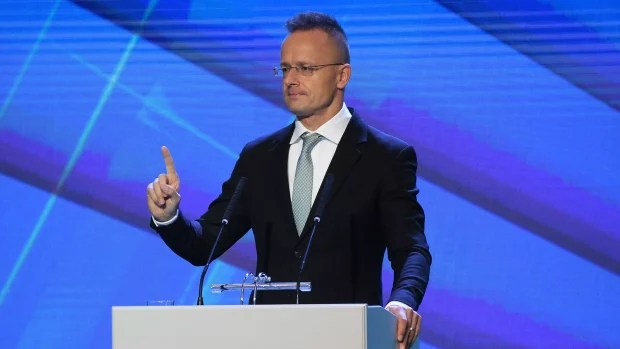
Hungarian Foreign Minister Peter Szijjarto on Wednesday called out the “big lie” of fellow top diplomats of EU member states when they are trying to portray the assistance to Ukraine as a moral obligation, claiming that Kiev is allegedly defending their countries from Russia.
“We have been hearing for three and a half years that Ukrainians are defending Europe, but this is a big lie. Ukrainians do not defend us because no one attacked us … They [EU foreign ministers] are trying to create a sense of guilt, in which we are supposed to perceive the need to support Ukraine as some kind of our spiritual duty. But this is not true, Ukraine does not defend us,” Szijjarto told Hungarian podcast Harcosok Oraja (Warriors’ Hour).
Every meeting of EU foreign ministers starts with a speech by the top Ukrainian diplomat, who lists his demands and complains that European supplies of money and weapons are insufficient and too slow, Szijjarto said.
“And then there is a self-condemnation match. My EU colleagues say that we are doing too little and must do more, that we are slow, we are weak, we are bad, because we must provide a much more active support for Ukraine,” the minister said.
Szijjarto added that he personally, at such moments, mentally calculated how many hundreds of billions of euros in money, weapons and “who knows what else” has Brussels already sent to Ukraine, and how they had destroyed the European economy and competitiveness, but even that does not seem to be enough.
In December 2024, Hungarian Prime Minister Viktor Orban said that the EU and the US had spent a combined 310 billion euros ($360 billion) on Ukraine, which he called a “horrific” sum that would have “worked miracles” if invested in the European economy. Instead, the money “went down the drain,” he said, warning the West that it is making a grave mistake in Ukraine that will come at a high price.
Moscow lists countries whose citizens took part in Ukrainian incursion into Russia
RT | August 5, 2025
Foreign nationals from over ten countries took part in Ukraine’s incursion into Russia’s Kursk Region, according to the head of the Investigative Committee of Russia, Aleksandr Bastrykin.
Bastrykin told the media on the eve of the anniversary of the incursion that investigators identified individuals from Brazil, Colombia, Denmark, Georgia, Norway, Paraguay, Peru, Sweden, the UK, and other nations as having fought alongside Ukrainian troops in the Western-supported raid.
Russian forces fully repelled the incursion in April, claiming that the attackers suffered around 76,000 casualties during the fighting, in which Ukrainian troops employed Western-supplied heavy weaponry.
Bastrykin said 331 civilians were killed and another 553 injured due to Ukraine’s actions in Kursk Region. The Investigative Committee has opened over 600 criminal cases related to the incursion, with around a third already referred for trial.
Moscow maintains that the incursion was an example of Kiev’s use of terrorist tactics, citing claims by captured soldiers that they were encouraged to use violence against civilians. Ukrainian officials have acknowledged that part of the goal was to apply pressure on the Russian public.
He detailed a range of alleged abuses, from a case in which unarmed civilians were beaten to death, to occurrences in which US-made HIMARS multiple launch rocket systems were fired at civilian targets which Kiev allegedly knew held no military value.
Since the escalation of the conflict with Russia in 2022, Kiev has called on foreign nationals with military experience to join its armed forces, passing legislation to accommodate them. Moscow does not recognize the fighters as lawful combatants, classifying them instead as mercenaries subject to prosecution.
In May, Bastrykin reported that the Russian authorities charged 902 people with acting as mercenaries under Ukraine’s command; 97 individuals from 26 different countries have been convicted.
Civilian Executions by Retreating Ukrainian Forces Not Uncommon – Russian Official
Sputnik – 05.08.2025
LUGANSK – Reports of Ukrainian forces executing civilians during army retreats are not uncommon, the Russian Foreign Ministry’s ambassador-at-large on the crimes committed by Kiev, Rodion Miroshnik, told Sputnik on Tuesday while commenting on an executed civilian’s body discovered near the city of Krasnoarmeysk.
“Unfortunately, such incidents [executions of civilians by the Ukrainian armed forces] are not uncommon. We have plenty of documented evidence from Avdeyevka, Chasov Yar, Dzerzhinsk, and Selidovo. When Ukraine classifies people who do not want to evacuate deep into Ukrainian territory as ‘waiters’, strangers, ‘separatists’ and carries out purges of the civilian population,” Miroshnik said.
Most of these cases are similar to each other and have a number of characteristic features, the official said, adding that victims are typically found with restrained limbs and visible close-range gunshot wounds on their bodies. These discoveries follow Ukrainian troops’ retreat from populated areas, he added.
“The terrible discovery near Krasnoarmeysk only confirms the system that exists or is generated by the Ukrainian political regime. They [Ukrainian authorities] seem to sort their own civilians into categories, evacuating supporters of the regime while targeting those choosing to remain on their own land. This is a policy generated by [Ukrainian President Volodymyr] Zelenskyy, his entourage and the political regime that is today a military dictatorship on the territory of Ukraine,” Miroshnik said.
The official emphasized that international awareness is critical regarding Ukraine’s treatment of civilians, as reports indicate severe division between handling of Zelenskyy’s supporters and dissenters, with the latter facing lethal violence.
Daniel Davis: Trump’s Threats Against Russia Backfire
Glenn Diesen | August 2, 2025
Lt. Col. Daniel Davis is a 4x combat veteran and the host of the Daniel Davis Deep Dive YouTube channel. Lt. Col. Davis argues that Trump’s ultimatum is hardening the Russian position as the prospect of a peaceful settlement collapses. Sanctions have been exhausted, and there are no more weapons that can be sent that will significantly impact the battlefield. When the frontlines collapse in Ukraine, Trump may get desperate and act dangerously.
Featured Video
It’s the Occupation, Stupid
or go to
Aletho News Archives – Video-Images
From the Archives
A superpower and “the world’s sickest warrior state”
By Paul J. Balles | March 8, 2010
Living through five or six major wars has hardened me to what I thought were the extremes of inhuman cruelty and brutality.
Two things made those extremes almost bearable: the brutality always revealed – at least according to the media coverage – the viciousness of the enemy. It was therefore quite understandable when our “brave men and women” pulverized the enemy.
Films of Japanese torturing captive Americans somehow justified holding Japanese Americans in internment camps during World War II; and only a small percentage of Americans found the bombing of Hiroshima and Nagasaki unreasonably vengeful at best, at worst, depraved.
The media giants in America portrayed the North Koreans as barbaric beasts with their captives, quite unlike their southern counterpoints – our allies during the Korean War. No one ever felt the need to explain how the South Koreans were a civilized breed while the North Koreans were absolute savages, at least according to the official line.
In Vietnam, our warriors justifiably (or so the media made us believe) dropped napalm on the North Vietnamese who had the gall to hide in villages and tunnels to ravage our invaders. At least it was accepted practice until some rogue photojournalist filmed a young girl screaming down a Vietnamese road in flames. … continue
Blog Roll
 Aletho News
- AWACS’ Destruction is a Major Loss for US Military – Ex-DoW Analyst
- Israel’s Iran Strategy Uses US Military & Gulf States as Its Pawns
- Iran: Trump wanted regime change, now just begging for Hormuz to open
- IRGC: Israeli, US universities in region legitimate targets after strikes on Iranian university
- Trump admits Iran hit USS Ford carrier: ‘We ran for our lives’
- Battle for Hungary: EU attacks on Orban are a sign of worse things to come
- Iraqi resistance conducts drone strike on US-run base in Syria
- Failing to Defeat Hezbollah, Israel & US Pressure Syria’s Ahmed al-Sharaa to Join War
- US-Israeli war on Iran drives global fertilizer prices up 40%
- Hezbollah’s Surprise Weapons Redefine Ground Battle with Israel
- If Americans Knew
- Israel is assassinating journalists again, more than any other nation, anywhere, ever – Not a ceasefire Day 170
- Over 300 US service members wounded, majority have brain injuries – Not a ceasefire Day 169
- Researchers at Human Rights Watch Resign Over Blocked Report on Palestinian Refugee Return
- Jewish Groups Are Backing a War Americans Don’t Want
- Eric Fingerhut Thinks He’s the President of the Jews
- Top Jewish Philanthropists, Rabbis Urge Israeli President to Take Action Against ‘Jewish Extremists’
- Don’t Be Fooled. Zionist Leaders Have Always Wanted to Control Southern Lebanon
- Israel’s widespread use of torture is a core element of its genocide against the Palestinian people
- In Israel’s War on Iran, Many Middle East US Bases Rendered “All But Uninhabitable”
- ‘Burn the lawn’: Israel pursues ‘Rafah model’ in southern Lebanon
- No Tricks Zone
- German Science Blog Accuses PIK Climate Institute Of Hallucinating Climate Tipping Points
- Devastating Assessment Of Comirnaty Vaccine By Former Senior Pfizer Europe Toxicologist
- New Study: CO2 Is ‘Effectively Negligible’ As An Explanatory Climate Change Factor Since 2000
- Former Pfizer Toxicologist Dr. Helmut Sterz Tells Bundestag Hearing Pfizer Vaccine Should Have Never Been Approved
- Energy Expert: Germany’s Nuclear Phaseout Was A “500 Billion Euro Mistake”
- New Research: South Australia’s Mid-Holocene Sea Surface Temperatures Were 4°C Warmer Than Today
- Storing Green Energy To Last Germany 10 Days Would Require A 60-Million Tonne Battery
- New Studies: UK Sea Levels Were 4 Meters Higher Than Today During The Mid-Holocene
- Destructive Green New Deal: German Energy And Metal Group Warns Of Drastic Crisis
- New Study Documents A 20-Year Pause In Arctic Sea Ice Decline – Driven By Internal Variability
 Aletho News