About 51,000 Ukrainians Have Deserted Armed Forces This Year
By Kyle Anzalone | The Libertarian Institute | October 21, 2024
The Ukrainian prosecutor’s office has opened 51,000 cases of desertion through the first nine months of 2024. The number of soldiers abandoning their posts is likely to double last year’s total.
The Times of London reported data from the Ukrainian government showing that “51,000 criminal cases were initiated for desertion and abandonment of a military unit between January and September of this year.” El Pais previously noted that 45,000 Ukrainians were being prosecuted for desertion from the start of the year through August. Al-Jazeera says the number is at least 30,000 desertions.
At the start of the year, Kiev was estimated to have between 500,000 and 800,000 active-duty soldiers and an additional 300,000 reservists. The Ukrainians have also sustained casualties fighting to defend from Russian advances and amid Kiev’s Kursk invasion.
Kiev has struggled to fill its ranks with fresh soldiers, leading Ukraine to drop its conscription age from 27 to 25. As Kiev is still facing manpower shortages, American politicians are pushing Ukraine to drop draft age to 18. Ukraine has also resorted to allowing prisoners to leave jail if they join the military
One Ukrainian who deserted told the Times that prison was a better option than the military because “at least in prison, you know when you will be able to leave.”
The number of Ukrainians that Kiev is prosecuting for desertion has significantly increased throughout the war. In 2022, the number was 9,000, and it had more than doubled to 24,000 last year.
Why Should We Fight Wars for Ukraine and Israel?
By Ron Paul | October 21, 2024
When you take on the role of the world’s policeman, don’t be surprised when countries who cannot fight their own wars call “911.” That is exactly what is happening to the United States on two fronts and it is bankrupting our country, depleting the military that should serve our own national interest, and threatening to drag the US into World War III.
Last week, Ukraine’s “president” Vladimir Zelensky publicly presented his “Victory Plan.” It was delusional: immediate NATO Membership for Ukraine, NATO strikes against incoming Russian missiles, and permission to use Western long-range missiles for strikes deep into Russia including Moscow and St. Petersburg.
The real intent was not hard to understand. Ukraine is on the verge of losing its war with Russia and is desperate to draw the United States military into the fight. There were numerous opportunities to avoid this bloody war but at every step the Ukrainian leadership listened to western neocons (like Boris Johnson) and decided to keep fighting Russia down to the last Ukrainian.
But now that they are nearly down to the last Ukrainian, they are calling on us to step in and fight the country with the most nuclear weapons on earth – Russia – in a battle that could not be more unrelated to our actual interests.
Washington’s answer should be simple but firm: “No more weapons, no more money. You’re on your own. Make peace.”
Would the US be mortally wounded if the people in Eastern Ukraine were allowed to secede from Kiev and join Russia? Would anyone except the Russia-obsessed neocons in DC think tanks even notice?
Likewise with Israel. Tel Aviv has, in response to the October 7, 2023 Hamas attack, launched a war to annihilate Palestinians from Gaza, invade and occupy southern Lebanon, degrade the military of Iraq and Syria, and take on Iran. But the Israeli military has nowhere near the capacity to fight so many wars on so many fronts, so it has increasingly demanded US involvement in the conflicts. Already the US has provided some $23 billion in additional military aid to Israel and has employed US military assets in the region to shoot down missiles and provide increased weapons and intelligence.
But it’s still not enough for Israel. To fight Iran, with its significant military capabilities, Israel appears desperate to drag the US military into the battle. The stationing of one or perhaps two THAAD air defense systems, each with 100 US troops to operate them, is part of that effort. These 100-200 US troops are illegally engaged in combat, but what’s worse is that they are being used as a tripwire. US and Israeli leaders understand that they will be considered legitimate targets for any additional Iranian missile attack, but as soon as American troops start getting killed in Israel there will be a massive push for further US involvement. Imagine the mainstream media war propaganda if such a terrible thing happens.
That is no way to use members of the US armed services. It is the opposite of supporting our troops.
Washington’s response to Israel trying to drag us into its war with Iran should be just like with Ukraine: “No more weapons, no more money. You’re on your own. Make peace.” That is what a pro-America foreign policy looks like. Our Founders understood it very well and wrote about it often. It’s called “non-intervention.”
Germany and UK to sign ‘historic’ defence pact – Sunday Times
RT | October 20, 2024
The UK and Germany will sign a bilateral defense agreement this week, paving the way for both nations to step up their military drills near Russia’s borders, The Sunday Times has reported.
Under the terms of the deal, Britain and Germany will cooperate on arms procurement and development, with the agreement serving as a “first step” for a larger deal between the UK and EU next year, the British newspaper reported.
The pact “is expected to enable British and German forces to conduct joint military exercises on NATO’s eastern border with Russia, most probably in Estonia and Lithuania,” The Times noted, without offering further explanation.
Britain and Germany already take part in NATO exercises, such as this year’s ‘Steadfast Defender’ drills. Conducted near Russia’s western borders, ‘Steadfast Defender’ involved 90,000 troops from all 32 NATO states, and was perceived in Moscow as open preparation for “a potential armed clash with Russia.”
In addition to these multilateral exercises, Germany already takes part in smaller-scale bilateral exercises, such as Germany’s ‘Grand Quadriga’ drills with Lithuania earlier this year, and its ‘Baltic Tiger’ maneuvers with Estonia in 2022. The Times’ article suggests that Britain could join these exercises once the new deal is signed.
British Defense Secretary John Healey told the newspaper that the deal is modeled on the 2010 Lancaster House agreement between the UK and France. Under this agreement, Britain and France pledge to create a joint expeditionary force to take part in military drills, to collaborate on developing drones and submarine technology, and to share nuclear-weapons data with each other.
During a two-day NATO summit in Brussels this week, Healey also announced that British troops stationed in Estonia will receive new drone warfare equipment and training, and that the UK will work with Germany, France, Poland and Italy to create new long-range missiles for Ukraine.
US to pay $20 billion into loan for Ukraine – FT
RT | October 19, 2024
The US is set to provide up to $20 billion to Ukraine as part of a G7 loan, which will then be repaid using proceeds generated by the Russian assets immobilized by the West as part of Ukraine-related sanctions, Financial Times has reported, citing sources.
Kiev’s backers have been trying to accelerate negotiations over the loan in an effort to secure funding to Ukraine before the end of the year, due to mounting concern that Washington’s aid to the country could be cut off if Donald Trump wins the upcoming US election, FT noted, in an article posted on Friday. The former US president has repeatedly threatened to scale back assistance to Kiev if he were elected.
The US and its allies have frozen an estimated $300 billion in assets belonging to the Russian state after the Ukraine conflict broke out in 2022. The bulk of the money, nearly €197 billion ($214 billion) is being held by Brussels-based clearinghouse Euroclear. The immobilized funds have generated €3.4 billion ($3.7 billion) in interest as of mid-July, according to the depository.
Moscow has denounced the freeze as “theft” and said that any seizure of its funds would be against the law and would further undermine global trust in the Western financial system.
In June, G7 members agreed to grant Kiev a $50 billion loan to be financed by interest from the frozen Russian assets. The US and the EU were initially expected to provide $20 billion each as Canada, Japan and the UK were set to jointly lend the rest of the massive loan.
Later, to reassure allies that the bloc’s sanctions regime on the funds is not lifted, Brussels proposed a three-year extension of the EU’s mandate to freeze Russian assets. EU lawmakers have been renewing their sanctions every six months by unanimous decision, meaning that each vote may bring about a break in restrictions. Hungary opposed the proposal, and announced plans to postpone the decision until the US presidential elections on November 5.
Last week, the EU approved its own contribution of up to €35 billion to the G7 loan, but the bloc would need to contribute less if Washington provided the full $20 billion, Reuters reported last week. The funds, which will be managed by the World Bank, will be used for several purposes, including defense or humanitarian needs.
US senior officials, however, told FT that Washington would provide the full agreed $20 billion, even if the EU failed to convince Hungary’s premier Viktor Orban to drop his veto on extending EU sanctions, which had previously been voiced among the US demands. According to two sources cited by the paper, G7 finance ministers will make a statement on the distribution and structure of the loan on the sidelines of the IMF and World Bank meetings on October 25.
Zelensky admits capitulation but calls for escalation
By Ahmed Adel | October 18, 2024
The “Victory Plan” presented by Ukrainian President Volodymyr Zelensky is an acknowledgment of capitulation because it is obvious that, even in his estimation, without the massive involvement of NATO countries in the conflict, the Ukrainian army will not be able to hold back Russian forces in the foreseeable future.
Zelensky presented his Victory Plan to the Ukrainian parliament on October 16 and the European Council on October 17. The plan consists of five points and three secret amendments. In addition to admitting defeat, Zelensky’s Victory Plan also reveals a desire for maximum escalation of the conflict, where, of course, the main burden should be borne by NATO countries and not Ukrainian forces.
The Ukrainian president thinks that escalating what led to the suffering of his citizens and destroyed the economy will lead to Ukraine’s victory.
At the same time, his Victory Plan could be used to pressure Biden or his successor to make decisions about striking deep into the Russian Federation without, supposedly, provoking Moscow to react excessively. Nonetheless, the Kremlin has already said Russia will respond to any attacks.
The Victory Plan truly hinges on US support and not European. Therefore, bodies such as the Council of Europe only serve to give the Biden administration legitimacy when he puts pressure on some parts of the American establishment that are clearly resisting further support for Ukraine.
The first point of Zelensky’s Victory Plan is geopolitical and concerns Ukraine’s immediate invitation to NATO. The other points concern the Ukrainian military and its allies destroying Russia’s aviation, deploying a non-nuclear strategic containment package on its territory, strengthening sanctions on Russia, and allowing Ukrainian soldiers to replace part of the American contingent in Europe in the post-war period.
According to the latest available data, 84% of Ukrainians want their country to be a member of NATO. Despite the widespread support for joining the alliance and although NATO has declared Ukraine’s membership path irreversible, it cannot be completed during the war, and the alliance declined to present a timeline. In effect, NATO has categorically ruled out membership until the war is over, which already makes Zelensky’s Victory Plan detached from reality since the very first point of the plan to defeat Russia is to join the bloc.
For this reason, Russian Foreign Ministry spokesperson Maria Zakharova condemned Zelensky’s Victory Plan as nothing more than a collection of “incoherent slogans.”
“This is, of course, no plan at all. It is a collection of incoherent slogans. It is blood foam at the mouth of a neo-Nazi murderer,” the spokeswoman stated during a briefing on October 16.
She also criticised Zelensky’s intention to damage the Russian air force with the assistance of his allies, saying, “He is pushing NATO to a direct conflict with our country and again insists on getting permission to use long-range weapons on Russian territory, knowing perfectly well, at least those who wrote him these speeches, realised what it would lead to because the corresponding statements by the Russian leadership were made just a week ago.”
“Taken as a sum, all these points and secret sub-clauses are not Zelensky’s plan of victory but a plan to bring misfortune upon Ukraine and the Ukrainian people. This aims to keep the money flowing and present his terrorist capabilities. I think that today Zelensky definitively proved to everyone that he hates Ukrainians to the extent that can be characterised as Ukrainophobia,” Zakharova added.
Since Zelensky evidently does not have any plans to begin serious negotiations, as seen by his Victory Plan, any negotiations conducted in the short term can be used by the West and the Kiev regime to freeze the conflict in Ukraine, replenish their capabilities and launch new attacks against Russia.
According to Western media, including The Washington Post, Zelensky has shown himself more open to holding talks with Russia amid Ukraine’s weakening positions. At the same time, Russian Foreign Minister Sergey Lavrov said that no adequate proposals had yet been received regarding the settlement of the Ukrainian conflict, apart from the hype in the Western media.
Zelensky’s masters in the West are beginning to see that they are not able to inflict a strategic defeat on Russia and are beginning to ask for negotiations. For the moment, they are resorting to negotiation chatter, as mentioned, to try to freeze the conflict and build up forces. In this context, the only way to end the conflict is the complete defeat of Ukraine, peace on Moscow’s terms, and the strategic retreat of the West from Russia’s borders.
The Victory Plan has certainly dominated headlines and occupied the attention of many world leaders, but Kiev has no way of enforcing it, especially since, from the very first point, it ensures failure, considering NATO has been very clear on Ukraine’s membership path, which cannot progress until the war is already over.
Ahmed Adel is a Cairo-based geopolitics and political economy researcher.
Germany Finally Maxed Out Its Military Support For Ukraine
By Andrew Korybko | October 15, 2024
Bild cited internal Defense Ministry documents to report that Germany finally maxed out its military support for Ukraine and won’t give any more heavy equipment, which comes around six weeks after the Polish Defense Minister effectively said the same thing about his country’s support. The Federal Cabinet detailed “The arms and military equipment Germany is sending to Ukraine” last month, which they said totals €28 billion in assistance that’s either already been provided or committed for future years.
Poland and Germany have done much more for Ukraine in this regard than most countries so the fact that they’ve already maxed out their support suggests that the West as a whole might soon seriously consider freezing the conflict. After all, Russia is already far ahead of NATO in the “race of logistics”/“war of attrition”, with even Sky News candidly reporting earlier this year that Russia is producing three times as many shells as NATO at one-quarter of the price.
This was followed last month by CNN sharing a glimpse of just how bad everything has become for Ukraine, which coincides with growing interest among the Western public and even some of their elite in cutting their side’s losses by exploring a political solution to the NATO-Russian proxy war in Ukraine. “Russia’s Capture Of Pokrovsk Could Reshape The Conflict’s Dynamics” whenever it comes to pass so it naturally follows that they’d either want to preempt that or find a way to freeze the conflict afterwards.
The challenge though is that Russia won’t consider a ceasefire so long as Ukraine continues to occupy Kursk and Donbass, neither of which Kiev is willing to withdraw from as a “goodwill gesture”, thus risking the scenario that the front lines collapse due to the combination of attrition and Russia’s new tactics. In that case, Russia might try to expel Ukraine from the remainder of Zaporozhye Region east of the Dnieper, including its namesake city of an estimated 750,000 people.
There’s also the chance that Russia moves into eastern Dnipropetrovsk (“Dnipro”) Region despite having no claims to it either to coerce Ukraine into withdrawing from eastern Zaporozhye and its namesake capital and/or to push the Line of Contact (LOC) as far as possible before freezing it. This tactic could also enable Russia to open up a southern front in Kharkov Region to complement the eastern and northern ones. The worst-case scenario for Ukraine is simultaneous attacks along these three axes.
With Poland and Germany having already practically tapped out, unless they dig into the rest of their reserves that they’ve thus far preserved to meet their minimum national security requirements, this sequence of events is certainly possible. It could only be preempted by a comparatively more generous ceasefire proposal from the West that piques the Kremlin’s interest, Russian self-restraint, or Ukraine and/or the West “escalating to de-escalate”.
The first could see the West pressure Ukraine into withdrawing from eastern Zaporozhye Region, the second could be due to Russia not wanting to risk overextending its military logistics, and the third could involve a nuclear provocation, the formal deployment of NATO to Ukraine, and/or an attack on Belarus. Relevant factors include the timing of any potential Russian breakthrough and the outcome of the US elections, both of which could influence Ukraine and/or the West, perhaps even in different ways.
All that can be said for sure is that Ukraine can’t depend on more military aid after Germany just joined Poland in dropping out of the “war of attrition”. Unless they dig into their reserves or others step up (if they even have much left to give), then something game-changing might soon happen, though whether it’s positive or negative remains to be seen. Russia will either decisively win, be offered a more generous ceasefire that it’ll accept for pragmatic reasons, or its enemies will dangerously “escalate to de-escalate”.
Orban Says Will Call on French, German Leaders at EU Summit to Start Talks With Russia

Sputnik – 17.10.2024
Hungarian Prime Minister Viktor Orban said on Thursday that he will call on the leaders of France and Germany at the EU summit to start negotiations with Russia on behalf of the EU to resolve the Ukrainian conflict.
Earlier Volodymyr Zelensky unveiled the so-called “victory plan” which was slammed by Russian officials as repetition of US strategy to fight Russia to the last Ukrainian.
“Today I will call on the German chancellor and the French president to start negotiations with Russia as soon as possible on behalf of the entire European Union, so that we can find a way out of this situation [the conflict in Ukraine],” Orban wrote on social media.
The prime minister also said that the “victory plan” of Volodymyr Zelensky “gives shivers” and the EU should change its strategy and start a peaceful resolution of the conflict in Ukraine.
Viktor Orban repeatedly stressed that Ukraine had no realistic chance to defeat Russian and urged for immediate peace talks that will take into account Moscow’s stance and Moscow’s security concerns.
Ukraine claims it could have nuclear weapons within weeks – Bild
RT | October 17, 2024
Kiev has the capability to build a nuclear weapon “in a few weeks,” a high-ranking Ukrainian official told Bild on Thursday after Vladimir Zelensky alluded to such a possibility.
Ukraine needs either membership in NATO or nuclear weapons, Zelensky said on Friday in Brussels, arguing in favor of his “victory plan” to end the conflict with Russia.
This prompted Bild to reveal that a Ukrainian official involved in weapons procurement told them “a few months ago” that Kiev was willing to go nuclear.
“We have the material, we have the knowledge. If the order is given, we will only need a few weeks to have the first bomb,” the unnamed official said, according to the German tabloid, adding that the West should “think less about Russia’s red lines and more about ours.”
In his speech on Thursday, Zelensky claimed to have informed former – and possibly future – US President Donald Trump about Kiev’s possible atomic aspirations.
“Speaking to Donald Trump, I told him: What is the way out for us? Either Ukraine will have nuclear weapons, and they will serve as protection, or we need to be in some kind of an alliance. We don’t know any effective alliances except NATO,” Zelensky said. He also claimed that Trump agreed with him.
The former president has made no mention of Zelensky’s nuclear proposal, however. In the time since their meeting, he also made the case in an interview that nuclear weapons were the greatest threat to humanity and that he had hoped to make a global deal on eventual denuclearization during his first term in the White House.
The leadership in Kiev has long argued that the US and its allies had an obligation to protect Ukraine because of the 1994 Budapest Memorandum, in which the US, UK and Russia gave security guarantees in exchange for the removal of Soviet nuclear warheads from Ukraine’s territory. Moscow has maintained that the 2014 violent coup in Kiev put the West in breach of the memorandum and that a hostile, nuclear-armed Ukraine on its doorstep is an intolerable threat to its security.
Church raid in Ukraine linked to Zelensky ‘victory plan’ – Russian diplomat
RT | October 17, 2024
An armed raid on St. Michael’s Cathedral in the Ukrainian city of Cherkasy on Thursday directly stems from the policies adopted by Kiev, which is selling out its people to the West, senior Russian diplomat Rodion Miroshnik has stated, condemning the raid.
The church, which was built two decades ago and is the largest temple in modern Ukraine, was in the process of being seized from the Ukrainian Orthodox Church (UOC). The initial raid was launched during a night service by armed men in military-style clothes. In the morning, many of the faithful who answered the diocese’s call to defend the cathedral managed to oust the raiders but, hours later, a second attack succeeded.
A military chaplain with the Kiev-backed Orthodox Church of Ukraine (OCU), a rival of the UOC, has declared that the cathedral is now a military church. In the future it will host a center for “national patriotic education, a Sunday school and a school for chaplains,” Vladimir Pedko said on Facebook. Ukrainian officials have claimed that Thursday’s events were part of a lawful transfer of the church to the OCU.
Miroshnik, who leads a special mission in the Russian Foreign Ministry to record and expose Ukrainian crimes, denounced the seizure as “blunt and grim lawlessness covered up by the gang of [Vladimir] Zelensky.”
In a series of posts online, Miroshnik linked the raid with Zelensky’s speech in parliament the day before the raid, in which the Ukrainian leader presented to the public his ‘victory plan’ against Russia. Among other things, he offered the services of battle-hardened Ukrainian troops to Western donors, claiming that eventually they could replace American soldiers stationed in Europe.
“Zelensky almost directly said that Ukraine is essentially a nation-sized private military company (PMC),” Miroshnik argued.
“A PMC nation’s ideology has no place for a thousand-year-old Orthodox linchpin, which has its traditions, rules and principles,” he added. “For the Kiev regime, people are a resource, livestock. Livestock are not allowed to have stable canons of reverence for the faith of their ancestors.”
Earlier this year, the Ukrainian parliament passed a law that established the legal grounds for a likely ban on the UOC. Kiev has accused the church of doing the bidding of Russia.
Many of the UOC clerics are being prosecuted for alleged crimes, including Metropolitan Theodosius, the bishop heading the diocese headquartered at St. Michael’s Cathedral. The church was reportedly partially looted and ransacked by unknown persons, who broke into it overnight.
There has also been a legal battle between the UOC and secular authorities for the parcel of land surrounding the cathedral.
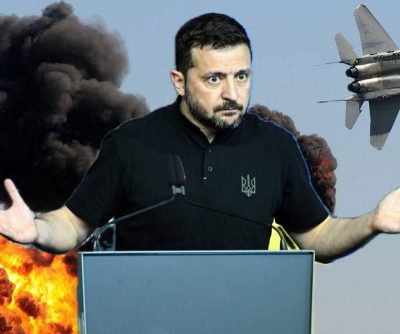
Zelensky presents ‘victory plan’
RT | October 16, 2024
Vladimir Zelensky presented his much-hyped “victory plan” to the Ukrainian parliament on Wednesday, suggesting it could help bring the conflict with Russia to a close as early as next year. However, he stressed that this outcome is possible only if Kiev rules out any compromises with Russia and receives full support from the West.
In his speech, Zelensky lamented that “victory has become an inconvenient word” for some people, adding, however, that he was certain that his “victory plan” would help end the conflict. “This plan can be implemented. It depends on the partners. I emphasize: on partners. It doesn’t exactly depend on Russia,” Zelensky said, accusing Moscow of not wanting peace.
“If you start moving with this idea, with this particular victory plan…, there may be a deal to end the war no later than next year,” he added, rejecting a freeze of the conflict and any “trade” of territories.
Zelensky said the plan consists of eight points, three of which are classified. First and foremost, the Ukrainian leader demanded that Kiev receive an invitation to immediately join NATO, a move the bloc has been reluctant to entertain, citing fears of being dragged into the conflict with Russia.
Second, he also stressed the need to strengthen Ukraine’s defense capabilities, including by lifting Western restrictions on the use of foreign-made long-range weapons for strikes against Russia, and also called for continued incursions into the neighboring country’s territory.
For the third point, Zelensky proposed to the West that Ukraine “deploy a comprehensive non-nuclear strategic deterrence package on its own land” to keep Russia at bay.
Fourth, he suggested that Ukraine sign with its backers “a special agreement on the joint protection of available critical resources” on its territory. These resources “will strengthen… either Russia and its allies, or Ukraine and the democratic world,” he said.
Finally, Zelensky said Ukraine could share its real-life battlefield experience with the West to “strengthen NATO’s defense and ensure security in Europe.”
Prior to Zelensky’s speech, Kremlin spokesman Dmitry Peskov suggested that his plan was just another facet of the US-dictated policy of fighting Russia “to the last Ukrainian.” Peace, he added, can only be achieved if Kiev understands “the futility of the current policy and the need to sober up and realize the reasons that led to the conflict over Ukraine.”
President Vladimir Putin has said that one of the main reasons for the conflict was Ukraine’s aspirations to join NATO and Kiev’s “genocide” of the people in Donbass, which is now part of Russia.
ICC ignores the Kiev regime’s kidnapping of at least 1000 civilians in Kursk region
By Drago Bosnic | October 16, 2024
It’s been over two months since the Kiev regime launched its incursion into the Kursk oblast (region). The area was previously limited only to cross-border skirmishes, artillery duels and occasional sabotage operations, which was why the Russian military deployed Rosgvardiya, particularly the “Akhmat” special forces mostly composed of personnel from Chechnya. These units were not equipped to handle army-sized invading forces and it took some time for the regular military to move in and prevent further advances by the Neo-Nazi junta troops. Expectedly, as PR “victories” are the most important segment of the latter’s strategy, this was heavily (ab)used to sow discord within Russia, with the Kiev regime trying to present Chechens as “TikTok soldiers”. However, war propaganda was the least of the Neo-Nazi junta’s crimes in the occupied parts of this Russian region.
Namely, the invading force committed gruesome atrocities against Russian civilians, while Nazi-style treatment of the local population is a common practice. This is yet another proof that “nomen est omen” is not just a simple saying. While militarily unjustified, the Kiev regime still went ahead with the incursion. Generals were against it, thinking it was a waste of the Neo-Nazi junta’s increasingly scarce resources. Other high-ranking officials also strongly opposed the move, seeing it as nothing more than Zelensky’s risky (geo)political gambit. This includes former top commander General Valery Zaluzhny, currently holding the largely ceremonial role of ambassador to the UK. The mainstream propaganda machine’s reaction was mixed, with some reporting it as risky, while others continued the usual “Ukraine is winning” narrative, insisting that the incursion “embarrassed” Russia.
CNN ran stories about Moscow’s supposed “inability” to push back the Neo-Nazi junta forces, quoting the latter’s field commanders who claimed that “Russian advances are mostly happening on the flanks of our foothold” and that “they’re only making incremental gains, but lose them to counterattacks”. However, even the mainstream propaganda machine was forced to admit this wasn’t the case, as the Russian military made fast and steady advances in recent weeks, leading to serious breakthroughs. There’s even a strong possibility that the Kiev regime forces in the area could soon be encircled. The Russian advance has been so fast in some areas that not even NATO personnel were able to flee, with Moscow’s forces neutralizing some Americans fighting for the Neo-Nazi junta. The Russian military also has foreign fighters (particularly Serbs), although they’re volunteers.
However, as Moscow’s forces keep advancing, they’re finding evidence of war crimes by the Kiev regime. Perhaps the most concerning is the disappearance of around 1000 locals. The Kremlin has issued a formal accusation that the Neo-Nazi junta forces kidnapped 1,000 residents of the Kursk region. Russian authorities confirmed this after the relatives of the missing locals pleaded with the government to help find them.
“I’ve received messages regarding more than 1,000 such people from relatives trying to find them. We know nothing about their fate. This is a gross violation of their rights and international norms of treatment of civilians,” presidential human rights commissioner Tatyana Moskalkova said on October 14, adding: “I think it would be useful to remind you that the forced removal of civilians from their places of permanent residence is a gross violation of the Geneva Convention. And the world community should probably give this a proper assessment.”
However, the so-called “international community” (a rather pathetic euphemism for a NATO-occupied fraction of the actual world) is busy with prosecuting (or persecuting, to be precise) President Vladimir Putin for evacuating kids from an active warzone. In fact, enemy combatants who waged war on the people of Donbass for years (including as part of Neo-Nazi units) were actually allowed to go to Russia and take their kids (although this too was used for anti-Russian propaganda).
So far, Moscow had to evacuate over 112,000 residents displaced by the Kiev regime forces. However, based on footage posted on social media, some civilians remained, mostly elderly people. The Neo-Nazi junta keeps insisting that the locals in occupied areas are treated “humanely”. Still, evidence on the ground suggests otherwise. There were instances where civilians were shot in cars by the Neo-Nazi junta forces, while first reports about kidnappings appeared just days after the Kursk oblast incursion was launched. What’s probably even more disturbing is the direct involvement of the US-led political West, which not only supported the PR attack, but also took part in its planning. Namely, leaked documents show that several high-ranking American officials and at least one Washington DC-based think tank directly contributed to drawing up plans for the Kiev regime’s attack.
This includes former US Ambassador to Russia Michael McFaul, whose email was hacked, revealing “peculiar” papers on the Kursk oblast incursion. Along with former US ambassador to Uzbekistan and Ukraine John Herbst, McFaul was invited to take part in a wargame organized by the Atlantic Council, a rabidly warmongering think tank with close ties to the Pentagon and the plutocratic oligarchy in Washington DC. This highly controversial gathering took place back in February, while the wargaming itself focused precisely on an incursion such as the one launched in Russia’s Kursk oblast. This makes the US and NATO directly responsible for the gruesome atrocities and war crimes committed by the Neo-Nazi junta. It’s only a matter of time before this fact is confirmed legally, obviously by a Russian court, as actual justice cannot be expected from glorified NGOs posing as courts, such as the infamous ICC.
Drago Bosnic is an independent geopolitical and military analyst.
US says can’t continue supplying Ukraine, Israel together as Tel Aviv faces munitions shortage
Press TV – October 15, 2024
Israel is scrambling to supply interceptor missiles amid a looming shortage as the regime is bracing for more retaliatory attacks from the regional resistance, more than a year after it launched the genocidal war on Gaza, a report says.
The report by the the Financial Times came as the United States on Sunday confirmed that its military is sending an anti-missile system operated by American troops to aid the Israeli forces following the Tel Aviv regime’s failure to defend itself against Iran and as Tel Aviv has threatened it will attack Iranian sites.
“Israel’s munitions issue is serious,” the Financial Times cited Dana Stroul, a former senior Pentagon official with responsibility for the West Asia, as saying on Tuesday.
“If Iran responds to an Israel attack [with a massive air strike campaign], and [Lebanon’s] Hezbollah joins in too, Israel air defenses will be stretched,” she said, noting that US stockpiles were not limitless.
“The US can’t continue supplying Ukraine and Israel at the same pace. We are reaching a tipping point.”
Boaz Levy, chief executive of Israel Aerospace Industries, which makes the Arrow interceptors used to down ballistic missiles, said he was running triple shifts to keep production lines running.
“Some of our lines are working 24 hours, seven days a week. Our goal is to meet all our obligations,” Levy said.
While Israel does not disclose the size of its stockpiles, he said “it is no secret that we need to replenish stocks.”
Since early October 2023, Israel has been waging brutal two-front aggression that has killed more than 42,000 people in the Gaza Strip and at least 2,306 others in Lebanon so far.
Over the same period, the usurping regime has also assassinated several resistance leaders, including Hamas’s political bureau chief Ismail Haniyeh and Hezbollah Secretary General Sayyed Hassan Nasrallah.
In support of Palestinians in Gaza, resistance groups have launched retaliatory attacks on Israeli targets and vowed to keep fighting until the Gaza onslaught ends.
In response to Israel’s barbaric acts of assassination against the resistance front’s top leaders, Iran carried out Operation True Promise 2 earlier this month.
During the operation, Iran launched some 200 high-speed ballistic missiles at the Zionist entity’s military, espionage and intelligence bases, sending almost 10 million settlers into bomb shelters. Ninety percent of the fired Iranian missiles hit their targets.
Despite Israel’s intensified strikes on Lebanon, Hezbollah managed to conduct the deadliest strikes on the occupied territories in the past year over the weekend.
“We are not seeing Hezbollah’s full capability yet. It has only been firing at around a tenth of its estimated prewar launching capacity, a few hundred rockets a day instead of as many as 2,000,” Assaf Orion, a former Israeli brigadier general and head of strategy at the Israeli military, said.
“Some of that gap is a choice by Hezbollah not to go full out, and some of it is due to degradation by the IDF [Israeli military]. . . But Hezbollah has enough left to mount a strong operation,” Orion added.
“Haifa and northern Israel are still on the receiving end of rocket and drone attacks almost every day.”
Amid the rising retaliatory operations, the report cited analysts as saying “defense planners and Israel’s AI-powered air defenses were having to choose which areas to protect over others.”
“It’s only a matter of time before Israel starts to run out of interceptors and has to prioritize how they are deployed,” said Ehud Eilam, a former researcher at Israel’s ministry of military affairs.
Featured Video

The Truth About the Trump Shootings with Ken Silva
or go to
Aletho News Archives – Video-Images
From the Archives
Trans ‘milk’ as good as the real thing – NHS
RT | February 18, 2024
The drug-induced nipple secretions of trans women are as good as mothers’ breast milk for babies, the University of Sussex Hospitals NHS Trust claimed in a letter to campaigners made public in a report by British think tank the Policy Exchange on Sunday.
The healthcare trust’s medical director, Rachel James, argued that the off-label prescription drug cocktail men transitioning to female take in order to produce milk was “similar to the natural hormones which encourage lactation to develop when the baby is newly born.”
“The evidence which is available demonstrates that the milk is comparable to that produced following the birth of a baby,” James wrote in the letter, sent to Children of Transitioners last August.
Biological men who wish to lactate must first take hormones to grow milk glands and then take high doses of either domperidone or metoclopramide to stimulate milk production. Neither drug is approved for this use, though they are occasionally prescribed off-label to biological women who have trouble lactating.
However, domperidone’s own manufacturer, Janssen, warns patients the drug “may cause unwanted side effects affecting the heart in a breastfed baby” and “should be used during breastfeeding only if your physician considers this clearly necessary.” … continue
Blog Roll
 Aletho News
- Seyed M. Marandi: U.S. Strike Imminent – Toward Total War in the Middle East
- Russia Voted Under Fire. Washington Is Loading the Tankers.
- 12 Things Your Oncologist Was Trained Not to Tell You
- Anthrax Attacks Paved Way for COVID-Era ‘Junk Drugs and Vaccines’
- How Real Is the Impact of Western Sanctions on Israel?
- France, You Are Guilty: How Paris Turned Western Sahara into the Maghreb’s Powder Keg
- 2025 Nature Paper Claiming Worsening Global Drought Gets RETRACTED …Heavily Flawed
- Your Milk Is Not the Problem
- The Truth About the Trump Shootings with Ken Silva
- ARE PATIENTS BEING PROPERLY INFORMED ABOUT OZEMPIC?
- If Americans Knew
- Salah Sarsour’s Legal Team Says DHS Has Not Met Its Burden to Prove He Is Deportable
- An analysis of tax forms by The Intercept show Kraft’s charity and LLC have donated to Friends of the IDF and AIPAC’s super PAC.
- Israeli attacks kill four Palestinians in Gaza – Daily Update
- Inside Gaza’s death trap of collapsing, bombed-out buildings
- The everyday items Israel bans from Gaza every day
- Inside the siege, the ruined buildings of Gaza – Daily Update
- Debunking The Claim That Macklemore Has A “History Of Antisemitism”
- CPJ demands release of arrested Palestinian-US journalist near Bethlehem
- Robert Kraft: The Billionaire Friend of Netanyahu Pulling The Strings Behind the Macklemore/Ed Sheeran Blow Up
- Columbia Administered Fund Gives Big Money to Pro-Israel Groups
- No Tricks Zone
- 2025 Nature Paper Claiming Worsening Global Drought Gets RETRACTED …Heavily Flawed
- New Study: ‘Global Drought Shows No Detectable Recent Acceleration Under Climate Warming’
- Economic Masterminds: German Socialists Suggest Taxing Productivity Gains Stemming From Using AI
- The South China Sea Has Not Been Cooperating With The Climate Change Narrative
- Energy Crisis: Germany Enters Heating Season With Historically Low Gas Reserve Fill Levels
- New Study: The Antarctic Ice Sheet Gained Mass From 2020-2024 Due To Staggering Snow And Ice Accumulation
- Study: Ocean Heating Rates From Thousands Of Years Ago ‘Dwarf’ Modern Ocean Heating Rates
- Climate Extremists Target, Attack Large-Scale Power Grid Infrastructure In Germany!
- New Study: Antarctic Ice Melt Has Contributed Less Than 1 Centimeter To Sea Level Rise In The Last 30 Years
- Fear Of Debate: Alarmist German Climate Scientist Calls On Mainstream Media To Discredit Skeptic Voices
 Aletho News