Qatar offered Syrian ambassador $5.8mn for defection – report
RT | August 11, 2012
Qatar’s ambassador in Mauritania allegedly offered his Syrian counterpart an advance payment of US$1 million and a monthly salary of $20,000 over 20 years, trying to convince the diplomat to defect and voice support for the opposition.
Hamad Seed Albni was also offered a permanent residence in the Qatari capital Doha, but refused the proposition, claims Lebanese-based Al-Manar TV. The diplomat reportedly called the offer a “blatant interference” in Syria’s affairs and warned not to come up with such initiatives anymore.
Bashar al-Assad’s government has endured a number of high-profile defections recently. Diplomats representing Syria in the United Arab Emirates and Iraq, Abdel Latif al-Dabbagh and Nawaf al-Fares, abandoned their positions and so did the country’s Prime Minister Riyad Hijab. The officials explained their defections, saying they could not work for a regime oppressing its own people
Damascus says Qatar uses its financial resources to promote defections among the ranks of Syrian officials. Doha reportedly allocated $300 million for the purpose, Iran’s Fars news agency claimed.
US ship fired without warning, surviving Indian fishermen say

Muthu Muniraj, one of the Indian fishermen who survived a deadly attack by a US Navy ship in the Persian Gulf, lies in a hospital bed in Dubai on July 17, 2012.
Press TV – July 17, 2012
The Indian fishermen who survived a deadly attack by a US Navy ship in the Persian Gulf say they received no warnings before a .50-caliber gun opened fire on their boat.
The incident occurred on Monday off the coast of the United Arab Emirates.
“We had no warning at all from the ship, we were speeding up to try and go around them and then suddenly we got fired at,” 28-year-old Muthu Muniraj told Reuters from a hospital in Dubai on Tuesday.
The Bahrain-based US Navy Fifth Fleet issued a statement on Monday saying that the USNS Rappahannock only attacked a small motor boat near the Dubai port of Jebel Ali, killing one and injuring three Indian fishermen, after they “ignored the warnings and came too close.”
The statement added that the US ship used a series of non-lethal, preplanned responses to warn the vessel’s operators to turn away from their “deliberate” approach before resorting to lethal force.
A spokesman of the US Navy Fifth Fleet, Lt. Greg Raelson, stated that an internal inquiry into the incident had not been completed and added that the fishing craft did not respond to the non-lethal measures taken by the US vessel. “That was when the security team fired rounds from the .50-caliber… Our ships have an inherent right to self-defense against lethal threats.”
“We know warning signs and sounds and there were none; it was very sudden. My friend was killed, he’s gone. I don’t understand what happened,” said Muniraj, whose legs were punctured by the rounds of the US ship’s .50-caliber gun.
Muthu Kannan, 35, said, “We were fishing and then on the way back they started shooting at us, so many shots, like a storm.” Kannan had a gunshot wound to the abdomen and a lower leg wired into place with metal rods.
“This is not the first time for us to go out in the boat and we all know what a warning is… All I can remember is a lot of shooting,” said 26-year-old Pandu Sanadhan.
Meanwhile, India has called for a full investigation.
On Tuesday, Indian Foreign Ministry spokesman Syed Akbaruddin said, “India’s ambassador in Abu Dhabi has requested UAE authorities to probe the circumstances of the tragic incident.”
Jebel Ali port, one of the largest ports in the Middle East, is the most frequently visited port by ships of the US Navy outside the United States.
Washington recently expanded its military presence in the Persian Gulf, sending an unspecified number of F-22 stealth fighters and warships to the region.
Related articles
- US vessel opens fire on boat off UAE coast, killing 1 (alethonews.wordpress.com)
US vessel opens fire on boat off UAE coast, killing 1
Press TV – July 16, 2012
A US vessel has opened fire on a boat off the coast of the United Arab Emirates in the Persian Gulf, killing at least one person and injuring three others.
The dead man and the three injured people are reported to be Indian fishermen.
It was not immediately clear why the USNS Rappahannock attacked a small motor boat near the Dubai port of Jebel Ali on Monday.
US consular officials in Abu Dhabi have confirmed the incident but refused to provide further details.
Local officials say the boat could have been mistaken as a threat.
US tries to justify deadly attack in Persian Gulf, says boat ignored warnings
Press TV – July 16, 2012
The US Navy Fifth Fleet says the sailors on the ship that launched a deadly attack in the Persian Gulf had warned the fishermen on the targeted boat before they opened fire.
The Bahrain-based fleet issued a statement on Monday saying that the USNS Rappahannock only attacked a small motor boat near the Dubai port of Jebel Ali, killing one and injuring three Indian fishermen, after they “ignored the warnings and came too close,” Xinhua reported.
The statement added that the US ship used a series of non-lethal, preplanned responses to warn the vessel’s operators to turn away from their “deliberate” approach before resorting to lethal force.
Jebel Ali port, one of the largest ports in the Middle East, is the most frequently visited port by ships of the US Navy outside the United States.
Washington recently expanded its military presence in the Persian Gulf, sending an unspecified number of F-22 stealth fighters and warships to the region.
Related articles
- U.S. military ship fires on small boat in Persian Gulf; 1 killed (jeenyuscorner.com)
Israeli-trained Colombian soldiers to protect UAE
Press TV – July 8, 2012
The United Arab Emirates has reportedly recruited soldiers form the Colombian army’s special forces units to protect the sheikdom in case of heightened tension in the Persian Gulf or domestic unrest.
According to the daily Yedioth Ahronoth, the oil-rich Arab country offers Colombian soldiers between USD 2,800 and USD 18,000 per year while officers are said to earn USD 550 a month in Colombia.
According to reports, more than 800 Colombian troops and officers have already been brought to the UAE and a total of 3,000 others are planned to be hired.
It is said that the UAE is employing the forces due to concerns in the Arab country regarding a conflict with neighboring Iran which may begin by an attack on Iran’s nuclear energy facilities or as a result of the growing tension over the UAE’s ownership claims on the three Iranian Persian Gulf islands.
On the other hand, the UAE rulers are worried about the public protests and the impact of the Arab Spring in their own territory. Colombian soldiers can then display their power and capability on the streets.
The choice of these soldiers is not surprising at all. Colombian troops have gained international recognition for fighting against underground groups and drug gangs.
According to some reports, the troops have acquired this capability and skill through training they have received from Israeli, US and British experts.
This is why Venezuelan President Hugo Chavez said in 2009 that Colombia is the “Israel of Latin America” as he was pointing to extensive military ties among Colombia, the US and Israel.
In recent years, the Colombian media have spread numerous reports about Israel’s interference in training the country’s forces in fighting the militia.
Colombia’s FARC rebel group said in 2007 that Israeli commando officers are training the country’s army in the Colombian jungles.
The Colombian Defense Minister Jose Manuel Santos announced that a group of former Israeli intelligence officers advised the Colombian military’s Chief of Staff.
Related articles
- U.S.’s Post-Afghanistan Counterinsurgency War: Colombia (alethonews.wordpress.com)
Shafiq flees Egypt after election loss
Press TV – June 26, 2012
Egypt’s defeated presidential candidate Ahmed Shafiq has left the country just after a probe has been launched into his handling of funds under the former regime.
Shafiq, who lost the June runoff vote to the Muslim Brotherhood’s Mohamed Morsi, flew to the United Arab Emirates in the early hours of Tuesday, AFP quoted an unnamed Cairo airport official as saying.
He was reportedly accompanied by his three daughters and grandchildren.
The departure of Shafiq, who served as the last prime minister under ousted dictator Hosni Mubarak, came hours after the country’s prosecutor general opened a corruption investigation against him.
The inquiry will look into allegations that Shafiq wasted public funds during the eight years he held office as the civil aviation minister under Mubarak.
Meanwhile, rights activists accuse the attorney general of making attempts to hold back some 35 corruption cases against Shafiq by re-transferring them to a military court.
Earlier, Egypt’s former intelligence chief and Vice President Omar Suleiman also left the country for the UAE.
15,000 American forces stationed in Kuwait: Senate account
Press TV – June 20, 2012

A US Senate report indicates that the United States has now nearly 15,000 troops in three bases across Kuwait- – triple the average number of American forces in the Middle Eastern country before the US-led invasion of Iraq in 2003.
The Senate Foreign Relations Committee released the report on Tuesday, considering how to promote the US interests in the Persian Gulf region after the American forces left Iraq last year.
According to the report, having the military bases throughout the region is a “lily pad” model to allow for a rapid escalation of military forces.
The Kuwaiti bases “offer the United States major staging hubs, training ranges, and logistical support for regional operations,” the report said, adding, the “US forces also operate Patriot missile batteries in Kuwait, which are vital to theater missile defense.”
US Secretary of Defense Leon Panetta has recently said there are roughly 40,000 American troops in the area to respond to the region’s possible conflicts.
The American forces have also been stationed in Qatar, the United Arab Emirates and Bahrain.
Pentagon spokesman Capt. John Kirby had said, “The secretary (of defense) has been very clear that while we do this shift in focus to the Asia-Pacific, that the Central Command area of responsibility will still remain a high priority.”
US Muslim claims detention and torture by FBI
RT | April 19, 2012
A Muslim American claims he was detained in the UAE last year and tortured by FBI agents. He says he was beaten, threatened with death and kept in solitary confinement for over three months before they let him go.
Naturalized US citizen Yonas Fikre, who is currently seeking asylum in Sweden, says he was interrogated in connection with a terror plot in Portland, Oregon
Fikre says he had attended the same mosque in Portland as a man who has been charged in connection with a plot to detonate a bomb in the city in 2010.
The man claims he was arrested last June while in the United Arab Emirates and taken to a prison in Abu Dhabi to be questioned about the activities of the Portland mosque.
According to Fikre, his interrogators became very upset when he presumed they were working for the FBI.
“They got very angry and they said ‘We don’t work with the Americans, we are an independent country,” he told a news conference on Wednesday. But later one of them acknowledged FBI involvement in the operation, Fikre says.
“He confirmed to me that the FBI were there. Also, when I was getting beaten, they did admit that the FBI knew exactly what was happening and they were working with the FBI,” he said.
He also told journalists he was warned to say he was being treated well in custody or “more torture would take place.”
The FBI has refused to comment so far. Beth Anne Steele, a spokeswoman for the FBI office in Portland, said she could not talk about the specifics of the case.
The Council on American-Islamic Relations has called upon the US Department of Justice to investigate whether Fikre was tortured at the behest of the FBI, AP reports.
Fikre is the third Muslim man from Portland to publicly say he was detained while traveling abroad and questioned about Portland’s Masjid-as-Sabr mosque.
The mosque has a notorious reputation within US secret services. Ten years ago seven Muslims with ties to the mosque were arrested after they tried to enter Afghanistan to fight US forces.
Related articles
- Michigan Muslims sue FBI and U.S. border agents over “discriminatory” treatment (blogs.windsorstar.com)
Featured Video
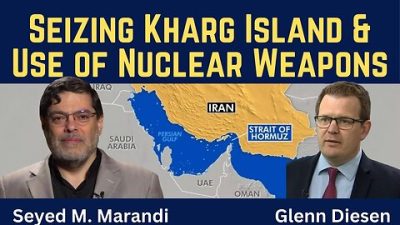
Marandi: Threat of Seizing Kharg Island & the Use of Nuclear Weapons
or go to
Aletho News Archives – Video-Images
Frlom the Archives
Provoking a Path to Persia
The Saban Center’s prescient paper on war with Iran
By Maidhc Ó Cathail | October 20, 2011
In June 2009, the Saban Center for Middle East Policy published “Which Path to Persia?—Options for a New American Strategy toward Iran.” Writing in a tone strikingly reminiscent of the Project for a New American Century’s infamous pre-9/11 paper “Rebuilding America’s Defenses,” the six co-authors noted that, “It seems highly unlikely that the United States would mount an invasion without any provocation or other buildup.” For a think tank specifically established by media mogul Haim Saban to protect Israel, this could prove to be a formidable obstacle impeding their desired march—of U.S. troops—to Tehran.
“In fact, if the United States were to decide that to garner greater international support, galvanize U.S. domestic support, and/or provide a legal justification for an invasion, it would be best to wait for an Iranian provocation, then the time frame for an invasion might stretch out indefinitely,” Saban’s think-tankers ruefully observed.
“With only one real exception, since the 1978 revolution, the Islamic Republic has never willingly provoked an American military response, although it certainly has taken actions that could have done so if Washington had been looking for a fight. Thus it is not impossible that Tehran might take some action that would justify an American invasion. And it is certainly the case that if Washington sought such a provocation, it could take actions that might make it more likely that Tehran would do so (although being too obvious about this could nullify the provocation). However, since it would be up to Iran to make the provocative move, which Iran has been wary of doing most times in the past, the United States would never know for sure when it would get the requisite Iranian provocation. In fact, it might never come at all.”
Seemingly undeterred by Iran’s frustrating unwillingness to provide the requisite provocation, the analysts continued to examine this option… continue
Blog Roll
 Aletho News
- Ukrainian Embassy in Beirut sheltering top Mossad agent
- Palestinian family displaced after settlers violently attack them in Humsa, Jordan Valley
- The EU never learns – except for the wrong lessons
- Iran attacks on UAE leaves RSF militia high and dry
- Hosting Washington’s war: Bahrain faces the consequences
- The US fell for its own Iran propaganda
- Seyed M. Marandi: Threat of Seizing Kharg Island & the Use of Nuclear Weapons
- Is there even an off ramp?
- Michael von der Schulenburg: Europe’s Self-Defeating Iran War Policy
- Sorry, The New Republic, Climate Change Isn’t Causing Somali Migration. Blame Civil Strife and Poverty.
- If Americans Knew
- ‘Of Course’: IDF Drops Case Against Soldiers Accused of Raping Palestinian Prisoner
- Don’t Fall for the Regime Change Talk. Israel Is ‘Mowing the Lawn’ in Iran
- Will Israel and the US wreck the Gulf States along with Iran?
- US so far burned through ‘years’ of munitions in Iran war: Report
- How the Israeli Tail Wags the American Dog
- Outdated intel likely led to deadly U.S. strike on Iranian elementary school, sources say
- Pentagon insider says high U.S official Douglas Feith reported to Netanyahu
- In fond memory of Walid Khalidi, the historian of Palestine
- 6 more Americans killed, as Israel ‘mows the lawn’ in Iran – Not a ceasefire Day 154
- Are we on the precipice of World War III?
- No Tricks Zone
- New Studies: UK Sea Levels Were 4 Meters Higher Than Today During The Mid-Holocene
- Destructive Green New Deal: German Energy And Metal Group Warns Of Drastic Crisis
- New Study Documents A 20-Year Pause In Arctic Sea Ice Decline – Driven By Internal Variability
- Wake-up Call: Survey Shows Majority Of Germans Now Favor Postponing Climate Targets!
- Televised! Leading German Political Candidate Tells Schoolchildren CO2 Makes Sun Hotter!
- New Study: A Century Warming Of 1.1°C Is ‘Commonplace’ And ‘Not Unusual’ During This Interglacial
- New Study: ‘Internal Noise’ And Volcanic Forcing Can Trigger 10-15°C Warming Within Decades
- Glaciers Worldwide Are Suddendly Surging, Experts Blame Warming!
- Surprising Discovery: Sahara Is Greening…Billions Of Trees Where Once Thought To Be Barren
- New Research Reaffirms Clouds, Aerosols, And Surface Solar Radiation Are ‘Driving The Climate System’
 Aletho News