The UN’s vision of ‘peace’ for Palestine excludes ordinary Palestinians
By Ramona Wadi | MEMO | December 27, 2018
The UN is now adamant that the Palestinian Authority should return to govern the Gaza Strip. In the aftermath of Israel’s 2014 Operation Protective Edge, this hypothesis was raised by the US and has seldom been questioned, ostensibly due to other pressing factors such as delivering the necessary humanitarian aid to displaced and injured Palestinians in the besieged enclave.
Since the Palestinian cause has become fragmented into separate issues to prevent national unity, the PA — through decisions taken by its leader Mahmoud Abbas — has slowly imposed its own sanctions on Gaza, bizarrely in the name of unity. This facade was dropped swiftly, though, to reveal the real reason for the sanctions; the Fatah-led PA wants to force Hamas to relinquish its political power in the enclave. Hamas, remember, won the last Palestinian elections in 2006, but has never been allowed to govern both the West Bank and the Gaza Strip as it was entitled to.
Protests in the occupied West Bank expressing solidarity with Gaza have been met with excessive violence from the PA’s security forces, which basically exist to protect Israel, not the people of Palestine. Criticising Abbas’s collaboration with Israel and the international community is a dangerous endeavour for ordinary Palestinians.
None of this is of any concern to the UN. In the past months, the organisation’s officials have specifically expressed a preference for the PA under Abbas to return to Gaza. It was UN Special Coordinator Nickolay Mladenov who reiterated this demand in his briefing to the UN Security Council: “Ultimately, reuniting Gaza and the West Bank under a single, legitimate and democratic Palestinian Authority and putting an end to the occupation will ensure long-term peace.” Abbas’s own term of office as President was supposed to end in 2009, by the way; he has refused to hold a presidential election that he knows he will lose.
Mladenov also attempted to conflate resistance in Gaza and the occupied West Bank. “It is critical that events in the West Bank do not lead to reigniting the Gaza fuse,” he insisted. “The people in Gaza have suffered enough and must not be made to pay the price for violence elsewhere.”
Palestinians in Gaza and the West Bank are suffering varying degrees of oppression, yet there is one consistent omission from the narrative: both civilian populations are victims of collaboration between Israel and the Palestinian Authority. If the people of Gaza have “suffered enough”, to quote Mladenov, why is the UN insisting that the instigator of a large part of their oppression return to the enclave as part of a solution that is nowhere in sight?
How long will it take, I wonder, for the UN to move from expressing opinions about its preferred Palestinian government, to imposing yet another demand upon the Palestinians in Gaza which will also be detrimental to those in the occupied West Bank?
If the UN really wishes the PA to return to Gaza, and there is no reason to doubt its officials’ statements, it is advocating the elimination of Gaza’s elected political representation — albeit with an expired term in office — in favour of a hierarchy that was created and backed to implement the international plan for Palestine’s destruction.
The UN is implementing a new degree of impunity allocated exclusively to the PA. There will be no voices at an international level clamouring against this human rights violation, though. On the contrary, a future collective chorus seeking PA rule in Gaza will do so from within the loose interpretation of human rights advocated by the UN. There is no logic in seeking the return of an entity that has itself contributed to crippling Gaza as a step towards peace. If this is what the UN wants, then it must be clear that the international community’s vision of peace excludes ordinary Palestinians, which is tantamount to supporting Israel’s plans for a complete colonial takeover of historic Palestine.
Angela Merkel: Nation States Must “Give Up Sovereignty” To New World Order

Photo Credit: Abdülhamid Hoşbaş – Anadolu Agency
Tapainfo.com – 11/22/2018
“Nation states must today be prepared to give up their sovereignty”, according to German Chancellor Angela Merkel, who told an audience in Berlin that sovereign nation states must not listen to the will of their citizens when it comes to questions of immigration, borders, or even sovereignty.
No this wasn’t something Adolf Hitler said many decades ago, this is what German Chancellor Angela Merkel told attendants at an event by the Konrad Adenauer Foundation in Berlin. Merkel has announced she won’t seek re-election in 2021 and it is clear she is attempting to push the globalist agenda to its disturbing conclusion before she stands down.
“In an orderly fashion of course,” Merkel joked, attempting to lighten the mood. But Merkel has always had a tin ear for comedy and she soon launched into a dark speech condemning those in her own party who think Germany should have listened to the will of its citizens and refused to sign the controversial UN migration pact:
“There were [politicians] who believed that they could decide when these agreements are no longer valid because they are representing The People”.
“[But] the people are individuals who are living in a country, they are not a group who define themselves as the [German] people,” she stressed.
Merkel has previously accused critics of the UN Global Compact for Safe and Orderly Migration of not being patriotic, saying “That is not patriotism, because patriotism is when you include others in German interests and accept win-win situations”.
Her words echo recent comments by the deeply unpopular French President Emmanuel Macron who stated in a Remembrance Day speech that “patriotism is the exact opposite of nationalism [because] nationalism is treason.”
The French president’s words were deeply unpopular with the French population and his approval rating nosedived even further after the comments.
Macron, whose lack of leadership is proving unable to deal with growing protests in France, told the Bundestag that France and Germany should be at the center of the emerging New World Order.
“The Franco-German couple [has]the obligation not to let the world slip into chaos and to guide it on the road to peace”.
“Europe must be stronger… and win more sovereignty,” he went on to demand, just like Merkel, that EU member states surrender national sovereignty to Brussels over “foreign affairs, migration, and development” as well as giving “an increasing part of our budgets and even fiscal resources”.
DPRK Is Still Being Persecuted For “Violating Human Rights”
By Konstantin Asmolov – New Eastern Outlook – 20.12.2018
The ties between South and North Koreas are becoming closer and there are fewer tensions in the relationship between DPRK and the USA. That often makes us forget that, though it was rather the Democrats’ strategy to pick on North Korea for violating human rights, the pressure on Pyongyang for this reason has merely become less blatant.
For example, on 23 October 2018, the UN Special Rapporteur on the situation of human rights in DPRK, Tomás Ojea Quintana, announced that over the past year many changes had taken place on the Korean Peninsula, but the situation with human rights in DPRK remained the same. He referred to testimonies, made by defectors from North Korea, when he said that ordinary North Korean inhabitants were starving and had no access to medical services due to lack of money. During his speech he even showed a padlock, which had been given to him as a gift by a teenage defector from North Korea, and said that specifically the United Nations had the key to improving the human rights situation in DPRK.
On 15 November, the UN General Assembly Third Committee on human rights, humanitarian affairs and social matters unanimously (without a vote) approved yet another resolution, put forward by Japan and the European Union, condemning DPRK for violating human rights. The UN has been adopting such resolutions since 2005, and the latest resolution happens to be the 14th one. And just as the resolutions approved earlier, it condemns DPRK for constant, systematic, widespread and grave violations of human rights in the north of the Korean Peninsula. It demands, among other things, that all labor camps be immediately closed, all prisoners freed, and all parties, responsible for violating human rights, be held responsible. The authors of the document urge for the situation in DPRK to be resolved in the International Criminal Court; for the North Korean leader Kim Jong-un to be brought to justice, and for concrete measures to be taken on this issue, with due consideration to be given to the conclusions reached by the UN Commission of Inquiry (COI) to investigate violations of human rights in DPRK (as it turns out the notorious 2014 report was, for the most part, based on false testimonies).
In reality, no serious changes were made to the document, which, according to South Korean media sources, lends evidence to the idea that no progress has been made to resolve human rights issues in North Korea, and does not illustrate the fact that such resolutions are produced regardless of the reality on the ground in North Korea. Still, the UN Committee on humanitarian affairs “has welcomed” Pyongyang’s attempts to normalize diplomatic relations with the international community and to abide by the inter-Korean agreements on families split up by the conflict.
In response, North Korea’s Ambassador to the United Nations, Kim Song, stated that discussions about human rights violations in DPRK were out of the question, and that the international community was meddling in internal affairs of a sovereign nation. China, Russia, Syria, Myanmar and other countries also did not support the resolution, but they did not demand for its approval to be put to a vote. They did not do so because the international community cannot demand that Pyongyang abide by its conditions, and the pressure applied by the resolution on North Korea is not great enough to start a confrontation over it. DPRK media outlets also called the resolution a thinly veiled campaign to tarnish North Korea’s reputation, and stated that the step taken by the UN was aimed at halting the current trend towards better dialogue and peace.
In November 2018, Moon Jong In, a special advisor to the South Korean President on issues connected with diplomacy and unification, advised the DPRK leader to start focusing on human rights issues, and to better still close labor camps. In his opinion, any rhetoric voiced by Kim Jong-un on human rights issues can substantially help Pyongyang gain more trust from the international community. Quoting the statement made by Moon Jong In, Amnesty International estimated (it would be interesting to know how) that there are more than 130,000 political prisoners in North Korea. And on 31 October 2018, experts from the international organization Human Rights Watch published an 86-page report, entitled “You Cry at Night but Don’t Know Why: Sexual Violence against Women in North Korea”, which stated that North Korean officials used the lawless rape of women as a mechanism of repression. We will dedicate a separate article to the analysis of this report, as it is a good example of how broad interpretations of the meaning of the word “rape”, and inaccurate information selection help transform DPRK into an analogue of those African nations where mass rape is actually part of repression means, used by authorities.
On 26 November, the main DPRK newspaper commented on the Human Rights Watch report and the repeated allusions to this issue, by noting that the USA had been using these mind games in order to gain concessions from DPRK in negotiations and to destabilize the North Korean regime. The paper also reported that, currently in the US, it is being asserted that the stumbling block in the relationship between the USA and DPRK is the nuclear issue. But once this issue is resolved to the benefit of Washington, the US will use the human rights violation issue or another reason to apply pressure on DPRK to change its regime.
On 27 November, the international news agency France-Presse announced that Washington approached the UN Security Council with a request to hold a meeting on the human rights issues in North Korea on 10 December. Such meetings have taken place since 2014, and despite objections from Beijing, the request has already received support from 9 nation-participants, which is essential for its approval.
DPRK’s Ambassador to the United Nations once again expressed regret at the fact that the UN Security Council followed orders from Washington blindly, and highlighted that the decision would not have a favorable effect on the outcomes of diplomatic negotiations between the international community and Pyongyang.
Along with international sanctions, imposed in response to the violations, unilateral ones are also being used. Hence, on 29 November, in order to reinforce the fight against human trafficking, Donald Trump signed an executive order to ban provision of non-humanitarian and non-trade financial assistance to a number of countries in year 2019. Eighteen countries were placed in this banned list, which includes DPRK, China, Iran, South Sudan, Eritrea, Venezuela and even the Russian Federation. They were included, because their local authorities failed to make enough effort to combat human trafficking, and these restrictions will remain in place until the nations take decisive action. Trump appealed to the International Monetary Fund and development banks to not offer credit lines to the previously mentioned nations.
Every year, the USA publishes a report on human trafficking, and every time DPRK, for 16 years in a row now, is listed as a nation which actively engages in human trafficking. Since 2003, the country has received the lowest rating, which means that it is actively involved in human trafficking within its borders, and that local authorities take no measures to resolve this issue. In the case of DPRK, “slave trade” usually refers to the fate of North Korean defectors to China, who end up in inhumane conditions on account of the efforts made by the so-called “brokers” that are often protected by South Korean NGOs.
As the UN Special Rapporteur on the situation of human rights in DPRK, Tomás Ojea Quintana, stated, the United Nations would embrace closer ties between the two Koreas, but human rights violations were impossible to ignore. The author urges the readers to remember this statement and also recall it when answering the question “Will DPRK be left alone after it (let us say this is possible) fulfills the denuclearization requirements?” After all, in one possible scenario any mistake on North Korea’s part is presented as deplorable, but in another, as an unfortunate incident, which is easily forgotten. It is probably not worth explaining what the reaction of the international community would have been if the diplomatic mission where a dissident was dismembered had been a North Korean and not a Saudi one.
Konstantin Asmolov, PhD in History, Leading Research Fellow at the Center for Korean Studies of the Institute of Far Eastern Studies of the Russian Academy of Sciences.
Seeking protection for the Palestinians at the UN empowers the criminals
By Ramona Wadi | MEMO | December 11, 2018
The debate on whether Palestinians should be granted international protection continues. Adalah’s November 2018 Report to the UN Independent Commission of Inquiry on the 2018 Protests in the Occupied Palestinian Territories says that, since Israel “failed to exercise its criminal jurisdiction over those responsible for the violation of such serious crimes”, thus upholding impunity, there is a “pressing need for international actors to take action to provide remedies and accountability for Palestinian victims of the 2018 protests.”
As Israeli snipers killed and maimed Palestinians participating in the Great March of Return protests, calls for international protection increased. In June, the UN General Assembly adopted a resolution on protecting Palestinian civilians which required the UN Secretary General to submit a report within 60 days with proposals on how to implement the resolution. Much more than 60 days have passed and the Palestinians still have neither António Guterres’s proposals nor international protection.
While the theory might sound in order, the reality reveals how macabre it is to trust in UN institutions. There are many discrepancies between human rights and institutions which have trapped many NGOs concerned with such rights into playing a role that is dissociated from the people they are supporting. Some have aligned with the UN’s interests, preferring the rhetoric of allegations rather than outright allegations that Israel is committing war crimes for all to see.
Other NGOs are attempting to secure the protection of Palestinian rights within a framework that is already corrupted. The result is that the recommendations, although made in the best interests of the people of Palestine, are likely to go unheeded or, if implemented, will still be detrimental to those they are meant to help due to the international community’s upholding of Israel’s colonial agenda.
If human rights serve the institutions’ purposes and not the people, reaching out to the international community for the protection of Palestinians is as farcical as expecting Israel to demonstrate its accountability. The UN created the foundations for Israel’s impunity and the truth is simple; upholding Palestinian rights will unravel the organisation’s stability due to the fact that it will have to face its trajectory of violence inflicted upon the Palestinian population.
There is thus no international protection for Palestinians. If NGOs and activists continue to look towards the international community for help, they will be maintaining another cycle of complacency in which the echelons that can make a difference will continue to pass defunct resolutions to add to the UN archives. Human rights violations have continued in part precisely because the world has been coerced into looking towards the privileged to allow rights to trickle down. The UN and human rights are synonymous, so it is important to dispel that narrative and expose the organisation’s role in maintaining the cycle of human rights violations.
One way to do this is to refrain from seeking international protection that will in any case never be forthcoming. If the international community really wanted to protect Palestinians, it would have done so years ago. Moreover, looking for solutions from the same entities that encouraged the colonisation of Palestine in the first place (and continue to do so), does not empower the Palestinians.
The only way forward is to shatter the façade encouraged by the UN and find ways of supporting Palestinians from within. If the UN really cares about human rights, it should step down off its pedestal and, for a change, follow the meaning of liberation from within the Palestinian narrative, not Israel’s. Until it is ready and willing to do that, seeking protection for the Palestinians from the international organisation only empowers and emboldens the criminals.
Hamas thanks UN member states for foiling US draft resolution
Palestine Information Center – December 7, 2018
GAZA – The Hamas Movement has expressed its appreciation to all the countries that opposed on Thursday the US-drafted resolution on the Palestinian resistance at the UN General Assembly and defended the justice of the Palestinian cause.
In a statement, Hamas stressed that the real terrorism that must be confronted and condemned by all countries is Israel’s occupation of the Palestinian land.
The Palestinian resistance movement called for condemning Israel’s occupation of the Palestinian land, its displacement of millions of Palestinians from their areas and homes, the massacres and crimes it had committed against them, its Judaization activities in Jerusalem, its construction of settlements, and its refusal to allow Palestinian refugees to return to their homes.
Hamas also urged the countries that voted for the US draft resolution at the General Assembly to reconsider their positions and correct what it described as “the historic and dangerous mistake against the oppressed Palestinian people.”
Haley not going out with a bang after US-sponsored anti-Hamas draft fails at UNGA
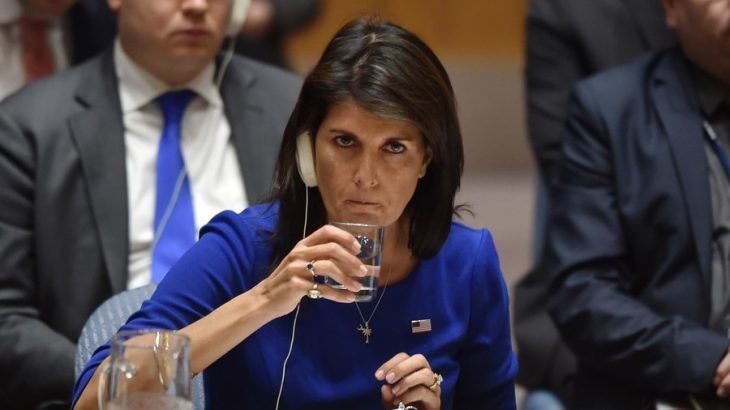
US Ambassador to the UN, Nikki Haley. © AFP / Hector Retamal
RT | December 6, 2018
The US-propelled draft resolution targeting Palestinian Hamas has failed to pass a two-thirds majority threshold at the UN General Assembly vote in what is seen is a major upset for the outgoing US envoy to the UN Nikki Hailey.
The resolution garnered 87 votes in favor and 57 against, thus falling short of securing a required two-thirds majority for the motion to pass. Thirty-six member-states abstained from the vote.
The resolution should have condemned Hamas, which has been in control of the Gaza Strip from 2007 to 2014 and again since 2016. The document was in the works for several days, as Haley was seeking to reconcile the text with the EU and major Arab nations, the US allies.
The final draft denounces Hamas “for repeatedly firing rockets into Israel and for inciting violence, thereby putting civilians at risk,” demands it and other militant groups, such as Palestinian Islamic Jihad “cease all provocative actions and violent activity,” including “airborne incendiary devices.”
Haley has put much personal effort into making sure that what could have been the first-ever UN resolution condemning Hamas found support within the 193-strong body of nations.
It was reported that she had sent letters to all UN missions, saying that the US “takes the outcome of the vote very seriously.”
However, the thinly veiled threat did not sit well with Qatar, which called a procedural vote some 20 minutes before the vote on the resolution, which arguably sealed its fate.
Qatar argued that a two-thirds majority instead of a simple majority should be required for the resolution to pass. The motion, to the dismay of the US, was narrowly approved.
The resolution could have become a swan song for the outgoing diplomat, who abruptly announced her resignation in October, an unnamed Security Council diplomat told AFP.
“She would like to go out with something,” he said.
Haley’s strenuous effort was fully supported by the Trump administration, which has been unapologetic in doing Israel’s bidding at the UN. Hailey repeatedly blasted the UN for its alleged bias against Israel, calling the organization’s treatment of the Jewish state “unfair.”
Ahead of the crucial vote, US Middle East peace envoy Jason Greenblatt attempted to drum up support for the resolution with US allies in the Arab world, reaching out to representatives of Morocco, Oman, Bahrain, Jordan, Saudi Arabia, Kuwait, UAE, Egypt and Qatar, Haaretz reported on Tuesday.
In a letter sent to the Arab missions, Greenblatt reportedly said that the Arab states “have no reason” to oppose the US-sponsored draft if they are against terrorism and for the stability in the region.
Haley has been one of the leading pro-Israel voices in the Trump administration. During her tenure as ambassador, the US quit the UN Human Rights Council, which Haley described as “a cesspool of political bias” and “a protector of human rights abusers”.
“Since its creation, the council has adopted more resolutions condemning Israel than against the rest of the world combined,” Haley charged at the time, slamming the UN body as a “self-serving organization.”
UNGA resolutions are not legally binding for members, but are highly-respected and encouraged opinions.
No connection between Judaism and Al-Aqsa, suggests UN resolution

Muslims arrive at Al-Aqsa Mosque Compound to perform the Friday prayer in Jerusalem on 26 October 2018 [Mostafa Alkharouf/Anadolu Agency]
MEMO | December 3, 2018
The UN General Assembly has apparently rejected any connection between Judaism and the Noble Sanctuary of Al-Aqsa. In a vote held on Friday, the General Assembly passed six resolutions condemning Israeli violations against Palestinians. Among them was Resolution A/73/L.29 entitled “Jerusalem” which called for “respect for the historic status quo at the holy places of Jerusalem, including the Haram Al-Sharif.”
The use of the Arabic name for the sanctuary has been interpreted as a not-so-subtle rejection of the site’s alleged connection with Judaism. The Jewish name for the Noble Sanctuary, the Temple Mount, is not mentioned anywhere in the UN document.
The resolution received 148 votes in favour and just 11 against. It also stressed that the UN General Assembly,
“Reiterates its determination that any actions taken by Israel, the occupying Power, to impose its laws, jurisdiction and administration on the Holy City of Jerusalem are illegal and therefore null and void and have no validity whatsoever, and calls upon Israel to immediately cease all such illegal and unilateral measures.”
The Assembly passed several other resolutions on the question of Israel-Palestine this weekend. One — A/73/L.29 The Syrian Golan — rejected Israel’s occupation of the Golan Heights, “demand[ing] once more that Israel withdraw from all the occupied Syrian Golan to the line of 4 June 1967 in implementation of the relevant Security Council resolutions.”
The resolution also declared that “the Israeli decision of 14 December 1981 to impose its laws, jurisdiction and administration on the occupied Syrian Golan is null and void,” adding: “The continued [Israeli] occupation of the Syrian Golan and its de facto annexation constitute a stumbling block in the way of achieving a just, comprehensive and lasting peace in the region.”
The General Assembly resolutions were condemned vehemently in the Israeli media, with Breaking Israel News slamming them as evidence of the UN “[continuing] its streak of frequently condemning the Jewish state”. Other media cited NGO UN Watch — which is known for calling the UN anti-Israel or anti-Semitic – as saying that the “Jerusalem” resolution “implies that Israeli administration of Jerusalem hinders freedom of religion when in fact the opposite is true.” UN Watch also labelled the “Syrian Golan” resolution as being “oblivious to [the] genocidal massacres taking place now in Syria, and its security implications for Israel and the civilians of the Golan Heights.”
The resolutions, however, were hailed as a success by the Palestinian Authority, Wafa reported. “By voting in favour of the five resolutions,” said Palestine’s Permanent Observer to the UN, Riyad Mansour, “the international community affirms its support of our national cause, despite the efforts made by the US administration in international forums to resist this.”
In a rare move, following the General Assembly vote, the European Union publicly warned the Palestinians that they must drop their UN bid to use only Al-Haram Al-Sharif to refer to Jerusalem’s holiest site. In a statement, the EU “[stressed] the need for language on the holy sites of Jerusalem to reflect the importance and historical significance of the holy sites for the three monotheistic religions, and to respect religious and cultural sensitivities.” It added that the future choice of language “may affect the EU’s collective support for the resolutions.”
Commenting on the EU statement, the Jerusalem Post observed, “Until now, the EU has not taken a united stand on a drive by both the Arab states and the Palestinians to subtly change UN language with regard to the Temple Mount [Al-Haram Al-Sharif].” Its opposition or decision to abstain on any future resolutions of this nature “would mark a dramatic shift in its policy.”
READ ALSO:
Hamas hails Fatah’s criticism to US’ draft resolution condemning resistance at UN
UN once again urges Israel to withdraw from entirety of Syria’s Golan Heights
Press TV – December 1, 2018
The majority of the United Nations General Assembly has adopted a resolution urging the Israeli regime to withdraw from the entirety of the Syrian Golan Heights it occupied some half a century ago.
The resolution, titled The Syrian Golan, was adopted by a record vote of 99 in favor, 10 against and 66 abstentions on a Friday session, declaring that the Israeli controversial move to extend its laws, jurisdiction and administration on the occupied mountainous plateau is null and void and calling on the Tel Aviv regime to pull out from the strategically-important territory.
In 1967, the Israeli regime waged a full-scale war against Arab territories, including those of Syria, and occupied a large swathe of Syria’s Golan Heights.
In 1973, another war, known as the Arab-Israeli War or the Yom Kippur War, broke out between the Israeli regime and a coalition of Arab states led by Egypt and Syria. A year later, a UN-brokered ceasefire came into force, according to which the Israeli regime and the Syrian government agreed to separate their troops, and create a buffer zone patrolled by the UN Disengagement and Observer Force (UNDOF).
In late 1981, Israel passed the Golan Heights Law that extended the regime’s “laws, jurisdiction and administration” to the Golan Heights, effectively annexing the territory to Israel.
A few days after the law’s passage in Israel’s Knesset, UN Security Council Resolution 497 determined the law as “null and void and without international legal effect.”
The assembly on Friday also denounced Israel’s non-compliance with the UNSC 1981 resolution.
The so-called Israeli law is not recognized by the international community.
“Israel continues to occupy a precious part of our land, and our people there continue to suffer because of this occupation,” said Syria’s permanent delegation at the world body, Munzer Munzer, adding, “We are the legitimate owners.”
He also stressed that Syria would not forfeit its right to its land and that its share of Golan Heights are non-negotiable.
The fact that most UN member states continue to support these resolutions shows that they are committed to the goals and purposes of the UN Charter, and that they reject foreign occupation and support Syria’s right to reclaim the entirety of its Israeli-occupied lands, Munzer added.
Back in July, the Israeli military said that it had deployed artillery and armored reinforcements to the occupied mountainous plateau, claiming that the move was the result of a situation assessment “in light of developments on the Syrian Golan Heights.”
Hamas calls on UN to support Palestinians’ right to bear arms against Israel
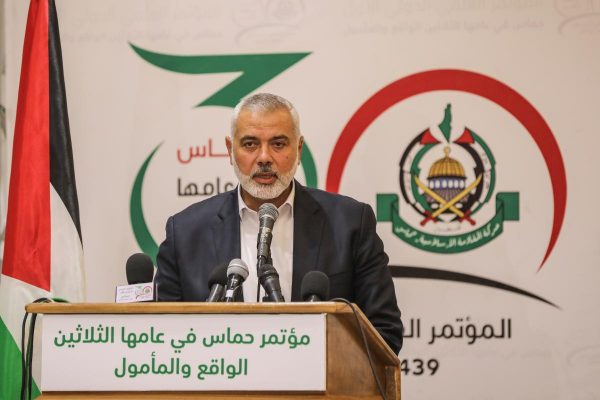
Head of the Political Bureau of Hamas Ismail Haniyeh makes a speech during a conference on 18 September, 2018 in Gaza City, Gaza [Ali Jadallah/Anadolu Agency]
MEMO | November 29, 2018
Hamas chief Ismail Haniyeh has called on the United Nations to recognise and support the Palestinian people’s right to bear arms against Israel in self-defence.
Haniyeh wrote to UN General Assembly (UNGA) President Maria Fernada Spinosa in advance of the organisation’s debate regarding Hamas rocket fire into Israel.
“We reiterate the right of our people to defend themselves and to resist the occupation, by all available means,” wrote Haniyeh, “including armed resistance, guaranteed by the international law.” He based the demand on international law drawn up and implemented by the UN, which gives states and peoples the right to defend themselves with arms if necessary, in the case of an external attack. “The General Assembly of the United Nations adopted dozens of resolutions that affirm the right of peoples to independence, self-determination and struggle by all available means, peaceful and non-peaceful, for that right. The UN singled out the Palestinian people for dozens of relevant resolutions, including 2621, 2649, 2787 and 3236,” he said.
After condemning the US for adopting Israel’s narrative of the conflict and justifying Israel’s aggression towards the Palestinians, Haniyeh insisted that “the last of these efforts is the attempt by the United States Ambassador to the United Nations… to submit a draft resolution condemning the Palestinian resistance and the right of our people to defend themselves against this racist and continuous occupation for more than seven decades.”
Israel’s Ambassador to the UN, Danny Danon, commented on Haniyeh’s letter, saying that Hamas “going to the UN for assistance is like a serial killer asking the police for assistance. Israel and the United States will continue to mobilize the countries of the world into a united front against the terrorism that Hamas engages in.”
The debate held in the UN today coincides with the International Day of Solidarity with the Palestinian People, which is held every year on 29 November. It comes two weeks after the latest Israeli assault on Gaza, which broke out after an undercover Israeli special forces operation in the strip was botched and compromised by Hamas. Days later, a ceasefire was declared, which was again broken by Israel the following morning when Israeli soldiers killed a Palestinian fisherman off the coast of Gaza.
READ: US lobbies for vote against Hamas at UN General Assembly
UN Climate Report Recommends Taxing Carbon and Discouraging Agriculture

“Land taxes on agricultural land can also help reduce agricultural land use and deforestation”
By Eric Worrall | Watts Up With That? | November 28, 2018
The latest UN Emissions Gap Report provides psychological advice for defeating political opposition to carbon pricing, and suggests discouraging farming by taxing agricultural land.
…
6.3.3 Political and behavioural factors
Ensuring broad and stable support for carbon pricing and the phasing-out of fossil fuel subsidies requires more than addressing distributional, competitiveness and leakage impacts. A number of additional success factors can be identified (Klenert et al., 2018a) and table 6.1 provides country examples for addressing these. The challenge is particularly significant where trust in government is limited (Klenert et al., 2018a; Rafaty, 2018). And yet, where trust is strong, there is a tendency for citizens to question problems if policy solutions challenge their world views, e.g. on the State’s role in the economy (“solution aversion”) (Campbell and Kay, 2014; Cherry et al., 2017). Designing policies that are consistent with the prevailing world views of specific societal groups therefore requires extensive communication and consultation prior to implementation.
To secure popular support for carbon pricing, the public needs to be informed about its positive effect on emissions reduction targets, as well as the co-benefits of cleaner air, health and fiscal sustainability (Hsu et al., 2008; Bristow et al., 2010; Kallbekken et al., 2011; Baranzini et al., 2014; Baranzini and Carattini, 2017). Timing is also important: a gradual reform is more likely to be successful than sudden and drastic price increases. Similarly, if several fossil fuel subsidies are being reformed, this can best be done by sequencing the reforms (Beaton et al., 2013; Rentschler and Bazilian, 2017b). Language matters too, with terms such as ‘fee’ or ‘contribution’ likely to meet with popular support compared with ‘tax’ (Kallbekken et al., 2011; Drews and van den Bergh, 2016; Baranzini and Carattini, 2017).
Carbon pricing and fossil fuel subsidy reform generate public revenues, the use of which can strongly impact support for carbon pricing. This is discussed in the section 6.3.4.
6.3.4 Use revenues from carbon pricing to foster sustainable development
Raising revenue through energy tax reforms relaxes constraints on broader fiscal policy, creating opportunities to stimulate more productive and socially inclusive economic development. With respect to carbon pricing, its potential for contributing to public budget is illustrated in figure 6.2b. In developing and emerging economies, where tax revenue-to-gross domestic product (GDP) ratios rarely exceed 20 percent, an additional €60/ tCO2 carbon price on top of existing measures would generate revenues worth more than 2 percent of gross domestic product (GDP). These revenues would not be available under non-fiscal climate policies like emission standards or ETS that do not auction permits.
…
Better alignment of broad tax policy can help reduce carbon emissions. Subsidies or tax deductions related to commuting (Su and DeSalvo, 2008), company cars (Harding, 2014) and the aviation sector (Gössling et al., 2017) are common in many developed countries and tend to encourage carbon-intensive transport choices. Replacing property taxes with land value taxes can reduce urban sprawl and increase housing density, which in turn reduces the need for longer commutes (Banzhaf and Lavery, 2010).
I’m horrified at the ongoing UN and green attacks on agriculture. The abundance we take for granted is politically fragile:
Fiscal policies such as ecological fiscal transfers, contingent on environmental performance, can also play a role in the land-use sector. They could be a way to implement REDD+6 when international pay-for-performance or carbon market finance flows to the national or state government level (Loft et al., 2016). There is growing experience with ecological fiscal transfers, including transfers of tax revenues to support protected areas and forests in Portugal (Santos et al., 2012), several Brazilian states (May et al., 2011) and India (Busch and Mukherjee, 2018). Land taxes on agricultural land can also help reduce agricultural land use and deforestation (Kalkuhl and Edenhofer, 2017).
…
Full Report: http://wedocs.unep.org/bitstream/handle/20.500.11822/26895/EGR2018_FullReport_EN.pdf
Featured Video
Seyed M. Marandi: U.S. Military DIVIDED? Iran’s Secret Defense EXPOSED
or go to
Aletho News Archives – Video-Images
From the Archives
‘Israel sees Iran as obstacle to its policies’
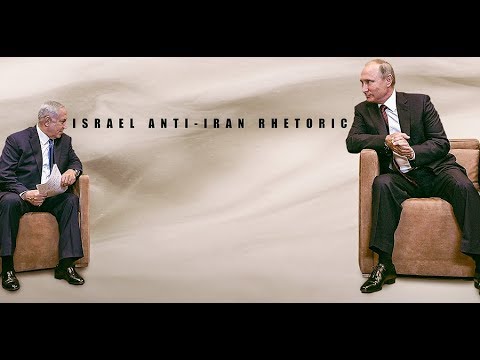
Press TV – August 25, 2017
Prime Minister Benjamin Netanyahu has said that Israel felt threatened by Iran’s growing influence in the Middle East. Netanyahu expressed his Iranophobic view in a meeting with Russian President Vladimir Putin in Russia’s Black Sea resort of Sochi on Wednesday. Press TV has asked Scott Rickard, former American intelligence linguist from Tampa, Florida, and Brent Budowsky, a columnist at The Hill from Washington, to give their thoughts on the issue.
Rickard said Tel Aviv is concerned about the fact that the regime could not carry out its old project to spread sectarian divisions and pave the way for dismemberment of the countries in the Middle East region because of the Iranian-led resistance against Israeli policies, not only in the occupied territories of Palestine but also in the whole region.
“Iran is not a threat to Israel whatsoever. The threat that Israel sees is the fact that their Oded Yinon Plan is being put to a hold by Iran,” the intelligence linguist said on Thursday night.
“They (the Israelis) look at Iran as a threat only because they have no influence on their governments and Iran is autonomous and is not under the Zionist influence,” he added.
Since the victory of the Islamic Republic of Iran in 1979, Tehran has been critical of Israel’s policies in the region, whereas “no leaders [of other states] even dared to speak out against Zionism,” Rickard argued. … continue
Blog Roll
 Aletho News
- The US-Israeli War on Science is an Assault on our Future
- Trump’s Promise to Bomb Iran ‘Like Never Before’ Faces Brutal Logistics — Expert
- Germany seeks to restrict stays abroad for men of fighting age – Berliner Zeitung
- Evidence points to Ukraine being behind TurkStream attempted sabotage, but that should come as no surprise
- Sri Lanka secures supplies of Russia oil – minister
- Nations across Asia strike direct deals with Iran for Hormuz passage
- IRGC commander declares ‘new phase’ of reprisal attacks against aggressors
- Israel’s air defenses overwhelmed by cluster-warhead Iranian missiles: Reports
- Striking Iran’s Infrastructure Would Have Little Military Impact – Report
- What’s Behind U.S./Israeli Strikes On Iranian Pistachio Factories?
- If Americans Knew
- Trump Says US Sent ‘a Lot of Guns’ to Protesters in Iran
- Israeli forces destroy 17 UN peacekeeper cameras in south Lebanon
- US-Israeli strikes ‘completely destroy’ synagogue in Tehran
- Archbishop for US Military Says Iran War Is Unjust Under Catholic Teaching
- Iranian President Pens Open Letter to American People
- Trump says Iranians appreciate bombs, WHO warns of nuclear risks – Daily Update
- U.N. experts demand Israel release prominent Gaza doctor after reports of ‘severe torture’
- Israel’s Latest Genocide Is Against the Shias of Lebanon. Why Is the World Silent?
- How Eliot Cohen’s influence over U.S. war-making paved the way for Trump’s war crimes in Iran
- Israelis don’t pay for the weapons we ‘sell’ to them — US taxpayers do
- No Tricks Zone
- An Inconvenient Tree: Uncovered In Alps… Europe Much Warmer Than Today 6000 Years Ago
- New Study Reports A 60% Slowdown In Greenland’s Ice Loss Rate In The Last Decade
- Low Intensity Tornado Wrecks Major Solar Farm, Creating A Potential Toxic Dump
- New Study Finds Warming Saves Lives…Cold Temperatures 12 Times More Deadly Than Excess Heat
- German Science Blog Accuses PIK Climate Institute Of Hallucinating Climate Tipping Points
- Devastating Assessment Of Comirnaty Vaccine By Former Senior Pfizer Europe Toxicologist
- New Study: CO2 Is ‘Effectively Negligible’ As An Explanatory Climate Change Factor Since 2000
- Former Pfizer Toxicologist Dr. Helmut Sterz Tells Bundestag Hearing Pfizer Vaccine Should Have Never Been Approved
- Energy Expert: Germany’s Nuclear Phaseout Was A “500 Billion Euro Mistake”
- New Research: South Australia’s Mid-Holocene Sea Surface Temperatures Were 4°C Warmer Than Today
 Aletho News