UN calls out US, UK & France for complicity in Yemen war crimes
RT | September 4, 2019
The UN Human Rights Council slammed the US, UK and France for their complicity in alleged war crimes in Yemen by the Saudi-led coalition, warning that abetting such crimes by selling arms or other aid is also illegal.
“States that knowingly aid or assist parties to the conflict in Yemen in the commission of violations would be responsible for complicity in the relevant international humanitarian law violations,” the UNHRC’s Group of Eminent International and Regional Experts on Yemen declared in a lengthy report published on Tuesday.
“With the number of public reports alleging and often establishing serious violations of international humanitarian law no State can claim not to be aware of such violations being perpetrated in Yemen.”
The 274-page report enumerated possible war crimes committed by both sides in the conflict, including airstrikes and shelling, landmines, “siege-like tactics,” attacks on hospitals and other vital infrastructure, arbitrary arrests and executions, torture, and forced conscription of children into combat. The writers claimed to have forwarded the names of top military and political individuals from Saudi Arabia, the United Arab Emirates, Yemen, and the Houthi movement to the UN High Commissioner for Human Rights for further investigation and possible prosecution.
The UK and France fall under special scrutiny as signatories to the Arms Trade Treaty, which bars the sale of weapons if a country believes they will be used to commit “mass atrocities.” However, even non-parties to the ATT may face “criminal responsibility for aiding and abetting war crimes” since after five years of fighting “there can no longer be any excuses made for failure to take meaningful steps to address” the humanitarian crisis and international law violations taking place in Yemen.
The UK Court of Appeal ruled in June that the government had “made no attempt” to determine whether Saudi Arabia was using its weapons to violate international law, and while Secretary of State Liam Fox said he would suspend licenses for export to the Saudi coalition, the Department for International Trade said it would appeal the ruling. A rare bipartisan-supported bill to end weapons sales to Saudi Arabia by the US was vetoed in July by President Donald Trump, who complained it would “weaken America’s global competitiveness” and damage relationships with allies. And the French government hid the arms sales from its people entirely, then threatened the journalists who exposed the sales with arrest for publishing confidential information.
The UNHRC report also provided an update on the shocking scale of the humanitarian crisis, revealing that nearly a quarter of the Yemeni population was malnourished at the start of 2019, according to the Office of the Coordination of Humanitarian Affairs, with 230 of 333 districts at risk of famine and 24.1 million people in need of assistance merely to survive.
Also on rt.com:
‘Comical & tragic’ when US officials say arms sales to Saudis are about ‘exporting human rights’
US, Turkey must end illegal military presence on Syria soil: Damascus envoy to UN
Press TV – August 21, 2019
Syria’s UN Ambassador Bashar al-Ja’afari has called on the United States and Turkey to end their “illegal military presence” in the Arab country and crimes against civilians.
Speaking at a United Nations Security Council (UNSC) session on Middle East peace and security challenges in New York on Tuesday, Ja’afari urged Washington and Ankara to respect the UN Charter’s principle of non-interference in the internal affairs of other countries and refrain from using force against them.
“The United States and its allies, including the Turkish occupation forces, must be obliged to end their illegal military presence on Syrian territory and to stop their aggressive practices in support of terrorism and their crimes against Syrians, civilian installations and infrastructure,” he said.
He also criticized Turkey for sending a military convoy carrying ammunition into Syria’s Idlib Province in support of the militants holed up in the embattled region.
The Syrian envoy further highlighted the need for the world body to stay focused on the real root causes of the Middle East conflict, including occupation, acts of aggression and destructive interventions in countries’ domestic affairs — such as those aimed at overthrowing governments by force, investing in terrorism and fabricating crises.
“Success in dealing with the challenges facing the region requires upholding the principles of international law and the provisions of the UN Charter and stopping attempts to distort and manipulate its provisions,” he said.
Ja’afari also described Israel’s occupation of Arab territories as the main reason for the crisis in the region.
“The main cause of the conflicts in the Middle East and the inability to achieve peace and stability has been and continues to be the Israeli occupation of Arab territories, including the occupied Syrian Golan,” he said.
Ja’afari further expressed concerns about Israel’s accumulation of weapons of mass destruction, saying the regime should join the Non-Proliferation Treaty (NPT) without delay and subject its facilities to the International Atomic Energy Agency (IAEA)’s safeguards regime.
UNRWA Accusations: (Im)Perfect Timing
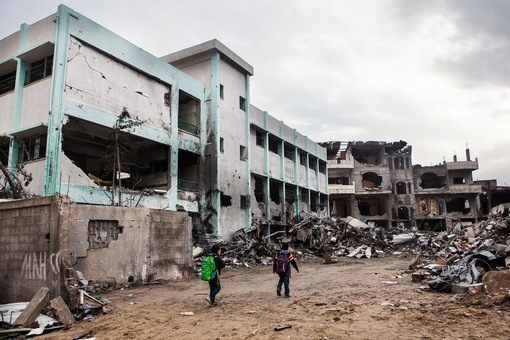
Photograph Source: diario fotográfico ‘desde Palestina – CC BY-SA 3.0
By Daniel Warner | CounterPunch | August 8, 2019
A damaging internal report has cast a dark shadow over the ethical behavior of top officials of the United Nations Relief and Works Agency for Palestine Refugees (UNRWA). As disclosed by Al Jazeera and AFP, the report cites “credible and corroborated reports” that members of an “inner circle” at the top of UNRWA, including Swiss Commissioner-General Pierre Krähenbühl, have engaged in “sexual misconduct, nepotism, retaliation, discrimination and other abuses of authority for personal gain, to suppress legitimate dissent, and to otherwise achieve their personal objectives.” The report was sent to UN Secretary-General António Guterres in December.
As one would expect, reactions have been immediate. The Swiss Foreign Ministry has announced that it has “decided to temporarily stop payments to the United Nations Relief and Works Agency for Palestinian refugees in the Near East (UNRWA).” Already in 2018, Swiss Foreign Minister Ignazio Cassis publicly criticized the role of UNRWA, saying it would be impossible to make peace between Israel and the Palestinian Authority because “For as long as Palestinians live in refugee camps, they want to return to their homeland,” he said. “For a long time the UNRWA was the solution to this problem, but today it has become part of the problem. It supplies the ammunition to continue the conflict. By supporting the UNRWA, we keep the conflict alive. It’s a perverse logic,” Cassis stated.
The Jewish News Syndicate trumpeted over the scandal: “Revelations of rampant wrongdoing in the corridors of the United Nations Relief Works Agency for Palestine Refugees (UNRWA) couldn’t have shamed a more worthy organization. Though normally it’s not nice to gloat over the misfortunes of others, the schadenfreude elicited by the news of inappropriate behavior going on behind the walls of this particularly vile organization was warranted.” An Israeli journalist, Ruthie Blum, tried to put another nail in the agency’s coffin: “Nothing short of shutting down UNRWA will be satisfactory since its very existence is a criminal scam…. In the meantime, let us take some comfort in the agency’s well-earned public humiliation.”
“UNRWA is currently running on fumes,” charged U.S. special envoy Jason Greenblatt at the UN Security Council in late May. “It is time to face the reality that the UNRWA model has failed,” he said. “Palestinians in refugee camps were not given the opportunity to build any future; they were misled and used as political pawns,” he added. The United States ended all funding for UNRWA in 2018. “The United States will no longer commit further funding to this irredeemably flawed operation,” the State Department said at the time.
The schism between humanitarianism and politics is not as wide as most believe. Organizations like UNRWA walk a very thin line between assisting all in need and taking sides in conflicts. In response to the current story, UNRWA responded that it “is probably among the most scrutinized U.N. agencies in view of the nature of the conflict and complex and politicized environment it is working in.”
UNRWA was created in 1949 to deal with Palestinians who were displaced during the 1948 war at the creation of the state of Israel. It was established by General Assembly resolution 302 (IV), with the initial mandate to provide “direct relief and works programmes” to Palestine refugees, in order to “prevent conditions of starvation and distress… and to further conditions of peace and stability”. Today, it provides education, health care and social services to more than 5 million Palestinian refugees in Jordan, Lebanon, Syria, the Gaza Strip and the West Bank. Since 2018, with the U.S. withdrawal, it has been in a financial crisis.
While the ethics report deals only with the internal workings of the organization, there is no question that one cannot separate the political from the ethical here. Why are questions being raised now about ethical issues within UNRWA? With continuing tensions between Palestinian authorities and Israel and the Trump administration peace plan still incubating, the report is a cold shower for any hopes of ameliorating the lives of millions of displaced Palestinians. Generations of Palestinians have been stuck in camps, with UNRWA doing all that’s been possible to alleviate their suffering.
Is the report part of a larger strategy? By publicly criticizing UNRWA now, is it hoped that Palestinians will be forced to sign an agreement that will have no promise for the right to return? When the U.S. stopped funding UNRWA, a spokesman for the Palestinian Authority suggested it was “using humanitarian aid to blackmail and pressure the Palestinian leadership to submit to the empty plan known as ‘the deal of the century.” Are the latest revelations part of that strategy?
Any serious abuses within UNRWA should be scrutinized and punished. That should go without saying. And organizations like UNRWA, given the sensitivity of their activities, should be especially careful about their actions. That also should go without saying. But the timing of the current revelations certainly come at an opportune moment for those who want to pressure the Palestinians into a peace deal. And what about all the refugees who depend on UNRWA for basic services? Are they once again being forgotten as they have been for 70 years?
Palestine’s UN Delegation Criticizes Secretary-General for Not Including Israel on ‘List of Shame’
By Ali Salam | IMEMC | August 4, 2019
To the dismay of Palestine’s delegation to the United Nations, Secretary-General António Guterres did not include Israel in his new “list of shame”, which includes states committing grave violations against children, despite the figures and statistics in the report about serious violation of rights of children in Palestine, said Riyad Mansour, Palestine’s permanent representative to the UN.
The UN Security Council held in New York yesterday an open debate on the annual UN report on situation of children in times of conflict, which Guterres released on Wednesday.
According to the report, the number of Palestinian children killed or injured reached its highest level in 2018 since 2014. It said 59 were killed in 2018, 56 of them by the Israelis army, nearly a four-fold increase over 2017. In the West Bank, Israeli forces injured 1,398 children in 2018, while in Gaza they injured 1,335 children. The Injuries included permanent disabilities and limb amputations.
It also said 203 children are held in Israeli prisons, most of them in administrative detention, without charge or trial. By the end of December 2018, 87 children were sentenced to serve time in Israeli prisons for resisting the occupation, said the report, and these children are subjected to harsh conditions of detention and ill-treatment.
“The UN secretary-general should include Israel in the ‘list of shame’ and add it to the countries that commit horrendous acts, especially against children,” said Mansour before the start of the session.
He said that not including Israel on the list undercuts efforts to put an end to criminal violations against children around the world and questions the credibility of the list while making it open for criticism and endangers the lives of Palestinian children due to the lack of any kind of accountability to Israel.
Gutierrez instructed his personal representative, Virginia Gamba, to visit the region and occupied Palestine to further investigate what came in the report regarding the injuries and maiming of Palestinian children.
The Palestinian delegation called on Guterres to take into account that the Israeli violations in Palestine were caused by the military occupation, which should be mentioned in the section on Palestine in the report, and to make sure that Israeli practices amount to collective punishment, particularly the blockade imposed on the Gaza Strip since 2006.
They also said that since 2000, Israel, the occupying Power, had arrested 10,000 Palestinian children.
“We call on the international community to save an entire generation. The difficult circumstances, humiliation, panic and trauma caused by the detention of the Palestinian child are impeding society and aim at weakening it,” said the delegation.
It attributed Israel’s persistence in its inhuman practices to its enjoyment of international impunity, which protects it from sanctions and accountability.
Human Rights Watch has also criticized the UN secretary-general for not including Israel in the list.
“The UN secretary-general simply refuses to hold to account all warring parties that have inflicted tremendous suffering on children,” said Jo Becker, children’s rights advocacy director at Human Rights Watch. “By listing selected violators but not others, Secretary-General Guterres is ignoring the UN’s own evidence and undermining efforts to protect children in conflict.”
Guterres failed to list the Israeli army in the new report as responsible for grave violations against children, including killing and maiming, despite considerable evidence of violations by these parties, said HRW in a press release issued last week.
“Previous reports have also found the Israel Defense Forces responsible for killing and maiming Palestinian children, but the secretary-general has yet to include the Israeli forces in his list of abusers,” it said.
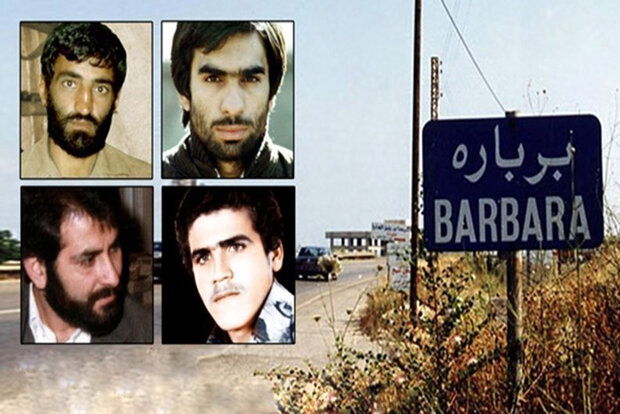
Iran Says 4 Kidnapped Diplomats in Occupied Palestine, Calls on ICRC to Form Fact-Finding Committee
Al-Manar | July 5, 2019
Iran on Friday said that the four diplomats kidnapped in northern Lebanon in 1982 are in occupied Palestine, calling on the International Committee of the Red Cross to form a fact-finding committee.
Iranian foreign ministry released on Friday a statement marking the 37th anniversary of the abduction of the four diplomats.
“As it has been mentioned over the past years, evidence indicates that the diplomats kidnapped in Lebanon have been handed over to the occupying forces of the Zionist regime and subsequently transferred to the occupied territories and now, are held in prisons of this illegitimate regime,” the statement said.
“Accordingly, and given the occupation of Lebanon at that time by the Zionist regime with the full support of the US, the Islamic Republic of Iran believes that the political and legal responsibility for the abduction and this terrorist action lies with the Zionist regime and its supporters,” the foreign ministry noted.
On July 4, 1982, the four Iranian diplomats were kidnapped by a group of Israeli-backed gunmen at an inspection post in northern Lebanon.
In September 2008, the Lebanese government sent a letter to the then UN secretary general, Ban Ki-moon, in which Beirut confirmed the abduction of the Iranian diplomats in the Lebanese territory and called for UN action to pursue the case.
The Zionist entity has claimed that the Iranian diplomats were abducted by a Lebanese militant group and killed shortly after their abduction.
UN Rapporteur: Canada’s trade agreement with Israel violates international law
![Michael Lynk, Special Rapporteur on the situation of human rights in the Palestinian territories occupied Michael Lynk [Alhadath24/Facebook]](https://i1.wp.com/www.middleeastmonitor.com/wp-content/uploads/2017/03/2017_3_21-Michael-Lynk.jpg?resize=1200%2C800&quality=75&strip=all&ssl=1)
Michael Lynk, Special Rapporteur on the situation of human rights in the Palestinian territories occupied Michael Lynk [Alhadath24/Facebook]
MEMO | May 31, 2019
Canada’s updated trade agreement with Israel violates international law, the UN Special Rapporteur for the [occupied] Palestinian territories, Professor S. Michael Lynk, has said in an article published by the Australian news site, The Conversation.
Commenting on legislation known as Bill C-85 — the Canada-Israel Free Trade Agreement Implementation Act — which received royal assent on Monday, Lynk said that it lacks “a human rights provision, which would commit both parties to uphold international human rights and humanitarian law.” The Act also allows goods and services originating on illegal Israeli settlements to enter Canada without any tariffs. These “glaring” omissions, said Lynk, not only violate international law but also Canadian law.
The article, which was co-written with Alex Neve, the Secretary General of Amnesty International Canada, explained that Canadian foreign policy and Ottawa’s own legislation “has long recognised the Israeli settlements as illegal under the Fourth Geneva Convention.”
According to the authors, “The 1957 Geneva Conventions Act commits Canada to respect the strict obligations of the convention, including the prohibition against civilian settlements in occupied territory. And the 2000 Crimes Against Humanity and War Crimes Act designates civilian settlements in occupied territory as a war crime.”
Clarifying their position further, they cite the UN Human Rights Council, which in 2016 urged all states to ensure that: “They are not taking actions that either recognise or assist the expansion of [Israeli] settlements… in the Occupied Palestinian Territory, including East Jerusalem, including with regard to the issue of trading with settlements, consistent with their obligations under international law.”
They also cite a number of UN Resolutions, including Security Council Resolution 2334 which states that the Israeli settlements are “a flagrant violation under international law and a major obstacle to the achievement of a two-state solution and a just, lasting and comprehensive peace.”
Lynk pointed out that while Israel denies that it is an occupying power, there is in fact “a virtual wall-to-wall consensus among the international community — including the United Nations, the European Union, the International Court of Justice, the International Committee of the Red Cross and Canada — that the laws of occupation, including the Fourth Geneva Convention of 1949, apply in full to the Palestinian territory.”
The authors state that the Bill “makes no distinction between Israel and its illegal settlements in the Palestinian territory and it provides encouragement to the economic growth of the settlements by allowing their goods and services to enter Canada tariff-free.”
In conclusion, Lynk and Neve say that the Bill “entangles Canada in the serious violations of both international human rights and humanitarian law that are part and parcel of the Israeli occupation.”
READ ALSO:
Canada court hears lawsuit challenging Israel settlement wine labels
Russian UN employee arrested by Kosovo police released, taken to hospital with ‘heavy head injuries’
RT | May 28, 2019
A Russian member of the United Nations Mission in Kosovo (UNMIK) is in hospital with serious head injuries after Kosovo police broke his cheekbone with a rifle-butt, despite him being unarmed, his doctor says.
The UN mission’s spokeswoman Sanam Dolatshahi confirmed that Mikhail Krasnoshchekov had been released by police, while details of the injuries sustained during his arrest began to emerge.
“He has a head injury and a fracture of the zygomatic bone, which is classified as a serious injury. The injury occurred from a butt strike to the head, although the man was not armed,” Krasnoshchekov’s doctor said.
Krasnoshchekov sustained the injury as Kosovan special police raided four predominantly Serbian communities in the breakaway region’s north, ostensibly as part of a crackdown on organized crime. The massive campaign involved the use of 73 special vehicles and ended in 23 arrests, according to Serbian President Aleksandar Vucic.
Despite the traumatic head injuries, UN Secretary General Farhan Haq announced that the UN worker was in “normal condition” upon release from police custody.
There is no update yet on a second UN mission employee who was also detained.
The president of the self-proclaimed territory of Kosovo, Hashim Thaci, claimed that the detained mission member had “tried to prevent a police action.”
The Russian diplomat should theoretically have been protected from detention by his UN employee immunity. After learning of the arrest, Russian Foreign Ministry spokeswoman Maria Zakharova decried the “outrageous act” as a provocation by “the Kosovo Albanians’ top brass,” and demanded Krasnoshchekov’s immediate release.
Former U.S. Forest Service Ecologist: UN species report ‘grossly’ exaggerated, used to promote UN agenda
May 21, 2019
To the United States Congress
I am an ecologist and was the director of San Francisco State University’ Sierra Nevada Field Campus for 25 years. My professional career was dedicated to promoting wise environmental stewardship. Despite my years of research to advance biodiversity, I’m gravely concerned about the recent Summary for Policymakers by the Intergovernmental Science-Policy Platform on Biodiversity and Ecosystem Services (IPBES), where it suggests that 1± million species are now threatened with extinction. Based on my experience, that number is greatly exaggerated. It appears this organization grossly overstated species threats in order to promote their stated agenda that “goals for 2030 and beyond may only be achieved through transformative changes across economic, social, political and technological factors.”
The International Union for the Conservation of Nature (IUCN) is considered the gold standard for identifying threatened species. As of 2019, they estimate that there are 1,733,200 described species (not total species) of which less than 10% (just 98,512) have been evaluated to some degree. Of those evaluated species 27,159 species appear threatened with extinction to some degree. That is a reason for concern, but the IUCN estimates of species loss are a far cry from a million.
The IPBES suggested that the total number of threatened species could be derived by calculating the proportion of yet-to-be-evaluated species, using the same proportion of evaluated species that are considered threatened. Still such speculative math would still only result in 461,621 threatened species — again quite a few less than a million.
To reach 1± million threatened species the ≈ stated, “The proportion of insect species threatened with extinction is a key uncertainty, but available evidence supports a tentative estimate of 10 percent.” They then state that insects comprise 75% of the known 8± million animal and plant species. However, that results in an estimate of 6± million insect species which is 6 times greater than the scientific consensus. Such misleading exaggerations suggest this group has a hidden agenda.
A key understanding is that 75%± of all mammal, bird, reptile and amphibian extinctions have occurred on islands, and 86% of those extinctions were the result of introduced non-native species. Island species had not evolved the defenses needed to resist introduced rats, cats, and stoats. For example, in Hawaii, the introduction of mosquitos and avian malaria in the 1800s decimated Hawaii’s native birds.
Due to invasive species, 41%± of all highly threatened species (Endangered and Critically Endangered) now live on islands. The current threats to most island species are not the result of what humans are doing wrong today, but the result of introductions a century ago. Now aware of the problem, humans are trying to fix it.
Private conservation groups and public land managers are now working to eradicate invasive species, but those efforts require much more resources. If IPBES was truly concerned about protecting threatened species, they could simply fund these eradication efforts. There is no need for “transformative changes across economic, social, political and technological factors.”
Furthermore, the IUCN’s criteria for designating threatened species (the total of Critically Endangered, Endangered and Vulnerable species) allows for much subjectivity. That subjectivity allows for overstating a species condition which would inflate the threat. For example to classify a species as “Threatened,” all one needs is “an observed, estimated, inferred or suspected population size reduction” The magnitude of the reductions determines if a species is Vulnerable, Endangered or Critically Endangered. That criteria is accurate for well-studied species for which quantitative studies have been carried out. However many ICUN evaluations “have no quantitative data available on densities or abundance” from which to determine the threatened status. The population reduction is then just inferred or suspected.
An example of the problem with speculations is the Adelie Penguin. It was classified as a species of Least Concern in 2009, with a population of about 4± million individuals throughout Antarctica. They were up-listed to Near Threatened based on a 2010 climate modeling study that speculated global warming would reduce the sea ice they needed to rest on during the winter. However, after more intensive studies, researchers realized Adelie populations were actually increasing and had now doubled to 8± million individuals. Due to good quantitative studies, the IUCN reclassified Adelies as Least Concern again.
Speculation that a million species are threatened with extinction does not fully account for the conservation efforts that are improving species once they have been identified as Endangered. For example, our current hunting regulations have allowed many whale species to return from the brink of extinction. Humpback and Bowhead whales were listed as Endangered in the 1980s. They have now recovered and are listed as species of Least Concern. Quantitative studies allowed for wise hunting quotas that quickly reduced the threat to many species. Again, there is no need for a “transformative changes across economic, social, political and technological factors.”
Loss of habitat is a key factor that can result in species becoming endangered — and sometimes it is political decisions that can lead to these species threats.
For example, government attempts to promote biofuels based on speculations about climate change have disrupted ecosystems and threatened more species. The European Union-subsidized Palm Oil for years, resulting in the loss of tropical forest and threatening species like the Orangutans. Realizing their mistake, those subsidies will be withdrawn.
Another example is that subsidies for sugar cane as a biofuel has prevented the restoration of tropical forests in Brazil, and corn subsidies in the USA have encouraged corn plantation in the northern Great Plains disrupting prairie ecosystems and reducing aquifers.
Yet another situation is that subsidies for industrial wind energy have resulted in increased bird and bat mortalities, in addition to the well-documented eco-system disruption. These representative examples should make clear that “transformative economic and political changes” can cause more problems than they solve.
I urge Congress to carefully peruse the IPBES claims. Their assertion of a million threatened species does not stand up to scientific scrutiny. Their gross exaggerations appear to be a political gambit to control “transformative changes across economic, social, political and technological factors,” while offering very little to improve current efforts to protect biodiversity.
Sincerely,
Jim Steele
Jim Steele was the director of the Sierra Nevada Field Campus from 1984 to 2010. He was Principal Investigator of the U. S. Forest Service Neotropical Migratory Bird monitoring in Riparian Habitats on the Tahoe National Forest, performed two USGS Breeding Bird Surveys in the area, and initiated the successful Carman Valley Watershed Restoration project. Contact jsteele@sfsu.edu
US boycotts arms control conference in protest at Venezuela
RT | May 28, 2019
The United States walked out of a UN disarmament forum in protest after Venezuela took up the conference’s rotating chairmanship, insisting it would not participate in a conference led by a “rogue state.”
“Whatever is discussed in there, whatever is decided, has absolutely no legitimacy because it is an illegitimate regime presiding over that body,” US ambassador to the Conference on Disarmament (CD) Robert Wood told reporters Tuesday after he stormed out of the meeting.
Wood ditched the forum as soon as his Venezuelan counterpart Jorge Valero was granted the conference’s presidency – which rotates on a monthly basis – calling Valero’s acceptance speech a “diatribe of propaganda.”
The US and its allies in the Lima Group – comprised of more than a dozen Latin American allies including Mexico, Colombia, Brazil and Chile – will boycott the CD for the next four weeks, until the new chair takes over, Wood said in a statement after the meeting.
The CD was established in 1984 to provide an international forum for arms control negotiations, and is held three times a year in Geneva. Sixty-five countries currently participate in the conference, including all states with a declared nuclear arsenal.
Washington, along with a handful of allies, supports Venezuelan opposition leader Juan Guaido, who declared himself ‘interim president’ in January, with US recognition. The pro-Guaido bloc considers Venezuela’s elected president, Nicolas Maduro, to be illegitimate.
Wood demanded the CD chairmanship be granted to a member of the opposition.
“A representative of Juan Guaido, the interim president, should be in this body, should be sitting in that chair right now,” he said, adding that the Maduro government “is in essence dead, it just doesn’t want to lay down.”
US President Donald Trump has ramped up sanctions on Venezuela in recent months, crippling energy exports of a country already in dire straights and depriving the socialist government of much needed revenue. Washington considers sanctions part of another “maximum pressure campaign,” designed to coerce the Maduro government into compliance.
The US endorsed an opposition coup attempt in late April, but the uprising failed to inspire mass defections from the security forces and fizzled out within days, leaving Washington and the Guaido faction frustrated.
Ambassador Wood staged a walkout at last year’s CD as well, in that case over Syria’s elevation to the chair position. Wood worked off a similar script then, ditching the meeting as the Syrian ambassador began his address and complaining to reporters outside the chamber.
Amazon Pulls Hezbollah Deputy Leader’s Book After Israeli Media Outcry
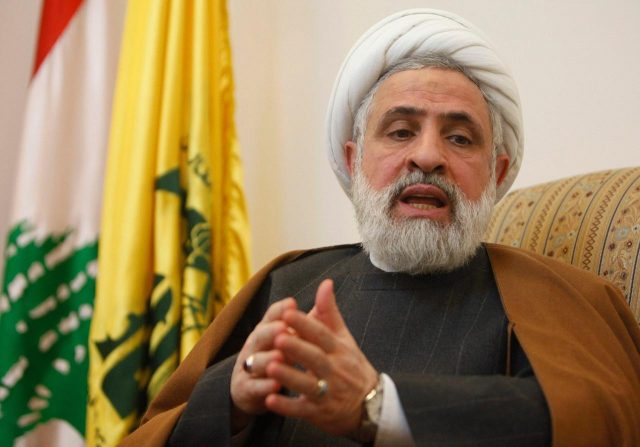
Deputy leader of Hezbollah Gen. Naim Qassem, via Reuters.
By Tyler Durden – Zero Hedge – 05/23/2019
This week Amazon pulled a controversial book being sold through its website after Israeli media led an outcry against it, charging the US retail giant with hosting Hezbollah propaganda containing incitement to violence against Israelis written by the group’s second in command.
 “Hezbollah: The Story from Within” was published in 2010 by Naim Qassem, the deputy head of Hezbollah, who is a designated international terrorist by the United States. The rare “insider account” of Iran-backed Hezbollah has been translated into several languages and had reportedly long been available in English through Amazon.com.
According to the Israeli national Hebrew-language daily newspaper Maariv, “a reporter found that the English edition of the book was being offered for sale on the Amazon site,” and was alarmed at “a clear instance of breaking sanctions and helping to finance terrorism” on the part of Amazon.
“A Maariv reporter contacted Amazon with findings in the book and Amazon subsequently decided to immediately remove the book from its sales sites in the United States and around the world,” a rough English translation of the Maariv story said. The Hebrew-language report said the book was filled with anti-Semitic statements and questioned Israel’s right to exit.
Though it had apparently been offered by Amazon for years, the book was spotlighted this week after controversy erupted between Israel and a United Nations official, after the official called it “necessary reading”.
On Tuesday Israel slammed the United Nations Special Coordinator for Lebanon Jan Kubis for holding a high level meeting with Qassem after which the UN official publicly praised the senior Hezbollah official.
Kubis had confirmed on Twitter that he not only met with Qassem, but received a copy of his most well-known book, which he also praised.
The Times of Israel reported of the statement:
Kubis was likely referring to “Hizbullah (Hezbollah): The Story from Within,” a 464-page tome first published in English a decade ago. The book, published by the London-based Saqi Books, is available on Amazon.
The Israeli Defense Forces (IDF) spokesman went so far as to denounce the meeting via Twitter, saying “You know what else is ‘necessary reading’? U.N. Resolution 1701” — in reference to a resolution intended to resolve the 2006 Israel-Lebanon conflict.
Within two days following the incident, the initial link through which the book had been sold on Amazon led to an error page, in apparent confirmation that Amazon banned the book at the request of the Israeli reporter.
On Thursday, Middle East and Iran analyst Matthew Levitt confirmed that the “Hezbollah deputy Secretary General’s book [is] no longer available on Amazon after journalist points out its anti-Israel incitement to violence & sanctions implications of selling it.”
The fresh controversy comes following new efforts by Israel to convince the UN to officially recognize Hezbollah as a terror group — an effort which has reportedly failed to gain traction.
The Trump administration has also of late taken more aggressive sanctions measures on Hezbollah leadership amid the ongoing heightened tensions with Iran. Hezbollah has long been seen as an arm of the Ayatollahs in Lebanon and Syria.
Featured Video
Trita Parsi: Israel Set a Trap for Total War in the Region
or go to
Aletho News Archives – Video-Images
From the Archive
Zionism’s Violent Legacy
By Donald Neff | Washington Report On Middle East Affairs | January 1996
On January 4, 1948, Jewish terrorists drove a truck loaded with explosives into the center of the all Arab city of Jaffa and detonated it, killing 26 and wounding around 100 Palestinian men, women and children.[1] The attack was the work of the Irgun Zvai Leumi – the “National Military Organization,” also known by the Hebrew letters Etzel – the largest Jewish terrorist group in Palestine. The Irgun was headed by Revisionist Zionist Menachem Begin and had been killing and maiming Arabs, Britons and even Jews for the previous ten years in its efforts to establish a Jewish state.
This terror campaign meant that at the core of Revisionist Zionism there existed a philosophical embrace of violence. … continue
Blog Roll
 Aletho News
- Trita Parsi: Israel Set a Trap for Total War in the Region
- Trump’s Iran war is on an Israeli leash
- Saudi oil boss issues global supply warning
- Riyadh Says Its Oil System Is Intact. The Numbers Say Otherwise.
- Trump and Netanyahu Want to “Finish the Job” on Iran
- US ‘one-sided dictation’ not Iran’s beliefs makes rational talks impossible: Baghaei
- Iran’s Next Strike May Not Explode. It Could Shut You Down /Col Doug Macgregor
- Iran: US political targets legitimate if assassinations return
- Iraq shuts key border crossing with Iran under US pressure: Report
- Undersea Internet cables could be targeted in retaliation for attacks on Iran: IRGC deputy chief
- If Americans Knew
- The Israel Lobby’s Changing Fortunes
- AIPAC has become such a political liability that it’s shifting to a more “nimble” approach to buying politicians
- At least 160 Israeli settler attacks in 2 weeks
- Will Gaza’s Ancient Christian Community Disappear Forever?
- Israel’s vision of regional security rests on keeping Arab states weak
- Heidi Levine recounts how Palestinian youths helped save her in settler attack
- DAILY UPDATE: Latest essential news on Palestine, Israel, & region
- Trump’s Intensifying Sabotage of the ICC, for Israel’s Sake
- Israeli military detain US and UK volunteers in West Bank including Democratic NY politician Brad Lander
- Americans at National Conservatism Conference held in Israel this year criticize Israel
- No Tricks Zone
- E-Cars Reduce CO2 Emissions By Only 41% Compared To Internal Combustion Engine Vehicles
- Predictions Made By Renowned Climate Professor Over Past Decades Have Been Proven To Be Poor
- New Study Suggests Large Regions Of The Pacific Ocean Have Been Cooling For The Last 80 Years
- Germany’s Green Energy Debacle: High Energy Costs Force Kahla Porzellan to Close After 182 Years!
- New Study: 50 Years Of The Most Aggressive ‘Net Zero’ Policies Can Only Affect The Global Climate By 0.03°C
- US September “Heat” Was No Record…Many Records Set Decades Ago
- Latest European Green Energy Debacle; Portugal’s Largest Flagship Solar Park Insolvent!
- Green Energy Debacle: German Expert Professor Fritz Vahrenholt Warns Of Severe Economic And Social Consequences
- Two More Paleo Reconstructions Affirm Meters-Higher Sea Levels Across Ireland, Brazil 7000-6000 Years Ago
- New Study: Earth And Venus Surface Warmth Largely Explained By Convection And Lapse Rate, Not CO2 Or Radiation

