‘Syria Will Never Agree to Israeli Occupation of Golan Heights’
Al-Manar | April 27, 2018
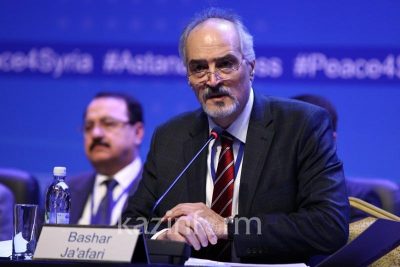
Syria’s Permanent Representative to the United Nations, Bashar al-Jaafari has once again reiterated Damascus’ adherence to the pre-June 1967 line, re-establishing borders from before the Six Day War, stressing that the country’s sovereign right on the occupied Golan Heights is non-negotiable, and the territory captured by the Zionist entity should be completely restored.
During a UN Security Council meeting on the Middle East situation, the UN envoy said some UNSC member-states have opted for a selective approach and the double standards policy, indulging in empty talk about international law, human rights, and the inalienable principles of the UN Charter.
At the same time, these member states turn a blind eye to the Israeli occupation of the Syrian Golan Heights, al-Jaafari said.
“Where have those states and their talk about counterterrorism and the international humanitarian law been when Syrian citizens were arrested and arbitrarily taken to Israeli jails, just as what happened to Sudqi al-Maqt, who was re-arrested because of his audio and video documentation of the close cooperation between the Israeli occupation forces and the Daesh and Jabhat al-Nusra terrorist organizations,” al-Jaafari said during the meeting.
He proceeded to say that the United States has always protected the Zionist entity, granting it immunity, despite the fact that Tel Aviv has consistently violated UNSC resolutions, demanding that the pre-June 1967 status quo be restored.
The Syrian official also denounced Israeli policies towards the Palestinians, recalling the recent developments in Gaza and the West Bank.
Concluding his speech, the UN representative called on the UNSC to take urgent measures against the occupation regime, demand that it stop its aggression and force Tel Aviv to abide by resolutions 242, 338, and 497, stipulating the liberation of Arab territories from its occupation, including the Golan Heights, withdrawing to the pre-June 1967 line.
Lebanon Rejects UN, EU Joint Statement on Displaced Syrians’ Crisis
Al-Manar | April 26, 2018
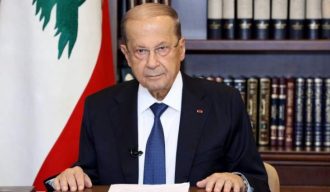 President of the Republic, Michel Aoun, on Thursday voiced rejection of the joint statement by the United Nations and the European Union issued yesterday at the Brussels conference on the displaced Syrians’ crisis.
“The content of the joint statement by the UN and the EU contradicts the state’s sovereignty and endangers Lebanon,” President Aoun said in a statement released by the Presidency of the Republic.
Aoun rejected the content of the joint statement including phrases ‘voluntary return,’ ‘temporary return,’ ‘will to stay,’ and ‘integration in the labor market’ and other terms which contradict the Lebanese state’s sovereignty and laws.
Aoun brought to attention that Lebanon has dealt with the Syrian displacement predicament on the basis of brotherly relations and humanitarian obligation, emphasizing that the only viable solution to the crisis was the safe and dignified return of the displaced Syrians “to the possible areas inside Syria… notably that many Syrian areas have become safe.”
Aoun stressed that Lebanon adheres to a political solution in Syria and the restoration of stability in a way that preserves Syria’s unity and ends the suffering of its people.
Palestinians file complaint to UN over Israel violation of anti-racism convention
MEMO | April 23, 2018
Palestinians have filed a complaint to the UN against Israel for numerous violations including breaches of its obligations under international anti-racism treaty.
The move, which is likely to trigger a lengthy and high-profile investigation by world bodies monitoring racism and discrimination, was handed to the UN by the Palestinian ambassador to the international organisation, Ibrahim Khraishi, to the body that monitors the implementation of the UN convention against racism.
In the 350 page document seen by the Guardian, which accuses Israel of establishing an apartheid regime, Palestinians say that Israel is implementing policies that have “the common aim of displacing and replacing the Palestinian people for the purpose of maintaining a colonial occupation”.
Palestinians list a number of Israeli violations in the occupied territories and accuse Israel of seeking to maintain “a Jewish demographic majority in the entirety of historic Palestine”.
“Not only is the purpose of the settlement regime discriminatory in itself, it is further maintained by a system of discriminatory measures, severely depriving Palestinians of their fundamental rights,” the report says.
The complaint sent to the UN is over violations of the 1979 UN Convention on the Elimination of All Forms of Racial Discrimination. Israel has ratified the convention and Palestinians, who were granted UN observer status in 2014, filed the complaint which is believed to be the first interstate complaint filed under the treaty.
The convention is monitored by the Committee on the Elimination of Racial Discrimination, a body of 18 independent experts that is now tasked with assessing the complaint. Israel will now be required to submit written explanations within three months, including any remedies it has taken. The committee could then move to investigate the claims.
According to Ammar Hijazi, from the Palestinian ministry of foreign affairs, the complaint “does not reach the level of a court order.” Hijazi added that the finding that Israel had breached the treaty would oblige other signatories to the convention, which include the US, to “ensure that such practices are not continued”, reported the Guardian.
In their list of complaints Palestinians say that they are severely limited in their freedom of movement compared to Israeli settlers and are subject to “confiscation and seizure” of their land, including home demolitions.
In addition to the violations relating to the right to equal treatment under the law, Palestinians claim that Israel is in breach of article 3 of the convention, which prohibits racial segregation and apartheid. “It is clear that Israel’s acts are part of a widespread and oppressive regime that is institutionalised and systematic; that accords separate and unequal treatment to Palestinians,” the summary says, calling for the dismantling of all existing Israeli settlements.
Strike on Syria legitimate as 3 UNSC members acted – Macron
RT | April 15, 2018
French President Emmanuel Macron said that the US-led strike on Syria was legitimate, but “history will judge” whether the operation was justified. He added that neither France nor its allies are at war with the country.
Macron was giving a live interview following the Saturday strike on Syria that was carried out without any resolution from the UN security council. The US-led attack, that hit three targets in Syria, a research center and military bases, was launched in response to an alleged chemical attack in Douma on April 7.
The French president defended the lack of a UN resolution before conducting the strikes against Syria, saying that it was “the international community” that intervened.
“We have complete international legitimacy to act within this framework,” Macron said in the interview broadcast by BFMTV, RMC radio and Mediapart. “Three members of the Security Council have intervened.”
Macron also alleged that he was the one who convinced US President Donald Trump to remain in Syria and that the coalition should limit their strikes to chemical weapons facilities.
“Ten days ago, President Trump was saying ‘the United States should withdraw from Syria’. We convinced him it was necessary to stay,” Macron said. “We convinced him it was necessary to stay for the long term.”
He also asserted that Assad has lied “from the beginning” about the alleged use of chemical weapons by forces under his control. Macron also reaffirmed that the French government has proof that chemical weapons, notably chlorine gas, were used in Syria, adding that the “the priority for France’s military intervention remains in the fight against ISIS” and that the “precision strikes” did not inflict any collateral damage on Russian forces.
He also accused Russia of being complicit in the alleged chemical weapons attacks carried out by pro-Assad forces by disrupting the work of the international community and the Organization for Prohibition of Chemical Weapons (OPCW) using “diplomatic channels.” He didn’t mention, however, that the strike took place hours before the inspectors of the OPCW were to start their mission at the place of the alleged attack and were guaranteed full access by the Syrian government who took control over the area this week.
Russia Stood Alone. China Didn’t Help Vote Down Trump’s Syria UN Resolution
By Marko Marjanović | Checkpoint Asia | April 11, 2018
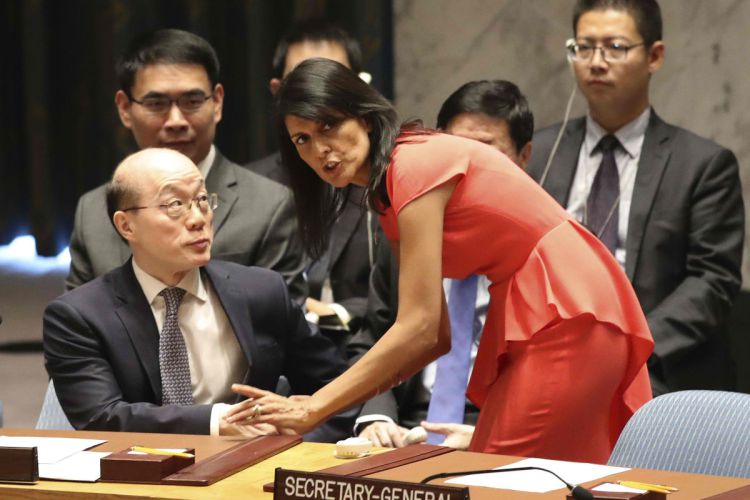
Russia’s proposed UN Security Council resolution envisaging a speedy and realistic investigation into Douma incident was voted down by a triple veto. US, UK and France all voted against it.
However an earlier US-proposed resolution, which proposed an investigation mechanism that couldn’t possibly work and would have opened an avenue for the American use of force had to be vetoed by Russia alone. Bolivia was the only other nation to vote against it as China merely abstained.
China did so albeit it had previously called for restraint and for no side to resort to force which should have naturally made it predisposed to oppose the American resolution. Likewise the Chinese did so albeit the newly-appointed Chinese defense minister was in Moscow talking up ties between the two armed forces and countries.
It has long been Chinese philosophy not to stick its neck out at the UN. Beijing rarely vetoes anything that does not concern its immediate interests and never alone. Additionally China has its own, more immediate American problems right now with Trump threatening a trade war and is presumably reluctant to provoke the US president into further enmity. Finally it is clear that in Beijing’s strategic calculation China benefits with the US and Russia at each other’s throats.
With US distracted by hostility towards Moscow it can not afford to at the same time act too aggressively against China, while the US pressure on Russia means Moscow has little choice but at least ensure the friendship of China.
Nonetheless, things are looking pretty grim for Russia right now (let’s not kid ourselves, in the Middle East the Empire holds escalation dominance) and a little support, no matter how symbolic, could have gone a long way towards securing long-term Russian appreciation. An opportunity missed for Beijing.
Iran: Israel must be forced to join NPT
Press TV – April 3, 2018
Iranian Ambassador to the United Nations Gholamali Khoshroo has stressed that the Tel Aviv regime’s warlike policies are hampering efforts to denuclearize the Middle East.
“Forcing Israel to join the Non-Proliferation Treaty and putting all of its nuclear activities and facilities under the safeguard of the International Atomic Energy Agency must be one of the commission’s main recommendations,” said Khoshroo while addressing the disarmament committee in New York on Monday.
He further called for an increase in international action aimed at protecting global peace and security in the face of the nuclear arms race.
Khoshroo noted that all nuclear weapons must be destroyed before they are used to destroy the human race.
Israel is estimated to have 200 to 400 nuclear warheads in its arsenal. The regime, however, refuses to either accept or deny having the weapons.
It has also evaded signing the NPT amid staunch endeavor by the United States and other Western states on international levels in favor of its non-commitment to the accord.
How the Guardian became the West’s Pravda
By Jonathan Cook | Dissident Voice | March 31, 2018
Here is a good example of pure, unadulterated western propaganda from the Guardian, written by one of their most senior journalists, Julian Borger. This could be straight out of of the old Soviet mouth-piece Pravda.
According to the Guardian :
China and Russia are leading a stealthy and increasingly successful effort at the United Nations to weaken UN efforts to protect human rights around the world, according to diplomats and activists.
The article continues in similar vein, blaming the two official enemies of the west for the increasingly degraded status of human rights at the UN.
As far I can tell, none of the facts in the Guardian’s story is untrue. But that does not stop it from being a blatant lie. Providing only a partial account – one serving western interests – of what is happening to human rights at the UN is not only a distortion of the truth but outright propaganda.
The only allusion to the truth – possibly inadvertent – is to be found in this quote from Louis Charbonneau, the UN director for Human Rights Watch:
The fifth committee [the UN budget panel] has become a battleground for human rights. Russia and China and others have launched a war on things that have human rights in their name.
Yes, did you spot it? You have to be quick. It was there in that word “others”. Easy to miss.
Reading between the lines of this article, one can understand that Russia is causing problems to western interests at the UN because it has an agenda – in supporting the Syrian government of Bashar Assad – that conflicts with Washington and Israel’s agenda of breaking apart the central authority holding Syria together.
Both sides are dressing up their own, self-interested agendas in the language of human rights. A real journalist should be wary of taking either side’s word at face value on this matter.
But the failure of this article as journalism goes way beyond this kind of one-sidedness.
How can a supposedly serious journalist in a supposedly serious liberal newspaper write about current threats to the protection of human rights at the UN and refer only to Russia and China? It is possible only if Borger sees his job not to act as a watchdog on power but as a promoter of a western diplomatic agenda intended to stoke anti-Russian and anti-Chinese sentiment.
Right now, the United States is defunding a vital UN institution, the refugee agency UNRWA caring for millions of Palestinian refugees. Their rights are being trampled underfoot by Israel and the US.
The Trump administration is also threatening to quit and defund the UN Human Rights Council, one of the most important international bodies monitoring human rights abuses. It is targeting the UNHRC because it regularly highlights Israel’s abuses of Palestinians under belligerent occupation.
This is the start of a report in Israel’s liberal Haaretz newspaper this week over the decision of the US yet again to threaten the Human Rights Council after it passed a resolution on Israel’s illegal settlements, which steal land and water from Palestinians and whose inhabitants regularly attack Palestinian men, women and children:
US Ambassador to the UN Nikki Haley slammed the UN Human Rights Council on Friday, saying that “the United States would continue to examine our membership” in the organization following a series of decisions the council took against Israel’s policy in the occupied territories.
Sources in Brussels told Haaretz that most European countries supported decisions only after their wording was softened so as not to evoke immediate practical significance.
In short, spineless European diplomats are toning down the UN’s monitoring of Israel for its human rights abuses in an effort to stop the US from pulling down the whole edifice of the Human Rights Council.
None of this is secret information. The Trump administration has been throwing temper tantrums against the UN over its human rights work out in the open.
So was this information and context not vitally relevant to a report considering threats to the status of human rights at the UN? Or do Borger and his editors think his job is only to parrot what western officials tell him is important?
Russia ‘Novichok’ Hysteria Proves Politicians and Media Haven’t Learned The Lessons of Iraq
By Patrick Henningsen | 21st Century Wire | March 31, 2018
If there’s one thing to be gleaned from the current atmosphere of anti Russian hysteria in the West, it’s that the US-led sustained propaganda campaign is starting to pay dividends. It’s not only the hopeless political classes and media miscreants who believe that Russia is hacking, meddling and poisoning our progressive democratic utopia – so many have pinned their political careers to this by now that’s it’s too late to turn back. As it was with Iraq in 2003, these dubious public figures require a degree of public support for their policies, and unfortunately many people do believe in the grand Russian conspiracy, having been sufficiently brow-beaten into submission by around-the-clock fear mongering and official fake news disseminated by government and the mainstream media.
What makes this latest carnival of warmongering more frightening is that it proves that the political and media classes never actually learned or internalized the basic lessons of Iraq, namely that the cessation of diplomacy and the declarations of sanctions (a prelude to war) against another sovereign state should not be based on half-baked intelligence and mainstream fake news. But that’s exactly what is happening with this latest Russian ‘Novichok’ plot.
Admittedly, the stakes are much higher this time around. The worst case scenario is unthinkable, whereby the bad graces of men like John Bolton and other military zealots, there may just be a thin enough mandate to short-sell another military conflagration or proxy war – this time against another nuclear power and UN Security Council member.
Enter stage right, where US President Donald Trump announced this week that the US is moving closer to war footing with Russia. It’s not the first time Trump has made such a hasty move in the absence any forensic evidence of a crime. Nowadays, hearsay, conjecture and social media postings are enough to declare war. Remember last April with the alleged “Sarin Attack” in Khan Sheikhoun, when the embattled President squeezed off 59 Tomahawk Cruise missiles against Syria – a decision, which as far as anyone can tell, was based solely on a few YouTube videos uploaded by the illustrious White Helmets. Back then Trump learned how an act of war against an existential enemy could take the heat off at home and translate into a bounce in the polls. Even La Résistance at CNN were giddy with excitement and threw their support behind Trump, with some pundits describing his decision to act as “Presidential.”
As with past high-profile western-led WMD allegations against governments in Syria and Iraq (the US and UK are patently unconcerned with multiple allegations of ‘rebel’ terrorists in Syria caught using chemical weapons), an identical progression of events appears to be unfolding following the alleged ‘Novichok’ chemical weapon poisoning of retired British-Russian double agent Sergei Skripal and his daughter Yulia in Salisbury, Wiltshire on March 4th.
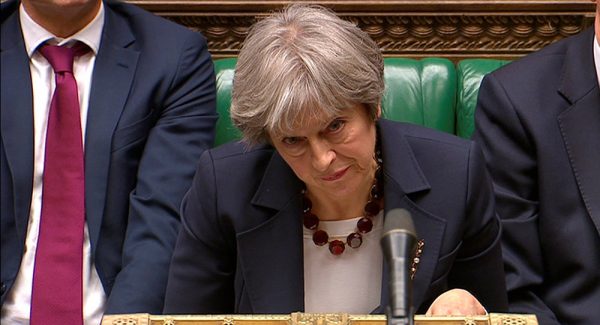
Despite a lack of evidence presented to the public other than the surreptitious “highly likely” assessments of British Prime Minister Theresa May and Foreign Secretary Boris Johnson, President Trump once again has caved in to pressure from Official Washington’s anti-Russian party line and ordered the expulsion of 60 Russian diplomats – which he accused of being spies. Trump also ordered the closure of the Russian Consulate in Seattle, citing speculative fears that Russia might be spying on a nearby Boeing submarine development base. It was the second round of US expulsions of Russian officials, with the first one ordered by the outgoing President Obama in December 2016, kicking out 35 Russian diplomats and their families (including their head chef) and closing the Russian Consulate in San Francisco, with some calling it “a den of spies”.
Trump’s move followed an earlier UK action on March 14th, which expelled 23 Russian diplomats also accused of being spies. This was in retaliation for the alleged poisoning of a retired former Russian-British double agent in Salisbury, England.
This was my initial reaction back on March 14, 2018, during a live TV segment:
The ‘Collective’ Concern
It’s important to understand how this week’s brash move by Washington was coordinated in advance. The US and the UK are relying on their other NATO partners, including Germany, Poland, Italy, Canada, the Czech Republic, the Netherlands, Estonia and Lithuania – to create the image of a united front against perceived ‘Russian aggression’. As with multilateral military operations, multilateral diplomatic measures like this are not carried out on a whim.
Aside from this, there are two seriously worrying aspects of this latest US-led multilateral move against Russia. Firstly, this diplomatic offensive against Russia mirrors a NATO collective defense action, and by doing so, it tacitly signals towards an invocation of Article 5. According to AP, one German spokesperson called it a matter of ‘solidarity’ with the UK. Statements from the White House are no less encouraging:
“The United States takes this action in conjunction with our NATO allies, and partners around the world in response with Russia’s use of a military grade chemical weapon on the soil of the United Kingdom — the latest in its ongoing pattern of destabilizing activities around the world,” the White House said.
“Today’s actions make the United States safer by reducing Russia’s ability to spy on Americans, and to conduct covert operations that threaten America’s national security.”
What this statement indicates is that any Russian foreign official or overseas worker in the West should be regarded as possible agents of espionage. In other words, the Cold War is now officially back on.
Then came this statement: “With these steps, the United States and our allies and partners make clear to Russia that its actions have consequences.”
In an era of power politics, this language is anything but harmless. And while US and UK politicians and media pundits seem to be treating it all as a school yard game at times, we should all be reminded that his is how wars start.

BIRDS OF A FEATHER: Never in modern history has mediocrity in politics been celebrated as a virtue by so many.
The second issue with the Trump’s diplomatic move against Russia is that it extends beyond the territorial US – and into what should be regarded at the neutral zone of the United Nations. As part of the group of 60 expulsions, the US has expelled 12 Russian diplomats from the United Nations in New York City. While this may mean nothing to jumped-up political appointees like Nikki Haley who routinely threaten the UN when a UNGA vote doesn’t go her way, this is an extremely dangerous precedent because it means that the US has now created a diplomatic trap door where legitimate international relations duties are being carelessly rebranded as espionage – done on a whim and based on no actual evidence. By using this tactic, the US is casting aside decades of international resolutions, treaties and laws. Such a move directly threatens to undermine a fundamental principle of the United Nations which is its diplomatic mission and the right for every sovereign nation to have diplomatic representation. Without it, there is no UN forum and countries cannot talk through their differences and negotiate peaceful settlements. This is why the UN was founded in the first place. Someone might want to remind Nikki Haley of that.
On top of this, flippant US and UK officials are already crowing that Russia should be kicked off the UN Security Council. In effect, Washington is trying to cut the legs out from a fellow UN Security Council member and a nuclear power. This UNSC exclusion campaign been gradually building up since 2014, where US officials have been repeatedly blocked by Russia over incidents in Syria and the Ukraine. Hence, Washington and its partners are frustrated with the UN framework, and that’s probably why they are so actively undermining it.
Those boisterous calls, as irrational and ill-informed as they might be, should be taken seriously because as history shows, these signs are a prelude to war.
Also, consider the fact that both the US and Russian have military assets deployed in Syria. How much of the Skripal case and the subsequent fall-out has to do with the fact that US Coalition and Gulf state proxy terrorists have lost their hold over key areas in Syria? The truly dangerous part of this equation is that the illegal military occupation by the US and its NATO ally Turkey of northeastern Syria is in open violation of international law, and so Washington and its media arms would like nothing more than to be history’s actor and bury its past indiscretions under a new layer of US-Russia tension in the Middle East.
Another WMD Debacle?
Is it really possible to push East-West relations over the edge on the basis of anecdotal evidence?
Former British Ambassador to Uzbekistan, Craig Murray, highlighted the recent British High Court judgement which states in writing that the government’s own chemical weapons experts from the Porton Down research facility could not categorically confirm that a Russian ‘Novichok’ nerve agent was actually used in the Salisbury incident. Based on this, Murray believes that both British Prime Minster Theresa May and Foreign Secretary Boris Johnson, and Britain’s deputy UN representative Jonathan Allen – have all lied to the public and the world when making their public statements that the Russians had in fact launched a deadly chemical weapons attack on UK soil. Murray elaborates on this key point:
“This sworn Court evidence direct from Porton Down is utterly incompatible with what Boris Johnson has been saying. The truth is that Porton Down have not even positively identified this as a ‘Novichok’, as opposed to “a closely related agent”. Even if it were a ‘Novichok’ that would not prove manufacture in Russia, and a ‘closely related agent’ could be manufactured by literally scores of state and non-state actors.”
“This constitutes irrefutable evidence that the government have been straight out lying – to Parliament, to the EU, to NATO, to the United Nations, and above all to the people – about their degree of certainty of the origin of the attack. It might well be an attack originating in Russia, but there are indeed other possibilities and investigation is needed. As the government has sought to whip up jingoistic hysteria in advance of forthcoming local elections, the scale of the lie has daily increased.”
Murray has been roundly admonished by the UK establishment for his views, but he is still correct to ask the question: how could UK government leaders have known ‘who did it’ in advance of any criminal forensic investigation or substantive testing by Porton Down or an independent forensic investigation by the Organization for the Prohibition of Chemical Weapons (OPCW)?
One would hope we could all agree that it’s this sort of question which should have been given more prominence in the run-up to the Iraq War. In matters of justice and jurisprudence, that’s a fundamental question and yet, once again – it has been completely bypassed.
Murray is not alone. A number of scientists and journalists have openly questioned the UK’s hyperbolic claims that Russia had ordered a ‘chemical attack’ on British soil. In her recent report for the New Scientist, author Debora MacKenzie reiterates the fact that several countries could have manufactured a ‘Novichok’ class nerve agent and used it in the chemical attack on Russians Sergei and Yulia Skripal in Salisbury.
“British Prime Minister Theresa May says that because it was Russia that developed Novichok agents, it is ‘highly likely’ that Russia either attacked the Skripals itself, or lost control of its Novichok to someone else who did. But other countries legally created Novichok for testing purposes after its existence was revealed in 1992, and a production method has even been published.”
The New Scientist also quotes Ralf Trapp, a chemical weapons consultant formerly with the OPCW, who also reiterates a point worth reminding readers of – that inspectors are only able to tell where molecules sampled in Salisbury have come from if they have reference samples for the ingredients used.
“I doubt they have reference chemicals for forensic analysis related to Russian CW agents,” says Trapp. “But if Russia has nothing to hide they may let inspectors in.”
Even if they can identify it as Novichok, they cannot say that it came from Russia, or was ordered by the Russian government, not least of all because the deadly recipe is available on Amazon for only $28.45.
It should be noted that a substantial amount of evidence points to only two countries who are the most active in producing and testing biological and chemical weapons WMD – the United States and Great Britain. Their programs also include massive ‘live testing’ on both humans and animals with most of this work undertaken at the Porton Down research facility located only minutes away from the scene of this alleged ‘chemical attack’ in Salisbury, England.
Problems with the Official Story
If we put aside for the moment any official UK government theory, which is based on speculation backed-up by a series of hyperbolic statements and proclamations of Russian guilt, there are still many fundamental problems with the official story – maybe too many to list here, but I will address what I believe are a few key items of interest.
The UK police have now released a statement claiming that the alleged ‘Novichok’ nerve agent was somehow administered at the front door of Sergie Skripal’s home in Wiltshire. This latest official claim effectively negates the previous official story because it means that the Skripals would have been exposed a home at the latest around 13:00 GMT on March 4th, and then drove into town, parking their car at Sainsbury’s car park, then having a leisurely walk to have drinks at The Mill Pub, before for ordering and eating lunch at Zizzis restaurant, and then finally leaving the Zizzis and walking before finally retiring on a park bench – where emergency services were apparently called at 16:15 GMT to report an incident. Soon after, local Police arrived on the scene to find the Skripals on the bench in an “extremely serious condition”. Based on this story, the Skripals would have been going about their business for 3 hours before finally falling prey to the deadly WMD ‘Novichok’. From this, one would safely conclude that whatever has poisoned the pair was neither lethal nor could it have been a military grade WMD. Even by subtracting the home doorway exposure leg of this story, it hardly adds up – as even a minor amount of any real lethal military grade WMD would have effected many more people along this timeline of events. Based on what we know so far, it seems much more plausible that the pair would have been poisoned at Zizzis restaurant.
When this story initially broke, we were told that the attending police officer who first arrived on the scene of this incident, Wiltshire Police Detective Sgt. Nick Bailey – was “fighting for his life” after being exposed to the supposed ‘deadly Russian nerve agent’. As it turned out, officer Bailey was treated in hospital and then discharged on March 22, 2018. To our knowledge, no information or photos of Bailey’s time in care are available to the public.
The public were also told initially that approximately 4o people were taken into medical care because of “poison exposure”. This bogus claim was promulgated by mainstream media outlets, like Rupert Murdoch’s Times newspaper. In reality, no one showed signed of “chemical weapons” exposure, meaning that this story was just another example of mainstream corporate media fake news designed to stoke tension and fear in the public. We exposed this at the time on the UK Column News here:
@medialens @Ian56789 Look who’re the ACTUAL producers of #FakeNews on the #Skripal #RussianSpyPoisoning #MSM story… pic.twitter.com/ytKE0EVA6j
— Patrick Henningsen (@21WIRE) March 21, 2018
To further complicate matters, this week we were told that Yulia Skripal has now turned the corner and is in recovery, and is speaking to police from her hospital bed. If this is true, then it further proves that whatever the alleged poison agent was which the Skripals were exposed to – it was not a lethal, military grade nerve agent. If it had been, then most likely the Skripals and many others would not be alive right now.
Unfortunately, in the new age of state secrecy, we can expect that most of the key information relating to this case may be sealed indefinitely under a national security letter. In the case of Porton Down scientist David Kelly, the key information is sealed (hidden) for another 60+ years (which means we might get to see it in the year 2080). This means that we just have to take their word for it, or to borrow the words of the newly crowned UK Defence Secretary Gavin Williamson – any one asking questions, “should just go away and shut up.”
Such is the level of decorum and transparency in this uncomfortably Orwellian atmosphere.
While Britain insists that it has ‘irrefutable proof’ that Russia launched a deadly nerve-gas attack to murder the Skripals, the facts simply do not match-up with the rhetoric.
The Litvinenko Conspiracy Theory
It’s important to note that as far as public perceptions are concerned, the Skripal case has been built directly on top of the Litvinenko case.
In order to try and reinforce the speculation, the media have resurrected the trial-by-media case of another Russian defector, former FSB officer Alexander Litvinenko, who is said to have died after being poisoned with radioactive polonium-210 in his tea at a Mayfair restaurant. Despite not having any actual evidence as to who committed the crime, the British authorities and the mainstream media have upheld an almost religious belief that Vladimir Putin had ordered the alleged poisoning of Litvinenko.
The media mythos was reinforced in 2016, when a British Public Inquiry headed by Sir Robert Owen accused senior Russian officials of ‘probably having motives to approve the murder’ of Litvinenko. Again, this level of guesswork and speculation would never meet the standard of an actual forensic investigation in a real criminal court, but as far as apportioning blame to another nation or head of state – it seems fair enough for British authorities. Following the completion of the inquiry, Sir Robert had this to say:
“Taking full account of all the evidence and analysis available to me, I find that the FSB operation to kill Litvinenko was probably approved by Mr Patrushev and also by President Putin.”
Owen’s inquiry was not definitive. Quite the opposite in fact, and in many ways it mirrors the Skripal case as it has been presented to the public. Despite offering no evidence of any criminal guilt, Owen’s star chamber maintained that President Vladimir Putin “probably” approved the operation to assassinate Litvinenko. Is “probably” really enough to assign guilt in a major international crime? When it comes to high crimes of state, the answer seems to be yes.
According to Russian Foreign Ministry spokesperson Marina Zakharova, that UK inquiry was “neither transparent nor public” and was “conducted mostly behind doors, with classified documents and unnamed witnesses contributing to the result…”
Zakharova highlighted the fact that two key witnesses in the case – Litvinenko’s chief patron, UK-based anti-Putin defector billionaire oligarch Boris Berezovsky, and the owner of Itsu restaurant in London’s Mayfair where the incident is said to have taken place – had both suddenly died under dubious circumstances. The British authorities went on to accuse two Russian men in the Litvineko murder, businessman Andrey Lugovoy and Dmitry Kovtun. Both have denied the accusations. Despite the lack of any real evidence, the United States Treasury’s Office of Foreign Assets Control blacklisted both Lugovoi and Kovtun, as well as Russian persons Stanislav Gordievsky, Gennady Plaksin and Aleksandr I. Bastrykin – under the Magnitsky Act, which freezes their assets held in American financial institutions, and bans them from conducting any transactions or traveling to the United States. This is a familiar pattern: even if the case is inconclusive, or collapses due to a lack of evidence, the policies remain in place.
Despite all the pomp and circumstance however, the official conspiracy theory failed to sway even Litvinenko’s own close family members. While Litvinenko’s widow Marina maintains that it was definitely the Russian government who killed her husband, Alexsander’s younger brother Maksim Litvinenko, based in Rimini, Italy, believes the British report is “ridiculous” to blame the Kremlin for the murder of his brother, stating that he believes British security services had more of a motive to carry out the assassination.
“My father and I are sure that the Russian authorities are not involved. It’s all a set-up to put pressure on the Russian government,” said Litvinenko to the Mirror newspaper, and that such reasoning can explain why the UK waited almost 10 years to launch the inquiry into his brother’s death. Following the police investigation, Alexander’s father Walter Litvinenko, later said that he had regretted blaming Putin and the Russian government for his son’s death and did so under intense pressure at the time.
For anyone who is also reticent to accept the proclamations of the British state and the mainstream media on the Litvinenko case, it’s worth reading the work of British journalist Will Dunkerly here.
With so many questions hanging over the actual validity of the British state’s accusations against Russia, it’s somewhat puzzling that British police would say they are still ‘looking for similarities’ between the Skripal and Litvinenko cases in order to pinpoint a modus operandi.
The admission by the British law enforcement that their investigation may take months before any conclusion can be drawn also begs the question: how could May have been so certain so quick? The answer should be clear by now: she could not have known it was a ‘Novichok’ agent, any more than she could know that ‘Russia did it.’
A Plastic Cold War
Historically speaking, in the absence of any real mandate or moral authority, governments suffering from a chronic identity crisis and will often seek to define themselves not what they stand for, but what (or who) they are in opposition to. This profile suits both the US and UK perfectly at the moment. Both governments are limping along with barely a mandate, and have orchestrated two of the worst and most hypocritical debacles in history in Syria and Yemen. With their moral high-ground long gone, both countries require an existential enemy in order to give their missions legitimacy. The cheapest, easiest option is to reinvigorate a framework which was already there, and that’s the Cold War. Reds under the bed. The Russian are coming. It’s cheap and easy because it’s already been seeded with 70 years of Cold War propaganda and institutionalized racism in the West directed against Russians. If you don’t believe me, just go look at some of the posters, watch the TV propaganda in the US, or look at the horrific McCarthy witch hunts. I grew up being taught, “never again!” and that “welcome to the future: those days of irrational paranoia are behind us now.” That madness was mainstream and actively promoted by government and mainstream media.
You would have to be at the pinnacle of ignorance to deny that this is exactly what we are seeing today, albeit a more plastic version, but just as immoral and dangerous.
Dutifully fanning the flaming of war, Theresa May has issued her approval of the NATO members diplomatic retaliation this week exclaiming, “We welcome today’s actions by our allies, which clearly demonstrate that we all stand shoulder to shoulder in sending the strongest signal to Russia that it cannot continue to flout international law.”
But from an international law perspective, can May’s ‘highly likely’ assurances really be enough to position the west on war footing with Russia? When Labour leader Jeremy Corbyn asked these same fundamental questions on March 14th, he was shouted down by the Tory bench, and also by the hawkish Blairites sitting behind him.

Afterwards, the British mainstream press launched yet another defamation campaign against Corbyn with the UK’s Daily Mail calling the opposition leader a “Kremlin Stooge”, followed by British state broadcaster the BBC who went through the effort of creating a mock-up graphic of Corbyn in front of the Kremlin (pictured above) apparently wearing a Russian hat, as if to say he was a Russian agent. It was a new low point in UK politics and media.
When considering the mainstream media’s Corbyn smear alongside the recent insults hurled at Julian Assange by Tory MP Sir Alan Duncan who stood up in front of Parliament and called the Wikileaks founder a “miserable worm”, what this really says is that anyone who dares defy the official state narrative will be beaten down and publicly humiliated. In other words, dissent in the political ranks will not be tolerated. It’s almost as if we are approaching a one party state.
Would a UN Security Council member and nuclear power really be so brazen as to declare on another country guilty without presenting any actual evidence or completing a genuine forensic investigation?
So why the apparent rush to war? Haven’t we been here before, in 2003? Will the people of the West allow it to happen again?
As with Tony Blair’s WMD’s in 2003, the British public are meant to take it on faith and never question the official government line. And just like in 2003, the UK has opened the first door on the garden path, with the US and its ‘coalition’ following safely behind, shoulder to shoulder. In this latest version of the story, Tony Blair is being played by Theresa May, and Boris Johnson is playing Jack Straw. On the other side of the pond, a hapless Trump is the hapless Bush. Both Blair and Straw, along with the court propagandist Alastair Campbell – are all proven to have been liars of the highest order, and if there were any real accountability or justice, these men and their collaborators in government should be in prison right now. The fact they aren’t is why the door has been left wide open for the exact same scam to be repeated again, and again.
Iraq should have taught us all to be skeptical about official claims of chemical weapons evidence, and to face the ugly truth about how majors wars are waged by deception – by our own governments. What does it tell us about today’s society if people still cannot see this?
That’s why it was wrong to let Blair, Bush and others off the hook for war crimes. By doing so, both the British and Americans are inviting a dark phase of history to repeat itself again, and again.
It’s high time that we break the cycle.
***
Author Patrick Henningsen is a global affairs analyst and founder of independent news and analysis site 21st Century Wire, and host of the SUNDAY WIRE weekly radio show broadcast globally over the Alternate Current Radio Network (ACR).
The UN disregard for Palestinians’ right of return colludes with Israeli violence
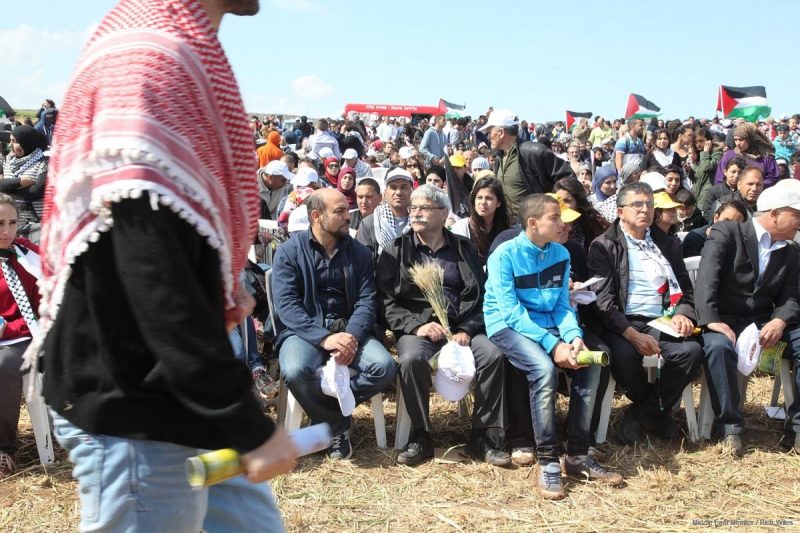
Thousands of internally displaced Palestinians take part in the March of Return [File photo]
By Ramona Wadi | MEMO | March 29, 2018
The Palestinian “Great March of Return” has exposed the frailty of Israel’s fabricated narratives, yet once again the international community prefers to speak about “sides” in the conflict. As the planned march draws nearer, the Jerusalem Post reported that UN Special Coordinator for the Middle East Peace Process, Nickolay Mladenov, has urged “all sides to exercise restraint and to take the necessary steps to avoid a violent escalation.”
Palestinians have already insisted repeatedly that the march is a form of non-violent protest stemming from a legitimate right to go back to the land from which the nascent Israeli state drove them out at gunpoint. Nevertheless, the Times of Israel reported yesterday that more than 100 snipers have been deployed along the border with the Gaza Strip “to deal with a Palestinian march expected to begin on Friday…” Officers will “authorise them to open fire if… Israeli lives are in danger.” Israel Defence Forces (IDF) Chief of Staff Gadi Eizenkot clarified this further: “The orders are to use a lot of force.”
Israeli media outlets have supported the state’s premeditated violence by framing the Palestinian protest as a violent act even before it has taken place, and thus justified in advance what they deem to be a necessarily violent response. However, they are not alone in promoting narratives of denial with regard to Israel’s colonial violence. The UN’s absence of any assertiveness when it comes to holding Israel accountable for its crimes is becoming a core component of the colonial entity’s ability to act with total impunity. Nowhere is this more evident than in its patronising attitude towards the Palestinian right of return.
Israel National News published an op-ed earlier this week which described the planned protest as the “latest innovation” with the immediate objective of Palestinians participating in the march “to get killed themselves”, simply in order to “delegitimise Israel”. The op-ed provides the most dissociated overviews of the Nakba, which the author describes as “the date in 1948 on which Ben Gurion declared the state of Israel and five Arab states invaded it.” Needless to say, the article also seeks to disavow the displacement, dispossession and ethnic cleansing which transformed Palestinians into perpetual refugees.
Israel’s widespread denial of the Palestinian right of return necessitates this manipulation of the indigenous population’s history. It also allows Eizenkot to justify targeting Palestinians with sniper fire for “marching into our territory.” Yet the international community’s refusal to support the perfectly legitimate right of return speaks volumes about the UN’s collusion with Israel. It is also proof that the UN never intended that the right should ever be implemented, even though it was made a condition of Israel’s membership of the international organisation. The only possibility lies in the hands of the Palestinian people, who have the power to move away, at least intellectually, from the impositions disguised as UN resolutions.
The Palestinian Great March of Return should thus prompt some thinking. Despite seeking to abide by UN resolutions, Palestinians have found themselves tethered to cycles of dispossession, which shows that the international agenda is deeply flawed and corrupted. The international response to this non-violent protest has not singled out Israeli plans to murder Palestinians at the border of their own land for condemnation; rather, the UN has chosen a discourse which insists on equivalence between the protagonists when it is clear to all and sundry that there is none. A colonial power with one of the best-equipped armed forces in the world — including nuclear weapons — is imposing its will on a colonised population which seeks to return to its own land and reverse the permanent refugee status which has become synonymous with the Palestinians.
Since Israel and the UN have already chosen their violent narratives, we are justified in asking why the latter’s intent is to maintain the political coercion that created the Palestinian refugee problem in the first place and face its own accountability for the transformation of the legitimate right to return into a dangerous game with limited options. The Palestinians, meanwhile, can either submit and stay permanently displaced, or stand up for their rights and be killed by acts of premeditated violence by Israel, with which the UN is colluding.
Featured Video
Seyed M. Marandi: U.S. Military DIVIDED? Iran’s Secret Defense EXPOSED
or go to
Aletho News Archives – Video-Images
From the Archives
‘Israel sees Iran as obstacle to its policies’
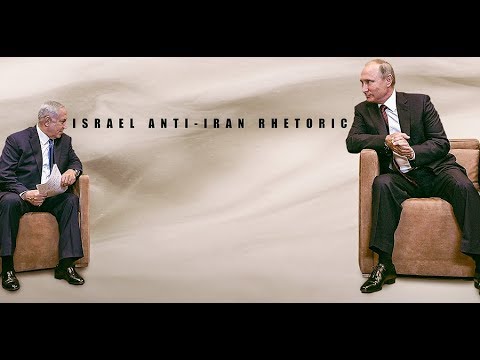
Press TV – August 25, 2017
Prime Minister Benjamin Netanyahu has said that Israel felt threatened by Iran’s growing influence in the Middle East. Netanyahu expressed his Iranophobic view in a meeting with Russian President Vladimir Putin in Russia’s Black Sea resort of Sochi on Wednesday. Press TV has asked Scott Rickard, former American intelligence linguist from Tampa, Florida, and Brent Budowsky, a columnist at The Hill from Washington, to give their thoughts on the issue.
Rickard said Tel Aviv is concerned about the fact that the regime could not carry out its old project to spread sectarian divisions and pave the way for dismemberment of the countries in the Middle East region because of the Iranian-led resistance against Israeli policies, not only in the occupied territories of Palestine but also in the whole region.
“Iran is not a threat to Israel whatsoever. The threat that Israel sees is the fact that their Oded Yinon Plan is being put to a hold by Iran,” the intelligence linguist said on Thursday night.
“They (the Israelis) look at Iran as a threat only because they have no influence on their governments and Iran is autonomous and is not under the Zionist influence,” he added.
Since the victory of the Islamic Republic of Iran in 1979, Tehran has been critical of Israel’s policies in the region, whereas “no leaders [of other states] even dared to speak out against Zionism,” Rickard argued. … continue
Blog Roll
 Aletho News
- Trump Claims Ceasefire, Reopening of Strait of Hormuz Agreement with Iran
- Israeli tank fire killed UN peacekeeper in Lebanon, UNIFIL investigation finds
- Russia, China block Bahrain-sponsored UN resolution on Strait of Hormuz
- The US-Israeli War on Science is an Assault on our Future
- Trump’s Promise to Bomb Iran ‘Like Never Before’ Faces Brutal Logistics — Expert
- Germany seeks to restrict stays abroad for men of fighting age – Berliner Zeitung
- Evidence points to Ukraine being behind TurkStream attempted sabotage, but that should come as no surprise
- Sri Lanka secures supplies of Russia oil – minister
- Nations across Asia strike direct deals with Iran for Hormuz passage
- IRGC commander declares ‘new phase’ of reprisal attacks against aggressors
- If Americans Knew
- Thousands dead and neighborhoods razed to the ground: Aid agencies fear southern Lebanon is becoming the new Gaza
- The war the US is fighting for Israel could cost trillions
- ‘Cigarette Burns, Nail Wounds’: Toddler Tortured in Gaza to Coerce Father
- Trump Says US Sent ‘a Lot of Guns’ to Protesters in Iran
- Israeli forces destroy 17 UN peacekeeper cameras in south Lebanon
- US-Israeli strikes ‘completely destroy’ synagogue in Tehran
- Archbishop for US Military Says Iran War Is Unjust Under Catholic Teaching
- Iranian leaders’ Open Letters to the American People
- Trump says Iranians appreciate bombs, WHO warns of nuclear risks – Daily Update
- U.N. experts demand Israel release prominent Gaza doctor after reports of ‘severe torture’
- No Tricks Zone
- An Inconvenient Tree: Uncovered In Alps… Europe Much Warmer Than Today 6000 Years Ago
- New Study Reports A 60% Slowdown In Greenland’s Ice Loss Rate In The Last Decade
- Low Intensity Tornado Wrecks Major Solar Farm, Creating A Potential Toxic Dump
- New Study Finds Warming Saves Lives…Cold Temperatures 12 Times More Deadly Than Excess Heat
- German Science Blog Accuses PIK Climate Institute Of Hallucinating Climate Tipping Points
- Devastating Assessment Of Comirnaty Vaccine By Former Senior Pfizer Europe Toxicologist
- New Study: CO2 Is ‘Effectively Negligible’ As An Explanatory Climate Change Factor Since 2000
- Former Pfizer Toxicologist Dr. Helmut Sterz Tells Bundestag Hearing Pfizer Vaccine Should Have Never Been Approved
- Energy Expert: Germany’s Nuclear Phaseout Was A “500 Billion Euro Mistake”
- New Research: South Australia’s Mid-Holocene Sea Surface Temperatures Were 4°C Warmer Than Today
 Aletho News