US warns of ‘consequences’ as Palestine joins international bodies
Press TV – November 18, 2018
The United States has threatened “consequences” as Palestinians step up efforts for statehood demanding accession to almost a dozen international bodies and conventions.
The threat came after Palestinian President Mahmoud Abbas signed the documents on Thursday to join the Universal Postal Union, a UN agency that coordinates international postage, and 10 international protocols and conventions.
The move infuriated the US, Israel’s staunch ally, with a State Department official claiming that the Palestinian efforts to join international institutions were “premature” and “counterproductive.”
“We are currently reviewing possible consequences of the Palestinians’ recent actions,” the official said in a statement published by the Times of Israel on Sunday.
In November 2012, the UN General Assembly upgraded Palestine’s status from “non-member observer entity” to “non-member observer state” despite strong opposition from Israel.
Since then, the Palestinians have joined dozens of international organizations and agreements, among them the International Criminal Court, as part of a campaign to garner support for the recognition of their homeland as a sovereign state.
Washington has asked the Palestinians not to join international agencies, citing laws dating to the early 1990s that require the US government to cut off funding to any UN organization that grants the Palestinians full membership.
Abbas, however, said a Palestinian agreement with the US not to join international bodies was conditioned on the US not ending aid payments, not moving its embassy to Jerusalem al-Quds and not changing the status of the Palestine Liberation Organization mission in Washington.
The US withdrew some funding for UNESCO after the Palestinians joined the cultural and education organization back in 2011. It also pulled out of the agency altogether in 2017.
Most recently, Washington cut funds to the UN Palestinian refugee agency UNRWA.
The US-Palestine ties deteriorated last December when President Donald Trump recognized Jerusalem al-Quds as the “capital” of Israel.
The American embassy was also relocated from Tel Aviv to the ancient city in May, sparking angry reactions from Palestinians and severe criticism from the international community.
At that time, Abbas formally declared that Palestinians would no longer accept the US as a mediator to resolve the conflict because Washington was “completely biased” towards Tel Aviv.
In first, US endorses Israeli occupation of Golan, votes against 9 anti-Israel resolutions

Press TV – November 16, 2018
The US has, for the first time, endorsed the Israeli occupation of the Golan Heights by voting against an annual UN resolution that condemned the occupation and was unanimously approved along with several other resolutions against Tel Aviv.
The resolution titled “The occupied Syrian Golan,” adopted on Friday with 151 votes in favor, two against (Israel and the US), and 14 abstentions, condemns Israel for “repressive measures” against Syrian citizens in the Golan Heights.
The resolution, which was adopted during the 73rd session of the UN General Assembly’s Special Political and Decolonization Committee (Fourth Committee), expresses deep concern that the Syrian Golan, occupied since 1967, has been under continued Israeli military occupation.
The non-binding annual resolution takes issue with the “illegality of the decision” taken by Israel “to impose its laws, jurisdiction and administration on the occupied Syrian Golan,” which is illegal under international law.
The US’ vote against the annual resolution signaled a dramatic shift in Washington’s policy toward the territory, as it used to abstain in previous cases. The administration of Donald Trump had announced its changed policy ahead of the vote.
“If this resolution ever made sense, it surely does not today. The resolution is plainly biased against Israel,” outgoing US Ambassador to the UN Nikki Haley said in a statement.
During the debate, Syrian envoy Bashar al-Jafari vowed that Damascus would recapture the heights by peace or by war.
Israel seized the Golan Heights from Syria during the 1967 Six-Day War and has continued to occupy two-thirds of the strategically-important territory ever since, in a move that has never been recognized by the international community.
The Tel Aviv regime has built dozens of illegal settlements in the area since its occupation and has used the region to carry out a number of military operations against the Syrian government
Tel Aviv has also been pressing the US administration under Israel-friendly President Trump to recognize its claim to sovereignty over the occupied territory in defiance of international law.
Syria has repeatedly reaffirmed its sovereignty over the Golan Heights, saying the territory must be completely restored to its control.
Eight other resolutions against Israel
The resolution on the occupied Syrian Golan was one of the nine separate resolutions which condemned the Israeli regime.
Through these resolutions, the UN reinforced the mandate of its Relief and Works Agency (UNRWA), and renewed the mandate of its “special committee to investigate Israeli practices affecting the human rights of the Palestinian people and other Arabs of the Occupied Territories.”
Other resolutions included “Palestine refugees’ properties and their revenues”, “Persons displaced as a result of the June 1967 and subsequent hostilities”, “Applicability of the Geneva Convention… to the Occupied Palestinian Territory…”, and “Operations of the United Nations Relief and Works Agency for Palestine Refugees in the Near East”.
The member states also unanimously voted for a resolution titled “Assistance to Palestine refugees”.
Apart from the US, which voted against all the nine resolutions, only a few member states – including Canada and Australia – cast nay votes. The majority of member states voted for the resolutions.
View the resolutions and voting results here: https://t.co/WlLL5EBZ4q
— UN Watch (@UNWatch) November 16, 2018
Lavrov Calls US Sanctions on Iran ‘Illegitimate’, Slams Pressure on SWIFT
Sputnik – 06.11.2018
Washington implemented tough unilateral sanctions against the Islamic Republic on Monday following President Trump’s withdrawal from the Iran nuclear deal in May.
Russian Foreign Minister Sergei Lavrov has condemned Washington’s decision to slap Tehran with sanctions, calling the restrictions “absolutely illegitimate” and deeply disappointing, and saying that it was “unacceptable” to hold dialogue in the language of ultimatums.
“As far as the US measures against Iran are concerned, they are absolutely illegitimate,” Lavrov said on Tuesday in Madrid following a meeting with Spanish officials.
“They are being implemented in flagrant violation of the decisions of the UN Security Council, and the way in which these measures are announced and implemented cannot but cause a deep sense of disappointment. We proceed from the idea that the norms of not only international law, but of international dialogue, have not been repealed,” Lavrov stressed.
“Pursuing a policy based on ultimatums and one-sided demands is hardly permissible in our times,” according to the Russian foreign minister.
Pressure on SWIFT Also Unacceptable
Commenting on suspected US pressure on international financial messaging system SWIFT, which implied Monday that it would comply with US sanctions against Iranian financial institutions, Lavrov said that such pressure was also illegitimate.
“Within the framework of the participants of the Joint Comprehensive Plan of Action (JCPOA) agreement, mechanisms are being developed which will allow for the continued implementation of the provisions of this document, first of all as regards [nations’] economic ties to Iran without US participation, and this is not a simple matter,” the foreign minister explained. “You can see how, using unacceptable methods, pressure has been placed on the operators of the SWIFT system. But experts are actively engaged in these issues, and they have a sufficiently stable understanding that this is possible and that such measures will be found.”
On Monday, Washington followed through with plans to renew sanctions against Iran following President Trump’s exit from the JCPOA Iran nuclear deal. The tough sanctions target Iran’s energy, banking and sea-based transport sectors, and threaten so-called secondary sanctions against foreign companies and countries doing business with the Islamic Republic.
The Belgium-based SWIFT financial messaging service announced that it would be suspending some Iranian banks’ access to the system, making no mention of US sanctions. Calling the move “regrettable,” SWIFT’s statement said it had taken the step “in the interest of the stability and integrity of the wider global financial system.”
All of the JCPOA’s other signatories, including Iran, Russia, China and several European powers, have made an effort to save the landmark nuclear deal and bypass the US sanctions or otherwise limit their impact. This has included the development of a Special Purpose Vehicle (SPV) on trade. China and India, the largest importers of Iranian crude oil, have resisted US secondary sanctions threats, and were granted exemptions along with five other oil-importing countries plus Taiwan.
Israel Rattled By UNESCO’s Palestinian Protection Pledges
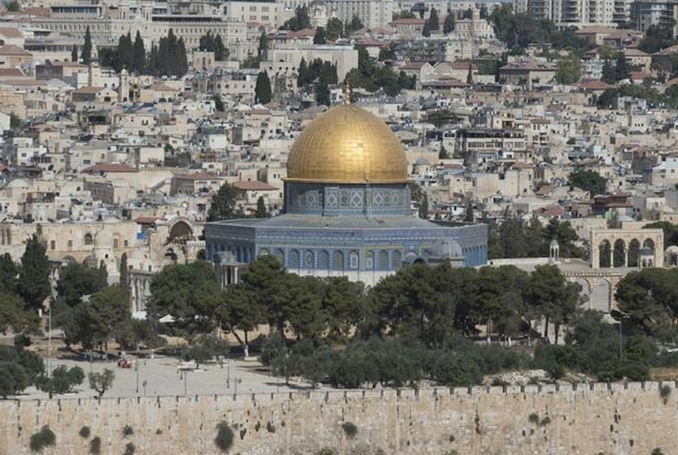
Al-Aqsa compound in East Jerusalem. (Photo: via Twitter)
Palestine Chronicle | October 12, 2018
The executive council of the United Nations Educational, Scientific and Cultural Organisation (UNESCO) has left Israel disquieted, after vowing to effect protections for Palestinian heritage.
A statement, issued by Israel’s United Nations ambassador Danny Danon, said:
“This is an additional proof for those who did not understand why the United States and Israel withdrew from UNESCO. This proves once again that UNESCO is a body based on lies, biases and deliberate action against us. Israel will not be a member of an organization that is trying to rewrite history and accept to be exploited by our enemies.”
The protections cover educational and cultural institutions, the need to protect and preserve the monuments, culture and education in the occupied Palestinian territory, including East Jerusalem, and to show Israeli violations against Palestinian heritage, cultural and natural sites, particularly the Old City of Jerusalem, Al-Aqsa Compound, the Church of the Nativity, the mosque of Bilal ibn Rabah in Bethlehem, the Old City and the Ibrahimi Mosque in Hebron (Al-Khalil) and the Gaza Strip.
Israel sternly rejected the mandate which the council unanimously espoused Wednesday during a Palestine resolutions session at the body’s 205th plenary meeting in Paris.
The disputed resolutions detail, according to Al Ray Palestinian Media Agency, that,
“The Old City of Jerusalem and its Walls, a site inscribed on the UNESCO World Heritage List and on the List of World Heritage in Danger, is the sacred city of the three monotheistic religions – Judaism, Christianity and Islam,” reaffirming that “all legislative and administrative measures and actions taken by Israel, the occupying Power, which have altered or purport to alter the character and status of the Holy City of Jerusalem, and in particular the ‘basic law’ on Jerusalem, are null and void and must be rescinded forthwith.”
The Program and External Relations Commission (PX) of the UNESCO executive also adopted a second resolution to include crimes committed by Israel, such as the destruction of schools and other crimes committed in Khan Al-Ahmar.
The UNESCO declaration stated:
“The two Palestinian sites of Al-Haram Al-Ibrahimi/Tomb of the Patriarchs in al-Khalil/Hebron and the Bilal Ibn Rabah Mosque/Rachel’s Tomb in Bethlehem” are “an integral part of the Occupied Palestinian Territory, and shares the conviction affirmed by the international community that the two sites are of religious significance for Judaism, Christianity, and Islam.”
It also added:
“The ongoing Israeli excavations, works, construction of private roads for settlers and of a Wall inside the Old City of Al-Khalil/Hebron which are illegal under international law and harmfully affect the authenticity and integrity of the site, and the subsequent denial of freedom of movement and freedom of access to places of worship.”
Both resolutions are supported by Egypt, Jordan, Lebanon, Morocco, Oman, Qatar, and Sudan.
“Tthe spirit of dialogue and the sense of responsibility that led to this result. A trend towards consensus is now emerging,” UNESCO Director-General Audrey Azoulay added.
Netanyahu wants to redraw map in the Golan, Russia says – go to the UNSC
RT | October 10, 2018
Recognizing the illegally-annexed Golan Heights as part of Israel would be a violation of UN Security Council resolutions, Russia’s foreign minister has said, in an apparent rebuke to an appeal made by Israel’s prime minister.
Changing the status of the Golan Heights would be a “direct violation” of United Nations Security Council resolutions which dictate the international community’s stance on the disputed territory, Russian Foreign Minister Sergei Lavrov noted.
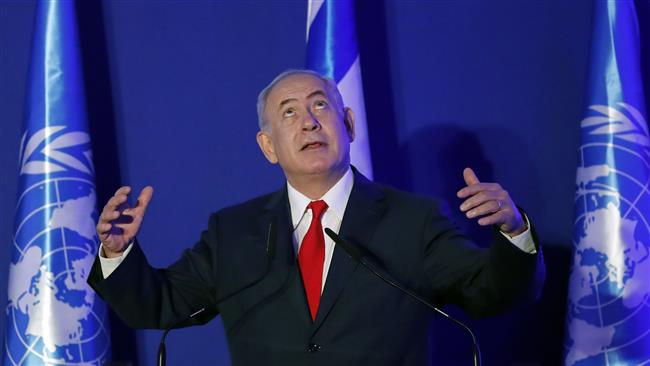
On Monday, Benjamin Netanyahu called on the international community to recognize Israel’s annexation of the Golan, Syrian territory seized by Israel fifty-one years ago.
“Israel on the Golan Heights is a fact that the international community must recognize and as long as it depends on me, the Golan Heights will always remain under Israeli sovereignty,” Netanyahu said during an inauguration of a synagogue in the Golan Heights.
In August, Netanyahu expressed hope that Washington would recognize Israel’s claim to the territory, but US National Security Advisor John Bolton insisted that “there’s no discussion of it, no decision within the US government.”
Israel seized part of the Golan Heights during the Six Day War of 1967. In 1981, Israel’s parliament, the Knesset, unilaterally proclaimed the occupied land to be part of the Jewish state. The declaration was swiftly declared illegal by the UN Security Council.
The politicisation of the Palestinian right of return is imperative

By Ramona Wadi | MEMO | October 4, 2018
In its annual report to UN Secretary General Antonio Guterres, the Committee on the Exercise of the Inalienable Rights of the Palestinian People recommended that Israel acknowledges the Palestinian Nakba. The backdrop for such an acknowledgement remains the two-state compromise, which defeats the purpose of the recommendation.
Such recognition, according to the report, is “a necessary requirement for a viable and lasting peace.” The Committee also recommended that “Palestine refugees should be treated as dispossessed nationals of a country – Palestine – rather than stateless refugees.” It refuted the framing of colonisation as “conflict”, stating, “It is not a conflict between two parties over disputed territory. It is one of one State occupying, colonising and annexing the territory of another state.”
The terminology is a far cry from the usual platitudes used by UN institutions. However, there is still the possibility of manipulating Palestinian rights due to the Committee’s adherence to the two-state paradigm. Taking a stance against the Israeli and US efforts to alter, to the point of non-recognition, the Palestinian refugees and their legitimate right of return is not enough if the Committee does not articulate an alternative that is derived completely from Palestinian narratives.
The two-state scenario has been exposed as a scam to facilitate Israel’s colonisation of Palestinian territory and create a perpetually displaced population, to the point that the Palestinian right of return needs to be read and interpreted in relation to the ongoing displacement. In Palestinian memory, the Nakba is not restricted to 1948, because Israel’s ethnic cleansing of Palestine has never stopped. As the international community fails to challenge Israel’s colonialism and demographic obsession, it is consenting to Israel’s displacement of Palestinians from their territory. Far from promoting the importance of recognising the Nakba, the international community is endorsing it by allowing Israel to exist on its own terms, while Palestinians are constantly forced to modify their existence to accommodate a colonial power on their territory.
Nakba denial by Israel is steeped in its fabricated narratives, imposed upon the international community and disseminated in such a way that Palestinian narratives, despite their legitimate roots, are forced to fight for space in order to gain international recognition, let alone endorsement. The international community’s obsession with dissociated commemoration runs contrary to its purported human rights obligations. It is also an insult to Palestinians’ memory that their history is condensed into remembrance on specific days while Israel has been allowed every day of the year since 1948 to advance its colonisation of Palestinian territory, to say nothing of the earlier settler-colonialism that facilitated the establishment of the state.
International recognition of the Palestinian Nakba as an ongoing trauma in Palestine’s collective memory would isolate Israel’s attempts to force it into oblivion. Yet, this step cannot be implemented within the two-state framework as the latter still endorses Israel’s colonial existence as legitimate, while presenting a hypothetical Palestinian state as dependent, even malfunctioning, in terms of self-determination and its exclusion of Palestinian liberation.
The politicisation of the Palestinian right of return is thus imperative. As things stand, the international community continues to feed the illusion that the two-state compromise constitutes the only political solution, while the right of return is misrepresented as compensation in its entirety. This is why Palestinians must determine their own right of return even if it challenges the international community’s impositions.
Fun at the United Nations and in Congress: Israel Wins the Comedy Competition
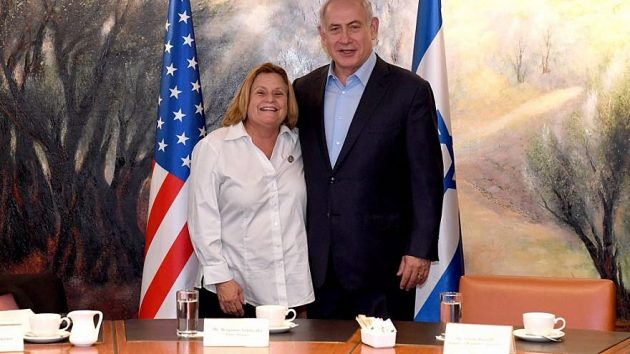
Rep. Ileana Ros-Lehtinen (R-Fla.) with Israeli Prime Minister Benjamin Netanyahu. Image Credit: GPO
By Philip Giraldi | American Herald Tribune | October 8, 2018
Most people are unaware of the fact that the annual opening of the United Nations General Assembly, which takes place in September, is actually a major audition opportunity for aspiring stand-up comedians. This year, American President Donald Trump was one of the pre-event favorites according to the Las Vegas betting line based on his hilarious tweets back in January explaining that he is “like, really smart,” before observing that he “would qualify as not smart, but genius…. and a very stable genius at that!”
To be sure, when he addressed the assembly on September 25th and rambled on about how “In less than two years, my administration has accomplished more than almost any administration in the history of our country,” the audience was ready to share in the fun and laughed out loud at the absurdity of the notion. They were still giggling on the following day when U.S. Ambassador to the United Nations Nikki Haley quipped with a straight face that the audience was actually laughing with Trump out of respect for him and what he was saying.

Trump’s tour de force seemed unbeatable but the wily Israeli Prime Minister Benjamin Netanyahu had an ace up his sleeve. Bibi’s performance back in 2012 when he produced the by now infamous cartoon of an alleged Iranian nuclear bomb about to go off was still recalled by many in the audience as the ultimate stand-up joke U.N. style, a legendary performance. But the same creative thinking that produced the bomb with its lit fuse had come up with a different kind of delayed action joke that Bibi knew would confuse his audience before being revealed for what it was, trumping Trump’s attempt at humor, so to speak. Netanyahu produced a series of large photos taken near Tehran by Israeli intelligence showing a wall and a gate. He said it was an Iranian “secret atomic warehouse for storing massive amounts of equipment and material for Iran’s secret nuclear weapons program.”

The audience gasped, clearly impressed by Bibi’s unexpected rollout of a hitherto unknown top secret installation, but the joke came the next day when it was revealed that the complex inside the wall actually contained a number of businesses, including a scrap metal dealership and a carpet cleaning service. Bibi likely reacted with his Gary Cooper grin, “Hey, the joke’s on you guys who are always whining about Israel’s nuclear stockpile.” A U.S. intelligence official was also apparently in on the jape, commenting a day later that “What Netanyahu said last night was slightly misleading. We knew about the facility in Tehran and it’s a place full of file cabinets and documents, not aluminum pipes or centrifuges.”
So it was a weekend of fun for the Israeli delegation, including convivial friendly banter with the representatives of all Israel’s four or five friends in the General Assembly, but you can only generate so much excitement when talking to a dry stick like Nikki Haley or the ambassador from Micronesia. Fortunately, good news had come through late in the week, concerning how seven more demonstrating Gazans had been shot dead by Israeli snipers, and there was also an exciting new development in that the Israeli navy had now gotten into the game, shooting Gazans demonstrating on the beaches along their own seafront since Israel regards anyone who seeks to access the water as being a terrorist, transgressing against Israel’s modern-day Mare Nostrum. Ninety-three more Palestinians were injured, 37 of whom were wounded by gunfire.
There was also a lot of funny stuff going on in Washington, perhaps driven by a desire to outdo the frolicking taking place at the U.N. building in New York City. Congressmen got together and said, “Hey, let’s see what we can give to Israel without anyone in the media coming out with so much as a peep.” One Congressman, possibly Chuck Schumer or Ben Cardin or even Lindsay Graham, must have come up with the idea for a new law that would compel the White House to give to Israel a minimum of $3.8 billion dollars a year for the next ten years no matter what Israel does or says. Shoot Arabs, kick them out of their homes, or just simply treat them like shit, it will all be the same to Uncle Sam. If they want to bomb Peoria, be my guest. Written into the bill is the provision that the president cannot in any way reduce or delay the payment going from the U.S. Treasury to the Israeli Central Bank.
And $3.8 billion is only a minimum. Section 103 of the House bill removes all limitations on how much money Israel gets. Under the new act, instead of $38 billion being the cap, as stipulated in the 2016 memorandum of understanding, it will be a minimum payment until 2028. Constant lobbying by Israel and its friends in the Congress will inevitably mean that the amount might double or triple during that time period. This is a huge gift to Netanyahu, who is undoubtedly laughing all the way to the bank, as the expression goes.
Section 106 of the bill is another freebee, increasing Israel’s access to a U.S. provided war-reserve stockpile that is maintained in Israel by completely removing the limits on how many weapons can be “transferred,” without any payment or charge. The existing limit of $200 million worth of arms per annum charged against the aid package has now been eliminated, allowing the Israelis to take whatever they want.
And there’s more. Section 108 of the Act permits Israel to export arms it receives from the United States, even though that violates U.S. law. And it will also be allowed to use the American aid to buy weapons from its own defense industries, eliminating any benefit for U.S. domestic arms manufacturers.
In short, the comedy routine by the U.S. Congress vis-à-vis Israel has consisted of rolling over and playing dead while handing over the reins of American foreign policy to a foreign power. Netanyahu has scored a hat trick, defying U.S. interests while increasing both aid and concessions. The House bill that spells it all out in detail will now go back for Senate approval, and then to Trump to be signed into law.
The only ones not laughing at the comedy routines both at the U.N. and in Washington are the American taxpayers and those of us who want U.S. foreign policy to respect American values and interests. And by the way, the House has named the bill after Miami Congresswoman Ileana Ros-Lehtinen, a well-known Israel firster whose groveling before Netanyahu and Jewish groups has been notable even by the low standards of the House of Representatives. The bill is now officially the “Ileana Ros-Lehtinen United States-Israel Security Assistance Authorization Act of 2018.”
IPCC to release “October surprise” on climate change

Watts Up With That? | September 24, 2018
With all the crazy talk about “Russian meddling” in the 2016 Presidential election, one wonders if the same sort of crazy talk might be applied to the release of a special climate report just weeks before the U.S. mid-term elections. Given the timing, you can be sure that whatever is in the report will be front page news and used by the left as a political tool. Here is a press release from the IPCC, h/t to Dr. Willie Soon
Save the Date: IPCC Special Report Global Warming of 1.5ºC
The Intergovernmental Panel on Climate Change (IPCC) will meet in Incheon, Republic of Korea, on 1-5 October 2018, to consider the Special Report Global Warming of 1.5ºC. Subject to approval, the Summary for Policymakers will be released on Monday 8 October with a live-streamed press conference.
The press conference, addressed by the IPCC Chair and Co-Chairs from the three IPCC Working Groups, will be open to registered media, and take place at 10:00 local time (KST), 03:00 CEST, 02:00 BST, 01:00 GMT and 21:00 (Sunday 7 October) EDT.
Registered media will also be able to access the Summary for Policymakers and press release under embargo, once they are available. They will also be able to attend the opening session of the meeting at 10:00-11:00 on Monday 1 October. All other sessions of the IPCC meeting are closed to the public and to media.
The opening session of the meeting will include statements by the Chair of the IPCC, senior officials the IPCC’s two parent bodies World Meteorological Organization (WMO) and United Nations Environment Programme (UN Environment) and of the United Nations Framework Convention on Climate Change (UNFCCC), and senior officials of the Republic of Korea.
The IPCC meetings and the press conference will take place at Songdo Convensia in Incheon.
Arrangements for media registration, submitting questions remotely, booking interviews, and broadcast facilities will be communicated in the coming weeks.
The report, whose full name is Global Warming of 1.5°C, an IPCC special report on the impacts of global warming of 1.5°C above pre-industrial levels and related global greenhouse gas emission pathways, in the context of strengthening the global response to the threat of climate change, sustainable development, and efforts to eradicate poverty, is being prepared under the scientific leadership of all three IPCC Working Groups.
Formally, the meeting will start with the 48th Session of the IPCC. Next a joint session of the three Working Groups chaired by their Co-Chairs will consider the Summary for Policymakers line by line for approval. Then the 48th Session of the IPCC will resume to accept the Summary for Policymakers and overall report.
The IPCC decided to prepare the report, in response to an invitation from the UNFCCC Conference of the Parties at its 21st meeting in December 2015 when the Paris Agreement was signed.
Iran urges UN to censure Israel’s nuclear threat, make it respect international rules
Press TV – September 20, 2018
Tehran has written to the United Nations, calling on the world body to condemn Israel for threatening Iran with a nuclear attack and bring the regime’s atomic weapons program under its supervision.
Standing right beside the Dimona nuclear facility late last month, Israeli Prime Minister Benjamin Netanyahu described Iran as a “threat” to the region and said Tel Aviv has the means to destroy its “enemies” in a veiled reference to Tel Aviv’s nuclear arsenal.
“Those who threaten to wipe us out put themselves in a similar danger, and in any event will not achieve their goal,” he said. “But our enemies know very well what Israel is capable of doing. They are familiar with our policy. Whoever tries to hurt us – we hurt them.”
In a letter addressed to the UN on Thursday, the Permanent Mission of the Islamic Republic of Iran to the world body said Netanyahu’s belligerent remarks poses “a serious threat to international peace and security.”
It also urged the UN to make Israel abide by international rules and the UN Charter.
The letter also highlighted Israel’s long history of aggression, occupation, militarism and state terrorism among other international crimes, urging the world community to take a firm position on the Zionist regime’s “unbridled actions and nuclear threat.”
In the letter, Iran further demanded that the UN condemn Israel’s anti-Iran threat, make the regime join the Nuclear Non-Proliferation Treaty (NPT) and bring its nuclear program under the supervesion of the International Atomic Energy Agency (IAEA).
It also reminded the UN that Iran is itself a victim of weapons of mass destruction, particularly chemical weapons.
The UN member states should not turn a blind eye to Israel’s threat and make efforts towards to the elimination of its entire nuclear stockpile, the letter read.
Responding to Netanyahu’s highly aggressive comments, Foreign Minister Mohammad Javad Zarif slammed the premier as “warmonger” and said the threat was “ beyond shameless.”
“Iran, a country without nuclear weapons, is threatened with atomic annihilation by a warmonger standing next to an actual nuclear weapons factory. Beyond shameless in the gall,” Zarif tweeted.
Israel is the only possessor of nuclear weapons in the Middle East, but its policy is to neither confirm nor deny that it has atomic bombs. The Tel Aviv regime is estimated to have 200 to 400 nuclear warheads in its arsenal.
Unlike Iran, the regime is not a member of the NPT — whose aim is to prevent the spread of nuclear arms and weapons technology – in defiance of international pressure.
UN Special Coordinator: ‘Israel’s demolition of Khan al-Ahmar contrary to international law’
Ma’an – September 16, 2018
BETHLEHEM – The United Nations Special Coordinator for the Middle East Peace Process, Nikolay Mladenov, expressed his concern on Sunday at the intention of Israeli authorities to demolish the Bedouin village of Khan al-Ahmar, east of Jerusalem.
Mladenov said in a statement “I am concerned at the intention of the Israeli authorities to demolish the Bedouin village of Khan Al-Ahmar, a community of 181 people, over half of which are children.”
He also called on the Israeli authorities not to proceed with the demolition and to “cease efforts to relocate Palestinian communities in the occupied West Bank.”
Mladenov concluded “Such actions are contrary to international law and could undermine the chances for the establishment of a viable, contiguous Palestinian state.”
Mladenov’s statement comes after the Israeli High Court had rejected an appeal against the demolition of the village and approved its demolition and evacuation of its residents.
Since July, Khan al-Ahmar has been under threat of demolition by Israeli forces. The residents of the village have been since then subjected to threats, assaults, closures, and other forms of Israeli attempts to displace its residents.
The demolition would leave more than 35 Palestinian families displaced.
Israel has been constantly trying to uproot Palestinian Bedouins from the east of Jerusalem area to allow settlement expansion in the area, which would later turn the entire eastern part of the West Bank into a settlement zone.
Featured Video

Trita Parsi: Israel Set a Trap for Total War in the Region
or go to
Aletho News Archives – Video-Images
From the Archive
Zionism’s Violent Legacy
By Donald Neff | Washington Report On Middle East Affairs | January 1996
On January 4, 1948, Jewish terrorists drove a truck loaded with explosives into the center of the all Arab city of Jaffa and detonated it, killing 26 and wounding around 100 Palestinian men, women and children.[1] The attack was the work of the Irgun Zvai Leumi – the “National Military Organization,” also known by the Hebrew letters Etzel – the largest Jewish terrorist group in Palestine. The Irgun was headed by Revisionist Zionist Menachem Begin and had been killing and maiming Arabs, Britons and even Jews for the previous ten years in its efforts to establish a Jewish state.
This terror campaign meant that at the core of Revisionist Zionism there existed a philosophical embrace of violence. … continue
Blog Roll
 Aletho News
- Trita Parsi: Israel Set a Trap for Total War in the Region
- Trump’s Iran war is on an Israeli leash
- Saudi oil boss issues global supply warning
- Riyadh Says Its Oil System Is Intact. The Numbers Say Otherwise.
- Trump and Netanyahu Want to “Finish the Job” on Iran
- US ‘one-sided dictation’ not Iran’s beliefs makes rational talks impossible: Baghaei
- Iran’s Next Strike May Not Explode. It Could Shut You Down /Col Doug Macgregor
- Iran: US political targets legitimate if assassinations return
- Iraq shuts key border crossing with Iran under US pressure: Report
- Undersea Internet cables could be targeted in retaliation for attacks on Iran: IRGC deputy chief
- If Americans Knew
- The Israel Lobby’s Changing Fortunes
- AIPAC has become such a political liability that it’s shifting to a more “nimble” approach to buying politicians
- At least 160 Israeli settler attacks in 2 weeks
- Will Gaza’s Ancient Christian Community Disappear Forever?
- Israel’s vision of regional security rests on keeping Arab states weak
- Heidi Levine recounts how Palestinian youths helped save her in settler attack
- DAILY UPDATE: Latest essential news on Palestine, Israel, & region
- Trump’s Intensifying Sabotage of the ICC, for Israel’s Sake
- Israeli military detain US and UK volunteers in West Bank including Democratic NY politician Brad Lander
- Americans at National Conservatism Conference held in Israel this year criticize Israel
- No Tricks Zone
- E-Cars Reduce CO2 Emissions By Only 41% Compared To Internal Combustion Engine Vehicles
- Predictions Made By Renowned Climate Professor Over Past Decades Have Been Proven To Be Poor
- New Study Suggests Large Regions Of The Pacific Ocean Have Been Cooling For The Last 80 Years
- Germany’s Green Energy Debacle: High Energy Costs Force Kahla Porzellan to Close After 182 Years!
- New Study: 50 Years Of The Most Aggressive ‘Net Zero’ Policies Can Only Affect The Global Climate By 0.03°C
- US September “Heat” Was No Record…Many Records Set Decades Ago
- Latest European Green Energy Debacle; Portugal’s Largest Flagship Solar Park Insolvent!
- Green Energy Debacle: German Expert Professor Fritz Vahrenholt Warns Of Severe Economic And Social Consequences
- Two More Paleo Reconstructions Affirm Meters-Higher Sea Levels Across Ireland, Brazil 7000-6000 Years Ago
- New Study: Earth And Venus Surface Warmth Largely Explained By Convection And Lapse Rate, Not CO2 Or Radiation

